
India Pipes and Fittings Market Size, Share, Trends, and Forecast by Type, Technology, Application, Vertical, and Region, 2026-2034
India Pipes and Fittings Market Size, Share, Trends & Forecast (2026-2034)
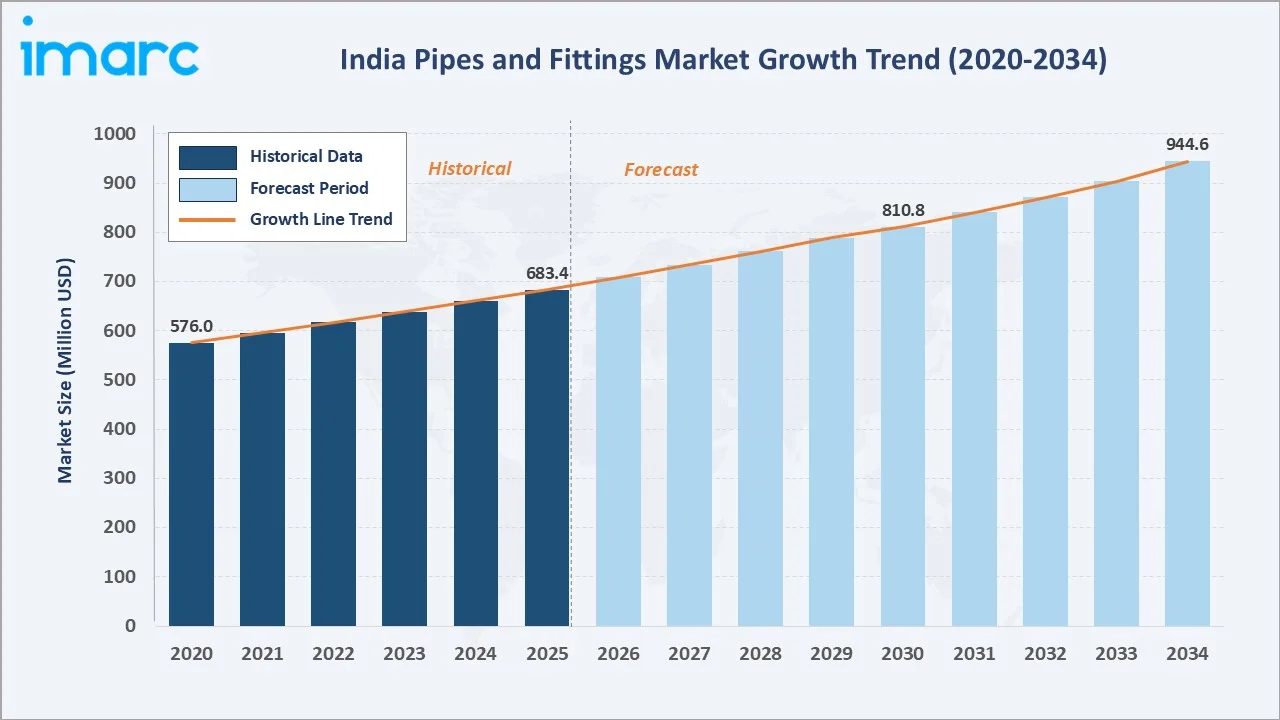
The India pipes and fittings market grew from USD 683.4 Million in 2025 to USD 718.5 Million in 2026 and is projected to reach USD 944.6 Million by 2034, growing at a CAGR of 3.48% during 2026-2034. The market is driven by government water supply programs, rapid urbanization, and growing residential and infrastructure construction activity. Since the launch of the Jal Jeevan Mission in 2019, tap water connectivity in India has expanded from 3.23 crore households, with an additional 12.48 crore households gaining access. This rapid expansion of water supply infrastructure is driving demand for pipes, fittings, valves, and related plumbing products, supporting the growth of the India pipes and fittings market. Pipes lead at 72.5% by type, water supply dominates at 31.6% by application, and West India commands the largest regional share at 31.7% in 2025.
Market Snapshot
|
Metric |
Value |
|
Base Year Market Size (2025) |
USD 683.4 Million |
|
Market Size (2026) |
USD 718.5 Million |
|
Forecast Market Size (2034) |
USD 944.6 Million |
|
CAGR (2026-2034) |
3.48% |
|
Base Year |
2025 |
|
Historical Period |
2020-2025 |
|
Forecast Period |
2026-2034 |
|
Dominant Type |
Pipes (72.5%, 2025) |
|
Dominant Application |
Water Supply (31.6%, 2025) |
|
Leading Region |
West India (31.7%, 2025) |
The India pipes and fittings market grew from USD 576.0 Million in 2020 to USD 683.4 Million in 2025, and further to USD 718.5 Million in 2026, reflecting sustained demand from government-funded water infrastructure, urban housing construction, and agricultural irrigation. The market is projected to reach USD 810.8 Million by 2030 before reaching USD 944.6 Million by 2034.
To get more information on this market, Request Sample
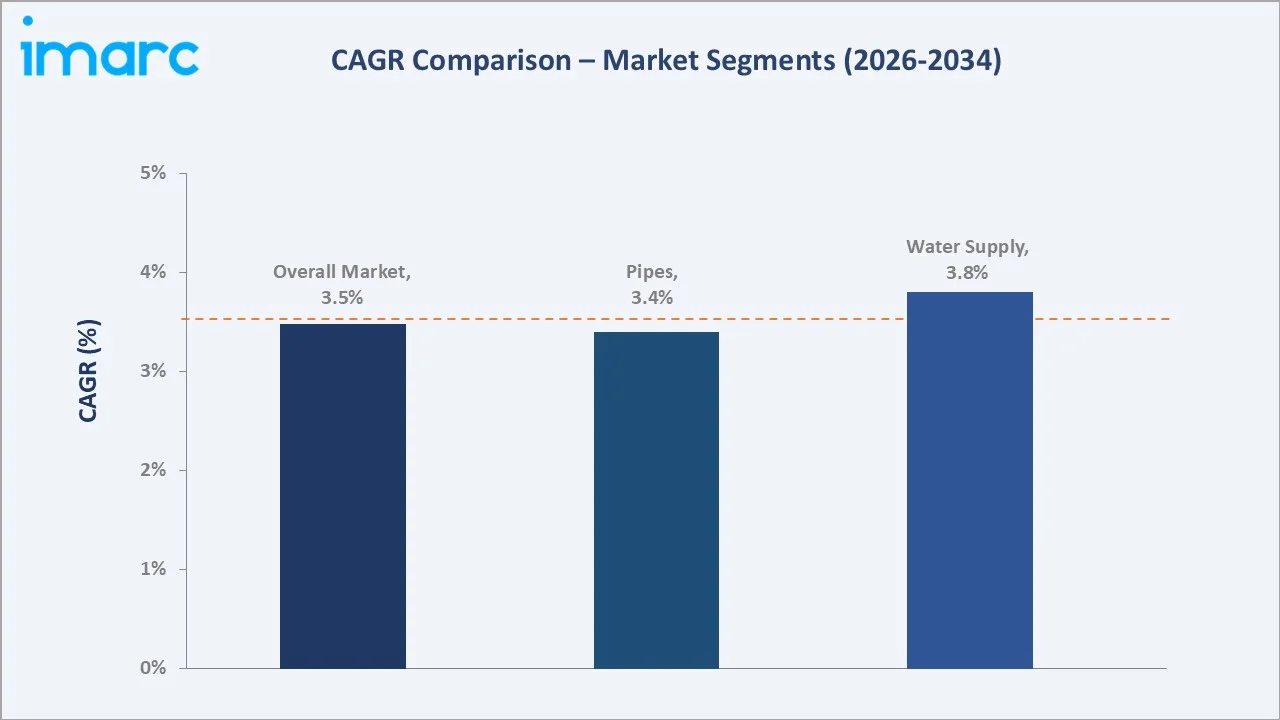
Water supply application is projected to grow at approximately 3.8% CAGR driven by Jal Jeevan Mission implementation. The pipes segment at approximately 3.4% CAGR reflects its dominant volume role across all construction and infrastructure applications. The overall market CAGR of 3.48% reflects steady and policy-supported demand growth through the forecast period.
Executive Summary
The India pipes and fittings market is on a sustained growth trajectory, underpinned by large-scale government water supply and sanitation programs, accelerating urbanization that is driving residential and commercial construction, and growing agricultural irrigation infrastructure investment. The market has expanded, supported by the Jal Jeevan Mission providing rural tap connections, urban water infrastructure, sanitation schemes, and sustained housing construction demand under the PMAY program.
Pipes dominate at 72.5% in 2025, reflecting their primacy as the volume-driven component in all water, plumbing, and drainage systems. Water supply leads applications at 31.6%, driven by government-mandated rural water connections and urban water distribution network expansion. West India leads regionally at 31.7%, driven by a large residential, industrial, and infrastructure construction base.
Key Market Insights
|
Insight |
Data |
|
Dominant Type |
Pipes - 72.5% share (2025) |
|
Dominant Application |
Water Supply - 31.6% share (2025) |
|
Leading Region |
West India - 31.7% (2025) |
|
Key Market Opportunity |
Government spending on water supply and urban sanitation infrastructure is creating sustained, policy-backed volume demand for plastic piping systems. |
Key Analytical Observations Supporting the Above Data:
- Pipes at 72.5%: Pipes constitute the large majority of volume demand because every water supply, plumbing, drainage, and irrigation system requires substantially more linear pipe footage than point-connection fittings.
- Water Supply at 31.6%: Water supply leads because the Jal Jeevan Mission and AMRUT 2.0 programs represent the largest government capital expenditure in pipe-consuming infrastructure in India history.
- West India at 31.7%: West India regional leadership reflects strength in residential construction through real estate markets, major industrial piping demand from petrochemical and manufacturing zones, and agriculture-driven irrigation pipe consumption across one of India's largest agricultural states.
India Pipes and Fittings Market Overview
The India pipes and fittings market encompasses the production, distribution, and installation of all pipes and associated connection fittings used in water supply, plumbing, sewerage, drainage, irrigation, and industrial fluid transport systems. Core material categories include PVC (polyvinyl chloride), CPVC (chlorinated PVC), HDPE (high-density polyethylene), PPR (polypropylene random), GI (galvanized iron), CI (cast iron), ductile iron, and specialty polymer pipes.
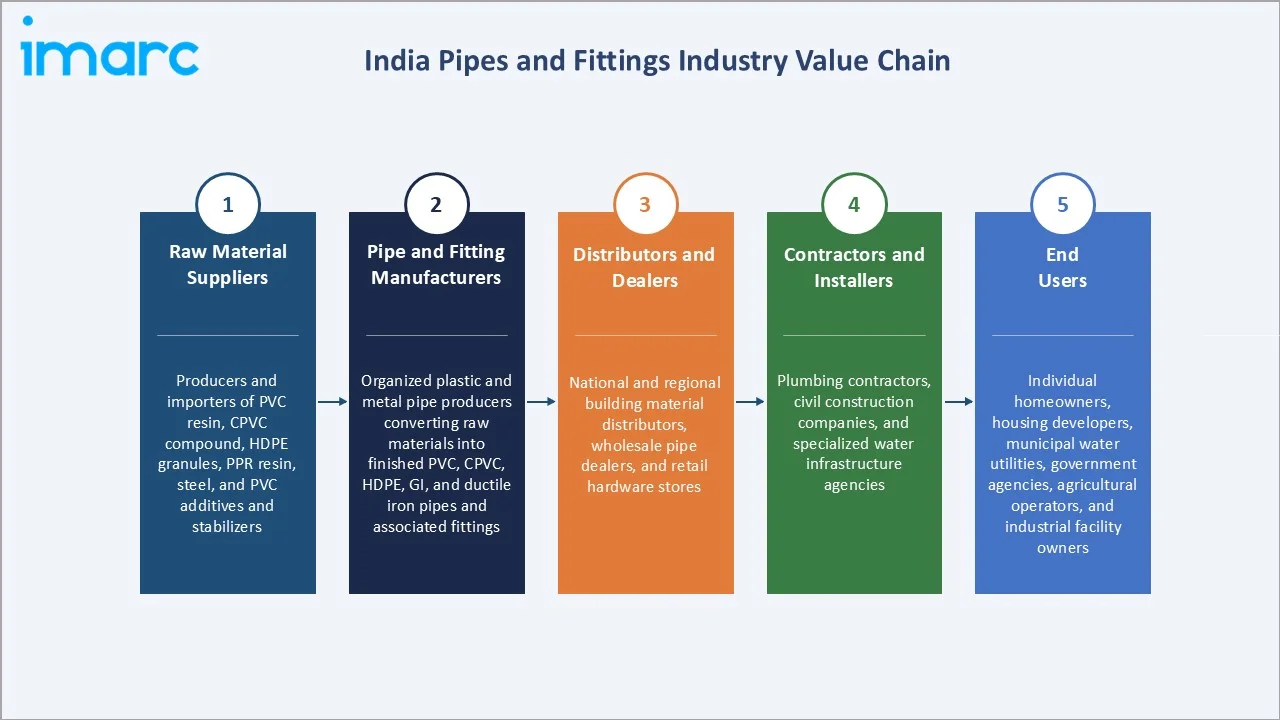
Applications span a broad spectrum from residential plumbing and municipal water distribution to agricultural irrigation, industrial process piping, and stormwater drainage. The industry ecosystem encompasses raw material producers supplying PVC resin, CPVC compound, and HDPE granules; pipe and fitting manufacturers converting these materials into finished products; national and regional distributors and building material dealers; plumbing and civil contractors installing systems; and end-user construction and infrastructure owners.
Market Dynamics
To evaluate market opportunities, Request Sample
Market Drivers
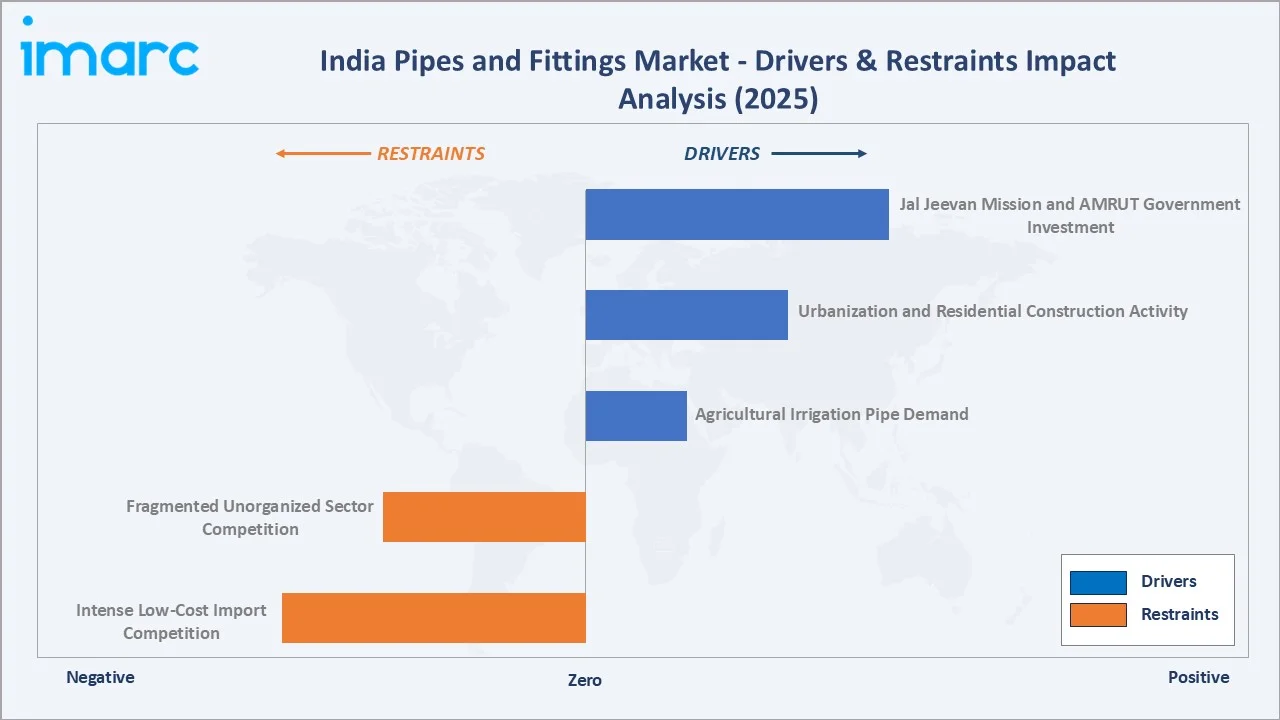
- Jal Jeevan Mission and AMRUT Government Investment: Since 2019, India has added 12.48 crore household tap water connections, up from 3.23 crore initially. Under AMRUT, around INR 43,359.6 crore has been allocated to water supply projects and INR 34,467 crore to sewerage and septage management, significantly strengthening the country’s water infrastructure. These government budgetary allocations are creating a significant incremental boost to PVC pipe demand across rural water supply connections and urban distribution network expansion.
- Urbanization and Residential Construction Activity: By 2036, India’s urban population is projected to reach 600 million, or 40% of the total population, compared to 31% in 2011, with cities expected to contribute nearly 70% of the country’s GDP. India's urban population is expanding rapidly, with residential construction across metro cities and tier-2 urban centers generating consistent demand for plumbing pipes and fittings in new housing projects.
- Agricultural Irrigation Pipe Demand: India agricultural sector represents a substantial and geographically distributed demand base for PVC and HDPE irrigation pipes, including surface distribution pipes, drip irrigation laterals, and sprinkler system components. Growing drip and micro-irrigation adoption across water-stressed agricultural states is creating durable demand for high-efficiency irrigation piping systems beyond conventional flood-irrigation infrastructure.
Market Restraints
- Intense Low-Cost Import Competition: The availability of competitively priced imported pipes and fittings creates pricing pressure on domestic manufacturers, particularly in price-sensitive segments. Lower-cost imports can compress profit margins and make it difficult for local producers to pass on rising raw material and production costs. This competition may also constrain investments in capacity expansion, product innovation, and advanced manufacturing technologies.
- Fragmented Unorganized Sector Competition: A significant portion of India pipe and fitting market is served by small, unorganized manufacturers producing sub-standard products outside BIS certification requirements. This unorganized competition constrains organized manufacturers from fully capturing price improvements in periods of demand growth, as low-cost non-certified products continue to serve cost-sensitive rural and small contractor segments.
Market Opportunities
- CPVC Backward Integration and Premium Product Development: Backward integration into CPVC compounds and raw materials can help pipe manufacturers improve supply security, control costs, and maintain consistent product quality. Simultaneously, developing premium pipes and fittings for hot-water, industrial, and specialized plumbing applications enables higher product differentiation and margins. These strategies create opportunities to strengthen competitiveness and capture growing demand for advanced piping solutions.
- Smart Water Management and IoT-Enabled Piping Infrastructure: Government water infrastructure programs are incorporating IoT-based water monitoring, geo-tagging, and decentralized water management systems that require advanced piping infrastructure with embedded sensing and quality standards. This technology evolution is creating demand for premium smart piping solutions beyond conventional commodity pipes.
Market Challenges
- Working Capital Pressure from Distributor Destocking: Extended periods of PVC price decline led to significant distributor inventory destocking as channel partners reduced stock exposure to avoid inventory losses. This working capital pressure has created periods of demand underperformance relative to underlying construction activity, as distributors deferred purchases pending price stabilization.
- Withdrawal of BIS Norms Creating Quality Uncertainty: The withdrawal of mandatory BIS certification norms for certain pipe categories has reduced quality barriers to entry for non-certified manufacturers, intensifying competition in the lower-quality segment and creating product quality uncertainty for end-user buyers in cost-sensitive markets.
Emerging Market Trends
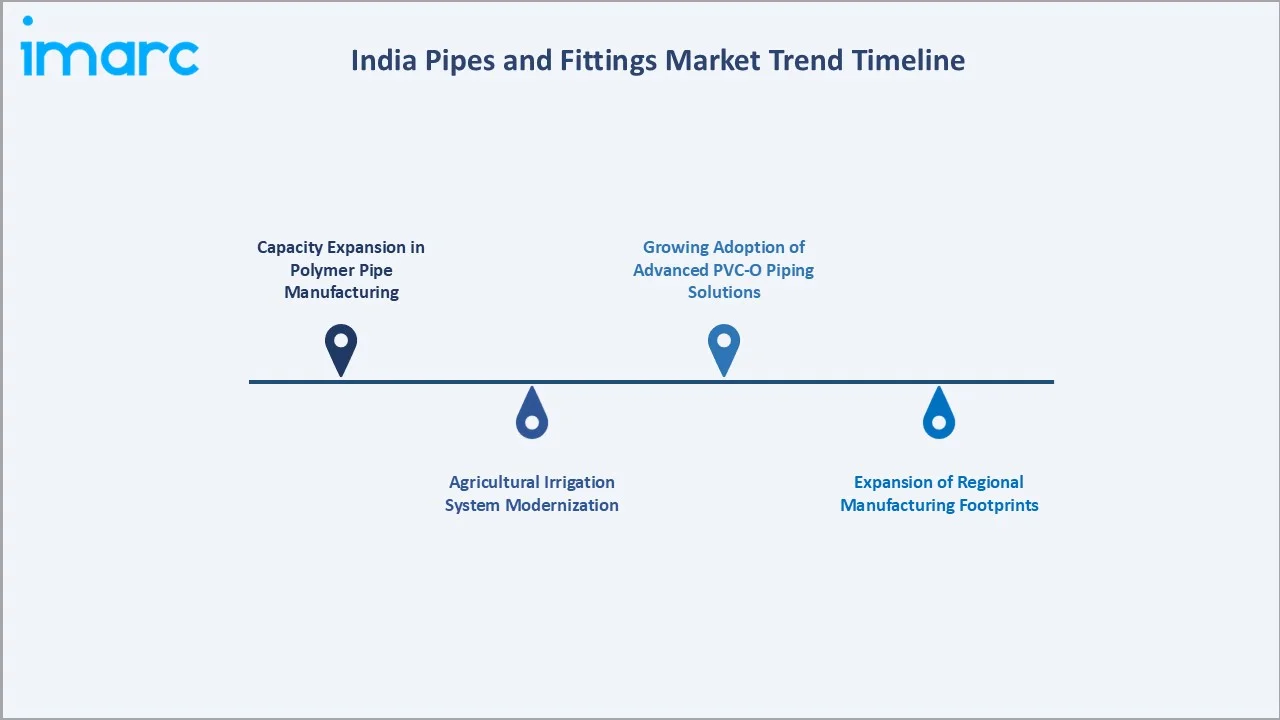
1. Capacity Expansion in Polymer Pipe Manufacturing
Indian pipe manufacturers are increasingly expanding PVC, HDPE, and MDPE production capacity through advanced, high-speed manufacturing lines. In February 2025, Malpani Pipes and Fittings Limited expanded its PVC pipe capacity by 1,800 MTPA through a new extruder line, while new high-speed HDPE and MDPE production lines will add another 3,600 MTPA of capacity. This trend reflects growing demand from water supply, irrigation, sewerage, infrastructure, and industrial applications while enabling manufacturers to improve production efficiency and market reach.
2. Agricultural Irrigation System Modernization
The transition from flood irrigation to drip and micro-irrigation systems across Indian agriculture is creating growing demand for high-efficiency PVC and HDPE piping networks that deliver water directly to root zones. Government subsidy programs for drip irrigation adoption, combined with farmer awareness of water efficiency and yield benefits, are systematically expanding the addressable market for precision irrigation pipe components beyond conventional open-channel distribution infrastructure.
3. Growing Adoption of Advanced PVC-O Piping Solutions
Manufacturers are expanding advanced piping portfolios to address growing requirements across municipal water supply, irrigation, and infrastructure projects. In June 2025, PRAYAG INDIA launched PVC-O (Oriented Polyvinyl Chloride) pipes for pressurized water transportation in India. Manufactured at its ISO-certified facility in Bhiwadi, Rajasthan, the new range strengthens the company’s portfolio of advanced plumbing and water infrastructure solutions.
4. Expansion of Regional Manufacturing Footprints
Pipe and fittings manufacturers in India are increasingly establishing production facilities closer to high-growth regional markets to improve product availability and reduce logistics costs. In March 2025, Prince Pipes & Fittings Limited (PPFL) inaugurated its eighth manufacturing facility in Begusarai, Bihar, expanding its pan-India production footprint and strengthening its presence in the rapidly growing eastern India market. Expansion into eastern India also enables companies to capitalize on rising demand from housing, water infrastructure, irrigation, and construction projects.
Industry Value Chain Analysis
The India pipes and fittings value chain spans five integrated stages from raw material production through end-user installation. The chain is characterized by import dependence for key raw materials at the upstream stage and progressive product innovation and brand differentiation at the manufacturing stage, with distribution network depth and geographic reach serving as critical competitive advantages in the mid-chain.
|
Stage |
Key Participants |
|
Raw Material Suppliers |
Producers and importers of PVC resin, CPVC compound, HDPE granules, PPR resin, steel, and PVC additives and stabilizers. |
|
Pipe and Fitting Manufacturers |
Organized plastic and metal pipe producers converting raw materials into finished PVC, CPVC, HDPE, GI, and ductile iron pipes and associated fittings. |
|
Distributors and Dealers |
National and regional building material distributors, wholesale pipe dealers, and retail hardware stores. |
|
Contractors and Installers |
Plumbing contractors, civil construction companies, and specialized water infrastructure agencies. |
|
End Users |
Individual homeowners, housing developers, municipal water utilities, government agencies, agricultural operators, and industrial facility owners. |
The manufacturing stage holds the greatest strategic value in the pipe and fittings value chain, as large-scale organized producers benefit from raw material sourcing scale, proprietary formulation expertise, brand recognition, and BIS-certified quality credentials that differentiate their products from unorganized competition.
Technology Landscape in the India Pipes and Fittings Industry
CPVC and Advanced Polymer Pipe Technology
CPVC and advanced polymer technologies are improving pipe performance through enhanced heat resistance, corrosion resistance, durability, and service life. Innovations in polymer formulations and manufacturing processes also enable lightweight and efficient piping systems. These technologies are increasingly used across residential plumbing, industrial applications, and water infrastructure projects.
HDPE and Multilayer Pipe Systems
High-density polyethylene pipes are gaining adoption in water mains, sewerage, and agricultural irrigation applications due to superior flexibility, impact resistance, and corrosion immunity compared to PVC and metal alternatives. Multilayer pipe systems combining CPVC inner layers with aluminium or fibreglass outer reinforcement are growing in premium residential plumbing applications, offering pressure ratings and thermal performance characteristics that support hot and cold water distribution in high-rise construction.
IoT-Enabled Water Management Infrastructure
Government water supply programs, including Jal Jeevan Mission, are integrating IoT-based flow monitoring, geo-tagging, and decentralized water management systems that require smart sensor-compatible piping infrastructure. These technology requirements are driving demand for pipe systems with embedded monitoring capability and premium material quality that supports long service life in remote rural installations with limited maintenance access.
Market Segmentation Analysis
The report covers the following segments:
|
Segment Category |
Leading Segment |
Market Share |
Year |
|
Type |
Pipes |
72.5% |
2025 |
|
Technology |
🔒 |
🔒 |
2025 |
|
Application |
Water Supply |
31.6% |
2025 |
|
Vertical |
🔒 |
🔒 |
2025 |
|
Region |
West India |
31.7% |
2025 |

By Type
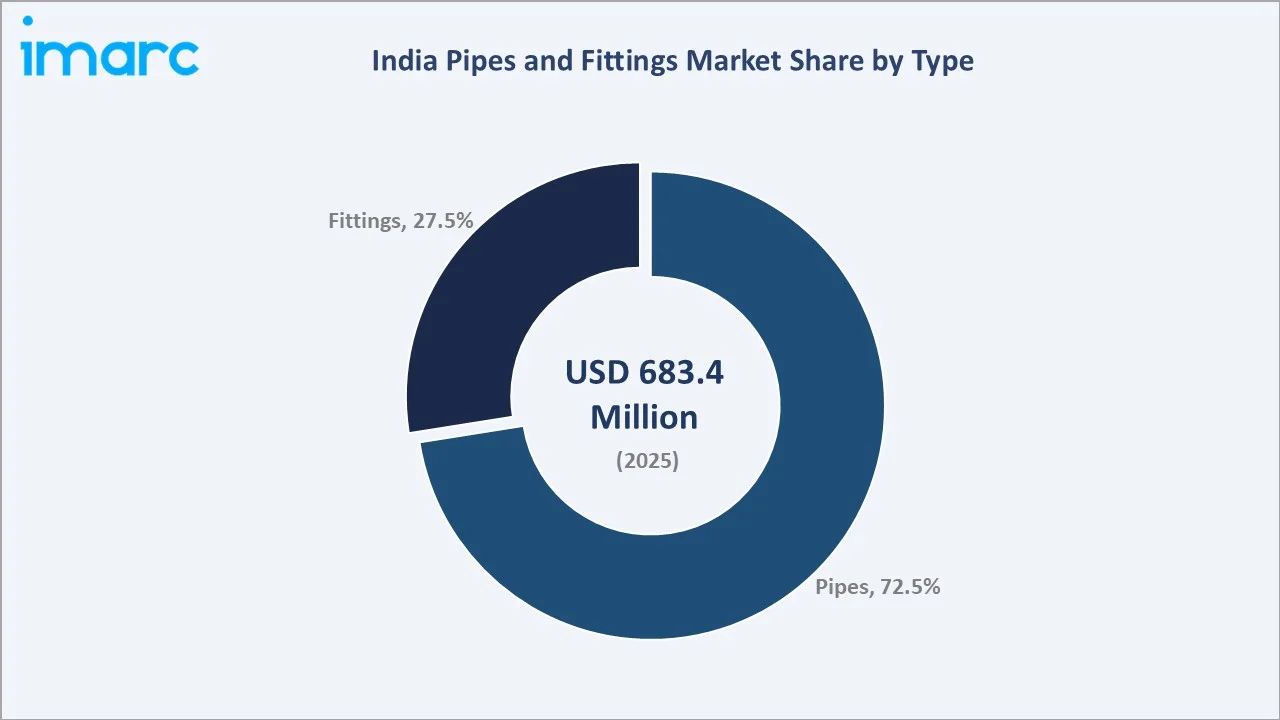
Pipes dominate at 72.5% in 2025, reflecting the volume-driven nature of pipe consumption in all water supply, plumbing, drainage, and irrigation systems. Every piping installation requires substantially more linear footage of pipe than point-connection fittings, making pipes the primary volume and revenue contributor across all application categories. PVC pipes serve the largest portion of domestic pipe demand across water supply, plumbing, sewerage, and agriculture, while CPVC, HDPE, and PPR serve premium and specialized applications.
To access detailed market analysis, Request Sample
Fittings at 27.5% encompass elbow joints, tee connectors, reducers, ball valves, end caps, and specialty connection components that provide the system integration points for pipe networks. While fittings represent a smaller volume share than pipes, they generate disproportionately higher revenue per kilogram due to their precision manufacturing requirements, complex geometries, and greater number of distinct stock-keeping units that command premium pricing relative to commodity pipe extrusions.
By Application
Water supply leads at 31.6% in 2025, driven by the Jal Jeevan Mission rural household tap connection program, AMRUT 2.0 urban water distribution network upgrades, and ongoing municipal water supply infrastructure maintenance and expansion.
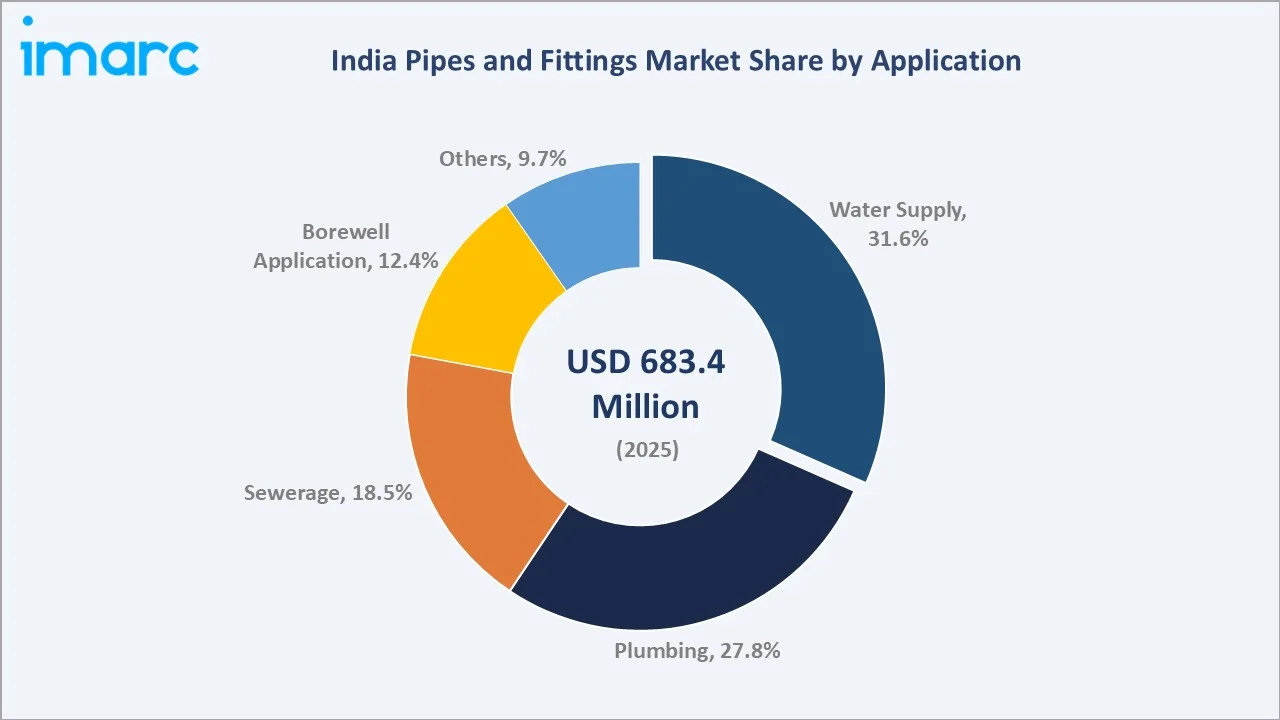
Plumbing at 27.8% reflects residential and commercial construction activity that generates interior plumbing system demand for hot and cold-water distribution, shower and sanitaryware connections, and kitchen and bathroom infrastructure. Sewerage at 18.5% is driven by urban sanitation infrastructure investment and rural sanitation. Borewell application at 12.4% serves agricultural and rural water extraction, while others at 9.7% include industrial, fire suppression, and specialty fluid transport applications.
Regional Market Insights
|
Region |
Share (2025) |
Key India Pipes and Fittings Market Drivers & Characteristics |
|
West India |
31.7% |
Reflecting a large residential and commercial construction market, industrial piping demand from petrochemical and manufacturing zones, and agricultural irrigation pipe consumption across large farming districts. |
|
South India |
27.5% |
Reflecting strong urban water supply and plumbing pipe demand driven by technology-sector construction activity, state government water infrastructure investment, and growing residential housing development. |
|
North India |
24.8% |
Reflecting significant residential and infrastructure construction pipe demand, agricultural irrigation pipe consumption, and growing Jal Jeevan Mission rural water supply installation activity. |
|
East India |
16.0% |
Reflecting a developing but growing market anchored in urban construction, growing infrastructure pipe demand, and agricultural irrigation needs of the eastern gangetic plains. |
West India regional leadership at 31.7% reflects the combination of real estate scale, industrial piping demand, and agricultural irrigation requirements that collectively generate the largest pipe consumption region in India. The region benefits from both organized urban residential construction generating plumbing demand and large-scale government water infrastructure project procurement across state water boards.
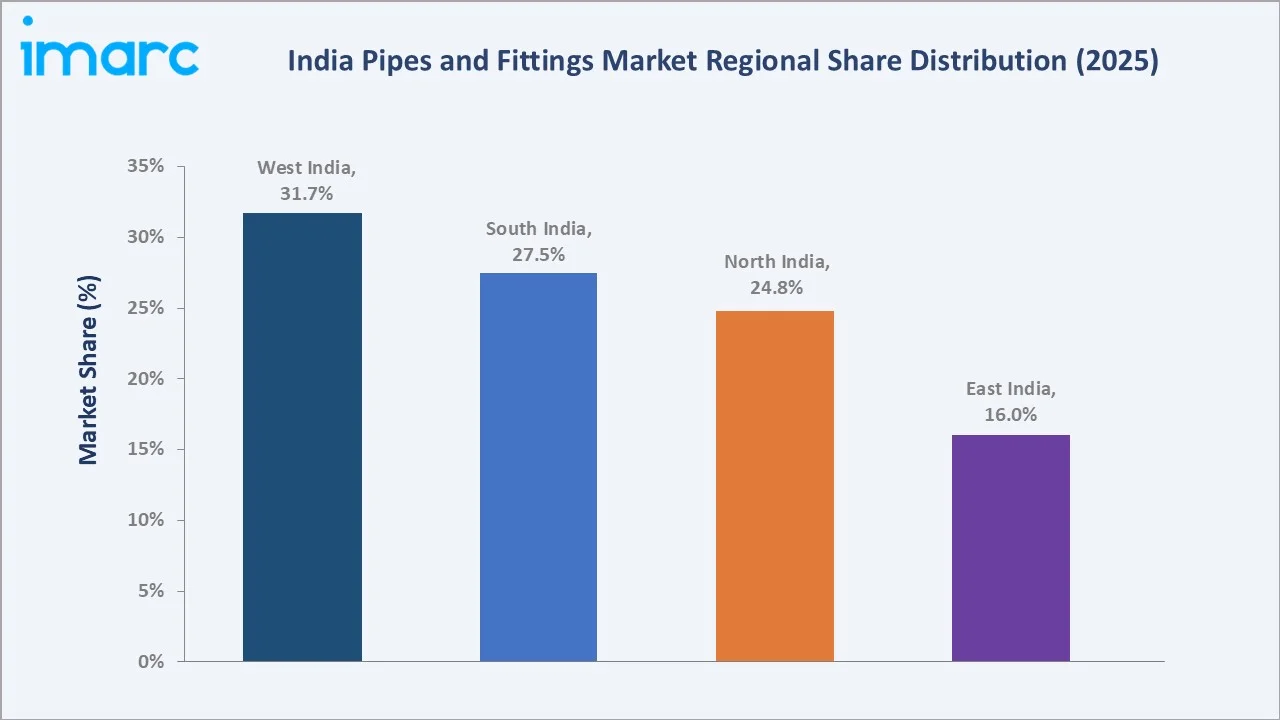
South India at 27.5% draws strength from strong urban infrastructure investment, active technology-sector-driven commercial construction, and government state water supply programs. North India at 24.8% has significant agricultural irrigation pipe consumption alongside urban construction demand. East India at 16.0% represents the smallest regional share but is experiencing progressive growth from JJM rural water connection infrastructure and new industrial investment across eastern states.
Competitive Landscape
The India pipes and fittings market features a competitive landscape led by organized national manufacturers with strong brand recognition, extensive distribution networks, and BIS-certified product quality, competing against regional organized players and a large unorganized segment serving cost-sensitive markets. Competition is driven by product quality, distribution reach, pricing, brand trust, and technical product innovation.
|
Company |
Key Products |
Market Position |
Core Strength |
|
Supreme Industries Limited |
Aqua Gold UPVC Pipes And Fittings, UPVC High Pressure Pipes, LifelinePlus C-PVC Hot & Cold Water System, Bathroom Fittings, SWR Pipe And Drainage System |
Market Leader |
Supreme Industries Limited is India's largest manufacturer of plastic piping products, serving as a pioneer and market leader in the country's plastic piping and fittings industry. |
|
Astral Ltd |
CPVC PRO, Pex-a PRO, MultiPex, Aquarius, ECO PRO, Silencio, Drain Pro, Drainmaster, Aquasafe, Bore-well |
Market Leader |
Astral Ltd is a market leader and pioneer in the Indian polymer pipes and fittings industry through Astral Pipes. |
|
Finolex Industries Ltd. |
PVC-U Agriculture Pipes & Fittings, PVC-U Column Pipes, Casing Pipes |
Market Leader |
Finolex Industries Ltd. operates as one of India's leading and largest manufacturers of rigid PVC pipes and fittings. |
|
Prince Pipes And Fittings Ltd |
Smartfit Plus, EasyFit, EasyFit RE, Onefit Corzan, Greenfit, PEFit Gas MDPE pipes, Aquafit, Safefit, PEfit Aqua |
Established Player |
Prince Pipes And Fittings Ltd is one of India's top integrated piping solutions and multi-polymer manufacturers, driving water management, sanitation, and infrastructure growth. |
|
APL APOLLO |
CPVC-X pipes and fittings, UPVC plumbing pipes and fittings, PPR-C plumbing system |
Challenger |
APL Apollo (Apollo Pipes) is a leading manufacturer of plastic piping systems and structural steel tubes in India. |
The organized plastic pipe sector is at a structural inflection point, transitioning from a period of PVC price pressure and volume weakness toward recovery driven by anti-dumping duty support and real estate construction sector revival.
Key Company Profiles
Supreme Industries Limited
Supreme Industries Limited is a prominent Indian manufacturer with an established presence in the plastic pipes and fittings industry. The company offers a diversified portfolio of piping solutions serving plumbing, water management, irrigation, infrastructure, and industrial applications. Its extensive manufacturing capabilities and distribution network support broad market coverage across India. The company emphasizes product quality, innovation, capacity expansion, and advanced polymer-based piping solutions.
- Key Products: Aqua Gold UPVC Pipes And Fittings, UPVC High Pressure Pipes, LifelinePlus C-PVC Hot & Cold Water System, Bathroom Fittings, SWR Pipe And Drainage System.
- Strategic Focus: Expanding production capacity, strengthening its distribution network, and diversifying its portfolio of advanced piping solutions. The company also emphasizes product innovation, operational efficiency, and value-added polymer products to address growing demand across plumbing, irrigation, infrastructure, and industrial applications.
Astral Ltd
Astral Ltd is a prominent Indian building materials company with a strong presence in the pipes and fittings segment. The company offers a diversified portfolio of CPVC, PVC, and other polymer-based piping solutions for residential, commercial, industrial, and infrastructure applications. Its extensive manufacturing capabilities and distribution network support broad market penetration across India. Astral emphasizes product innovation, quality, advanced technologies, and portfolio expansion to address evolving plumbing and water management requirements.
- Key Products: CPVC PRO, Pex-a PRO, MultiPex, Aquarius, ECO PRO, Silencio, Drain Pro, Drainmaster, Aquasafe, Bore-well.
- Strategic Focus: Expanding its pipes and fittings portfolio through product innovation, capacity enhancement, and wider distribution across India. The company emphasizes advanced polymer technologies, premium piping solutions, and operational efficiency to address growing demand from plumbing, infrastructure, and water management applications.
Market Concentration Analysis
The India pipes and fittings market is moderately fragmented, with organized large-scale manufacturers accounting for the majority of branded product revenues while a large unorganized sector serves regional and rural demand. The top five organized players together represent roughly 35-40% of total market revenue, with the balance distributed among regional organized producers and a large unorganized manufacturing base.
The organized segment has been gaining share from the unorganized sector as BIS quality standards, government procurement preferences for certified products, and distributor consolidation toward reliable, branded suppliers reshape market structure. Market concentration is expected to increase through the forecast period as large, organized manufacturers benefit from scale economies, brand investment capability, and distribution network advantages that smaller regional producers cannot match, while government scheme procurement increasingly favors organized sector suppliers with quality certification and supply reliability credentials.
Investment & Growth Opportunities
Highest Growth Segments
Water supply application represents the highest and most policy-certain growth opportunity within the market, sustained by JJM and AMRUT 2.0 budget commitments that provide demand visibility through 2026 and beyond. CPVC premium pipe systems represent the highest-margin growth segment, growing at 10-15% annually within the plastic pipe industry. Agricultural drip and micro-irrigation pipe systems represent a large-volume, geographically distributed growth opportunity as precision irrigation adoption accelerates.
Investment Themes
- CPVC and Premium Pipe Manufacturing Capacity: Growing builder and contractor preference for CPVC in plumbing applications, combined with limited domestic CPVC resin production, creates investment opportunity in both CPVC pipe manufacturing capacity expansion and backward integration into CPVC compound production.
- Rural Distribution Network Development: Jal Jeevan Mission rural water connection installation demand is generating large volume requirements across geographically dispersed rural markets. Manufacturers and distributors investing in rural dealer network development and last-mile logistics capability are positioned to capture a significant portion of the government scheme-driven rural pipe procurement wave.
Future Market Outlook (2026-2034)
The India pipes and fittings market grew from USD 683.4 Million in 2025 to USD 718.5 Million in 2026, reaching USD 944.6 Million by 2034, exhibiting a CAGR of 3.48% during the forecast period. The market is expected to reach an intermediate milestone of approximately USD 810.8 Million by 2030, as Jal Jeevan Mission rural water connection completions peak, AMRUT 2.0 urban water infrastructure investments mature, and the recovery of residential real estate construction sustains plumbing pipe demand.
Three structural forces will define India pipes and fittings market through 2034. First, the Jal Jeevan Mission and AMRUT 2.0 government programs provide a multi-year policy-backed demand foundation with budgetary commitments, directly and substantially increasing pipe procurement for rural household connections and urban water network expansion. Second, India's urbanization trajectory and residential construction cycle will sustain plumbing pipe demand across metro, tier-2, and emerging urban centers as housing development, commercial construction, and urban civic infrastructure investment continue at scale. Third, the progressive adoption of premium CPVC, HDPE, and multilayer pipe systems in residential, commercial, and industrial applications will shift product mix toward higher-value, higher-margin pipe categories, supporting revenue growth.
Research Methodology
Primary Research
Primary research comprised structured consultations with pipe and fitting manufacturing executives, building material distributors and dealer networks, plumbing contractors, government infrastructure project officials, and agricultural sector irrigation system suppliers. These discussions validated market sizing estimates, assessed application-specific demand dynamics, identified policy-driven growth catalysts, and provided forward-looking perspectives on competitive developments and product innovation priorities across the India pipes and fittings market.
Secondary Research
Secondary research drew on IMARC Group market data, ratings sector analyses, company annual reports and investor presentations, BIS standards documentation, equity research reports, anti-dumping recommendations, and industry publications covering the Indian plastic pipe and building materials sectors. Historical market data spanning 2020 through 2025 was cross-validated across multiple data sources.
Forecasting Models
Market forecasts incorporated historical market growth trends, application-level demand modeling for water supply, plumbing, sewerage, agriculture, and industrial uses, government scheme expenditure projections, residential construction volume forecasts, PVC resin price scenario analysis, competitive market share shift assumptions, and macroeconomic indicators including GDP growth and urban population expansion through 2034.
India Pipes and fittings Market Report Coverage:
| Report Features | Details |
|---|---|
| Base Year of the Analysis | 2025 |
| Historical Period | 2020-2025 |
| Forecast Period | 2026-2034 |
| Units | Million USD |
| Scope of the Report |
Exploration of Historical Trends and Market Outlook, Industry Catalysts and Challenges, Segment-Wise Historical and Future Market Assessment:
|
| Types Covered |
|
| Technologies Covered | Compression Molding, Injection Molding, Thermoforming, Extrusion, Electro Fusion, Fabricated, Others |
| Applications Covered | Sewerage, Water Supply, Plumbing, Borewell Application, Others |
| Verticals Covered | Chemical and Petrochemical, Residential, Commercial, Transportation, Municipal, Food and Beverage, Oil and Gas, Power, Process Instrumentation, Semiconductor, Irrigation, HVAC, Others |
| Regions Covered | North India, South India, East India, West India |
| Companies Covered | Supreme Industries Limited, Astral Ltd, Finolex Industries Ltd., Prince Pipes And Fittings Ltd, APL APOLLO, etc. |
| Customization Scope | 10% Free Customization |
| Post-Sale Analyst Support | 10-12 Weeks |
| Delivery Format | PDF and Excel through Email (We can also provide the editable version of the report in PPT/Word format on special request) |
Key Benefits for Stakeholders:
- IMARC’s industry report offers a comprehensive quantitative analysis of various market segments, historical and current market trends, market forecasts, and dynamics of the India pipes and fittings market from 2020-2034.
- The research report provides the latest information on the market drivers, challenges, and opportunities in the India pipes and fittings market.
- Porter's five forces analysis assist stakeholders in assessing the impact of new entrants, competitive rivalry, supplier power, buyer power, and the threat of substitution. It helps stakeholders to analyze the level of competition within the India pipes and fittings industry and its attractiveness.
- Competitive landscape allows stakeholders to understand their competitive environment and provides an insight into the current positions of key players in the market.
Frequently Asked Questions About the India Pipes and Fittings Market Report
The India pipes and fittings market reached USD 718.5 Million in 2026, driven by Jal Jeevan Mission rural water connections, AMRUT 2.0 urban infrastructure, and residential construction plumbing demand.
The market is projected to grow at a CAGR of 3.48% during 2026-2034, supported by government water supply program investment, urbanization-driven residential construction, and progressive premium pipe material adoption.
The market is projected to reach approximately USD 810.8 Million by 2030, driven by JJM and AMRUT 2.0 infrastructure completion, residential construction recovery, and growing CPVC premium pipe adoption in plumbing applications.
Pipes lead with a 72.5% share in 2025, reflecting their primary volume role as the linear network component in all water supply, plumbing, sewerage, and irrigation systems that require substantially more pipe footage than point-connection fittings.
Water supply leads with a 31.6% share in 2025, driven by the Jal Jeevan Mission rural household tap connection program and AMRUT 2.0 urban water network expansion, with high government budgetary allocations.
West India leads with a 31.7% share in 2025, driven by residential construction scale, industrial piping demand, and agricultural irrigation pipe consumption that collectively generate the largest regional market.
Key players include Supreme Industries Limited, Astral Ltd, Finolex Industries Ltd., Prince Pipes And Fittings Ltd., and APL APOLLO, among others.
The market is projected to reach USD 944.6 Million by 2034, driven by sustained government water supply investment, residential housing construction growth, premium CPVC pipe adoption, and progressive market formalization favoring organized manufacturers.
Need more help?
- Speak to our experienced analysts for insights on the current market scenarios.
- Include additional segments and countries to customize the report as per your requirement.
- Gain an unparalleled competitive advantage in your domain by understanding how to utilize the report and positively impacting your operations and revenue.
- For further assistance, please connect with our analysts.
 Request Customization
 Speak to an Analyst
 Request Brochure
 Inquire Before Buying
Benefits of Customization
- Personalize this research
- Triangulate with your data
- Get data as per your format and definition
- Gain a deeper dive into a specific application, geography, customer, or competitor
- Any level of personalization
Get in Touch With Us
UNITED STATES
Phone: +1-201-971-6302
INDIA
Phone: +91-120-433-0800
UNITED KINGDOM
Phone: +44-753-714-6104
Email: [email protected]
Client Testimonials


.webp)



.webp)









Related Reports

Choose your plan
*Please note that the prices mentioned below are starting prices for each bundle type. Kindly contact our team for further details.*
Single User License
- 1 User License, Access on 2 Devices
- PDF Report + Excel Dataset (Password Protected)
- Lifetime Access
- No Printing Rights
- 10% Free Report Customization
- 10–12 Weeks of Analyst Support
Five User License
- Access for 5 Users, 2 Devices per User
- PDF Report + Excel Dataset (Password Protected)
- Lifetime Access
- Dedicated Account Manager
- 12–14 Weeks of Analyst Support
- No Printing Rights
- 15% Free Report Customization
- 25% Discount on Your Next Purchase
Corporate User License
- Unlimited User Access (Within Your Organization)
- PDF Report + Excel Dataset
- Lifetime Access
- Dedicated Account Manager
- 14–20 Weeks of Analyst Support
- No Printing Rights
- 20% Free Report Customization
- 30% Discount on Your Next Purchase
Essential Insights
What's included:
3 reports
- Lifetime Access
- PDF Reports
- Excel Datasets
- 2 Weeks of Free Analyst Support
- 2 User Licenses
- Access on 2 Devices
- Printing Rights
- Complimentary PowerPoint (PPT) Version
- Complimentary License Upgrade
Professional Access
What's included:
5 reports
- Lifetime Access
- PDF Reports
- Excel Datasets
- 8 Weeks of Free Analyst Support
- 2 User Licenses
- Access on 2 Devices
- Printing Rights
- Complimentary PowerPoint (PPT) Version
- Complimentary License Upgrade
Business Advantage
What's included:
8 reports
- Lifetime Access
- PDF Reports
- Excel Datasets
- 14 Weeks of Free Analyst Support
- 2 User Licenses
- Access on 2 Devices
- Printing Rights
- Complimentary PowerPoint (PPT) Version
- Complimentary License Upgrade
Enterprise Intelligence
What's included:
10 reports
- Lifetime Access
- PDF Reports
- Excel Datasets
- 20 Weeks of Free Analyst Support
- 2 User Licenses
- Access on 2 Devices
- Printing Rights
- Complimentary PowerPoint (PPT) Version
- Complimentary License Upgrade