
India Refractories Market Size, Share, Trends and Forecast by Form, Alkalinity, Manufacturing Process, Composition, Refractory Mineral, Application, and Region, 2026-2034
India Refractories Market Size, Share, Trends & Forecast (2026-2034)
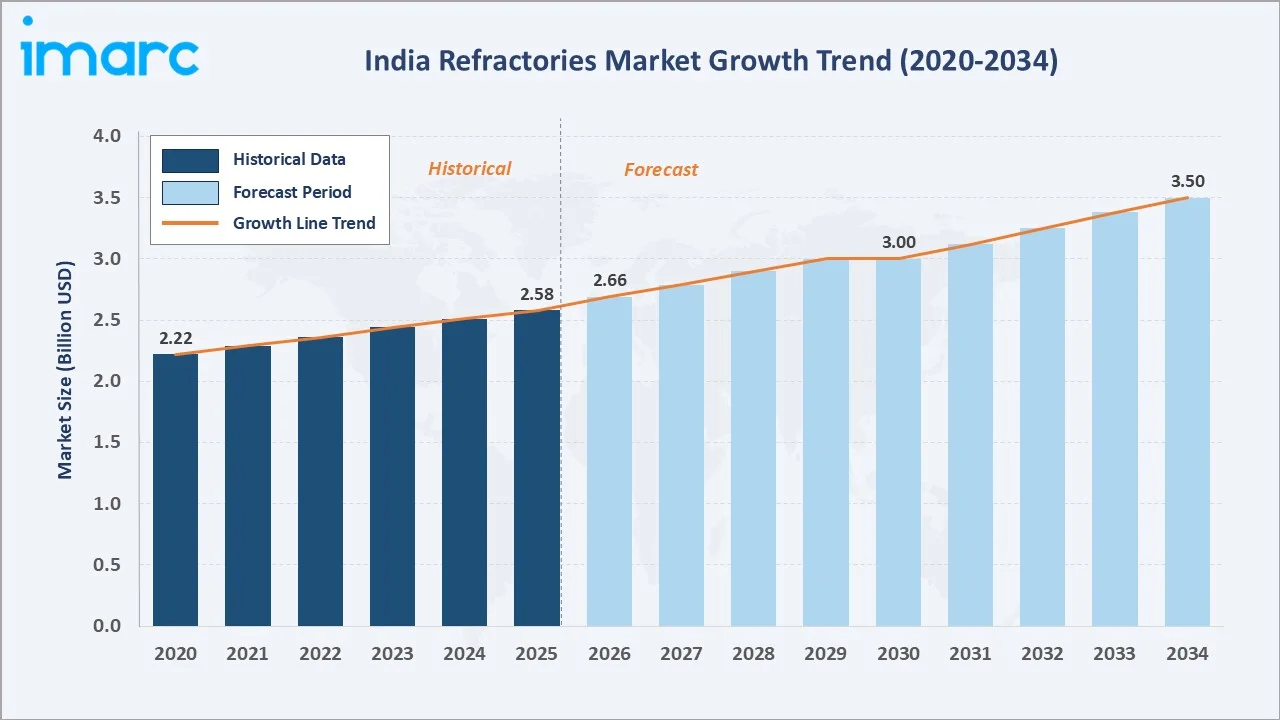
The India refractories market grew from USD 2.58 Billion in 2025 and is estimated to reach USD 2.66 Billion in 2026. The market is projected to reach USD 3.50 Billion by 2034, growing at a CAGR of 3.07% during 2026-2034. Market expansion is driven by the expanding steel and cement industries, rising demand for high-performance refractory materials, and government initiatives such as "Make in India."
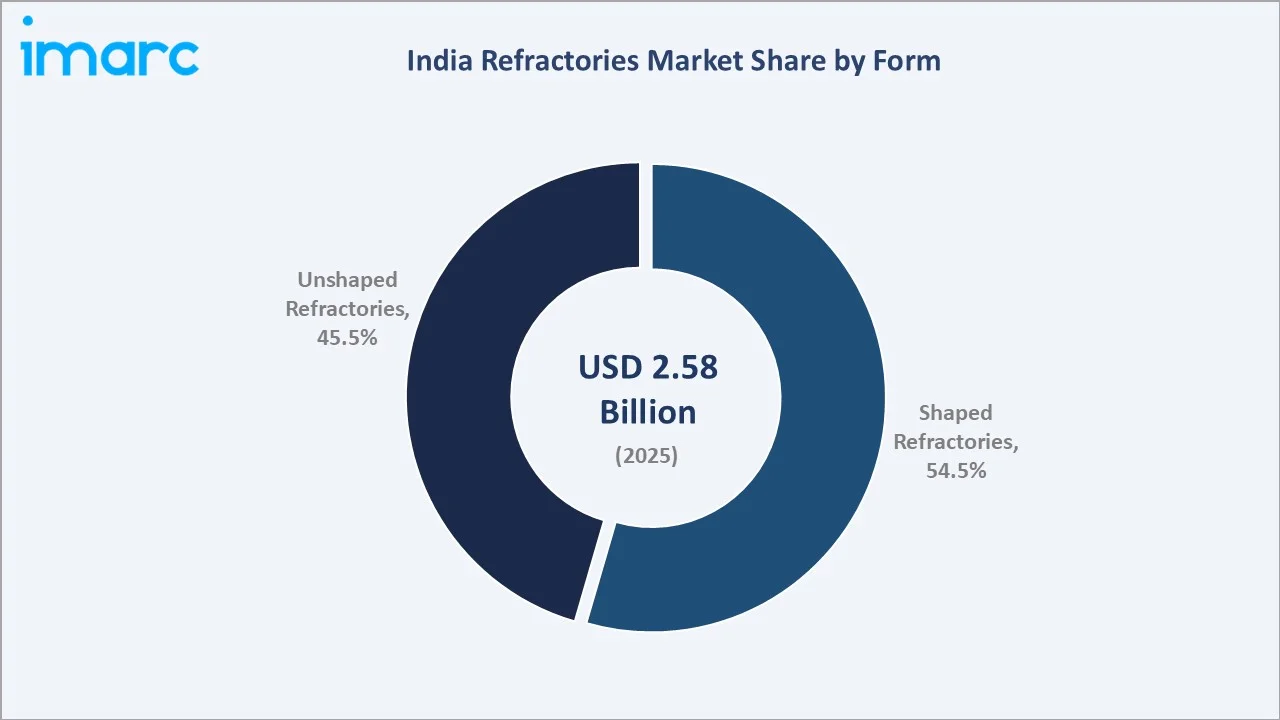
Shaped refractories lead the form segment at 54.5%, Acidic and Neutral leads the alkalinity segment at 59.5%, and East India accounts for 31.5% of regional market share in 2025.
Market Snapshot
|
Metric |
Value |
|
Base Year Market Size (2025) |
USD 2.58 Billion |
|
Market Size (2026) |
USD 2.66 Billion |
|
Forecast Market Size (2034) |
USD 3.50 Billion |
|
CAGR (2026-2034) |
3.07% |
|
Base Year |
2025 |
|
Historical Period |
2020-2025 |
|
Forecast Period |
2026-2034 |
|
Largest Region |
East India (31.5%, 2025) |
|
Second Largest Region |
West India (27.4%, 2025) |
|
Leading Form |
Shaped Refractories (54.5%, 2025) |
|
Leading Alkalinity |
Acidic and Neutral (59.5%, 2025) |
The India refractories market size increased from USD 2.22 Billion in 2020 to USD 2.58 Billion in 2025 and is estimated to reach USD 2.66 Billion in 2026. The market is further expected to grow to USD 3.00 Billion by 2030 and USD 3.50 Billion by 2034. Growth is underpinned by rising steel production, government infrastructure investments, and the growing adoption of energy-efficient refractory solutions.
To get more information on this market, Request Sample
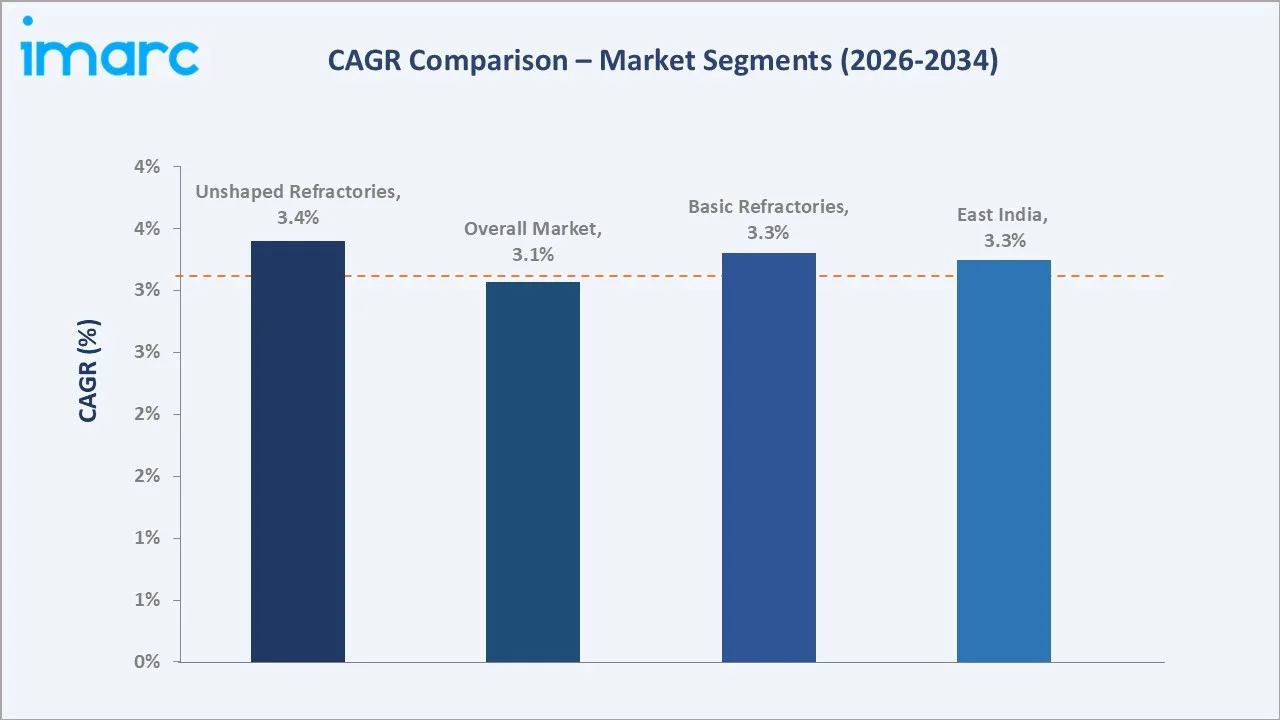
CAGR trajectories across form and alkalinity sub-segments show unshaped refractories (~3.40% CAGR) and basic refractories (~3.30% CAGR) expanding faster than the overall 3.07% market CAGR, driven by rising adoption of monolithic solutions, growing steel industry demand, and increasing construction activity across India.
Executive Summary
The India refractories market expanded from USD 2.58 Billion in 2025 to an estimated USD 2.66 Billion in 2026, reflecting steady growth driven by rising steel and cement production and increasing government infrastructure spending. The industry has evolved from basic brick-form refractories to advanced monolithic solutions, offering improved efficiency and cost-effectiveness.
Shaped refractories lead the form segment at 54.5% in 2025, reflecting strong demand from traditional steel furnace linings, kilns, and high-temperature process equipment. Acidic and Neutral commands 59.5% of the alkalinity segment in 2025. East India holds 31.5% of regional share, reflecting the concentration of steel and heavy industries in states like Jharkhand, Odisha, and West Bengal.
Key Market Insights
|
Insight |
Data |
|
Leading Form |
Shaped Refractories — 54.5% share (2025) |
|
Second Largest Form |
Unshaped Refractories — 45.5% share (2025) |
|
Leading Alkalinity |
Acidic and Neutral — 59.5% share (2025) |
|
Second Largest Alkalinity |
Basic — 40.5% share (2025) |
|
Leading Region |
East India — 31.5% share (2025) |
|
Second Largest Region |
West India — 27.4% share (2025) |
|
Top Companies |
RHI Magnesita, Vesuvius India Limited, Imerys, Calderys, IFGL Refractories |
Key Analytical Observations Expanding On the Data Above:
- Shaped refractories dominance at 54.5%: Supported by sustained demand from steel manufacturers and non-ferrous metal processors who rely on brick-form linings for blast furnaces, converters, and ladles, where structural integrity under extreme thermal stress is critical.
- Unshaped refractories share at 45.5%: Growing steadily as industries adopt castables, plastics, and ramming mixes due to their ease of installation, reduced downtime, and ability to conform to complex furnace geometries.
- Acidic and Neutral leadership at 59.5%: Reflects broad usage across glass, cement, and non-ferrous sectors where silica-based and alumina-based refractories offer cost efficiency and reliable thermal performance.
- Basic segment at 40.5%: Expanding alongside steel industry growth, as magnesia-carbon and dolomite refractories are essential for BOF converters and electric arc furnaces processing high-iron content steel.
- East India at 31.5%: Reflects the concentration of India's largest integrated steel plants in Jharkhand, Odisha, and West Bengal, anchored by facilities such as Tata Steel Jamshedpur, SAIL Rourkela, and JSW, sustaining consistent high-volume refractory demand.
India Refractories Market Overview
Refractories are non-metallic materials with melting points exceeding 1,500°C, engineered to withstand extreme temperatures, mechanical stress, and chemical attack in high-temperature industrial processes. They are used as linings for furnaces, kilns, incinerators, reactors, and ladles across the steel, cement, glass, and non-ferrous metals industries.
The Indian refractories ecosystem integrates raw material suppliers, refractory manufacturers, distributors, technology providers, logistics networks, and end-user industries spanning iron and steel, cement, non-ferrous metals, and glass. Together, these participants enable a broad and scalable refractory supply chain across India's major industrial corridors.
Market Dynamics
To evaluate market opportunities, Request Sample
Market Drivers
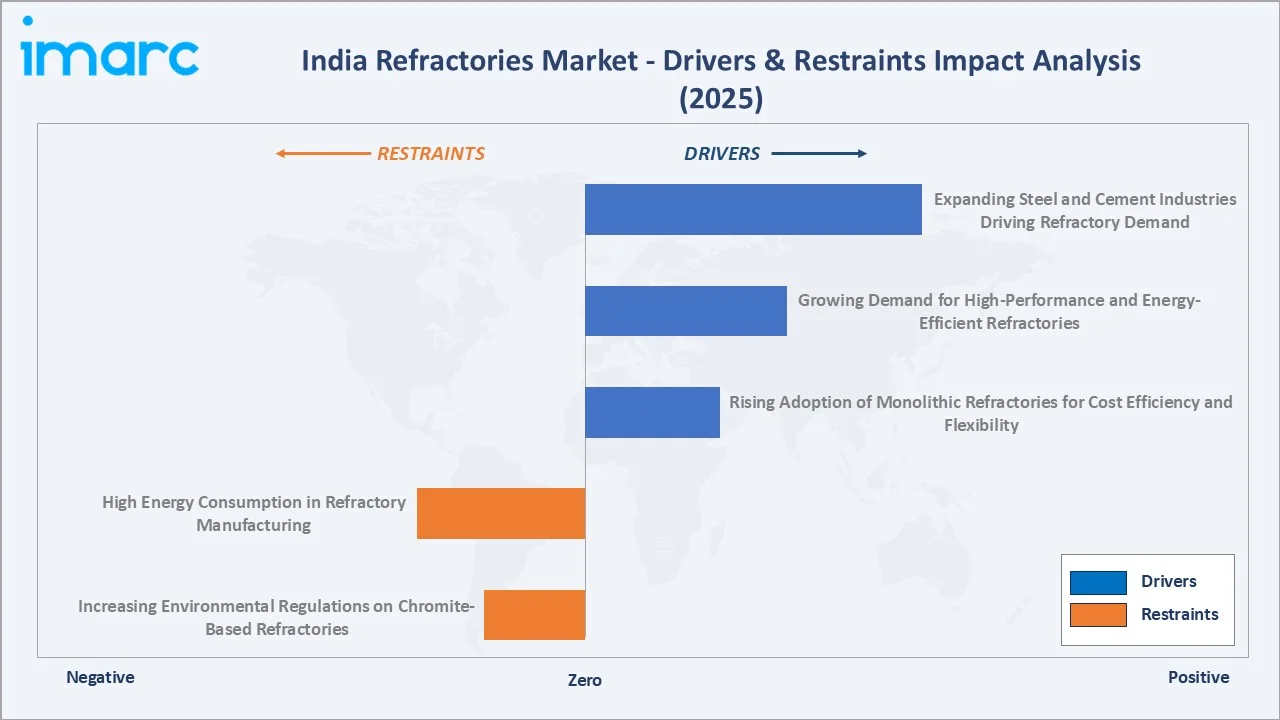
- Expanding Steel and Cement Industries Driving Refractory Demand: India's position as one of the world's largest steel and cement producers generates consistent high-volume refractory demand. Rising infrastructure spending, urbanization, and government-backed construction programs are expanding furnace capacity and kiln installations, directly increasing consumption of shaped and unshaped refractory products.
- Government Initiatives Including Make in India Supporting Local Manufacturing: Policy frameworks promoting domestic industrial production, including Make in India and the Production Linked Incentive scheme for specialty materials, are encouraging investment in refractory manufacturing capacity. Local procurement preferences across public sector steel plants further support demand for domestically produced refractories.
- Growing Demand for High-Performance and Energy-Efficient Refractories: Steelmakers and cement producers are increasingly adopting advanced refractory formulations, including low-cement castables and high-alumina bricks, to reduce energy consumption, extend lining life, and minimize operational downtime, driving demand for premium-grade products across high-temperature process applications.
- Rising Adoption of Monolithic Refractories for Cost Efficiency and Flexibility: Monolithic refractories, including castables, plastics, and ramming mixes, are gaining preference over traditional bricks due to easier application, lower installation costs, reduced downtime, and the ability to form complex shapes. Growing adoption across cement kilns, glass furnaces, and secondary steelmaking is broadening the addressable market.
Market Restraints
- Volatility in Raw Material Prices Affecting Profitability: The refractory industry relies on raw materials including magnesite, chromite, silica, and high alumina, whose prices are subject to significant volatility driven by global mining output, trade policy changes, and supply chain disruptions, compressing margins for manufacturers unable to pass input cost increases downstream.
- High Energy Consumption in Refractory Manufacturing: Refractory production requires high-temperature firing processes that are energy-intensive and costly. Rising electricity and fuel prices in India increase operational costs for manufacturers, limiting capacity expansion and reducing competitiveness for producers operating older, less energy-efficient facilities.
- Increasing Environmental Regulations on Chromite-Based Refractories: Growing environmental scrutiny around hexavalent chromium emissions from chromite-based refractories is imposing regulatory compliance requirements on manufacturers and end users, increasing costs and driving substitution toward alternative formulations in steel and glass applications.
Market Opportunities
- Expansion of Infrastructure and Construction Sectors Creating New Demand: India's sustained investment in infrastructure including roads, railways, power plants, and urban housing is generating growing demand for cement, glass, and construction materials, indirectly expanding refractory consumption across kilns and furnaces supplying these industries.
- Growing Adoption of Green Steel and Low-Carbon Manufacturing: India's steel industry is exploring electric arc furnace-based steelmaking and hydrogen-based direct reduced iron production as lower-carbon alternatives, creating demand for specialized refractory solutions capable of withstanding different operating conditions compared to traditional blast furnace linings.
Market Challenges
- Dependence on Imported Raw Materials for Specialty Refractories: Several high-performance refractory inputs including fused alumina, zirconia, and high-purity magnesite are substantially imported from China, Europe, and other countries. Supply chain vulnerabilities, currency fluctuations, and import tariff changes create pricing and availability risks for specialty refractory manufacturers.
- Skilled Workforce Shortage for Specialty Refractory Installation: The proper installation and maintenance of monolithic and specialty refractories requires trained technicians with expertise in material properties, mixing protocols, and curing procedures. A persistent shortage of skilled refractory installers across India's industrial corridors can affect lining performance and customer satisfaction.
Emerging Market Trends
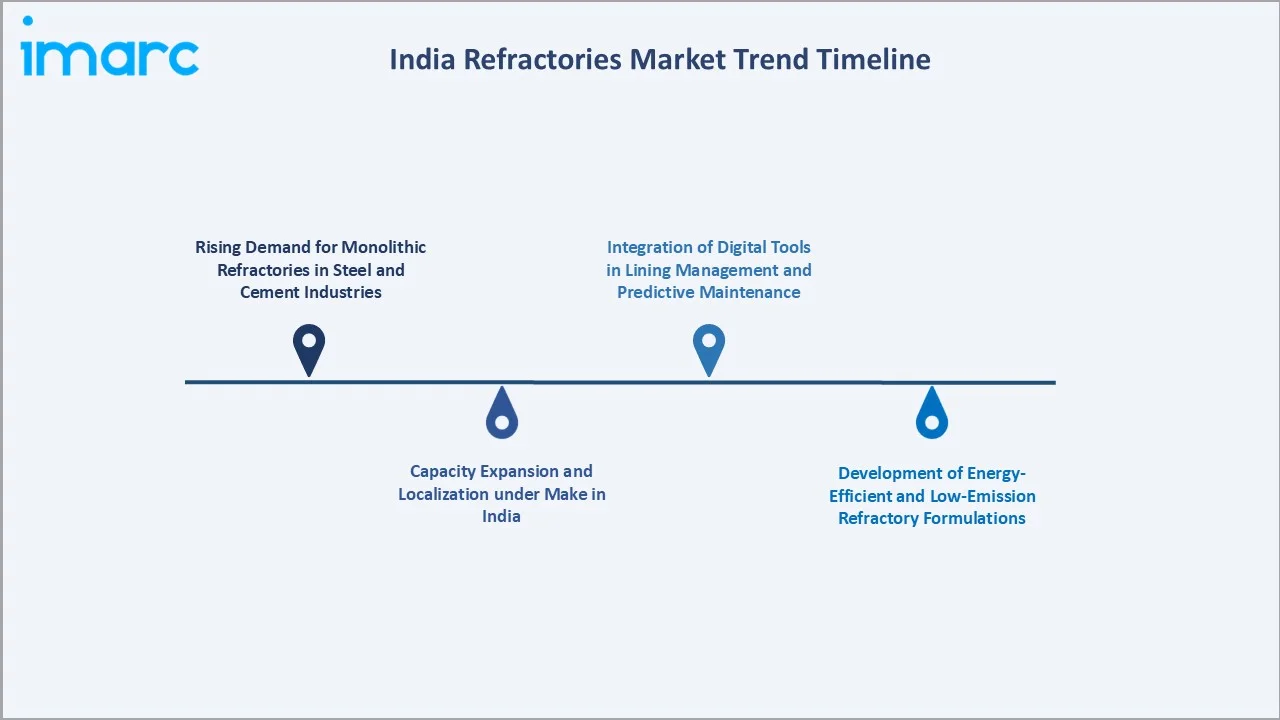
1. Rising Demand for Monolithic Refractories in Steel and Cement Industries
Monolithic refractories are increasingly replacing conventional brick linings across Indian steel plants, cement kilns, and glass furnaces due to their faster installation, reduced downtime, and lower lifecycle cost. Refractory manufacturers are expanding their monolithic product portfolios, including low-cement castables, self-flow castables, and gunning mixes, to address the growing preference for flexible and cost-efficient lining solutions.
2. Capacity Expansion and Localization under Make in India
Leading domestic and international refractory producers are investing in greenfield and brownfield capacity expansions within India to serve growing local demand, reduce import dependence, and align with government procurement preferences. New manufacturing facilities in Odisha, Andhra Pradesh, and Gujarat are adding significant domestic production capacity to support the expanding steel and cement sectors.
3. Development of Energy-Efficient and Low-Emission Refractory Formulations
Indian refractory manufacturers and end users are increasingly focused on developing and deploying materials that improve energy retention in high-temperature processes. Innovations in microporous insulating refractories, ceramic fiber linings, and alumina-based castables are enabling steel and cement plants to reduce specific energy consumption and lower carbon dioxide emissions per ton of output.
4. Integration of Digital Tools in Lining Management and Predictive Maintenance
Steel producers and refractory suppliers are adopting digital technologies including laser-based lining thickness measurement, thermal imaging, and predictive analytics to monitor refractory wear patterns and schedule maintenance proactively. These capabilities reduce unplanned furnace outages, extend lining campaigns, and optimize refractory consumption across high-volume industrial installations.
Industry Value Chain Analysis
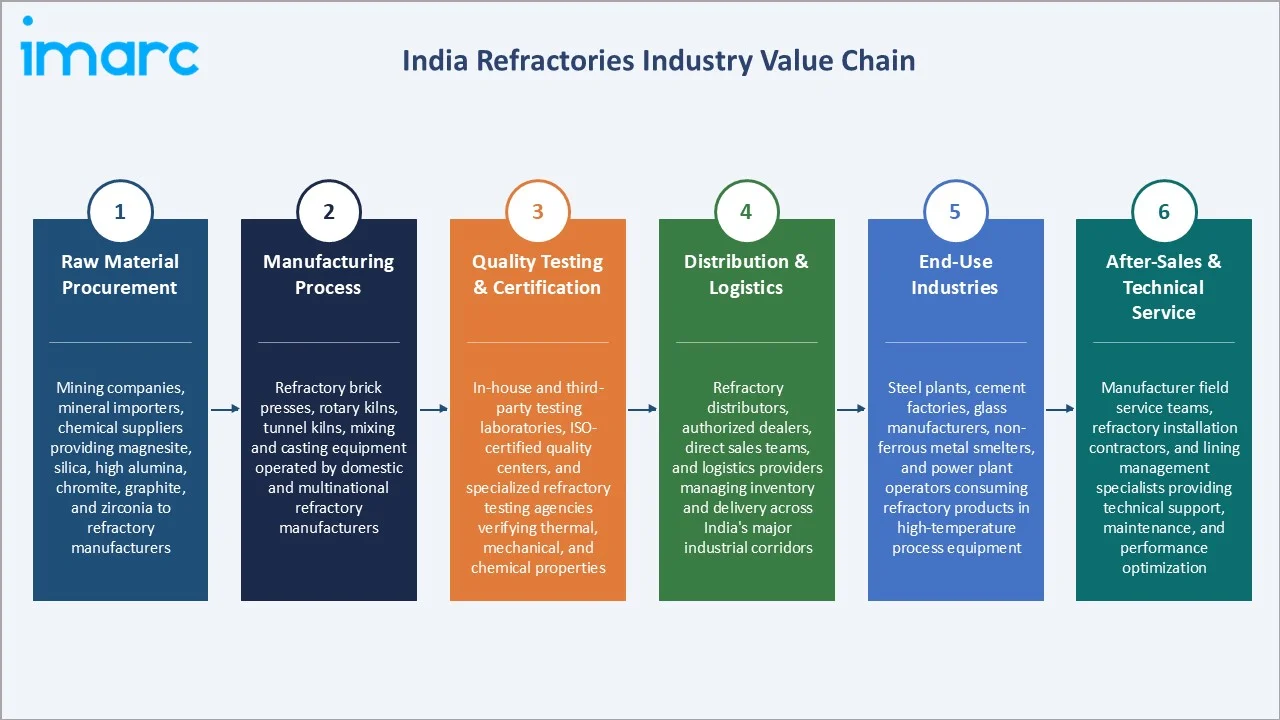
The India refractories value chain spans six stages, from raw material procurement through end-use industry service. Refractory manufacturing and quality testing capture the highest value-add, while logistics and distribution capabilities increasingly determine market reach and competitive differentiation across India's geographically diverse industrial landscape.
|
Stage |
Key Players / Examples |
|
Raw Material Procurement |
Mining companies, mineral importers, chemical suppliers providing magnesite, silica, high alumina, chromite, graphite, and zirconia to refractory manufacturers |
|
Manufacturing Process |
Refractory brick presses, rotary kilns, tunnel kilns, mixing and casting equipment operated by domestic and multinational refractory manufacturers |
|
Quality Testing & Certification |
In-house and third-party testing laboratories, ISO-certified quality centers, and specialized refractory testing agencies verifying thermal, mechanical, and chemical properties |
|
Distribution & Logistics |
Refractory distributors, authorized dealers, direct sales teams, and logistics providers managing inventory and delivery across India's major industrial corridors |
|
End-Use Industries |
Steel plants, cement factories, glass manufacturers, non-ferrous metal smelters, and power plant operators consuming refractory products in high-temperature process equipment |
|
After-Sales & Technical Service |
Manufacturer field service teams, refractory installation contractors, and lining management specialists providing technical support, maintenance, and performance optimization |
Refractory manufacturers that vertically integrate upstream into raw material sourcing or downstream into installation services are better positioned to deliver consistent product quality, manage cost structures, and build durable customer relationships with major steel and cement producers.
Technology Landscape in the India Refractories Industry
Advanced Refractory Material Formulations
Refractory manufacturers are investing in the development of advanced material formulations including low-cement castables, ultra-low cement castables, and self-flowing monolithics that offer superior performance in extreme thermal and chemical environments. These materials reduce installation time, improve lining consistency, and extend campaign life across steel converters, ladles, and cement rotary kilns.
Digital Lining Management and Predictive Analytics
Leading steel producers and refractory suppliers are deploying laser profiling, infrared thermal mapping, and predictive lining management platforms to monitor refractory wear in real time. These digital tools enable proactive maintenance scheduling, minimize unplanned furnace downtime, and optimize total refractory consumption per unit of output across large-scale steelmaking operations.
Energy-Efficient and Low-Carbon Refractory Technologies
Energy-intensive refractory manufacturing processes are increasingly targeted for efficiency improvements through advanced kiln design, waste heat recovery systems, and optimized firing schedules. Emerging technologies including cold-setting binders and geopolymer-based refractories are being explored as lower-energy alternatives that could reduce manufacturing-side carbon emissions.
Nano-Technology and Composite Refractory Materials
Research programs within India and globally are exploring the application of nano-particles, carbon nanotubes, and composite fiber-reinforced matrices to enhance refractory thermal shock resistance, mechanical strength, and oxidation resistance. Pilot deployments in specialty steel and non-ferrous applications provide early evidence of performance advantages for next-generation refractory formulations.
Market Segmentation Analysis
The report covers the following segments:
|
Segment Category |
Leading Segment |
Market Share |
Year |
|
Form |
Shaped Refractories |
54.5% |
2025 |
|
Alkalinity |
Acidic and Neutral |
59.5% |
2025 |
|
Manufacturing Process |
Dry Press Process |
43.5% |
2025 |
|
Composition |
Clay-Based |
55.0% |
2025 |
|
Refractory Mineral |
High Alumina |
34.8% |
2025 |
|
Application |
Iron and Steel |
70.0% |
2025 |
|
Region |
East India |
31.5% |
2025 |

By Form
Shaped refractories command a 54.5% majority share (2025). The shaped refractories segment encompasses standardized bricks, blocks, and pre-formed shapes engineered for blast furnace linings, ladles, and converter applications across India's large integrated steel plants and non-ferrous smelters. Shaped refractories' ~2.66% CAGR reflects the steady but moderate expansion driven by incremental new steel capacity and kiln installations.
To access detailed market analysis, Request Sample
Unshaped refractories at 45.5% are expanding faster at ~3.40% CAGR as cement kilns, glass furnaces, and secondary steelmaking operations increasingly adopt castables, gunning mixes, and plastic refractories that reduce installation time, minimize joints, and offer superior performance in irregular or complex furnace geometries.
By Alkalinity
Acidic and Neutral leads with 59.5% share (2025). The acidic and neutral segment encompasses silica, high alumina, and fireclay-based refractories widely used across glass, cement, and non-ferrous applications where chemical compatibility with acidic process environments determines material selection. Acidic and Neutral's ~2.55% CAGR reflects the mature but steady demand from India's diverse high-temperature industries.
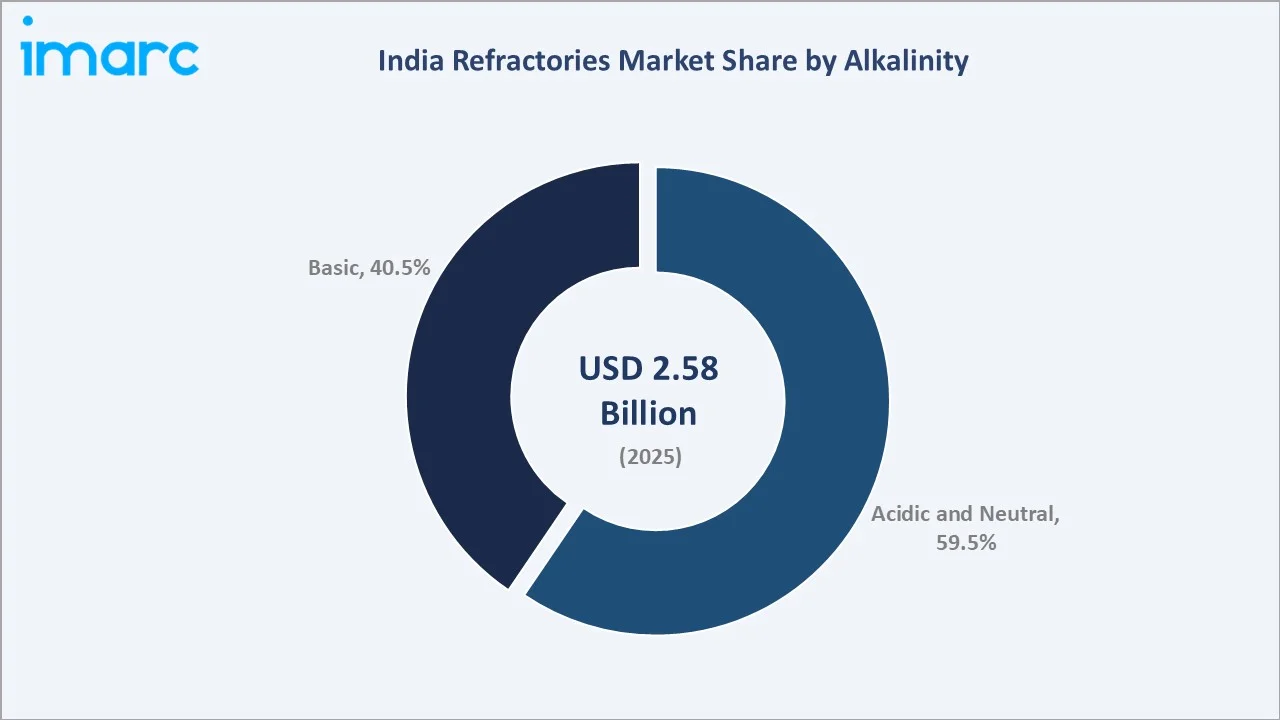
Basic refractories at 40.5% remain structurally important and grow faster at ~3.30% CAGR, anchored by magnesia-carbon and dolomite products essential for BOF converters, electric arc furnaces, and ladle linings in India's primary steel industry. Growing domestic steel production and rising EAF adoption are expected to support basic refractory demand through the forecast period.
Regional Market Insights
|
Region |
Share (2025) |
Key Growth Drivers |
|
East India |
31.5% |
Concentration of large integrated steel plants in Jharkhand, Odisha, and West Bengal, including Tata Steel, SAIL, and JSW facilities, generating high-volume refractory demand |
|
West India |
27.4% |
Growing cement and glass industries in Maharashtra and Gujarat, expanding non-ferrous metal production, and increasing secondary steel capacity driving refractory consumption |
|
North India |
22.6% |
Rising construction activity, expanding government infrastructure projects, and growing demand from cement plants and steel rolling mills across Uttar Pradesh, Haryana, and Rajasthan |
|
South India |
18.5% |
Expanding steel and cement capacity in Andhra Pradesh and Tamil Nadu, growing non-ferrous metals processing, and increasing glass manufacturing activity supporting gradual market expansion |
East India at 31.5% leads the regional landscape, anchored by India's largest concentration of integrated steel plants across Jharkhand, Odisha, and West Bengal. The region benefits from proximity to high-grade iron ore and coal deposits, sustained public and private steel capacity investments, and the presence of major facilities operated by Tata Steel, SAIL, and JSW that generate continuous large-volume refractory demand.
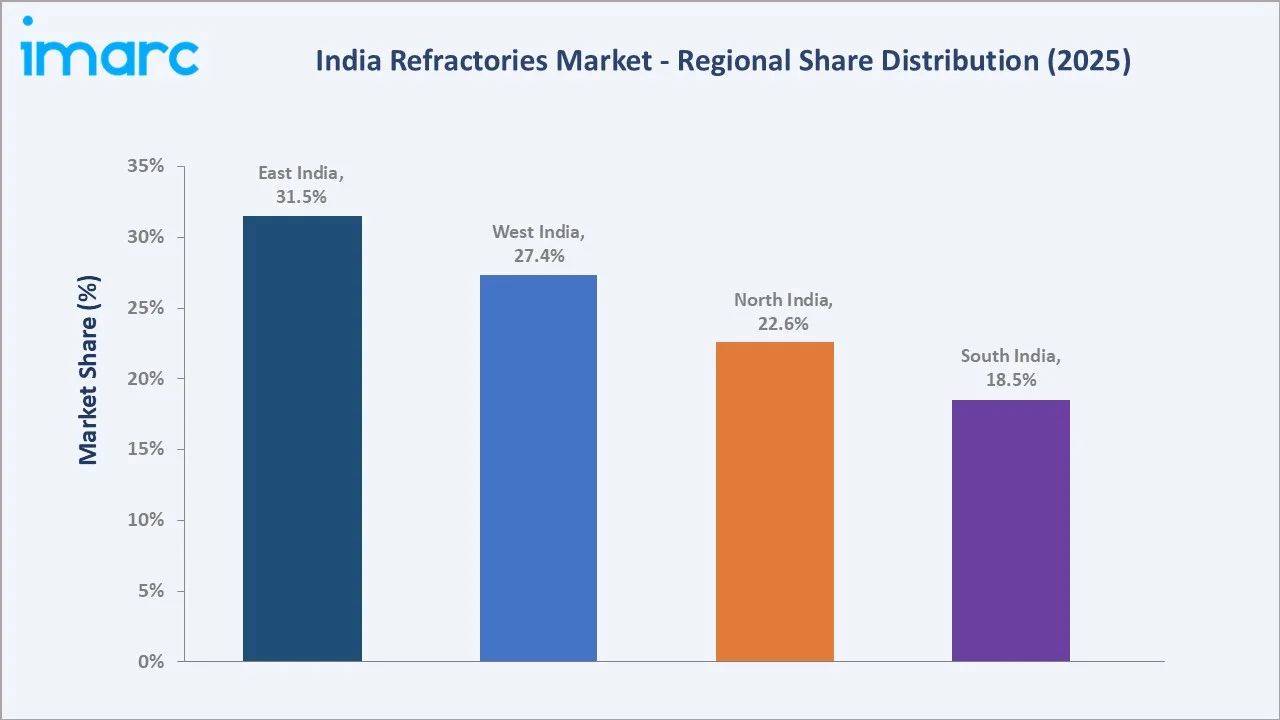
South India, while currently the smallest contributor at 18.5%, is expanding as infrastructure investment, growing cement capacity in Andhra Pradesh, and increasing non-ferrous processing activity develop new demand corridors. Rising investments in port-based industrial clusters and expanding construction activity are expected to support gradual refractory consumption growth in the region through 2034.
Competitive Landscape
The India refractories market is moderately concentrated, with leading multinational manufacturers and established domestic players competing on product quality, technical service capability, and raw material security. R&D investment, manufacturing scale, and proximity to key end-user industries form the primary competitive differentiators across the sector.
|
Company Name |
Brand / Key Product |
Position |
Strategic Focus |
|
RHI Magnesita |
Magnesite & Dolomite Refractories |
Leader |
Expanding capacity and product range for India's steel and cement sectors through local manufacturing investment |
|
Vesuvius India Limited |
Steel Flow Control Solutions |
Leader |
Strengthening steel industry partnerships and commissioning new manufacturing facilities in Visakhapatnam |
|
Imerys |
Flow Control Products, and Refractory Concretes |
Leader |
Developing advanced refractory formulations and expanding technical service capabilities for Indian industrial clients |
|
Calderys |
Monolithic Refractories |
Challenger |
Investing in India's largest greenfield refractory plant in Odisha to expand domestic production for growing steel demand |
|
IFGL Refractories |
Refractory Solutions |
Challenger |
Strengthening product portfolio and expanding international distribution through refractory solutions for steel casting |
Key players include RHI Magnesita, Vesuvius India Limited, Imerys, Calderys, and IFGL Refractories, among others.
Key Company Profiles
RHI Magnesita
RHI Magnesita is the world's leading supplier of high-grade refractory products, systems, and services, serving steel, cement, non-ferrous metals, and glass industries globally and across India. The company combines raw material ownership with manufacturing scale and technical service expertise to deliver integrated refractory solutions.
- Key Products: Shaped and unshaped refractories for steelmaking and non-ferrous metal applications, magnesia-carbon bricks, dolomite products, flow control systems, and lining management services for blast furnaces, converters, and ladles.
- Recent Developments: In June 2026, RHI Magnesita India announced a strategic joint venture with Khemka Refractories Pvt. Ltd. to establish a greenfield refractory recycling facility in Odisha, India. The partnership will focus on the recovery, processing, and reuse of spent refractory materials, creating an integrated recycling supply chain for the Indian refractory industry. The facility is expected to increase the availability of high-value secondary raw materials, reduce dependence on virgin resources, and support circular economy and sustainability goals across high-temperature industries.
- Strategic Focus: Driving growth through integrated lining management solutions, expanding India-specific product lines, and leveraging global raw material supply networks to deliver consistent performance across Indian steel and cement applications.
Vesuvius India Limited
Vesuvius India Limited Limited is a leading provider of steel flow control refractories, advanced ceramics, and thermal management solutions serving India's steel industry. The company operates manufacturing facilities across multiple Indian locations and serves major domestic steel producers with specialized refractory and filtration products.
- Key Products: Steel flow control systems including slide gate plates and shrouds, ladle furniture, monolithic refractories, continuous casting products, and advanced ceramics for steel tundishes and ladles.
- Recent Developments: In 2026, Vesuvius showcased new tundish refractory technologies at ICSQS 2026, focusing on solutions for cleaner and more efficient steel production. The company presented its “Innovative Tundish Refractory Technologies for Clean Steel Production”, highlighting technologies designed to reduce re-oxidation, improve inclusion removal, and optimise steel flow control. The development demonstrates Vesuvius’ continued focus on advanced refractory solutions for steelmaking, particularly technologies that support improved steel quality and process efficiency.
- Strategic Focus: Strengthening India manufacturing presence under Make in India, expanding steel flow control product penetration, and deepening technical partnerships with major domestic steel producers.
Calderys
Calderys is a global provider of monolithic refractory solutions serving steel, foundry, cement, and non-ferrous industries. With a significant and growing presence in India, the company is making major manufacturing investments to establish itself as a leading domestic supplier of castable and monolithic refractory products.
- Key Products: Monolithic refractories including castables, gunning mixes, ramming mixes, and plastic refractories for steel foundries, cement kilns, and non-ferrous processing facilities across India and globally.
- Recent Developments: On April 9, 2026, Calderys officially inaugurated its new CAPES facility in Odisha, India, described by the company as the world’s largest single-site greenfield facility for refractories and steel casting fluxes. The plant had already commissioned its acidic and basic monolithics production lines, while additional lines for acidic and basic bricks, steel casting fluxes, and taphole clays were under development for operation later in 2026. The facility strengthens Calderys’ local manufacturing capabilities and expands its portfolio of refractory solutions for the Indian steel industry.
- Strategic Focus: Establishing domestic manufacturing leadership in monolithic refractories through large-scale Odisha plant investment, aligned with India's industrial growth and sustainability objectives.
Market Concentration Analysis
The India refractories market exhibits moderate concentration, with multinational leaders holding significant shares of high-value steel and cement applications while domestic manufacturers compete effectively in volume segments and regional markets where local service capability and cost proximity are important.
Barriers to entry include high capital requirements for manufacturing equipment, the technical complexity of refractory formulation and quality control, raw material sourcing relationships, and the need for established technical service infrastructure to support demanding end-user customers in steel and cement plants.
Consolidation is gradually increasing as leading international players acquire domestic manufacturers to accelerate market access and as Indian producers form technology partnerships with global refractory specialists to upgrade product quality and expand into high-value specialty segments.
Investment & Growth Opportunities
Highest Growth Segments
Unshaped refractories (~3.40% CAGR), basic refractories (~3.30% CAGR), East India market (~3.25% CAGR), and South India region (~3.20% CAGR) represent the highest-growth India refractories investment vectors through 2034, driven by rising EAF steelmaking adoption, growing cement capacity, and infrastructure expansion in underserved regions.
Emerging Investment Opportunities
South India is expanding as infrastructure investment and growing industrial capacity in Andhra Pradesh and Tamil Nadu develop new refractory demand corridors. Emerging steel clusters, port-based industrial zones, and expanding cement capacity in underserved southern states represent significant untapped opportunities for refractory manufacturers seeking geographic diversification.
Investment Themes
- New greenfield monolithic refractory manufacturing capacity aligned with Make in India: Companies investing in large-scale Indian monolithic refractory manufacturing through greenfield or brownfield investment by 2025-2027 are positioned to capture the demand wave from expanding steel and cement capacity while benefiting from government procurement preferences for domestically produced materials.
- Digital lining management platform development for Indian steel industry subscription revenue: Refractory AI lining management has documented a commercial benefit of 15-25% reduction in specific refractory consumption. A cloud-based lining management platform subscription model creates above-product-sale-margin recurring revenue as India's steel fleet modernizes.
Future Market Outlook (2026-2034)
The India refractories market is projected to grow from USD 2.58 Billion in 2025 to USD 2.66 Billion in 2026, reaching USD 3.50 Billion by 2034, registering a CAGR of 3.07% during 2026-2034. The market's anchor value of USD 3.00 Billion in 2030 represents a refractories industry at a critical modernization inflection, where digital lining management will have achieved mainstream commercial deployment and monolithic refractories will have surpassed shaped refractories in new installation volume.
Three structural forces define India refractories market growth through 2034 with high confidence. Steel capacity expansion as a policy imperative across India creates government-backed and private sector-financed refractory demand that is multi-decade and committed. Make in India creates domestic manufacturing capacity investment incentives that are reducing import dependence and strengthening India's refractory supply chain resilience. Technology cost reduction is making premium refractory technology and digital lining management commercially accessible to mid-tier steel and cement producers.
By 2034, the India refractories market is expected to be defined by advanced lining management, specialized high-performance formulations, and stronger domestic manufacturing capabilities. Continued government investment in steel infrastructure and industrial development will further accelerate the evolution of India's refractory supply chain.
Research Methodology
Primary Research
Primary research included structured interviews with refractory manufacturers, steel plant procurement managers, cement industry executives, and raw material suppliers, validating market sizing, segment mix, and regional demand patterns across the India refractories industry.
Secondary Research
Secondary sources included Ministry of Steel publications, Bureau of Indian Standards refractory specifications, IMARC Group industry databases, annual reports and investor presentations from listed refractory and steel companies, and industry association data from the Refractories Manufacturers Association of India. Over 50 secondary sources reviewed.
Forecasting Models
Market revenue forecasts developed using a segment bottom-up model: (i) shaped refractory component by application and region; (ii) unshaped/monolithic refractory component; (iii) specialty refractory services component. Scenario analysis addressed steel capacity utilization rates, raw material cost volatility, and adoption pace of monolithic refractories.
India Refractories Market Report Coverage:
| Report Features | Details |
|---|---|
| Base Year of the Analysis | 2025 |
| Historical Period | 2020-2025 |
| Forecast Period | 2026-2034 |
| Units | Billion USD |
| Scope of the Report | Exploration of Historical Trends and Market Outlook, Industry Catalysts and Challenges, Segment-Wise Historical and Future Market Assessment:
|
| Forms Covered | Shaped Refractories, Unshaped Refractories |
| Alkalinities Covered | Acidic, Neutral and Basic |
| Manufacturing Processes Covered | Dry Press Process, Fused Cast, Hand Molded, Formed, Unformed |
| Compositions Covered | Clay-Based, Nonclay-Based |
| Refractory Minerals Covered | Graphite, Magnesite, Chromite, Silica, High Alumina, Zirconia, Others |
| Applications Covered | Steel, Cement, Non-Ferrous Metals, Glass, Others |
| Regions Covered | North India, South India, East India, West India |
| Companies Covered | RHI Magnesita, Vesuvius India Limited, Imerys, Calderys, IFGL Refractories, etc. |
| Customization Scope | 10% Free Customization |
| Post-Sale Analyst Support | 10-12 Weeks |
| Delivery Format | PDF and Excel through Email (We can also provide the editable version of the report in PPT/Word format on special request) |
Key Benefits for Stakeholders:
- IMARC’s industry report offers a comprehensive quantitative analysis of various market segments, historical and current market trends, market forecasts, and dynamics of the India refractories market from 2020-2034.
- The research report provides the latest information on the market drivers, challenges, and opportunities in the India refractories market.
- Porter's five forces analysis assist stakeholders in assessing the impact of new entrants, competitive rivalry, supplier power, buyer power, and the threat of substitution. It helps stakeholders to analyze the level of competition within the India refractories industry and its attractiveness.
- Competitive landscape allows stakeholders to understand their competitive environment and provides an insight into the current positions of key players in the market.
Frequently Asked Questions About the India Refractories Market Report
The India refractories market reached USD 2.58 Billion in 2025. The market is driven by rising demand from the expanding steel and cement industries, increasing government infrastructure investments, and the growing adoption of advanced monolithic refractory solutions. Advancements in digital lining management, energy-efficient formulations, and the Make in India initiative are further supporting market growth.
The market grows at 3.07% CAGR during 2026-2034, reaching USD 3.50 Billion by 2034. Unshaped refractories grow fastest at ~3.40% CAGR through rising monolithic adoption in cement kilns, glass furnaces, and EAF steelmaking applications.
Shaped refractories lead at 54.5% through high-volume demand from blast furnace linings, ladle applications, and converter linings across India's large integrated steel plants, while unshaped refractories grow faster at ~3.40% CAGR.
Acidic and Neutral is the leading alkalinity segment, accounting for 59.5% of market share in 2025, supported by broad demand across glass, cement, and non-ferrous metal applications requiring silica-based and alumina-based refractory materials.
East India leads with 31.5% share in 2025, anchored by India's largest concentration of integrated steel plants across Jharkhand, Odisha, and West Bengal, including facilities operated by Tata Steel, SAIL, and JSW.
Leading companies include RHI Magnesita, Vesuvius India Limited, Imerys, Calderys, and IFGL Refractories, among others.
The market is projected to reach approximately USD 3.00 Billion by 2030, with digital lining management achieving commercial adoption among leading Indian steel producers, monolithic refractories surpassing shaped refractories in new installation volume, and South India's market share expanding as new steel and cement capacity comes online.
Make in India is driving investment in domestic refractory manufacturing capacity, reducing import dependence for specialty refractory inputs, and creating local procurement preferences at public sector steel plants. Companies investing in Indian manufacturing are positioned to capture growing domestic demand and government-linked procurement opportunities through 2034.
Digital lining management platforms, laser profiling, predictive analytics, and advanced monolithic formulations are improving refractory campaign life, reducing specific consumption per ton of steel, and enabling data-driven lining optimization across India's major steel and cement operations.
Need more help?
- Speak to our experienced analysts for insights on the current market scenarios.
- Include additional segments and countries to customize the report as per your requirement.
- Gain an unparalleled competitive advantage in your domain by understanding how to utilize the report and positively impacting your operations and revenue.
- For further assistance, please connect with our analysts.
 Request Customization
 Speak to an Analyst
 Request Brochure
 Inquire Before Buying
Benefits of Customization
- Personalize this research
- Triangulate with your data
- Get data as per your format and definition
- Gain a deeper dive into a specific application, geography, customer, or competitor
- Any level of personalization
Get in Touch With Us
UNITED STATES
Phone: +1-201-971-6302
INDIA
Phone: +91-120-433-0800
UNITED KINGDOM
Phone: +44-753-714-6104
Email: [email protected]
Client Testimonials




.webp)




.webp)













Related Reports

Choose your plan
*Please note that the prices mentioned below are starting prices for each bundle type. Kindly contact our team for further details.*
Single User License
- 1 User License, Access on 2 Devices
- PDF Report + Excel Dataset (Password Protected)
- Lifetime Access
- No Printing Rights
- 10% Free Report Customization
- 10–12 Weeks of Analyst Support
Five User License
- Access for 5 Users, 2 Devices per User
- PDF Report + Excel Dataset (Password Protected)
- Lifetime Access
- Dedicated Account Manager
- 12–14 Weeks of Analyst Support
- No Printing Rights
- 15% Free Report Customization
- 25% Discount on Your Next Purchase
Corporate User License
- Unlimited User Access (Within Your Organization)
- PDF Report + Excel Dataset
- Lifetime Access
- Dedicated Account Manager
- 14–20 Weeks of Analyst Support
- No Printing Rights
- 20% Free Report Customization
- 30% Discount on Your Next Purchase
Essential Insights
What's included:
3 reports
- Lifetime Access
- PDF Reports
- Excel Datasets
- 2 Weeks of Free Analyst Support
- 2 User Licenses
- Access on 2 Devices
- Printing Rights
- Complimentary PowerPoint (PPT) Version
- Complimentary License Upgrade
Professional Access
What's included:
5 reports
- Lifetime Access
- PDF Reports
- Excel Datasets
- 8 Weeks of Free Analyst Support
- 2 User Licenses
- Access on 2 Devices
- Printing Rights
- Complimentary PowerPoint (PPT) Version
- Complimentary License Upgrade
Business Advantage
What's included:
8 reports
- Lifetime Access
- PDF Reports
- Excel Datasets
- 14 Weeks of Free Analyst Support
- 2 User Licenses
- Access on 2 Devices
- Printing Rights
- Complimentary PowerPoint (PPT) Version
- Complimentary License Upgrade
Enterprise Intelligence
What's included:
10 reports
- Lifetime Access
- PDF Reports
- Excel Datasets
- 20 Weeks of Free Analyst Support
- 2 User Licenses
- Access on 2 Devices
- Printing Rights
- Complimentary PowerPoint (PPT) Version
- Complimentary License Upgrade