
India Wellness Tourism Market Size, Share, Trends and Forecast by Travelers Type, Service Type, Location, and Region, 2026-2034
India Wellness Tourism Market Size, Share, Trends & Forecast (2026-2034)
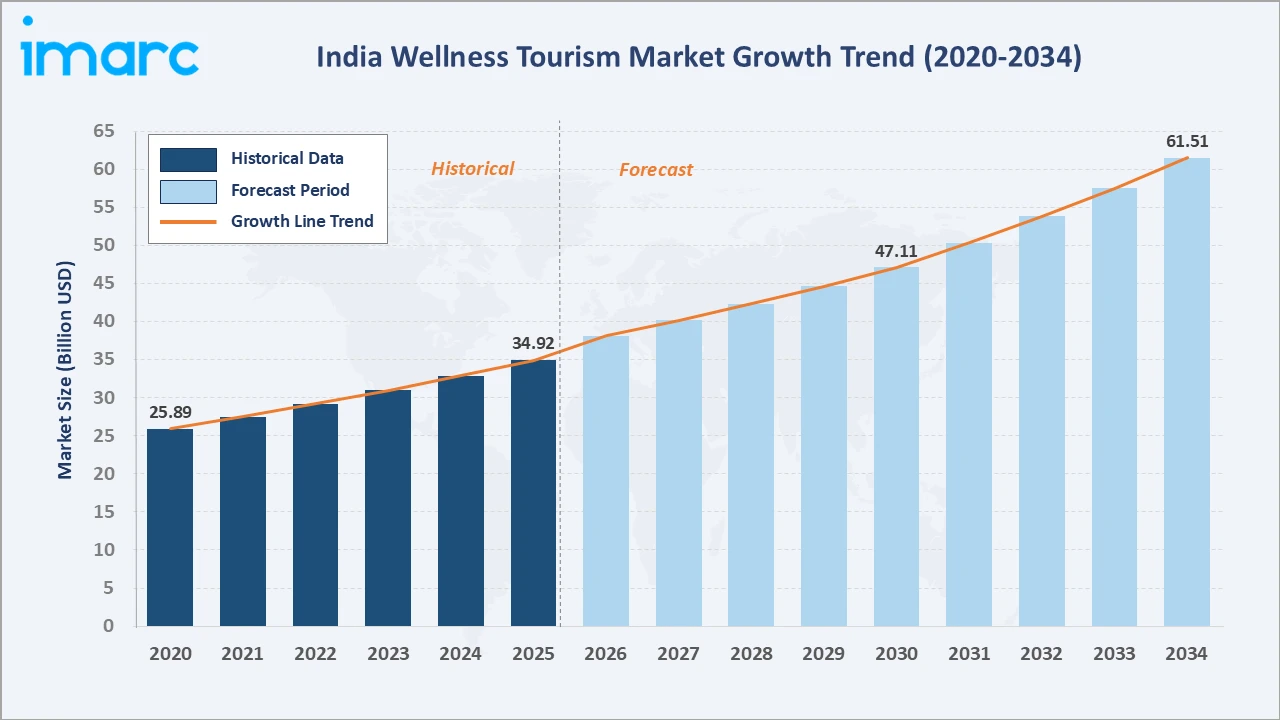
The India wellness tourism market was valued at USD 34.92 Billion in 2025 and is projected to reach USD 38.11 Billion in 2026, growing at a CAGR of 6.17% to attain USD 61.51 Billion by 2034. This growth reflects the increasing global and domestic interest in holistic health, preventive medicine, and experiential travel rooted in India's rich heritage of Ayurveda, yoga, and traditional healing practices.
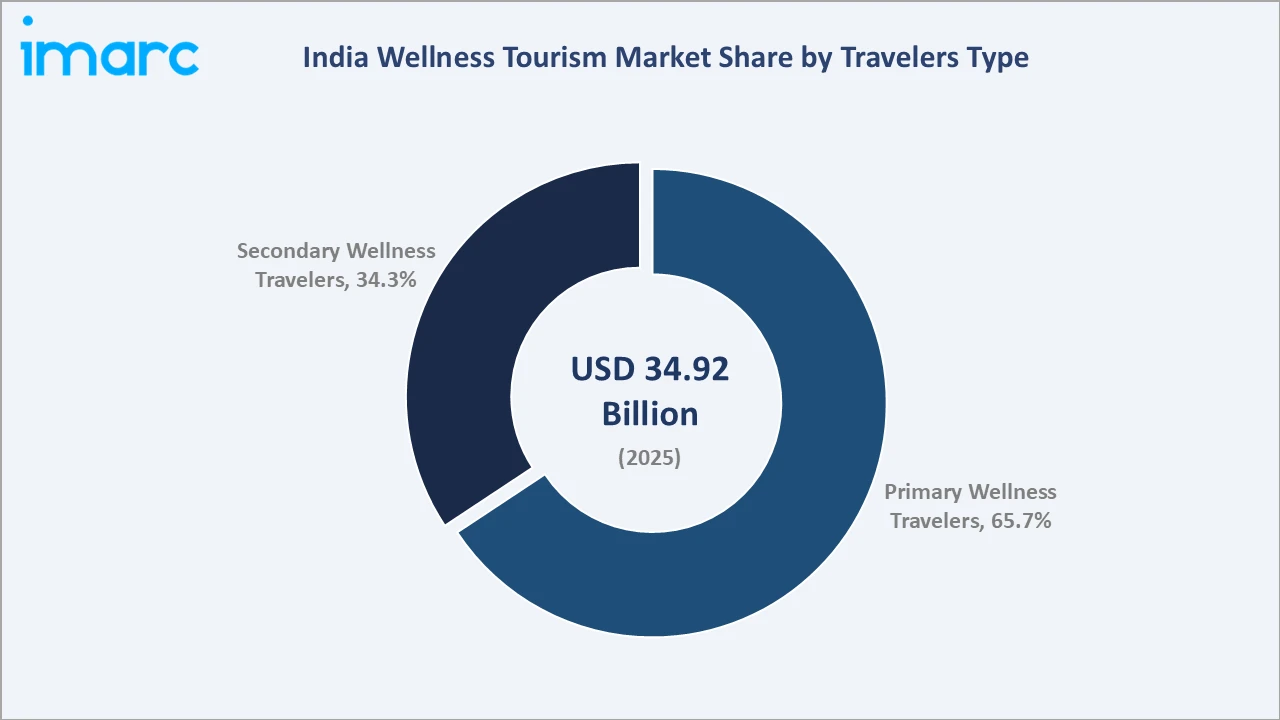
Primary wellness travelers dominate with 65.7% share in 2025, domestic tourism leads with 61.8% location share, and North India commands the leading regional share at 31.6%. The India health and wellness tourism market has emerged as a globally recognized segment, with the wellness tourism industry in India attracting travelers seeking authentic healing experiences, mental rejuvenation, and preventive health treatments.
Market Snapshot
|
Metric |
Value |
|
Base Year Market Size (2025) |
USD 34.92 Billion |
|
Market Size (2026) |
USD 38.11 Billion |
|
Forecast Year Market Size (2034) |
USD 61.51 Billion |
|
CAGR (2026-2034) |
6.17% |
|
Base Year |
2025 |
|
Historical Period |
2020-2025 |
|
Forecast Period |
2026-2034 |
|
Dominant Travelers Type |
Primary Wellness Travelers (65.7%, 2025) |
|
Dominant Location |
Domestic (61.8%, 2025) |
|
Leading Region |
North India (31.6%, 2025) |
The market has expanded from USD 25.89 Billion in 2020 to USD 34.92 Billion in 2025, with growth accelerating to USD 38.11 Billion in 2026, expected to reach USD 47.11 Billion by 2030, and projected to attain USD 61.51 Billion by 2034. This trajectory underscores the resilience and structural growth of wellness tourism in India, supported by government initiatives, rising health awareness, and expanding infrastructure.
To get more information on this market, Request Sample
India's wellness tourism sector is undergoing structural transformation driven by convergence of traditional healing wisdom with modern wellness concepts. Post-pandemic behavioral shifts have accelerated demand for preventive health travel, with consumers prioritizing mental well-being, stress management, and holistic rejuvenation alongside conventional leisure tourism.
Executive Summary
The India wellness tourism market is poised for robust expansion, projected to grow from USD 38.11 Billion in 2026 to USD 61.51 Billion by 2034, registering a CAGR of 6.17%. This growth is anchored in India's unparalleled legacy as a global center for Ayurveda, yoga, meditation, and traditional healing, attracting a growing cohort of health-aware travelers seeking transformative wellness experiences.
Primary wellness travelers dominate with 65.7% share in 2025, reflecting travelers who embed wellness as their core journey purpose. Domestic tourism leads with 61.8% location share, driven by rising wellness consciousness and improving accessibility to premium retreat destinations.
North India commands the leading regional share at 31.6%, driven by Rishikesh's Himalayan retreat ecosystem. South India's Kerala Ayurveda belt holds 24.1% share.
Key Market Insights
|
Insight |
Data |
|
Leading Travelers Type Segment |
Primary Wellness Travelers – 65.7% (2025) |
|
Dominant Location Segment |
Domestic Tourism – 61.8% (2025) |
|
Leading Region |
North India – 31.6% (2025) |
|
Market Opportunity |
Medical tourists, Ayurveda retreat visitors, rising health awareness, expanding infrastructure |
Key Analytical Observations Supporting the Above Data:
- Primary Travelers at 65.7%: Primary wellness travellers dominate the India wellness tourism market due to their strong intent-driven travel behaviour, where wellness is the core trip purpose rather than a supplementary activity. This segment encompasses medical tourists, Ayurveda retreat visitors, and yoga immersion travellers who select destinations specifically for therapeutic outcomes, contributing disproportionately to per-trip revenue and extended length-of-stay metrics across certified wellness facilities.
- Domestic Tourism at 61.8%: Domestic wellness tourism leads market share owing to rising health consciousness among India’s urban middle class, improved connectivity to established wellness hubs such as Rishikesh, Kerala, and Mysuru, and the cost advantage of domestic retreats over international alternatives.
- North India at 31.6%: North India leads regional market share driven by the globally recognized spiritual and wellness destinations of Rishikesh and Haridwar, robust yoga and meditation retreat infrastructure, and strong inbound international traveller interest in Himalayan wellness experiences.
India Wellness Tourism Market Overview
India's wellness tourism market represents a convergence of ancient healing traditions and contemporary health travel demand. The country's diverse geographic and cultural landscape, from the Himalayan yoga circuits of Uttarakhand to Kerala's backwater Ayurveda centers and Rajasthan's palace spa retreats, offers a uniquely rich wellness proposition that distinguishes India from other global wellness destinations.
The market spans Ayurvedic treatments, yoga and meditation retreats, naturopathy centers, spiritual pilgrimages with wellness components, spa resorts, and medical wellness tourism. This diversity enables India to cater to a wide traveller demographic, from luxury seekers to budget-conscious wellness enthusiasts, generating revenue across multiple hospitality and service verticals.
Market Dynamics
To evaluate market opportunities, Request Sample
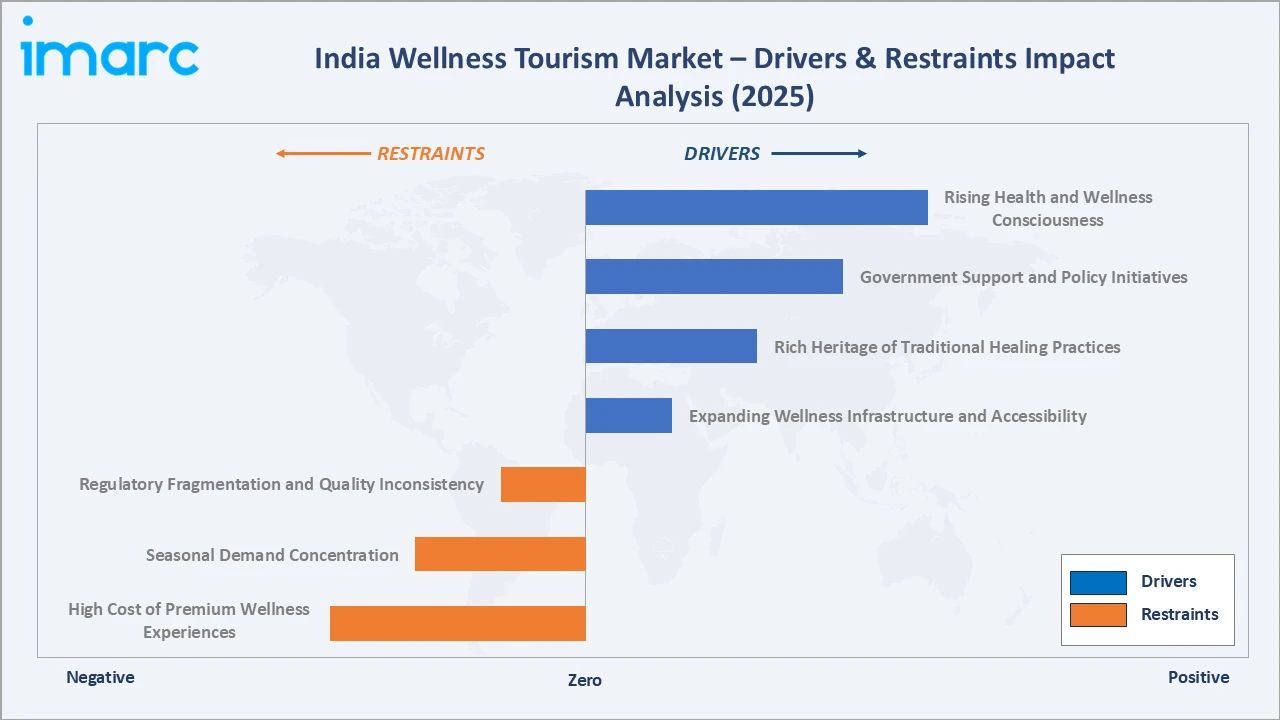
Market Drivers
- Rising Health and Wellness Consciousness: Growing awareness about preventive healthcare and mental well-being is prompting Indian and global travelers to seek wellness-centric experiences. Post-pandemic shifts have elevated interest in Ayurveda, yoga, and naturopathy, with consumers viewing wellness tourism as a long-term health investment rather than mere leisure.
- Government Support and Policy Initiatives: India's Ministry of Ayush and Tourism Department have implemented targeted initiatives through Incredible India campaigns and AYUSH visa provisions. Strategic public-private partnerships and Ayurvedic tourism certification frameworks have expanded organized wellness tourism infrastructure, improving quality standards and international competitiveness.
- Rich Heritage of Traditional Healing Practices: India's millennia-old traditions in Ayurveda, yoga, Siddha, Unani, and naturopathy provide an authentic healing proposition that mass-market spa destinations cannot replicate. This cultural differentiator attracts international wellness seekers, creating premium market segments and enabling higher yield per traveler through experience-rich wellness journeys.
- Expanding Wellness Infrastructure and Accessibility: Rapid development of luxury wellness resorts, eco-retreats, and certified Ayurvedic hospitals across Tier-2 and Tier-3 destinations is broadening access to wellness experiences. Improved air connectivity, highway infrastructure, and digital booking platforms are reducing planning friction, enabling a larger domestic consumer base to access previously remote retreat destinations.
Market Restraints
- Regulatory Fragmentation and Quality Inconsistency: Absence of a unified national certification framework results in significant quality variance across practitioners, retreat centers, and Ayurvedic treatment facilities. This regulatory gap erodes consumer confidence, particularly among international travelers who cannot easily differentiate authentic wellness establishments from unqualified operators offering substandard treatments.
- Seasonal Demand Concentration: India's wellness tourism demand is heavily concentrated in October through March, creating significant revenue volatility and complicating year-round staffing and investment planning. Peak-season overcrowding at destinations like Rishikesh and Kerala diminishes experiential quality, while monsoon and summer off-seasons generate insufficient revenue to sustain premium properties at optimal efficiency.
- High Cost of Premium Wellness Experiences: Luxury wellness retreats and Panchakarma treatment programs commanding USD 200–500 per night remain beyond the price range of India's large middle-class consumer base. This affordability gap limits mass market penetration and constrains volume growth, even as aspirational demand remains strong across urban demographics increasingly aware of wellness tourism benefits.
Market Opportunities
- Digital Wellness Platform Integration: Convergence of digital health technologies with physical wellness travel creates opportunities for hybrid wellness journey models combining pre-travel digital consultations, AI-driven retreat programming, and post-travel health monitoring. Operators investing in digital-physical integration can command premium pricing and build recurring customer relationships with tech-savvy wellness travelers seeking measurable health outcomes.
- Emerging Wellness Tourism Destinations: Beyond Rishikesh and Kerala, destinations including Sikkim, Meghalaya, and Arunachal Pradesh present compelling opportunities for differentiated wellness product development. Government-supported wellness village projects and eco-retreat certification programs in these regions offer early-mover advantages for operators seeking leadership in underserved geographic markets with authentic wellness propositions.
Market Challenges
- Skilled Wellness Practitioner Shortage: Rapid expansion of wellness tourism facilities has outpaced supply of certified Ayurvedic therapists, yoga instructors, and naturopathy practitioners, creating quality delivery constraints. Bridging this workforce gap requires investment in accredited training institutions, certification pathways, and competitive compensation to retain qualified professionals in organized tourism settings.
- Competition from International Wellness Destinations: India faces intensifying competition from Thailand, Bali, Sri Lanka, and the Maldives, which offer comparable infrastructure, marketing sophistication, and multi-lingual service delivery at competitive prices. Maintaining India's positioning requires investment in quality standardization, international marketing, visa facilitation, and digital experience improvements that reduce friction for international wellness travelers.
Emerging Market Trends
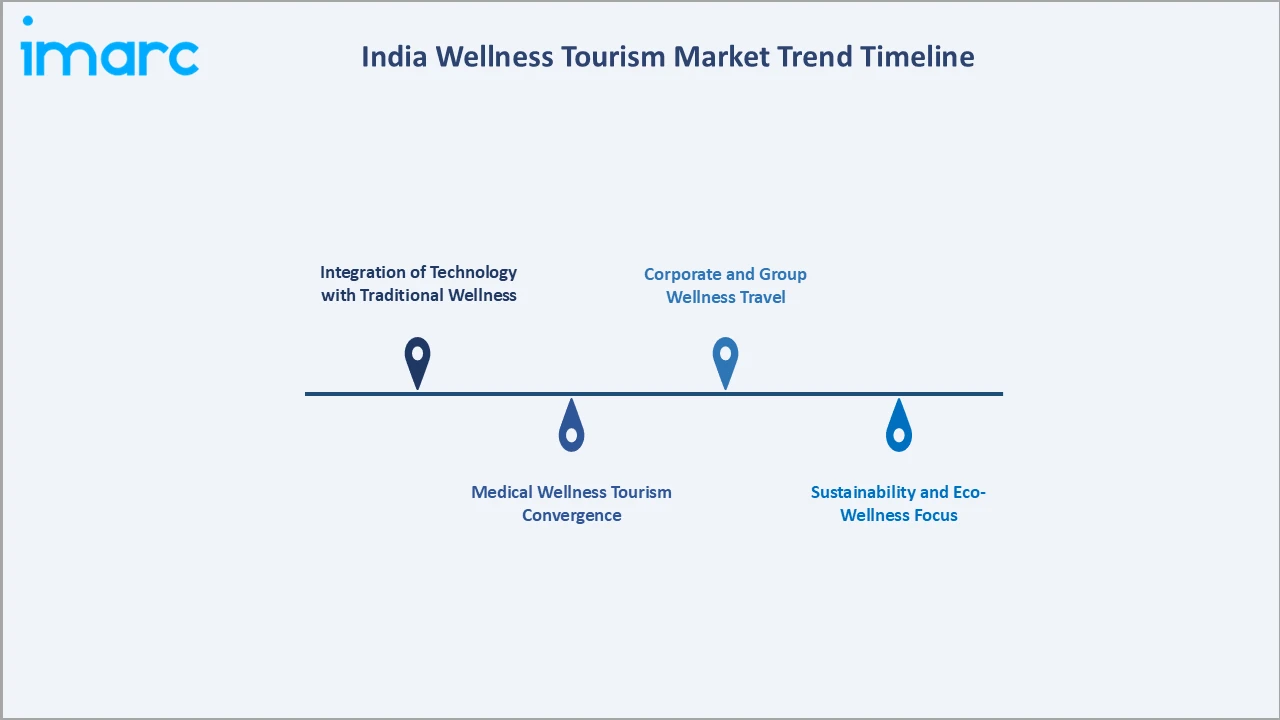
1. Integration of Technology with Traditional Wellness
Wellness retreats are integrating wearable health monitoring devices, AI-powered wellness assessments, and telemedicine consultations into traditional Ayurvedic and yoga programs. This tech-wellness fusion enables personalized treatment optimization, real-time health tracking, and data-driven post-retreat maintenance programs extending commercial relationships beyond the physical stay.
2. Medical Wellness Tourism Convergence
The boundary between medical tourism and wellness tourism is blurring, with premium operators developing integrated programs combining preventive diagnostics, genomic health assessments, and traditional healing modalities. This convergence creates a high-value segment targeting high-net-worth individuals seeking comprehensive health optimization through modern medicine and classical Indian healing traditions.
3. Sustainability and Eco-Wellness Focus
Environmental sustainability is becoming a primary purchasing criterion for wellness travelers globally, driving Indian retreat operators to invest in eco-certified construction, renewable energy systems, zero-waste kitchen programs, and organic farming. Eco-wellness retreats commanding 20–30% pricing premiums attract environmentally conscious international tourists seeking restorative experiences aligned with their environmental values.
4. Corporate and Group Wellness Travel
Organizations across India's major corporate hubs are incorporating wellness retreats into employee wellness programs and leadership development initiatives, creating a structurally growing B2B segment. Corporate wellness packages combining stress management, mindfulness training, and Ayurvedic rejuvenation offer operators predictable high-volume booking streams offsetting seasonal demand volatility.
Industry Value Chain Analysis
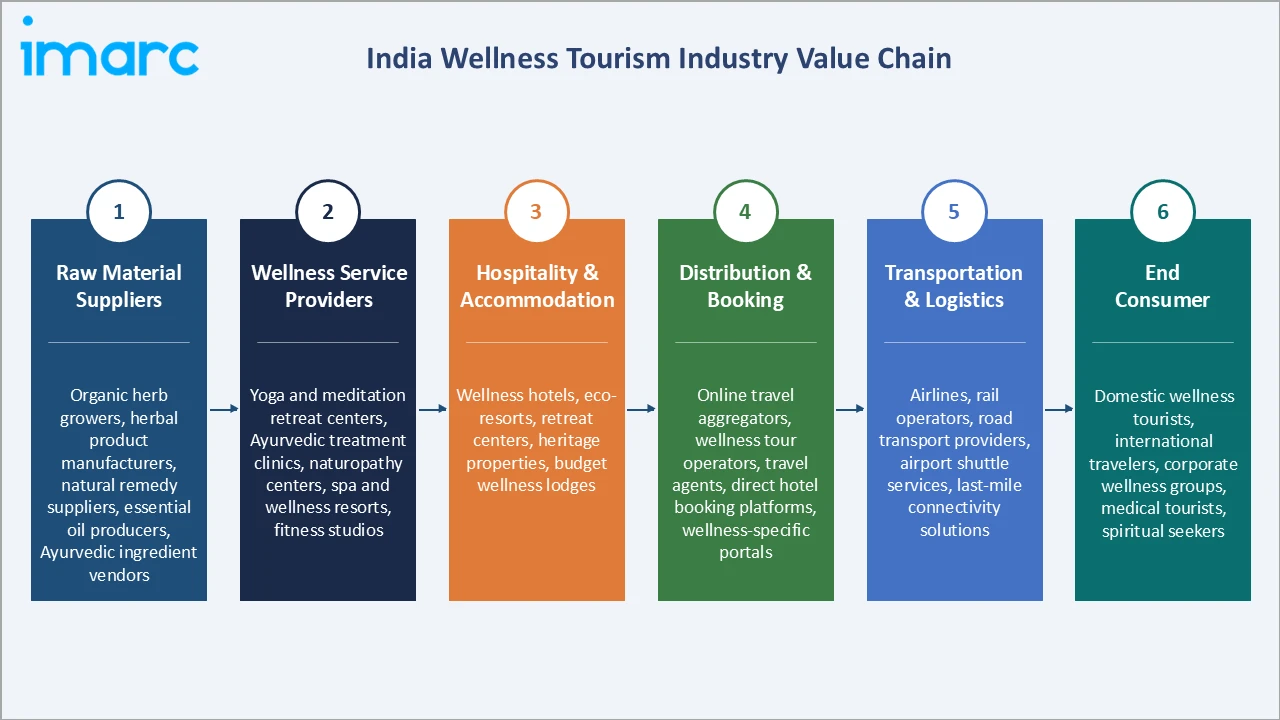
The India wellness tourism value chain encompasses interconnected stakeholders spanning raw material suppliers, service providers, hospitality operators, distribution intermediaries, transportation networks, and end consumers. Each stage adds distinct value and is subject to varying degrees of regulatory oversight, competitive intensity, and digital disruption.
|
Stage |
Key Participants |
|
Raw Material Suppliers |
Organic herb growers, herbal product manufacturers, natural remedy suppliers, essential oil producers, Ayurvedic ingredient vendors |
|
Wellness Service Providers |
Yoga and meditation retreat centers, Ayurvedic treatment clinics, naturopathy centers, spa and wellness resorts, fitness studios |
|
Hospitality & Accommodation |
Wellness hotels, eco-resorts, retreat centers, heritage properties, budget wellness lodges |
|
Distribution & Booking |
Online travel aggregators, wellness tour operators, travel agents, direct hotel booking platforms, wellness-specific portals |
|
Transportation & Logistics |
Airlines, rail operators, road transport providers, airport shuttle services, last-mile connectivity solutions |
|
End Consumer |
Domestic wellness tourists, international travelers, corporate wellness groups, medical tourists, spiritual seekers |
Value chain efficiency is increasingly determined by digital integration across booking, service delivery, and post-stay wellness monitoring. Operators who vertically integrate from on-site organic ingredient cultivation to direct digital booking channels achieve superior margin capture and stronger traveler loyalty than those relying on fragmented, commission-intensive intermediary relationships.
Technology Landscape in the India Wellness Tourism Industry
Digital Booking and Experience Platforms
Online wellness travel platforms, specialized retreat booking portals, and AI-powered personalization engines are transforming how travelers discover and book wellness experiences in India. These platforms aggregate inventory, enable user-generated reviews, support dynamic pricing, and offer virtual pre-retreat consultations, reducing booking friction and expanding India's addressable wellness market globally.
Wellness Technology and Health Monitoring
Integration of wearable health monitoring devices, biometric assessment tools, and real-time analytics within retreat programs enables quantified wellness outcomes. Ayurvedic wellness centers are adopting digital Prakriti assessment tools, genetic predisposition analysis, and AI-based dosha profiling to deliver personalized treatment recommendations elevating clinical credibility of traditional Indian healing practices.
Sustainable and Smart Wellness Infrastructure
Smart building technologies, solar energy systems, IoT-enabled environmental management, and sustainable water solutions are becoming standard investments for premium wellness properties seeking eco-certification. Digital energy management reduces operational costs while supporting sustainability brand positioning, with leading resorts achieving net-zero footprints that differentiate them in premium international wellness tourism marketing.
Market Segmentation Analysis
The report covers the following segments:
| Segment | Leading Category | Market Share | Year |
|---|---|---|---|
| Travelers Type | Primary | 65.7% | 2025 |
| Service Type | 🔒 | 🔒 | 2025 |
| Location | Domestic | 61.8% | 2025 |
| Region | North India | 31.6% | 2025 |

By Travelers Type
Primary wellness travelers constitute 65.7% of the market in 2025, representing individuals for whom wellness activities form the central purpose of travel. This segment drives demand for comprehensive retreat packages and specialized Ayurvedic treatment programs.
To access detailed market analysis, Request Sample
Secondary wellness travelers (34.3%) incorporate wellness components within broader leisure itineraries, creating ancillary revenue streams for mainstream hospitality operators. Their demand supports the integration of spa services, yoga sessions, and wellness-focused dining into conventional travel packages, enabling hospitality providers to diversify offerings and increase per-guest spending.
By Location
Domestic wellness tourism commands 61.8% market share in 2025, driven by growing health consciousness and rising disposable incomes among India's urban middle class. The segment also benefits from affordable wellness retreats, improved connectivity to domestic destinations, and growing demand for preventive healthcare and stress-management experiences.
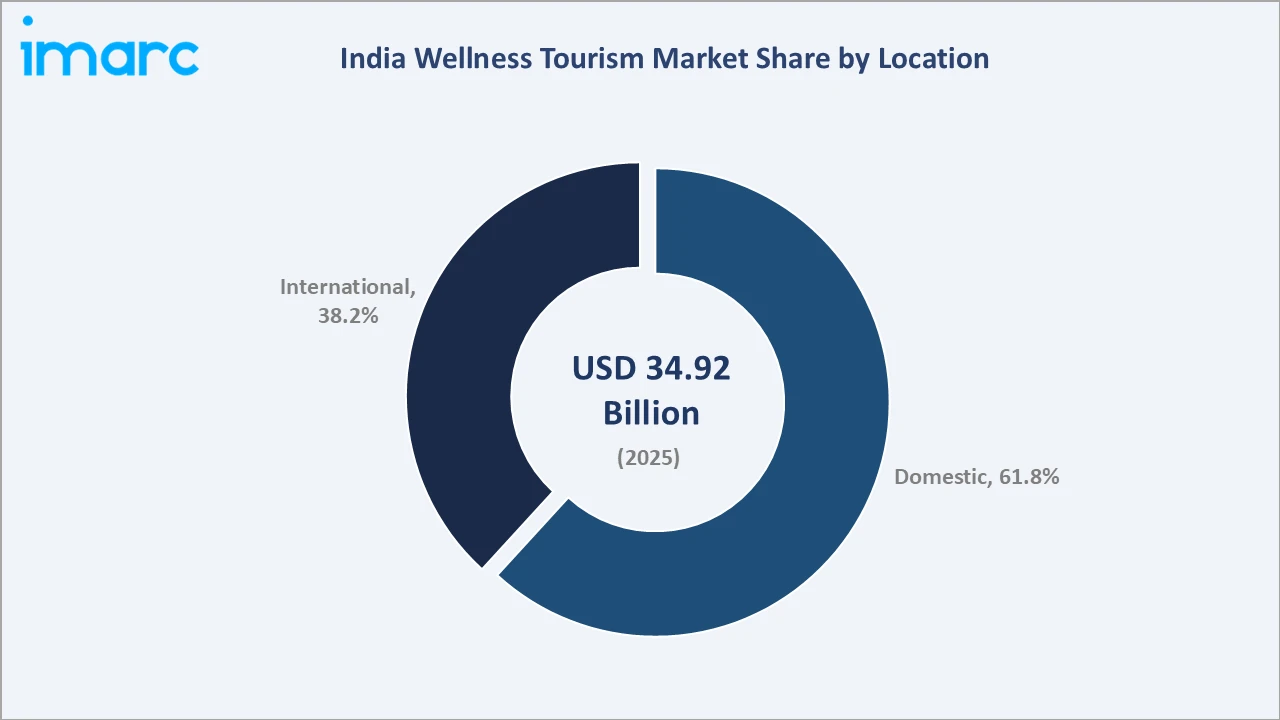
International wellness tourism (38.2%) generates disproportionately higher revenue per traveler, with international visitors attracted by India's authentic Ayurvedic and yoga heritage undertaking longer stays with significantly higher per-night expenditure. The segment is further supported by India's competitive treatment costs, established wellness retreats, and increasing global interest in traditional Indian healing practices.
Regional Market Insights
|
Region |
Share (2025) |
Key Drivers |
|
North India |
31.6% |
Himalayan retreats, yoga capital (Rishikesh), Ayurvedic heritage, robust infrastructure |
|
West & Central India |
27.8% |
Goa beach wellness, Maharashtra spa culture, tribal wellness traditions, desert retreats in Rajasthan |
|
South India |
24.1% |
Kerala Ayurveda tourism, temple wellness circuits, coastal retreats, traditional Kalaripayattu centers |
|
East & Northeast India |
16.5% |
Buddhist meditation circuits, tribal healing traditions, natural hot springs, eco-wellness lodges |
North India's 31.6% share is anchored by Rishikesh's positioning as the global yoga capital, the Himalayan wellness corridors of Uttarakhand and Himachal Pradesh, and Rajasthan's heritage palace wellness properties. This region benefits from strong international brand recognition, developed hospitality infrastructure, and government promotion through dedicated yoga and wellness tourism initiatives.
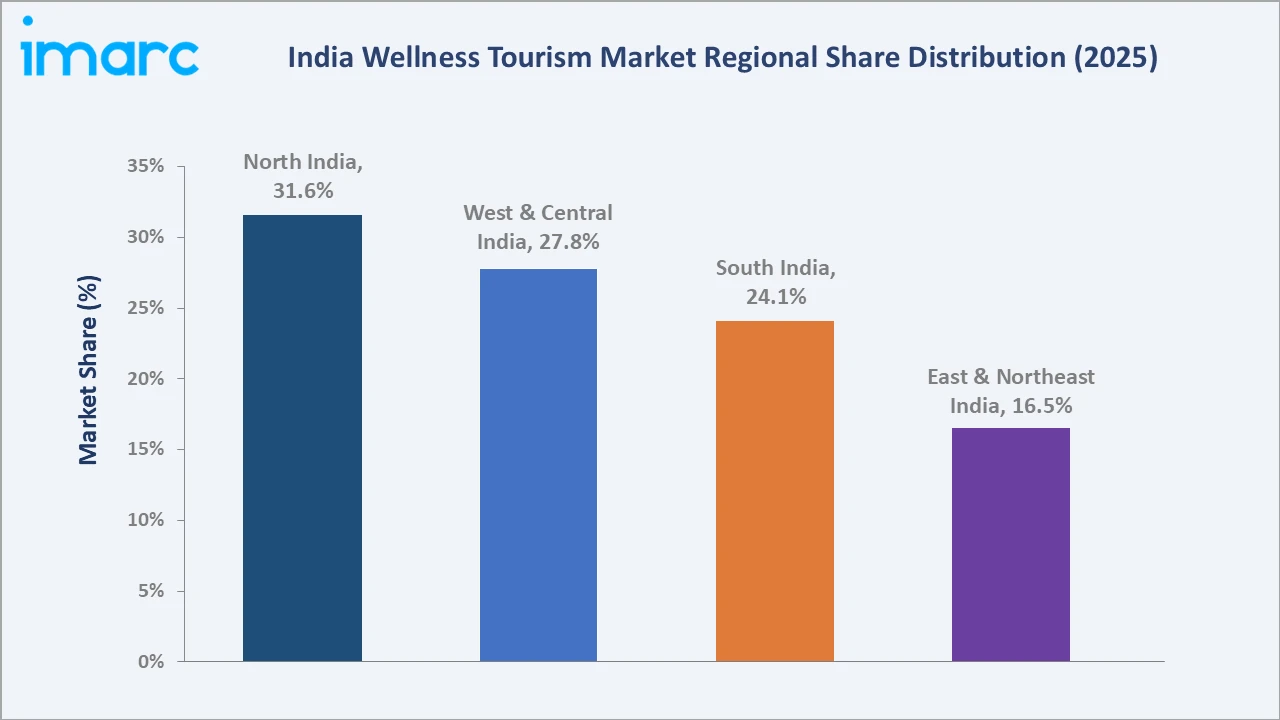
South India's ecosystem, led by Kerala's Ayurveda belt, is India's most clinically sophisticated wellness offering, with state-certified treatment centers and established quality frameworks supporting high-yield international medical wellness tourism. West and Central India's 27.8% share reflects Goa's resort wellness ecosystem, while East and Northeast India presents untapped growth potential through tribal healing traditions and Buddhist meditation circuits.
Competitive Landscape
The India wellness tourism competitive landscape features a heterogeneous mix of luxury heritage wellness resorts, specialized Ayurvedic chains, large hospitality conglomerates, spiritual wellness organizations, and boutique eco-wellness operators. Differentiation is primarily achieved through authentic healing heritage, location uniqueness, practitioner expertise, and depth of wellness programming.
| Company | Key Services | Market Position | Core Strength |
|---|---|---|---|
| IHHR Hospitality Ananda Pvt. Ltd. | Ayurveda, Yoga, Spa | Premium luxury segment leader | IHHR Hospitality redefined India’s luxury wellness tourism segment by establishing Ananda in the Himalayas as a globally acclaimed destination spa |
| Kairali Ayurvedic Group | Panchakarma, Wellness Packages | Heritage Ayurveda specialist | Kairali Ayurvedic Group has built an internationally recognized brand around authentic Panchakarma therapies and classical Kerala Ayurveda |
| The Indian Hotels Company Limited | Spa, Fitness, Retreats | Largest luxury network | The Indian Hotels Company Limited, through its Taj, SeleQtions, and Vivanta brands, operates the widest network of luxury wellness facilities across India |
| The Art of Living | Yoga, Meditation, Breathing | Spiritual wellness leader | The Art of Living Foundation has established itself as the world’s largest wellness and spiritual organization, drawing millions of participants annually to its yoga, Sudarshan Kriya breathing, and meditation programs |
| Hotel & Allied Trades Private Ltd | Eco-wellness, Ayurveda, Village stays | Sustainable wellness pioneer | Hotel & Allied Trades differentiates through eco-certified wellness properties and authentic village immersion experiences, pioneering a sustainable tourism |
Key players include IHHR Hospitality Ananda Pvt. Ltd., Kairali Ayurvedic Group, The Indian Hotels Company Limited, The Art of Living, Hotel & Allied Trades Private Ltd, and others.
Key Company Profiles
IHHR Hospitality Ananda Pvt. Ltd.
IHHR Hospitality Ananda Pvt. Ltd. is India's premier destination wellness retreat near Rishikesh, offering Ayurvedic therapies, international wellness modalities, yoga, and meditation programs within a UNESCO heritage palace estate, positioning it among Asia's most iconic luxury wellness brands.
- Key Services: Ananda offers signature Ayurvedic programs, Panchakarma detoxification, yoga and meditation retreats, spa therapies, and personalized wellness journeys combining traditional Indian healing with evidence-based modern wellness practices for international and domestic luxury travelers.
- Strategic Focus: Ananda's strategy focuses on reinforcing global luxury brand positioning through ultra-personalized healthcare integration, expanding international medical wellness referral networks, and developing branded satellite experiences in Tier-2 Indian cities to capture the growing domestic premium wellness segment seeking Ananda-quality healing experiences.
Kairali Ayurvedic Group
Kairali Ayurvedic Group is a pioneer in authentic Kerala Ayurveda wellness tourism, operating the acclaimed Kairali Ayurvedic Healing Village alongside international wellness centers, offering Panchakarma, rejuvenation therapies, and Ayurvedic lifestyle programs rooted in over three decades of heritage practice.
- Key Services: Kairali specializes in authentic Panchakarma detoxification, Rasayana rejuvenation, Ayurvedic weight management, chronic disease management through traditional protocols, and customized treatment packages for international wellness tourists seeking medically supervised traditional Kerala healing experiences.
- Strategic Focus: Kairali's strategy focuses on scaling its international franchise model while preserving treatment authenticity, developing clinically validated Ayurvedic efficacy research, expanding its certified organic herbal product range, and establishing a recognized global certification standard for authentic Kerala Ayurveda.
Market Concentration Analysis
The India wellness tourism market exhibits a moderately fragmented structure, with the top five operators accounting for approximately 28–32% of organized market revenue. Fragmentation reflects geographic diversity, location-specific authenticity requirements, and the meaningful role of smaller specialist operators commanding loyal international customer bases through deep expertise in specific Indian healing traditions.
Concentration is highest in the luxury segment, where properties like Ananda, Vana, and Shreyas capture a disproportionate share of high-yield international wellness tourists. Mid-market and budget segments remain highly fragmented, with regional operators, ashram retreat centers, and Ayurvedic hospitals competing on price, authenticity credentials, and specialized therapeutic program differentiation.
Investment & Growth Opportunities
Highest Growth Segments
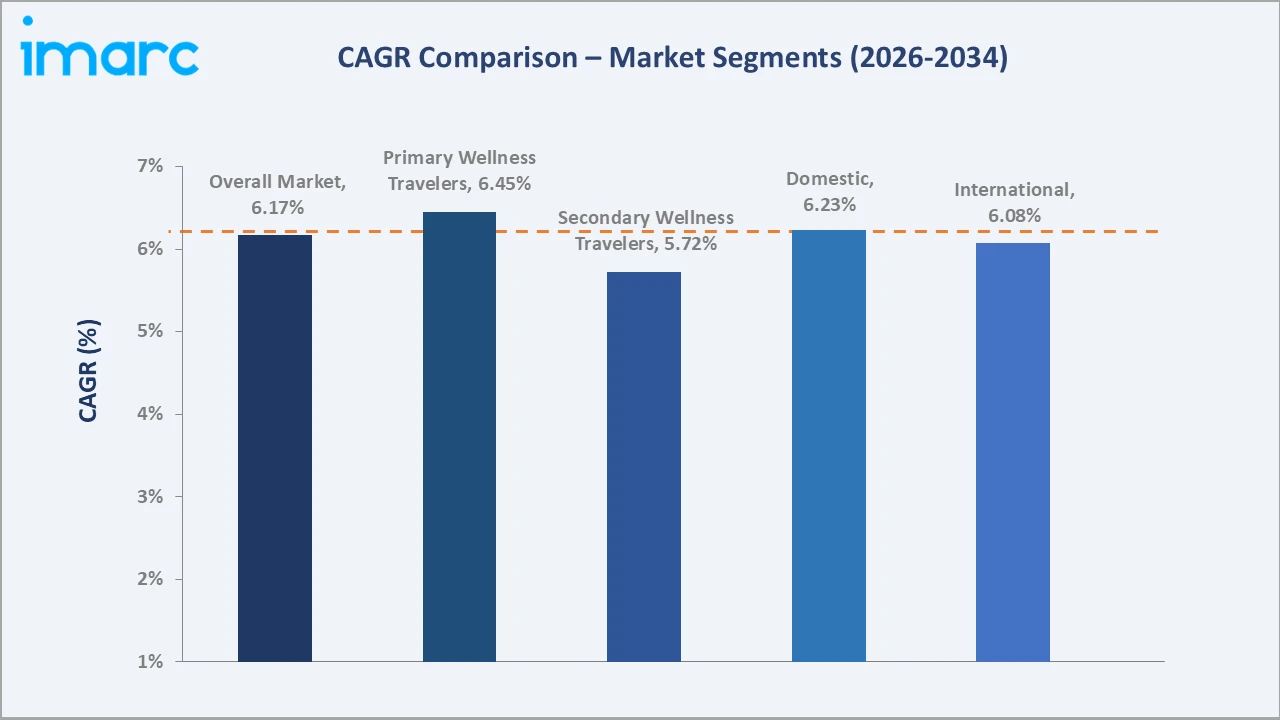
Primary travelers represent the fastest-growing segment, projected to expand at a CAGR of 6.45% and domestic wellness at 6.23% CAGR. International wellness is expected to grow at 6.08% CAGR, while secondary travelers record the lowest projected CAGR of 5.72%. The growth outlook highlights increasing demand for dedicated wellness travel and sustained expansion across both domestic and international wellness tourism.
Emerging Investment Opportunities
Northeast India presents compelling greenfield opportunities for wellness resort development, with Sikkim, Meghalaya, and Manipur offering government incentives, pristine natural environments, and authentic tribal healing traditions that differentiate products from established Southern and Northern India circuits. Digital wellness platforms enabling seamless booking, AI personalization, and wearable health integration represent technology-layer opportunities with scalable returns.
Investment Themes
- Sustainability-Integrated Wellness Infrastructure: Eco-certified wellness property development combining net-zero operational design with authentic Indian healing programs commands 20–35% revenue premiums while qualifying for government eco-tourism incentives and premium international distribution through sustainability-focused wellness travel platforms targeting environmentally conscious high-net-worth travelers.
- Technology-Enabled Wellness Personalization: Investment in AI-powered wellness assessment platforms, genomic profiling, wearable health analytics, and digital practitioner consultation tools creates competitive advantages enabling operators to deliver measurable, personalized health outcomes that justify premium pricing and extend revenue relationships with wellness travelers beyond the physical retreat stay.
Future Market Outlook (2026-2034)
The India wellness tourism market is projected to grow from USD 38.11 Billion in 2026 to USD 61.51 Billion by 2034, representing a compound annual growth rate of 6.17% through the forecast period. This robust growth trajectory is underpinned by structurally favorable demand drivers including rising health consciousness, growing disposable incomes, expanding international wellness tourism arrivals, and India's enduring competitive advantage in authentic traditional healing experiences.
The forecast period will witness accelerated growth in premium medical wellness tourism, driven by India's competitive positioning combining authentic traditional healing modalities with internationally competitive healthcare standards at lower cost than equivalent Western destinations. The USD 47.11 Billion milestone projected for 2030 reflects the mainstreaming of wellness tourism among India's urban middle class.
Research Methodology
Primary Research
Primary research involved structured interviews with wellness resort operators, Ayurvedic practitioners, travel agents, tourism board officials, and international wellness travelers visiting India. Field research across Rishikesh, Kerala, Goa, and Rajasthan provided market intelligence on demand patterns, pricing dynamics, traveler demographics, and emerging service innovations.
Secondary Research
Secondary research incorporated analysis of India's Ministry of Tourism annual reports, Ayush Ministry wellness tourism statistics, and Global Wellness Institute industry reports. Wellness tourism in india market statistics compiled from the UN World Tourism Organization, academic literature, and company annual reports form the quantitative foundation of the wellness tourism market india sizing analysis. International benchmarking data from Thailand, Bali, and Sri Lanka informed competitive positioning.
Forecasting Models
Market size forecasts were developed using bottom-up and top-down modeling approaches incorporating historical growth rates, macroeconomic demand drivers, government policy impact assessments, and competitive intensity analysis. Scenario modeling with optimistic, base, and conservative assumptions validated the 6.17% CAGR forecast, with Monte Carlo simulation applied to quantify uncertainty ranges across key market sizing variables.
India Wellness Tourism Market Report Coverage:
| Report Features | Details |
|---|---|
| Base Year of the Analysis | 2025 |
| Historical Period | 2020-2025 |
| Forecast Period | 2026-2034 |
| Units | Billion USD |
| Scope of the Report |
Exploration of Historical Trends and Market Outlook, Industry Catalysts and Challenges, Segment-Wise Historical and Future Market Assessment:
|
| Travelers Type Covered | Primary, Secondary |
| Service Types Covered | Transport, Lodging, Food and Beverage, Shopping, Activities and Excursion, Others |
| Locations Covered | Domestic, International |
| Regions Covered | North India, West and Central India, South India, East and Northeast India |
| Companies Covered | IHHR Hospitality Ananda Pvt. Ltd., Kairali Ayurvedic Group, The Indian Hotels Company Limited, The Art of Living, Hotel & Allied Trades Private Ltd, etc. |
| Customization Scope | 10% Free Customization |
| Post-Sale Analyst Support | 10-12 Weeks |
| Delivery Format | PDF and Excel through Email (We can also provide the editable version of the report in PPT/Word format on special request) |
Key Benefits for Stakeholders:
- IMARC’s industry report offers a comprehensive quantitative analysis of various market segments, historical and current market trends, market forecasts, and dynamics of the India wellness tourism market from 2020-2034.
- The research report provides the latest information on the market drivers, challenges, and opportunities in the India wellness tourism market.
- Porter's five forces analysis assist stakeholders in assessing the impact of new entrants, competitive rivalry, supplier power, buyer power, and the threat of substitution. It helps stakeholders to analyze the level of competition within the India wellness tourism industry and its attractiveness.
- Competitive landscape allows stakeholders to understand their competitive environment and provides an insight into the current positions of key players in the market.
Frequently Asked Questions About the India Wellness Tourism Market Report
The India wellness tourism market was valued at USD 34.92 Billion in 2025 and is projected to reach USD 38.11 Billion in 2026, growing at a CAGR of 6.17% to attain USD 61.51 Billion by 2034.
The India wellness tourism market is projected to grow at a CAGR of 6.17% during 2026-2034, driven by rising health consciousness, expanding wellness infrastructure, and growing international traveler arrivals seeking authentic Indian healing experiences.
Primary wellness travelers dominate with 65.7% of total market share in 2025, undertaking journeys where wellness forms the central purpose, including Ayurvedic retreats, yoga immersions, and dedicated resort stays that generate higher per-trip expenditure than secondary wellness travelers.
Domestic wellness tourism leads with 61.8% market share in 2025, reflecting growing health consciousness among India's urban middle class. Domestic travelers increasingly seek extended wellness retreats within India, supported by improved connectivity to established wellness tourism hubs.
North India holds the largest regional share at 31.6% in 2025, driven by Rishikesh's positioning as the global yoga capital, the Himalayan retreat ecosystems of Uttarakhand and Himachal Pradesh, and Rajasthan's luxury heritage wellness properties.
Key growth drivers include rising health consciousness, strong government support through Ministry of Ayush and tourism promotion initiatives, India's unparalleled Ayurveda and yoga heritage, expanding wellness resort infrastructure across new destinations, and growing digital integration with traditional wellness service delivery.
Leading companies include IHHR Hospitality Ananda Pvt. Ltd., Kairali Ayurvedic Group, The Indian Hotels Company Limited, The Art of Living, Hotel & Allied Trades Private Ltd, and others.
Key challenges include regulatory fragmentation, seasonal demand concentration limiting year-round revenue, high cost barriers restricting mass market access to premium experiences, shortage of certified skilled practitioners, and intensifying competition from Southeast Asian wellness destinations offering comparable experiences at competitive price points.
Need more help?
- Speak to our experienced analysts for insights on the current market scenarios.
- Include additional segments and countries to customize the report as per your requirement.
- Gain an unparalleled competitive advantage in your domain by understanding how to utilize the report and positively impacting your operations and revenue.
- For further assistance, please connect with our analysts.
 Request Customization
 Speak to an Analyst
 Request Brochure
 Inquire Before Buying
Benefits of Customization
- Personalize this research
- Triangulate with your data
- Get data as per your format and definition
- Gain a deeper dive into a specific application, geography, customer, or competitor
- Any level of personalization
Get in Touch With Us
UNITED STATES
Phone: +1-201-971-6302
INDIA
Phone: +91-120-433-0800
UNITED KINGDOM
Phone: +44-753-714-6104
Email: [email protected]
Client Testimonials













Related Reports

Choose your plan
*Please note that the prices mentioned below are starting prices for each bundle type. Kindly contact our team for further details.*
Single User License
- 1 User License, Access on 2 Devices
- PDF Report + Excel Dataset (Password Protected)
- Lifetime Access
- No Printing Rights
- 10% Free Report Customization
- 10–12 Weeks of Analyst Support
Five User License
- Access for 5 Users, 2 Devices per User
- PDF Report + Excel Dataset (Password Protected)
- Lifetime Access
- Dedicated Account Manager
- 12–14 Weeks of Analyst Support
- No Printing Rights
- 15% Free Report Customization
- 25% Discount on Your Next Purchase
Corporate User License
- Unlimited User Access (Within Your Organization)
- PDF Report + Excel Dataset
- Lifetime Access
- Dedicated Account Manager
- 14–20 Weeks of Analyst Support
- No Printing Rights
- 20% Free Report Customization
- 30% Discount on Your Next Purchase
Essential Insights
What's included:
3 reports
- Lifetime Access
- PDF Reports
- Excel Datasets
- 2 Weeks of Free Analyst Support
- 2 User Licenses
- Access on 2 Devices
- Printing Rights
- Complimentary PowerPoint (PPT) Version
- Complimentary License Upgrade
Professional Access
What's included:
5 reports
- Lifetime Access
- PDF Reports
- Excel Datasets
- 8 Weeks of Free Analyst Support
- 2 User Licenses
- Access on 2 Devices
- Printing Rights
- Complimentary PowerPoint (PPT) Version
- Complimentary License Upgrade
Business Advantage
What's included:
8 reports
- Lifetime Access
- PDF Reports
- Excel Datasets
- 14 Weeks of Free Analyst Support
- 2 User Licenses
- Access on 2 Devices
- Printing Rights
- Complimentary PowerPoint (PPT) Version
- Complimentary License Upgrade
Enterprise Intelligence
What's included:
10 reports
- Lifetime Access
- PDF Reports
- Excel Datasets
- 20 Weeks of Free Analyst Support
- 2 User Licenses
- Access on 2 Devices
- Printing Rights
- Complimentary PowerPoint (PPT) Version
- Complimentary License Upgrade