
Japan Chocolate Market Size, Share, Trends and Forecast by Product Type, Product Form, Application, Pricing, Distribution, and Region, 2026-2034
Japan Chocolate Market Size, Share, Trends & Forecast (2026-2034)
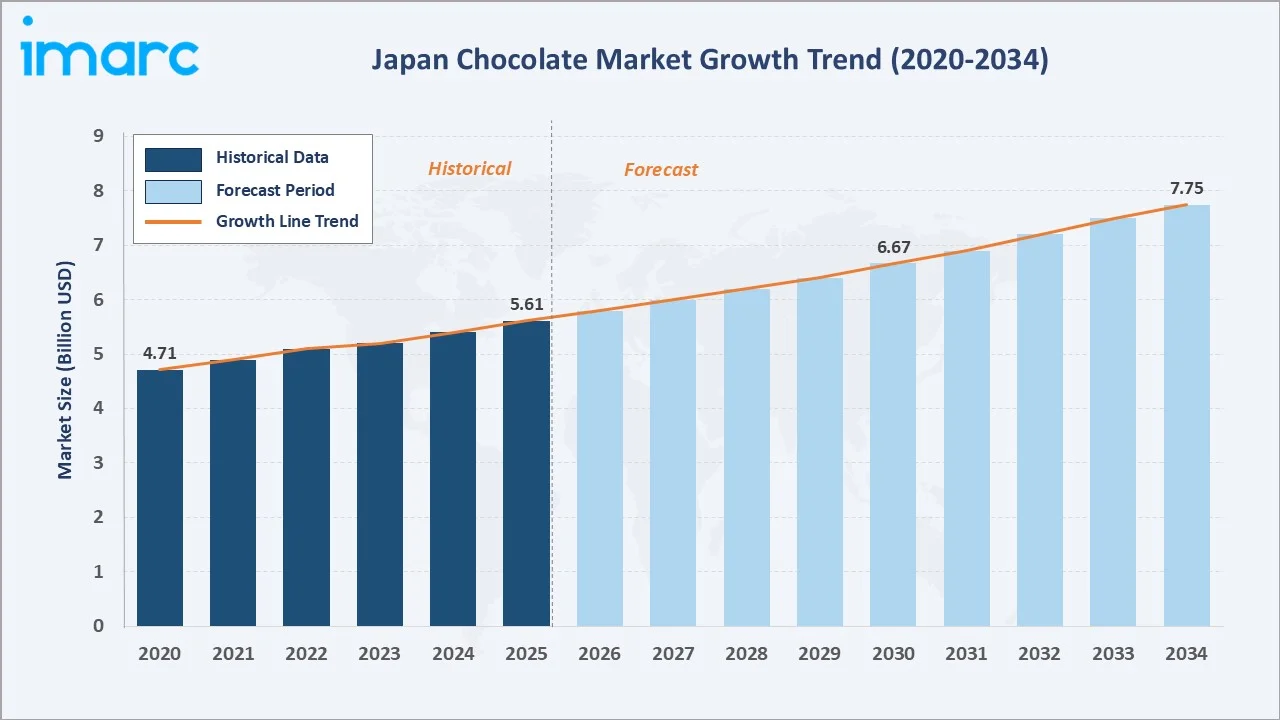
The Japan chocolate market grew from USD 5.61 Billion in 2025 to USD 5.86 Billion in 2026 and is projected to reach USD 7.75 Billion by 2034, growing at a CAGR of 3.55% during 2026-2034. Rising demand for premium, health-oriented, and gift-format chocolate is driving sustained market expansion. Milk Chocolate dominates at 52.6%. Molded leads product form at 58.3%. Kanto Region commands 35.8% of the national market share.
Market Snapshot
|
Metric |
Value |
|
Base Year Market Size (2025) |
USD 5.61 Billion |
| Market Size (2026) | USD 5.86 Billion |
|
Forecast Market Size (2034) |
USD 7.75 Billion |
|
CAGR (2026-2034) |
3.55% |
|
Base Year |
2025 |
|
Historical Period |
2020-2025 |
|
Forecast Period |
2026-2034 |
|
Dominant Product Type |
Milk Chocolate (52.6%, 2025) |
|
Dominant Product Form |
Molded (58.3%, 2025) |
|
Leading Region |
Kanto Region (35.8%, 2025) |
The Japan chocolate market expanded from USD 4.71 Billion in 2020 to USD 5.61 Billion in 2025 and an estimated USD 5.86 Billion in 2026, is anchored at USD 6.67 Billion in 2030, and is forecast to reach USD 7.75 Billion by 2034. Post-pandemic normalization and rising premiumization sustained steady above-trend growth through 2022-2025.
To get more information on this market, Request Sample
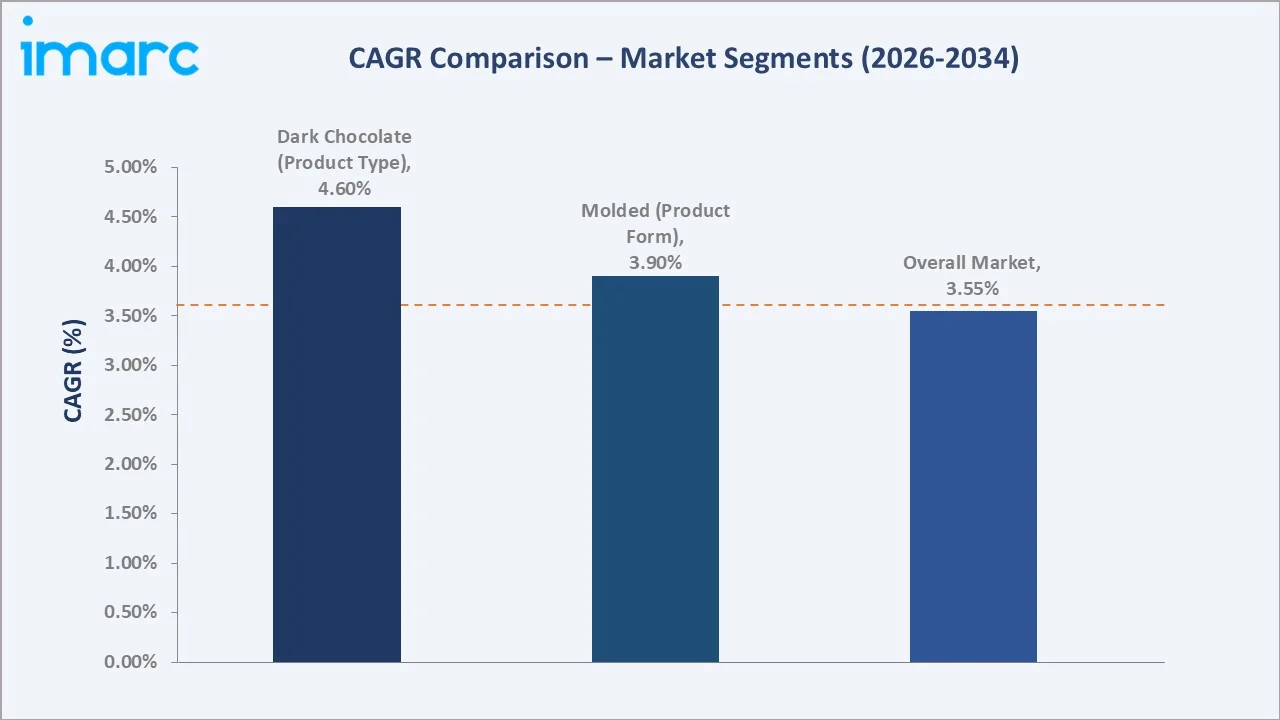
Dark Chocolate grows fastest among product types at an estimated 4.6% CAGR, supported by rising health-consciousness. Molded formats maintain steady growth at approximately 3.9% CAGR through sustained gifting and retail self-purchase demand.
Executive Summary
The Japan chocolate market, which increased from USD 5.61 Billion in 2025 to an estimated USD 5.86 Billion in 2026, reflecting a mature yet innovation-driven confectionery sector. The market encompasses cocoa sourcing, chocolate manufacturing, packaging, and multi-channel distribution across Japan’s retail and foodservice landscape.
Milk Chocolate at 52.6% dominates through broad consumer familiarity and everyday affordability. Molded formats at 58.3% lead through their role in gifting and self-purchase occasions. Kanto Region, at 35.8%, leads through population density and premium retail concentration.
Key Market Insights
|
Insight |
Data |
|
Dominant Product Type |
Milk Chocolate - 52.6% share (2025) |
|
Dominant Product Form |
Molded - 58.3% market share (2025) |
|
Leading Region |
Kanto Region - 35.8% market share |
|
Market Opportunity |
Premium dark chocolate; localized flavor innovation; sustainable cocoa sourcing; e-commerce gifting expansion |
Key Analytical Observations Supporting The Above Data:
- Milk Chocolate at 52.6%: Milk Chocolate’s 52.6% share reflects its position as the most widely consumed everyday format, supported by broad retail availability and affordable pricing across convenience and supermarket channels.
- Molded Format at 58.3%: Molded chocolate’s 58.3% share is anchored by its dominant role in gifting occasions such as Valentine’s Day and White Day, alongside everyday bar-format retail demand.
- Dark Chocolate Momentum: Dark Chocolate is gaining share as health-conscious consumers seek antioxidant-rich, premium options, supporting its position as the fastest-growing product type.
- Kanto Region at 35.8%: Kanto Region’s leadership is anchored by Tokyo’s dense urban population, premium department-store retail, and concentrated corporate gifting demand.
Japan Chocolate Market Overview
The Japan chocolate market encompasses the sourcing, manufacturing, packaging, and distribution of milk, dark, white, and other chocolate formats across retail and foodservice channels. The market spans everyday, premium, and seasonal chocolate pricing tiers.
Macroeconomic factors including stable disposable income, an aging yet gift-oriented consumer base, and continued urbanization support consistent chocolate demand. Rising health awareness and interest in premium and ethically sourced cocoa are shaping product innovation.
Market Dynamics
To evaluate market opportunities, Request Sample
Market Drivers
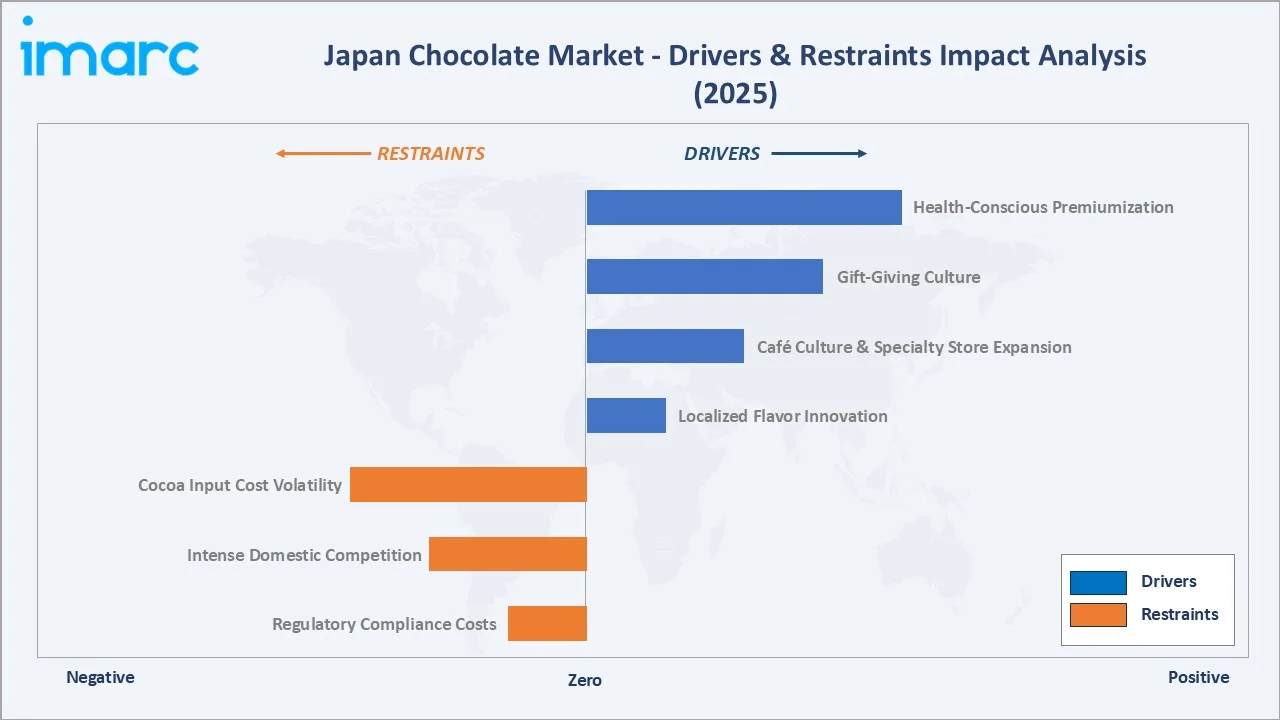
- Health-Conscious Premiumization: Rising awareness of the health benefits associated with antioxidant-rich dark chocolate, including its polyphenol and flavanol content, is steadily shifting consumer preference toward premium, quality-oriented chocolate products. This health-conscious shift is prompting manufacturers to expand high-cocoa-content product lines, reformulate recipes to reduce added sugar, and market chocolate as a functional indulgence rather than a purely discretionary treat, thereby supporting sustained volume and value growth across retail channels.
- Gift-Giving Culture: Japan’s deeply rooted tradition of gift-giving, particularly around seasonal occasions such as Valentine’s Day, White Day, Ochugen, and Oseibo, sustains consistent and predictable demand for gift-format chocolate throughout the year. Elaborately packaged assortments, limited-edition seasonal releases, and premium boxed chocolates are central to this gifting culture, encouraging manufacturers and retailers to continuously refresh packaging design and product assortments to capture recurring festive and social-obligation purchasing occasions.
- Café Culture & Specialty Store Expansion: The escalating café culture and the proliferation of specialty chocolate stores and chocolatiers across Japan’s major cities are elevating consumption patterns and introducing consumers to premium, artisanal, and single-origin chocolate experiences. This trend is fostering greater consumer sophistication around cocoa origin, texture, and flavor profile, which in turn supports premiumization and encourages both domestic and international brands to expand boutique and limited-batch product offerings.
- Localized Flavor Innovation: Manufacturers are increasingly introducing unique, localized flavors such as matcha, wasabi, yuzu, and sakura to cater to the distinctive palate of Japanese consumers and to differentiate products in a highly competitive shelf environment. This localized flavor innovation strengthens brand loyalty, supports premium pricing, and enhances the appeal of Japanese chocolate products both domestically and as sought-after gifting items among international visitors and export markets.
Market Restraints
- Cocoa Input Cost Volatility: Volatility in global cocoa bean prices, driven by climate conditions in West African producing regions and fluctuating currency exchange rates, increases input cost pressure for Japanese manufacturers. This cost volatility can compress margins or force retail price adjustments, particularly for manufacturers with limited pricing power against established private-label and mass-market alternatives.
- Intense Domestic Competition: The market features intense competition among a small number of well-established domestic manufacturers with strong brand equity and extensive distribution networks, creating persistent pricing pressure. New entrants and smaller players must continuously innovate on flavor, format, and packaging to maintain shelf presence against dominant incumbents across supermarket and convenience store channels.
- Regulatory Compliance Costs: Compliance with food safety, ingredient labeling, and health-related regulatory requirements under Japan’s Food Sanitation Act and related consumer protection frameworks adds operational cost and complexity for manufacturers introducing new products or reformulated recipes, particularly those targeting health-conscious or allergen-sensitive consumer segments.
Market Opportunities
- Sustainable & Ethical Sourcing: Rising demand for organic, vegan, and ethically sourced chocolate presents opportunities for manufacturers to differentiate through sustainability-focused product lines.
- E-Commerce Channel Expansion: Expanding e-commerce and direct-to-consumer channels offer opportunities to reach premium and gifting-focused consumers with curated chocolate assortments.
Market Challenges
- Balancing Innovation and Cost: Maintaining consistent product quality and flavor innovation while managing input cost pressures remains an ongoing operational challenge for manufacturers.
- Sustainable Packaging Adaptation: Adapting packaging and product formats to evolving sustainability expectations without compromising shelf appeal presents a continuing design challenge.
Emerging Market Trends
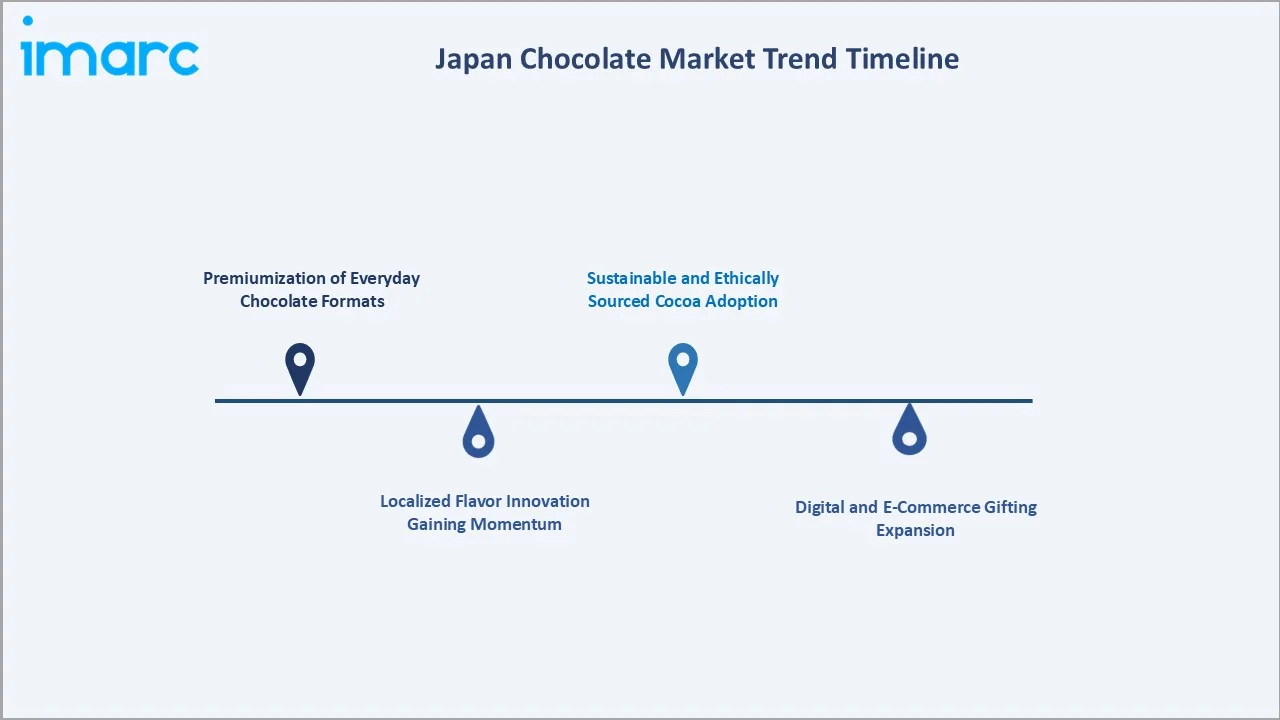
1. Premiumization of Everyday Chocolate Formats
Manufacturers are elevating everyday chocolate through higher cocoa content, refined packaging, and premium ingredient positioning, blurring the line between mass-market and premium tiers.
2. Localized Flavor Innovation Gaining Momentum
Domestic and international brands are increasingly launching matcha, sakura, and wasabi-flavored chocolates, reflecting sustained consumer appetite for culturally distinctive product variants.
3. Sustainable and Ethically Sourced Cocoa Adoption
Growing consumer consciousness around sustainability is encouraging manufacturers to adopt certified, ethically sourced cocoa and transparent supply chain practices.
4. Digital and E-Commerce Gifting Expansion
Online platforms and direct-to-consumer channels are expanding premium and seasonal gifting chocolate sales, supported by curated digital gifting experiences.
Industry Value Chain Analysis
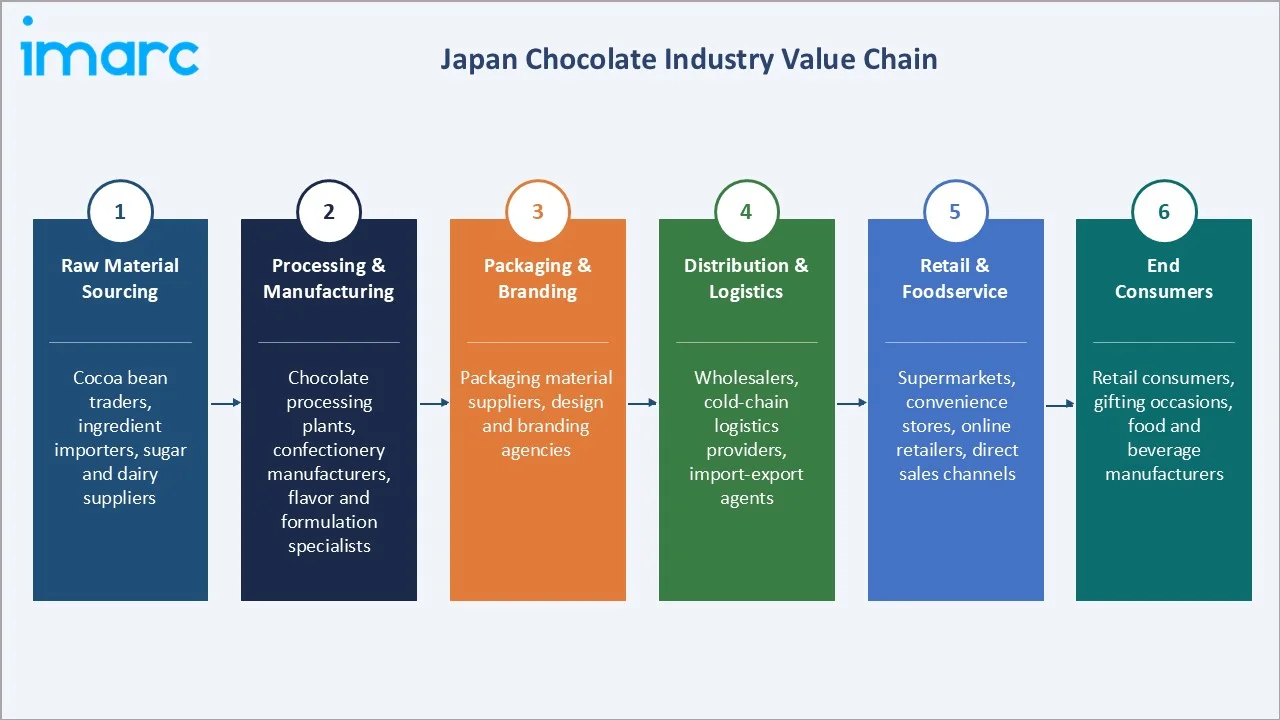
The Japan chocolate value chain spans raw material sourcing, processing and manufacturing, packaging and branding, distribution and logistics, retail and foodservice supply, and end consumption.
|
Stage |
Key Participants |
|
Raw Material Sourcing |
Cocoa bean traders, ingredient importers, sugar and dairy suppliers |
|
Processing & Manufacturing |
Chocolate processing plants, confectionery manufacturers, flavor and formulation specialists |
|
Packaging & Branding |
Packaging material suppliers, design and branding agencies |
|
Distribution & Logistics |
Wholesalers, cold-chain logistics providers, import-export agents |
|
Retail & Foodservice |
Supermarkets, convenience stores, online retailers, direct sales channels |
|
End Consumers |
Retail consumers, gifting occasions, food and beverage manufacturers |
The processing and manufacturing stage captures the greatest value-add through formulation expertise and quality control, while distribution and retail stages determine market reach and consumer accessibility.
Technology Landscape in the Japan Chocolate Industry
Bean-to-Bar Craft Processing Technology
Bean-to-bar craft processing technology enables small-batch manufacturers and specialty chocolatiers to control every stage of production, from roasting and winnowing to conching and tempering. This technology supports single-origin transparency and distinctive flavor profiling, allowing premium and artisanal producers to differentiate from mass-market chocolate on provenance and craftsmanship.
Cold Chain & Temperature-Controlled Distribution
Cold chain and temperature-controlled distribution technology preserves chocolate quality, texture, and appearance during transport and storage, particularly critical during Japan’s humid summer months. Reliable temperature-controlled logistics networks reduce bloom formation and melting risk, supporting consistent product quality across supermarket, convenience store, and e-commerce delivery channels.
Automated Molding, Packaging & Quality Control Systems
Automated molding, packaging, and quality control systems enable high-precision, high-volume production while maintaining consistent shape, weight, and visual presentation. Vision-based inspection systems and automated wrapping lines help manufacturers meet Japan’s stringent quality and presentation standards, particularly for premium gifting formats where packaging aesthetics are commercially critical.
Market Segmentation Analysis
The report covers the following segments:
|
Segment Category |
Leading Segment |
Market Share |
Year |
|
Product Type |
Milk Chocolate |
52.6% |
2025 |
|
Product Form |
Molded |
58.3% |
2025 |
|
Application |
🔒 |
🔒 |
2025 |
|
Pricing |
🔒 |
🔒 |
2025 |
|
Distribution |
🔒 |
🔒 |
2025 |
|
Region |
Kanto Region |
35.8% |
2025 |

By Product Type
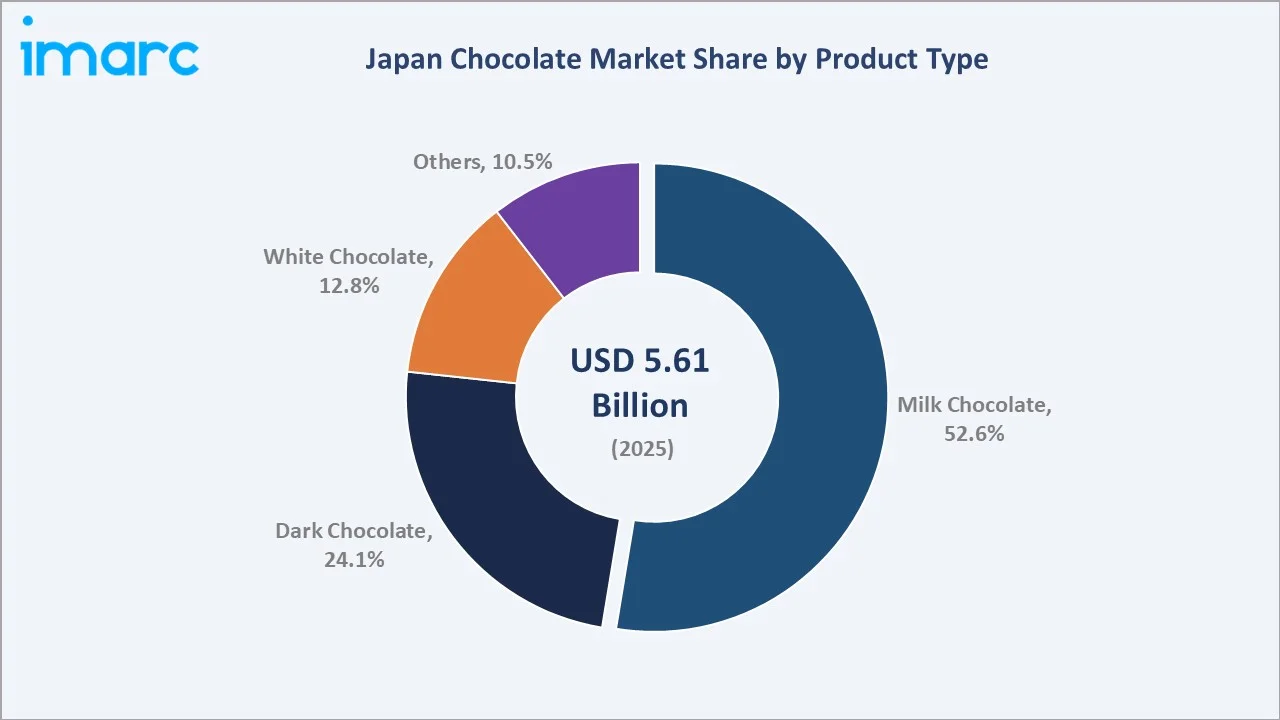
Milk Chocolate leads the Japan chocolate market at 52.6% (2025). The segment encompasses classic milk chocolate bars, filled and layered milk chocolate confections, and milk-chocolate-coated snack products, benefiting from broad consumer familiarity, affordability, and near-universal retail availability across supermarket, convenience store, and vending channels nationwide.
To access detailed market analysis, Request Sample
Dark Chocolate, at 24.1% share, is the fastest-growing product type at an estimated 4.6% CAGR, propelled by rising health-consciousness and premiumization among adult consumers. White Chocolate holds 12.8%, popular in seasonal and gifting formats, while Others, at 10.5%, spans ruby, flavored, and mixed-format chocolate products.
By Product Form
Molded chocolate leads at 58.3% (2025). The segment encompasses tablet bars, solid and filled blocks, and seasonal figured chocolate such as Valentine’s Day and White Day gift molds, reflecting the format’s central role in both everyday retail self-purchase and Japan’s structured seasonal gifting occasions.
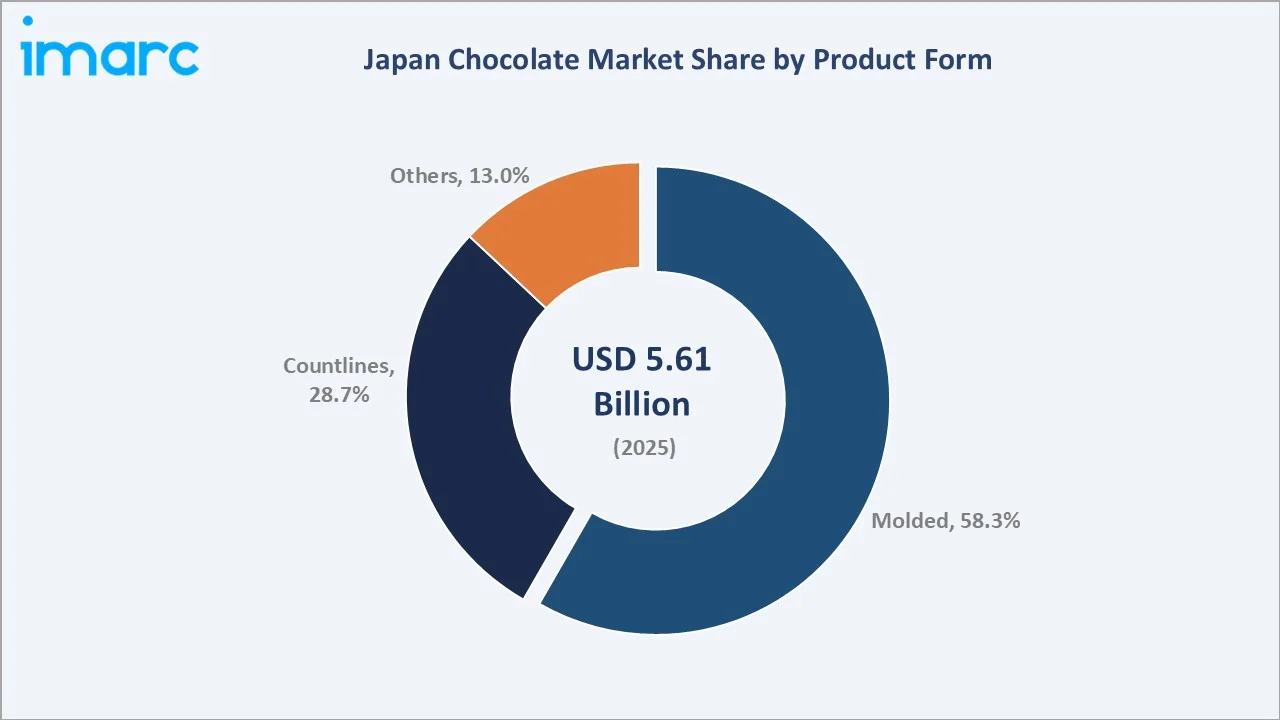
Countlines, at 28.7% share and growing near 3.9% CAGR, represent individually wrapped bar and stick formats favored for on-the-go and convenience-store impulse consumption. Others, at 13.0%, includes assorted boxes, bite-sized pieces, and specialty packaged multi-piece formats.
Regional Market Insights
|
Region |
Share (2025) |
Key Market Drivers & Characteristics |
|
Kanto Region |
35.8% |
Driven by dense urban population, concentration of premium retailers, and strong gifting demand around Tokyo. |
|
Kinki Region |
19.1% |
Supported by Osaka’s confectionery manufacturing base and established department-store gifting culture. |
|
Central/Chubu Region |
15.4% |
Anchored by Nagoya’s manufacturing hub and steady demand across supermarkets and convenience channels. |
|
Kyushu-Okinawa Region |
9.5% |
Growing through expanding convenience store networks and rising tourism-linked confectionery demand. |
|
Tohoku Region |
7.0% |
Driven by steady retail demand and increasing penetration of seasonal and premium chocolate formats. |
|
Chugoku Region |
5.6% |
Supported by regional supermarket chains and stable everyday-chocolate consumption patterns. |
|
Hokkaido Region |
4.5% |
Known for specialty and souvenir chocolate demand linked to regional tourism and gifting. |
|
Shikoku Region |
3.1% |
Smallest regional base, with gradual growth through modern retail channel expansion. |
Kanto Region’s 35.8% leadership is anchored by Tokyo’s dense urban population and concentrated premium retail and gifting demand. Kinki Region’s 19.1% reflects Osaka’s manufacturing base and department-store gifting culture.
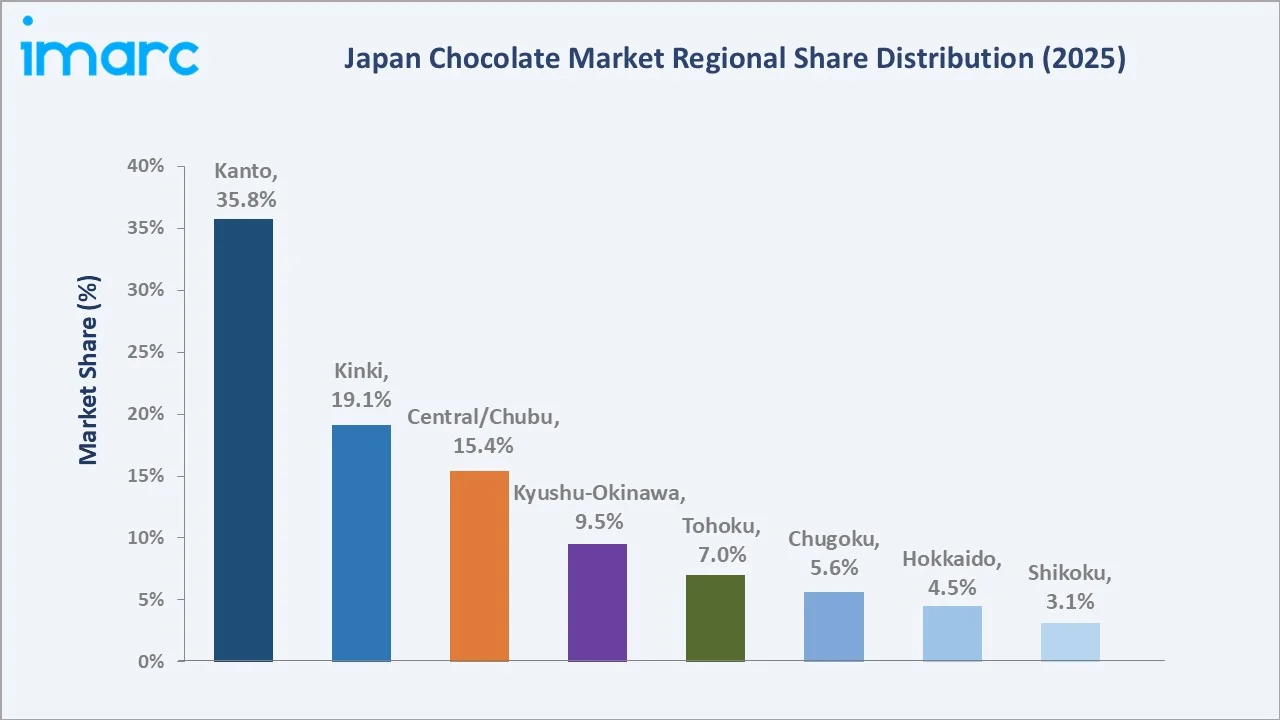
Central/Chubu Region’s 15.4% is supported by Nagoya’s manufacturing hub, while Kyushu-Okinawa, at 9.5%, is expanding through growing convenience retail and tourism-linked demand.
Competitive Landscape
The Japan chocolate market competitive landscape features established domestic manufacturers competing across product innovation, distribution reach, and seasonal gifting positioning.
|
Company Name |
Key Products |
Market Position |
Core Strength |
|
Meiji Holdings Co., Ltd. |
Meiji Milk Chocolate, Meiji Almond |
Market Leader |
Meiji holds the leading position in Japan’s chocolate market through its broad milk and premium chocolate portfolio and extensive retail distribution network. |
|
Ezaki Glico Co., Ltd. |
Pocky, Almond Peak |
Market Leader |
Glico is known for its confectionery innovation and strong countline and gifting formats sold through convenience and supermarket channels nationwide. |
|
Morinaga & Co., Ltd. |
DARS, Carre de Chocolat |
Established Player |
Morinaga is a long-established chocolate manufacturer with strength in molded and small-format chocolate for everyday and seasonal occasions. |
|
Lotte Co., Ltd. |
Ghana Chocolate, Crunky |
Established Player |
Lotte competes through its Ghana Chocolate brand, leveraging strong brand recall and wide supermarket and convenience store presence. |
|
Nestlé Japan Ltd. |
KitKat |
Established Player |
Nestlé Japan’s KitKat franchise drives significant volume through localized flavor variants and strong seasonal gifting positioning. |
|
Fujiya Co., Ltd. |
Milky, Peko Poko Chocolate |
Niche Player |
Fujiya maintains a loyal consumer base through heritage confectionery brands sold across convenience and specialty retail formats. |
Market leaders sustain competitive advantage through broad distribution networks and continuous product innovation, while niche players compete through heritage branding and targeted retail presence.
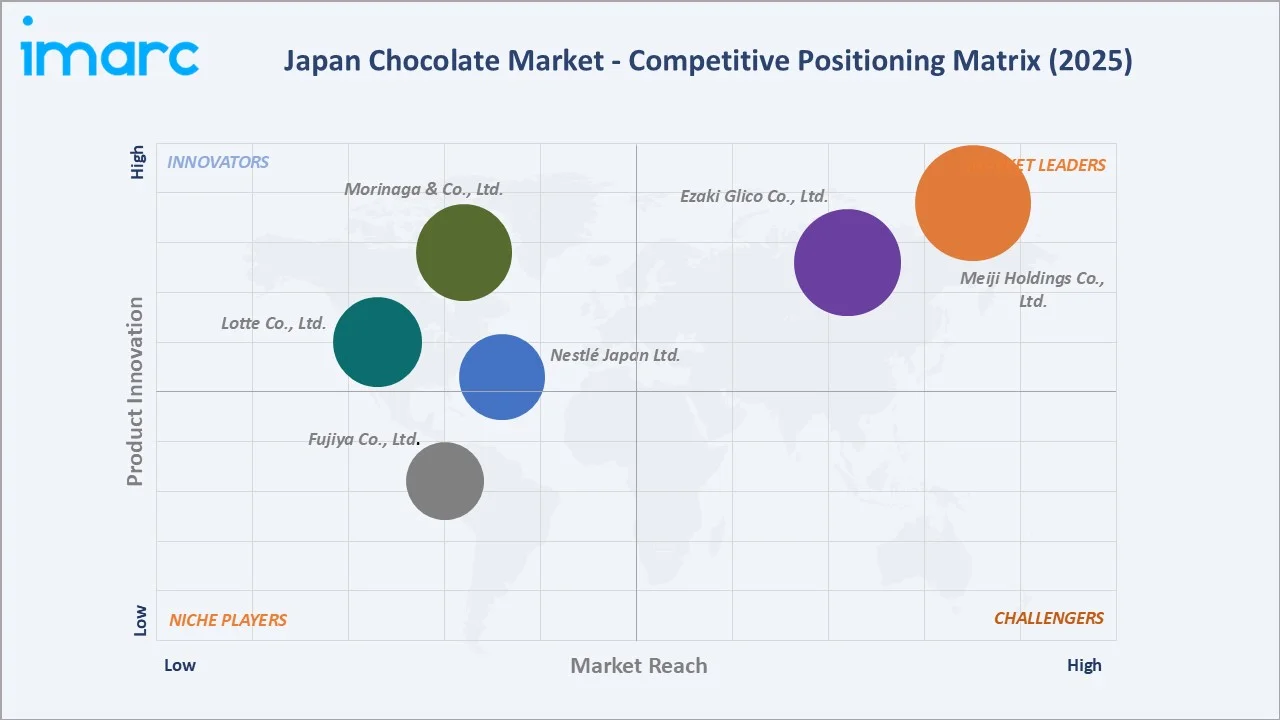
Key Company Profiles
Meiji Holdings Co., Ltd.
Meiji Holdings is Japan’s leading chocolate manufacturer, offering an extensive portfolio spanning milk, dark, and premium chocolate formats distributed nationwide.
- Key Products: Meiji Milk Chocolate, The Chocolate, Meiji Almond.
- Recent Developments: In February 2026, Meiji Holdings Co., Ltd. announced plans to invest approximately JPY 10 billion to expand its chocolate production capacity in the United States, primarily to meet the rapidly growing demand for its Hello Panda chocolate snacks. The company stated that the investment would increase U.S. production capacity by around 50% compared with FY2024, supporting its global chocolate business expansion strategy.
- Strategic Focus: Focused on portfolio innovation, premiumization, and sustained retail distribution leadership across Japan.
Ezaki Glico Co., Ltd.
Ezaki Glico is a prominent confectionery manufacturer known for its countline and gifting-format chocolate products distributed through convenience and supermarket channels.
- Key Products: Pocky, Almond Peak, LOOK.
- Strategic Focus: Centered on confectionery innovation, brand extension, and international distribution growth.
Morinaga & Co., Ltd.
Morinaga is a long-established chocolate manufacturer with strength in small-format and molded chocolate products for everyday and seasonal consumption.
- Key Products: DARS, Carre de Chocolat.
- Strategic Focus: Focused on product quality, format innovation, and sustained retail channel presence.
Market Concentration Analysis
The Japan chocolate market is moderately concentrated, with a small number of established domestic manufacturers accounting for a significant share of national retail distribution. Competitive intensity remains high across everyday and gifting-format segments, while niche and specialty players compete through targeted branding and regional presence.
Investment & Growth Opportunities
Highest Growth Segments
Dark Chocolate (≎4.6% CAGR), premium molded gifting formats, and e-commerce-driven direct-to-consumer chocolate sales represent the highest-growth investment vectors through 2034.
Emerging Investment Opportunities
Sustainable and ethically sourced cocoa supply chains represent a significant near-term investment opportunity as consumer sustainability expectations continue to rise across Japan’s retail landscape.
Investment Themes
- Sustainable Cocoa Sourcing: Investment in certified, traceable cocoa sourcing and transparent supply chain infrastructure positions manufacturers to meet rising sustainability-driven consumer expectations.
- Digital Gifting Platforms: Development of digital and e-commerce gifting platforms creates recurring, premium-margin revenue opportunities beyond traditional retail channels.
Future Market Outlook (2026-2034)
The Japan chocolate market is projected to grow from USD 5.61 Billion in 2025 to USD 5.86 Billion in 2026 and is forecast to reach USD 7.75 Billion by 2034, delivering a 3.55% CAGR. The market’s anchor value of USD 6.67 Billion in 2030 reflects steady premiumization and sustained gifting-driven demand.
Continued health-conscious premiumization, localized flavor innovation, and sustainable sourcing adoption are expected to shape the market’s trajectory through 2034, alongside expanding digital and e-commerce gifting channels.
Research Methodology
Primary Research
Primary research comprised structured interviews with industry stakeholders including confectionery manufacturers, distribution executives, and retail category specialists.
Secondary Research
Secondary research encompassed confectionery industry publications, trade association data, company annual reports, and regional retail market statistics.
Forecasting Models
Market revenue forecasts were developed using a segment bottom-up model incorporating product type, product form, and regional demand components.
Japan Chocolate Market Report Coverage:
| Report Features | Details |
|---|---|
| Base Year of the Analysis | 2025 |
| Historical Period | 2020-2025 |
| Forecast Period | 2026-2034 |
| Units | Billion USD |
| Scope of the Report | Exploration of Historical and Forecast Trends, Industry Catalysts and Challenges, Segment-Wise Historical and Predictive Market Assessment:
|
| Product Types Covered | White Chocolate, Milk Chocolate, Dark Chocolate, Others |
| Product Forms Covered | Molded, Countlines, Others |
| Applications Covered |
|
| Pricings Covered | Everyday Chocolate, Premium Chocolate, Seasonal Chocolate |
| Distributions Covered | Direct Sales (B2B), Supermarkets and Hypermarkets, Convenience Stores, Online Stores, Others |
| Regions Covered | Kanto Region, Kinki Region, Central/ Chubu Region, Kyushu-Okinawa Region, Tohoku Region, Chugoku Region, Hokkaido Region, Shikoku Region |
| Companies Covered | Meiji Holdings Co., Ltd., Ezaki Glico Co., Ltd., Morinaga & Co., Ltd., Lotte Co., Ltd., Nestlé Japan Ltd., Fujiya Co., Ltd., etc. |
| Customization Scope | 10% Free Customization |
| Post-Sale Analyst Support | 10-12 Weeks |
| Delivery Format | PDF and Excel through Email (We can also provide the editable version of the report in PPT/Word format on special request) |
Key Benefits for Stakeholders:
- IMARC’s report offers a comprehensive quantitative analysis of various market segments, historical and current market trends, market forecasts, and dynamics of the Japan chocolate market from 2020-2034.
- The research study provides the latest information on the market drivers, challenges, and opportunities in the Japan chocolate market.
- Porter's five forces analysis assist stakeholders in assessing the impact of new entrants, competitive rivalry, supplier power, buyer power, and the threat of substitution. It helps stakeholders to analyze the level of competition within the Japan chocolate industry and its attractiveness.
- Competitive landscape allows stakeholders to understand their competitive environment and provides an insight into the current positions of key players in the market.
Frequently Asked Questions About the Japan Chocolate Market Report
The Japan chocolate market size is estimated at USD 5.86 Billion in 2026, driven by rising demand for premium, health-oriented, and gift-format chocolate products.
The market is projected to grow at a CAGR of 3.55% during 2026-2034, reaching USD 7.75 Billion by 2034.
Milk Chocolate leads at 52.6% (2025), supported by broad consumer familiarity and widespread retail availability.
Molded chocolate leads at 58.3% (2025), driven by its central role in gifting and retail self-purchase occasions.
Kanto Region leads at 35.8%, driven by Tokyo’s dense urban population and concentrated premium retail demand.
Leading companies include Meiji Holdings Co., Ltd., Ezaki Glico Co., Ltd., Morinaga & Co., Ltd., Lotte Co., Ltd., Nestlé Japan Ltd., and Fujiya Co., Ltd., among others.
The market is projected to reach approximately USD 6.67 Billion by 2030, supported by sustained premiumization and gifting-driven demand.
Rising demand for organic, vegan, and ethically sourced chocolate reflects growing consumer sustainability consciousness, encouraging manufacturers to adopt certified cocoa sourcing practices.
Need more help?
- Speak to our experienced analysts for insights on the current market scenarios.
- Include additional segments and countries to customize the report as per your requirement.
- Gain an unparalleled competitive advantage in your domain by understanding how to utilize the report and positively impacting your operations and revenue.
- For further assistance, please connect with our analysts.
 Request Customization
 Speak to an Analyst
 Request Brochure
 Inquire Before Buying
Benefits of Customization
- Personalize this research
- Triangulate with your data
- Get data as per your format and definition
- Gain a deeper dive into a specific application, geography, customer, or competitor
- Any level of personalization
Get in Touch With Us
UNITED STATES
Phone: +1-201-971-6302
INDIA
Phone: +91-120-433-0800
UNITED KINGDOM
Phone: +44-753-714-6104
Email: [email protected]
Client Testimonials




.webp)




.webp)













Related Reports

Choose your plan
*Please note that the prices mentioned below are starting prices for each bundle type. Kindly contact our team for further details.*
Single User License
- 1 User License, Access on 2 Devices
- PDF Report + Excel Dataset (Password Protected)
- Lifetime Access
- No Printing Rights
- 10% Free Report Customization
- 10–12 Weeks of Analyst Support
Five User License
- Access for 5 Users, 2 Devices per User
- PDF Report + Excel Dataset (Password Protected)
- Lifetime Access
- Dedicated Account Manager
- 12–14 Weeks of Analyst Support
- No Printing Rights
- 15% Free Report Customization
- 25% Discount on Your Next Purchase
Corporate User License
- Unlimited User Access (Within Your Organization)
- PDF Report + Excel Dataset
- Lifetime Access
- Dedicated Account Manager
- 14–20 Weeks of Analyst Support
- No Printing Rights
- 20% Free Report Customization
- 30% Discount on Your Next Purchase
Essential Insights
What's included:
3 reports
- Lifetime Access
- PDF Reports
- Excel Datasets
- 2 Weeks of Free Analyst Support
- 2 User Licenses
- Access on 2 Devices
- Printing Rights
- Complimentary PowerPoint (PPT) Version
- Complimentary License Upgrade
Professional Access
What's included:
5 reports
- Lifetime Access
- PDF Reports
- Excel Datasets
- 8 Weeks of Free Analyst Support
- 2 User Licenses
- Access on 2 Devices
- Printing Rights
- Complimentary PowerPoint (PPT) Version
- Complimentary License Upgrade
Business Advantage
What's included:
8 reports
- Lifetime Access
- PDF Reports
- Excel Datasets
- 14 Weeks of Free Analyst Support
- 2 User Licenses
- Access on 2 Devices
- Printing Rights
- Complimentary PowerPoint (PPT) Version
- Complimentary License Upgrade
Enterprise Intelligence
What's included:
10 reports
- Lifetime Access
- PDF Reports
- Excel Datasets
- 20 Weeks of Free Analyst Support
- 2 User Licenses
- Access on 2 Devices
- Printing Rights
- Complimentary PowerPoint (PPT) Version
- Complimentary License Upgrade