
Japan Electric Vehicle Charging Equipment Market Size, Share, Trends and Forecast by Charging Station, End Use, and Region, 2026-2034
Japan Electric Vehicle Charging Equipment Market Size, Share, Trends & Forecast (2026-2034)
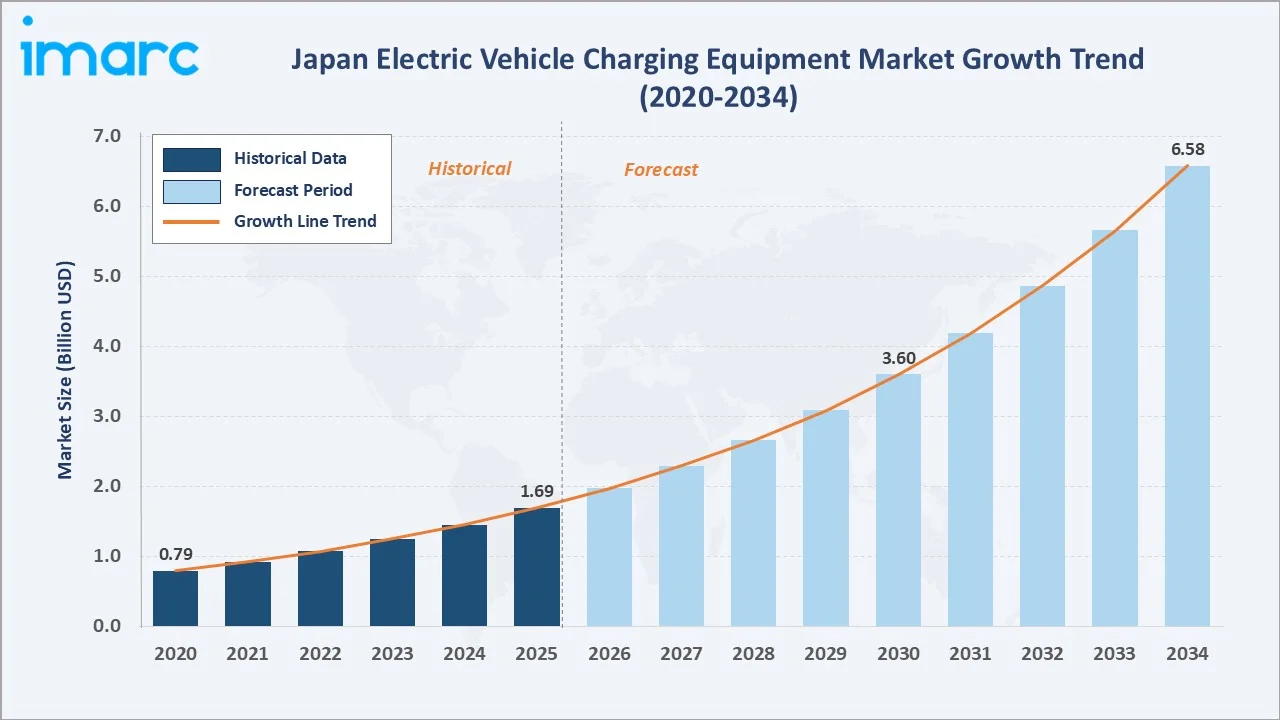
The Japan electric vehicle charging equipment market reached USD 1.69 Billion in 2025 and is projected to reach USD 6.58 Billion by 2034, growing at a CAGR of 16.32% during 2026-2034. The market is driven by rising EV adoption, government subsidies under METI's Green Growth Fund, fast-charging and battery-swapping innovation, and corporate sustainability commitments across Japan's automotive and logistics sectors.
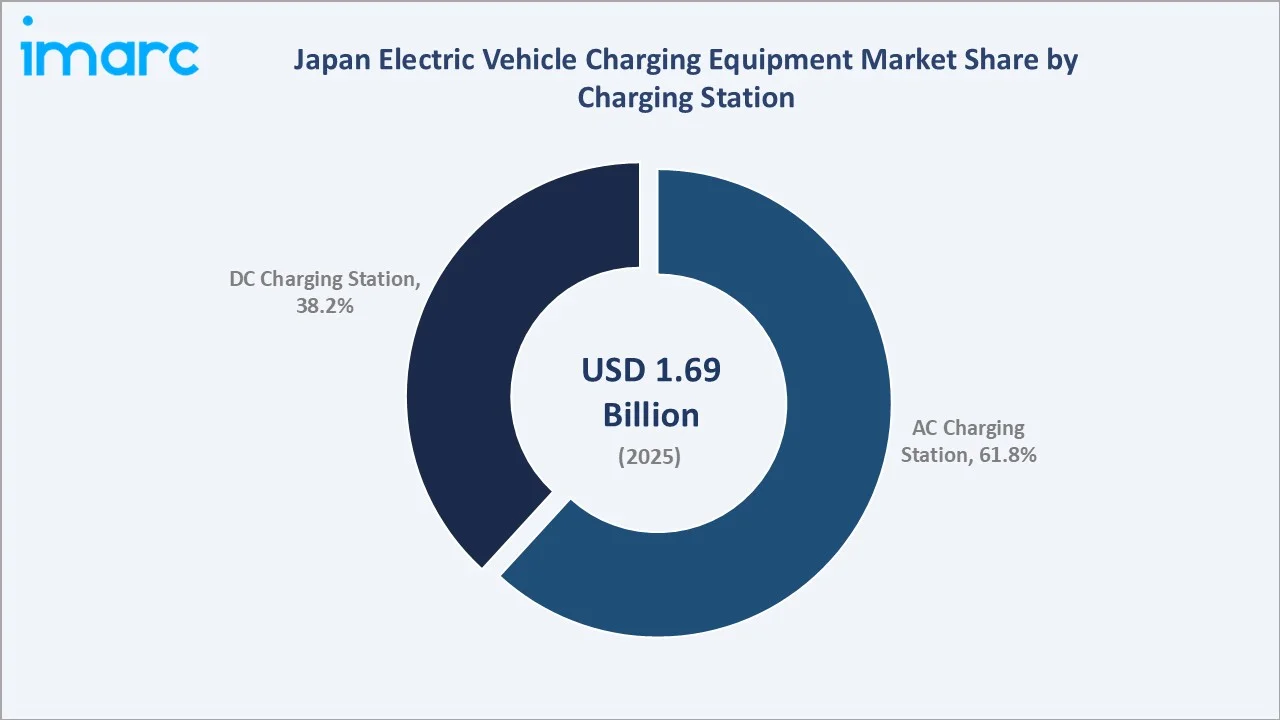
The AC Charging Station segment dominates at 61.8%. Home Charging leads applications at 57.4%. Kanto Region commands 41.6% of the national market share.
Market Snapshot
|
Metric |
Value |
|
Market Size (2025) |
USD 1.69 Billion |
|
Forecast Market Size (2034) |
USD 6.58 Billion |
|
CAGR (2026-2034) |
16.32% |
|
Base Year |
2025 |
|
Historical Period |
2020-2025 |
|
Forecast Period |
2026-2034 |
|
Dominant Charging Station |
AC Charging Station (61.8%, 2025) |
|
Dominant End Use |
Home Charging (57.4%, 2025) |
|
Leading Region |
Kanto Region (41.6%, 2025) |
The market expanded from USD 0.79 Billion in 2020 to USD 1.69 Billion in 2025 - more than doubling in five years - anchored at USD 3.60 Billion in 2030 and forecast to reach USD 6.58 Billion by 2034. Japan's 2035 gasoline-vehicle sales ban and expanding public charging network build-out created sustained equipment demand growth, which continued to strengthen through 2023-2025 as METI subsidy programs scaled and corporate fleet electrification mandates took hold nationwide.
To get more information on this market, Request Sample
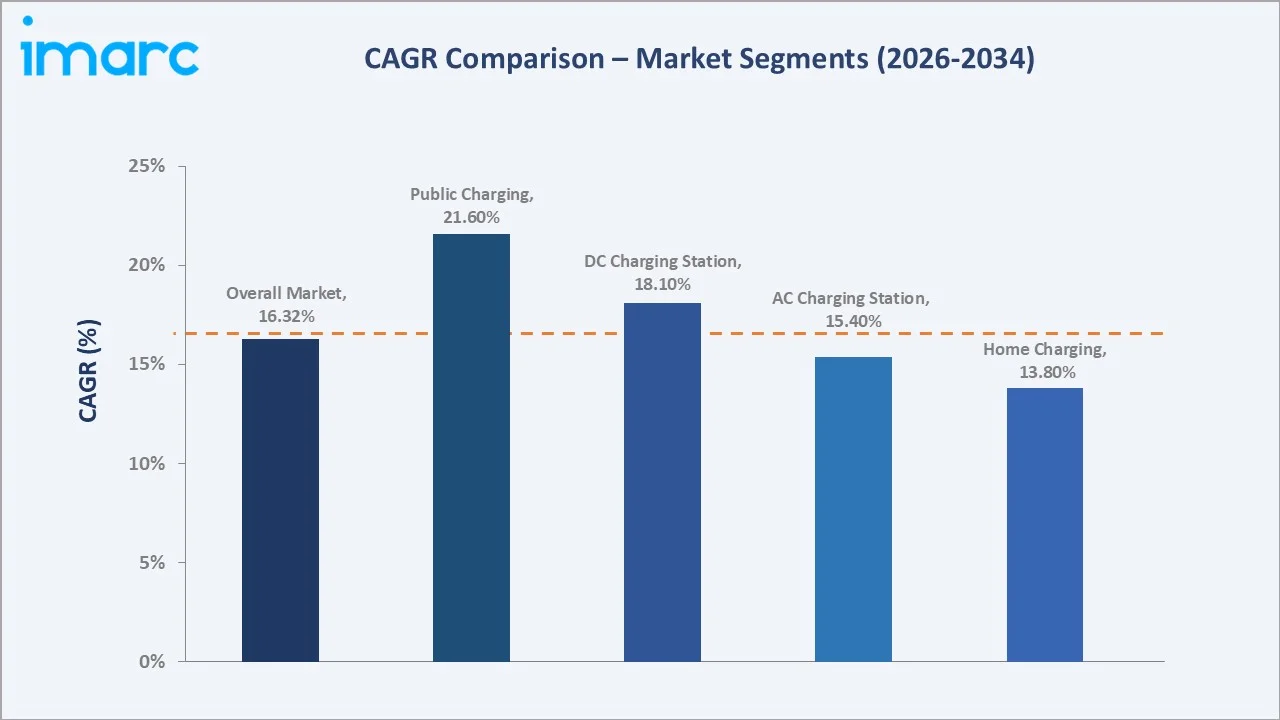
Public Charging application grows fastest at approximately 21.6% CAGR as urban charging network densification and retail-integrated fast charging multiply installation volumes, and the national charging port build-out continues compounding above overall equipment production growth. The DC Charging Station segment grows at approximately 18.1% CAGR as expressway and fleet depot fast-charging deployment represents Japan's highest-value equipment procurement category.
Executive Summary
The Japan electric vehicle charging equipment market reached USD 1.69 Billion in 2025, representing one of the automotive infrastructure industry's highest-growth technology component markets driven by the fundamental electrification transformation of Japan's road transport sector. Charging equipment is the defining infrastructure layer of EV adoption, performing the function that fuel pumps and refuelling stations performed for conventional vehicles. The market is projected to reach USD 6.58 Billion by 2034.
AC Charging Station at 61.8% dominates by capturing the mainstream residential and workplace overnight charging specification. Home Charging application at 57.4% leads through Japan's high reliance on overnight residential charging and the highest per-unit installation value among all end-use categories. Kanto Region at 41.6% leads nationally through Tokyo's population density, corporate headquarters concentration, and overlapping national and municipal subsidy programs supporting charger rollouts.
Key Market Insights
|
Insight |
Data |
|
Dominant Charging Station |
AC Charging Station - 61.8% share (2025) |
|
Dominant End Use |
Home Charging - 57.4% market share (2025) |
|
Leading Region |
Kanto Region - 41.6% market share (2025) |
|
Market Opportunity |
Bidirectional V2H chargers; expressway fast-charging hubs; SiC power modules; fleet depot charging; battery-swapping stations |
Key Analytical Observations Supporting the Above Data:
- AC Charging Station at 61.8%: The AC charging station segment dominates as it provides affordable, widely compatible charging hardware suited to overnight residential and workplace applications. Its widespread adoption in home wall boxes and workplace charging points by major suppliers such as Panasonic and Denso further strengthens segment demand.
- Home Charging at 57.4%: The home charging segment dominates due to the high share of Japanese EV owners relying on overnight residential charging, supported by favourable off-peak electricity tariffs and expanding government incentives. With rising EV ownership nationwide, home charger installation continues to generate substantial demand for AC equipment.
- Kanto Region at 41.6%: The Kanto region dominates the Japan EV charging equipment market due to its large-scale urban EV adoption base and strong corporate demand, led primarily by Tokyo. Tokyo prefecture layers hardware subsidies atop national METI grants, generating substantial demand for charging equipment across residential, workplace, and public categories.
Japan Electric Vehicle Charging Equipment Market Overview
The Japan electric vehicle charging equipment market encompasses the design, manufacture, and supply of all AC and DC charging hardware used to support electric vehicles across residential, workplace, and public charging categories, including passenger cars, commercial vehicles, and fleet applications. The ecosystem integrates charger OEMs and component manufacturers, power electronics and semiconductor suppliers, cable and connector manufacturers, charge point operators, utilities providing grid interconnection, EV OEM vehicle manufacturers, and regulatory bodies including METI setting charging equipment certification standards. Macroeconomic factors include Japan's 2035 gasoline-vehicle sales ban, rising electricity tariff structures, corporate ESG mandates, and sustained government investment in nationwide charging infrastructure.
Market Dynamics
To evaluate market opportunities, Request Sample
Market Drivers
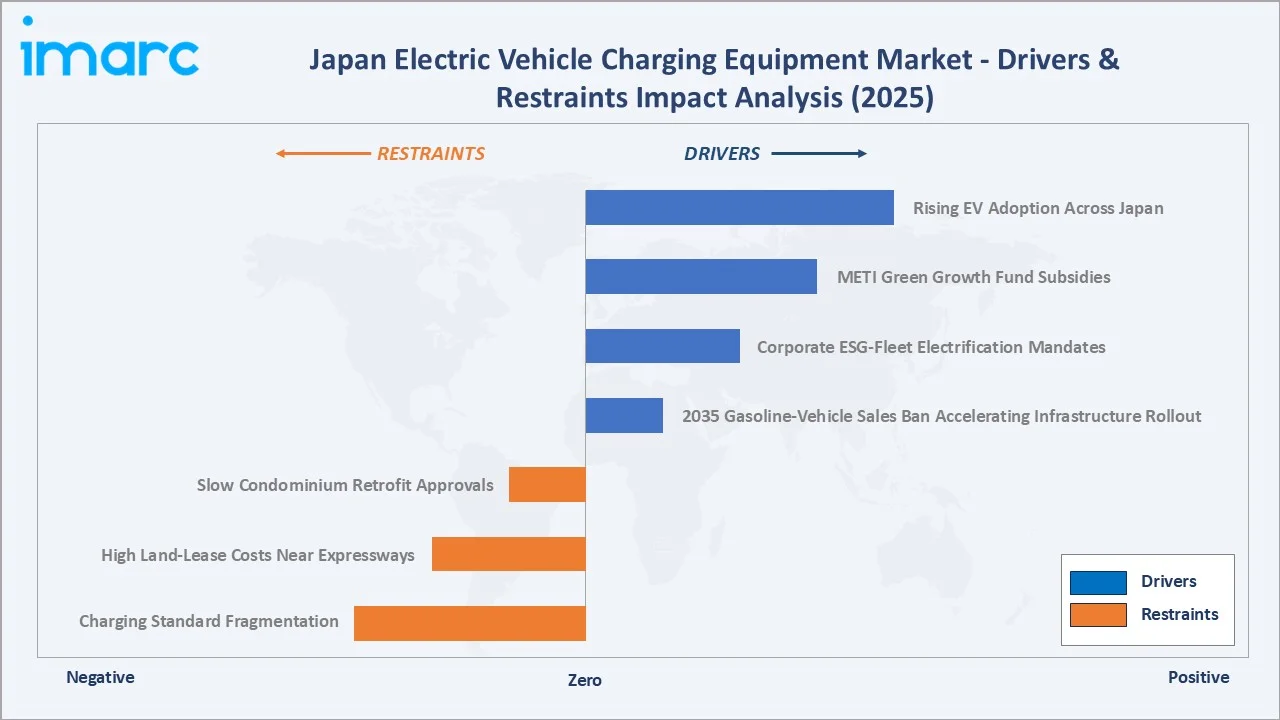
- 2035 Gasoline-Vehicle Sales Ban Accelerating Infrastructure Rollout: Japan's policy ban on new gasoline-vehicle sales by 2035 removes long-term demand ambiguity, enabling charging equipment suppliers to confidently plan a decade of capacity expansion. The government has set an approximately eight-fold public charging port target by 2030, directly boosting equipment procurement nationwide. This regulatory certainty is encouraging long-term capital investment from both domestic and international charger manufacturers. Suppliers are consequently scaling production capacity to meet anticipated national demand.
- Corporate ESG-Fleet Electrification Mandates: Japan's keiretsu corporate groups are increasingly committing to fully electrified commercial fleets by 2030, creating predictable, contracted demand for depot and workplace charging equipment. This unified corporate strategy generates infrastructure demand patterns distinct from consumer-led adoption models. Logistics leaders are deploying megawatt-scale charging hubs that double as micro-grids, creating additional revenue streams through ancillary grid services.
- METI Green Growth Fund Subsidies: Government subsidy programs targeting high-power charger installations are narrowing payback periods for operators, particularly for 150kW-plus public fast-charging equipment. Concentrated funding across Tokyo, Aichi, and Fukuoka is accelerating deployment and equipment sales. Subsidy eligibility increasingly requires grid-integration functionality, giving domestic power-electronics manufacturers a competitive advantage.
- Rising EV Adoption Across Japan: Growing electric vehicle penetration, supported by expanding model availability from Toyota, Nissan, and Honda alongside new entrants, is directly increasing demand for both home and public charging equipment across the country. Consumer confidence in EV ownership continues to strengthen as charging network density improves in both urban and suburban areas.
Market Restraints
- Slow Condominium Retrofit Approvals: Japan's Building Management Act requires unanimous owner consent for major electrical modifications, significantly delaying residential charger installations in condominium-dominated urban areas and pushing EV owners toward public charging alternatives. This regulatory friction disproportionately affects dense metropolitan markets where condominium living is most prevalent. Equipment suppliers are consequently redirecting sales strategies toward public and workplace charging channels.
- High Land-Lease Costs Near Expressways: Premium land-lease rates for high-visibility public fast-charging sites near expressways and urban hubs challenge operator profitability, often pushing installations toward less accessible secondary locations. This cost pressure is particularly acute for DC fast-charging equipment, which requires higher power infrastructure investment to justify site economics.
- Charging Standard Fragmentation: Continued fragmentation between CHAdeMO, CCS, and the emerging NACS protocol creates interoperability challenges for equipment manufacturers and increases development costs for multi-standard hardware. This fragmentation complicates procurement decisions for fleet operators seeking future-proof charging infrastructure investments.
Market Opportunities
- Bidirectional V2H Charger Commercialization: Bidirectional Vehicle-to-Home charging technology enables EV batteries to function as distributed household energy storage, creating new revenue streams for equipment makers and utilities alike. As dynamic electricity pricing plans expand nationally, demand for V2H-capable wall boxes is expected to rise sharply among residential customers.
- Expressway and Highway Service Area Fast-Charging Hubs: METI's continued guidance toward higher-output public charging along expressway corridors is creating a substantial equipment procurement opportunity for DC fast-charger manufacturers. Multi-year subsidy windows specifically support these complex, higher-capital builds, reducing developer risk.
Market Challenges
- Grid Capacity Constraints in Historic Urban Districts: Aging grid infrastructure in older downtown districts limits the deployment of high-power DC charging equipment, forcing operators to prioritize outer-ring logistics parks with greater capacity headroom. Utilities must undertake costly transformer upgrades to support expanded charging loads, creating multi-year lead times for some public charging projects.
- Rural Utilization Rate Pressure: Charging equipment installed in rural prefectures often experiences utilization rates below 8%, straining the commercial viability of standalone rural charging investments. Local governments are increasingly bundling charger deployment with tourism and disaster-resilience initiatives to justify installation costs.
Emerging Market Trends
The Japan electric vehicle charging equipment market is evolving through five distinct technology and adoption phases, moving from early AC-dominant installations toward an increasingly intelligent, bidirectional, and network-dense charging ecosystem through 2034.
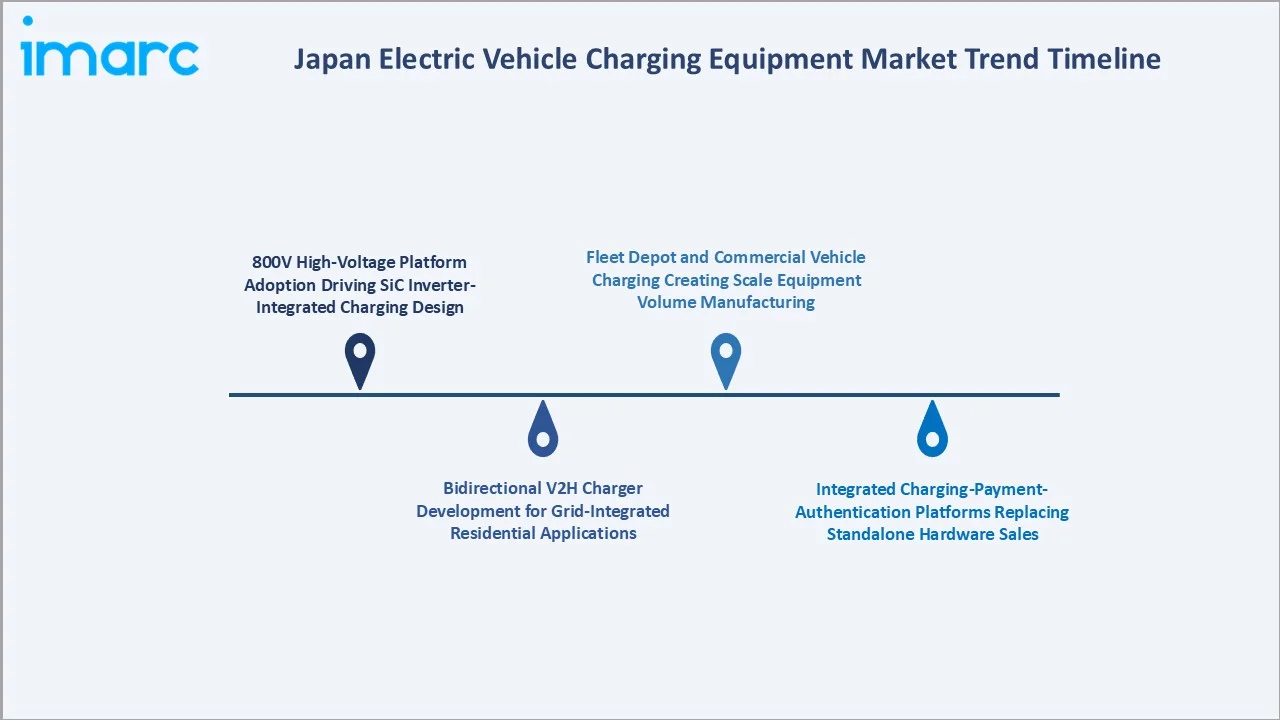
1. 800V High-Voltage Platform Adoption Driving SiC Inverter-Integrated Charging Design
Adoption of 800V high-voltage EV platforms enables faster charging, higher efficiency, and improved power delivery, driving integration of SiC inverter-based charging systems that reduce energy losses and improve equipment performance across residential and public applications.
2. Bidirectional V2H Charger Development for Grid-Integrated Residential Applications
Bidirectional V2H charger development integrates EV batteries directly into household energy management, reducing grid dependency and improving energy resilience. As utilities increasingly offer dynamic pricing plans rewarding bidirectional participation, V2H chargers are gaining attention nationwide.
3. Integrated Charging-Payment-Authentication Platforms Replacing Standalone Hardware Sales
Integrated charging-payment-authentication platforms are emerging as operators shift from standalone hardware procurement toward compact, software-connected ecosystems that improve driver convenience and simplify multi-operator network access.
4. Fleet Depot and Commercial Vehicle Charging Creating Scale Equipment Volume Manufacturing
Fleet depot and commercial vehicle charging is emerging as logistics fleets generate high-volume equipment demand, creating large-scale procurement opportunities for depot-grade DC charging blocks and advanced load-scheduling software.
Industry Value Chain Analysis
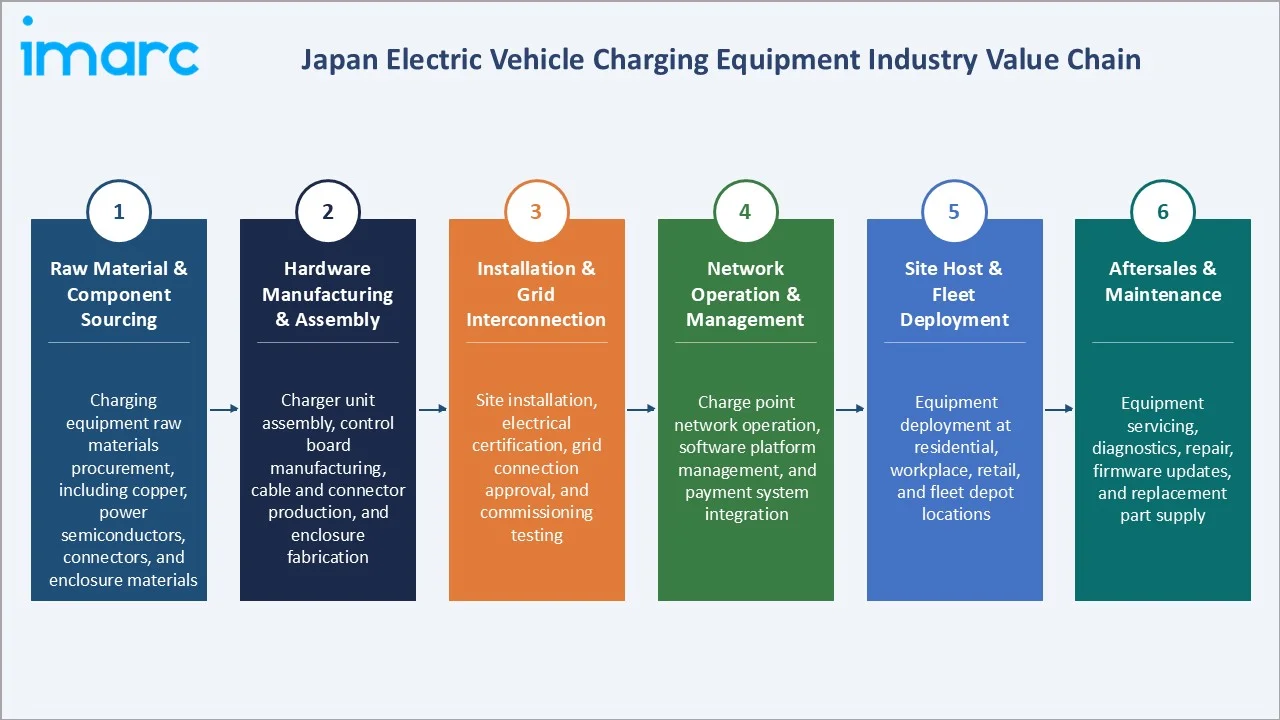
The Japan EV charging equipment value chain integrates component and power electronics sourcing, charger hardware manufacturing and assembly, installation and grid interconnection testing, network operation and charge point management, site host and fleet deployment integration, and aftersales equipment maintenance. The value chain's commercial architecture has been progressively consolidating toward integrated hardware-plus-software platforms as the primary commercial format, replacing the former separation between pure hardware vendors and network operators.
|
Stage |
Key Participants |
|
Raw Material & Component Sourcing |
Charging equipment raw materials procurement, including copper, power semiconductors, connectors, and enclosure materials |
|
Hardware Manufacturing & Assembly |
Charger unit assembly, control board manufacturing, cable and connector production, and enclosure fabrication |
|
Installation & Grid Interconnection |
Site installation, electrical certification, grid connection approval, and commissioning testing |
|
Network Operation & Management |
Charge point network operation, software platform management, and payment system integration |
|
Site Host & Fleet Deployment |
Equipment deployment at residential, workplace, retail, and fleet depot locations |
|
Aftersales & Maintenance |
Equipment servicing, diagnostics, repair, firmware updates, and replacement part supply |
The component sourcing tier is the value chain's most commercially critical stage, given its dependence on semiconductor availability. The network operation tier is experiencing the value chain's most rapid transition as standalone hardware sales are progressively displaced by integrated software-connected charging platforms.
Technology Landscape in the Japan Electric Vehicle Charging Equipment Industry
AC Charging Technology
AC charging technology offers cost-effective, widely compatible hardware suited to residential and workplace overnight applications, with compact wall-mounted designs and straightforward grid connection making it the preferred choice for Japan's home charging majority.
DC Fast-Charging Technology
DC fast-charging technology offers rapid charging speeds and reduced turnaround time, making it suitable for public locations, expressway service areas, and fleet depots requiring high-utilization operational efficiency.
Silicon Carbide (SiC) Power Module Technology
Silicon carbide power module technology is enabling more efficient, compact, high-power charging equipment designs, improving charging speed, energy efficiency, and thermal reliability across next-generation installations nationwide.
Japan Electric Vehicle Charging Equipment Market Segmentation Analysis
The report covers the following segments:
|
Segment Category |
Leading Segment |
Market Share |
Year |
|
Charging Station |
AC Charging Station |
61.8% |
2025 |
|
End Use |
Home Charging |
57.4% |
2025 |
|
Region |
Kanto Region |
41.6% |
2025 |

By Charging Station
AC Charging Station leads at 61.8% in 2025, encompassing the mainstream residential and workplace overnight charging specification, the most commercially widespread hardware category in the Japan EV charging equipment market.
To access detailed market analysis, Request Sample
DC Charging Station accounts for 38.2%, supporting fast-charging applications at public locations, expressway service areas, and commercial fleet depots where rapid turnaround times are essential for operational efficiency. This segment commands a premium per-unit equipment value given its higher power delivery requirements and more sophisticated thermal management systems.
By End Use
Home Charging leads at 57.4%, reflecting Japan's high reliance on overnight residential charging for daily commuting, supported by favourable off-peak electricity tariffs and government incentives for home charger installation. The home charging segment's steady growth reflects rising single-family and condominium EV ownership across suburban and metropolitan areas alike.
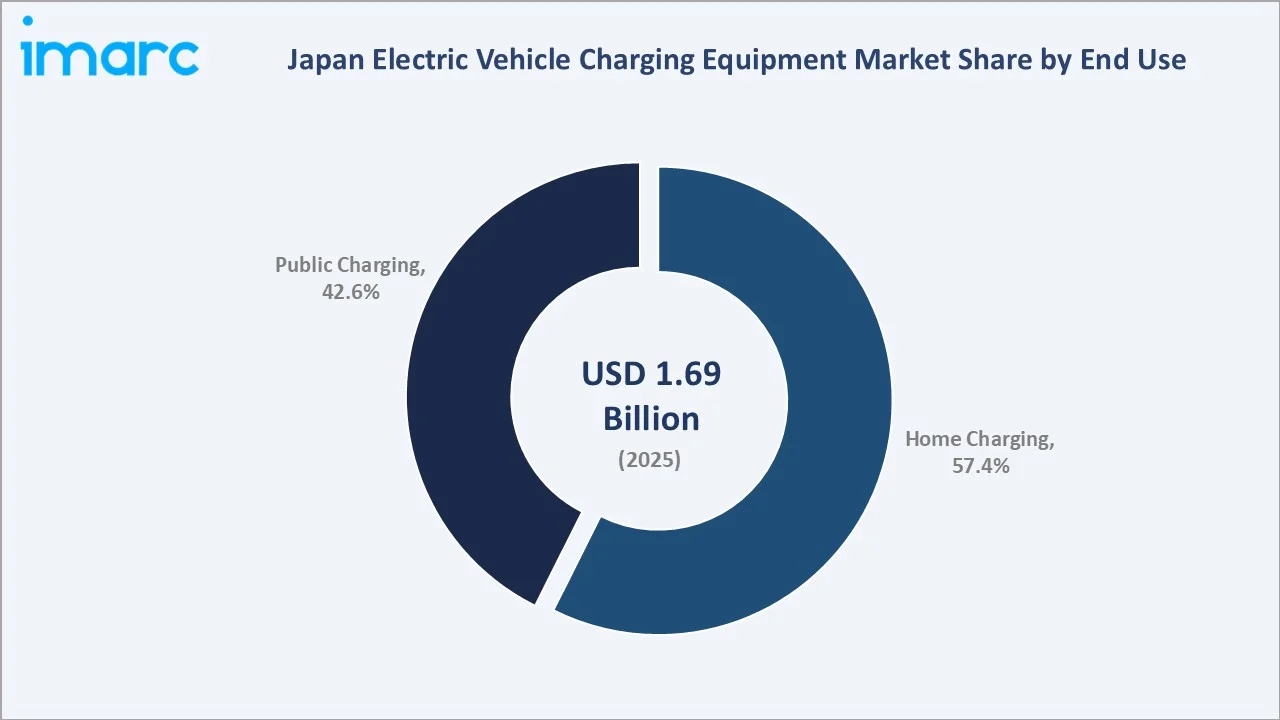
Public Charging accounts for 42.6%, growing rapidly as municipalities integrate curbside charging into smart-city upgrades and retail operators deploy multi-bay charging clusters to capture dwell-time revenue from EV drivers. This segment is expanding fastest among all end-use categories as urban charging accessibility becomes a key adoption driver.
Regional Market Insights
|
Region |
Share (2025) |
Key Market Drivers & Characteristics |
|
Kanto Region |
41.6% |
Driven by Tokyo's dense population, corporate headquarters concentration, and overlapping national and municipal subsidy programs |
|
Kansai/Kinki Region |
20.3% |
Supported by Osaka's expanding urban charging investment and growing residential and commercial equipment adoption |
|
Central/Chubu Region |
14.8% |
Driven by Aichi's automotive manufacturing concentration and Toyota-led logistics fleet electrification |
|
Kyushu-Okinawa Region |
6.9% |
Growing through Fukuoka's METI-backed subsidy allocation and expanding public charging deployment |
|
Tohoku Region |
5.4% |
Supported by disaster-resilient charging infrastructure and Tohoku Electric Power's backup-capable chargers |
|
Chugoku Region |
4.3% |
Driven by rural EV network expansion initiatives connecting remote areas with charging infrastructure |
|
Hokkaido Region |
3.8% |
Focused on cold-climate charging technology tailored to withstand harsh winter conditions |
|
Shikoku Region |
2.9% |
Early-stage growth supported by tourism-linked charger deployment and local government initiatives |
Kanto Region, at 41.6%, leads through Tokyo's metropolitan cluster, dense population, high GDP per capita, and progressive municipal climate plans that layer national METI grants atop prefectural subsidies. Kansai/Kinki Region, at 20.3%, reflects Osaka's expanding urban charging investment and growing residential and commercial equipment adoption.
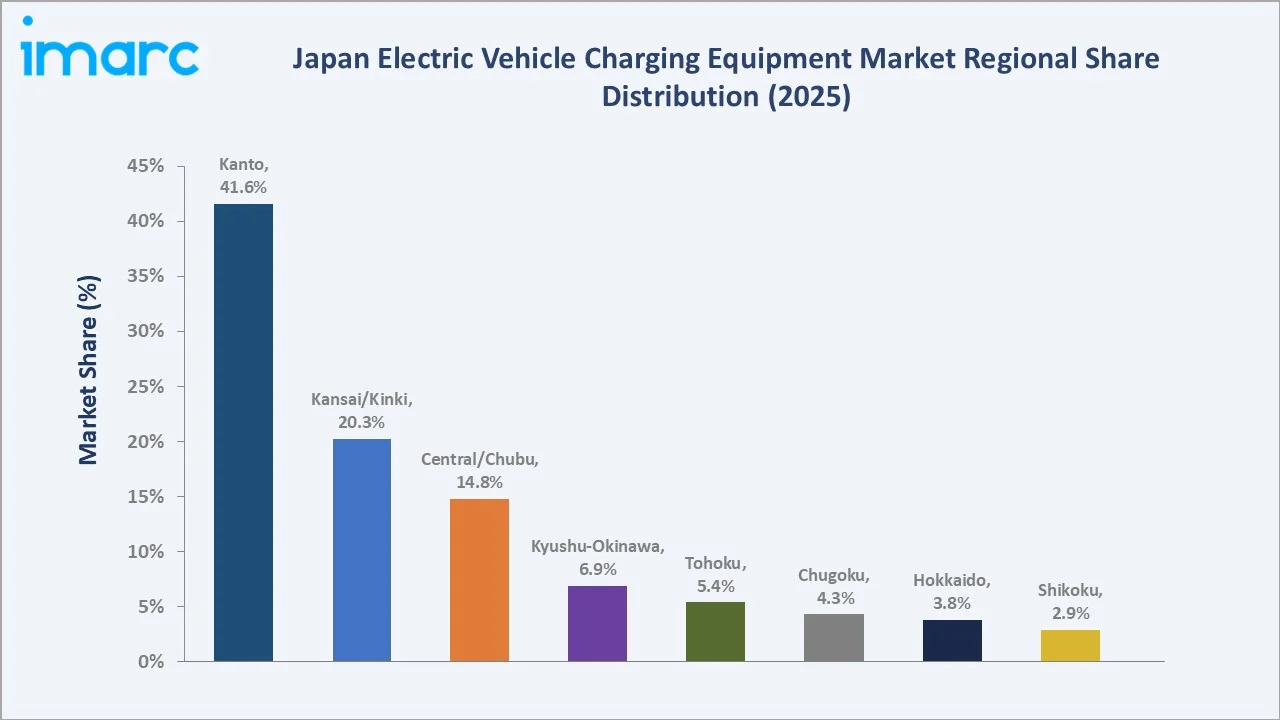
Central/Chubu Region, at 14.8%, benefits from Aichi's automotive manufacturing concentration and Toyota-led logistics electrification. Kyushu-Okinawa, Tohoku, Chugoku, Hokkaido, and Shikoku collectively represent 19.3% of the market, reflecting Japan's progressive nationwide charging network expansion into rural and secondary urban markets.
Competitive Landscape
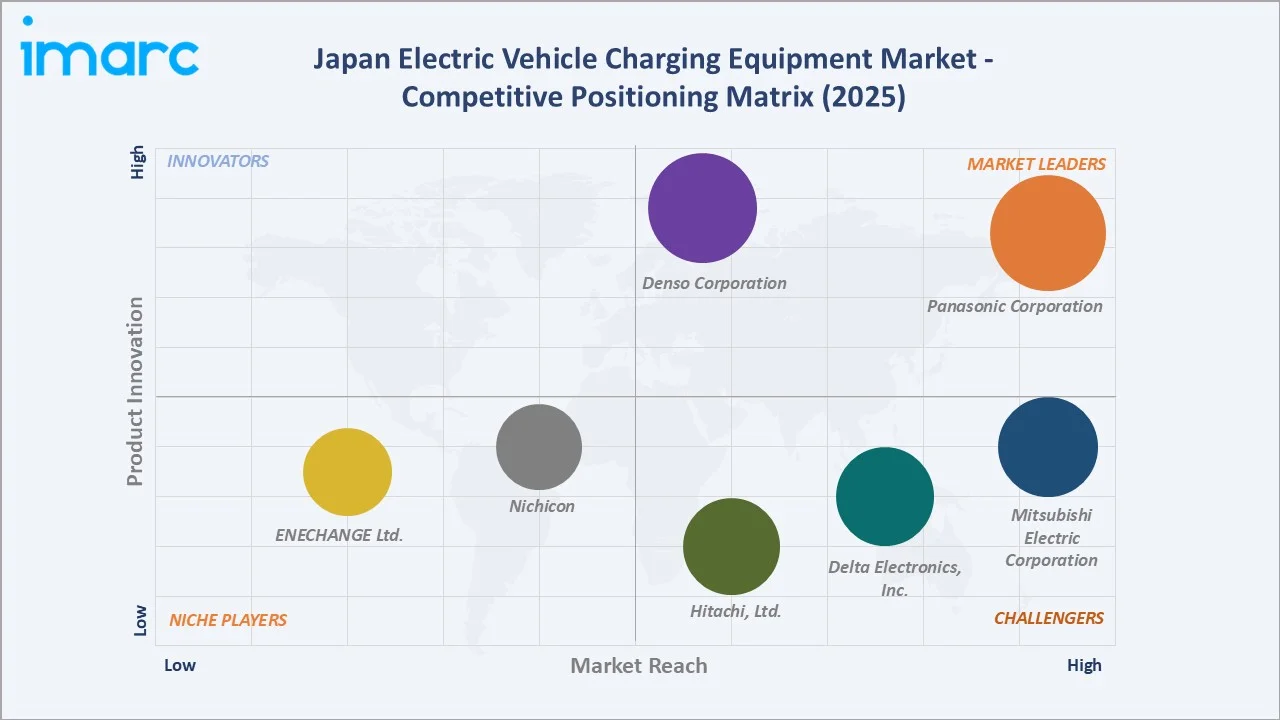
The Japan electric vehicle charging equipment market competitive landscape is moderately fragmented, with established electronics conglomerates, automotive-linked component makers, and specialist charging technology firms competing across hardware and software-integrated solutions.
|
Company Name |
Key Products |
Market Position |
Core Strength |
|
Panasonic Corporation |
AC/DC Charging Systems, EV Chargers |
Market Leader |
Panasonic leverages its broad electronics and battery manufacturing base to supply integrated charging hardware. |
|
Denso Corporation |
EV Charging Modules, Power Electronics |
Market Leader |
Denso specializes in automotive-grade power electronics supporting OEM-integrated charging systems. |
|
Mitsubishi Electric Corporation |
DC Fast Chargers, Control Systems |
Strong Challenger |
Mitsubishi Electric provides high-power charging infrastructure for public and commercial applications. |
|
Hitachi, Ltd. |
Charging Infrastructure, Grid Integration Systems, Multi-Port EV Charger |
Strong Challenger |
Hitachi combines power electronics expertise with grid-integration capabilities for scalable charger networks. |
|
Delta Electronics, Inc. |
EV Charging system |
Strong Challenger |
Delta Electronics supplies power-dense charging hardware backed by global manufacturing scale. |
|
Nichicon |
Electric Vehicle Charging Infrastructure |
Niche Specialist |
Nichicon is a specialist in bidirectional home charging systems supporting Japan's V2H tariff programs. |
|
ENECHANGE Ltd. |
EV Charging Stations |
Niche Specialist |
ENECHANGE combines charger hardware with software platforms for energy management and utilization optimization. |
Key players include Panasonic Corporation, Denso Corporation, Mitsubishi Electric Corporation, Hitachi, Ltd., Delta Electronics, Inc., Nichicon, ENECHANGE Ltd., and others.
Key Company Profiles
Panasonic Corporation
Panasonic Corporation is a Japan-based electronics and energy technology company with a strong presence in the EV charging equipment market through its AC and DC charging systems and battery manufacturing capabilities.
- Key Products: AC/DC Charging Systems, EV Chargers, Battery Storage Integration.
- Recent Developments: In April 2023, Panasonic Corporation invested in Ubiden Inc., an electric vehicle (EV) charging service provider, through the Panasonic Kurashi Visionary Fund. The investment aims to strengthen the development of EV charging infrastructure in Japan by combining Panasonic's charging hardware with Ubiden's software-based charging service platform.
- Strategic Focus: Expanding integrated charging and energy storage solutions combining chargers, batteries, and grid-management software for residential and commercial applications. The company continues to invest in domestic manufacturing capacity to support rising national charger demand. Panasonic is also deepening partnerships with utilities to develop demand-response-compatible charging hardware for the residential V2H segment.
Denso Corporation
Denso Corporation is a leading Japanese automotive component supplier with a growing presence in the EV charging equipment market through its power electronics and charging module portfolio.
- Key Products: EV Charging Modules, Power Electronics, Onboard Charger Systems.
- Recent Developments: In October 2025, DENSO Corporation announced that its newly developed electrification products have been adopted for Toyota's new bZ4X battery electric vehicle (BEV). The company is supplying an advanced inverter, a cell monitoring circuit, and a shunt current sensor designed to improve vehicle efficiency, driving performance, battery management, and charging capabilities.
- Strategic Focus: Strengthening automotive-grade charging component supply chains and deepening integration with major Japanese OEM electrification programs. Denso is prioritizing silicon carbide power module development to improve charging efficiency across its product range. The company is also expanding collaborative R&D initiatives with domestic automakers to align charging hardware roadmaps with next-generation vehicle platforms.
Mitsubishi Electric Corporation
Mitsubishi Electric Corporation is a diversified Japanese electronics manufacturer with a significant role in the EV charging equipment market through its DC fast-charging and control systems portfolio.
- Key Products: DC Fast Chargers, Charging Control Systems, Power Conversion Equipment.
- Strategic Focus: Scaling high-power DC charging equipment production to meet expressway service area and commercial fleet depot demand nationwide. The company is investing in advanced thermal management systems to improve fast-charger reliability under sustained high-utilization conditions. Mitsubishi Electric is also pursuing strategic partnerships with charge point operators to secure long-term equipment supply agreements.
Market Concentration Analysis
The Japan EV charging equipment market is moderately fragmented, with the key players collectively accounting for a substantial share of national charger hardware revenue. Specialist players compete in bidirectional V2H and software-integrated charging niches respectively. Market concentration is expected to gradually increase as consolidation favors vendors offering integrated hardware-plus-software ecosystems capable of supporting multi-gigawatt national rollouts through the forecast period.
Investment & Growth Opportunities
Highest Growth Segments
Public Charging application (approximately 21.6% CAGR), DC Charging Station hardware (approximately 18.1% CAGR), fleet depot and commercial vehicle charging equipment, bidirectional V2H premium hardware, expressway fast-charging hub deployment, and SiC power module-integrated charging systems represent the highest-growth investment vectors through 2034.
Emerging Investment Opportunities
Commercial fleet and depot charging systems represent the market's highest per-unit-value emerging opportunity, with electric bus and delivery fleet DC charging hardware generating substantially higher per-unit revenue than standard residential AC equipment, supported by Japan's growing corporate electrification mandate pool.
Investment Themes
- SiC vertical integration for charging equipment power modules as a structural cost advantage through 2034: Suppliers achieving below-market SiC device cost through vertical integration create a sustainable equipment cost advantage over competitors dependent on external procurement in a supply-constrained market.
- Bidirectional V2H charger manufacturing investment, capturing Japan's fastest-growing residential equipment category: Japan's V2H tariff programs are creating a rapidly expanding unit volume opportunity requiring a corresponding scale-up of bidirectional charger supply, currently served primarily by domestic suppliers such as Nichicon.
Future Market Outlook (2026-2034)
The Japan electric vehicle charging equipment market is projected to grow from USD 1.69 Billion in 2025 to USD 6.58 Billion by 2034, delivering a 16.32% CAGR over the forecast period. The market's anchor value of USD 3.60 Billion in 2030 represents a critical infrastructure inflection point, as bidirectional V2H chargers achieve mainstream residential adoption, expressway fast-charging hubs reach national coverage targets, SiC inverters are expected to achieve wider adoption particularly in higher-power public charging applications, and public charging networks close the urban accessibility gap with home charging.
Three structural forces define market growth through 2034 with exceptional confidence. Japan's 2035 gasoline-vehicle sales ban creates a self-reinforcing demand cycle where infrastructure investment enables EV adoption, which drives further charger demand. Corporate ESG-fleet electrification mandates by keiretsu groups lock in multi-year charger contracts at depots and logistics hubs, multiplying equipment units deployed above simple fleet volume growth. The urban-rural charging network convergence, supported by sustained METI subsidy programs, ensures nationwide equipment demand growth extending beyond metropolitan centres alone.
Research Methodology
Primary Research
Primary research comprised structured interviews with industry stakeholders across Japan's EV charging equipment value chain, including charger OEM executives, utility infrastructure planners, charge point operators, and fleet electrification programme leads.
Secondary Research
Secondary research encompassed company annual reports, METI policy releases, IEA Global EV Outlook data, and industry association datasets covering charging standards and rollout targets. Over 60 secondary sources were reviewed.
Forecasting Models
Market revenue forecasts were developed using a charger-installation-based bottom-up model incorporating projected charger additions by type, average equipment revenue per unit, replacement demand cycles, and technology premium adjustments for bidirectional and high-power DC hardware.
Japan Electric Vehicle Charging Equipment Market Report Coverage:
| Report Features | Details |
|---|---|
| Base Year of the Analysis | 2025 |
| Historical Period | 2020-2025 |
| Forecast Period | 2026-2034 |
| Units | Billion USD |
| Scope of the Report |
Exploration of Historical Trends and Market Outlook, Industry Catalysts and Challenges, Segment-Wise Historical and Future Market Assessment:
|
| Charging Stations Covered | AC Charging Station, DC Charging Station |
| End Uses Covered | Home Charging, Public Charging. |
| Regions Covered | Kanto Region, Kansai/Kinki Region, Central/ Chubu Region, Kyushu-Okinawa Region, Tohoku Region, Chugoku Region, Hokkaido Region, Shikoku Region. |
| Companies Covered | Panasonic Corporation, Denso Corporation, Mitsubishi Electric Corporation, Hitachi, Ltd., Delta Electronics, Inc., Nichicon, ENECHANGE Ltd., etc. |
| Customization Scope | 10% Free Customization |
| Post-Sale Analyst Support | 10-12 Weeks |
| Delivery Format | PDF and Excel through Email (We can also provide the editable version of the report in PPT/Word format on special request) |
Key Benefits for Stakeholders:
- IMARC’s industry report offers a comprehensive quantitative analysis of various market segments, historical and current market trends, market forecasts, and dynamics of the Japan electric vehicle charging equipment market from 2020-2034.
- The research report provides the latest information on the market drivers, challenges, and opportunities in the Japan electric vehicle charging equipment market.
- Porter's five forces analysis assist stakeholders in assessing the impact of new entrants, competitive rivalry, supplier power, buyer power, and the threat of substitution. It helps stakeholders to analyze the level of competition within the Japan electric vehicle charging equipment industry and its attractiveness.
- Competitive landscape allows stakeholders to understand their competitive environment and provides an insight into the current positions of key players in the market.
Frequently Asked Questions About the Japan Electric Vehicle Charging Equipment Market Report
The Japan EV charging equipment market reached USD 1.69 Billion in 2025, driven by the AC Charging Station segment dominant at 61.8%, Home Charging application leading at 57.4%, rising EV adoption across Japan's major population centres, Kanto Region commanding 41.6% market share through Tokyo's population density and corporate concentration, and expanding public charging network investment contributing the market's fastest-growing equipment demand pool.
The market grows at 16.32% CAGR during 2026-2034, reaching USD 6.58 Billion by 2034. This growth reflects Japan's 2035 gasoline-vehicle sales ban, corporate ESG-fleet electrification mandates, expanding public charging network density, and premium bidirectional V2H equipment pricing growth.
The AC Charging Station segment leads at 61.8%, capturing the mainstream residential and workplace overnight charging specification. This segment grows steadily through home charger installation expansion and workplace charging network build-out.
Home Charging leads at 57.4% through the highest reliance on overnight residential charging and compounding EV ownership growth, creating sustained procurement expansion. Public Charging grows fastest at approximately 21.6% CAGR through urban network densification and retail-integrated fast-charging deployment.
Kanto Region leads at 41.6% through Tokyo's population density, corporate headquarters concentration, and overlapping national and municipal subsidy programs supporting charger rollouts nationwide.
Leading companies include Panasonic Corporation, Denso Corporation, Mitsubishi Electric Corporation, Hitachi, Ltd., Delta Electronics, Inc., Nichicon, ENECHANGE Ltd., and others.
The market is projected to reach approximately USD 3.60 Billion by 2030, with bidirectional V2H chargers becoming a standard specification for new residential platforms, expressway fast-charging hub expansion, commercial fleet depot charging growth, and SiC power module-integrated equipment beginning mainstream deployment.
Three priority investment opportunities: SiC vertical integration for charging equipment power module manufacturing, bidirectional V2H charger manufacturing for residential energy resilience applications, and expressway fast-charging hub technology commercialization partnerships.
Need more help?
- Speak to our experienced analysts for insights on the current market scenarios.
- Include additional segments and countries to customize the report as per your requirement.
- Gain an unparalleled competitive advantage in your domain by understanding how to utilize the report and positively impacting your operations and revenue.
- For further assistance, please connect with our analysts.
 Request Customization
 Speak to an Analyst
 Request Brochure
 Inquire Before Buying
Benefits of Customization
- Personalize this research
- Triangulate with your data
- Get data as per your format and definition
- Gain a deeper dive into a specific application, geography, customer, or competitor
- Any level of personalization
Get in Touch With Us
UNITED STATES
Phone: +1-201-971-6302
INDIA
Phone: +91-120-433-0800
UNITED KINGDOM
Phone: +44-753-714-6104
Email: [email protected]
Client Testimonials




.webp)




.webp)













Related Reports

Choose your plan
*Please note that the prices mentioned below are starting prices for each bundle type. Kindly contact our team for further details.*
Single User License
- 1 User License, Access on 2 Devices
- PDF Report + Excel Dataset (Password Protected)
- Lifetime Access
- No Printing Rights
- 10% Free Report Customization
- 10–12 Weeks of Analyst Support
Five User License
- Access for 5 Users, 2 Devices per User
- PDF Report + Excel Dataset (Password Protected)
- Lifetime Access
- Dedicated Account Manager
- 12–14 Weeks of Analyst Support
- No Printing Rights
- 15% Free Report Customization
- 25% Discount on Your Next Purchase
Corporate User License
- Unlimited User Access (Within Your Organization)
- PDF Report + Excel Dataset
- Lifetime Access
- Dedicated Account Manager
- 14–20 Weeks of Analyst Support
- No Printing Rights
- 20% Free Report Customization
- 30% Discount on Your Next Purchase
Essential Insights
What's included:
3 reports
- Lifetime Access
- PDF Reports
- Excel Datasets
- 2 Weeks of Free Analyst Support
- 2 User Licenses
- Access on 2 Devices
- Printing Rights
- Complimentary PowerPoint (PPT) Version
- Complimentary License Upgrade
Professional Access
What's included:
5 reports
- Lifetime Access
- PDF Reports
- Excel Datasets
- 8 Weeks of Free Analyst Support
- 2 User Licenses
- Access on 2 Devices
- Printing Rights
- Complimentary PowerPoint (PPT) Version
- Complimentary License Upgrade
Business Advantage
What's included:
8 reports
- Lifetime Access
- PDF Reports
- Excel Datasets
- 14 Weeks of Free Analyst Support
- 2 User Licenses
- Access on 2 Devices
- Printing Rights
- Complimentary PowerPoint (PPT) Version
- Complimentary License Upgrade
Enterprise Intelligence
What's included:
10 reports
- Lifetime Access
- PDF Reports
- Excel Datasets
- 20 Weeks of Free Analyst Support
- 2 User Licenses
- Access on 2 Devices
- Printing Rights
- Complimentary PowerPoint (PPT) Version
- Complimentary License Upgrade