
South Africa Electric Vehicle Charging Station Market Size, Share, Trends and Forecast by Charging Station Type, Vehicle Type, Installation Type, Charging Level, Connector Type, Application, and Region, 2026-2034
South Africa Electric Vehicle Charging Station Market Size, Share, Trends & Forecast (2026-2034)
The South Africa electric vehicle charging station market reached USD 96.79 Million in 2025 and is projected to reach USD 968.84 Million by 2034, growing at a CAGR of 28.13% during 2026-2034. Rising EV adoption, government incentives, and carbon-reduction commitments drive charging station demand. Private sector investments and renewable energy integration further support growth. AC Charging dominates at 57.6%. BEV leads at 54.9%. Gauteng commands 36.5% of market share.
Market Snapshot
|
Metric |
Value |
|
Market Size (2025) |
USD 96.79 Million |
|
Forecast Market Size (2034) |
USD 968.84 Million |
|
CAGR (2026-2034) |
28.13% |
|
Base Year |
2025 |
|
Historical Period |
2020-2025 |
|
Forecast Period |
2026-2034 |
|
Dominant Charging Station Type |
AC Charging (57.6%, 2025) |
|
Dominant Vehicle Type |
Battery Electric Vehicle – BEV (54.9%, 2025) |
|
Leading Province |
Gauteng (36.5%, 2025) |
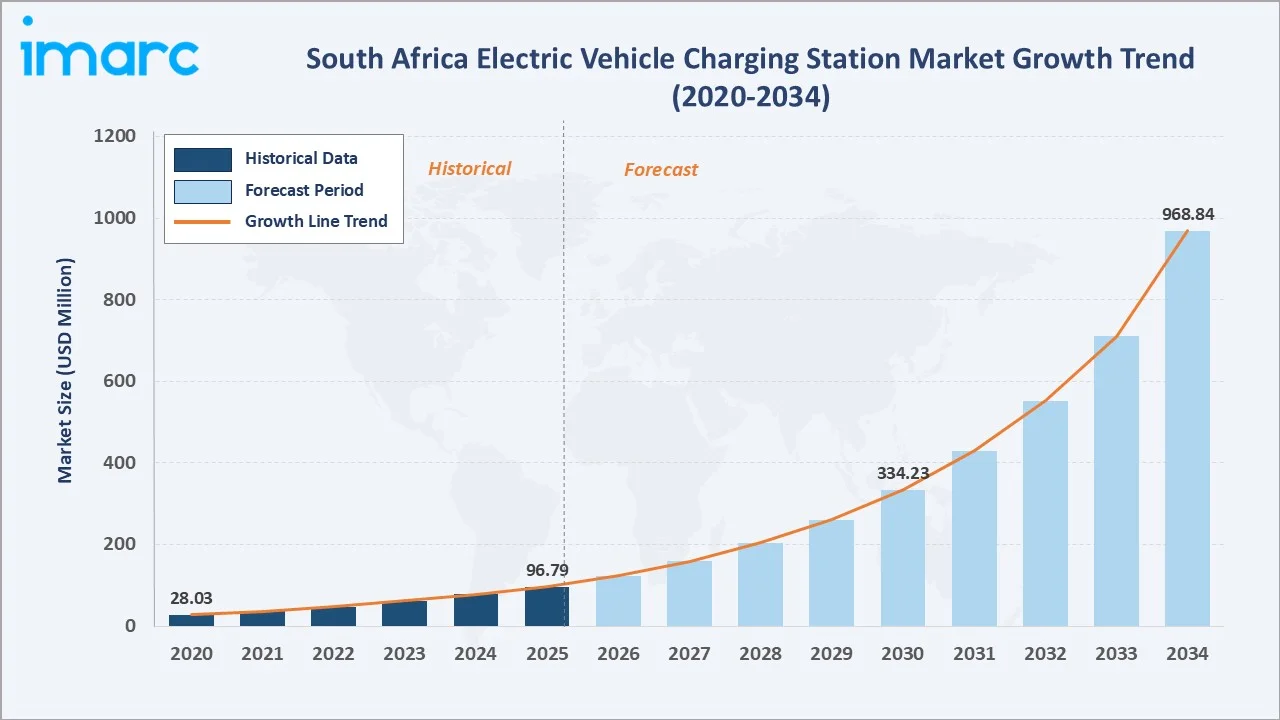
The South Africa EV charging station market expanded from USD 28.03 Million in 2020 to USD 96.79 Million in 2025, anchored at USD 334.23 Million in 2030, and forecast to reach USD 968.84 Million by 2034. Government clean mobility programmes and accelerating private sector deployments sustained above-trend growth through 2022-2025.
To get more information on this market, Request Sample
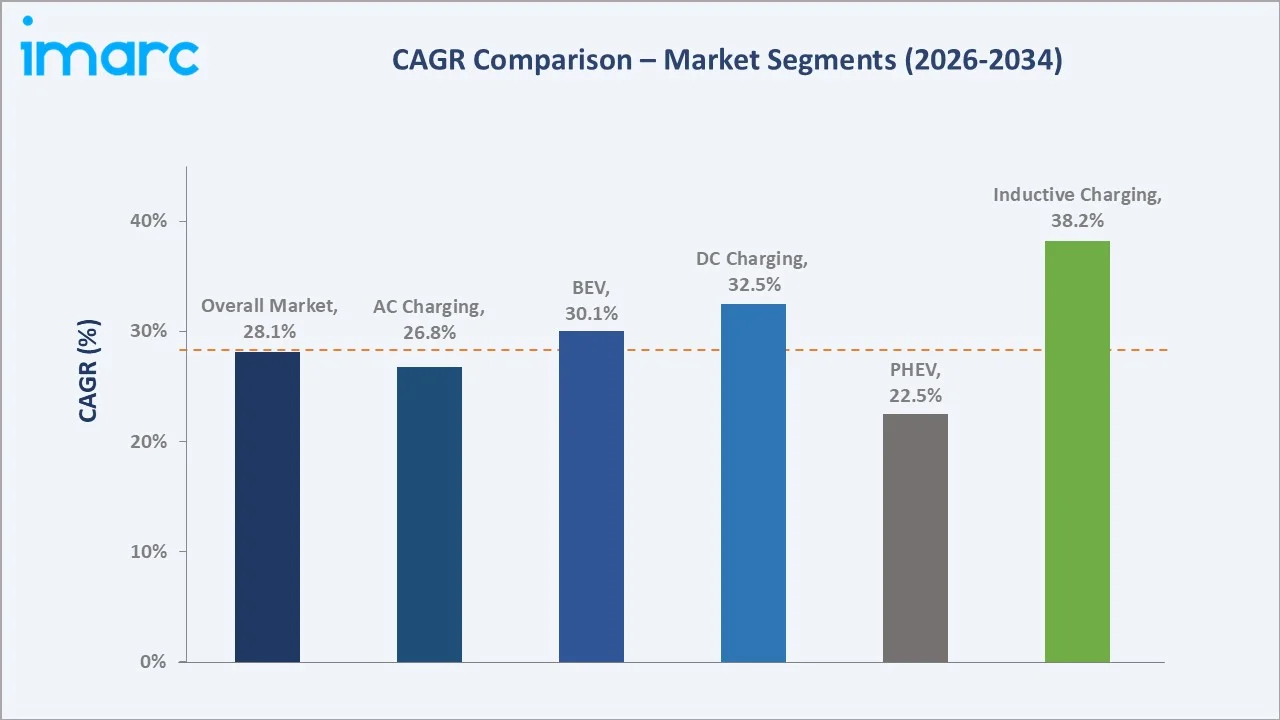
DC Charging grows fastest at ~32.5% CAGR through highway fast-charge corridor development. Inductive Charging grows at ~38.2% CAGR from a small base through fleet depot pilots. BEV charging demand grows at ~30.1% CAGR through expanding full-electric vehicle adoption across the country.
Executive Summary
The South Africa electric vehicle charging station market reached USD 96.79 Million in 2025, representing one of Africa's most dynamic intersections of clean energy, mobility infrastructure, and technology investment. The market encompasses AC charging, DC fast charging, and inductive charging solutions serving BEV, PHEV, and HEV segments across all major provinces.
AC Charging at 57.6% dominates through wide vehicle compatibility and lower installation cost. BEV at 54.9% leads vehicle type through full electrification demand. Gauteng at 36.5% leads all provinces through concentrated economic activity and fleet electrification programmes.
Key Market Insights
|
Insight |
Data |
|
Dominant Charging Type |
AC Charging – 57.6% share (2025) |
|
Dominant Vehicle Type |
Battery Electric Vehicle (BEV) – 54.9% (2025) |
|
Leading Province |
Gauteng – 36.5% (2025) |
|
Market Opportunity |
Solar-integrated charging; fleet depot charging; DC fast-charge corridors; smart grid integration; rural off-grid EV charging |
Key Analytical Observations Supporting The Above Data:
- AC Charging at 57.6%: AC charging dominates due to its lower infrastructure cost, broad vehicle compatibility, and ease of deployment in residential, commercial, and hospitality settings. It is the most deployed technology for EV infrastructure expansion across South Africa.
- Battery EV (BEV) at 54.9%: BEVs lead demand as consumers and corporate fleets adopt zero-emission mobility. Full battery electric vehicles require dedicated external charging, creating the largest addressable segment for charging station operators and technology providers.
- Gauteng at 36.5%: Gauteng leads due to its position as South Africa's economic hub with the highest vehicle density, concentration of corporate fleet electrification, and the most advanced government charging infrastructure investment programme of all provinces.
South Africa Electric Vehicle Charging Station Market Overview
The South Africa EV charging station market encompasses the supply, installation, and operation of AC, DC, and inductive charging infrastructure for passenger vehicles, commercial fleets, and public transport. The market includes hardware manufacturing, software platform services, installation, and network operations across all provinces.
Macroeconomic factors include rising fuel prices, South Africa's national climate commitments, urbanisation, and corporate ESG mandates. Government clean mobility programmes, renewable energy cost reduction, and growing consumer EV confidence are accelerating charging infrastructure deployment across Gauteng, Western Cape, and other key provinces.
Market Dynamics
To evaluate market opportunities, Request Sample
Market Drivers
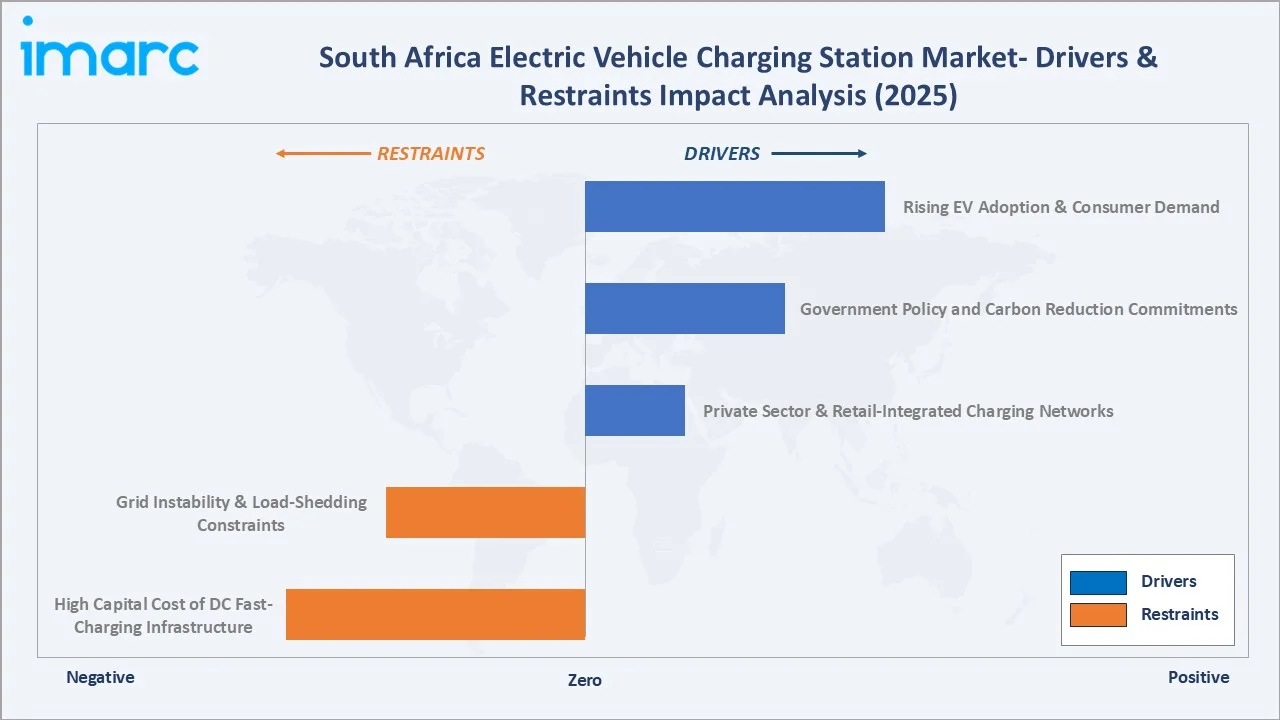
- Rising Electric Vehicle Adoption and Consumer Demand: Increasing EV sales across South Africa generate direct demand for charging infrastructure. As more consumers and corporate fleets transition to electric mobility, investment in public and private charging stations accelerates. Government incentives and falling EV purchase prices reinforce this shift, with BEV registrations growing consistently year-on-year since 2021.
- Government Policy and Carbon Reduction Commitments: South Africa's national climate targets and green mobility policies drive public investment in charging corridors and urban hubs. The Western Cape Government's fleet electrification initiative, including Golden Arrow Bus Service's 120 electric bus programme, and SABS's 30-unit charging network deployment exemplify policy-driven infrastructure expansion.
- Private Sector and Retail-Integrated Charging Networks: Retailers, property developers, and energy companies deploy charging stations at shopping centres, office parks, and fuel forecourts. This creates a self-reinforcing network effect that improves EV viability and expands the total addressable market for charging operators beyond traditional urban centres.
- Renewable Energy Integration and Solar-Powered Charging: Growing solar power capacity in South Africa enables solar-integrated charging stations that reduce grid dependency. This reduces operating costs, supports load-shedding resilience, and aligns with sustainability goals of operators and end users across all provinces.
Market Restraints
- Grid Instability and Load-Shedding Constraints: South Africa's electricity grid challenges and periodic load-shedding create operational risk for charging station operators. Unreliable power supply requires costly battery backup systems and raises total infrastructure investment, limiting deployment pace in underserved provinces and secondary cities.
- High Capital Cost of DC Fast-Charging Infrastructure: DC fast-charging stations require significantly higher capital expenditure than AC chargers. For smaller operators and municipalities with limited budgets, this barrier slows deployment of high-speed charging on national corridors, restricting network density relative to growing BEV adoption.
- Limited EV Model Availability and Affordability: The relatively high cost of EVs and limited model availability in South Africa constrains the consumer base, indirectly slowing charging demand growth. Without sufficient vehicle penetration outside premium segments, the business case for dense networks in non-urban areas remains commercially challenging.
Market Opportunities
- Solar-Integrated and Off-Grid Charging Solutions: Declining solar panel costs and high South African solar irradiation create a strong opportunity for solar-powered charging stations. Operators can reduce energy costs and achieve grid independence, expanding commercially viable deployment into rural and peri-urban areas where grid connection is costly or unreliable.
- Fleet Depot and Corporate EV Charging Infrastructure: Commercial fleet operators and logistics companies transitioning to electric vehicles represent a large depot charging opportunity. Dedicated fast-charging hubs for bus, taxi, and delivery fleets create predictable revenue streams and long-term contracts for infrastructure providers.
Market Challenges
- Charging Infrastructure Equity Across Provinces: Infrastructure deployment is concentrated in Gauteng and Western Cape, leaving under-served provinces with limited charging access. Addressing this geographic imbalance requires coordinated government and private investment to support equitable EV adoption and rural network development.
- Standardisation of Connector Types and Interoperability: Multiple connector standards (CCS, CHAdeMO, Type 2, Tesla) create fragmentation complicating user experience and network investment. Establishing clear national standards and interoperability frameworks is needed to improve network efficiency and reduce operator capital uncertainty.
Emerging Market Trends
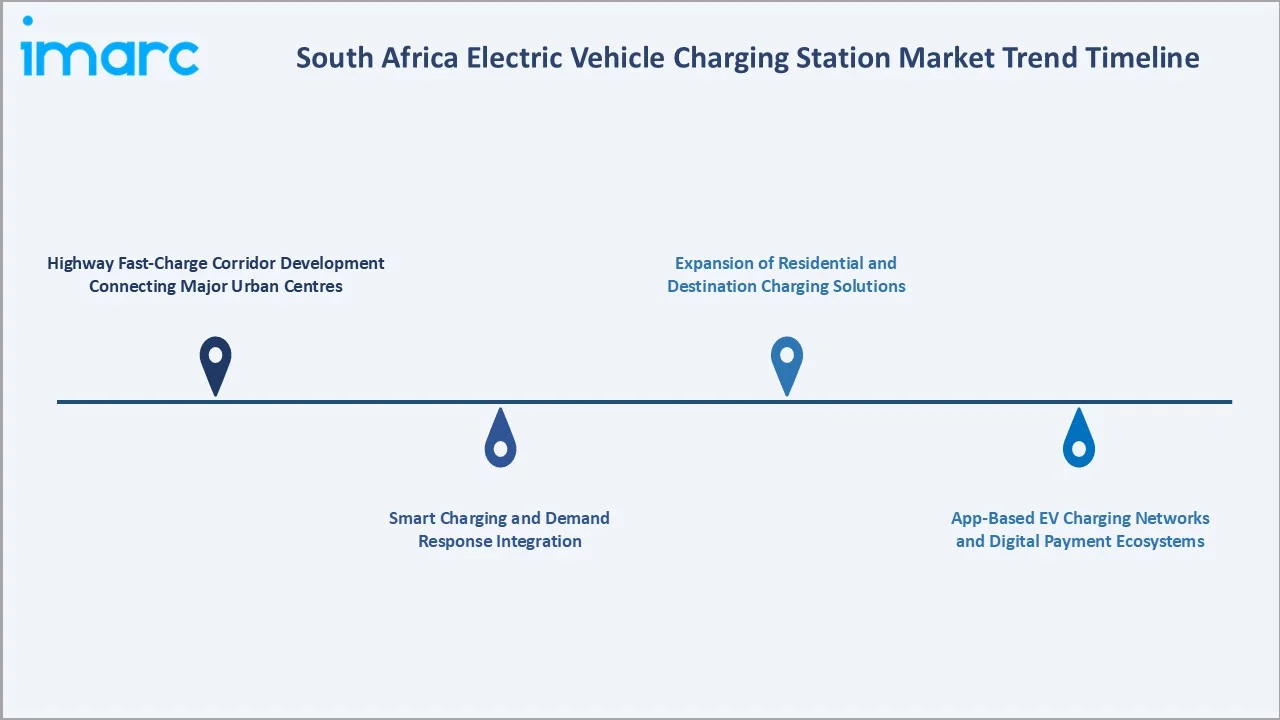
1. Highway Fast-Charge Corridor Development Connecting Major Urban Centres
Private operators and government bodies are deploying DC fast-charging stations along national highways linking Gauteng, Western Cape, and KwaZulu-Natal. These corridors reduce range anxiety and support long-distance EV travel. In April 2025, the Western Cape Government deployed 30 SABS-installed charging units across government transport locations.
2. Smart Charging and Demand Response Integration
Operators are deploying smart EV chargers with load management, time-of-use pricing, and grid demand response capabilities. These systems optimise grid impact, reduce energy costs, and create new revenue streams. Smart charging is becoming a standard feature of commercial deployments in Gauteng and Western Cape.
3. App-Based EV Charging Networks and Digital Payment Ecosystems
Mobile applications providing real-time charger availability, route planning, contactless payment, and loyalty programme integration are becoming standard across South Africa. This digital layer improves user experience and increases utilisation rates of existing charging infrastructure.
4. Expansion of Residential and Destination Charging Solutions
Growing demand for home and workplace EV charging is driving Level 2 AC charger installations in residential estates, hotels, and commercial premises. Property developers increasingly incorporate EV charging as a standard amenity to attract tenants and buyers across South Africa.
Industry Value Chain Analysis
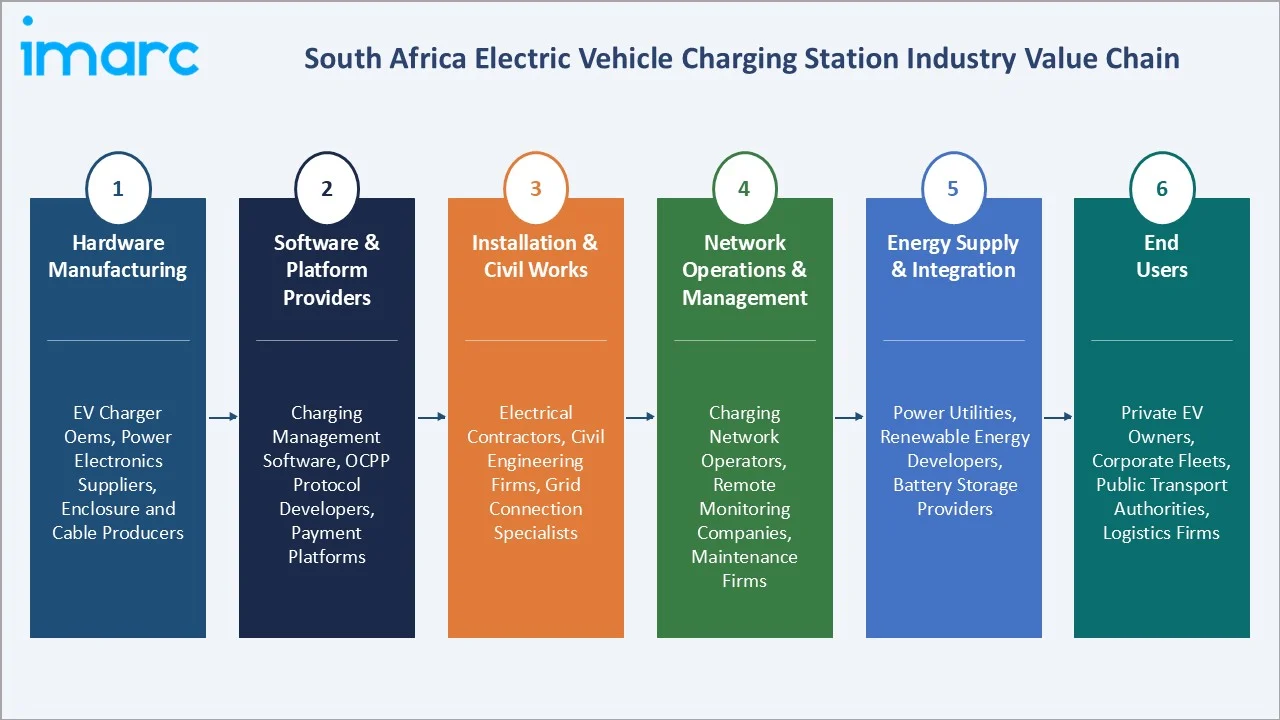
The South Africa EV charging station value chain integrates hardware manufacturing, software platforms, installation services, network operations, energy supply, and end-user deployment. Each stage contributes to the delivery, reliability, and commercial sustainability of charging infrastructure across all provinces.
|
Stage |
Key Participants |
|
Hardware Manufacturing |
EV charger OEMs, power electronics suppliers, enclosure and cable producers |
|
Software & Platform Providers |
Charging management software, OCPP protocol developers, payment platform providers |
|
Installation & Civil Works |
Electrical contractors, civil engineering firms, grid connection specialists |
|
Network Operations & Management |
Charging network operators, remote monitoring companies, maintenance firms |
|
Energy Supply & Integration |
Power utilities, renewable energy developers, battery storage solution providers |
|
End Users |
Private EV owners, corporate fleets, public transport authorities, logistics companies |
The network operations and management stage is the most commercially differentiated phase, where platform technology and data analytics create recurring revenue. Software platforms enabling smart charging and demand response are emerging as high-value nodes attracting premium margins above hardware-only business models.
Technology Landscape in the South Africa EV Charging Station Industry
AC Charging Technology
AC charging technology converts grid alternating current using the vehicle's onboard charger. It is the most widely deployed technology in South Africa for residential and commercial destination charging. AC chargers operate at 3.7–22 kW, making them cost-effective for overnight and workplace charging with wide vehicle compatibility.
DC Fast-Charging Technology
DC fast-charging technology bypasses the onboard charger and delivers direct current to the vehicle battery, significantly reducing charging times. DC chargers are ideal for highway corridors and high-turnover commercial sites, operating at 50–150 kW with ultra-fast variants above 150 kW entering deployment on major routes.
Inductive (Wireless) Charging Technology
Inductive charging uses electromagnetic induction to transfer energy without physical connectors. While still nascent in South Africa at 8.6% market share, wireless charging is gaining commercial interest for fleet depot applications and public transport integration where automation and operational convenience are priorities.
Market Segmentation Analysis
The report covers the following segments:
|
Segment Category |
Leading Segment |
Market Share |
Year |
|
Charging Station Type |
AC Charging |
57.6% |
2025 |
|
Vehicle Type |
Battery Electric Vehicle (BEV) |
54.9% |
2025 |
|
Installation Type |
🔒 |
🔒 |
2025 |
|
Charging Level |
🔒 |
🔒 |
2025 |
|
Connector Type |
🔒 |
🔒 |
2025 |
|
Application |
🔒 |
🔒 |
2025 |
|
Province |
Gauteng |
36.5% |
2025 |

By Charging Station Type
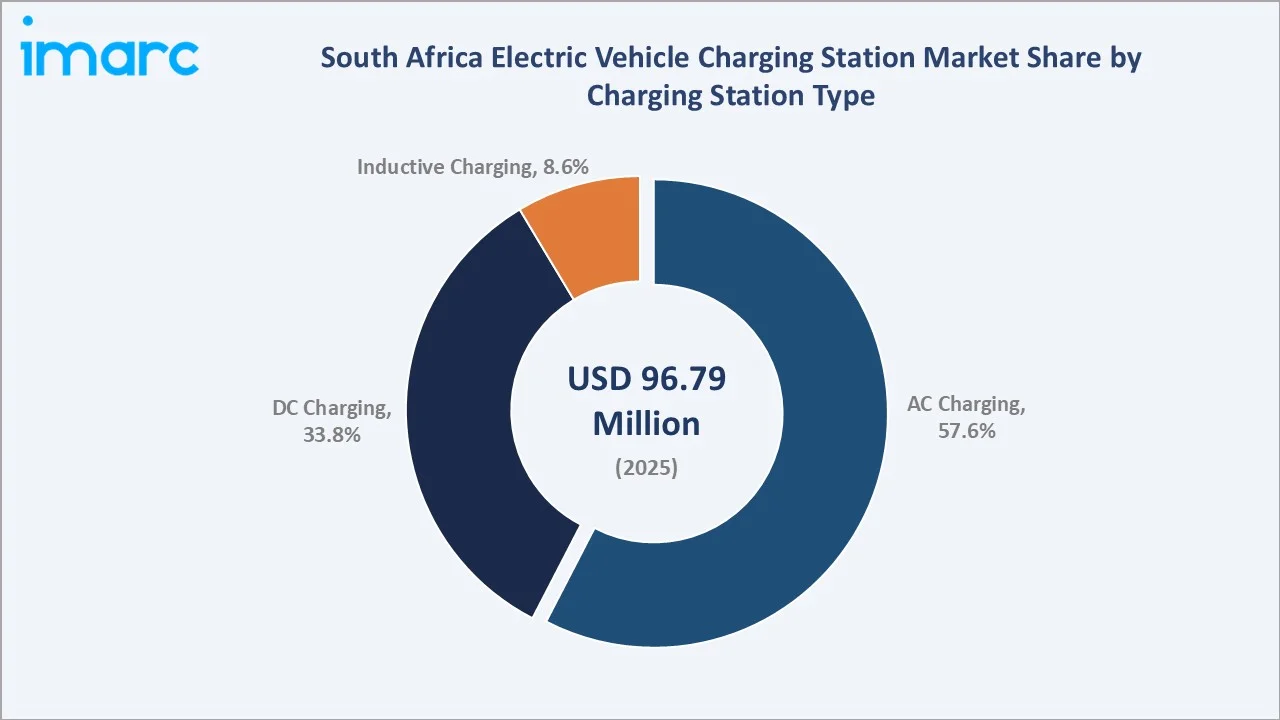
AC Charging leads at 57.6% (2025). The AC charging segment encompasses residential Level 2 chargers, commercial destination chargers in retail and hospitality settings, and workplace charging solutions. Its lower cost and broad vehicle compatibility make it the dominant technology for EV infrastructure expansion in South Africa.
To access detailed market analysis, Request Sample
DC Charging at 33.8% serves the high-speed segment, driven by highway corridor development and public fast-charging hubs. Inductive Charging at 8.6% remains emerging but is gaining pilot investment from fleet operators and select municipal transport projects. The report covers the following segments:
By Vehicle Type
Battery Electric Vehicle (BEV) leads at 54.9% (2025). BEVs require dedicated charging infrastructure and are the primary driver of charging station demand. Fleet electrification, government procurement programmes, and falling BEV purchase costs sustain BEV dominance. The BEV segment grows at ~30.1% CAGR through the forecast period.
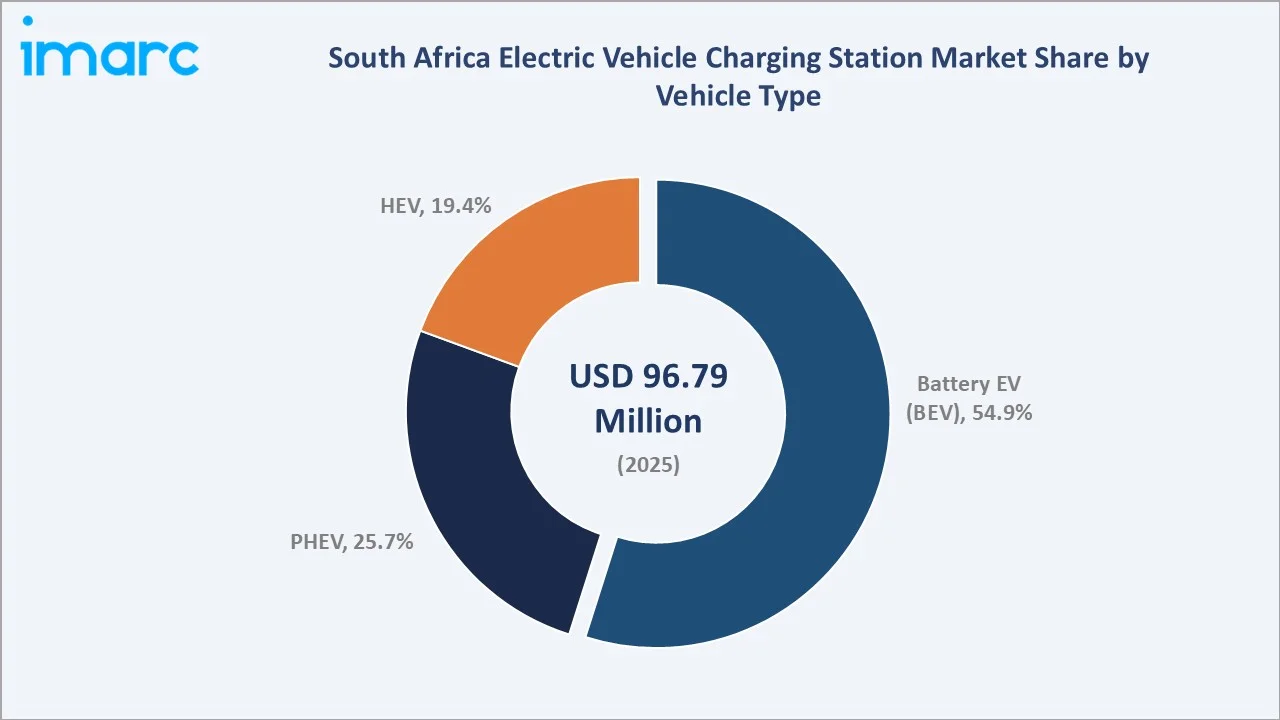
PHEV at 25.7% represents a transitional demand segment using both AC Level 1 and Level 2 charging. HEV at 19.4% does not require external charging and primarily supports energy management rather than dedicated charging infrastructure demand.
Regional Market Insights
|
Province |
Share (2025) |
Key EV Charging Market Drivers & Characteristics |
|
Gauteng |
36.5% |
Economic hub with highest EV density, corporate fleet electrification, and concentrated government charging infrastructure investment. |
|
Western Cape |
24.8% |
Driven by progressive EV policy, Golden Arrow Bus Service fleet electrification, and tourism corridor fast-charging demand. |
|
KwaZulu-Natal |
18.9% |
Supported by port logistics electrification, Durban metro commercial EV adoption, and growing tourism infrastructure investment. |
|
Eastern Cape |
8.4% |
Automotive manufacturing heritage supports EV transition; charging investment follows OEM electrification programmes. |
|
Mpumalanga |
5.9% |
Early-stage deployment; mining and energy sector fleet electrification is creating nascent charging demand. |
|
Others |
5.5% |
Remaining provinces at nascent stage with growing government-supported charging infrastructure investment. |
Gauteng's 36.5% leadership reflects its position as South Africa's economic and vehicle density hub, where corporate fleet transitions and government infrastructure programmes create the largest single-province charging demand. Western Cape at 24.8% reflects a supportive policy environment and early-mover advantage in fleet electrification.
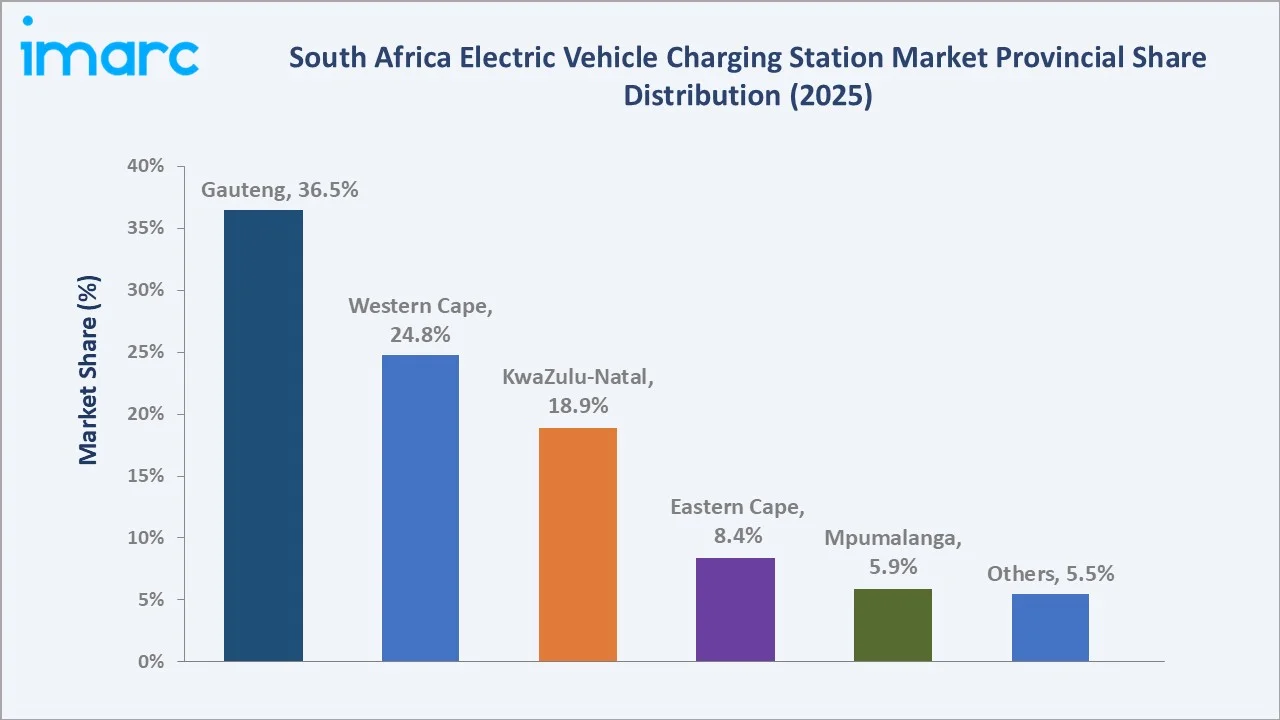
KwaZulu-Natal at 18.9% is driven by port logistics electrification and Durban metropolitan commercial fleet transitions. Eastern Cape at 8.4% benefits from its automotive manufacturing heritage, where OEM electrification programmes drive early charging deployment in Port Elizabeth and East London.
Competitive Landscape
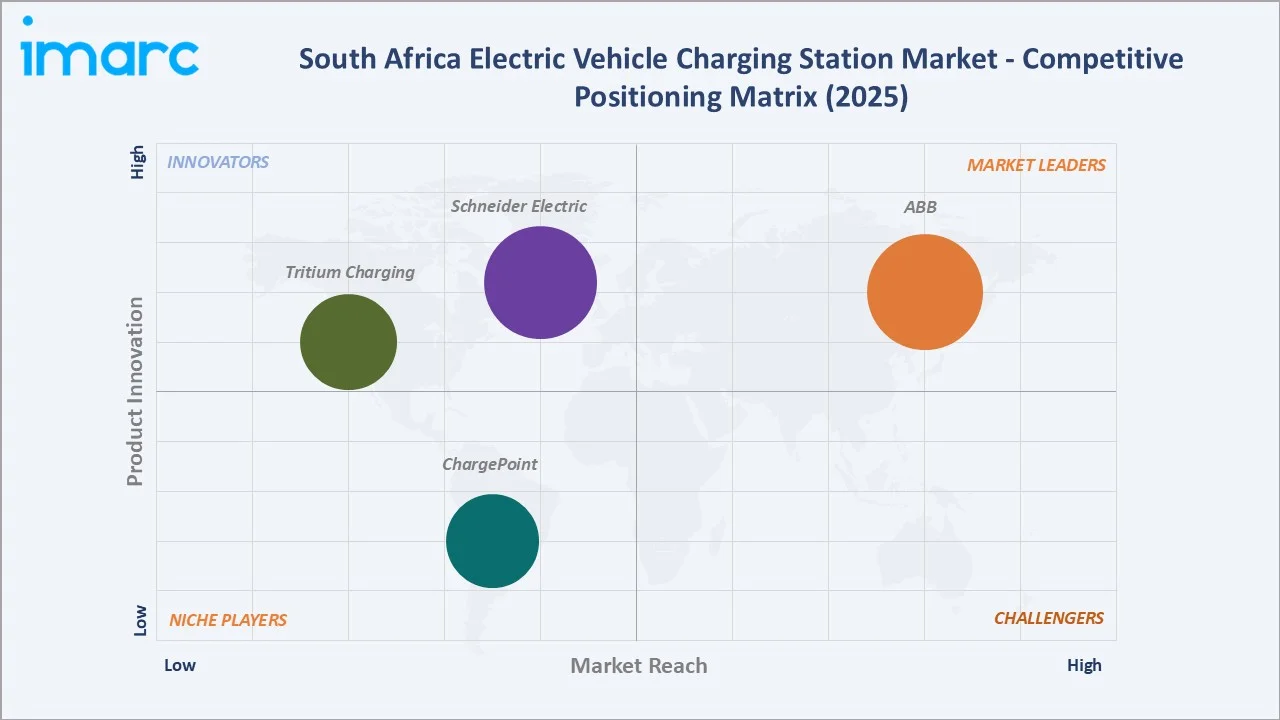
The South Africa EV charging station competitive landscape encompasses global hardware manufacturers, network platform operators, and integrated energy service providers. Competition is intensifying as international players accelerate local deployment through partnerships with South African energy utilities and property developers.
|
Company Name |
Key Products |
Market Position |
Core Strength |
|
|
Terra AC Wallbox, Terra DC Fast Charger, Terra HP |
Market Leader |
ABB provides integrated AC and DC EV charging hardware and software. Its global manufacturing and service network supports large-scale South Africa corridor deployments. |
|
|
EVlink City, EVlink Parking, EVlink Smart Wallbox |
Established Player |
Schneider Electric provides AC charging integrated with building energy management systems, enabling commercial and residential EV charging with real-time monitoring. |
|
|
RTM 75, PKM 150, RTM 300 |
Established Player |
Tritium specialises in DC fast chargers for highway corridors and high-utilisation public sites. Its modular architecture suits South Africa's diverse deployment environments. |
|
|
CP6000, CPF50 |
Niche Player |
ChargePoint provides network-managed AC and DC charging with a software-first approach, enabling remote monitoring, billing, and fleet management in South Africa. |
Global OEM-aligned charging networks are expanding into South Africa alongside vehicle launch programmes. Consolidation is occurring at the software and network management platform tier as operators seek integrated hardware-software solutions supporting smart grid compatibility for South Africa's unique grid conditions.
Key Company Profiles
ABB Ltd.
ABB Ltd. is a global leader in electrification and automation solutions with a dedicated e-mobility division providing EV charging hardware and software for residential, commercial, and public applications. ABB's charging solutions are deployed across multiple African markets including South Africa.
- Key Products: Terra AC Wallbox, Terra DC Fast Charger, Terra HP ultra-fast charger.
- Recent Developments: In February 2026, ABB E-mobility and Esyasoft signed a memorandum of understanding to deploy EV charging infrastructure across the Middle East, Africa, and Latin America. The partnership focuses on fleet electrification projects, public transit charging solutions, and integrated charging ecosystems.
- Strategic Focus: Focused on high-power DC fast-charging infrastructure, digital network management platforms, and grid-integrated charging solutions for highway and fleet depot applications.
Schneider Electric SE
Schneider Electric SE is a global energy management and automation company providing EV charging solutions integrated with its broader building and grid energy management ecosystem. The company serves residential, commercial, and industrial charging markets.
- Key Products: EVlink City, EVlink Parking, EVlink Smart Wallbox, EVlink Home.
- Recent Developments: In February 2026, Schneider Electric launched the EVlink Pro DC 720, a next-generation DC fast-charging platform delivering up to 720 kW and capable of charging up to 12 vehicles simultaneously. The system is designed for public charging hubs, fleet depots, logistics centers, and commercial sites, featuring dynamic load management and a modular architecture for scalable deployment.
- Strategic Focus: Focused on building-integrated EV charging, energy management optimisation, and commercial parking facility solutions aligned to corporate sustainability mandates.
Market Concentration Analysis
The South Africa EV charging station market is moderately concentrated at the hardware supply tier, with global manufacturers ABB, Schneider Electric and Tritium Charging holding leading positions. The network operations tier is more fragmented, with domestic and regional operators competing alongside international platform providers.
Market concentration is increasing at the software and network management platform tier as operators seek integrated solutions. Consolidation through partnerships between hardware manufacturers and software platform providers is emerging as a competitive strategy for capturing recurring revenue from charging network management services.
Investment & Growth Opportunities
Highest Growth Segments
DC fast charging (~32.5% CAGR), inductive charging (~38.2% CAGR from small base), solar-integrated charging (~40% CAGR from small base), fleet depot charging (~30% CAGR), BEV-dedicated public charging hubs (~30.1% CAGR), and smart charging management software (~45% CAGR from small base) represent the highest-growth investment vectors through 2034.
Emerging Investment Opportunities
Highway fast-charge corridor development between Gauteng, Western Cape, and KwaZulu-Natal represents the largest near-term infrastructure opportunity. Operators securing land rights and utility agreements along national corridors are positioned for above-market revenue growth as EV penetration accelerates post-2026.
Investment Themes
- Solar-integrated off-grid charging stations: Combining photovoltaic generation with battery storage and EV charging creates grid-independent charging with lower operating costs and load-shedding resilience. Companies investing in solar-EV charging integration by 2026-2027 are positioned for premium market positioning in South Africa's underserved regions.
- Fleet depot fast-charging platforms: Logistics, bus, and minibus taxi fleet operators transitioning to EVs require dedicated high-power depot charging with fleet management software. Platform providers offering integrated hardware-software depot solutions command recurring subscription revenue alongside hardware sales.
Future Market Outlook (2026-2034)
The South Africa EV charging station market is projected to grow from USD 96.79 Million in 2025 to USD 968.84 Million by 2034, delivering a 28.13% CAGR. By 2030, the market is estimated at USD 334.23 Million, representing a commercial inflection point where public fast-charging corridors reach critical mass and fleet electrification accelerates meaningfully across all major provinces.
Three structural forces define growth through 2034: South Africa's national EV policy commitments create government-backed infrastructure demand; renewable energy cost reduction makes solar-integrated charging commercially viable across provinces; and technology cost reduction makes DC fast charging accessible beyond premium urban deployments into secondary cities and national transport corridors.
Research Methodology
Primary Research
Primary research comprised structured interviews with 40+ industry stakeholders (2025) including EV charging network operators, energy utility executives, automotive OEM representatives, government mobility policy advisors, and provincial infrastructure planners across South Africa.
Secondary Research
Secondary research encompassed South Africa national energy reports, EV charging deployment databases, provincial infrastructure investment records, international EV market statistics, company annual reports, and industry association publications. Over 50 secondary sources were reviewed.
Forecasting Models
Market revenue forecasts were developed using a segment bottom-up model incorporating: (i) charging station unit deployment projections by type; (ii) average revenue per unit by segment; (iii) provincial demand weighting. Forecasts validated against macroeconomic EV adoption scenarios for South Africa.
South Africa Electric Vehicle Charging Station Market Report Coverage:
|
Report Features |
Details |
|
Base Year of the Analysis |
2025 |
|
Historical Period |
2020-2025 |
|
Forecast Period |
2026-2034 |
|
Units |
Million USD |
|
|
Exploration of Historical Trends and Market Outlook, Industry Catalysts and Challenges, Segment-Wise Historical and Future Market Assessment:
|
|
Charging Station Types Covered |
AC Charging, DC Charging, Inductive Charging |
|
Vehicle Types Covered |
Battery Electric Vehicle (BEV), Plug-in Hybrid EV (PHEV), Hybrid Electric Vehicle (HEV) |
|
Installation Types Covered |
Portable Charger, Fixed Charger |
|
Charging Levels Covered |
Level 1, Level 2, Level 3 |
|
Connector Types Covered |
CCS, CHAdeMO, Normal Charging, Tesla Supercharger, Type-2 (IEC 621196), Others |
|
Applications Covered |
Residential, Commercial |
|
Provinces Covered |
Gauteng, KwaZulu-Natal, Western Cape, Mpumalanga, Eastern Cape, Others |
|
Companies Covered |
ABB, Schneider Electric, Tritium Charging, ChargePoint, etc. |
|
Customisation Scope |
10% Free Customisation |
|
Post-Sale Analyst Support |
10-12 Weeks |
|
Delivery Format |
PDF and Excel through Email |
Key Benefits for Stakeholders:
- IMARC’s industry report offers a comprehensive quantitative analysis of various market segments, historical and current market trends, market forecasts, and dynamics of the South Africa electric vehicle charging station market from 2020-2034.
- The research report provides the latest information on the market drivers, challenges, and opportunities in the South Africa electric vehicle charging station market.
- Porter's five forces analysis assist stakeholders in assessing the impact of new entrants, competitive rivalry, supplier power, buyer power, and the threat of substitution. It helps stakeholders to analyze the level of competition within the South Africa electric vehicle charging station industry and its attractiveness.
- Competitive landscape allows stakeholders to understand their competitive environment and provides an insight into the current positions of key players in the market.
Frequently Asked Questions About the South Africa Electric Vehicle Charging Station Market Report
The South Africa EV charging station market reached USD 96.79 Million in 2025. Rising EV adoption, government renewable energy commitments, and private sector infrastructure investment are the primary growth drivers sustaining above-trend market expansion through 2026-2034.
The market grows at 28.13% CAGR during 2026-2034, reaching USD 968.84 Million by 2034. DC fast charging and solar-integrated charging represent the highest-growth sub-segments, growing at ~32.5% and ~40% CAGR respectively.
AC Charging leads at 57.6% through its cost advantage, broad vehicle compatibility, and suitability for residential and commercial destination charging. It is the most deployed technology for EV infrastructure expansion across all provinces.
Battery Electric Vehicles (BEV) lead at 54.9% through increasing consumer adoption, government fleet procurement, and falling BEV purchase costs. BEVs drive the largest share of dedicated public and commercial charging station demand nationally.
Gauteng leads at 36.5% through South Africa's economic hub status with the highest vehicle and fleet density, concentrated government charging infrastructure investment, and advanced corporate EV adoption programmes.
Leading companies include ABB Ltd., Schneider Electric SE, Tritium DCFC Limited, and ChargePoint Holdings, Inc., among others.
The market is projected to reach USD 334.23 Million by 2030, with public fast-charging corridors reaching commercial viability, fleet depot charging scaling, and solar-integrated charging achieving mainstream deployment in Gauteng and Western Cape as EV adoption accelerates.
Need more help?
- Speak to our experienced analysts for insights on the current market scenarios.
- Include additional segments and countries to customize the report as per your requirement.
- Gain an unparalleled competitive advantage in your domain by understanding how to utilize the report and positively impacting your operations and revenue.
- For further assistance, please connect with our analysts.
 Request Customization
 Speak to an Analyst
 Request Brochure
 Inquire Before Buying
Benefits of Customization
- Personalize this research
- Triangulate with your data
- Get data as per your format and definition
- Gain a deeper dive into a specific application, geography, customer, or competitor
- Any level of personalization
Get in Touch With Us
UNITED STATES
Phone: +1-201-971-6302
INDIA
Phone: +91-120-433-0800
UNITED KINGDOM
Phone: +44-753-714-6104
Email: [email protected]
Client Testimonials




.webp)




.webp)













Related Reports

Choose your plan
*Please note that the prices mentioned below are starting prices for each bundle type. Kindly contact our team for further details.*
Single User License
- 1 User License, Access on 2 Devices
- PDF Report + Excel Dataset (Password Protected)
- Lifetime Access
- No Printing Rights
- 10% Free Report Customization
- 10–12 Weeks of Analyst Support
Five User License
- Access for 5 Users, 2 Devices per User
- PDF Report + Excel Dataset (Password Protected)
- Lifetime Access
- Dedicated Account Manager
- 12–14 Weeks of Analyst Support
- No Printing Rights
- 15% Free Report Customization
- 25% Discount on Your Next Purchase
Corporate User License
- Unlimited User Access (Within Your Organization)
- PDF Report + Excel Dataset
- Lifetime Access
- Dedicated Account Manager
- 14–20 Weeks of Analyst Support
- No Printing Rights
- 20% Free Report Customization
- 30% Discount on Your Next Purchase
Essential Insights
What's included:
3 reports
- Lifetime Access
- PDF Reports
- Excel Datasets
- 2 Weeks of Free Analyst Support
- 2 User Licenses
- Access on 2 Devices
- Printing Rights
- Complimentary PowerPoint (PPT) Version
- Complimentary License Upgrade
Professional Access
What's included:
5 reports
- Lifetime Access
- PDF Reports
- Excel Datasets
- 8 Weeks of Free Analyst Support
- 2 User Licenses
- Access on 2 Devices
- Printing Rights
- Complimentary PowerPoint (PPT) Version
- Complimentary License Upgrade
Business Advantage
What's included:
8 reports
- Lifetime Access
- PDF Reports
- Excel Datasets
- 14 Weeks of Free Analyst Support
- 2 User Licenses
- Access on 2 Devices
- Printing Rights
- Complimentary PowerPoint (PPT) Version
- Complimentary License Upgrade
Enterprise Intelligence
What's included:
10 reports
- Lifetime Access
- PDF Reports
- Excel Datasets
- 20 Weeks of Free Analyst Support
- 2 User Licenses
- Access on 2 Devices
- Printing Rights
- Complimentary PowerPoint (PPT) Version
- Complimentary License Upgrade