
Japan Gaskets and Seals Market Size, Share, Trends and Forecast by Product, Material, Application, End Use, and Region, 2026-2034
Japan Gaskets and Seals Market Size, Share, Trends & Forecast (2026-2034)
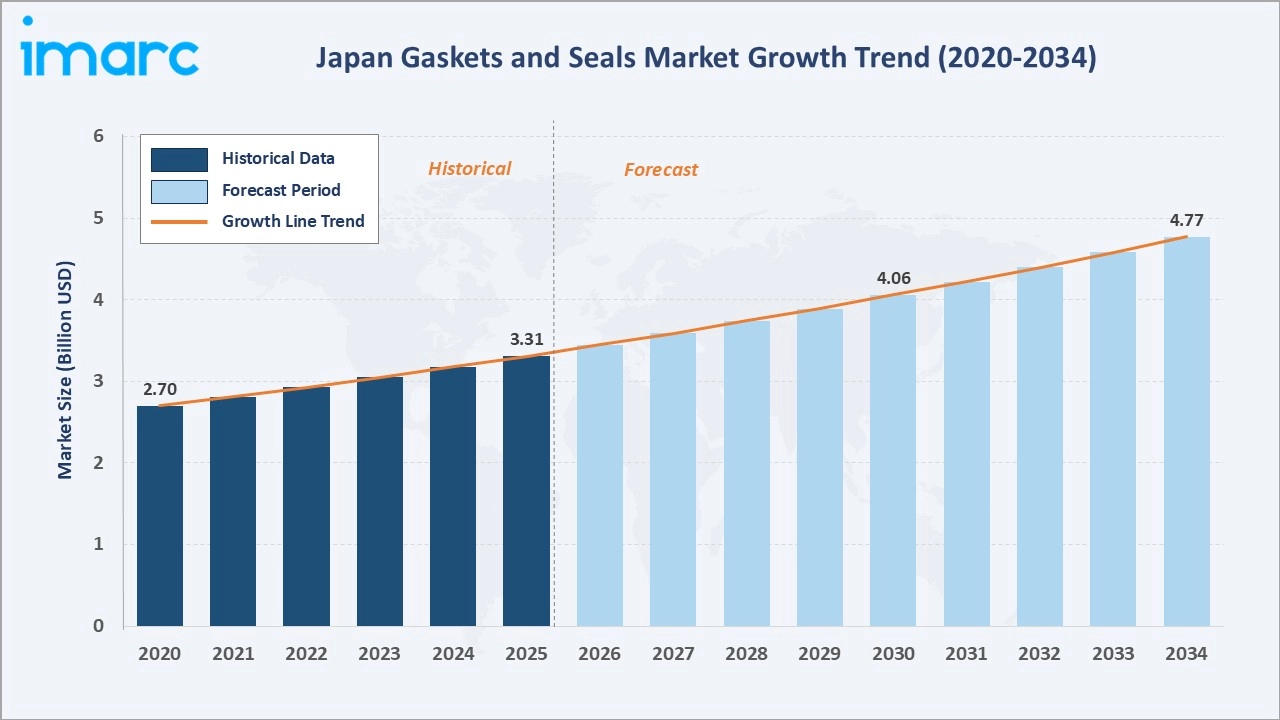
The Japan gaskets and seals market grew from USD 3.31 Billion in 2025 to USD 3.45 Billion in 2026 and is projected to reach USD 4.77 Billion by 2034, exhibiting a CAGR of 4.14% during 2026-2034. Japan's manufacturing sector, underpinned by robust automotive and electronics output, continues to drive sustained demand for high-performance sealing solutions.
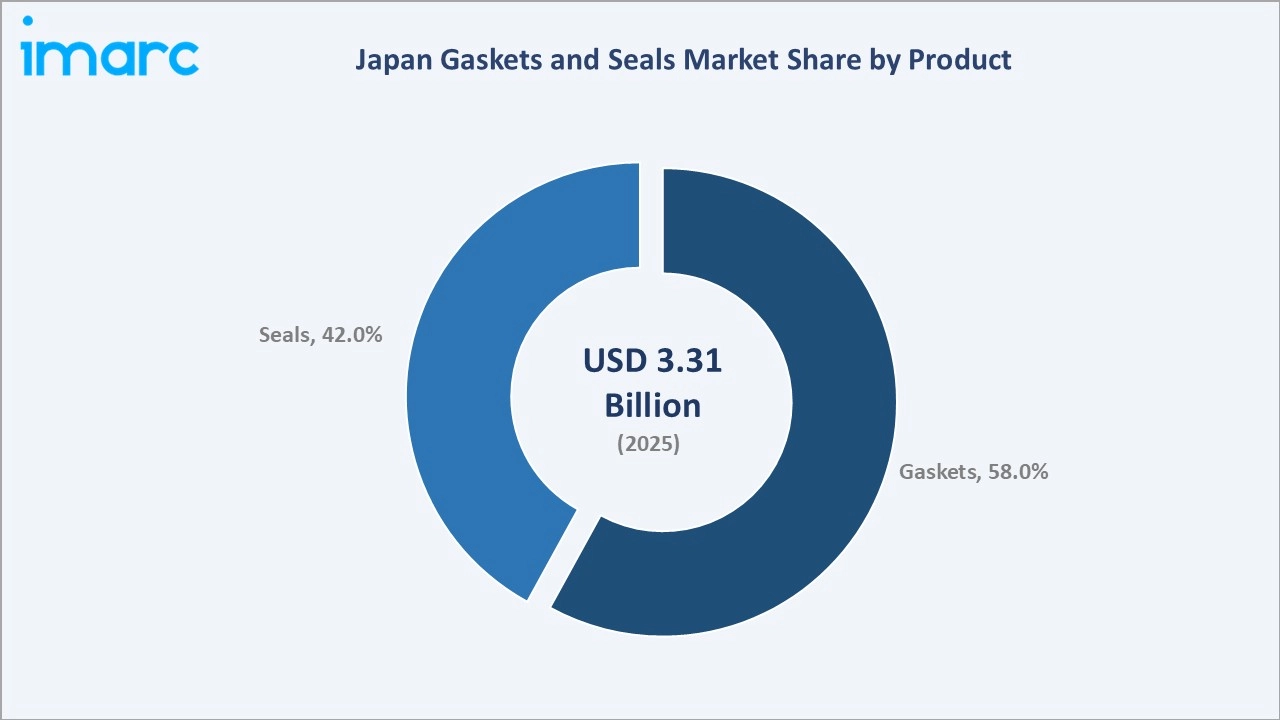
Gaskets command a 58.0% product share in 2025, rubber prevails over the material segment with 25.0% share, and Kanto Region leads regionally with a 34.0% share.
Market Snapshot
|
Metric |
Value |
|
Base Year Market Size (2025) |
USD 3.31 Billion |
|
Market Size (2026) |
USD 3.45 Billion |
|
Forecast Market Size (2034) |
USD 4.77 Billion |
|
CAGR (2026-2034) |
4.14% |
|
Base Year |
2025 |
|
Historical Period |
2020-2025 |
|
Forecast Period |
2026-2034 |
|
Largest Region |
Kanto Region (34.0%, 2025) |
|
Second Largest Region |
Kansai/Kinki Region (20.0%, 2025) |
|
Leading Product |
Gaskets (58.0%, 2025) |
|
Leading Material |
Rubber (25.0%, 2025) |
The Japan gaskets and seals market size increased from USD 2.70 Billion in 2020 to USD 3.31 Billion in 2025 and is estimated to reach USD 3.45 Billion in 2026. The market is further expected to grow to USD 4.06 Billion by 2030 and USD 4.77 Billion by 2034, supported by increasing electrification of vehicles, expanding hydrogen fuel-cell infrastructure, and growing demand for specialized high-temperature and chemical-resistant sealing materials across key end-use industries.
To get more information on this market, Request Sample
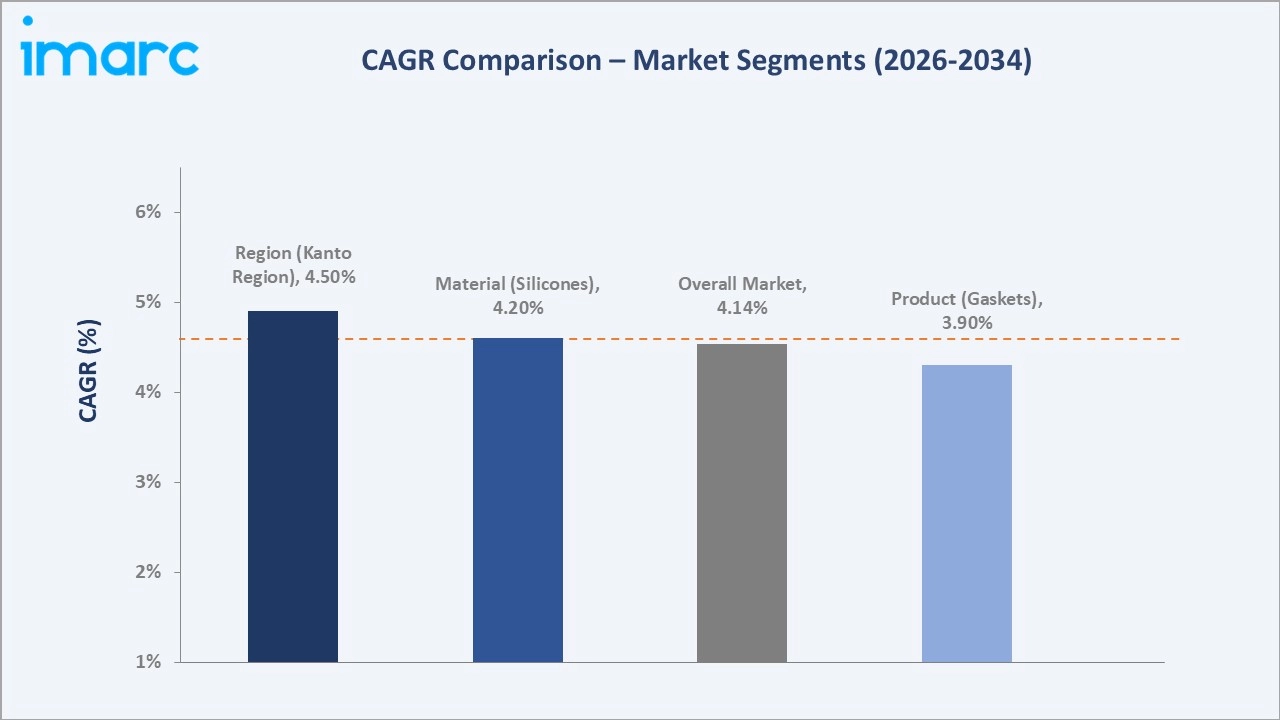
CAGR trajectories across product, material, and regional sub-segments indicate that Kyushu-Okinawa Region and seals are expanding above the overall 4.14% market CAGR, driven by increasing semiconductor and automotive manufacturing activity, rising demand for specialized sealing solutions, and greater adoption of high-performance components across industrial applications.
Executive Summary
The Japan gaskets and seals market expanded from USD 3.31 Billion in 2025 to an estimated USD 3.45 Billion in 2026, positioning it on a steady growth trajectory toward USD 4.77 Billion by 2034. The industry has evolved from standardized commodity sealing products to high-performance, application-specific solutions serving automotive, chemical, semiconductor, and energy sectors.
Gaskets command a 58.0% product share in 2025, underpinned by widespread application across automotive engine assemblies, flanges, and industrial pipework. Rubber dominates the material segment at 25.0% share, reflecting its broad use in automotive, industrial, and fluid-handling applications. Kanto Region leads with a 34.0% regional share, anchored by its concentration of automotive, manufacturing, and industrial facilities.
Key Market Insights
|
Insight |
Data |
|
Leading Product |
Gaskets – 58.0% share (2025) |
|
Second Largest Product |
Seals – 42.0% share (2025) |
|
Leading Material |
Rubber – 25.0% share (2025) |
|
Second Largest Material |
Fiber – 22.0% share (2025) |
|
Leading Region |
Kanto Region – 34.0% share (2025) |
|
Second Largest Region |
Kansai/Kinki Region – 20.0% share (2025) |
|
Top Companies |
NOK Corporation, Valqua, Ltd., Nichias Corporation, Parker Hannifin Corporation |
Key Analytical Observations Expanding on the Data Above:
- Gaskets dominance at 58.0% is supported by widespread application across automotive engine assemblies, industrial flanges, heat exchangers, and pipeline connections across Japan's diverse manufacturing base.
- Seals share at 42.0% is growing on the back of increasing EV drivetrain adoption, expanding hydraulic system applications in industrial machinery, and growing semiconductor fabrication requirements.
- Rubber leadership at 25.0% reflects its cost-effectiveness, flexibility, and proven performance across a wide temperature and chemical compatibility range in automotive and general industrial applications.
- Fiber at 22.0% is sustained by its strong sealing performance, thermal resistance, and suitability for high-pressure applications across automotive, chemical processing, and industrial equipment.
- Kanto Region dominance at 34.0% is anchored by the high concentration of automotive, electronics, semiconductor, machinery, and industrial manufacturing activities across the region.
Japan Gaskets and Seals Market Overview
Gaskets and seals are engineered components designed to prevent leakage of fluids, gases, and contaminants at the interface of two joined surfaces. Gaskets are static sealing devices placed between flanges, covers, or joints, while seals are dynamic components used in rotating or reciprocating applications, such as shafts, pistons, and cylinders. Together, they serve critical functions across automotive, chemical processing, oil and gas, power generation, semiconductor manufacturing, and food processing industries.
Japan's ecosystem integrates raw material suppliers covering rubber, PTFE, graphite, silicone, and metallic materials; component fabricators and specialist manufacturers; industrial distributors and maintenance, repair, and operations (MRO) networks; and end-use industries spanning automotive, chemical, and precision equipment sectors. Regulatory standards set by the Japan Industrial Standards Committee (JISC) and international ISO frameworks govern product quality, material safety, and performance requirements across the value chain.
Market Dynamics
To evaluate market opportunities, Request Sample
Market Drivers
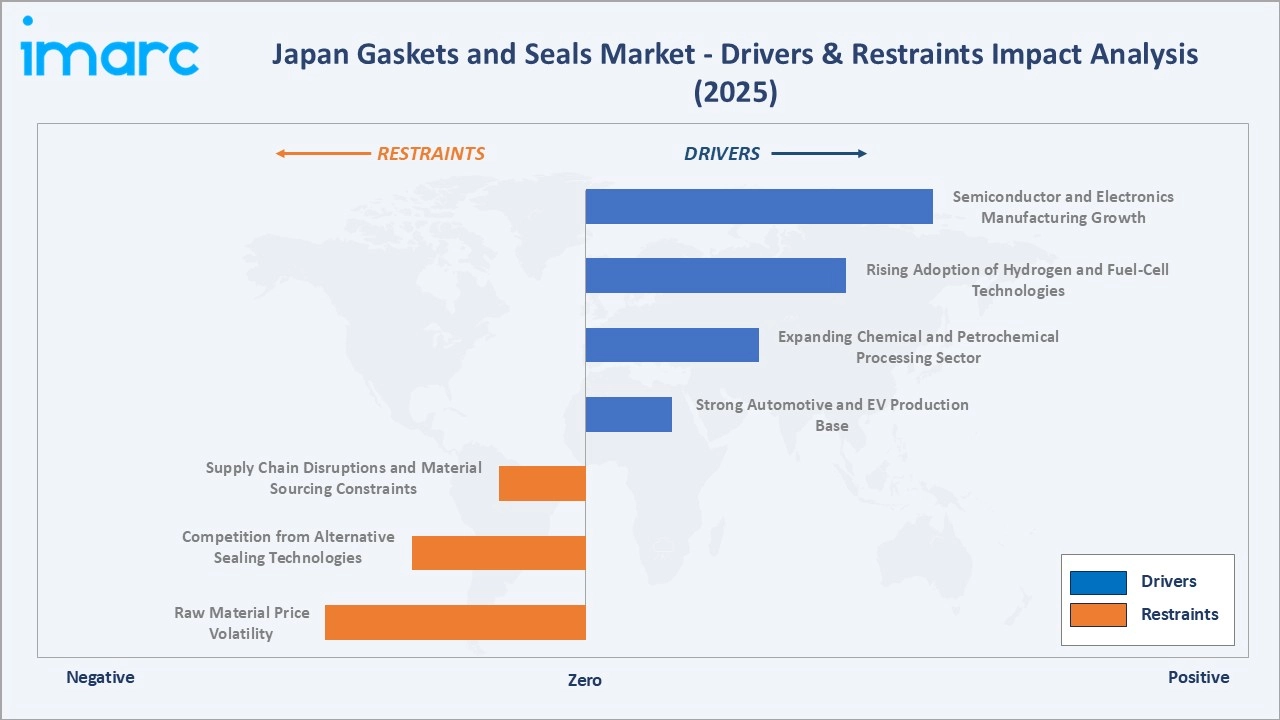
- Strong Automotive and EV Production Base: Japan remains one of the world's largest automotive producers, with sustained demand for precision gaskets in engine assemblies, transmissions, exhaust systems, and increasingly in EV battery pack thermal management and drivetrain sealing applications. As per IMARC Group, the Japan EVs market reached USD 73.2 Billion in 2025.
- Expanding Chemical and Petrochemical Processing Sector: Growth in specialty chemical, petrochemical, and pharmaceutical manufacturing in Japan is driving demand for high-performance chemical-resistant sealing materials, including PTFE and graphite-based gaskets for flanges, reactors, and pipework systems.
- Rising Adoption of Hydrogen and Fuel-Cell Technologies: Japan's continued development of hydrogen infrastructure and fuel-cell applications is creating demand for specialized gaskets and seals capable of withstanding high pressures, temperature variations, and hydrogen exposure across fuel-cell systems, storage equipment, and associated piping.
- Semiconductor and Electronics Manufacturing Growth: Expansion of semiconductor fabrication and electronics manufacturing in Japan is driving demand for ultra-clean, contamination-free sealing solutions compatible with cleanroom environments and aggressive chemical processes in wafer fabrication.
Market Restraints
- Raw Material Price Volatility: Fluctuations in prices of rubber, PTFE resins, graphite, and metallic inputs can significantly affect production costs for gasket and seal manufacturers, compressing margins and complicating long-term procurement planning.
- Competition from Alternative Sealing Technologies: Advances in liquid gasket compounds, adhesive bonding technologies, and integrated molded sealing solutions are reducing the addressable market for traditional mechanical gaskets and seals in certain automotive and industrial applications.
- Supply Chain Disruptions and Material Sourcing Constraints: Dependence on imported raw materials for specialty polymers and advanced sealing compounds exposes manufacturers to logistics disruptions and sourcing constraints that can delay production timelines.
Market Opportunities
- Hydrogen Infrastructure and Fuel-Cell Vehicle Rollout: Continued government investment in hydrogen refueling networks, industrial hydrogen supply chains, and fuel-cell vehicle deployment is opening significant new demand channels for specialized, hydrogen-grade sealing components.
- Advanced Materials Innovation and High-Performance Seals: Growing requirements for sealing solutions capable of operating in extreme temperature, pressure, and chemical exposure conditions is driving investment in novel materials, including expanded PTFE, silicone composites, and thermoplastic elastomers.
Market Challenges
- Skilled Workforce and Precision Manufacturing Requirements: The production of high-specification gaskets and seals for semiconductor, hydrogen, and advanced industrial applications requires specialized materials expertise and precision manufacturing capabilities that are increasingly in short supply.
- Stricter Environmental and Chemical Compliance Standards: Evolving regulations governing chemical content, material emissions, and end-of-life recycling requirements for sealing products are adding compliance complexity and cost for manufacturers serving Japanese and export markets.
Emerging Market Trends
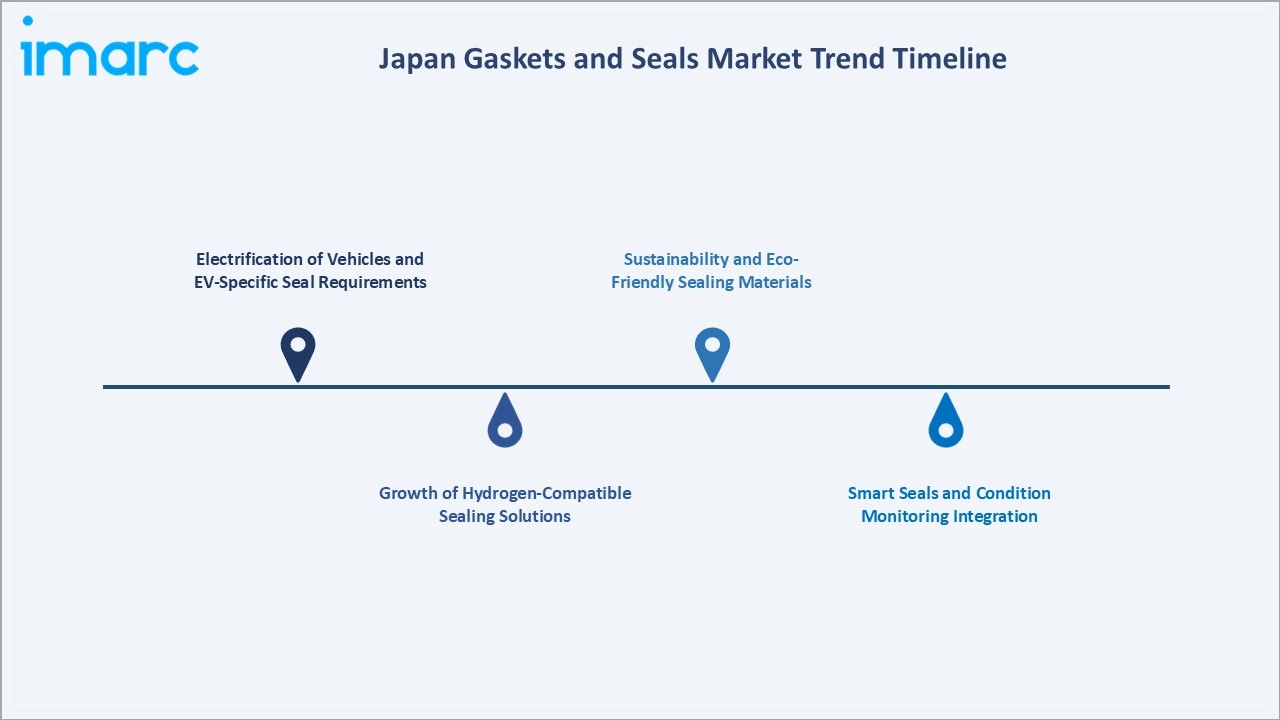
1. Electrification of Vehicles and EV-Specific Seal Requirements
The rapid transition toward battery EVs and hybrid powertrains is reshaping the demand profile for seals, with growing requirements for battery cell module sealing, thermal management gaskets, and high-voltage connector seals. Japanese automotive OEMs are increasingly specifying purpose-designed sealing components for EV platforms.
2. Growth of Hydrogen-Compatible Sealing Solutions
Japan's hydrogen economy roadmap is creating specialized demand for gaskets and seals capable of withstanding high-pressure hydrogen environments, offering zero-leakage performance, and maintaining integrity across repeated compression-expansion cycles in fuel-cell stacks and hydrogen storage systems.
3. Smart Seals and Condition Monitoring Integration
Integration of sensor elements within sealing components is emerging as a technology trend, enabling real-time monitoring of pressure, temperature, and seal integrity within industrial machinery, contributing to predictive maintenance programs and reducing unplanned downtime in high-value manufacturing environments.
4. Sustainability and Eco-Friendly Sealing Materials
Regulatory pressure and corporate sustainability commitments are driving interest in bio-based rubber compounds, recycled polymer inputs, and halogen-free sealing materials, influencing material selection across automotive and industrial seal procurement in Japan.
Industry Value Chain Analysis
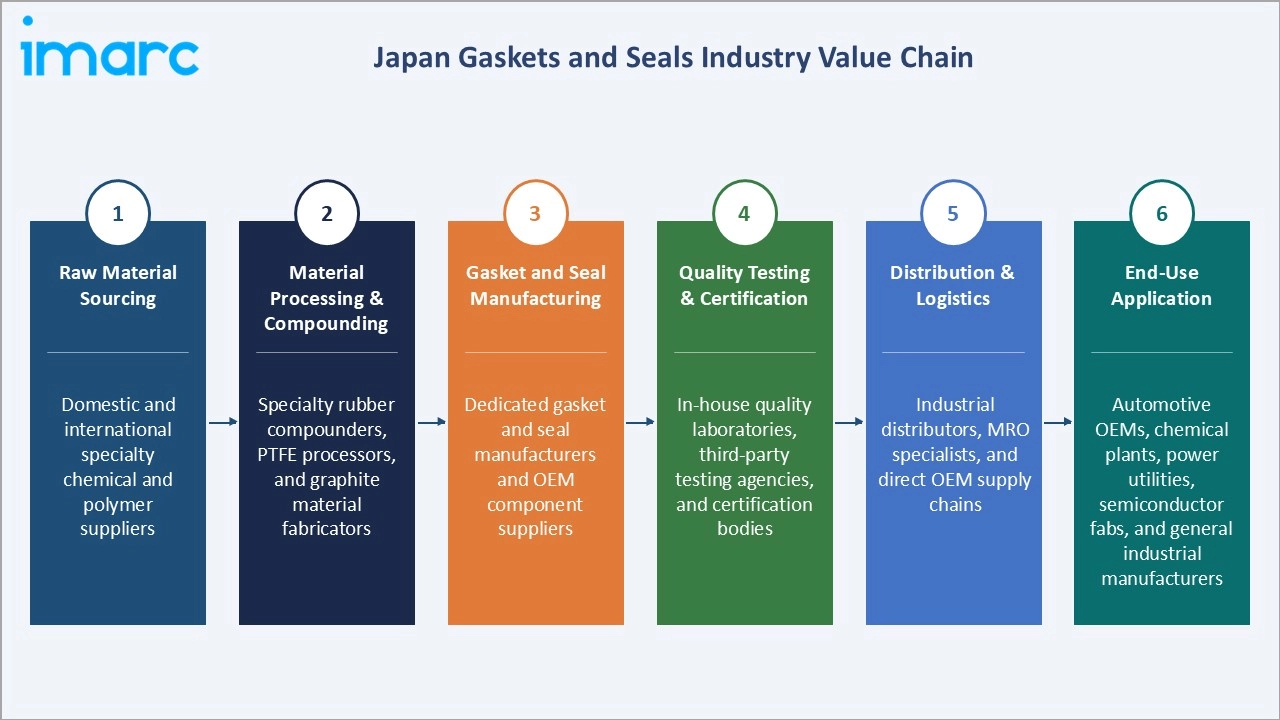
The Japan gaskets and seals value chain spans six stages, from raw material sourcing and compound development through precision manufacturing, testing, distribution, and end-use application. Manufacturing and quality certification capture the highest value-add, while distribution and MRO capabilities increasingly determine customer retention and competitive positioning within the domestic industrial market.
|
Stage |
Key Players / Examples |
|
Raw Material Sourcing |
Domestic and international specialty chemical and polymer suppliers |
|
Material Processing & Compounding |
Specialty rubber compounders, PTFE processors, and graphite material fabricators |
|
Gasket and Seal Manufacturing |
Dedicated gasket and seal manufacturers and OEM component suppliers |
|
Quality Testing & Certification |
In-house quality laboratories, third-party testing agencies, and certification bodies |
|
Distribution & Logistics |
Industrial distributors, MRO specialists, and direct OEM supply chains |
|
End-Use Application |
Automotive OEMs, chemical plants, power utilities, semiconductor fabs, and general industrial manufacturers |
Vertically integrated manufacturers capable of controlling material development, precision processing, and direct customer support are positioned to capture greater value than distributors or contract fabricators reliant on third-party materials and external quality assurance.
Technology Landscape in the Japan Gaskets and Seals Industry
Advanced Materials and Polymer Innovation
Development of expanded PTFE, fluoroelastomers, and thermoplastic elastomers is enabling sealing components to meet increasingly demanding temperature, pressure, and chemical exposure requirements across pharmaceutical, semiconductor, and hydrogen energy applications in Japan.
Precision Manufacturing and Automated Fabrication
Computer numerical control (CNC) cutting, automated vulcanization, and robotic assembly are improving dimensional accuracy, reducing material waste, and enhancing production throughput for high-specification gaskets and seals serving automotive and precision industrial customers.
Surface Engineering and Coating Technologies
Application of anti-stick coatings, surface treatments, and composite laminating processes is expanding the functional range of sealing materials, improving installation performance, and extending service life across harsh industrial operating environments.
Smart Sealing and Embedded Sensor Technology
Emerging integration of pressure, temperature, and wear sensors within sealing elements is enabling condition monitoring capabilities that support predictive maintenance programs, reducing unplanned downtime and improving asset reliability in high-value industrial applications across Japan.
Market Segmentation Analysis
The report covers the following segments:
|
Segment Category |
Leading Segment |
Market Share |
Year |
|
Product |
Gaskets |
58.0% |
2025 |
|
Material |
Rubber |
25.0% |
2025 |
|
Application |
🔒 |
🔒 |
2025 |
|
End Use |
🔒 |
🔒 |
2025 |
|
Region |
Kanto Region |
34.0% |
2025 |
.webp)
By Product
Gaskets command a 58.0% majority share in 2025, driven by their essential role in static sealing applications across automotive engine assemblies, flanged pipe connections, heat exchangers, and pressure vessel joints throughout Japan's industrial base.
To access detailed market analysis, Request Sample
Seals account for 42.0% of the market in 2025, with growing application in dynamic sealing requirements, including rotating shaft seals, hydraulic cylinder seals, and EV drivetrain component sealing. The segment is expanding as EV adoption increases requirements for specialized battery module and motor seals.
By Material
Rubber leads the material segment with a 25.0% share in 2025, supported by its versatility, cost-effectiveness, and compatibility across a wide range of automotive and general industrial applications. Its flexibility, sealing reliability, and resistance to vibration and temperature variations support continued use across automotive and industrial sealing applications.
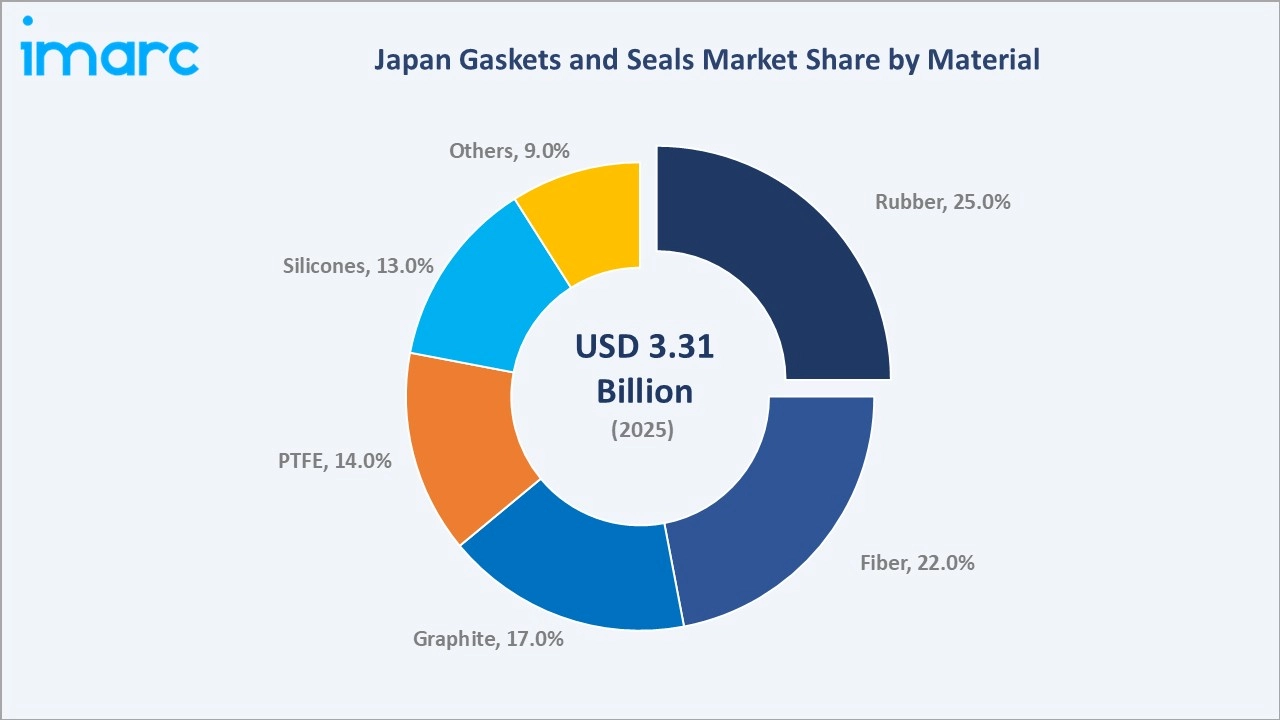
Fiber at 22.0% is supported by its strong heat resistance, durability, and suitability for high-pressure sealing applications across automotive, chemical processing, and industrial equipment.
Regional Market Insights
|
Region |
Share (2025) |
Key Growth Drivers |
|
Kanto Region |
34.0% |
High concentration of automotive assembly plants, machinery manufacturers, and chemical processing facilities driving sustained sealing component demand |
|
Kansai/Kinki Region |
20.0% |
Mature industrial base in chemical processing, precision machinery, and electronics manufacturing supporting diverse sealing solution requirements |
|
Central/Chubu Region |
17.0% |
Strong automotive supply chain concentration around Nagoya and Toyota cluster driving high-volume gasket and seal procurement |
|
Kyushu-Okinawa Region |
10.0% |
Growing semiconductor fabrication, automotive assembly, and chemical manufacturing base supporting expanding sealing component demand |
|
Tohoku Region |
7.0% |
Expanding industrial reconstruction activities, growing electronics and food processing facilities creating incremental sealing product demand |
|
Chugoku Region |
6.0% |
Established steel and heavy manufacturing base, along with growing chemical and shipbuilding sectors sustaining regional seal demand |
|
Shikoku Region |
4.0% |
Chemical and paper manufacturing clusters alongside growing food processing operations driving regional sealing product requirements |
|
Hokkaido Region |
2.0% |
Food and agricultural processing facilities, alongside emerging renewable energy projects, contributing to regional sealing product demand |
Kanto Region at 34.0% in 2025 leads the regional landscape, anchored by Japan's capital cluster of automotive, chemical, and precision manufacturing industries spanning Tokyo, Kanagawa, Saitama, and Chiba prefectures. A dense concentration of OEMs, tier-1 and tier-2 suppliers, and industrial distributors supports sustained regional leadership in gasket and seal procurement.
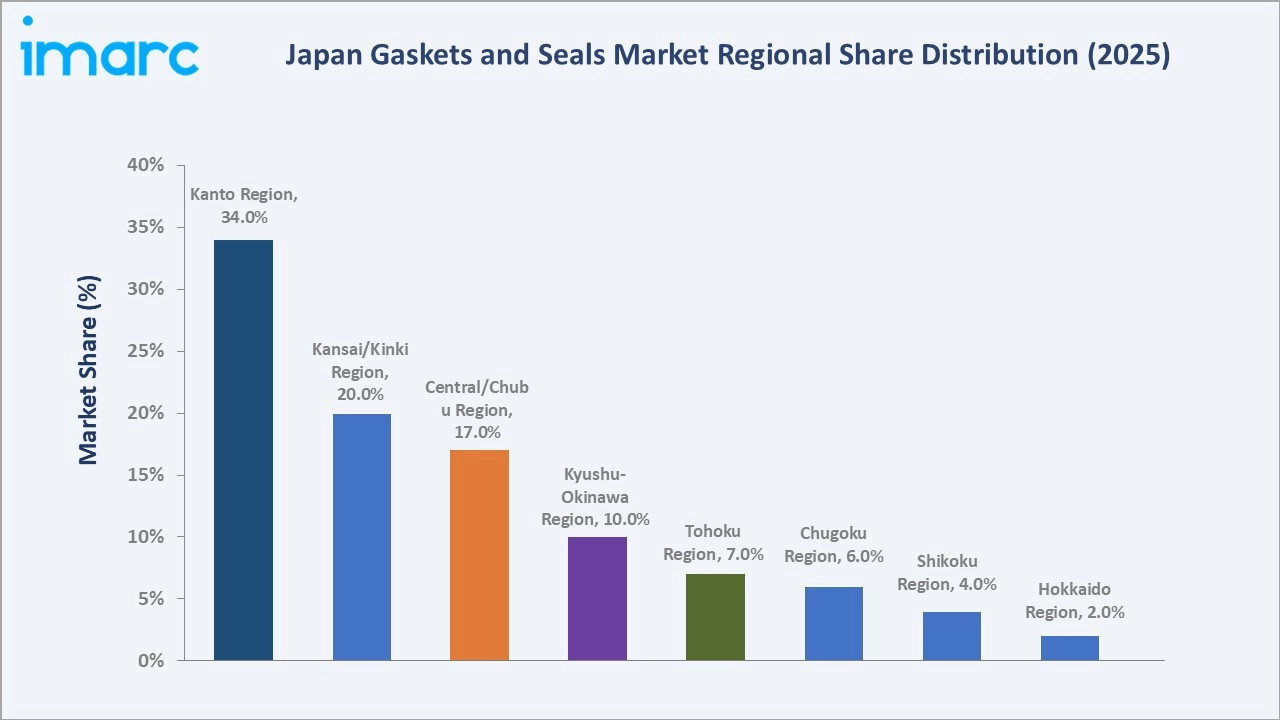
Kyushu-Okinawa Region, while contributing 10.0% in 2025, represents the fastest growing regional market, supported by expansion of semiconductor manufacturing, automotive assembly plant investments, and broadening chemical industry clusters in Kitakyushu and Oita prefectures. The region is increasingly attracting high-value industrial investments that are expected to sustain above-average demand growth through 2034.
Competitive Landscape
The Japan gaskets and seals market is moderately concentrated, with established domestic manufacturers holding leading positions supported by deep customer relationships, broad product portfolios, and precision engineering capabilities, while international players compete on specialized product offerings and global supply chain advantages. Material expertise, manufacturing precision, and application engineering support form the primary competitive differentiators across the industry.
|
Company Name |
Brand / Key Product |
Position |
Strategic Focus |
|
NOK Corporation |
Seals |
Leader |
Expanding precision seal product range and strengthening OEM partnerships across automotive and industrial applications |
|
Valqua, Ltd. |
Seal Products |
Leader |
Broadening chemical-resistant and high-performance gasket offerings for chemical processing and semiconductor markets |
|
Nichias Corporation |
TOMBO™ |
Leader |
Growing industrial gasket and insulation product capabilities through material innovation and application engineering |
|
Parker Hannifin Corporation |
Parker O-Ring & Engineered Seals |
Challenger |
Expanding engineered sealing solutions across hydraulic, pneumatic, and high-pressure industrial applications |
Key players include NOK Corporation, Valqua, Ltd., Nichias Corporation, and Parker Hannifin Corporation, among others.
Key Company Profiles
NOK Corporation
NOK Corporation is a Japanese manufacturer specializing in sealing products for automotive and industrial applications, with extensive domestic manufacturing operations and a global customer base.
- Product Portfolio: Oil seals and bearing seals across automotive, industrial, and precision equipment applications.
- Recent Developments: The company continues to invest in its sealing product portfolio and manufacturing capabilities, supporting demand across automotive, industrial, and energy-related applications in Japan and international markets.
- Strategic Focus: Advancing precision sealing capabilities and deepening partnerships with automotive and industrial OEM customers through targeted product development.
Valqua, Ltd.
Valqua, Ltd. is a Japanese specialty manufacturer of sealing, fluid control, and industrial products, with a particular focus on high-performance gasket and sealing materials for chemical processing and semiconductor markets.
- Product Portfolio: PTFE gaskets, expanded PTFE sheets, gland packings, sheet gaskets, and specialty industrial sealing products.
- Recent Developments: The company continues to develop its sealing product portfolio and expand its production capabilities, supporting customers across chemical processing, semiconductor fabrication, and general industrial sectors.
- Strategic Focus: Developing specialized fluoropolymer and composite sealing solutions tailored to chemical, pharmaceutical, and semiconductor manufacturing requirements.
Nichias Corporation
Nichias Corporation is a Japanese manufacturer of industrial insulation, sealing, and friction materials, serving automotive, chemical, semiconductor, and construction sectors with a broad range of specialty industrial products.
- Product Portfolio: Sheet gaskets, spiral wound gaskets, joint sheets, PTFE-based sealing products under the TOMBO™ brand, and thermal insulation materials.
- Recent Developments: The company continues to strengthen its gasket and sealing product range, advancing its material technologies and customer support capabilities across industrial, energy, and semiconductor-related end markets.
- Strategic Focus: Strengthening advanced gasket and insulation product portfolios by investing in materials technology and application-specific engineering expertise.
Market Concentration Analysis
The Japan gaskets and seals market is moderately concentrated, with the leading domestic manufacturers including NOK Corporation, Valqua, Ltd., and Nichias Corporation collectively accounting for a significant share of the overall market, reflecting the scale, material expertise, and customer relationships required to serve Japan's demanding automotive and industrial sectors.
Barriers to entry are meaningful, including the need for precision manufacturing capabilities, advanced materials knowledge, JIS and ISO certification, and established OEM supply relationships. These factors sustain the competitive advantage of established manufacturers and limit the ability of new entrants to rapidly capture meaningful market share.
Consolidation is gradually increasing as domestic manufacturers expand their product portfolios through internal development and selective acquisitions of specialty material or technology capabilities. International players are also deepening their Japan presence through local manufacturing investments and application engineering partnerships, further shaping the competitive dynamics of the market.
Investment & Growth Opportunities
Fastest-Growing Segments
Seals are expanding fastest within the product category, driven by rising EV adoption, growing industrial automation, and increasing semiconductor manufacturing requirements. Demand is further supported by the need for reliable sealing performance in compact, high-temperature, and chemically demanding applications across these industries.
Emerging Markets
Kyushu-Okinawa Region is the fastest growing region, supported by expanding automotive manufacturing, semiconductor production, and industrial activity that is generating additional demand for gaskets and seals across manufacturing and processing applications.
Venture & Investment Trends
Investment activity is focused on advanced polymer R&D, hydrogen-compatible sealing material development, and smart sealing technologies incorporating sensor integration. Corporate partnerships between gasket manufacturers and automotive OEMs for co-development of next-generation EV sealing systems are also gaining momentum in Japan.
Future Market Outlook (2026-2034)
The Japan gaskets and seals market is projected to grow from USD 3.31 Billion in 2025 to USD 3.45 Billion in 2026, reaching USD 4.77 Billion by 2034, registering a CAGR of 4.14% during 2026–2034.
Four forces will shape the market through 2034: accelerating EV adoption and the associated demand for specialized battery and drivetrain sealing solutions; expanding hydrogen fuel-cell applications requiring high-pressure, hydrogen-compatible sealing components; growing semiconductor and electronics manufacturing driving demand for ultra-clean, contamination-free sealing materials; and increasing environmental and sustainability requirements influencing material selection and product design across the industry.
By 2034, the Japan gaskets and seals market is expected to be characterized by a higher share of premium, application-specific sealing products, with advanced polymer materials, smart sealing technologies, and hydrogen-grade components accounting for a growing proportion of overall market value. Manufacturers with strong application engineering capabilities and advanced material portfolios are positioned to capture disproportionate value from these structural growth trends.
Research Methodology
Primary Research
Primary research included structured discussions with gasket and seal manufacturers, industrial distributors, automotive OEM procurement specialists, and end-user industry representatives, validating market sizing, segment mix, material trends, and regional demand patterns.
Secondary Research
Secondary sources included JISC publications, Ministry of Economy, Trade and Industry (METI) industry data, trade association reports from the Japan Rubber Manufacturers Association, and annual reports, investor presentations, and press releases from listed gasket and seal manufacturers.
Forecasting Models
Market forecasts combined top-down and bottom-up modeling approaches, incorporating automotive production volume trends, industrial output indices, material price dynamics, and macroeconomic variables. Scenario analysis addressed automotive electrification pace, hydrogen infrastructure investment, and semiconductor industry growth trajectories.
Japan Gaskets and Seals Market Report Coverage:
| Report Features | Details |
|---|---|
| Base Year of the Analysis | 2025 |
| Historical Period | 2020-2025 |
| Forecast Period | 2026-2034 |
| Units | Billion USD |
| Scope of the Report |
Exploration of Historical Trends and Market Outlook, Industry Catalysts and Challenges, Segment-Wise Historical and Future Market Assessment:
|
| Products Covered |
|
| Materials Covered | Fiber, Graphite, PTFE, Rubber, Silicones, Others |
| Applications Covered | Automotive, Industrial Machinery, Electrical and Electronics, Marine and Rail, Aerospace, Oil and Gas, Chemicals and Petrochemicals, Others |
| End Uses Covered | OEM, Aftermarket |
| Regions Covered | Kanto Region, Kansai/Kinki Region, Central/ Chubu Region, Kyushu-Okinawa Region, Tohoku Region, Chugoku Region, Hokkaido Region, Shikoku Region |
| Companies Covered | NOK Corporation, Valqua, Ltd., Nichias Corporation, Parker Hannifin Corporation, etc. |
| Customization Scope | 10% Free Customization |
| Post-Sale Analyst Support | 10-12 Weeks |
| Delivery Format | PDF and Excel through Email (We can also provide the editable version of the report in PPT/Word format on special request) |
Key Benefits for Stakeholders:
- IMARC’s industry report offers a comprehensive quantitative analysis of various market segments, historical and current market trends, market forecasts, and dynamics of the Japan gaskets and seals market from 2020-2034.
- The research report provides the latest information on the market drivers, challenges, and opportunities in the Japan gaskets and seals market.
- Porter's five forces analysis assist stakeholders in assessing the impact of new entrants, competitive rivalry, supplier power, buyer power, and the threat of substitution. It helps stakeholders to analyze the level of competition within the Japan gaskets and seals industry and its attractiveness.
- Competitive landscape allows stakeholders to understand their competitive environment and provides an insight into the current positions of key players in the market.
Frequently Asked Questions About the Japan Gaskets and Seals Market Report
The Japan gaskets and seals market size is estimated at USD 3.45 Billion in 2026, driven by strong automotive production, chemical processing growth, and rising demand for high-performance sealing solutions across industrial end-use sectors.
The market is projected to grow at a CAGR of 4.14% from 2026-2034, reaching USD 4.77 Billion, driven by EV adoption and hydrogen energy expansion.
Gaskets dominate the product segment with a 58.0% share in 2025, underpinned by widespread application across automotive engine assemblies, industrial flanges, and pipeline systems.
Rubber leads the material segment with a 25.0% share in 2025, reflecting its versatility, cost-effectiveness, and broad compatibility across automotive and general industrial sealing applications.
Kanto Region commands 34.0% share in 2025, supported by its established automotive, electronics, machinery, and industrial manufacturing base.
Leading players include NOK Corporation, Valqua, Ltd., Nichias Corporation, and Parker Hannifin Corporation, among others.
EV adoption is driving demand for specialized battery module sealing, motor shaft seals, and thermal management gaskets, creating new premium product requirements for sealing manufacturers.
Japan's hydrogen infrastructure buildout is generating specialized demand for high-pressure, hydrogen-compatible sealing components used in fuel-cell vehicles and hydrogen refueling stations.
Key drivers include strong automotive production, chemical sector expansion, hydrogen energy infrastructure investment, semiconductor manufacturing growth, and rising demand for advanced sealing materials.
Key challenges include raw material price volatility, competition from alternative sealing technologies, and evolving environmental compliance requirements that add product development complexity.
Need more help?
- Speak to our experienced analysts for insights on the current market scenarios.
- Include additional segments and countries to customize the report as per your requirement.
- Gain an unparalleled competitive advantage in your domain by understanding how to utilize the report and positively impacting your operations and revenue.
- For further assistance, please connect with our analysts.
 Request Customization
 Speak to an Analyst
 Request Brochure
 Inquire Before Buying
Benefits of Customization
- Personalize this research
- Triangulate with your data
- Get data as per your format and definition
- Gain a deeper dive into a specific application, geography, customer, or competitor
- Any level of personalization
Get in Touch With Us
UNITED STATES
Phone: +1-201-971-6302
INDIA
Phone: +91-120-433-0800
UNITED KINGDOM
Phone: +44-753-714-6104
Email: [email protected]
Client Testimonials




.webp)




.webp)













Related Reports

Choose your plan
*Please note that the prices mentioned below are starting prices for each bundle type. Kindly contact our team for further details.*
Single User License
- 1 User License, Access on 2 Devices
- PDF Report + Excel Dataset (Password Protected)
- Lifetime Access
- No Printing Rights
- 10% Free Report Customization
- 10–12 Weeks of Analyst Support
Five User License
- Access for 5 Users, 2 Devices per User
- PDF Report + Excel Dataset (Password Protected)
- Lifetime Access
- Dedicated Account Manager
- 12–14 Weeks of Analyst Support
- No Printing Rights
- 15% Free Report Customization
- 25% Discount on Your Next Purchase
Corporate User License
- Unlimited User Access (Within Your Organization)
- PDF Report + Excel Dataset
- Lifetime Access
- Dedicated Account Manager
- 14–20 Weeks of Analyst Support
- No Printing Rights
- 20% Free Report Customization
- 30% Discount on Your Next Purchase
Essential Insights
What's included:
3 reports
- Lifetime Access
- PDF Reports
- Excel Datasets
- 2 Weeks of Free Analyst Support
- 2 User Licenses
- Access on 2 Devices
- Printing Rights
- Complimentary PowerPoint (PPT) Version
- Complimentary License Upgrade
Professional Access
What's included:
5 reports
- Lifetime Access
- PDF Reports
- Excel Datasets
- 8 Weeks of Free Analyst Support
- 2 User Licenses
- Access on 2 Devices
- Printing Rights
- Complimentary PowerPoint (PPT) Version
- Complimentary License Upgrade
Business Advantage
What's included:
8 reports
- Lifetime Access
- PDF Reports
- Excel Datasets
- 14 Weeks of Free Analyst Support
- 2 User Licenses
- Access on 2 Devices
- Printing Rights
- Complimentary PowerPoint (PPT) Version
- Complimentary License Upgrade
Enterprise Intelligence
What's included:
10 reports
- Lifetime Access
- PDF Reports
- Excel Datasets
- 20 Weeks of Free Analyst Support
- 2 User Licenses
- Access on 2 Devices
- Printing Rights
- Complimentary PowerPoint (PPT) Version
- Complimentary License Upgrade