
Japan Healthy Snacks Market Size, Share, Trends and Forecast by Product, Distribution Channel, and Region, 2026-2034
Japan Healthy Snacks Market Size, Share, Trends & Forecast (2026-2034)
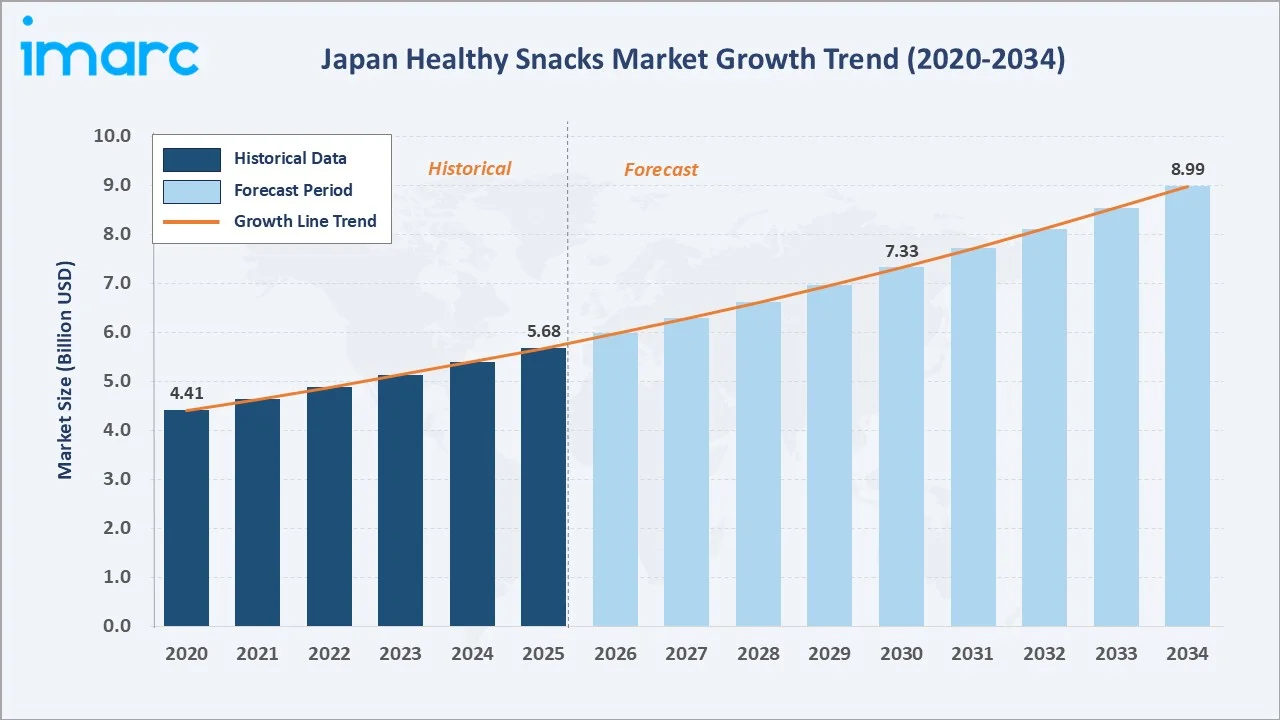
The Japan healthy snacks market size increased from USD 5.68 Billion in 2025 to USD 5.98 Billion in 2026 and is projected to reach USD 8.99 Billion by 2034, growing at a CAGR of 5.23% during 2026-2034. Rising health consciousness among Japan's aging population, growing demand for portion-controlled, on-the-go snacking, and immunity-focused product innovation continue to drive Japan healthy snacks market growth. Nuts, seeds and trail mixes lead the product landscape at 34.6% share in 2025, while supermarkets and hypermarkets remain the dominant distribution channel at 38.7%. The Kanto region anchors regional demand, commanding 39.5% of the market, supported by dense urban retail infrastructure and high disposable incomes.
Market Snapshot
|
Metric |
Value |
|
Base Year Market Size (2025) |
USD 5.68 Billion |
| Market Size (2026) | USD 5.98 Billion |
|
Forecast Market Size (2034) |
USD 8.99 Billion |
|
CAGR (2026-2034) |
5.23% |
|
Base Year |
2025 |
|
Historical Period |
2020-2025 |
|
Forecast Period |
2026-2034 |
|
Largest Region |
Kanto Region (39.5% share) |
|
Fastest Growing Channel |
Online (16.3% share, ~9.2% CAGR) |
The market expanded from USD 4.41 Billion in 2020 to USD 5.68 Billion in 2025 and an estimated USD 5.98 Billion in 2026, anchored at USD 7.33 Billion in 2030, and is forecast to reach USD 8.99 Billion by 2034. Convenience-store snacking formats and functional, immunity-boosting ingredients are reshaping Japan's healthy snacking economics beyond baseline retail price trends.
To get more information on this market, Request Sample
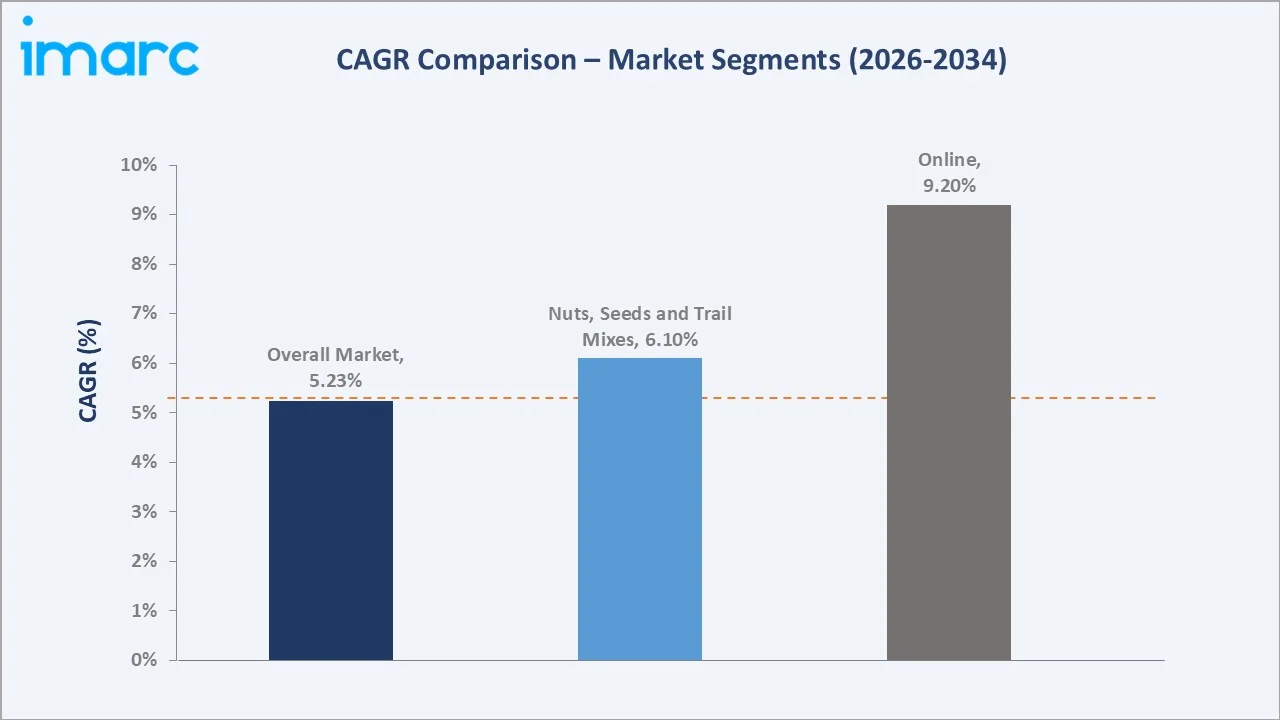
Online retail grows fastest at approximately 9.2% CAGR (2026-2034), reflecting Japan's still-low but rapidly rising food e-commerce penetration. Nuts, seeds and trail mixes expand at roughly 6.1% CAGR, ahead of cereals and granola bars at 4.6%, as protein-forward, minimally processed formats gain favor among health-focused consumers.
Executive Summary
The Japan healthy snacks market expanded from USD 5.68 Billion in 2025 to an estimated USD 5.98 Billion in 2026, reflecting the country's structural shift toward functional, better-for-you snacking formats. Japan's aging population, with 29.3% of citizens aged 65 or older as of October 2024 according to the Cabinet Office, is driving sustained demand for nutrient-dense, easily digestible snacks that support active longevity. This demographic reality, combined with rising dual-income households and shrinking meal-preparation time, is reshaping how consumers approach between-meal nutrition.
Nuts, seeds and trail mixes lead the market with 34.6% product share in 2025, followed by cereals and granola bars at 24.8%. Dried fruit snacks hold 17.2% share, while meat snacks account for 13.5%, benefiting from protein-focused diet trends. Supermarkets and hypermarkets dominate distribution at 38.7%, though online retail is growing fastest at an estimated 16.3% share.
The Japan healthy snacks market is forecast to reach USD 8.99 Billion by 2034, at a 5.23% CAGR, supported by continued product innovation, immunity-focused formulations, and expanding e-commerce access. The Kanto region, anchored by Tokyo's dense retail and convenience-store network, will remain the largest regional market through the forecast period.
Key Market Insights
|
Insight |
Data |
|
Largest Product Segment |
Nuts, Seeds and Trail Mixes - 34.6% share (2025) |
|
Leading Distribution Channel |
Supermarkets and Hypermarkets - 38.7% share (2025) |
|
Fastest Growing Channel |
Online - 16.3% share, ~9.2% CAGR (2026-2034) |
|
Leading Region |
Kanto Region - 39.5% share (2025) |
|
Top Companies |
Calbee, Inc., Nissin Foods Holdings, and Kyoritsu Foods Co., Ltd. |
|
Market Opportunity |
Functional, immunity-boosting formulations and online subscription snacking |
Key Analytical Observations Supporting The Above Data:
- Nuts, Seeds and Trail Mixes lead at 34.6% (2025): The segment benefits from consumer preference for minimally processed, protein and healthy-fat-rich snacking.
- Supermarkets and Hypermarkets anchor distribution at 38.7%: Japan's dense supermarket network supports broad healthy snack assortments and in-store sampling programs.
- Online channel is fastest-growing at 16.3% share: Japan's food e-commerce market surpassed JPY 5 trillion in 2025, though food e-commerce penetration remains low at 4.52%, indicating substantial headroom.
- Kanto Region leads regional demand at 39.5%: Tokyo, Kanagawa, and Saitama's dense convenience-store networks and higher disposable incomes concentrate healthy snack consumption.
Japan Healthy Snacks Market Overview
Japan's healthy snacks market encompasses nuts, seeds and trail mixes, dried fruit snacks, cereals and granola bars, meat snacks, and other functional snack formats sold through supermarkets, convenience stores, specialty retailers, and online channels. The ecosystem integrates raw material suppliers, food manufacturers, regulatory bodies including the Ministry of Health, Labour and Welfare (MHLW), the Consumer Affairs Agency (CAA), and the Ministry of Agriculture, Forestry and Fisheries (MAFF), alongside wholesale distributors and retail networks serving Japan's 123.8 million residents. Macroeconomic drivers include Japan's rapidly aging demographic profile, JPY currency fluctuations affecting imported nut and dried-fruit costs, and rising per-capita spending on preventive health and functional nutrition.
Market Dynamics
To evaluate market opportunities, Request Sample
Market Drivers
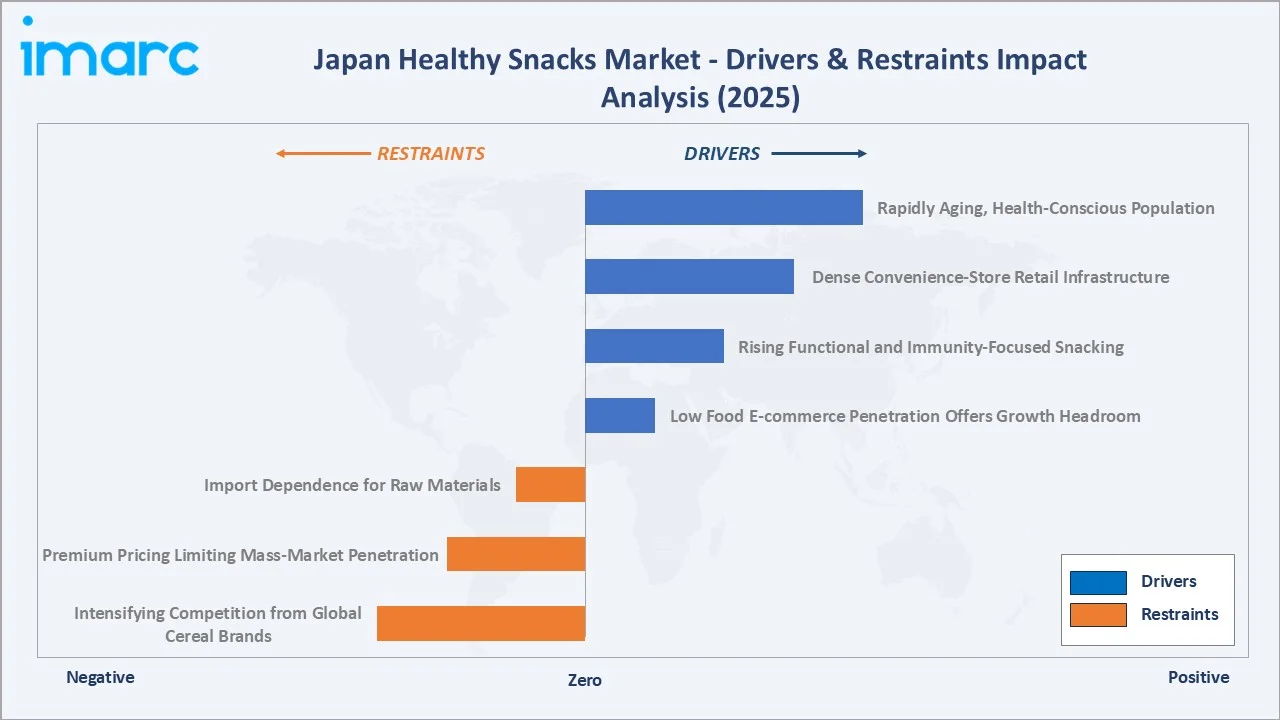
- Rapidly Aging, Health-Conscious Population: Japan's population aged 65 and over reached 36.24 million, or 29.3% of the total population, as of October 1, 2024, per Cabinet Office data. This demographic increasingly favors portion-controlled, nutrient-dense snacks that support digestive health and sustained energy.
- Dense Convenience-Store Retail Infrastructure: Japan's convenience-store networks stock healthy snack SKUs prominently near checkout counters, supporting the 26.4% distribution share convenience stores hold in 2025.
- Rising Functional and Immunity-Focused Snacking: Consumers increasingly seek snacks fortified with vitamins, minerals, and probiotics, encouraging manufacturers such as Calbee and Kyoritsu Foods to expand fortified product lines.
Market Restraints
- Import Dependence for Raw Materials: Japan imports the majority of its almonds, cashews, and raisins, exposing manufacturers to JPY exchange-rate volatility and global commodity price swings.
- Premium Pricing Limiting Mass-Market Penetration: Healthy snack formats typically carry a price premium over conventional confectionery, constraining adoption among budget-conscious households.
Market Opportunities
- Low Food E-commerce Penetration Offers Growth Headroom: Japan's food, beverage, and alcohol e-commerce penetration stood at just 4.52% in 2024 versus 9.78% for all physical-goods categories, per METI data.
- Plant-Based and Alternative-Protein Snack Expansion: Growing interest in plant-based diets is prompting meat-snack manufacturers, including Itoham Yonekyu Holdings, to introduce soy-based jerky alternatives.
Market Challenges
- Intensifying Competition from Global Cereal Brands: Multinational entrants compete directly with Calbee's Frugra in the granola and cereal-bar segment, pressuring shelf space and marketing spend.
- Raw Material Price Volatility: Fluctuating global prices for nuts and dried fruit inputs, compounded by JPY weakness, continue to compress manufacturer margins across the value chain.
Emerging Market Trends
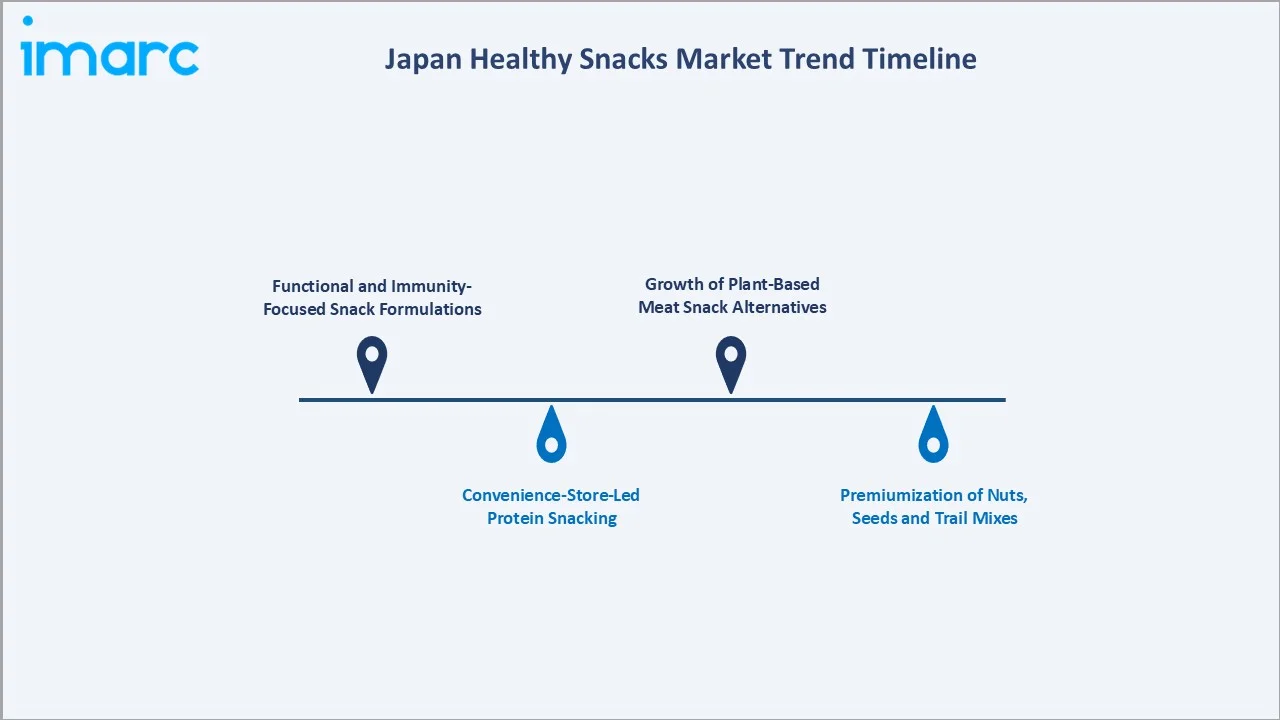
1. Functional and Immunity-Focused Snack Formulations
Manufacturers are increasingly fortifying nuts, granola, and dried-fruit snacks with vitamins, probiotics, and dietary fiber to align with Japan's health-conscious consumer base. This trend supports premiumization across the cereals and granola bars segment, where Calbee's Frugra brand continues to introduce fortified variants.
2. Convenience-Store-Led Protein Snacking
Japan's convenience-store chains are expanding dedicated protein and healthy-snack sections, capitalizing on the channel's 26.4% distribution share. Single-serve nut packs and jerky sticks are increasingly positioned near checkout counters to capture impulse purchases.
3. Growth of Plant-Based Meat Snack Alternatives
Itoham Yonekyu Holdings and other processors are introducing soy-based jerky products positioned as meat alternatives, targeting flexitarian and environmentally conscious consumers within the meat snacks segment.
4. E-commerce and Subscription-Based Snacking Models
Japan's food e-commerce market surpassed JPY 5 trillion in 2025, encouraging healthy snack brands to launch direct-to-consumer subscription boxes offering curated nut, dried-fruit, and granola assortments.
5. Premiumization of Nuts, Seeds and Trail Mixes
Consumers increasingly favor single-origin, minimally processed nuts and seeds over conventional roasted-and-salted formats, prompting manufacturers such as Kyoritsu Foods to expand premium, additive-free product lines.
Industry Value Chain Analysis
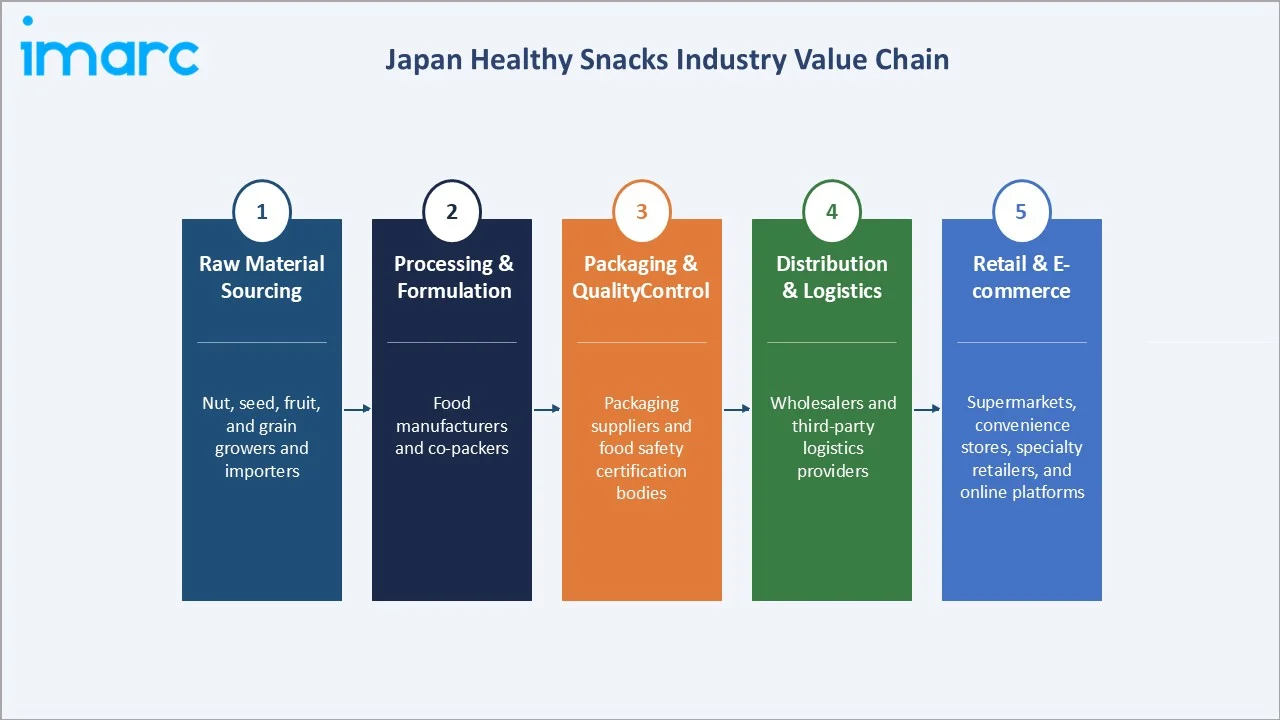
Japan's healthy snacks value chain integrates raw material sourcing, processing and formulation, packaging and quality control, distribution and logistics, and retail or e-commerce dispensing to reach health-conscious consumers nationwide.
|
Stage |
Key Participants |
|
Raw Material Sourcing |
Nut, seed, fruit, and grain growers and importers |
|
Processing & Formulation |
Food manufacturers and co-packers |
|
Packaging & Quality Control |
Packaging suppliers and food safety certification bodies |
|
Distribution & Logistics |
Wholesalers and third-party logistics providers |
|
Retail & E-commerce |
Supermarkets, convenience stores, specialty retailers, and online platforms |
Value creation is concentrated at the processing and branding stages, where manufacturers capture premium margins through product formulation, flavor innovation, and packaging differentiation, before retail markups are applied downstream.
Technology Landscape in the Japan Healthy Snacks Industry
Functional Ingredient Innovation
Japanese manufacturers are investing in functional ingredient technology, incorporating probiotics, plant-based proteins, and dietary fiber additives into nuts, granola, and jerky formats to meet Foods with Function Claims (FFC) labeling requirements set by the Consumer Affairs Agency.
Freeze-Drying and Preservation Technology
Advanced freeze-drying techniques are improving the nutrient retention and shelf life of dried fruit snacks, allowing manufacturers to reduce added sugar while preserving natural flavor profiles.
Smart and Sustainable Packaging
Snack manufacturers are adopting recyclable and reduced-plastic packaging formats in response to Japan's Plastic Resource Circulation Act, alongside portion-controlled single-serve packaging that supports on-the-go consumption.
Automation in Manufacturing
Automated roasting, mixing, and packaging lines are enabling manufacturers such as Calbee to scale premium granola and trail mix production while maintaining consistent quality across high-volume output.
Market Segmentation Analysis
The report covers the following segments:
|
Segment Category |
Leading Segment |
Market Share |
Year |
|
Product |
Nuts, Seeds and Trail Mixes |
34.6% |
2025 |
|
Distribution Channel |
Supermarkets and Hypermarkets |
38.7% |
2025 |
|
Region |
Kanto Region |
39.5% |
2025 |

By Product
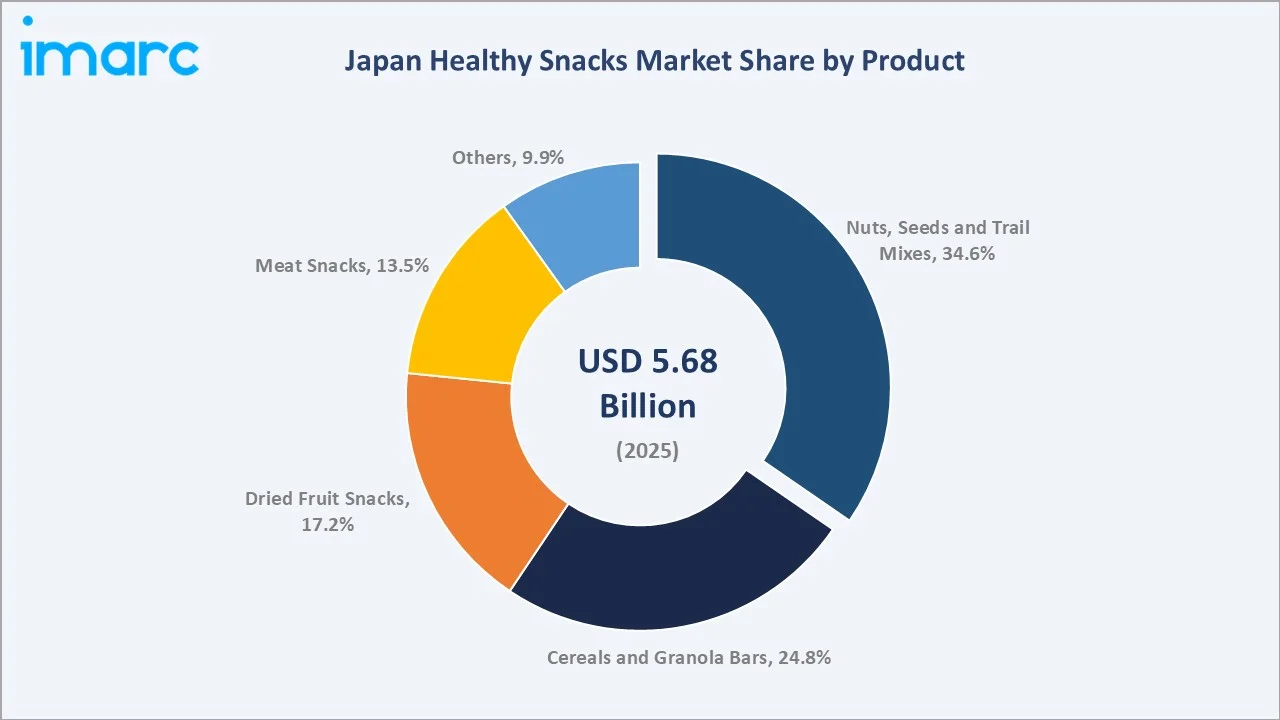
Nuts, seeds and trail mixes lead the Japan healthy snacks market with 34.6% share in 2025. Growing consumer preference for protein and healthy-fat-dense snacking continues to support this segment's roughly 6.1% CAGR through 2034.
To access detailed market analysis, Request Sample
Cereals and granola bars hold the second-largest share at 24.8%, anchored by Calbee's Frugra brand, Japan's top-selling cereal product by retail sales value. Dried fruit snacks account for 17.2% share, followed by meat snacks at 13.5%, which are benefiting from rising protein-focused dietary trends among Japan's fitness-conscious consumers. Others account for 9.9% of the market share.
By Distribution Channel
Supermarkets and hypermarkets lead distribution with 38.7% share in 2025, reflecting Japan's established grocery retail infrastructure. Convenience stores follow at 26.4%, supported by Japan's dense store network offering single-serve healthy snack formats for on-the-go consumption.
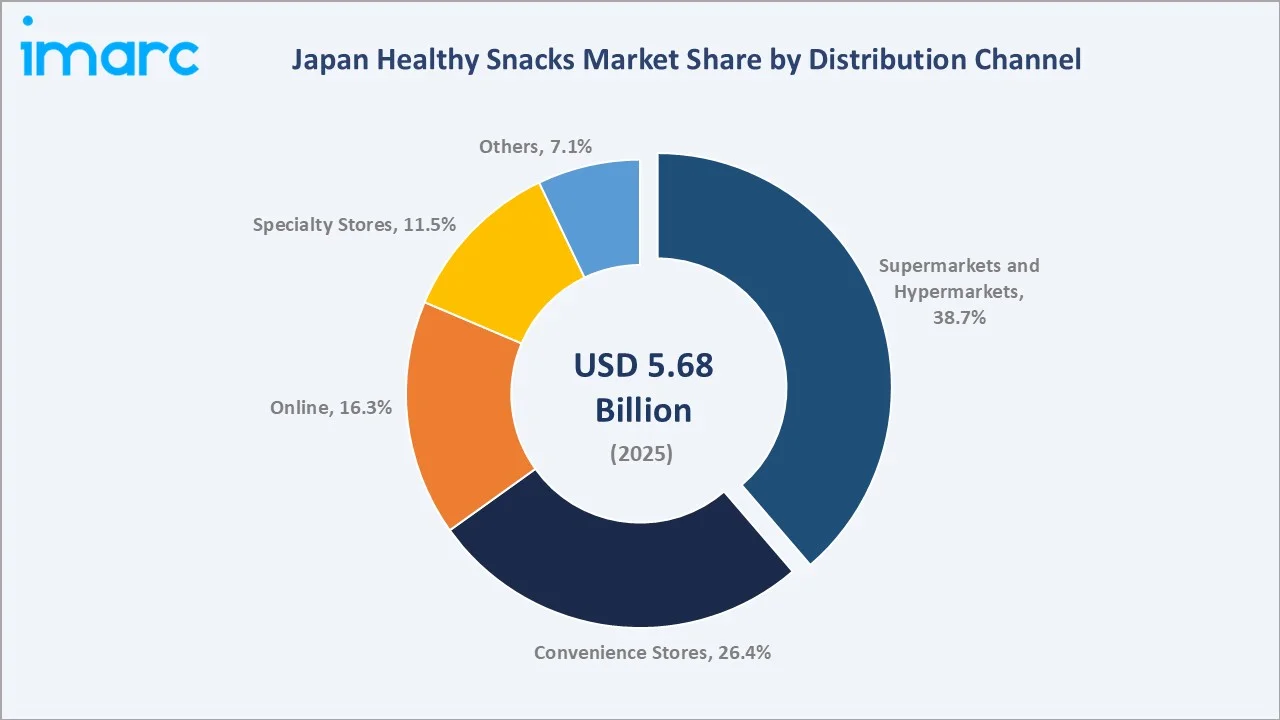
Online retail holds 16.3% share and is the fastest-growing channel at an estimated 9.2% CAGR through 2034, supported by Japan's expanding food e-commerce infrastructure. Specialty stores account for 11.5% share, catering to consumers seeking premium, artisanal nut and dried-fruit assortments. Others account for 7.1% of the market share.
Regional Market Insights
Japan's healthy snacks market spans eight regional blocks, each shaped by distinct urbanization levels, retail density, and demographic profiles. Regional demand concentration closely tracks population density and convenience-store penetration across Japan's prefectures.
|
Region |
Share (2025) |
Key Demand Characteristics |
|
Kanto Region |
39.5% |
Dense urban retail infrastructure and high disposable incomes |
|
Kansai/Kinki Region |
18.4% |
Strong convenience-store and supermarket penetration |
|
Central/Chubu Region |
14.4% |
Manufacturing-hub economy with steady retail demand |
|
Kyushu-Okinawa Region |
8.4% |
Growing tourism-linked snack consumption |
|
Tohoku Region |
6.3% |
Rural demographic with gradual urban retail expansion |
|
Chugoku Region |
5.3% |
Moderate urbanization with steady grocery retail demand |
|
Hokkaido Region |
4.4% |
Agricultural base supporting regional snack sourcing |
|
Shikoku Region |
3.3% |
Smallest regional market with localized specialty retail |
The Kanto region, encompassing Tokyo, Kanagawa, Saitama, and Chiba, leads the Japan healthy snacks market with 39.5% share in 2025, reflecting its dense population and extensive convenience-store and supermarket networks. The Kansai/Kinki region follows at 18.4%, anchored by Osaka's active retail and hospitality sector.
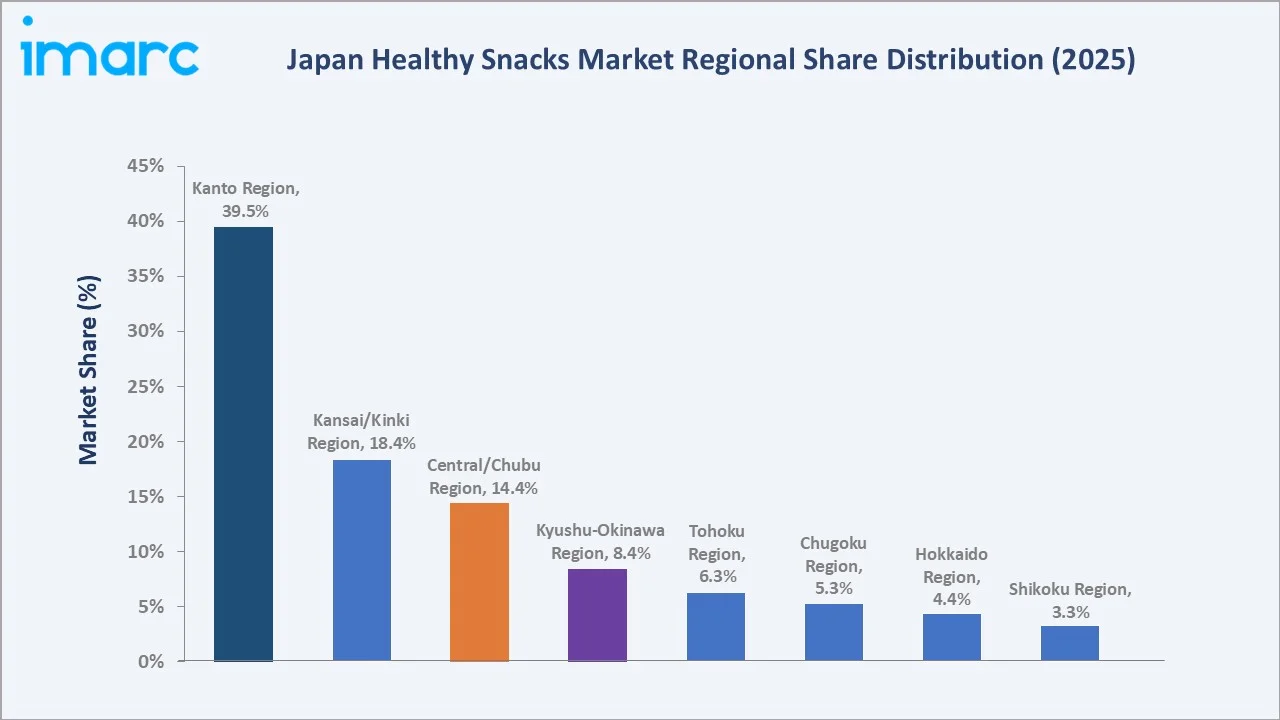
The Central/Chubu region holds 14.4% share, while Kyushu-Okinawa accounts for 8.4%, supported by rising tourism-linked snack consumption. Tohoku, Chugoku, Hokkaido, and Shikoku collectively represent the remaining 19.3% of the market, characterized by lower population density but steady grocery retail demand.
Competitive Landscape
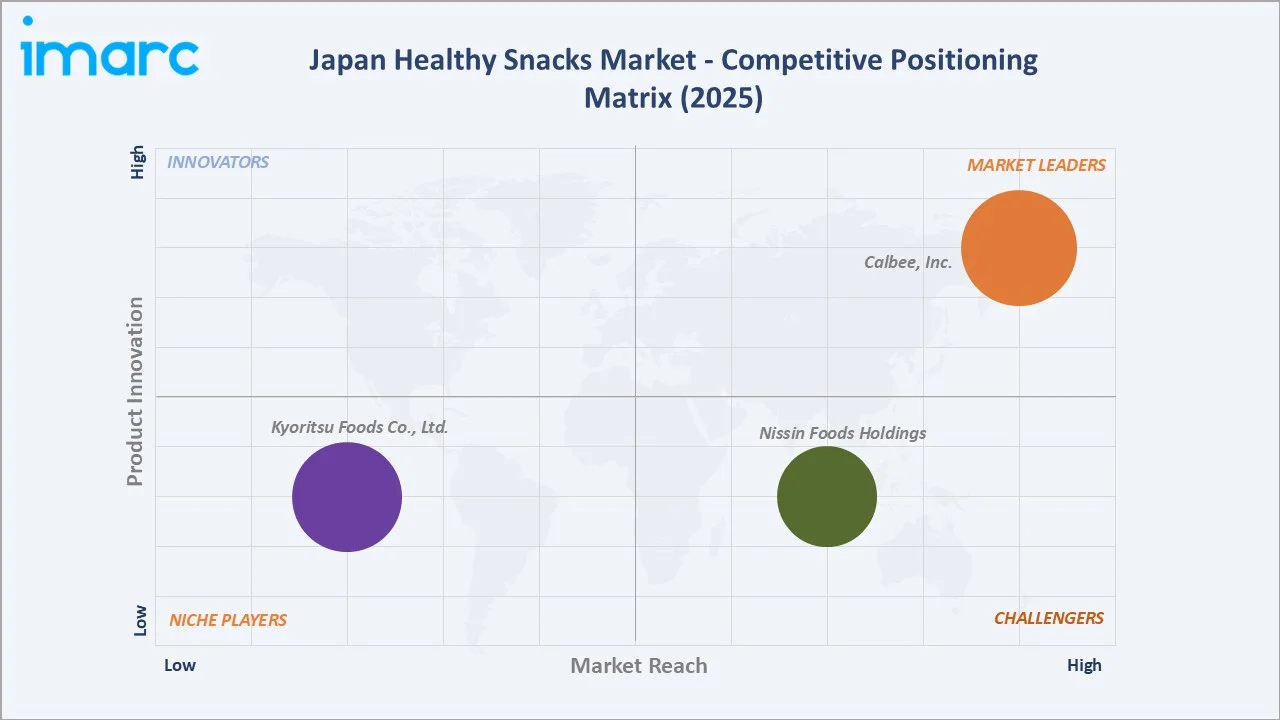
The Japan healthy snacks market is moderately fragmented, with domestic food conglomerates competing alongside specialized nut, dried-fruit, and meat-snack processors. Calbee, Inc. maintains category leadership in cereals and granola bars through its Frugra brand, while Kyoritsu Foods Co., Ltd. and Nissin Foods Holdings hold specialized positions in nuts/dried fruit and granola snacks, respectively.
|
Company Name |
Brand/ Product |
Market Position |
Core Strength |
|
Calbee, Inc. |
Frugra, Sayaendo, Miino |
Market Leader |
Japan's top-selling cereal/granola brand by retail sales value |
|
Nissin Foods Holdings |
Ciscorn, GoroGura |
Strong Challenger |
Operates Nissin Cisco Co., Ltd., established multinational-backed cereal and granola competitor |
|
Kyoritsu Foods Co., Ltd. |
Nuts & Dried Fruit Range |
Niche Player |
Broad nuts and dried-fruit portfolio for retail and baking channels |
Competitive intensity is increasing as convenience-store private-label brands and online-native snack startups enter the market, pressuring established manufacturers to accelerate flavor innovation and functional product launches.
Key Company Profiles
Calbee, Inc.
Calbee is Japan's leading snack food manufacturer, and its Frugra brand holds the top position in the country's cereal and granola category by retail sales value.
- Product Portfolio: Frugra, Sayaendo, Miino, and others.
- Strategic Focus: Scaling granola and trail mix production capacity while broadening functional and fortified snack offerings.
Nissin Foods Holdings
Nissin Foods Holdings operates Nissin Cisco Co., Ltd., which is a longstanding Japanese cereal manufacturer with a prominent position in the domestic granola and cereal-bar category.
- Product Portfolio: Ciscorn, GoroGura, and others.
- Strategic Focus: Defending category share against Calbee through product diversification and retail partnerships.
Kyoritsu Foods Co., Ltd.
Kyoritsu Foods is a Japan-based manufacturer specializing in nuts and dried fruit products distributed across retail and baking-ingredient channels.
- Product Portfolio: Mixed nuts, raisins, dried mango, dried cranberries, and pitted prunes.
- Strategic Focus: Broadening premium and organic nut and dried-fruit product lines for health-conscious retail consumers.
Market Concentration Analysis
The Japan healthy snacks market exhibits moderate fragmentation. The top companies collectively hold an estimated 30-35% combined share across the cereals/granola bars and meat snacks segments, while the nuts, seeds, dried fruit, and trail mixes segment remains more fragmented among specialized processors and private-label suppliers.
Consolidation trends are emerging as convenience-store chains expand private-label healthy snack lines, while established manufacturers pursue flavor innovation and functional product launches to defend shelf space against new entrants.
Investment & Growth Opportunities
Fastest Growing Segments
The online distribution channel (~9.2% CAGR), nuts, seeds and trail mixes (~6.1% CAGR), and dried fruit snacks (~5.4% CAGR) represent Japan's highest-growth investment vectors through 2034. Plant-based meat-snack alternatives also represent an emerging high-growth niche within the broader meat snacks segment.
Emerging Market Opportunities
Japan's low food e-commerce penetration of 4.52% in 2024, per METI data, represents a substantial runway for direct-to-consumer healthy snack brands. Rural regions including Tohoku and Shikoku, currently underserved by specialty retail, present opportunities for e-commerce-led market expansion.
Investment Themes
- Functional and Fortified Snack Innovation: Manufacturers investing in Foods with Function Claims (FFC)-labeled products can command premium retail pricing while meeting Consumer Affairs Agency labeling standards.
- Direct-to-Consumer E-commerce Expansion: Given Japan's below-average food e-commerce penetration, brands establishing early direct-to-consumer subscription models are positioned to capture disproportionate future channel growth.
Future Market Outlook (2026-2034)
The Japan healthy snacks market is projected to grow from USD 5.68 Billion in 2025 to USD 5.98 Billion in 2026, reaching USD 8.99 Billion by 2034, at a steady 5.23% CAGR, reflecting sustained demand from Japan's aging, health-conscious population and expanding e-commerce access. The market's USD 7.33 Billion valuation in 2030 will mark a consolidation point as functional and fortified snack formats gain broader mainstream adoption.
Three structural forces underpin this growth trajectory with high predictability: Japan's continuing demographic aging, which structurally expands demand for nutrient-dense snacking; the gradual maturation of Japan's food e-commerce infrastructure, unlocking new direct-to-consumer channels; and rising functional-ingredient innovation across nuts, granola, dried fruit, and meat snack formats, which is driving category premiumization through 2034.
Research Methodology
Primary Research
Primary research comprised structured interviews with food industry stakeholders, including product development managers at leading Japanese snack manufacturers, retail category managers at major supermarket and convenience-store chains, and nutrition and food-labeling consultants familiar with Japan's Foods with Function Claims (FFC) system.
Secondary Research
Secondary research encompassed Cabinet Office Annual Report on the Ageing Society data, Ministry of Health, Labour and Welfare (MHLW) dietary and nutrition publications, Ministry of Economy, Trade and Industry (METI) e-commerce market survey reports, company annual reports and press releases from Calbee and other Japan-operating snack manufacturers, and industry trade publications covering Japan's food and beverage sector.
Forecasting Models
Market forecasts were developed using historical consumption trend extrapolation combined with demographic-adjusted demand modeling, validated against company-reported sales data and government demographic and e-commerce statistics. Key inputs include Cabinet Office population aging projections, METI food e-commerce penetration trends, and segment-level historical growth patterns across 2020-2025.
Japan Healthy Snacks Market Report Coverage:
| Report Features | Details |
|---|---|
| Base Year of the Analysis | 2025 |
| Historical Period | 2020-2025 |
| Forecast Period | 2026-2034 |
| Units | Billion USD |
| Scope of the Report |
Exploration of Historical Trends and Market Outlook, Industry Catalysts and Challenges, Segment-Wise Historical and Future Market Assessment:
|
| Products Covered | Nuts, Seeds and Trail Mixes, Dried Fruit Snacks, Cereals and Granola Bars, Meat Snacks, Others |
| Distribution Channels Covered | Supermarkets and Hypermarkets, Convenience Stores, Specialty Stores, Online, Others |
| Regions Covered | Kanto Region, Kansai/Kinki Region, Central/ Chubu Region, Kyushu-Okinawa Region, Tohoku Region, Chugoku Region, Hokkaido Region, Shikoku Region |
| Companies Covered | Calbee Inc., Nissin Foods Holdings, Kyoritsu Foods Co. Ltd., etc. |
| Customization Scope | 10% Free Customization |
| Post-Sale Analyst Support | 10-12 Weeks |
| Delivery Format | PDF and Excel through Email (We can also provide the editable version of the report in PPT/Word format on special request) |
Key Benefits for Stakeholders:
- IMARC’s industry report offers a comprehensive quantitative analysis of various market segments, historical and current market trends, market forecasts, and dynamics of the Japan healthy snacks market from 2020-2034.
- The research report provides the latest information on the market drivers, challenges, and opportunities in the Japan healthy snacks market.
- Porter's five forces analysis assist stakeholders in assessing the impact of new entrants, competitive rivalry, supplier power, buyer power, and the threat of substitution. It helps stakeholders to analyze the level of competition within the Japan healthy snacks industry and its attractiveness.
- Competitive landscape allows stakeholders to understand their competitive environment and provides an insight into the current positions of key players in the market.
Frequently Asked Questions About the Japan Healthy Snacks Market Report
The Japan healthy snacks market size is estimated at USD 5.98 Billion in 2026, covering nuts, seeds and trail mixes, dried fruit snacks, cereals and granola bars, and meat snacks.
The Japan healthy snacks market is projected to grow at a CAGR of 5.23% during 2026-2034, reaching USD 8.99 Billion by 2034.
Nuts, seeds and trail mixes lead with 34.6% market share in 2025, driven by consumer preference for protein and healthy-fat-rich, minimally processed snacking formats.
Supermarkets and hypermarkets hold the largest share at 38.7% in 2025, supported by Japan's established grocery retail infrastructure and broad healthy snack assortments.
Online retail is the fastest-growing channel at an estimated 9.2% CAGR (2026-2034), supported by Japan's expanding, though still low-penetration, food e-commerce infrastructure.
The Kanto region leads with 39.5% market share in 2025, reflecting its dense population, high disposable incomes, and extensive convenience-store and supermarket networks.
Leading companies include Calbee, Inc., Nissin Foods Holdings, and Kyoritsu Foods Co., Ltd., among other domestic and specialized processors.
The Japan healthy snacks market is projected to reach approximately USD 7.33 Billion by 2030, driven by continued functional snack innovation and e-commerce expansion.
Japan's population aged 65 and over reached 29.3% of the total population in 2024, per Cabinet Office data, structurally increasing demand for nutrient-dense snacking.
Rising protein-focused dietary trends and growing interest in plant-based jerky alternatives are driving demand across the meat snacks segment, which held 13.5% share in 2025.
Need more help?
- Speak to our experienced analysts for insights on the current market scenarios.
- Include additional segments and countries to customize the report as per your requirement.
- Gain an unparalleled competitive advantage in your domain by understanding how to utilize the report and positively impacting your operations and revenue.
- For further assistance, please connect with our analysts.
 Request Customization
 Speak to an Analyst
 Request Brochure
 Inquire Before Buying
Benefits of Customization
- Personalize this research
- Triangulate with your data
- Get data as per your format and definition
- Gain a deeper dive into a specific application, geography, customer, or competitor
- Any level of personalization
Get in Touch With Us
UNITED STATES
Phone: +1-201-971-6302
INDIA
Phone: +91-120-433-0800
UNITED KINGDOM
Phone: +44-753-714-6104
Email: [email protected]
Client Testimonials




.webp)




.webp)













Related Reports

Choose your plan
*Please note that the prices mentioned below are starting prices for each bundle type. Kindly contact our team for further details.*
Single User License
- 1 User License, Access on 2 Devices
- PDF Report + Excel Dataset (Password Protected)
- Lifetime Access
- No Printing Rights
- 10% Free Report Customization
- 10–12 Weeks of Analyst Support
Five User License
- Access for 5 Users, 2 Devices per User
- PDF Report + Excel Dataset (Password Protected)
- Lifetime Access
- Dedicated Account Manager
- 12–14 Weeks of Analyst Support
- No Printing Rights
- 15% Free Report Customization
- 25% Discount on Your Next Purchase
Corporate User License
- Unlimited User Access (Within Your Organization)
- PDF Report + Excel Dataset
- Lifetime Access
- Dedicated Account Manager
- 14–20 Weeks of Analyst Support
- No Printing Rights
- 20% Free Report Customization
- 30% Discount on Your Next Purchase
Essential Insights
What's included:
3 reports
- Lifetime Access
- PDF Reports
- Excel Datasets
- 2 Weeks of Free Analyst Support
- 2 User Licenses
- Access on 2 Devices
- Printing Rights
- Complimentary PowerPoint (PPT) Version
- Complimentary License Upgrade
Professional Access
What's included:
5 reports
- Lifetime Access
- PDF Reports
- Excel Datasets
- 8 Weeks of Free Analyst Support
- 2 User Licenses
- Access on 2 Devices
- Printing Rights
- Complimentary PowerPoint (PPT) Version
- Complimentary License Upgrade
Business Advantage
What's included:
8 reports
- Lifetime Access
- PDF Reports
- Excel Datasets
- 14 Weeks of Free Analyst Support
- 2 User Licenses
- Access on 2 Devices
- Printing Rights
- Complimentary PowerPoint (PPT) Version
- Complimentary License Upgrade
Enterprise Intelligence
What's included:
10 reports
- Lifetime Access
- PDF Reports
- Excel Datasets
- 20 Weeks of Free Analyst Support
- 2 User Licenses
- Access on 2 Devices
- Printing Rights
- Complimentary PowerPoint (PPT) Version
- Complimentary License Upgrade