
Japan Oat Milk Market Size, Share, Trends and Forecast by Source, Product, Packaging Type, Application, Distribution Channel, and Region, 2026-2034
Japan Oat Milk Market Size, Share, Trends & Forecast (2026-2034)
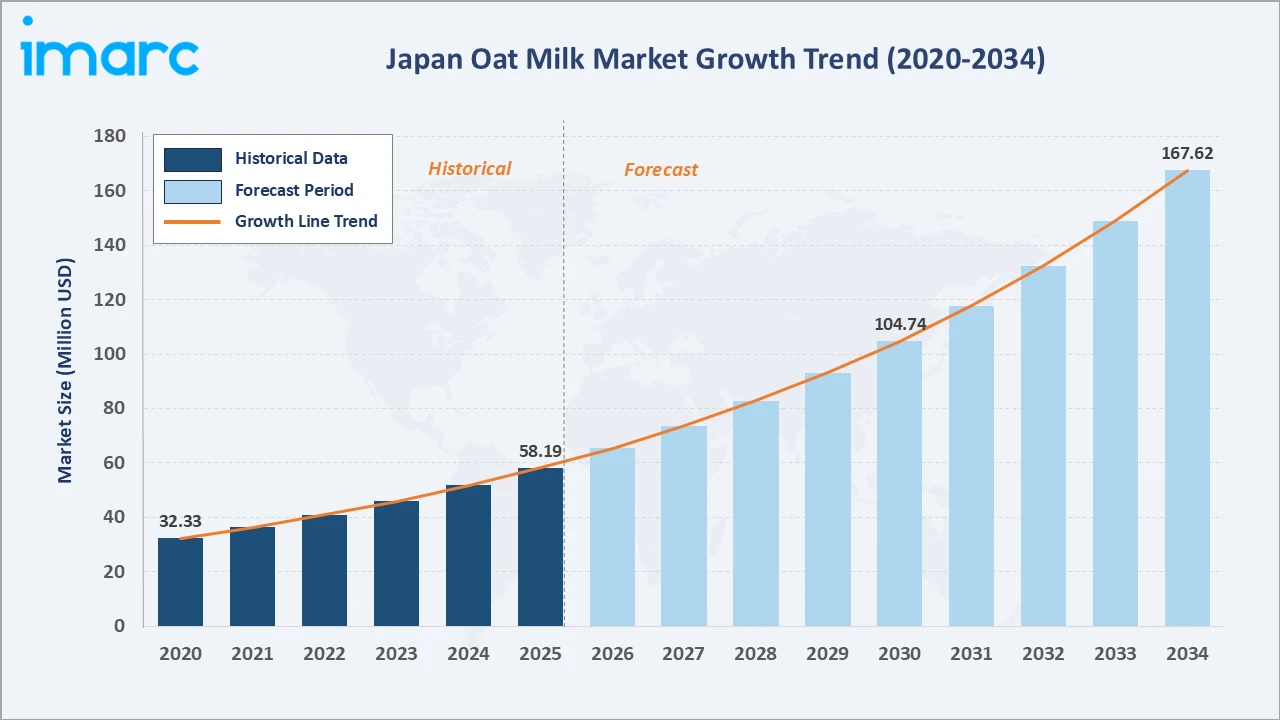
The Japan oat milk market grew from USD 58.19 Million in 2025 to USD 65.45 Million in 2026 and is projected to reach USD 167.62 Million by 2034, exhibiting a CAGR of 12.47% during 2026-2034. Rising consumer preference for plant-based dairy alternatives, surging lactose intolerance awareness, and expanding retail availability are supporting sustained market growth.
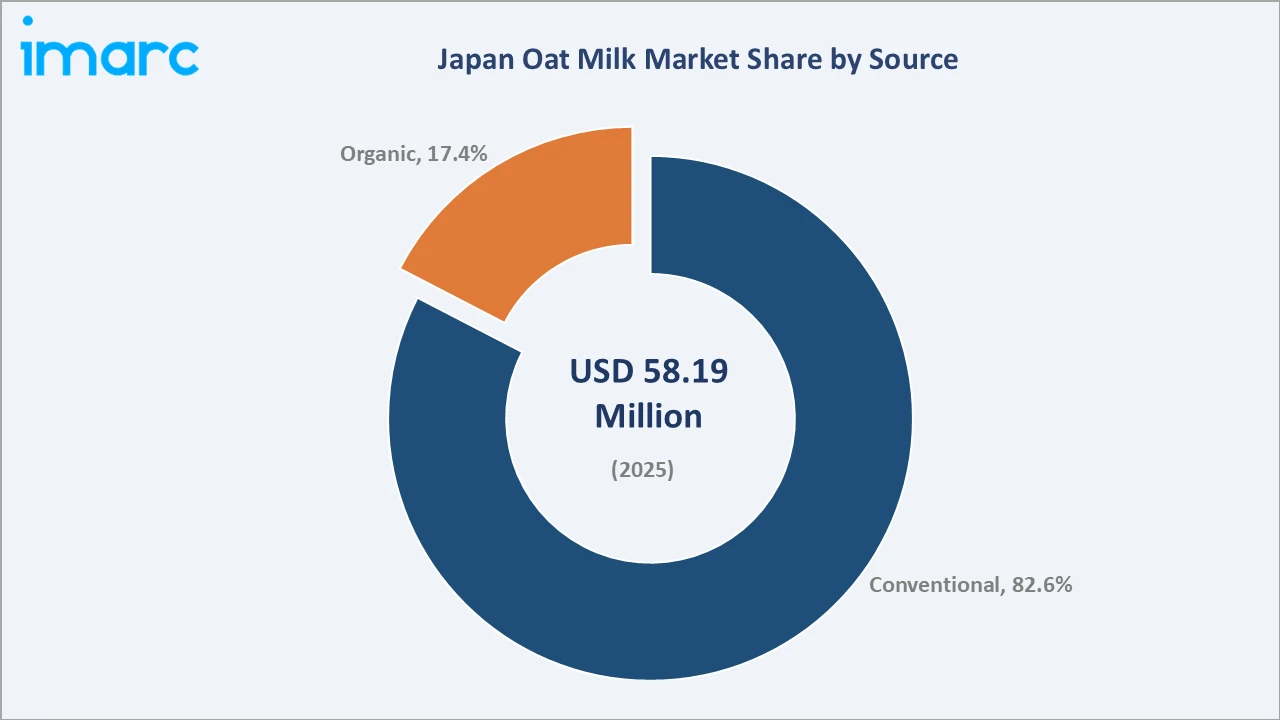
Conventional leads the source segment at 82.6%, plain dominates the product segment at 68.3%, and Kanto Region commands 39.1% of regional share in 2025.
Market Snapshot
|
Metric |
Value |
|
Base Year Market Size (2025) |
USD 58.19 Million |
|
Market Size (2026) |
USD 65.45 Million |
|
Forecast Market Size (2034) |
USD 167.62 Million |
|
CAGR (2026-2034) |
12.47% |
|
Base Year |
2025 |
|
Historical Period |
2020-2025 |
|
Forecast Period |
2026-2034 |
|
Largest Region |
Kanto Region (39.1%, 2025) |
|
Second Largest Region |
Kansai/Kinki Region (18.0%, 2025) |
|
Leading Source |
Conventional (82.6%, 2025) |
|
Leading Product |
Plain (68.3%, 2025) |
The Japan oat milk market expanded from USD 32.33 Million in 2020 to USD 58.19 Million in 2025 and an estimated USD 65.45 Million in 2026, driven by widening retail availability, growing café adoption, and rising awareness of lactose-free alternatives across urban centers. Anchored at USD 104.74 Million in 2030, the forecast to USD 167.62 Million by 2034 is supported by accelerating domestic manufacturing capacity, broader foodservice integration, and continued flavor and format innovation.
To get more information on this market, Request Sample
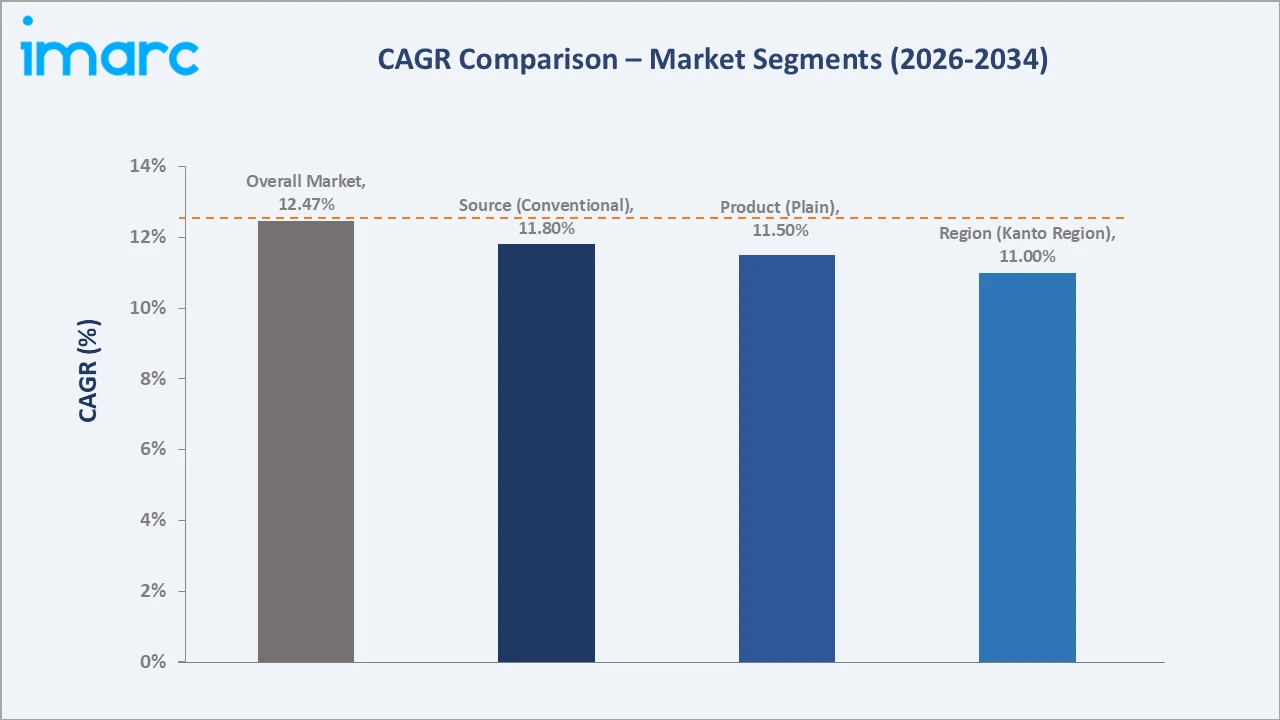
CAGR trajectories across source and product sub-segments show organic and flavored expanding faster than the overall 12.47% market CAGR, reflecting a gradual shift toward premium, differentiated, and health-positioned offerings.
Executive Summary
The Japan oat milk market is on a steady growth trajectory, expanding from USD 32.33 Million in 2020 to an estimated USD 65.45 Million in 2026, and is projected to reach USD 167.62 Million by 2034. The category has moved from a niche, import-led offering into a widening set of domestically manufactured and retail-ready products spanning plain and flavored formats. Affordable retail access, growing café adoption, and rising consumer interest in lactose-free and low-carbon dairy alternatives are encouraging first-time trial across a broader consumer base.
Based on source, conventional leads with an 82.6% share in 2025, supported by lower shelf pricing and wider mainstream retail placement. Plain leads the product segment at 68.3%, valued for its versatility across coffee, cooking, and everyday drinking occasions. Kanto Region commands 39.1% of regional share, anchored by Tokyo's dense retail and café network.
Key Market Insights
|
Insight |
Data |
|
Leading Source |
Conventional - 82.6% share (2025) |
|
Second Largest Source |
Organic - 17.4% share (2025) |
|
Leading Product |
Plain - 68.3% share (2025) |
|
Second Largest Product |
Flavored - 31.7% share (2025) |
|
Leading Region |
Kanto Region - 39.1% share (2025) |
|
Second Largest Region |
Kansai/Kinki Region (18.0%, 2025) |
|
Top Companies |
Marusan-Ai Co., Ltd., Danone, Minor Figures, Ecotone, Costco Wholesale Corporation |
Key Analytical Observations Expanding On The Data Above:
- Conventional dominance at 82.6% is supported by lower price points, wider mainstream retail placement, and broader supermarket and convenience store availability compared with certified-organic alternatives.
- Organic share at 17.4% is expanding as certified and premium offerings gain traction among health-focused shoppers willing to pay a premium for verified sourcing and cleaner-label claims.
- Plain leadership at 68.3% reflects consumer preference for a versatile, neutral-tasting base suited to coffee, cooking, and daily drinking occasions across households and cafes.
- Flavored at 31.7% is gaining share as brands introduce matcha, coffee, and dessert-inspired formats aimed at younger, trend-driven consumers seeking differentiated taste experiences.
- Kanto Region share at 39.1% is anchored by Tokyo's dense retail, café, and foodservice network. Strong consumer acceptance of plant-based beverages and the concentration of premium grocery chains continue to support steady demand across the region.
Japan Oat Milk Market Overview
Oat milk is a dairy-free beverage produced by soaking, blending, and straining whole oats into a smooth, naturally sweet liquid that serves as a substitute for cow's milk in beverages, cooking, and baking. In Japan, the category sits within a broader plant-based milk ecosystem alongside soy and almond milk, and spans plain and flavored formats sold through supermarkets, grocery stores, online channels, and foodservice outlets.
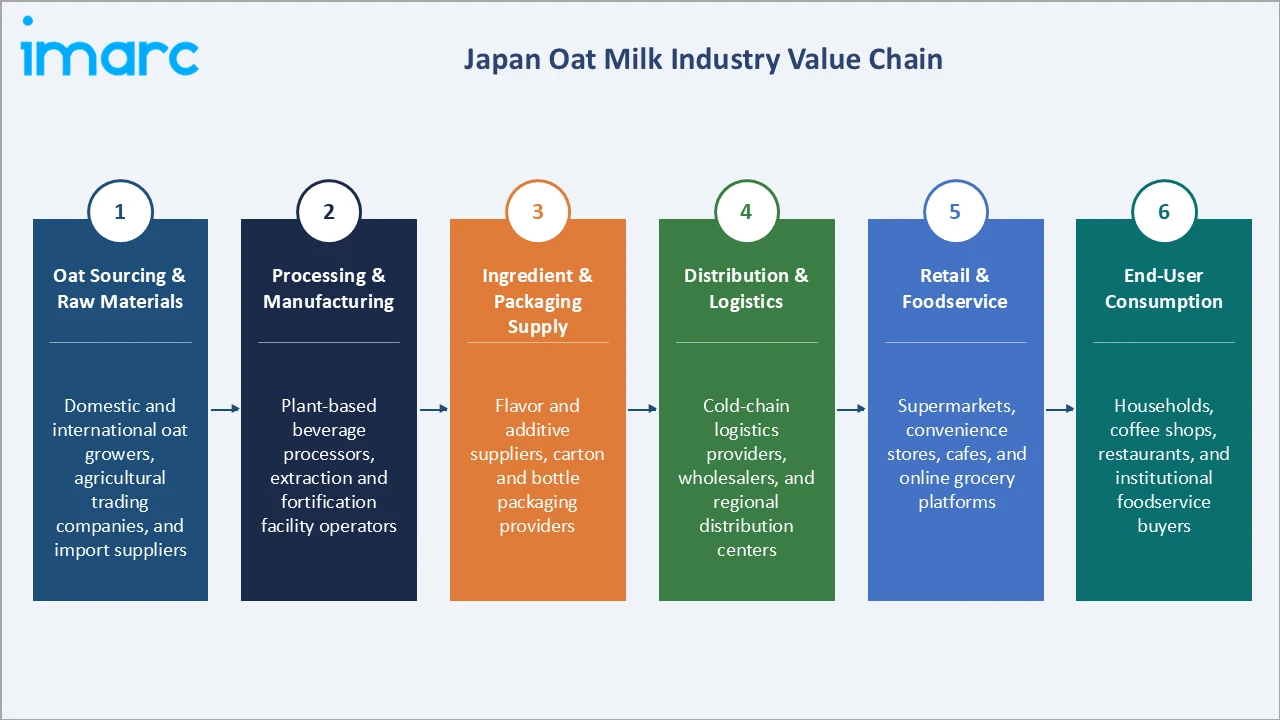
The domestic ecosystem links imported and domestic oat sourcing, ingredient suppliers, processors, packaging companies, distribution and retail networks, and foodservice operators, all shaped by evolving consumer health preferences and Japan's broader import-dependent food supply chain.
Market Dynamics
To evaluate market opportunities, Request Sample
Market Drivers
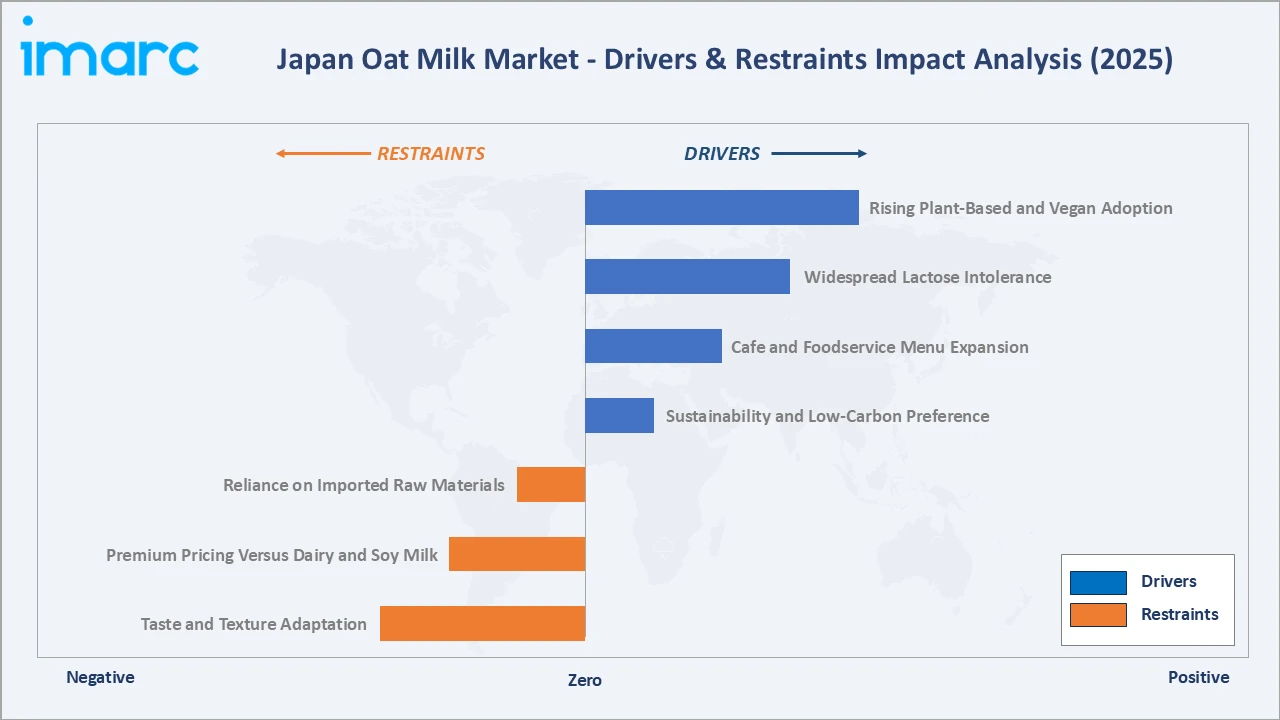
- Rising Plant-Based and Vegan Adoption: Growing consumer interest in vegetarian, vegan, and flexitarian diets is broadening the addressable base for dairy-free alternatives, with oat milk benefiting from its neutral taste and simple ingredient profile. As per IMARC Group, the Japan vegan food market size was valued at USD 1.32 Billion in 2025.
- Widespread Lactose Intolerance: A high prevalence of lactase non-persistence among Japanese adults continues to support demand for digestible, lactose-free milk alternatives such as oat milk.
- Café and Foodservice Menu Expansion: Coffee chains and specialty cafes are increasingly listing oat milk as a barista-grade option, exposing new consumers to the category through everyday coffee and tea occasions.
- Sustainability and Low-Carbon Preference: Oats require comparatively less water and land than dairy farming, aligning oat milk with the preferences of environmentally conscious consumers seeking a lower-carbon-footprint beverage choice.
Market Restraints
- Reliance on Imported Raw Materials: Japan's limited domestic oat cultivation base means manufacturers depend heavily on imported oats and other raw agricultural inputs, exposing production costs to currency and global supply fluctuations.
- Premium Pricing Versus Dairy and Soy Milk: Oat milk typically carries a higher shelf price than cow's milk and established soy milk brands, which can limit trial among price-sensitive, value-oriented shoppers.
- Taste and Texture Adaptation: Some consumers accustomed to dairy or soy milk require repeated trial before adjusting to oat milk's distinct mouthfeel and flavor profile, slowing the pace of habitual repurchase.
Market Opportunities
- Domestic Manufacturing Expansion: Growing domestic processing capacity presents an opportunity to reduce reliance on imported finished products, improve shelf pricing, and shorten replenishment cycles for retailers.
- Functional and Fortified Formulations: Calcium- and vitamin-fortified, protein-enhanced, and low-sugar variants offer a route to premiumization and can help brands differentiate on health credentials beyond taste alone.
Market Challenges
- Limited Consumer Awareness Outside Urban Centers: Category familiarity remains concentrated in major metropolitan areas, leaving rural and regional markets comparatively underpenetrated and dependent on continued retail education.
- Intensifying Competitive Pressure: A growing roster of domestic and international entrants is increasing shelf competition, requiring sustained marketing investment to maintain brand visibility and retail placement.
Emerging Market Trends
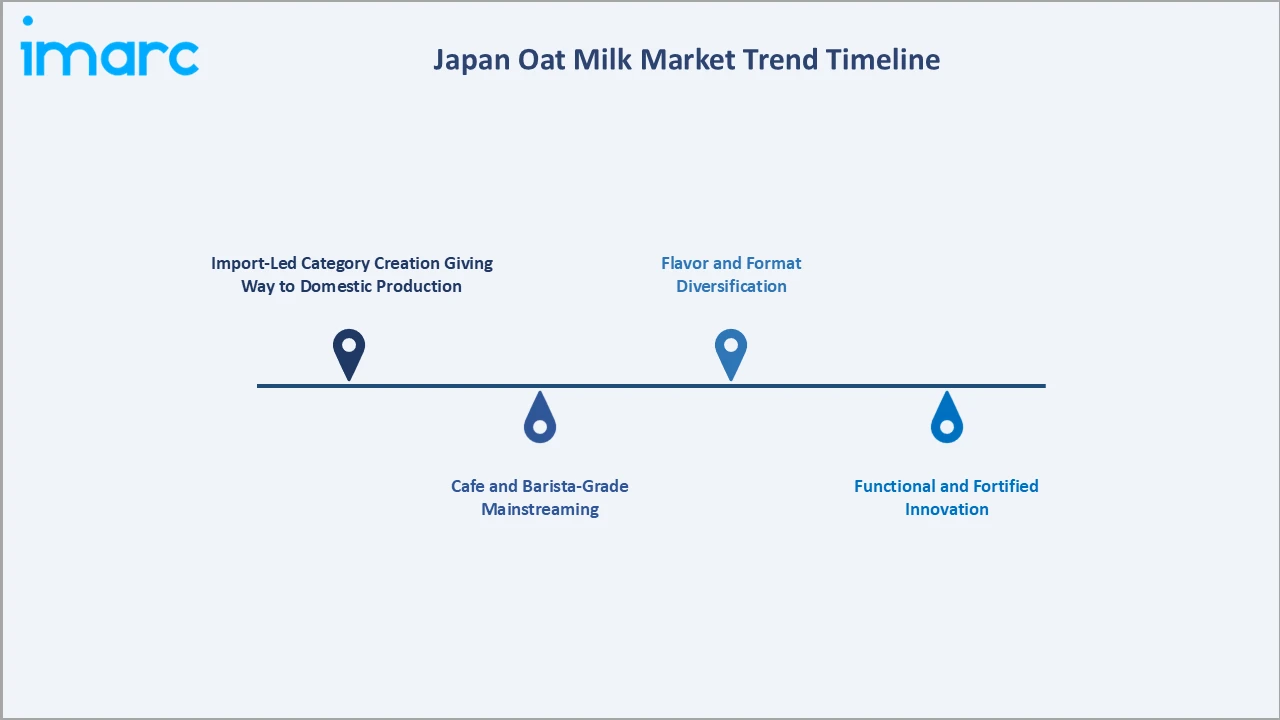
1. Import-Led Category Creation Giving Way to Domestic Production
Early category growth was driven by imported brands sold through international supermarkets and e-commerce platforms. Domestic manufacturers have since scaled up local processing, improving price competitiveness and shelf availability across mainstream retail.
2. Café and Barista-Grade Mainstreaming
Coffee shops and cafés across Japan are increasingly offering oat milk as a standard beverage option, helping normalize its use beyond niche plant-based consumers. Growing demand for dairy alternatives in specialty coffee and café menus continues to strengthen oat milk adoption across both foodservice and retail channels.
3. Flavor and Format Diversification
Brands are introducing matcha, hojicha, coffee, and dessert-inspired flavored variants alongside barista-grade and ready-to-drink formats, broadening occasions for consumption beyond the traditional glass of milk.
4. Functional and Fortified Innovation
Calcium- and vitamin-fortified, reduced-sugar, and fermentation-enhanced formulations are emerging as manufacturers seek to improve taste, digestibility, and nutritional positioning relative to dairy milk.
Industry Value Chain Analysis
The Japan oat milk value chain spans six stages, from raw material sourcing through end-user consumption. Processing and manufacturing, together with distribution and retail placement, capture the largest share of value-add, while packaging and ingredient suppliers increasingly influence shelf differentiation as flavored and fortified variants expand.
|
Stage |
Key Players / Examples |
|
Oat Sourcing & Raw Materials |
Domestic and international oat growers, agricultural trading companies, and import suppliers |
|
Processing & Manufacturing |
Plant-based beverage processors, extraction and fortification facility operators |
|
Ingredient & Packaging Supply |
Flavor and additive suppliers, carton and bottle packaging providers |
|
Distribution & Logistics |
Cold-chain logistics providers, wholesalers, and regional distribution centers |
|
Retail & Foodservice |
Supermarkets, convenience stores, online grocery platforms, and cafes |
|
End-User Consumption |
Households, coffee shops, restaurants, and institutional foodservice buyers |
Vertically capable manufacturers that combine in-house processing with direct retail relationships are best positioned to capture incremental value as the category scales through 2034.
Technology Landscape in the Japan Oat Milk Industry
Fermentation and Taste-Masking Techniques
Manufacturers are investing in fermentation and enzymatic processing methods that reduce the naturally earthy flavor of raw oats, improving sweetness and mouthfeel to better match Japanese taste preferences.
Fortification and Functional Nutrition
Calcium, vitamin D, and protein fortification are becoming standard among premium offerings, helping oat milk compete more directly with dairy milk on nutritional grounds while retaining a lactose-free profile.
Sustainable and Eco-Friendly Packaging
Brands are adopting recyclable cartons, reduced-plastic closures, and lighter-weight packaging formats to align with sustainability-focused retailers and environmentally conscious consumers.
Market Segmentation Analysis
The report covers the following segments:
|
Segment Category |
Leading Segment |
Market Share |
Year |
|
Source |
Conventional |
82.6% |
2025 |
|
Product |
Plain |
68.3% |
2025 |
|
Packaging Type |
🔒 |
🔒 |
2025 |
|
Application |
🔒 |
🔒 |
2025 |
|
Distribution Channel |
🔒 |
🔒 |
2025 |
|
Region |
Kanto Region |
39.1% |
2025 |

By Source
Conventional commands an 82.6% majority share in 2025, supported by lower production costs, broader raw material availability, and wide mainstream retail placement across supermarkets and convenience stores. The segment benefits from established supply relationships and consistent price positioning relative to dairy milk.
To access detailed market analysis, Request Sample
Organic at 17.4% is expanding as certified suppliers scale up and as health- and sustainability-focused consumers seek verified, cleaner-label alternatives. The segment carries a price premium but is gaining share as certification becomes more widely available across retail channels.
By Product
Plain leads with 68.3% share in 2025, reflecting its versatility across coffee, cooking, and everyday drinking occasions. The format remains the default entry point for first-time buyers due to its neutral flavor and broad culinary compatibility.
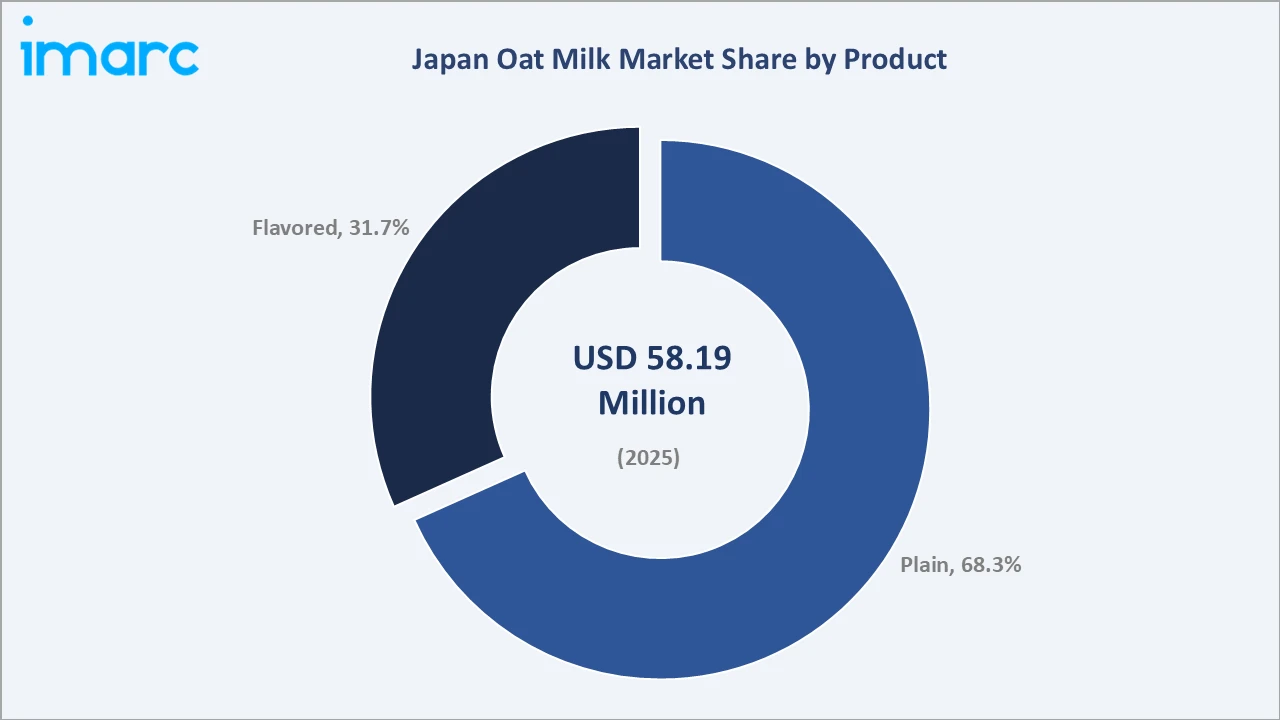
Flavored at 31.7% is growing faster than the overall category as brands introduce matcha, coffee, and dessert-inspired formats targeting younger, trend-driven consumers seeking differentiated taste experiences.
Regional Market Insights
|
Region |
Share (2025) |
Key Growth Drivers |
|
Kanto Region |
39.1% |
Dense urban population, strong retail and café infrastructure, and high concentration of health-conscious consumers |
|
Kansai/Kinki Region |
18.0% |
Established metropolitan retail base, growing foodservice adoption, and rising health awareness |
|
Central/Chubu Region |
15.4% |
Expanding supermarket networks, industrial base supporting distribution, and steady urban consumption growth |
|
Kyushu-Okinawa Region |
8.5% |
Growing tourism-linked foodservice demand and expanding modern retail penetration |
|
Tohoku Region |
6.8% |
Gradual retail modernization and increasing availability through regional supermarket chains |
|
Chugoku Region |
5.1% |
Steady urban consumption growth and expanding convenience store distribution |
|
Hokkaido Region |
4.0% |
Strong dairy-adjacent retail culture creating cross-category awareness for milk alternatives |
|
Shikoku Region |
3.1% |
Emerging retail availability and gradual consumer awareness building |
Kanto Region at 39.1% in 2025 leads the regional landscape, anchored by Tokyo's dense retail, café, and foodservice network. A large concentration of health-conscious, digitally engaged consumers and high density of specialty and organic grocery outlets support sustained regional leadership.
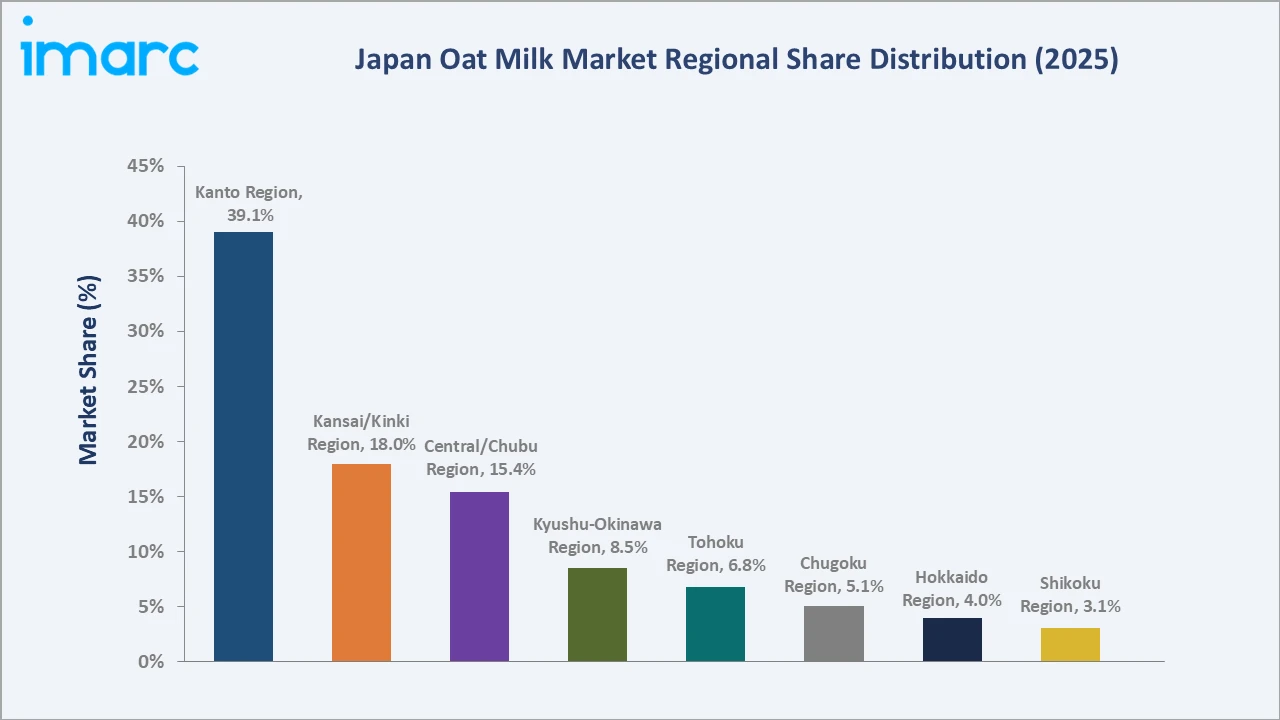
Kyushu-Okinawa Region, with 8.5% market share, is the fastest growing market, supported by expanding modern retail formats, rising tourism-linked foodservice demand, and gradual consumer education efforts extending oat milk's reach beyond core metropolitan areas.
Competitive Landscape
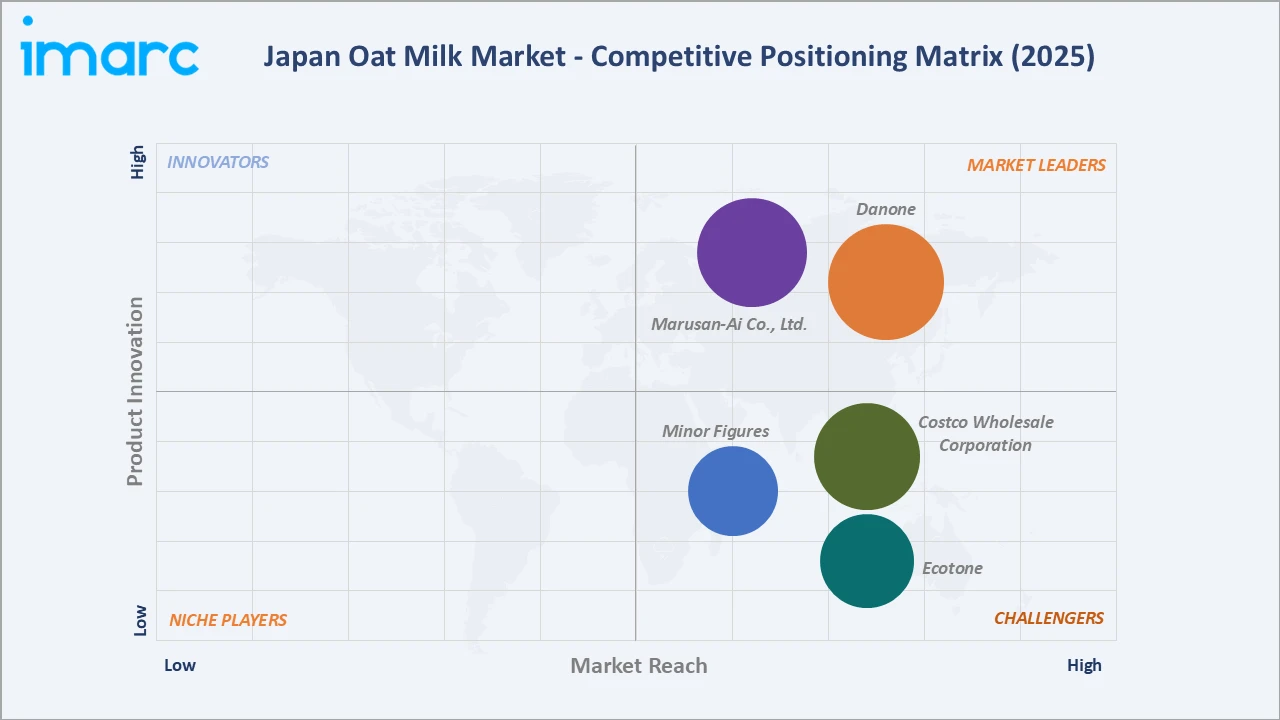
The Japan oat milk market is moderately fragmented, with domestic manufacturers, global plant-based specialists, and beverage majors competing alongside niche import brands. Product localization, retail distribution reach, and brand trust form the key competitive differentiators as the category scales beyond its early-adopter base.
|
Company Name |
Brand / Key Product |
Position |
Strategic Focus |
|
Marusan-Ai Co., Ltd. |
Oat Milk Craft |
Leader |
Domestic manufacturer scaling plant-based milk production through proprietary processing and broad retail distribution |
|
Danone |
Alpro Oat Original Drink |
Leader |
Global plant-based nutrition company expanding retail and barista-grade offerings across Japan |
|
Minor Figures |
Minor Figures |
Challenger |
Broadening market presence by expanding distribution channels and improving product accessibility |
|
Ecotone |
Isola Bio |
Challenger |
Enhancing product quality and consumer appeal through ongoing innovation and sustainable sourcing initiatives |
|
Costco Wholesale Corporation |
Kirkland Signature |
Challenger |
Expanding sourcing capacity and strengthening supplier partnerships to support long-term growth in the plant-based beverage market |
Key players include Marusan-Ai Co., Ltd., Danone, Minor Figures, Ecotone, and Costco Wholesale Corporation, among others.
Key Company Profiles
Marusan-Ai Co., Ltd.
Marusan-Ai Co., Ltd. is a Japanese food manufacturer headquartered in Aichi, and a long-established player in the domestic soy milk industry, with its plant-based portfolio extending into oat-based beverages.
- Product Portfolio: Oat Milk Craft, sold alongside the company's established soy and almond milk lines through retail channels nationwide.
- Recent Developments: The company continues to strengthen its plant-based beverage portfolio through ongoing product development, manufacturing improvements, and expansion of its distribution network across domestic retail channels.
- Strategic Focus: Strengthening domestic plant-based milk production through proprietary processing capabilities and broad retail distribution.
Danone
Danone is a global food and beverage company operating the Alpro brand as one of its leading international plant-based nutrition lines, with a retail presence spanning multiple countries, including Japan.
- Product Portfolio: Alpro Oat Original Drink, offered alongside the company's wider plant-based dairy-alternative range.
- Recent Developments: The company has continued to broaden its retail and foodservice presence in Japan as part of its ongoing plant-based growth strategy.
- Strategic Focus: Expanding its plant-based nutrition portfolio through wider retail presence and barista-focused product offerings in Japan.
Minor Figures
Minor Figures is a United Kingdom-based coffee and plant-based beverage company known for its barista-formulated oat milk, serving specialty coffee and retail channels internationally.
- Product Portfolio: Minor Figures oat milk, formulated for barista and foodservice coffee applications.
- Recent Developments: The company has continued to broaden its distribution channels and improve product accessibility across its international markets.
- Strategic Focus: Enhancing market penetration by strengthening distribution networks and improving product availability.
Market Concentration Analysis
The Japan oat milk market is moderately fragmented, with both domestic beverage companies and international plant-based brands competing through product innovation, retail expansion, and foodservice partnerships.
Barriers to entry include the cost of building retail relationships, the need for consistent import or domestic supply chains, and the marketing investment required to build consumer trial in a still-developing category. These factors favor established food and beverage companies with existing distribution infrastructure.
Consolidation is likely to accelerate gradually as domestic manufacturing scales and as larger beverage companies deepen investment in plant-based portfolios, while smaller import brands continue to serve specialty and organic retail niches.
Investment & Growth Opportunities
Fastest-Growing Segments
Organic and flavored are expanding faster than the overall market, driven by rising demand for certified, premium, and differentiated offerings. Growing consumer interest in clean-label ingredients, plant-based nutrition, and innovative flavor profiles continues to support faster adoption of these segments across both retail and foodservice channels.
Emerging Markets
Kyushu-Okinawa Region represents the fastest-growing regional opportunity, supported by expanding modern retail formats and rising tourism-linked foodservice demand. Tohoku Region and Chugoku Region offer untapped potential as retail modernization continues.
Venture & Investment Trends
Investment interest is concentrated in domestic processing capacity, fortified and functional product development, and sustainable packaging innovation, reflecting the category's shift from import-led awareness building toward scaled domestic production.
Future Market Outlook (2026-2034)
The Japan oat milk market is expected to increase from USD 58.19 Million in 2025 to USD 65.45 Million in 2026 and further to USD 167.62 Million by 2034 at a CAGR of 12.47%, adding roughly USD 109 Million in incremental market value over the forecast period.
Three forces are expected to shape the market through 2034: continued growth in domestic manufacturing capacity that improves price competitiveness; deeper integration of oat milk into café and foodservice menus; and ongoing product innovation across fortified, low-sugar, and flavored formats.
By 2034, the Japan oat milk market is expected to reflect a more mature, domestically anchored category, with broader retail availability, deeper foodservice penetration, and a wider range of functional and flavored products serving an increasingly health-conscious consumer base.
Research Methodology
Primary Research
Primary research included structured discussions with plant-based beverage manufacturers, retail category managers, and foodservice operators to validate market sizing, segment mix, and regional demand patterns.
Secondary Research
Secondary sources included Japan's Ministry of Agriculture, Forestry and Fisheries publications, peer-reviewed nutrition and gastroenterology research, industry association data, and company disclosures from leading plant-based beverage manufacturers.
Forecasting Models
Market forecasts used top-down and bottom-up modeling combining historical category growth, retail distribution trends, and segment-level demand indicators, with scenario analysis addressing input cost variability and evolving consumer adoption rates.
Japan Oat Milk Market Report Coverage:
| Report Features | Details |
|---|---|
| Base Year of the Analysis | 2025 |
| Historical Period | 2020-2025 |
| Forecast Period | 2026-2034 |
| Units | Million USD |
| Scope of the Report | Exploration of Historical Trends and Market Outlook, Industry Catalysts and Challenges, Segment-Wise Historical and Future Market Assessment:
|
| Sources Covered | Organic, Conventional |
| Products Covered | Plain, Flavored |
| Packaging Types Covered | Cartons, Bottles, Others |
| Applications Covered | Food, Beverages |
| Distribution Channels Covered | Supermarkets and Hypermarkets, Grocery Stores, Online Stores, Others |
| Regions Covered | Kanto Region, Kansai/Kinki Region, Central/ Chubu Region, Kyushu-Okinawa Region, Tohoku Region, Chugoku Region, Hokkaido Region, Shikoku Region |
| Companies Covered | Marusan-Ai Co., Ltd., Danone, Minor Figures, Ecotone, Costco Wholesale Corporation, etc. |
| Customization Scope | 10% Free Customization |
| Post-Sale Analyst Support | 10-12 Weeks |
| Delivery Format | PDF and Excel through Email (We can also provide the editable version of the report in PPT/Word format on special request) |
Key Benefits for Stakeholders:
- IMARC’s industry report offers a comprehensive quantitative analysis of various market segments, historical and current market trends, market forecasts, and dynamics of the Japan oat milk market from 2020-2034.
- The research report provides the latest information on the market drivers, challenges, and opportunities in the Japan oat milk market.
- Porter's five forces analysis assist stakeholders in assessing the impact of new entrants, competitive rivalry, supplier power, buyer power, and the threat of substitution. It helps stakeholders to analyze the level of competition within the Japan oat milk industry and its attractiveness.
- Competitive landscape allows stakeholders to understand their competitive environment and provides an insight into the current positions of key players in the market.
Frequently Asked Questions About the Japan Oat Milk Market Report
The Japan oat milk market size is estimated at USD 65.45 Million in 2026, supported by rising plant-based diet adoption and growing retail and café availability across the country.
The market is projected to grow at a CAGR of 12.47% from 2026-2034, reaching USD 167.62 Million, supported by domestic manufacturing expansion and product innovation.
Conventional leads at 82.6% in 2025, supported by lower pricing and wide mainstream retail availability. Its broad presence across supermarkets and convenience stores continues to reinforce consumer accessibility.
Plain dominates at 68.3% in 2025, valued for its versatility. It is widely preferred for everyday consumption, coffee preparation, and a variety of culinary applications.
Kanto Region commands 39.1% share in 2025, led by Tokyo's dense retail, café, and foodservice network and concentration of health-conscious consumers.
Leading players include Marusan-Ai Co., Ltd., Danone, Minor Figures, Ecotone, and Costco Wholesale Corporation, among others.
Domestic production supports market growth by improving product availability, shortening supply chains, enabling localized product innovation, and reducing dependence on imported finished oat milk products.
Key trends include café and barista-grade mainstreaming, flavor and format diversification, and growing investment in fortified, functional product formulations.
Need more help?
- Speak to our experienced analysts for insights on the current market scenarios.
- Include additional segments and countries to customize the report as per your requirement.
- Gain an unparalleled competitive advantage in your domain by understanding how to utilize the report and positively impacting your operations and revenue.
- For further assistance, please connect with our analysts.
 Request Customization
 Speak to an Analyst
 Request Brochure
 Inquire Before Buying
Benefits of Customization
- Personalize this research
- Triangulate with your data
- Get data as per your format and definition
- Gain a deeper dive into a specific application, geography, customer, or competitor
- Any level of personalization
Get in Touch With Us
UNITED STATES
Phone: +1-201-971-6302
INDIA
Phone: +91-120-433-0800
UNITED KINGDOM
Phone: +44-753-714-6104
Email: [email protected]
Client Testimonials




.webp)




.webp)













Related Reports

Choose your plan
*Please note that the prices mentioned below are starting prices for each bundle type. Kindly contact our team for further details.*
Single User License
- 1 User License, Access on 2 Devices
- PDF Report + Excel Dataset (Password Protected)
- Lifetime Access
- No Printing Rights
- 10% Free Report Customization
- 10–12 Weeks of Analyst Support
Five User License
- Access for 5 Users, 2 Devices per User
- PDF Report + Excel Dataset (Password Protected)
- Lifetime Access
- Dedicated Account Manager
- 12–14 Weeks of Analyst Support
- No Printing Rights
- 15% Free Report Customization
- 25% Discount on Your Next Purchase
Corporate User License
- Unlimited User Access (Within Your Organization)
- PDF Report + Excel Dataset
- Lifetime Access
- Dedicated Account Manager
- 14–20 Weeks of Analyst Support
- No Printing Rights
- 20% Free Report Customization
- 30% Discount on Your Next Purchase
Essential Insights
What's included:
3 reports
- Lifetime Access
- PDF Reports
- Excel Datasets
- 2 Weeks of Free Analyst Support
- 2 User Licenses
- Access on 2 Devices
- Printing Rights
- Complimentary PowerPoint (PPT) Version
- Complimentary License Upgrade
Professional Access
What's included:
5 reports
- Lifetime Access
- PDF Reports
- Excel Datasets
- 8 Weeks of Free Analyst Support
- 2 User Licenses
- Access on 2 Devices
- Printing Rights
- Complimentary PowerPoint (PPT) Version
- Complimentary License Upgrade
Business Advantage
What's included:
8 reports
- Lifetime Access
- PDF Reports
- Excel Datasets
- 14 Weeks of Free Analyst Support
- 2 User Licenses
- Access on 2 Devices
- Printing Rights
- Complimentary PowerPoint (PPT) Version
- Complimentary License Upgrade
Enterprise Intelligence
What's included:
10 reports
- Lifetime Access
- PDF Reports
- Excel Datasets
- 20 Weeks of Free Analyst Support
- 2 User Licenses
- Access on 2 Devices
- Printing Rights
- Complimentary PowerPoint (PPT) Version
- Complimentary License Upgrade