
Japan Sportswear Market Size, Share, Trends and Forecast by Product, Distribution Channel, End User, and Region, 2026-2034
Japan Sportswear Market Size, Share, Trends & Forecast (2026-2034)
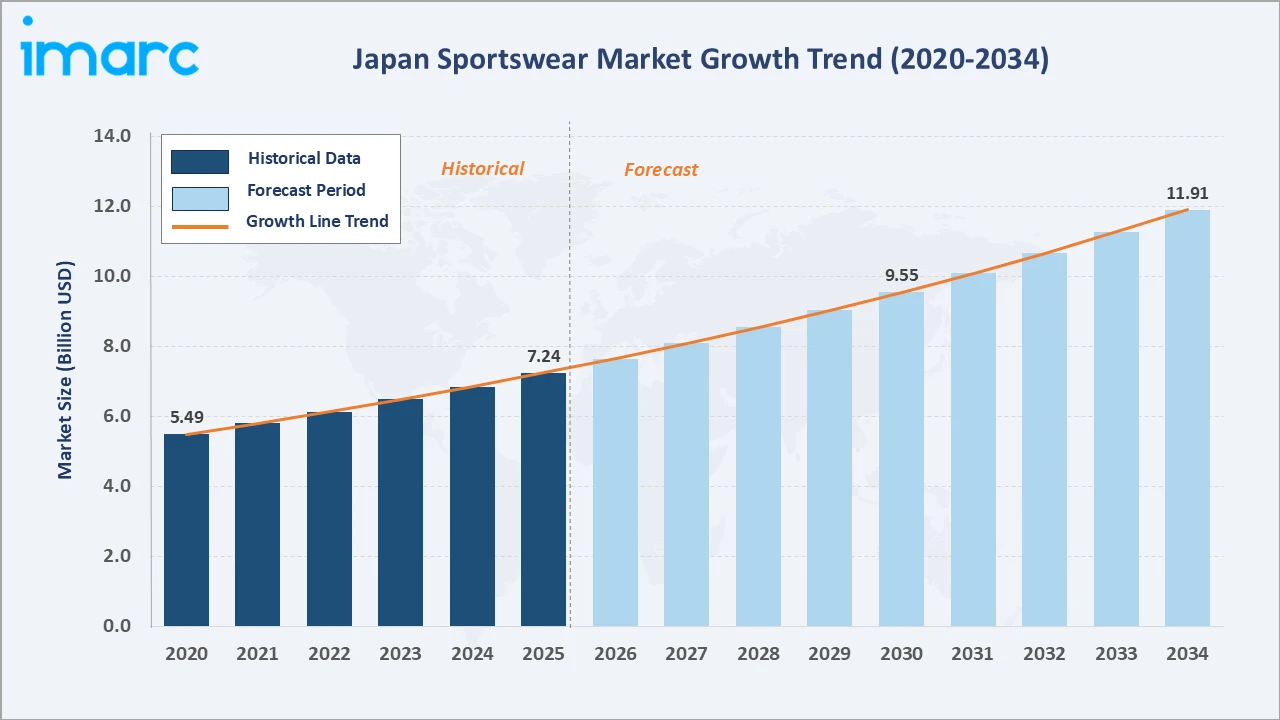
The Japan sportswear market size increased from USD 7.24 Billion in 2025 to USD 7.65 Billion in 2026 and is projected to reach USD 11.91 Billion by 2034, exhibiting a CAGR of 5.69% during 2026-2034. Growing health consciousness, expanding athleisure adoption, and sustained popularity of running, baseball, golf, and racquet sports are driving demand nationwide. Clothes represent the largest product segment at 57.6% share (2025), while retail stores remain the dominant distribution channel at 68.5% share. The Kanto region leads the market with a 39.7% share, supported by dense retail infrastructure and strong consumer spending power.
Market Snapshot
|
Metric |
Value |
|
Base Year Market Size (2025) |
USD 7.24 Billion |
|
Market Size (2026) |
USD 7.65 Billion |
|
Forecast Market Size (2034) |
USD 11.91 Billion |
|
CAGR (2026-2034) |
5.69% |
|
Base Year |
2025 |
|
Historical Period |
2020-2025 |
|
Forecast Period |
2026-2034 |
|
Largest Product |
Clothes (57.6% share) |
|
Largest Distribution Channel |
Retail Stores (68.5% share) |
|
Largest Region |
Kanto Region (39.7% share) |
The market grew from USD 5.49 Billion in 2020 to USD 7.24 Billion in 2025 and an estimated USD 7.65 Billion in 2026, anchored at USD 9.55 Billion in 2030, and is forecast to reach USD 11.91 Billion by 2034. Premiumization of performance footwear and expanding e-commerce penetration are reshaping Japan's sportswear retail economics beyond simple population-driven demand.
To get more information on this market, Request Sample
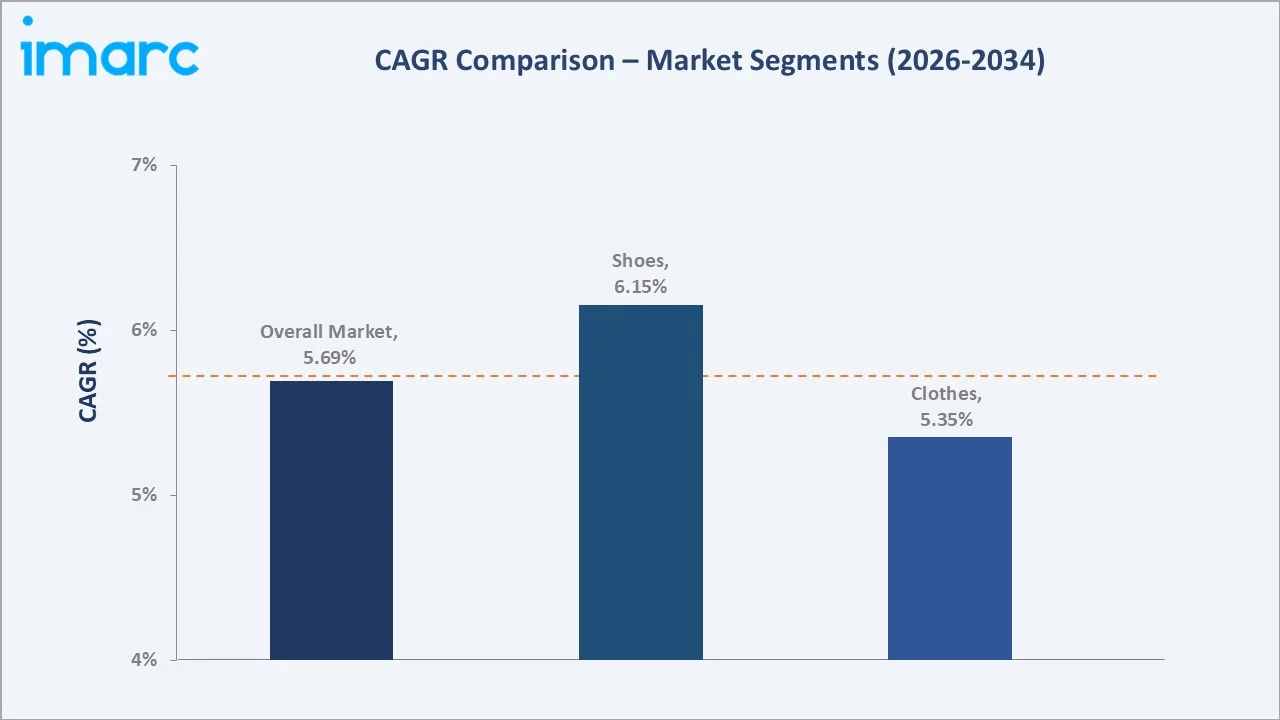
Shoes are projected to grow fastest among product segments at approximately 6.15% CAGR (2026-2034), outpacing the clothes segment's 5.35% CAGR, as premium running and performance footwear command higher price points. The overall market CAGR of 5.69% reflects steady structural growth anchored by athleisure demand and sustained retail investment.
Executive Summary
The Japan sportswear market, which increased from USD 7.24 Billion in 2025 to an estimated USD 7.65 Billion in 2026, representing one of Asia's most mature and premium-oriented sportswear markets. Japan's rapidly aging yet health-conscious population, combined with a strong sporting culture around running, baseball, golf, and racquet sports, underpins consistent replacement demand and supports steady volume growth despite a shrinking overall population base.
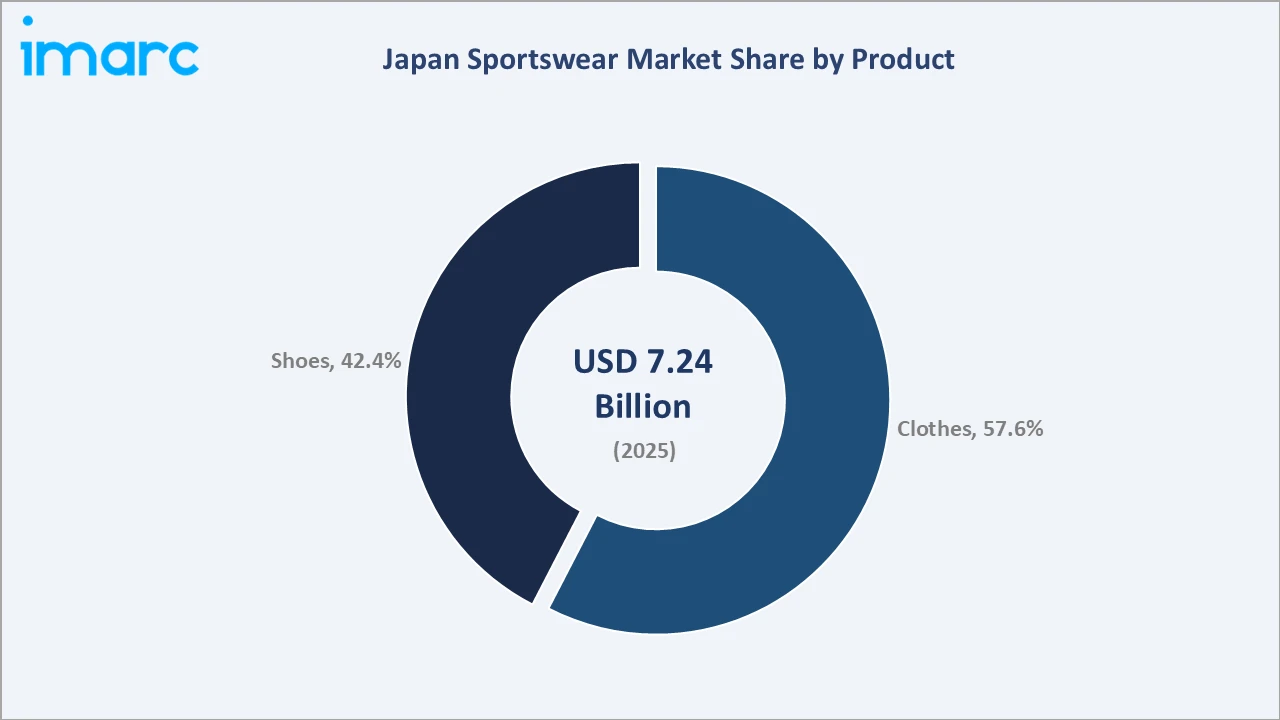
Clothes lead the product segmentation at 57.6% share (2025), driven by athleisure adoption and demand for functional daily wear, while shoes at 42.4% grow faster at approximately 6.15% CAGR on premium running-shoe pricing. Retail stores dominate distribution at 68.5%, reflecting Japan's dense specialty-store network, though online stores at 31.5% are expanding quickly as e-commerce penetration deepens.
Japan's 5.69% CAGR through 2034 reflects a structurally stable market shaped by sustainability-driven material innovation, digital retail expansion, and premiumization across ASICS, Mizuno, Descente, and YONEX portfolios. The Kanto region anchors overall demand with a 39.7% share, while emerging regions gain share as sports tourism and regional retail investment expand.
Key Market Insights
|
Insight |
Data |
|
Largest Segment |
Clothes - 57.6% share (2025) |
|
Fastest Growing Segment |
Shoes - ~6.15% CAGR (2026-2034) |
|
Leading Distribution Channel |
Retail Stores - 68.5% share (2025) |
|
Leading Region |
Kanto Region - 39.7% share (2025) |
|
Top Companies |
ASICS Corporation, Mizuno Corporation, Descente Ltd., and YONEX Co., Ltd. |
|
Market Opportunity |
E-commerce & DTC expansion beyond 31.5% online share |
Key Analytical Observations Supporting the Above Data:
- Clothes at 57.6% (2025) driven by athleisure and daily-wear crossover: Japan's growing casualwear-meets-performance culture keeps apparel replacement cycles short, sustaining the clothes segment's revenue leadership through 2034.
- Shoes grow fastest at ~6.15% CAGR on premiumization: Running, trail, and lifestyle sneaker launches from ASICS and Mizuno command higher average selling prices, lifting shoes segment revenue growth above clothes.
- Retail stores anchor 68.5% share through Japan's dense specialty network: Department stores, sporting-goods chains, and brand flagship stores remain the primary purchase channel, reinforcing Japan's in-store retail culture.
- Online stores at 31.5% expand fastest as e-commerce penetration deepens: Direct-to-consumer platforms and marketplace growth are reshaping Japan's sportswear retail mix, especially among digitally native younger consumers.
- Kanto Region leads with 39.7% share anchored by Tokyo's retail density: Japan's capital region concentrates flagship stores, corporate headquarters, and high disposable income, sustaining outsized sportswear consumption.
- Kansai/Kinki follows at 18.5% share, supported by Osaka's sporting-goods retail cluster: The region's strong baseball and running culture contributes meaningfully to overall national demand.
Japan Sportswear Market Overview
Japan's sportswear market encompasses performance and lifestyle apparel and footwear designed for running, baseball, golf, racquet sports, and daily athleisure wear. The ecosystem integrates textile and component suppliers, domestic and multinational brand manufacturers, retail and e-commerce distribution networks, and end consumers across all age groups. Japan's sportswear industry operates under the oversight of the Ministry of Economy, Trade and Industry (METI) and consumer product safety regulations governing textile labeling and quality standards. Macroeconomic drivers include Japan's yen depreciation supporting inbound tourism spending, rising health awareness among an aging population, and steady corporate wellness initiatives that sustain athletic participation and equipment replacement demand nationwide.
Market Dynamics
To evaluate market opportunities, Request Sample
Market Drivers
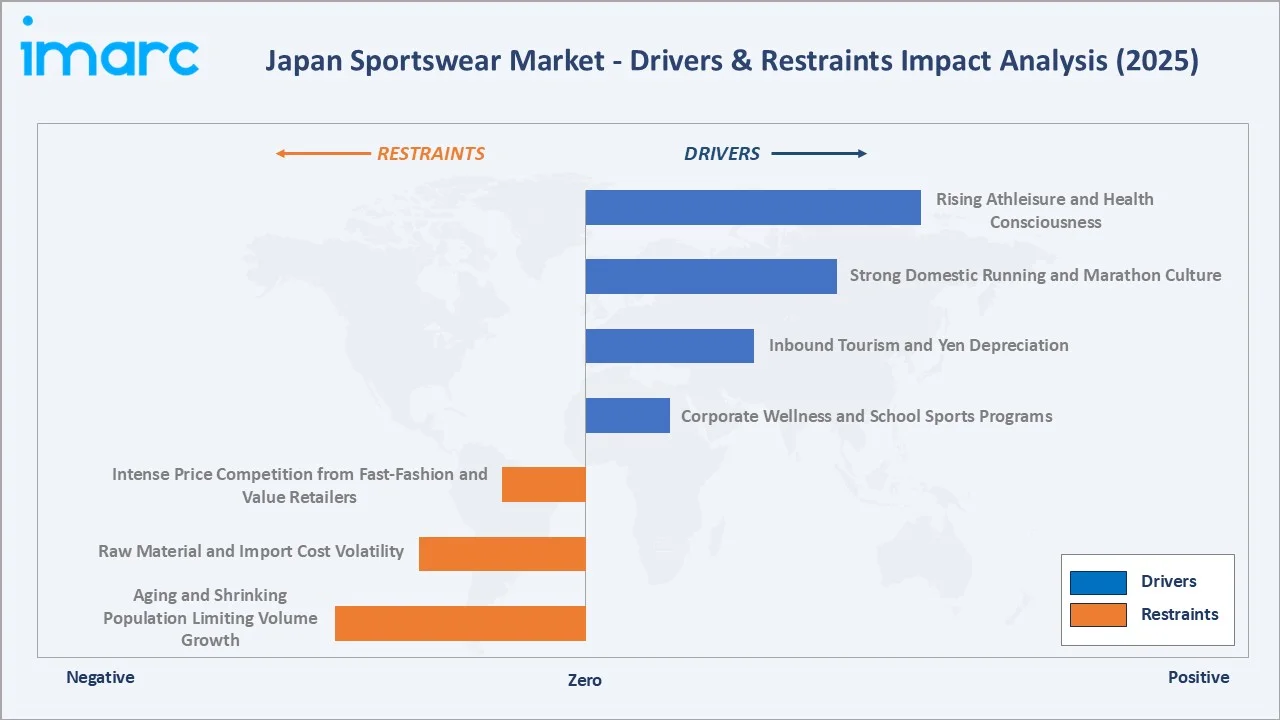
- Rising Athleisure and Health Consciousness: Japan's health-conscious consumers increasingly wear performance apparel for daily use, extending sportswear demand beyond dedicated athletic occasions into everyday fashion consumption.
- Strong Domestic Running and Marathon Culture: Major events such as the Tokyo Marathon sustain consistent demand for performance running shoes and apparel, reinforcing ASICS and Mizuno's domestic leadership.
- Inbound Tourism and Yen Depreciation: A weaker yen has boosted inbound tourist spending at Japanese sportswear flagship stores, particularly benefiting premium and heritage brands such as Onitsuka Tiger.
- Corporate Wellness and School Sports Programs: Japan's structured school sports culture and rising corporate wellness initiatives sustain steady equipment and apparel replacement demand across age groups.
Market Restraints
- Intense Price Competition from Fast-Fashion and Value Retailers: Entry of value-oriented apparel chains pressures margins on mass-market sportswear, particularly within the clothes segment.
- Raw Material and Import Cost Volatility: Japan's reliance on imported technical fabrics exposes manufacturers to yen exchange-rate movements and global raw-material price fluctuations.
Market Opportunities
- E-commerce and DTC Channel Expansion: Brands are investing in direct-to-consumer platforms to capture the growing 31.5% online distribution share and improve overall margins.
- Sustainable and Recycled-Material Product Lines: Growing consumer demand for eco-conscious products is prompting brands such as ASICS and Descente to expand recycled-material collections.
Market Challenges
- Aging and Shrinking Population Limiting Volume Growth: Japan's demographic contraction constrains long-term unit volume growth, requiring brands to rely on premiumization rather than population-driven expansion.
- Domestic Manufacturing Labor Shortage: A shrinking working-age population is tightening domestic apparel manufacturing capacity, pushing brands toward greater reliance on overseas production.
Emerging Market Trends
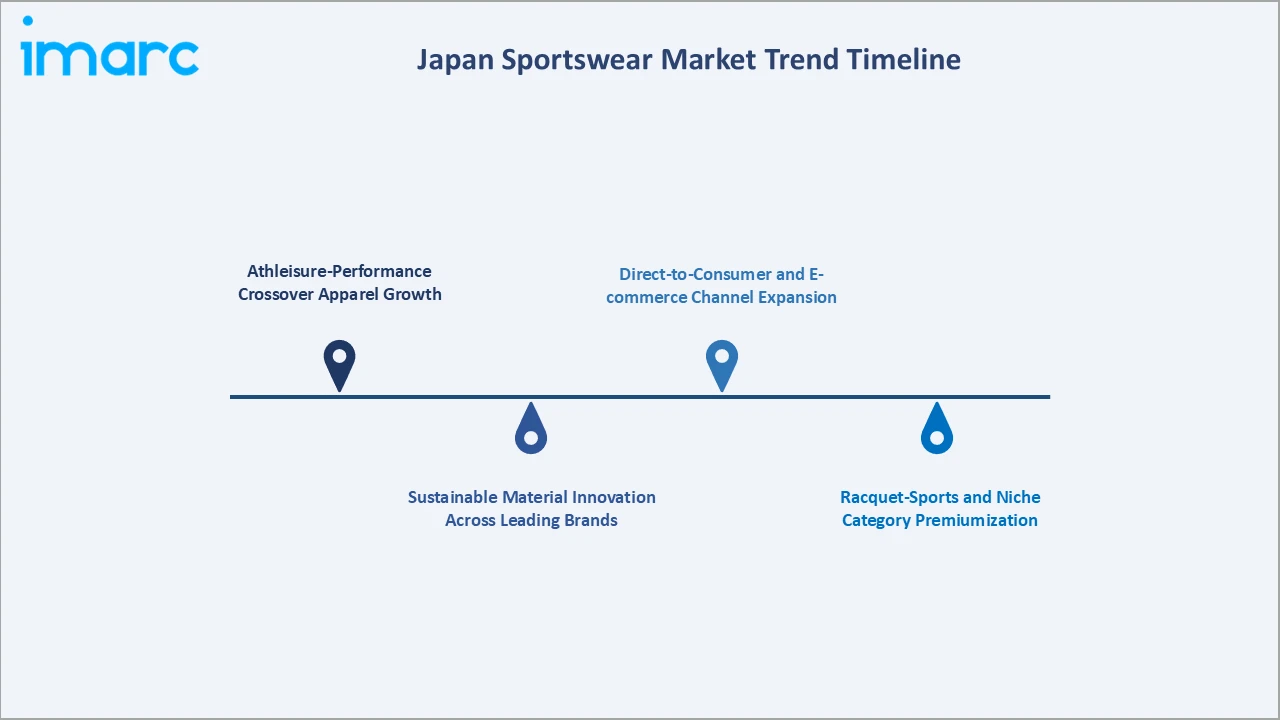
1. Athleisure-Performance Crossover Apparel Growth
In 2025, ASICS expanded its Sportstyle category net sales by 49.6% year-over-year, reflecting Japan's growing preference for apparel that blends performance technology with everyday fashion appeal.
2. Sustainable Material Innovation Across Leading Brands
Descente launched its "Design that Sustain" environmental initiative in April 2025, introducing recycled-material collections and a used-clothing collection program across its Japan store network.
3. Direct-to-Consumer and E-commerce Channel Expansion
Mizuno's shift toward direct-to-consumer retail lifted its gross profit margin to 41.9% in FY2025, highlighting how digital and owned-retail channels are reshaping profitability across Japan's sportswear industry.
4. Racquet-Sports and Niche Category Premiumization
YONEX's continued price increases on badminton equipment and apparel, alongside strong demand from China, illustrate premiumization trends extending beyond mainstream running and lifestyle categories into specialty racquet sports.
Industry Value Chain Analysis
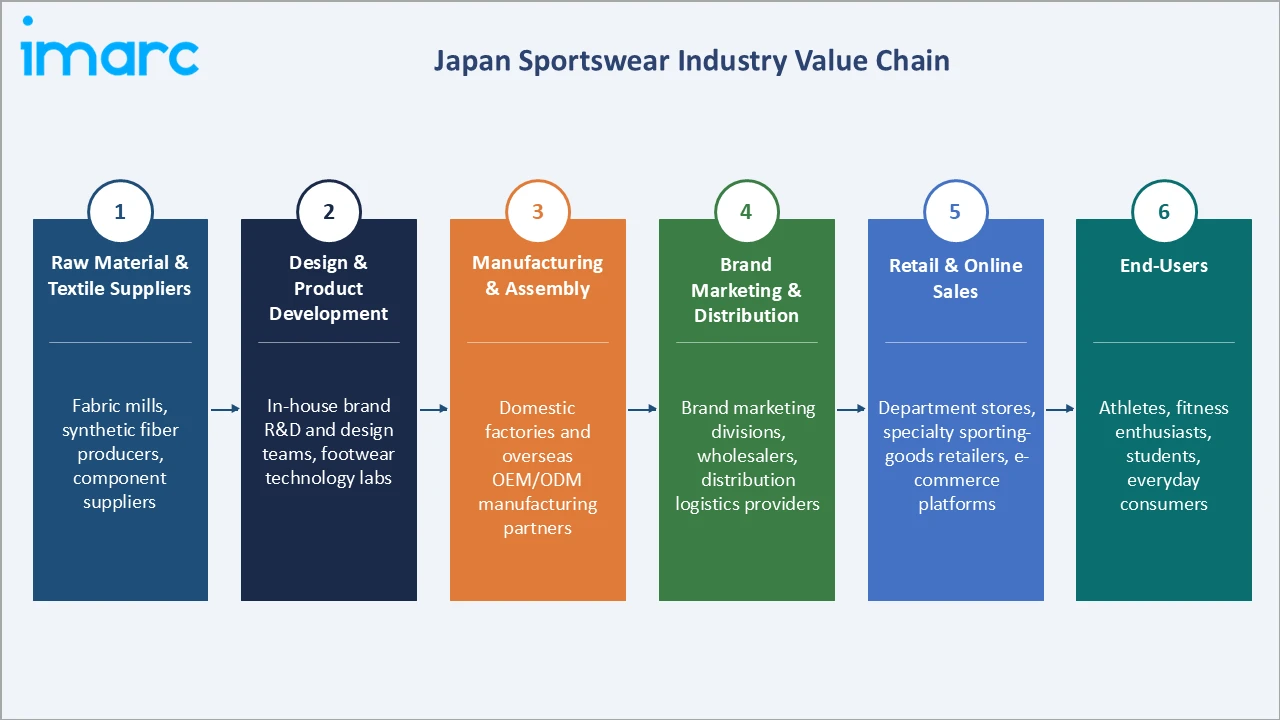
Japan's sportswear value chain integrates raw material and textile sourcing, product design and development, manufacturing through domestic and overseas OEM partners, brand marketing, and multi-channel distribution to end consumers nationwide.
|
Stage |
Key Participants |
|
Raw Material & Textile Suppliers |
Fabric mills, synthetic fiber producers, component suppliers |
|
Design & Product Development |
In-house brand R&D and design teams, footwear technology labs |
|
Manufacturing & Assembly |
Domestic factories and overseas OEM/ODM manufacturing partners |
|
Brand Marketing & Distribution |
Brand marketing divisions, wholesalers, distribution logistics providers |
|
Retail & Online Sales |
Department stores, specialty sporting-goods retailers, e-commerce platforms |
|
End-Users |
Athletes, fitness enthusiasts, students, everyday consumers |
Japan's sportswear manufacturers increasingly balance domestic production of premium technical footwear with overseas manufacturing of value apparel, optimizing cost structures while preserving quality control over flagship performance product lines.
Technology Landscape in the Japan Sportswear Industry
Advanced Materials and Footwear Technology
ASICS' proprietary FF TURBO SQUARED foam, introduced in its 2025 MEGABLAST and SONICBLAST performance running shoes, exemplifies Japan's continued investment in cushioning and energy-return technology for competitive and recreational runners alike.
Digital and Direct-to-Consumer Connectivity
Brands are integrating e-commerce platforms with in-store experiences, using digital fit tools and membership apps to strengthen direct-to-consumer relationships and capture higher-margin online sales beyond the current 31.5% channel share.
Manufacturing Automation and Sustainable Production
Descente's newly expanded Mizusawa Factory, brought online in 2025 at 1.5 times its previous capacity, reflects the industry's investment in automated, efficient domestic manufacturing for premium down and performance apparel lines. Collectively, these innovations support Japan's premiumization strategy, differentiating domestic brands from mass-market international competitors while reinforcing quality perceptions among Japanese consumers.
Market Segmentation Analysis
The report covers the following segments:
|
Segment Category |
Leading Segment |
Market Share |
Year |
|
Product |
Clothes |
57.6% |
2025 |
|
Distribution Channel |
Retail Stores |
68.5% |
2025 |
|
End User |
🔒 |
🔒 |
2025 |
|
Region |
Kanto Region |
39.7% |
2025 |

By Product
Clothes lead the market with 57.6% share in 2025, reflecting Japan's athleisure adoption and demand for functional daily-wear apparel across age groups. ASICS and Mizuno continue expanding lifestyle apparel lines alongside performance-focused collections.
To access detailed market analysis, Request Sample
Shoes, at 42.4% share, grow fastest at approximately 6.15% CAGR through 2034, driven by premium running-shoe pricing and rising participation in marathon and trail-running events nationwide.
By Distribution Channel
Retail stores lead distribution at 68.5% share in 2025, anchored by Japan's dense network of department stores, specialty sporting-goods chains, and brand flagship locations across the Kanto and Kansai regions.
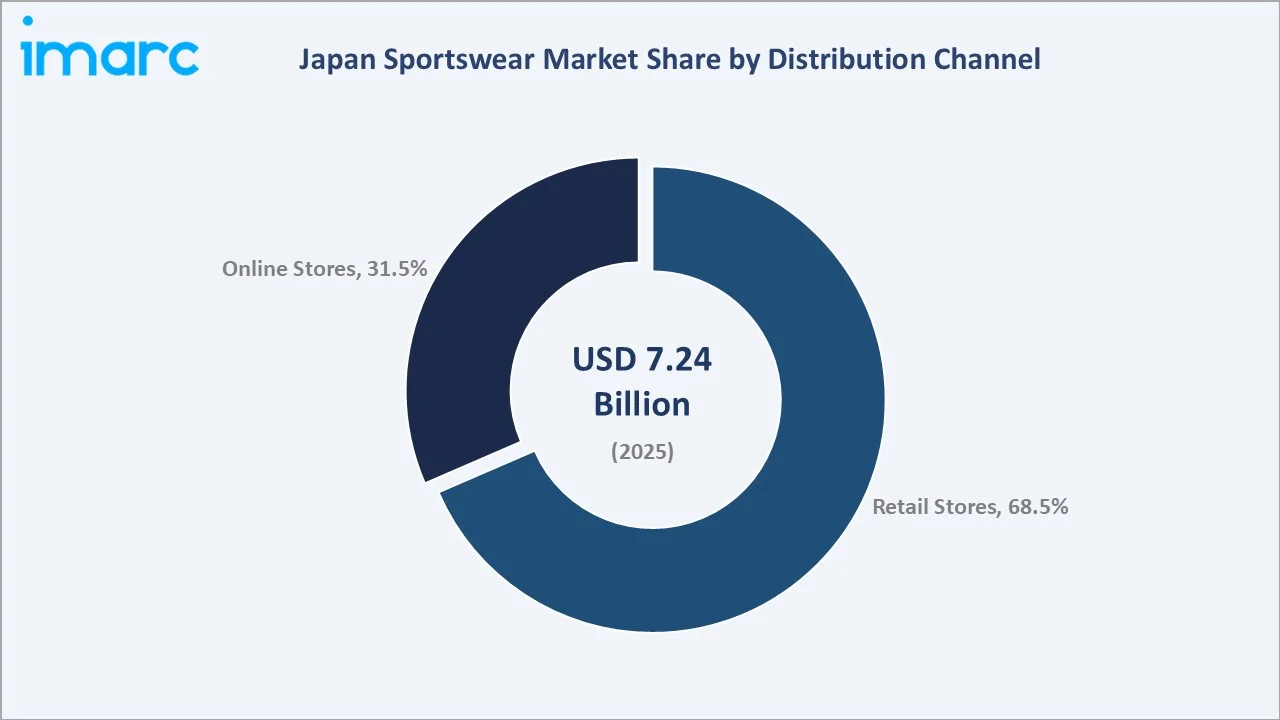
Online stores at 31.5% share grow fastest among distribution channels, supported by expanding direct-to-consumer platforms and marketplace penetration among digitally native younger consumers.
Regional Market Insights
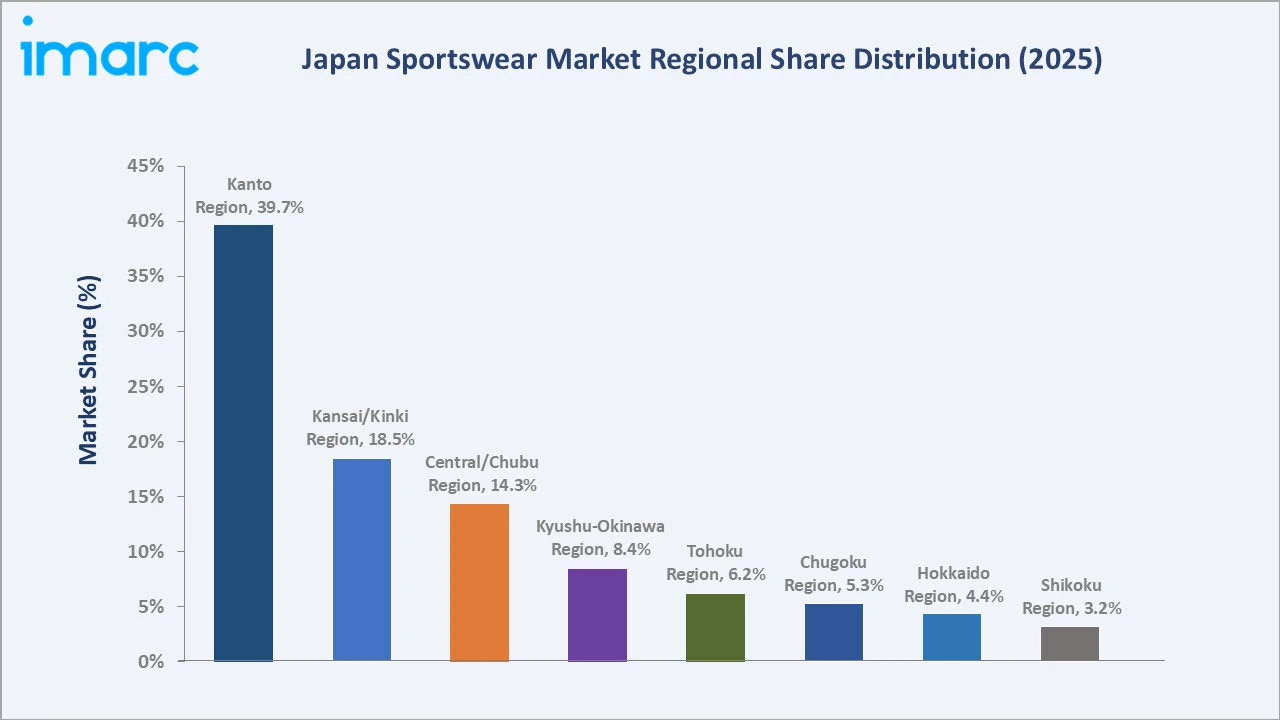
Japan's sportswear demand varies meaningfully by region, shaped by population density, retail infrastructure, and regional sporting culture. The Kanto region leads nationally, while central and western regions contribute steady secondary demand.
|
Region |
Share (2025) |
Key Characteristics |
|
Kanto Region |
39.7% |
Dense urban retail hubs, corporate headquarters, high disposable income |
|
Kansai/Kinki Region |
18.5% |
Strong baseball and running culture, major sporting-goods retail clusters |
|
Central/Chubu Region |
14.3% |
Manufacturing base, growing suburban retail and e-commerce penetration |
|
Kyushu-Okinawa Region |
8.4% |
Rising sports tourism and stadium infrastructure investment |
|
Tohoku Region |
6.2% |
Winter sports demand and steady rural retail presence |
|
Chugoku Region |
5.3% |
Moderate urban centers with expanding specialty retail chains |
|
Hokkaido Region |
4.4% |
Winter and outdoor sportswear demand tied to seasonal tourism |
|
Shikoku Region |
3.2% |
Smaller population base with steady community sports participation |
Kanto commands the largest share at 39.7% (2025), followed by Kansai/Kinki at 18.5% and Central/Chubu at 14.3%. Kyushu-Okinawa, at 8.4% share, is emerging as a fast-growing region as inbound tourism and new sports-tourism infrastructure investment expand regional retail demand.
Competitive Landscape
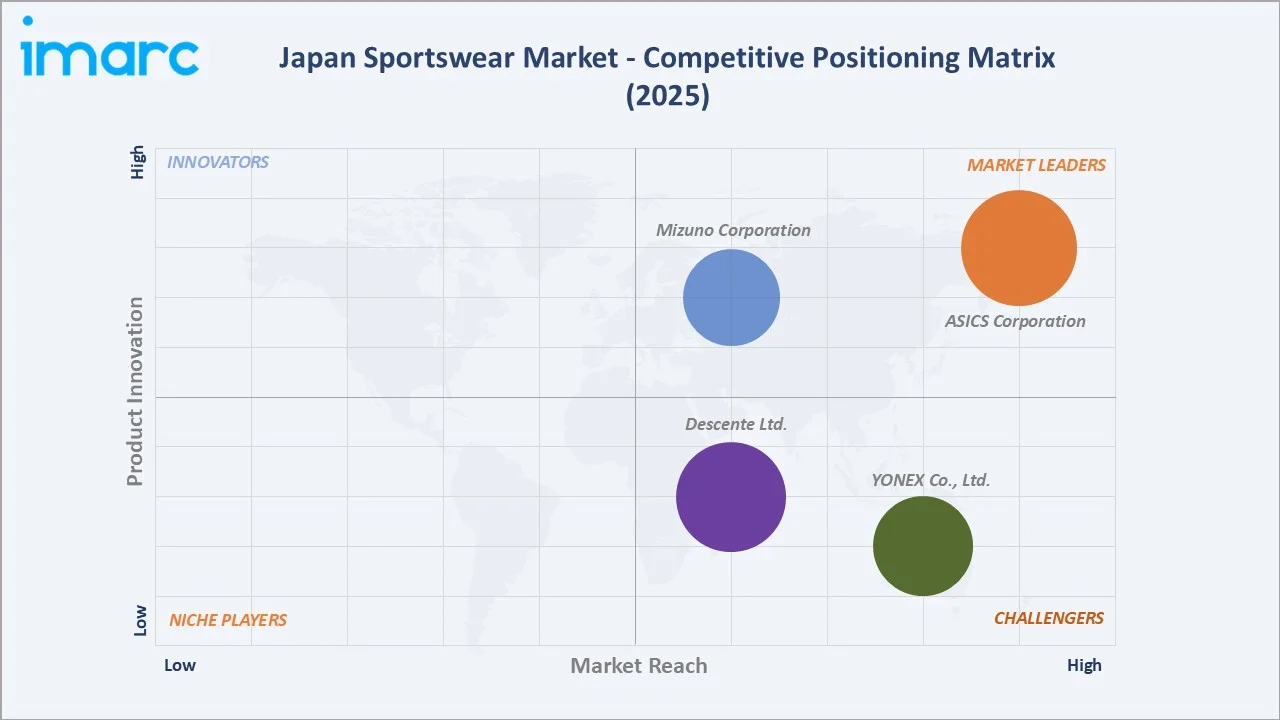
Japan's sportswear market is moderately concentrated, with domestic heritage brands ASICS and Mizuno competing alongside global players, while Descente and YONEX maintain strong niche leadership in performance apparel and racquet sports respectively.
|
Company Name |
Brand / Product |
Market Position |
Core Strength |
|
ASICS Corporation |
ASICS, Onitsuka Tiger |
Market Leader |
Performance running heritage & global expansion strategy |
|
Mizuno Corporation |
Mizuno Wave, Mizuno Enerzy |
Market Leader |
Multi-sport equipment & apparel diversification |
|
Descente Ltd. |
Descente, Le Coq Sportif, Arena |
Strong Challenger |
Premium performance apparel under ITOCHU Corporation’s network |
|
YONEX Co., Ltd. |
YONEX |
Strong Challenger |
Serves both elite professional competitors and everyday recreational athletes across Japan |
Global players Adidas Japan and Nike hold meaningful share within the premium athletic footwear category, leveraging global marketing scale and athlete endorsements to compete against Japan's domestic heritage brands.
Key Company Profiles
ASICS Corporation
ASICS is Japan's leading performance sportswear company, headquartered in Kobe, and reported record FY2025 revenue of approximately ¥810.9 billion, marking its fourth consecutive year of record net sales.
- Key Brands: ASICS, Onitsuka Tiger
- Strategic Focus: Global Integrated Enterprise transformation emphasizing premiumization, sportstyle growth, and brand experience expansion.
Mizuno Corporation
Mizuno, founded in 1906 in Osaka, is a diversified sporting-goods manufacturer with a full-year net sales forecast of approximately ¥260 billion for the fiscal year ending March 2026.
- Key Brands: Mizuno Wave, Mizuno Enerzy
- Strategic Focus: Margin improvement through DTC growth and continued diversification across baseball, football, and lifestyle categories.
Descente Ltd.
Descente, a wholly owned subsidiary of ITOCHU Corporation, targeted net sales of approximately ¥130 billion for the fiscal year ended March 2025.
- Key Brands: Descente, Le Coq Sportif, Arena.
- Strategic Focus: Integration into ITOCHU's global textile network while expanding China and Southeast Asia retail presence.
Market Concentration Analysis
Japan's sportswear market exhibits moderate concentration, with ASICS and Mizuno together commanding substantial domestic share within the performance footwear category. The clothes segment remains comparatively fragmented, with department-store private labels and international brands including Adidas and Nike competing across price tiers alongside specialty players such as Descente and YONEX.
Consolidation trends are evident in ITOCHU's acquisition of Descente in 2025, reflecting broader industry moves toward integrated textile and apparel conglomerates. Niche racquet-sports and outdoor specialists continue to defend focused market positions against larger diversified competitors.
Investment & Growth Opportunities
Fastest Growing Segments
Shoes (~6.15% CAGR), online/e-commerce distribution, and premium sustainable apparel collections represent Japan's highest-growth investment vectors through 2034, as brands prioritize direct-to-consumer margin expansion over volume-driven growth.
Emerging Market Opportunities
Regional retail expansion into Kyushu-Okinawa and Central/Chubu, supported by inbound sports tourism, presents opportunity for brands to build regional flagship presence beyond Kanto's saturated retail landscape.
Investment Themes
- Sustainable Material Manufacturing Investment: Brands investing in recycled and eco-conscious textile production, following Descente's "Design that Sustain" initiative, can differentiate within Japan's increasingly sustainability-conscious consumer base.
- Direct-to-Consumer Digital Infrastructure: Investment in e-commerce platforms and membership ecosystems offers margin-expansion potential as online distribution share grows beyond its current 31.5% base.
Future Market Outlook (2026-2034)
The Japan sportswear market is projected to grow from USD 7.24 Billion in 2025 to USD 7.65 Billion in 2026, reaching USD 11.91 Billion by 2034, at a steady 5.69% CAGR reflecting premiumization, athleisure adoption, and expanding e-commerce penetration. Japan's USD 9.55 Billion market in 2030 will consolidate its position as a mature, high-value sportswear market within Asia.
Three structural forces anchor this growth: continued athleisure-performance apparel crossover, premium footwear innovation from ASICS and Mizuno, and expanding direct-to-consumer digital infrastructure that creates parallel revenue streams alongside traditional retail channels.
Research Methodology
Primary Research
Primary research comprised structured interviews with sportswear retailers, brand marketing executives, and industry association representatives across Japan's Kanto and Kansai retail hubs, supplemented by consultations with textile suppliers and e-commerce platform operators.
Secondary Research
Secondary research encompassed company annual reports and investor presentations from ASICS, Mizuno, Descente, and YONEX, Japan's Ministry of Economy, Trade and Industry (METI) trade statistics, Japan Sporting Goods Industry Association publications, and IMARC Group's proprietary market database. Over 100 secondary sources were reviewed.
Forecasting Models
Market forecasts were developed using historical trend analysis combined with segment-level penetration modeling across product, distribution channel, and regional categories, validated against company-reported financial data and METI trade statistics through 2034.
Japan Sportswear Market Report Coverage:
| Report Features | Details |
|---|---|
| Base Year of the Analysis | 2025 |
| Historical Period | 2020-2025 |
| Forecast Period | 2026-2034 |
| Units | Billion USD |
| Scope of the Report | Exploration of Historical Trends and Market Outlook, Industry Catalysts and Challenges, Segment-Wise Historical and Future Market Assessment:
|
| Products Covered | Shoes, Clothes |
| Distribution Channels Covered | Online Stores, Retail Stores |
| End Users Covered | Men, Women, Kids |
| Regions Covered | Kanto Region, Kansai/Kinki Region, Central/ Chubu Region, Kyushu-Okinawa Region, Tohoku Region, Chugoku Region, Hokkaido Region, Shikoku Region |
| Companies Covered | ASICS Corporation, Mizuno Corporation, Descente Ltd., YONEX Co., Ltd., etc. |
| Customization Scope | 10% Free Customization |
| Post-Sale Analyst Support | 10-12 Weeks |
| Delivery Format | PDF and Excel through Email (We can also provide the editable version of the report in PPT/Word format on special request) |
Key Benefits for Stakeholders:
- IMARC’s industry report offers a comprehensive quantitative analysis of various market segments, historical and current market trends, market forecasts, and dynamics of the Japan sportswear market from 2020-2034.
- The research report provides the latest information on the market drivers, challenges, and opportunities in the Japan sportswear market.
- Porter's five forces analysis assist stakeholders in assessing the impact of new entrants, competitive rivalry, supplier power, buyer power, and the threat of substitution. It helps stakeholders to analyze the level of competition within the Japan sportswear industry and its attractiveness.
- Competitive landscape allows stakeholders to understand their competitive environment and provides an insight into the current positions of key players in the market.
Frequently Asked Questions About the Japan Sportswear Market Report
The Japan sportswear market size increased from USD 7.24 Billion in 2025 to USD 7.65 Billion in 2026, covering performance and lifestyle apparel and footwear across product, distribution channel, and regional categories nationwide.
The market is projected to grow at a CAGR of 5.69% during 2026-2034, reaching USD 11.91 Billion by 2034, driven by athleisure adoption and premiumization.
Clothes lead at 57.6% market share (2025), driven by athleisure adoption and demand for functional daily-wear apparel across all consumer age groups nationwide.
Shoes are growing fastest at approximately 6.15% CAGR (2026-2034), supported by premium running-shoe pricing and rising marathon and trail-running participation across Japan.
Retail stores hold the largest share at 68.5% (2025), anchored by Japan's dense specialty sporting-goods and department-store retail network across major regions.
Online stores are growing fastest, supported by expanding direct-to-consumer platforms and marketplace penetration among Japan's digitally native younger consumer base.
The Kanto region leads with 39.7% share (2025), anchored by Tokyo's dense retail infrastructure, corporate presence, and high consumer disposable income levels.
Leading companies include ASICS Corporation, Mizuno Corporation, Descente Ltd., and YONEX Co., Ltd., among other domestic and global players.
Japan's sportswear market is projected to reach approximately USD 9.55 Billion by 2030, driven by continued premiumization and expanding e-commerce distribution channels nationwide.
Growth is driven by athleisure adoption, strong running and racquet-sports culture, inbound tourism spending, and continued premiumization across footwear and apparel categories.
Need more help?
- Speak to our experienced analysts for insights on the current market scenarios.
- Include additional segments and countries to customize the report as per your requirement.
- Gain an unparalleled competitive advantage in your domain by understanding how to utilize the report and positively impacting your operations and revenue.
- For further assistance, please connect with our analysts.
 Request Customization
 Speak to an Analyst
 Request Brochure
 Inquire Before Buying
Benefits of Customization
- Personalize this research
- Triangulate with your data
- Get data as per your format and definition
- Gain a deeper dive into a specific application, geography, customer, or competitor
- Any level of personalization
Get in Touch With Us
UNITED STATES
Phone: +1-201-971-6302
INDIA
Phone: +91-120-433-0800
UNITED KINGDOM
Phone: +44-753-714-6104
Email: [email protected]
Client Testimonials




.webp)




.webp)













Related Reports

Choose your plan
*Please note that the prices mentioned below are starting prices for each bundle type. Kindly contact our team for further details.*
Single User License
- 1 User License, Access on 2 Devices
- PDF Report + Excel Dataset (Password Protected)
- Lifetime Access
- No Printing Rights
- 10% Free Report Customization
- 10–12 Weeks of Analyst Support
Five User License
- Access for 5 Users, 2 Devices per User
- PDF Report + Excel Dataset (Password Protected)
- Lifetime Access
- Dedicated Account Manager
- 12–14 Weeks of Analyst Support
- No Printing Rights
- 15% Free Report Customization
- 25% Discount on Your Next Purchase
Corporate User License
- Unlimited User Access (Within Your Organization)
- PDF Report + Excel Dataset
- Lifetime Access
- Dedicated Account Manager
- 14–20 Weeks of Analyst Support
- No Printing Rights
- 20% Free Report Customization
- 30% Discount on Your Next Purchase
Essential Insights
What's included:
3 reports
- Lifetime Access
- PDF Reports
- Excel Datasets
- 2 Weeks of Free Analyst Support
- 2 User Licenses
- Access on 2 Devices
- Printing Rights
- Complimentary PowerPoint (PPT) Version
- Complimentary License Upgrade
Professional Access
What's included:
5 reports
- Lifetime Access
- PDF Reports
- Excel Datasets
- 8 Weeks of Free Analyst Support
- 2 User Licenses
- Access on 2 Devices
- Printing Rights
- Complimentary PowerPoint (PPT) Version
- Complimentary License Upgrade
Business Advantage
What's included:
8 reports
- Lifetime Access
- PDF Reports
- Excel Datasets
- 14 Weeks of Free Analyst Support
- 2 User Licenses
- Access on 2 Devices
- Printing Rights
- Complimentary PowerPoint (PPT) Version
- Complimentary License Upgrade
Enterprise Intelligence
What's included:
10 reports
- Lifetime Access
- PDF Reports
- Excel Datasets
- 20 Weeks of Free Analyst Support
- 2 User Licenses
- Access on 2 Devices
- Printing Rights
- Complimentary PowerPoint (PPT) Version
- Complimentary License Upgrade