
Japan Used Truck Market Size, Share, Trends and Forecast by Vehicle Type, Sales Channel, End User, and Region, 2026-2034
Japan Used Truck Market Size, Share, Trends & Forecast (2026-2034)
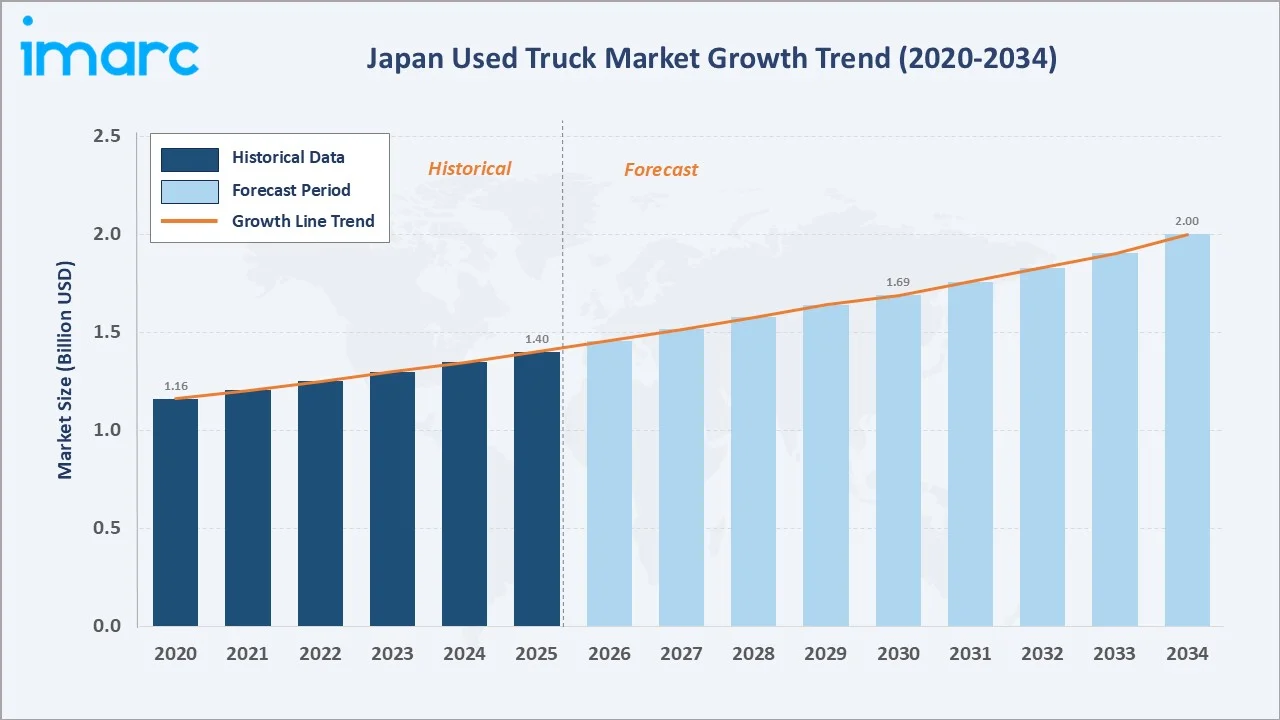
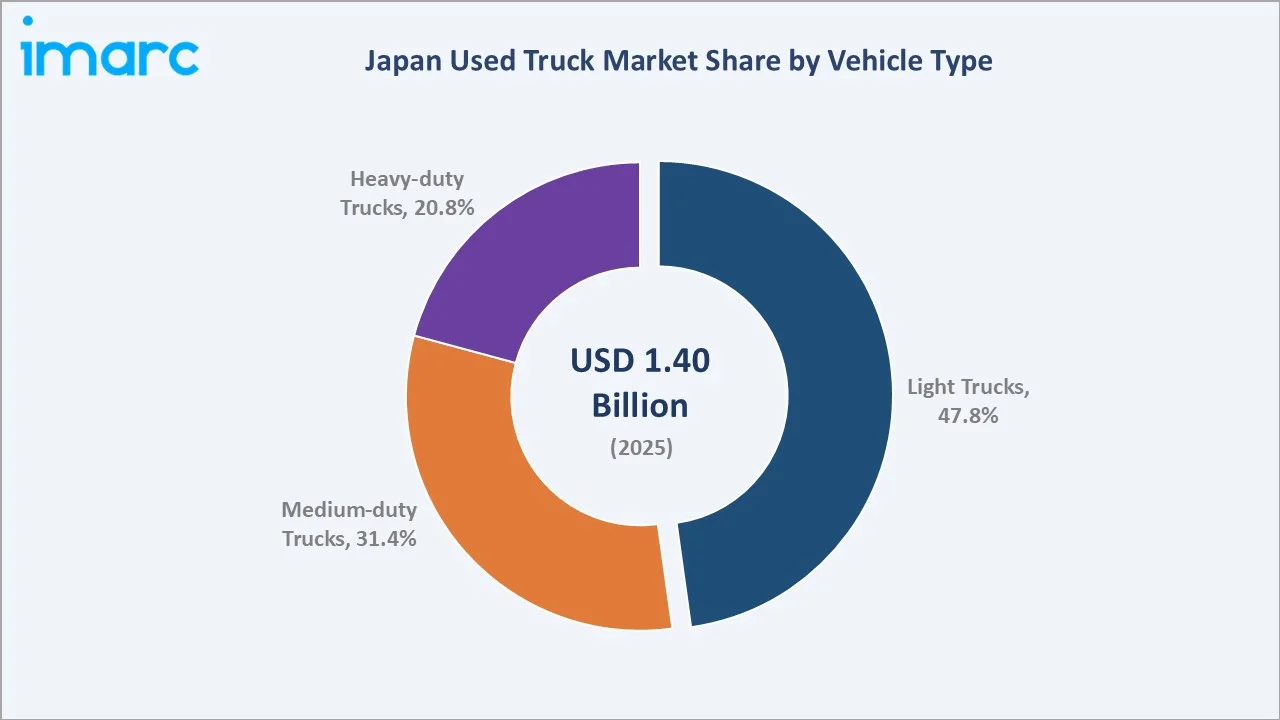
The Japan used truck market grew from USD 1.40 Billion in 2025 to USD 1.45 Billion in 2026 and is projected to reach USD 2.00 Billion by 2034, growing at a CAGR of 3.87% during 2026-2034. The market is driven by rapid industrialization activities, the imposition of stringent regulations by the Government of Japan promoting vehicle recycling and reutilization, widespread vehicle utilization by e-commerce and retail businesses, the emerging trend of green consumerism, and recent technological advancements in fuel-efficient engines. Light Trucks dominate the vehicle-type mix at 47.8%, Independent Dealer leads the sales channel mix at 51.2%, and the Kanto Region commands 37.8% of the overall market share in 2025.
Market Snapshot
|
Metric |
Value |
|
Base Year Market Size (2025) |
USD 1.40 Billion |
| Market Size (2026) | USD 1.45 Billion |
|
Forecast Market Size (2034) |
USD 2.00 Billion |
|
CAGR (2026-2034) |
3.87% |
|
Base Year |
2025 |
|
Historical Period |
2020-2025 |
|
Forecast Period |
2026-2034 |
|
Dominant Vehicle Type |
Light Trucks (47.8%, 2025) |
|
Dominant Sales Channel |
Independent Dealer (51.2%, 2025) |
|
Leading Region |
Kanto Region (37.8%, 2025) |
The Japan used truck market expanded from USD 1.16 Billion in 2020 to USD 1.40 Billion in 2025 and an estimated USD 1.45 Billion in 2026, anchored at USD 1.69 Billion in 2030, and is forecast to reach USD 2.00 Billion by 2034. The post-pandemic recovery in industrial and logistics activity, combined with stringent government regulations promoting vehicle recycling and reutilization, sustained steady market growth through the historical period.
To get more information on this market, Request Sample
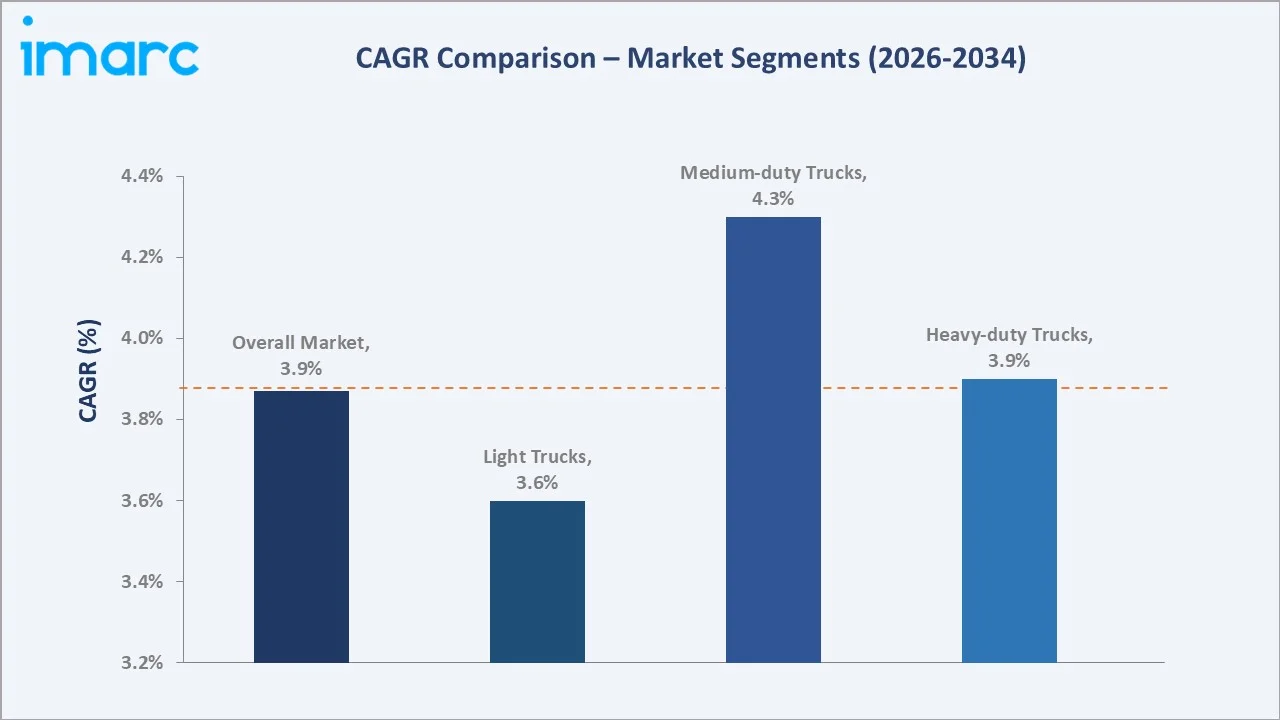
Independent Dealer and Peer-to-Peer sales channels are expanding fastest as digital auction platforms widen buyer access, while Medium-duty Trucks post the strongest vehicle-type growth on rising e-commerce and construction-linked logistics demand.
Executive Summary
The Japan used truck market, which increased from USD 1.40 Billion in 2025 to an estimated USD 1.45 Billion in 2026, reflecting one of Asia's most mature and quality-driven secondary vehicle markets. The market encompasses vehicle sourcing through auctions and trade-ins, inspection and certification, reconditioning, and distribution through franchised, independent, and peer-to-peer sales channels to end users across construction, oil and gas, and other commercial sectors.
Light Trucks at 47.8% dominate through their versatility across last-mile delivery, retail, and small-business logistics applications. Independent Dealers at 51.2% lead the sales channel mix through nationwide network reach and flexible, price-competitive inventory. The Kanto Region, at 37.8%, leads through Tokyo's concentration of logistics operators, auction houses, and export infrastructure.
Key Market Insights
|
Insight |
Data |
|
Dominant Vehicle Type |
Light Trucks - 47.8% share (2025) |
|
Dominant Sales Channel |
Independent Dealer - 51.2% market share (2025) |
|
Leading Region |
Kanto Region - 37.8% market share |
|
Market Opportunity |
Digital auction platforms; certified pre-owned programs; export-oriented heavy-duty trucks; EV and hybrid used-truck resale; fleet leasing conversions; cross-border peer-to-peer marketplaces |
Key Analytical Observations Supporting The Above Data:
- Light Trucks at 47.8%: Light Trucks lead due to their affordability, maneuverability in urban logistics, and broad applicability across retail delivery and small commercial operations, making them the most liquid and widely traded vehicle-type segment.
- Independent Dealer at 51.2%: Independent dealers dominate through dense nationwide networks, competitive pricing, and direct sourcing from auctions, giving buyers wide model and price-point choice outside manufacturer-affiliated channels.
- Kanto Region at 37.8%: Kanto leads due to its concentration of logistics hubs, port-linked export infrastructure, and the highest density of auction houses and dealer networks in Japan.
Japan Used Truck Market Overview
The Japan used truck market reached USD 1.40 Billion in 2025, representing one of Asia's most mature and quality-driven secondary commercial vehicle markets. A used truck is defined as a commercial vehicle that has been previously owned and subjected to rigorous evaluation of its engine, transmission, brakes, suspension, bodywork, and interior condition. The market encompasses vehicle sourcing through auctions, trade-ins, and fleet disposal, inspection and grading, reconditioning, financing, and resale through franchised, independent, and peer-to-peer sales channels to end users across construction, oil and gas, and other commercial sectors.
Used trucks are deployed across a wide spectrum of applications, including construction, logistics and freight transport, retail delivery, and specialized areas such as oil and gas transportation. They offer multiple benefits over new trucks, including a reduction in initial purchase cost, immediate availability, known performance history, decreased depreciation, and access to certified pre-owned selections backed by professional-grade inspection assurances.
Macroeconomic factors include rapid industrialization activities, rising urbanization, and increasing freight and logistics activity across Japan. In addition, the imposition of stringent regulations by the Government of Japan promoting vehicle recycling and reutilization, widespread vehicle utilization by e-commerce and retail businesses, the emerging trend of green consumerism, and continuous advancements in fuel-efficient engine technology are accelerating used truck adoption nationwide.
Market Dynamics
To evaluate market opportunities, Request Sample
Market Drivers
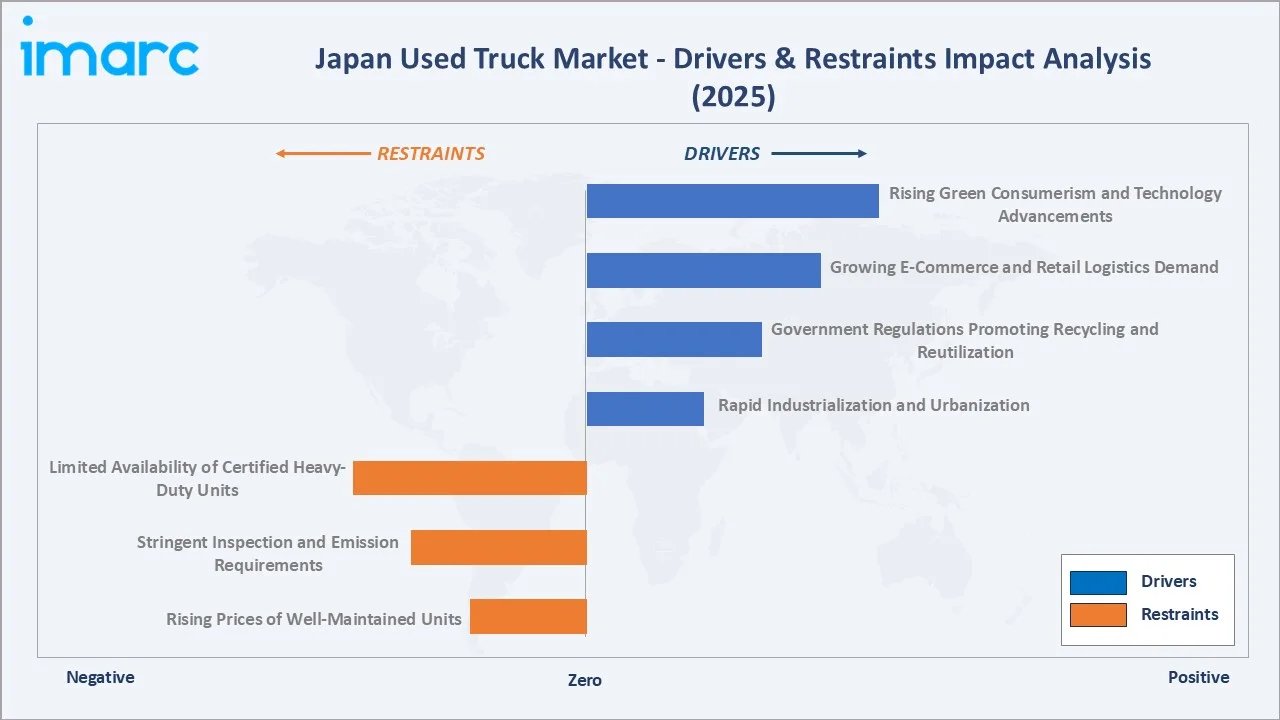
- Rapid Industrialization and Urbanization: The resurgence of industrial activities and rapid urbanization in Japan is increasing the demand for cost-effective transport solutions across construction, manufacturing, and freight movement. Businesses are increasingly acquiring used trucks rather than committing capital to new fleets, allowing them to expand operational capacity while preserving liquidity for other investments.
- Government Regulations Promoting Recycling and Reutilization: The imposition of stringent regulations by the Government of Japan promoting the recycling and reutilization of vehicles is acting as a significant growth-inducing factor. These policies extend the usable life of trucks, reduce landfill and material waste, and support a well-regulated, transparent secondary market with standardized inspection and certification requirements.
- Growing E-Commerce and Retail Logistics Demand: Widespread vehicle utilization as an economical and viable solution by e-commerce and retail businesses for logistics and freight services is contributing meaningfully to market growth. The rapid expansion of last-mile delivery networks is driving sustained demand for readily available, cost-effective light and medium-duty used trucks.
- Rising Green Consumerism and Technology Advancements: The emerging trend of green consumerism in Japan is encouraging the adoption of used trucks as a sustainable choice that reduces carbon footprint and supports environmental preservation. This is reinforced by recent technological advancements, such as the integration of advanced, fuel-efficient engines in used trucks, which align with the broader shift toward eco-friendly transportation.
Market Restraints
- Rising Prices of Well-Maintained Units: Strong and sustained demand for low-mileage, well-maintained used trucks is pushing up auction and dealer prices, narrowing the cost advantage over new vehicles for price-sensitive buyers and small fleet operators seeking affordable acquisitions.
- Stringent Inspection and Emission Requirements: Rigorous roadworthiness and emission compliance requirements increase reconditioning costs for dealers and can limit the resale eligibility of older units, particularly diesel-powered heavy-duty trucks facing tightening environmental standards.
- Limited Availability of Certified Heavy-Duty Units: Constrained supply of certified, high-grade heavy-duty trucks can restrict inventory availability for buyers seeking larger-capacity vehicles, occasionally leading to longer procurement lead times and elevated prices in this sub-segment.
Market Opportunities
- Digital Auction and Online Marketplace Expansion: The growth of digital bidding platforms and online marketplaces is widening buyer access beyond traditional regional boundaries and improving price discovery and transparency across the used truck trade, creating new revenue streams for auction operators and dealers alike.
- Certified Pre-Owned and Export Programs: Expanding certified pre-owned programs backed by OEM inspection standards, together with export-oriented sourcing for overseas buyers in Southeast Asia, Africa, and the Middle East, present significant growth avenues for dealers, trading companies, and auction operators.
Market Challenges
- Vehicle Condition Verification: Ensuring consistent, transparent assessment of mechanical condition and usage history across a fragmented dealer base remains an operational challenge for buyers and sellers alike, particularly outside standardized auction-grade certification frameworks.
- Financing and Residual Value Uncertainty: Fluctuating resale values and limited financing options for older vehicles can complicate transactions, particularly for small and medium-scale buyers who rely on flexible financing and lower insurance premiums to make purchases viable.
Emerging Market Trends
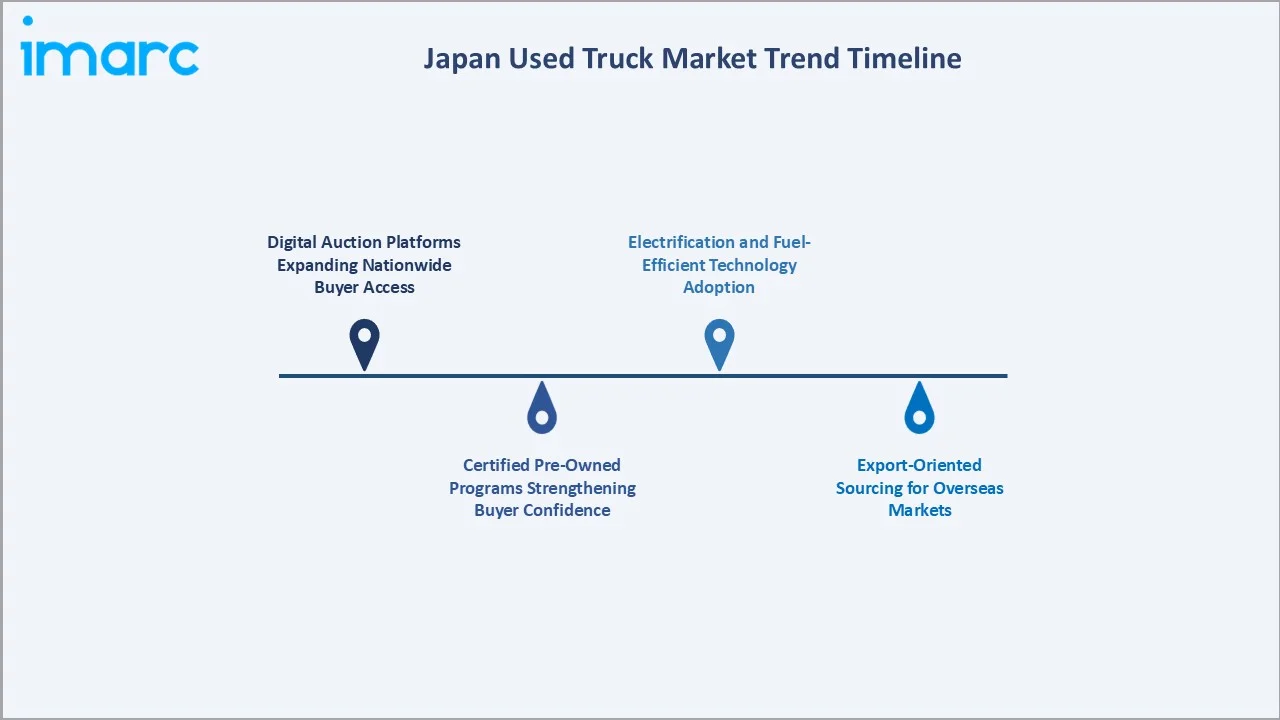
1. Digital Auction Platforms Expanding Nationwide Buyer Access
Digital and online auction platforms are enabling dealers and fleet buyers across Japan, and increasingly overseas, to view detailed vehicle condition reports and bid on inventory remotely without on-site attendance. This shift is reducing geographic barriers, improving price transparency and benchmark price discovery across the used truck trade, and accelerating transaction volumes while shortening inventory turnover cycles for auction operators and dealers alike. Continued investment in remote terminal and internet-based bidding infrastructure is expected to further broaden participation through 2034.
2. Certified Pre-Owned Programs Strengthening Buyer Confidence
Manufacturer-backed and dealer-led certified pre-owned programs are gaining traction across Japan's leading truck brands, offering standardized inspection protocols, warranty coverage, and documented service history. These programs are improving buyer confidence, reducing information asymmetry between sellers and buyers, and supporting premium pricing for higher-grade used trucks, particularly within the light and medium-duty segments where fleet turnover is most frequent.
3. Export-Oriented Sourcing for Overseas Markets
Rising overseas demand for durable, well-maintained Japanese trucks, prized for their reliability, fuel efficiency, and low mileage relative to comparable used vehicles elsewhere, is encouraging dealers and trading companies to expand export-oriented sourcing and logistics capabilities. This trend is particularly pronounced for heavy-duty and medium-duty units bound for emerging markets in Southeast Asia, Africa, and the Middle East, where import demand for certified pre-owned commercial vehicles continues to rise.
4. Electrification and Fuel-Efficient Technology Adoption
The gradual entry of electric and hybrid trucks into the secondary market, alongside continued adoption of fuel-efficient diesel engines and advanced emission-control technology, is reshaping buyer preferences across the industry. This shift is creating new reconditioning, battery health assessment, and certification requirements for dealers, while also opening a distinct resale category for environmentally conscious commercial fleet operators seeking to lower their carbon footprint.
Industry Value Chain Analysis
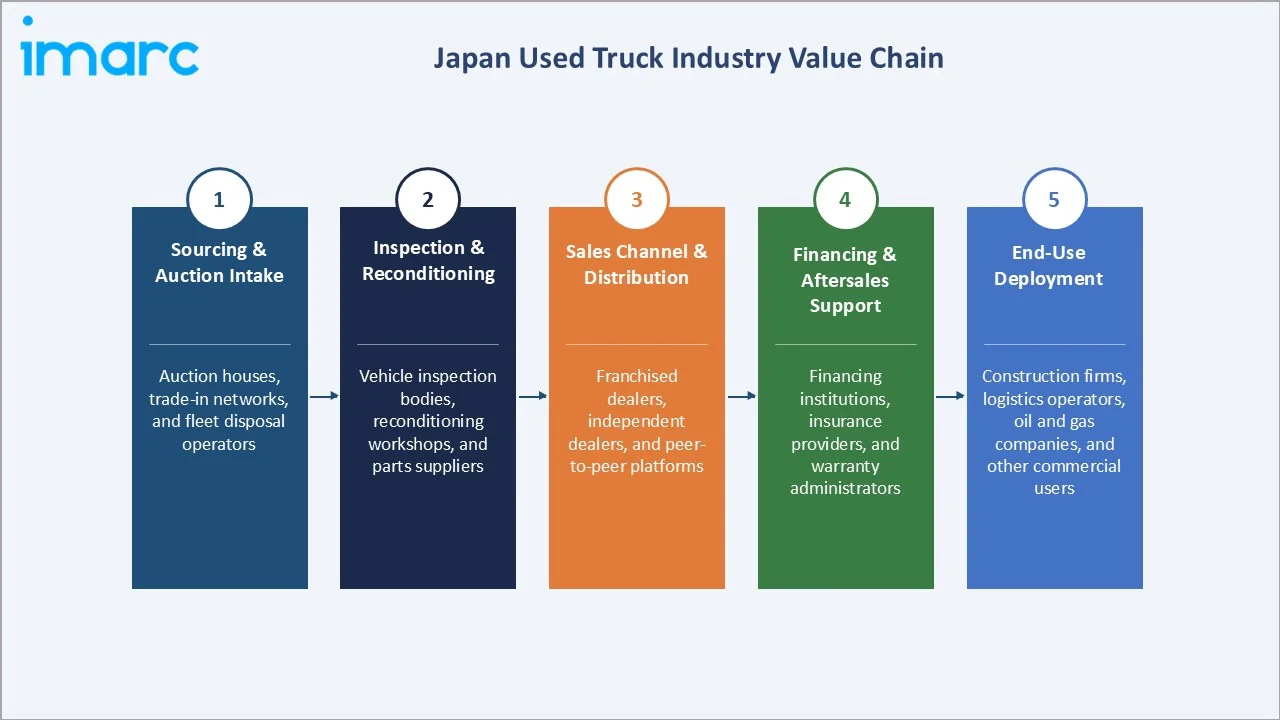
The Japan used truck value chain integrates vehicle sourcing and auction intake, inspection and reconditioning, sales channel distribution, financing and aftersales support, and final deployment by commercial end users.
|
Stage |
Key Participants |
|
Sourcing & Auction Intake |
Auction houses, trade-in networks, fleet disposal operators |
|
Inspection & Reconditioning |
Vehicle inspection bodies, reconditioning workshops, parts suppliers |
|
Sales Channel & Distribution |
Franchised dealers, independent dealers, peer-to-peer platforms |
|
Financing & Aftersales Support |
Financing institutions, insurance providers, warranty administrators |
|
End-Use Deployment |
Construction firms, logistics operators, oil and gas companies, other commercial users |
The inspection and reconditioning stage is the value chain's most technically differentiated phase, as certified vehicle condition directly determines resale value and buyer confidence. Distribution through independent dealers sustains the broadest market reach across Japan.
Technology Landscape in the Japan Used Truck Industry
Digital Auction and Bidding Technology
Digital auction and remote bidding technology enables dealers to view detailed vehicle condition reports, images, and inspection grades, and to bid in real time without on-site attendance. This technology is broadening participation and improving transaction efficiency across the auction network.
Vehicle Inspection and Grading Technology
Standardized inspection and grading technology assesses mileage, frame condition, engine performance, and body condition to assign transparent quality grades. This supports consistent valuation and builds buyer trust across both domestic and export transactions.
Telematics and Fleet History Verification
Telematics and digital service-record verification tools are increasingly used to confirm maintenance history and usage patterns, helping buyers assess a vehicle's remaining operational life before purchase.
Market Segmentation Analysis
The report covers the following segments:
|
Segment Category |
Leading Segment |
Market Share |
Year |
|
Vehicle Type |
Light Trucks |
47.8% |
2025 |
|
Sales Channel |
Independent Dealer |
51.2% |
2025 |
|
End User |
🔒 |
🔒 |
2025 |
|
Region |
Kanto Region |
37.8% |
2025 |

By Vehicle Type
Light Trucks lead at 47.8% (2025). The segment encompasses compact and mid-sized delivery trucks widely used for last-mile logistics, retail distribution, and small-business transport. Light Trucks' ~3.6% CAGR reflects steady, high-volume replacement demand from e-commerce and retail delivery fleets, which prioritize affordability and maneuverability over raw load capacity.
To access detailed market analysis, Request Sample
Medium-duty Trucks at 31.4% serve regional freight and construction support roles and post the fastest vehicle-type growth at ~4.3% CAGR as regional distribution networks and construction activity expand. Heavy-duty Trucks at 20.8% serve long-haul freight, industrial, and export-oriented applications requiring higher load capacity, growing at ~3.9% CAGR through sustained export demand for certified high-tonnage units.
By Sales Channel
Independent Dealer leads at 51.2% (2025). The segment encompasses non-franchised dealer networks sourcing inventory directly from auctions and trade-ins, offering wide model selection and competitive pricing. Independent Dealer's ~3.5% CAGR reflects its position as the market's largest and most established channel, with growth pacing broadly in line with overall market expansion.
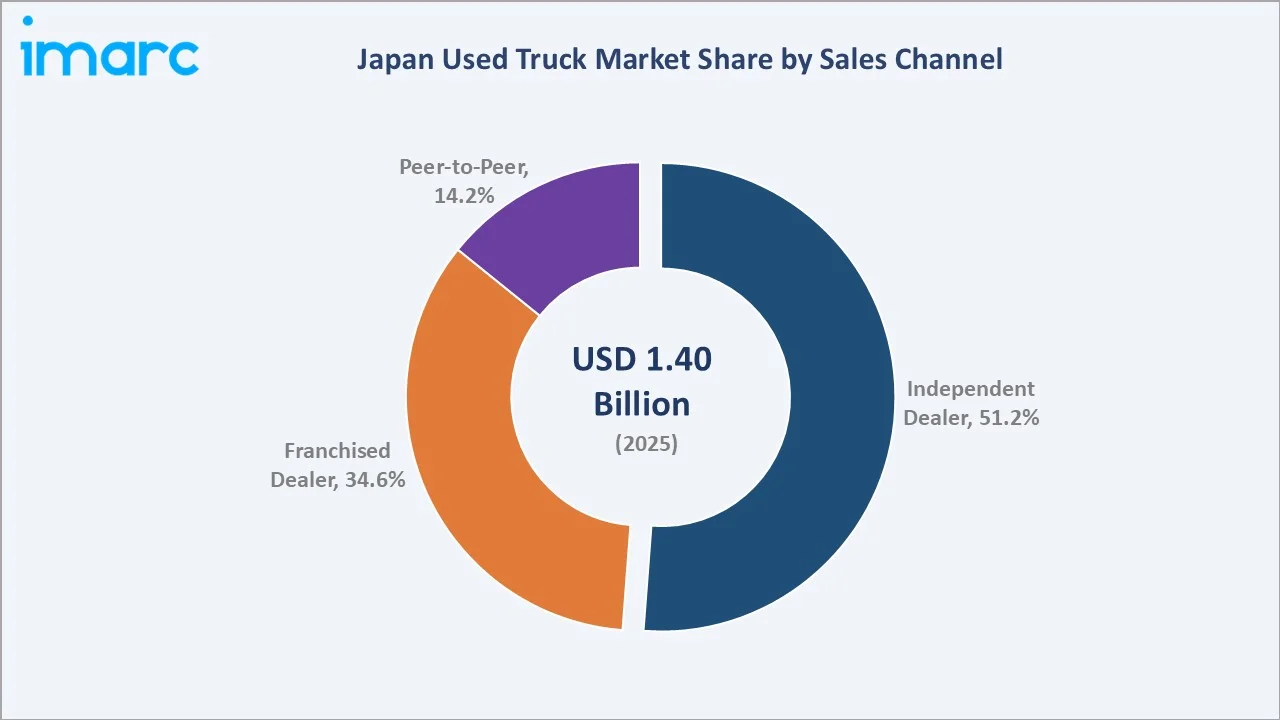
Franchised Dealer at 34.6% offers manufacturer-backed certified pre-owned inventory with warranty support, growing at ~4.0% CAGR as OEM-certified programs expand. Peer-to-Peer at 14.2% is the fastest-growing sales channel at ~5.1% CAGR as digital marketplaces increasingly enable direct, commission-free buyer-seller transactions outside traditional dealer networks.
Regional Market Insights
|
Region |
Share (2025) |
Key Japan Used Truck Market Drivers & Characteristics |
|
Kanto Region |
37.8% |
Driven by Tokyo's logistics hub concentration, dense auction house and dealer networks, and port-linked export infrastructure. |
|
Kinki Region |
18.5% |
Supported by Osaka's industrial base and strong independent dealer presence across the Kansai corridor. |
|
Central/Chubu Region |
15.3% |
Anchored by Nagoya's manufacturing and logistics activity, including proximity to major auction sites. |
|
Kyushu-Okinawa Region |
8.8% |
Growing on construction and export-oriented demand supported by regional port access. |
|
Tohoku Region |
6.9% |
Driven by agricultural and regional freight transport requirements. |
|
Chugoku Region |
5.3% |
Supported by industrial and manufacturing-linked commercial transport demand. |
|
Hokkaido Region |
4.2% |
Driven by agricultural logistics and seasonal freight transport needs. |
|
Shikoku Region |
3.2% |
Supported by regional distribution and small-scale commercial transport demand. |
Kanto's 37.8% leadership is anchored by Tokyo's dual role as Japan's largest logistics hub and primary vehicle export gateway. Kinki's 18.5% reflects Osaka's industrial base and dense independent dealer network.
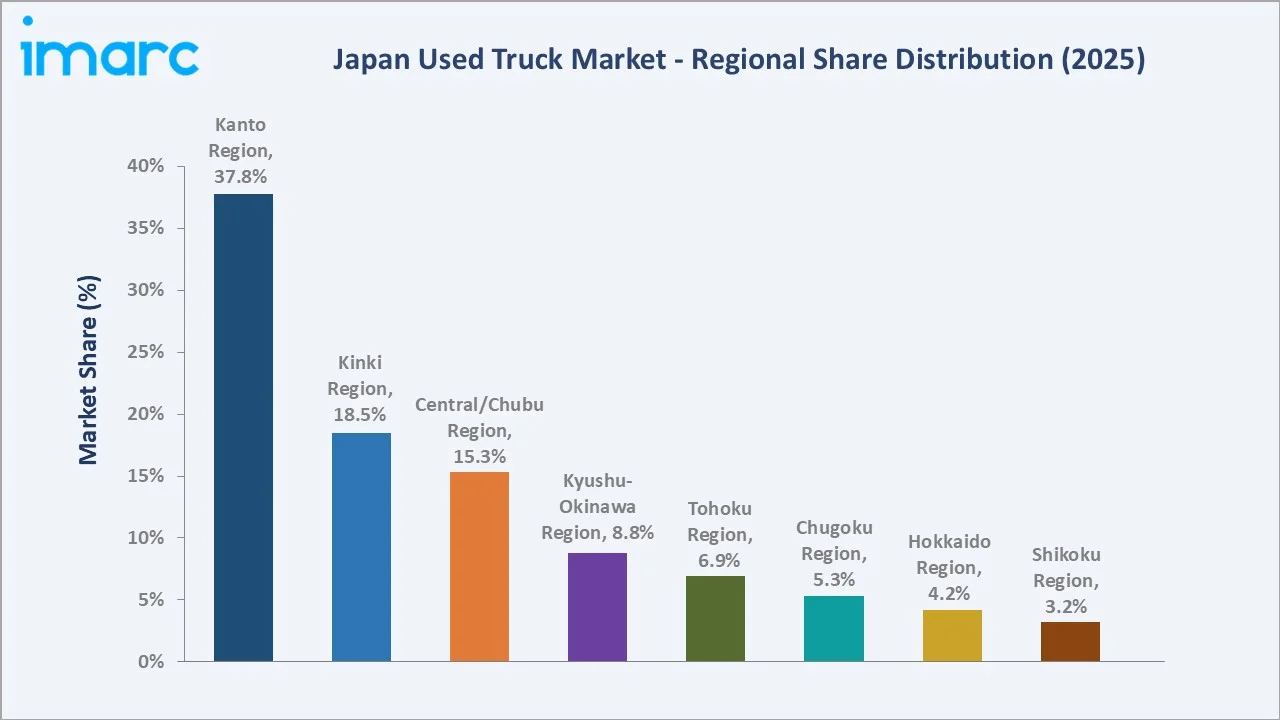
Central/Chubu's 15.3% is supported by Nagoya's manufacturing and auction infrastructure, while Kyushu-Okinawa, at 8.8%, is the fastest-growing region through expanding port-linked export activity.
Competitive Landscape
The Japan used truck market competitive landscape encompasses distinct tiers: nationwide auction operators, independent and franchised dealer networks, OEM-backed certified pre-owned programs, and export-focused trading companies.
|
Company Name |
Key Products |
Market Position |
Core Strength |
|
USS Co., Ltd. |
USS Auto Auction |
Market Leader |
USS operates Japan's largest used-vehicle auction network, giving dealers nationwide access to inventory, transparent grading, and benchmark price discovery. |
|
BE FORWARD Co., Ltd. |
BE FORWARD online stocklist |
Market Leader |
BE FORWARD plays a central role in used truck distribution by offering a large online inventory with detailed listings for both domestic and export buyers. |
|
Isuzu Motors Limited |
Forward and Giga trucks |
Established Player |
Isuzu leverages its OEM position to offer certified pre-owned trucks backed by manufacturer inspection standards and dealer service networks. |
|
Hino Motors, Ltd. |
Hino Trucks |
Established Player |
Hino supports the used truck market through manufacturer-certified resale programs and an extensive dealer service network across Japan. |
Key players in the Japan used truck market include USS Co., Ltd., BE FORWARD Co., Ltd., SBT Japan Co., Ltd., Isuzu Motors Limited, and Hino Motors, Ltd., among others.
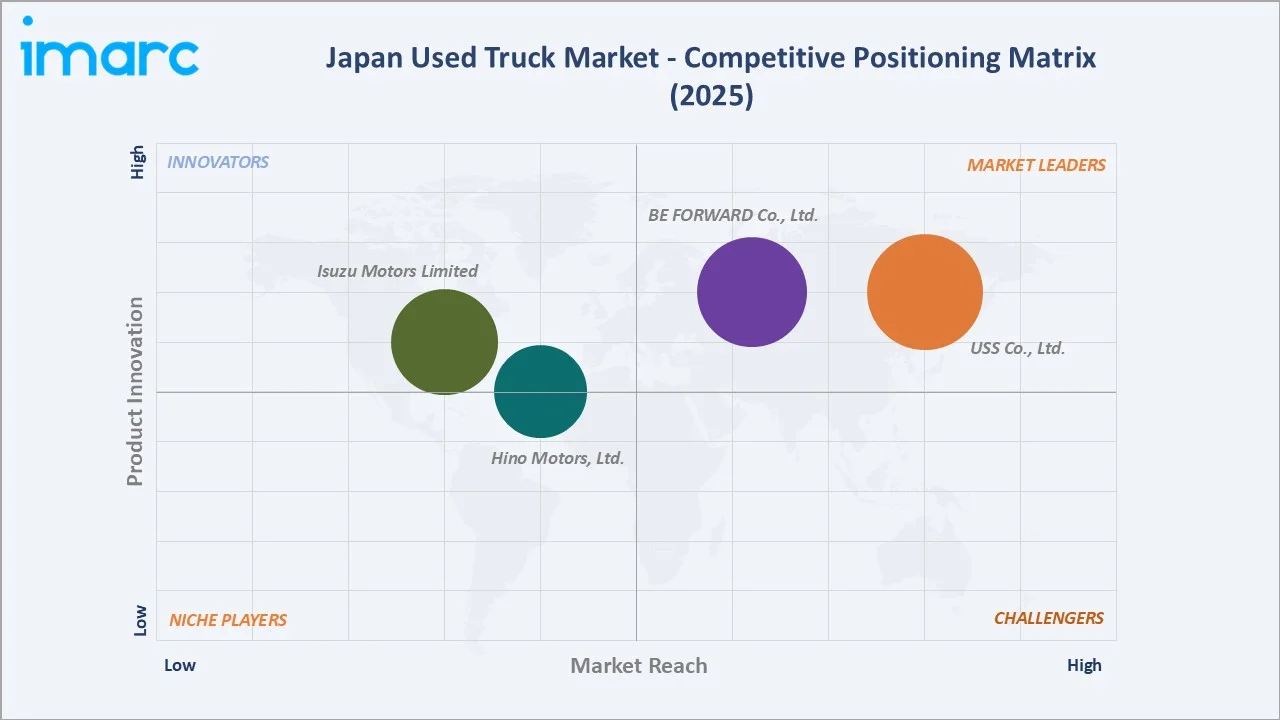
Auction operators such as USS maintain a concentrated, technology-driven position at the wholesale trading tier, while dealer distribution remains fragmented across thousands of independent operators nationwide. OEM-backed certified pre-owned programs are strengthening manufacturer influence over the higher-quality segment of the resale market.
Key Company Profiles
USS Co., Ltd.
USS Co., Ltd. operates Japan's largest used-vehicle auction network, serving as a central trading hub for dealers and fleet owners sourcing used trucks and other commercial vehicles nationwide.
- Key Products: USS Auto Auction, USS JAPAN dedicated terminal service, CIS Internet auction platform.
- Recent Developments: In April 2026, USS Co., Ltd. reported strong growth in its FY2025 (ended March 31, 2026) used vehicle auction business. For the fourth quarter, vehicles consigned increased 4.6% year over year, while vehicles contracted (sold) rose 10.1%, lifting the contract completion rate to 69.0%. For the full fiscal year, both consignments and contracted vehicle sales increased 9.4% year over year, demonstrating sustained demand across USS's auction network, including commercial vehicles and used trucks.
- Strategic Focus: Focuses on expanding digital auction access, transparent vehicle grading, and nationwide network reach for dealers and professional buyers.
BE FORWARD Co., Ltd.
BE FORWARD Co., Ltd. is a leading Japanese used vehicle exporter, offering a large online inventory of used trucks sourced from auctions and dealers for both domestic and international buyers.
- Key Products: Online stocklist covering light, medium, and heavy-duty used trucks; export logistics and shipping coordination services.
- Recent Developments: In March 2026, BE FORWARD Co., Ltd. expanded the promotion of its used heavy trucks and construction equipment for customers in the Democratic Republic of the Congo, Burundi, and Rwanda. The company highlighted the availability of used dump trucks, tractor heads, cranes, and other commercial vehicles for export through its global marketplace, reinforcing its focus on growing used truck sales in African markets.
- Strategic Focus: Centered on broadening export reach, digital inventory transparency, and buyer-friendly shipping and financing options.
Market Concentration Analysis
The Japan used truck market is moderately fragmented at the dealer distribution tier, with thousands of independent and franchised dealers operating nationwide alongside peer-to-peer platforms. Auction operators are more concentrated, with a small number of nationwide networks accounting for a majority of wholesale trading volume. Market concentration is increasing at the OEM-backed certified pre-owned tier as manufacturers expand dealer-supported resale programs.
Investment & Growth Opportunities
Highest Growth Segments
Peer-to-Peer sales channel growth, Medium-duty Trucks demand, digital auction platform adoption, certified pre-owned program expansion, and export-oriented heavy-duty truck sourcing represent the highest-growth Japan used truck market investment vectors through 2034.
Emerging Investment Opportunities
Digital marketplace platforms that connect independent dealers with export buyers represent the largest near-term opportunity. Auction operators and dealers that build strong export logistics and certification capabilities are positioned for above-market revenue growth as overseas demand accelerates.
Investment Themes
- Digital auction and marketplace platform investment: Companies investing in remote bidding technology, transparent vehicle grading, and online inventory management are positioned to capture growing digital transaction volumes.
- Certified pre-owned program development: OEM-backed and dealer-led certified pre-owned programs that combine inspection standards with warranty support are creating recurring, premium-margin revenue opportunities.
Future Market Outlook (2026-2034)
The Japan used truck market is projected to grow from USD 1.40 Billion in 2025 to USD 1.45 Billion in 2026, reaching USD 2.00 Billion by 2034, delivering a 3.87% CAGR over the forecast period. The market's anchor value of USD 1.69 Billion in 2030 reflects continued expansion of digital auction platforms, certified pre-owned programs, and export-oriented sourcing capabilities across the industry.
Three structural forces define market growth through 2034. Continued industrialization and urbanization sustain steady demand for cost-effective commercial transport. Government regulations promoting vehicle recycling and reutilization support a well-regulated, transparent secondary market. Technological advancements in digital auctions, vehicle grading, and fuel-efficient engines are making used trucks an increasingly attractive and accessible choice for commercial buyers.
Research Methodology
Primary Research
Primary research comprised structured interviews with industry stakeholders including dealer network executives, auction house representatives, fleet procurement managers, and logistics operators across Japan.
Secondary Research
Secondary research encompassed automotive industry publications, government vehicle registration and recycling statistics, dealer association data, company reports, and trade and export documentation.
Forecasting Models
Market revenue forecasts were developed using a segment bottom-up model: (i) vehicle type component; (ii) sales channel component; (iii) regional component.
Japan Used Truck Market Report Coverage:
| Report Features | Details |
|---|---|
| Base Year of the Analysis | 2025 |
| Historical Period | 2020-2025 |
| Forecast Period | 2026-2034 |
| Units | Billion USD |
| Scope of the Report | Exploration of Historical and Forecast Trends, Industry Catalysts and Challenges, Segment-Wise Historical and Predictive Market Assessment:
|
| Vehicle Types Covered | Light Trucks, Medium-duty Trucks, Heavy-duty Trucks |
| Sales Channels Covered | Franchised Dealer, Independent Dealer, Peer-to-Peer |
| End Users Covered | Construction, Oil and Gas, Others |
| Regions Covered | Kanto Region, Kinki Region, Central/Chubu Region, Kyushu/Okinawa Region, Tohoku Region, Chugoku Region, Hokkaido Region, Shikoku Region. |
| Companies Covered | USS Co., Ltd., BE FORWARD Co., Ltd., Isuzu Motors Limited, Hino Motors, Ltd., etc. |
| Customization Scope | 10% Free Customization |
| Post-Sale Analyst Support | 10-12 Weeks |
| Delivery Format | PDF and Excel through Email (We can also provide the editable version of the report in PPT/Word format on special request) |
Key Benefits for Stakeholders:
- IMARC’s report offers a comprehensive quantitative analysis of various market segments, historical and current market trends, market forecasts, and dynamics of the Japan used truck market from 2020-2034.
- The research study provides the latest information on the market drivers, challenges, and opportunities in the Japan used truck market.
- Porter's five forces analysis assist stakeholders in assessing the impact of new entrants, competitive rivalry, supplier power, buyer power, and the threat of substitution. It helps stakeholders to analyze the level of competition within the Japan used truck industry and its attractiveness.
- Competitive landscape allows stakeholders to understand their competitive environment and provides an insight into the current positions of key players in the market.
Frequently Asked Questions About the Japan Used Truck Market Report
The Japan used truck market size is estimated at USD 1.45 Billion in 2026. The market is driven by rapid industrialization, government recycling regulations, and growing e-commerce and retail logistics demand.
The market grows at 3.87% CAGR during 2026-2034, reaching USD 2.00 Billion by 2034, supported by rising digital auction adoption and certified pre-owned program expansion.
Light Trucks lead at 47.8% through their versatility and affordability across last-mile delivery and small-business logistics applications.
Independent Dealer leads at 51.2% through nationwide network reach and competitive, auction-sourced inventory.
Kanto Region leads at 37.8% through Tokyo's logistics hub concentration and export infrastructure.
Leading companies include USS Co., Ltd, BE FORWARD Co., Ltd., Isuzu Motors Limited and Hino Motors, Ltd., among others.
The market is projected to reach approximately USD 1.69 Billion by 2030, with digital auction platforms and certified pre-owned programs achieving broader mainstream adoption.
Demand is driven by rapid industrialization, stringent government recycling regulations, growing e-commerce and retail logistics use, and rising green consumerism favoring vehicle reuse.
Need more help?
- Speak to our experienced analysts for insights on the current market scenarios.
- Include additional segments and countries to customize the report as per your requirement.
- Gain an unparalleled competitive advantage in your domain by understanding how to utilize the report and positively impacting your operations and revenue.
- For further assistance, please connect with our analysts.
 Request Customization
 Speak to an Analyst
 Request Brochure
 Inquire Before Buying
Benefits of Customization
- Personalize this research
- Triangulate with your data
- Get data as per your format and definition
- Gain a deeper dive into a specific application, geography, customer, or competitor
- Any level of personalization
Get in Touch With Us
UNITED STATES
Phone: +1-201-971-6302
INDIA
Phone: +91-120-433-0800
UNITED KINGDOM
Phone: +44-753-714-6104
Email: [email protected]
Client Testimonials




.webp)




.webp)













Related Reports

Choose your plan
*Please note that the prices mentioned below are starting prices for each bundle type. Kindly contact our team for further details.*
Single User License
- 1 User License, Access on 2 Devices
- PDF Report + Excel Dataset (Password Protected)
- Lifetime Access
- No Printing Rights
- 10% Free Report Customization
- 10–12 Weeks of Analyst Support
Five User License
- Access for 5 Users, 2 Devices per User
- PDF Report + Excel Dataset (Password Protected)
- Lifetime Access
- Dedicated Account Manager
- 12–14 Weeks of Analyst Support
- No Printing Rights
- 15% Free Report Customization
- 25% Discount on Your Next Purchase
Corporate User License
- Unlimited User Access (Within Your Organization)
- PDF Report + Excel Dataset
- Lifetime Access
- Dedicated Account Manager
- 14–20 Weeks of Analyst Support
- No Printing Rights
- 20% Free Report Customization
- 30% Discount on Your Next Purchase
Essential Insights
What's included:
3 reports
- Lifetime Access
- PDF Reports
- Excel Datasets
- 2 Weeks of Free Analyst Support
- 2 User Licenses
- Access on 2 Devices
- Printing Rights
- Complimentary PowerPoint (PPT) Version
- Complimentary License Upgrade
Professional Access
What's included:
5 reports
- Lifetime Access
- PDF Reports
- Excel Datasets
- 8 Weeks of Free Analyst Support
- 2 User Licenses
- Access on 2 Devices
- Printing Rights
- Complimentary PowerPoint (PPT) Version
- Complimentary License Upgrade
Business Advantage
What's included:
8 reports
- Lifetime Access
- PDF Reports
- Excel Datasets
- 14 Weeks of Free Analyst Support
- 2 User Licenses
- Access on 2 Devices
- Printing Rights
- Complimentary PowerPoint (PPT) Version
- Complimentary License Upgrade
Enterprise Intelligence
What's included:
10 reports
- Lifetime Access
- PDF Reports
- Excel Datasets
- 20 Weeks of Free Analyst Support
- 2 User Licenses
- Access on 2 Devices
- Printing Rights
- Complimentary PowerPoint (PPT) Version
- Complimentary License Upgrade