
Latin America Electric Vehicle (EV) Charging Stations Market Size, Share, Trends and Forecast by Charging Station Type, Vehicle Type, Installation Type, Charging Level, Connector Type, Application, and Region, 2026-2034
Latin America Electric Vehicle (EV) Charging Stations Market Size, Share, Trends & Forecast (2026-2034)
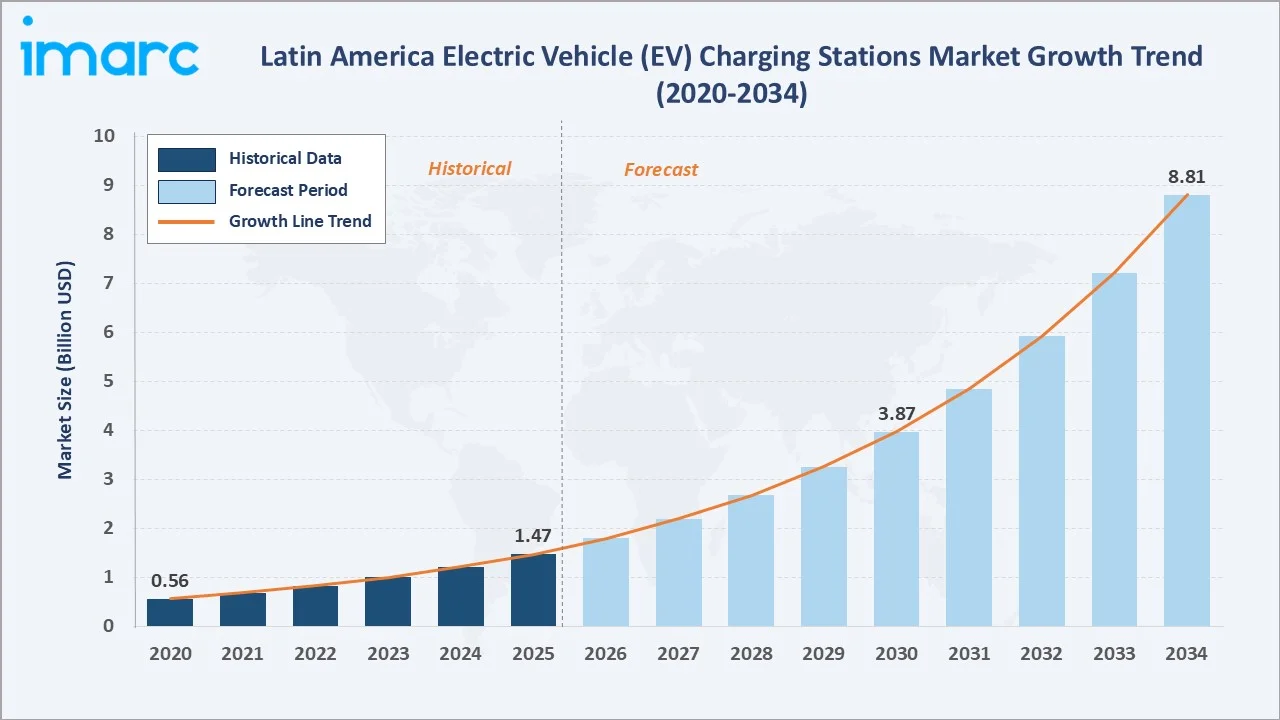
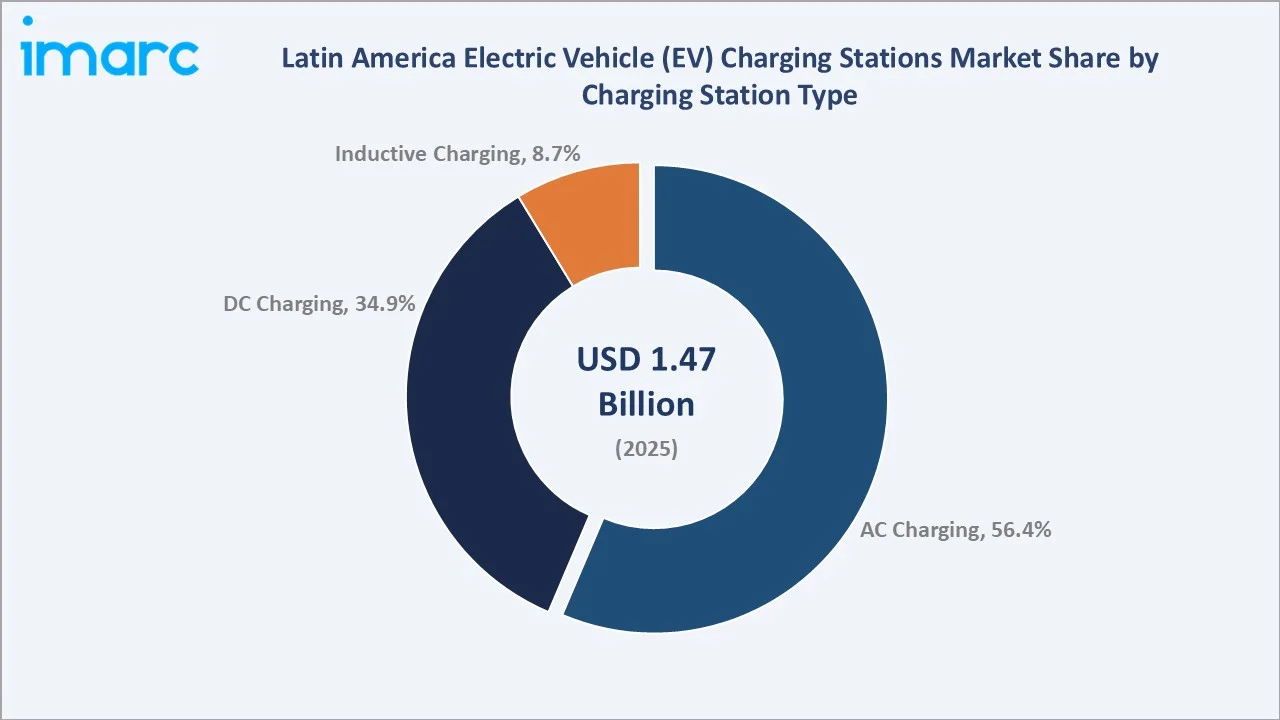
The Latin America electric vehicle (EV) charging stations market grew from USD 1.47 Billion in 2025 to USD 1.87 Billion in 2026 and is projected to reach USD 8.81 Billion by 2034, growing at a CAGR of 21.35% during 2026-2034. The market is driven by rising electric vehicle adoption, supported by government incentives, emissions reduction targets, and investments in public charging infrastructure. Brazil’s charging network expanded sharply from 1,876 stations in 2023 to 12,700 by the end of 2024, while Mexico’s network rose from 1,340 to 3,212 stations during the same period. Together, Brazil and Mexico account for nearly 86% of Latin America’s charging infrastructure, highlighting their role as key growth hubs. This rapid expansion is driving the Latin America EV charging stations market by improving charging accessibility, reducing range anxiety, and encouraging wider EV adoption across the region. AC charging leads at 56.4%. Commercial leads application at 63.7%. Brazil leads regionally at 34.6%.
Market Snapshot
|
Metric |
Value |
|
Base Year Market Size (2025) |
USD 1.47 Billion |
|
Market Size (2026) |
USD 1.87 Billion |
|
Forecast Market Size (2034) |
USD 8.81 Billion |
|
CAGR (2026-2034) |
21.35% |
|
Base Year |
2025 |
|
Historical Period |
2020-2025 |
|
Forecast Period |
2026-2034 |
|
Dominant Charging Station Type |
AC Charging (56.4%, 2025) |
|
Dominant Application |
Commercial (63.7%, 2025) |
|
Leading Region |
Brazil (34.6%, 2025) |
Latin America EV charging stations market expanded from USD 0.56 Billion in 2020 to USD 1.47 Billion in 2025 and an estimated USD 1.87 Billion in 2026, anchored at USD 3.87 Billion in 2030, and forecast to reach USD 8.81 Billion by 2034. Latin America EV charging market uniqueness derives from the region's combination of EV charging electricity mix, rapidly growing urban EV demand, and government EV transition policies.
To get more information on this market, Request Sample
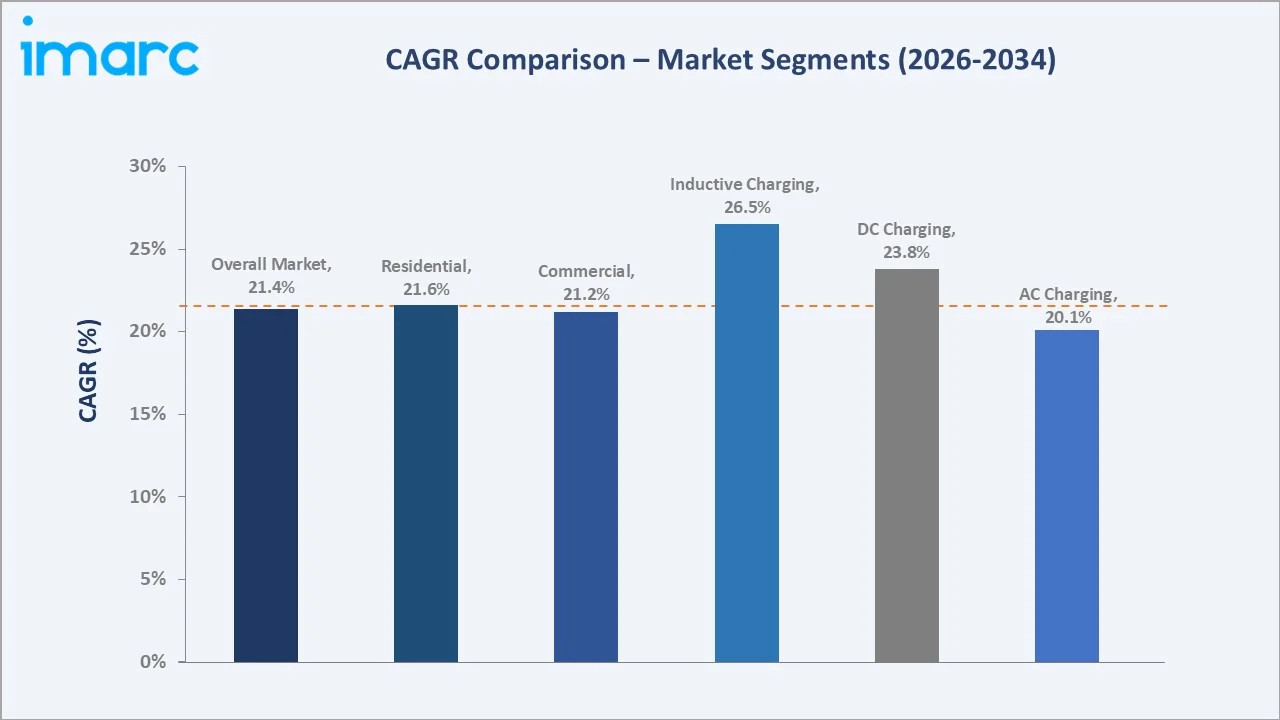
Inductive charging grows fastest at ~26.5% CAGR through electric bus, taxi fleet, and wireless charging plaza adoption. DC charging grows at ~23.8% CAGR through highway fast charging corridor development.
Executive Summary
Latin America EV charging stations market, which increased from USD 1.47 Billion in 2025 to an estimated USD 1.87 Billion in 2026, represents one of the regional EV infrastructure growth markets, a market’s 21.35% CAGR over the forecast period reflects the compound acceleration of rapidly growing EV fleet, government support measures, charging regulations, and infrastructure investment programs, and the region's renewable electricity advantage, creating a promising emerging EV charging market with strong renewable-energy potential. The market is projected to reach USD 8.81 Billion by 2034.
AC charging at 56.4% leads through commercial Level 2 AC EVSE for shopping malls, hotels, and corporate campuses. Commercial at 63.7% leads through fleet, ride-hailing depot, and commercial property deployment. Brazil leads regionally at 34.6%.
Key Market Insights
|
Insight |
Data |
|
Dominant Charging Station Type |
AC Charging - 56.4% share (2025) |
|
Dominant Application |
Commercial - 63.7% market share (2025) |
|
Leading Region |
Brazil - 34.6% share (2025) |
|
Market Opportunity |
Highway DC fast charging corridor; ride-hailing fleet charging hubs; solar EV charging plaza; port and logistics fleet charging; residential smart charging subsidy |
Key Analytical Observations Supporting the Above Data:
- AC Charging at 56.4%: The AC charging segment dominates due to its lower installation cost, suitability for residential/workplace charging, and wider deployment in urban parking areas. Its compatibility with most EV models further supports large-scale adoption.
- Commercial at 63.7%: The commercial segment dominates due to rapid deployment at malls, offices, hotels, fleet depots, and public parking spaces. Rising investments by charging operators and retailers are improving public access and supporting higher EV usage.
- Brazil at 34.6%: Brazil dominates regionally due to its large EV fleet, rapid charger rollout, and strong public-private investments in charging infrastructure. Expanding networks across major cities and highways are further improving EV accessibility and adoption.
Latin America Electric Vehicle (EV) Charging Stations Market Overview
Latin America EV charging stations market operates within the broader Latin America electric vehicle market, through each new EV requiring charging infrastructure support above self-sustaining standalone product sales. The market's commercial uniqueness is the renewable energy advantage.
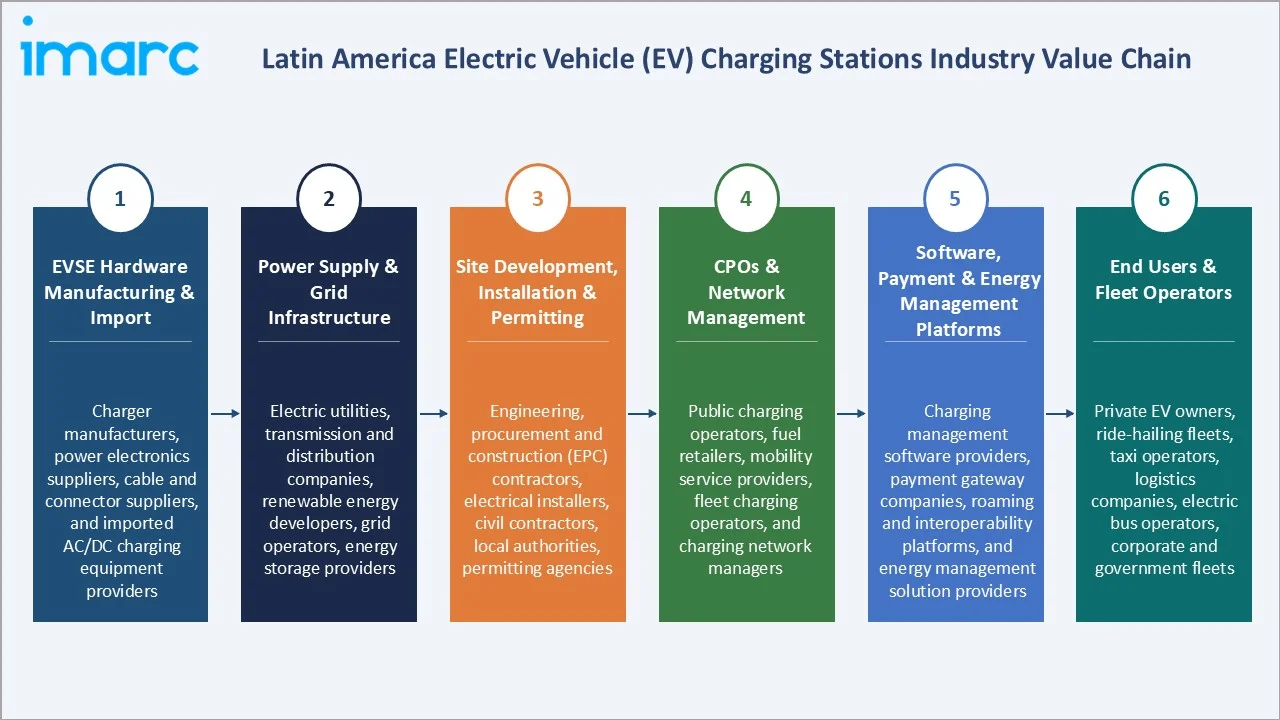
Latin America's EV charging ecosystem integrates EVSE hardware manufacturers and importers, utility and grid partners, charging network operators, real estate and site hosts, and EV driver and fleet end-users. Macroeconomic factors include rising urbanization, growing disposable incomes, fuel price volatility, and government focus on decarbonization.
Market Dynamics
To evaluate market opportunities, Request Sample
Market Drivers
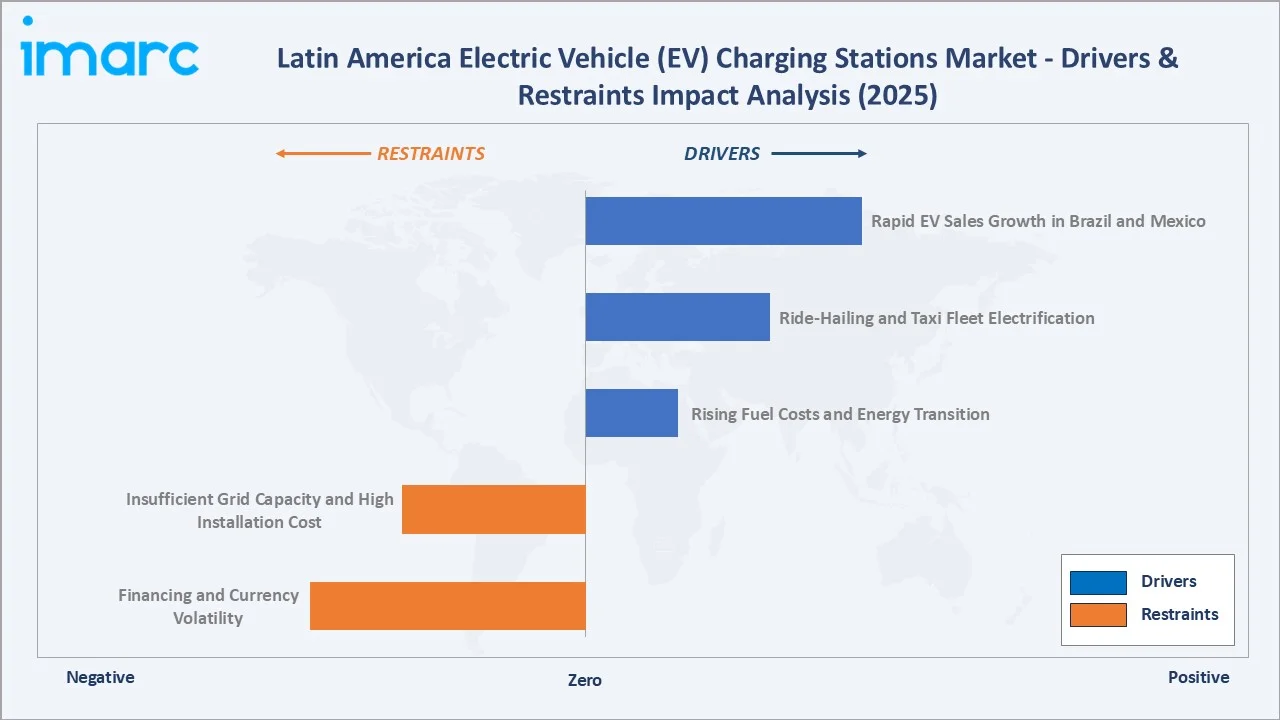
- Rapid EV Sales Growth in Brazil and Mexico: Electric car sales in Latin America grew rapidly in 2025, exceeding 350,000 units and rising by 75% compared with 2024. Brazil and Mexico contributed over 75% of this growth, driven largely by strong PHEV demand, which increased the PHEV share of regional electric car sales to nearly 50%, up from 40% a year earlier. This rapid EV sales growth in Brazil and Mexico is increasing the demand for reliable and accessible charging infrastructure across Latin America. As EV ownership expands, governments, utilities, and private operators are accelerating the rollout of public, residential, and commercial charging points. Brazil and Mexico’s large vehicle markets also attract investments from charging network operators and automakers. This helps reduce range anxiety, improves user convenience, and supports wider EV adoption across the region.
- Ride-Hailing and Taxi Fleet Electrification: The electrification of ride-hailing and taxi fleets is driving the demand for extensive and reliable EV charging infrastructure across Latin America. Fleet operators require frequent charging to maintain high vehicle utilization, encouraging the installation of charging stations at depots, airports, transit hubs, and urban centers. As companies transition to electric fleets to reduce operating costs and emissions, investments in both AC and fast-charging networks are increasing. This expansion supports broader EV adoption and strengthens the region’s charging ecosystem.
- Rising Fuel Costs and Energy Transition: Rising fuel costs across Latin America are encouraging consumers and fleet operators to switch to electric vehicles as a more cost-effective transportation option. At the same time, national energy transition strategies and decarbonization goals are promoting the adoption of cleaner mobility solutions. As EV demand grows, governments and private investors are expanding charging infrastructure to support the increasing vehicle base. This trend is accelerating the deployment of public and private charging stations throughout the region.
Market Restraints
- Insufficient Grid Capacity and High Installation Cost: Insufficient grid capacity is limiting the deployment of EV charging stations, especially fast chargers that require high power loads. Weak distribution networks in several areas increase the need for costly grid upgrades, transformers, and power management systems. High equipment, installation, and maintenance costs also make projects less attractive for operators. These challenges slow charging network expansion, particularly in smaller cities, highways, and underserved regions across Latin America.
- Financing and Currency Volatility: Financing challenges are slowing the rollout of EV charging stations in Latin America, as high upfront capital is required for equipment, installation, land access, and grid upgrades. Currency volatility further increases project risk because many chargers and components are imported and priced in foreign currencies. This raises costs for operators and makes long-term returns less predictable. As a result, investors may delay expansion plans, especially in smaller markets with weaker financing support.
Market Opportunities
- DC Fast Charging Points: DC fast-charging points surged from 1,109 in August 2024 to 6,479 by early 2026 in Brazil, while ABVE data indicates that DC chargers’ share of the national network rose from 16% to 31%. These rising DC fast charging points reduce charging time and improve EV convenience for users. They are especially valuable at highways, fleet depots, fuel stations, malls, and urban transport hubs. Faster charging helps reduce range anxiety and supports high-usage vehicles such as taxis, buses, and delivery fleets. As EV adoption rises, demand for DC fast chargers is expected to grow across major Latin American markets.
- Solar-EV Integrated Charging Hubs: Solar-EV integrated charging hubs reduce dependence on stressed grid networks. They can lower electricity costs for operators while supporting clean-energy-based mobility. Solar-backed hubs are especially useful in remote areas, highways, parking lots, and commercial sites with high sunlight availability. This model also aligns with regional decarbonization goals and can attract green financing for charging infrastructure projects.
Market Challenges
- Uneven Distribution of Charging Infrastructure across Countries and Regions: The uneven distribution of charging infrastructure across Latin America is creating accessibility gaps between major urban centers and smaller cities or rural regions. While countries such as Brazil, Mexico, and Chile have expanded their charging networks, many other markets remain underserved. This imbalance limits long-distance travel, increases range anxiety, and discourages EV adoption in less-developed areas. As a result, the growth of the regional EV ecosystem remains uneven and fragmented.
- Lack of Standardized Charging Protocols and Interoperability Issues: Lack of standardized charging protocols creates compatibility issues between EV models, charger types, payment systems, and network operators across Latin America. This can make charging inconvenient for users and reduce confidence in EV adoption. Interoperability gaps also increase costs for charging operators, as they may need to support multiple connectors, software platforms, and billing systems. As a result, fragmented infrastructure can slow network expansion and limit the efficiency of the regional EV charging ecosystem.
Emerging Market Trends
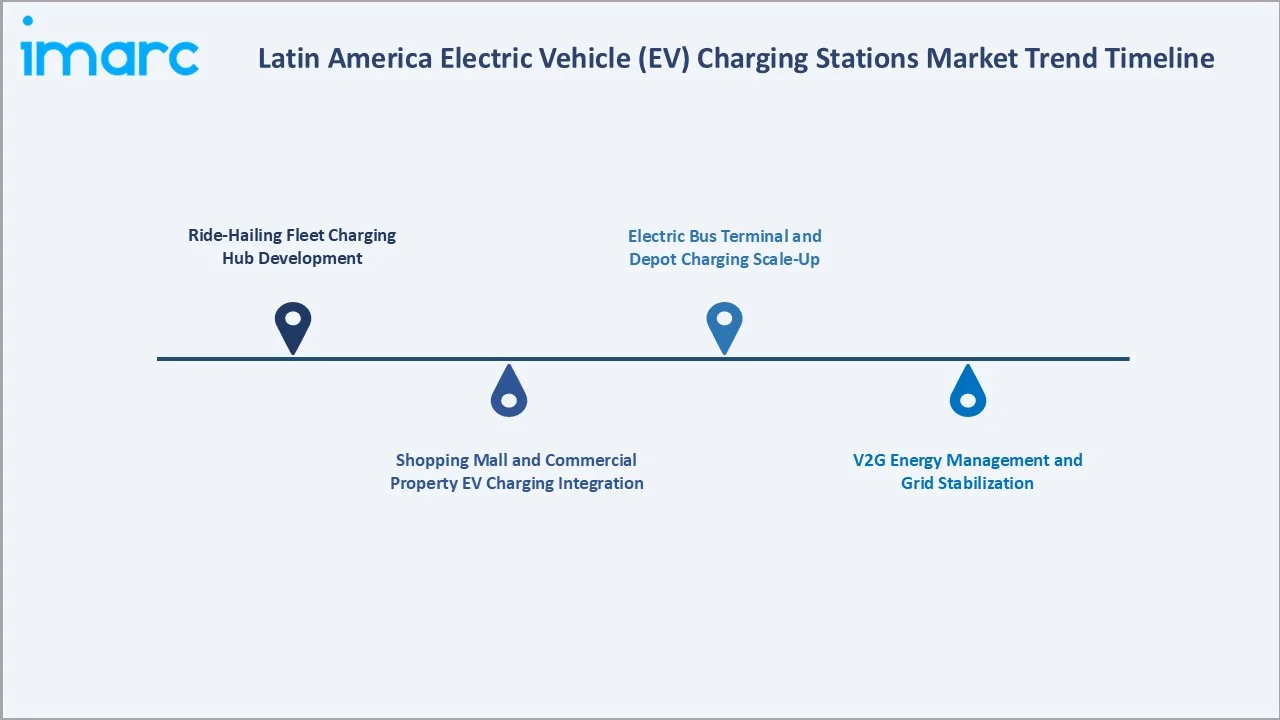
1. Ride-Hailing Fleet Charging Hub Development
Ride-hailing fleet charging hub development is emerging as taxi and app-based mobility operators shift toward electric vehicles. These fleets require reliable, high-utilization charging points near airports, business districts, transit hubs, and dense urban routes. Dedicated charging hubs help reduce downtime, improve fleet operations, and support faster vehicle turnover. This trend is encouraging investment in depot-based and fast-charging infrastructure across major Latin American cities.
2. Shopping Mall and Commercial Property EV Charging Integration
Shopping mall and commercial property EV charging integration is emerging as property owners use chargers to attract EV users and increase visitor dwell time. Malls, offices, hotels, and retail complexes are installing AC and DC chargers as value-added amenities. In December 2025, XCharge partnered with FAZT Charging to install EV charging stations across Mexico, with a target of 1,000 charging points by 2030. The first SuperFAZT station is operational near Soriana’s corporate offices in Monterrey, with additional sites already opened nearby and future stations planned in Mexico City, Guadalajara, Querétaro, and Puebla. XCharge’s compact C6EU chargers provide 60 kW to 200 kW capacity, with 150–200 kW units planned for highways and busy public locations, while 60–120 kW chargers will serve malls and longer-stay destinations. This supports convenient destination charging while vehicles remain parked. It also creates new revenue opportunities through charging fees, partnerships, and customer loyalty programs.
3. V2G Energy Management and Grid Stabilization
V2G energy management and grid stabilization are emerging as EVs can act as distributed energy storage assets. Through bidirectional charging, vehicles can supply power back to the grid during peak demand or outages. This helps utilities manage load fluctuations, improve renewable energy integration, and reduce grid stress. As Latin America expands EV and clean energy adoption, V2G could gain strategic importance as bidirectional charging pilots and grid-integration models develop.
4. Electric Bus Terminal and Depot Charging Scale-Up
Electric bus terminal and depot charging scale-up is emerging as cities electrify public transport fleets to reduce fuel costs and emissions. Bus operators require high-capacity chargers at depots, terminals, and route endpoints to support daily operations. This is driving demand for DC fast chargers, smart load management, and fleet-specific charging systems. As more municipalities adopt electric buses, depot charging infrastructure is becoming a major growth area in Latin America.
Industry Value Chain Analysis
Latin America EV charging stations value chain integrates EVSE hardware manufacturing & import, power supply & grid infrastructure, site development, installation & permitting, charging point operators (CPOs) & network management, software, payment & energy management platforms, and end users & fleet operators.
|
Stage |
Key Participants |
|
EVSE Hardware Manufacturing & Import |
Charger manufacturers, power electronics suppliers, cable and connector suppliers, and imported AC/DC charging equipment providers |
|
Power Supply & Grid Infrastructure |
Electric utilities, transmission and distribution companies, renewable energy developers, grid operators, energy storage providers |
|
Site Development, Installation & Permitting |
Engineering, procurement and construction (EPC) contractors, electrical installers, civil contractors, local authorities, permitting agencies |
|
CPOs & Network Management |
Public charging operators, fuel retailers, mobility service providers, fleet charging operators, and charging network managers |
|
Software, Payment & Energy Management Platforms |
Charging management software providers, payment gateway companies, roaming and interoperability platforms, and energy management solution providers |
|
End Users & Fleet Operators |
Private EV owners, ride-hailing fleets, taxi operators, logistics companies, electric bus operators, corporate and government fleets |
Charging point operators (CPOs) are responsible for managing and maintaining EV charging stations across public, commercial, and fleet locations. They oversee charger uptime, network monitoring, pricing, user access, and energy management to ensure reliable charging services. CPOs also coordinate with utilities, site owners, and software providers to optimize station performance and expand charging coverage. Their role is critical in improving charging availability and supporting the growth of EV adoption across Latin America.
Technology Landscape in the Latin America Electric Vehicle (EV) Charging Stations Industry
Smart Charging and Load Management
Smart charging and load management optimize electricity consumption based on grid conditions, energy prices, and charging demand. These systems can dynamically distribute power among multiple chargers, reducing peak-load stress and minimizing infrastructure upgrade requirements. Smart charging platforms also enable remote monitoring, demand response, and integration with renewable energy sources. This improves grid efficiency, lowers operating costs, and supports the scalable expansion of EV charging networks across the region.
Mobile Payment and Digital Integration
Mobile payment and digital integration enable seamless, cashless charging experiences through mobile apps, QR codes, digital wallets, and contactless payments. Advanced digital platforms allow users to locate chargers, reserve charging slots, monitor charging sessions, and make real-time payments. Integration with cloud-based management systems also helps operators optimize charger utilization, pricing, and maintenance. These technologies improve user convenience, enhance network efficiency, and support the broader adoption of EV charging infrastructure across the region.
Cloud-based Charging Management Platforms
Cloud-based charging management platforms enable operators to remotely monitor charger performance, uptime, energy usage, and transaction data across multiple sites. These platforms support real-time fault detection, dynamic pricing, user authentication, and payment integration. They also help CPOs optimize charger utilization and reduce maintenance downtime. In February 2026, S2G Energy selected AMPECO as its EV charging management platform for one of Latin America’s largest corporate fleet electrification projects. Through this partnership, S2G Energy will manage more than 1,000 charging points for a last-mile electric delivery fleet while also supporting expansion into other charging applications. As Latin America’s charging networks expand, cloud-based systems are becoming essential for scalable and efficient EV infrastructure management.
Market Segmentation Analysis
The report covers the following segments:
|
Segment Category |
Leading Segment |
Market Share |
Year |
|
Charging Station Type |
AC Charging |
56.4% |
2025 |
|
Vehicle Type |
🔒 |
🔒 |
2025 |
|
Installation Type |
🔒 |
🔒 |
2025 |
|
Charging Level |
🔒 |
🔒 |
2025 |
|
Connector Type |
🔒 |
🔒 |
2025 |
|
Application |
Commercial |
63.7% |
2025 |
|
Region |
Brazil |
34.6% |
2025 |

By Charging Station Type
AC charging leads at 56.4% (2025). Latin America's AC charging encompasses commercial Level 2 at shopping malls, hotels, corporate campuses, and residential at home garages and apartment complexes, creating a high EVSE installation count through AC chargers' lower per-unit cost, allowing higher installation volume per equivalent capital investment.
To access detailed market analysis, Request Sample
DC charging at 34.9% grows at ~23.8% CAGR through highway and fleet depot DC fast charger investment. Inductive charging at 8.7% grows fastest at ~26.5% CAGR through electric bus terminal wireless charging and ride-hailing fleet wireless depot.
By Application
Commercial leads at 63.7% (2025). Commercial encompassing shopping malls, hotels, corporate campuses, fleet depots, fuel stations, airports, and highway rest stop EVSE creates Latin America's most commercially CPO-operated revenue-generating charging network above residential use case.
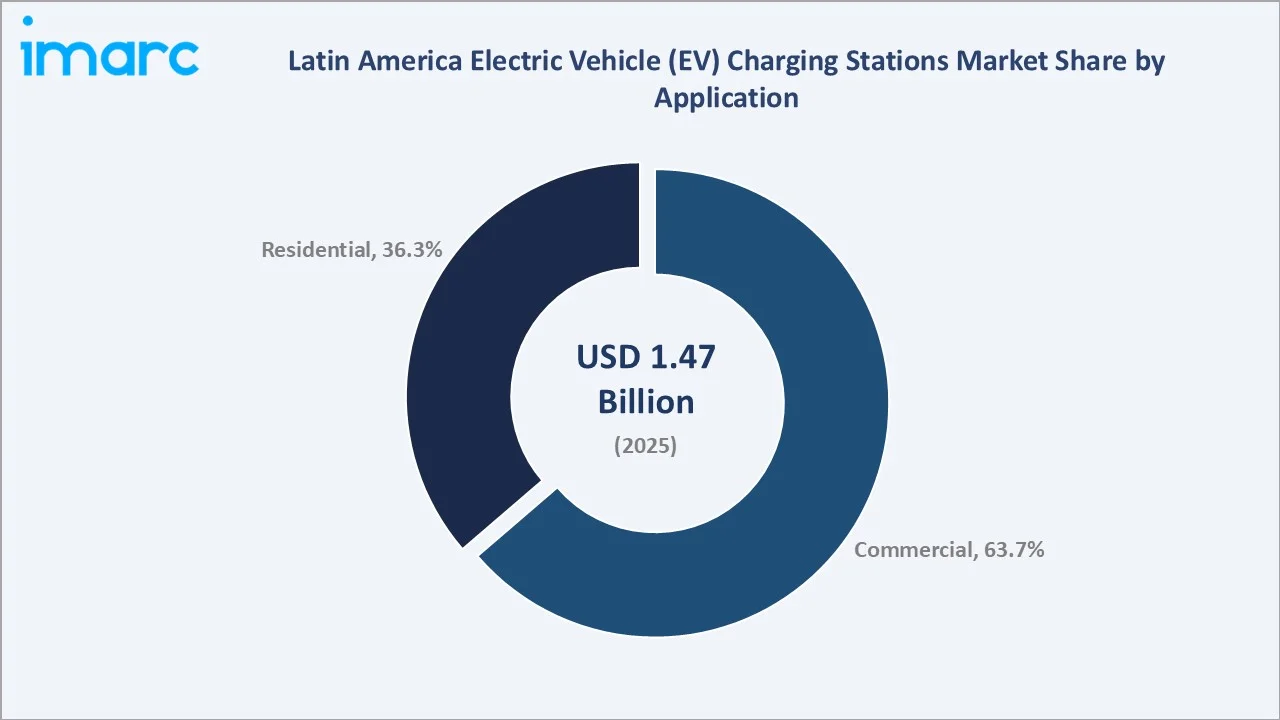
Residential at 36.3% grows at ~21.6% CAGR through home EV adoption and government incentives. Residential EVSE in Latin America encompasses condominium and apartment building EVSE above individual home garages through Latin America's higher apartment-to-house ratio.
Regional Market Insights
|
Country |
Share (2025) |
Key Latin America EV Charging Stations Market Drivers & Characteristics |
|
Brazil |
34.6% |
Supported by rapid EV adoption, extensive charging network expansion, strong private-sector investments, and government initiatives promoting electric mobility across major cities and highway corridors. |
|
Mexico |
24.3% |
Driven by growing EV sales, increasing investments by charging network operators, expanding fleet electrification programs, and rising deployment of fast-charging infrastructure in urban and commercial locations. |
|
Argentina |
12.5% |
Driven by increasing interest in sustainable transportation, gradual EV adoption, expansion of public charging infrastructure, and investments in renewable-energy-linked charging solutions. |
|
Colombia |
9.8% |
Benefits from supportive clean mobility policies, rising adoption of electric buses and fleet vehicles, and growing deployment of charging stations in metropolitan areas and transport corridors. |
|
Chile |
8.1% |
Supported by strong decarbonization targets, high renewable energy penetration, expanding electric public transport networks, and increasing investments in fast-charging infrastructure. |
|
Peru |
5.2% |
Driven by early-stage development of EV infrastructure, growing awareness of electric mobility, and gradual investments in charging stations across key urban centers. |
|
Others |
5.5% |
Other Latin American countries collectively account for 5.5% of the market, supported by emerging EV adoption, pilot charging projects, government sustainability initiatives, and increasing private-sector participation in charging infrastructure development. |
Brazil's 34.6% and Mexico's 24.3%, supported by strong EV adoption, expanding charging networks, and significant public-private investments. Argentina's 12.5% and Colombia's 9.8% benefiting from clean mobility initiatives, growing EV fleets, and increasing deployment of public and commercial charging infrastructure.
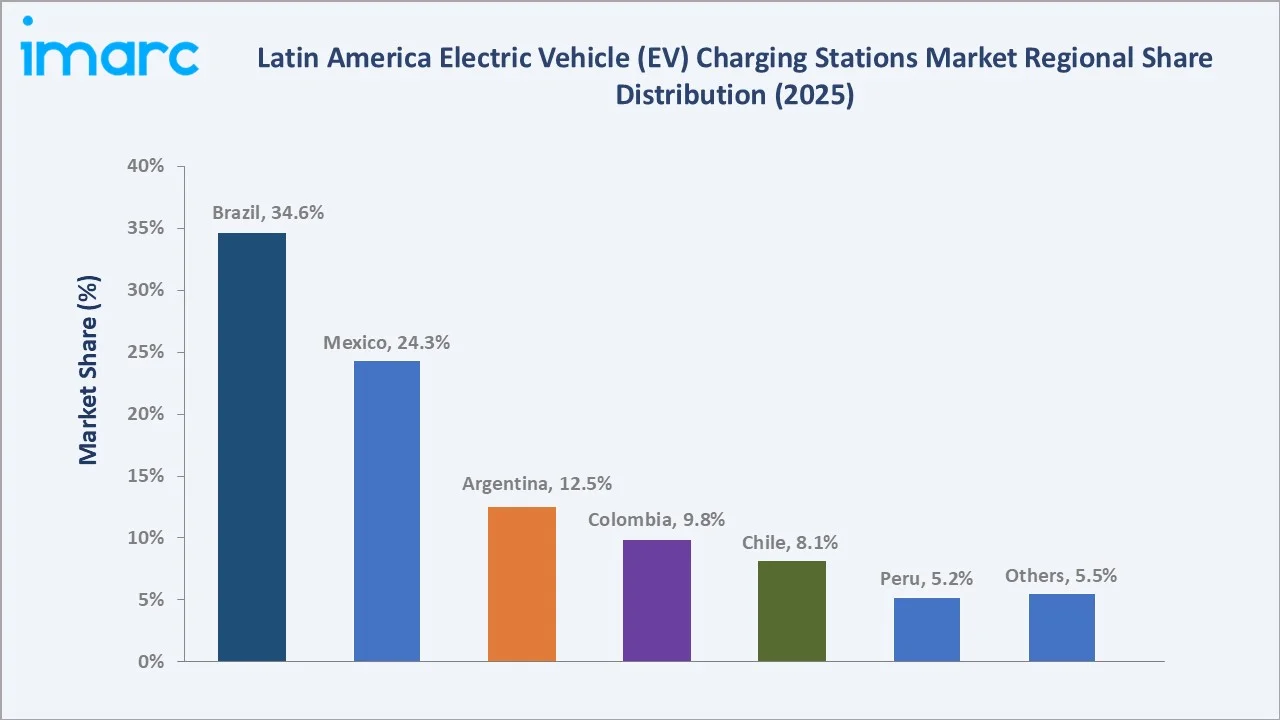
Chile's 8.1% through renewable energy integration and electric public transport programs. Peru's 5.2% and others at 5.5% witnessing gradual growth driven by sustainability goals, pilot projects, and rising awareness of electric mobility.
Competitive Landscape
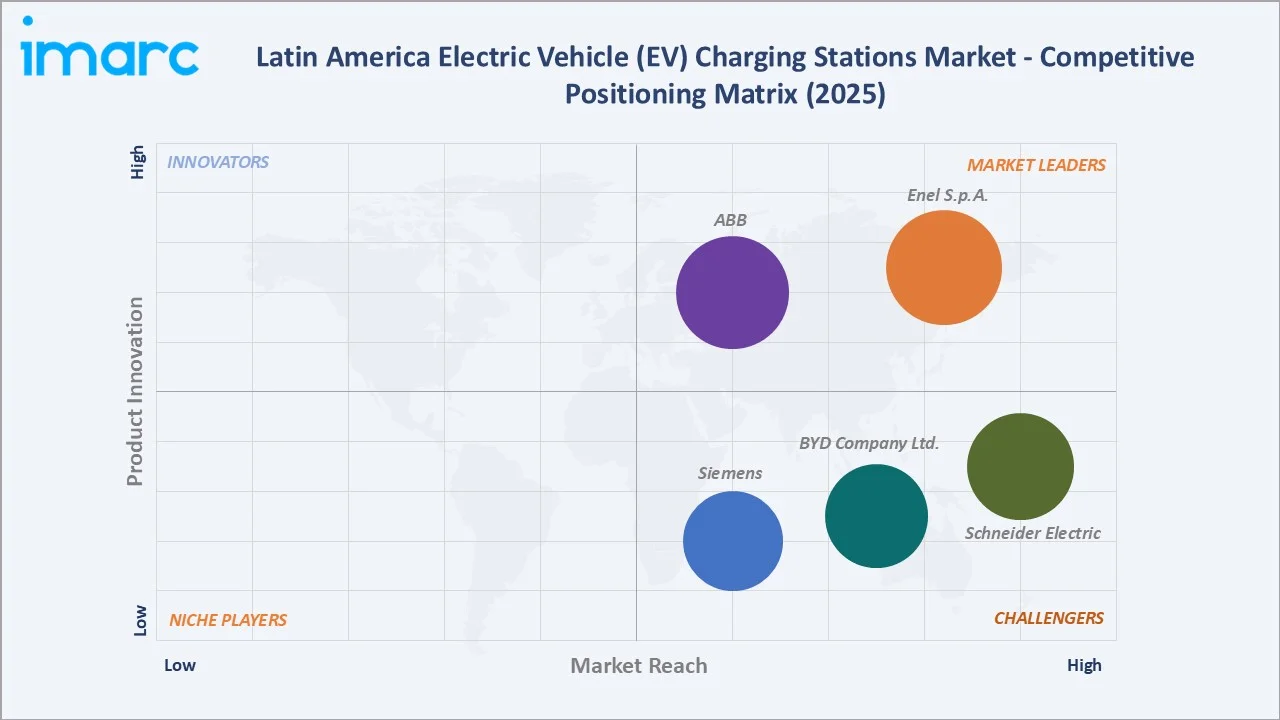
Latin America EV charging stations' competitive landscape is commercially stratified between utility-integrated CPO, EVSE hardware manufacturers, CPO software, OEM-integrated charging, and Latin American domestic brands.
|
Company |
Key Products |
Market Position |
Core Strength |
|
Enel S.p.A. |
Waybox, Waypole, Waypump |
Market Leader |
Enel S.p.A. is a dominant player in Latin America's electric vehicle (EV) charging infrastructure, driving the region's transition to sustainable mobility. |
|
ABB |
A400, C50, HVC360, HVC150 |
Market Leader |
ABB, through its ABB E-mobility, plays a leading role in electric vehicle (EV) charging infrastructure across Latin America, focusing on deploying high-power DC fast chargers, partnering for large-scale fleet electrification, and providing digital solutions for grid reliability. |
|
Schneider Electric |
Schneider Charge, Schneider Charge Pro, EVLink Pro DC, EVLink Pro AC |
Strong Challenger |
Schneider Electric plays a pivotal role in the Latin American electric vehicle (EV) charging market by providing end-to-end, integrated, and smart charging infrastructure. |
|
BYD Company Ltd. |
BYD-EVC-1SXP7, BYD-EVC-1SXP22, BYD-EVC-2SXM60, BYD-EVC-2SXM120 |
Strong Challenger |
BYD Company Ltd. is playing a leading, transformative role in the Latin American Electric Vehicle (EV) charging infrastructure market, transitioning from a focus on electric buses to rapidly expanding public and residential charging networks to support its dominant EV sales. |
|
Siemens |
SICHARGE D |
Strong Challenger |
Siemens plays a leading role in the Latin American electric vehicle (EV) charging station market by providing high-power charging infrastructure and grid integration expertise. |
The competitive landscape is evolving through Chinese EV brand integration, domestic Brazilian manufacturing, and solar-EV integration.
Key Company Profiles
Enel S.p.A.
Enel S.p.A. is one of the leading providers of electricity, renewable energy, and e-mobility solutions. Through its e-mobility business line, the company develops and operates EV charging infrastructure across residential, commercial, public, and fleet applications.
- Key Products: Waybox, Waypole, Waypump.
- Recent Developments: In May 2024, Enel X and Espacio Urbano launched a new large EV charging hub at Espacio Urbano Las Rejas in Estación Central, located in the underground parking levels -1 and -2. The facility is available during the day for private users and commercial vehicles involved in courier, delivery, and last-mile services. At night, the hub will primarily support transportation fleets, helping improve charging access for both individual and business EV users.
- Strategic Focus: Expanding its EV charging network across Latin America by leveraging its strong presence in electricity distribution and renewable energy markets.
ABB
ABB is a technology company specializing in electrification, automation, robotics, and digital solutions. Through its ABB E-mobility division, the company is a key player in EV charging infrastructure, offering a broad portfolio of AC chargers, DC fast chargers, high-power charging systems, and charging management software.
- Key Products: A400, C50, HVC360, HVC150.
- Strategic Focus: Strengthening its presence in Latin America through the deployment of high-power DC fast-charging solutions for public charging networks, commercial sites, and fleet operators.
Market Concentration Analysis
The Latin America EV charging stations market exhibits a moderately fragmented structure, with a mix of charging technology providers, utilities, charging point operators (CPOs), and regional mobility companies competing for market share. Regional operators and local energy companies are expanding rapidly, particularly in Brazil, Mexico, Chile, and Colombia. Market competition is centered on network expansion, DC fast-charging deployment, software integration, and fleet charging solutions. As EV adoption accelerates, consolidation through partnerships, joint ventures, and infrastructure investments is expected to increase, gradually strengthening the position of leading market participants.
Investment & Growth Opportunities
Highest Growth Segments
Inductive charging (~26.5% CAGR), DC charging (~23.8% CAGR), residential (~21.6% CAGR through home EV adoption), solar-EV integrated charging (~30-35% CAGR from small base), mining sector EV charging (~25-28% CAGR), and fleet hub charging (~22-25% CAGR through ride-hailing electrification) represent Latin America's highest-growth EV charging investment vectors through 2034.
Investment Themes
Brazil-Argentina Pan-American highway DC fast charging corridor investment: Investment in 50-175kW CCS2 DC fast charger creates existing-fuel-infrastructure-sited highway EVSE above dedicated greenfield charging site through fuel station's above-grid-connection single existing electrical infrastructure advantage.
Future Market Outlook (2026-2034)
Latin America EV charging stations market is projected to grow from USD 1.47 Billion in 2025 to USD 1.87 Billion in 2026, reaching USD 8.81 Billion by 2034, delivering a 21.35% CAGR over the forecast period, increasing in market value through EV fleet multiplication, highway corridor infrastructure completion, fleet electrification, and residential rollout, creating Latin America's emerging-market EV charging acceleration through green-energy advantage, government policy catalyst, and affordability democratizing. The market's anchor value of USD 3.87 Billion in 2030 represents Latin America's EV charging at a commercial inflection. Highway charging corridor creating inter-city EV viability, and ride-hailing fleet electrification.
Three structural forces define Latin America's EV charging growth through 2034: EV fleet multiplication, government policy cascade creates above-voluntary mandated EVSE investment through Latin American countries' progressive ZEV transition mandate and building code EVSE requirement, and renewable energy advantage creates green EV charging credential, making Latin America's EV the most commercially carbon-clean EV charging market.
Research Methodology
Primary Research
Primary research comprised interviews and discussions with industry stakeholders across the Latin America EV charging stations market. It included inputs from charging point operators, EVSE manufacturers, utilities, fleet operators, distributors, and technology providers. The research helped validate market trends, adoption patterns, pricing structures, installation challenges, and demand outlook. These insights were used to cross-check secondary findings and strengthen the overall market assessment.
Secondary Research
Secondary research encompassed an extensive review of company annual reports, investor presentations, government publications, regulatory documents, industry associations, EV mobility reports, and utility sector databases. It also included analysis of company websites, press releases, charging network data, and reputable industry journals to assess market size, competitive landscape, technology trends, and infrastructure developments.
Forecasting Models
Market revenue forecasts developed using EV fleet charging infrastructure penetration model: Latin American new EV sales by country multiplied by EVSE-to-EV ratio, multiplied by average EVSE installed cost and lifetime by type.
Latin America Electric Vehicle (EV) Charging Stations Market Report Coverage:
| Report Features | Details |
|---|---|
| Base Year of the Analysis | 2025 |
| Historical Period | 2020-2025 |
| Forecast Period | 2026-2034 |
| Units | Billion USD |
| Scope of the Report |
Exploration of Historical Trends and Market Outlook, Industry Catalysts and Challenges, Segment-Wise Historical and Future Market Assessment:
|
| Charging Station Types Covered | AC Charging, DC Charging, Inductive Charging |
| Vehicle Types Covered | Battery Electric Vehicle (BEV), Plug-in Hybrid Electric Vehicle (PHEV), Hybrid Electric Vehicle (HEV) |
| Installation Types Covered | Portable Charger, Fixed Charger |
| Charging Levels Covered | Level 1, Level 2, Level 3 |
| Connector Types Covered | Combines Charging Station (CCS), CHAdeMO, Normal Charging, Tesla Supercharger, Type-2 (IEC 621196), Others |
| Applications Covered | Residential, Commercial |
| Regions Covered | Brazil, Mexico, Argentina, Colombia, Chile, Peru, Others |
| Companies Covered | Enel S.p.A., ABB, Schneider Electric, BYD Company Ltd., Siemens, etc. |
| Customization Scope | 10% Free Customization |
| Post-Sale Analyst Support | 10-12 Weeks |
| Delivery Format | PDF and Excel through Email (We can also provide the editable version of the report in PPT/Word format on special request) |
Key Benefits for Stakeholders:
- IMARC’s industry report offers a comprehensive quantitative analysis of various market segments, historical and current market trends, market forecasts, and dynamics of the Latin America electric vehicle (EV) charging stations market from 2020-2034.
- The research report provides the latest information on the market drivers, challenges, and opportunities in the Latin America electric vehicle (EV) charging stations market.
- Porter's five forces analysis assist stakeholders in assessing the impact of new entrants, competitive rivalry, supplier power, buyer power, and the threat of substitution. It helps stakeholders to analyze the level of competition within the Latin America electric vehicle (EV) charging stations industry and its attractiveness.
- Competitive landscape allows stakeholders to understand their competitive environment and provides an insight into the current positions of key players in the market.
Frequently Asked Questions About the Latin America Electric Vehicle (EV) Charging Stations Market Report
The Latin America EV charging stations market size is estimated at USD 1.87 Billion in 2026, driven by rapid EV sales growth, especially in Brazil and Mexico, which is increasing the need for accessible public and private charging infrastructure. Rising fuel costs, clean mobility policies, and decarbonization targets are encouraging consumers, fleets, and governments to shift toward electric mobility. Expansion of ride-hailing, taxi, logistics, and electric bus fleets is further boosting demand for depot and fast-charging solutions. Growing investments by utilities, charging operators, automakers, and commercial property owners are also accelerating network deployment across the region.
The Latin America EV charging stations market grows at 21.35% CAGR during 2026-2034, reaching USD 8.81 Billion by 2034. The overall CAGR reflects EV fleet multiplication through Chinese EV brand affordability, government building code EVSE mandate, highway corridor completion, and Latin America's renewable electricity advantage, creating green EV charging credential.
AC charging leads at 56.4% through commercial Level 2 AC EVSE deployment at shopping malls, hotels, corporate campuses, and fleet depots, creating the most commercially urban dwell-time AC charging installation above DC's above-highway single fast-charge application.
Commercial leads at 63.7% through shopping malls, hotels, corporate campuses, fleet depots, and ride-hailing hub EVSE, creating Latin America's most commercially CPO-operated revenue-generating charging network.
Brazil leads at 34.6% through a utility-integrated public charging network, factory domestic EV manufacturing, a regulated EV charging framework, and Brazil's renewable electricity grid, creating the EV charging credential.
Leading companies include Enel S.p.A., ABB, Schneider Electric, BYD Company Ltd., and Siemens, among others.
The market is projected to reach approximately USD 3.87 Billion by 2030, with the electric bus fleet and highway corridor completing commercial EV highway travel.
Three priority investment opportunities: Brazil-Argentina Pan-American highway DC fast charging corridor, São Paulo and Mexico City ride-hailing fleet charging hubs, and solar-EV charging hub for the Pan-American highway.
Need more help?
- Speak to our experienced analysts for insights on the current market scenarios.
- Include additional segments and countries to customize the report as per your requirement.
- Gain an unparalleled competitive advantage in your domain by understanding how to utilize the report and positively impacting your operations and revenue.
- For further assistance, please connect with our analysts.
 Request Customization
 Speak to an Analyst
 Request Brochure
 Inquire Before Buying
Benefits of Customization
- Personalize this research
- Triangulate with your data
- Get data as per your format and definition
- Gain a deeper dive into a specific application, geography, customer, or competitor
- Any level of personalization
Get in Touch With Us
UNITED STATES
Phone: +1-201-971-6302
INDIA
Phone: +91-120-433-0800
UNITED KINGDOM
Phone: +44-753-714-6104
Email: [email protected]
Client Testimonials




.webp)




.webp)













Related Reports

Choose your plan
*Please note that the prices mentioned below are starting prices for each bundle type. Kindly contact our team for further details.*
Single User License
- 1 User License, Access on 2 Devices
- PDF Report + Excel Dataset (Password Protected)
- Lifetime Access
- No Printing Rights
- 10% Free Report Customization
- 10–12 Weeks of Analyst Support
Five User License
- Access for 5 Users, 2 Devices per User
- PDF Report + Excel Dataset (Password Protected)
- Lifetime Access
- Dedicated Account Manager
- 12–14 Weeks of Analyst Support
- No Printing Rights
- 15% Free Report Customization
- 25% Discount on Your Next Purchase
Corporate User License
- Unlimited User Access (Within Your Organization)
- PDF Report + Excel Dataset
- Lifetime Access
- Dedicated Account Manager
- 14–20 Weeks of Analyst Support
- No Printing Rights
- 20% Free Report Customization
- 30% Discount on Your Next Purchase
Essential Insights
What's included:
3 reports
- Lifetime Access
- PDF Reports
- Excel Datasets
- 2 Weeks of Free Analyst Support
- 2 User Licenses
- Access on 2 Devices
- Printing Rights
- Complimentary PowerPoint (PPT) Version
- Complimentary License Upgrade
Professional Access
What's included:
5 reports
- Lifetime Access
- PDF Reports
- Excel Datasets
- 8 Weeks of Free Analyst Support
- 2 User Licenses
- Access on 2 Devices
- Printing Rights
- Complimentary PowerPoint (PPT) Version
- Complimentary License Upgrade
Business Advantage
What's included:
8 reports
- Lifetime Access
- PDF Reports
- Excel Datasets
- 14 Weeks of Free Analyst Support
- 2 User Licenses
- Access on 2 Devices
- Printing Rights
- Complimentary PowerPoint (PPT) Version
- Complimentary License Upgrade
Enterprise Intelligence
What's included:
10 reports
- Lifetime Access
- PDF Reports
- Excel Datasets
- 20 Weeks of Free Analyst Support
- 2 User Licenses
- Access on 2 Devices
- Printing Rights
- Complimentary PowerPoint (PPT) Version
- Complimentary License Upgrade