
Mexico Blockchain Market Size, Share, Trends and Forecast by Component, Provider, Type, Deployment Mode, Organization Size, Vertical, and Region, 2026-2034
Mexico Blockchain Market Size, Share, Trends & Forecast (2026-2034)
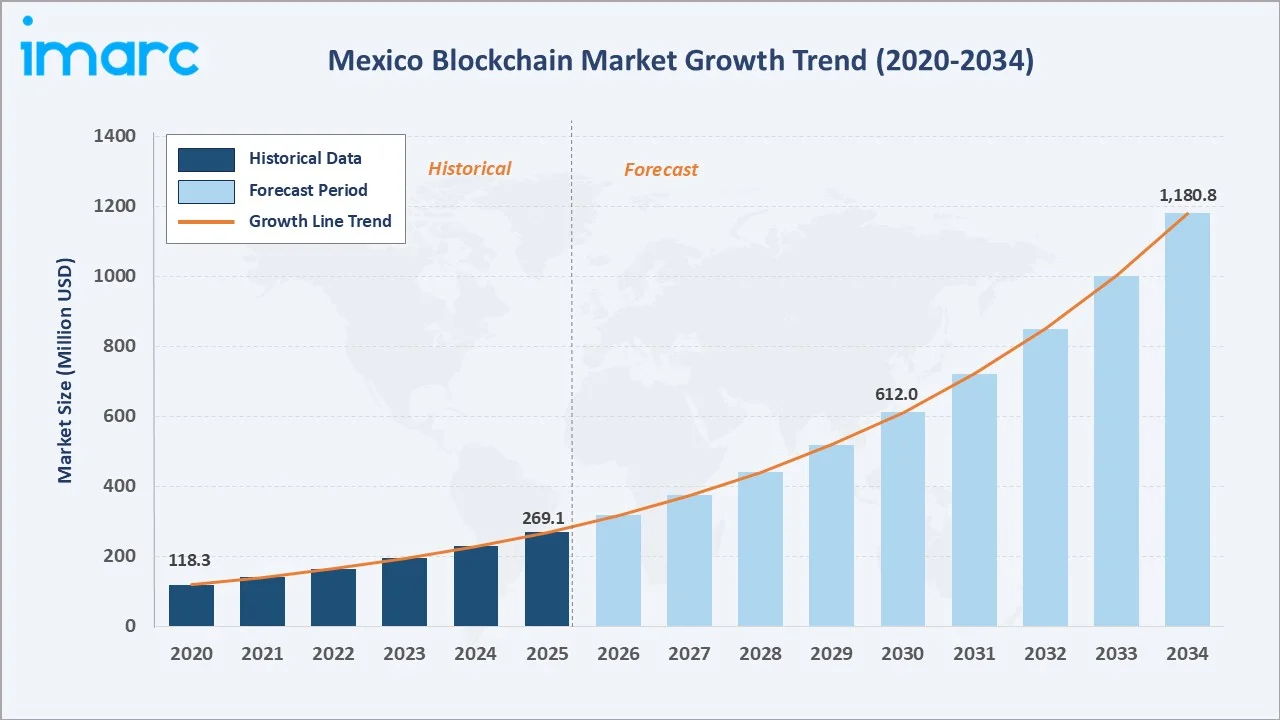
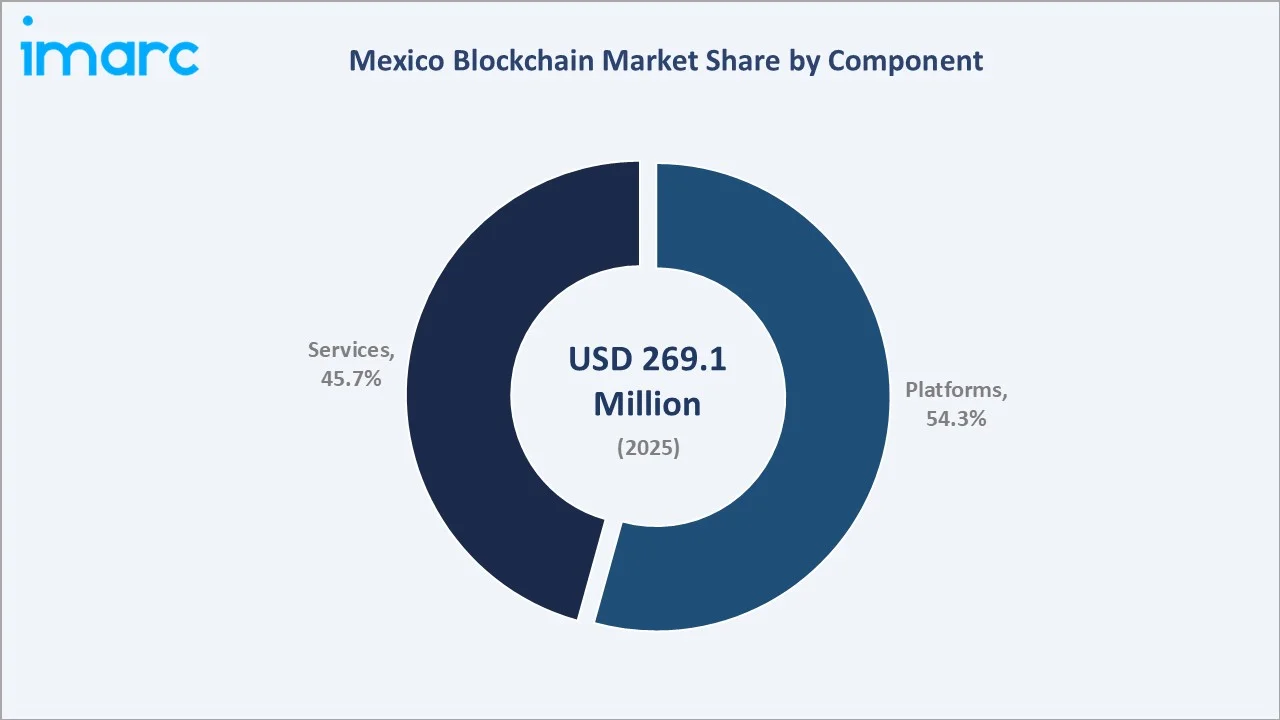
The Mexico blockchain market reached USD 269.1 Million in 2025 and is projected to reach USD 1,180.8 Million by 2034, growing at a CAGR of 17.86% during 2026-2034. The market is driven by expanding financial inclusion, government-led digital transformation, and growing enterprise demand for secure, transparent transaction infrastructure. Mexico's large remittance economy accelerates blockchain payment adoption. Platforms dominate at 54.3%. Application Provider leads at 39.8%. Central Mexico commands 44.6% of the national market share.
Market Snapshot
|
Metric |
Value |
|
Market Size (2025) |
USD 269.1 Million |
|
Forecast Market Size (2034) |
USD 1,180.8 Million |
|
CAGR (2026-2034) |
17.86% |
|
Base Year |
2025 |
|
Historical Period |
2020-2025 |
|
Forecast Period |
2026-2034 |
|
Dominant Component |
Platforms (54.3%, 2025) |
|
Dominant Provider |
Application Provider (39.8%, 2025) |
|
Leading Region |
Central Mexico (44.6%, 2025) |
The Mexico blockchain market expanded from USD 118.3 Million in 2020 to USD 269.1 Million in 2025, anchored at USD 612.0 Million in 2030, and forecast to reach USD 1,180.8 Million by 2034. Mexico's Fintech Law of 2018 established an early regulatory foundation, attracting global blockchain investment and enabling ecosystem development across financial services and enterprise verticals.
To get more information on this market, Request Sample
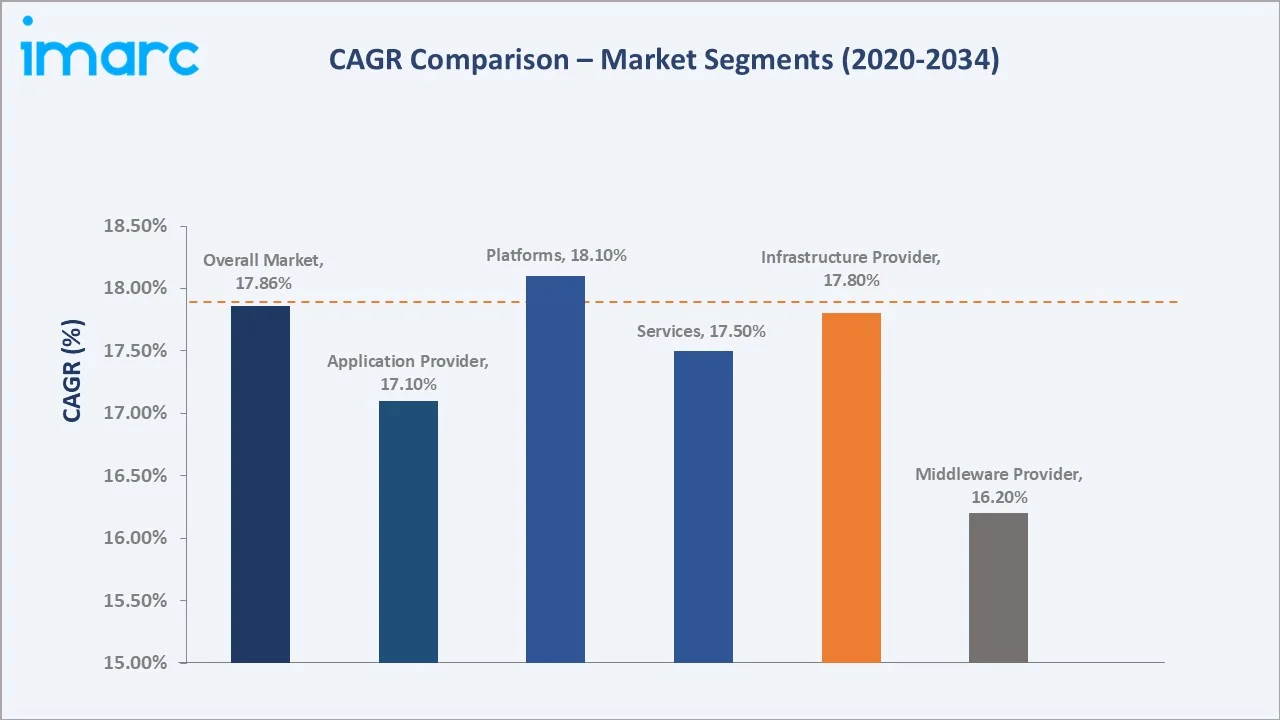
Application providers lead due to high demand for blockchain-based applications in fintech, supply chain, and government services. Platforms dominate as enterprises prefer ready-to-deploy blockchain frameworks over custom builds. Services component maintains strong growth via consulting and managed services expanding rapidly across verticals.
Executive Summary
The Mexico blockchain market reached USD 269.1 Million in 2025, representing one of Latin America's most dynamic technology adoption markets, driven by Mexico's large remittance economy, progressive fintech regulation, and growing enterprise digitization mandates. The market encompasses blockchain platforms, professional services, managed services, infrastructure provision, and application development spanning financial, supply chain, government, and healthcare verticals.
Platforms at 54.3% dominate through enterprise adoption of pre-built blockchain frameworks, enabling faster deployment timelines and reduced development costs. Application providers at 39.8% lead through the high commercial value of blockchain applications in payment processing and supply chain transparency. Central Mexico at 44.6% leads through concentration of financial institutions and technology enterprises in Mexico City.
Key Market Insights
|
Insight |
Data |
|
Dominant Component |
Platforms - 54.3% share (2025) |
|
Dominant Provider |
Application Provider - 39.8% market share (2025) |
|
Leading Region |
Central Mexico - 44.6% market share |
|
Market Opportunity |
CBDC pilot expansion; cross-border remittance blockchain; supply chain traceability; DeFi platform growth; smart contract automation; government digital identity |
Key Analytical Observations Supporting the Above Data:
- Application Provider at 39.8%: Blockchain-enabled remittance payment systems, tokenized cross-border settlement, and digital asset trading platforms constitute the application provider segment's primary revenue base.
- Platforms at 54.3%: Enterprise-grade blockchain platforms from IBM, Microsoft Azure, and Hyperledger provide the foundation for rapid deployment across banking, logistics, and government use cases.
- Central Mexico at 44.6%: Mexico City's concentration of banks, fintechs, multinational corporations, and government agencies creates the dominant adoption cluster for blockchain solutions nationally.
Mexico Blockchain Market Overview
The Mexico blockchain market encompasses the development, deployment, and operation of distributed ledger technology solutions across enterprise, government, and financial service contexts. The market covers blockchain platform licensing, infrastructure provisioning, professional implementation services, managed operations services, and custom application development.
Macroeconomic factors include Mexico's USD 66+ Billion annual remittance inflow, growing digital financial services adoption, government-mandated open banking regulations, and enterprise demand for transparent supply chain infrastructure. In addition, cryptocurrency exchange growth, Fintech Law implementation, and central bank digital currency exploration are accelerating blockchain adoption nationwide.
Market Dynamics
To evaluate market opportunities, Request Sample
Market Drivers
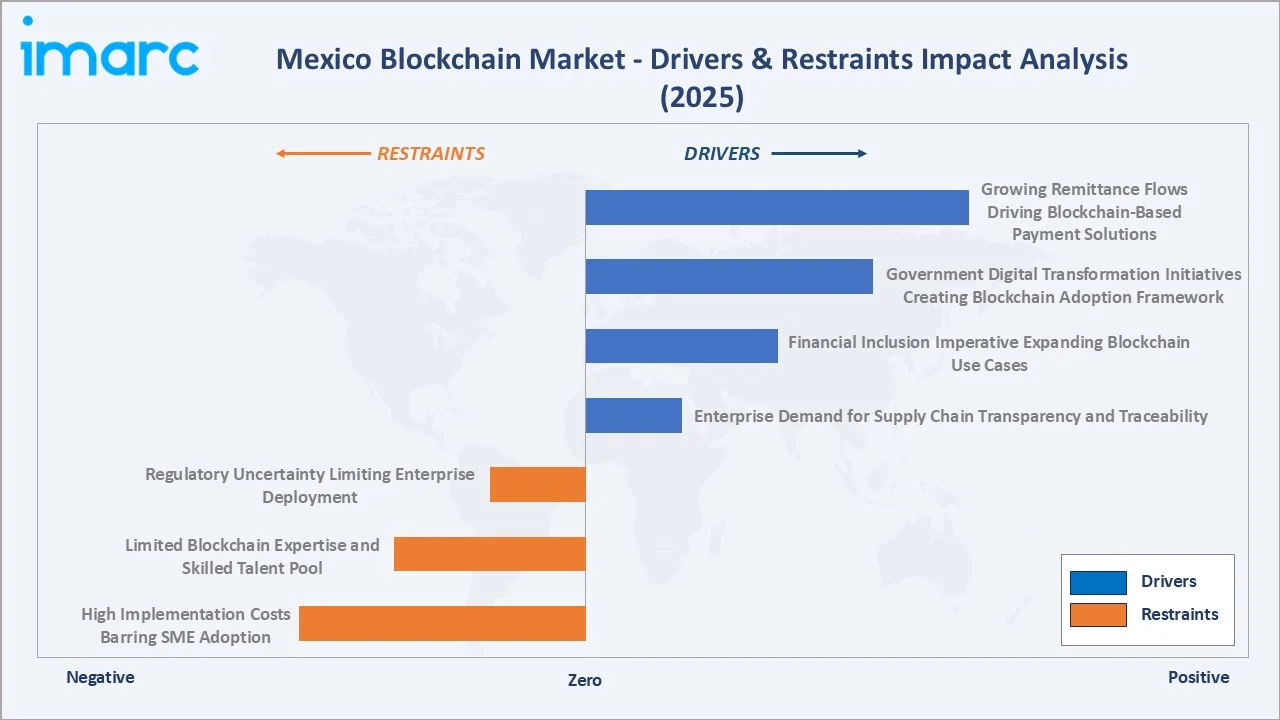
- Growing Remittance Flows Driving Blockchain-Based Payment Solutions: Growing remittance inflows are driving demand for blockchain-based payment rails that reduce cost and settlement time. Financial institutions and fintechs are deploying distributed ledger solutions to capture this high-volume transaction market and improve cross-border transfer efficiency for millions of Mexicans.
- Government Digital Transformation Initiatives Creating Blockchain Adoption Framework: Government digital transformation programs are creating structured demand for blockchain in identity management, tax administration, and public procurement. Regulatory frameworks supporting distributed ledger adoption establish market legitimacy and encourage enterprise investment in blockchain infrastructure across regulated sectors.
- Financial Inclusion Imperative Expanding Blockchain Use Cases: Mexico's large unbanked and underbanked population creates significant market opportunity for blockchain-enabled financial inclusion tools. Decentralized finance platforms, microfinance applications, and digital wallet solutions are expanding access to financial services for segments previously excluded from traditional banking.
- Enterprise Demand for Supply Chain Transparency and Traceability: Manufacturing, retail, and logistics enterprises are deploying blockchain for end-to-end supply chain visibility and product authentication. Regulatory requirements for food safety and pharmaceutical traceability are accelerating adoption as companies invest in distributed ledger solutions to meet compliance mandates and reduce fraud.
Market Restraints
- Regulatory Uncertainty Limiting Enterprise Deployment: Ambiguous regulatory treatment of smart contracts, tokenized assets, and decentralized applications limits enterprise willingness to commit substantial investment to blockchain infrastructure until clear legal frameworks are established across all relevant use cases and sectors.
- Limited Blockchain Expertise and Skilled Talent Pool: Mexico faces a significant shortage of blockchain developers, smart contract auditors, and distributed systems architects. This talent gap increases implementation timelines, raises project costs, and forces organizations to rely on expensive foreign consultants, limiting the scalability of blockchain adoption.
- High Implementation Costs Barring SME Adoption: Enterprise blockchain implementation requires significant upfront investment in infrastructure, software licensing, system integration, and change management. These costs place blockchain adoption beyond the reach of most small and medium enterprises, concentrating market benefits among large corporations.
Market Opportunities
- CBDC Exploration Creating Government-Backed Blockchain Infrastructure Demand: Mexico's central bank is actively exploring digital peso issuance and blockchain-based payment infrastructure. A successful CBDC launch would create substantial demand for blockchain middleware, integration services, and compliance solutions across the entire Mexican financial system.
- Cross-Border Trade Digitization Opportunity through USMCA Supply Chain Blockchain: Mexico's position as a major manufacturing hub creates strong demand for blockchain-based trade documentation, customs clearance, and cross-border supply chain coordination with North American trading partners under the USMCA framework.
Market Challenges
- Legacy System Integration Complexity: Many traditional enterprises in Mexico operate on legacy ERP and database systems incompatible with blockchain protocols. Achieving seamless integration between distributed ledgers and existing IT infrastructure requires substantial middleware development, creating technical barriers that slow adoption cycles.
- Data Privacy Compliance Complexity in Blockchain Architecture: Blockchain's distributed, immutable record-keeping creates tension with Mexico's data protection regulations. Enterprises must navigate complex compliance requirements for data residency and cross-border data transfer restrictions that constrain blockchain architecture choices.
Emerging Market Trends
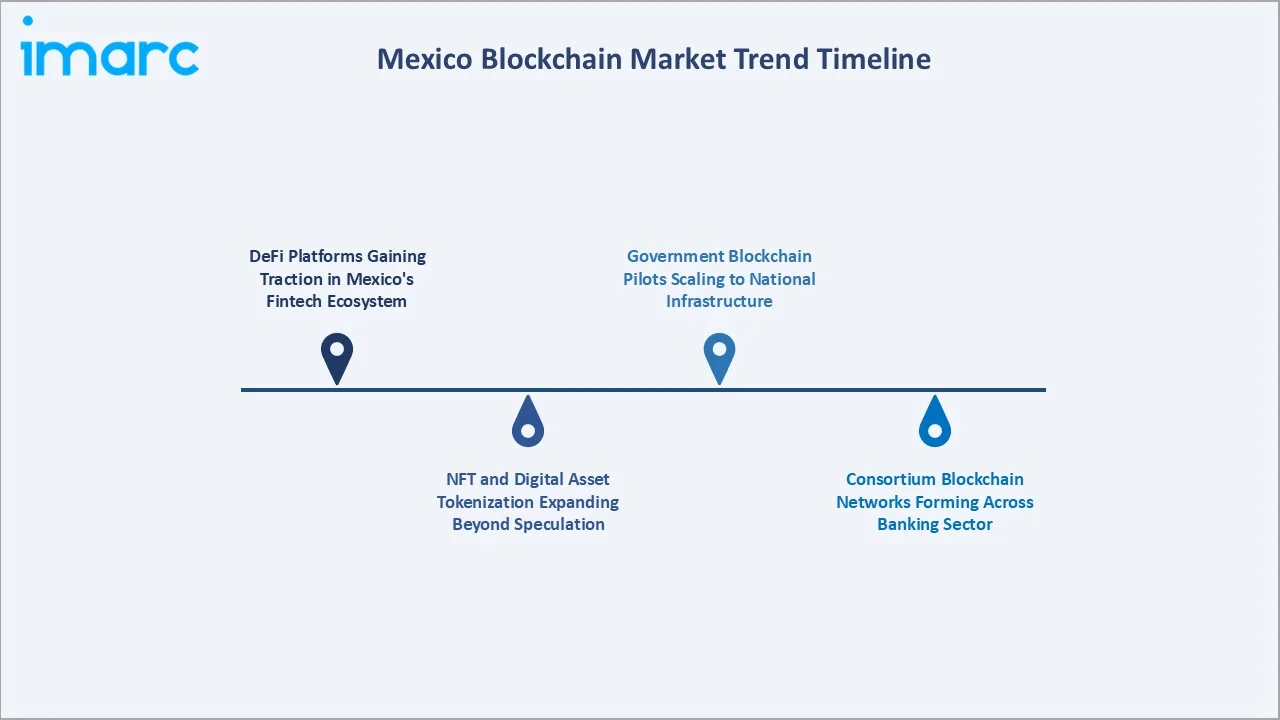
1. DeFi Platforms Gaining Traction in Mexico's Fintech Ecosystem
Decentralized finance platforms are attracting Mexican consumers and businesses seeking alternatives to traditional banking. DeFi protocols offering lending, yield farming, and tokenized assets are growing as regulatory tolerance increases and smartphone penetration enables broader access. Mexico's young demographic profile and high mobile internet adoption creates a receptive market for DeFi-based financial services.
2. NFT and Digital Asset Tokenization Expanding Beyond Speculation
Non-fungible token applications are moving beyond collectibles toward real estate tokenization, intellectual property rights management, and cultural heritage asset digitization. Mexican enterprises are exploring tokenization for real estate investment democratization and supply chain asset tracking, creating new blockchain application demand.
3. Consortium Blockchain Networks Forming Across Banking Sector
Major Mexican banks and financial institutions are establishing consortium blockchain networks for interbank settlement, trade finance, and KYC data sharing. These industry-wide initiatives reduce individual implementation costs, establish interoperability standards, and accelerate the transition from blockchain pilots to production-scale deployments.
4. Government Blockchain Pilots Scaling to National Infrastructure
Federal and state government agencies are transitioning blockchain pilots in land registry, business registration, and healthcare records management to full-scale national deployment. These government applications create standardized blockchain infrastructure that private sector enterprises can leverage for regulatory compliance and public-private data sharing.
Industry Value Chain Analysis
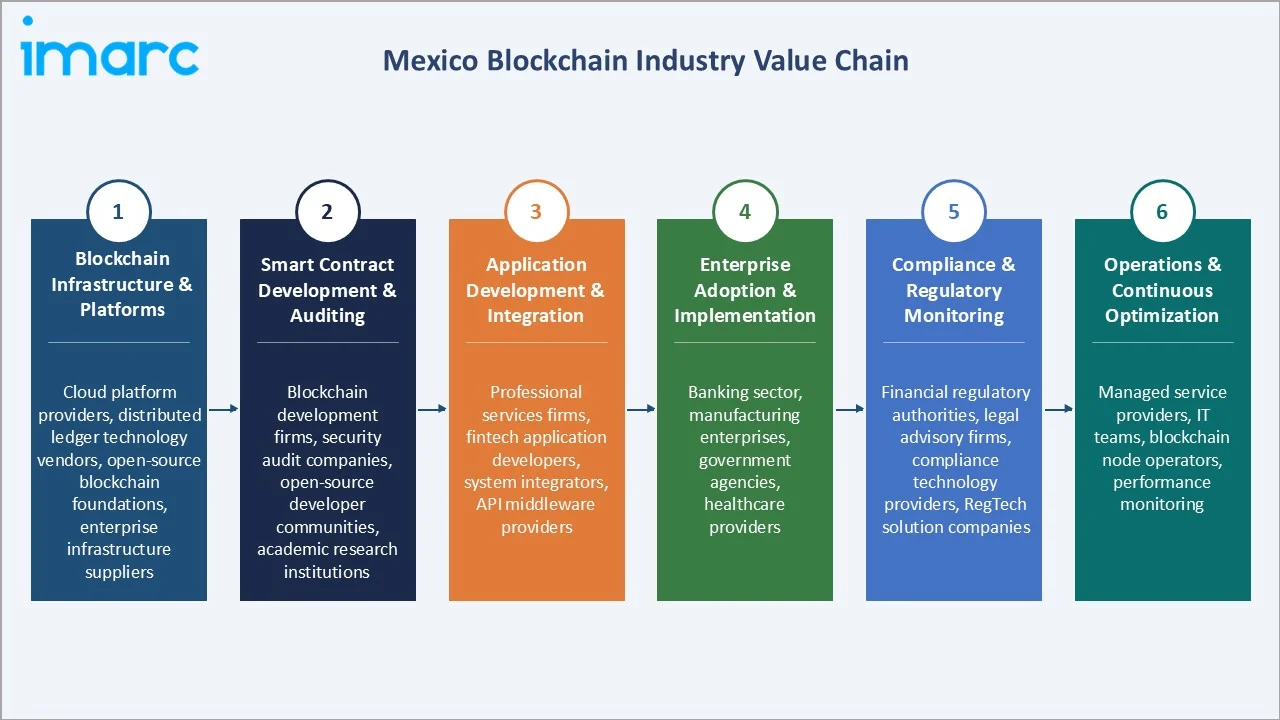
The Mexico blockchain market value chain integrates technology infrastructure provisioning, platform development, application creation, enterprise implementation, compliance management, and ongoing operations optimization.
|
Stage |
Key Participants |
|
Blockchain Infrastructure & Platforms |
Cloud platform providers, distributed ledger technology vendors, open source blockchain foundations, enterprise infrastructure suppliers |
|
Smart Contract Development & Auditing |
Blockchain development firms, security audit companies, open-source developer communities, academic research institutions |
|
Application Development & Integration |
Professional services firms, fintech application developers, system integrators, API middleware providers |
|
Enterprise Adoption & Implementation |
Banking sector, manufacturing enterprises, government agencies, healthcare providers |
|
Compliance & Regulatory Monitoring |
Financial regulatory authorities, legal advisory firms, compliance technology providers, RegTech solution companies |
|
Operations & Continuous Optimization |
Managed service providers, IT operations teams, blockchain node operators, performance monitoring companies |
The application development and integration stage is the value chain's highest-margin tier, commanding premium fees for custom blockchain solution development and legacy system integration expertise. The compliance and regulatory monitoring layer creates recurring revenue streams as enterprises require ongoing guidance navigating Mexico's evolving blockchain legal framework.
Technology Landscape in the Mexico Blockchain Market
Hyperledger Fabric and Enterprise Permissioned Blockchain
Hyperledger Fabric dominates enterprise blockchain deployments in Mexico's banking and supply chain sectors through its permissioned architecture enabling controlled participant access and transaction privacy. Its modular framework supports compliance with Mexico's data sovereignty and financial privacy requirements while delivering performance characteristics required for high-volume enterprise transaction processing.
Ethereum and Smart Contract Platforms
Ethereum and Ethereum-compatible networks support the majority of Mexico's DeFi applications, NFT platforms, and tokenization projects. The extensive developer ecosystem, comprehensive smart contract tooling, and established security audit practices make Ethereum-based platforms the preferred choice for application developers building consumer-facing blockchain products in Mexico.
Cross-Chain Interoperability Protocols
As Mexico's blockchain ecosystem diversifies across multiple networks, cross-chain interoperability protocols enabling asset and data transfer between different blockchain networks become increasingly critical. Bridge technology and interoperability middleware are emerging as key infrastructure components enabling enterprises to leverage multiple blockchain networks within integrated business processes.
Market Segmentation Analysis
The report covers the following segments:
|
Segment Category |
Leading Segment |
Market Share |
Year |
|
Component |
Platforms |
54.3% |
2025 |
|
Provider |
Application Provider |
39.8% |
2025 |
|
Type |
🔒 |
🔒 |
2025 |
|
Deployment Mode |
🔒 |
🔒 |
2025 |
|
Organization Size |
🔒 |
🔒 |
2025 |
|
Vertical |
🔒 |
🔒 |
2025 |
|
Region |
Central Mexico |
44.6% |
2025 |

By Component
Platforms lead at 54.3% (2025). The platforms segment encompasses enterprise blockchain frameworks including Hyperledger Fabric, IBM Blockchain, Microsoft Azure Blockchain, and Ethereum-based enterprise platforms. These ready-to-deploy technology stacks reduce implementation timelines and development costs, making blockchain adoption accessible to a broader range of enterprises.
To access detailed market analysis, Request Sample
Services at 45.7% encompasses professional implementation services, blockchain strategy consulting, smart contract development and audit, system integration services, training programs, and managed blockchain operations. Services growth accelerates as enterprise adoption expands beyond pilot projects to production-scale deployment requiring sustained operational support.
By Provider
Application providers lead at 39.8% (2025). The application provider segment encompasses blockchain application developers creating fintech platforms, supply chain solutions, digital identity systems, and government services applications. Mexico's vibrant fintech ecosystem creates strong demand for blockchain application development expertise targeting the country's large unbanked population and digital payment market.
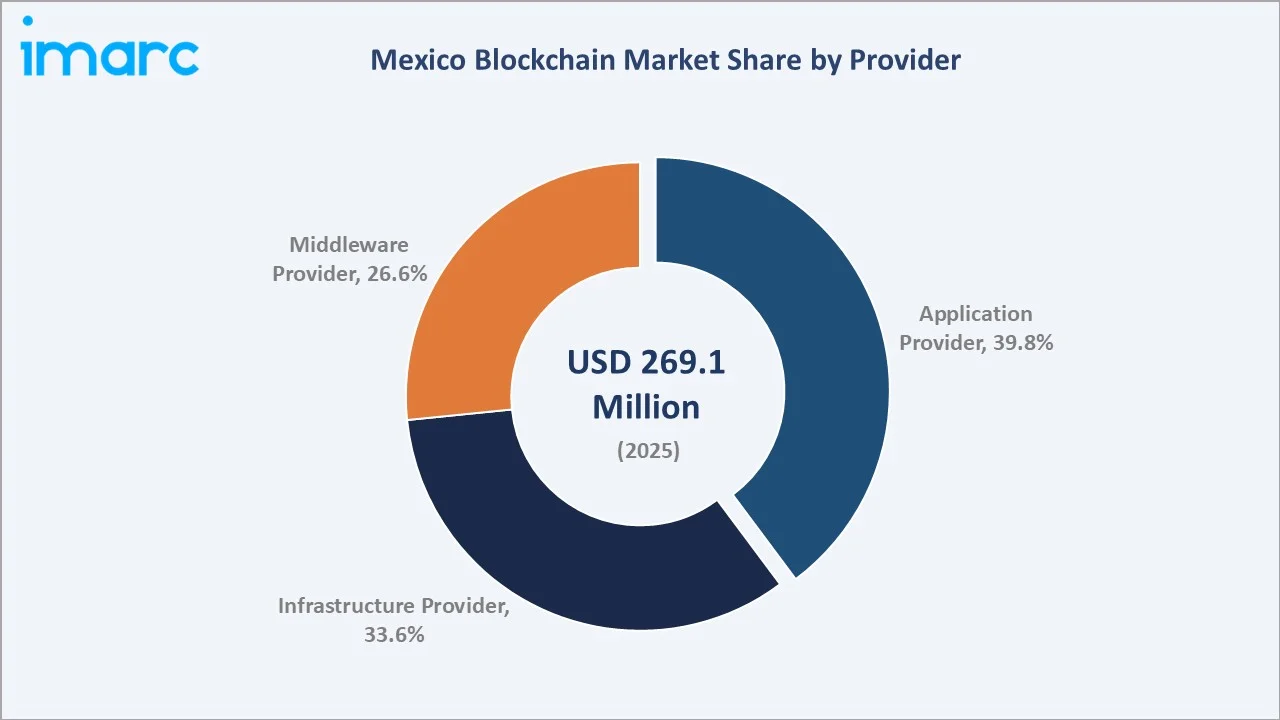
Infrastructure providers at 33.6% supply the computing hardware, cloud infrastructure, and network connectivity required for blockchain node operation and distributed ledger maintenance. Middleware providers at 26.6% deliver API integration, data translation, and protocol bridging solutions enabling blockchain networks to connect with existing enterprise systems.
Regional Market Insights
|
Region |
Share (2025) |
Key Mexico Blockchain Market Drivers & Characteristics |
|
Central Mexico |
44.6% |
Driven by concentration of financial institutions, technology enterprises, and government digital transformation initiatives in Mexico City metropolitan area. |
|
Northern Mexico |
31.9% |
Supported by manufacturing and maquiladora sector blockchain adoption for supply chain management and USMCA trade compliance across border with the United States. |
|
Southern Mexico |
18.3% |
Driven by agricultural supply chain traceability demand, growing financial inclusion initiatives, and government programs expanding digital infrastructure in underserved communities. |
|
Others |
5.2% |
Encompasses emerging blockchain adoption in tourism, hospitality, and local government digital services across coastal and regional markets. |
Central Mexico's 44.6% market leadership is anchored by Mexico City's dual position as the country's financial capital and primary technology innovation hub. Northern Mexico's 31.9% reflects the Monterrey industrial cluster and maquiladora sector's growing blockchain adoption for cross-border supply chain management and manufacturing traceability.
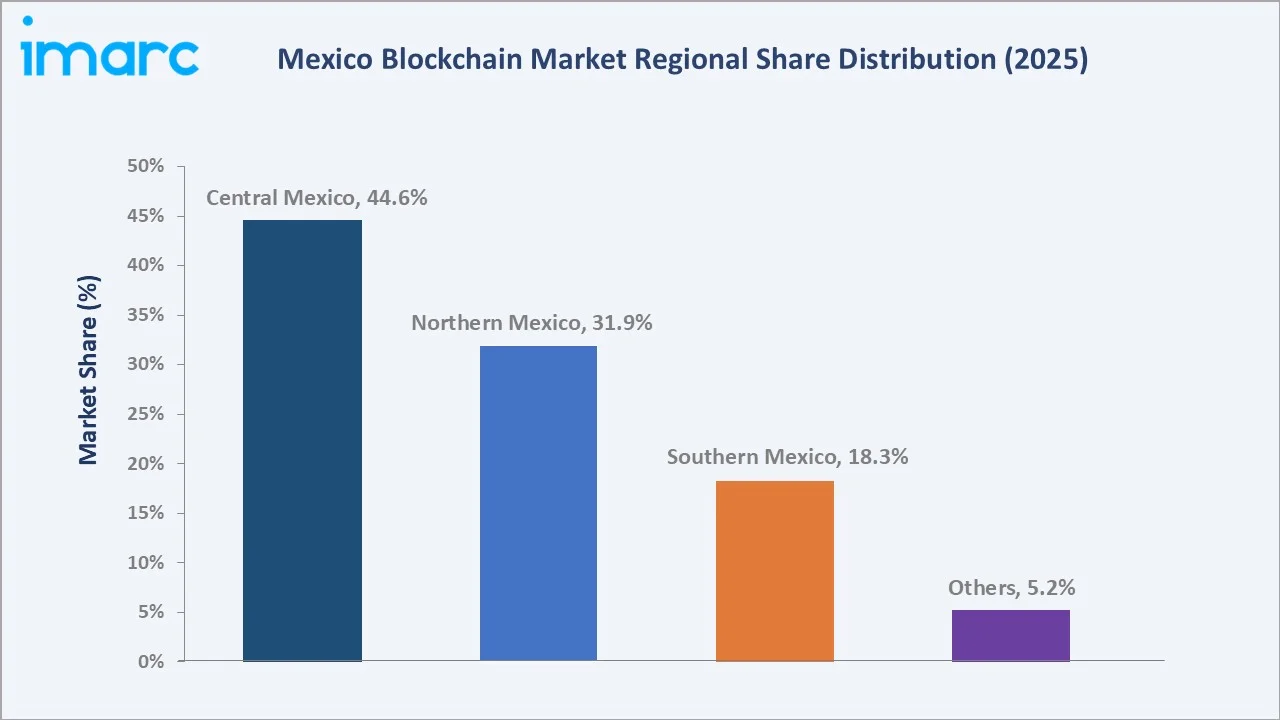
Southern Mexico's 18.3% encompasses agricultural blockchain applications for coffee and avocado supply chain transparency, financial inclusion platforms targeting unbanked rural populations, and emerging government blockchain programs for land registry and social benefit distribution. Others at 5.2% represents nascent adoption in tourism and regional markets.
Competitive Landscape
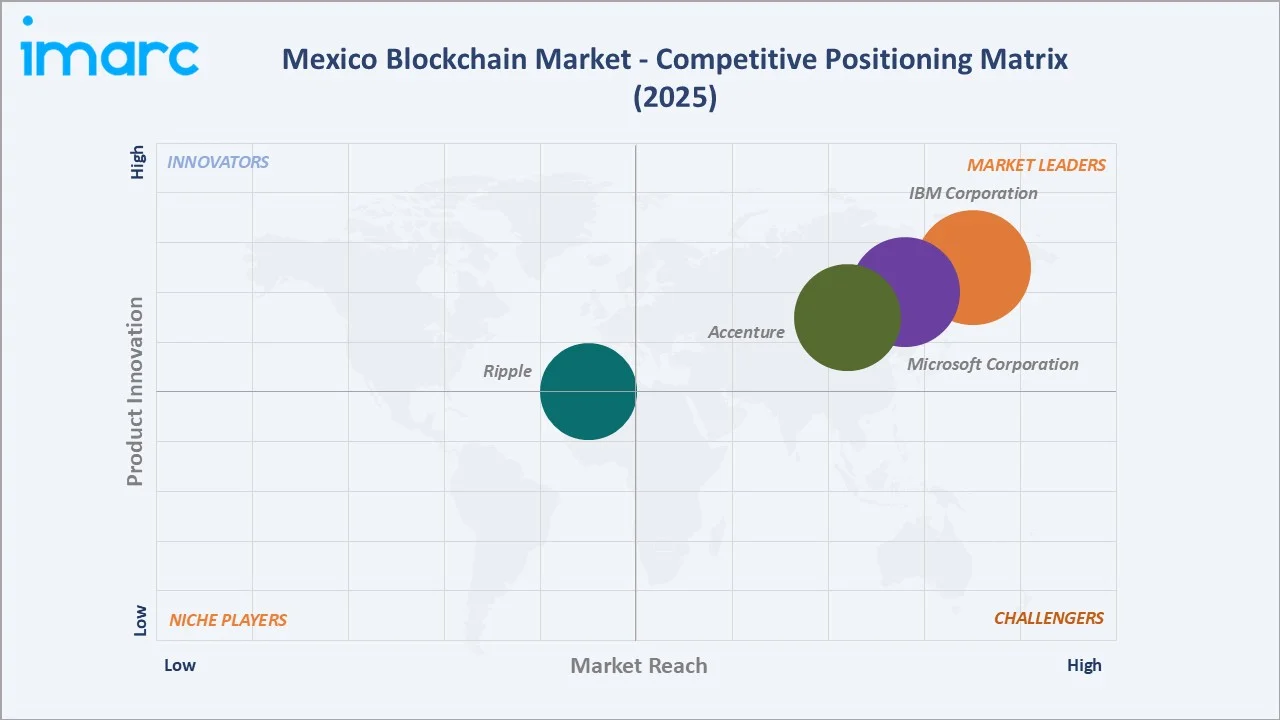
The Mexico blockchain market competitive landscape encompasses distinct tiers: global technology platforms, enterprise systems integrators, specialized blockchain solution providers, and domestic fintech companies deploying blockchain infrastructure.
|
Company Name |
Key Products |
Market Position |
Core Strength |
|
IBM Corporation |
IBM Blockchain Platform, IBM Food Trust |
Market Leader |
IBM plays a central role in Mexico's blockchain market by providing enterprise Hyperledger Fabric deployments across banking, supply chain, and government sectors. |
|
Microsoft Corporation |
Azure Confidential Ledger |
Market Leader |
Microsoft provides cloud-based blockchain infrastructure and platform services enabling Mexican enterprises to deploy distributed ledger solutions with minimal infrastructure investment. |
|
Accenture |
Accenture Blockchain Platform |
Market Leader |
Accenture delivers end-to-end blockchain implementation services for Mexico's financial and government sectors, combining technical expertise with deep regulatory and industry knowledge. |
|
Ripple |
Payments, Custody, Stablecoin |
Established layer |
Ripple provides cross-border payment blockchain infrastructure to Mexican financial institutions, enabling faster and lower-cost international transfers through its distributed ledger network. |
Global technology platform concentration at the infrastructure layer creates significant competitive advantages for established players through existing client relationships and integration capabilities. Domestic fintech companies' deep knowledge of Mexico's remittance economy and underbanked population needs creates competitive differentiation for locally-developed blockchain payment solutions.
Key Company Profiles
IBM Corporation
IBM Corporation is a global technology leader providing enterprise blockchain solutions through its Hyperledger Fabric-based IBM Blockchain Platform. IBM's consulting division delivers end-to-end implementation services across Mexico's banking, supply chain, and government sectors, making it the dominant enterprise blockchain provider in the market.
- Key Products: IBM Blockchain Platform, IBM Food Trust, IBM TradeLens, IBM Sterling Supply Chain.
- Strategic Focus: Focused on enterprise permissioned blockchain deployments, Hyperledger Fabric expertise, and integration with IBM Cloud and IBM Watson AI platforms, delivering end-to-end blockchain solutions from strategy to managed operations.
Microsoft Corporation
Microsoft Corporation is a leading technology provider delivering cloud-based blockchain infrastructure and platform services through its Azure Blockchain portfolio. Microsoft Azure serves as the preferred cloud infrastructure layer for Mexico's enterprise blockchain deployments, enabling rapid solution deployment with enterprise-grade security and compliance capabilities.
- Key Products: Azure Blockchain Service, Azure Confidential Ledger, Azure Logic Apps for blockchain workflow, Microsoft Power Platform blockchain connectors.
- Recent Developments: In September 2025, the London Stock Exchange Group (LSEG) completed its first blockchain-powered fundraising transaction using its Digital Markets Infrastructure platform, which was developed in partnership with Microsoft and runs on Microsoft Azure. The platform enables blockchain-based issuance, trading, and settlement of private market assets, supporting the tokenization of financial instruments.
- Strategic Focus: Focused on cloud-native blockchain infrastructure provisioning, hybrid on-premises and cloud blockchain deployments, enterprise developer ecosystem expansion through Azure Marketplace, and integration with Microsoft 365 and Dynamics 365 enterprise software platforms.
Accenture
Accenture plc is a leading professional services company providing blockchain strategy, implementation, and managed services across Mexico's financial services, government, and manufacturing sectors. Accenture's blockchain practice combines technical platform expertise with deep industry knowledge and regulatory advisory capabilities, positioning it as the primary systems integrator for large-scale enterprise blockchain deployments in Mexico.
- Key Products: Accenture Blockchain Platform, Trade Finance on Blockchain, Digital Identity on Blockchain, Supply Chain Visibility Platform, Accenture SynOps managed blockchain operations.
- Recent Developments: In March 2025, Accenture announced the opening of applications for the 2025 FinTech Innovation Lab Asia-Pacific, where blockchain-based asset tokenization was identified as one of the key innovation themes. The accelerator, powered by Accenture in collaboration with Hong Kong Cyberport, supports startups developing blockchain, AI, and digital asset solutions for banking, capital markets, and insurance.
- Strategic Focus: Centered on financial services blockchain transformation, government digital infrastructure modernization, supply chain digitization serving Mexico's manufacturing export sector, and talent development programs building domestic blockchain expertise through partnerships with Mexican universities.
Market Concentration Analysis
The Mexico blockchain market exhibits moderate concentration at the platform and infrastructure tiers, where three to five global technology companies collectively control the majority of enterprise deployment. The services tier is highly fragmented with hundreds of implementation partners and consulting firms competing for project work. Domestic fintech companies hold strong positions in consumer-facing remittance and payment blockchain applications due to local market knowledge advantages. Concentration is increasing at the platform tier through strategic partnerships and acquisition activity.
Investment & Growth Opportunities
Highest Growth Segments
CBDC infrastructure and digital peso platform development (~25% CAGR), blockchain remittance payment rails (~20% CAGR), agricultural supply chain traceability in Southern Mexico (~22% CAGR), DeFi platform development (~30% CAGR from small base), government digital identity blockchain (~18% CAGR), NFT and digital asset tokenization (~28% CAGR), and cross-border USMCA trade documentation (~19% CAGR) represent the highest-growth Mexico blockchain investment vectors through 2034.
Emerging Investment Opportunities
Mexico's position as the world's largest remittance recipient per capita creates the most commercially significant near-term blockchain investment opportunity in Latin America. Blockchain payment rail companies securing partnerships with Mexico's major banks and money transfer operators are positioned for exceptional revenue growth as digital channel adoption accelerates.
Investment Themes
- Remittance blockchain infrastructure capturing Mexico's high-volume cross-border payment market: Blockchain-enabled platforms offering sub-24-hour settlement at 50-80% lower cost than traditional wire transfers create compelling value propositions for Mexico's USD 66+ Billion annual remittance market, enabling platform operators to capture meaningful transaction fee revenue at scale.
- Agricultural blockchain traceability platform for Mexico's high-value export crop market: Agricultural supply chain blockchain for Mexico's coffee, avocado, and berry export industries creates premium certification infrastructure commanding price premiums in US and European markets while complying with increasingly stringent import traceability requirements.
Future Market Outlook (2026-2034)
The Mexico blockchain market is projected to grow from USD 269.1 Million in 2025 to USD 1,180.8 Million by 2034, delivering a 17.86% CAGR over the forecast period. The market's anchor value of USD 612.0 Million in 2030 represents a blockchain industry at its most critical commercial inflection, as CBDC infrastructure, enterprise-scale supply chain deployments, and DeFi mainstream adoption converge to create a comprehensive blockchain economic layer across Mexico.
Three structural forces define Mexico blockchain market growth through 2034. The remittance economy, at USD 66+ Billion annually, creates durable payment blockchain demand independent of economic cycles. Government digital transformation programs, spanning CBDC development, digital identity, and e-government applications, create multi-billion peso public sector procurement demand. Mexico's Fintech ecosystem maturation, combining progressive regulation and growing consumer digital finance adoption, accelerates blockchain application deployment across financial services verticals.
Research Methodology
Primary Research
Primary research comprised structured interviews with 50+ industry stakeholders (2025) including Chief Technology Officers at Mexican financial institutions; Blockchain Practice Directors at professional services firms; Fintech CEOs; government digital transformation officers; and blockchain developer community leaders.
Secondary Research
Secondary research encompassed Mexico Fintech Law regulatory documentation; Banxico digital payment statistics; CNBV financial sector technology adoption data; blockchain industry association publications; company annual reports; remittance flow data from World Bank and INEGI; cryptocurrency exchange volume data. Over 60 secondary sources reviewed.
Forecasting Models
Market revenue forecasts developed using a segment bottom-up model integrating: (i) platform licensing and subscription revenue; (ii) professional services implementation revenue; (iii) managed services recurring revenue; calibrated against macroeconomic indicators including remittance flows, digital financial services adoption rates, and enterprise IT investment trends.
Mexico Blockchain Market Report Coverage:
| Report Features | Details |
|---|---|
| Base Year of the Analysis | 2025 |
| Historical Period | 2020-2025 |
| Forecast Period | 2026-2034 |
| Units | Million USD |
| Scope of the Report | Exploration of Historical Trends and Market Outlook, Industry Catalysts and Challenges, Segment-Wise Historical and Future Market Assessment:
|
| Components Covered |
|
| Providers Covered | Application Provider, Infrastructure Provider, Middleware Provider |
| Types Covered | Public, Private, Hybrid, Consortium |
| Deployment Modes Covered | On-Premises, Cloud, Hybrid |
| Organization Sizes Covered | SMES, Large Enterprises |
| Verticals Covered | Transportation & Logistics, Agriculture & Food, Manufacturing, Energy & Utilities, Healthcare & Life Sciences, Media, Advertising, and Entertainment, Banking & Financial Services, Insurance, IT & Telecom, Retail & Ecommerce, Government, Real Estate & Construction, Others |
| Regions Covered | Northern Mexico, Central Mexico, Southern Mexico, Others |
| Companies Covered | IBM Corporation, Microsoft Corporation, Accenture, Ripple, etc. |
| Customization Scope | 10% Free Customization |
| Post-Sale Analyst Support | 10-12 Weeks |
| Delivery Format | PDF and Excel through Email (We can also provide the editable version of the report in PPT/Word format on special request) |
Key Benefits for Stakeholders:
- IMARC’s industry report offers a comprehensive quantitative analysis of various market segments, historical and current market trends, market forecasts, and dynamics of the Mexico blockchain market from 2020-2034.
- The research report provides the latest information on the market drivers, challenges, and opportunities in the Mexico blockchain market.
- Porter's five forces analysis assist stakeholders in assessing the impact of new entrants, competitive rivalry, supplier power, buyer power, and the threat of substitution. It helps stakeholders to analyze the level of competition within the Mexico blockchain industry and its attractiveness.
- Competitive landscape allows stakeholders to understand their competitive environment and provides an insight into the current positions of key players in the market.
Frequently Asked Questions About the Mexico Blockchain Market Report
The Mexico blockchain market reached USD 269.1 Million in 2025. The market is driven by Mexico's large remittance economy, growing enterprise blockchain adoption, government digital transformation programs, and the expanding fintech ecosystem deploying distributed ledger solutions.
The market grows at 17.86% CAGR during 2026-2034, reaching USD 1,180.8 Million by 2034. Application providers grow fastest through expanding demand for blockchain-based payment and fintech applications targeting Mexico's large unbanked population and dominant remittance market.
Platforms lead at 54.3% through enterprise preference for pre-built blockchain frameworks enabling faster deployment and lower development costs. IBM Blockchain Platform, Microsoft Azure, and Hyperledger-based solutions dominate enterprise deployments across banking, supply chain, and government sectors.
Application providers lead at 39.8% through the high commercial value of blockchain applications in payment processing, remittance settlement, supply chain traceability, and digital identity. Mexico's dynamic fintech ecosystem creates strong demand for innovative blockchain application development.
Central Mexico leads at 44.6% through Mexico City's concentration of financial institutions, technology enterprises, and government agencies creating the dominant blockchain adoption cluster nationally.
Leading companies include IBM Corporation, Microsoft Corporation, Accenture, and Ripple, among others.
The market is projected to reach approximately USD 612.0 Million by 2030, with CBDC pilot programs advancing toward full deployment, enterprise blockchain achieving mainstream adoption in banking and manufacturing, and DeFi platforms capturing meaningful market share in retail financial services.
Need more help?
- Speak to our experienced analysts for insights on the current market scenarios.
- Include additional segments and countries to customize the report as per your requirement.
- Gain an unparalleled competitive advantage in your domain by understanding how to utilize the report and positively impacting your operations and revenue.
- For further assistance, please connect with our analysts.
 Request Customization
 Speak to an Analyst
 Request Brochure
 Inquire Before Buying
Benefits of Customization
- Personalize this research
- Triangulate with your data
- Get data as per your format and definition
- Gain a deeper dive into a specific application, geography, customer, or competitor
- Any level of personalization
Get in Touch With Us
UNITED STATES
Phone: +1-201-971-6302
INDIA
Phone: +91-120-433-0800
UNITED KINGDOM
Phone: +44-753-714-6104
Email: [email protected]
Client Testimonials




.webp)




.webp)













Related Reports

Choose your plan
*Please note that the prices mentioned below are starting prices for each bundle type. Kindly contact our team for further details.*
Single User License
- 1 User License, Access on 2 Devices
- PDF Report + Excel Dataset (Password Protected)
- Lifetime Access
- No Printing Rights
- 10% Free Report Customization
- 10–12 Weeks of Analyst Support
Five User License
- Access for 5 Users, 2 Devices per User
- PDF Report + Excel Dataset (Password Protected)
- Lifetime Access
- Dedicated Account Manager
- 12–14 Weeks of Analyst Support
- No Printing Rights
- 15% Free Report Customization
- 25% Discount on Your Next Purchase
Corporate User License
- Unlimited User Access (Within Your Organization)
- PDF Report + Excel Dataset
- Lifetime Access
- Dedicated Account Manager
- 14–20 Weeks of Analyst Support
- No Printing Rights
- 20% Free Report Customization
- 30% Discount on Your Next Purchase
Essential Insights
What's included:
3 reports
- Lifetime Access
- PDF Reports
- Excel Datasets
- 2 Weeks of Free Analyst Support
- 2 User Licenses
- Access on 2 Devices
- Printing Rights
- Complimentary PowerPoint (PPT) Version
- Complimentary License Upgrade
Professional Access
What's included:
5 reports
- Lifetime Access
- PDF Reports
- Excel Datasets
- 8 Weeks of Free Analyst Support
- 2 User Licenses
- Access on 2 Devices
- Printing Rights
- Complimentary PowerPoint (PPT) Version
- Complimentary License Upgrade
Business Advantage
What's included:
8 reports
- Lifetime Access
- PDF Reports
- Excel Datasets
- 14 Weeks of Free Analyst Support
- 2 User Licenses
- Access on 2 Devices
- Printing Rights
- Complimentary PowerPoint (PPT) Version
- Complimentary License Upgrade
Enterprise Intelligence
What's included:
10 reports
- Lifetime Access
- PDF Reports
- Excel Datasets
- 20 Weeks of Free Analyst Support
- 2 User Licenses
- Access on 2 Devices
- Printing Rights
- Complimentary PowerPoint (PPT) Version
- Complimentary License Upgrade