
Mexico Enterprise Data Management Market Size, Share, Trends and Forecast by Component, Deployment, Enterprise Size, Industries, and Region, 2026-2034
Mexico Enterprise Data Management Market Size, Share, Trends & Forecast (2026-2034)
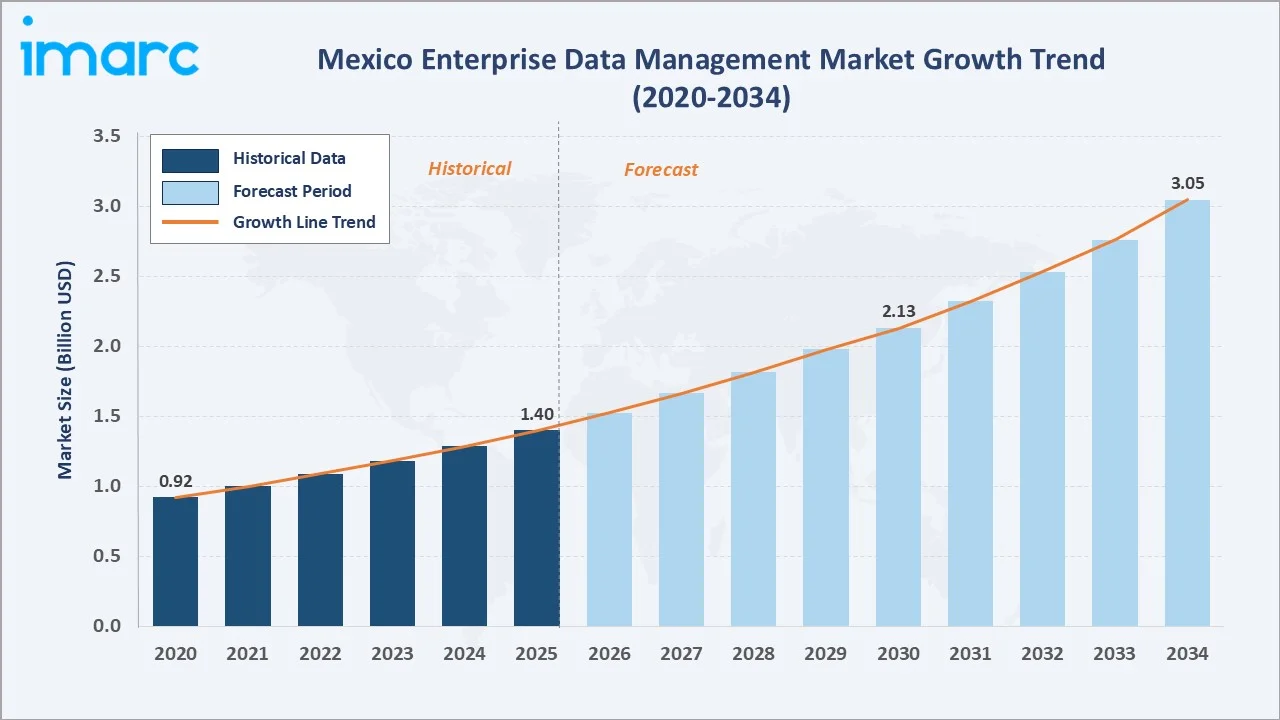
The Mexico enterprise data management market reached USD 1.40 Billion in 2025 and is projected to reach USD 3.05 Billion by 2034, growing at a CAGR of 8.74% during 2026-2034. The market is driven by surging data volumes from e-commerce sites, social media, and IoT devices; the rise in adoption of cloud-native solutions that provide flexibility and scalability; the necessity of real-time data access for quick decision-making; and the growing focus on regulatory compliance with data protection regulations. Software dominates at 73.4%, cloud-based deployment leads at 66.7%, and Central Mexico commands 46.5% of the country's market share.
Market Snapshot
|
Metric |
Value |
|
Market Size (2025) |
USD 1.40 Billion |
|
Forecast Market Size (2034) |
USD 3.05 Billion |
|
CAGR (2026-2034) |
8.74% |
|
Base Year |
2025 |
|
Historical Period |
2020-2025 |
|
Forecast Period |
2026-2034 |
|
Dominant Component |
Software (73.4%, 2025) |
|
Dominant Deployment |
Cloud-based (66.7%, 2025) |
|
Leading Region |
Central Mexico (46.5%, 2025) |
The market expanded from USD 0.92 Billion in 2020 to USD 1.40 Billion in 2025, anchored at USD 2.13 Billion in 2030 and forecast to reach USD 3.05 Billion by 2034.
To get more information on this market, Request Sample
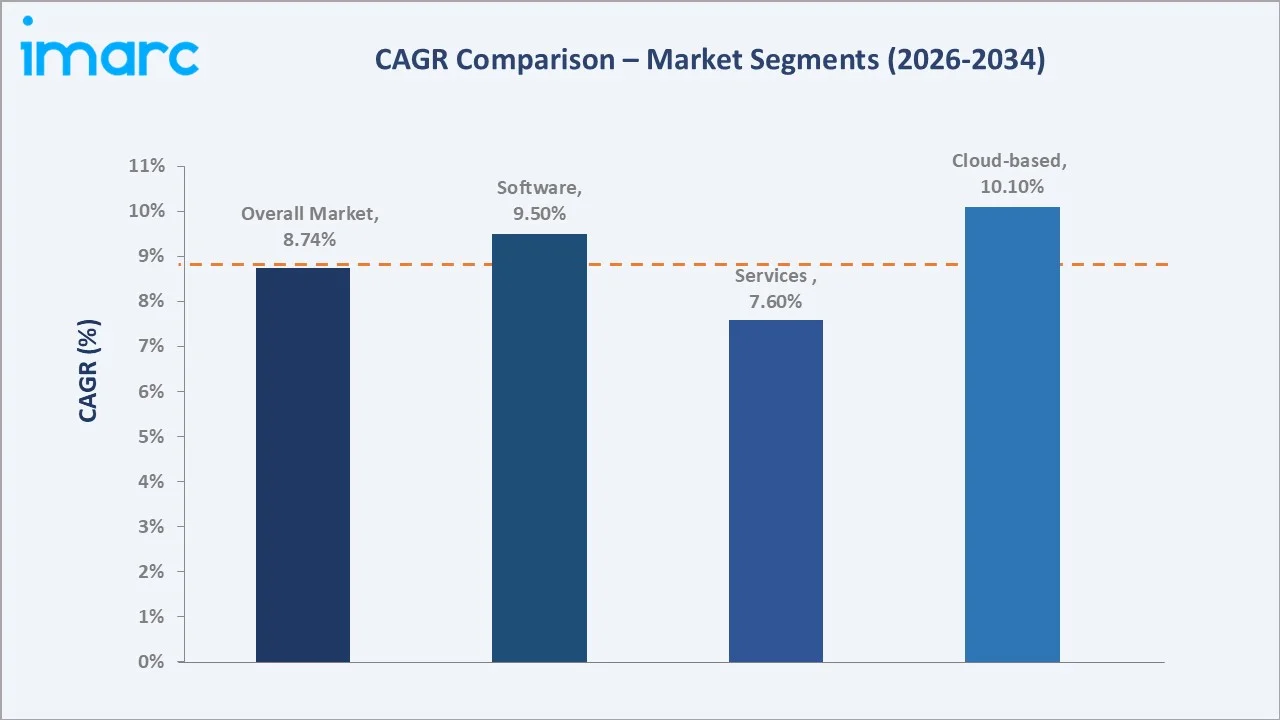
Software segment grows fastest at ~9.5% CAGR as SaaS-based master data management, data governance, and data integration platforms displace legacy on-premises deployments. Cloud-based deployment grows at ~10.1% CAGR driven by hyperscaler infrastructure expansion into Mexico, multi-cloud strategy adoption, and reduced total cost of ownership relative to on-premises alternatives.
Executive Summary
The Mexico enterprise data management market reached USD 1.40 Billion in 2025, representing one of Latin America's fastest-growing technology markets driven by the fundamental data-driven transformation of Mexico's digital economy. The market is projected to reach USD 3.05 Billion by 2034.
Software at 73.4% dominates by capturing the SaaS-led MDM, data governance, data integration, and data security workloads as enterprises shift to subscription-based licensing. Cloud-based deployment at 66.7% leads as organizations modernize infrastructure through cloud platforms. Central Mexico at 46.5% leads regionally through the concentration of BFSI institutions, multinational headquarters, and federal government data initiatives in Mexico City.
Key Market Insights
|
Insight |
Data |
|
Dominant Component |
Software – 73.4% share (2025) |
|
Dominant Deployment |
Cloud-based – 66.7% market share (2025) |
|
Leading Region |
Central Mexico – 46.5% market share (2025) |
|
Market Opportunity |
AI-driven data governance; real-time analytics; LFPDPPP compliance platforms; cloud MDM scale-up; nearshoring supply chain data management |
Key Analytical Observations Supporting the Above Data:
- Software at 73.4%: The software segment dominates as enterprises increasingly adopt SaaS-based EDM platforms for master data management, data security, data integration, and data governance. The growing complexity of multi-source data environments, combined with the need for automated compliance workflows under Mexico's LFPDPPP regulation, directly drives sustained software procurement growth.
- Cloud-based at 66.7%: The cloud-based deployment segment leads through the expansion of hyperscaler infrastructure in Mexico and the growing enterprise preference for subscription-based, scalable EDM platforms. Cloud-native solutions enable seamless data access, collaboration, and integration across distributed enterprise environments, accelerating displacement of on-premises alternatives.
- Central Mexico at 46.5%: Central Mexico leads through Mexico City's role as the country's financial, governmental, and technology capital, housing many large enterprise headquarters, federal data management mandates, and multinational technology operations. The high density of BFSI institutions and IT companies in the region sustains a disproportionate share of national EDM investment.
Mexico Enterprise Data Management Market Overview
The Mexico enterprise data management market encompasses the design, deployment, and management of software and services for organizing, integrating, governing, securing, and analyzing enterprise data assets across all industries, including IT and telecom, BFSI, retail and consumer goods, healthcare, and manufacturing.
Market Dynamics
To evaluate market opportunities, Request Sample
Market Drivers
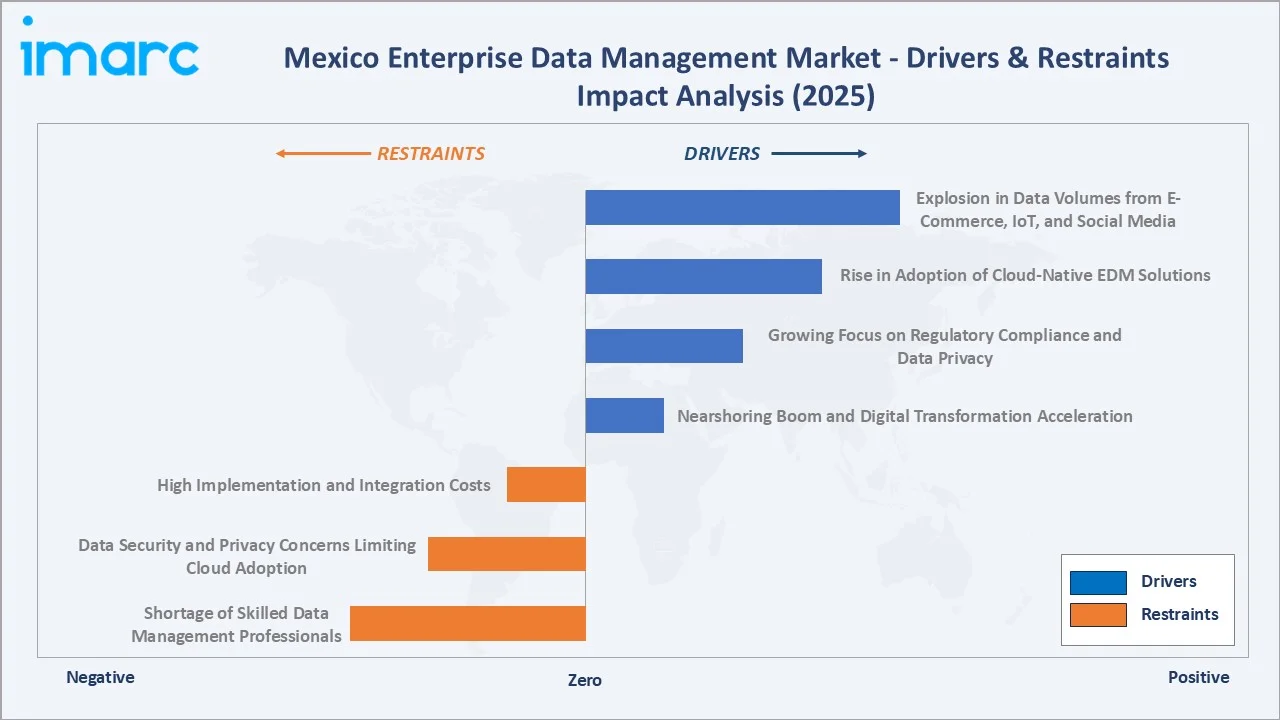
- Explosion in Data Volumes from E-Commerce, IoT, and Social Media: Mexico's rapid e-commerce expansion, IoT device proliferation across manufacturing and logistics, and social media penetration generate massive volumes of unstructured and semi-structured enterprise data. Organizations are compelled to invest in scalable EDM platforms to govern, integrate, and analyze this data to maintain competitive advantage. This structural data growth directly stimulates sustained demand for data integration, warehousing, and quality management solutions across all enterprise sectors.
- Rise in Adoption of Cloud-Native EDM Solutions: Cloud-native EDM platforms deliver scalability, operational flexibility, and cost-efficiency advantages compared to legacy on-premises systems, accelerating enterprise adoption across Mexico. The expansion of Microsoft Azure, AWS, and Google Cloud infrastructure in Mexico provides low-latency cloud EDM capabilities, enabling local enterprises to migrate data workloads with confidence. This transition reduces capital expenditure while unlocking advanced analytics, AI, and real-time data processing capabilities unavailable in traditional EDM deployments.
- Growing Focus on Regulatory Compliance and Data Privacy: Mexico's Federal Law on Protection of Personal Data Held by Private Parties (LFPDPPP) and evolving sector-specific data regulations compel enterprises to implement formal data governance, security, and lineage management frameworks. EDM platforms provide automated compliance workflows, audit trails, and data classification capabilities essential for regulatory adherence across BFSI, healthcare, and telecom sectors.
- Nearshoring Boom and Digital Transformation Acceleration: Mexico's position as a nearshoring destination for North American manufacturing and technology operations attracts substantial foreign direct investment requiring standardized, scalable enterprise data infrastructure across complex multinational supply chains. Multinational corporations establishing or expanding Mexican operations mandate enterprise-grade EDM to integrate data across ERP systems, supply chain platforms, and customer management applications. Digital transformation programs across banking, retail, and government sectors generate incremental EDM investment cycles, compounding the organic market growth driven by Mexico's expanding enterprise data estate.
Market Restraints
- High Implementation and Integration Costs: Enterprise data management deployments require significant upfront investment in software licensing, data migration, legacy system integration, and specialized IT implementation resources, creating financial barriers for mid-market Mexican enterprises. SMEs operating with constrained IT budgets face difficulty justifying the ROI of comprehensive EDM solutions against competing digital investment priorities. This cost barrier restricts market penetration in the mid-market segment and slows adoption velocity below the technology's full demand potential in Mexico.
- Data Security and Privacy Concerns Limiting Cloud Adoption: Concerns about data breaches, cyber threats, and cloud data sovereignty slow enterprise adoption of cloud-native EDM platforms, particularly in regulated sectors such as BFSI, healthcare, and government where data residency requirements are stringent. Organizations require robust security certifications, clear data sovereignty frameworks, and documented compliance with LFPDPPP before committing sensitive data workloads to third-party cloud infrastructure. These concerns create implementation delays, additional compliance assessment costs, and a preference for hybrid EDM deployments that partially offset cloud efficiency gains.
- Shortage of Skilled Data Management Professionals: The significant shortage of data engineers, data architects, governance specialists, and AI/ML data practitioners in Mexico constrains successful EDM implementation, optimization, and ongoing management across enterprise deployments. Without adequate skilled human capital, enterprises struggle to extract full value from deployed EDM solutions, dampening ROI perceptions and slowing incremental investment decisions. This skills gap is particularly acute in mid-sized enterprises and sectors outside IT and telecom, where data management expertise is concentrated.
Market Opportunities
- AI-Powered Data Governance and Master Data Management Platforms: The integration of AI and ML into EDM platforms enables automated data cataloging, intelligent data quality management, and predictive governance workflows that dramatically reduce manual data stewardship overhead. Mexican enterprises across BFSI, telecom, and retail are actively evaluating AI-augmented MDM solutions to manage growing data complexity without proportional headcount increases.
- Nearshoring Supply Chain Data Management Solutions: The nearshoring boom driving foreign direct investment into Mexico's manufacturing and technology sectors creates substantial demand for specialized supply chain data management, cross-border data integration, and multi-enterprise master data synchronization solutions. Companies operating integrated US-Mexico supply chains require EDM platforms capable of managing data across multiple ERP systems, customs compliance databases, and logistics platforms in real time.
Market Challenges
- Fragmented Data Landscapes and Legacy System Integration Complexity: Many large Mexican enterprises operate highly fragmented data environments spanning multiple legacy ERP systems, siloed departmental databases, and heterogeneous cloud and on-premises infrastructure accumulated through decades of organic IT growth. Integrating these disparate data sources into a coherent, governed EDM architecture requires substantial custom integration development, data mapping, and quality remediation effort that extends implementation timelines and inflates project budgets.
- Intensifying Competition from Hyperscaler-Embedded EDM Capabilities: Major cloud hyperscalers are increasingly embedding sophisticated data governance, integration, and quality management capabilities directly into their cloud service platforms at minimal incremental cost to existing cloud subscribers, creating competitive pressure on standalone EDM software vendors. Microsoft Fabric, AWS Lake Formation, and Google Cloud Dataplex provide growing EDM functionality that satisfies basic governance and integration requirements without requiring separate EDM software investment.
Emerging Market Trends
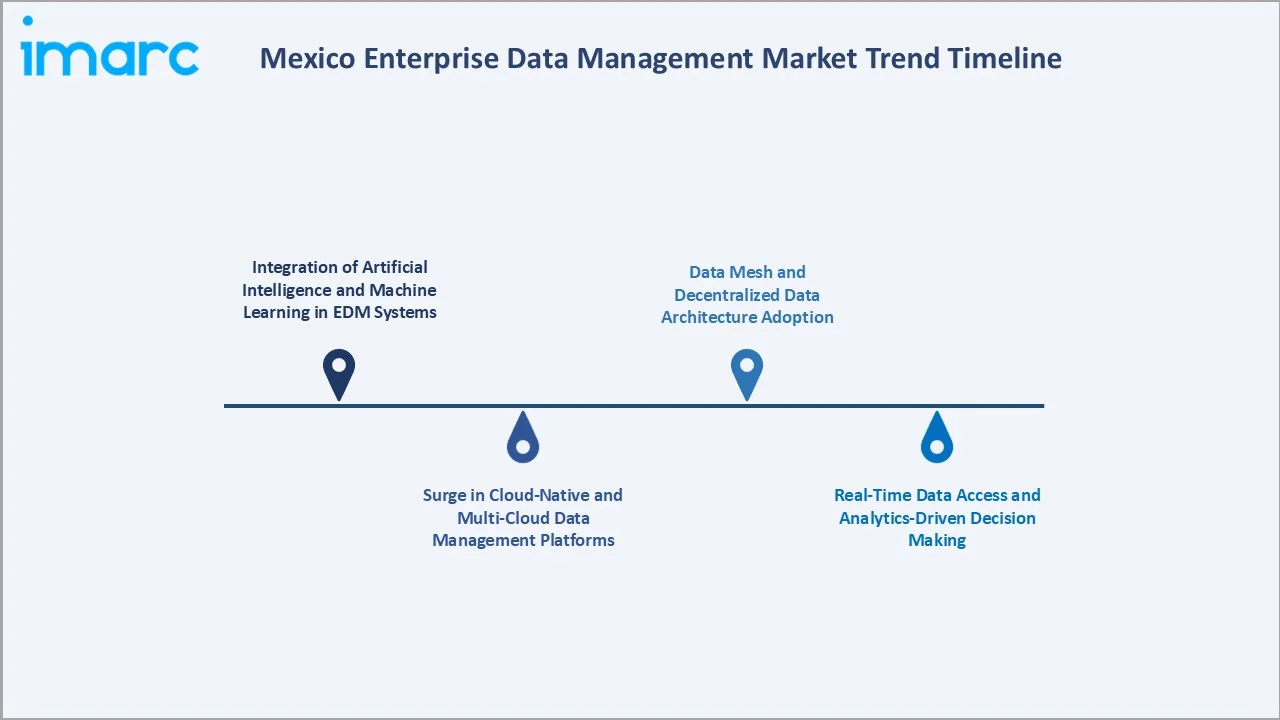
1. Integration of Artificial Intelligence and Machine Learning in EDM Systems
AI and machine learning are increasingly being integrated into enterprise data management (EDM) systems to automate data classification, identify anomalies, improve data quality, and streamline governance processes. As organizations manage increasingly complex and diverse data environments, AI-enabled EDM solutions can help improve operational efficiency while reducing the need for extensive manual data management.
2. Surge in Cloud-Native and Multi-Cloud Data Management Platforms
The adoption of cloud-native EDM platforms is increasing as enterprises seek greater scalability, flexibility, and operational efficiency. Organizations are increasingly shifting from traditional on-premises data management environments toward cloud-based and hybrid architectures. At the same time, multi-cloud strategies are creating demand for data integration, governance, and management solutions that can operate consistently across multiple cloud environments.
3. Real-Time Data Access and Analytics-Driven Decision Making
Growing demand for timely and accurate information is encouraging enterprises to adopt real-time data management and analytics capabilities. Businesses across sectors are increasingly using streaming data integration, real-time analytics, and automated data-processing technologies to support faster decision-making and improve customer experiences. This trend is driving demand for low-latency data pipelines, event-driven architectures, and integrated data management platforms.
4. Data Mesh and Decentralized Data Architecture Adoption
Enterprises are increasingly exploring decentralized data architectures such as data mesh to improve data ownership, accessibility, and scalability across business functions. These approaches distribute data management responsibilities among individual business domains while maintaining common governance and quality standards. The growing adoption of distributed data environments is creating demand for EDM platforms that can manage diverse data sources and products while maintaining consistent enterprise-wide governance.
Industry Value Chain Analysis
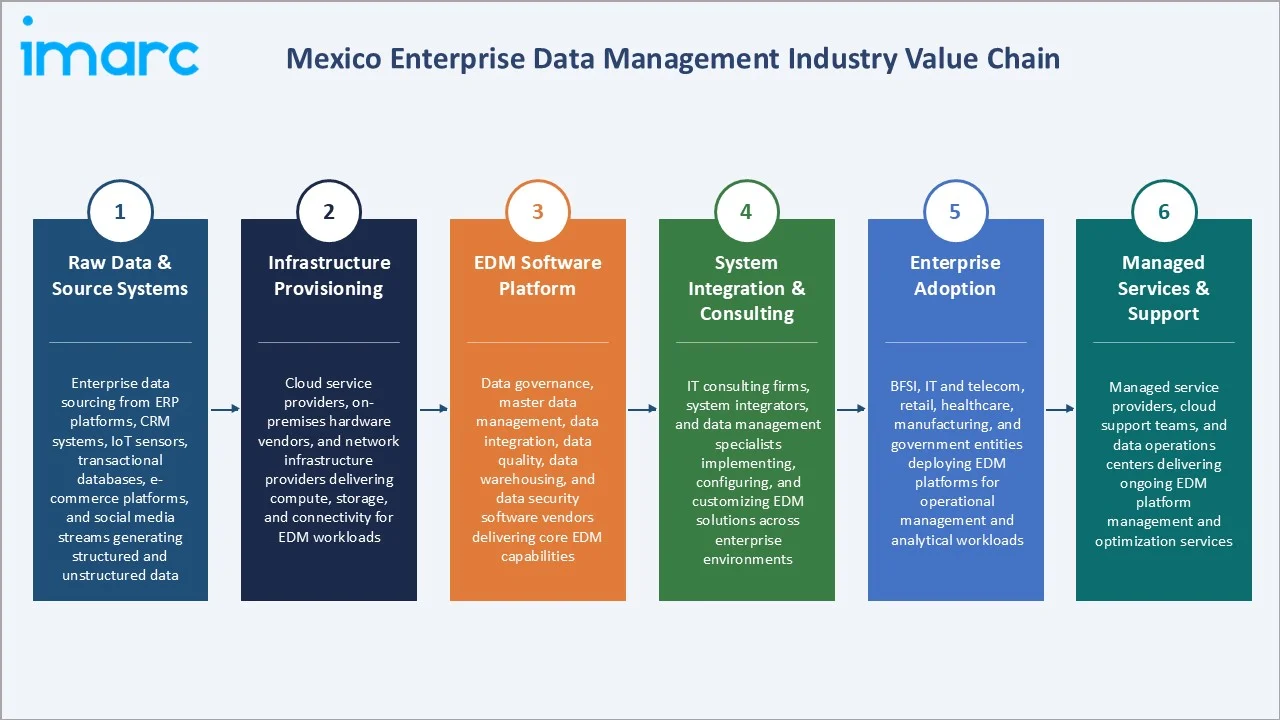
The Mexico EDM value chain integrates raw data sourcing from enterprise systems, cloud infrastructure provisioning, EDM software platform deployment, system integration and consulting, enterprise end-user adoption across all verticals, and managed services delivery.
|
Stage |
Key Participants |
|
Raw Data & Source Systems |
Enterprise data sourcing from ERP platforms, CRM systems, IoT sensors, transactional databases, e-commerce platforms, and social media streams generating structured and unstructured data |
|
Infrastructure Provisioning |
Cloud service providers, on-premises hardware vendors, and network infrastructure providers delivering compute, storage, and connectivity for EDM workloads |
|
EDM Software Platform |
Data governance, master data management, data integration, data quality, data warehousing, and data security software vendors delivering core EDM capabilities |
|
System Integration & Consulting |
IT consulting firms, system integrators, and data management specialists implementing, configuring, and customizing EDM solutions across enterprise environments |
|
Enterprise Adoption |
BFSI, IT and telecom, retail, healthcare, manufacturing, and government entities deploying EDM platforms for operational management and analytical workloads |
|
Managed Services & Support |
Managed service providers, cloud support teams, and data operations centers delivering ongoing EDM platform management and optimization services |
The infrastructure provisioning tier is experiencing the most rapid commercial transformation as Mexican enterprises accelerate cloud migration and hyperscalers expand Mexico-region data center capacity.
Technology Landscape in the Mexico Enterprise Data Management Industry
Master Data Management (MDM) Technology
Master data management technology consolidates and governs enterprise master data across business domains such as customer, product, supplier, and asset data, enabling a single trusted data record. MDM platforms are increasingly cloud-native and AI-augmented, delivering automated data matching, deduplication, and stewardship workflows that reduce manual oversight burden. Their broad applicability across BFSI, retail, manufacturing, and healthcare sectors is accelerating technology adoption and innovation across Mexico's enterprise data management landscape.
Data Integration and ETL/ELT Technology
Data integration and ETL/ELT technology enables seamless, governed data movement between source systems, data warehouses, and analytics platforms, forming the foundational connective tissue of enterprise EDM architectures. Modern cloud-native ELT platforms are replacing traditional ETL tools as real-time, event-driven data pipeline requirements increase across Mexico's digitally transforming enterprises. Their scalability, lower development overhead, and native cloud integration make them the preferred integration technology for new EDM deployments.
AI-Powered Data Governance Technology
AI-powered data governance platforms automate data cataloging, lineage tracking, quality monitoring, policy enforcement, and sensitive data discovery across enterprise data estates. These intelligent governance tools reduce manual data stewardship effort while improving data quality metrics and regulatory compliance posture for Mexican enterprises subject to LFPDPPP requirements.
Market Segmentation Analysis
The report covers the following segments:
|
Segment Category |
Leading Segment |
Market Share |
Year |
|
Component |
Software |
73.4% |
2025 |
|
Deployment |
Cloud-based |
66.7% |
2025 |
|
Enterprise Size |
🔒 |
🔒 |
2025 |
|
Industries |
🔒 |
🔒 |
2025 |
|
Region |
Central Mexico |
46.5% |
2025 |

By Component
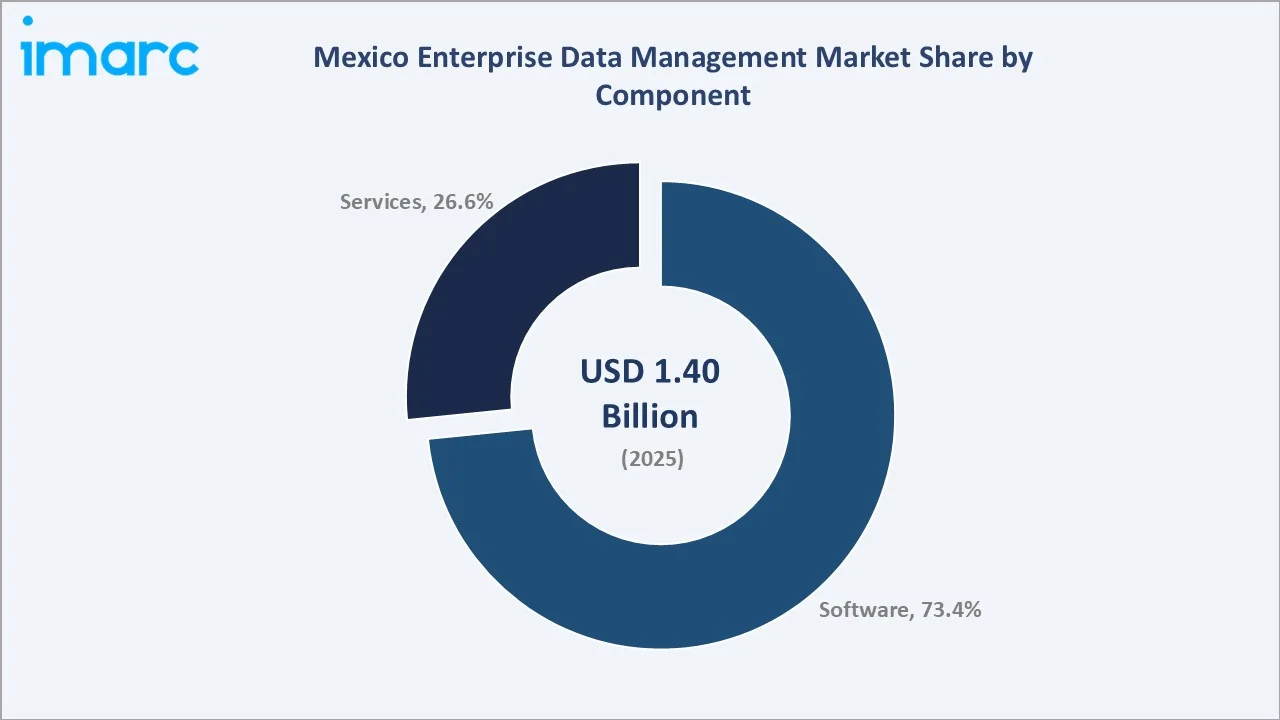
The software segment leads at 73.4% in 2025, capturing data governance, master data management, data integration, data security, data quality, and data warehousing platforms as Mexican enterprises prioritize SaaS-led modernization of their data management infrastructure.
To access detailed market analysis, Request Sample
Services at 26.6% captures managed services and professional services as organizations seek specialized external expertise for complex EDM implementations, ongoing platform management, data quality remediation, and strategic data consulting engagements.
By Deployment
Cloud-based deployment leads at 66.7% in 2025, driven by hyperscaler infrastructure expansion in Mexico, SaaS-first enterprise IT strategies, and the operational agility and cost-efficiency advantages of cloud-native EDM relative to on-premises alternatives.
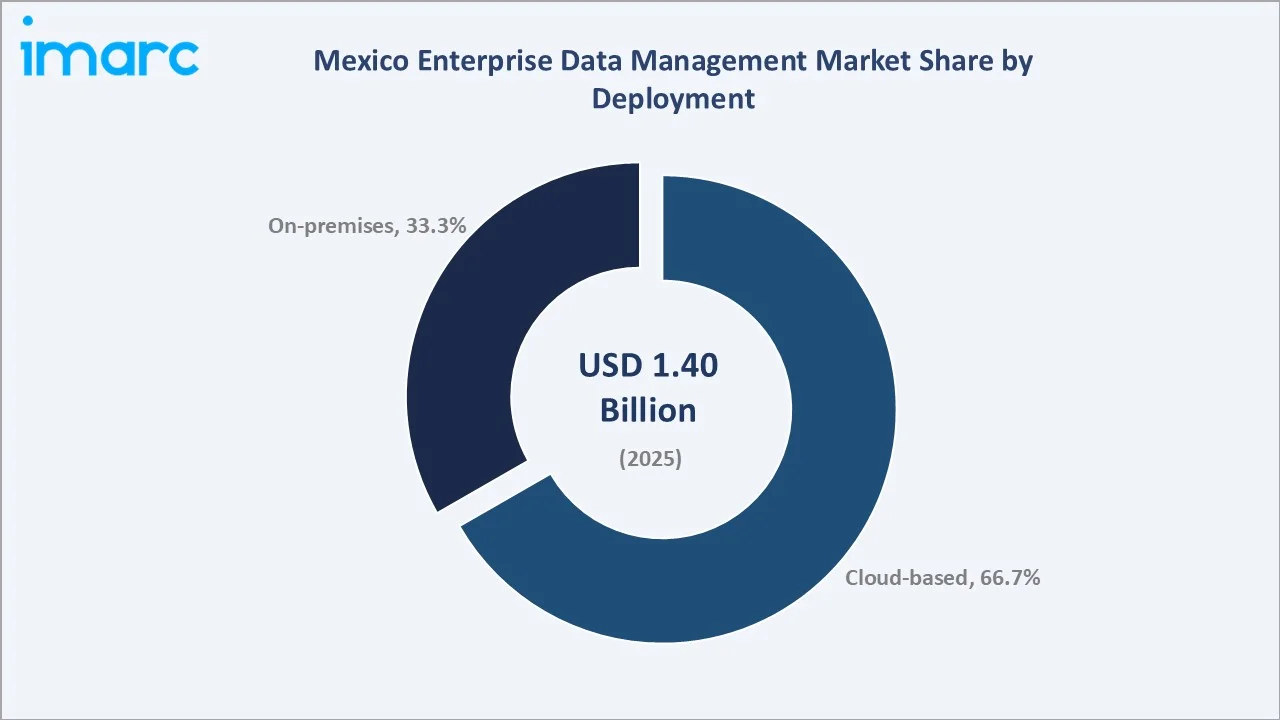
On-premises deployment at 33.3% persists in regulated industries such as banking, healthcare, and government where data sovereignty requirements, latency sensitivity, and security policies mandate local infrastructure control.
Regional Market Insights
|
Region |
Share (2025) |
Key EDM Market Drivers & Characteristics |
|
Central Mexico |
46.5% |
Driven by concentration of BFSI institutions, multinational headquarters, federal government data initiatives, and technology hubs in Mexico City requiring advanced EDM platforms for regulatory compliance, financial data governance, and enterprise-wide data integration |
|
Northern Mexico |
31.8% |
Driven by nearshoring manufacturing expansion, cross-border supply chain data complexity, and technology investments by US-aligned multinationals in industrial states |
|
Southern Mexico |
14.2% |
Emerging with growing public sector digitization, government infrastructure investment programs, and expanding regional enterprises adopting foundational EDM solutions for data compliance and operational management |
|
Others |
7.5% |
Includes coastal and inland regions with early-stage EDM adoption driven by tourism sector data management, agricultural data platforms, and government-led digital inclusion initiatives |
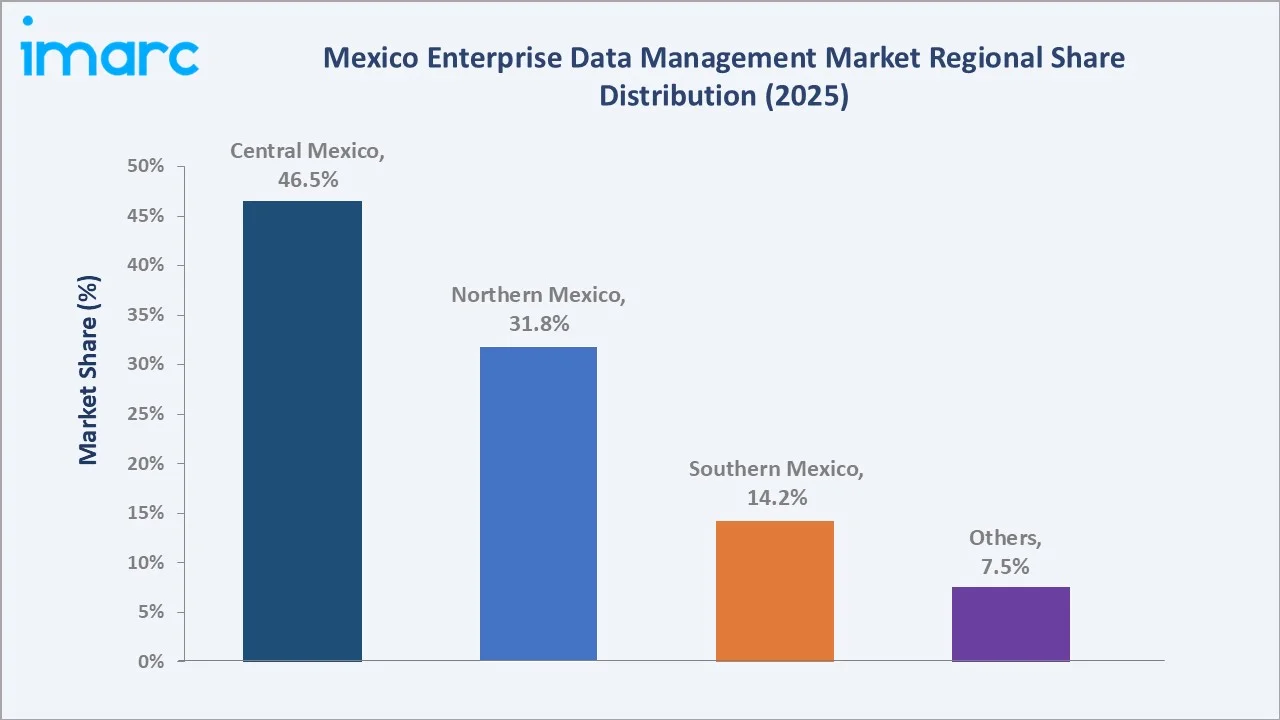
Central Mexico at 46.5% leads through Mexico City's role as the country's financial, governmental, and technology capital, concentrating BFSI institutions, multinational headquarters, and federal government data initiatives that generate the majority of large-scale EDM investment. Northern Mexico at 31.8% reflects the nearshoring manufacturing boom creating complex cross-border data management requirements across automotive, electronics, and aerospace manufacturing clusters.
Competitive Landscape
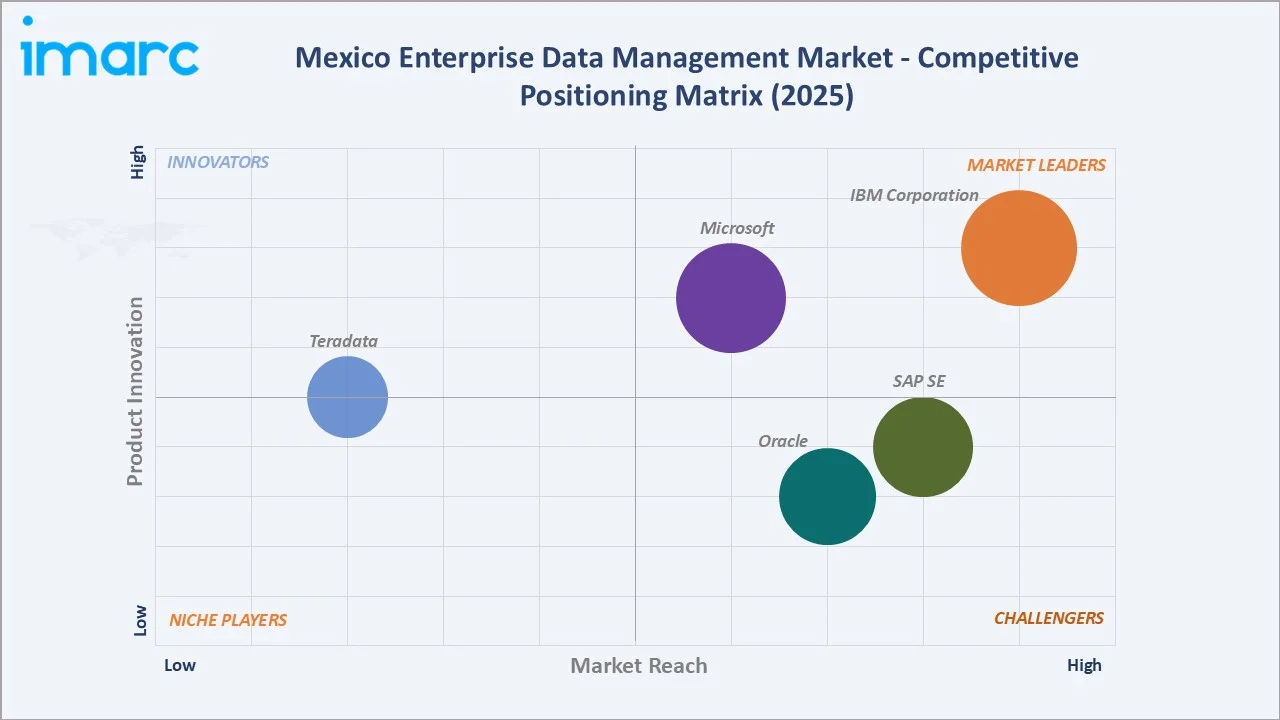
The Mexico enterprise data management market competitive landscape is moderately concentrated with three distinct competitive tiers: global full-suite EDM platform leaders with broad solution portfolios, specialized technology providers targeting specific EDM domains such as data integration or data quality, and regional system integrators delivering EDM implementation and managed services.
|
Company Name |
Key Products |
Market Position |
Core Strength |
|
IBM Corporation |
IBM Master Data Management (MDM), IBM DataStage, IBM OpenPages |
Market Leader |
IBM specializes in full-suite hybrid cloud EDM platforms combining master data management, AI-powered data governance |
|
Microsoft |
Azure Data Factory, Azure Synapse Analytics, Microsoft Fabric |
Market Leader |
Microsoft specializes in cloud-native, AI-integrated EDM platforms leveraging Mexico Azure region infrastructure to deliver enterprise-scale data governance, integration, and analytics capabilities |
|
Oracle |
Oracle Enterprise Data Management Cloud, Oracle Data Integrator, Oracle GoldenGate |
Strong Challenger |
Oracle specializes in ERP-integrated data management solutions enabling seamless master data synchronization and governance across Oracle Cloud and on-premises enterprise environments |
|
SAP SE |
SAP Master Data Governance, SAP HANA Cloud |
Strong Challenger |
SAP specializes in ERP-native data governance and master data management tightly integrated with SAP S/4HANA deployments widely adopted across Mexico's large manufacturing and financial enterprises |
|
Teradata |
Teradata Vantage, Teradata QueryGrid |
Established Player |
Teradata specializes in enterprise-scale analytics data management platforms serving Mexico's telco, banking, and retail sectors with high-performance data warehousing and integrated analytics capabilities |
Key players include IBM Corporation, Microsoft, Oracle, SAP SE, Teradata, and others.
Key Company Profiles
IBM Corporation
IBM is a US-based multinational technology corporation with a strong presence in the Mexico enterprise data management market through its InfoSphere MDM platform, Watson Knowledge Catalog, and hybrid cloud data fabric architecture serving large enterprise and government clients.
- Key Products: IBM InfoSphere Master Data Management, IBM DataStage, IBM Watson Knowledge Catalog, IBM OpenPages, IBM Cloud Pak for Data.
- Strategic Focus: IBM is expanding its hybrid cloud data fabric architecture, enabling unified data management across on-premises, private cloud, and public cloud environments for Mexico's large enterprise and government sector clients. The company is investing in AI-native data governance capabilities that automate stewardship workflows and compliance reporting, reducing the skilled resource burden on enterprise data teams.
Microsoft
Microsoft is a US-based global technology company with a commanding presence in Mexico's enterprise data management market through Azure cloud infrastructure, Microsoft Purview data governance, and Microsoft Fabric unified analytics and data management platform.
- Key Products: Microsoft Azure Purview, Azure Data Factory, Azure Synapse Analytics, Azure Data Lake Storage, Microsoft Fabric.
- Recent Developments: In May 2024, Microsoft Azure expanded its cloud footprint in Mexico, accelerating enterprise EDM adoption through localized data center infrastructure and AI-integrated data governance tools that reinforce its market leadership position.
- Strategic Focus: Microsoft is deepening Microsoft Fabric integration as a unified analytics and data management platform, consolidating Azure Synapse, Power BI, and Azure Data Factory into a single cloud-native EDM environment for Mexican enterprises. The company is investing in Copilot AI capabilities embedded within its EDM platform to enable natural language data governance, automated data quality management, and conversational data cataloging for enterprise users.
Market Concentration Analysis
The Mexico enterprise data management market is moderately concentrated at the full-suite platform level, with the key players collectively accounting for approximately 45–55% of Mexico's large enterprise EDM software revenue. Specialized vendors account for an estimated 20–25% of market revenue, while regional system integrators and managed service providers capture the remainder through services delivery. Market concentration is expected to gradually decline through the forecast period as cloud-embedded EDM capabilities enable mid-market enterprise adoption and new AI-native vendors compete for emerging data governance workloads.
Investment & Growth Opportunities
Highest Growth Segments
Cloud-based EDM deployment (~10.1% CAGR), software component (~9.5% CAGR), AI-powered data governance platforms (~15–18% CAGR from smaller base), LFPDPPP compliance automation solutions, nearshoring supply chain data management, and Central Mexico large enterprise MDM modernization represent the highest-growth investment vectors through 2034.
Emerging Investment Opportunities
Nearshoring supply chain data management represents the Mexico enterprise data management market's highest-value emerging investment opportunity, with cross-border data integration platforms serving US-Mexico manufacturing and logistics. The concentration of nearshoring investment in automotive, electronics, and aerospace manufacturing in Northern Mexico creates a geographically specific, sector-concentrated EDM demand pool addressable through targeted product and go-to-market strategies.
Investment Themes
- AI-powered data governance SaaS platforms targeting Mexico's compliance-driven BFSI and healthcare sectors: LFPDPPP compliance automation embedded in AI-native governance platforms creates a defensible, recurring revenue opportunity in Mexico's most data-regulated enterprise sectors. Vendors delivering pre-built compliance workflows, automated PII detection, and audit trail management for LFPDPPP requirements address a non-discretionary enterprise need with strong renewal economics.
- Cloud-native data integration solutions for nearshoring manufacturing supply chains: The nearshoring boom in Northern Mexico creates demand for specialized cross-border EDM platforms integrating US and Mexican enterprise systems across manufacturing, customs, logistics, and finance domains. Vendors with pre-built connectors for SAP, Oracle, and US-Mexico customs compliance data systems have a significant go-to-market advantage in this structurally growing segment.
Future Market Outlook (2026-2034)
The Mexico enterprise data management market is projected to grow from USD 1.40 Billion in 2025 to USD 3.05 Billion by 2034, delivering an 8.74% CAGR over the forecast period. The market's anchor value of USD 2.13 Billion in 2030 represents Mexico's enterprise data management industry at its most transformative commercial inflection point. By 2030, cloud-native EDM will have displaced on-premises deployments as the majority delivery model, AI-augmented data governance will be standard in enterprise MDM implementations, and LFPDPPP compliance automation will be embedded as a baseline requirement in all enterprise EDM procurements.
Research Methodology
Primary Research
Primary research comprised structured interviews with 50+ industry stakeholders (2025), including Chief Data Officers, enterprise IT directors, EDM platform architects, data governance specialists, managed service providers, and regulatory compliance consultants across Mexico's BFSI, IT and telecom, healthcare, retail, and manufacturing sectors.
Secondary Research
Secondary research encompassed company annual reports, Mexico INEGI digital economy statistics, AMIPCI industry data, LFPDPPP regulatory publications, IDC Latin America technology market reports, Gartner Magic Quadrant reports for data management platforms, hyperscaler Mexico infrastructure investment announcements, and government digital transformation program reports. Over 60 secondary sources were reviewed and cross-referenced.
Forecasting Models
Market revenue forecasts were developed using a demand-side bottom-up model: (i) enterprise IT spending data by sector and size in Mexico; (ii) EDM software and services share of enterprise IT budgets by sector; (iii) cloud migration velocity projections by deployment type and industry vertical; (iv) LFPDPPP compliance investment multipliers applied to sector-specific EDM adoption rates; (v) technology premium adjustment for AI-native EDM versus traditional platform pricing.
Mexico Enterprise Data Management Market Report Coverage:
| Report Features | Details |
|---|---|
| Base Year of the Analysis | 2025 |
| Historical Period | 2020-2025 |
| Forecast Period | 2026-2034 |
| Units | Billion USD |
| Scope of the Report | Exploration of Historical Trends and Market Outlook, Industry Catalysts and Challenges, Segment-Wise Historical and Future Market Assessment:
|
| Components Covered |
|
| Deployments Covered | Cloud-based, On-premises |
| Enterprise Sizes Covered | Small and Medium-sized Enterprises, Large Enterprises |
| Industries Covered | IT and Telecom, Banking, Financial Services, and Insurance, Retail and Consumer Goods, Healthcare, Manufacturing, Others |
| Regions Covered | Northern Mexico, Central Mexico, Southern Mexico, Others |
| Customization Scope | 10% Free Customization |
| Post-Sale Analyst Support | 10-12 Weeks |
| Delivery Format | PDF and Excel through Email (We can also provide the editable version of the report in PPT/Word format on special request) |
Key Benefits for Stakeholders:
- IMARC’s industry report offers a comprehensive quantitative analysis of various market segments, historical and current market trends, market forecasts, and dynamics of the Mexico enterprise data management market from 2020-2034.
- The research report provides the latest information on the market drivers, challenges, and opportunities in the Mexico enterprise data management market.
- Porter's five forces analysis assist stakeholders in assessing the impact of new entrants, competitive rivalry, supplier power, buyer power, and the threat of substitution. It helps stakeholders to analyze the level of competition within the Mexico enterprise data management industry and its attractiveness.
- Competitive landscape allows stakeholders to understand their competitive environment and provides an insight into the current positions of key players in the market.
Frequently Asked Questions About the Mexico Enterprise Data Management Market Report
The Mexico enterprise data management market reached USD 1.40 Billion in 2025, driven by the software segment dominant at 73.4%, cloud-based deployment leading at 66.7%, Central Mexico commanding 46.5% regional share, and accelerating digital transformation demand across BFSI, IT and telecom, retail, healthcare, and manufacturing sectors, supported by LFPDPPP regulatory compliance investment and nearshoring-driven enterprise data infrastructure expansion.
The Mexico enterprise data management market grows at 8.74% CAGR during 2026-2034, reaching USD 3.05 Billion by 2034. This growth reflects nearshoring-driven enterprise expansion, hyperscaler cloud platform adoption, AI-powered enterprise data management integration, and the structural shift from on-premises to cloud-native data management delivery models across all enterprise verticals.
Software leads at 73.4%, capturing SaaS-based master data management, data governance, data security, data integration, data quality, and data warehousing platforms as Mexican enterprises prioritize cloud-native software modernization over legacy on-premises deployments, with AI-augmented software capabilities accelerating replacement cycles across all enterprise data management software categories.
Cloud-based leads at 66.7% through hyperscaler Mexico region infrastructure expansion, SaaS-first enterprise IT procurement strategies, and the operational flexibility, scalability, and cost-efficiency advantages of cloud-native enterprise data management over on-premises systems, with LFPDPPP-aligned cloud compliance frameworks enabling regulated sector adoption.
Central Mexico leads at 46.5% through Mexico City's concentration of BFSI institutions, multinational headquarters, federal government data initiatives, and technology sector enterprises that generate the majority of large-scale enterprise data management platform investment and enterprise data management transformation programs in the country.
Leading companies include IBM Corporation, Microsoft, Oracle, SAP SE, Teradata, and others.
The Mexico enterprise data management market is projected to reach approximately USD 2.13 Billion by 2030, with cloud-native enterprise data management becoming the standard deployment model for new enterprise procurements and AI-powered data governance platforms achieving mainstream enterprise adoption.
Need more help?
- Speak to our experienced analysts for insights on the current market scenarios.
- Include additional segments and countries to customize the report as per your requirement.
- Gain an unparalleled competitive advantage in your domain by understanding how to utilize the report and positively impacting your operations and revenue.
- For further assistance, please connect with our analysts.
 Request Customization
 Speak to an Analyst
 Request Brochure
 Inquire Before Buying
Benefits of Customization
- Personalize this research
- Triangulate with your data
- Get data as per your format and definition
- Gain a deeper dive into a specific application, geography, customer, or competitor
- Any level of personalization
Get in Touch With Us
UNITED STATES
Phone: +1-201-971-6302
INDIA
Phone: +91-120-433-0800
UNITED KINGDOM
Phone: +44-753-714-6104
Email: [email protected]
Client Testimonials




.webp)




.webp)













Related Reports

Choose your plan
*Please note that the prices mentioned below are starting prices for each bundle type. Kindly contact our team for further details.*
Single User License
- 1 User License, Access on 2 Devices
- PDF Report + Excel Dataset (Password Protected)
- Lifetime Access
- No Printing Rights
- 10% Free Report Customization
- 10–12 Weeks of Analyst Support
Five User License
- Access for 5 Users, 2 Devices per User
- PDF Report + Excel Dataset (Password Protected)
- Lifetime Access
- Dedicated Account Manager
- 12–14 Weeks of Analyst Support
- No Printing Rights
- 15% Free Report Customization
- 25% Discount on Your Next Purchase
Corporate User License
- Unlimited User Access (Within Your Organization)
- PDF Report + Excel Dataset
- Lifetime Access
- Dedicated Account Manager
- 14–20 Weeks of Analyst Support
- No Printing Rights
- 20% Free Report Customization
- 30% Discount on Your Next Purchase
Essential Insights
What's included:
3 reports
- Lifetime Access
- PDF Reports
- Excel Datasets
- 2 Weeks of Free Analyst Support
- 2 User Licenses
- Access on 2 Devices
- Printing Rights
- Complimentary PowerPoint (PPT) Version
- Complimentary License Upgrade
Professional Access
What's included:
5 reports
- Lifetime Access
- PDF Reports
- Excel Datasets
- 8 Weeks of Free Analyst Support
- 2 User Licenses
- Access on 2 Devices
- Printing Rights
- Complimentary PowerPoint (PPT) Version
- Complimentary License Upgrade
Business Advantage
What's included:
8 reports
- Lifetime Access
- PDF Reports
- Excel Datasets
- 14 Weeks of Free Analyst Support
- 2 User Licenses
- Access on 2 Devices
- Printing Rights
- Complimentary PowerPoint (PPT) Version
- Complimentary License Upgrade
Enterprise Intelligence
What's included:
10 reports
- Lifetime Access
- PDF Reports
- Excel Datasets
- 20 Weeks of Free Analyst Support
- 2 User Licenses
- Access on 2 Devices
- Printing Rights
- Complimentary PowerPoint (PPT) Version
- Complimentary License Upgrade