
Mexico Luxury Watch Market Size, Share, Trends and Forecast by Type, End User, Distribution Channel, and Region, 2026-2034
Mexico Luxury Watch Market Size, Share, Trends & Forecast (2026-2034)
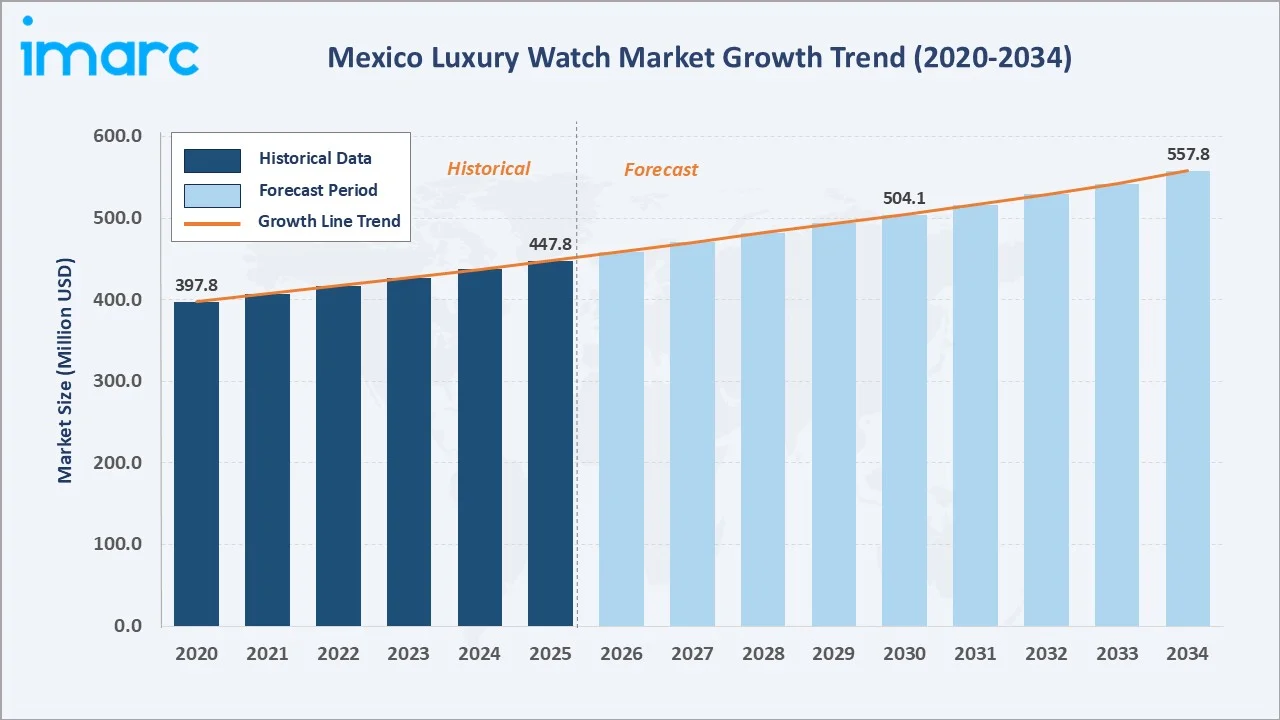
The Mexico luxury watch market reached USD 447.8 Million in 2025 and is projected to reach USD 557.8 Million by 2034, growing at a CAGR of 2.40% during 2026-2034. Growth is supported by a rising affluent consumer base, expanding boutique retail networks, and increasing demand for watches as investment and heritage assets. Analog watches lead the type at 81.6%, reflecting sustained preference for traditional Swiss craftsmanship. Men represent the largest end-user category at 57.8%, while Central Mexico dominates regionally at 46.5%, anchored by Mexico City's concentration of luxury retail and affluent households.
Market Snapshot
|
Metric |
Value |
|
Market Size (2025) |
USD 447.8 Million |
|
Forecast Market Size (2034) |
USD 557.8 Million |
|
CAGR (2026-2034) |
2.40% |
|
Base Year |
2025 |
|
Historical Period |
2020-2025 |
|
Forecast Period |
2026-2034 |
|
Dominant Type |
Analog Watch (81.6%, 2025) |
|
Dominant End User |
Men (57.8%, 2025) |
|
Leading Region |
Central Mexico (46.5%, 2025) |
The Mexico luxury watch market grew from USD 397.8 Million in 2020 to USD 447.8 Million in 2025, supported by steady demand from affluent professionals and collectors. It is expected to reach USD 504.1 Million by 2030, aided by expanding boutique networks and tourism-linked luxury spending. By 2034, the market is forecast to reach USD 557.8 Million, driven by rising disposable income, premiumization, and growing appetite for heritage timepieces across Mexico's urban centers.
To get more information on this market, Request Sample
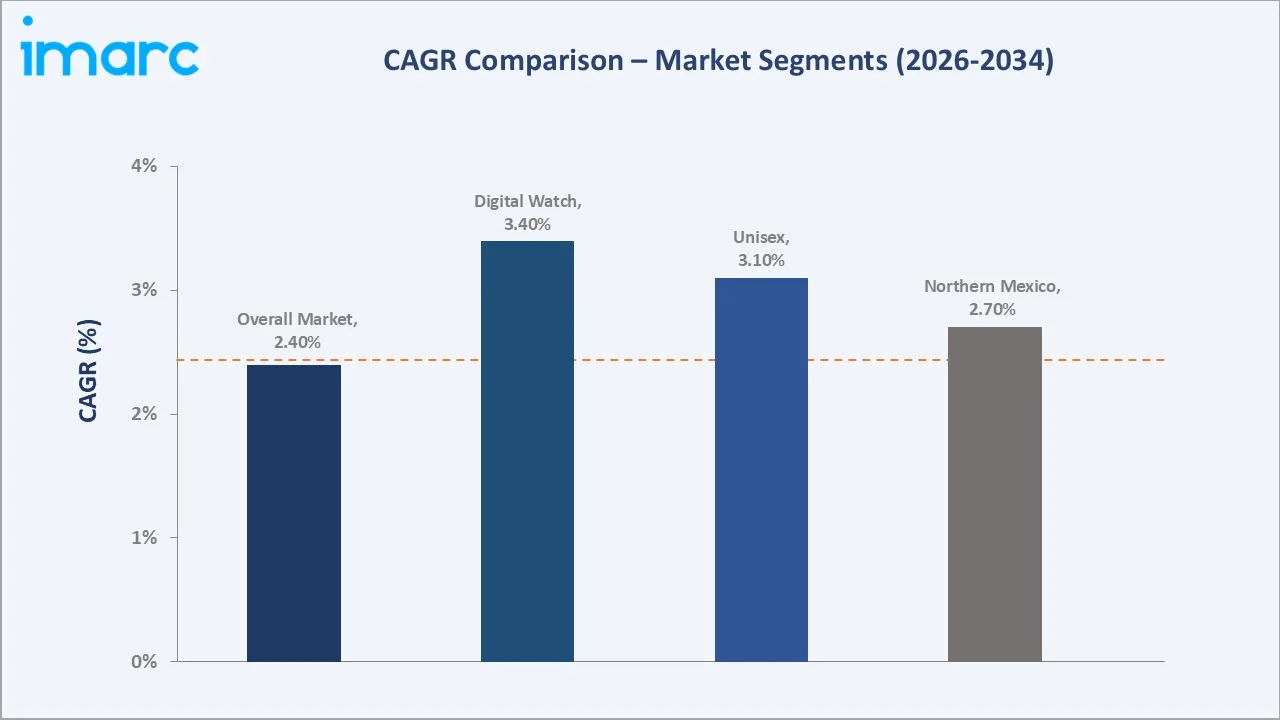
Digital watches grow fastest at ~3.4% CAGR as smart-luxury hybrids gain acceptance among younger buyers. Unisex watches expand at ~3.1% CAGR through gender-neutral design trends. Northern Mexico grows at ~2.7% CAGR, supported by cross-border retail access and rising industrial-sector incomes.
Executive Summary
The Mexico luxury watch market is advancing at a measured pace, supported by a resilient base of affluent consumers and a broader luxury goods sector that has expanded steadily across the country. Growing appreciation for Swiss horology and mechanical craftsmanship is encouraging both first-time buyers and seasoned collectors to acquire analog timepieces. Consumers increasingly view luxury watches as long-term stores of value rather than purely functional accessories.
Retail modernization continues to shape demand, with authorized boutiques and department-store counters expanding across Mexico City, Monterrey, and Guadalajara. International watchmakers have reinforced their retail presence through flagship boutiques and partnerships with established jewelers. Analog watches at 81.6% lead by type through heritage appeal and mechanical craftsmanship. Men at 57.8% lead by end user, reflecting long-standing purchasing patterns among professional and executive buyers.
Central Mexico leads regionally at 46.5%, supported by concentrated affluent households and luxury retail infrastructure. Looking ahead, the market's outlook remains steady as premiumization, certified pre-owned growth, and expanding boutique retail continue to widen consumer access to luxury timepieces through 2034.
Key Market Insights
|
Insight |
Data |
|
Dominant Type |
Analog Watch - 81.6% share (2025) |
|
Dominant End User |
Men - 57.8% share (2025) |
|
Leading Region |
Central Mexico - 46.5% share (2025) |
|
Market Opportunities |
Smart-luxury hybrid watches; certified pre-owned platforms; boutique retail expansion; unisex design lines; tourism-linked luxury retail; digital authentication services |
Key Analytical Observations Supporting the Above Data:
- Analog Watches at 81.6%: Analog timepieces dominate due to mechanical heritage, craftsmanship appeal, and strong resale value retention. Their enduring design language keeps them the preferred choice for collectors and affluent households alike.
- Men at 57.8%: Male buyers lead through long-standing purchasing patterns among professional and executive segments. Gifting occasions and brand loyalty to established Swiss houses continue to reinforce this dominance.
- Central Mexico at 46.5%: Central Mexico dominates through its concentration of affluent households, boutique density, and strong luxury retail infrastructure in Mexico City and surrounding states.
- Digital Watch Growth: Digital watches grow fastest at ~3.4% CAGR as smart-hybrid features blending mechanical heritage with connected functionality gain traction among younger buyers.
- Northern Mexico Growth: Northern Mexico expands at ~2.7% CAGR, benefiting from cross-border retail access and rising incomes tied to the region's industrial employment base.
- Certified Pre-Owned Momentum: Certified pre-owned platforms are emerging as a distribution channel as brands formalize resale certification programs to protect authenticity and brand value.
Mexico Luxury Watch Market Overview
The Mexico luxury watch market encompasses analog and digital timepieces positioned at premium and ultra-premium price points, sold through authorized boutiques, department stores, specialty jewelers, and e-commerce platforms. It includes mechanical, automatic, and quartz watches from established Swiss and international houses, alongside digital and smart-hybrid models. Growth is supported by a rising affluent population, expanding boutique retail infrastructure, and increasing recognition of watches as investment assets. Macroeconomic factors include rising disposable income, tourism-linked luxury spending, and continued formalization of Mexico's high-end retail sector under customs and consumer-protection oversight.
Market Dynamics
To evaluate market opportunities, Request Sample
Market Drivers
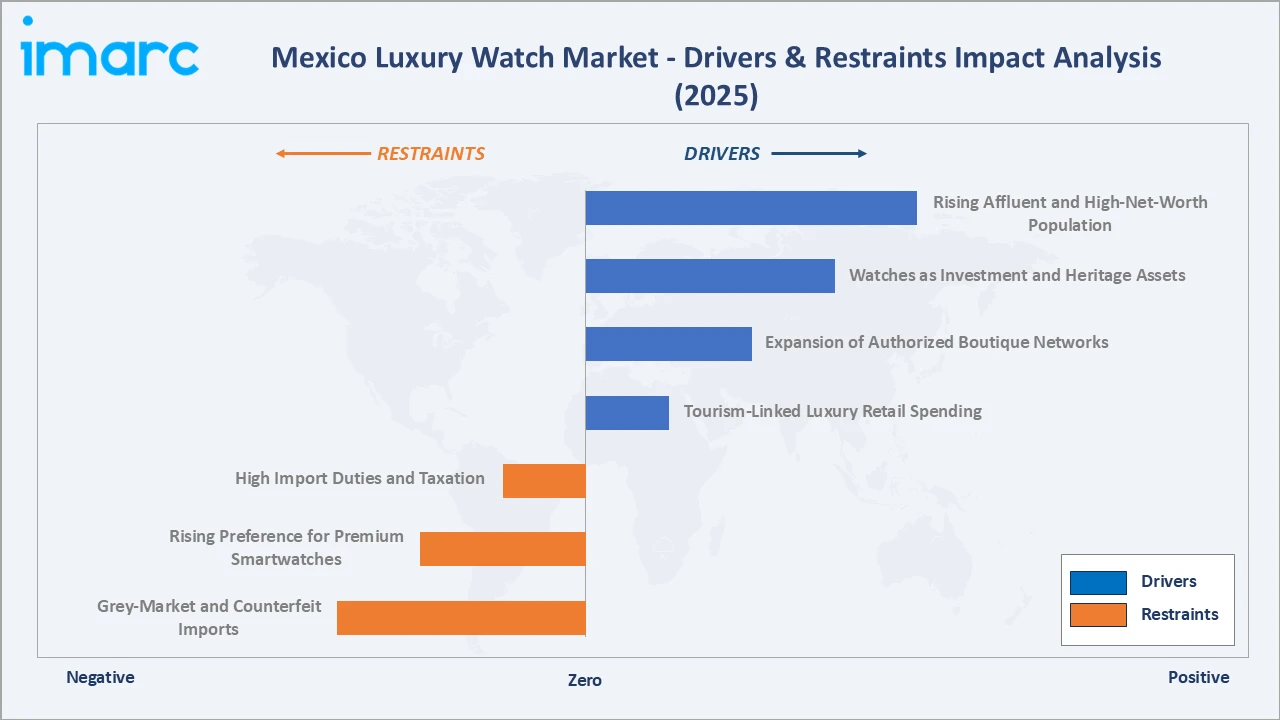
- Rising Affluent and High-Net-Worth Population: Mexico's affluent consumer base has been expanding steadily, with rising disposable incomes among urban professionals supporting higher spend on luxury accessories. Growing wealth concentration in Mexico City and Monterrey is increasing boutique footfall.
- Watches as Investment and Heritage Assets: Increasing consumer awareness of watch resale value and long-term appreciation is driving demand for recognized Swiss brands. Buyers increasingly view select models as alternative stores of value alongside traditional assets.
- Expansion of Authorized Boutique Networks: International watchmakers have been broadening their boutique and shop-in-shop presence across premium malls and jewelry chains, widening access to authenticated luxury timepieces.
- Tourism-Linked Luxury Retail Spending: Mexico's strong international tourism inflows, particularly across resort and coastal destinations, continue to support duty-free and airport luxury watch sales.
Market Restraints
- High Import Duties and Taxation: Import tariffs and value-added tax on luxury imports raise retail price points, limiting accessibility among aspirational buyers relative to comparable regional markets.
- Rising Preference for Premium Smartwatches: Growing adoption of connected smartwatches among younger, tech-oriented consumers is redirecting some discretionary spending away from traditional mechanical timepieces.
Market Opportunities
- Growth of Certified Pre-Owned Platforms: Rising consumer interest in certified pre-owned watches is creating opportunities for brand-backed resale and authentication programs across Mexico's major cities.
- Expansion of Smart-Luxury Hybrid Models: Increasing demand for timepieces that combine mechanical heritage with digital connectivity is opening opportunities for hybrid product lines among established houses.
Market Challenges
- Grey-Market and Counterfeit Imports: Unregistered imports and counterfeit products entering through informal channels create authentication challenges and pricing pressure for authorized retailers.
- Price Sensitivity Beyond Core Affluent Segments: Aspirational buyers outside the core affluent base remain highly price-sensitive, requiring brands to balance exclusivity with broader accessibility.
Emerging Market Trends
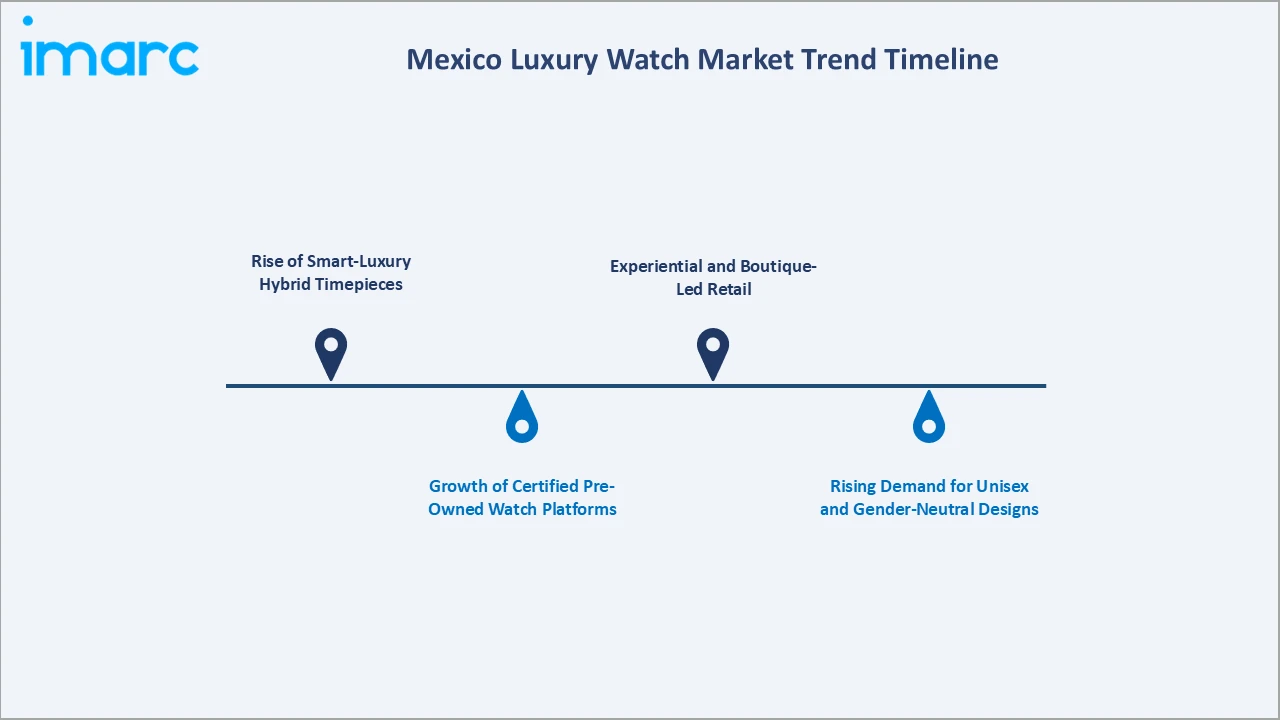
1. Rise of Smart-Luxury Hybrid Timepieces
Hybrid watches combining mechanical movements with connected features are gaining traction among younger affluent buyers. Brands are integrating discreet smart functions while preserving traditional craftsmanship and design heritage.
2. Growth of Certified Pre-Owned Watch Platforms
Certified pre-owned programs are expanding as brands formalize resale channels to protect brand value and authenticity. This trend is widening access to heritage models across varied price points.
3. Experiential and Boutique-Led Retail
Watchmakers are investing in immersive boutique experiences, private appointments, and after-sales service centers to strengthen brand loyalty among Mexico's affluent clientele.
4. Rising Demand for Unisex and Gender-Neutral Designs
Design houses are expanding unisex collections featuring versatile case sizes and minimalist dials, appealing to younger consumers seeking flexible, everyday luxury pieces.
Industry Value Chain Analysis
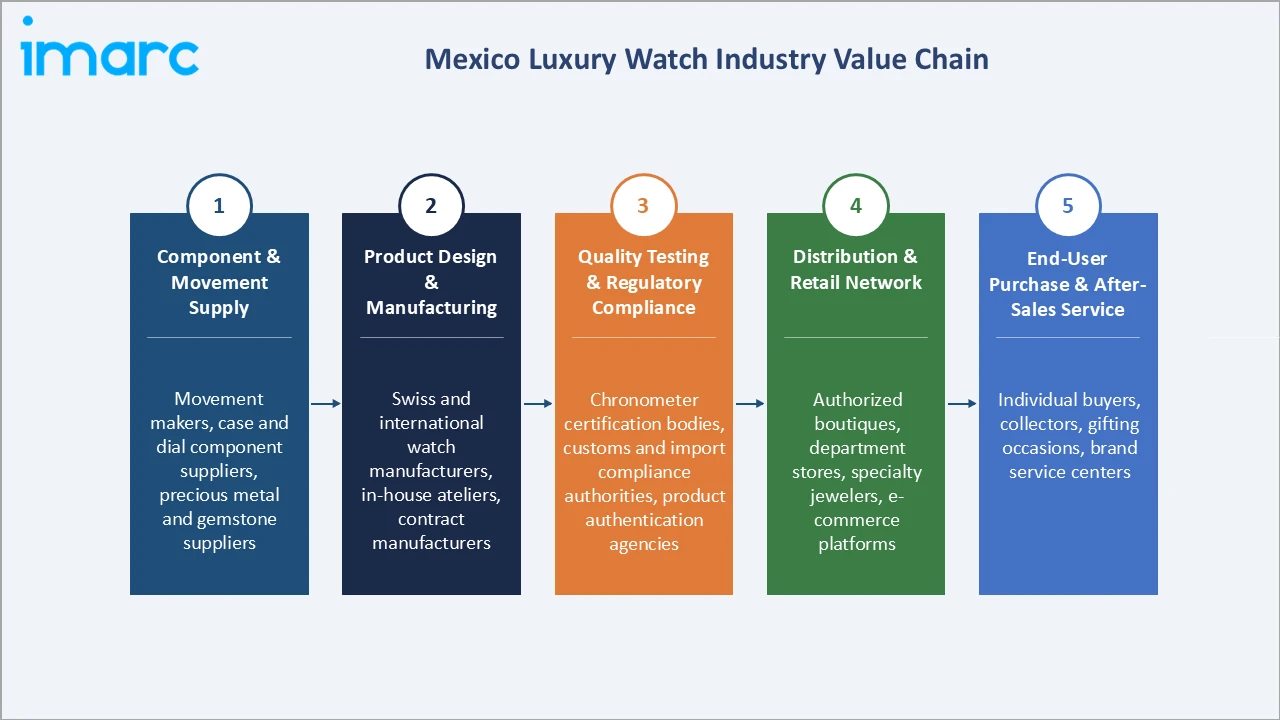
The Mexico luxury watch value chain integrates component and movement supply, product design and manufacturing, quality testing and regulatory compliance, distribution and retail, and end-user purchase and after-sales service.
|
Stage |
Key Participants |
|
Component & Movement Supply |
Movement makers, case and dial component suppliers, precious metal and gemstone suppliers |
|
Product Design & Manufacturing |
Swiss and international watch manufacturers, in-house ateliers, contract manufacturers |
|
Quality Testing & Regulatory Compliance |
Chronometer certification bodies, customs and import compliance authorities, product authentication agencies |
|
Distribution & Retail Network |
Authorized boutiques, department stores, specialty jewelers, e-commerce platforms |
|
End-User Purchase & After-Sales Service |
Individual buyers, collectors, gifting occasions, brand service centers |
Product design and manufacturing represents the most value-added stage in the Mexico luxury watch value chain. This stage determines mechanical precision, material quality, and design heritage that differentiate premium models from mass-market alternatives. Strength in movement engineering and finishing allows manufacturers to command premium pricing and sustain brand exclusivity across retail channels.
Technology Landscape in the Mexico Luxury Watch Industry
Movement Technology
Automatic and mechanical movements continue to anchor the premium segment, with in-house calibers and chronometer certification serving as key differentiators. Continued refinement in power reserve and precision engineering supports brand positioning among collectors.
Materials Innovation
Manufacturers are increasingly using ceramic, titanium, and scratch-resistant sapphire crystal to enhance durability and everyday wearability. Precious metal alloys with improved tarnish resistance are also gaining adoption across higher price tiers.
Smart Connectivity
Select luxury houses are introducing hybrid models with discreet activity tracking and smartphone connectivity, appealing to buyers who value both mechanical heritage and modern functionality.
Manufacturing Automation
Precision automation in movement assembly and quality inspection is improving consistency across production runs, while skilled artisans continue to handle finishing and complication assembly for top-tier models.
Market Segmentation Analysis
The report covers the following segments:
|
Segment Category |
Leading Segment |
Market Share |
Year |
|
Type |
Analog Watch |
81.6% |
2025 |
|
End User |
Men |
57.8% |
2025 |
|
Distribution Channel |
🔒 |
🔒 |
2025 |
|
Region |
Central Mexico |
46.5% |
2025 |

By Type
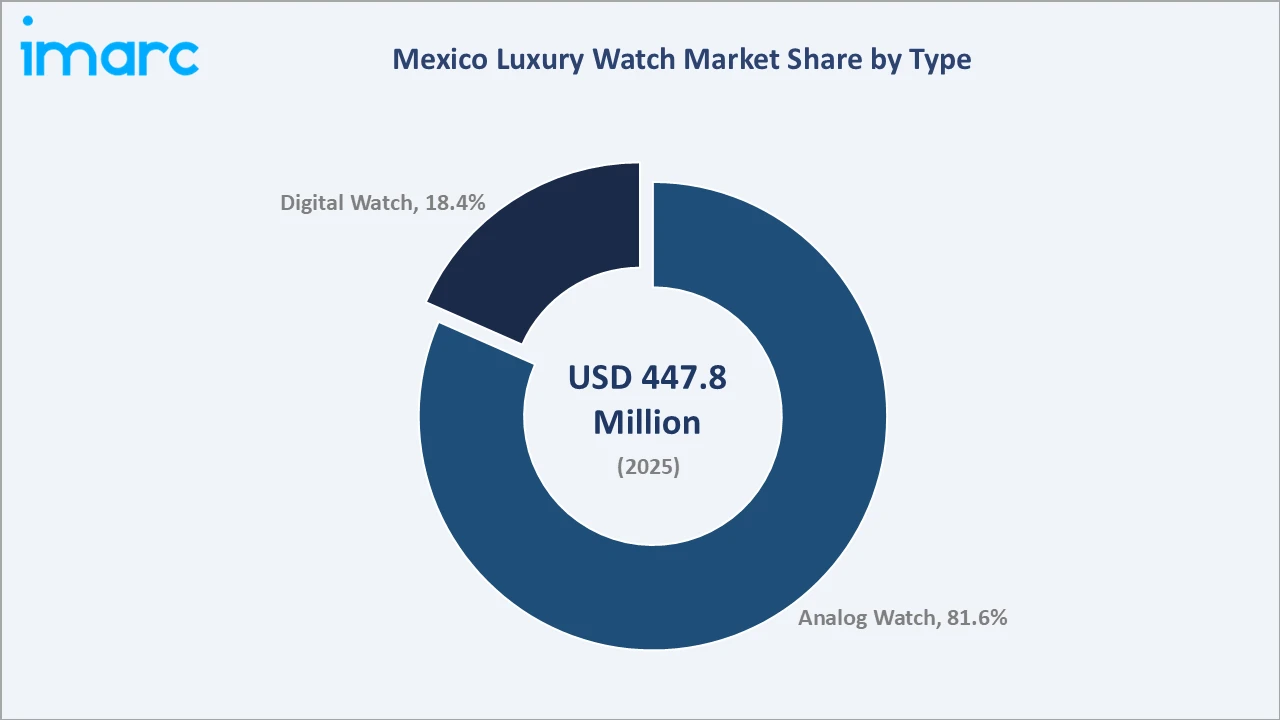
Analog watches lead at 81.6% (2025), through their mechanical heritage, craftsmanship appeal, and strong resale value among Mexico's affluent buyers.
To access detailed market analysis, Request Sample
Digital watches at 18.4% grow fastest at ~3.4% CAGR through smart-hybrid functionality and rising appeal among younger, tech-oriented consumers seeking connected luxury.
By End User
Men lead at 57.8% (2025), reflecting long-standing purchasing patterns among professional and executive buyers seeking heritage Swiss timepieces.
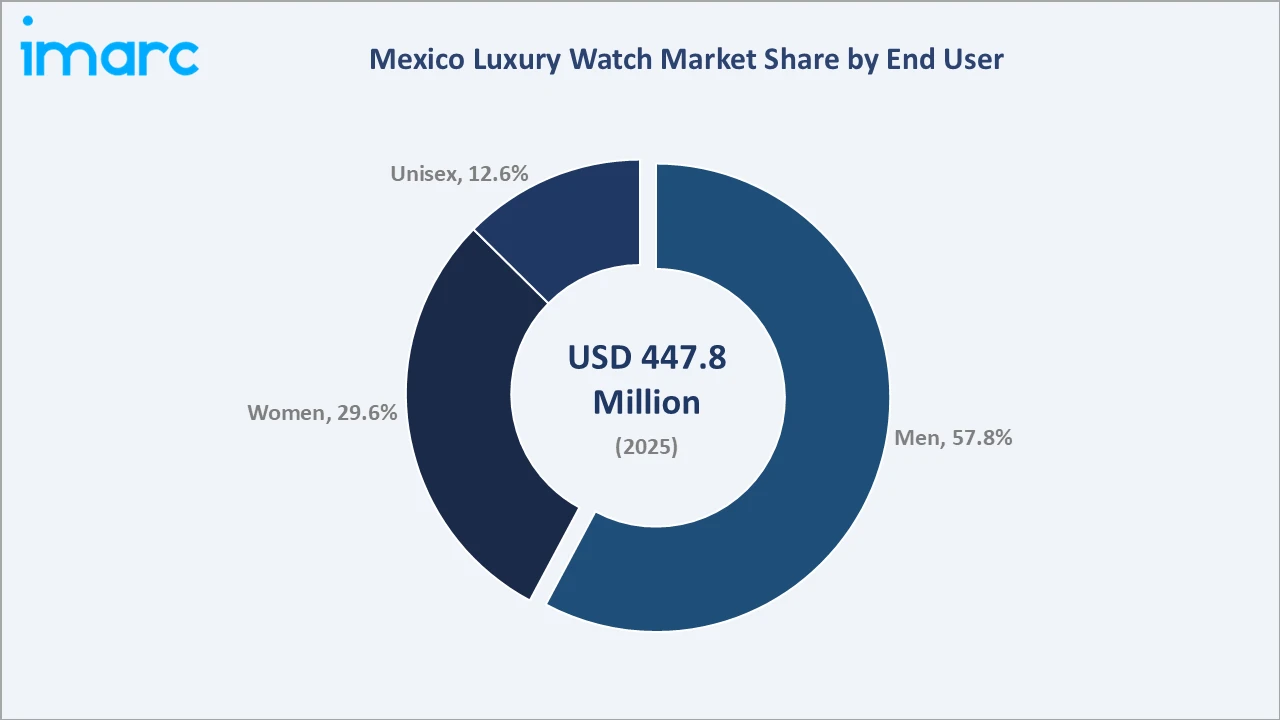
Women at 29.6% continue to grow through expanding jewelry-watch hybrid collections, while Unisex designs at 12.6% grow fastest at ~3.1% CAGR through gender-neutral case sizing and minimalist styling.
Regional Market Insights
|
Region |
Share (2025) |
Key Mexico Luxury Watch Market Characteristics |
|
Central Mexico |
46.5% |
Reflects concentration of affluent households, boutique density, and luxury retail infrastructure across Mexico City and surrounding states. |
|
Northern Mexico |
31.9% |
Supported by cross-border retail access, industrial-sector incomes, and proximity to United States luxury retail corridors. |
|
Southern Mexico |
14.1% |
Reflects gradual expansion of organized luxury retail and growing tourism-linked demand in emerging urban centers. |
|
Others |
7.5% |
Other regions, including coastal and resort destinations, contribute through tourism and duty-free retail activity. |
Central Mexico's 46.5% dominance is supported by concentrated affluent households and boutique density in and around Mexico City. Northern Mexico's 31.9% follows through cross-border retail access and rising industrial-sector incomes.
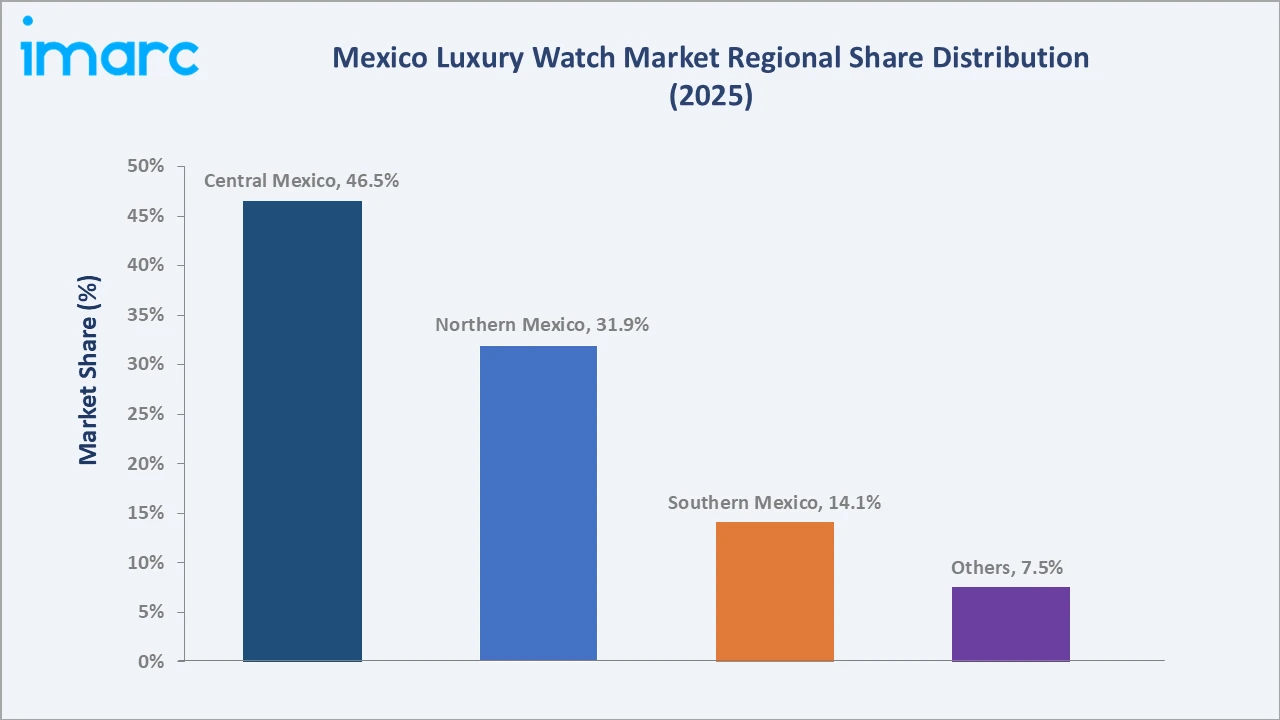
Southern Mexico's 14.1% reflects steady growth of organized luxury retail across expanding urban centers. Others at 7.5%, including coastal and resort regions, contribute through tourism-linked and duty-free retail activity.
Competitive Landscape
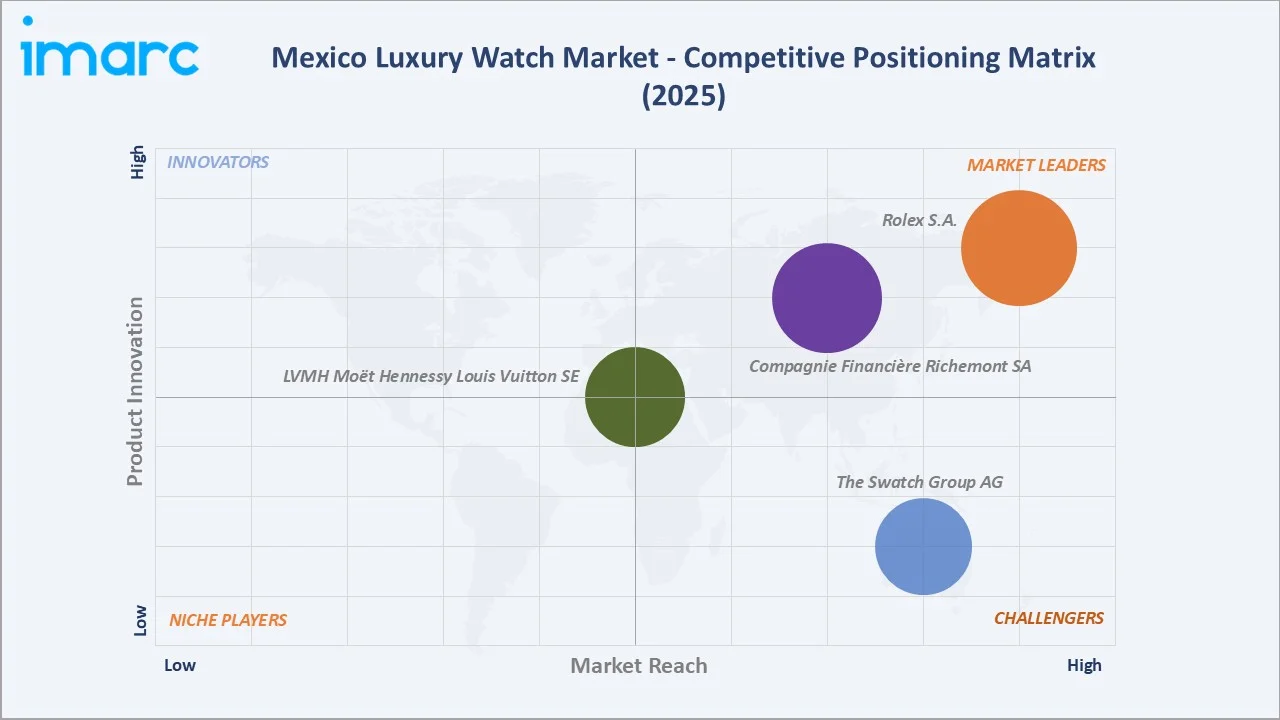
The Mexico luxury watch market is moderately consolidated, with established Swiss and international watchmakers competing alongside multi-brand jewelers and specialty retailers. Key firms focus on boutique expansion, heritage positioning, and certified after-sales service. Competition is shaped by brand recognition, craftsmanship, exclusivity, and distribution reach across authorized retail channels.
|
Company |
Key Brand(s) |
Market Position |
Core Strength |
|
Rolex S.A. |
Rolex, Tudor |
Market Leader |
Maintains a dominant boutique and authorized-dealer presence across Mexico's major cities, anchored by strong brand recognition and resale value retention. |
|
Compagnie Financière Richemont SA |
Cartier, Panerai, IWC Schaffhausen |
Market Leader |
Leverages Cartier's heritage jewelry-watch positioning and expanding boutique network across premium Mexican retail centers. |
|
The Swatch Group AG |
Omega, Longines, Rado |
Strong Challenger |
Operates a multi-tier brand portfolio spanning accessible and premium price points, supported by established retail partnerships. |
|
LVMH Moët Hennessy Louis Vuitton SE |
TAG Heuer, Bulgari |
Established Player |
Differentiates through sport-luxury positioning and celebrity-linked marketing, appealing to younger affluent buyers. |
Companies are increasingly investing in boutique experiences, certified pre-owned programs, and after-sales service centers to strengthen brand loyalty. The market is also seeing growing participation from multi-brand specialty jewelers targeting Mexico's expanding affluent consumer base.
Key Company Profiles
Rolex S.A.
Rolex S.A. is a Swiss manufacturer and one of the most recognized names in the Mexico luxury watch market. The company operates through authorized dealer networks and boutiques offering mechanical and automatic timepieces renowned for precision and resale value.
- Key Brands: Rolex, Tudor, and others.
- Strategic Focus: Strengthening authorized boutique presence while reinforcing certified pre-owned and after-sales service standards across Mexico.
Compagnie Financière Richemont SA
Compagnie Financière Richemont SA is a Swiss luxury goods holding company with a strong jewelry-watch presence in Mexico through its Cartier brand. The company combines heritage craftsmanship with expanding boutique retail across premium shopping destinations.
- Key Brands: Cartier, Panerai, IWC Schaffhausen, and others.
- Strategic Focus: Expanding boutique retail footprint while strengthening jewelry-watch hybrid positioning among affluent Mexican consumers.
The Swatch Group AG
The Swatch Group AG is a diversified Swiss watchmaker with a multi-tier brand portfolio spanning accessible and premium segments in Mexico. Its Omega and Longines brands maintain strong recognition among collectors and professional buyers.
- Key Brands: Omega, Longines, Rado, and others.
- Strategic Focus: Strengthening premium positioning of Omega while expanding accessible-luxury distribution through Tissot and Longines.
Market Concentration Analysis
The Mexico luxury watch market shows moderate concentration, with established Swiss watchmakers holding strong positions through boutique networks and brand heritage. Large players benefit from certified authentication, resale value retention, and long-standing distribution partnerships. However, the market remains fragmented at the accessible-luxury end, where multi-brand jewelers and department-store counters continue to hold meaningful share. Rising demand for certified pre-owned and smart-hybrid models is also opening space for specialized retailers. Overall, competition is shifting from pure brand prestige toward differentiated after-sales service, authentication assurance, and boutique experience.
Investment & Growth Opportunities
Highest Growth Segments
Digital watches (~3.4% CAGR), unisex designs (~3.1% CAGR), Northern Mexico (~2.7% CAGR), and Women's watches (~2.6% CAGR) represent the Mexico luxury watch market's highest-growth investment vectors through 2034.
Investment Themes
- Certified Pre-Owned Platform Development: Growing consumer interest in verified resale timepieces is creating opportunities for brand-backed certification and authentication platforms targeting collectors and first-time luxury buyers.
- Smart-Luxury Hybrid Product Lines: Rising preference for timepieces blending mechanical heritage with connected functionality is creating investment opportunities in hybrid product development and boutique showcasing.
Future Market Outlook (2026-2034)
The Mexico luxury watch market is projected to grow from USD 447.8 Million in 2025 to USD 557.8 Million by 2034, delivering a 2.40% CAGR over the forecast period through rising affluent spending, boutique expansion, and growing recognition of watches as investment assets. The market's anchor value of USD 504.1 Million in 2030 represents a mid-point shift toward premium analog and smart-hybrid positioning.
Three structural forces define Mexico luxury watch market growth through 2034. First, continued expansion of authorized boutique and department-store retail is widening consumer access to certified luxury timepieces. Second, rising recognition of watches as heritage and investment assets is sustaining demand among affluent professionals and collectors. Third, ongoing innovation in smart-hybrid and unisex design is supporting premiumization across both traditional and younger buyer segments.
Research Methodology
Primary Research
Primary research comprised interviews with luxury watch manufacturers, authorized distributors, specialty jewelers, and boutique retail managers across Mexico. Discussions also covered e-commerce platform managers and customs compliance specialists. Inputs were gathered on product demand, pricing, distribution practices, and adoption of certified pre-owned and smart-hybrid models. Feedback from industry participants helped validate market size, regional trends, and competitive positioning.
Secondary Research
Secondary research encompassed government trade and customs statistics, industry publications, company reports, and luxury retail market databases. It also included reviews of affluent consumer spending trends, import duty structures, and regulatory updates from Mexico's tax administration and consumer-protection authorities. Public sources on boutique expansion and luxury imports were assessed to map regional demand patterns.
Forecasting Models
Forecasting models combined historical market performance, boutique expansion trends, and macroeconomic indicators to project future demand. The analysis incorporated expected growth in certified pre-owned platforms, smart-hybrid adoption, and boutique retail infrastructure. Market estimates were validated through triangulation of primary insights, secondary research, and segment-level demand analysis to ensure robust long-term projections through 2034.
Mexico Luxury Watch Market Report Coverage:
| Report Features | Details |
|---|---|
| Base Year of the Analysis | 2025 |
| Historical Period | 2020-2025 |
| Forecast Period | 2026-2034 |
| Units | Million USD |
| Scope of the Report |
Exploration of Historical Trends and Market Outlook, Industry Catalysts and Challenges, Segment-Wise Historical and Future Market Assessment:
|
| Types Covered | Analog Watch, Digital Watch |
| End Users Covered | Women, Men, Unisex |
| Distribution Channels Covered | Online Stores, Offline Stores |
| Regions Covered | Northern Mexico, Central Mexico, Southern Mexico, Others |
| Companies Covered | Rolex S.A., Compagnie Financière Richemont SA, The Swatch Group AG, LVMH Moët Hennessy Louis Vuitton SE, etc. |
| Customization Scope | 10% Free Customization |
| Post-Sale Analyst Support | 10-12 Weeks |
| Delivery Format | PDF and Excel through Email (We can also provide the editable version of the report in PPT/Word format on special request) |
Key Benefits for Stakeholders:
- IMARC’s industry report offers a comprehensive quantitative analysis of various market segments, historical and current market trends, market forecasts, and dynamics of the Mexico luxury watch market from 2020-2034.
- The research report provides the latest information on the market drivers, challenges, and opportunities in the Mexico luxury watch market.
- Porter's five forces analysis assist stakeholders in assessing the impact of new entrants, competitive rivalry, supplier power, buyer power, and the threat of substitution. It helps stakeholders to analyze the level of competition within the Mexico luxury watch industry and its attractiveness.
- Competitive landscape allows stakeholders to understand their competitive environment and provides an insight into the current positions of key players in the market.
Frequently Asked Questions About the Mexico Luxury Watch Market Report
The Mexico luxury watch market reached USD 447.8 Million in 2025, driven by rising affluent spending, expanding boutique retail infrastructure, and growing recognition of watches as heritage investment assets.
The Mexico luxury watch market grows at a 2.40% CAGR during 2026-2034, reaching USD 557.8 Million by 2034. The CAGR reflects steady affluent demand and premiumization trends.
Analog watches lead at 81.6% due to mechanical heritage, craftsmanship appeal, and strong resale value. Their enduring popularity makes them the preferred choice among collectors and affluent buyers alike.
Men lead at 57.8% due to long-standing purchasing patterns among professional and executive buyers. Unisex designs are growing fastest as gender-neutral styling gains popularity among younger consumers.
Central Mexico leads at 46.5% due to its concentration of affluent households, boutique density, and luxury retail infrastructure across Mexico City and surrounding metropolitan areas.
Leading companies include Rolex S.A., Compagnie Financière Richemont SA, The Swatch Group AG, and LVMH Moët Hennessy Louis Vuitton SE, among other specialty jewelers and distributors.
The market is projected to reach approximately USD 504.1 Million by 2030, supported by rising boutique expansion and growing demand for certified pre-owned and smart-hybrid timepieces.
Certified pre-owned platforms offer strong growth potential as consumers seek verified resale timepieces. Smart-luxury hybrid product lines also present opportunities as demand rises for connected heritage watches.
In-house movement engineering, ceramic and titanium materials, and discreet smart-connectivity features are shaping product innovation, supporting premiumization across the industry through 2034.
Growing online boutique presence and authenticated e-commerce platforms are widening consumer access to both accessible and premium luxury timepieces, supporting steady market growth nationwide.
Need more help?
- Speak to our experienced analysts for insights on the current market scenarios.
- Include additional segments and countries to customize the report as per your requirement.
- Gain an unparalleled competitive advantage in your domain by understanding how to utilize the report and positively impacting your operations and revenue.
- For further assistance, please connect with our analysts.
 Request Customization
 Speak to an Analyst
 Request Brochure
 Inquire Before Buying
Benefits of Customization
- Personalize this research
- Triangulate with your data
- Get data as per your format and definition
- Gain a deeper dive into a specific application, geography, customer, or competitor
- Any level of personalization
Get in Touch With Us
UNITED STATES
Phone: +1-201-971-6302
INDIA
Phone: +91-120-433-0800
UNITED KINGDOM
Phone: +44-753-714-6104
Email: [email protected]
Client Testimonials




.webp)




.webp)













Related Reports

Choose your plan
*Please note that the prices mentioned below are starting prices for each bundle type. Kindly contact our team for further details.*
Single User License
- 1 User License, Access on 2 Devices
- PDF Report + Excel Dataset (Password Protected)
- Lifetime Access
- No Printing Rights
- 10% Free Report Customization
- 10–12 Weeks of Analyst Support
Five User License
- Access for 5 Users, 2 Devices per User
- PDF Report + Excel Dataset (Password Protected)
- Lifetime Access
- Dedicated Account Manager
- 12–14 Weeks of Analyst Support
- No Printing Rights
- 15% Free Report Customization
- 25% Discount on Your Next Purchase
Corporate User License
- Unlimited User Access (Within Your Organization)
- PDF Report + Excel Dataset
- Lifetime Access
- Dedicated Account Manager
- 14–20 Weeks of Analyst Support
- No Printing Rights
- 20% Free Report Customization
- 30% Discount on Your Next Purchase
Essential Insights
What's included:
3 reports
- Lifetime Access
- PDF Reports
- Excel Datasets
- 2 Weeks of Free Analyst Support
- 2 User Licenses
- Access on 2 Devices
- Printing Rights
- Complimentary PowerPoint (PPT) Version
- Complimentary License Upgrade
Professional Access
What's included:
5 reports
- Lifetime Access
- PDF Reports
- Excel Datasets
- 8 Weeks of Free Analyst Support
- 2 User Licenses
- Access on 2 Devices
- Printing Rights
- Complimentary PowerPoint (PPT) Version
- Complimentary License Upgrade
Business Advantage
What's included:
8 reports
- Lifetime Access
- PDF Reports
- Excel Datasets
- 14 Weeks of Free Analyst Support
- 2 User Licenses
- Access on 2 Devices
- Printing Rights
- Complimentary PowerPoint (PPT) Version
- Complimentary License Upgrade
Enterprise Intelligence
What's included:
10 reports
- Lifetime Access
- PDF Reports
- Excel Datasets
- 20 Weeks of Free Analyst Support
- 2 User Licenses
- Access on 2 Devices
- Printing Rights
- Complimentary PowerPoint (PPT) Version
- Complimentary License Upgrade