
Mexico Recycled Plastics Market Size, Share, Trends and Forecast by Plastic Type, Raw Material, Application, and Region, 2026-2034
Mexico Recycled Plastics Market Size, Share, Trends & Forecast (2026-2034)
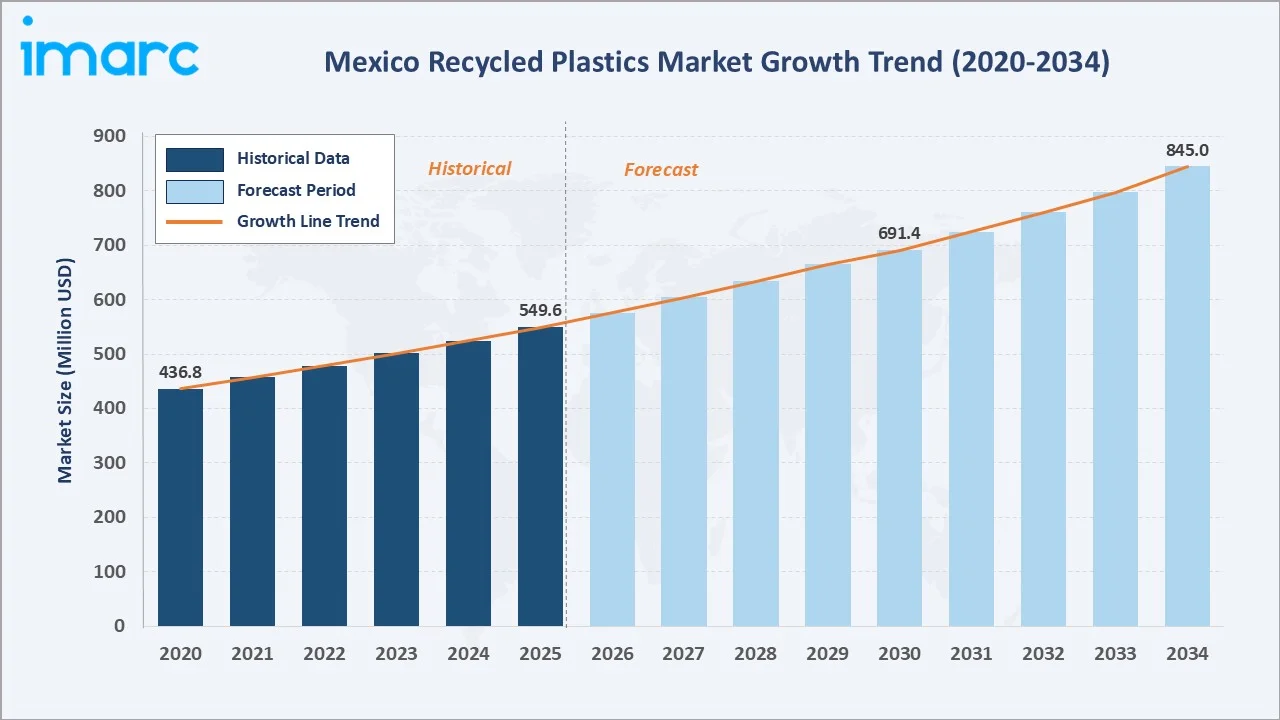
The Mexico recycled plastics market size increased from USD 549.6 Million in 2025 to USD 575.4 Million in 2026 and is projected to reach USD 845.0 Million by 2034, growing at a CAGR of 4.70% during 2026-2034.
The market is driven by rising environmental awareness, single-use plastic restrictions, and expanding construction activity adopting recycled materials. In 2024, Mexico generated around 5.7 Million Tons of mismanaged plastic waste, intensifying recycling efforts.
Plastic bottles dominate raw materials at 44.2%, supported by Mexico's large food-grade rPET base and high PET recovery rate. Non-food contact packaging leads applications at 37.8%, while Central Mexico commands 43.5% of national demand on the strength of its industrial concentration and proximity to large-scale recycling capacity.
Market Snapshot
|
Metric |
Value |
|
Base Year Market Size (2025) |
USD 549.6 Million |
|
Market Size (2026) |
USD 575.4 Million |
|
Forecast Market Size (2034) |
USD 845.0 Million |
|
CAGR (2026-2034) |
4.70% |
|
Base Year |
2025 |
|
Historical Period |
2020-2025 |
|
Forecast Period |
2026-2034 |
|
Dominant Raw Material |
Plastic Bottles (44.2%, 2025) |
|
Dominant Application |
Non-Food Contact Packaging (37.8%, 2025) |
|
Leading Region |
Central Mexico (43.5%, 2025) |
The market expanded from USD 436.8 Million in 2020 to USD 549.6 Million in 2025 to an estimated USD 575.4 Million in 2026, anchored at USD 691.4 Million in 2030 and forecast to reach USD 845.0 Million by 2034. Pandemic-era collection disruptions slowed momentum but did not reverse the structural shift toward circular packaging.
To get more information on this market, Request Sample
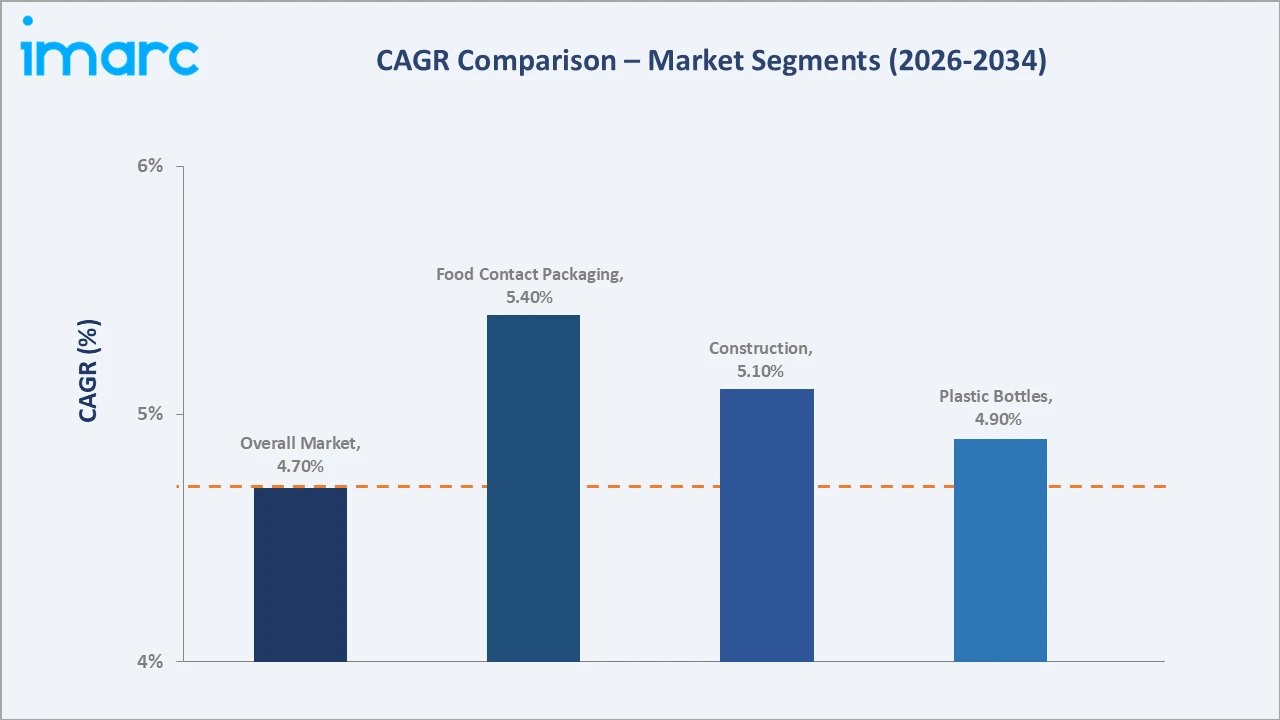
Food contact packaging grows fastest at ~5.4% CAGR as bottle-to-bottle rPET adoption deepens among beverage brand owners. Plastic bottles, the largest raw material category, grow at ~4.9% CAGR on Mexico's high PET recovery rate.
Executive Summary
The Mexico recycled plastics market grew from USD 549.6 Million in 2025 to USD 575.4 Million in 2026, positioned as one of Latin America's most advanced recycling markets, underpinned by world-leading food-grade rPET capacity and strong beverage-sector demand. The market is projected to reach USD 845.0 Million by 2034, growing steadily as sustainability mandates, recycled-content commitments, and circular-economy initiatives broaden across industries.
Plastic bottles at 44.2% dominate raw materials through Mexico's mature PET collection ecosystem. Non-food contact packaging at 37.8% leads applications, while Central Mexico at 43.5% leads regionally through its concentration of recycling plants and packaging converters in the central industrial corridor.
Key Market Insights
|
Insight |
Data |
|
Dominant Raw Material |
Plastic Bottles - 44.2% share (2025) |
|
Dominant Application |
Non-Food Contact Packaging - 37.8% share (2025) |
|
Leading Region |
Central Mexico - 43.5% share (2025) |
|
Market Opportunity |
Food-grade rPET scale-up; chemical recycling; rHDPE in construction; EPR-driven collection expansion |
Key Analytical Observations Supporting the Above Data:
- Plastic Bottles at 44.2%: Bottles dominate as Mexico recovers over half of its post-consumer PET, supplying integrated recyclers such as PetStar and Alpek with high-quality feedstock for bottle-to-bottle resin.
- Non-Food Contact Packaging at 37.8%: This segment leads through broad use of recycled resin in non-food bottles, containers, and films where regulatory thresholds are lower than food-contact uses.
- Central Mexico at 43.5%: The region leads through its dense cluster of recycling plants, converters, and beverage bottlers concentrated in the central industrial corridor.
Mexico Recycled Plastics Market Overview
The Mexico recycled plastics market covers the collection, sorting, washing, and reprocessing of post-consumer and post-industrial plastics into flakes, pellets, and recycled resins used across packaging, construction, automotive, and textile applications. Mexico is one of Latin America's most advanced recycling markets, anchored by world-leading food-grade rPET capacity and a high post-consumer PET recovery rate that exceeds many regional peers.
The ecosystem integrates feedstock and material suppliers, collection and sorting networks, recyclers and reprocessors, brand owners and converters, and regulatory bodies setting packaging and recycled-content standards. Macroeconomic factors include sustainability mandates, single-use plastic bans, and rising consumer preference for eco-friendly products. The market also benefits from Mexico's proximity to the United States, which supports cross-border recycled resin trade and nearshoring-driven industrial demand for recycled materials.
Market Dynamics
To evaluate market opportunities, Request Sample
Market Drivers
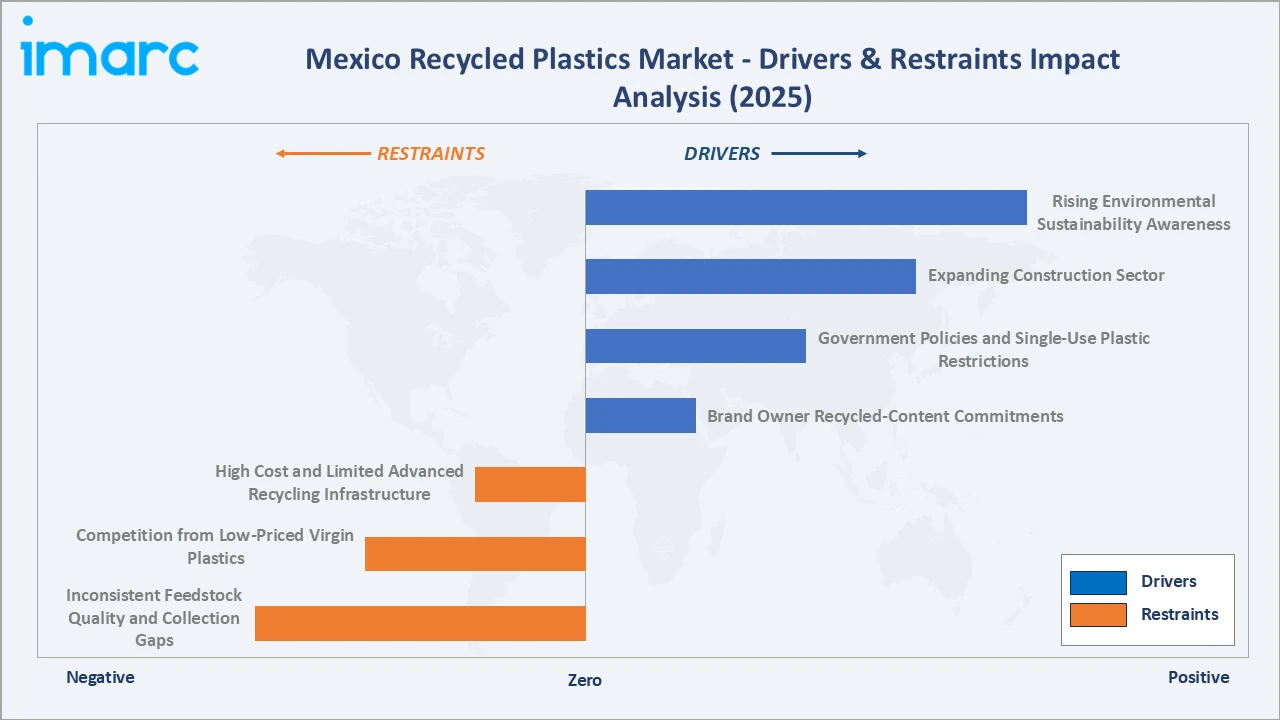
- Rising Environmental Sustainability Awareness: Growing awareness of plastic pollution is pushing businesses and consumers toward recycled materials. With Mexico generating 5.7 Million Tons of mismanaged plastic waste in 2024, recycling initiatives and eco-friendly alternatives are expanding rapidly, lifting recycled plastic demand. Educational campaigns, corporate sustainability targets, and consumer preference for products made with recycled content are further reinforcing this shift across packaging, retail, and consumer-goods sectors.
- Expanding Construction Sector: Mexico's construction sector is adopting recycled plastics in piping, insulation, panels, and roofing. These lightweight, durable, moisture-resistant materials lower waste and project costs, reinforcing recycled plastic usage in modern building practices. Urban development and modular construction using plastic-based components are further accelerating demand, particularly in space-constrained urban areas where ease of transport and installation are valued.
- Government Policies and Single-Use Plastic Restrictions: State-level single-use plastic bans and recycling programs are encouraging recycled content. Policies promoting eco-friendly packaging and waste reduction make it easier for companies to invest in recycled materials, supporting consistent market growth.
- Brand Owner Recycled-Content Commitments: Beverage and consumer-goods brand owners are committing to recycled content targets, especially in PET. Coca-Cola bottlers' bottle-to-bottle programs with local recyclers directly increase structural demand for high-quality recycled resin.
Market Restraints
- High Cost and Limited Advanced Recycling Infrastructure: Advanced sorting, washing, and food-grade processing require significant capital. Infrastructure gaps and the high cost of adopting new recycling technologies limit capacity expansion and constrain smaller players.
- Competition from Low-Priced Virgin Plastics: Recycled resins frequently compete against cheaper virgin plastics, particularly when oil prices are low. Price disadvantages can slow recycled-content adoption among cost-sensitive converters.
- Inconsistent Feedstock Quality and Collection Gaps: Low household source-separation rates and uneven collection coverage create variable feedstock quality, raising sorting costs and limiting output of high-grade recycled materials.
Market Opportunities
- Food-Grade rPET Capacity Expansion: Continued investment in food-grade rPET, led by PetStar's multi-stage plant expansions, opens scope to capture rising bottle-to-bottle demand from beverage brand owners.
- Chemical Recycling and rHDPE in Construction: Emerging chemical recycling can process harder-to-recycle plastics, while recycled HDPE for construction and infrastructure offers a growing, higher-volume outlet beyond packaging.
Market Challenges
- Low National Recycling and Source-Separation Rates: Despite strong PET recovery, overall plastic recycling and household sorting rates remain low, limiting recoverable high-quality feedstock and constraining scale economics for recyclers.
- Regulatory Fragmentation Across States: Single-use plastic and recycling rules vary widely by state, creating uneven compliance requirements and complicating nationwide investment and collection strategies.
Emerging Market Trends
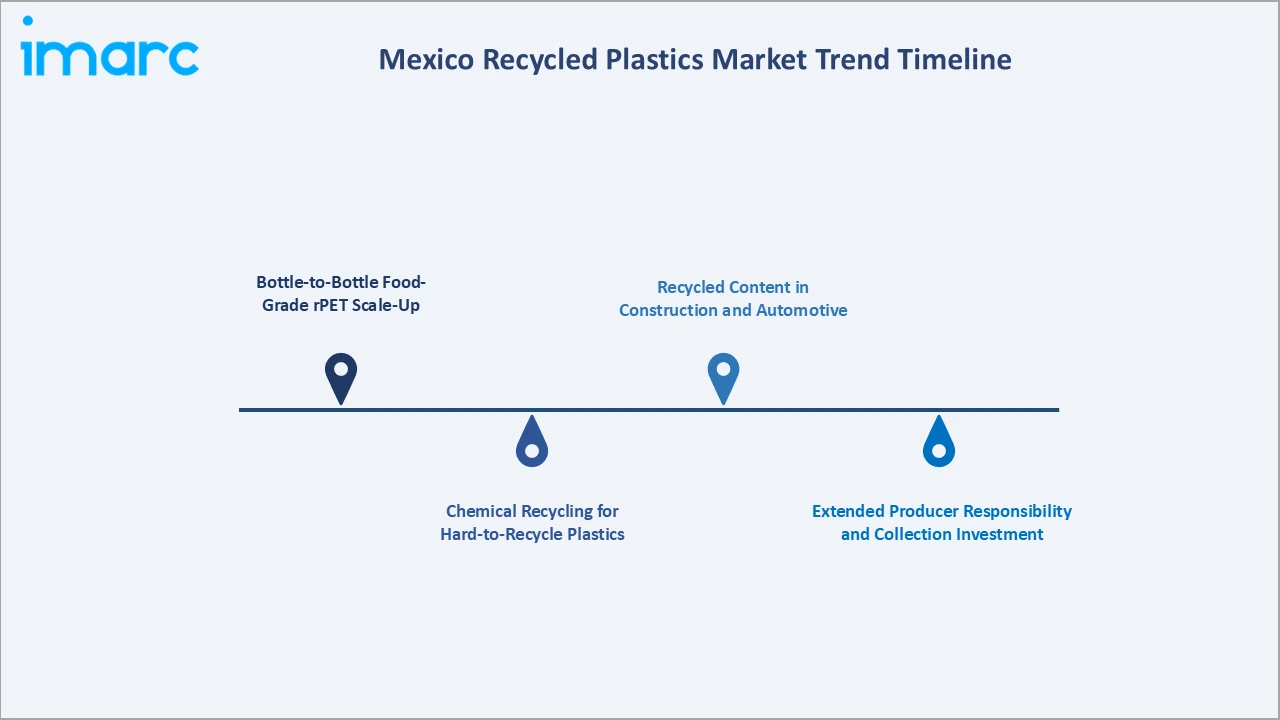
1. Bottle-to-Bottle Food-Grade rPET Scale-Up
Beverage bottlers are deepening bottle-to-bottle recycling, with integrated recyclers expanding food-grade rPET capacity to meet recycled-content commitments. This trend raises demand for clean PET feedstock and high-purity processing, anchoring market growth in the packaging segment. Multi-year capacity expansions and additional collection centers are reinforcing this shift, positioning Mexico as a regional leader in closed-loop PET recycling.
2. Chemical Recycling for Hard-to-Recycle Plastics
Chemical recycling is gaining attention as a route to process mixed and contaminated plastics that mechanical recycling cannot handle. Pilot projects and international partnerships are expanding the recyclable plastic pool and supporting circular packaging goals.
3. Extended Producer Responsibility and Collection Investment
EPR proposals and collection-scheme investment are improving feedstock availability. Expanded collection centers and inclusive collection models are strengthening the supply of recoverable plastics across regions.
4. Recycled Content in Construction and Automotive
Recycled plastics are increasingly specified in construction components and automotive parts. As builders and OEMs pursue sustainability targets, recycled HDPE and PP find growing, higher-volume applications beyond traditional packaging.
Industry Value Chain Analysis
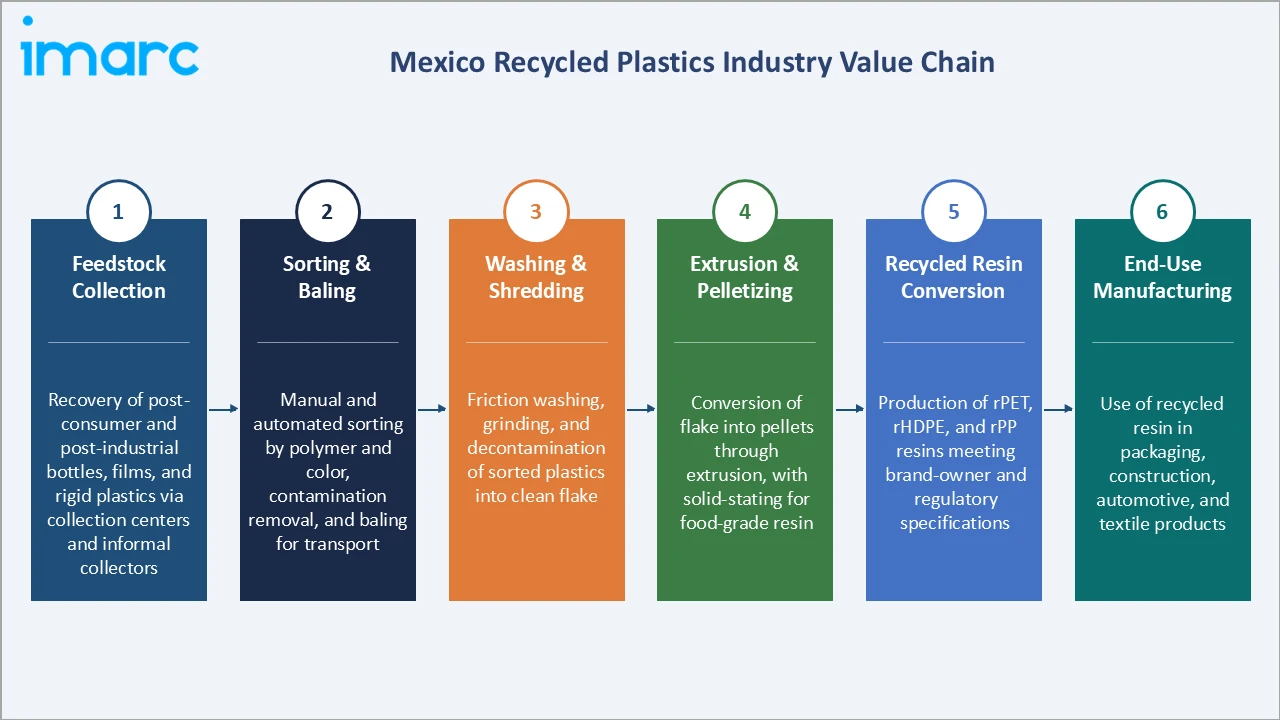
The recycled plastics value chain integrates feedstock collection, sorting and baling, washing and shredding, extrusion and pelletizing, recycled resin conversion, and end-use manufacturing. The chain is consolidating toward integrated recyclers that control collection through resin output.
|
Stage |
Key Activities |
|
Feedstock Collection |
Recovery of post-consumer and post-industrial bottles, films, and rigid plastics via collection centers and informal collectors |
|
Sorting & Baling |
Manual and automated sorting by polymer and color, contamination removal, and baling for transport |
|
Washing & Shredding |
Friction washing, grinding, and decontamination of sorted plastics into clean flake |
|
Extrusion & Pelletizing |
Conversion of flake into pellets through extrusion, with solid-stating for food-grade resin |
|
Recycled Resin Conversion |
Production of rPET, rHDPE, and rPP resins meeting brand-owner and regulatory specifications |
|
End-Use Manufacturing |
Use of recycled resin in packaging, construction, automotive, and textile products |
Feedstock collection is the most commercially critical and socially significant stage, given Mexico's reliance on informal collectors. Recycled resin conversion is experiencing the fastest technology transition as food-grade and chemical recycling capacity expands.
Technology Landscape in the Mexico Recycled Plastics Industry
Mechanical Recycling Technology
Mechanical recycling remains the dominant technology, processing post-consumer plastics through sorting, washing, shredding, and extrusion into flakes and pellets. It offers cost-efficient, high-throughput recovery for PET and HDPE, making it the backbone of bottle-to-bottle and packaging applications across Mexico's recycling base. Ongoing investment in automated optical sorting and AI-assisted separation is improving recovery rates and reducing contamination.
Food-Grade rPET (Bottle-to-Bottle) Technology
Food-grade rPET technology uses advanced washing, decontamination, and solid-state polymerization to produce resin safe for direct food contact. This enables closed-loop bottle-to-bottle recycling for beverage brand owners, supporting higher-value output and meeting strict regulatory and quality standards.
Chemical Recycling Technology
Chemical recycling depolymerizes plastics into base monomers, enabling recovery of mixed and contaminated streams that mechanical processes cannot handle. Though early-stage in Mexico, pilot projects and international partnerships position it to expand the recyclable plastic pool and advance circular packaging goals. As the technology matures, it is expected to complement mechanical recycling by addressing harder-to-recycle plastics and supporting higher recycled-content targets.
Market Segmentation Analysis
The report covers the following segments:
|
Segment Category |
Leading Segment |
Share |
Year |
|
Plastic Type |
🔒 |
🔒 |
2025 |
|
Raw Material |
Plastic Bottles |
44.2% |
2025 |
|
Application |
Non-Food Contact Packaging |
37.8% |
2025 |
|
Region |
Central Mexico |
43.5% |
2025 |

By Raw Material
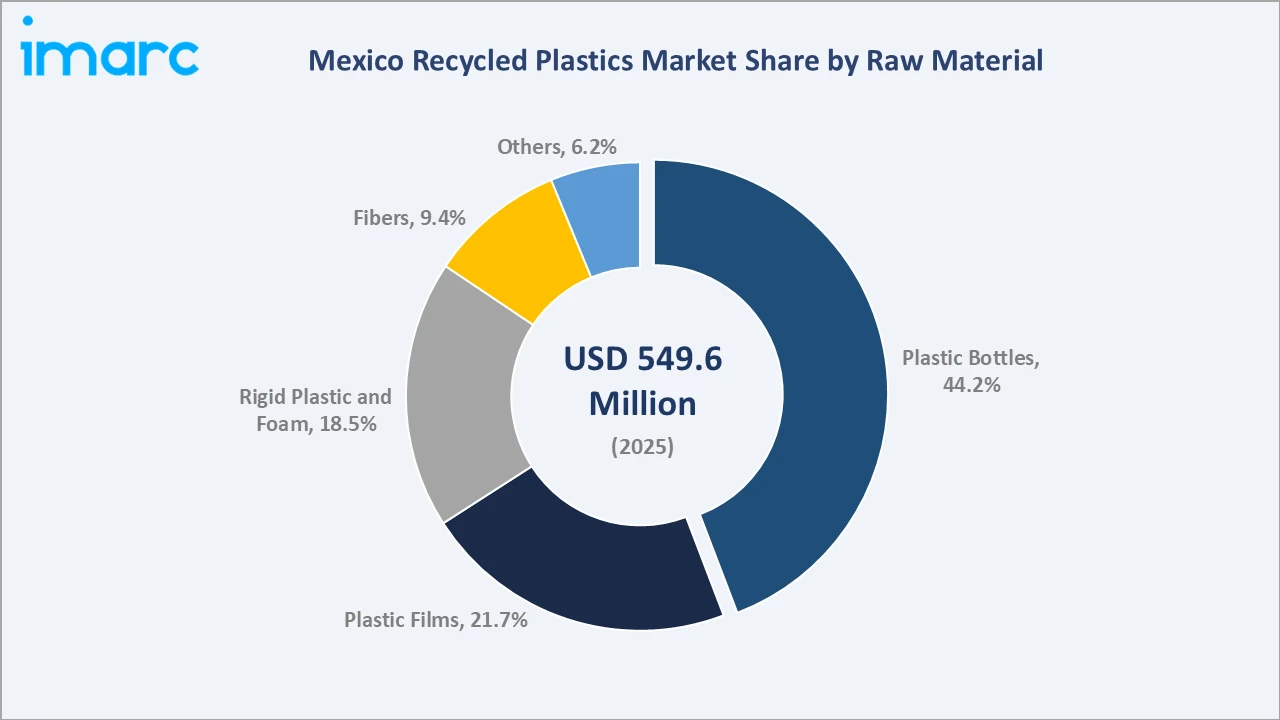
Plastic bottles lead at 44.2% in 2025, reflecting Mexico's mature PET bottle collection and bottle-to-bottle recycling base, the most commercially developed feedstock category in the market.
To access detailed market analysis, Request Sample
Plastic films at 21.7% capture flexible packaging recovery from retail, food, and consumer-goods streams, though contamination and multi-layer structures raise processing complexity. Rigid plastic and foam at 18.5% serve containers, crates, and durable goods, supported by HDPE and PP recovery. Fibers at 9.4% reflect textile and carpet recycling, and others account for 6.2%.
By Application
Non-food contact packaging leads at 37.8% through broad use of recycled resin in non-food bottles, containers, and films. Food contact packaging at 26.4% grows fastest as bottle-to-bottle rPET adoption deepens.
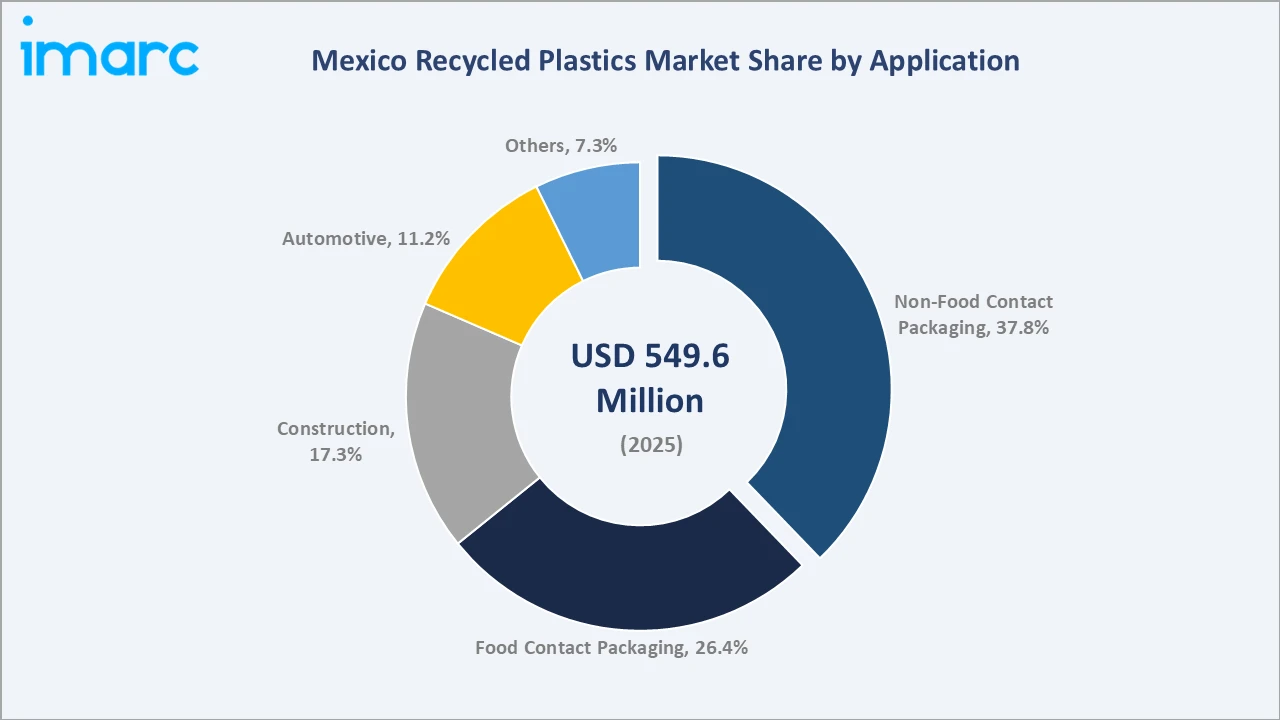
Construction at 17.3% reflects recycled plastics in piping, panels, insulation, and roofing, benefiting from durability and moisture resistance. Automotive at 11.2% covers recycled components in interior trim, under-hood, and structural parts as OEMs pursue sustainability targets, while others account for 7.3%. The food contact packaging segment's faster growth is underpinned by beverage bottlers' recycled-content commitments and expanding food-grade rPET capacity.
Regional Market Insights
|
Region |
Share (2025) |
Key Market Drivers & Characteristics |
|
Central Mexico |
43.5% |
Leads through a dense concentration of recyclers, packaging converters, and beverage bottlers in the central industrial corridor |
|
Northern Mexico |
29.1% |
Driven by manufacturing, automotive, and nearshoring activity demanding recycled materials for industrial use |
|
Southern Mexico |
16.2% |
Emerging with growing collection initiatives, packaging demand, and infrastructure development |
|
Others |
11.2% |
Represents remaining areas with developing recycling capacity and collection networks |
Central Mexico, at 43.5%, leads through its dense industrial cluster and proximity to large-scale recycling capacity. Northern Mexico, at 29.1%, reflects manufacturing and nearshoring-driven recycled material demand.
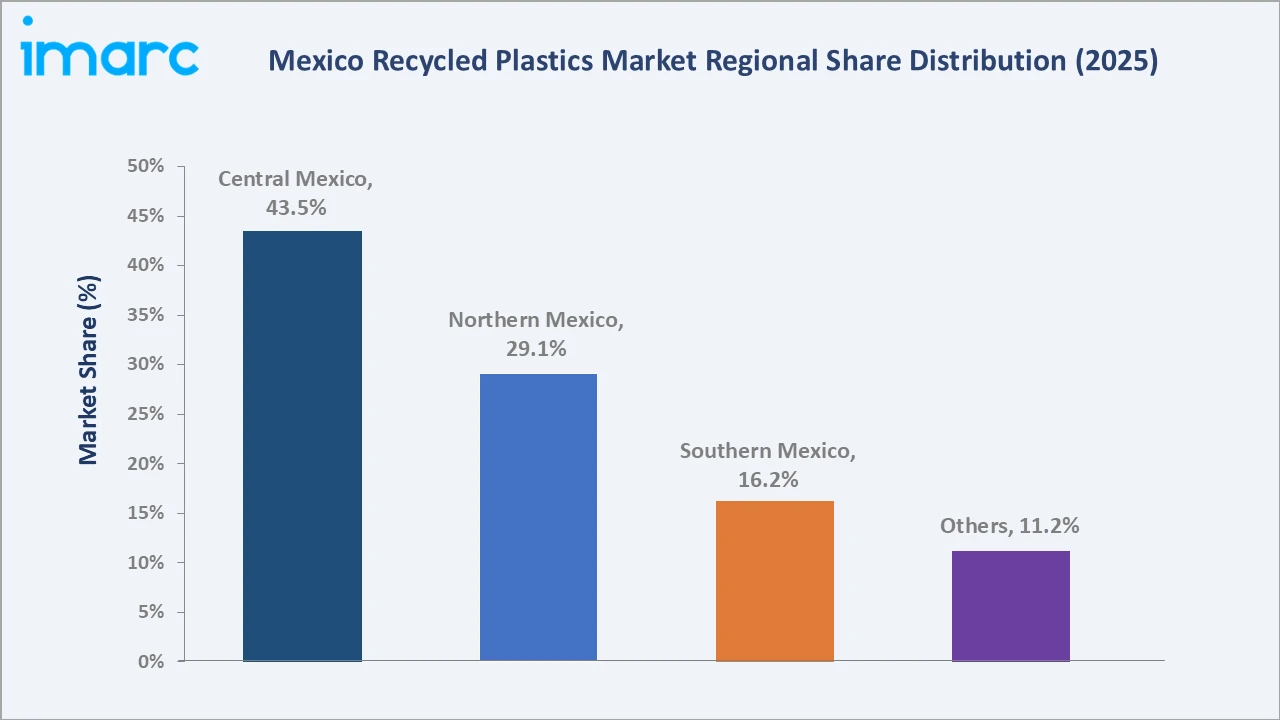
Southern Mexico, at 16.2%, and other areas, at 11.2%, represent earlier-stage but growing markets supported by expanding collection programs and rising sustainability awareness. Investment in collection infrastructure and gradual formalization of recovery networks are expected to lift participation from these regions over the forecast period, broadening the national feedstock base.
Competitive Landscape
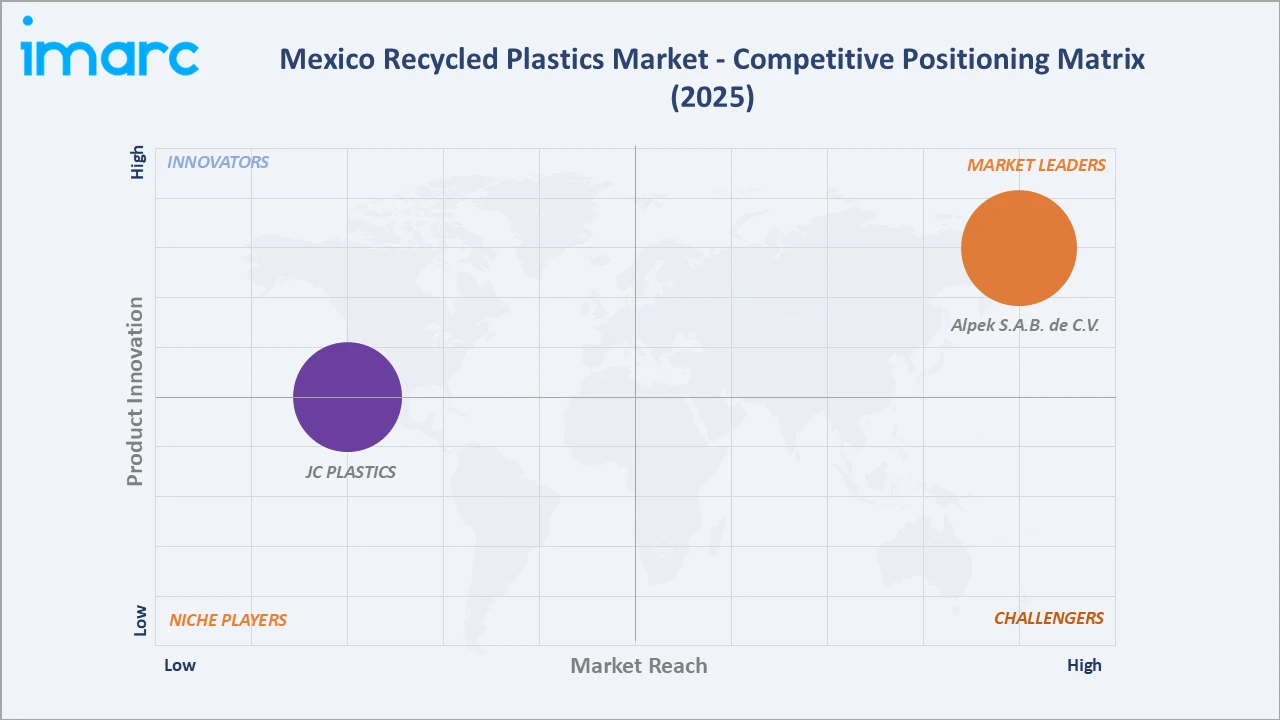
The Mexico recycled plastics market is moderately concentrated, led by integrated food-grade rPET producers, large polyester recyclers, and collection-focused specialists serving the beverage and packaging value chain. Competition centers on feedstock access, processing quality, and the ability to meet brand-owner recycled-content specifications, with the strongest players controlling the chain from collection through resin output.
|
Company Name |
Key Products |
Market Position |
Core Strength |
|
Alpek, S.A.B. de C.V. |
rPET flake and pellet, PerPETual recycled resin |
Market Leader |
Largest producer and recycler of PET in the Americas with integrated polyester value chain |
|
JC PLASTICS |
Recycled polypropylene and HDPE pellets and flakes |
Established Player |
Mexican recycler offering high-quality recycled raw materials with scrap collection and export capability |
Key players include Alpek, S.A.B. de C.V., JC PLASTICS, and others.
Key Company Profiles
JC PLASTICS
JC Plastics is a 100% Mexican recycling company specializing in the collection, recycling, and sale of recycled plastic raw materials for national and international customers.
- Key Products: Recycled polypropylene (PP) and high-density polyethylene (HDPE) pellets and flakes.
- Strategic Focus: Supplying high-quality recycled raw materials with above-market quality standards and supporting the environmental goals of commercial partners and communities, aligned with the United Nations Sustainable Development Goals.
Alpek, S.A.B. de C.V.
Alpek, through its Alpek Polyester business, is the largest producer and recycler of PET in the Americas, integrating PTA, PET, and recycled resin across a global manufacturing network anchored in Mexico.
- Key Products: rPET flake and pellet, PerPETual recycled PET resin, and recycled-content PET resins.
- Strategic Focus: Building a circular economy through Single Pellet Technology and 100% recycled PET offerings, targeting billions of bottles recycled annually.
Market Concentration Analysis
The market is moderately concentrated among integrated food-grade rPET producers, with the top three key players collectively accounting for a significant share of recycled PET resin output. Collection specialists such as Avangard Innovative and Promotora Ambiental anchor feedstock supply, while numerous small and medium enterprises serve regional non-food applications. Concentration is expected to remain stable as capacity investment scales alongside rising recycled-content demand.
Barriers to entry are high in the food-grade segment, where capital-intensive decontamination and solid-state polymerization technology, regulatory certification, and brand-owner qualification limit new participants. In contrast, the non-food contact packaging and construction segments remain fragmented, with lower technology thresholds enabling regional players to compete on cost and proximity to feedstock. This two-tier structure is likely to persist through the forecast period.
Investment & Growth Opportunities
Highest Growth Segments
Food contact packaging (~5.4% CAGR), construction applications (~5.1% CAGR), and plastic bottles (~4.9% CAGR) represent the highest-growth vectors, driven by bottle-to-bottle rPET demand and recycled content in building materials.
Emerging Investment Opportunities
Food-grade rPET capacity and chemical recycling offer the highest-value emerging opportunities, enabling recyclers to capture premium beverage-sector demand and process harder-to-recycle plastics that mechanical recycling cannot handle.
Investment Themes
- Integrated collection-to-resin capacity: Investment in collection networks paired with food-grade processing secures feedstock and captures the highest-value recycled resin demand from brand owners.
- Recycled content in construction and automotive: Scaling recycled HDPE and PP for building and vehicle components opens higher-volume outlets beyond packaging as sustainability mandates expand.
Future Market Outlook (2026-2034)
The Mexico recycled plastics market is projected to grow from USD 549.6 Million in 2025 to USD 575.4 Million in 2026, reaching USD 845.0 Million by 2034, a 4.70% CAGR. The anchor value of USD 691.4 Million in 2030 marks a transition point as food-grade rPET and chemical recycling capacity expand and EPR frameworks mature.
Three structural forces define growth: deepening brand-owner recycled-content commitments in packaging, expanding collection infrastructure improving feedstock availability, and broadening recycled-content adoption across construction and automotive. Together these sustain steady demand growth across the forecast period.
By 2034, food-grade rPET is expected to consolidate its position as the highest-value output category, while chemical recycling reaches early commercial scale for harder-to-recycle streams. Extended producer responsibility frameworks, as they mature, are likely to formalize collection funding and lift national recovery rates, narrowing the gap between Mexico's strong PET performance and its lower overall plastic recycling rate. These shifts position the market for resilient, sustainability-led expansion despite competition from virgin plastics and feedstock quality constraints.
Research Methodology
Primary Research
Primary research comprised structured interviews with industry stakeholders, including recycling plant operators, collection network managers, packaging converters, and brand-owner sustainability leads.
Secondary Research
Secondary research encompassed company reports, industry associations, government environmental data, and recycling-sector publications covering Mexico's plastics value chain.
Forecasting Models
Market forecasts were developed using a bottom-up model based on feedstock recovery volumes, recycled resin output by polymer, application demand, and recycled-content adoption trends multiplied by price assumptions.
Mexico Recycled Plastics Market Report Coverage:
| Report Features | Details |
|---|---|
| Base Year of the Analysis | 2025 |
| Historical Period | 2020-2025 |
| Forecast Period | 2026-2034 |
| Units | Million USD |
| Scope of the Report | Exploration of Historical Trends and Market Outlook, Industry Catalysts and Challenges, Segment-Wise Historical and Future Market Assessment:
|
| Plastic Types Covered | Polyethylene Terephthalate (PET), High Density Polyethylene (HDPE), Polypropylene (PP), Low Density Polyethylene (LDPE), Others |
| Raw Materials Covered | Plastic Bottles, Plastic Films, Rigid Plastic and Foam, Fibers, Others |
| Applications Covered | Non-Food Contact Packaging, Food Contact Packaging, Construction, Automotive, Others |
| Regions Covered | Northern Mexico, Central Mexico, Southern Mexico, Others |
| Companies Covered | Alpek, S.A.B. de C.V., JC PLASTICS, etc. |
| Customization Scope | 10% Free Customization |
| Post-Sale Analyst Support | 10-12 Weeks |
| Delivery Format | PDF and Excel through Email (We can also provide the editable version of the report in PPT/Word format on special request) |
Key Benefits for Stakeholders:
- IMARC’s industry report offers a comprehensive quantitative analysis of various market segments, historical and current market trends, market forecasts, and dynamics of the Mexico recycled plastics market from 2020-2034.
- The research report provides the latest information on the market drivers, challenges, and opportunities in the Mexico recycled plastics market.
- Porter's five forces analysis assist stakeholders in assessing the impact of new entrants, competitive rivalry, supplier power, buyer power, and the threat of substitution. It helps stakeholders to analyze the level of competition within the Mexico recycled plastics industry and its attractiveness.
- Competitive landscape allows stakeholders to understand their competitive environment and provides an insight into the current positions of key players in the market.
Frequently Asked Questions About the Mexico Recycled Plastics Market Report
The Mexico recycled plastics market size is estimated at USD 575.4 Million in 2026, led by plastic bottles at 44.2%, non-food contact packaging at 37.8%, and Central Mexico at 43.5%.
The market grows at 4.70% CAGR during 2026-2034, reaching USD 845.0 Million by 2034, driven by recycled-content commitments, collection expansion, and construction adoption.
Plastic bottles lead at 44.2%, supported by Mexico's mature PET collection and bottle-to-bottle recycling base, growing at about 4.9% CAGR.
Non-food contact packaging leads at 37.8%, while food contact packaging grows fastest at about 5.4% CAGR as bottle-to-bottle rPET adoption deepens.
Central Mexico leads at 43.5% through its concentration of recyclers, converters, and beverage bottlers around the Mexico City industrial corridor.
Leading companies include Alpek, S.A.B. de C.V., JC PLASTICS, and others.
The market is projected to reach approximately USD 691.4 Million by 2030, with food-grade rPET and chemical recycling capacity expanding alongside maturing EPR frameworks.
Priority opportunities include food-grade rPET capacity expansion, chemical recycling for hard-to-recycle plastics, and recycled content in construction and automotive.
Need more help?
- Speak to our experienced analysts for insights on the current market scenarios.
- Include additional segments and countries to customize the report as per your requirement.
- Gain an unparalleled competitive advantage in your domain by understanding how to utilize the report and positively impacting your operations and revenue.
- For further assistance, please connect with our analysts.
 Request Customization
 Speak to an Analyst
 Request Brochure
 Inquire Before Buying
Benefits of Customization
- Personalize this research
- Triangulate with your data
- Get data as per your format and definition
- Gain a deeper dive into a specific application, geography, customer, or competitor
- Any level of personalization
Get in Touch With Us
UNITED STATES
Phone: +1-201-971-6302
INDIA
Phone: +91-120-433-0800
UNITED KINGDOM
Phone: +44-753-714-6104
Email: [email protected]
Client Testimonials




.webp)




.webp)













Related Reports

Choose your plan
*Please note that the prices mentioned below are starting prices for each bundle type. Kindly contact our team for further details.*
Single User License
- 1 User License, Access on 2 Devices
- PDF Report + Excel Dataset (Password Protected)
- Lifetime Access
- No Printing Rights
- 10% Free Report Customization
- 10–12 Weeks of Analyst Support
Five User License
- Access for 5 Users, 2 Devices per User
- PDF Report + Excel Dataset (Password Protected)
- Lifetime Access
- Dedicated Account Manager
- 12–14 Weeks of Analyst Support
- No Printing Rights
- 15% Free Report Customization
- 25% Discount on Your Next Purchase
Corporate User License
- Unlimited User Access (Within Your Organization)
- PDF Report + Excel Dataset
- Lifetime Access
- Dedicated Account Manager
- 14–20 Weeks of Analyst Support
- No Printing Rights
- 20% Free Report Customization
- 30% Discount on Your Next Purchase
Essential Insights
What's included:
3 reports
- Lifetime Access
- PDF Reports
- Excel Datasets
- 2 Weeks of Free Analyst Support
- 2 User Licenses
- Access on 2 Devices
- Printing Rights
- Complimentary PowerPoint (PPT) Version
- Complimentary License Upgrade
Professional Access
What's included:
5 reports
- Lifetime Access
- PDF Reports
- Excel Datasets
- 8 Weeks of Free Analyst Support
- 2 User Licenses
- Access on 2 Devices
- Printing Rights
- Complimentary PowerPoint (PPT) Version
- Complimentary License Upgrade
Business Advantage
What's included:
8 reports
- Lifetime Access
- PDF Reports
- Excel Datasets
- 14 Weeks of Free Analyst Support
- 2 User Licenses
- Access on 2 Devices
- Printing Rights
- Complimentary PowerPoint (PPT) Version
- Complimentary License Upgrade
Enterprise Intelligence
What's included:
10 reports
- Lifetime Access
- PDF Reports
- Excel Datasets
- 20 Weeks of Free Analyst Support
- 2 User Licenses
- Access on 2 Devices
- Printing Rights
- Complimentary PowerPoint (PPT) Version
- Complimentary License Upgrade