
Middle East Geospatial Analytics Market Report by Component (Solution, Services), Type (Surface and Field Analytics, Network and Location Analytics, Geovisualization, and Others), Technology (Remote Sensing, GIS, GPS, and Others), Enterprise Size (Large Enterprises, Small and Medium-sized Enterprises), Deployment Mode (On-premises, Cloud-based), Vertical (Automotive, Energy and Utilities, Government, Defense and Intelligence, Smart Cities, Insurance, Natural Resources, and Others), and Country 2026-2034
Market Overview:
Middle East geospatial analytics market size reached USD 4.8 Billion in 2025. Looking forward, IMARC Group expects the market to reach USD 9.7 Billion by 2034, exhibiting a growth rate (CAGR) of 8.01% during 2026-2034. The increasing demand for location-based services across various industries, such as retail, transportation, and healthcare, coupled with the inflating application of geospatial analytics, is driving the market.
|
Report Attribute
|
Key Statistics
|
|---|---|
|
Base Year
|
2025 |
|
Forecast Years
|
2026-2034
|
|
Historical Years
|
2020-2025
|
| Market Size in 2025 | USD 4.8 Billion |
| Market Forecast in 2034 | USD 9.7 Billion |
| Market Growth Rate (2026-2034) | 8.01% |
Access the full market insights report Request Sample
Geospatial analytics is a field that involves the analysis of spatial and geographic data to extract meaningful insights and patterns. By integrating various sources of location-based information, such as satellite imagery, GPS data, and geographic information systems (GIS), geospatial analytics enables organizations to make informed decisions. It plays a crucial role in diverse sectors, including urban planning, environmental monitoring, agriculture, and disaster management. This analytical approach helps uncover relationships between location-based variables, allowing for better understanding of spatial trends and facilitating more effective decision-making. Geospatial analytics can be applied to address challenges ranging from resource allocation and infrastructure planning to risk assessment and epidemiology, making it a valuable tool for optimizing processes and enhancing overall situational awareness.
Middle East Geospatial Analytics Market Trends:
The geospatial analytics market is propelled by a myriad of factors that collectively underscore its exponential growth. Firstly, the increasing prevalence of big data and the proliferation of satellite imagery have significantly expanded the pool of geospatial data available for analysis. Consequently, businesses and government agencies are harnessing the power of geospatial analytics to derive actionable insights for strategic decision-making. Additionally, the rising demand for location-based services across various industries, including retail, logistics, and healthcare, is steering the market forward. Moreover, advancements in technology, such as the integration of artificial intelligence and machine learning algorithms, are enhancing the capabilities of geospatial analytics tools, enabling more accurate predictions and valuable spatial patterns recognition. Furthermore, the growing awareness of the potential benefits of geospatial analytics in risk management, environmental monitoring, and urban planning is driving its adoption regionally. In tandem, the increasing deployment of Internet of Things (IoT) devices is generating vast amounts of geospatial data, further fueling the demand for advanced analytics solutions. Collectively, these interconnected drivers underscore the dynamic momentum of the geospatial analytics market in the Middle East, positioning it as a pivotal force in shaping the future of data-driven decision-making.
Middle East Geospatial Analytics Market Segmentation:
IMARC Group provides an analysis of the key trends in each segment of the market, along with forecasts at the regional and country levels for 2026-2034. Our report has categorized the market based on component, type, technology, enterprise size, deployment mode, and vertical.
Component Insights:
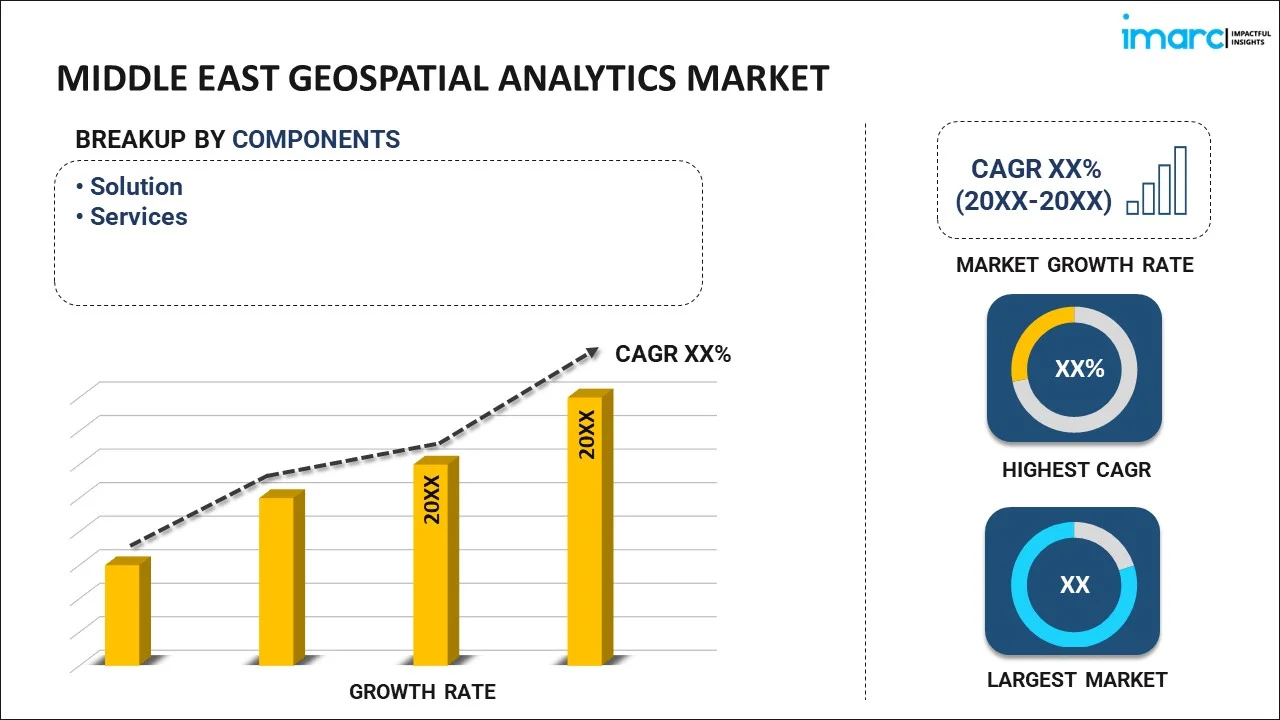
To get detailed segment analysis of this market Request Sample
- Solution
- Services
The report has provided a detailed breakup and analysis of the market based on the component. This includes solution and services.
Type Insights:
- Surface and Field Analytics
- Network and Location Analytics
- Geovisualization
- Others
A detailed breakup and analysis of the market based on the type have also been provided in the report. This includes surface and field analytics, network and location analytics, geovisualization, and others.
Technology Insights:
- Remote Sensing
- GIS
- GPS
- Others
The report has provided a detailed breakup and analysis of the market based on the technology. This includes remote sensing, GIS, GPS, and others.
Enterprise Size Insights:
- Large Enterprises
- Small and Medium-sized Enterprises
A detailed breakup and analysis of the market based on the enterprise size have also been provided in the report. This includes large enterprises and small and medium-sized enterprises.
Deployment Mode Insights:
- On-premises
- Cloud-based
The report has provided a detailed breakup and analysis of the market based on the deployment mode. This includes on-premises and cloud-based.
Vertical Insights:
- Automotive
- Energy and Utilities
- Government
- Defense and Intelligence
- Smart Cities
- Insurance
- Natural Resources
- Others
A detailed breakup and analysis of the market based on the vertical have also been provided in the report. This includes automotive, energy and utilities, government, defense and intelligence, smart cities, insurance, natural resources, and others.
Country Insights:
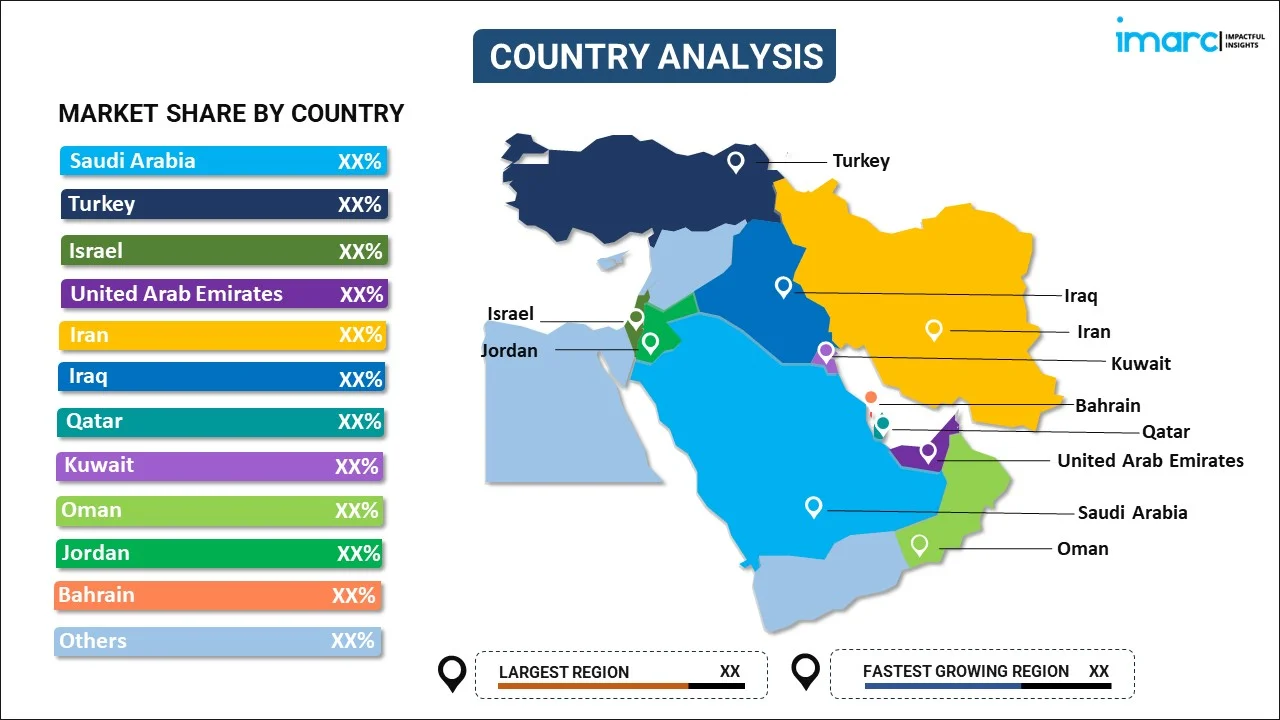
To get detailed regional analysis of this market Request Sample
- Saudi Arabia
- Turkey
- Israel
- United Arab Emirates
- Iran
- Iraq
- Qatar
- Kuwait
- Oman
- Jordan
- Bahrain
- Others
The report has also provided a comprehensive analysis of all the major regional markets, which include Saudi Arabia, Turkey, Israel, United Arab Emirates, Iran, Iraq, Qatar, Kuwait, Oman, Jordan, Bahrain, and Others.
Competitive Landscape:
The market research report has also provided a comprehensive analysis of the competitive landscape. Competitive analysis such as market structure, key player positioning, top winning strategies, competitive dashboard, and company evaluation quadrant has been covered in the report. Also, detailed profiles of all major companies have been provided.
Middle East Geospatial Analytics Market Report Coverage:
| Report Features | Details |
|---|---|
| Base Year of the Analysis | 2025 |
| Historical Period | 2020-2025 |
| Forecast Period | 2026-2034 |
| Units | Billion USD |
| Scope of the Report | Exploration of Historical and Forecast Trends, Industry Catalysts and Challenges, Segment-Wise Historical and Predictive Market Assessment:
|
| Components Covered | Solution, Services |
| Types Covered | Surface and Field Analytics, Network and Location Analytics, Geovisualization, Others |
| Technologies Covered | Remote Sensing, GIS, GPS, Others |
| Enterprise Sizes Covered | Large Enterprises, Small and Medium-sized Enterprises |
| Deployment Modes Covered | On-premises, Cloud-based |
| Verticals Covered | Automotive, Energy and Utilities, Government, Defense and Intelligence, Smart Cities, Insurance, Natural Resources, Others |
| Countries Covered | Saudi Arabia, Turkey, Israel, United Arab Emirates, Iran, Iraq, Qatar, Kuwait, Oman, Jordan, Bahrain, Others |
| Customization Scope | 10% Free Customization |
| Post-Sale Analyst Support | 10-12 Weeks |
| Delivery Format | PDF and Excel through Email (We can also provide the editable version of the report in PPT/Word format on special request) |
Key Questions Answered in This Report:
- How has the Middle East geospatial analytics market performed so far and how will it perform in the coming years?
- What has been the impact of COVID-19 on the Middle East geospatial analytics market?
- What is the breakup of the Middle East geospatial analytics market on the basis of component?
- What is the breakup of the Middle East geospatial analytics market on the basis of type?
- What is the breakup of the Middle East geospatial analytics market on the basis of technology?
- What is the breakup of the Middle East geospatial analytics market on the basis of enterprise size?
- What is the breakup of the Middle East geospatial analytics market on the basis of deployment mode?
- What is the breakup of the Middle East geospatial analytics market on the basis of vertical?
- What are the various stages in the value chain of the Middle East geospatial analytics market?
- What are the key driving factors and challenges in the Middle East geospatial analytics?
- What is the structure of the Middle East geospatial analytics market and who are the key players?
- What is the degree of competition in the Middle East geospatial analytics market?
Key Benefits for Stakeholders:
- IMARC’s industry report offers a comprehensive quantitative analysis of various market segments, historical and current market trends, market forecasts, and dynamics of the Middle East geospatial analytics market from 2020-2034.
- The research report provides the latest information on the market drivers, challenges, and opportunities in the Middle East geospatial analytics market.
- Porter's five forces analysis assist stakeholders in assessing the impact of new entrants, competitive rivalry, supplier power, buyer power, and the threat of substitution. It helps stakeholders to analyze the level of competition within the Middle East geospatial analytics industry and its attractiveness.
- Competitive landscape allows stakeholders to understand their competitive environment and provides an insight into the current positions of key players in the market.
Need more help?
- Speak to our experienced analysts for insights on the current market scenarios.
- Include additional segments and countries to customize the report as per your requirement.
- Gain an unparalleled competitive advantage in your domain by understanding how to utilize the report and positively impacting your operations and revenue.
- For further assistance, please connect with our analysts.
 Request Customization
 Speak to an Analyst
 Request Brochure
 Inquire Before Buying
Benefits of Customization
- Personalize this research
- Triangulate with your data
- Get data as per your format and definition
- Gain a deeper dive into a specific application, geography, customer, or competitor
- Any level of personalization
Get in Touch With Us
UNITED STATES
Phone: +1-201-971-6302
INDIA
Phone: +91-120-433-0800
UNITED KINGDOM
Phone: +44-753-714-6104
Email: [email protected]
Client Testimonials




.webp)




.webp)













Related Reports

Choose your plan
*Please note that the prices mentioned below are starting prices for each bundle type. Kindly contact our team for further details.*
Single User License
- 1 User License, Access on 2 Devices
- PDF Report + Excel Dataset (Password Protected)
- Lifetime Access
- No Printing Rights
- 10% Free Report Customization
- 10–12 Weeks of Analyst Support
Five User License
- Access for 5 Users, 2 Devices per User
- PDF Report + Excel Dataset (Password Protected)
- Lifetime Access
- Dedicated Account Manager
- 12–14 Weeks of Analyst Support
- No Printing Rights
- 15% Free Report Customization
- 25% Discount on Your Next Purchase
Corporate User License
- Unlimited User Access (Within Your Organization)
- PDF Report + Excel Dataset
- Lifetime Access
- Dedicated Account Manager
- 14–20 Weeks of Analyst Support
- No Printing Rights
- 20% Free Report Customization
- 30% Discount on Your Next Purchase
Essential Insights
What's included:
3 reports
- Lifetime Access
- PDF Reports
- Excel Datasets
- 2 Weeks of Free Analyst Support
- 2 User Licenses
- Access on 2 Devices
- Printing Rights
- Complimentary PowerPoint (PPT) Version
- Complimentary License Upgrade
Professional Access
What's included:
5 reports
- Lifetime Access
- PDF Reports
- Excel Datasets
- 8 Weeks of Free Analyst Support
- 2 User Licenses
- Access on 2 Devices
- Printing Rights
- Complimentary PowerPoint (PPT) Version
- Complimentary License Upgrade
Business Advantage
What's included:
8 reports
- Lifetime Access
- PDF Reports
- Excel Datasets
- 14 Weeks of Free Analyst Support
- 2 User Licenses
- Access on 2 Devices
- Printing Rights
- Complimentary PowerPoint (PPT) Version
- Complimentary License Upgrade
Enterprise Intelligence
What's included:
10 reports
- Lifetime Access
- PDF Reports
- Excel Datasets
- 20 Weeks of Free Analyst Support
- 2 User Licenses
- Access on 2 Devices
- Printing Rights
- Complimentary PowerPoint (PPT) Version
- Complimentary License Upgrade