
Mixed Martial Arts Equipment Market Size, Share, Trends and Forecast by Product, Distribution Channel, End User, and Region, 2026-2034
Mixed Martial Arts Equipment Market Size, Share, Trends & Forecast (2026-2034)
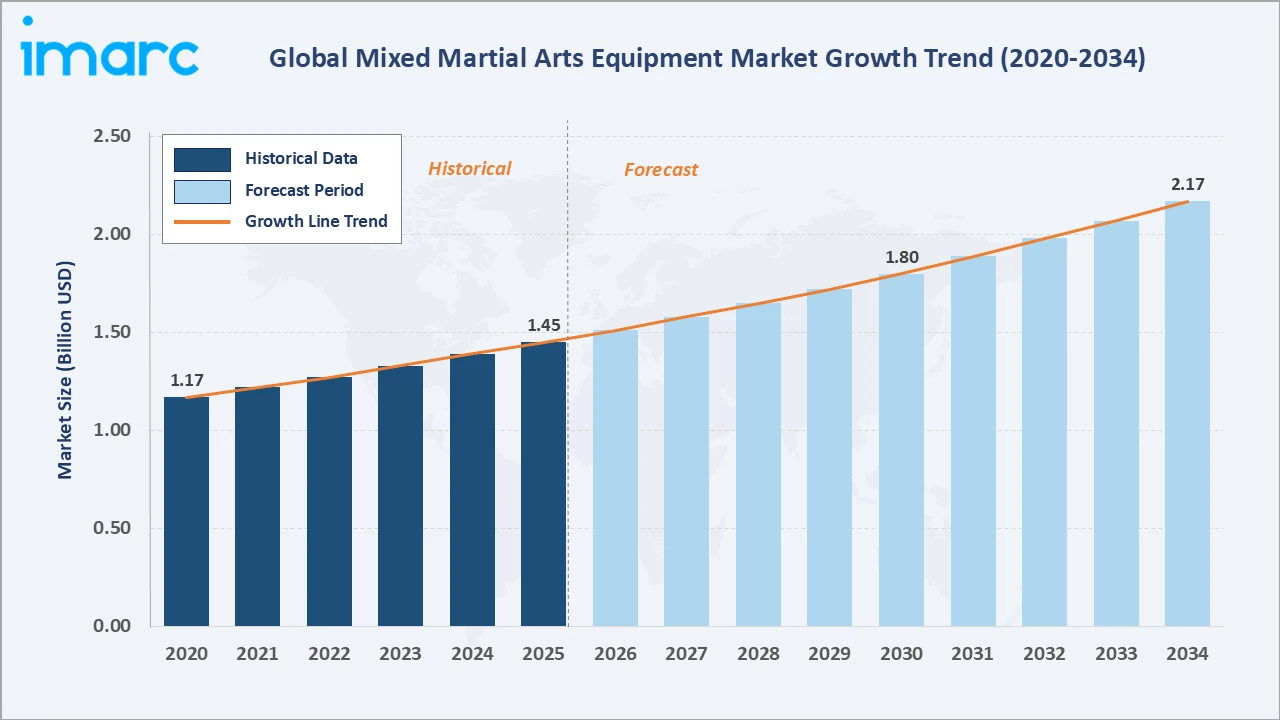
The mixed martial arts (MMA) equipment market grew from USD 1.45 Billion in 2025 to USD 1.53 Billion in 2026 and is projected to reach USD 2.17 Billion by 2034, expanding at a CAGR of 4.46% during 2026-2034. Rising global MMA participation, growing combat-sports fandom, and expanding fitness and self-defense training culture are the primary growth catalysts.
Market Snapshot
|
Metric |
Value |
|
Base Year Market Size (2025) |
USD 1.45 Billion |
| Market Size (2026) | USD 1.53 Billion |
|
Forecast Market Size (2034) |
USD 2.17 Billion |
|
CAGR (2026-2034) |
4.46% |
|
Base Year |
2025 |
|
Historical Period |
2020-2025 |
|
Forecast Period |
2026-2034 |
North America leads the global MMA equipment landscape, holding a 36.0% share in 2025, anchored by the region's dense mixed martial arts gym network and deep-rooted combat-sports fan base. MMA gloves command the largest share of the product mix at 30.0%, reflecting sustained demand from both amateur trainees and professional fighters across federations.
To get more information on this market, Request Sample
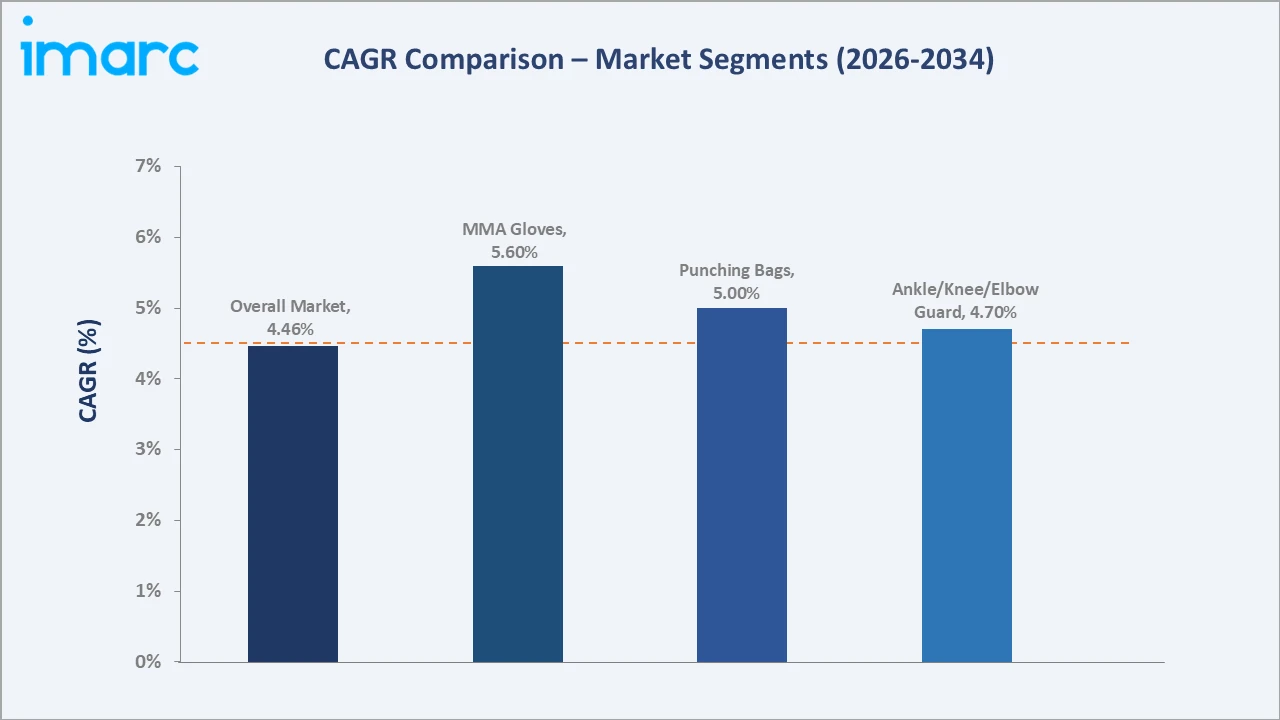
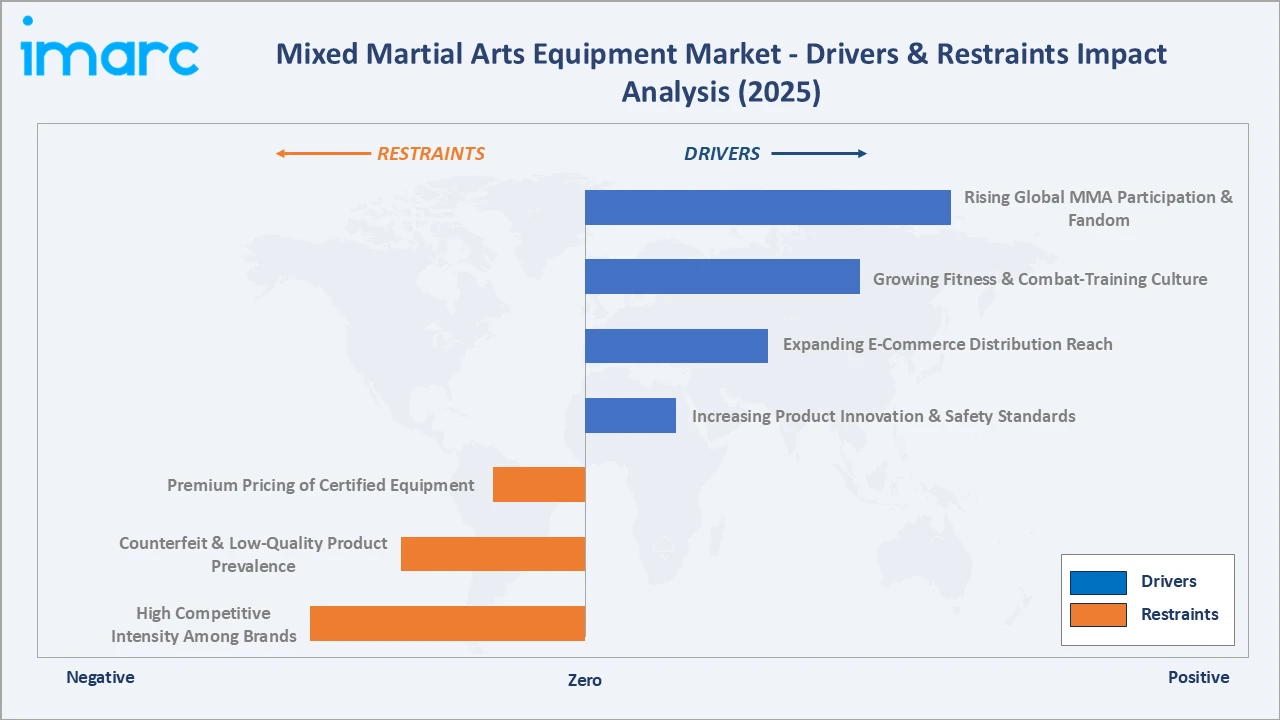
The global mixed martial arts equipment market is underpinned by three structural forces: rising global participation in mixed martial arts and combat-sports training, expanding fitness and self-defense culture among mainstream consumers, and continuous product innovation across protective and training gear categories. Each force independently reinforces category growth, sustaining steady CAGR expansion through 2034 despite premium pricing pressure on certified, federation-approved equipment.
Executive Summary
The global mixed martial arts equipment market is experiencing steady expansion, driven by rising participation in combat-sports training, growing MMA fandom, and increasing adoption of mixed martial arts disciplines within mainstream fitness culture. The market expanded from USD 1.45 Billion in 2025 to an estimated USD 1.53 Billion in 2026, and is forecast to reach USD 2.17 Billion by 2034, growing at a CAGR of 4.46%.
MMA gloves dominate the product segment with a 30.0% share in 2025, encompassing competition, sparring, and training glove formats that remain the primary purchase across both amateur and professional user bases. Offline retail leads the distribution channel mix at 68.0% share, supported by specialty combat-sports stores and gym-affiliated pro shops, while online retail is emerging as an increasingly important channel as consumers seek broader brand selection and competitive pricing.
North America leads regionally at 36.0%, anchored by the region's dense MMA gym network and combat-sports fan base. Leading manufacturers are shaping the industry's product innovation roadmap through continuous R&D investment and category expansion.
Key Market Insights
|
Insight |
Data |
|
Largest Product Segment |
MMA Gloves – 30.0% share (2025) |
|
Fastest Growing Product Segment |
MMA Gloves – ~5.6% CAGR (2020-2025) |
|
Largest Distribution Channel |
Offline – 68.0% share (2025) |
|
Leading Region |
North America – 36.0% share (2025) |
|
Top Companies |
Frasers Group, adidas AG, Hayabusa Fightwear Inc., Fairtex, BoxUnion Holdings, LLC |
Key Analytical Observations Supporting the Above Data:
- MMA gloves account for 30.0% of the global MMA equipment market in 2025. This dominance reflects sustained demand across competition, sparring, and training use cases among both amateur and professional fighters.
- Offline retail remains the leading distribution channel at 68.0% share (2025), supported by specialty combat-sports stores, gym-affiliated pro shops, and federation-endorsed retail partnerships.
- Online retail is expanding steadily at 32.0% share (2025), as consumers increasingly seek broader brand selection, competitive pricing, and direct-to-consumer purchasing convenience.
- North America's 36.0% share (2025) reflects the region's dense MMA gym infrastructure, deep-rooted combat-sports fan base, and high per-capita spending on premium training equipment.
- Rising global MMA participation and growing combat-fitness culture are broadening the addressable consumer base beyond competitive athletes into mainstream fitness and self-defense training.
Mixed Martial Arts Equipment Market Overview
The mixed martial arts equipment market encompasses gloves, punching bags, protective guards, hand wraps, mouth guards, and head gear formulated for training, sparring, and competition use, serving amateur trainees, professional fighters, and fitness-oriented consumers. The global MMA equipment ecosystem spans specialty combat-sports manufacturers, apparel and footwear conglomerates, and an expanding retail and e-commerce distribution network.
Macroeconomic drivers include rising global media coverage of major MMA promotions, expanding gym and fitness infrastructure across urban centers, and growing consumer disposable income supporting premium equipment purchases. Manufacturers are simultaneously investing in sustainable materials and sensor-enabled smart equipment to improve safety and performance tracking, positioning the global MMA equipment sector for continued category-led growth through 2034 despite counterfeit product pressure in price-sensitive markets.
Market Dynamics
To evaluate market opportunities, Request Sample
Market Drivers
- Rising Global MMA Participation & Fandom: Expanding global viewership of major MMA promotions and rising grassroots gym enrollment (global gym memberships reached 895 million in 2023) are driving sustained demand for training and competition equipment.
- Growing Fitness & Combat-Training Culture: Increasing mainstream adoption of combat-sports disciplines for fitness and self-defense purposes is broadening the consumer base beyond competitive athletes.
- Expanding E-Commerce Distribution Reach: According to YouGov Global Profiles, an average of 37% of consumers prefer purchasing sports equipment through online channels. Growing online retail penetration is improving product accessibility and enabling direct-to-consumer sales across previously underserved markets.
- Increasing Product Innovation & Safety Standards: Manufacturers are advancing impact-absorption materials and federation-compliant safety designs, supporting premium product adoption.
Market Restraints
- Premium Pricing of Certified Equipment: Federation-approved and certified protective gear typically carries a significant price premium, limiting adoption among price-sensitive amateur consumers.
- Counterfeit & Low-Quality Product Prevalence: Widespread availability of counterfeit and substandard equipment in price-sensitive markets undermines brand trust and safety standards.
- High Competitive Intensity Among Brands: Intense competition among established and emerging brands continues to pressure margins across the value chain.
Market Opportunities
- Smart & Sensor-Enabled Equipment: Rising demand for performance tracking presents opportunities for sensor-integrated gloves, bags, and wearables targeting serious trainees and professional athletes.
- Sustainable Material Adoption: Growing consumer preference for eco-friendly products creates opportunities for manufacturers investing in sustainable leather alternatives and recycled foam padding.
- Emerging Market Gym Expansion: Expanding gym and fitness infrastructure across Asia-Pacific and Latin America offers manufacturers new distribution and brand-building opportunities.
Market Challenges
- Balancing Cost and Safety Compliance: Manufacturers must balance premium material and certification costs with the need to remain accessible to price-sensitive mainstream consumers.
- Brand Differentiation in a Crowded Market: Sustaining brand loyalty amid intense competitive intensity and counterfeit product prevalence requires continuous innovation and marketing investment.
Emerging Market Trends
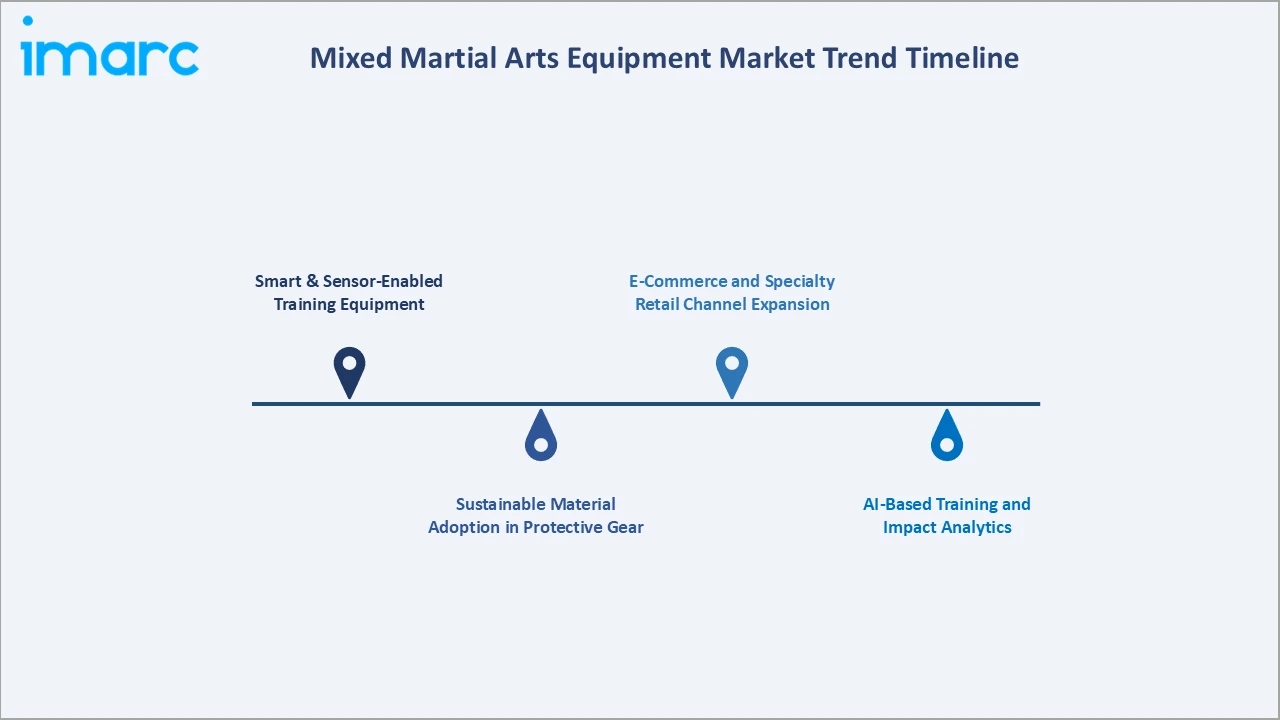
1. Smart & Sensor-Enabled Training Equipment
Manufacturers are increasingly launching sensor-integrated gloves and punching bags that track impact force, speed, and technique, targeting serious trainees and professional athletes seeking data-driven performance improvement. In June 2025, UFC partnered with Sports & Wellbeing Analytics to use PROTECHT sensor-equipped mouthguards for monitoring fighters’ head impacts and heart rates, supporting improved safety, injury detection, and performance management.
2. Sustainable Material Adoption in Protective Gear
Growing consumer demand for environmentally responsible products is driving adoption of synthetic leather alternatives and recycled foam padding across gloves, bags, and protective guards. For instance, Sanabul offers sustainable MMA products such as vegan-leather L’uva Boxing Gloves, eco-conscious Los Cactus Boxing Gloves, and jiu-jitsu gis made with water-efficient cotton blends and responsibly sourced materials.
3. E-Commerce and Specialty Retail Channel Expansion
Online retail and specialty combat-sports stores are expanding their MMA equipment assortments, enabling consumers to access a broader range of certified and imported products beyond traditional gym pro shops.
4. AI-Based Training and Impact Analytics
Leading manufacturers are exploring AI-based training platforms that analyze striking technique and impact data captured through connected equipment, reflecting the broader industry shift toward precision combat-sports training.
Industry Value Chain Analysis
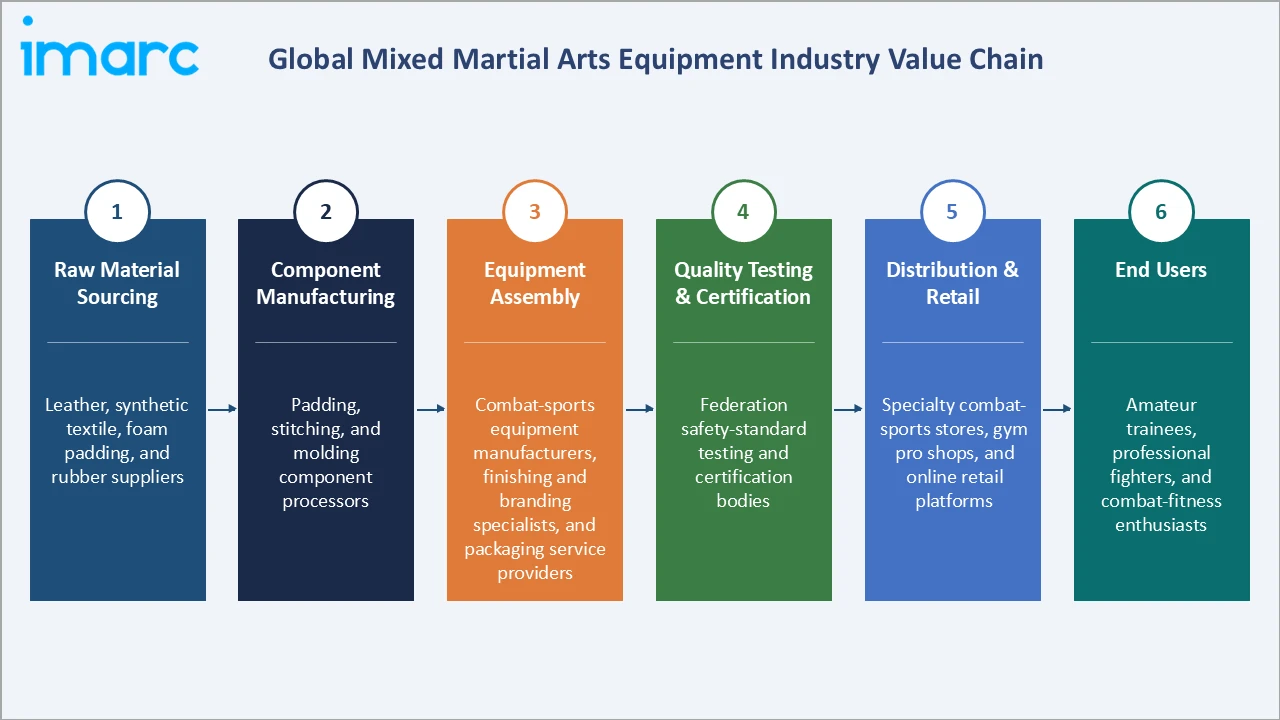
The global mixed martial arts equipment value chain spans raw material sourcing through end-consumer delivery, with each stage occupied by specialized suppliers, manufacturers, and retailers whose performance directly influences product quality, safety compliance, and consumer trust.
|
Stage |
Key Players / Examples |
|
Raw Material Sourcing |
Leather, synthetic textile, foam padding, and rubber suppliers |
|
Component Manufacturing |
Padding, stitching, and molding component processors |
|
Equipment Assembly |
Combat-sports equipment manufacturers, finishing and branding specialists, and packaging service providers |
|
Quality Testing & Certification |
Federation safety-standard testing and certification bodies |
|
Distribution & Retail |
Specialty combat-sports stores, gym pro shops, and online retail platforms |
|
End Users |
Amateur trainees, professional fighters, and combat-fitness enthusiasts |
Technology Landscape in the Mixed Martial Arts Equipment Industry
Glove and Padding Innovation
Manufacturers are advancing multi-layer foam padding and ergonomic hand-wrap designs to improve impact absorption and wrist support, supporting broader adoption among both amateur and professional fighters. Leading MMA equipment brands are also incorporating gel-infused and memory foam hybrid padding into open-finger glove constructions to address the dual grappling and striking demands unique to MMA competition formats.
Sensor-Integrated Training Gear Development
Growing investment in sensor and connectivity technology is expanding smart glove and bag portfolios, addressing rising demand for performance tracking and data-driven training among serious trainees. MMA-specific applications include embedded accelerometers and gyroscopic sensors in sparring gloves and shin guards that capture strike velocity, force distribution, and defensive movement patterns, enabling coaches to optimize fighter conditioning programs with real-time biomechanical data.
Sustainable Material Formulation Technology
Manufacturers are adopting synthetic leather alternatives and recycled foam materials to meet rising consumer demand for environmentally responsible protective gear across all product categories. In the MMA equipment segment specifically, bio-based polyurethane coatings and plant-derived foam composites are being validated for use in rash guards, shorts, and grappling gear, allowing brands to align sustainability commitments with the performance and durability standards.
Certification and Safety Compliance Systems
Expanding federation-endorsed certification infrastructure and safety-testing protocols are strengthening consumer trust and supporting premium positioning across retail channels. Alignment with UFC, ONE Championship, and national athletic commission equipment mandates is becoming a key commercial differentiator, compelling manufacturers to invest in standardized impact-attenuation testing and third-party certification programs.
Market Segmentation Analysis
The report covers the following segments:
|
Segment Category |
Leading Segment |
Market Share |
Year |
|
Product |
MMA Gloves |
30.0% |
2025 |
|
Distribution Channel |
Offline |
68.0% |
2025 |
|
End User |
🔒 |
🔒 |
2025 |
|
Region |
North America |
36.0% |
2025 |

By Product
MMA gloves dominate with a 30.0% share in 2025. This segment encompasses competition, sparring, and training glove formats that remain the primary purchase driver across both amateur and professional user bases, supported by continuous padding and ergonomic design innovation.
.webp)
To access detailed market analysis, Request Sample
Punching bags represent 18.0% of the market (2025), serving both gym-based and home training use cases, followed by ankle/knee/elbow guard (15.0%) and shin guard (13.0%), which remain essential protective gear across sparring and competition settings. Hand wraps (10.0%), mouth guard (8.0%), and head gear (6.0%) collectively round out the protective and training equipment mix.
By Distribution Channel
The offline distribution channel leads the distribution channel segment with a 68.0% share (2025), supported by specialty combat-sports stores, gym-affiliated pro shops, and federation-endorsed retail partnerships that provide consumers with hands-on product evaluation and expert guidance.
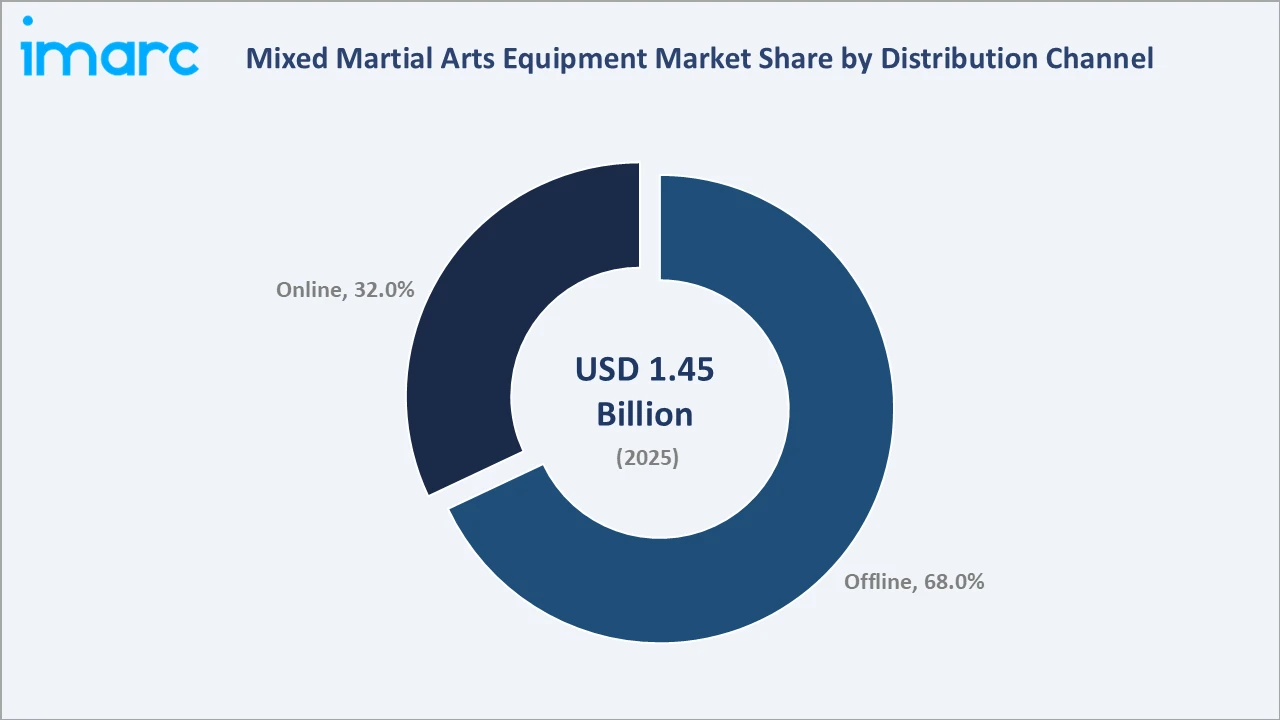
The online distribution channel is expanding steadily at a 32.0% share (2025), as consumers increasingly seek broader brand selection, competitive pricing, and direct-to-consumer purchasing convenience through e-commerce platforms and brand-owned online stores.
Regional Market Insights
North America's market leadership (36.0%, 2025) reflects the region's dense MMA gym network, deep-rooted combat-sports fan base, and extensive specialty retail infrastructure. High per-capita disposable income and strong media coverage of major MMA promotions combine to sustain its dominant position through 2034.
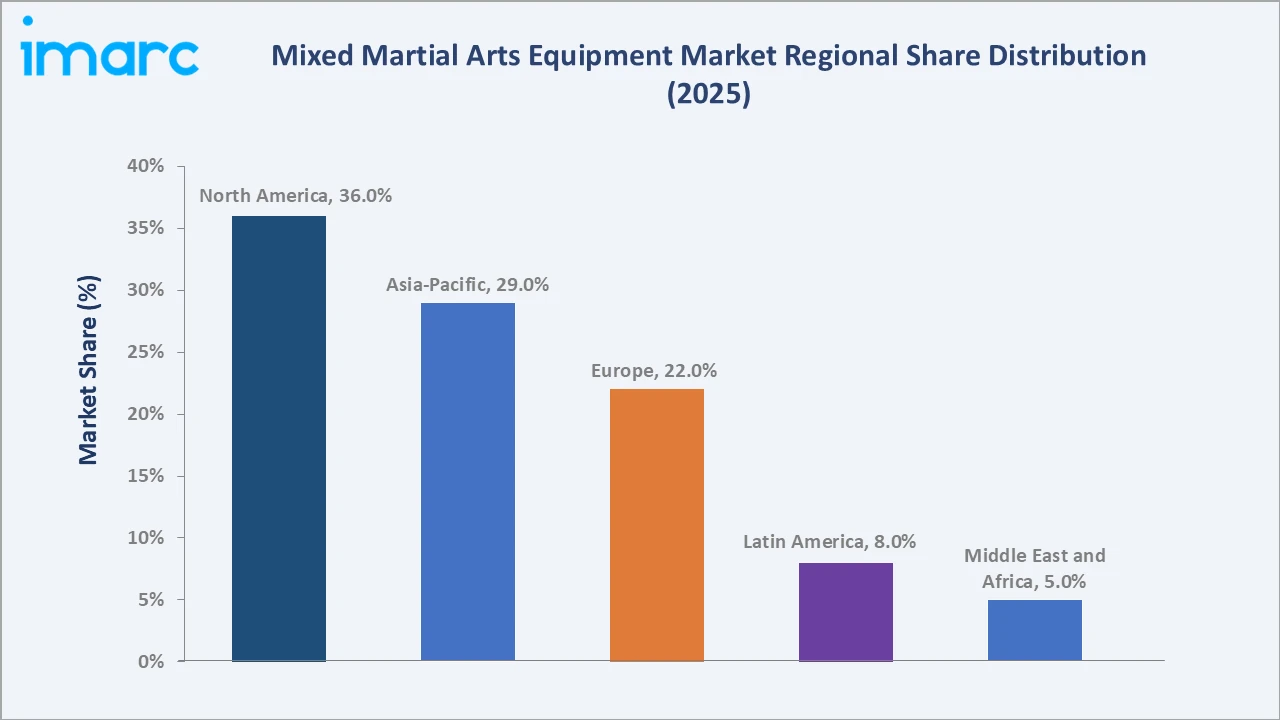
Asia-Pacific at 29.0% (2025) represents the second-largest MMA equipment market globally. Rising combat-sports participation and expanding gym infrastructure across major economies are sustaining steady growth, positioning the region as a key contributor alongside North America through the forecast period.
|
Region |
Share (2025) |
Key Growth Drivers |
|
North America |
36.0% |
Dense MMA gym network, strong combat-sports fan base, and high disposable income |
|
Asia-Pacific |
29.0% |
Rising combat-sports participation and expanding gym infrastructure across major markets |
|
Europe |
22.0% |
Growing fitness culture and expanding specialty retail adoption across major economies |
|
Latin America |
8.0% |
Emerging combat-sports popularity and expanding grassroots gym networks |
|
Middle East and Africa |
5.0% |
Growing interest in combat sports and gradual retail infrastructure expansion |
Competitive Landscape
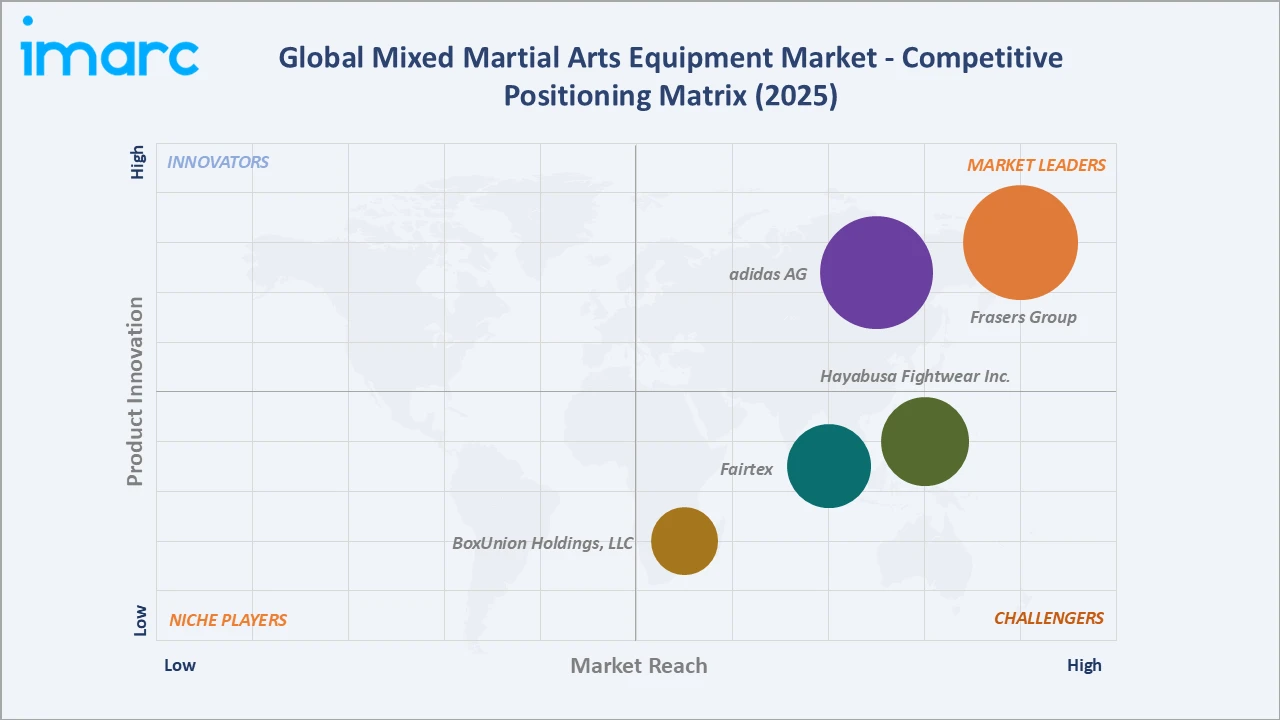
The global mixed martial arts equipment market exhibits high concentration, with leading manufacturers collectively holding a dominant share of market revenue in 2025, reflecting sustained investment in product innovation and distribution reach.
|
Company Name |
Brand Name |
Market Position |
Core Strength |
|
Frasers Group |
Everlast |
Market Leader |
Broad combat-sports equipment portfolio; strong global retail and licensing network |
|
adidas AG |
Adidas |
Market Leader |
Established combat-sports apparel and equipment innovation pipeline |
|
Hayabusa Fightwear Inc. |
Hayabusa |
Strong Challenger |
Premium MMA glove and protective gear category leadership |
|
Fairtex |
Fairtex |
Strong Challenger |
Muay Thai and MMA training equipment heritage and craftsmanship |
|
BoxUnion Holdings, LLC |
TITLE Boxing |
Challenger |
Boxing and MMA equipment retail and specialty distribution focus |
Frasers Group and adidas AG dominate through comprehensive product portfolios and extensive global retail networks, supported by continuous R&D investment. Hayabusa Fightwear Inc., Fairtex, and BoxUnion Holdings, LLC compete through targeted category leadership, craftsmanship heritage, and specialty retail positioning, respectively.
Key Company Profiles
Frasers Group
Frasers Group’s subsidiary Everlast Worldwide Inc. is one of the leading global combat-sports equipment manufacturers with an extensive MMA product portfolio spanning gloves, bags, and protective gear distributed across global retail networks.
- Product Portfolio: MMA gloves, punching bags, protective guards, and training apparel under the Everlast brand.
- Recent Developments: In December 2025, Frasers Group reported FY26 first-half revenue of GBP 2.58 billion, up 5.0%, driven by a 42.8% increase in international retail revenue. The group maintained its FY26 adjusted profit-before-tax guidance of GBP 550–600 million and continued investing in international expansion, store upgrades, and acquisitions.
- Strategic Focus: Strengthening premium product innovation; expanding e-commerce distribution reach across emerging markets.
adidas AG
adidas AG is a global sportswear and equipment leader with a growing combat-sports equipment portfolio serving MMA gyms and federations worldwide.
- Product Portfolio: MMA gloves, hand wraps, and protective gear distributed through major global retail chains and specialty combat-sports stores.
- Recent Developments: In April 2026, adidas AG reported Q1 2026 net sales of EUR 6.59 billion, up 14% on a currency-neutral basis, while operating profit increased 16% to EUR 705 million. The company maintained its 2026 outlook for high-single-digit currency-neutral sales growth and operating profit of approximately EUR 2.3 billion.
- Strategic Focus: Scaling combat-sports product innovation; deepening federation and gym distribution partnerships.
Market Concentration Analysis
The global mixed martial arts equipment market exhibits high concentration, with key players collectively accounting for a dominant share of total category revenue in 2025, reflecting sustained R&D investment, brand loyalty, and extensive distribution infrastructure worldwide. Consolidation pressure remains moderate as leading manufacturers maintain distinct strategic positioning:
Frasers Group and adidas AG through comprehensive multi-category portfolios, Hayabusa Fightwear Inc. through premium glove category leadership, and Fairtex and BoxUnion Holdings, LLC through craftsmanship heritage and specialty retail differentiation, rather than pursuing direct M&A consolidation.
Investment & Growth Opportunities
Fastest Growing Segments
MMA gloves (~5.6% CAGR) represent the highest-growth investment vector through 2034, driven by expanding sensor-integration innovation and sustained demand across amateur and professional user bases. This subcategory addresses a rapidly expanding addressable market within the global combat-sports and fitness training ecosystem.
Emerging Market Expansion
Latin America and the Middle East and Africa collectively represent an incremental growth opportunity beyond North America and Asia-Pacific by 2034, as rising combat-sports popularity and expanding gym infrastructure accelerate category penetration in these secondary regional markets.
Venture and Institutional Investment Trends
- Manufacturer investment toward sensor-integrated equipment innovation is creating supply chain opportunities for technology and component suppliers serving the MMA equipment sector.
- Growing e-commerce and specialty retail expansion is sustaining institutional interest in direct-to-consumer combat-sports equipment distribution platforms.
- Sustainable material adoption, led by major manufacturers, is opening opportunities for material technology and formulation vendors serving the global combat-sports equipment industry.
Future Market Outlook (2026-2034)
The global mixed martial arts equipment market is positioned for steady, participation-driven expansion through 2034. From a base of USD 1.45 Billion in 2025 to USD 1.53 Billion in 2026, and the market is projected to reach USD 2.17 Billion by 2034, representing substantial incremental value creation at a CAGR of 4.46%. This growth is underpinned by rising global MMA participation, expanding combat-fitness culture, and continuous product innovation across the equipment manufacturing sector.
The product mix will continue evolving through 2034, with MMA gloves gaining further share as sensor-integration innovation and consumer preference for performance tracking accelerate. This shift creates opportunities for manufacturers investing in smart equipment technology, sustainable material formulations, and expanding e-commerce distribution to capture the next phase of the global MMA equipment market growth.
Research Methodology
Primary Research
Primary research comprised structured interviews with industry participants across 2024-2025, including equipment manufacturer executives, gym and federation representatives, retail category managers, and combat-sports trainers globally. Expert input validated market sizing, segmentation trends, and regional consumption patterns.
Secondary Research
Secondary research encompassed manufacturer annual reports, federation and industry association publications, and combat-sports trade press covering equipment innovation, participation trends, and regional retail dynamics across major markets.
Forecasting Models
Market size estimations were derived using top-down and bottom-up forecasting, incorporating product and distribution channel mix transitions and manufacturer capacity disclosures. A base-case CAGR of 4.46% reflects consensus estimates validated against announced product launch timelines and manufacturer strategic investment plans.
Report Coverage:
| Report Features | Details |
|---|---|
| Base Year of the Analysis | 2025 |
| Historical Period | 2020-2025 |
| Forecast Period | 2026-2034 |
| Units | Billion USD |
| Products Covered | MMA Gloves, Ankle/Knee/Elbow Guard, Punching Bags, Hand Wraps, Shin Guard, Mouth Guard, Head Gear |
| Distribution Channels Covered | Offline, Online |
| End Users Covered | Personal-use, Institution |
| Regions Covered | Asia Pacific, Europe, North America, Latin America, Middle East and Africa |
| Countries Covered | United States, Canada, Germany, France, United Kingdom, Italy, Spain, Russia, China, Japan, India, South Korea, Australia, Indonesia, Brazil, Mexico |
| Companies Covered | Frasers Group, adidas AG, Hayabusa Fightwear Inc., Fairtex, BoxUnion Holdings, LLC, etc. |
| Customization Scope | 10% Free Customization |
| Post-Sale Analyst Support | 10-12 Weeks |
| Delivery Format | PDF and Excel through Email (We can also provide the editable version of the report in PPT/Word format on special request) |
Key Benefits for Stakeholders:
- IMARC’s report offers a comprehensive quantitative analysis of various market segments, historical and current market trends, market forecasts, and dynamics of the mixed martial arts equipment market from 2020-2034.
- The research study provides the latest information on the market drivers, challenges, and opportunities in the global mixed martial arts equipment market.
- The study maps the leading as well as the fastest growing regional markets. It further enables stakeholders to identify the key country-level markets within each region.
- Porter's five forces analysis assist stakeholders in assessing the impact of new entrants, competitive rivalry, supplier power, buyer power, and the threat of substitution. It helps stakeholders to analyze the level of competition within the mixed martial arts equipment industry and its attractiveness.
- Competitive landscape allows stakeholders to understand their competitive environment and provides an insight into the current positions of key players in the market.
Frequently Asked Questions About the Mixed Martial Arts Equipment Market Report
The global MMA equipment market size is estimated at USD 1.53 Billion in 2026 and is projected to reach USD 2.17 Billion by 2034.
The market is expected to grow at a CAGR of 4.46% during 2026-2034, driven by rising global MMA participation and combat-fitness culture.
North America leads with a 36.0% share in 2025, anchored by the region's dense MMA gym network and combat-sports fan base.
MMA gloves dominate with a 30.0% share in 2025, driven by sustained demand across competition, sparring, and training use cases.
Offline leads with a 68.0% share in 2025, supported by specialty combat-sports stores and gym-affiliated pro shops.
Some of the key players include Frasers Group, adidas AG, Hayabusa Fightwear Inc., Fairtex, and BoxUnion Holdings, LLC.
MMA gloves are growing fastest at an estimated 5.6% CAGR as sensor-integration innovation and consumer demand accelerate adoption.
Key challenges include premium pricing of certified equipment, counterfeit product prevalence, and high competitive intensity among brands.
Sensor-integrated equipment innovation, e-commerce channel expansion, and sustainable material development represent leading investment opportunities.
Online, at 32.0% share, is expanding steadily as consumers increasingly seek broader brand selection and competitive pricing through e-commerce channels.
Need more help?
- Speak to our experienced analysts for insights on the current market scenarios.
- Include additional segments and countries to customize the report as per your requirement.
- Gain an unparalleled competitive advantage in your domain by understanding how to utilize the report and positively impacting your operations and revenue.
- For further assistance, please connect with our analysts.
 Request Customization
 Speak to an Analyst
 Request Brochure
 Inquire Before Buying
Benefits of Customization
- Personalize this research
- Triangulate with your data
- Get data as per your format and definition
- Gain a deeper dive into a specific application, geography, customer, or competitor
- Any level of personalization
Get in Touch With Us
UNITED STATES
Phone: +1-201-971-6302
INDIA
Phone: +91-120-433-0800
UNITED KINGDOM
Phone: +44-753-714-6104
Email: [email protected]
Client Testimonials




.webp)




.webp)













Related Reports

Choose your plan
*Please note that the prices mentioned below are starting prices for each bundle type. Kindly contact our team for further details.*
Single User License
- 1 User License, Access on 2 Devices
- PDF Report + Excel Dataset (Password Protected)
- Lifetime Access
- No Printing Rights
- 10% Free Report Customization
- 10–12 Weeks of Analyst Support
Five User License
- Access for 5 Users, 2 Devices per User
- PDF Report + Excel Dataset (Password Protected)
- Lifetime Access
- Dedicated Account Manager
- 12–14 Weeks of Analyst Support
- No Printing Rights
- 15% Free Report Customization
- 25% Discount on Your Next Purchase
Corporate User License
- Unlimited User Access (Within Your Organization)
- PDF Report + Excel Dataset
- Lifetime Access
- Dedicated Account Manager
- 14–20 Weeks of Analyst Support
- No Printing Rights
- 20% Free Report Customization
- 30% Discount on Your Next Purchase
Essential Insights
What's included:
3 reports
- Lifetime Access
- PDF Reports
- Excel Datasets
- 2 Weeks of Free Analyst Support
- 2 User Licenses
- Access on 2 Devices
- Printing Rights
- Complimentary PowerPoint (PPT) Version
- Complimentary License Upgrade
Professional Access
What's included:
5 reports
- Lifetime Access
- PDF Reports
- Excel Datasets
- 8 Weeks of Free Analyst Support
- 2 User Licenses
- Access on 2 Devices
- Printing Rights
- Complimentary PowerPoint (PPT) Version
- Complimentary License Upgrade
Business Advantage
What's included:
8 reports
- Lifetime Access
- PDF Reports
- Excel Datasets
- 14 Weeks of Free Analyst Support
- 2 User Licenses
- Access on 2 Devices
- Printing Rights
- Complimentary PowerPoint (PPT) Version
- Complimentary License Upgrade
Enterprise Intelligence
What's included:
10 reports
- Lifetime Access
- PDF Reports
- Excel Datasets
- 20 Weeks of Free Analyst Support
- 2 User Licenses
- Access on 2 Devices
- Printing Rights
- Complimentary PowerPoint (PPT) Version
- Complimentary License Upgrade