Aluminium Slug Prices Q2 2026: Germany Leads at USD 10,044/MT as Global Prices Diverge
15-Sep-2026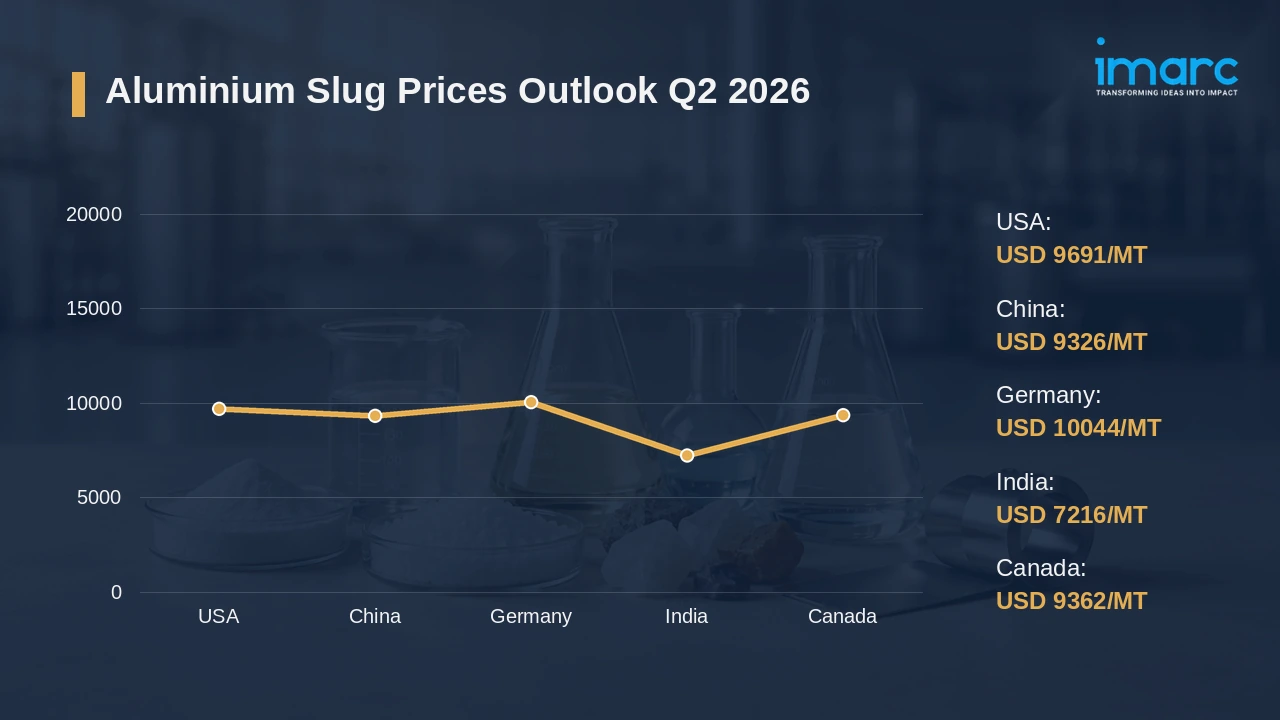
Aluminium slug is a precision-cut round, oval, or shaped blank engineered for impact extrusion, valued for ductility, low density, and corrosion resistance. Shaped at high line speeds into aerosol cans, collapsible tubes, pharmaceutical containers, capacitor housings, and automotive components, it ties aluminium slug prices to packaging and industrial output. Dimensional consistency governs yield on extrusion presses. Beyond primary metal benchmarks, pricing responds to electricity costs, freight on key trade lanes, and personal care demand cycles.
Global Market Overview:
Globally, the aluminium slug industry was valued at USD 2.60 Billion in 2025. Market projections indicate steady growth, with the industry expected to reach USD 4.07 Billion by 2034, with a compound annual growth rate (CAGR) of 5.10% during 2026-2034. Increasingly, lightweight metal packaging displaces plastic formats in personal care and pharmaceuticals. Across cosmetic, beverage, and battery casing uses, new extrusion capacity and recycled-content mandates anchor the aluminium slug price trend to packaging volumes.
Aluminium Slug Price Trend Q2 2026:
Regional prices (USD per MT) and QoQ changes Q2 2026 vs Q1 2026:
| Region | Price (USD/MT) | QoQ Change | Direction |
|---|---|---|---|
| USA | 9,691 | +9.21% | ↑ |
| China | 9,326 | +2.99% | ↑ |
| Germany | 10,044 | +21.33% | ↑ |
| India | 7,216 | +3.23% | ↑ |
| Canada | 9,362 | +8.08% | ↑ |
To access real-time prices Request Sample
What Moved Prices:
USA:
- In Q2 2026, aluminium slug prices in the USA climbed to USD 9,691/MT, a 9.21% QoQ gain led by aerosol can, beverage, and automotive component makers. Import tariffs on aluminium narrowed offshore sourcing for Midwest converters. With feedstock billet costs rising, production bottlenecks at domestic casthouses kept prompt availability thin.
- Export inquiries absorbed regional volumes and strengthened seller leverage. Against this backdrop, higher inland delivery and insurance charges lifted replacement values, while buyers kept regular ordering cadences rather than deferring purchases into the third quarter. The aluminium slug price chart for the USA showed firm monthly gains through June.
China:
- During Q2 2026, aluminium slug prices in China rose to USD 9,326/MT, a 2.99% QoQ increase as policy incentives lifted manufacturing activity across coastal fabrication hubs. Under stricter environmental inspections, several slug producers trimmed operating rates. That output restraint tightened spot availability for converters in Jiangsu.
- Demand from personal care packaging, pharmaceutical tube, and capacitor shell makers in Guangdong and Zhejiang held steady. Although ample upstream alumina stocks moderated cost escalation, intermittent refinery outages and firmer bauxite purchase costs kept producer sentiment firmly positive through most of the quarter. Firmer primary aluminium quotes on the Shanghai Futures Exchange reinforced seller confidence.
Germany:
- In Q2 2026, aluminium slug prices in Germany jumped to USD 10,044/MT, a 21.33% QoQ surge and the steepest among tracked regions, as export inquiries intensified. Buyers from neighboring European markets drew material away from domestic tube and aerosol converters. Across Bavaria and Baden-Württemberg, automotive component orders kept baseline consumption firm.
- Port congestion on North Sea gateways periodically delayed shipments, raising replacement concerns among manufacturers. Although energy costs eased late in the quarter, volatile feedstock metal values kept conversion economics under pressure for slug casthouses operating power-intensive rolling, punching, and annealing lines. Reliable output from integrated German plants prevented a sharper shortage.
India:
- During Q2 2026, aluminium slug prices in India advanced to USD 7,216/MT, up 3.23% QoQ as food packaging and collapsible tube makers expanded orders across western industrial clusters. Raw material shortfalls and intermittent power shortages pushed up production costs at domestic mills. In response, suppliers raised offers to recover operating expenses.
- Ahead of the monsoon, converters around Mumbai and Ahmedabad prioritized securing supply over chasing discounts. At Nhava Sheva and Mundra, landed costs for imported primary metal stayed elevated, narrowing the price advantage that overseas slugs previously held over competing domestic material. Household goods producers added incremental volumes during the period.
Canada:
- In Q2 2026, aluminium slug prices in Canada increased to USD 9,362/MT, an 8.08% QoQ rise as tighter North American supply chains squeezed prompt availability for converters. Strong US demand absorbed Quebec-origin volumes, raising replacement costs for Canadian producers. Electronics makers maintained steady call-offs despite the higher pricing.
- Cross-border trucking lanes carried higher freight and insurance charges, firming delivered prices. Supported by steady aerosol and industrial component consumption, suppliers across Ontario and Quebec kept offers disciplined, rarely discounting spot tonnage as buyers maintained regular order schedules. Import alternatives from Asia remained unattractive given long transit times.
Drivers Influencing the Market:
Several factors continue to shape aluminium slug pricing and market behavior:
- Aerosol and Tube Packaging Demand: Because deodorant and hairspray cans absorb most extruded output, personal care fillers set the baseline for slug consumption and dictate order timing across every major producing region. According to AEROBAL, member deliveries of aluminium aerosol cans slipped 1.7% to roughly 3.3 Billion units in H1 2025. Still, EU and UK shipments, at 1.21 Billion units, edged higher. Food aerosols partly offset the cosmetics slowdown.
- Primary Aluminium and Alumina Costs: Primary metal represents the largest share of slug production cost, and LME-linked benchmarks pass through to converter offers within weeks. Beneath those benchmarks, alumina and bauxite pricing set the smelter cost floor. Whenever Midwest or European duty-paid premiums widen, delivered slug values climb even if headline exchange prices hold flat, keeping the aluminium slug price index sensitive to physical tightness.
- Energy Expenditure in Casting and Annealing: Casting, rolling, and annealing lines make electricity the dominant slug conversion cost. Per Eurostat, EU non-household electricity averaged EUR 18.37 per 100 kWh in H2 2025, down 3.5% from H1. German users paid EUR 22.64, among the bloc's highest rates. Against hydropower-backed producers in Scandinavia or Canada, that gap leaves German slug converters structurally disadvantaged, compressing margin headroom whenever metal costs rise at the same time.
- Ocean Freight and Logistics Economics: Freight shapes landed costs more for slugs than for bulk ingot, because smaller consignments move in containers rather than breakbulk. During recent quarters, congestion at North Sea and Indian gateways stretched delivery windows. As cross-border trucking and marine insurance charges climb, importers find overseas material less competitive, which lets regional suppliers defend higher offers without losing any contracted volume.
- Environmental and Regulatory Compliance: Europe's Packaging and Packaging Waste Regulation (PPWR) is pushing aerosol and tube designs toward higher recycled content and easier separation. To meet those rules, slug casthouses must adjust alloys and tighten scrap sorting.
- Trade Policy and Currency Dynamics: US aluminium tariffs have redrawn North American sourcing patterns. On the export side, China's removal of export tax rebates for aluminium products has narrowed the discount Asian slugs carry into Europe and India. Because contracts settle mostly in US dollars, movements in the euro, rupee, and Canadian dollar alter local-currency procurement costs even when dollar quotes stay completely unchanged.
Recent Highlights & Strategic Developments:
Recent strategic moves within the industry further illustrate evolving dynamics:
- In September 2025, Alumar installed and commissioned its third slug surface-treatment line. Engineered and implemented by specialists from JSC NIIstromavtoliniya in the Republic of Belarus, the system added finishing capacity for blanks destined for impact extrusion into cans and tubes.
Outlook & Strategic Takeaways:
Looking ahead, the aluminium slug market is expected to expand steadily through 2034, carried by pharmaceutical tube demand, lighter aerosol can designs, and wider personal care packaging adoption. Primary metal and power costs will steer the aluminium slug price forecast.
To navigate this complex landscape, stakeholders should:
- Monitor Regional Price Differentials: Track quarterly spreads between German, US, Canadian, Chinese, and Indian slug assessments to spot procurement windows where landed costs undercut domestic offers by a meaningful margin. Benchmark contract rates against those spreads every quarter.
- Assess Freight Market Developments: Monitor container, trucking, and marine insurance rates closely across the Asia-Europe, transpacific, and US-Canada corridors that carry finished slugs to aerosol, tube, and pharmaceutical container converters. Negotiate rate adjustment clauses into annual logistics contracts.
- Evaluate Downstream Demand Indicators: Track aerosol, collapsible tube, and capacitor housing order books across the Americas, Europe, and Asia, comparing demand signals against the aluminium slug price per MT before committing volumes. Align inventory targets with filler production schedules to avoid overstocking.
- Review Regulatory Compliance Expenditures: Audit the cost of meeting PPWR recycled-content targets, CBAM reporting duties, and Chinese environmental inspections, then rank the obligations that most directly affect landed slug costs. Identify efficiencies that preserve full chemical safety compliance.
- Strengthen Currency Exposure Management: Implement forward cover for euro, rupee, and Canadian dollar exposure on dollar-denominated slug contracts, matching hedge maturities to scheduled import payment dates and supplier invoicing cycles. Coordinate treasury and procurement teams on coverage ratios.
- Explore Emerging Application Segments: Investigate slug demand from EV battery casings, food aerosols, and cosmetic jars, where impact extrusion is replacing plastic or deep-drawn steel components in new product lines. Partner with converters to qualify alloys early.
Subscription Plans & Customization:
IMARC offers flexible subscription models to suit varying needs:
- Monthly Updates: 12 deliverables/year
- Quarterly Updates: 4 deliverables/year
- Biannual Updates: 2 deliverables/year
Each includes detailed datasets (Excel + PDF) and post-report analyst support.

Get in Touch With Us
UNITED STATES
Phone: +1-201-971-6302
INDIA
Phone: +91-120-433-0800
UNITED KINGDOM
Phone: +44-753-714-6104
Email: [email protected]
Client Testimonials




.webp)




.webp)












