Amino Acid Price Update: Mixed Movements Across Key Markets in Q1 2026
21-May-2026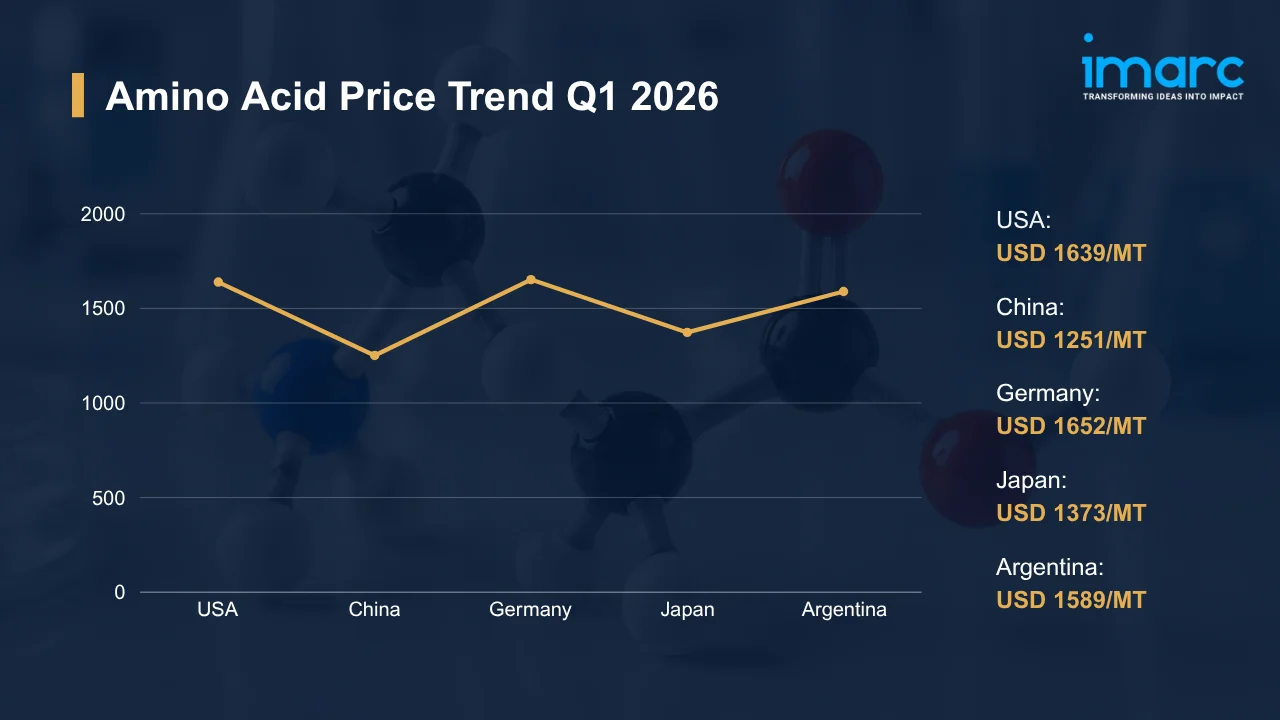
Amino acid contains both an amino group and a carboxyl group. There are twenty standard amino acids, which serve as the building blocks of all proteins. Across feed, food fortification, pharmaceutical synthesis, and cosmetics, amino acid prices answer to a sprawling demand mix spanning livestock nutrition, supplements, and high-purity medical uses. Corn and glucose feedstock, fermentation energy, and ocean freight set the pace.
Global Market Overview:
Globally, the amino acid industry reached a volume of 12.4 Million Tons in 2025. Market projections indicate steady growth, with the industry expected to reach a volume of 17.3 Million Tons by 2034, with a compound annual growth rate (CAGR) of 3.68% during 2026-2034. Underpinned by livestock expansion and steady protein intake across emerging economies, the amino acid price trend holds firm. Pharmaceutical-grade demand and precision fermentation broaden the application base.
Amino Acid Price Trend Q1 2026:
Regional prices (USD per MT) and QoQ changes Q1 2026 vs Q4 2025:
| Region | Price (USD/MT) | QoQ Change | Direction |
|---|---|---|---|
| USA | 1639 | -8.23% | ↓ |
| China | 1251 | +4.34% | ↑ |
| Germany | 1652 | -2.13% | ↓ |
| Japan | 1373 | +4.33% | ↑ |
| Argentina | 1589 | +3.11% | ↑ |
To access real-time prices Request Sample
What Moved Prices:
USA:
- At USD 1639/MT in Q1 2026, an 8.23% QoQ slide, the USA posted the steepest drop on the board, as heavy carryover stocks met cheaper Asian export offers. Distributors kept destocking through the quarter. With ports well supplied, spot purchasing from feed and nutrition accounts stayed thin, leaving suppliers little leverage to defend list prices.
- One thing kept the fall in check. Elevated corn and glucose costs held domestic production expense well above the floor. Even so, the amino acid price chart traced a steady decline, as plentiful port stocks and import parity handed buyers the upper hand well into March.
China:
- During Q1 2026, amino acid prices in China firmed to USD 1251/MT, a 4.34% QoQ gain that set the market clearly apart from its softer Western counterparts. Domestic feed demand strengthened across the board. Leading producers nudged lysine and methionine quotes higher, and steadier export bookings lifted assessed values off a soft year-end base.
- Tight production discipline did the heavy lifting. By trimming near-term availability, major fermentation producers kept the upward drift intact while millers rebuilt depleted stocks. A stable yuan helped too, keeping Chinese-origin material competitively placed for export even as anti-dumping scrutiny intensified across several key destination markets in the West.
Germany:
- In the first quarter of 2026, amino acid prices in Germany eased to USD 1652/MT, down 2.13% QoQ, yet the country still held the region’s top assessed price. Feed compounders and pharmaceutical formulators bought cautiously. Comfortable European inventory capped any urgency to chase volume.
- Structural demand here never really wavered. Pharmaceutical and biotech manufacturing stayed strong, though near-term orders ran measured. On the cost side, softer Asia–Europe freight and competitively priced imports squeezed supplier margins, dragging contract settlements lower across both specialty and feed-grade amino acid grades.
Japan:
- During Q1 2026, amino acid prices in Japan climbed to USD 1373/MT, a 4.33% QoQ rise. Two clear forces pushed values higher. Steady feed and nutraceutical offtake met a weaker yen, and that softer currency raised the landed cost of imported material right across the domestic distribution chain.
- Premium grades carried much of the rest. Across the board, GMP-grade and high-purity supply reinforced firmer pricing. With little domestic capacity, buyers leaned on imports, and as regional methionine availability tightened, procurement teams paid up to lock in timely deliveries for pharmaceutical and animal-nutrition formulations.
Argentina:
- In Q1 2026, amino acid prices in Argentina rose to USD 1589/MT, up 3.11% QoQ. The peso did most of the work. Its persistent slide lifted import-parity costs, while firm demand from animal feed and agricultural processing kept buyers in the market despite tight working capital across the chain.
- Currency ruled almost everything else here. Bracing for further depreciation, importers front-loaded orders to lock in rates. High inland transportation expenses, combined with port handling charges, are increasing the final delivered cost of both feed-grade and food-grade amino acid shipments upon arrival.
Drivers Influencing the Market:
Several factors continue to shape amino acid pricing and market behavior:
- Animal Feed and Livestock Nutrition Demand: Feed-grade lysine, methionine, and threonine set the consumption floor, since producers lean on essential amino acids to push growth rates, sharpen feed-conversion ratios, and curb nitrogen excretion in modern rations. Year after year, demand keeps coming. Across China, India, and Latin America, rising meat and dairy output feeds steady order flow, though seasonal herd cycles still bend purchasing volumes quarter to quarter. As per Indian government data, milk output rose by 63.56% from 146.30 Million Tons in 2014-15 to 239.30 Million Tons in 2023-24.
- Corn and Glucose Feedstock Costs: Amino acid fermentation depends heavily on corn and glucose feedstocks, making production costs highly sensitive to fluctuations in grain prices. Since corn remains the largest variable input, elevated raw material expenses continued to keep manufacturing costs firm and limited the extent of downward correction in finished amino acid prices during the quarter.
- Energy Expenditure in Fermentation and Processing: Fermentation, separation, and drying make the process power-hungry, so electricity and fuel bills bear directly on producer economics at every major hub. Here, sudden energy spikes impact operations quickly. When power prices jump, margins compress suddenly, and plants in higher-cost grids quickly lose ground to rivals sitting in cheaper power markets with stronger export margins.
- Ocean Freight and Logistics Economics: Because most output ships from Asia, container rates steer landed amino acid costs in every importing region. Drewry’s World Container Index sat near USD 2,232 per 40ft container in late April 2026, dragged down by soft Asia–Europe demand and a glut of vessel capacity. For importers, cheaper boxes plainly help. Falling freight trimmed import-parity costs into Europe and the Americas, handing those buyers extra leverage at the table.
- Environmental and Regulatory Compliance: Stricter rules on fermentation effluent, air emissions, and chemical waste disposal keep pushing compliance bills higher, especially across jurisdictions where discharge and reporting limits run particularly tight. Registration and safety-testing duties add more. Step by step, those costs work their way into the amino acid price index that buyers track across major producing regions.
- Trade Policy and Currency Dynamics: Anti-dumping probes into Chinese lysine across the US and EU keep rerouting export flows, reshaping regional supply and nudging producers toward fresh destination markets. Beyond tariffs, currency adds a second layer. A weaker peso or yen lifts import-parity costs for every dollar-based buyer, which is exactly why exchange-rate swings stay decisive across several importing markets this year.
Recent Highlights & Strategic Developments:
Recent strategic moves within the industry further illustrate evolving dynamics:
- In March 2026, Croda International Plc revealed the successful introduction of its new BioXPro amino acid line, aimed at meeting increasing demand in bioprocessing and pharmaceutical sectors. The firm leveraged the expertise of its pharmaceutical division in advanced ingredient development to produce a range of high purity amino acids. These products were designed to enhance performance in intricate formulations and aid efficiency in biomanufacturing processes.
- In January 2025, Cizzle Brands unveiled Spoken Nutrition, a high-end NSF Certified for Sport nutraceutical line aimed at sportspeople. Supported by specialists and MLB team directives, the product range featured Sleep Builder, Greens, Aminos + ATP, Creatine, Fish Oil + D, MAG 3, Pro Resolving Mediators, Vitamin D3 + K1/K2, Daily Packs, Grass Fed Whey, and Beef Protein.
Outlook & Strategic Takeaways:
Looking ahead, the amino acid market is expected to keep expanding in volume through 2034, carried by livestock nutrition, brisk dietary-supplement uptake, and a widening slate of pharmaceutical-grade applications. Where corn and glucose feedstock costs head next, alongside fermentation energy, will largely set the amino acid price forecast and the margins producers can defend.
To navigate this complex landscape, stakeholders should:
- Monitor Regional Price Differentials: Track the quarterly price gaps spanning the USA, China, Germany, Japan, and Argentina to time entries. Benchmark landed costs against live contract rates to surface the best sourcing windows.
- Assess Freight Market Developments: Watch container rates on the Asia–Europe and Transpacific lanes to read landed-cost direction early. Build rate-adjustment clauses into logistics contracts so spot swings do not blindside budgets.
- Evaluate Downstream Demand Indicators: Track livestock output, feed-mill run rates, and supplement order books region by region. Sync procurement cycles to those signals, trimming inventory risk before overstocking sets in.
- Hedge Feedstock Cost Exposure: Watch corn and glucose closely, since they steer most of the cost base. Comparing the amino acid price per MT against feedstock benchmarks lets teams flag savings windows early.
- Strengthen Currency Risk Management: Hedge purchases booked in volatile currencies such as the peso and yen to steady landed costs. Align treasury and procurement operations to ensure foreign exchange hedging is synchronized with import payment schedules.
- Explore Emerging Application Segments: Probe demand in medical nutrition, alternative proteins, and high-purity pharmaceutical grades. Partner with researchers to test commercial viability and stretch reach beyond traditional feed.
Subscription Plans & Customization:
IMARC offers flexible subscription models to suit varying needs:
- Monthly Updates — 12 deliverables/year
- Quarterly Updates — 4 deliverables/year
- Biannual Updates — 2 deliverables/year
Each includes detailed datasets (Excel + PDF) and post-report analyst support.
Get in Touch With Us
UNITED STATES
Phone: +1-201-971-6302
INDIA
Phone: +91-120-433-0800
UNITED KINGDOM
Phone: +44-753-714-6104
Email: [email protected]
Client Testimonials




.webp)




.webp)












