Glass Fiber Prices in the USA Reach USD 1,458/MT Amid Steady Industrial Demand
07-Jan-2026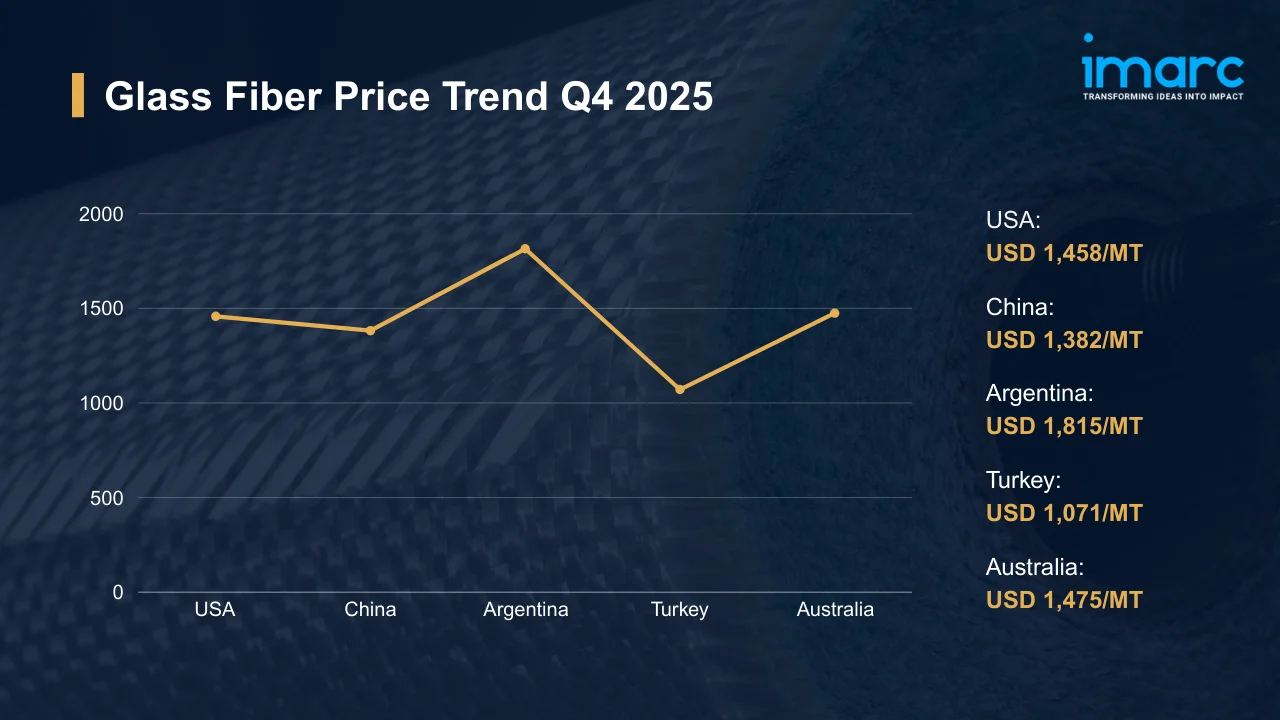
Glass fiber, widely referred to as fiberglass, is an advanced material produced from extremely fine filaments of glass. Recognized for its outstanding strength-to-weight ratio, it serves as a versatile and economical solution deployed across the construction, automotive, aerospace, and marine industries. The material is non-combustible, corrosion-resistant, and provides excellent thermal and electrical insulation characteristics. Available in forms, such as mats, woven fabrics, and chopped strands, glass fiber is combined with resins to produce resilient composite materials utilized in panels, pipes, tanks, and structural elements. Given its extensive industrial reliance, pricing remains highly sensitive to raw material availability, energy costs, construction activity, and trade policy shifts.
Global Market Overview:
Globally, the glass fiber industry reached a volume of 5.3 Million Tons in 2025. Market projections indicate steady growth, with the industry expected to reach 7.4 Million Tons by 2034, with a compound annual growth rate (CAGR) of 3.76% during 2026-2034. The rising demand triggered by the thriving construction and automotive industries is a major driving factor, as the increasing urbanization and infrastructure development projects globally lead to an increase in the procurement of materials. The growing use of glass fiber in renewable energy applications, such as the manufacturing of wind turbine blades, is a major driving factor that continues to support the demand base. At the same time, advancements in the engineering of composite materials continue to improve the mechanical properties of glass fiber materials, making it possible to enter the high-end industrial market.
Glass Fiber Price Trend Q4 2025:
Regional prices (USD per MT) and QoQ changes vs Q3 2025:
| Region | Price (USD/MT) | QoQ Change | Direction |
|---|---|---|---|
| USA | 1,458 | -1.55% | ↓ |
| China | 1,382 | -3.69% | ↓ |
| Argentina | 1,815 | +3.30% | ↑ |
| Turkey | 1,071 | +2.19% | ↑ |
| Australia | 1,475 | -2.51% | ↓ |
To access real-time prices Request Sample
What Moved Prices:
- USA: During Q4 2025, glass fiber prices in the USA declined to USD 1,458/MT, registering a 1.55% quarter-over-quarter decrease amid a combination of softening demand signals and evolving trade dynamics. Scheduled maintenance shutdowns at key production facilities curtailed output capacity, yet this supply-side tightness was insufficient to offset cautious procurement strategies adopted by downstream manufacturers in the construction and automotive segments. Elevated energy expenditures continued to weigh on production economics, while shifts in import volumes from non-tariffed origins, such as Mexico and Malaysia, introduced competitive pricing pressures that tempered domestic quotations throughout the period.
- China: Prices for glass fiber in China fell to USD 1,382/MT in Q4 2025, a quarterly loss of 3.69%, due to restrained consumption from the local wind energy and automotive industries. Unit values were continuously under pressure to decline due to increased production capabilities at significant industrial centers, and pricing support was further undermined by an accommodating raw material supply situation. As the global buyers took advantage of the oversupply situation to negotiate better landed cost terms in major importing countries, the export market conditions became highly competitive, and as a result, the domestic producers were forced to reassess their pricing structures in order to protect their global market share.
- Argentina: Due to reviving demand from the industrial and construction industries, glass fiber prices in Argentina increased by 3.30% on a quarterly basis to USD 1,815/MT in the fourth quarter of 2025. Procurement volumes were strengthened by the automotive industry's gradual shift to lighter, fuel-efficient car layouts and growing demands for renewable energy capacity, especially in wind power generation. In addition to logistical obstacles in local distribution networks, currency exchange rate variations increased the landed costs of imported products. For converters working throughout the value chain, stable feedstock pricing offered a measure of cost predictability.
- Turkey: The price of glass fibers in Turkey slightly increased to USD 1,071/MT in Q4 2025, registering a quarterly increase of 2.19%, due to favorable export conditions to neighboring countries. Despite the fact that the overall demand remained below record levels, the demand from the infrastructure and construction sectors slowly started to recover from the previous quarter. The fluctuations in the price of raw materials and the volatility of energy prices had a noticeable but moderate effect on production costs. During the quarter, the suppliers modified their pricing models to remain competitive in the domestic as well as export markets.
- Australia: Glass fiber prices in Australia dropped to USD 1,475/MT in Q4 2025, with a quarterly decline of 2.51% due to a slow-down in demand from the infrastructure and renewable energy industries. As regional import channels stabilized and global maritime restrictions diminished, supply chain conditions eased, thus relieving the tightness that had characterized previous quarters. An environment with reduced production costs was created through enhancements in the availability of raw materials and changes in the cost of energy. Although government sustainability requirements continued to support minimum consumption levels in the construction and transport industries, downstream firms utilized inventory management techniques to cut costs.
Drivers Influencing the Market:
Several factors continue to shape glass fiber pricing and market behavior:
- Construction and Infrastructure Demand: Sustained residential and commercial building activity across major economies drives consistent glass fiber consumption in reinforcement, insulation, and facade applications. Urban expansion initiatives and infrastructure modernization programs underpin procurement volumes, while seasonal construction cycles introduce periodic fluctuations in ordering patterns across wholesale distribution networks and regional supply chains.
- Automotive Sector Lightweighting: The automotive industry's accelerating shift towards lightweight composite materials to enhance fuel efficiency and reduce emissions sustains robust glass fiber procurement. Regulatory mandates, such as Corporate Average Fuel Economy standards, compel manufacturers to integrate fiberglass into body panels, bumpers, and structural components, reinforcing demand growth irrespective of broader economic sentiment fluctuations or inventory adjustment cycles.
- Renewable Energy Expansion: Growing investment in wind energy installations worldwide amplifies demand for glass fiber composites utilized in turbine blade fabrication. Government renewable energy targets and subsidy programs accelerate capacity additions, creating sustained procurement requirements. Solar panel structural applications provide supplementary consumption channels, broadening the industrial demand base beyond traditional sectors and supporting long-term volume growth trajectories.
- Raw Material and Energy Costs: Fluctuations in soda ash, silica sand, and energy input costs directly influence glass fiber production economics and downstream pricing structures. Natural gas and electricity tariff variations affect furnace operating expenditures, compelling manufacturers to adjust quotations accordingly. Supply disruptions at key extraction sites or feedstock processing facilities amplify cost volatility, transmitting upward pricing pressure across the entire value chain.
- Trade Policies and Geopolitical Dynamics: Evolving antidumping and countervailing duty investigations targeting fiberglass imports reshape international trade flows and regional pricing differentials. Tariff adjustments and regulatory restrictions compel buyers to diversify sourcing toward non-tariffed origins, altering competitive dynamics across supply corridors. Geopolitical tensions and bilateral trade negotiations introduce uncertainty into procurement planning, encouraging strategic inventory accumulation and contractual hedging mechanisms.
- Logistics and Supply Chain Conditions: International shipping rate movements, port congestion levels, and container availability directly impact glass fiber landed costs across import-dependent markets. Transportation bottlenecks and berth restrictions at major distribution hubs create transient supply shortages that elevate spot premiums. Regional freight cost differentials between inland production centers and coastal demand zones further shape competitive pricing structures across global markets.
Recent Highlights & Strategic Developments:
Recent strategic moves within the industry further illustrate evolving dynamics:
- In November 2025, AGY, a prominent manufacturer of advanced specialty glass fiber reinforcements for high-performance composites based in Aiken, South Carolina, unveiled plans to broaden its production capacity in Aiken County. The initiative entailed a capital commitment of USD 12.1 Million and was anticipated to create 80 new employment positions.
Outlook & Strategic Takeaways:
Looking ahead, the glass fiber market is expected to sustain moderate growth, supported by expanding construction activity across global markets. Raw material cost fluctuations and shifting supply chain dynamics will remain critical variables influencing regional pricing trajectories and procurement strategies.
To navigate this complex landscape, stakeholders should:
- Monitor Regional Price Differentials: Track quarterly pricing variations across key supply regions to identify cost-saving procurement windows. Establish benchmarking protocols that compare landed costs against prevailing contract rates for optimal sourcing decisions.
- Assess Feedstock Cost Exposure: Monitor soda ash, silica sand, and energy input price movements that directly affect production economics. Negotiate index-linked contracts to align procurement expenditures with prevailing market conditions.
- Evaluate Trade Policy Developments: Track antidumping investigations and tariff adjustments targeting fiberglass imports across major trade corridors. Adapt sourcing strategies proactively to capitalize on duty-free origins and favorable bilateral arrangements.
- Strengthen Logistics Planning: Review international shipping routes and freight cost trends to optimize landed cost structures. Develop contingency logistics arrangements that ensure supply continuity during port congestion or capacity disruptions.
- Track End-Use Sector Performance: Analyze automotive and renewable energy sector indicators to anticipate demand shifts. Align inventory positioning with projected consumption patterns to avoid overexposure during cyclical downturns.
- Explore Premium Segment Opportunities: Investigate specialty glass fiber applications in aerospace and electronics where margins remain favorable. Develop technical capabilities to serve high-performance composite specifications and capture value-added market segments.
Subscription Plans & Customization:
IMARC offers flexible subscription models to suit varying needs:
- Monthly Updates — 12 deliverables/year
- Quarterly Updates — 4 deliverables/year
- Biannual Updates — 2 deliverables/year
Each includes detailed datasets (Excel + PDF) and post-report analyst support.

Get in Touch With Us
UNITED STATES
Phone: +1-201-971-6302
INDIA
Phone: +91-120-433-0800
UNITED KINGDOM
Phone: +44-753-714-6104
Email: [email protected]
Client Testimonials




.webp)




.webp)












