Nickel Powder Price Update: Fluctuations Across Key Markets in Q2 2026
21-Aug-2026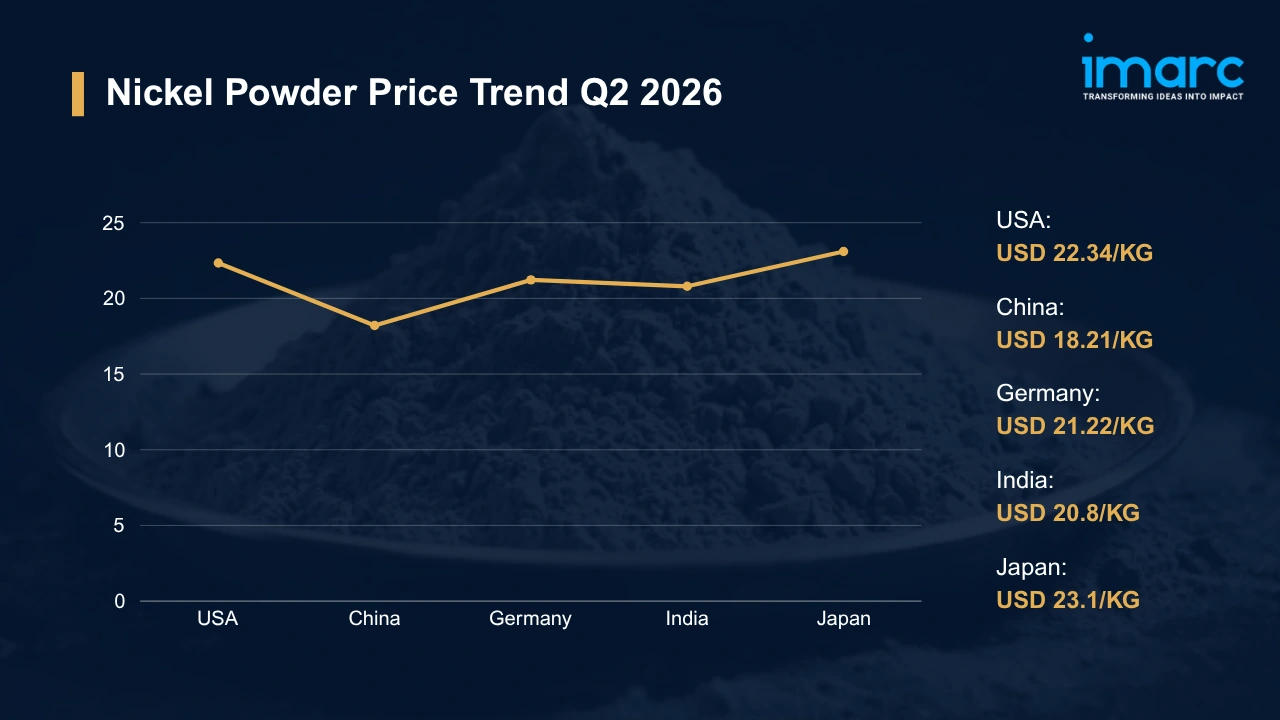
Nickel powder is a fine metallic powder produced through the decomposition of nickel carbonyl or other metallurgical processes. It is used extensively in industries such as rechargeable batteries and alloys, playing a crucial role in additive manufacturing, metal coatings, and electronics. Nickel powder prices are influenced by feedstock costs, energy inputs, regulatory compliance, and trade policies affecting core consuming sectors.
Global Market Overview:
Globally, the nickel powder industry was valued at USD 587.6 Million in 2025. Market projections indicate steady growth, with the industry expected to reach USD 910.4 Million by 2034, with a compound annual growth rate (CAGR) of 4.84% during 2026-2034. Persistent demand from battery manufacturing, aerospace, and electronic components manufacturing supports the nickel powder price trend. Expanding technological advancements and green energy initiatives also contribute to its rising market value.
Nickel Powder Price Trend Q2 2026:
Regional prices (USD per KG) and QoQ changes Q2 2026 vs Q1 2026:
| Region | Price (USD/KG) | QoQ Change | Direction |
|---|---|---|---|
| USA | 22.34 | +0.23% | ↑ |
| China | 18.21 | -3.32% | ↓ |
| Germany | 21.22 | +1.21% | ↑ |
| India | 20.8 | -2.12% | ↓ |
| Japan | 23.1 | -2.78% | ↓ |
To access real-time prices Request Sample
What Moved Prices:
USA:
- In Q2 2026, nickel powder prices in the USA increased to USD 22.34/KG with strong demand from the aerospace and electronics sectors. Balanced supply met steady downstream demand, while better coordination in supply chains facilitated smooth domestic transactions through the quarter.
- Adequate producer inventories reduced restocking urgency, keeping spot activity steady across regional distribution channels. Moderate feedstock cost pressure influenced production costs, and strategic supplier negotiations nudged offers upward. The nickel powder price chart depicted stable growth as buyers focused on long-term supply security.
China:
- During Q2 2026, nickel powder prices in China dropped to USD 18.21/KG due to softer downstream demand and consistent domestic output. Battery and electronics sector activity was subdued, leading to limited buying interest across major production hubs through the period.
- Manufacturers maintained consistent production schedules, ensuring comfortable availability and reducing supply-driven price pressure. Competitive offers among domestic suppliers led to lower values, while a cautious procurement outlook reflected sufficient inventory levels. Decreased export activity contributed to the bearish sentiment, reinforcing the price retreat.
Germany:
- In the second quarter of 2026, nickel powder prices in Germany rose to USD 21.22/KG as demand from the automotive and electronics industries remained moderate to strong. Proactive inventory management by buyers limited replenishment on a large scale, maintaining stable purchasing even as suppliers kept output ready.
- Steady European production coupled with stable feedstock costs enabled consistent availability, reducing regional supply concerns. Supplier adaptability in pricing strategies helped retain contract customers, keeping spot activity measured. The market saw values under controlled upward pressure due to end-use sector needs.
India:
- During Q2 2026, nickel powder prices in India declined to USD 20.8/KG following a decrease in industrial demand and steady regional availability. Consistent production schedules maintained stock levels for domestic and export markets, while downstream buyers remained cautious with ordering.
- Slower export-driven manufacturing reduced the demand pull, softening the broader consumption through the quarter. Robust regional stocks encouraged competitive pricing as manufacturers worked to retain market share. Stable feedstock costs supported controlled pricing strategies without compressing margins.
Japan:
- In Q2 2026, nickel powder prices in Japan fell to USD 23.1/KG, affected by reduced demand in the electronics and automotive sectors. Domestic supply and imports aligned well to balance the market, tempering upward pressure on prices throughout the quarter.
- Sufficient inventory coverage reduced procurement urgency across downstream manufacturing segments. Market competition prompted adjustments in offers, ensuring alignment with slower purchasing rates. Reliable logistics and operations secured smooth supply chains, maintaining a downward trend in pricing.
Drivers Influencing the Market:
Several factors continue to shape nickel powder pricing and market behavior:
- End-Use Sector Demand: Structural demand for nickel powder is based in rechargeable batteries, aerospace, and electronics manufacturing. Shifts in technology and energy transition strategies guide order rhythms, with increasing innovation in battery technology bolstering the demand. Advanced manufacturing processes in key economies through 2026 are expected to drive consistent procurement, supporting demand-driven price adjustments.
- Upstream Nickel Ore and Processing Costs: Feedstock economics anchor nickel powder production expenses, with nickel ore values shaping supplier margins. Declining nickel ore costs through recent quarters eased production economics, feeding into lower finished offers. Crude oil movements and mining availability continue to sway the nickel powder price index across producing regions.
- Energy Expenditure in Production: Natural gas and electricity costs weigh heavily on nickel powder synthesis, particularly across energy-intensive processing stages. Rising natural gas prices and elevated electricity costs increase production expenses, putting pressure on the cost structures of North American producers.
- Ocean Freight and Logistics Economics: Container shipping rates on major trans-Pacific and Asia-Europe trade corridors directly influence landed costs for internationally traded nickel powder. Drewry's World Container Index recorded USD 4,339 per 40ft container as of August 13, 2026, reflecting firming freight conditions on transpacific routes amid active blank sailing programs by major carriers. Elevated CIF costs increase the landed price differential between Asian-origin material and domestically produced grades, affecting sourcing decisions in import-dependent markets.
- Environmental and Regulatory Compliance: Tightening rules on material handling, storage, and emissions raise compliance spending for producers and distributors. Registration, labeling, and worker-exposure requirements under chemical safety frameworks add administrative and testing costs. These expenses filter progressively into pricing, most visibly across jurisdictions enforcing stringent environmental and occupational standards.
- Trade Policy and Currency Dynamics: Import tariffs, export allocations, and shifting trade terms redirect regional supply and influence landed cost competitiveness. Currency swings against the US dollar alter procurement economics for buyers in Asia and Europe. Producers recalibrate offers as exchange-rate volatility and policy adjustments reshape cross-border margins through each quarter.
Recent Highlights & Strategic Developments:
Recent strategic moves within the industry further illustrate evolving dynamics:
- In February 2026, 6K Additive signed a long-term agreement with Siemens Energy to recycle nickel-based revert powder from the company's in-house production into high-quality alloy powder feedstock for the additive manufacturing market. The partnership strengthened 6K Additive’s circular economy strategy, with nearly 20 Tons already processed and supplied.
Outlook & Strategic Takeaways:
Looking ahead, the nickel powder market is expected to expand steadily through 2034, supported by sustained demand in additive manufacturing, electronics, and battery sectors alongside broadening industrial applications. Feedstock and energy cost trajectories will remain the pivotal variable shaping the nickel powder price forecast across supplier margins and regional competitiveness.
To navigate this complex landscape, stakeholders should:
- Monitor Regional Price Differentials: Track quarterly variations across the USA, China, Germany, India, and Japan to locate cost-saving procurement windows. Benchmark landed costs against prevailing contract rates before committing volumes.
- Assess Freight Market Developments: Monitor container rate trends on Asia-Europe and transpacific corridors to anticipate landed cost shifts. Negotiate logistics contracts with adjustment clauses tied to prevailing spot market conditions.
- Evaluate Downstream Demand Indicators: Track additive manufacturing, electronic components, and battery production order books across principal consuming regions. Align procurement cycles with observed demand signals to avoid overstocking during soft periods.
- Review Feedstock and Energy Cost Trends: Monitor nickel ore and natural gas benchmarks that steer the nickel powder price per KG. Adjust sourcing timing as input cost movements reshape supplier offers.
- Strengthen Currency Exposure Management: Implement hedging for procurement denominated in volatile currencies to stabilize landed cost projections. Coordinate treasury and procurement functions to align coverage with import payment timelines.
- Explore Emerging Application Segments: Investigate growth potential in higher-purity nickel powders for electronics and battery applications for portfolio diversification. Engage research partners to assess commercial viability of novel formulations.
Subscription Plans & Customization:
IMARC offers flexible subscription models to suit varying needs:
- Monthly Updates: 12 deliverables/year
- Quarterly Updates: 4 deliverables/year
- Biannual Updates: 2 deliverables/year
Each includes detailed datasets (Excel + PDF) and post-report analyst support.

Get in Touch With Us
UNITED STATES
Phone: +1-201-971-6302
INDIA
Phone: +91-120-433-0800
UNITED KINGDOM
Phone: +44-753-714-6104
Email: [email protected]
Client Testimonials




.webp)




.webp)












