PET Resin Prices: IMARC Group Unveils Real-Time Price Trends, Regional Analysis, and Forecast
21-Jul-2026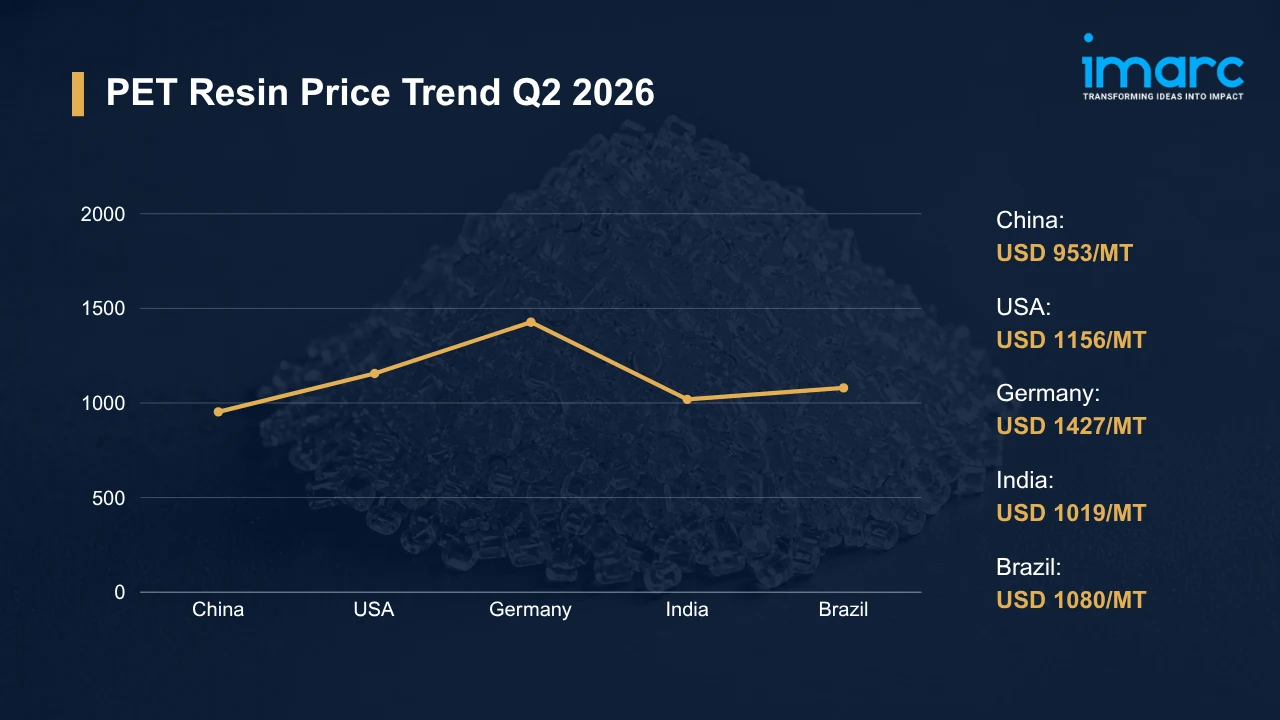
PET resin is a thermoplastic polyester derived from PTA and MEG polymerization. Prized for transparency, tensile strength, and gas barrier performance, the material serves beverage bottling, food containers, packaging films, textile fibers, and personal care applications at scale across global markets. PET resin prices mainly react to fluctuations in upstream PTA and MEG feedstock costs, energy costs during polymerization, ocean freight charges on Asian routes, and demand patterns related to beverages and FMCG.
Global Market Overview:
Globally, the PET resin industry was valued at USD 49.3 Billion in 2025. Market projections indicate steady growth, with the industry expected to reach USD 74.5 Billion by 2034, with a compound annual growth rate (CAGR) of 4.70% during 2026-2034. Lightweight recyclable bottle formats and expanding food packaging adoption across Asia-Pacific and Latin America keep volume growth consistent year over year. Tightening recycled content mandates in the EU and North America are reshaping procurement decisions, with the PET resin price trend reflecting these regulatory cost pressures alongside steady FMCG demand growth.
PET Resin Price Trend Q2 2026:
Regional prices (USD per MT) and QoQ changes Q2 2026 vs Q1 2026:
| Region | Price (USD/MT) | QoQ Change | Direction |
|---|---|---|---|
| China | 953 | +3.54% | ↑ |
| USA | 1156 | +3.25% | ↑ |
| Germany | 1427 | +3.44% | ↑ |
| India | 1019 | +3.97% | ↑ |
| Brazil | 1080 | +3.86% | ↑ |
To access real-time prices Request Sample
What Moved Prices:
China:
- In Q2 2026, PET resin prices in China reached USD 953/MT, recovering on a combination of post-holiday output resumptions and pre-summer restocking by FMCG bottlers. At integrated complexes in Yizheng and Jiangyin, disciplined operating rates kept inventory lean, removing the supply overhang that had pressured values in the preceding quarter.
- Paraxylene feedstock costs firmed modestly through April, lifting the PTA cost floor and giving producers a credible basis to hold higher offer levels into June. Export order books from Southeast Asian buyers added incremental volume. The PET resin price chart plotted a consistent upward line through the quarter, with no meaningful price reversals recorded between April and June.
USA:
- During Q2 2026, PET resin prices in the USA rose to USD 1156/MT as converters serving bottled beverages, food packaging, and consumer goods accelerated procurement ahead of the summer demand peak. Spot availability tightened through May, not because output fell, but because buyers front-loaded purchases to avoid end-of-quarter shortfalls.
- Structural supply tightness persisted following the permanent shutdown of a major North American PTA facility, which kept feedstock costs elevated for domestic bottle-grade resin producers. Gulf Coast producers carried full order books through the period. Inland logistics operated without notable disruption, keeping delivery lead times predictable.
Germany:
- In the second quarter of 2026, PET resin prices in Germany advanced to USD 1427/MT as packaging converters across food processing, beverage, and retail channels expanded procurement ahead of seasonal output ramp-ups. Producers held firm offer levels, supported by healthy order intake and balanced supply across European production sites.
- Competitively priced Asian imports provided supplementary volume without destabilizing domestic price floors, as European logistics premiums absorbed a share of the origin cost advantage. EU recycled content compliance obligations sustained rPET integration activity among converters, adding sourcing complexity that kept upward pressure on virgin bottle-grade PET valuations through June.
India:
- During Q2 2026, PET resin prices in India climbed to USD 1019/MT as beverage bottlers, food packaging producers, and consumer goods converters lifted procurement volumes during the post-summer restocking cycle. Across the Gujarat and Maharashtra manufacturing corridors, buying momentum built steadily through the quarter and kept spot market conditions firm.
- Import-linked PTA costs, tracking paraxylene price movements in Asian markets, pushed domestic production cost floors higher for Indian resin manufacturers. At port gateway facilities in Mundra and Nhava Sheva, inventory levels held balanced rather than accumulating, removing the inventory pressure that typically softens spot pricing during similar seasonal windows.
Brazil:
- In Q2 2026, PET resin prices in Brazil increased to USD 1080/MT, driven by improving order volumes from beverage bottlers, food converters, and consumer goods manufacturers in the Sao Paulo and Minas Gerais industrial zones. Converters advanced procurement schedules ahead of seasonal consumption peaks, tightening spot availability through the period.
- BRL's decline against the USD increased import parity prices for buyers obtaining resin from foreign suppliers, strengthening the competitive edge of local manufacturers and enabling them to maintain elevated price points. Manufacturing operations stayed stable throughout. Converter-to-producer logistics networks functioned without material disruption.
Drivers Influencing the Market:
Several factors continue to shape PET resin pricing and market behavior:
- Beverage and Packaging Sector Demand: Bottled water, carbonated soft drinks, juices, and functional beverages generate consistent base demand for bottle-grade PET resin worldwide. Pre-summer restocking cycles introduce sharp quarterly procurement surges that directly support price firming across key producing regions. Expanding FMCG distribution networks in India, Brazil, and Southeast Asia add incremental annual volume, reinforcing the PET resin price index through predictable structural consumption growth.
- Energy Expenditure in Polymerization: Per the EIA's July 2026 Short-Term Energy Outlook, the Henry Hub natural gas spot price averaged USD 3.52/MMBtu across 2025, a 56% rise compared to the 2024 annual average, noted as the lowest ever when factoring in inflation. For PET resin producers relying on natural gas in melt-phase polymerization and solid-state polycondensation, this sustained input cost elevation lifted operating cost floors across North American facilities through the year.
- Ocean Freight and Logistics Economics: Changes in ocean freight rates and logistics costs directly affect the landed cost of PET resin, influencing the competitiveness of imported material relative to domestic supply and contributing to fluctuations in market prices. This creates uncertainty in procurement and pricing strategies.
- Environmental and Regulatory Compliance: Evolving environmental regulations and recycled content requirements are increasing compliance and production costs for PET resin manufacturers, while encouraging greater investment in sustainable production and recycling technologies. Compliance requirements continue to become more stringent across key markets.
- Trade Policy and Currency Dynamics: Trade policies, import duties, and currency fluctuations influence the cost competitiveness of PET resin across global markets by affecting import prices and procurement decisions. These factors contribute to greater pricing volatility and supply chain uncertainty.
Recent Highlights & Strategic Developments:
Recent strategic moves within the industry further illustrate evolving dynamics:
- In January 2026, Otsuka Pharmaceutical launched a nationwide rollout of beverage containers produced from 100% rPET. Covering more than 90% of the company's PET-bottled beverage products by bottle count, the initiative was projected to cut greenhouse gas emissions by approximately 5,300 Tons, reflecting growing commitment to closed-loop PET material use across pharmaceutical and beverage sectors.
Outlook & Strategic Takeaways:
Looking ahead, the PET resin market is expected to sustain a measured growth trajectory through 2034, underpinned by beverage packaging volume expansion, growing food storage applications, and accelerating rPET integration requirements across regulated packaging markets in Europe and North America. Upstream PTA and MEG feedstock cost trajectories, alongside tightening recycled content compliance mandates, will remain the pivotal variables shaping the PET resin price forecast across producing regions through the forecast horizon.
To navigate this complex landscape, stakeholders should:
- Assess Freight Market Developments: Monitor container shipping rate movements on Asia-to-Europe and Asia-to-Americas corridors to anticipate landed cost shifts in import-sourced resin. Negotiate flexible logistics contracts with rate adjustment mechanisms tied to prevailing spot freight indices to protect cost visibility.
- Evaluate Downstream Demand Indicators: Track beverage production output, FMCG order books, and food packaging sector activity indices across principal consumption regions. Correlate seasonal demand signals with procurement planning cycles to optimize inventory positioning and prevent excess stock accumulation ahead of demand softening.
- Review Regulatory Compliance Expenditures: Audit current costs tied to rPET sourcing, recycled content verification, and packaging redesign obligations under EU, US, and national regulatory frameworks. Identify operational efficiencies that reduce compliance burden without compromising material quality or supply security.
- Strengthen Currency Exposure Management: Implement hedging strategies for procurement denominated in BRL, INR, and EUR to stabilize landed cost projections amid exchange rate volatility. Coordinate treasury and procurement functions to align foreign exchange coverage with anticipated import payment timelines and contract renewal cycles.
- Monitor Regional Price Differentials: Track quarterly pricing variations across China, Europe, and the Americas to identify cost-saving procurement windows. Establish benchmarking protocols comparing CIF landed costs against prevailing contract rates; referencing the PET resin price per MT across regions enables direct cost comparison for sourcing decisions.
- Explore Emerging Application Segments: Investigate growth potential in pharmaceutical packaging, personal care containers, and high-barrier food storage applications where PET resin is displacing glass and competing polymers. Engage with resin producers and converter partners to evaluate commercial viability of novel applications that can expand addressable demand beyond traditional beverage bottling.
Subscription Plans & Customization:
IMARC offers flexible subscription models to suit varying needs:
- Monthly Updates: 12 deliverables/year
- Quarterly Updates: 4 deliverables/year
- Biannual Updates: 2 deliverables/year
Each includes detailed datasets (Excel + PDF) and post-report analyst support.

Get in Touch With Us
UNITED STATES
Phone: +1-201-971-6302
INDIA
Phone: +91-120-433-0800
UNITED KINGDOM
Phone: +44-753-714-6104
Email: [email protected]
Client Testimonials




.webp)




.webp)












