Tin Plate Prices Hit USD 1,975/MT in Japan as IMARC Group Unveils Real-Time Global Price Trends
05-Aug-2026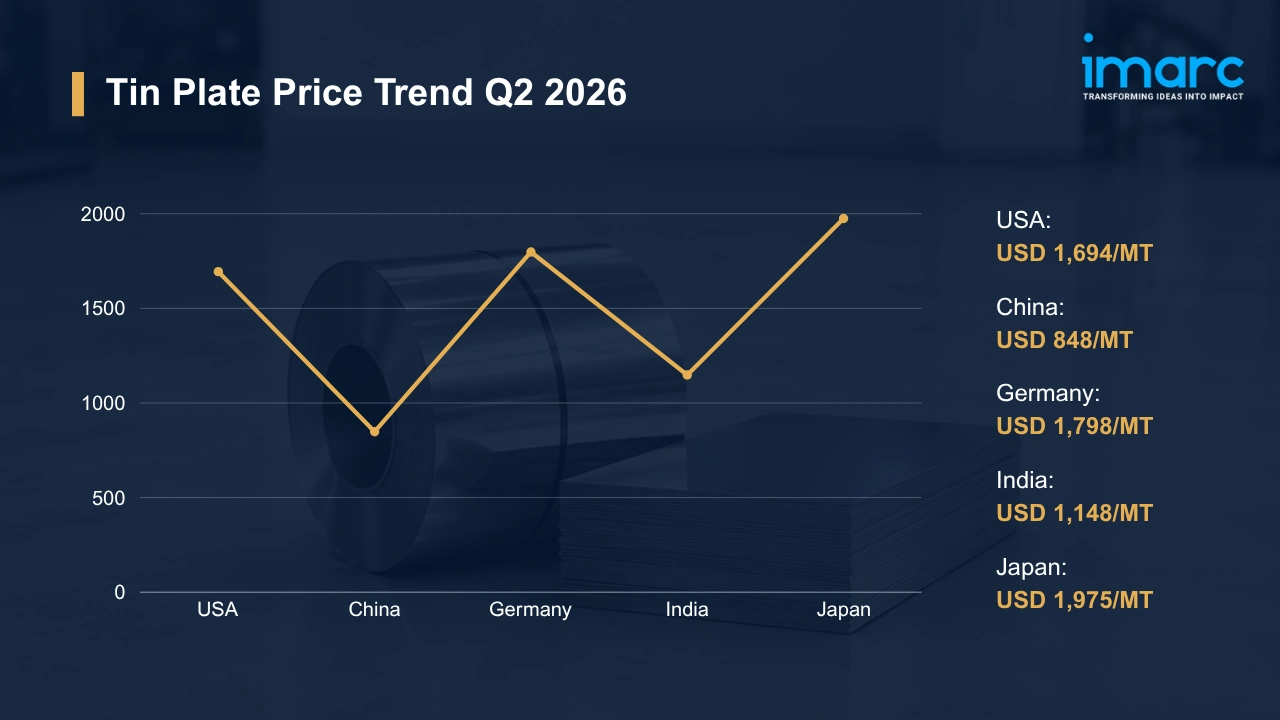
Tin plate is a thin cold-rolled steel sheet electrocoated on one or both sides with commercially pure tin, combining corrosion resistance, formability, and non-toxic characteristics essential for direct-contact applications. Widely deployed across food can manufacturing, beverage containers, aerosol packaging, bottle caps, electrical components, and decorative items, the material serves critical industrial and consumer packaging functions. Tin plate prices are primarily shaped by upstream fluctuations in low-carbon steel substrate and refined tin costs, energy expenditure during electrolytic coating processes, ocean freight dynamics on key trade lanes, and demand cycles within food and beverage packaging industries.
Global Market Overview
Globally, the tin plate industry was valued at USD 27.71 Billion in 2025. Market projections indicate steady growth, with the industry expected to reach USD 37.08 Billion by 2034, with a compound annual growth rate (CAGR) of 3.29% during 2026-2034. Expanding food and beverage packaging requirements across emerging economies, alongside growing demand from aerosol and specialty can manufacturers, sustain the tin plate price trend across supplier networks globally. Regulatory momentum favoring recyclable metal packaging and rising FMCG production further diversify end-use demand channels.
Tin Plate Price Trend Q2 2026
Regional prices (USD per MT) and QoQ changes Q2 2026 vs Q1 2026:
| Region | Price (USD/MT) | QoQ Change | Direction |
|---|---|---|---|
| USA | 1,694 | +8.12% | ↑ |
| China | 848 | +7.11% | ↑ |
| Germany | 1,798 | +9.12% | ↑ |
| India | 1,148 | +14.23% | ↑ |
| Japan | 1,975 | +8.21% | ↑ |
To access real-time prices Request Sample
What Moved Prices
USA:
- In Q2 2026, tin plate prices in the USA climbed to USD 1,694/MT, driven by steady procurement from food can manufacturers and beverage packaging converters maintaining regular production runs. Domestic supply conditions remained disciplined as steel mills managed output carefully, preventing excess availability and anchoring the quarter's upward price direction.
- Import competition eased as higher landed costs from Asian origins reduced competitive pressure on domestic suppliers. Supported by stable energy costs at inland processing centers, the tin plate price chart for the USA reflected continuous gains through each month, with aerosol can and specialty packaging segments contributing active sourcing activity.
China:
- During Q2 2026, tin plate prices in China rose to USD 848/MT as domestic food packaging manufacturers and export-oriented can producers maintained consistent procurement volumes. Controlled output from steel mills kept supply conditions balanced, while ongoing FMCG absorption at major hubs in Guangzhou and Yiwu supported transaction activity through the period.
- EU anti-dumping duties on Chinese tin plate imports, which had diverted export volumes in earlier periods, continued redirecting supply toward Southeast Asian markets, moderating domestic oversupply risks. With stable CNY exchange rates supporting cost predictability, firm demand from confectionery and specialty can producers enabled the quarter's upward price movement to consolidate.
Germany:
- In Q2 2026, tin plate prices in Germany advanced to USD 1,798/MT amid firming demand from food packaging converters, aerosol manufacturers, and specialty can producers across European distribution networks. Controlled steel production maintained a disciplined supply environment, and Asian import flows remained measured, supporting sustained price strengthening through the quarter.
- Consistent downstream utilization rates across European converter facilities encouraged structured procurement aligned with confirmed production schedules. Against this backdrop, stable European natural gas storage levels limited energy-cost escalation, though gradual tightening in hot-rolled coil availability at upstream suppliers incrementally supported higher assessed values throughout the period.
India:
- During Q2 2026, tin plate prices in India surged to USD 1,148/MT, recording the sharpest QoQ gain among tracked regions at 14.23%. Food can manufacturers, edible oil container producers, and FMCG packaging converters across industrial centers maintained active restocking activity, absorbing available supply and tightening the domestic market throughout the quarter.
- Rising steel substrate costs at domestic mills, reflecting firmer iron ore and coking coal input values, filtered directly into assessments for electroplated products. Import parity pricing for Asian-origin tin plate trended higher as freight costs to major Indian gateway ports increased, further reinforcing the domestic price trajectory through mid-year.
Japan:
- In Q2 2026, tin plate prices in Japan reached USD 1,975/MT, supported by stable demand from high-specification food-grade can manufacturers and quality packaging converters requiring prime-grade material. Controlled production operations across domestic steel mills prevented supply accumulation, allowing prices to build on gains established through prior quarters.
- Successful price negotiations between Japanese steelmakers and regional buyers in Southeast Asia supported higher export reference values that shaped domestic assessments. Sustained consumption across automotive parts and electrical components complemented the packaging sector's steady offtake, limiting spot price concessions and reinforcing the quarter's upward pricing direction.
Drivers Influencing the Market
Several factors continue to shape tin plate pricing and market behavior:
- Food and Beverage Packaging Sector Demand: Sustained consumption from food can, beverage container, and aerosol manufacturers underpins baseline procurement volumes for tin plate across global markets. Urbanization trends in emerging economies and expanding FMCG production networks generate consistent ordering patterns, while seasonal canning cycles in food processing introduce periodic procurement acceleration that shapes quarterly price assessments.
- Upstream Steel and Tin Substrate Costs: Low-carbon cold-rolled steel and refined tin prices serve as the twin cost anchors governing tin plate production economics across all major manufacturing regions. Supply-chain dynamics for both substrates translate directly into electroplating cost structures, influencing assessed tin plate prices globally.
- Energy Expenditure in Production: Electricity and natural gas consumption during electrolytic tinning and cold-rolling operations constitute a material share of total production costs for tin plate manufacturers. Across North America, Europe, and Asia, energy price volatility introduces input-cost asymmetries that unevenly affect regional producers and alter competitive positioning in international supply chains. Periods of elevated power tariffs compress operating margins and push producers to revise contract pricing.
- Ocean Freight and Logistics Economics: Container shipping rates on key Asia-Europe and Transpacific trade routes influence the landed cost of imported tin plate for manufacturers and distributors globally. Drewry's World Container Index reached USD 3,549 per 40ft container in the week of June 11, 2026, reflecting strengthening momentum as early peak season demand and carrier surcharges drove rates higher across major routes. The tin plate price index across import-dependent markets responds directly to freight rate movements on these trade corridors.
- Environmental and Regulatory Compliance: Tightening environmental standards governing the handling, storage, and disposal of tin-bearing materials and electrolytic process chemicals raise operational compliance costs for tin plate producers and processors. Registration and assessment protocols under chemical safety frameworks in the EU and North America impose recurring administrative expenditures that filter progressively into product pricing across jurisdictions with active enforcement programs.
- Trade Policy and Currency Dynamics: Anti-dumping duties on Chinese tin plate imports enforced by the European Commission, alongside evolving US trade tariff structures, reshape supply flows and regional price competitiveness materially. Compounding these pressures, currency fluctuations in the JPY, CNY, and INR introduce landed-cost variability for import-dependent buyers, requiring procurement teams to monitor exchange rate movements alongside tin plate contract pricing to optimize sourcing decisions.
Recent Highlights & Strategic Developments
Recent strategic moves within the industry further illustrate evolving dynamics:
- In March 2026, Henkel, partnering with Pirlo and Thyssenkrupp Rasselstein, introduced tinplate cans incorporating CO2-reduced Bluemint steel for its contact adhesive product line. The initiative, certified by DNV and TÜV SÜD, targeted a substantial reduction in packaging-related carbon emissions by substituting conventional inputs with processed scrap-derived material.
- In April 2025, NS-Siam United Steel Co., Ltd. (NS-SUS), a Nippon Steel subsidiary producing tin plate in Thailand, announced an investment of approximately 2 Billion Baht to expand capacity at its electric plating line. The expansion targeted rising demand from can manufacturers driving stronger tinplate consumption across container applications.
Outlook & Strategic Takeaways
Looking ahead, the tin plate market is expected to maintain steady expansion through 2034, supported by growing food and beverage packaging volumes across emerging economies, aerosol industry demand, and favorable regulatory tailwinds for recyclable metal packaging. Upstream steel substrate cost trajectories and refined tin market conditions will remain the pivotal variables shaping the tin plate price forecast across both producer margin structures and buyer contract frameworks.
To navigate this complex landscape, stakeholders should:
- Monitor Regional Price Differentials: Track quarterly pricing variations across the USA, Europe, Asia, and India to identify cost-saving procurement windows. Establish benchmarking protocols comparing landed costs against prevailing contract rates for optimal sourcing decisions.
- Assess Freight Market Developments: Monitor container shipping rates on Asia-Europe and Transpacific corridors to anticipate landed cost movements for imported tin plate. Negotiate logistics agreements with rate adjustment provisions tied to published container rate indices to maintain cost predictability.
- Evaluate Downstream Demand Indicators: Track procurement activity across food can manufacturing, beverage packaging, and aerosol segment order books in major consumption regions. Correlate demand signals with inventory positioning cycles to avoid overstocking during periods of seasonal procurement deceleration.
- Review Regulatory Compliance Expenditures: Audit current costs associated with anti-dumping duty obligations, chemical handling protocols, and environmental discharge requirements across sourcing jurisdictions. Identify operational efficiencies that reduce compliance burden without compromising product quality or regulatory adherence.
- Strengthen Currency Exposure Management: Implement hedging strategies for procurement in volatile currencies, particularly JPY, CNY, and INR, to stabilize landed cost projections. Coordinate treasury and procurement functions to align exchange coverage timelines with import payment schedules and tin plate price per MT contract cycles.
- Explore Emerging Application Segments: Investigate growth potential in specialty industrial, electrical, and automotive tin plate end-uses beyond conventional food and beverage packaging channels. Engage with research partners and downstream manufacturers to assess commercial viability of expanding addressable demand in these segments.
Subscription Plans & Customization
IMARC offers flexible subscription models to suit varying needs:
- Monthly Updates: 12 deliverables/year
- Quarterly Updates: 4 deliverables/year
- Biannual Updates: 2 deliverables/year
Each includes detailed datasets (Excel + PDF) and post-report analyst support.

Get in Touch With Us
UNITED STATES
Phone: +1-201-971-6302
INDIA
Phone: +91-120-433-0800
UNITED KINGDOM
Phone: +44-753-714-6104
Email: [email protected]
Client Testimonials




.webp)




.webp)












