Latest Sodium Nitrite Prices Reveal Regional Trends and Real-Time Market Intelligence by IMARC Group
05-Aug-2026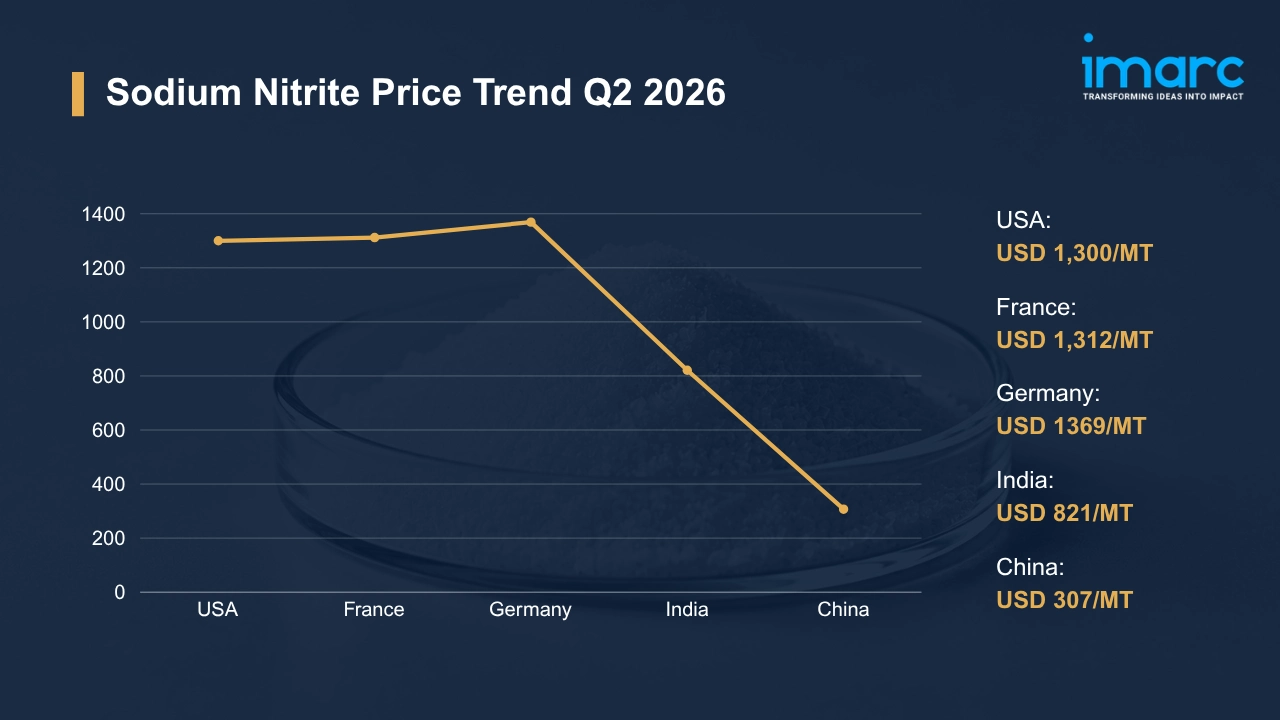
Sodium nitrite is a white crystalline salt of nitrous acid, soluble in water and hygroscopic in humid storage. Within industrial applications, meat curing, azo dye intermediates, pharmaceutical synthesis, rubber chemicals, and metal corrosion inhibition absorb most volumes. Governed largely by upstream economics, sodium nitrite prices track ammonia and soda ash feedstock costs, energy expenditure during nitrous gas absorption, freight rates, and procurement cycles across food processing. Regulatory oversight shapes handling and storage costs.
Global Market Overview
Globally, the sodium nitrite industry was valued at USD 468.54 Million in 2025. Market projections indicate steady growth, with the industry expected to reach USD 664.00 Million by 2034, with a compound annual growth rate (CAGR) of 3.95% during 2026-2034. Expanding processed meat output and wider corrosion inhibitor adoption anchor the sodium nitrite price trend, while pharmaceutical intermediates and wastewater treatment applications broaden demand across developed and emerging economies.
Sodium Nitrite Price Trend Q2 2026
Regional prices (USD per MT) and QoQ changes Q2 2026 vs Q1 2026:
| Region | Price (USD/MT) | QoQ Change | Direction |
|---|---|---|---|
| USA | 1,300 | +1.45% | ↑ |
| France | 1,312 | +1.78% | ↑ |
| Germany | 1,369 | +2.11% | ↑ |
| India | 821 | +1.21% | ↑ |
| China | 307 | +0.76% | ↑ |
To access real-time prices Request Sample
What Moved Prices
USA:
- During Q2 2026, sodium nitrite prices in the USA advanced to USD 1,300/MT, lifted by firm procurement from meat curing operations and corrosion inhibitor formulators. Domestic output held steady through the period. Front-loading contracted volumes, buyers tightened spot availability across Gulf Coast and Midwest distribution channels.
- Inland freight surcharges and elevated warehousing costs added to landed expenses for regional distributors, while imported material arrived at only a narrow discount to domestic offers. For most buyers, substitution opportunities therefore remained scarce. Processors carrying lean inventories into the spring grilling season accepted modest increases.
France:
- In Q2 2026, sodium nitrite prices in France climbed to USD 1,312/MT as food preservation and specialty chemical buyers restocked ahead of peak summer processing schedules. Suppliers maintained disciplined production output throughout. Under EU chemical safety rules, compliance testing added incremental cost to every delivered consignment.
- Firmer container rates on Asia to Europe corridors raised landed costs for imported tonnage, narrowing the discount that overseas cargoes had held over domestic French material. Through April and May, the sodium nitrite price chart tracked a measured climb. Port handling charges at Le Havre stayed elevated.
Germany:
- In the second quarter of 2026, sodium nitrite prices in Germany rose to USD 1,369/MT, supported by consistent offtake from dye manufacturing, meat processing, and industrial water treatment. Producers ran scheduled maintenance at select sites. Contracted volumes moved forward into April, limiting later exposure to spot pricing.
- Elevated industrial power tariffs kept conversion costs high for domestic nitrite producers, while ammonia feedstock contracts settled above year-earlier levels through most of the quarter. Offering limited relief, import parity narrowed as freight absorbed the arbitrage. Procurement teams extended contract tenors into the third quarter.
India:
- During Q2 2026, sodium nitrite prices in India moved up to USD 821/MT, helped by improved offtake from dye intermediates, pharmaceutical formulators, and textile processing units. Domestic plants operated near normal rates. Picking up modestly, export inquiries from Southeast Asia trimmed the surplus that had weighed on values.
- Higher precursor costs for imported nitric acid and ammonia lifted variable production expenses at chemical clusters through the quarter, particularly around Gujarat and Maharashtra. At western gateways, port congestion added dwell charges to landed costs. Buyers shortened order cycles, purchasing smaller lots more frequently.
China:
- In Q2 2026, sodium nitrite prices in China edged higher to USD 307/MT after several quarters of surplus-driven weakness across domestic chemical and food processing demand. Producers trimmed operating rates at several eastern plants. Across Shandong and Jiangsu, inventory drawdowns restored a firmer tone to spot negotiations.
- Export offers turned more selective as sellers rebuilt margins eroded during the previous year, and renminbi movement against the dollar shaped netback calculations for overseas shipments. Across smaller producers, environmental inspections limited output. Downstream dye and rubber chemical consumption recovered slowly, capping the quarterly gain.
Drivers Influencing the Market
Several factors continue to shape sodium nitrite pricing and market behavior:
- Food Preservation and Meat Processing Demand: Curing salt formulations for bacon, ham, and processed poultry anchor baseline sodium nitrite consumption worldwide. Per USDA figures, US pork production reached 27.6 Billion pounds in 2025, running about 1% below the prior year and shaping order volumes for curing agents. Seasonal grilling cycles introduce recurring variability into quarterly purchasing patterns.
- Upstream Ammonia and Soda Ash Costs: Nitrous gases from ammonia oxidation are absorbed into sodium carbonate solutions. According to USGS data, US soda ash output neared 12 Million Tons in 2025, roughly 3% above 2024, with average plant-level values around USD 150 per ton. Feedstock swings pass through to the sodium nitrite price index within one or two quarters.
- Energy Expenditure in Production: Ammonia oxidation and absorption stages consume substantial electricity and process steam, tying producer margins directly to regional power tariffs and gas contract terms negotiated across each region. Across the continent, European manufacturers carry structurally higher energy bills. That gap sustains the wide spread between Chinese and German assessments.
- Ocean Freight and Logistics Economics: Container availability, bunker costs, and port dwell times determine the delivered economics of long-haul nitrite cargoes moving from Asian producers toward European and North American buyers. Under hazard classification rules, only some carriers accept the material. Booking constraints therefore amplify freight movements more sharply than for unregulated cargo.
- Environmental and Regulatory Compliance: Occupational exposure limits, wastewater discharge rules, and food-additive residue thresholds govern nitrite handling across every major jurisdiction, adding compliance layers that vary widely by region and product grade. Beyond that, registration dossiers and batch testing add fixed overhead. Smaller producers absorb that burden less easily than integrated chemical groups.
- Trade Policy and Currency Dynamics: Antidumping measures, tariff schedules, and import licensing rules reshape sourcing routes for buyers weighing Chinese, Indian, and European supply against one another each contract cycle. Alongside policy shifts, currency swings alter netback values for exporters. A weaker rupee or renminbi improves Asian competitiveness in dollar-denominated tenders.
Recent Highlights & Strategic Developments
Recent strategic moves within the industry further illustrate evolving dynamics:
- In December 2025, a study in Applied Food Research evaluated how sodium nitrite dosage could affect Xuanwei ham quality through NMR and GC-MS profiling of cured muscle samples. Redness improved while peroxide and TBARS values declined. At 90 mg/kg, residual nitrite stayed within acceptable limits, and fatty acid and volatile compound profiles shifted measurably across treatment groups.
Outlook & Strategic Takeaways
Looking ahead, the sodium nitrite market is expected to expand steadily through 2034, carried by processed meat consumption, pharmaceutical intermediate synthesis, and wider corrosion inhibitor use. Ammonia and soda ash cost trajectories will remain the decisive variable in any sodium nitrite price forecast, with regulatory residue limits shaping grade preferences.
To navigate this complex landscape, stakeholders should:
- Monitor Regional Price Differentials: Track quarterly spreads between Asian, Indian, and European offers to identify favorable procurement windows. Establish benchmarking routines that compare landed costs against prevailing annual contract rates before each renewal cycle.
- Assess Freight Market Developments: Monitor container rates and bunker surcharges on Asia to Europe and transpacific corridors. Negotiate logistics agreements that include rate adjustment clauses tied to prevailing spot benchmarks rather than fixed annual pricing.
- Evaluate Downstream Demand Indicators: Track meat processing output, dye production indices, and pharmaceutical order books across major consuming regions. Compare sodium nitrite price per MT against those demand signals to time inventory build-ups more precisely.
- Review Regulatory Compliance Expenditures: Audit recurring costs tied to residue testing, storage permitting, and wastewater discharge obligations at each site. Identify process efficiencies that lower administrative burden without weakening food safety or occupational exposure controls.
- Strengthen Currency Exposure Management: Implement forward cover for purchases denominated in renminbi, rupee, or euro terms. Coordinate treasury and sourcing calendars so hedge tenors match expected import payment schedules through the contract year.
- Explore Emerging Application Segments: Investigate demand potential in industrial water treatment, heat transfer salts, and specialty pharmaceutical synthesis. Engage technical partners to test commercial viability before committing capital to new supply arrangements.
Subscription Plans & Customization
IMARC offers flexible subscription models to suit varying needs:
- Monthly Updates: 12 deliverables/year
- Quarterly Updates: 4 deliverables/year
- Biannual Updates: 2 deliverables/year
Each includes detailed datasets (Excel + PDF) and post-report analyst support.
Get in Touch With Us
UNITED STATES
Phone: +1-201-971-6302
INDIA
Phone: +91-120-433-0800
UNITED KINGDOM
Phone: +44-753-714-6104
Email: [email protected]
Client Testimonials




.webp)




.webp)












