Sodium Acetate Price Update: Sustained Growth Across Key Markets in Q2 2026
13-Jul-2026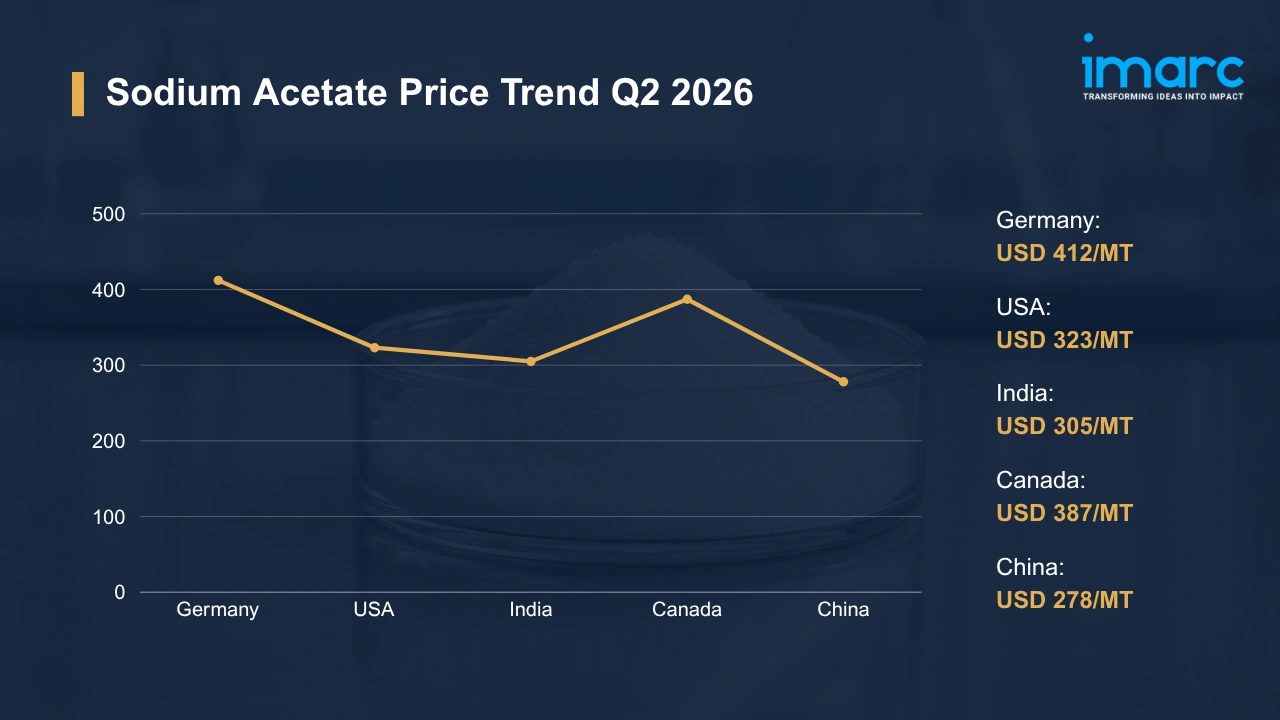
Sodium acetate, the sodium salt of acetic acid, reaches commercial channels as an anhydrous white powder or as trihydrate crystals valued for strong water solubility. Within food processing, the compound regulates acidity and extends shelf life. Shaped by pharmaceutical buffering and textile dyeing requirements, sodium acetate prices also carry the imprint of leather tanning and reusable heating pad consumption. Beyond demand, feedstock costs, production energy, and freight economics set the quarterly rhythm.
Global Market Overview:
Globally, the sodium acetate industry was valued at USD 271.7 Million in 2025. Market projections indicate steady growth, with the industry expected to reach USD 512.3 Million by 2034, with a compound annual growth rate (CAGR) of 7.30% during 2026-2034. Growing processed food output anchors the sodium acetate price trend. Beyond preservation, dialysis therapies, pharmaceutical buffers, and heating pad production add further breadth to end-use demand.
Sodium Acetate Price Trend Q2 2026:
Regional prices (USD per MT) and QoQ changes Q2 2026 vs Q1 2026:
| Region | Price (USD/MT) | QoQ Change | Direction |
|---|---|---|---|
| Germany | 412 | +1.40% | ↑ |
| USA | 323 | +0.90% | ↑ |
| India | 305 | +2.10% | ↑ |
| Canada | 387 | +1.10% | ↑ |
| China | 278 | +3.50% | ↑ |
To access real-time prices Request Sample
What Moved Prices:
Germany:
- In Q2 2026, sodium acetate prices in Germany advanced 1.40% QoQ to USD 412/MT. Food preservation accounts kept ordering steadily, and pharmaceutical processors matched that pace once production schedules firmed through the spring months. Holding output consistent, suppliers avoided any drift into surplus inventory positions.
- Order inflows improved, yet balanced regional availability capped how far offers could climb. Alongside energy-linked production expenses, inland haulage costs firmed distributor pricing. Tracked against the sodium acetate price chart, German quotations posted the steadiest quarterly climb recorded within the European complex this year.
USA:
- During Q2 2026, sodium acetate prices in the USA rose 0.90% to USD 323/MT on regular purchasing from food processing, textile treatment, and chemical manufacturing accounts. Domestic output met requirements without visible strain. Even so, steady downstream buying handed suppliers modest leverage at renewal discussions.
- Converters replenished on schedule rather than speculatively, which kept spot inquiry consistent. With inland freight and distribution charges edging higher, sellers defended incremental increases through the quarter. Buyers accepted the adjustments; product availability stayed dependable and no meaningful supply disruption surfaced across major hubs.
India:
- In the second quarter of 2026, sodium acetate prices in India climbed 2.10% QoQ to USD 305/MT, the strongest advance after China among tracked markets. Food additive, pharmaceutical, and textile processing buyers stayed active. Backed by dependable order volumes, domestic producers planned output with unusual confidence.
- Restocking after the monsoon season lifted purchasing across dye, specialty chemical, and processed food clusters. At key port terminals, efficient operations enable import-dependent formulators to address additional needs swiftly. Competitive domestic capacity restrained the gain, though tightening acetic acid supply narrowed the discount against imported material.
Canada:
- During Q2 2026, sodium acetate prices in Canada firmed 1.10% to USD 387/MT on consistent industrial and food processing demand. Across downstream accounts, procurement schedules barely moved. Replenishment programs stayed regular through the period, and opportunistic spot buying found little room as buyers held to planning discipline.
- Cross-border dependence on US producers tied Canadian landed costs to firming American benchmarks. With the currency holding stable, import cost volatility stayed contained. Distributors passed through moderate increases without pushback, since end users valued supply continuity more than any short-term negotiation gain during the quarter.
China:
- In Q2 2026, sodium acetate prices in China strengthened 3.50% QoQ to USD 278/MT, the sharpest movement among the listed countries. Chemical manufacturing, food preservation, and textile treatment absorbed rising volumes. Buoyed by full order books, producers raised offers in successive small steps across the quarter.
- Manufacturers extending operational schedules into the third quarter accelerated inventory replenishment downstream. From regional trading houses, export inquiries layered on additional demand. Domestic capacity stayed adequate on paper, yet strong consumption blocked any inventory build and kept spot negotiations tilted toward sellers through June.
Drivers Influencing the Market:
Several factors continue to shape sodium acetate pricing and market behavior:
- Food and Pharmaceutical Sector Demand: Consumption rests first on processed food preservation and pharmaceutical buffering, which together anchor global procurement volumes. Compared with those staples, dialysis and electrolyte therapies barely flex with economic cycles. Within textile dyeing and leather processing, order patterns swing more, while seasonal snack production schedules impose their own quarterly rhythm on purchasing across principal consuming regions.
- Upstream Acetic Acid and Caustic Soda Costs: Acetic acid and caustic soda values decide production economics on every manufacturing route. When quotations firm at origin, producers reprice finished volumes within one or two contract cycles. Precursor movements feed the sodium acetate price index across producing regions, so buyers negotiating quarterly agreements watch upstream markets as closely as finished offers.
- Energy Expenditure in Production: Drying and crystallization stages carry heavy power and gas requirements, making production costs sensitive to energy price fluctuations. Stable energy costs help manufacturers maintain efficient production and competitive pricing.
- Ocean Freight and Logistics Economics: Across intercontinental trade lanes, container rates shape what importers ultimately pay at destination. Drewry’s World Container Index surged 9% to USD 4,530 per 40ft container in early July 2026, lifted by Transpacific and Asia-Europe rate increases. At that scale, freight escalation raises delivered values for buyers reliant on Asian-origin material.
- Environmental and Regulatory Compliance: Compliance spending accumulates across chemical safety registration, effluent discharge limits, and food-grade certification. Meeting pharmacopoeia specifications demands documented quality systems plus periodic audits, a burden smaller producers absorb with difficulty. Across strictly regulated jurisdictions, these obligations filter into offer levels and widen the premium on certified grades.
- Trade Policy and Currency Dynamics: Tariff schedules and import duties reset relative competitiveness among exporters serving deficit markets. For procurement planning, currency swings matter just as much. A stronger dollar against Asian currencies hands European and North American importers negotiating room, while local-currency producers recover margin through favorable conversion on export receipts.
Recent Highlights & Strategic Developments:
Recent strategic moves within the industry further illustrate evolving dynamics:
- In December 2025, Pharmbio Korea won marketing approval from the Ministry of Food and Drug Safety for Neonatrium Injection, 2 mEq/mL, the country’s first domestically produced sodium acetate injection and a designated national essential drug. The clearance aimed to shore up supply for metabolic acidosis treatment in neonatal and pediatric care.
Outlook & Strategic Takeaways:
Looking ahead, the sodium acetate market is expected to expand, driven by processed food preservation demand, pharmaceutical buffering, and dialysis formulation growth across emerging healthcare networks. Acetic acid trajectories stay the decisive variable in any credible sodium acetate price forecast, since input costs pass into regional offers within weeks.
To navigate this complex landscape, stakeholders should:
- Monitor Regional Price Differentials: Track quarterly pricing gaps across key supplying regions to identify cost-saving procurement windows early. Establish benchmarking routines that weigh landed costs against prevailing contract rates before each sourcing decision closes.
- Assess Freight Market Developments: Monitor container rate movements on Transpacific and Asia-Europe corridors to anticipate landed cost shifts. Negotiate logistics contracts carrying adjustment clauses tied to recognized freight indices, which limits exposure to sudden escalation.
- Evaluate Downstream Demand Indicators: Track food processing output, pharmaceutical production schedules, and textile activity across principal consuming regions. Correlate those signals with the prevailing sodium acetate price per MT to sharpen inventory positioning and purchase timing.
- Review Regulatory Compliance Expenditures: Audit certification, handling, and discharge compliance costs across the supply base each year. Identify process efficiencies that trim regulatory burden while keeping food-grade and pharmacopoeia obligations fully intact.
- Strengthen Currency Exposure Management: Implement hedging coverage for purchases denominated in volatile currencies to steady landed cost projections. Align treasury programs with expected import payment schedules so coverage matches actual procurement timing.
- Explore Emerging Application Segments: Investigate growth potential in thermal energy storage, de-icing formulations, and specialty buffers. Engage research partners to test commercial viability before committing development budgets to unproven product lines.
Subscription Plans & Customization:
IMARC offers flexible subscription models to suit varying needs:
- Monthly Updates: 12 deliverables/year
- Quarterly Updates: 4 deliverables/year
- Biannual Updates: 2 deliverables/year
Each includes detailed datasets (Excel + PDF) and post-report analyst support.
Get in Touch With Us
UNITED STATES
Phone: +1-201-971-6302
INDIA
Phone: +91-120-433-0800
UNITED KINGDOM
Phone: +44-753-714-6104
Email: [email protected]
Client Testimonials




.webp)




.webp)












