Sorbic Acid Prices Update Q2 2026 : France Records Highest Price at USD 4,014/MT
10-Sep-2026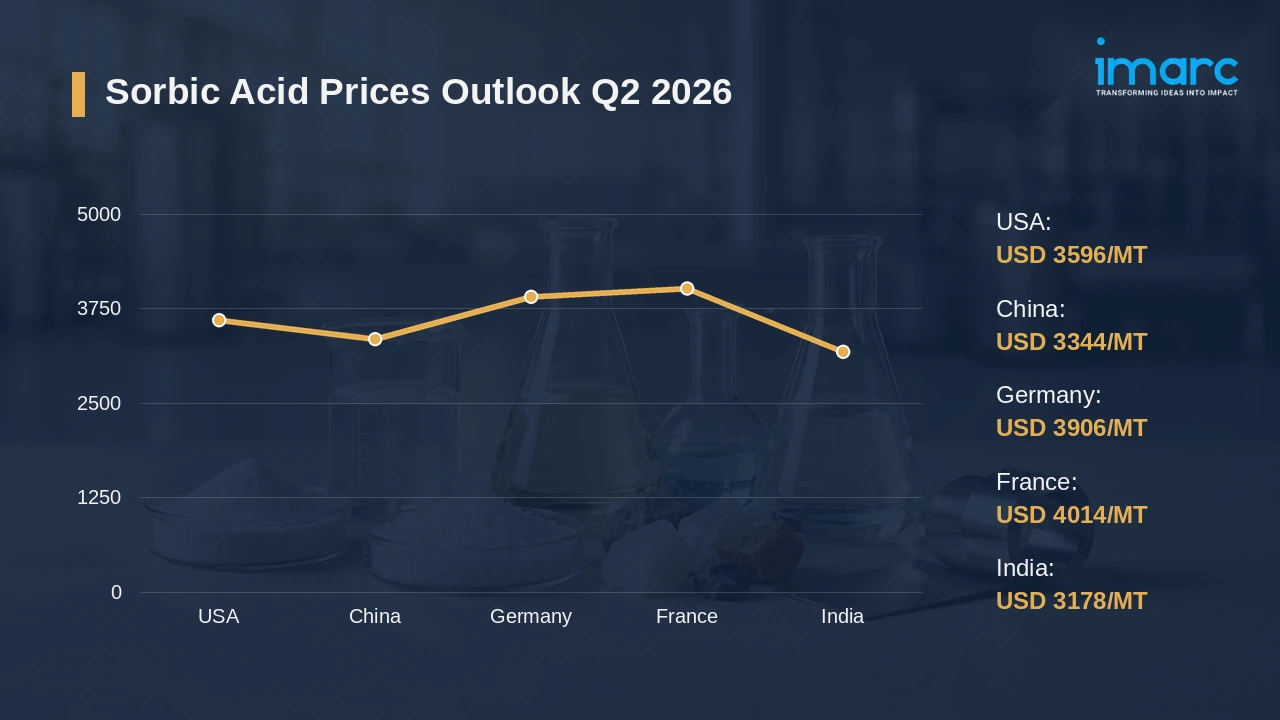
Sorbic acid is a widely used preservative, integral in the food and beverage industry to inhibit yeast and mold growth. It maintains product freshness and quality over extended shelf lives. Sorbic acid prices are influenced by its broad application range, raw material costs, and evolving consumer preferences impacting markets like food packaging, cosmetics, and pharmaceutical sectors.
Global Market Overview:
Globally, the sorbic acid market was valued at USD 560.4 Million in 2025. Market projections indicate steady growth, with the industry expected to reach USD 840.7 Million by 2034, showcasing a compound annual growth rate (CAGR) of 4.47% during 2026-2034. Rising demand for sorbic acid in food preservation and natural product formulations enhances the sorbic acid price trend, while increased use in personal care and pharmaceuticals further supports market growth.
Sorbic Acid Price Trend Q2 2026:
Regional prices (USD per MT) and QoQ changes Q2 2026 vs Q1 2026:
| Region | Price (USD/MT) | QoQ Change | Direction |
|---|---|---|---|
| USA | 3,596 | +13.31% | ↑ |
| China | 3,344 | +11.33% | ↑ |
| Germany | 3,906 | +12.56% | ↑ |
| France | 4,014 | +10.21% | ↑ |
| India | 3,178 | +4.45% | ↑ |
To access real-time prices Request Sample
What Moved Prices:
USA:
- In Q2 2026, sorbic acid prices in the USA rose to USD 3,596/MT, reflecting a 13.31% increase since the last quarter. Strong demand across food manufacturing and preservation sectors drove the uptick, as processors sought to bolster inventory levels amidst ongoing supply chain adjustments.
- Logistics efficiencies maintained steady movement of sorbic acid across domestic networks, while rising e-commerce activity for preservative-infused packaged goods provided additional market support. The sorbic acid price chart during the quarter reflected broad-based demand enhancement, sustaining firm price levels.
China:
- During Q2 2026, sorbic acid prices in China climbed to USD 3,344/MT, an 11.33% rise, as food sector manufacturers bolstered supply levels ahead of peak consumption periods. Limited regional availability led sellers to adjust offers upward across leading industrial clusters.
- Robust domestic consumption and stabilized currency exchange rates helped mitigate cost volatility, facilitating steady transactions. Lean supply conditions prompted industry participants to secure favorable terms, reinforcing the quarter's positive pricing trend.
Germany:
- In Q2 2026, sorbic acid prices in Germany rose to USD 3,906/MT, marking a 12.56% quarter-on-quarter increase. Healthy demand from processed food and preservative-free product manufacturers supported the price climb as regional availability tightened.
- While energy cost fluctuations added marginal pressure, steady demand across food and beverage applications maintained the upwards trajectory of local market offers, keeping converter engagement high.
France:
- During Q2 2026, sorbic acid prices in France increased to USD 4,014/MT, up 10.21% from the previous quarter. Strong offtake from the expanding packaged food segment sustained higher bids, supported by consistent restocking schedules among manufacturers.
- Sorbic acid import flows adapted effectively to demand surges without disrupting supply chain efficiencies, aiding cost predictability across consumer markets and ensuring uninterrupted supply to downstream users.
India:
- In Q2 2026, sorbic acid prices in India increased to USD 3,178/MT, showing a 4.45% rise, as food processing sectors leveraged restocking strategies post-periodic supply challenges. Import smoothing facilitated steady downstream uptake and solidified supply chain stability.
- High demand for food preservation drove sustained buyer interest, while domestic logistics maintained sufficient distribution rates to prevent sharp price escalations, reinforcing industry confidence.
Drivers Influencing the Market:
Several factors continue to shape sorbic acid pricing and market behavior:
- Food and Beverage Sector Demand: Food and beverage sector demand anchors global sorbic acid procurement. According to FAO’s Food Outlook, the global food import bill was set to rise nearly 8% year-on-year to reach USD 2.22 Trillion in 2025, reflecting broad-based momentum in food trade volumes. Expanding packaged food production across Asia-Pacific and stable bakery and dairy sector activity generate predictable purchasing cycles for antimicrobial preservative ingredients.
- Upstream Sorbic Acid Feedstock Costs: Sorbic acid production is influenced by costs associated with primary feedstocks and energy. Variations in raw materials from agricultural sources and the availability of alternative preservatives can impact pricing, causing shifts from one quarter to the next. Suppliers adjust prices to account for these cost fluctuations, influencing buyer negotiations.
- Energy Expenditure in Production: Electricity and fuel costs shape sorbic acid production economics, especially during intensive synthesis and purification. Energy Information Administration data shows an upward trend, with average electricity prices contributing to elevated production costs. Variations in energy pricing significantly affect global manufacturing competitiveness.
- Ocean Freight and Logistics Economics: Ocean shipping forms a structural cost layer across import economics in every consumer region. Drewry’s World Container Index stood at USD 4,465 per 40ft container in early September 2026, reflecting sustained freight pressure on key East-West trade lanes after rates escalated sharply through mid-year. Adding further complexity to landed cost calculations, port congestion and equipment imbalances constrain procurement flexibility for import-dependent buyers.
- Environmental and Regulatory Compliance: Stricter regulations surrounding sorbic acid manufacturing and use drive up compliance costs. Global chemical regulatory frameworks necessitate adherence to safety and emissions standards, gradually influencing sorbic acid price index movements in major markets. Compliance-related costs may be passed down the supply chain.
- Trade Policy and Currency Dynamics: Trade agreements and tariffs between key producing and consuming regions influence sorbic acid flow patterns and costs. Exchange rate volatility against major currencies impacts import prices, prompting buyers to seek advantageous currency positions. Exporters adjust contract terms to manage these dynamics proactively.
Recent Highlights & Strategic Developments:
Recent strategic moves within the industry further illustrate evolving dynamics:
- In November 2026, researchers discovered adipic acid to be a successful removable template for generating phase-pure nanocrystalline hydroxyapatite, a mineral commonly utilized in biomedical, agricultural, and environmental fields. The research examined adipic acid alongside sorbic acid to explore the influence of carboxylate chemistry on crystal formation. Sorbic acid preserved brushite and monetite intermediates, leading to mixed phases and larger crystal sizes. The results might aid in enhancing the design of calcium phosphate materials for bone healing, medication transport, fertilizers, and contaminant elimination.
Outlook & Strategic Takeaways:
Looking ahead, the sorbic acid market is forecasted to grow steadily through 2034, supported by its broad application in food preservation, pharmaceuticals, and personal care. Monitoring trends in raw material availability will be crucial for anticipating sorbic acid price forecast variations across global markets.
To navigate this market landscape, stakeholders should:
- Monitor Regional Price Variations: Track price differences quarterly across the USA, China, Germany, France, and India to identify cost-effective purchasing opportunities. Compare market rates to inform procurement timing.
- Assess Freight Market Trends: Observe shipping cost trends on major trade routes to anticipate delivered cost changes. Negotiate adjustable freight contracts aligned with market fluctuations.
- Evaluate Downstream Demand Trends: Review demand forecasts in major application areas to align production scales. Plan procurement to meet anticipated demand without excessive stockholding.
- Audit Regulatory Compliance Costs: Analyze costs tied to production and emissions regulations to ensure lean operations. Evaluate expenses against sorbic acid price per MT for cost management insights.
- Enhance Currency Risk Management: Utilize hedging strategies for imports in currencies prone to volatility to stabilize cost forecasts. Coordinate treasury and procurement functions to optimize currency positions.
- Explore Emerging Market Opportunities: Investigate new uses in healthcare and agriculture for product diversification. Collaborate with research partners to explore novel applications and their market potential.
Subscription Plans & Customization:
IMARC offers flexible subscription models to suit varying needs:
- Monthly Updates: 12 deliverables/year
- Quarterly Updates: 4 deliverables/year
- Biannual Updates: 2 deliverables/year
Each includes detailed datasets (Excel + PDF) and post-report analyst support.
Get in Touch With Us
UNITED STATES
Phone: +1-201-971-6302
INDIA
Phone: +91-120-433-0800
UNITED KINGDOM
Phone: +44-753-714-6104
Email: [email protected]
Client Testimonials




.webp)




.webp)












