Styrene Acrylonitrile Resin Prices Q2 2026: USA Records Highest Price at USD 3,161/MT
30-Sep-2026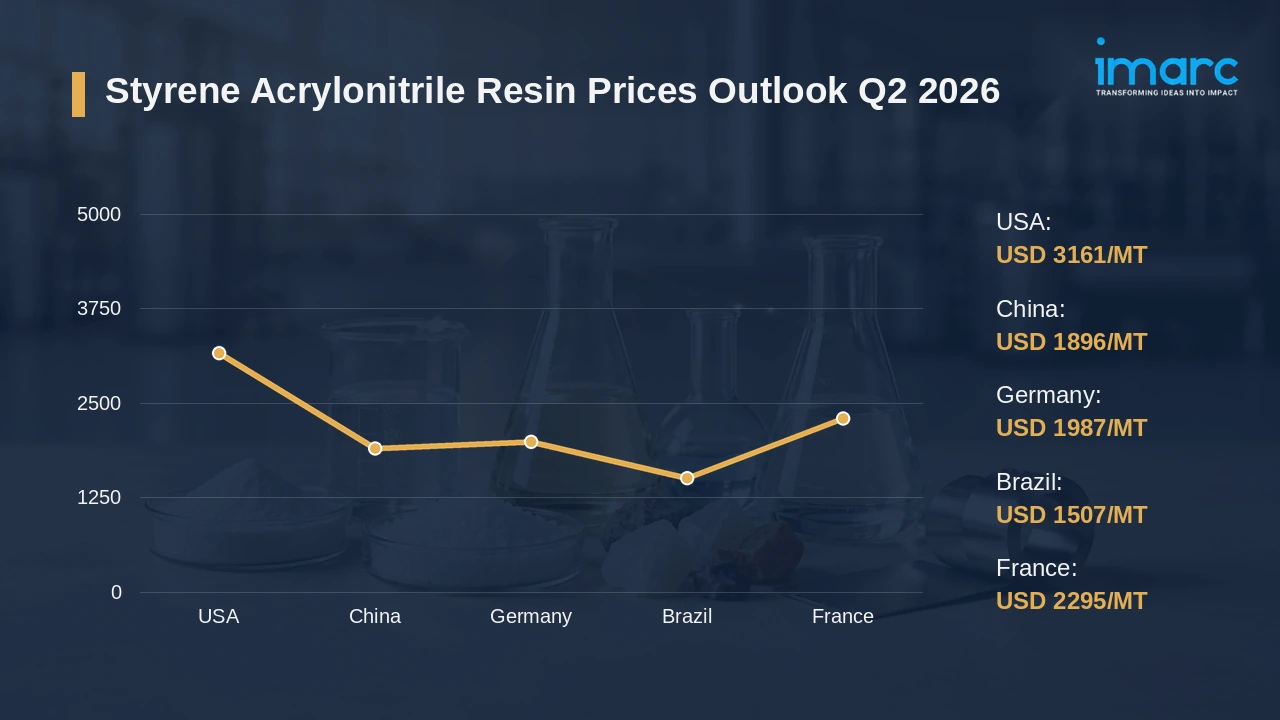
Styrene acrylonitrile resin is a rigid, transparent copolymer. Offering chemical resistance, dimensional stability, and heat tolerance above general-purpose polystyrene, it serves appliance parts, cosmetic packaging, automotive trims, and battery housings. Because feedstock accounts for most conversion costs, styrene acrylonitrile resin prices follow styrene monomer and acrylonitrile benchmarks, polymerization energy expenditure, Asian export freight, and appliance demand cycles.
Global Market Overview:
Globally, the styrene acrylonitrile resin industry reached a volume of 773.8 Thousand Tons in 2025. Market projections indicate steady growth, with the industry expected to reach a volume of 1,099.5 Thousand Tons by 2034, with a compound annual growth rate (CAGR) of 3.98% during 2026-2034. Appliance and cosmetics packaging demand anchors global consumption. Tied to monomer benchmarks, the styrene acrylonitrile resin price trend stays sensitive to petrochemical feedstock cycles.
Styrene Acrylonitrile Resin Price Trend Q2 2026:
Regional prices (USD per MT) and QoQ changes Q2 2026 vs Q1 2026:
| Region | Price (USD/MT) | QoQ Change | Direction |
|---|---|---|---|
| USA | 3,161 | +21.11% | ↑ |
| China | 1,896 | +34.12% | ↑ |
| Germany | 1,987 | +9.12% | ↑ |
| Brazil | 1,507 | +4.42% | ↑ |
| France | 2,295 | +9.88% | ↑ |
To access real-time prices Request Sample
What Moved Prices:
USA:
- In Q2 2026, styrene acrylonitrile resin prices in the USA climbed to USD 3,161/MT, a 21.11% QoQ gain that reflected steeper monomer contracts on the Gulf Coast. Benzene and propylene costs escalated through April and May. Passing these increases downstream, compounders secured higher settlements with appliance and automotive molders.
- Inland rail and trucking surcharges lifted delivered costs for Midwest converters. With inventories lean after first-quarter drawdowns, buyers accepted firmer offers during peak appliance production. Across the quarter, the styrene acrylonitrile resin price chart traced a steady upward path, with limited Asian import arrivals offering buyers little relief on spot volumes.
China:
- During Q2 2026, styrene acrylonitrile resin prices in China surged to USD 1,896/MT, a 34.12% QoQ jump that marked the steepest gain among tracked regions this quarter. East China styrene port inventories tightened as cracker operators trimmed runs. Responding to firmer feedstock, Zhejiang and Jiangsu producers raised list prices in successive rounds.
- Home appliance makers in Guangdong and Ningbo restocked ahead of summer air-conditioner and refrigerator production. Against tight supply, domestic producers prioritized contract customers and rationed spot volumes to traders in the Yuyao and Dongguan plastics markets, lifting assessed values further across the quarter. Spot liquidity stayed thin through June.
Germany:
- In Q2 2026, styrene acrylonitrile resin prices in Germany rose to USD 1,987/MT, a 9.12% QoQ increase driven chiefly by higher European styrene contract settlements and firmer naphtha costs. Automotive interior and appliance compounders kept purchasing volumes steady. Pressured by elevated gas and power tariffs, Rhine-area producers defended margins through firmer offers.
- Asia–Europe container rates stayed elevated, narrowing the discount on Asian-origin material landed in Hamburg and Rotterdam. Despite subdued construction activity, electrical and cosmetics packaging converters maintained regular call-offs, while lean distributor stocks limited buyer resistance to higher quarterly settlements across the region. Import substitution offered buyers little relief.
Brazil:
- In the second quarter of 2026, styrene acrylonitrile resin prices in Brazil advanced to USD 1,507/MT, a 4.42% QoQ rise, the most modest among tracked markets. Import parity pricing absorbed higher Asian and US offers. Tempered by cautious appliance demand in São Paulo, distributors passed through only part of the cost increase.
- BRL volatility against the dollar complicated import timing for converters in the São Paulo and Manaus industrial hubs. With Santos port operations running normally, arrivals stayed regular, and local compounders drew down existing stocks rather than chase higher replacement costs through most of the quarter. Purchasing therefore stayed selective through June.
France:
- During Q2 2026, styrene acrylonitrile resin prices in France increased to USD 2,295/MT, a 9.88% QoQ gain supported by firmer European monomer contracts and steady cosmetics packaging demand. Fragrance and skincare packagers kept orders consistent. Following upstream settlements, distributors lifted offers to converters in the Lyon and Oyonnax plastics valley.
- Higher energy costs raised compounding expenses for domestic processors. Because Asian-origin cargoes faced higher Asia–Europe freight, French buyers leaned on European supply, handing regional producers stronger leverage in quarterly contract talks with appliance and automotive molders. Inventory levels across distribution hubs stayed moderate.
Drivers Influencing the Market:
Several factors continue to shape styrene acrylonitrile resin pricing and market behavior:
- Appliance and Automotive Sector Demand: Household appliance and automotive interior manufacturing absorb the largest share of styrene acrylonitrile resin consumption worldwide. Throughout the year, seasonal refrigerator, air-conditioner, and kitchenware production creates predictable procurement peaks in China and Southeast Asia. Across automotive supply chains, lightweighting programs favor the resin for knobs, instrument lenses, and interior trims where transparency, rigidity, and scratch resistance must coexist in a single molded part. Cosmetics and battery housings diversify this demand base.
- Upstream Styrene and Acrylonitrile Costs: Styrene monomer and acrylonitrile together make up most of the styrene acrylonitrile resin raw material bill, so their price swings pass quickly into resin offers. Per the EIA, monthly Brent crude averages climbed from USD 71 per Barrel in February 2026 to USD 117 in April, lifting benzene, propylene, and naphtha feedstock costs. Resin makers typically revise offers within one contract cycle.
- Energy Expenditure in Polymerization and Compounding: Polymerization and compounding lines consume substantial steam and electricity. Where power and gas tariffs run higher, as across much of Western Europe, producers carry structurally higher conversion costs than Asian peers operating integrated sites with captive utilities. Through pass-through clauses in quarterly contracts, these energy charges feed directly into the styrene acrylonitrile resin price index for European grades.
- Ocean Freight and Logistics Economics: Because Northeast Asia remains the largest styrene acrylonitrile resin exporting hub, container rates shape landed costs in Europe and the Americas. In the week of June 25, 2026, Drewry's World Container Index climbed 5% to USD 4,166 per 40ft container, a 22-month high driven by transpacific gains. Carrier surcharges kept Asia–Europe landed costs firm.
- Environmental and Regulatory Compliance: Acrylonitrile is classified as a hazardous substance in most jurisdictions, requiring strict emission controls, worker exposure monitoring, and tight residual monomer limits in finished resin grades. Under EU REACH and food-contact rules, producers must document migration testing for housewares and packaging grades. These compliance obligations add persistent fixed costs for producers.
- Trade Policy and Currency Dynamics: Antidumping reviews, tariff adjustments, and shifting free trade arrangements alter the competitiveness of Asian styrene acrylonitrile resin cargoes in the Americas and Europe. With the CNY, EUR, and BRL swinging against the dollar, importers face shifting landed costs, and distributors must reprice inventory bought under earlier exchange rate assumptions. Currency hedging has become standard procurement practice.
Recent Highlights & Strategic Developments:
Recent strategic moves within the industry further illustrate evolving dynamics:
- In September 2025, Gurit secured a multi-year agreement to supply its Corecell structural foam, a core material based on styrene acrylonitrile resin, to a major subsea customer. The deal deepens Gurit's role in deep-water composite systems.
Outlook & Strategic Takeaways:
Looking ahead, the styrene acrylonitrile resin market is expected to expand steadily through 2034, supported by appliance manufacturing, automotive lightweighting, and growing use in cosmetics packaging and battery housings. Monomer costs will shape the styrene acrylonitrile resin price forecast.
To navigate this complex landscape, stakeholders should:
- Assess Freight Market Developments: Track weekly container rate assessments on Asia–Europe and transpacific lanes to anticipate landed cost shifts for imported styrene acrylonitrile resin cargoes before quarterly supply contracts come up for renewal. Build rate-adjustment clauses into logistics agreements.
- Evaluate Downstream Demand Indicators: Follow appliance output data, automotive build schedules, and cosmetics packaging order books across China, Europe, and the Americas to time purchases around seasonal consumption peaks each year. Align inventory targets with these production signals.
- Monitor Regional Price Differentials: Compare styrene acrylonitrile resin price per MT across the USA, China, Germany, Brazil, and France to pinpoint sourcing windows, given the wide gap between US and Brazilian levels. Benchmark landed costs against prevailing contract rates.
- Review Regulatory Compliance Expenditures: Audit costs tied to acrylonitrile exposure monitoring, emission controls, and food-contact documentation for housewares and packaging grades sold into regulated markets across Europe and North America. Identify savings without weakening safety obligations.
- Strengthen Currency Exposure Management: Hedge procurement payments denominated in volatile currencies, particularly BRL and CNY, so that landed cost projections stay stable across quarterly buying cycles and budget planning periods. Coordinate treasury and procurement teams on payment timelines.
- Explore Emerging Application Segments: Investigate demand for transparent styrene acrylonitrile resin grades in battery housings, medical labware, and structural foam cores used in offshore composites, where performance requirements support premium pricing levels. Partner with compounders on qualification trials.
Subscription Plans & Customization:
IMARC offers flexible subscription models to suit varying needs:
- Monthly Updates: 12 deliverables/year
- Quarterly Updates: 4 deliverables/year
- Biannual Updates: 2 deliverables/year
Each includes detailed datasets (Excel + PDF) and post-report analyst support.

Get in Touch With Us
UNITED STATES
Phone: +1-201-971-6302
INDIA
Phone: +91-120-433-0800
UNITED KINGDOM
Phone: +44-753-714-6104
Email: [email protected]
Client Testimonials




.webp)




.webp)












