
Printed Sensor Market Size, Share, Trends and Forecast by Type, Printing Technology, Application, and Region, 2026-2034
Printed Sensor Market Size and Share:
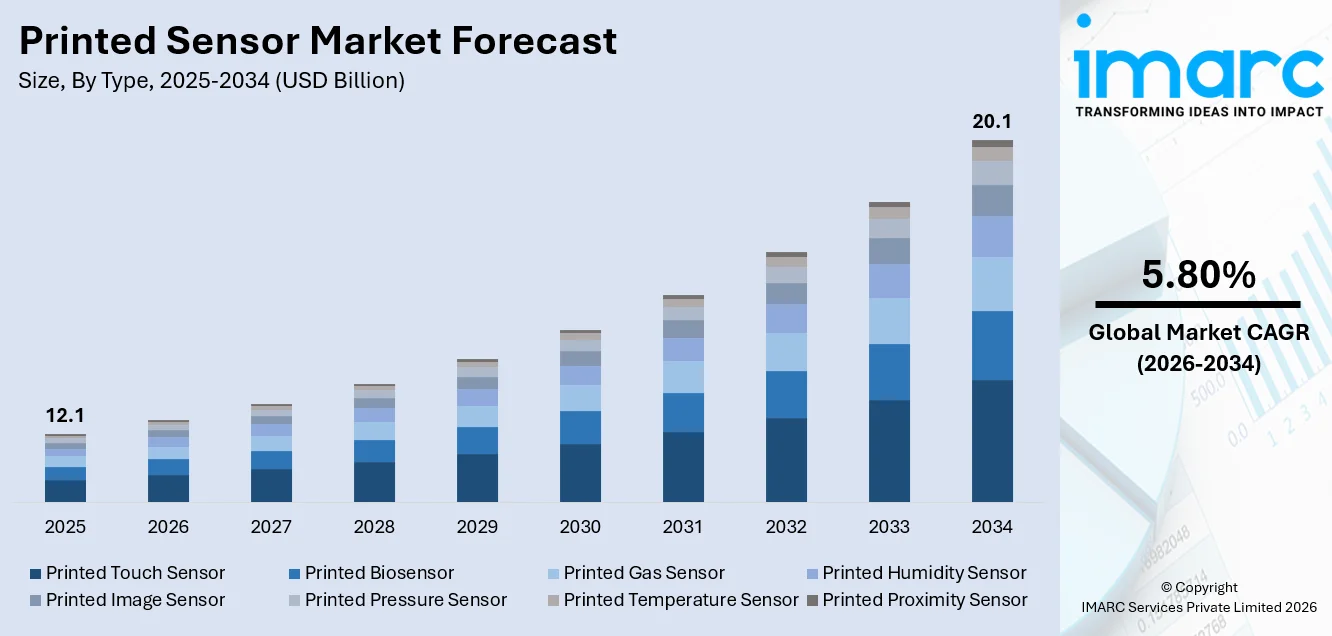
The global printed sensor market grew from USD 12.1 Billion in 2025 to USD 12.8 Billion in 2026. Looking forward, IMARC Group estimates the market to reach USD 20.1 Billion by 2034, exhibiting a CAGR of 5.80% from 2026-2034. North America currently dominates the market, holding a market share of 34% in 2025. The region benefits from strong investments in healthcare innovation, a thriving consumer electronics sector, widespread Internet of Things (IoT) adoption, and a favorable regulatory environment that encourages the development and commercialization of advanced sensor technologies, contributing to the printed sensor market share.
The growing demand for flexible, lightweight, and cost-effective sensing solutions across various end-use industries is a major factor propelling the market forward. The increasing integration of printed sensors into wearable devices, smart packaging, and automotive interiors is creating substantial growth opportunities. Additionally, the rapid expansion of the IoT ecosystem is generating strong demand for thin-film and conformable sensors that can be seamlessly embedded into connected devices and infrastructure. Advancements in conductive ink formulations, including silver nanowire and carbon nanotube-based inks, are enhancing sensor performance, sensitivity, and durability while reducing manufacturing costs through roll-to-roll production techniques. The rising focus on sustainability and eco-friendly manufacturing methods is also supporting market expansion, as printed sensors require less energy and raw material compared to traditional semiconductor-based sensor fabrication, making them an attractive option for manufacturers and end users alike.
The United States has emerged as a major region in the printed sensor market owing to many factors. The country's robust healthcare infrastructure and strong demand for wearable medical devices are driving significant adoption of printed sensor technologies in patient monitoring and diagnostics. Furthermore, the thriving consumer electronics industry in the United States is fueling demand for flexible touch sensors and proximity sensors in smartphones, tablets, and smart home devices. The presence of leading technology companies and research institutions focused on printed electronics innovation is accelerating product development and commercialization. In December 2025, the United States Food and Drug Administration updated its sensor-based digital health technology device list, which reflects the expanding regulatory support for sensor-integrated digital health items in the country, contributing to the overall market expansion.
To get more information on this market Request Sample
Printed Sensor Market Trends:
Expanding Wearable Healthcare Applications
The escalating demand for wearable healthcare devices is impelling the printed sensor market forward. Printed sensors, particularly biosensors and temperature sensors, are increasingly integrated into wearable patches, smart bandages, and health monitoring wristbands that provide continuous and real-time physiological data. These sensors enable remote patient monitoring for chronic conditions, such as diabetes, cardiovascular disease, and respiratory disorders, reducing the need for frequent hospital visits. The lightweight and conformable nature of printed sensors allows seamless integration into skin-contact devices, enhancing patient comfort and compliance. Furthermore, the growing emphasis on preventive healthcare technologies and services and personalized medicine is accelerating the adoption of sensor-equipped wearable devices. As per IMARC Group, the global preventive healthcare technologies and services market size reached USD 330.6 Billion in 2024. The convergence of flexible electronics and telehealth platforms is creating new opportunities for printed sensor deployment in medical applications.
Growing IoT and Smart Packaging Adoption
The rapid proliferation of the IoT and smart packaging solutions is significantly bolstering printed sensor demand. Printed sensors, including humidity, temperature, and gas sensors, are being embedded into packaging materials to monitor product quality, freshness, and supply chain integrity in real time. In the broader IoT landscape, printed sensors serve as essential data collection nodes in smart homes, industrial automation systems, and environmental monitoring networks. The cost-effectiveness and scalability of printed sensor manufacturing, particularly through roll-to-roll processes, make them ideal for high-volume IoT deployments requiring millions of low-cost sensor nodes. Additionally, increasing demand for real-time data visibility and traceability across the logistics, healthcare, and retail sectors is expanding the use of printed sensors. This growing reliance on connected monitoring solutions is expected to support a positive printed sensor market forecast.
Advancements in Conductive Ink Technologies
Significant breakthroughs in conductive ink formulations and printing techniques are transforming the printed sensor industry. Innovations in silver nanoparticle, graphene, and carbon nanotube-based inks are improving sensor conductivity, sensitivity, and mechanical flexibility while enabling fabrication on diverse substrates, including plastic films, paper, and textiles. Inkjet printing and aerosol jet printing technologies are achieving higher spatial resolution and multi-material deposition capabilities, allowing manufacturers to produce complex sensor architectures with enhanced performance characteristics. These advancements are expanding the application scope of printed sensors into previously inaccessible domains, such as electronic skin, structural health monitoring, and precision agriculture, enabling scalable manufacturing of customized sensor designs tailored to specific end use requirements. Overall, these material and process innovations are driving down production costs while improving sensor reliability, supporting the printed sensor market trends.
Printed Sensor Industry Segmentation:
IMARC Group provides an analysis of the key trends in each segment of the global printed sensor market, along with forecast at the global, regional, and country levels from 2026-2034. The market has been categorized based on type, printing technology, and application.

Analysis by Type:
- Printed Biosensor
- Printed Touch Sensor
- Printed Gas Sensor
- Printed Humidity Sensor
- Printed Image Sensor
- Printed Pressure Sensor
- Printed Temperature Sensor
- Printed Proximity Sensor
Printed touch sensor holds 22% of the market share. Printed touch sensors are thin, flexible, and lightweight capacitive or resistive sensing devices manufactured through advanced printing techniques onto substrates, such as polyester, polyimide, and glass. These sensors are widely adopted in consumer electronics, automotive dashboards, and industrial control panels owing to their superior design flexibility, seamless integration into curved and irregular surfaces, and cost-effective mass production capabilities. The growing demand for touch-enabled interfaces in smartphones, tablets, wearables, and smart home appliances is reinforcing the segment's leading position. Furthermore, the rising trend of replacing mechanical buttons and knobs with smooth touch-sensitive surfaces in automotive and industrial applications is sustaining demand for printed touch sensors. Additionally, increasing adoption of touch-based human–machine interfaces across retail kiosks, medical devices, and smart appliances is further strengthening the market position of printed touch sensors.
Analysis by Printing Technology:
- Gravure Printing
- Inkjet Printing
- Screen Printing
- Others
Inkjet printing leads the market with a share of 31%. Inkjet printing is a non-contact, digital deposition technique that precisely ejects functional ink droplets onto flexible substrates to create intricate sensor patterns with high spatial resolution and minimal material waste. This technology is favored for prototyping and small-to-medium-volume production of printed sensors due to its ability to handle multiple materials, including silver nanoparticle, graphene, and conductive polymer inks, without the need for custom printing plates or masks. The increasing adoption of inkjet printing in biosensor, gas sensor, and temperature sensor fabrication is supporting the segment's dominance. The ongoing improvements in printhead resolution and jetting frequency are further expanding inkjet printing's commercial viability. Additionally, its compatibility with rapid design iteration and customized sensor layouts makes inkjet printing particularly attractive for research-driven and application-specific printed sensor development.
Analysis by Application:
Access the comprehensive market breakdown Request Sample
- Automotive
- Consumer Electronics
- Environmental Testing
- Industrial Equipment
- Medical Devices
- Building Automation
- Smart Packaging
- Others
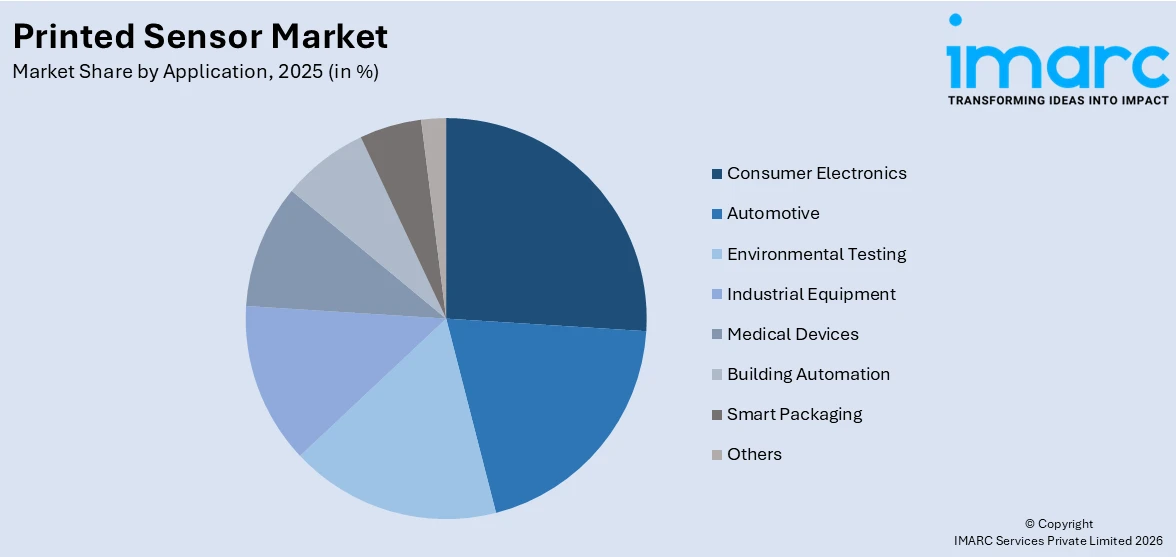
Consumer electronics dominate the market, with a share of 26%. Printed sensors in consumer electronics are integrated into smartphones, tablets, wearable devices, smart home products, and gaming accessories to enable touch functionality, environmental monitoring, proximity detection, and user interface enhancements. The segment's dominance is driven by the continuous miniaturization of electronic devices, the shift towards flexible and foldable form factors, and the growing consumer preference for intuitive, touch-enabled interfaces. Printed sensors offer manufacturers significant advantages in terms of design flexibility, lightweight construction, and cost-efficient large-scale production, making them essential components in next-generation consumer products. The expanding smart home ecosystem and rising adoption of wearable fitness and health trackers are further reinforcing consumer electronics as the leading application segment.
Regional Analysis:
To get more information on the regional analysis of this market Request Sample
- North America
- United States
- Canada
- Asia-Pacific
- China
- Japan
- India
- South Korea
- Australia
- Indonesia
- Others
- Europe
- Germany
- France
- United Kingdom
- Italy
- Spain
- Russia
- Others
- Latin America
- Brazil
- Mexico
- Others
- Middle East and Africa
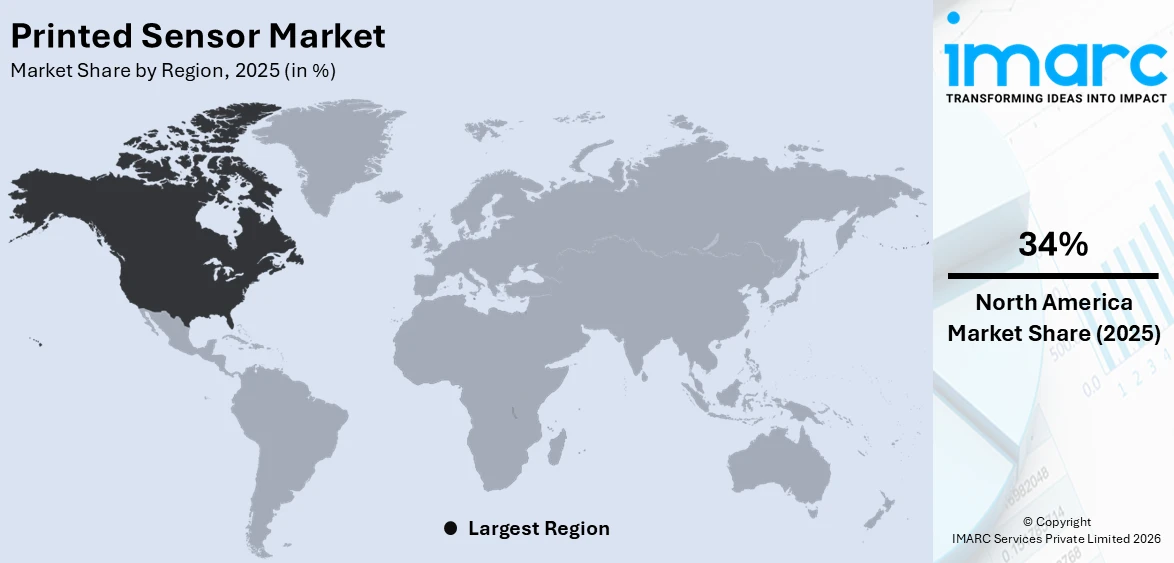
North America, accounting for 34% of the share, enjoys the leading position in the market. The region's leadership is driven by strong investments in healthcare innovation, advanced IoT infrastructure, and a thriving consumer electronics industry that collectively generate significant demand for printed sensor technologies. The presence of leading technology companies, research institutions, and government agencies actively supporting printed electronics development is accelerating commercialization. Furthermore, the expanding adoption of wearable medical devices and remote patient monitoring systems in the United States is creating substantial demand for printed biosensors, temperature sensors, and touch sensors. As per IMARC Group, the United States remote patient monitoring market size reached USD 464.8 Million in 2025. The favorable regulatory environment for digital health technologies and the growing automotive sector's integration of flexible touch surfaces further strengthen the region's dominant position.
Key Regional Takeaways:
United States Printed Sensor Market Analysis
The United States represents the primary growth engine within the printed sensor market, driven by its advanced technological ecosystem, strong healthcare digitization initiatives, and robust consumer electronics industry. The country's well-established medical device sector is increasingly adopting printed biosensors and wearable sensor patches for continuous health monitoring, chronic disease management, and point-of-care (POC) diagnostics. In 2025, it was estimated that there would be 2,041,910 newly diagnosed cancer cases and 618,120 cancer-related deaths in the United States. The expanding smart home market, fueled by growing consumer preference for connected devices and intelligent automation, is generating sustained demand for printed touch, proximity, and environmental sensors. Additionally, the automotive industry's shift towards touch-sensitive dashboards and advanced driver-assistance systems is creating new application opportunities for printed sensor manufacturers. The strong venture capital ecosystem and government-funded research programs in printed electronics further support innovation and market expansion in the country. Moreover, increasing collaboration between technology startups, research institutions, and large original equipment manufacturers (OEMs) is accelerating the commercialization of printed sensor solutions across multiple end-use industries in the United States.
Europe Printed Sensor Market Analysis
Europe represents a significant and growing market for printed sensors, supported by the region's strong automotive manufacturing base, advanced healthcare systems, and increasing investment in flexible electronics research and development (R&D). The European automotive industry is a major consumer of printed sensors, particularly touch sensors and pressure sensors, integrated into vehicle dashboards, steering interfaces, and climate control systems. The region's stringent environmental regulations are also driving demand for printed gas and humidity sensors used in air quality monitoring and industrial emission control. Furthermore, the growing elderly population across Europe is accelerating the adoption of wearable health monitoring devices equipped with printed biosensors. Nearly one in five (19%, 11 Million) individuals in England were 65 years old or over in 2025. Germany, in particular, holds a significant position within the market owing to its strong automotive and industrial manufacturing sectors, with companies actively integrating flexible sensor solutions into next-generation vehicle interiors and smart factory environments, strengthening the printed sensor market outlook across the region.
Asia-Pacific Printed Sensor Market Analysis
Asia-Pacific is among the fastest-growing regional markets for printed sensors, driven by rapid industrialization, expanding electronics manufacturing capabilities, and increasing healthcare infrastructure investments across key economies. China, Japan, South Korea, and India are leading regional growth through substantial investments in printed electronics research, advanced manufacturing facilities, and the development of domestic sensor supply chains. The region's dominant position in global consumer electronics production is generating consistent demand for printed touch, image, and proximity sensors. Rising adoption of Industry 4.0 initiatives, smart city projects, and wearable health technologies further supports the printed sensor market growth across the Asia-Pacific region.
Latin America Printed Sensor Market Analysis
Latin America is an emerging market for printed sensors, supported by growing smartphone penetration, expanding healthcare digitization, and increasing industrial automation across the region. Brazil and Mexico are the primary contributors to regional market growth, driven by their large consumer electronics markets and rising investments in connected healthcare and smart manufacturing. The growing adoption of wearable fitness and health tracking devices is creating new demand for printed biosensors and temperature sensors.
Middle East and Africa Printed Sensor Market Analysis
The Middle East and Africa region represents a nascent but promising market for printed sensors, driven by growing investments in smart hospital infrastructure, expanding IoT applications, and the adoption of connected healthcare technologies. Saudi Arabia and the United Arab Emirates are leading regional growth through ambitious smart city initiatives and substantial healthcare modernization programs that integrate sensor-enabled monitoring and automation systems. The increasing focus on environmental monitoring, particularly air and water quality assessment, is also creating demand for printed gas and humidity sensors.
Competitive Landscape:
The printed sensor market is characterized by a moderately fragmented competitive structure, with a mix of established electronics conglomerates and specialized sensor manufacturers competing across diverse application segments. Leading players are focusing on strategic partnerships, product innovation, and capacity expansion to strengthen their market positions. Companies are investing heavily in advanced conductive ink formulations, roll-to-roll manufacturing capabilities, and hybrid flexible electronics to address the growing demand from healthcare, consumer electronics, and automotive sectors. Mergers, acquisitions, and technology licensing agreements are shaping the competitive dynamics, as players seek to expand their product portfolios and geographic reach. Additionally, collaborations between sensor manufacturers and research institutions are accelerating the development of next-generation printed sensor technologies. These competitive strategies are collectively enhancing innovation intensity and supporting long-term growth across the global printed sensor market.
The report provides a comprehensive analysis of the competitive landscape in the printed sensor market with detailed profiles of all major companies, including:
- Canatu Oy
- Interlink Electronics
- ISORG
- KWJ Engineering
- Nissha Co. Ltd.
- Peratech Holdco Limited
- PolyIC GmbH & Co.KG (LEONHARD KURZ Stiftung & Co. KG)
- PST Sensors
- Sensitronics LLC
- Tekscan
Printed Sensor Market Report Scope:
| Report Features | Details |
|---|---|
| Base Year of the Analysis | 2025 |
| Historical Period | 2020-2025 |
| Forecast Period | 2026-2034 |
| Units | Billion USD |
| Scope of the Report |
Exploration of Historical Trends and Market Outlook, Industry Catalysts and Challenges, Segment-Wise Historical and Future Market Assessment:
|
| Types Covered | Printed Biosensor, Printed Touch Sensor, Printed Gas Sensor, Printed Humidity Sensor, Printed Image Sensor, Printed Pressure Sensor, Printed Temperature Sensor, Printed Proximity Sensor |
| Printing Technologies Covered | Gravure Printing, Inkjet Printing, Screen Printing, Others |
| Applications Covered | Automotive, Consumer Electronics, Environmental Testing, Industrial Equipment, Medical Devices, Building Automation, Smart Packaging, Others |
| Regions Covered | Asia Pacific, Europe, North America, Latin America, Middle East and Africa |
| Countries Covered | United States, Canada, Germany, France, United Kingdom, Italy, Spain, Russia, China, Japan, India, South Korea, Australia, Indonesia, Brazil, Mexico |
| Companies Covered | Canatu Oy, Interlink Electronics, ISORG, KWJ Engineering, Nissha Co. Ltd., Peratech Holdco Limited, PolyIC GmbH & Co.KG (LEONHARD KURZ Stiftung & Co. KG), PST Sensors, Sensitronics LLC, Tekscan, etc. |
| Customization Scope | 10% Free Customization |
| Post-Sale Analyst Support | 10-12 Weeks |
| Delivery Format | PDF and Excel through Email (We can also provide the editable version of the report in PPT/Word format on special request) |
Key Benefits for Stakeholders:
- IMARC's report offers a comprehensive quantitative analysis of various market segments, historical and current market trends, market forecasts, and dynamics of the printed sensor market from 2020-2034.
- The research study provides the latest information on the market drivers, challenges, and opportunities in the global printed sensor market.
- The study maps the leading, as well as the fastest-growing, regional markets. It further enables stakeholders to identify the key country-level markets within each region.
- Porter's Five Forces analysis assists stakeholders in assessing the impact of new entrants, competitive rivalry, supplier power, buyer power, and the threat of substitution. It helps stakeholders to analyze the level of competition within the printed sensor industry and its attractiveness.
- Competitive landscape allows stakeholders to understand their competitive environment and provides an insight into the current positions of key players in the market.
Frequently Asked Questions About the Printed Sensor Market Report
The printed sensor market size increased from USD 12.1 Billion in 2025 to USD 12.8 Billion in 2026.
The printed sensor market is projected to exhibit a CAGR of 5.80% during 2026-2034, reaching a value of USD 20.1 Billion by 2034.
The key factors driving the printed sensor market include the expanding adoption of wearable healthcare devices and IoT-connected systems, the rising demand for flexible and cost-effective sensing solutions in consumer electronics and automotive applications, advancements in conductive ink formulations and roll-to-roll printing technologies, and the growing integration of printed sensors into smart packaging for real-time quality and supply chain monitoring.
North America currently dominates the printed sensor market, accounting for a share of 34%. The region's leadership is attributed to strong investments in healthcare innovation, advanced IoT infrastructure, a thriving consumer electronics industry, and a favorable regulatory environment supporting digital health technologies.
Some of the major players in the printed sensor market include Canatu Oy, Interlink Electronics, ISORG, KWJ Engineering, Nissha Co. Ltd., Peratech Holdco Limited, PolyIC GmbH & Co.KG (LEONHARD KURZ Stiftung & Co. KG), PST Sensors, Sensitronics LLC, Tekscan, etc.
Need more help?
- Speak to our experienced analysts for insights on the current market scenarios.
- Include additional segments and countries to customize the report as per your requirement.
- Gain an unparalleled competitive advantage in your domain by understanding how to utilize the report and positively impacting your operations and revenue.
- For further assistance, please connect with our analysts.
 Request Customization
 Speak to an Analyst
 Request Brochure
 Inquire Before Buying
Benefits of Customization
- Personalize this research
- Triangulate with your data
- Get data as per your format and definition
- Gain a deeper dive into a specific application, geography, customer, or competitor
- Any level of personalization
Get in Touch With Us
UNITED STATES
Phone: +1-201-971-6302
INDIA
Phone: +91-120-433-0800
UNITED KINGDOM
Phone: +44-753-714-6104
Email: [email protected]
Client Testimonials




.webp)




.webp)













Related Reports

Choose your plan
*Please note that the prices mentioned below are starting prices for each bundle type. Kindly contact our team for further details.*
Single User License
- 1 User License, Access on 2 Devices
- PDF Report + Excel Dataset (Password Protected)
- Lifetime Access
- No Printing Rights
- 10% Free Report Customization
- 10–12 Weeks of Analyst Support
Five User License
- Access for 5 Users, 2 Devices per User
- PDF Report + Excel Dataset (Password Protected)
- Lifetime Access
- Dedicated Account Manager
- 12–14 Weeks of Analyst Support
- No Printing Rights
- 15% Free Report Customization
- 25% Discount on Your Next Purchase
Corporate User License
- Unlimited User Access (Within Your Organization)
- PDF Report + Excel Dataset
- Lifetime Access
- Dedicated Account Manager
- 14–20 Weeks of Analyst Support
- No Printing Rights
- 20% Free Report Customization
- 30% Discount on Your Next Purchase
Essential Insights
What's included:
3 reports
- Lifetime Access
- PDF Reports
- Excel Datasets
- 2 Weeks of Free Analyst Support
- 2 User Licenses
- Access on 2 Devices
- Printing Rights
- Complimentary PowerPoint (PPT) Version
- Complimentary License Upgrade
Professional Access
What's included:
5 reports
- Lifetime Access
- PDF Reports
- Excel Datasets
- 8 Weeks of Free Analyst Support
- 2 User Licenses
- Access on 2 Devices
- Printing Rights
- Complimentary PowerPoint (PPT) Version
- Complimentary License Upgrade
Business Advantage
What's included:
8 reports
- Lifetime Access
- PDF Reports
- Excel Datasets
- 14 Weeks of Free Analyst Support
- 2 User Licenses
- Access on 2 Devices
- Printing Rights
- Complimentary PowerPoint (PPT) Version
- Complimentary License Upgrade
Enterprise Intelligence
What's included:
10 reports
- Lifetime Access
- PDF Reports
- Excel Datasets
- 20 Weeks of Free Analyst Support
- 2 User Licenses
- Access on 2 Devices
- Printing Rights
- Complimentary PowerPoint (PPT) Version
- Complimentary License Upgrade