
Qatar Convenience Store Market Size, Share, Trends and Forecast by Product Type, Store Type, Ownership Model, and Region, 2026-2034
Qatar Convenience Store Market Summary:
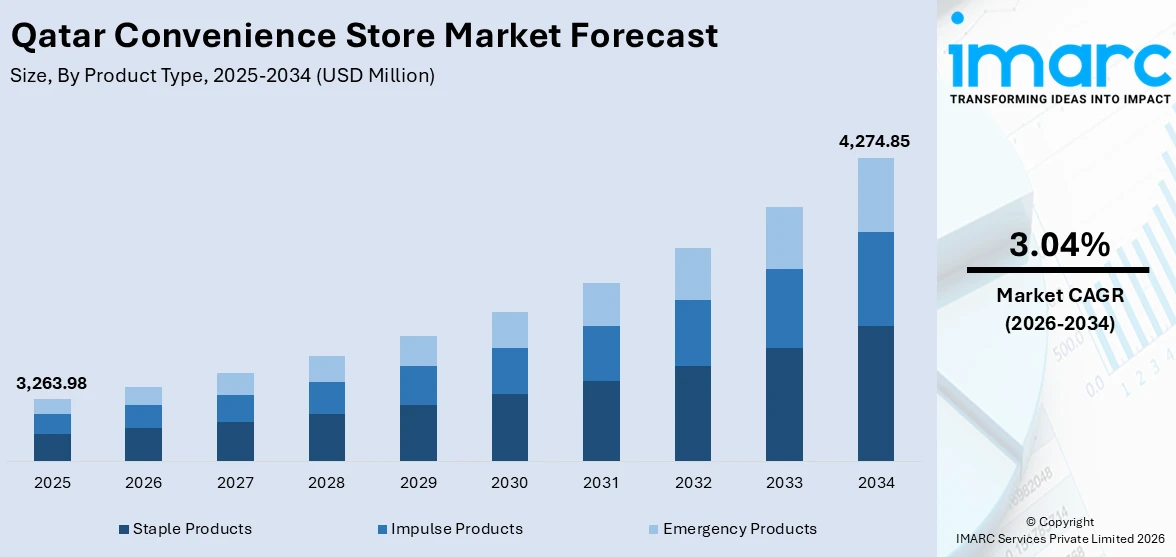
The Qatar convenience store market size was valued at USD 3,263.98 Million in 2025 and is projected to reach USD 4,274.85 Million by 2034, growing at a compound annual growth rate of 3.04% from 2026-2034.
The Qatar convenience store market is expanding steadily, driven by rapid urbanization, a growing expatriate population, rising consumer preference for quick-service retail formats, and increasing tourism inflows. The proliferation of neighborhood retail outlets, adoption of digital payment technologies, and integration of ready-to-eat food offerings are reinforcing the convenience store sector’s appeal among time-constrained consumers seeking accessible, everyday shopping solutions across Qatar’s convenience store market share.
Key Takeaways and Insights:
- By Product Type: Staple products dominate the market with a share of 41.6% in 2025, owing to the consistent consumer demand for essential everyday items including packaged foods, beverages, dairy products, and household necessities that drive regular footfall to convenience retail outlets.
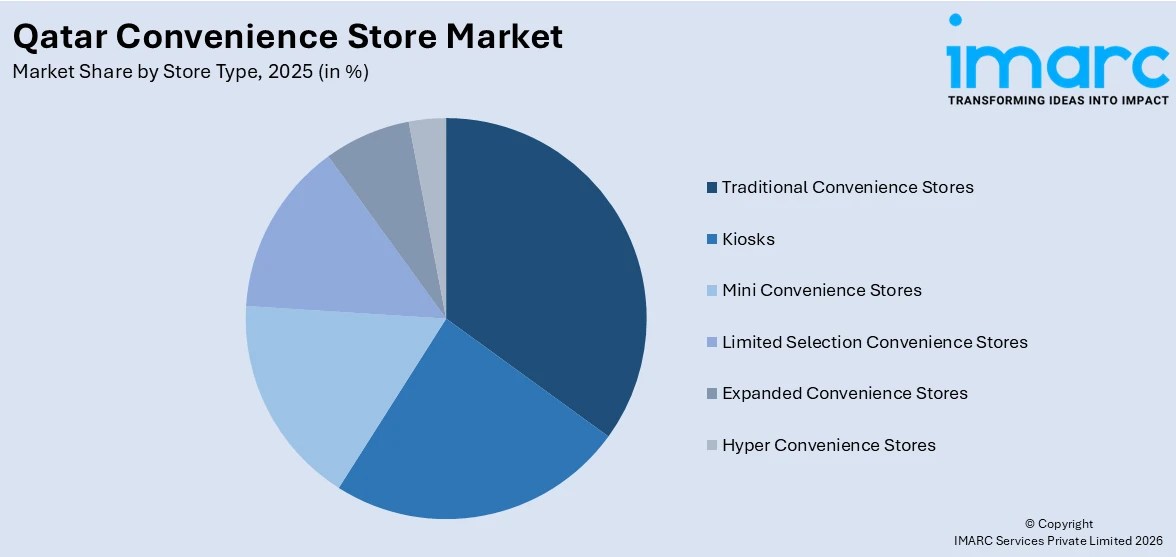
- By Store Type: Traditional convenience stores lead the market with a share of 33.8% in 2025. This dominance is driven by the established network of neighborhood retail outlets offering balanced product assortments, extended operating hours, and accessible locations that serve residential communities across Qatar.
- By Ownership Model: Corporate-owned chains represent the largest segment with a market share of 49.7% in 2025, reflecting the competitive advantages of centralized procurement, standardized operations, strong brand recognition, and extensive distribution networks that enable consistent service delivery across multiple locations.
- By Region: Ad Dawhah comprises the largest region with 61.2% share in 2025, driven by the concentration of Qatar’s population in the capital metropolitan area, high commercial activity, proximity to major transportation hubs, and the density of residential neighborhoods generating sustained convenience shopping demand.
- Key Players: The market features local and international retail chains competing on location convenience, product variety, pricing, and services like quick checkout and loyalty programs. Competition intensifies around urban centers and high-traffic areas, with emphasis on fresh foods, private-label offerings, and digital payment integration to attract repeat customers.
To get more information on this market Request Sample
The Qatar convenience store market is strengthening as the country’s economic diversification and population growth sustain robust consumer demand for accessible retail formats. Qatar welcomed a record 5.08 million international visitors in 2024, representing a 25% increase from the previous year. This surge in visitor traffic, combined with a resident population of 3.1 million where expatriates constitute 88.4% of the total, creates substantial demand for convenience retail outlets offering quick-service shopping for daily essentials. According to PwC’s Voice of the Consumer 2024 survey, 60% of Qatari consumers expect to increase grocery spending, while 54% continue to favor in-store shopping experiences. The country’s non-hydrocarbon sector now accounts for 64% of real GDP, providing diversified household income sources that support discretionary consumer spending. Qatar’s convenience store landscape is further bolstered by the government’s strategy, which promotes entrepreneurship, encourages small and medium enterprise expansion, and strengthens consumer protection frameworks across the retail sector.
Qatar Convenience Store Market Trends:
Digital payment integration and smart retail technology adoption
Qatar’s convenience store sector is witnessing accelerated adoption of digital payment systems and smart retail technologies. In July 2024, Qatar Central Bank introduced the Request-to-Pay feature through its Fawran instant-payment service, enhancing transaction efficiency for retail operations. Mobile payments are widely adopted among Qatari consumers, and self-checkout technologies are increasingly preferred for faster, more convenient shopping experiences. Convenience stores are increasingly integrating contactless payment solutions and digital loyalty programs to serve tech-savvy consumers seeking seamless shopping experiences.
Expansion of ready-to-eat and fresh food offerings in convenience formats
Convenience stores across Qatar are diversifying their product portfolios to include ready-to-eat meals, freshly prepared beverages, and grab-and-go food items that cater to the fast-paced lifestyles of urban professionals and expatriate workers. The food and beverage category commanded 42.02% of Qatar’s total retail market share in 2024, reflecting strong consumer demand for food-oriented retail formats. This trend is transforming traditional convenience outlets into quick-service food destinations that compete with standalone food establishments for consumer spending.
Tourism-driven footfall growth supporting convenience retail expansion
Sustained growth in Qatar’s tourism sector is creating strong opportunities for convenience store operators, especially in high traffic areas near hotels, airports, stadiums, and entertainment districts. Rising visitor arrivals and higher tourist spending are translating into increased demand for ready to eat food, beverages, travel essentials, and impulse purchases. Major international sporting events and cultural festivals generate peak footfall periods, driving short term sales surges for nearby outlets. This expanding tourism base is encouraging retailers to refine product assortments, extend operating hours, and enhance in store experiences to capture incremental demand from both domestic and international shoppers.
Market Outlook 2026-2034:
The Qatar convenience store market is poised for sustained growth throughout the forecast period, underpinned by continued population expansion, rising tourism inflows, and evolving consumer preferences toward accessible, quick-service retail formats. Qatar’s National Tourism Sector Strategy 2030 targets over 6 million annual visitors by the end of the decade, which is expected to generate incremental demand for convenience retail outlets in transit corridors and hospitality zones. The ongoing expansion of residential developments in Al Rayyan, Al Wakrah, and Lusail will create new catchment areas requiring neighborhood convenience formats. Meanwhile, the integration of digital payment technologies, mobile ordering capabilities, and data-driven inventory management systems will enable convenience store operators to enhance operational efficiency and deliver personalized shopping experiences that align with the expectations of Qatar’s increasingly connected consumer base. The market generated a revenue of USD 3,263.98 Million in 2025 and is projected to reach a revenue of USD 4,274.85 Million by 2034, growing at a compound annual growth rate of 3.04% from 2026-2034.
Qatar Convenience Store Market Report Segmentation:
|
Segment Category |
Leading Segment |
Market Share |
| Product Type | Staple Products | 41.6% |
| Store Type | Traditional Convenience Stores | 33.8% |
| Ownership Model | Corporate-Owned Chains | 49.7% |
|
Region |
Ad Dawhah | 61.2% |
Product Type Insights:
- Staple Products
- Impulse Products
- Emergency Products
Staple products dominate with a market share of 41.6% of the total Qatar convenience store market in 2025.
Staple products constitute the dominant product category in Qatar’s convenience store market, driven by the consistent consumer need for essential everyday items including packaged foods, beverages, dairy products, bread, and household necessities. The diverse expatriate population, generates sustained daily demand for staple grocery items across neighborhood convenience outlets. These products form the backbone of convenience store revenue as consumers rely on nearby retail formats for frequent, small-basket purchases of daily essentials that would otherwise require trips to larger supermarket chains located further from residential communities.
The staple products segment is further strengthened by rising consumer spending on grocery categories across Qatar’s retail landscape. Likewise, Qatari consumers expect to increase their spending on groceries, reflecting growing household allocation toward food and daily necessities. Convenience stores benefit directly from this spending trend as their neighborhood proximity and extended operating hours make them preferred destinations for top-up grocery shopping. The integration of fresh produce sections and expanded packaged food assortments is enhancing the staple product offering in modern convenience store formats.
Store Type Insights:
Access the comprehensive market breakdown Request Sample
- Kiosks
- Mini Convenience Stores
- Limited Selection Convenience Stores
- Traditional Convenience Stores
- Expanded Convenience Stores
- Hyper Convenience Stores
Traditional convenience stores lead with a share of 33.8% of the total Qatar convenience store market in 2025.
Traditional convenience stores represent the largest store type segment in Qatar’s convenience store market, anchored by their balanced combination of product variety, accessible locations, and extended operating hours that serve diverse residential communities. These mid-sized retail formats typically range from 200 plus square meters and offer curated assortments of staple groceries, beverages, snacks, personal care items, and household products. Qatar’s organized retail supply, including approximately 1.6 million square meters of mall space supplemented by over 400,000 square meters of open-air retail destinations, provides the infrastructure framework within which traditional convenience stores operate as complementary neighborhood retail anchors.
The sustained dominance of traditional convenience stores in Qatar is supported by a strong preference for in store shopping experiences. Consumers value personalized service, immediate product access, and the ability to physically inspect items before purchase, advantages that digital channels cannot fully replicate. Neighborhood convenience outlets benefit from their proximity to residential communities, providing quick access to daily essentials and household goods. Ongoing urban expansion and new housing developments continue to generate steady footfall, reinforcing the role of traditional formats as primary retail touchpoints within local communities.
Ownership Model Insights:
- Independent Stores
- Franchise Stores
- Corporate-Owned Chains
The corporate-owned chains exhibit a clear dominance with a 49.7% share of the total Qatar convenience store market in 2025.
Corporate-owned chains command the largest share of Qatar’s convenience store market, leveraging centralized procurement systems, standardized operational protocols, and strong brand equity to maintain competitive advantages across multiple retail locations. These chain operators benefit from economies of scale in purchasing, marketing, and logistics that enable competitive pricing and consistent product availability. Al Meera Consumer Goods, Qatar’s largest national retail chain operating over 69 branches across the country, exemplifies the corporate chain model’s strength through its extensive neighborhood network. In February 2025, Al Meera completed comprehensive renovations at four branches, including Onaiza 2, Legtaifiya, Hazm Al Markhiya, and Dahal Al Hamam, reinforcing its market leadership.
Corporate-owned convenience chains are further expanding their market presence through strategic new store openings and technology integration. In February 2025, Al Meera opened its latest branch in Al Mansoura, spanning 5,500 square meters and equipped with cutting-edge digital screens and modern design features. The corporate chain model’s competitive strength is further demonstrated by the broader GCC retail landscape, where Lulu Retail reported fiscal year 2024 revenue growth of 4.7% to USD 7.6 Billion while expanding its network by 21 new stores to reach 250 locations across the region. These investments underscore the scalability and financial resilience of corporate-owned retail formats.

Regional Insights:
- Ad Dawhah
- Al Rayyan
- Al Wakrah
- Others
Ad Dawhah holds the largest share at 61.2% of the total Qatar convenience store market in 2025.
Ad Dawhah, encompassing Qatar’s capital city Doha and its surrounding metropolitan area, commands the dominant regional share in the convenience store market. The region’s high population density concentrated commercial activity, and proximity to major transportation infrastructure including Hamad International Airport generate the strongest convenience retail demand. Ad Dawhah’s extensive network of residential neighborhoods, office complexes, and hospitality establishments creates consistent consumer footfall, while the November 2024 soft opening of Doha Mall, spanning 100,000 square meters, further reinforces the region’s retail ecosystem.
In addition, the capital hosts key business districts, transport hubs, and mixed-use developments that operate late into the evening, sustaining demand for quick service retail. Convenience stores in this region benefit from extended operating hours, strong pedestrian traffic, and integration with fuel stations and metro stations. This concentration of economic and social activity positions Ad Dawhah as the primary growth engine for convenience retail expansion in Qatar.
Market Dynamics:
Growth Drivers:
Why is the Qatar Convenience Store Market Growing?
Record tourism growth generating incremental convenience retail demand
Qatar’s tourism sector is witnessing strong expansion that directly supports growth in the convenience store market. Rising international arrivals and higher visitor spending are increasing consumer footfall in key commercial districts, transport hubs, and hospitality zones. Qatar Tourism reported that the sector contributed QAR 55 billion to national GDP in 2024, representing about 8% of the economy and marking a 14% increase over the previous year. Major sporting events, cultural festivals, and a growing cruise segment continue to attract diverse traveler segments throughout the year. Tourists typically seek quick and accessible retail options for snacks, beverages, personal care essentials, and last-minute purchases near hotels, airports, and entertainment venues. National tourism development plans aim to further elevate visitor numbers over the coming years, providing sustained demand momentum for convenience store operators positioned in high traffic and destination focused locations across the country.
Expanding urban population and residential development
Qatar’s expanding population and continued urban development are creating new residential clusters that require accessible neighborhood retail services. According to the National Planning Council, Qatar’s population stood at 3,214,609 at the end of December 2025, reflecting a 2.3% year on year increase. A large expatriate community, supported by residency initiatives aimed at skilled professionals, is contributing to a stable consumer base with consistent daily shopping needs. Emerging districts in areas such as Lusail, Al Rayyan, and Al Wakrah are increasing demand for conveniently located stores that provide groceries, household essentials, and quick service products. Retail chains are responding by expanding their footprint with modern outlets designed to serve growing communities. This steady residential growth is reinforcing the importance of convenience stores as essential retail anchors within Qatar’s evolving urban landscape.
Digital transformation and technology integration
Rapid digital transformation across Qatar’s retail sector is helping convenience store operators strengthen efficiency and customer engagement. The introduction of advanced instant payment features by the central bank has simplified transaction processing and accelerated checkout experiences. Growing consumer comfort with mobile and contactless payments is encouraging retailers to upgrade point of sale systems and integrate seamless digital payment options. Many convenience outlets are rolling out digital loyalty programs, app-based promotions, and mobile ordering services to build repeat footfall and personalize offers. At the operational level, smart inventory management and data analytics tools are improving stock control and reducing wastage. Progress toward a central bank digital currency framework further signals ongoing evolution in payment infrastructure, supporting faster, more secure transactions across convenience retail environments.
Market Restraints:
What Challenges the Qatar Convenience Store Market is Facing?
Intensifying competition from e-commerce and food delivery platforms
The rapid expansion of online retail and food delivery platforms in Qatar is increasing competitive pressure on traditional convenience store operators. On demand grocery services and quick commerce models are capturing a growing share of consumer spending that previously went to neighborhood outlets. Digital platforms offer home delivery, app-based promotions, and rapid fulfillment, appealing to time conscious consumers. Strategic investments and acquisitions within the delivery segment signal intensifying competition, prompting convenience retailers to strengthen their omnichannel presence and value proposition.
Rising operational costs and rental pressures in prime locations
Rising operational expenses are also challenging convenience store profitability, particularly in high visibility commercial areas. Increasing rental rates in prime retail corridors and shopping centers are placing pressure on margins, especially for smaller independent operators. Higher utility, staffing, and supply chain costs further compound financial strain. These occupancy and overhead pressures limit pricing flexibility and make cost control a critical priority. As a result, operators are seeking more efficient store formats and negotiating longer term lease arrangements to sustain profitability.
Price sensitivity among a significant portion of the consumer base
Despite Qatar’s reputation as an affluent market, a significant portion of the consumer population demonstrates strong price sensitivity that constrains convenience store pricing strategies. With expatriate workers comprising the majority of Qatar’s population, many consumers prioritize affordability over convenience and actively seek lower-priced alternatives at hypermarkets and discount retailers. The potential introduction of value-added tax in Qatar could further amplify price-conscious consumer behavior, challenging convenience stores that typically command premium pricing for their accessibility advantages.
Competitive Landscape:
The Qatar convenience store market features a competitive landscape characterized by a mix of large corporate retail chains, franchise operations, and independent neighborhood outlets. Corporate-owned chains dominate the market through extensive store networks, centralized supply chains, and strong brand recognition. Competition is intensifying as established players invest in store modernization, digital payment integration, and expanded product assortments while new entrants leverage franchise models to rapidly scale operations. The market’s competitive dynamics are further shaped by the expansion of quick-commerce platforms and hypermarket chains that compete for consumer spending on daily essentials.
Recent Developments:
- In February 2026, BinDawood Holding opened its first BinDawood branded store in Qatar under a franchise agreement with Regional Group, with plans to launch eight outlets. The move supports its GCC expansion strategy and is expected to positively impact operations during 2026.
- In October 2025, Qatar expanded acceptance of India’s UPI payment system to Lulu Group stores, following its rollout at Hamad International Airport. Implemented through Qatar National Bank partnerships, the move supports seamless, low-cost transactions, benefits the large Indian community, and strengthens bilateral trade and digital payment integration.
Qatar Convenience Store Market Report Coverage:
|
Report Features |
Details |
|
Base Year of the Analysis |
2025 |
|
Historical Period |
2020-2025 |
|
Forecast Period |
2026-2034 |
|
Units |
Million USD |
|
Scope of the Report |
Exploration of Historical Trends and Market Outlook, Industry Catalysts and Challenges, Segment-Wise Historical and Future Market Assessment:
|
| Product Types Covered | Staple Products, Impulse Products, Emergency Products |
|
Store Types Covered |
Kiosks, Mini Convenience Stores, Limited Selection Convenience Stores, Traditional Convenience Stores, Expanded Convenience Stores, Hyper Convenience Stores |
| Ownership Models Covered | Independent Stores, Franchise Stores, Corporate-Owned Chains |
|
Regions Covered |
Ad Dawhah, Al Rayyan, Al Wakrah, Others |
|
Customization Scope |
10% Free Customization |
|
Post-Sale Analyst Support |
10-12 Weeks |
|
Delivery Format |
PDF and Excel through Email (We can also provide the editable version of the report in PPT/Word format on special request) |
Frequently Asked Questions About the Qatar Convenience Store Market Report
The Qatar convenience store market size was valued at USD 3,263.98 Million in 2025.
The Qatar convenience store market is expected to grow at a compound annual growth rate of 3.04% from 2026-2034 to reach USD 4,274.85 Million by 2034.
Staple products dominated the market with a share of 41.6%, driven by consistent consumer demand for essential everyday items including packaged foods, beverages, dairy products, and household necessities across neighborhood convenience outlets.
Key factors driving the Qatar convenience store market include record tourism growth, expanding urban population and residential development, digital payment integration, and rising consumer preference for accessible quick-service retail formats.
Major challenges include intensifying competition from e-commerce and food delivery platforms, rising commercial rental costs in prime locations, price sensitivity among expatriate consumers, and the need for continuous technology investment to maintain competitiveness.
Need more help?
- Speak to our experienced analysts for insights on the current market scenarios.
- Include additional segments and countries to customize the report as per your requirement.
- Gain an unparalleled competitive advantage in your domain by understanding how to utilize the report and positively impacting your operations and revenue.
- For further assistance, please connect with our analysts.
 Request Customization
 Speak to an Analyst
 Request Brochure
 Inquire Before Buying
Benefits of Customization
- Personalize this research
- Triangulate with your data
- Get data as per your format and definition
- Gain a deeper dive into a specific application, geography, customer, or competitor
- Any level of personalization
Get in Touch With Us
UNITED STATES
Phone: +1-201-971-6302
INDIA
Phone: +91-120-433-0800
UNITED KINGDOM
Phone: +44-753-714-6104
Email: [email protected]
Client Testimonials




.webp)




.webp)













Related Reports

Choose your plan
*Please note that the prices mentioned below are starting prices for each bundle type. Kindly contact our team for further details.*
Single User License
- 1 User License, Access on 2 Devices
- PDF Report + Excel Dataset (Password Protected)
- Lifetime Access
- No Printing Rights
- 10% Free Report Customization
- 10–12 Weeks of Analyst Support
Five User License
- Access for 5 Users, 2 Devices per User
- PDF Report + Excel Dataset (Password Protected)
- Lifetime Access
- Dedicated Account Manager
- 12–14 Weeks of Analyst Support
- No Printing Rights
- 15% Free Report Customization
- 25% Discount on Your Next Purchase
Corporate User License
- Unlimited User Access (Within Your Organization)
- PDF Report + Excel Dataset
- Lifetime Access
- Dedicated Account Manager
- 14–20 Weeks of Analyst Support
- No Printing Rights
- 20% Free Report Customization
- 30% Discount on Your Next Purchase
Essential Insights
What's included:
3 reports
- Lifetime Access
- PDF Reports
- Excel Datasets
- 2 Weeks of Free Analyst Support
- 2 User Licenses
- Access on 2 Devices
- Printing Rights
- Complimentary PowerPoint (PPT) Version
- Complimentary License Upgrade
Professional Access
What's included:
5 reports
- Lifetime Access
- PDF Reports
- Excel Datasets
- 8 Weeks of Free Analyst Support
- 2 User Licenses
- Access on 2 Devices
- Printing Rights
- Complimentary PowerPoint (PPT) Version
- Complimentary License Upgrade
Business Advantage
What's included:
8 reports
- Lifetime Access
- PDF Reports
- Excel Datasets
- 14 Weeks of Free Analyst Support
- 2 User Licenses
- Access on 2 Devices
- Printing Rights
- Complimentary PowerPoint (PPT) Version
- Complimentary License Upgrade
Enterprise Intelligence
What's included:
10 reports
- Lifetime Access
- PDF Reports
- Excel Datasets
- 20 Weeks of Free Analyst Support
- 2 User Licenses
- Access on 2 Devices
- Printing Rights
- Complimentary PowerPoint (PPT) Version
- Complimentary License Upgrade