
Saudi Arabia Ammonia Market Size, Share, Trends and Forecast by Physical Form, Application, End Use Industry, and Region, 2026-2034
Saudi Arabia Ammonia Market Size, Share, Trends & Forecast (2026-2034)
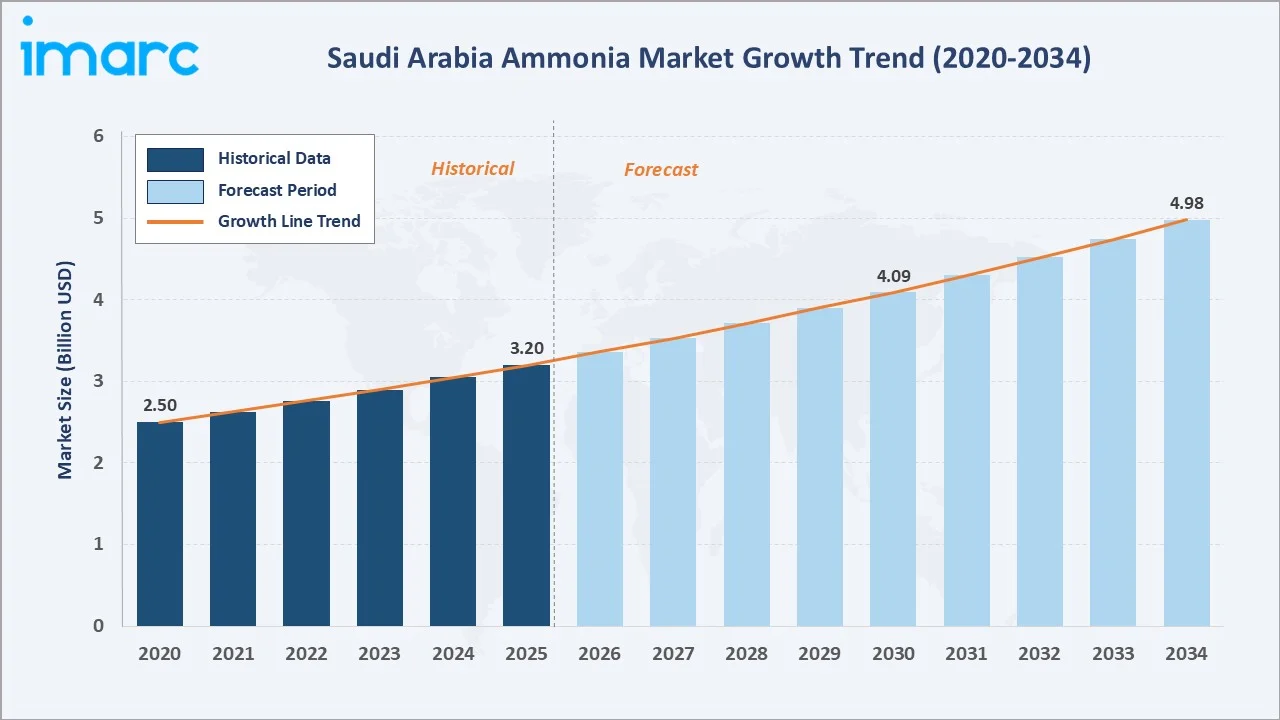
The Saudi Arabia ammonia market grew from USD 3.20 Billion in 2025 to USD 3.36 Billion in 2026 and is projected to reach USD 4.98 Billion by 2034, exhibiting a CAGR of 5.05% during 2026-2034. Saudi Arabia has emerged as a prominent ammonia producer globally, driven by its access to abundant and low-cost natural gas feedstock.
Gas dominates the physical form segment at 52.8%, while agrochemical leads end-use industry at 45.6%, and Eastern Region commands the largest regional share at 38.9%.
Market Snapshot
|
Metric |
Value |
|
Base Year Market Size (2025) |
USD 3.20 Billion |
|
Market Size (2026) |
USD 3.36 Billion |
|
Forecast Market Size (2034) |
USD 4.98 Billion |
|
CAGR (2026-2034) |
5.05% |
|
Base Year |
2025 |
|
Historical Period |
2020-2025 |
|
Forecast Period |
2026-2034 |
|
Largest Region |
Eastern Region (38.9%, 2025) |
|
Second Largest Region |
Northern and Central Region (32.6%, 2025) |
|
Leading Physical Form |
Gas (52.8%, 2025) |
|
Leading End-Use Industry |
Agrochemical (45.6%, 2025) |
The Saudi Arabia ammonia market size increased from USD 2.50 Billion in 2020 to USD 3.20 Billion in 2025 and is estimated to reach USD 3.36 Billion in 2026. The market is further expected to grow to USD 4.09 Billion by 2030 and USD 4.98 Billion by 2034. This growth is supported by expanding industrial demand, increasing production capacity, and ongoing investments across the Kingdom’s chemical and energy sectors.
To get more information on this market, Request Sample
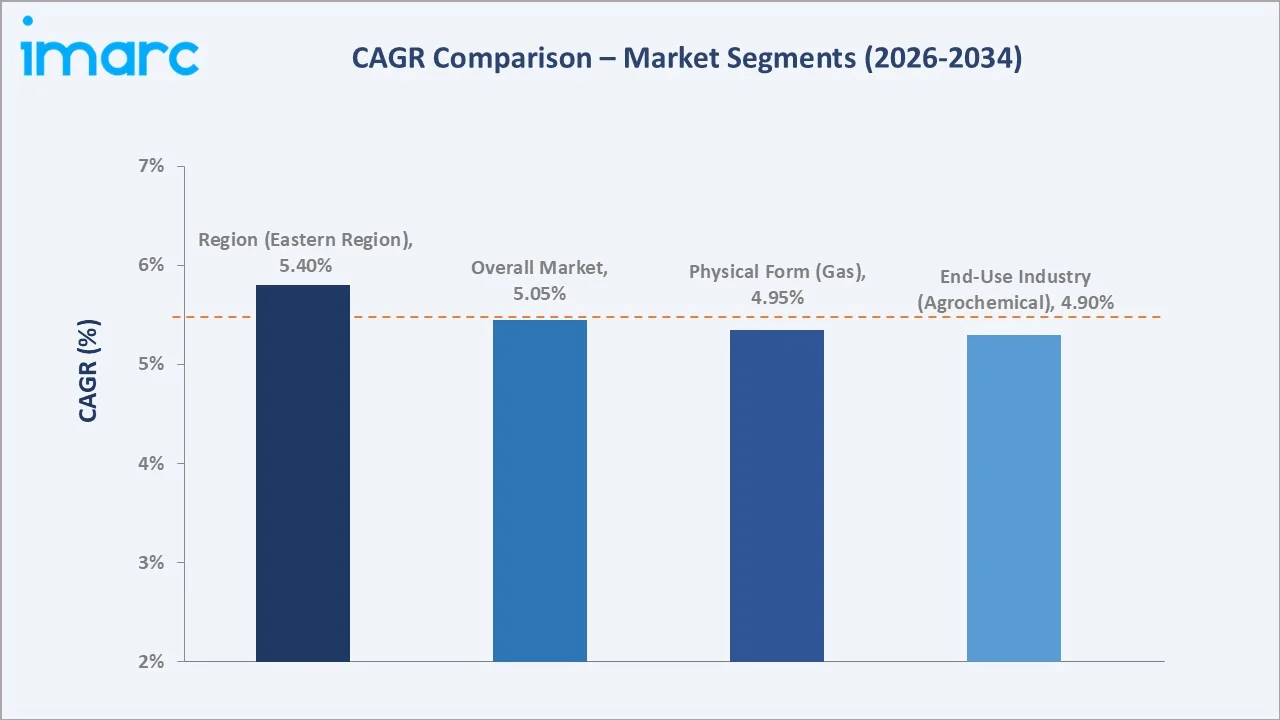
CAGR trajectories across physical form and end-use industry sub-segments, together with regional patterns, show industrial chemical, liquid, and Northern and Central Region growing faster than the overall 5.05% market CAGR, reflecting the expanding role of downstream chemical manufacturing, rising ammonia export volumes, and accelerating industrial development across Saudi Arabia's emerging economic corridors."
Executive Summary
The Saudi Arabia ammonia market expanded from USD 3.20 Billion in 2025 to an estimated USD 3.36 Billion in 2026, positioning it on a steady growth trajectory toward USD 4.98 Billion by 2034. The industry has evolved from a predominantly domestic consumption base to a globally competitive export-oriented platform, underpinned by the Kingdom's abundant natural gas reserves and strategic petrochemical infrastructure.
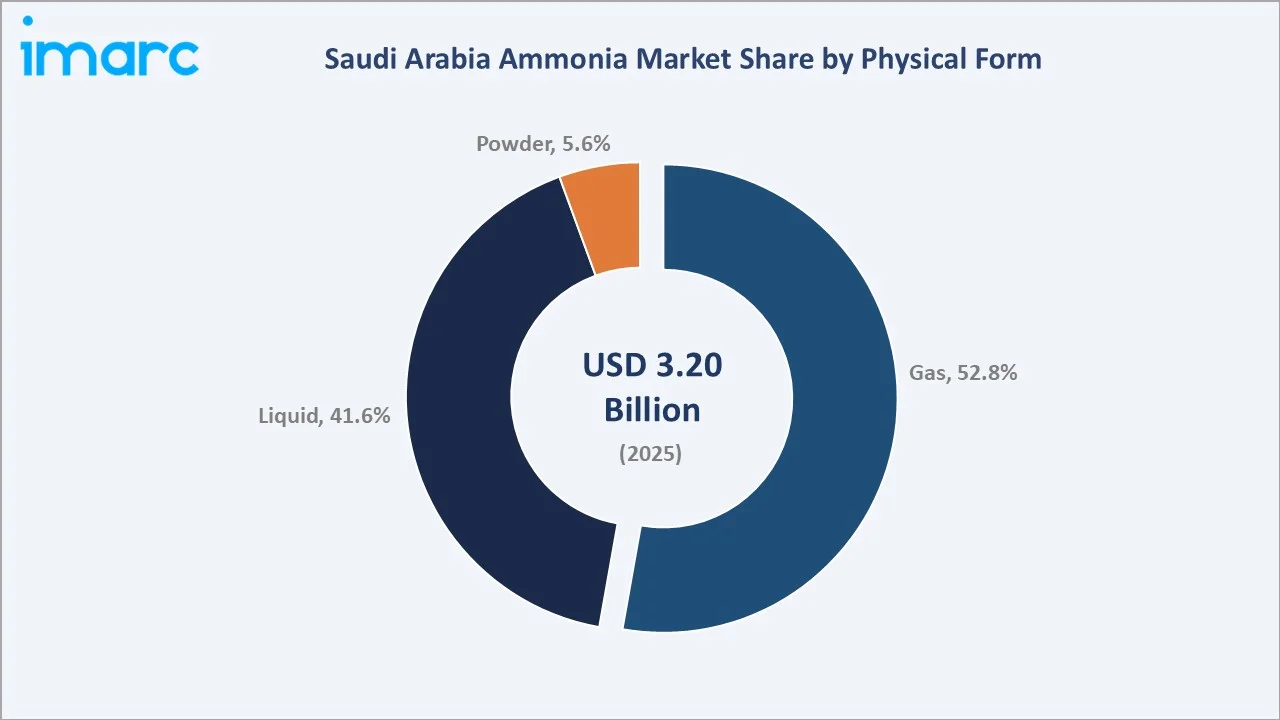
Gas commands the physical form segment at 52.8% in 2025, supported by established industrial supply chains and low storage costs relative to liquid alternatives. Agrochemical leads the end-use industry segment with a 45.6% share, benefiting from expanding domestic food security initiatives and fertilizer demand. Eastern Region at 38.9% dominates regionally, anchored by major production hubs in Jubail Industrial City and Al-Ahsa.
Key Market Insights
|
Insight |
Data |
|
Leading Physical Form |
Gas - 52.8% share (2025) |
|
Second Largest Physical Form |
Liquid - 41.6% share (2025) |
|
Leading End-Use Industry |
Agrochemical - 45.6% share (2025) |
|
Second Largest End-Use Industry |
Industrial Chemical - 26.8% share (2025) |
|
Leading Region |
Eastern Region - 38.9% share (2025) |
|
Second Largest Region |
Northern and Central Region - 32.6% share (2025) |
|
Top Companies |
Saudi Aramco, Ma'aden, Yara International ASA |
Key Analytical Observations Expanding On the Data Above:
- Gas dominance at 52.8% reflects cost efficiency and compatibility with existing industrial pipelines and ammonia synthesis plants across Jubail and Yanbu petrochemical clusters.
- Liquid at 41.6% remains significant for fertilizer blending and export terminal operations, particularly for agrochemical off-take volumes destined for Asian markets.
- Agrochemical leadership at 45.6% is driven by domestic urea and DAP production, supporting Saudi Arabia's growing agricultural output and food security agenda under Vision 2030.
- Industrial chemical at 26.8% reflects downstream use in nitric acid, ammonium nitrate, and specialty chemical production servicing mining and construction sectors.
- Eastern Region at 38.9% is home to major petrochemical and industrial hubs, including Jubail and Dammam, supporting concentrated ammonia production, processing, and downstream industrial activities.
Saudi Arabia Ammonia Market Overview
Ammonia is a fundamental industrial chemical produced through the Haber-Bosch process using nitrogen and hydrogen derived primarily from natural gas. It serves as a critical input in fertilizer manufacturing, industrial chemical synthesis, mining explosives, pharmaceutical production, and textile processing. Saudi Arabia holds a strategic advantage as one of the world's lowest-cost ammonia producers, benefiting from domestically priced natural gas feedstock and well-established petrochemical infrastructure concentrated in Jubail and Yanbu industrial cities.
The Saudi Arabia ammonia ecosystem integrates upstream natural gas producers, large-scale ammonia manufacturers, government industrial authorities, logistics and port operators, downstream agrochemical and industrial chemical producers, and export markets across Asia, Europe, and the Americas. Saudi Arabia exports a significant proportion of its ammonia production, positioning itself as a key supplier to global fertilizer markets.
Market Dynamics
To evaluate market opportunities, Request Sample
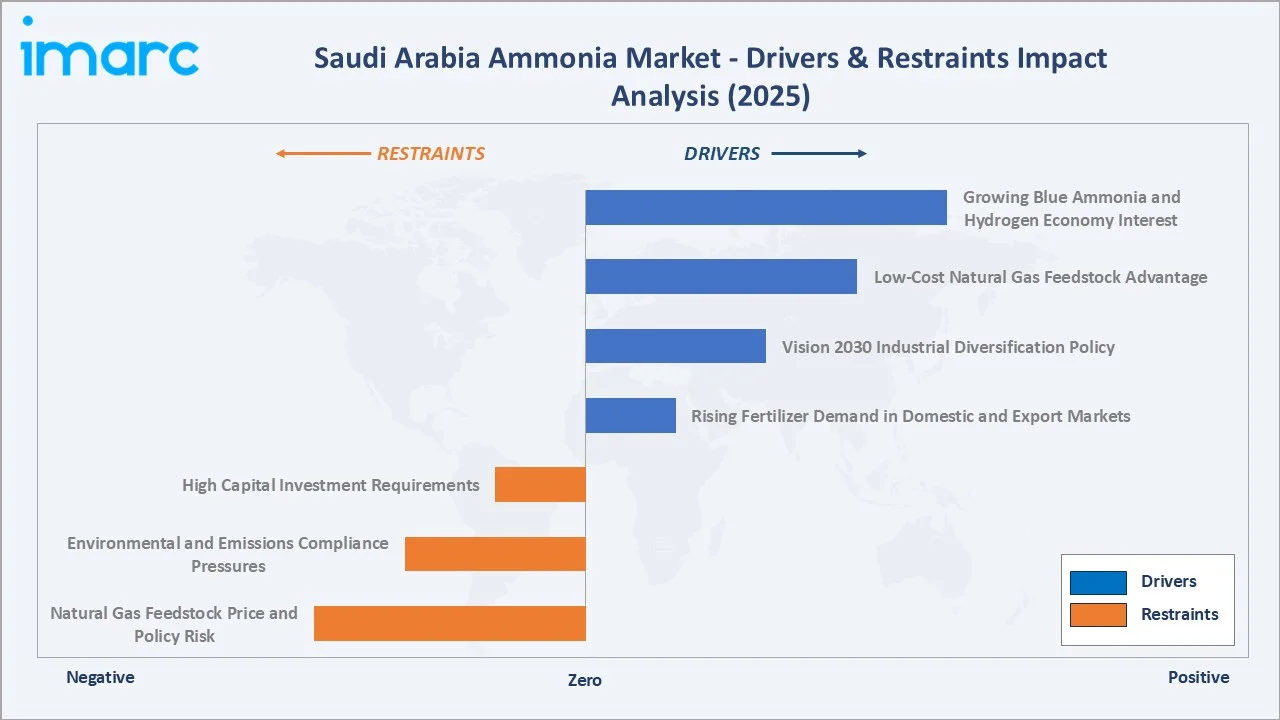
Market Drivers
- Rising Fertilizer Demand in Domestic and Export Markets: Saudi Arabia's commitment to food security under Vision 2030 is expanding domestic fertilizer consumption, while Asia and Africa represent growing export destinations for ammonia-based fertilizers.
- Vision 2030 Industrial Diversification Policy: The Saudi government is actively incentivizing expansion of the chemical and petrochemical sectors through financing, infrastructure development, and industrial city upgrades. This is encouraging investments in new production facilities, capacity expansions, and downstream ammonia applications.
- Low-Cost Natural Gas Feedstock Advantage: Saudi Arabia's domestically priced natural gas provides ammonia producers with a significant structural cost advantage relative to producers in Europe and North America. This cost efficiency enables competitive ammonia pricing in global markets while supporting healthy producer margins that fund capacity expansions.
- Growing Blue Ammonia and Hydrogen Economy Interest: Increasing investment in low-carbon hydrogen and carbon capture technologies is supporting the development of blue ammonia production and export opportunities. In July 2024, Sabic Agri-Nutrients Company was set to construct its sixth plant in Jubail Industrial City to manufacture 1.2 Million Metric Tons per year (MMTPA) of low-carbon blue ammonia along with 1.1 MMTPA of urea and specialized agri-nutrients.
Market Restraints
- Natural Gas Feedstock Price and Policy Risk: While current feedstock pricing is favorable, any revision to domestic gas pricing policies or reduction in energy subsidies could materially increase production costs for Saudi ammonia producers, affecting competitive positioning in export markets.
- Environmental and Emissions Compliance Pressures: Increasing global scrutiny on carbon-intensive production processes is affecting demand for grey ammonia in carbon-sensitive markets. European and Asian importers are beginning to impose sustainability requirements on ammonia supply chains, requiring producers to invest in carbon capture or low-carbon production methods to retain market access.
- High Capital Investment Requirements: Ammonia plant construction and capacity expansion require substantial upfront capital commitments with extended payback periods. This limits the pace at which producers can scale operations and may slow competitive entry from new participants across the market.
Market Opportunities
- Blue and Green Ammonia Export Platform Development: Saudi Arabia's abundant renewable energy resources and low-cost natural gas make it well-positioned to develop large-scale blue and green ammonia production, targeting premium energy-sector markets in Japan, South Korea, and Europe seeking low-carbon hydrogen carriers.
- Expansion of Downstream Ammonia Derivatives: Growing demand for ammonium nitrate in mining and construction, nitric acid in specialty chemicals, and ammonium phosphate in fertilizer blends presents significant downstream integration opportunities for Saudi producers seeking to capture greater value chain margin.
Market Challenges
- Global Ammonia Price Volatility: International ammonia prices are subject to sharp fluctuations driven by natural gas price movements, geopolitical events, and demand-supply imbalances. This volatility creates revenue uncertainty for producers and complicates long-term investment planning.
- Competition from Emerging Low-Cost Producers: Countries including Qatar, Russia, and emerging African producers with access to low-cost natural gas or renewable energy are building new ammonia production capacity, intensifying competitive pressure on Saudi export market share over the forecast period.
Emerging Market Trends
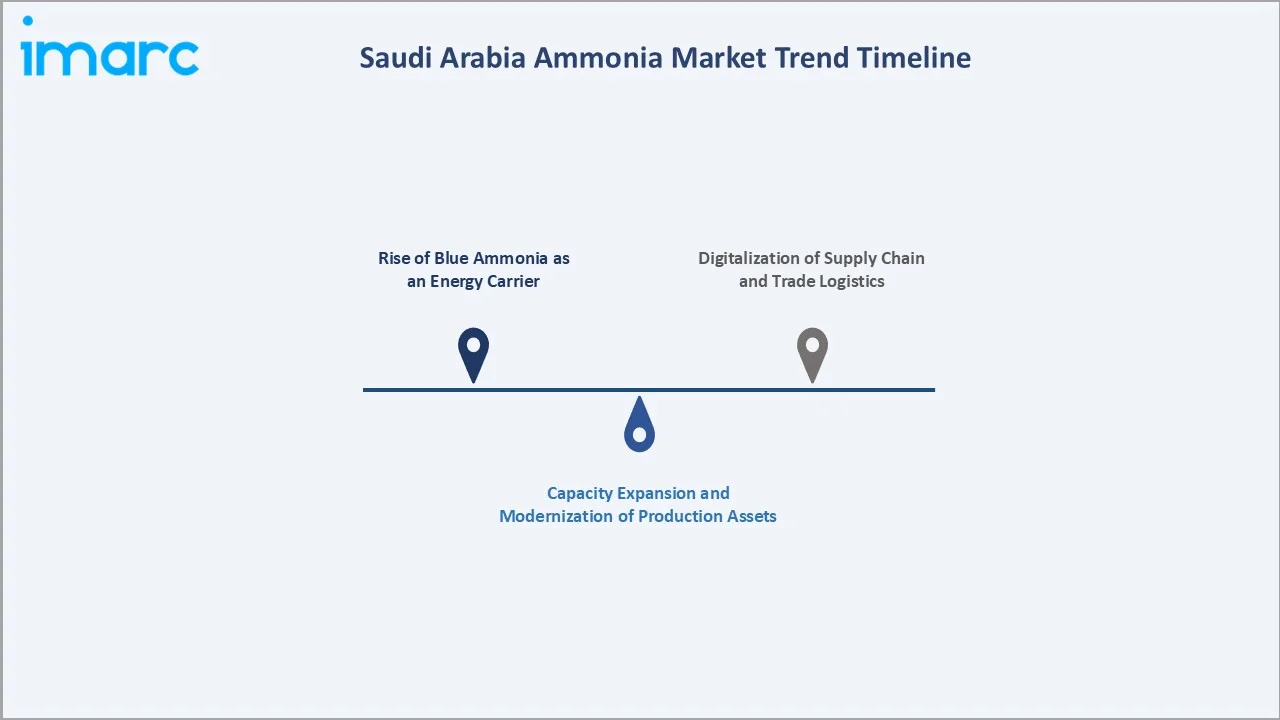
1. Rise of Blue Ammonia as an Energy Carrier
Saudi Arabia is developing its blue ammonia capabilities by integrating conventional ammonia production with carbon capture and storage. This trend is expected to gain momentum through 2034 as decarbonization initiatives in importing markets support demand for lower-emission ammonia.
2. Capacity Expansion and Modernization of Production Assets
Leading Saudi producers are investing in plant debottlenecking, digitalization of operations, and efficiency upgrades to increase output without proportional increases in feedstock consumption. These initiatives are also improving operational reliability and supporting long-term production efficiency.
3. Digitalization of Supply Chain and Trade Logistics
Ammonia producers and distributors are adopting digital platforms for logistics optimization, predictive demand forecasting, and real-time cargo tracking. Port infrastructure upgrades are enhancing export handling capacity, reducing turnaround times for ammonia tanker loading, and improving Saudi Arabia's competitiveness as a reliable bulk supplier for time-sensitive agrochemical and industrial markets.
Industry Value Chain Analysis
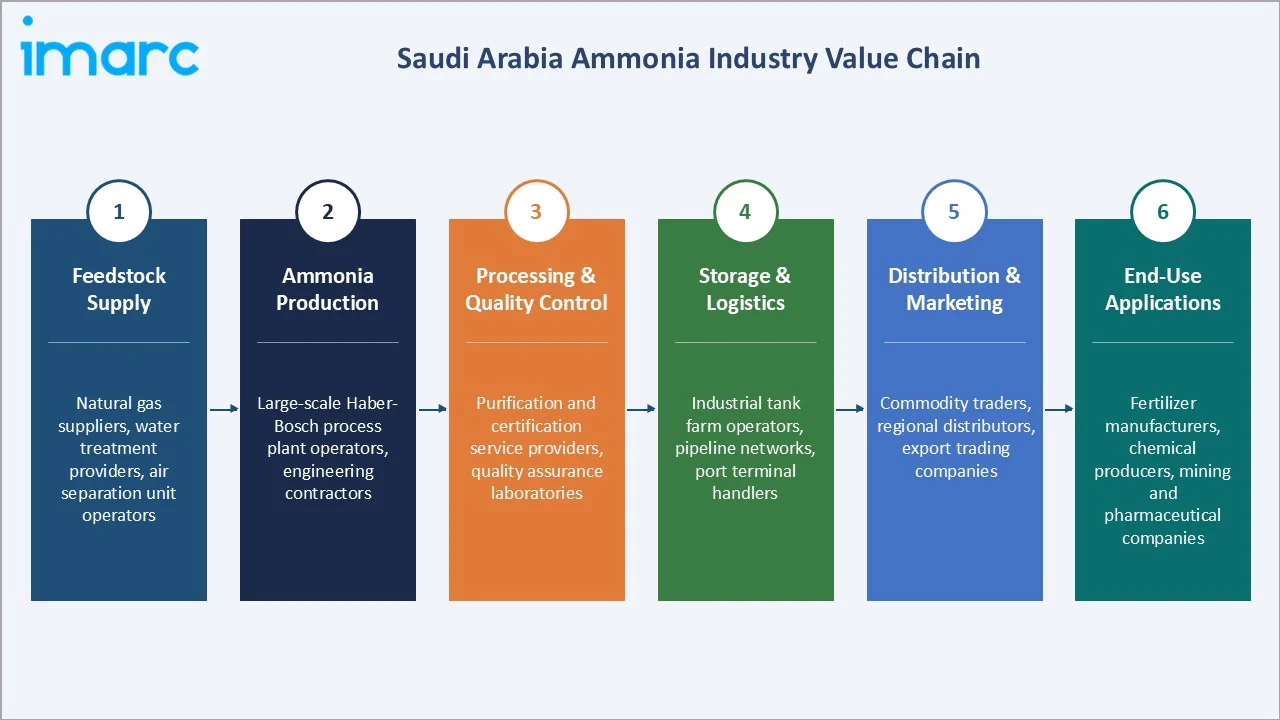
The Saudi Arabia ammonia value chain spans six stages, from upstream natural gas feedstock supply through ammonia manufacturing, processing and quality control, storage and logistics, distribution, and final end-use applications. Each stage represents distinct value addition, with ammonia producers sitting at the center of a tightly integrated industrial system linking feedstock providers to downstream industrial users and export markets.
|
Stage |
Key Players / Examples |
|
Feedstock Supply |
Natural gas suppliers, water treatment providers, air separation unit operators |
|
Ammonia Production |
Large-scale Haber-Bosch process plant operators, engineering contractors |
|
Processing & Quality Control |
Purification and certification service providers, quality assurance laboratories |
|
Storage & Logistics |
Industrial tank farm operators, pipeline networks, port terminal handlers |
|
Distribution & Marketing |
Commodity traders, regional distributors, export trading companies |
|
End-Use Applications |
Fertilizer manufacturers, chemical producers, mining and pharmaceutical companies |
Vertically integrated producers, which control manufacturing, storage, and export terminal assets, are positioned to capture a greater proportion of total value chain margin than standalone producers reliant on third-party logistics or trading intermediaries.
Technology Landscape in the Saudi Arabia Ammonia Industry
Haber-Bosch Process Optimization
The Haber-Bosch process remains the dominant production technology for synthetic ammonia, and producers in Saudi Arabia are increasingly investing in catalyst efficiency improvements, heat integration upgrades, and advanced process control systems to reduce energy intensity per unit of ammonia output. Newer reformer designs and high-pressure synthesis loop optimizations are extending plant run lengths and reducing maintenance costs across major production sites.
Carbon Capture and Storage for Blue Ammonia
Blue ammonia production requires the integration of post-combustion carbon capture systems and secure geological storage of captured CO2. These technologies help reduce the carbon intensity of ammonia production while supporting the development of lower-emission supply chains.
Digitalization and Industry 4.0 Adoption
Advanced sensor networks, digital twin modeling of ammonia synthesis plants, and AI-driven process optimization are being deployed at major Saudi production facilities to improve operational efficiency, predict equipment failures, and maximize throughput. These technologies are expected to become increasingly standard across the industry through 2034, supporting cost competitiveness as the market transitions toward lower-carbon production models.
Market Segmentation Analysis
The report covers the following segments:
|
Segment Category |
Leading Segment |
Market Share |
Year |
|
Physical Form |
Gas |
52.8% |
2025 |
|
Application |
🔒 |
🔒 |
2025 |
|
End-Use Industry |
Agrochemical |
45.6% |
2025 |
|
Region |
Eastern Region |
38.9% |
2025 |

By Physical Form
Gas commands a 52.8% majority share in 2025, benefiting from established industrial supply infrastructure, lower cost of transport within integrated petrochemical complexes, and compatibility with dominant ammonia synthesis processes that deliver the product in gaseous form. The segment benefits from high-efficiency industrial use in nitric acid production and direct application in industrial cleaning and refrigeration.
To access detailed market analysis, Request Sample
Liquid at 41.6% remains critical for fertilizer blending, export terminal loading, and direct soil application in agricultural markets. The segment supports Saudi Arabia's ammonia export operations, as anhydrous liquid ammonia can be efficiently loaded into specialized tanker vessels for international trade.
By End-Use Industry
Agrochemical accounts for 45.6% of the market, driven by the feedstock role of ammonia in urea, ammonium nitrate, and diammonium phosphate production. Saudi Arabia exports a significant proportion of its fertilizer output to Asian and African markets, sustained by competitive ammonia feedstock costs and established trading relationships across major agricultural importing economies.
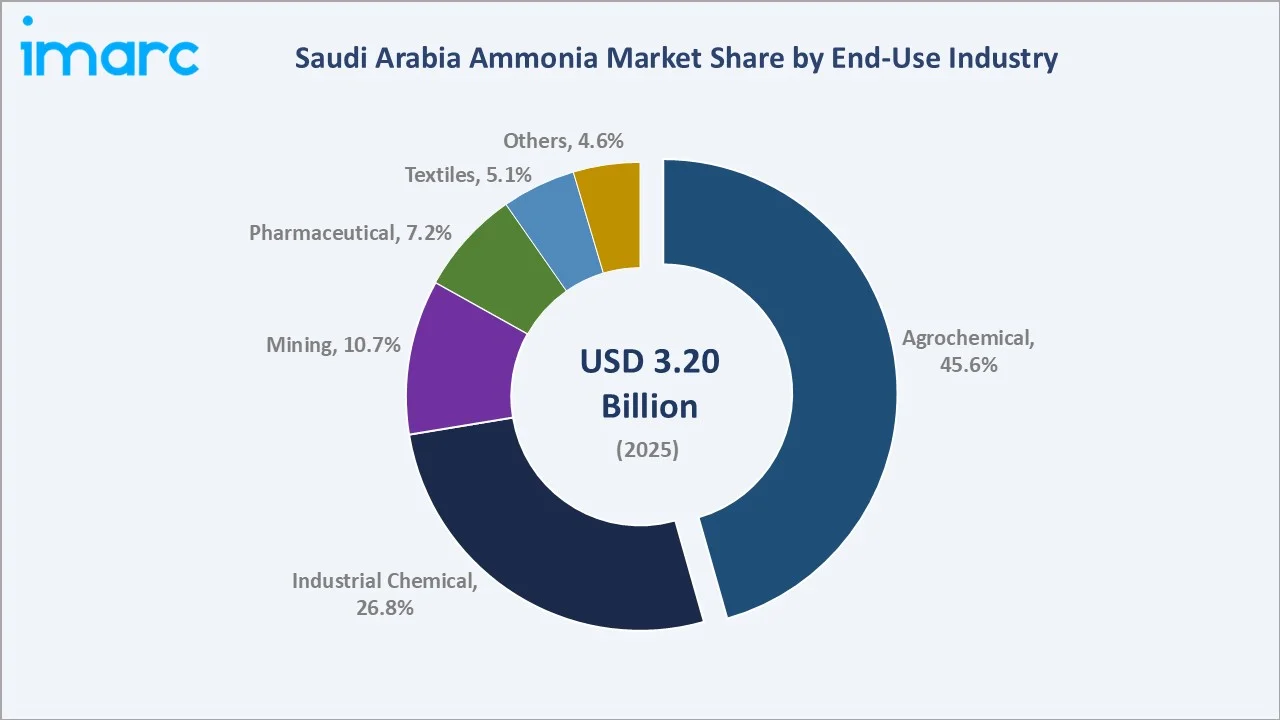
Industrial chemical at 26.8% reflects ammonia's role in nitric acid, acrylonitrile, and caprolactam production supporting downstream chemical manufacturing.
Regional Market Insights
|
Region |
Share (2025) |
Key Growth Drivers |
|
Eastern Region |
38.9% |
Large concentration of petrochemical and ammonia production infrastructure, established export terminals, and proximity to major shipping routes |
|
Northern and Central Region |
32.6% |
Growing industrial investment aligned with Vision 2030, expanding mining activity, and chemical demand from new industrial zones |
|
Western Region |
19.7% |
Yanbu Industrial City petrochemical hub, fertilizer manufacturing, and growing pharmaceutical-grade ammonia demand |
|
Southern Region |
8.8% |
Agricultural ammonia demand, proximity to African export markets, and emerging industrial development in Jizan Economic City |
Eastern Region at 38.9% in 2025 dominates the Saudi Arabia ammonia market, anchored by major petrochemical hubs, ammonia production facilities, and export infrastructure in Jubail and Ras Tanura.
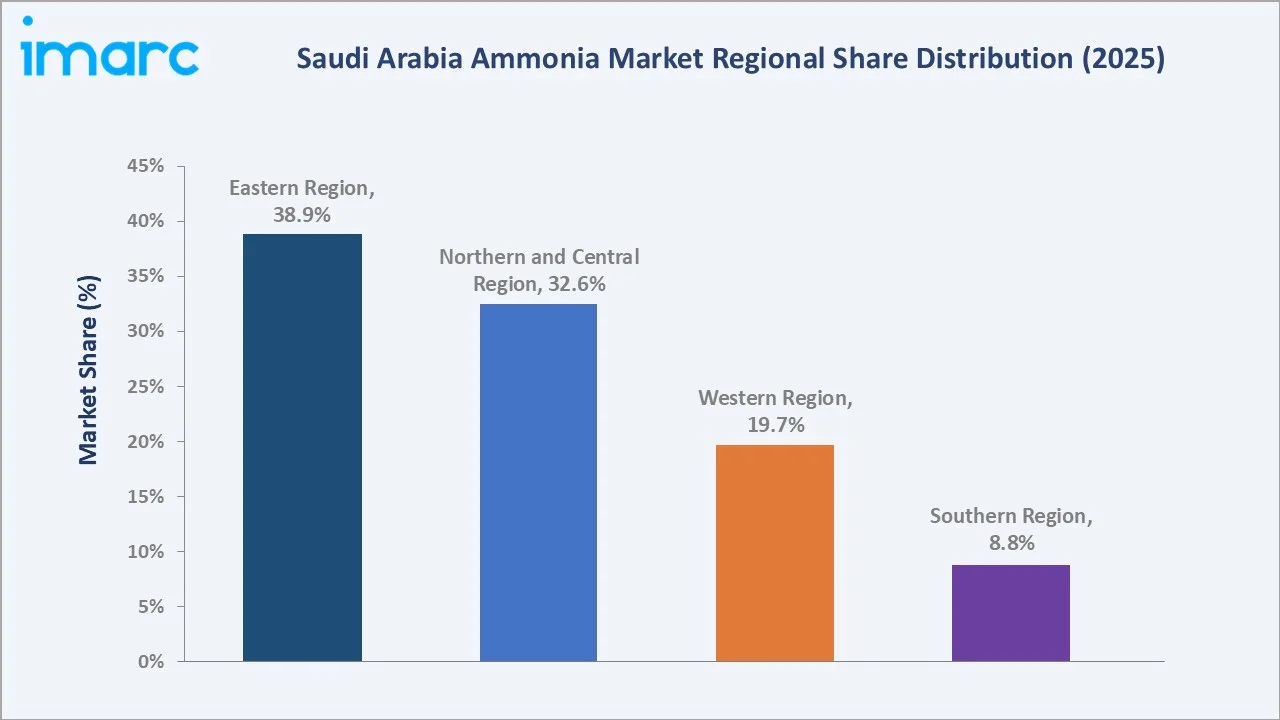
Northern and Central Region at 32.6% is expanding rapidly, supported by growing industrial investment, mining activity in Al-Qassim and Hail, and the development of new chemical and manufacturing facilities.
Competitive Landscape
The Saudi Arabia ammonia market is moderately concentrated, with established domestic producers commanding leading positions through integrated production assets, export infrastructure, and long-term off-take agreements. International players are present through strategic partnerships and distribution agreements linked to Saudi Arabia's blue and green ammonia development programs.
|
Company Name |
Brand / Key Product |
Position |
Strategic Focus |
|
Saudi Aramco |
Ammonia & Hydrogen Products |
Leader |
Expanding low-carbon ammonia production capabilities and strengthening export infrastructure |
|
Ma'aden |
Ma'aden Fertilizers |
Challenger |
Increasing ammonia and fertilizer production capacity through integrated operations and capacity expansion |
|
Yara International ASA |
Yara Ammonia |
Innovator |
Advancing low-carbon ammonia solutions and strengthening distribution and market reach |
Key players include Saudi Aramco, Ma'aden, and Yara International ASA, among others.
Key Company Profiles
Saudi Aramco
Saudi Aramco is the world's leading oil and gas company and Saudi Arabia's national oil company, headquartered in Dhahran, Saudi Arabia. The company is majority-owned by the Saudi government and operates one of the world's most extensive hydrocarbon production, refining, and chemicals networks. Beyond its core oil and gas operations, Saudi Aramco is actively developing low-carbon ammonia and hydrogen capabilities, leveraging its vast natural gas reserves to support the Kingdom's energy diversification and export strategy.
- Product Portfolio: Ammonia and hydrogen products, crude oil, natural gas, LNG, and a broad range of downstream hydrocarbon and chemical products produced through integrated operations and joint ventures across Saudi Arabia and internationally.
- Recent Developments: Saudi Aramco has continued to advance its downstream and low-carbon product portfolio, progressing discussions with international partners on ammonia and hydrogen supply agreements and maintaining its position as one of the world's largest and most integrated energy companies.
- Strategic Focus: Building out low-carbon ammonia and hydrogen production capabilities alongside its core operations, while reinforcing the export infrastructure required to serve emerging international markets for clean energy carriers.
Ma'aden
Ma'aden is Saudi Arabia's leading mining and minerals company, listed on the Saudi Exchange (Tadawul) and majority-owned by the Public Investment Fund. The company operates through multiple business units covering phosphate, aluminum, gold, and industrial minerals, with its fertilizer segment representing a significant contributor to both domestic supply and international export volumes.
- Product Portfolio: Ammonia, monoammonium phosphate (MAP), and a range of nitrogen and phosphate-based fertilizer products, alongside aluminum, gold, and industrial mineral products across its diversified mining portfolio.
- Recent Developments: Ma'aden has continued to strengthen its position in the ammonia and fertilizer segment, progressing capacity expansion initiatives and securing new long-term supply agreements with international buyers across Asian agricultural markets.
- Strategic Focus: Intensifying ammonia and fertilizer production capacity through the continued development of integrated phosphate and chemical operations, with a focus on growing export market share and expanding downstream value-added product offerings.
Yara International ASA
Yara International ASA is a Norwegian global crop nutrition company and one of the world's largest producers and distributors of ammonia and nitrogen-based fertilizers, headquartered in Oslo, Norway. The company operates production facilities and distribution networks across several countries, supplying farmers and industrial customers with a broad portfolio of fertilizer and industrial products.
- Product Portfolio: Yara Ammonia, urea, nitrates, NPK fertilizers, and a growing portfolio of low-carbon and renewable ammonia products distributed through one of the world's most extensive ammonia trading and logistics networks.
- Recent Developments: Yara International ASA has continued to progress its clean ammonia strategy, advancing partnership discussions with key ammonia producers in the region and working to integrate lower-carbon supply sources into its global distribution platform.
- Strategic Focus: Advancing the distribution and marketing of low-carbon ammonia through strategic regional partnerships, while strengthening its global market reach and positioning itself as a leading commercial platform for the emerging clean ammonia trade.
Market Concentration Analysis
The Saudi Arabia ammonia market is moderately concentrated, with a limited number of established producers accounting for a significant share of production capacity and exports.
Barriers to entry are high, including the need for large-scale capital investment in synthesis plants, access to competitively priced natural gas feedstock, regulatory approvals from Saudi industrial authorities, and established logistics infrastructure for domestic distribution and export. These factors create significant structural advantages for existing producers and limit meaningful competitive entry from new participants in the near term.
Consolidation is occurring gradually as larger producers integrate downstream into fertilizer and derivative chemicals, while strategic partnerships on blue and green ammonia projects are creating new competitive alignments.
Investment & Growth Opportunities
Fastest-Growing Segments
Industrial chemical is the fastest-growing end-use industry category, driven by expanding demand for nitric acid and ammonium-based specialty chemicals across the Kingdom's growing manufacturing base. Liquid is also expanding as export infrastructure investments improve handling capacity at Arabian Gulf terminals, enabling larger volumes to reach international buyers efficiently.
Emerging Markets
Northern and Central Region is the fastest-growing geographic segment, supported by new industrial zone development, mining-related chemical demand, and proximity to NEOM's emerging industrial and energy infrastructure. The market represents significant untapped opportunity for ammonia producers capable of serving new industrial parks and construction-related applications across the region.
Venture & Investment Trends
Investment activity is concentrated in blue and green ammonia production infrastructure, storage and export terminal capacity at Red Sea and Arabian Gulf ports, and downstream fertilizer and chemical processing. Strategic partnerships between Saudi producers and international energy companies are increasingly channeling capital into low-carbon ammonia projects, reflecting growing investor confidence in Saudi Arabia's long-term position as a globally competitive ammonia exporter.
Future Market Outlook (2026-2034)
The Saudi Arabia ammonia market is projected to grow from USD 3.20 Billion in 2025 to USD 3.36 Billion in 2026, reaching USD 4.98 Billion by 2034, registering a CAGR of 5.05% during 2026-2034.
Four forces will shape the market through 2034: continued capacity expansion by domestic producers aligned with Vision 2030 industrial policy; growing demand for blue and eventually green ammonia as global energy transition accelerates; deepening downstream integration into fertilizers, specialty chemicals, and energy carrier applications; and expanding export market relationships with Asian, African, and European buyers seeking competitive, reliable ammonia supply.
By 2034, the Saudi Arabia ammonia market is expected to be characterized by a dual structure in which traditional grey ammonia serves cost-sensitive agrochemical markets while blue ammonia premium products capture emerging energy-sector and low-carbon fertilizer demand. Continued government policy support, abundant natural gas availability, and strategic location at the nexus of Asia, Africa, and Europe trade routes will sustain Saudi Arabia's position as one of the world's most competitive ammonia producers and exporters.
Research Methodology
Primary Research
Primary research included structured consultations with ammonia plant operators, fertilizer producers, industrial chemical buyers, logistics and terminal operators, and regulatory specialists across Saudi Arabia, validating market sizing, segment mix, and regional demand patterns.
Secondary Research
Secondary sources included Saudi Ministry of Energy publications, SIDF annual reports, SABIC and SABIC Agri-Nutrients annual reports, Saudi industrial city development authority publications, International Fertilizer Association data, and trade publications covering Middle Eastern petrochemical and fertilizer markets.
Forecasting Models
Market forecasts used top-down and bottom-up models combining Saudi Arabia ammonia production capacity data, domestic consumption trends, export volume trajectories, natural gas feedstock pricing, and macroeconomic variables. Scenario analysis addressed policy changes, capacity additions, and energy transition impacts on demand and pricing through 2034.
Saudi Arabia Ammonia Market Report Coverage:
| Report Features | Details |
|---|---|
| Base Year of the Analysis | 2025 |
| Historical Period | 2020-2025 |
| Forecast Period | 2026-2034 |
| Units | Billion USD |
| Scope of the Report |
Exploration of Historical Trends and Market Outlook, Industry Catalysts and Challenges, Segment-Wise Historical and Future Market Assessment:
|
| Physical Forms Covered | Liquid, Powder, Gas |
| Applications Covered | MAP and DAP, Urea, Nitric Acid, Ammonium Sulfate, Ammonium Nitrate, Others |
| End Use Industries Covered | Agrochemical, Industrial Chemical, Mining, Pharmaceutical, Textiles, Others |
| Regions Covered | Northern and Central Region, Western Region, Eastern Region, Southern Region |
| Companies Covered | Saudi Aramco, Ma'aden, Yara International ASA, etc. |
| Customization Scope | 10% Free Customization |
| Post-Sale Analyst Support | 10-12 Weeks |
| Delivery Format | PDF and Excel through Email (We can also provide the editable version of the report in PPT/Word format on special request) |
Key Benefits for Stakeholders:
- IMARC’s industry report offers a comprehensive quantitative analysis of various market segments, historical and current market trends, market forecasts, and dynamics of the Saudi Arabia ammonia market from 2020-2034.
- The research report provides the latest information on the market drivers, challenges, and opportunities in the Saudi Arabia ammonia market.
- Porter's five forces analysis assist stakeholders in assessing the impact of new entrants, competitive rivalry, supplier power, buyer power, and the threat of substitution. It helps stakeholders to analyze the level of competition within the Saudi Arabia ammonia industry and its attractiveness.
- Competitive landscape allows stakeholders to understand their competitive environment and provides an insight into the current positions of key players in the market.
Frequently Asked Questions About the Saudi Arabia Ammonia Market Report
The Saudi Arabia ammonia market size is estimated at USD 3.36 Billion in , driven by strong agrochemical demand, low-cost natural gas feedstock, and growing blue ammonia export interest.
The market is projected to grow at a CAGR of 5.05% from 2026-2034, reaching USD 4.98 Billion, supported by capacity expansions and rising industrial chemical demand.
Gas leads the physical form segment at 52.8% in 2025, driven by compatibility with existing industrial infrastructure and cost-efficient supply to petrochemical complexes.
Agrochemical leads with 45.6% share in 2025, reflecting ammonia's critical role as feedstock for urea, DAP, and other nitrogen fertilizers produced and exported by Saudi manufacturers.
Eastern Region commands 38.9% share in 2025, led by Jubail Industrial City's large-scale ammonia production and export infrastructure on the Arabian Gulf.
Leading players include Saudi Aramco, Ma'aden, and Yara International ASA, among others.
Blue ammonia is produced using conventional natural gas with carbon capture and storage, reducing lifecycle emissions. Saudi Arabia views it as a key export product for the global energy transition and hydrogen economy.
Vision 2030 is driving industrial diversification, infrastructure investment, and financing support for petrochemical expansion, directly supporting ammonia capacity growth and downstream chemical development.
Key challenges include natural gas feedstock pricing risk, evolving environmental regulations in export markets, high capital costs for new capacity, and competition from emerging low-cost producers globally.
Need more help?
- Speak to our experienced analysts for insights on the current market scenarios.
- Include additional segments and countries to customize the report as per your requirement.
- Gain an unparalleled competitive advantage in your domain by understanding how to utilize the report and positively impacting your operations and revenue.
- For further assistance, please connect with our analysts.
 Request Customization
 Speak to an Analyst
 Request Brochure
 Inquire Before Buying
Benefits of Customization
- Personalize this research
- Triangulate with your data
- Get data as per your format and definition
- Gain a deeper dive into a specific application, geography, customer, or competitor
- Any level of personalization
Get in Touch With Us
UNITED STATES
Phone: +1-201-971-6302
INDIA
Phone: +91-120-433-0800
UNITED KINGDOM
Phone: +44-753-714-6104
Email: [email protected]
Client Testimonials























Related Reports

Choose your plan
*Please note that the prices mentioned below are starting prices for each bundle type. Kindly contact our team for further details.*
Single User License
- 1 User License, Access on 2 Devices
- PDF Report + Excel Dataset (Password Protected)
- Lifetime Access
- No Printing Rights
- 10% Free Report Customization
- 10–12 Weeks of Analyst Support
Five User License
- Access for 5 Users, 2 Devices per User
- PDF Report + Excel Dataset (Password Protected)
- Lifetime Access
- Dedicated Account Manager
- 12–14 Weeks of Analyst Support
- No Printing Rights
- 15% Free Report Customization
- 25% Discount on Your Next Purchase
Corporate User License
- Unlimited User Access (Within Your Organization)
- PDF Report + Excel Dataset
- Lifetime Access
- Dedicated Account Manager
- 14–20 Weeks of Analyst Support
- No Printing Rights
- 20% Free Report Customization
- 30% Discount on Your Next Purchase
Essential Insights
What's included:
3 reports
- Lifetime Access
- PDF Reports
- Excel Datasets
- 2 Weeks of Free Analyst Support
- 2 User Licenses
- Access on 2 Devices
- Printing Rights
- Complimentary PowerPoint (PPT) Version
- Complimentary License Upgrade
Professional Access
What's included:
5 reports
- Lifetime Access
- PDF Reports
- Excel Datasets
- 8 Weeks of Free Analyst Support
- 2 User Licenses
- Access on 2 Devices
- Printing Rights
- Complimentary PowerPoint (PPT) Version
- Complimentary License Upgrade
Business Advantage
What's included:
8 reports
- Lifetime Access
- PDF Reports
- Excel Datasets
- 14 Weeks of Free Analyst Support
- 2 User Licenses
- Access on 2 Devices
- Printing Rights
- Complimentary PowerPoint (PPT) Version
- Complimentary License Upgrade
Enterprise Intelligence
What's included:
10 reports
- Lifetime Access
- PDF Reports
- Excel Datasets
- 20 Weeks of Free Analyst Support
- 2 User Licenses
- Access on 2 Devices
- Printing Rights
- Complimentary PowerPoint (PPT) Version
- Complimentary License Upgrade