
Saudi Arabia Bus Market Size, Share, Trends and Forecast by Type, Fuel Type, Seat Capacity, Application, and Region, 2026-2034
Saudi Arabia Bus Market Size, Share, Trends & Forecast (2026-2034)
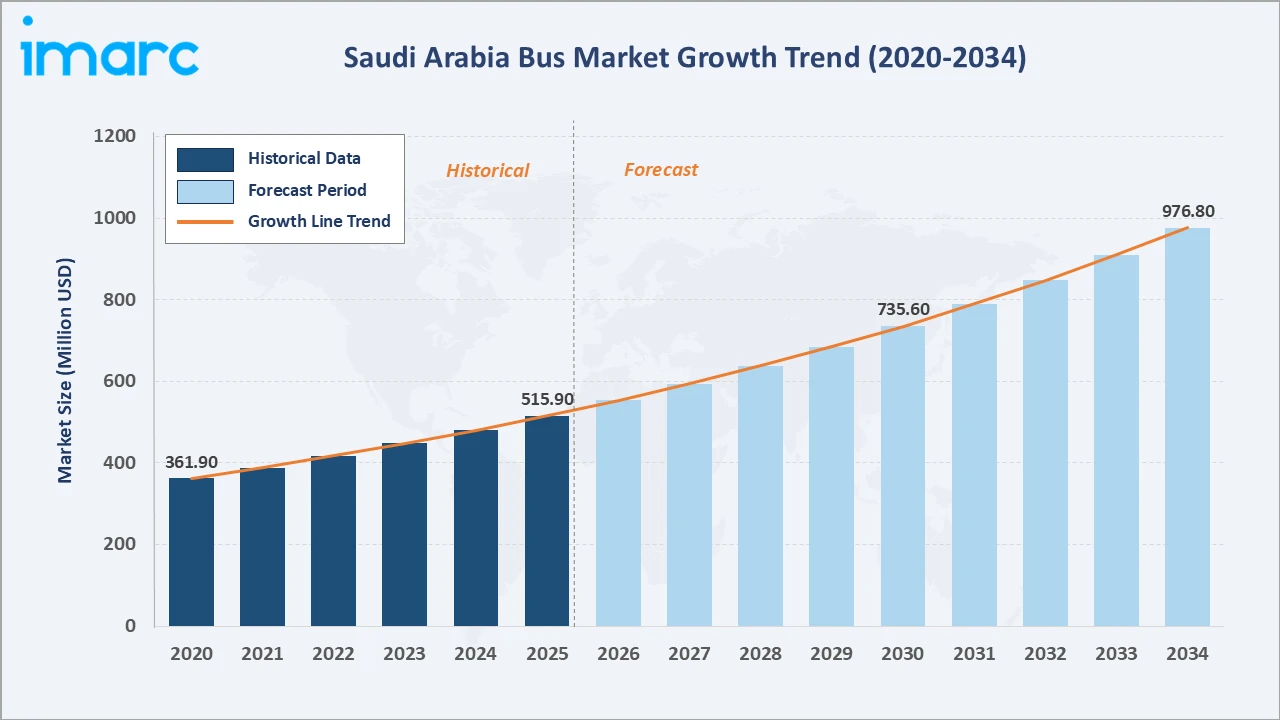
The Saudi Arabia bus market size increased from USD 515.9 Million in 2025 to USD 553.9 Million in 2026 and is projected to reach USD 976.8 Million by 2034, growing at a CAGR of 7.35% during 2026-2034. The market is driven by sustained public transport investment, rapid urbanization, and fleet modernization programmes aligned with national mobility objectives.
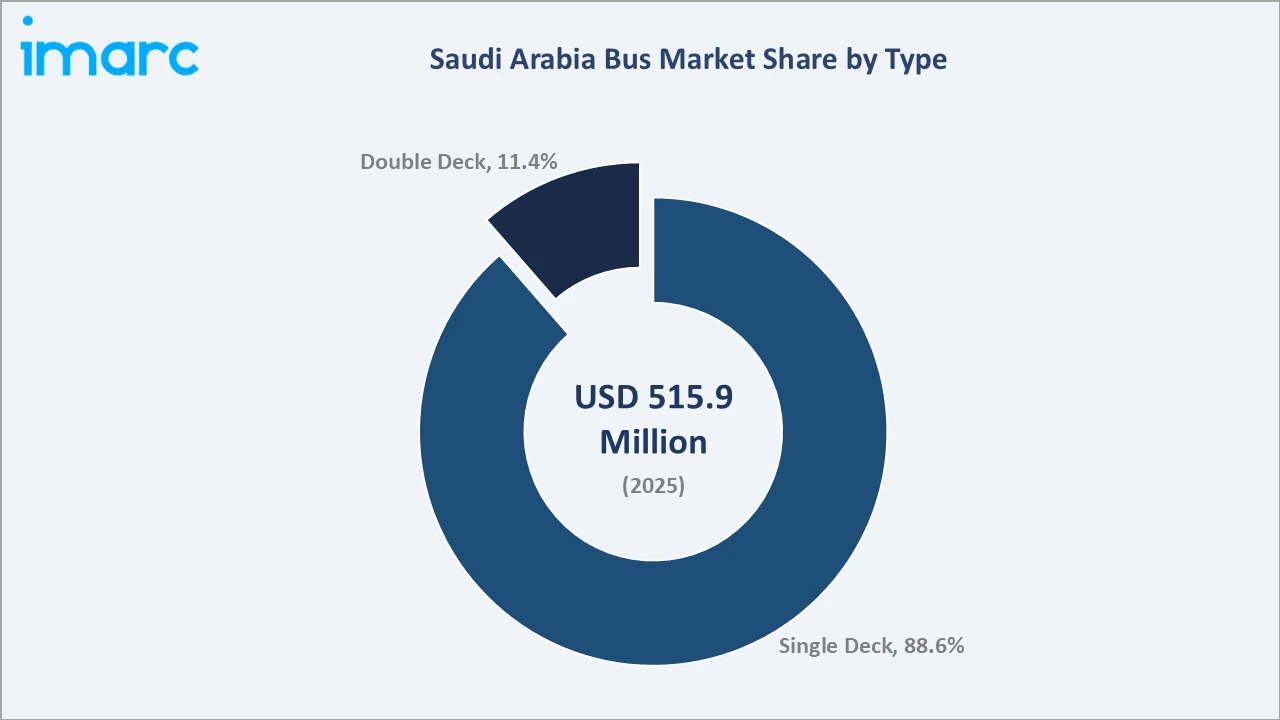
Expanding metropolitan networks, rising religious tourism volumes, and a policy shift toward low-emission vehicles are increasing procurement of modern transit and intercity fleets. Single deck buses dominate at 88.6%. Diesel leads fuel type at 86.3%. The Northern and Central Region commands 39.8% of the market share.
Market Snapshot
|
Metric |
Value |
|
Base Year Market Size (2025) |
USD 515.9 Million |
|
Market Size (2026) |
USD 553.9 Million |
|
Forecast Market Size (2034) |
USD 976.8 Million |
|
CAGR (2026-2034) |
7.35% |
|
Base Year |
2025 |
|
Historical Period |
2020-2025 |
|
Forecast Period |
2026-2034 |
|
Dominant Type |
Single Deck (88.6%, 2025) |
|
Dominant Fuel Type |
Diesel (86.3%, 2025) |
|
Leading Region |
Northern and Central Region (39.8%, 2025) |
The Saudi Arabia bus market expanded from USD 361.9 Million in 2020 to USD 515.9 Million in 2025 and an estimated USD 553.9 Million in 2026, anchored at USD 735.6 Million in 2030, and forecast to reach USD 976.8 Million by 2034. Pandemic restrictions deferred fleet renewal in 2020, after which reopening and transit commissioning restored procurement momentum.
To get more information on this market, Request Sample
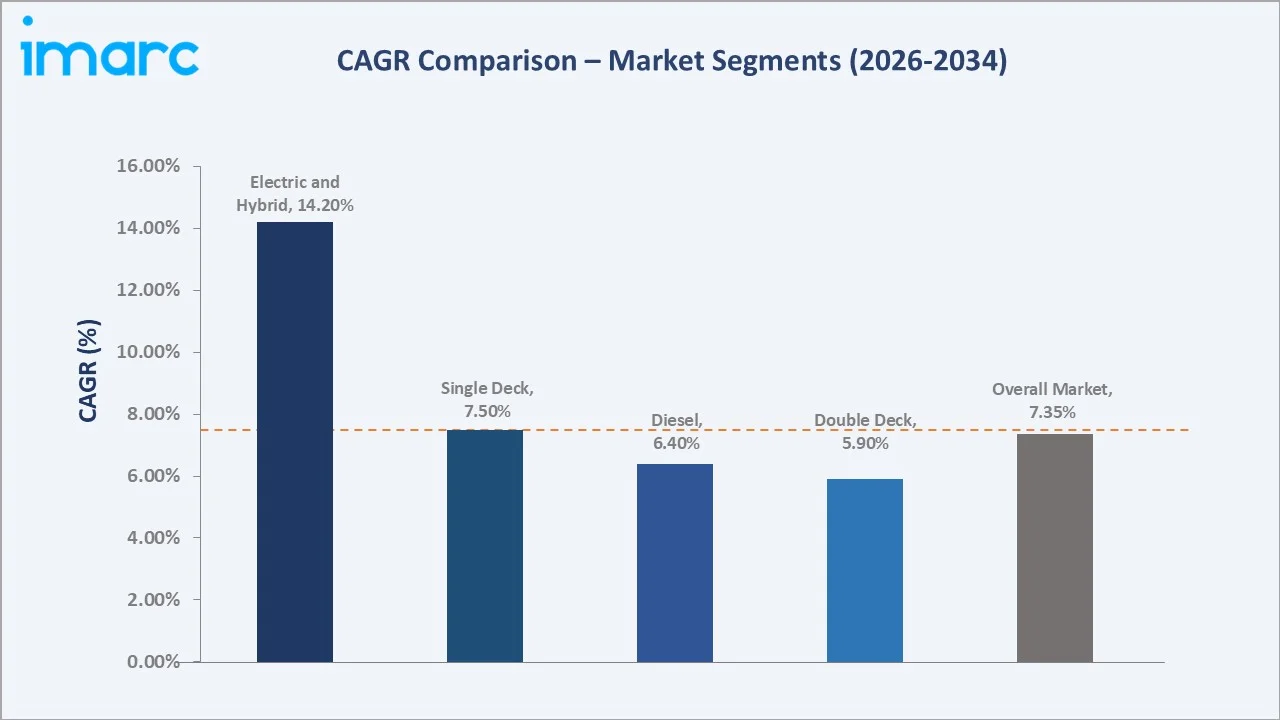
Electric and hybrid buses grow fastest at ~14.2% CAGR as decarbonization mandates and depot charging investment expand zero-emission viability. Single deck buses grow at ~7.5% CAGR through high-frequency urban transit deployment economics.
Executive Summary
The Saudi Arabia bus market, which increased from USD 515.9 Million in 2025 to an estimated USD 553.9 Million in 2026, representing a structurally expanding intersection of public infrastructure policy, urban mobility, and vehicle technology investment. The market encompasses transit buses, intercity coaches, school and staff transport vehicles, and the associated bodybuilding, financing, and aftersales ecosystem.
Single deck buses at 88.6% dominate through operational flexibility and route economics. Diesel at 86.3% leads fuel type through established refuelling infrastructure, lower acquisition cost, and proven durability in high-temperature operating conditions. The Northern and Central Region, at 39.8%, leads through Riyadh's metropolitan transit build-out and administrative concentration.
Key Market Insights
|
Insight |
Data |
|
Dominant Type |
Single Deck - 88.6% share (2025) |
|
Dominant Fuel Type |
Diesel - 86.3% market share (2025) |
|
Leading Region |
Northern and Central Region - 39.8% market share |
|
Market Opportunity |
Electric bus fleet conversion; depot charging infrastructure; giga-project mobility contracts; intelligent transport systems; local assembly localization; Hajj and Umrah coach capacity |
Key Analytical Observations Supporting the Above Data:
- Single Deck at 88.6%: Single deck buses dominate due to their route flexibility, lower acquisition and maintenance cost, and suitability for the majority of urban transit and intercity corridors. These vehicles support higher service frequency, easier manoeuvrability in dense city environments, and simpler depot and workshop requirements.
- Diesel at 86.3%: Diesel buses dominate because of established refuelling infrastructure, competitive upfront pricing, and dependable performance under high ambient temperatures and long-distance duty cycles. Wide parts availability and technician familiarity further reinforce operator preference across both public and private fleets.
- Northern and Central Region at 39.8%: The region leads the market due to its concentration of administrative, commercial, and population density, anchored by large-scale metropolitan transit programmes. Sustained investment in bus rapid transit corridors and depot infrastructure further supports its leading position.
Saudi Arabia Bus Market Overview
The Saudi Arabia bus market encompasses the manufacture, import, bodybuilding, distribution, and operation of passenger road vehicles used for scheduled transit, intercity coach services, staff and school transport, and charter mobility. The market spans chassis and powertrain supply, body construction, fleet financing, telematics integration, and aftersales support.
Macroeconomic factors include population growth, accelerating urbanization, rising tourism and pilgrimage volumes, and sustained public capital expenditure on transport infrastructure. In addition, emissions reduction commitments, fuel pricing reform, and localization policy are reshaping fleet composition and procurement strategy across the Kingdom.
Market Dynamics
To evaluate market opportunities, Request Sample
Market Drivers
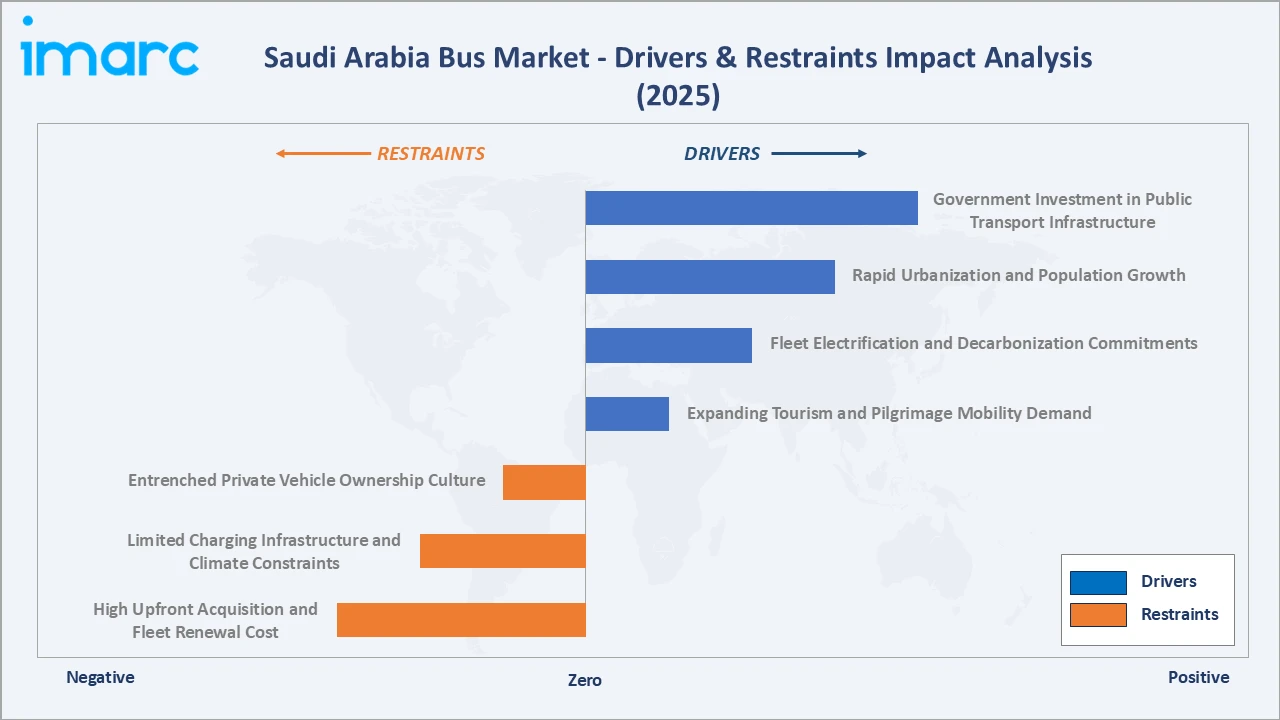
- Government Investment in Public Transport Infrastructure: Sustained public capital allocation toward mass transit networks is expanding structural demand for buses. National programmes fund corridors, depots, terminals, and ticketing systems requiring large committed fleets. Budget-backed procurement insulates this demand from short-term cycles.
- Rapid Urbanization and Population Growth: Expanding metropolitan populations are intensifying congestion and increasing requirements for high-capacity passenger transport. Growing commuter volumes make scheduled bus services economically efficient relative to private vehicle use, translating into larger operating fleets.
- Fleet Electrification and Decarbonization Commitments: Emissions reduction targets are accelerating the transition from conventional diesel fleets toward electric and hybrid buses. Public operators are piloting and scaling zero-emission vehicles supported by depot charging investment and favourable total-cost-of-ownership modelling. Falling battery costs and improving thermal management are steadily widening commercial viability.
- Expanding Tourism and Pilgrimage Mobility Demand: Growth in religious tourism and leisure travel is increasing requirements for intercity coaches and charter transport capacity. Seasonal peaks demand large, comfortable, and reliable vehicles capable of sustained long-distance operation. Operators are consequently renewing and expanding coach fleets to meet rising service quality expectations.
Market Restraints
- High Upfront Acquisition and Fleet Renewal Cost: Substantial capital outlay for vehicle purchase, depot facilities, and workshop tooling constrains adoption among smaller operators. Financing costs and extended payback periods can delay fleet replacement cycles. As a result, ageing vehicles remain in service longer, slowing overall market turnover.
- Limited Charging Infrastructure and Climate Constraints: Insufficient depot and en-route charging capacity restricts large-scale electric bus deployment. High ambient temperatures increase auxiliary cooling loads and can reduce effective battery range and longevity. These operational uncertainties make operators cautious about rapid fleet-wide electrification.
- Entrenched Private Vehicle Ownership Culture: Widespread reliance on private cars limits public transport ridership growth in several corridors. Lower utilisation weakens the revenue case for service expansion and additional vehicle procurement. Shifting travel behaviour requires sustained service quality improvement and supporting policy measures.
Market Opportunities
- Electric Bus Fleet Conversion and Depot Charging: Large-scale replacement of ageing diesel fleets with electric buses represents a significant multi-year procurement opportunity. Integrated packages combining vehicles, charging hardware, and energy management services command higher contract value. Early suppliers establishing depot infrastructure capability are positioned to capture recurring long-term revenue.
- Local Assembly and Component Localization: Policy incentives favouring domestic value addition are creating opportunities for local bodybuilding and assembly operations. Localization reduces import lead times, supports aftersales responsiveness, and improves competitiveness in public tenders. Manufacturers forming joint ventures early can secure preferred supplier positioning.
Market Challenges
- Skilled Technician Availability and Maintenance Capability: Modern buses require specialised diagnostic, electrical, and high-voltage servicing competencies that remain in limited supply. Shortages extend vehicle downtime and raise lifecycle maintenance cost. Sustained investment in training and technical infrastructure is required to support growing and increasingly complex fleets.
- Supply Chain Volatility and Delivery Lead Times: Global component availability, particularly for batteries, electronics, and powertrain systems, can delay vehicle delivery schedules. Extended lead times complicate service planning and contractual commitments for operators. Price volatility in key inputs additionally creates budgeting uncertainty across procurement cycles.
Emerging Market Trends
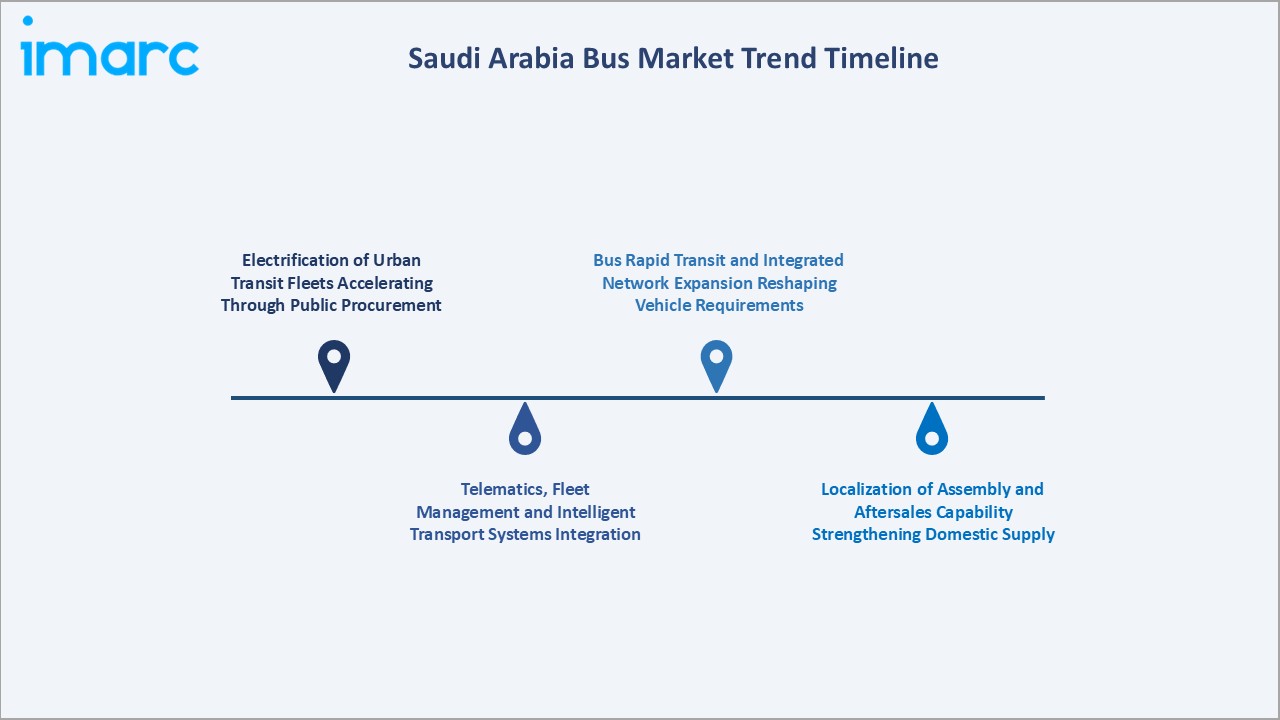
1. Electrification of Urban Transit Fleets Accelerating Through Public Procurement
Public operators are progressively integrating electric buses into scheduled urban services, supported by depot charging investment and improving battery performance. Procurement increasingly specifies zero-emission capability alongside conventional vehicles. Falling lifecycle costs are shifting the balance toward electrified fleets.
2. Bus Rapid Transit and Integrated Network Expansion Reshaping Vehicle Requirements
Dedicated corridors and integrated multimodal networks are changing specification requirements toward higher-capacity, faster-boarding vehicle configurations. Operators are prioritising articulated and high-floor-efficiency designs suited to frequent-stop, high-throughput service patterns. Network integration with rail and feeder services further increases predictable long-term fleet demand.
3. Telematics, Fleet Management and Intelligent Transport Systems Integration
Connected fleet platforms are becoming standard, enabling real-time tracking, predictive maintenance, driver behaviour monitoring, and passenger information services. These systems reduce unplanned downtime and improve schedule adherence and asset utilisation. As data-driven operations mature, digital capability is increasingly a differentiator in competitive tender evaluation.
4. Localization of Assembly and Aftersales Capability Strengthening Domestic Supply
Manufacturers are establishing local assembly, bodybuilding, and parts distribution capability to meet domestic content expectations and improve service responsiveness. Localization shortens delivery timelines and supports faster warranty and maintenance turnaround. This structural shift is progressively deepening the domestic supplier base and raising barriers for import-only competitors.
Industry Value Chain Analysis
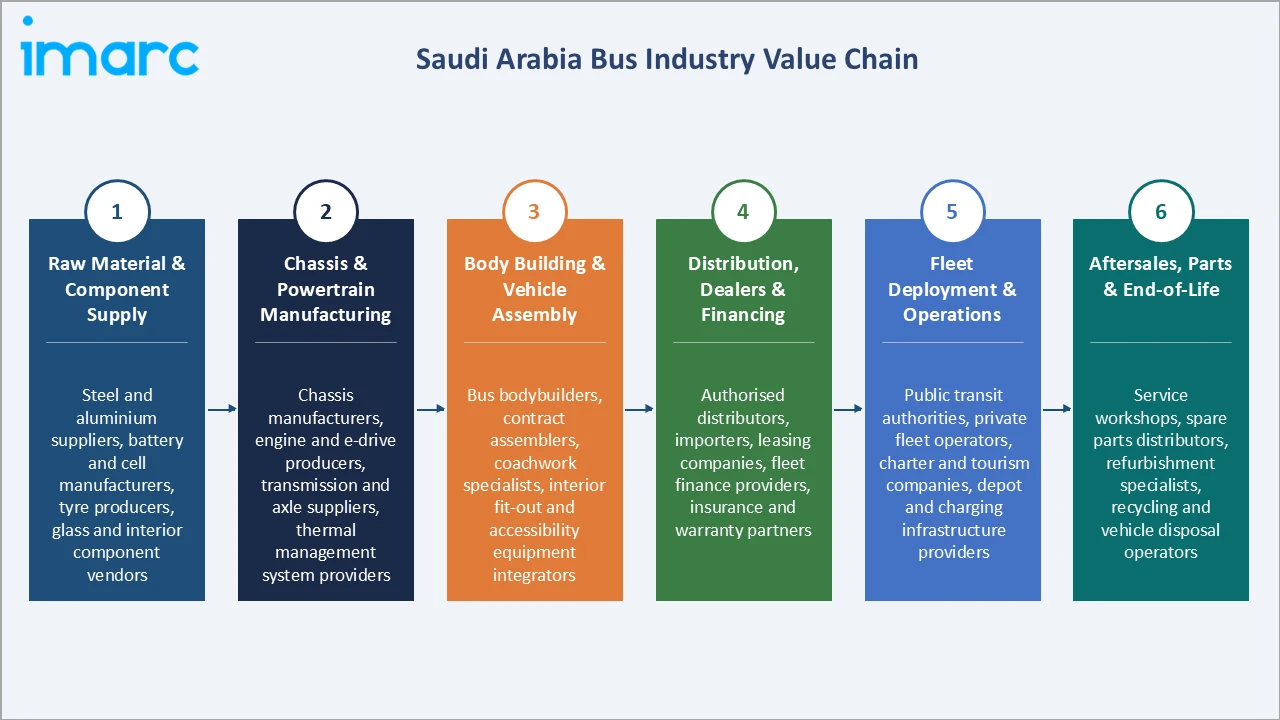
The bus industry value chain integrates raw material and component supply, chassis and powertrain manufacturing, body building and vehicle assembly, distribution and financing, fleet deployment and operations, and aftersales support through end-of-life vehicle handling.
|
Stage |
Key Participants |
|
Raw Material & Component Supply |
Steel and aluminium suppliers, battery and cell manufacturers, tyre producers, glass and interior component vendors |
|
Chassis & Powertrain Manufacturing |
Chassis manufacturers, engine and e-drive producers, transmission and axle suppliers, thermal management system providers |
|
Body Building & Vehicle Assembly |
Bus bodybuilders, contract assemblers, coachwork specialists, interior fit-out and accessibility equipment integrators |
|
Distribution, Dealers & Financing |
Authorised distributors, importers, leasing companies, fleet finance providers, insurance and warranty partners |
|
Fleet Deployment & Operations |
Public transit authorities, private fleet operators, charter and tourism companies, depot and charging infrastructure providers |
|
Aftersales, Parts & End-of-Life |
Service workshops, spare parts distributors, refurbishment specialists, recycling and vehicle disposal operators |
The body building and vehicle assembly stage is the value chain's most commercially differentiated phase, where specification, durability, and configuration determine operator preference. The distribution and financing layer governs access to fleet-scale procurement, while aftersales capability sustains vehicle availability and protects lifecycle economics.
Technology Landscape in the Saudi Arabia Bus Industry
Battery Electric Bus Powertrain Technology
Battery electric powertrains eliminate tailpipe emissions and reduce operating noise and maintenance complexity. Advances in energy density, thermal management, and fast-charging capability are extending practical route coverage in demanding climates. As depot charging infrastructure matures, electric platforms are becoming increasingly viable for high-frequency urban service.
Advanced Driver Assistance and Safety Systems
Collision mitigation, lane departure warning, blind-spot detection, and electronic stability control are becoming standard specification requirements. These systems reduce accident frequency and support insurance and compliance objectives for large fleets. Growing regulatory emphasis on passenger safety continues to accelerate adoption across new vehicle procurement.
Fleet Telematics and Predictive Maintenance Platforms
Connected telematics platforms capture vehicle health, energy consumption, and route performance data in real time. Predictive analytics enable condition-based servicing that reduces unscheduled downtime and extends component life. Consequently, operators achieve higher fleet availability and measurably lower total cost of ownership.
Market Segmentation Analysis
The report covers the following segments:
|
Segment Category |
Leading Segment |
Market Share |
Year |
|
Type |
Single Deck |
88.6% |
2025 |
|
Fuel Type |
Diesel |
86.3% |
2025 |
|
Seat Capacity |
🔒 |
🔒 |
2025 |
|
Application |
🔒 |
🔒 |
2025 |
|
Region |
Northern and Central Region |
39.8% |
2025 |

By Type
Single deck buses lead at 88.6% (2025). The single deck segment encompasses standard urban transit vehicles, midibuses, intercity coaches, and staff and school transport configurations that serve the overwhelming majority of scheduled and contracted route requirements across the Kingdom.
To access detailed market analysis, Request Sample
Double deck buses at 11.4% serve high-density corridors, premium intercity routes, and tourism applications where passenger capacity per unit of road space is the governing constraint. The segment's ~5.9% CAGR reflects selective deployment on specific high-volume corridors rather than broad fleet-wide adoption.
By Fuel Type
Diesel leads at 86.3% (2025). The diesel segment encompasses conventional and modern low-emission compression-ignition platforms deployed across transit, intercity, and contract transport fleets, supported by mature refuelling infrastructure and established maintenance capability.
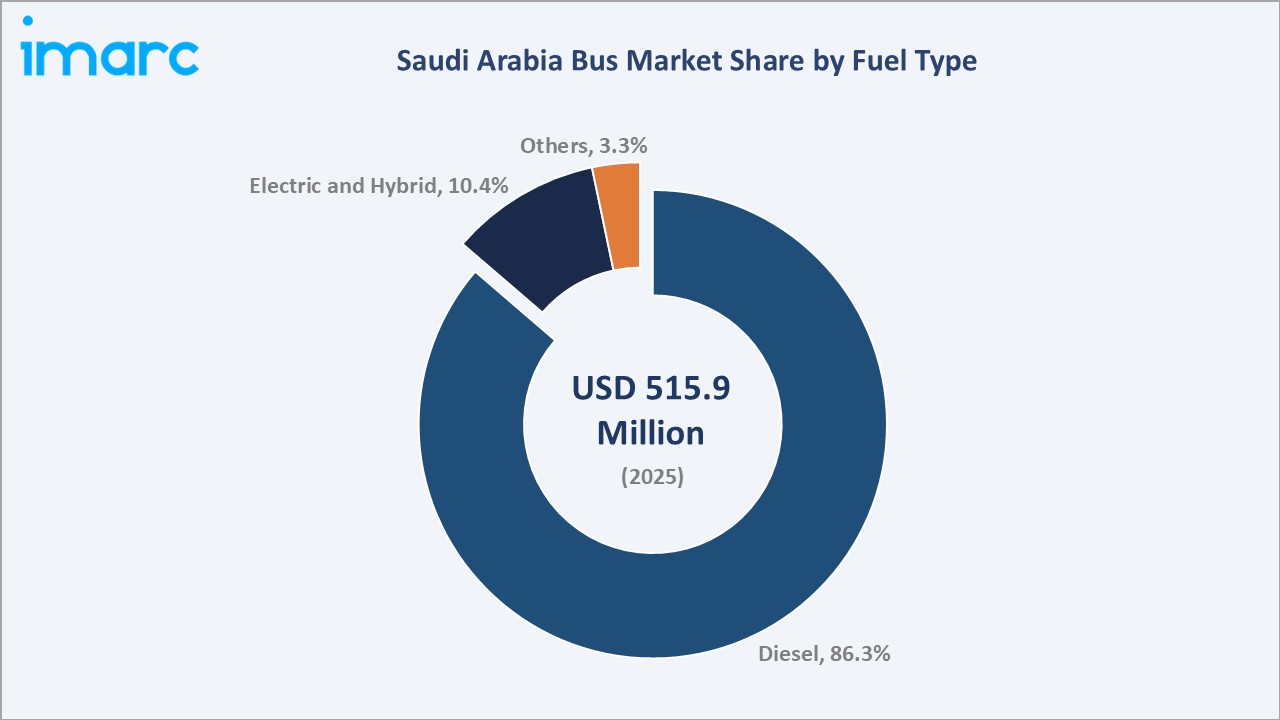
Electric and hybrid buses at 10.4% grow fastest at ~14.2% CAGR through decarbonization policy, depot charging investment, and improving lifecycle economics. Others at 3.3% encompasses compressed natural gas, liquefied petroleum gas, and alternative fuel platforms deployed in selective operating contexts.
Regional Market Insights
|
Region |
Share (2025) |
Key Saudi Arabia Bus Market Drivers & Characteristics |
|
Northern and Central Region |
39.8% |
Driven by metropolitan transit network expansion, administrative and commercial concentration, and large-scale bus rapid transit corridor investment. |
|
Western Region |
30.6% |
Supported by religious tourism and pilgrimage mobility demand, dense urban populations, and sustained intercity coach and charter fleet requirements. |
|
Eastern Region |
20.2% |
Driven by industrial and energy sector staff transport demand, established commercial corridors, and expanding municipal transit service coverage. |
|
Southern Region |
9.4% |
Supported by intercity connectivity requirements, tourism development initiatives, and gradual modernization of regional public transport fleets. |
The Northern and Central Region's 39.8% market leadership is anchored by Riyadh's metropolitan transit build-out and the concentration of government and corporate employment generating sustained commuter volumes. The Western Region's 30.6% reflects pilgrimage-driven coach demand and high urban population density across its principal cities.
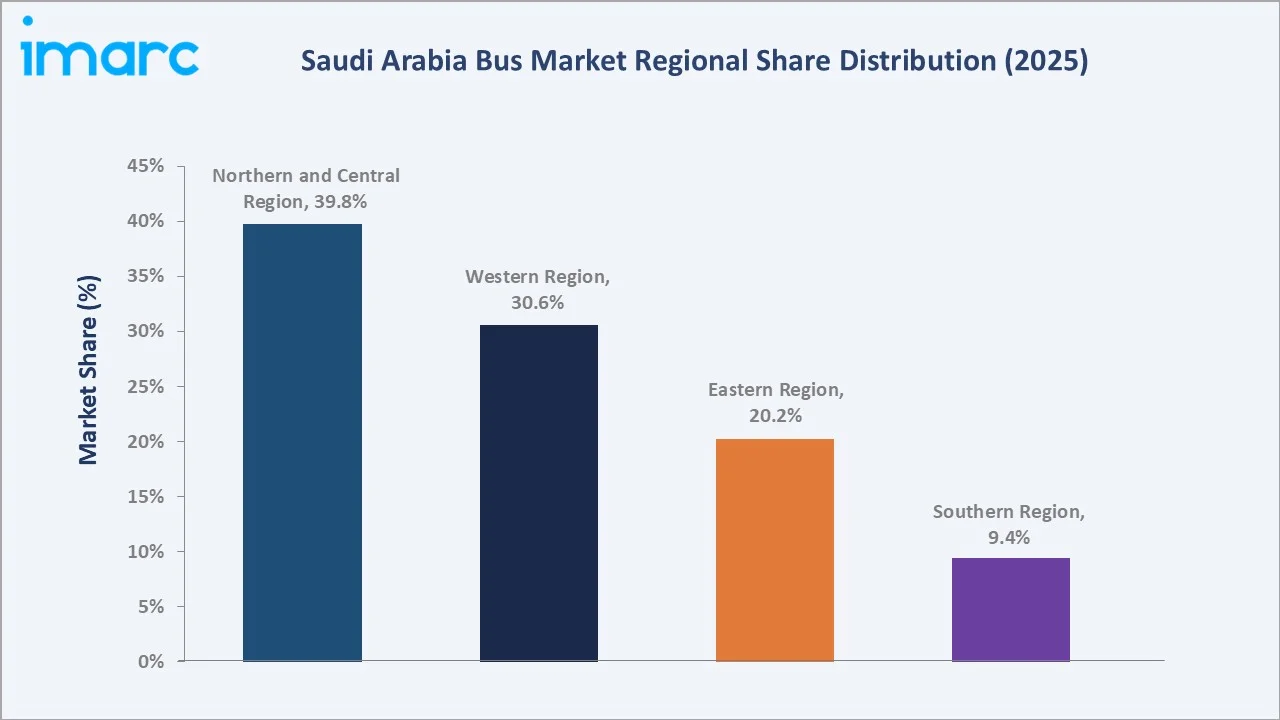
The Eastern Region's 20.2% encompasses industrial staff transport fleets alongside expanding municipal services. The Southern Region, at 9.4%, is the smallest but is progressively modernising its regional connectivity fleet.
Competitive Landscape
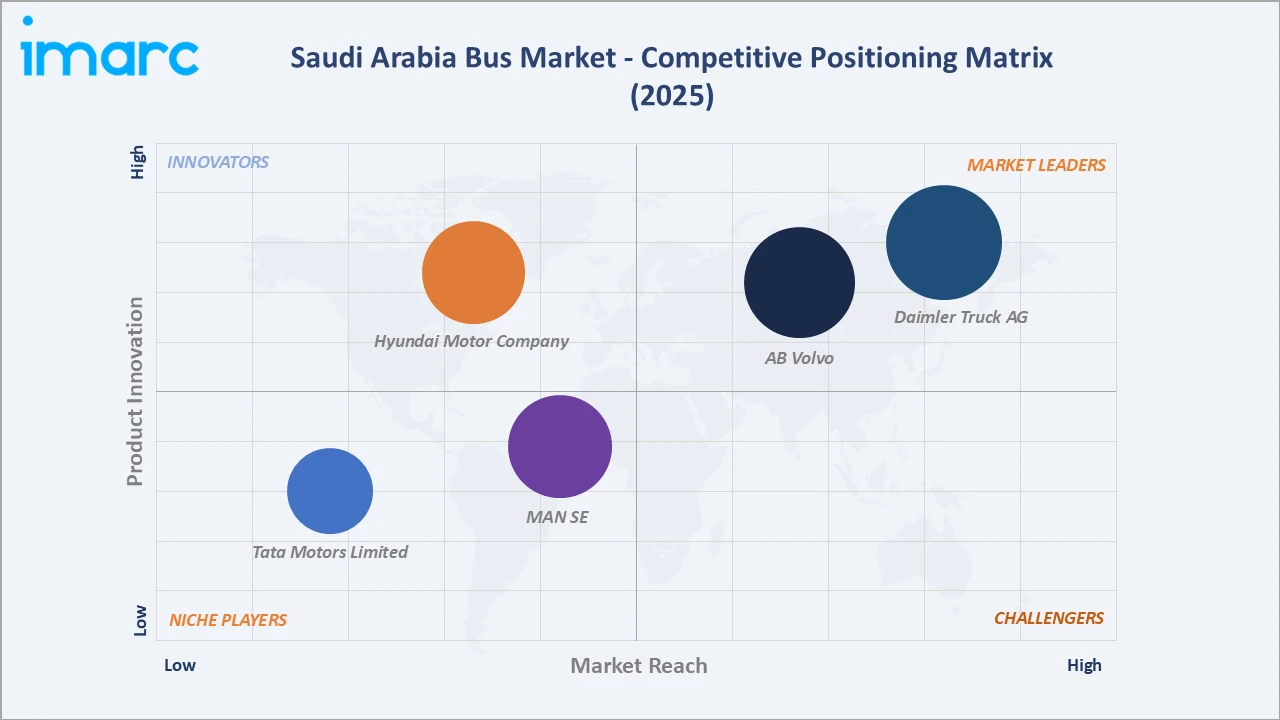
The Saudi Arabia bus market competitive landscape encompasses distinct tiers: global premium bus manufacturers, volume-oriented Asian manufacturers, local bodybuilders and assemblers, and fleet operators procuring at scale.
|
Company Name |
Key Products |
Market Position |
Core Strength |
|
Daimler Truck AG |
Mercedes-Benz Citaro, Intouro, OC 500 chassis |
Market Leader |
Broad transit and coach portfolio combined with an established regional service network, strong safety specification, and proven durability in high-temperature operating conditions. |
|
AB Volvo |
Volvo 7900, 9700, 9900 |
Market Leader |
Premium intercity and transit platforms with advanced safety systems, strong fuel efficiency performance, and a mature electric bus portfolio supported by global depot charging expertise. |
|
MAN SE |
MAN Lion's City |
Established Player |
Efficient urban transit platforms and coach products with modular configuration options and a well-developed European engineering base supporting reliability and lifecycle cost. |
|
Hyundai Motor Company |
Hyundai Universe, Elec City |
Established Player |
Competitive midibus and coach range combined with expanding electric platform capability and strong price-to-specification positioning across contract transport applications. |
|
Tata Motors Limited |
Tata Starbus, LP chassis series |
Emerging Player |
Value-focused platforms with robust construction and extensive parts availability, positioned strongly in staff transport and budget-conscious fleet segments. |
Global premium manufacturers retain leadership in high-specification transit and coach tenders through service network depth and compliance capability. Asian manufacturers are expanding share on price and delivery flexibility, particularly in electric platforms, while localization requirements progressively favour suppliers investing in domestic assembly and aftersales presence.
Key Company Profiles
Daimler Truck AG
Daimler Truck AG is a leading global commercial vehicle manufacturer supplying transit buses and intercity coaches under the Mercedes-Benz and Setra brands. The company provides complete vehicles and bus chassis supported by an extensive regional service and parts network.
- Key Products: Mercedes-Benz Citaro, Mercedes-Benz Tourismo, Mercedes-Benz Intouro, OC 500 chassis.
- Recent Developments: In March 2026, Daimler Buses presented the Mercedes-Benz eCitaro with the new NMC4 battery and expanded eMobility services at mobility move 2026 in Berlin, offering higher energy density, longer service life, and enhanced battery monitoring.
- Strategic Focus: Focused on safety system leadership, fleet electrification, and lifecycle cost reduction through integrated service and connectivity offerings.
AB Volvo
AB Volvo is a prominent manufacturer of buses and bus chassis, offering transit, intercity, and coach platforms alongside a well-established electric bus range. The company combines vehicle supply with fleet management and charging system expertise.
- Key Products: Volvo 7900 Electric, Volvo 9700, Volvo 9900, B8R and B11R chassis.
- Recent Developments: In May 2026, AB Volvo's subsidiary Volvo Buses received an order from Swedish operator Bergkvara for 47 Volvo 8900 Electric buses to operate regional services across Skåne and city routes in Helsingborg. The order includes both 4×2 and 6×2 configurations equipped with five or six battery packs, with deliveries scheduled through 2027, further strengthening Volvo Buses' position in sustainable, zero-emission public transportation.
- Strategic Focus: Centred on electromobility, advanced safety systems, and total cost of ownership optimisation for high-utilisation public transport fleets.
MAN SE
MAN SE manufactures urban transit buses, intercity vehicles, and coaches, together with bus chassis supplied to independent bodybuilders. The company emphasises modular configuration and operational efficiency across its product range.
- Key Products: MAN Lion's City, MAN Lion's City E, MAN Lion's Coach, MAN bus chassis range.
- Recent Developments: In May 2026, MAN Truck & Bus received an order for 112 fully electric Lion's City E buses from Vilnius operator VVT, the largest electric bus procurement recorded in Lithuania, following the start of e-bus production in Ankara in April 2026.
- Strategic Focus: Focused on efficient urban transit platforms, modular vehicle architecture, and progressive electrification of its core product portfolio.
Market Concentration Analysis
The Saudi Arabia bus market is moderately concentrated at the vehicle supply tier, with a limited group of global manufacturers capturing most high-specification transit and coach tenders. The bodybuilding and assembly tier is more fragmented.
Concentration is increasing at the electric platform tier, where technology capability and charging infrastructure expertise create meaningful barriers to entry.
Investment & Growth Opportunities
Highest Growth Segments
Electric and hybrid buses (~14.2% CAGR), depot charging infrastructure, intelligent transport and telematics systems, bus rapid transit corridor fleets, intercity coach capacity serving pilgrimage demand, and local assembly and bodybuilding operations represent the highest-growth investment vectors in the Saudi Arabia bus market through 2034.
Emerging Investment Opportunities
Public fleet electrification programmes represent the largest near-term opportunity. Manufacturers and infrastructure providers that establish preferred supplier relationships with transit authorities and depot operators are positioned for above-market revenue growth as procurement budgets are progressively disbursed across the forecast period.
Investment Themes
- Integrated electric bus and depot charging solutions capturing full-system contract value: Combined vehicle, charging hardware, and energy management propositions command higher contract value than vehicle supply alone. Suppliers building this capability by 2026-2027 are positioned to capture the fleet conversion wave as transit operators scale zero-emission deployment.
- Local assembly and aftersales network investment supporting tender competitiveness: Domestic assembly and parts distribution capability improves delivery lead times and localization scoring in public procurement. Companies establishing this footprint early secure durable advantage as content requirements tighten across the forecast horizon.
Future Market Outlook (2026-2034)
The Saudi Arabia bus market is projected to grow from USD 515.9 Million in 2025 to USD 553.9 Million in 2026, reaching USD 976.8 Million by 2034, delivering a 7.35% CAGR over the forecast period.
The market's anchor value of USD 735.6 Million in 2030 represents an industry at a transition point, where electric platforms move from pilot deployment to mainstream procurement and localized assembly becomes a structural feature of the supply base.
Three structural forces define market growth through 2034. Public transport investment as a policy priority creates budget-committed, multi-year fleet demand. Urbanization expands the commuter base requiring scheduled services.
Decarbonization commitments progressively shift fleet composition toward electric and hybrid platforms, creating a sustained replacement cycle extending beyond the forecast horizon.
Research Methodology
Primary Research
Primary research comprised structured interviews with 45+ industry stakeholders (2025) including fleet operations directors; transit authority procurement managers; bus manufacturer regional sales leads; bodybuilding and assembly specialists; and mobility infrastructure consultants.
Secondary Research
Secondary research encompassed national transport statistics; public transport programme disclosures; vehicle registration data; company annual reports; commercial vehicle industry publications; electrification and infrastructure studies; and regional mobility market data. Over 55 secondary sources were reviewed.
Forecasting Models
Market revenue forecasts were developed using a segment bottom-up model: (i) vehicle unit demand by application; (ii) average selling price by type and fuel platform; (iii) fleet replacement and expansion cycle modelling.
Saudi Arabia Bus Market Report Coverage:
| Report Features | Details |
|---|---|
| Base Year of the Analysis | 2025 |
| Historical Period | 2020-2025 |
| Forecast Period | 2026-2034 |
| Units | Million USD |
| Scope of the Report | Exploration of Historical Trends and Market Outlook, Industry Catalysts and Challenges, Segment-Wise Historical and Future Market Assessment:
|
| Types Covered | Single Deck, Double Deck |
| Fuel Types Covered | Diesel, Electric and Hybrid, Others |
| Seat Capacities Covered | 15-30 Seats, 31-50 Seats, More Than 50 Seats |
| Applications Covered | Transit Bus, Intercity/Coaches, Others |
| Regions Covered | Northern and Central Region, Western Region, Eastern Region, Southern Region |
| Companies Covered | Daimler Truck AG, AB Volvo, MAN SE, Hyundai Motor Company, Tata Motors Limited, etc. |
| Customization Scope | 10% Free Customization |
| Post-Sale Analyst Support | 10-12 Weeks |
| Delivery Format | PDF and Excel through Email (We can also provide the editable version of the report in PPT/Word format on special request) |
Key Benefits for Stakeholders:
- IMARC’s industry report offers a comprehensive quantitative analysis of various market segments, historical and current market trends, market forecasts, and dynamics of the Saudi Arabia bus market from 2020-2034.
- The research report provides the latest information on the market drivers, challenges, and opportunities in the Saudi Arabia bus market.
- Porter's five forces analysis assist stakeholders in assessing the impact of new entrants, competitive rivalry, supplier power, buyer power, and the threat of substitution. It helps stakeholders to analyze the level of competition within the Saudi Arabia bus industry and its attractiveness.
- Competitive landscape allows stakeholders to understand their competitive environment and provides an insight into the current positions of key players in the market.
Frequently Asked Questions About the Saudi Arabia Bus Market Report
The Saudi Arabia bus market size is estimated at USD 553.9 Million in 2026. The market is driven by sustained public transport investment, rapid urbanization, rising tourism and pilgrimage mobility demand, and progressive fleet modernization. Improvements in vehicle safety systems, telematics, and alternative powertrain technology are further supporting market growth.
The market grows at 7.35% CAGR during 2026-2034, reaching USD 976.8 Million by 2034. Electric and hybrid buses grow fastest at ~14.2% CAGR through decarbonization policy, expanding depot charging infrastructure, and improving lifecycle cost economics.
Single deck buses lead at 88.6% through route flexibility, lower acquisition and maintenance cost, manoeuvrability in dense urban environments, and suitability for the majority of transit and intercity corridor requirements.
Diesel leads at 86.3% through established refuelling infrastructure, competitive acquisition cost, and proven reliability under high-temperature and long-distance operating conditions.
The Northern and Central Region leads at 39.8% through metropolitan transit network expansion and the concentration of administrative and commercial employment generating sustained commuter demand.
Leading companies include Daimler Truck AG, AB Volvo, MAN SE, Hyundai Motor Company, and Tata Motors Limited, among others.
The market is projected to reach approximately USD 735.6 Million by 2030, with electric bus procurement achieving mainstream adoption in metropolitan transit fleets, bus rapid transit corridors reaching operational maturity, depot charging infrastructure scaling across major depots, and localized assembly capability strengthening the domestic supply base.
Electric bus adoption is driven by national emissions reduction commitments, improving battery and thermal management technology, falling lifecycle costs relative to diesel, and public procurement increasingly specifying zero-emission capability. Depot charging investment and favourable total cost of ownership modelling are progressively widening commercial viability.
Need more help?
- Speak to our experienced analysts for insights on the current market scenarios.
- Include additional segments and countries to customize the report as per your requirement.
- Gain an unparalleled competitive advantage in your domain by understanding how to utilize the report and positively impacting your operations and revenue.
- For further assistance, please connect with our analysts.
 Request Customization
 Speak to an Analyst
 Request Brochure
 Inquire Before Buying
Benefits of Customization
- Personalize this research
- Triangulate with your data
- Get data as per your format and definition
- Gain a deeper dive into a specific application, geography, customer, or competitor
- Any level of personalization
Get in Touch With Us
UNITED STATES
Phone: +1-201-971-6302
INDIA
Phone: +91-120-433-0800
UNITED KINGDOM
Phone: +44-753-714-6104
Email: [email protected]
Client Testimonials




.webp)




.webp)













Related Reports

Choose your plan
*Please note that the prices mentioned below are starting prices for each bundle type. Kindly contact our team for further details.*
Single User License
- 1 User License, Access on 2 Devices
- PDF Report + Excel Dataset (Password Protected)
- Lifetime Access
- No Printing Rights
- 10% Free Report Customization
- 10–12 Weeks of Analyst Support
Five User License
- Access for 5 Users, 2 Devices per User
- PDF Report + Excel Dataset (Password Protected)
- Lifetime Access
- Dedicated Account Manager
- 12–14 Weeks of Analyst Support
- No Printing Rights
- 15% Free Report Customization
- 25% Discount on Your Next Purchase
Corporate User License
- Unlimited User Access (Within Your Organization)
- PDF Report + Excel Dataset
- Lifetime Access
- Dedicated Account Manager
- 14–20 Weeks of Analyst Support
- No Printing Rights
- 20% Free Report Customization
- 30% Discount on Your Next Purchase
Essential Insights
What's included:
3 reports
- Lifetime Access
- PDF Reports
- Excel Datasets
- 2 Weeks of Free Analyst Support
- 2 User Licenses
- Access on 2 Devices
- Printing Rights
- Complimentary PowerPoint (PPT) Version
- Complimentary License Upgrade
Professional Access
What's included:
5 reports
- Lifetime Access
- PDF Reports
- Excel Datasets
- 8 Weeks of Free Analyst Support
- 2 User Licenses
- Access on 2 Devices
- Printing Rights
- Complimentary PowerPoint (PPT) Version
- Complimentary License Upgrade
Business Advantage
What's included:
8 reports
- Lifetime Access
- PDF Reports
- Excel Datasets
- 14 Weeks of Free Analyst Support
- 2 User Licenses
- Access on 2 Devices
- Printing Rights
- Complimentary PowerPoint (PPT) Version
- Complimentary License Upgrade
Enterprise Intelligence
What's included:
10 reports
- Lifetime Access
- PDF Reports
- Excel Datasets
- 20 Weeks of Free Analyst Support
- 2 User Licenses
- Access on 2 Devices
- Printing Rights
- Complimentary PowerPoint (PPT) Version
- Complimentary License Upgrade