
Saudi Arabia Cloud Managed Services Market Size, Share, Trends and Forecast by Service Type, Deployment Model, Vertical, and Region, 2026-2034
Saudi Arabia Cloud Managed Services Market Size, Share, Trends & Forecast (2026-2034)
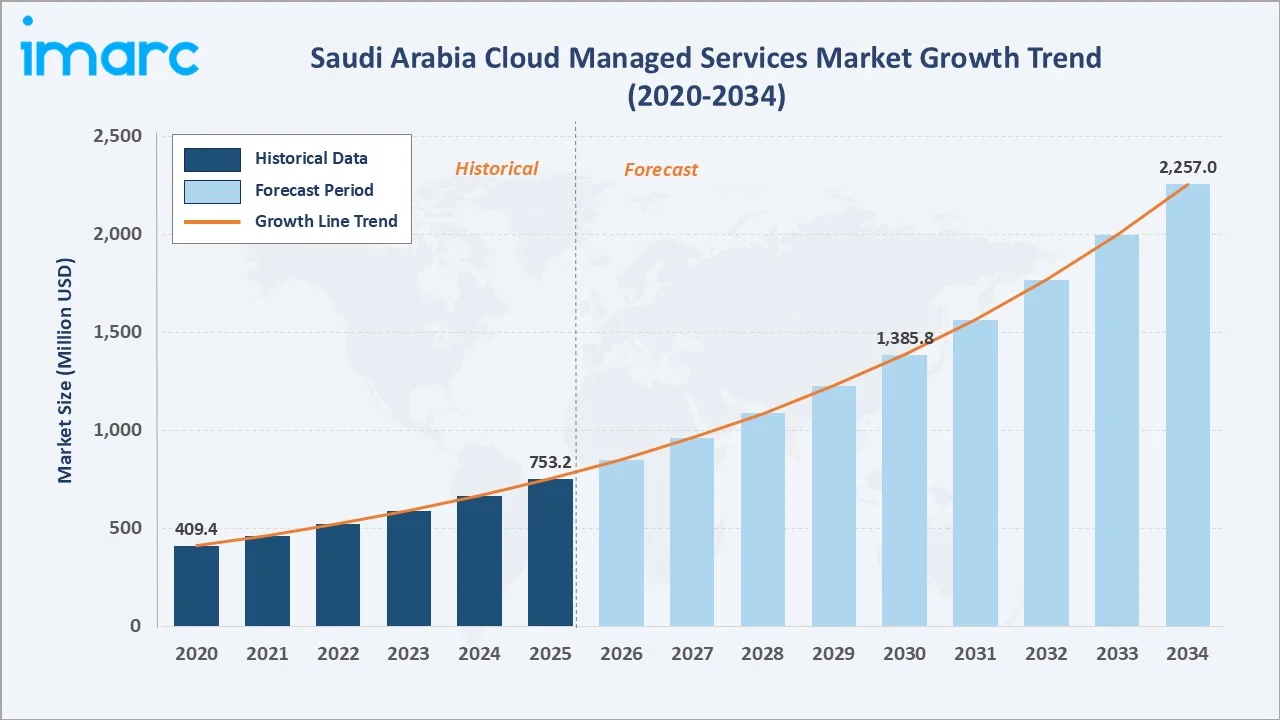
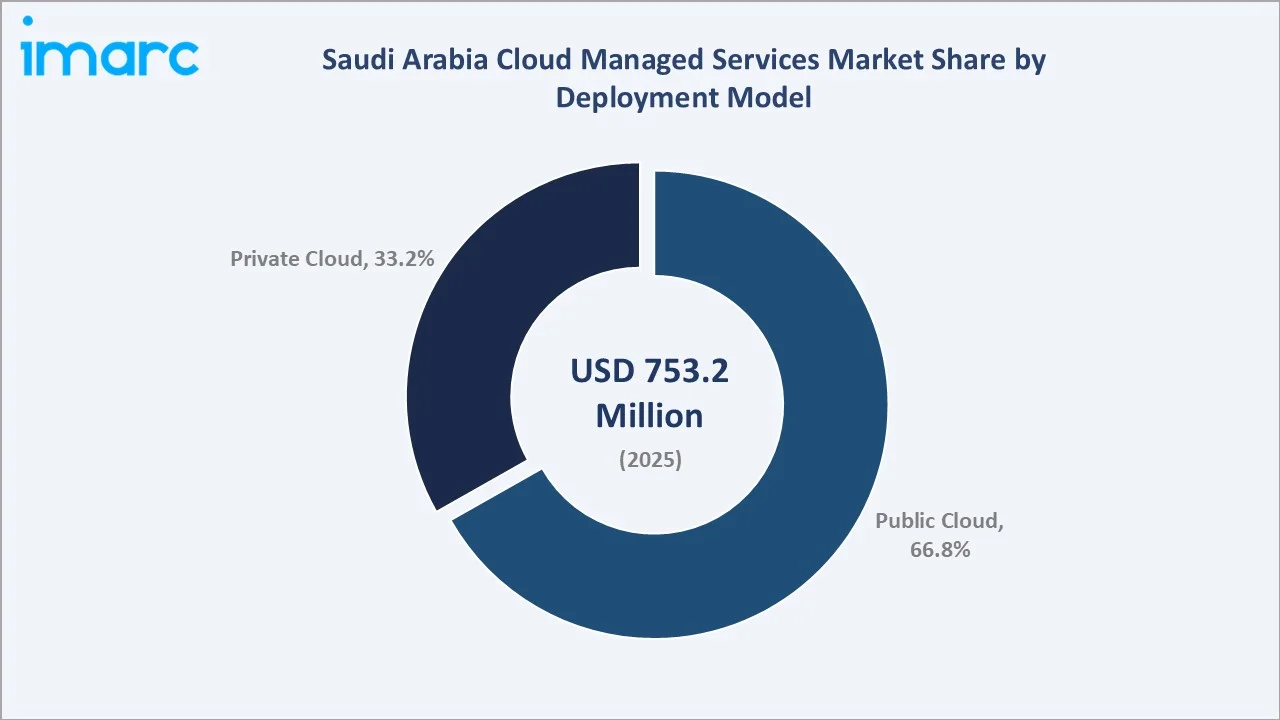
The Saudi Arabia cloud managed services market reached USD 753.2 Million in 2025 and is projected to reach USD 2,257.0 Million by 2034, growing at a CAGR of 12.97% during 2026-2034. The market is driven by Vision 2030 digital transformation mandates, rising demand for managed security services, growing cloud adoption across government and BFSI sectors, and increasing reliance on third-party IT expertise. Public Cloud leads the deployment model segment at 66.8%, Large Enterprises dominate at 68.7%, and the Northern and Central Region commands 43.4% of regional share.
Market Snapshot
|
Metric |
Value |
|
Market Size (2025) |
USD 753.2 Million |
|
Forecast Market Size (2034) |
USD 2,257.0 Million |
|
CAGR (2026-2034) |
12.97% |
|
Base Year |
2025 |
|
Historical Period |
2020-2025 |
|
Forecast Period |
2026-2034 |
|
Dominant Deployment Model |
Public Cloud (66.8%, 2025) |
|
Dominant Organization Size |
Large Enterprises (68.7%, 2025) |
|
Leading Region |
Northern and Central Region (43.4%, 2025) |
The market expanded from USD 409.4 Million in 2020 to USD 753.2 Million in 2025, anchored at USD 1,385.8 Million in 2030 and forecast to reach USD 2,257.0 Million by 2034. Vision 2030 cloud-first policies and hyperscaler entry accelerated adoption, with recovery and above-trend growth through 2022-2025 as enterprise digital transformation mandates intensified.
To get more information on this market, Request Sample
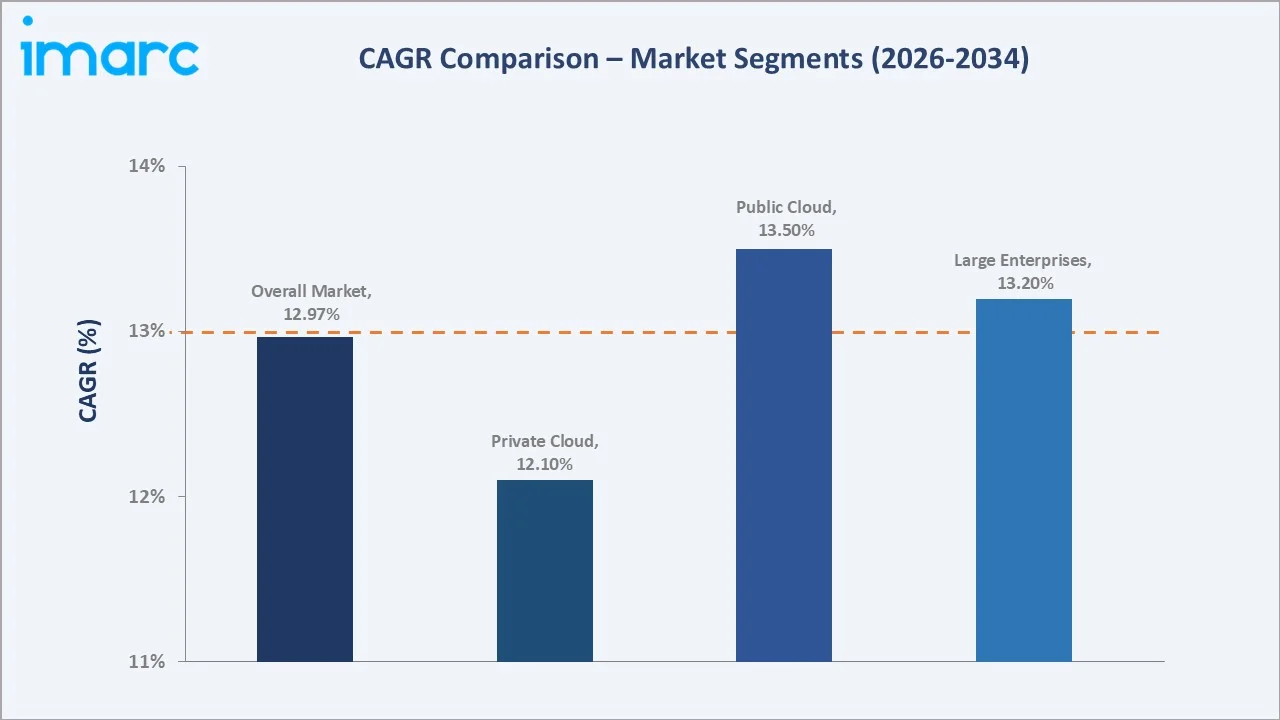
Public Cloud deployment grows at approximately 13.5% CAGR as scalable, pay-as-you-go managed services gain widespread enterprise adoption across BFSI, government, and healthcare sectors. Large enterprise deployments drive above-market CAGR at ~13.2% as multi-cloud and hybrid MSP strategies accelerate across the Kingdom.
Executive Summary
The Saudi Arabia cloud managed services market reached USD 753.2 Million in 2025, representing one of the Middle East's highest-growth technology markets driven by Vision 2030's digital transformation imperative and the fundamental shift of enterprise IT operations toward outsourced, cloud-native managed service delivery. The market is projected to reach USD 2,257.0 Million by 2034.
Public Cloud at 66.8% dominates through its scalability, cost efficiency, and breadth of managed services offered by global hyperscalers with established Saudi Arabia cloud regions. Large Enterprises at 68.7% lead adoption through complex, multi-service MSP contracts. The Northern and Central Region at 43.4% commands the highest regional share through Riyadh-concentrated enterprise IT investment.
Key Market Insights
|
Insight |
Data |
|
Dominant Deployment Model |
Public Cloud – 66.8% share (2025) |
|
Dominant Organization Size |
Large Enterprises – 68.7% market share (2025) |
|
Leading Region |
Northern and Central Region – 43.4% market share (2025) |
|
Market Opportunity |
Managed security services; sovereign cloud; AI-powered MSP platforms; SME cloud adoption programs |
Key Analytical Observations Supporting the Above Data:
- Public Cloud at 66.8%: Public Cloud dominates as global hyperscalers—AWS, Microsoft Azure, and Google Cloud—operate dedicated Saudi Arabia cloud regions meeting CITC and NCA data residency requirements, enabling compliant managed service delivery at scale for enterprise, government, and BFSI clients.
- Large Enterprises at 68.7%: Large enterprises lead through established IT procurement budgets, complex multi-site managed service requirements, and stronger ROI realization from comprehensive MSP engagements covering managed security, network, infrastructure, and application services.
- Northern and Central Region at 43.4%: The Northern and Central Region dominates through Riyadh's concentration of government ministries, large enterprise headquarters, and financial sector institutions that are the primary procurement drivers for comprehensive cloud managed services engagements.
Saudi Arabia Cloud Managed Services Market Overview
The Saudi Arabia cloud managed services market encompasses the outsourced management of cloud-based IT infrastructure, networks, security, applications, mobility, and communication services by third-party providers. Service categories include managed network, security, infrastructure, business, mobility, and communication and collaboration services.
The ecosystem integrates global cloud hyperscalers, regional MSPs, telecommunications companies, software vendors, and regulatory bodies. Macroeconomic drivers include Vision 2030 digital infrastructure investment, NCA cloud security mandates, enterprise IT cost optimization imperatives, and the rapid growth of data-intensive sectors requiring scalable cloud management.
Market Dynamics
To evaluate market opportunities, Request Sample
Market Drivers
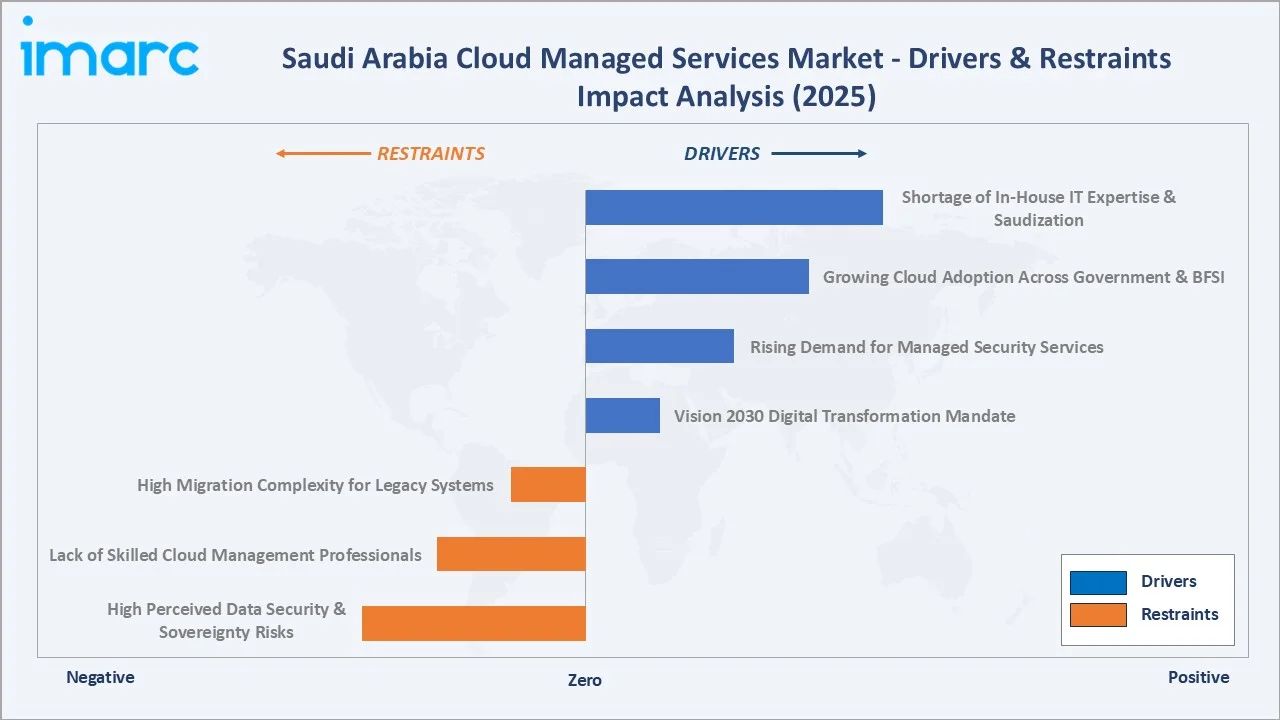
- Vision 2030 Digital Transformation Mandate: Saudi Arabia's Vision 2030 program positions cloud adoption as foundational to economic diversification, with government entities mandated to migrate IT systems to cloud infrastructure and engage managed service providers for operational continuity. Major giga-projects including NEOM, Smart Riyadh, and the National Data Management Office are generating large-scale MSP procurement pipelines. These initiatives create multi-year managed service contracts across infrastructure, security, and business process management domains.
- Rising Demand for Managed Security Services: Escalating cyber threats targeting Saudi Arabia's financial, government, and energy sectors—combined with NCA's Essential Cybersecurity Controls mandate—are driving enterprises to outsource security operations to specialized managed security service providers. Organizations increasingly require 24/7 threat monitoring, incident response, and compliance management that exceed internal IT team capabilities. The Kingdom's position as a high-value cyber target amplifies managed security service procurement urgency across all enterprise verticals.
- Growing Cloud Adoption Across Government & BFSI: Government entities under the Government Cloud program and BFSI institutions under Saudi Central Bank (SAMA) cloud guidelines are mandating cloud-first IT architectures that require professional managed service delivery. Government cloud spending is accelerating as ministries migrate to CITC-certified cloud environments. BFSI sector MSP demand is driven by core banking modernization, digital payment infrastructure management, and regulatory compliance requirements that necessitate continuous managed service support.
- Shortage of In-House IT Expertise & Saudization: Saudi Arabia faces a significant shortage of cloud-skilled IT professionals capable of managing complex, multi-cloud enterprise environments. Saudization workforce requirements create additional pressure on internal IT team composition and capability, making third-party managed service providers economically and operationally compelling for enterprises requiring 24/7 cloud management. MSP engagement enables organizations to access global cloud expertise while maintaining Saudi-compliant workforce structures.
Market Restraints
- High Perceived Data Security & Sovereignty Risks: Enterprise and government organizations remain concerned about data sovereignty, residency compliance, and security risks associated with third-party managed cloud service engagements. PDPL (Personal Data Protection Law) requirements and sector-specific data governance mandates create compliance complexity for MSP delivery models, particularly for cross-border data management. These concerns delay managed service adoption and increase compliance management costs for MSP providers operating in the Kingdom.
- Lack of Skilled Cloud Management Professionals: Saudi Arabia's shortage of certified cloud architects, security specialists, and DevOps engineers constrains MSP service delivery quality and scalability. Building local cloud talent pipelines requires sustained investment in training and certification programs that create multi-year staffing gaps for MSP providers. Dependency on expatriate cloud expertise creates operational vulnerability and increases service delivery costs in the highly regulated Saudi labor market.
- High Migration Complexity for Legacy Systems: Saudi enterprises across government, manufacturing, and financial services operate extensive legacy IT infrastructure that creates significant complexity and cost in migrating to managed cloud service models. Integration challenges between legacy ERP, database, and operational technology systems and modern cloud platforms extend MSP onboarding timelines and increase project risk. These migration barriers reduce the pace of enterprise MSP adoption, particularly among mid-market organizations with limited transformation budgets.
Market Opportunities
- Sovereign Cloud and Government MSP Expansion: Saudi Arabia's National Cloud Computing Program and sovereign data requirements are creating a large-scale, policy-driven MSP market for locally hosted, NCA-compliant cloud managed services. Government entities represent a structurally captive, long-duration MSP procurement pipeline as public sector cloud migration accelerates under Vision 2030 digital government targets.
- AI-Powered MSP Platform Services: Integration of AI, machine learning, and AIOps capabilities into managed service delivery is creating premium service tiers that deliver predictive infrastructure management, automated remediation, and intelligent cost optimization. Early MSP providers deploying AI-native service platforms are commanding premium pricing and achieving higher client retention rates across the Saudi enterprise market.
Market Challenges
- Multi-Cloud Complexity and Vendor Lock-In Risks: Enterprises adopting multi-cloud MSP strategies face significant complexity in managing consistent security, governance, and cost optimization across AWS, Azure, Google Cloud, and local cloud environments. The risk of vendor lock-in to specific MSP platforms creates procurement caution that extends contract decision timelines and increases client negotiating complexity for MSP providers.
- Evolving Regulatory Compliance Requirements: The rapidly evolving Saudi cloud regulatory landscape—including NCA Essential Cybersecurity Controls, CITC service provider regulations, SAMA cloud guidelines, and PDPL data protection requirements—creates continuous compliance investment requirements for MSP providers. Keeping pace with regulatory changes across multiple sector-specific frameworks simultaneously is a significant operational challenge that increases MSP service delivery costs.
Emerging Market Trends
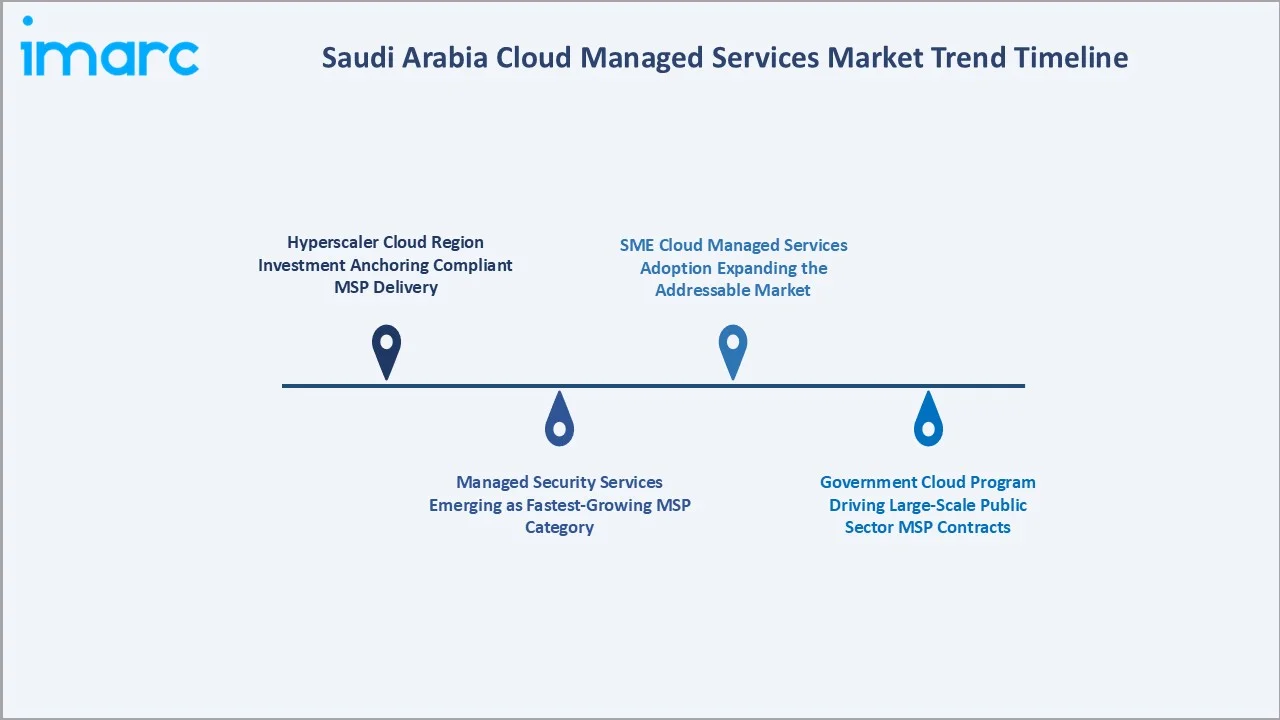
1. Hyperscaler Cloud Region Investment Anchoring Compliant MSP Delivery
AWS, Microsoft Azure, and Google Cloud have established dedicated Saudi Arabia cloud regions meeting CITC data residency and NCA security requirements, creating compliant infrastructure foundations for large-scale enterprise MSP delivery. These local cloud regions enable MSP providers to offer sovereign managed services that satisfy government and BFSI regulatory requirements previously impossible with offshore cloud delivery. The hyperscaler regional presence is attracting global systems integrators establishing Saudi-based MSP practices to serve this captive compliance-driven demand.
2. Managed Security Services Emerging as Fastest-Growing MSP Category
Managed Security Service Provider (MSSP) engagements are growing at above-market rates as NCA compliance mandates and escalating cyber threat environments compel enterprises to outsource security operations center (SOC) management, threat intelligence, and incident response capabilities. The Kingdom's status as a high-value cyber target across energy, financial, and government sectors is driving demand for specialist MSSP capabilities that exceed internal IT team competencies. AI-powered threat detection and automated response platforms are creating premium MSSP service tiers.
3. Government Cloud Program Driving Large-Scale Public Sector MSP Contracts
Saudi Arabia's National Cloud Computing Program and Government Cloud (G-Cloud) initiative are mandating public sector migration to CITC-certified cloud environments managed by qualified MSP providers. These programs are generating large, multi-year MSP procurement contracts across infrastructure management, security operations, and application support for over 1,000 government entities. The Government Cloud program represents a structurally captive MSP demand pipeline anchoring above-trend market growth through the forecast period.
4. SME Cloud Managed Services Adoption Expanding the Addressable Market
Government SME support programs under Vision 2030, combined with affordable cloud MSP subscription models offered by regional telco-backed MSPs, are expanding cloud managed services adoption beyond large enterprise buyers. STC, Mobily, and regional MSPs are offering modular, cost-accessible managed cloud bundles tailored for Saudi SMEs in retail, professional services, and manufacturing. This SME market expansion is creating a high-growth, long-duration incremental revenue opportunity that diversifies MSP provider client bases beyond the large enterprise segment.
Industry Value Chain Analysis
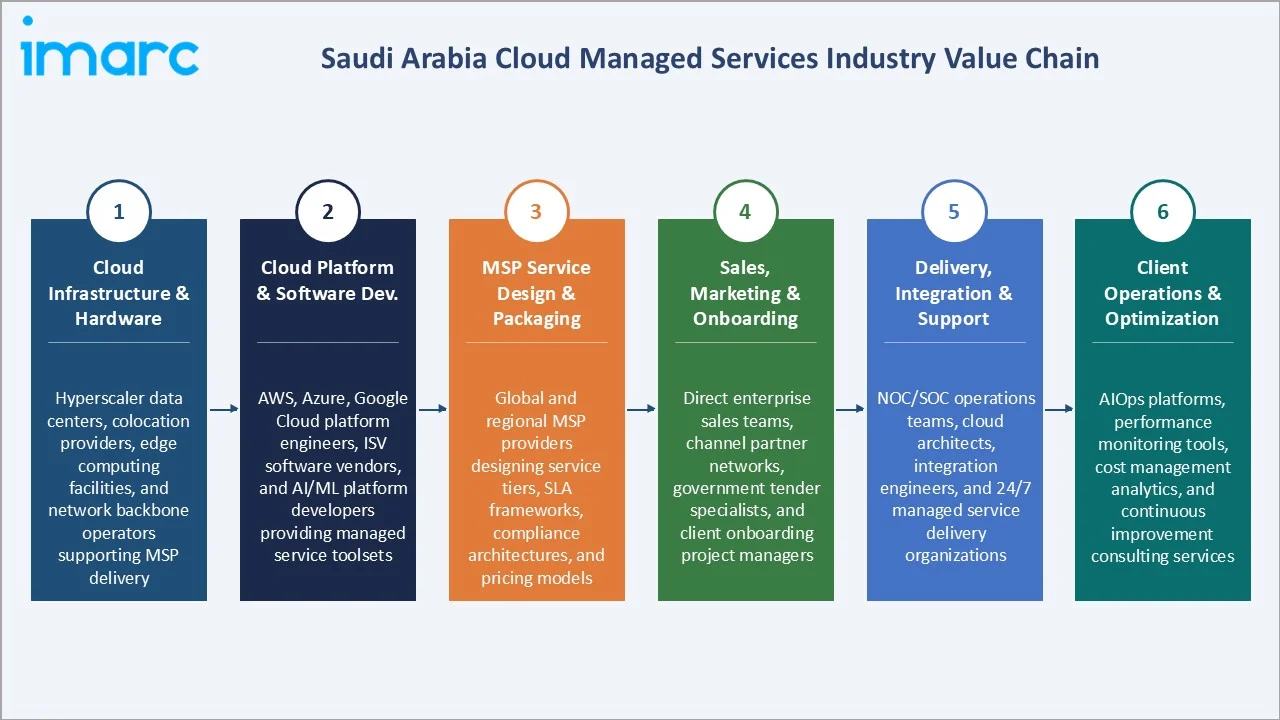
The Saudi Arabia cloud managed services value chain integrates cloud infrastructure provisioning, platform and software development, MSP service design and packaging, go-to-market delivery, ongoing client support, and continuous optimization services. The value chain is progressively consolidating toward integrated MSP platforms that bundle infrastructure, security, and application management into unified service agreements.
|
Stage |
Key Participants |
|
Cloud Infrastructure & Hardware |
Hyperscaler data centers, colocation providers, edge computing facilities, and network backbone operators supporting MSP delivery |
|
Cloud Platform & Software Dev. |
AWS, Azure, Google Cloud platform engineers, ISV software vendors, and AI/ML platform developers providing managed service toolsets |
|
MSP Service Design & Packaging |
Global and regional MSP providers designing service tiers, SLA frameworks, compliance architectures, and pricing models |
|
Sales, Marketing & Onboarding |
Direct enterprise sales teams, channel partner networks, government tender specialists, and client onboarding project managers |
|
Delivery, Integration & Support |
NOC/SOC operations teams, cloud architects, integration engineers, and 24/7 managed service delivery organizations |
|
Client Operations & Optimization |
AIOps platforms, performance monitoring tools, cost management analytics, and continuous improvement consulting services |
The MSP service design and packaging tier is the most commercially differentiated stage in the Saudi Arabia cloud managed services value chain. The delivery and SOC/NOC operations tier is experiencing the most rapid talent investment as NCA compliance mandates create binding managed security service delivery requirements.
Technology Landscape in the Saudi Arabia Cloud Managed Services Industry
AIOps and Intelligent Automation Technology
AIOps platforms integrate AI, machine learning, and big data analytics to automate cloud infrastructure monitoring, anomaly detection, root cause analysis, and self-healing remediation across complex multi-cloud managed service environments. These platforms are transforming MSP service delivery economics by replacing manual monitoring workflows with automated, predictive management that reduces mean time to resolution and improves SLA performance.
Zero Trust Security Architecture Technology
Zero trust network access and cloud-native security management technologies are becoming foundational to NCA-compliant managed security service delivery in Saudi Arabia. These architectures enforce continuous identity verification, micro-segmentation, and least-privilege access controls across cloud workloads, enabling MSP providers to deliver provably compliant security postures for government and BFSI enterprise clients. The mandatory adoption of NCA Essential Cybersecurity Controls is driving rapid enterprise investment in zero trust managed security service engagements.
Sovereign Cloud and Data Residency Technology
In 2025, AWS, Microsoft, and Google expanded their dedicated Saudi Arabia sovereign cloud infrastructure to support NCA and CITC data residency compliance requirements for government and regulated sector managed service delivery. These sovereign cloud zones enable MSP providers to offer legally compliant, locally hosted managed services with documented data governance chains required for government cloud program qualification.
Market Segmentation Analysis
The report covers the following segments:
|
Segment Category |
Leading Segment |
Market Share |
Year |
|
Service Type |
🔒 |
🔒 |
2025 |
|
Deployment Model |
Public Cloud |
66.8% |
2025 |
|
Organization Size |
Large Enterprises |
68.7% |
2025 |
|
Vertical |
🔒 |
🔒 |
2025 |
|
Region |
Northern and Central Region |
43.4% |
2025 |

By Deployment Model
Public Cloud leads at 66.8% in 2025, driven by hyperscaler-managed service availability, pay-as-you-go economics, and the establishment of local Saudi Arabia cloud regions by AWS, Microsoft Azure, and Google Cloud that satisfy CITC data residency requirements for enterprise and government deployments.
To access detailed market analysis, Request Sample
Private Cloud at 33.2% serves highly regulated sectors where data sovereignty, dedicated compliance architecture, and highest-tier security controls necessitate single-tenant managed service environments. Private cloud MSP is growing as SAMA and NCA mandates push BFSI clients toward dedicated hosted environments managed by certified service providers.
By Organization Size
Large Enterprises lead at 68.7% through their established IT procurement budgets, complex multi-service MSP requirements, and stronger ROI realization from comprehensive managed service engagements covering infrastructure, security, network, and application management across multiple facilities and geographies.
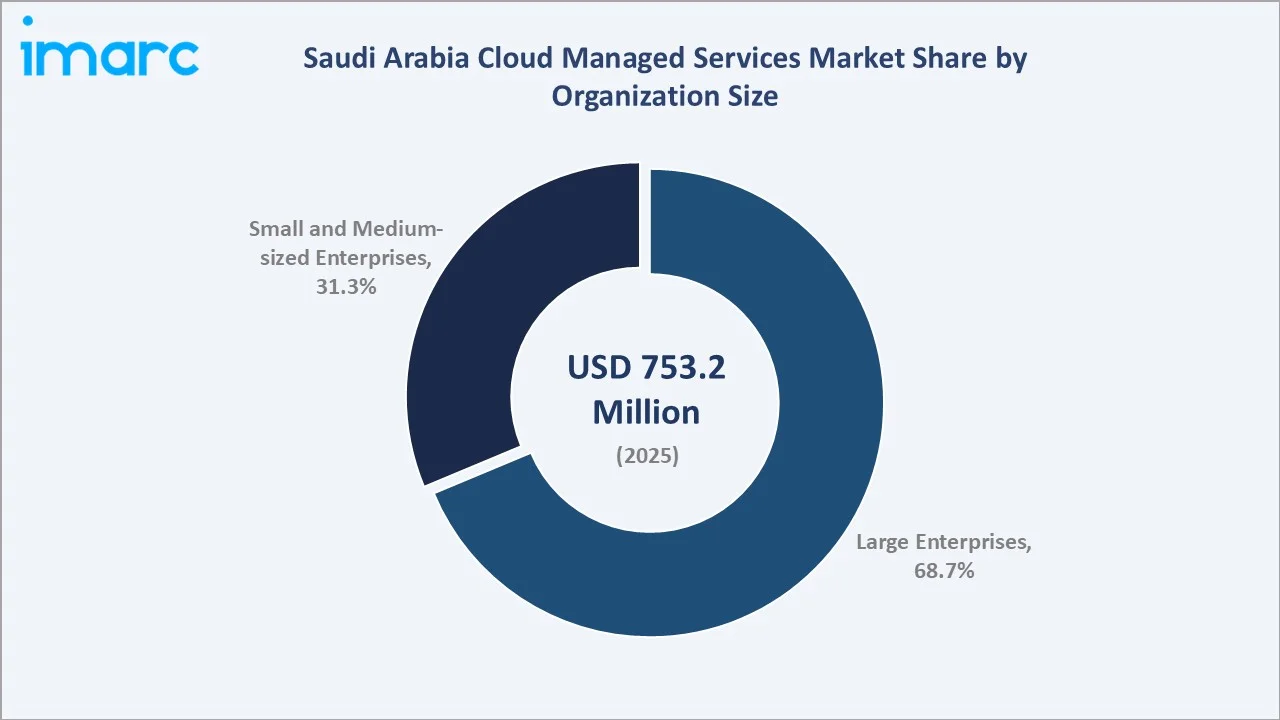
Small and Medium-sized Enterprises at 31.3% represent a rapidly growing adoption segment as affordable subscription-based managed cloud service bundles from regional telcos and global MSPs reduce total cost of ownership barriers. Government SME support programs and Vision 2030 SME digitization incentives are accelerating cloud MSP adoption across this segment through 2034.
Regional Market Insights
|
Region |
Share (2025) |
Key Cloud Managed Services Market Drivers & Characteristics |
|
Northern and Central Region |
43.4% |
Anchored by Riyadh government ministry concentration, large enterprise headquarters, hyperscaler cloud region locations, and the Kingdom's highest-density enterprise IT investment activity under Vision 2030 digital transformation programs |
|
Western Region |
24.7% |
Driven by Jeddah financial services sector cloud adoption, Red Sea Project digital infrastructure requirements, and Makkah and Madinah hospitality sector cloud managed service deployments |
|
Eastern Region |
20.8% |
Supported by ARAMCO and petrochemical sector cloud managed service adoption, industrial IoT management requirements, and Dammam technology hub enterprise IT outsourcing activity |
|
Southern Region |
11.1% |
Emerging region with growing SME cloud adoption, government entity cloud migration programs, and expanding digital infrastructure investment under Vision 2030 southern province development initiatives |
The Northern and Central Region at 43.4% leads through Riyadh's role as the Kingdom's government, financial, and enterprise IT hub, with AWS, Microsoft, and Google cloud region infrastructure concentrated in the capital providing low-latency MSP delivery capabilities. The Western Region at 24.7% benefits from Jeddah's BFSI and hospitality sector cloud adoption.
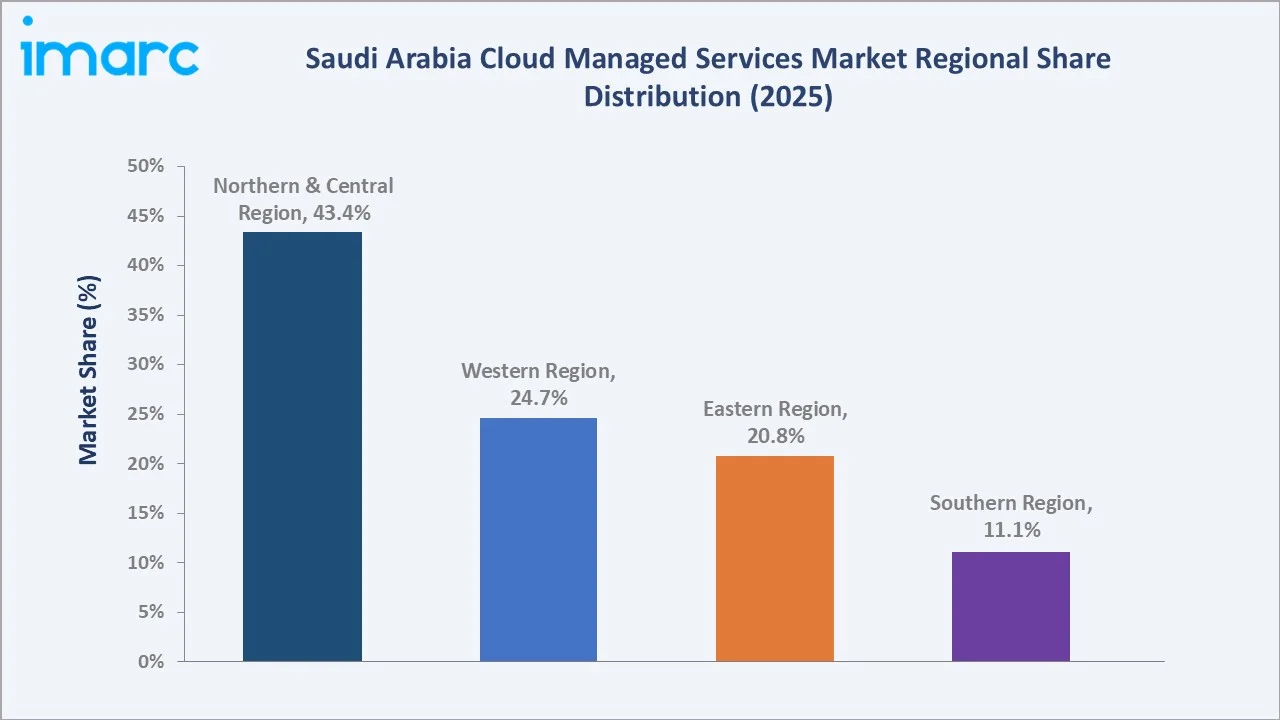
The Eastern Region at 20.8% is sustained by the energy and petrochemical sector's operational technology cloud management requirements from ARAMCO-linked enterprises and industrial zone digital transformation. The Southern Region at 11.1% represents early-stage but growing opportunity as government cloud programs extend digital service mandates to underserved southern provinces.
Competitive Landscape
The Saudi Arabia cloud managed services market competitive landscape is moderately concentrated, with global hyperscalers and enterprise technology companies operating alongside regional telco-backed MSPs and specialist managed security service providers. The market features three distinct tiers: global hyperscaler-anchored MSP platforms, regional systems integrators and telco MSPs, and specialist vertical MSP providers.
|
Company Name |
Key Services |
Market Position |
Core Strength |
|
Amazon Web Services, Inc. |
AWS Managed Services, CloudOps, Managed Security, MSP Partner Program |
Market Leader |
Amazon Web Services operates the Kingdom's most comprehensive cloud managed services platform through its dedicated Saudi Arabia cloud regions, supporting government, BFSI, and enterprise MSP delivery. |
|
Microsoft |
Azure Managed Services, Microsoft Sentinel MSSP, Azure Virtual Desktop Management |
Market Leader |
Microsoft delivers integrated cloud managed services through Azure's Saudi Arabia cloud regions, combining enterprise application management with compliance-ready security operations for government and enterprise clients. |
|
IBM Corporation |
IBM Managed Cloud Services, IBM Cloud Satellite |
Strong Challenger |
IBM Corporation specializes in hybrid cloud managed services combining IBM Cloud Satellite sovereign deployment capabilities with enterprise-grade security operations and legacy system integration management. |
|
Oracle |
Oracle Managed Cloud Services, Oracle Cloud Infrastructure Management, Autonomous DB |
Strong Challenger |
Oracle provides specialized managed cloud services centered on Oracle application and database management, serving Saudi Arabia's large installed base of Oracle ERP and financial application customers. |
|
SAP SE |
SAP RISE with SAP Managed Cloud, SAP S/4HANA Cloud, SAP Business Technology Platform |
Strong Challenger |
SAP SE delivers managed cloud services through its RISE with SAP program, providing end-to-end managed SAP S/4HANA migration and operations for Saudi Arabia's large enterprise SAP customer base. |
|
stc |
stc Cloud Managed Services, stc Security Operations Center, Government Cloud |
Market Participant |
stc leverages its domestic telco infrastructure, government relationships, and NCA-certified cloud environment to deliver sovereign managed cloud services for Saudi government entities. |
Key players include Amazon Web Services, Inc., Microsoft, IBM Corporation, Oracle, SAP SE, stc, and others.
Key Company Profiles
Amazon Web Services, Inc.
Amazon Web Services, Inc. is a United States-based cloud computing subsidiary of Amazon.com Inc. with a strong presence in the Saudi Arabia cloud managed services market through its dedicated AWS Middle East (Riyadh) cloud region and comprehensive AWS Managed Services portfolio serving enterprise, government, and BFSI sectors across the Kingdom.
- Key Services: AWS Managed Services, AWS Systems Manager, AWS CloudOps, Managed Security Services, MSP Partner Program, AWS GovCloud.
- Strategic Focus: Expanding the AWS Saudi Arabia cloud region capacity and managed services portfolio to serve the rapidly growing government cloud program and enterprise digital transformation MSP demand. The company is investing in local Saudization-compliant MSP delivery partner ecosystem development and AI-powered cloud management capabilities to strengthen its market leadership position across all verticals.
Microsoft
Microsoft is a United States-based global technology leader with a strong presence in the Saudi Arabia cloud managed services market through its Microsoft Azure dedicated Saudi Arabia cloud regions, offering comprehensive managed cloud infrastructure, security operations, and enterprise application management services.
- Key Services: Azure Managed Services, Microsoft Sentinel MSSP, Microsoft Defender for Cloud, Azure Virtual Desktop Management, Microsoft 365 Managed Services.
- Strategic Focus: Deepening enterprise and government cloud managed services penetration through Azure's Saudi Arabia cloud regions and AI-integrated managed service offerings that combine Microsoft 365, Azure infrastructure management, and Sentinel-powered MSSP capabilities into comprehensive managed service packages. The company is investing in local partner certification programs to expand its Saudization-compliant managed service delivery ecosystem across the Kingdom.
Market Concentration Analysis
The Saudi Arabia cloud managed services market exhibits moderate concentration at the enterprise and government MSP tiers, with the key players collectively commanding an estimated 40-55% of large enterprise managed cloud revenue through their hyperscaler platform advantages and dedicated Saudi cloud regions. The managed security services and specialist vertical MSP tiers are more fragmented, served by various players and regional telco-backed MSPs. Market concentration is expected to moderate as AI-native MSP platforms create new differentiated competitive positions.
Investment & Growth Opportunities
Highest Growth Segments
Managed Security Services for NCA compliance (~15.8% CAGR), Government Cloud MSP under the National Cloud Computing Program, AI-powered AIOps managed infrastructure platforms, Sovereign Cloud managed services for regulated sectors, SME managed cloud subscription bundles, and managed AI/ML workload platforms for Vision 2030 giga-project digital operations represent the highest-growth investment vectors through 2034.
Emerging Investment Opportunities
Managed AI platform services represent the highest per-contract-value emerging opportunity as Saudi Arabia's Vision 2030 industrial AI deployment targets create demand for 24/7 managed AI infrastructure and MLOps platform management. NEOM's smart city operations management specifications are creating greenfield managed service opportunities for autonomous city infrastructure management at unprecedented scale.
Investment Themes
- NCA-compliant MSSP capability investment: The NCA Essential Cybersecurity Controls mandate creates a policy-driven, non-discretionary MSP demand stream for certified managed security operations. Early investment in NCA-certified SOC infrastructure and Saudi-qualified cybersecurity talent positions MSP providers for preferential access to government and BFSI managed security contracts.
- Sovereign cloud MSP platform investment for government market capture: Saudi Arabia's Government Cloud program creates a large, long-duration, policy-mandated MSP procurement pipeline for CITC-certified sovereign cloud managed service providers. Early establishment of compliant sovereign MSP delivery infrastructure positions providers for sustainable competitive advantage in the Kingdom's most stable and growing managed service revenue pool.
Future Market Outlook (2026-2034)
The Saudi Arabia cloud managed services market is projected to grow from USD 753.2 Million in 2025 to USD 2,257.0 Million by 2034 at a 12.97% CAGR. The market's anchor value of USD 1,385.8 Million in 2030 represents the industry at its government cloud maturity inflection, as the National Cloud Computing Program reaches full implementation, hyperscaler MSP ecosystems achieve critical mass, and AI-powered managed service delivery becomes the market standard.
Three structural forces define Saudi Arabia cloud managed services market growth through 2034. The Vision 2030 Government Cloud program creates a policy-mandated, multi-year MSP procurement pipeline across over 1,000 public sector entities. The NCA cybersecurity compliance mandate creates a non-discretionary managed security service demand stream that grows with regulatory enforcement intensity. The AI-driven enterprise digital transformation creates compounding managed service demand as enterprises deploy AI workloads requiring specialized cloud management expertise.
Research Methodology
Primary Research
Primary research comprised structured interviews with 45+ industry stakeholders (2025), including cloud procurement directors at Saudi government entities; CIO and CISO executives at large enterprises; MSP provider regional directors; and NCA/CITC regulatory affairs specialists advising on cloud compliance frameworks.
Secondary Research
Secondary research encompassed Saudi National Cloud Computing Program publications; NCA Essential Cybersecurity Controls documentation; CITC cloud service provider certification framework; SAMA cloud computing framework for BFSI; IDC Saudi Arabia cloud market reports; hyperscaler investor disclosures; and regional MSP company annual reports. Over 50 secondary sources were reviewed.
Forecasting Models
Market revenue forecasts developed using a demand-side bottom-up model: (i) cloud managed service spending by sector and organization size; (ii) average MSP contract value by service type; (iii) cloud adoption rate trajectories by enterprise size tier; (iv) policy adjustment factors for Vision 2030 Government Cloud program and NCA compliance enforcement timelines.
Saudi Arabia Cloud Managed Services Market Report Coverage:
| Report Features | Details |
|---|---|
| Base Year of the Analysis | 2025 |
| Historical Period | 2020-2025 |
| Forecast Period | 2026-2034 |
| Units | Million USD |
| Scope of the Report |
Exploration of Historical Trends and Market Outlook, Industry Catalysts and Challenges, Segment-Wise Historical and Future Market Assessment:
|
| Service Types Covered | Managed Network Services, Managed Business Services, Managed Security Services, Managed Infrastructure Services, Managed Mobility Services, Managed Communication and Collaboration Services |
| Deployment Models Covered | Private Cloud, Public Cloud |
| Organization Sizes Covered | Large Enterprises, Small and Medium-sized Enterprises |
| Verticals Covered | Retail and Consumer Goods, BFSI, Telecom, Government and Public Sector, Healthcare and Lifesciences, Manufacturing, Energy and Utilities, IT, Others |
| Regions Covered | Northern and Central Region, Western Region, Eastern Region, Southern Region |
| Companies Covered | Amazon Web Services, Inc., Microsoft, IBM Corporation, Oracle, SAP SE, stc, etc. |
| Customization Scope | 10% Free Customization |
| Post-Sale Analyst Support | 10-12 Weeks |
| Delivery Format | PDF and Excel through Email (We can also provide the editable version of the report in PPT/Word format on special request) |
Key Benefits for Stakeholders:
- IMARC’s industry report offers a comprehensive quantitative analysis of various market segments, historical and current market trends, market forecasts, and dynamics of the Saudi Arabia cloud managed services market from 2020-2034.
- The research report provides the latest information on the market drivers, challenges, and opportunities in the Saudi Arabia cloud managed services market.
- Porter's five forces analysis assist stakeholders in assessing the impact of new entrants, competitive rivalry, supplier power, buyer power, and the threat of substitution. It helps stakeholders to analyze the level of competition within the Saudi Arabia cloud managed services industry and its attractiveness.
- Competitive landscape allows stakeholders to understand their competitive environment and provides an insight into the current positions of key players in the market.
Frequently Asked Questions About the Saudi Arabia Cloud Managed Services Market Report
The Saudi Arabia cloud managed services market reached USD 753.2 Million in 2025, driven by Public Cloud at 66.8%, Large Enterprises leading at 68.7%, Vision 2030 digital transformation mandates, and the Northern and Central Region commanding 43.4% market share through Riyadh-concentrated government and enterprise cloud investment.
The market grows at 12.97% CAGR during 2026-2034, reaching USD 2,257.0 Million by 2034, driven by Vision 2030 Government Cloud program execution, NCA mandatory cybersecurity compliance generating managed security demand, AI-powered MSP adoption increasing average contract value, and SME managed cloud subscription expansion.
Public Cloud leads at 66.8%, driven by hyperscaler-managed services from AWS, Microsoft Azure, and Google Cloud's dedicated Saudi Arabia cloud regions that satisfy CITC data residency requirements. Growing at ~13.5% CAGR, the segment benefits from scalability, pay-as-you-go pricing, and breadth of available managed service tiers.
Large Enterprises lead at 68.7% through established IT procurement budgets, complex multi-service MSP requirements, and stronger ROI realization from comprehensive cloud managed service engagements. Government entities, BFSI institutions, and energy sector enterprises are the primary large enterprise procurement cohort across the Kingdom.
The Northern and Central Region leads at 43.4% through Riyadh's concentration of government ministries, enterprise headquarters, and hyperscaler cloud region infrastructure. The region benefits from Vision 2030 capital program concentration and the highest-density enterprise IT investment activity in the Kingdom.
Key players include Amazon Web Services, Inc., Microsoft, IBM Corporation, Oracle, SAP SE, stc, and others.
Need more help?
- Speak to our experienced analysts for insights on the current market scenarios.
- Include additional segments and countries to customize the report as per your requirement.
- Gain an unparalleled competitive advantage in your domain by understanding how to utilize the report and positively impacting your operations and revenue.
- For further assistance, please connect with our analysts.
 Request Customization
 Speak to an Analyst
 Request Brochure
 Inquire Before Buying
Benefits of Customization
- Personalize this research
- Triangulate with your data
- Get data as per your format and definition
- Gain a deeper dive into a specific application, geography, customer, or competitor
- Any level of personalization
Get in Touch With Us
UNITED STATES
Phone: +1-201-971-6302
INDIA
Phone: +91-120-433-0800
UNITED KINGDOM
Phone: +44-753-714-6104
Email: [email protected]
Client Testimonials




.webp)




.webp)













Related Reports

Choose your plan
*Please note that the prices mentioned below are starting prices for each bundle type. Kindly contact our team for further details.*
Single User License
- 1 User License, Access on 2 Devices
- PDF Report + Excel Dataset (Password Protected)
- Lifetime Access
- No Printing Rights
- 10% Free Report Customization
- 10–12 Weeks of Analyst Support
Five User License
- Access for 5 Users, 2 Devices per User
- PDF Report + Excel Dataset (Password Protected)
- Lifetime Access
- Dedicated Account Manager
- 12–14 Weeks of Analyst Support
- No Printing Rights
- 15% Free Report Customization
- 25% Discount on Your Next Purchase
Corporate User License
- Unlimited User Access (Within Your Organization)
- PDF Report + Excel Dataset
- Lifetime Access
- Dedicated Account Manager
- 14–20 Weeks of Analyst Support
- No Printing Rights
- 20% Free Report Customization
- 30% Discount on Your Next Purchase
Essential Insights
What's included:
3 reports
- Lifetime Access
- PDF Reports
- Excel Datasets
- 2 Weeks of Free Analyst Support
- 2 User Licenses
- Access on 2 Devices
- Printing Rights
- Complimentary PowerPoint (PPT) Version
- Complimentary License Upgrade
Professional Access
What's included:
5 reports
- Lifetime Access
- PDF Reports
- Excel Datasets
- 8 Weeks of Free Analyst Support
- 2 User Licenses
- Access on 2 Devices
- Printing Rights
- Complimentary PowerPoint (PPT) Version
- Complimentary License Upgrade
Business Advantage
What's included:
8 reports
- Lifetime Access
- PDF Reports
- Excel Datasets
- 14 Weeks of Free Analyst Support
- 2 User Licenses
- Access on 2 Devices
- Printing Rights
- Complimentary PowerPoint (PPT) Version
- Complimentary License Upgrade
Enterprise Intelligence
What's included:
10 reports
- Lifetime Access
- PDF Reports
- Excel Datasets
- 20 Weeks of Free Analyst Support
- 2 User Licenses
- Access on 2 Devices
- Printing Rights
- Complimentary PowerPoint (PPT) Version
- Complimentary License Upgrade