
Saudi Arabia Construction Products Market Size, Share, Trends and Forecast by Product Type, Application, and Region, 2026-2034
Saudi Arabia Construction Products Market Size, Share, Trends & Forecast (2026-2034)
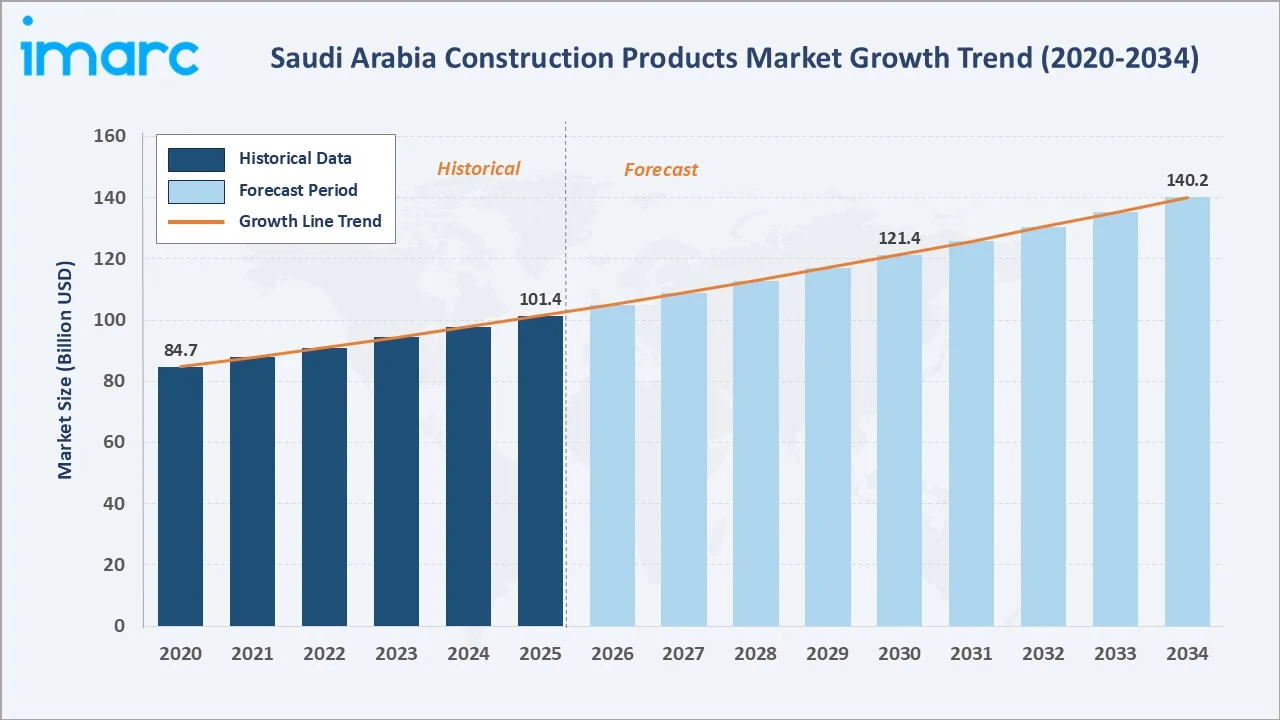
The Saudi Arabia construction products market reached USD 101.4 Billion in 2025 and is projected to reach USD 140.2 Billion by 2034, growing at a CAGR of 3.66% during 2026-2034. The market is driven by Vision 2030-led infrastructure spending, rapid urbanization, rising residential construction activity, and sustained government investment in megaprojects. Cement leads at 31.8%, the Residential Sector dominates at 46.7%, and the Northern and Central Region commands 42.6% of regional share.
Market Snapshot
|
Metric |
Value |
|
Market Size (2025) |
USD 101.4 Billion |
|
Forecast Market Size (2034) |
USD 140.2 Billion |
|
CAGR (2026-2034) |
3.66% |
|
Base Year |
2025 |
|
Historical Period |
2020-2025 |
|
Forecast Period |
2026-2034 |
|
Dominant Product Type |
Cement (31.8%, 2025) |
|
Dominant Application |
Residential Sector (46.7%, 2025) |
|
Leading Region |
Northern and Central Region (42.6%, 2025) |
The market expanded from USD 84.7 Billion in 2020 to USD 101.4 Billion in 2025, anchored at USD 121.4 Billion in 2030 and forecast to reach USD 140.2 Billion by 2034. Short-term disruptions in 2020-2021 did not reverse the structural demand trajectory, which recovered sharply through 2022-2023 as Vision 2030 project execution accelerated and construction sector investment intensified.
To get more information on this market, Request Sample
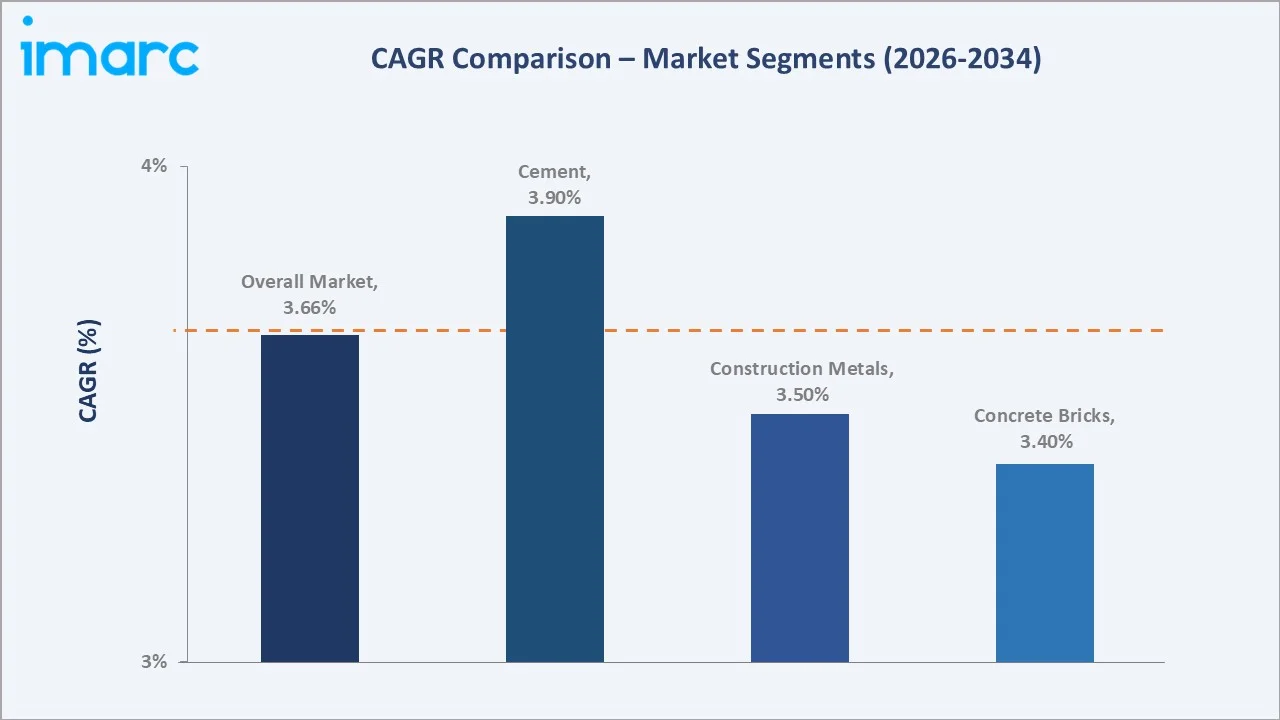
Residential sector application grows at above-market rates as Saudi Arabia's Sakani housing program and mortgage market expansion accelerate new unit delivery. The cement product type grows at approximately 3.9% CAGR, as giga-project procurement and mass residential construction sustain volume demand across the Kingdom through the forecast period.
Executive Summary
The Saudi Arabia construction products market reached USD 101.4 Billion in 2025, representing one of the Middle East's highest-activity construction procurement markets driven by the fundamental infrastructure and urbanization transformation of the Kingdom under Vision 2030. Construction products encompass all materials and systems used across residential, commercial, and industrial building activity. The market is projected to reach USD 140.2 Billion by 2034.
Cement at 31.8% dominates by capturing the foundational building material requirement across all construction typologies. Residential Sector at 46.7% leads through government housing program execution and population-driven demand expansion. The Northern and Central Region at 42.6% leads regionally through Riyadh's concentration of government capital investment, commercial development, and residential construction activity.
Key Market Insights
|
Insight |
Data |
|
Dominant Product Type |
Cement – 31.8% share (2025) |
|
Dominant Application |
Residential Sector – 46.7% market share (2025) |
|
Leading Region |
Northern and Central Region – 42.6% market share (2025) |
|
Market Opportunity |
Green building materials; prefabricated construction; smart infrastructure products; circular economy aggregates |
Key Analytical Observations Supporting the Above Data:
- Cement at 31.8%: The cement segment dominates as it underpins all major construction typologies in Saudi Arabia—residential housing, commercial towers, and megaproject infrastructure—supported by strong domestic production capacity and sustained government procurement volumes for large-scale project execution.
- Residential Sector at 46.7%: The residential sector dominates due to rapid population growth, Vision 2030 housing targets under the Sakani program, and expanding mortgage accessibility. The government's commitment to delivering new housing units generates substantial demand for cement, bricks, aggregates, and construction metals across the Kingdom.
- Northern and Central Region at 42.6%: The Northern and Central Region dominates through Riyadh's status as the Kingdom's primary government, financial, and commercial hub.
Saudi Arabia Construction Products Market Overview
The Saudi Arabia construction products market encompasses the production, supply, and distribution of all materials and systems used in residential, commercial, and industrial construction across the Kingdom. Core product categories include cement, construction aggregates, construction metals, concrete bricks, and specialty construction materials used across the full construction project lifecycle.
The ecosystem integrates raw material producers, product manufacturers, distributors, construction contractors, and government project entities. Macroeconomic drivers include oil revenues channeled into infrastructure investment, Vision 2030 economic diversification programs, rising urbanization, and strong population growth supported by government social development commitments.
Market Dynamics
To evaluate market opportunities, Request Sample
Market Drivers
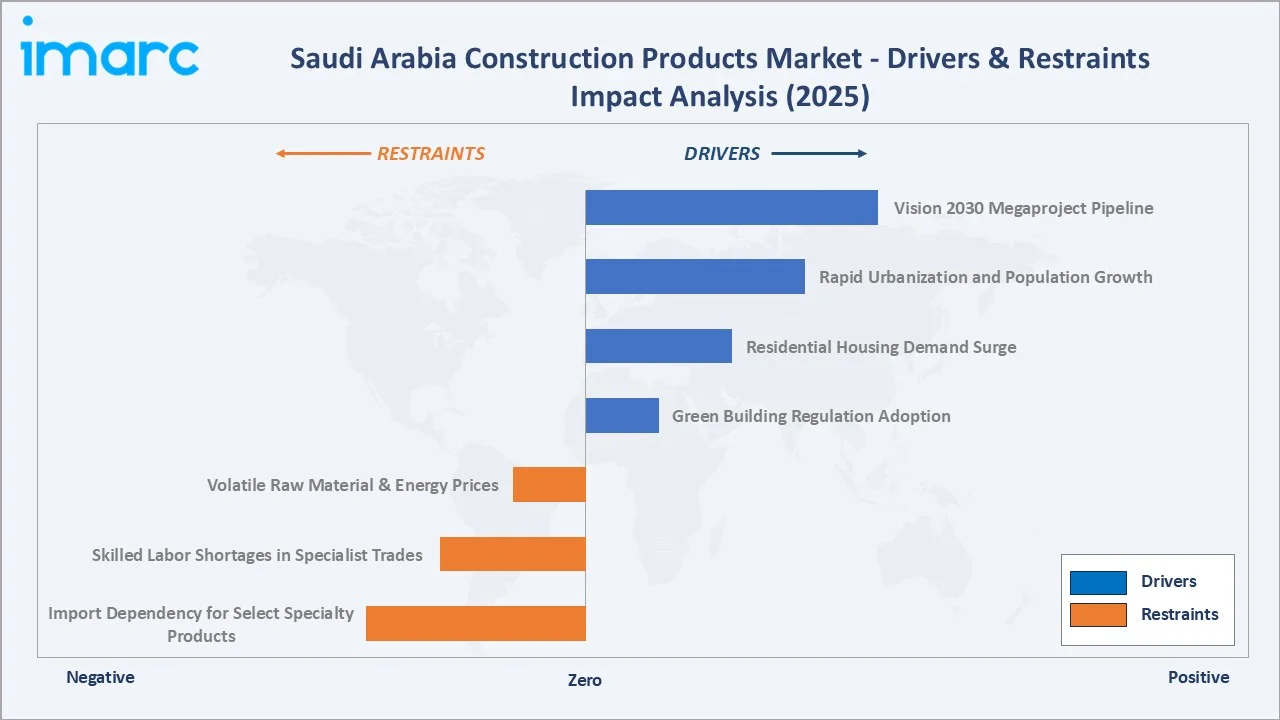
- Vision 2030 Megaproject Pipeline: Saudi Arabia's Vision 2030 program encompasses NEOM, the Red Sea Project, Diriyah Gate, and Qiddiya, collectively valued at over USD 1 trillion, generating massive, sustained demand for cement, steel, aggregates, and specialty construction products. These projects create multi-year procurement cycles with long-duration demand visibility for domestic and international suppliers. The concentration of project execution timelines between 2025 and 2030 anchors above-trend market growth across all product type segments.
- Rapid Urbanization and Population Growth: Saudi Arabia's urban population is projected to exceed 90% of total by 2030, driving expansion of city boundaries, new city developments, and municipal infrastructure investment, increasing demand for all construction product categories. Population growth supported by government social investment programs amplifies residential and community infrastructure construction activity. The emergence of new urban centers under Vision 2030 further diversifies geographic demand concentration beyond Riyadh and Jeddah.
- Residential Housing Demand Surge: Government-backed housing programs including the Sakani initiative, targeting over 300,000 housing units, alongside expanded mortgage accessibility, are driving unprecedented residential construction activity and construction product procurement volumes. The Saudi Real Estate Refinance Company's market development activities enable a larger population segment to access homeownership, accelerating new residential unit delivery. Government subsidization of mortgage rates further widens accessible homeownership, amplifying new unit start volumes.
- Green Building Regulation Adoption: Saudi Arabia's adoption of Saudi Green Building Forum standards and alignment with LEED and BREEAM benchmarks is accelerating demand for energy-efficient insulation, low-carbon cement variants, recycled aggregates, and advanced facade systems, expanding the addressable premium product market. Regulatory mandates requiring green building certification for new government-procured facilities create a structurally growing demand segment. The Kingdom's net-zero ambitions translate into active procurement of sustainable construction alternatives with higher per-unit value.
Market Restraints
- Volatile Raw Material & Energy Prices: Fluctuations in global steel, aluminum, and clinker prices, alongside energy cost volatility impacting cement kilns and aggregate processing, create margin pressure for manufacturers and procurement cost uncertainty for contractors. This volatility complicates project budgeting and delays procurement decisions on large-scale projects where fixed-price material contracts are difficult to secure. Exposure to global commodity cycles reduces the predictability of construction product pricing, impacting manufacturer profitability and contractor cost management.
- Skilled Labor Shortages in Specialist Trades: Scarcity of technically skilled labor in specialized construction trades constrains project execution speeds and creates bottlenecks in high-complexity construction segments. The competition for skilled trades across simultaneously executing Vision 2030 megaprojects intensifies staffing pressures on individual project sites. Saudization requirements further complicate labor availability for international construction companies operating in the Kingdom.
- Import Dependency for Select Specialty Products: Saudi Arabia's reliance on imports for high-specification products exposes the market to supply chain disruption risks, currency fluctuation, and extended lead times that delay project delivery. This import dependency creates strategic vulnerability, particularly for premium specification projects where domestic substitutes are unavailable. The logistical complexity of importing high-value products at giga-project scale increases procurement costs.
Market Opportunities
- Prefabricated and Modular Construction: Growing adoption of prefabricated and modular construction methods creates demand for factory-produced panels, precast concrete elements, and modular steel systems that reduce on-site construction time and align with Vision 2030 efficiency mandates for large-scale residential delivery. Government encouragement of construction innovation under Vision 2030 frameworks actively supports prefabrication adoption as a productivity multiplier. The scale of giga-project housing delivery requirements is particularly driving adoption of prefabricated structural systems, enabling faster unit completion.
- Smart Infrastructure and IoT-Integrated Building Materials: Increasing demand for smart cities and intelligent infrastructure is driving adoption of IoT-embedded building products and sensor-integrated structural elements, creating new high-value product segments. NEOM's ambitious smart city specifications are setting new material performance standards that will cascade across the broader Saudi construction sector. The premium pricing of smart building materials relative to conventional alternatives represents a significant market value expansion opportunity.
Market Challenges
- Regulatory Compliance Complexity Across Vision 2030 Project Frameworks: Navigating regulatory compliance requirements across multiple Vision 2030 project frameworks, combined with localizing supply chains under Saudization requirements, creates operational complexity for international suppliers seeking market entry or expansion. Each giga-project authority applies its own specification standards and procurement protocols, requiring suppliers to maintain multiple certification tracks simultaneously. The evolving regulatory landscape demands continuous compliance investment, increasing costs and entry barriers.
- Project Execution Coordination Across Simultaneous Megaprojects: The concurrent execution of multiple large-scale megaprojects creates coordination and logistics challenges for construction product suppliers managing simultaneous large-volume delivery commitments. Supply chain bottlenecks from peak demand concentration across project execution timelines result in product delivery delays and cost overruns. The geographic distribution of simultaneous project sites from NEOM in the northwest to Red Sea coastal developments strains logistics infrastructure.
Emerging Market Trends
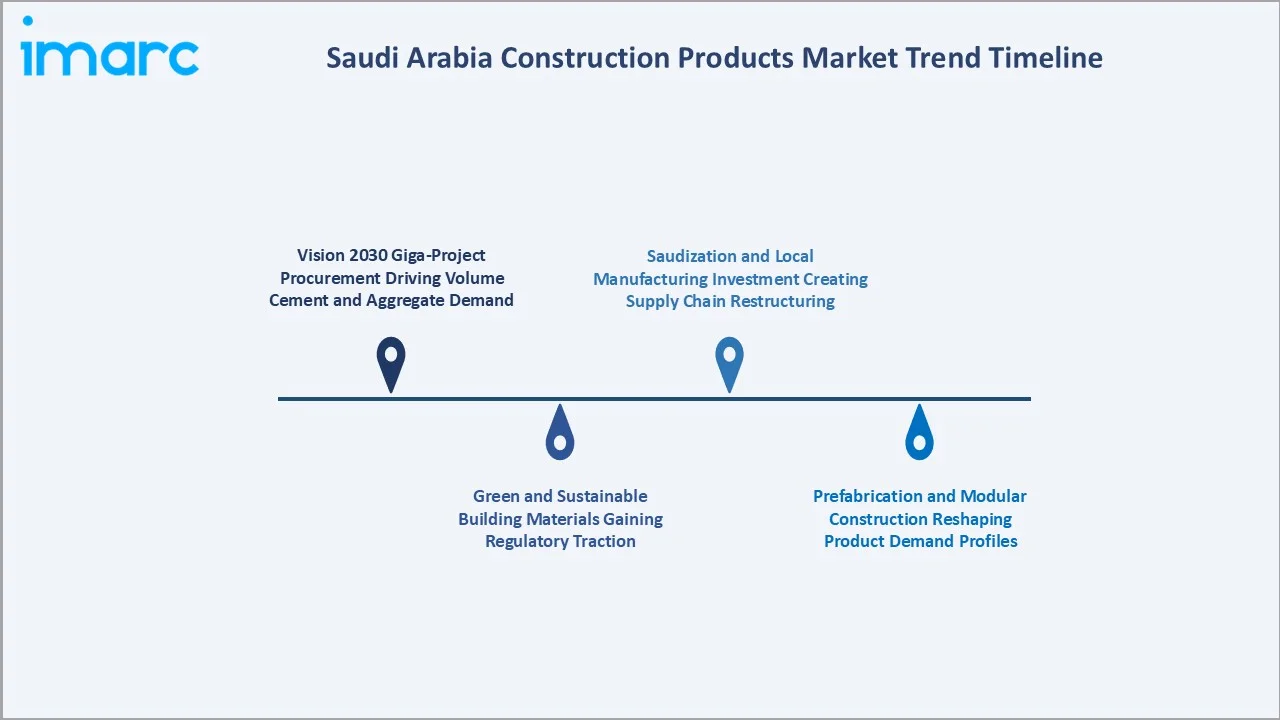
1. Vision 2030 Giga-Project Procurement Driving Volume Cement and Aggregate Demand
NEOM, The Line, Diriyah Gate, and the Red Sea Project are generating multi-billion-dollar construction product procurement cycles that prioritize locally sourced cement, aggregates, and steel, boosting domestic production capacity and creating long-duration demand visibility. The scale of giga-project material requirements is incentivizing capacity expansion investment by domestic cement and aggregate producers to secure long-term supply contracts. Project procurement authorities are increasingly mandating local content compliance, supporting Saudi-based construction product manufacturing investment.
2. Green and Sustainable Building Materials Gaining Regulatory Traction
Saudi Arabia's Green Building Forum guidelines and alignment with LEED and BREEAM standards are accelerating adoption of low-carbon cement, recycled aggregates, and thermally efficient facade products across commercial and institutional construction segments. The government's commitment to reducing the built environment's carbon footprint under Vision 2030 sustainability pillars is creating binding specification requirements for new government-procured facilities. This regulatory shift expands the addressable premium construction products market.
3. Prefabrication and Modular Construction Reshaping Product Demand Profiles
Growing construction speed requirements on mass housing and hospitality projects are accelerating prefabricated panel, precast concrete, and structural insulated panel adoption, diversifying demand toward factory-manufactured alternatives with consistent quality and reduced site waste. The Sakani program's scale and delivery timeline commitments are driving adoption of prefabricated structural systems that enable faster unit completion. This structural shift creates new manufacturing investment opportunities for construction product companies capable of producing certified prefabricated elements at scale.
4. Saudization and Local Manufacturing Investment Creating Supply Chain Restructuring
Vision 2030 local content requirements under Saudization mandates are incentivizing international construction product manufacturers to establish Saudi-based production facilities, reducing import dependency and creating a growing domestic manufacturing base across cement, steel, and specialty product segments. Companies establishing local manufacturing capacity gain preferential access to government project procurement and compliance advantages under evolving local content scoring frameworks. Policy is progressively tightening local content thresholds, making early manufacturing localization strategically valuable.
Industry Value Chain Analysis
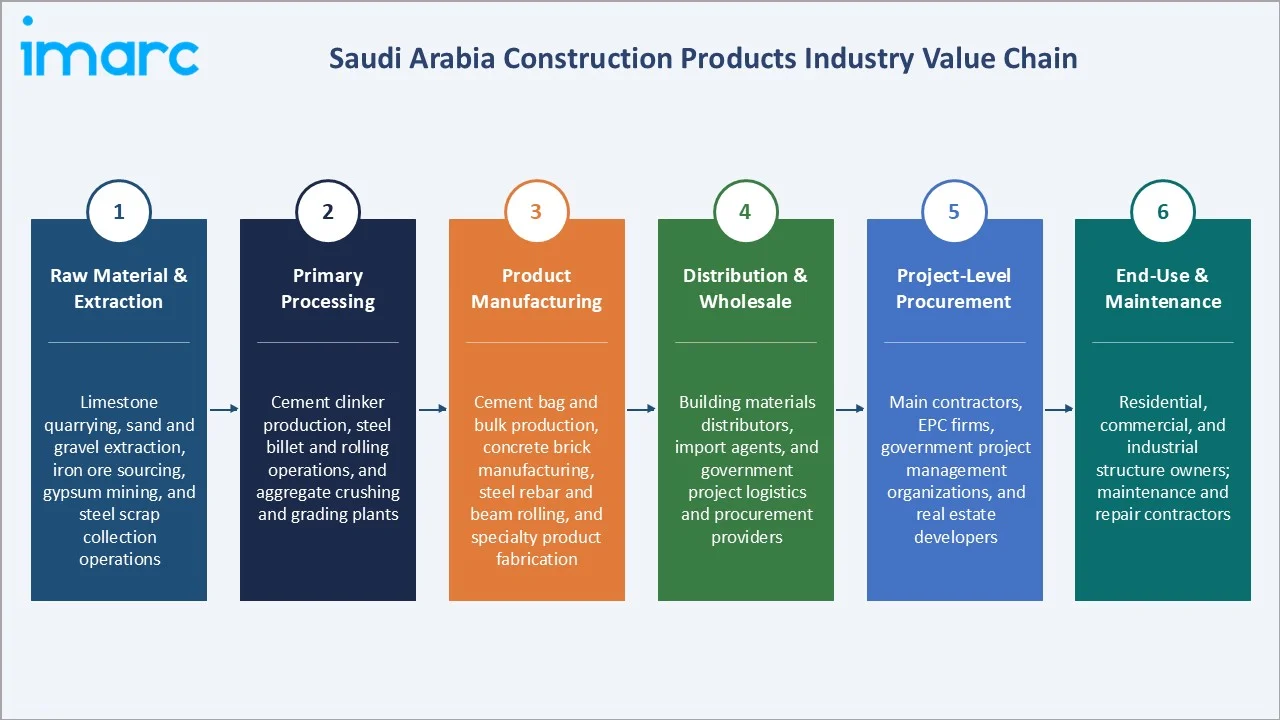
The Saudi Arabia construction products value chain integrates raw material extraction, primary processing, product manufacturing, distribution logistics, project-level procurement, and post-construction maintenance. The value chain's commercial architecture is progressively consolidating toward integrated supply agreements as primary commercial formats, replacing fragmented spot procurement for large-scale government project execution.
|
Stage |
Key Participants |
|
Raw Material & Extraction |
Limestone quarrying, sand and gravel extraction, iron ore sourcing, gypsum mining, and steel scrap collection operations |
|
Primary Processing |
Cement clinker production, steel billet and rolling operations, and aggregate crushing and grading plants |
|
Product Manufacturing |
Cement bag and bulk production, concrete brick manufacturing, steel rebar and beam rolling, and specialty product fabrication |
|
Distribution & Wholesale |
Building materials distributors, import agents, and government project logistics and procurement providers |
|
Project-Level Procurement |
Main contractors, EPC firms, government project management organizations, and real estate developers |
|
End-Use & Maintenance |
Residential, commercial, and industrial structure owners; maintenance and repair contractors |
The raw material and extraction tier is the most commercially critical and geopolitically sensitive stage. The product manufacturing tier is experiencing the most rapid investment expansion as domestic capacity growth responds to structural demand acceleration created by Vision 2030 project execution.
Technology Landscape in the Saudi Arabia Construction Products Industry
Green Cement and Low-Carbon Binder Technology
Green cement technology encompasses low-carbon Portland cement variants, supplementary cementitious materials (SCMs), and geopolymer binders that reduce CO2 emissions per tonne of cementitious product by 20-40% compared to conventional clinker-based cement. These technologies are gaining adoption in Saudi Arabia driven by mandatory Green Building certification requirements for government-procured facilities and corporate sustainability commitments by major developers. Their compatibility with existing concrete mix design practices is accelerating adoption across high-specification residential and commercial project categories.
Prefabricated Structural System Technology
Prefabricated structural system technology encompasses precast concrete panels, modular steel frames, and factory-manufactured volumetric units that enable rapid on-site assembly with reduced labor requirements and improved dimensional accuracy. These systems reduce on-site construction time by 30-50% compared to conventional cast-in-place methods, making them attractive for Vision 2030 mass housing and hospitality project delivery timelines. Their cost-effectiveness and quality consistency are accelerating adoption across high-volume residential construction programs in Saudi Arabia.
Smart Building Material and IoT Integration Technology
In 2025, several global construction materials manufacturers introduced sensor-embedded structural panels and IoT-enabled concrete monitoring systems designed for high-specification smart building applications. These technologies enable real-time structural health monitoring, embedded environmental sensing, and predictive maintenance capabilities integrated directly into the building fabric. This supports smart infrastructure construction by enabling more efficient, data-driven building operations and is particularly relevant to NEOM's ambitious smart city specifications creating demand for advanced construction product technologies in Saudi Arabia.
Market Segmentation Analysis
The report covers the following segments:
|
Segment Category |
Leading Segment |
Market Share |
Year |
|
Product Type |
Cement |
31.8% |
2025 |
|
Application |
Residential Sector |
46.7% |
2025 |
|
Region |
Northern and Central Region |
42.6% |
2025 |

By Product Type
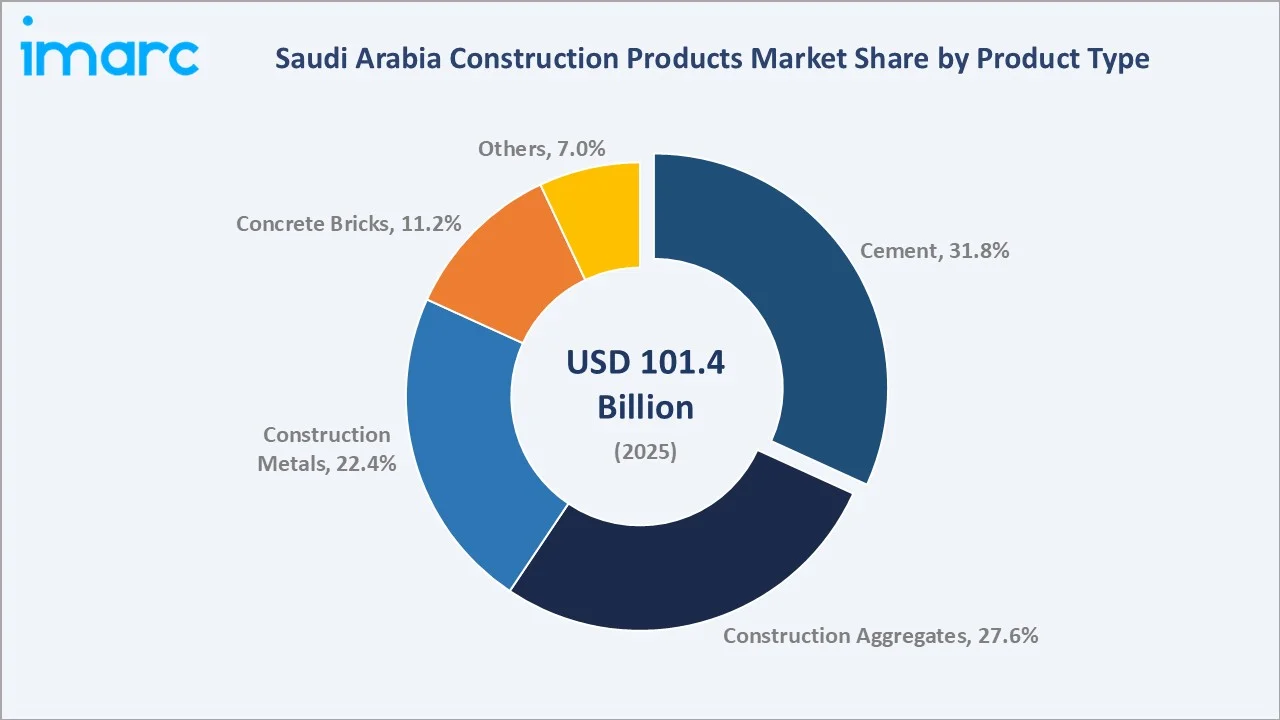
Cement leads at 31.8% in 2025, encompassing the foundational building material requirement across all construction typologies and representing the highest-volume procurement category in the Saudi construction products market. This segment is driven by intensive residential and infrastructure construction activity across the Kingdom, with domestic production capacity meeting the majority of demand across project scales.
To access detailed market analysis, Request Sample
Construction Aggregates at 27.6% reflect intensive infrastructure and foundation construction activity driven by road and utility infrastructure investment. Construction Metals at 22.4% reflect robust structural steel demand from high-rise residential and commercial projects. Concrete Bricks at 11.2% serve the mid-market residential segment, while Others at 7.0% captures specialty insulation, waterproofing, and finishing products gaining share through green building adoption.
By Application
The Residential Sector leads at 46.7% through government housing initiatives, expanding mortgage accessibility, and population-driven demand generating the largest single demand pool for construction products. The sector's above-market growth trajectory reflects simultaneous execution of government social housing delivery and private sector residential development across major urban centers.
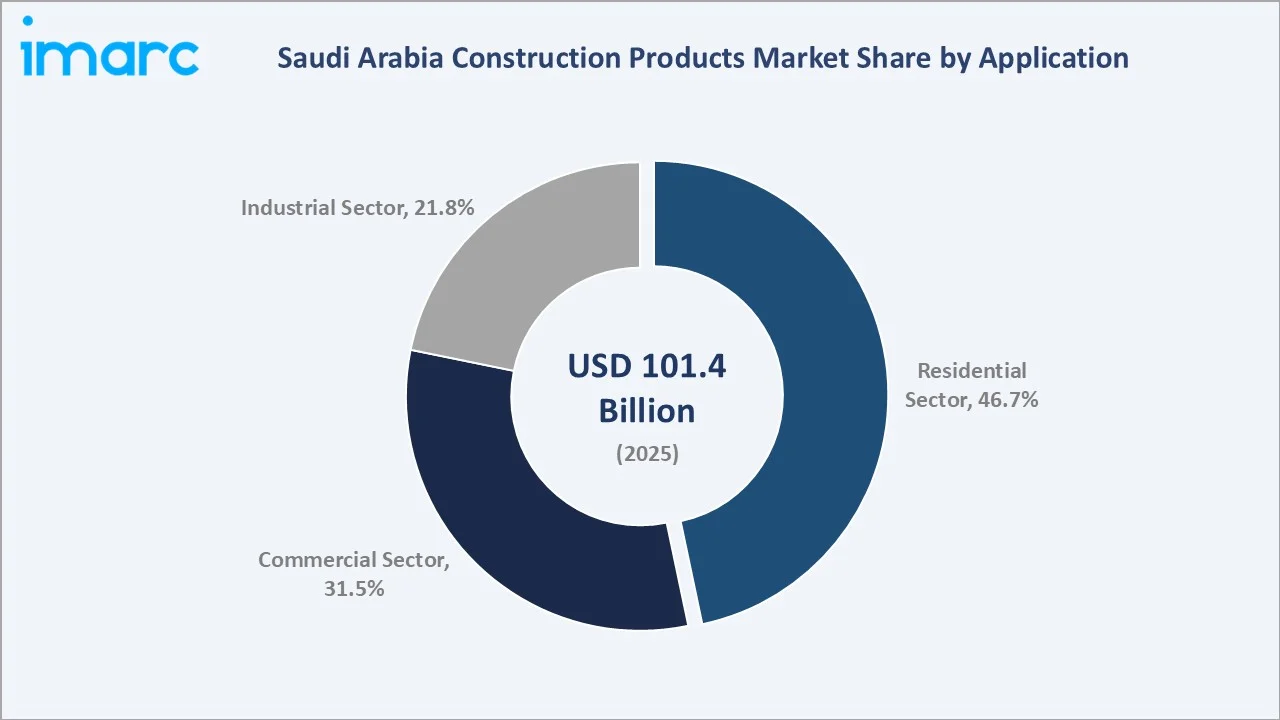
The Commercial Sector at 31.5% reflects sustained investment in retail, hospitality, and office development across Riyadh, Jeddah, and NEOM-linked entertainment and tourism projects. The Industrial Sector at 21.8% captures demand from logistics parks, special economic zones, and oil and gas facility construction, underpinned by Vision 2030 industrial diversification investments.
Regional Market Insights
|
Region |
Share (2025) |
Key Construction Products Market Drivers & Characteristics |
|
Northern and Central Region |
42.6% |
Anchored by Riyadh metropolitan expansion, government capital project concentration, and the Kingdom's highest-density commercial and residential construction activity |
|
Western Region |
24.8% |
Driven by Jeddah urban expansion, Red Sea tourism project construction, and Makkah and Madinah religious infrastructure investment |
|
Eastern Region |
21.5% |
Supported by Dammam-Al Khobar industrial expansion, ARAMCO facility upgrades, petrochemical zone construction, and Eastern Province logistics infrastructure |
|
Southern Region |
11.1% |
Emerging region with growing residential development, cross-border infrastructure investment, and government programs targeting underserved southern provinces |
The Northern and Central Region at 42.6% leads through Riyadh's status as the Kingdom's primary government, financial, and commercial hub with the highest concentration of Vision 2030 project activity. The Western Region at 24.8% benefits from Jeddah's port-city economy and Red Sea tourism construction.
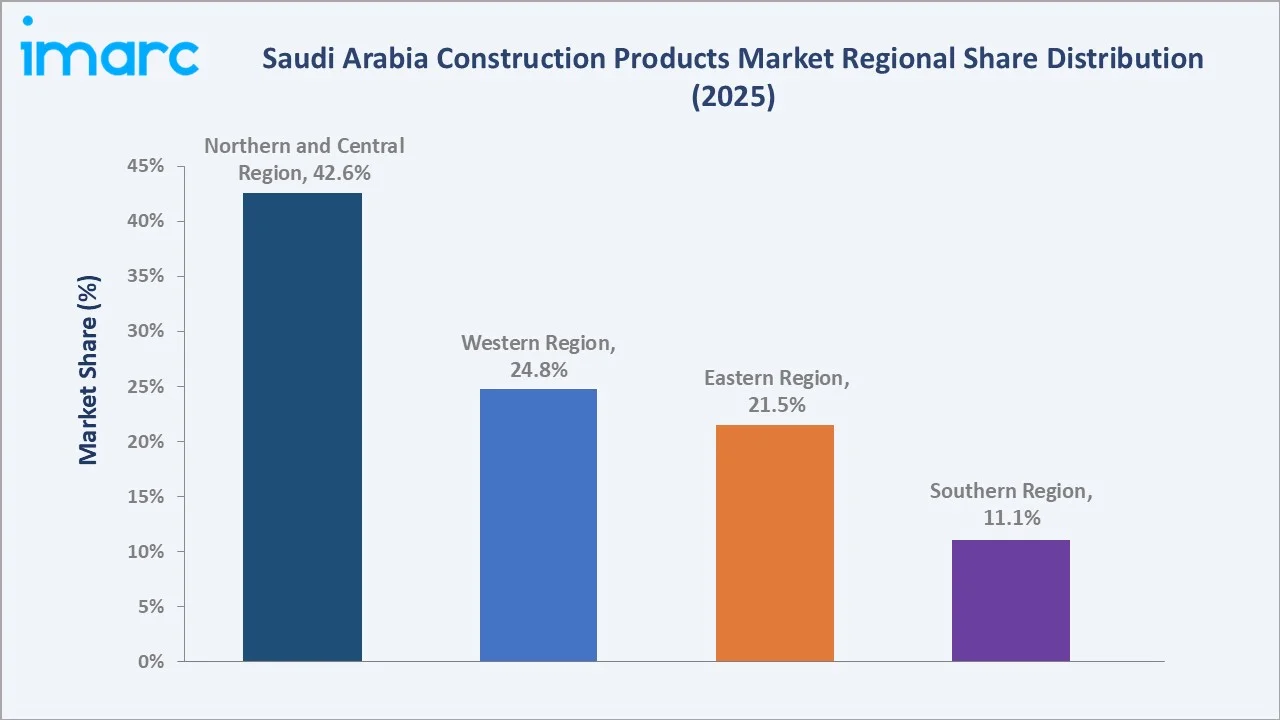
The Eastern Region at 21.5% is sustained by industrial and energy sector capital expenditure from ARAMCO-linked development and petrochemical zone expansion. The Southern Region at 11.1% represents early-stage but growing opportunity as government development programs expand infrastructure investment into underserved southern provinces.
Competitive Landscape
The Saudi Arabia construction products market competitive landscape is moderately concentrated, with large domestic cement producers operating alongside regional aggregate companies and international specialty materials suppliers.
|
Company Name |
Key Products |
Market Position |
Core Strength |
|
Arabian Cement Company |
Mabani, Tashteeb, Mosallah |
Market Leader |
Arabian Cement Company is a leading Western Region cement producer with a broad product range and established contractor and infrastructure project client relationships. |
|
Southern Province Cement Company |
Ordinary Portland Cement, Sulphate Resistant Cement, Finishing Cement, Portland Pozzolan Cement |
Strong Challenger |
Southern Province Cement Company holds a dominant market position in the Southern Region with integrated production and logistics capabilities serving regional demand. |
|
Riyadh Cement Company |
Ordinary Portland Cement Type, Sulfate Resisting Portland Cement, Finishing Cement, White Portland Cement |
Strong Challenger |
Riyadh Cement Company operates Riyadh-focused production facilities with growing capacity to serve increasing Central Region residential and infrastructure construction demand. |
Key players include Arabian Cement Company, Southern Province Cement Company, Riyadh Cement Company, and others.
Key Company Profiles
Arabian Cement Company
Arabian Cement Company is a Saudi Arabia-based integrated cement producer with strong market positioning in the Western Region, supplying ordinary, white, and specialty cement products to residential, commercial, and infrastructure construction projects across the Jeddah and Makkah corridors.
- Key Products: Mabani, Tashteeb, Mosallah
- Strategic Focus: Strengthening Western Region market position through distribution network expansion, product quality leadership in white and specialty cement, and increasing supply volume to large-scale commercial and hospitality projects aligned with Vision 2030 tourism development goals. The company is pursuing product portfolio diversification into specialty cement variants suited to high-humidity coastal construction environments across Red Sea corridor projects.
Southern Province Cement Company
Southern Province Cement Company is a Saudi Arabia-based cement producer with three integrated plants strategically located in the Jazan, Asir, and Makkah regions, enabling large-scale cement supply to Southern Region construction markets and infrastructure projects across southwestern Saudi Arabia.
- Key Products: Ordinary Portland Cement, Sulphate Resistant Cement, Finishing Cement, Portland Pozzolan Cement
- Strategic Focus: Expanding production capacity across its three Southern Region plants to serve growing cement demand from Vision 2030 infrastructure and residential construction projects in Jazan, Asir, and Makkah provinces. The company is investing in sustainable production solutions aligned with the Kingdom's aspirations and Vision 2030, and continues to enhance environmental capabilities by adopting initiatives to reduce emissions and improve consumption efficiency in line with the Kingdom's sustainability direction.
Market Concentration Analysis
The Saudi Arabia construction products market exhibits moderate concentration in the cement and aggregate segments, with the top five domestic cement producers collectively accounting for approximately 55-65% of national cement production capacity. The construction metals segment demonstrates higher import competition from international steel suppliers, while concrete bricks production remains fragmented across numerous regional producers serving localized demand. Market concentration is expected to remain stable in cement while increasing in specialty product segments as Vision 2030 local content mandates incentivize domestic manufacturing consolidation.
Investment & Growth Opportunities
Highest Growth Segments
Residential construction products driven by Sakani housing programs (~4.1% CAGR), green building compliant cement and insulation materials, prefabricated structural elements for giga-project applications, specialty industrial construction products for SEZ development, smart building material systems for NEOM and premium commercial applications, and circular economy aggregate products represent the highest-growth investment vectors through 2034.
Emerging Investment Opportunities
Specialty construction chemical products for high-specification NEOM and Red Sea Project applications represent high per-unit-value emerging opportunities, with advanced facade systems and energy-efficient glazing for commercial towers in Riyadh and Jeddah creating a growing premium product market. The prefabricated construction element segment represents the highest per-unit-margin emerging opportunity, with factory-produced panels commanding premium pricing relative to site-mixed alternatives.
Investment Themes
- Local manufacturing investment under Saudization: Vision 2030 local content requirements create strong incentives for establishing Saudi-based production of specialty construction products currently imported, offering protected domestic market positioning and preferential government procurement access. Companies achieving early-mover manufacturing localization advantage gain compounding competitive benefits as local content thresholds progressively tighten under Vision 2030 program evolution.
- Green and sustainable construction product manufacturing: Rising Green Building standard adoption across Saudi Arabia creates a structurally growing addressable market for low-carbon cement, recycled aggregate, and thermally efficient building product manufacturers. The premium pricing of sustainable construction products relative to conventional alternatives represents a significant market value expansion opportunity for manufacturers meeting evolving specification requirements.
Future Market Outlook (2026-2034)
The Saudi Arabia construction products market is projected to grow from USD 101.4 Billion in 2025 to USD 140.2 Billion by 2034, delivering a 3.66% CAGR over the forecast period. The market's anchor value of USD 121.4 Billion in 2030 represents the industry at its most transformative inflection as Vision 2030 megaproject execution peaks, residential program delivery accelerates, and green building material adoption achieves meaningful market penetration across all construction segments.
Research Methodology
Primary Research
Primary research comprised structured interviews with 45+ industry stakeholders (2025), including procurement directors at major construction contractors; plant managers at Saudi cement and aggregate producers; government project officers at Vision 2030 project authorities; and international construction product distributors operating in Saudi Arabia.
Secondary Research
Secondary research encompassed Saudi Cement industry production statistics; Saudi Ministry of Municipal and Rural Affairs construction permit data; Vision 2030 program investment and project pipeline reports; MEED Projects database construction activity tracking; Saudi Council of Engineers publications; and GCC construction market outlook reports. Over 50 secondary sources were reviewed.
Forecasting Models
Market revenue forecasts developed using a construction activity bottom-up model: (i) construction permit volume and value by sector and region; (ii) average construction product intensity per construction value by product type; (iii) price trajectory adjustments for raw material cost evolution; (iv) policy adjustment factors for Vision 2030 procurement effects and local content compliance incentives.
Saudi Arabia Construction Products Market Report Coverage:
| Report Features | Details |
|---|---|
| Base Year of the Analysis | 2025 |
| Historical Period | 2020-2025 |
| Forecast Period | 2026-2034 |
| Units | Billion USD |
| Scope of the Report |
Exploration of Historical Trends and Market Outlook, Industry Catalysts and Challenges, Segment-Wise Historical and Future Market Assessment:
|
| Product Types Covered | Construction Aggregates, Concrete Bricks, Cement, Construction Metals, Others |
| Applications Covered | Residential Sector, Commercial Sector, Industrial Sector |
| Regions Covered | Northern and Central Region, Western Region, Eastern Region, Southern Region |
| Companies Covered | Arabian Cement Company, Southern Province Cement Company, Riyadh Cement Company, etc. |
| Customization Scope | 10% Free Customization |
| Post-Sale Analyst Support | 10-12 Weeks |
| Delivery Format | PDF and Excel through Email (We can also provide the editable version of the report in PPT/Word format on special request) |
Key Benefits for Stakeholders:
- IMARC’s industry report offers a comprehensive quantitative analysis of various market segments, historical and current market trends, market forecasts, and dynamics of the Saudi Arabia construction products market from 2020-2034.
- The research report provides the latest information on the market drivers, challenges, and opportunities in the Saudi Arabia construction products market.
- Porter's five forces analysis assist stakeholders in assessing the impact of new entrants, competitive rivalry, supplier power, buyer power, and the threat of substitution. It helps stakeholders to analyze the level of competition within the Saudi Arabia construction products industry and its attractiveness.
- Competitive landscape allows stakeholders to understand their competitive environment and provides an insight into the current positions of key players in the market.
Frequently Asked Questions About the Saudi Arabia Construction Products Market Report
The Saudi Arabia construction products market reached USD 101.4 Billion in 2025, driven by cement at 31.8%, residential sector application leading at 46.7%, Vision 2030 project execution sustaining demand, and the Northern and Central Region commanding 42.6% market share through Riyadh-concentrated capital investment and construction activity, and the Kingdom's residential housing program delivery generating substantial demand for construction products across all categories.
The Saudi Arabia construction products market grows at 3.66% CAGR during 2026-2034, reaching USD 140.2 Billion by 2034. This growth reflects Vision 2030 giga-project pipeline execution, residential construction demand expansion driven by Sakani program delivery and mortgage market growth, green building material adoption increasing average product value, and industrial sector construction activity expansion under Vision 2030 economic diversification targets.
Cement leads at 31.8%, driven by its foundational role across all construction typologies including residential, commercial, and infrastructure segments supported by strong domestic production capacity. Cement demand is sustained by the full spectrum of construction activity from individual residential units to multi-billion-dollar giga-project infrastructure requiring high-volume, continuous supply.
The Residential Sector leads at 46.7% through government housing programs, expanding mortgage accessibility, and strong population-driven housing demand, with Vision 2030 Sakani initiative targets accelerating residential construction product procurement volumes across the Kingdom.
The Northern and Central Region leads at 42.6% through Riyadh's concentration of government capital investment, commercial real estate development, and the Kingdom's highest-density residential construction activity anchored by Vision 2030 project execution.
Key players include Arabian Cement Company, Southern Province Cement Company, Riyadh Cement Company, and others.
Need more help?
- Speak to our experienced analysts for insights on the current market scenarios.
- Include additional segments and countries to customize the report as per your requirement.
- Gain an unparalleled competitive advantage in your domain by understanding how to utilize the report and positively impacting your operations and revenue.
- For further assistance, please connect with our analysts.
 Request Customization
 Speak to an Analyst
 Request Brochure
 Inquire Before Buying
Benefits of Customization
- Personalize this research
- Triangulate with your data
- Get data as per your format and definition
- Gain a deeper dive into a specific application, geography, customer, or competitor
- Any level of personalization
Get in Touch With Us
UNITED STATES
Phone: +1-201-971-6302
INDIA
Phone: +91-120-433-0800
UNITED KINGDOM
Phone: +44-753-714-6104
Email: [email protected]
Client Testimonials




.webp)




.webp)













Related Reports

Choose your plan
*Please note that the prices mentioned below are starting prices for each bundle type. Kindly contact our team for further details.*
Single User License
- 1 User License, Access on 2 Devices
- PDF Report + Excel Dataset (Password Protected)
- Lifetime Access
- No Printing Rights
- 10% Free Report Customization
- 10–12 Weeks of Analyst Support
Five User License
- Access for 5 Users, 2 Devices per User
- PDF Report + Excel Dataset (Password Protected)
- Lifetime Access
- Dedicated Account Manager
- 12–14 Weeks of Analyst Support
- No Printing Rights
- 15% Free Report Customization
- 25% Discount on Your Next Purchase
Corporate User License
- Unlimited User Access (Within Your Organization)
- PDF Report + Excel Dataset
- Lifetime Access
- Dedicated Account Manager
- 14–20 Weeks of Analyst Support
- No Printing Rights
- 20% Free Report Customization
- 30% Discount on Your Next Purchase
Essential Insights
What's included:
3 reports
- Lifetime Access
- PDF Reports
- Excel Datasets
- 2 Weeks of Free Analyst Support
- 2 User Licenses
- Access on 2 Devices
- Printing Rights
- Complimentary PowerPoint (PPT) Version
- Complimentary License Upgrade
Professional Access
What's included:
5 reports
- Lifetime Access
- PDF Reports
- Excel Datasets
- 8 Weeks of Free Analyst Support
- 2 User Licenses
- Access on 2 Devices
- Printing Rights
- Complimentary PowerPoint (PPT) Version
- Complimentary License Upgrade
Business Advantage
What's included:
8 reports
- Lifetime Access
- PDF Reports
- Excel Datasets
- 14 Weeks of Free Analyst Support
- 2 User Licenses
- Access on 2 Devices
- Printing Rights
- Complimentary PowerPoint (PPT) Version
- Complimentary License Upgrade
Enterprise Intelligence
What's included:
10 reports
- Lifetime Access
- PDF Reports
- Excel Datasets
- 20 Weeks of Free Analyst Support
- 2 User Licenses
- Access on 2 Devices
- Printing Rights
- Complimentary PowerPoint (PPT) Version
- Complimentary License Upgrade