
Saudi Arabia Dairy Ingredients Market Size, Share, Trends and Forecast by Product, Source, Form, Application, and Region, 2026-2034
Saudi Arabia Dairy Ingredients Market Size, Share, Trends & Forecast (2026-2034)
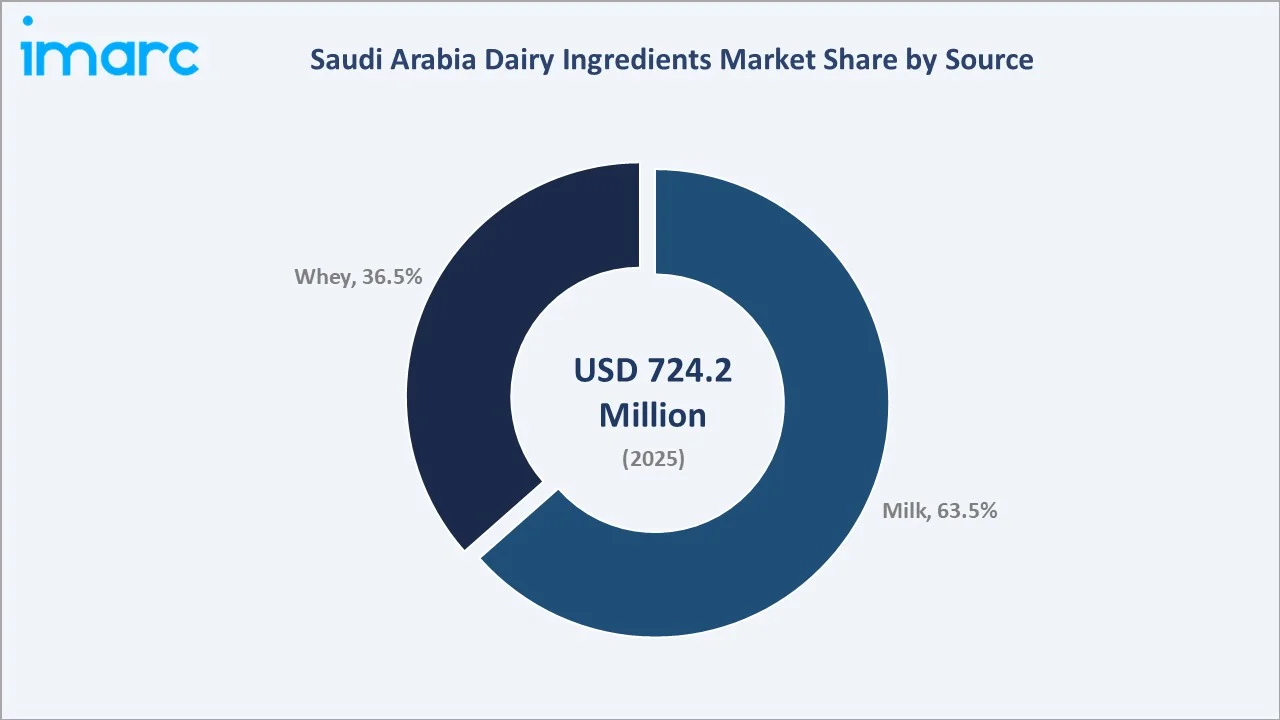
The Saudi Arabia dairy ingredients market grew from USD 724.2 Million in 2025 to USD 763.7 Million in 2026 and is projected to reach USD 1,168.1 Million by 2034, growing at a CAGR of 5.45% during 2026-2034. The market is driven by rising demand from food and beverage manufacturers, the growing infant formula sector, sports nutrition expansion, and Vision 2030 food security mandates accelerating domestic dairy production investment. Milk source leads at 63.5% by source, dry form dominates at 82.6% by form, and the Northern and Central region commands the largest regional share at 42.8% in 2025.
Market Snapshot
|
Metric |
Value |
|
Base Year Market Size (2025) |
USD 724.2 Million |
|
Market Size (2026) |
USD 763.7 Million |
|
Forecast Market Size (2034) |
USD 1,168.1 Million |
|
CAGR (2026-2034) |
5.45% |
|
Base Year |
2025 |
|
Historical Period |
2020-2025 |
|
Forecast Period |
2026-2034 |
|
Dominant Source |
Milk (63.5%, 2025) |
|
Dominant Form |
Dry (82.6%, 2025) |
|
Leading Region |
Northern and Central Region (42.8%, 2025) |
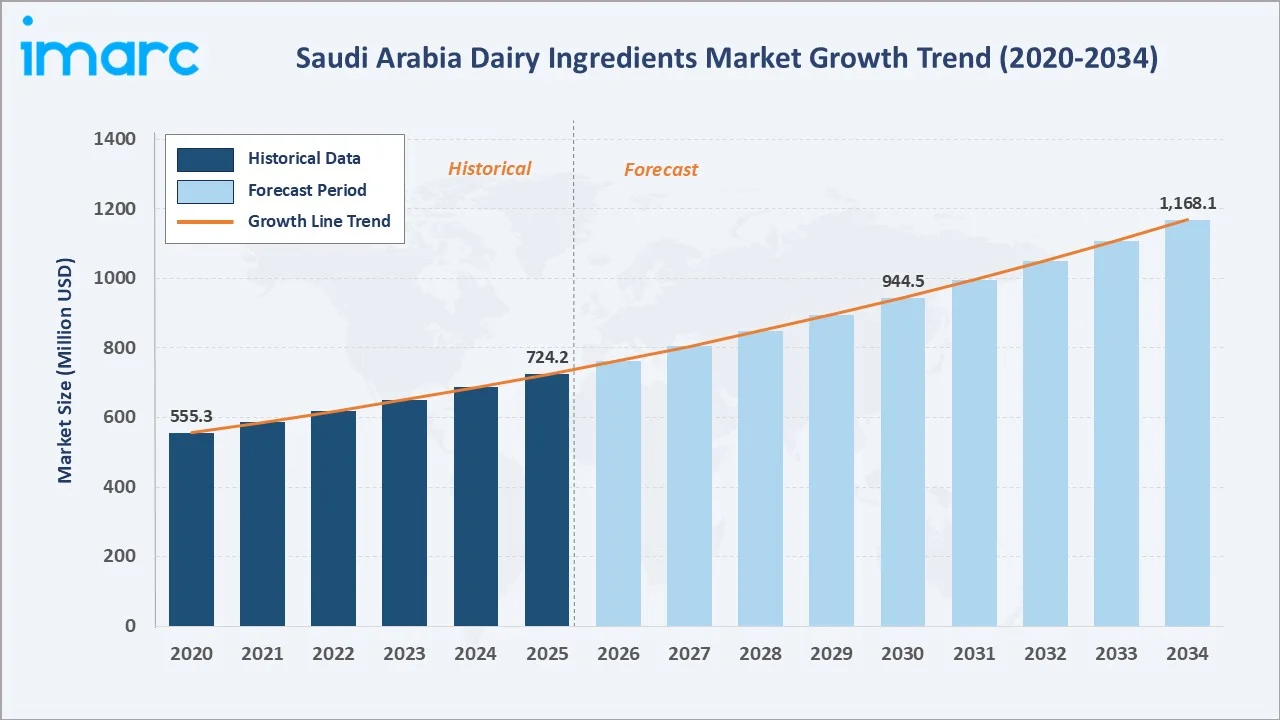
The Saudi Arabia dairy ingredients market grew from USD 555.3 Million in 2020 to USD 724.2 Million in 2025, and further to USD 763.7 Million in 2026, reflecting sustained demand from the food processing sector, growing population-driven consumption, and expanding applications in infant nutrition and sports supplements. The market is projected to reach USD 944.5 Million by 2030 before reaching USD 1,168.1 Million by 2034.
To get more information on this market, Request Sample
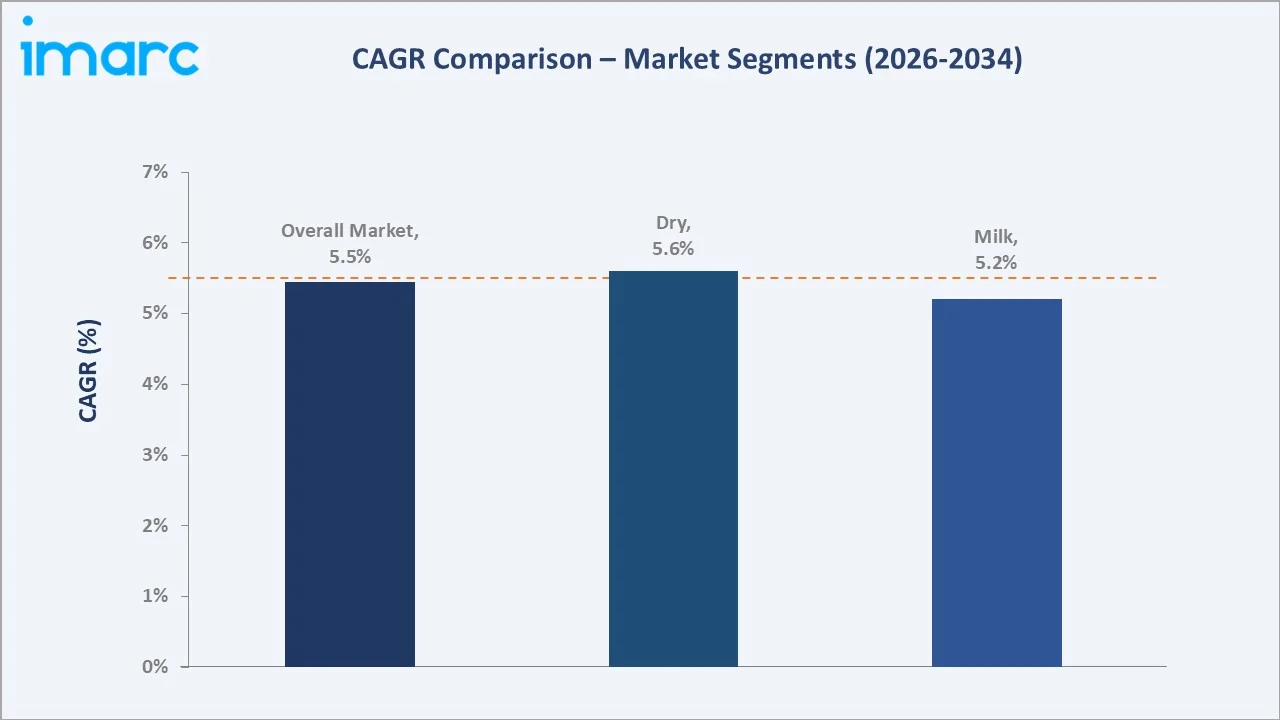
Milk-sourced ingredients are growing at 5.2% CAGR, maintaining dominance across whole and skimmed milk powder, milk protein concentrates, and casein applications that serve the largest food manufacturing end-use categories. Dry form ingredients at 5.6% CAGR reflect the strong preference for powder formats that offer superior shelf life, ease of transport, and reconstitution flexibility across Saudi Arabia diverse food manufacturing ecosystem. The overall CAGR of 5.45% reflects the structural growth in Saudi Arabia food processing industry supported by Vision 2030 National Industrial Development programs.
Executive Summary
The Saudi Arabia dairy ingredients market is experiencing sustained growth, driven by the convergence of a growing and urbanizing population, expanding food manufacturing capacity under Vision 2030 industrial policy, surging demand for infant formula dairy proteins, rapidly growing sports and clinical nutrition sectors, and government-backed food security initiatives that are simultaneously increasing domestic dairy production and rationalizing import supply chains.
Milk leads at 63.5% by source, encompassing skimmed milk powder, whole milk powder, milk protein concentrates, milk protein isolates, casein, caseinates, and anhydrous milk fat that collectively serve the broadest range of food manufacturing applications. Dry form ingredients at 82.6% reflect the logistics and shelf-life advantages of powder formats for Saudi Arabia import-dependent ingredient supply chain. The Northern and Central region leads at 42.8%, anchored by Riyadh as the primary food manufacturing and population center.
Key Market Insights
|
Insight |
Data |
|
Dominant Source |
Milk - 63.5% share (2025) |
|
Dominant Form |
Dry - 82.6% share (2025) |
|
Leading Region |
Northern and Central Region - 42.8% (2025) |
|
Key Market Opportunity |
Infant formula and sports nutrition whey protein demand expansion driven by Saudi Arabia birth rate and growing health and fitness culture aligned with Vision 2030 quality of life programs. |
Key Analytical Observations Supporting the Above Data:
- Milk at 63.5%: Milk-sourced dairy ingredients lead because they encompass the broadest range of functional ingredient categories, including the most widely consumed whole milk powder and skimmed milk powder used across reconstituted dairy processing, bakery, confectionery, and infant formula manufacturing, that collectively address a far larger addressable food manufacturing base than whey ingredients alone.
- Dry Form at 82.6%: Dry dairy ingredients dominate overwhelmingly because Saudi Arabia imports the significant majority of its dairy ingredient requirements, and powder formats are essential for transcontinental shipping economics, hot climate storage, extended shelf life, and reconstitution flexibility that Saudi food manufacturers require.
- Northern and Central Region at 42.8%: The Northern and Central Region commands the largest share because Riyadh hosts the highest concentration of food and beverage manufacturing facilities, corporate headquarters of leading Saudi food companies, and the primary modern retail distribution infrastructure that drives dairy ingredient consumption.
Saudi Arabia Dairy Ingredients Market Overview
The Saudi Arabia dairy ingredients market encompasses the production, import, and commercial supply of all dairy-derived ingredient categories used as functional inputs in food and beverage manufacturing. Core product categories include milk powders (skimmed milk powder and whole milk powder), milk protein concentrates and milk protein isolates, whey ingredients (whey protein concentrate, whey protein isolate, and hydrolyzed whey protein), lactose and lactose derivatives, casein and caseinates, and anhydrous milk fat. These ingredients serve as critical functional inputs across bakery and confectionery, reconstituted dairy manufacturing, infant formula production, sports and clinical nutrition, and general food processing applications.
Market Dynamics
To evaluate market opportunities, Request Sample
Market Drivers
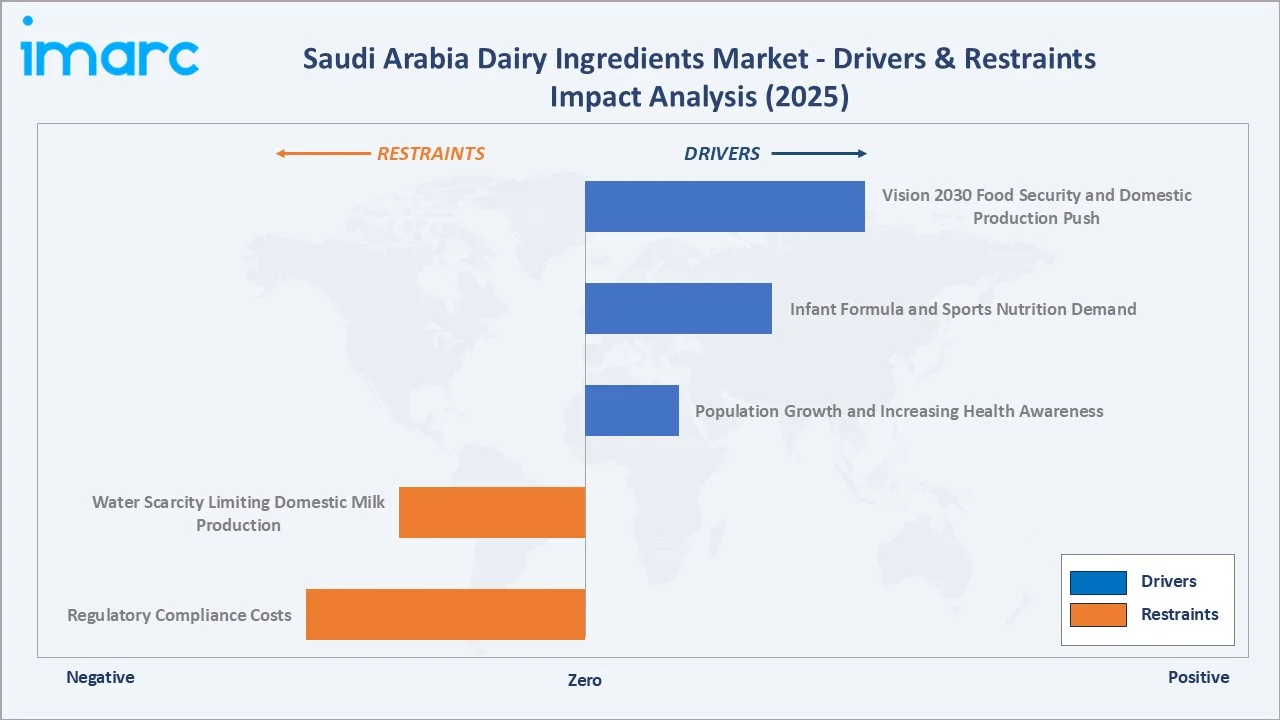
- Vision 2030 Food Security and Domestic Production Push: Saudi Arabia Vision 2030 program places strong emphasis on food security, including diversifying the economy, reducing food import dependence, and promoting indigenous dairy and agricultural output. Government measures align with these objectives by stimulating domestic dairy production while ensuring a consistent supply of imported high-quality dairy ingredients, with the Agricultural Development Fund providing financing support for dairy farm expansions and processing facility investments that directly expand the domestic dairy ingredient production base and reduce supply chain vulnerability.
- Infant Formula and Sports Nutrition Demand: Saudi Arabia birth rate is 13.41% in 2025, driving significant and growing demand for infant formula, which is commonly used due to cultural preferences, medical advice, and a growing tendency toward convenience in childrearing. Infant formula might hold a dominant position in the Saudi Arabia milk powder market, with stringent guidelines and halal standards instilling consumer confidence.
- Population Growth and Increasing Health Awareness: Saudi Arabia’s population is estimated at around 36 million in 2026, including approximately 22 million Saudi citizens and 14 million expatriate residents. Saudi Arabia growing population, combined with rising awareness of the benefits of protein-, calcium-, and probiotic-rich foods, is driving demand for fortified dairy products, high-protein dairy drinks, and specialized dairy ingredients. The Saudi dairy products market is creating expanding upstream demand for dairy ingredient inputs across all major product categories.
Market Restraints
- Water Scarcity Limiting Domestic Milk Production: Saudi Arabia arid climate and acute water scarcity represent a fundamental constraint on expanding domestic dairy farming, as large-scale dairy operations require substantial water for animal husbandry, feed crop irrigation, and milk processing. Saudi Arabia had to phase out domestic alfalfa production due to water depletion concerns, requiring costly imported feed that raises domestic milk production costs and limits the economics of domestic dairy ingredient manufacturing versus competitively priced imported alternatives.
- Regulatory Compliance Costs: Saudi Arabia stringent halal certification requirements and import regulations for dairy ingredients impose compliance costs and administrative complexity on ingredient importers and food manufacturers. International dairy ingredient suppliers must maintain current halal certifications and meet regulatory compositional standards, creating barriers that favor established certified suppliers and limit price competition from lower-cost alternative sources that may not have completed the regulatory compliance investment.
Market Opportunities
- Expanding Whey Protein Market for Sports and Clinical Nutrition: The rapid growth of Saudi Arabia sports and fitness culture is generating strong demand for whey protein ingredients across protein powder supplements, high-protein food products, and clinical nutrition formulations for hospitals and healthcare settings. Whey protein concentrates and isolate imports are growing at above-market rates, and the establishment of domestic sports nutrition product manufacturing facilities creates growing localized demand for premium whey ingredient supply.
- E-commerce Growth Enabling Premium Dairy Ingredient Products: Online sales growth, with e-commerce enabling direct-to-consumer specialized nutrition products including protein supplements and specialty infant formulas that create demand for premium dairy ingredients. The shift toward online purchasing is expanding the addressable consumer market for specialized dairy-based nutrition products and enabling smaller brands to reach consumers directly, diversifying the end-use demand base for premium dairy ingredient categories.
Market Challenges
- Fluctuations in Raw Material Prices: The prices of milk and dairy-derived ingredients can fluctuate due to changes in feed costs, energy prices, weather conditions, and global dairy supply. Such volatility can increase production costs for food and beverage manufacturers using dairy ingredients. Smaller processors may find it difficult to absorb sudden cost increases. Maintaining stable pricing while protecting margins therefore remains a challenge.
- Dependence on Imported Dairy Ingredients: Saudi Arabia relies on imports for several specialized dairy ingredients, including whey proteins, milk powders, lactose, caseinates, and other functional ingredients. This exposes manufacturers to international price fluctuations, freight costs, and supply-chain disruptions. Changes in global dairy production and export availability can also affect procurement costs. Currency movements and geopolitical disruptions may further increase import-related risks.
Emerging Market Trends
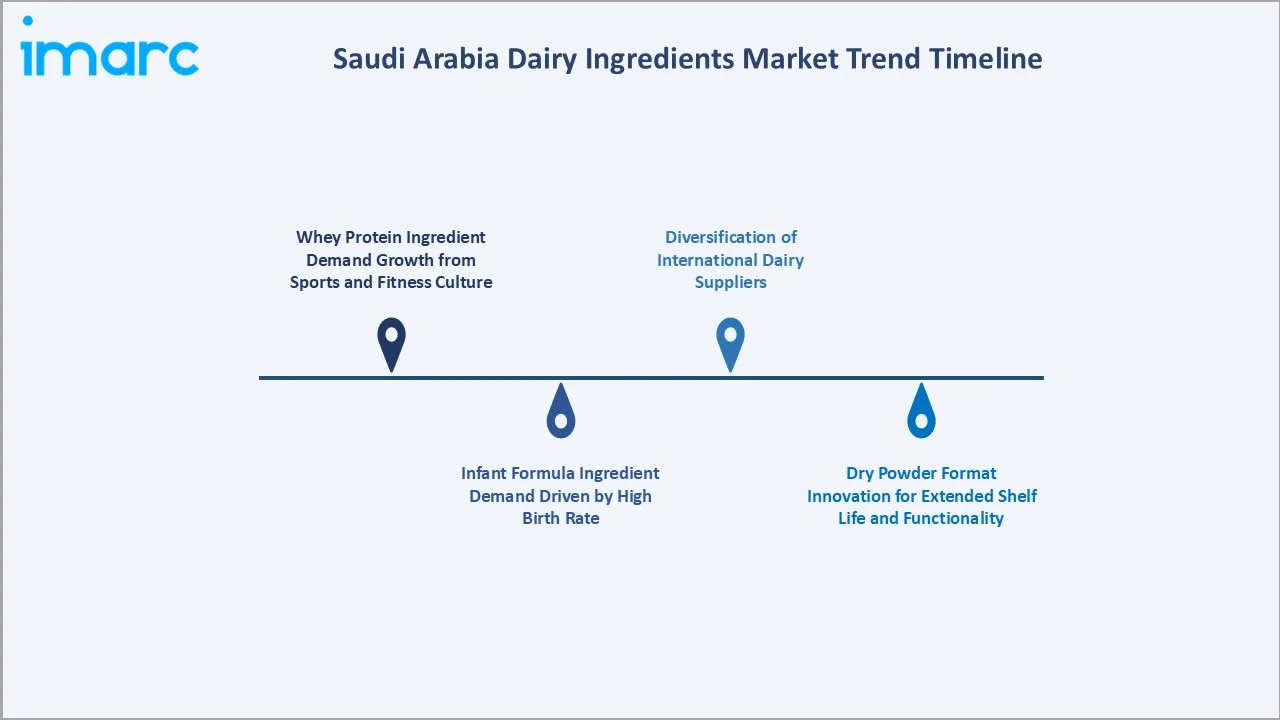
1. Whey Protein Ingredient Demand Growth from Sports and Fitness Culture
Saudi Arabia growing health and fitness culture, significantly accelerated by Vision 2030 quality of life initiatives, is driving rapid growth in whey protein ingredient consumption across sports nutrition supplements, high-protein dairy products, and functional food and beverage categories. Whey protein remains a staple in sports nutrition globally, and Saudi Arabia sports nutrition market expansion is creating new import demand for premium whey protein concentrate, whey protein isolate, and hydrolyzed whey protein ingredients.
2. Infant Formula Ingredient Demand Driven by High Birth Rate
Saudi Arabia birth rate drives significant demand for infant formula-grade dairy ingredients, including demineralized whey powder, alpha-lactalbumin, lactoferrin, and milk protein fractions that are specifically used in infant formula formulation. Cultural preferences for infant formula alongside breastfeeding and the growing tendency toward childrearing convenience are sustaining infant formula as the most important value-added application for premium dairy ingredients in Saudi Arabia.
3. Diversification of International Dairy Suppliers
In September 2026, Saudi Arabia increased the number of approved Russian dairy suppliers to 26 companies. According to Russia’s agricultural watchdog, Rosselkhoznadzor, the updated list includes the Semikarakorsk Cheese-Making Plant in the Rostov region. The Saudi Food and Drug Authority (SFDA) granted the approval based on assurances and guarantees provided by Rosselkhoznadzor. Saudi Arabia’s approval of additional Russian dairy suppliers indicates a growing trend toward diversifying international sourcing channels for dairy products and ingredients. This can broaden supplier options, strengthen supply-chain resilience, and increase the availability of imported dairy ingredients in the Saudi market
4. Dry Powder Format Innovation for Extended Shelf Life and Functionality
Manufacturers and importers are investing in spray drying technology innovation, encapsulation techniques, and agglomerated powder formats that improve the functionality of dairy ingredient powders in specific end-use applications. Instantization of milk protein concentrates, encapsulation of heat-sensitive whey proteins, and development of specially heat-treated powder variants for bakery applications are creating higher-value dry dairy ingredient subcategories that command premium prices and improve technical performance in Saudi Arabia food manufacturing applications.
Industry Value Chain Analysis
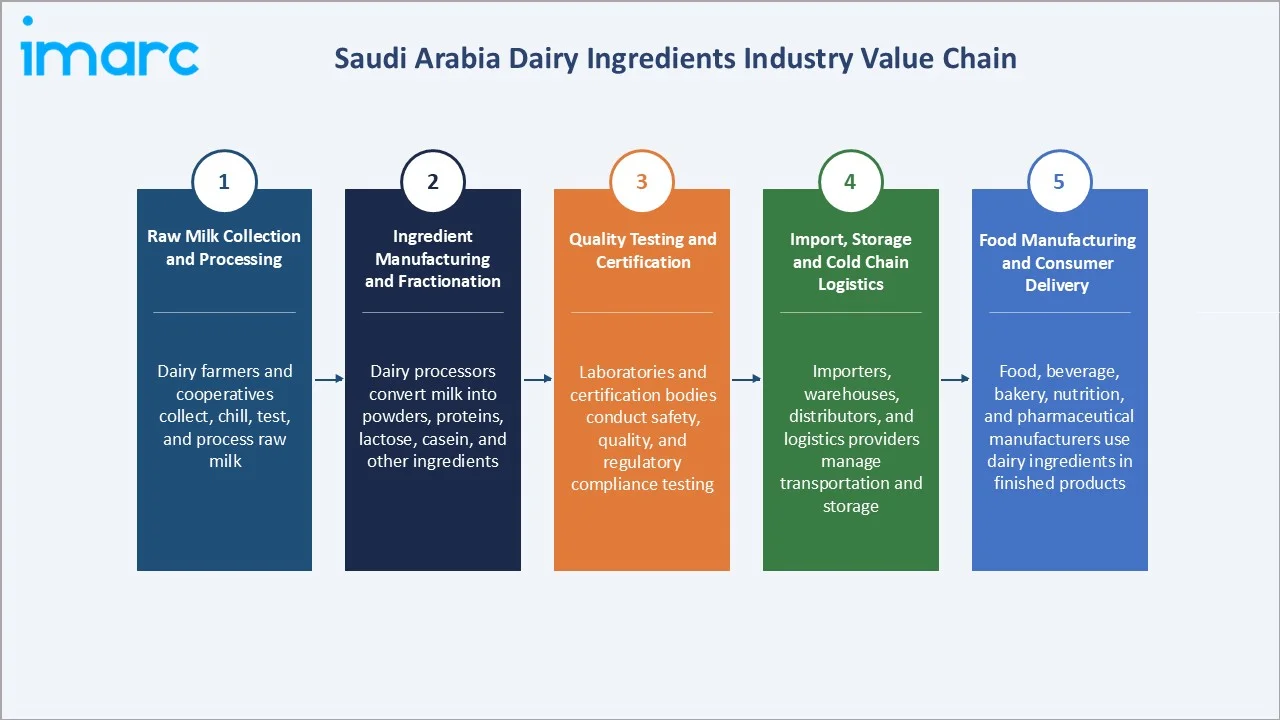
The Saudi Arabia dairy ingredients market value chain spans five integrated stages from raw milk collection through consumer delivery. The ingredient manufacturing and fractionation stage captures the highest technical value addition in the chain, as the processing of raw milk and whey streams into specialized functional ingredient fractions determines the nutritional and technical performance of downstream food products.
|
Stage |
Key Participants |
|
Raw Milk Collection and Primary Processing |
Dairy farmers and cooperatives collect, chill, test, and process raw milk. |
|
Ingredient Manufacturing and Fractionation |
Dairy processors convert milk into powders, proteins, lactose, casein, and other ingredients. |
|
Quality Testing and Certification |
Laboratories and certification bodies conduct safety, quality, and regulatory compliance testing. |
|
Import, Storage and Cold Chain Logistics |
Importers, warehouses, distributors, and logistics providers manage transportation and storage. |
|
Food Manufacturing and Consumer Delivery |
Food, beverage, bakery, nutrition, and pharmaceutical manufacturers use dairy ingredients in finished products. |
The ingredient manufacturing and fractionation stage is the highest value-added stage in the dairy ingredients value chain. Companies that possess proprietary fractionation technologies for producing standardized high-protein concentrates, isolates, and specialized whey protein fractions command premium pricing and technical advisory relationships with Saudi food manufacturers that create durable commercial differentiation beyond commodity ingredient supply.
Technology Landscape in the Saudi Arabia Dairy Ingredients Industry
Spray Drying and Instantization Technology
Spray drying is the primary processing technology for converting liquid dairy streams into the dry powder formats that constitute most of the Saudi Arabia dairy ingredients market by form. Advanced spray drying technology improvements, including multi-stage spray drying, fluidized bed agglomeration, and controlled inlet air temperature profiles, are enabling production of instantized dairy powders with improved dispersibility, improved heat stability, and enhanced functional properties for specific bakery, dairy processing, and infant formula applications that require powder performance beyond commodity specification levels.
Membrane Filtration and Protein Fractionation
Ultrafiltration, microfiltration, nanofiltration, and reverse osmosis membrane technologies enable the precise fractionation of milk and whey streams into standardized protein concentrates and isolates with defined protein content, specific amino acid profiles, and controlled functional characteristics. These separation technologies are enabling the production of alpha-lactalbumin-enriched fractions for infant formula, native whey protein concentrates with superior foaming properties, and milk protein isolates with low fat and lactose content for clinical nutrition applications that command significant price premiums over commodity dairy ingredient categories.
Microencapsulation and Bioactive Protection
Microencapsulation technology is enabling dairy ingredient manufacturers to protect heat-sensitive bioactives, including lactoferrin, immunoglobulins, and probiotic cultures, within dairy ingredient matrices that maintain activity through food manufacturing processes and product shelf life. These encapsulated dairy ingredient formats are creating new value-added product categories in infant formula, functional dairy beverages, and clinical nutrition that expand the revenue opportunity per kilogram of dairy ingredient processed and align with the premiumization trend in the Saudi Arabia health nutrition market.
Market Segmentation Analysis
The report covers the following segments:
|
Segment Category |
Leading Segment |
Market Share |
Year |
|
Product |
🔒 |
🔒 |
2025 |
|
Source |
Milk |
63.5% |
2025 |
|
Form |
Dry |
82.6% |
2025 |
|
Application |
🔒 |
🔒 |
2025 |
|
Region |
Northern and Central Region |
42.8% |
2025 |

By Source
Milk leads at 63.5% in 2025, reflecting the dominant position of milk-derived products across all major application categories. Milk powders, including both whole milk powder and skimmed milk powder, represent the largest volume category within milk-sourced ingredients, serving as the primary ingredient in reconstituted dairy beverages, infant formula base, bakery fat replacement, and confectionery dairy flavoring.
To access detailed market analysis, Request Sample
Whey at 36.5% is the fastest-growing source category, driven by the expanding sports nutrition market where whey protein concentrate and isolate are the preferred protein supplement inputs, the infant formula sector where demineralized whey powder and alpha-lactalbumin whey fractions provide critical amino acid profile benefits, and food processing applications where whey protein functionalities including emulsification, gelation, and water binding serve bakery and confectionery manufacturing requirements.
By Form
Dry form leads at 82.6% in 2025, reflecting the overwhelming preference for powder formats across all supply chain tiers in Saudi Arabia dairy ingredients ecosystem. The structural preference for dry dairy ingredients in Saudi Arabia is driven by import logistics economics, climate compatibility for storage in Saudi Arabia hot ambient conditions, extended ambient shelf life eliminating cold chain requirements, and the reconstitution flexibility that allows Saudi food manufacturers to adjust ingredient concentration precisely to formulation requirements.
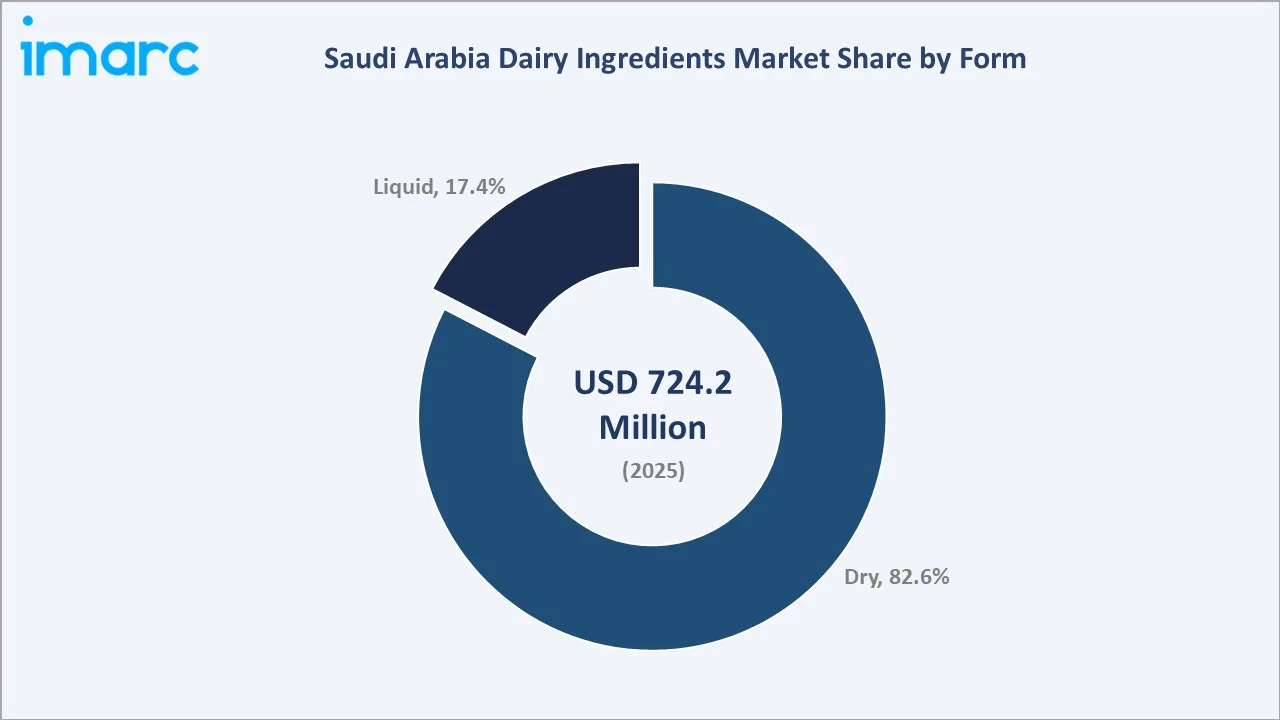
Liquid at 17.4% serves applications requiring immediate high-value functional performance, including fresh cream for foodservice, liquid dairy concentrates for local dairy processing, and fresh liquid whey fractions for geographically proximate dairy ingredient users.
Regional Market Insights
|
Region |
Share (2025) |
Key Saudi Arabia Dairy Ingredients Market Drivers & Characteristics |
|
Northern and Central Region |
42.8% |
Strong food processing activity and population concentration support demand for diverse dairy ingredients. |
|
Western Region |
27.6% |
Tourism, hospitality, and urban consumption contribute to demand from food and beverage manufacturers. |
|
Eastern Region |
19.4% |
Industrial activity and established dairy processing infrastructure support ingredient consumption. |
|
Southern Region |
10.2% |
Growing retail and food-service activity is gradually supporting demand for dairy-based ingredients. |
The Northern and Central region represents the largest share of the Saudi Arabia dairy ingredients market, accounting for 42.8% in 2025, supported by population concentration and established food processing activities. The Western region holds 27.6%, driven by urban consumption, hospitality, and food-service demand.
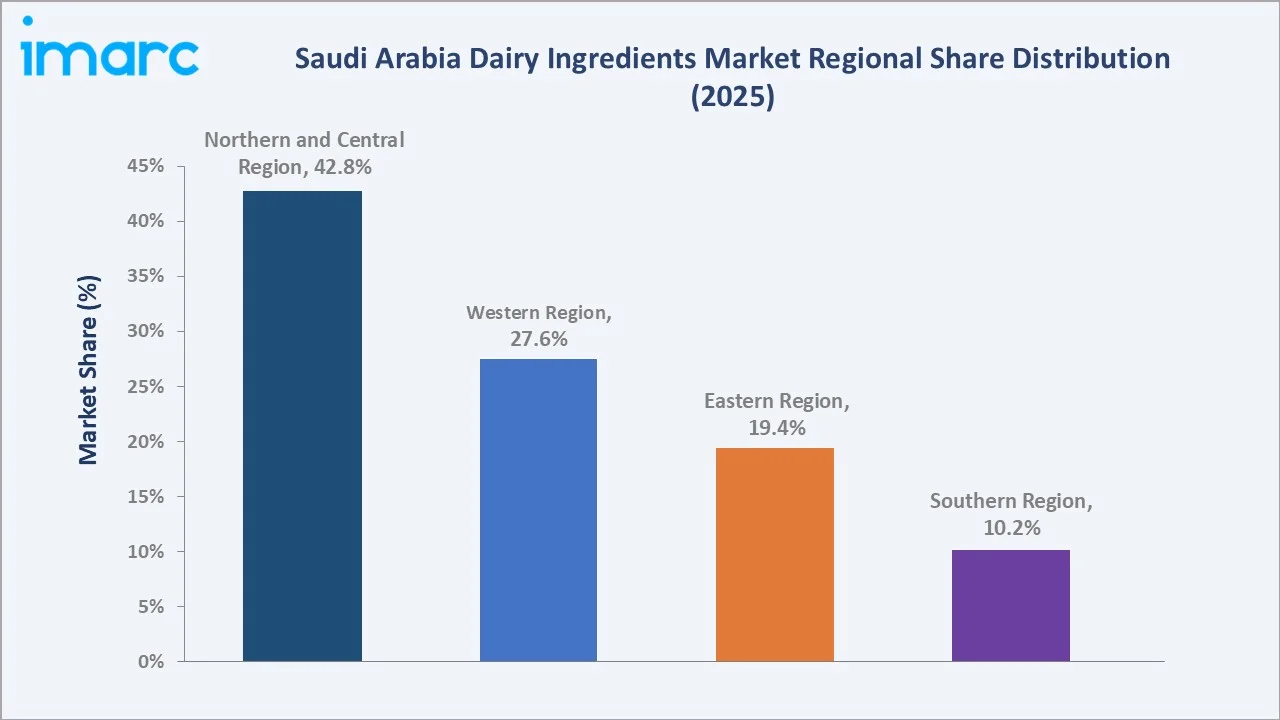
The Eastern region contributes 19.4%, benefiting from industrial activity and a developed dairy processing ecosystem. Meanwhile, the Southern region accounts for 10.2%, with demand supported by expanding retail and food-service activities.
Competitive Landscape
The Saudi Arabia dairy ingredients market is served by a combination of global dairy ingredient manufacturers supplying through import channels and domestic Saudi dairy producers generating locally sourced dairy ingredient streams.
|
Company |
Key Offerings |
Market Position |
Core Strength |
|
Almarai |
Liquid Dairy |
Market Leader |
Almarai plays a foundational role in Saudi Arabia’s dairy and food processing sector as one of the largest vertically integrated dairy companies. |
|
Fonterra Co-operative Group Limited |
Dairy Fats, Milk Powder |
Market Leader |
Fonterra Co-operative Group Limited supplies essential dairy ingredients to Saudi Arabia through major distribution partnerships and regional operational hubs. |
|
Arla Foods amba |
Nutrilac ProteinBoost, Nutrilac HighYield, Nutrilac MFGM, Variolac, Capolac |
Established Player |
Saudi Arabia serves as a primary regional hub and key manufacturing base for Arla Foods amba outside Europe, utilizing local processing through its subsidiary Danya Foods. |
|
FrieslandCampina |
Demineralised Whey, Fermented whey protein, Casein Protein |
Established Player |
FrieslandCampina plays a major role in the Saudi Arabia dairy sector by supplying long-standing consumer staples and professional ingredient solutions. |
|
SADAFCO |
Plain Milk, Functional milk, Follow On Milk, Flavored Milk |
Market Leader |
SADAFCO (Saudia Dairy & Foodstuff Company) is a leader in Saudi Arabia for long-life milk, acting as a major manufacturer and supplier of dairy ingredients and consumer dairy products. |
Competition in the Saudi Arabia dairy ingredients market is structured around the fundamental tension between import-dependent global dairy ingredient supply and the strategic Vision 2030 objective of expanding domestic dairy production capability.
Key Company Profiles
Almarai
Almarai is a prominent Saudi Arabian dairy and food company with a strong presence across the region. The company offers a broad portfolio of dairy and food products supported by integrated production and distribution capabilities. Its established processing infrastructure and extensive distribution network contribute to the availability of dairy-based products across Saudi Arabia. Almarai’s operations also support demand for various dairy ingredients across food manufacturing applications.
- Key Offerings: Liquid Dairy.
- Strategic Focus: Strengthening its dairy value chain through production efficiency, product diversification, and supply-chain capabilities. The company also emphasizes innovation and quality to address evolving demand across dairy, food, and nutrition-related categories.
Fonterra Co-operative Group Limited
Fonterra Co-operative Group Limited is a New Zealand-based dairy cooperative engaged in the collection, processing, and marketing of milk and dairy-derived products. The company supplies dairy ingredients such as milk powders, proteins, lactose, and specialty dairy solutions to food and beverage manufacturers. Its international operations and distribution network support its presence across global dairy markets, including Saudi Arabia. Fonterra serves applications spanning nutrition, food processing, beverages, and other value-added products.
- Key Offerings: Dairy Fats, Milk Powder.
- Strategic Focus: Expanding its value-added dairy ingredient portfolio and strengthening supply capabilities across international markets. The company emphasizes product innovation, quality, and application-focused dairy solutions to address evolving requirements from food, beverage, and nutrition manufacturers in Saudi Arabia.
Market Concentration Analysis
The Saudi Arabia dairy ingredients market is moderately concentrated at the domestic production level, where Almarai dominates with 49.6% overall dairy market share, but highly fragmented at the import supply level, where numerous global dairy cooperatives and ingredient companies compete for Saudi Arabia commodity ingredient procurement. The distinction between domestic ingredient production (concentrated) and imported ingredient supply (fragmented) reflects the structural dual-sourcing nature of the Saudi Arabia dairy ingredients market.
Market concentration is expected to shift progressively through 2034 as Vision 2030 domestic dairy investment expands Saudi producer ingredient output, gradually reducing the import dependence that characterizes the current market structure. However, import dependence for specialty high-value ingredient fractions, including infant formula bioactives and premium sports nutrition proteins, is expected to persist through the forecast period given the technical complexity of domestic production at commercial scale.
Investment & Growth Opportunities
Highest Growth Segments
Whey protein ingredients for sports nutrition and infant formula represent the highest value growth opportunity, with both application segments growing at above-market rates driven by Saudi Arabia birth rate demographics and Vision 2030 health culture expansion. Specialty milk protein concentrates for infant formula and clinical nutrition represent the highest per-unit-value opportunity in the ingredient market. Dry powder ingredient supply for the expanding Saudi Arabia bakery and confectionery manufacturing sector represents the largest near-term volume growth opportunity.
Investment Themes
- Domestic Dairy Ingredient Fractionation Investment: Investment in Saudi Arabia dairy processing facilities capable of fractionating local milk into value-added ingredient streams, milk protein concentrates, native whey proteins, and specialty fractions, represents the highest long-term strategic opportunity, directly addressing Vision 2030 food security objectives while capturing the margin advantage of local production versus imported commodity ingredients.
- Sports Nutrition Whey Protein Import Optimization: As Saudi Arabia sports nutrition market expands under Vision 2030 quality of life programs, establishing direct import relationships with premium whey protein concentrate and isolate suppliers provides a market access advantage in the rapidly growing protein supplement ingredient category.
Future Market Outlook (2026-2034)
The Saudi Arabia dairy ingredients market stood at USD 724.2 Million in 2025 and is projected to grow from USD 763.7 Million in 2026 to USD 1,168.1 Million by 2034, exhibiting a CAGR of 5.45% during the forecast period. The market is expected to reach an intermediate milestone of approximately USD 944.5 Million by 2030, as Vision 2030 food security investments scale domestic dairy production capacity, the infant formula and sports nutrition ingredient demand reaches fuller commercial maturity, and the Saudi Arabia food manufacturing sector continues expanding under National Industrial Development Program support.
Three structural forces will define Saudi Arabia dairy ingredients market through 2034. First, the fundamental demographic and consumption growth driver of a young, urbanizing Saudi population growing at above-average rates creates compounding demand for dairy ingredients across infant formula, fluid dairy, bakery, and confectionery applications. Second, Vision 2030 structural policy support will progressively shift Saudi Arabia ingredient sourcing balance from predominantly imported toward a mixed domestic-import model, expanding total market value as domestic ingredient fractionation capabilities develop. Third, the premiumization of Saudi Arabia health nutrition market will progressively shift demand toward higher-value specialty dairy ingredient categories, including premium whey protein fractions, bioactive milk proteins, and functional dairy ingredient systems that command substantial price premiums over commodity powder grades and expand market value per unit volume consumed through 2034.
Research Methodology
Primary Research
Primary research comprised structured consultations with dairy ingredient procurement managers at Saudi food manufacturers, representatives of global dairy ingredient exporters active in the Saudi Arabia market, regulatory compliance specialists, Saudi dairy farm operators, logistics and cold chain managers, and industry associations representing the Saudi food processing sector. These consultations validated market sizing, assessed Vision 2030 policy impact on domestic dairy ingredient production, identified import supply chain evolution, and provided competitive intelligence on supplier positioning and ingredient specification trends across major application categories.
Secondary Research
Secondary research drew on IMARC Group market data, Saudi Arabia dairy market reports including dairy product import statistics, Saudi Arabia milk powder market reports, company annual report investor disclosures, dairy product market research, dairy products and alternatives Middle East and Africa analysis, import regulations and halal standard documentation, and Vision 2030 National Industrial Development Program publications. Historical market data spanning 2020 through 2025 was cross-validated across multiple commercial and government data sources.
Forecasting Models
Market forecasts incorporated Saudi Arabia food manufacturing sector growth projections, infant formula demand modeling based on birth rate demographics, sports nutrition market expansion projections aligned with Vision 2030 quality of life programs, dairy product market size trajectory feeding upstream ingredient demand, Vision 2030 domestic dairy production investment pipeline assessment, global dairy ingredient commodity price trend analysis, and macroeconomic indicators including Saudi Arabia GDP growth and food expenditure trajectory through 2034.
Saudi Arabia Dairy Ingredients Market Report Coverage:
| Report Features | Details |
|---|---|
| Base Year of the Analysis | 2025 |
| Historical Period | 2020-2025 |
| Forecast Period | 2026-2034 |
| Units | Million USD |
| Scope of the Report |
Exploration of Historical and Forecast Trends, Industry Catalysts and Challenges, Segment-Wise Historical and Predictive Market Assessment:
|
| Products Covered |
|
| Sources Covered | Milk, Whey |
| Forms Covered | Dry, Liquid |
| Applications Covered | Bakery and Confectionery, Dairy Products, Infant Milk Formula, Sports and Clinical Nutrition, Others |
| Regions Covered | Northern and Central Region, Western Region, Eastern Region, Southern Region |
| Companies Covered | Almarai, Fonterra Co-operative Group Limited, Arla Foods amba, FrieslandCampina, SADAFCO, etc. |
| Customization Scope | 10% Free Customization |
| Post-Sale Analyst Support | 10-12 Weeks |
| Delivery Format | PDF and Excel through Email (We can also provide the editable version of the report in PPT/Word format on special request) |
Key Benefits for Stakeholders:
- IMARC’s industry report offers a comprehensive quantitative analysis of various market segments, historical and current market trends, market forecasts, and dynamics of the Saudi Arabia dairy ingredients market from 2020-2034.
- The research report provides the latest information on the market drivers, challenges, and opportunities in the Saudi Arabia dairy ingredients market.
- Porter's five forces analysis assist stakeholders in assessing the impact of new entrants, competitive rivalry, supplier power, buyer power, and the threat of substitution. It helps stakeholders to analyze the level of competition within the Saudi Arabia dairy ingredients industry and its attractiveness.
- Competitive landscape allows stakeholders to understand their competitive environment and provides an insight into the current positions of key players in the market.
Frequently Asked Questions About the Saudi Arabia Dairy Ingredients Market Report
The Saudi Arabia dairy ingredients market reached USD 763.7 Million in 2026, driven by growing food manufacturing sector demand, infant formula and sports nutrition expansion, Vision 2030 food security investment, and sustained import demand.
The market is projected to grow at a CAGR of 5.45% during 2026-2034, supported by demographic-driven food consumption growth, Vision 2030 food processing sector expansion, infant formula ingredient demand from Saudi Arabia birth rate, and growing sports nutrition whey protein demand aligned with health culture expansion.
The market is projected to reach approximately USD 944.5 Million by 2030, driven by Vision 2030 domestic dairy production expansion, infant formula manufacturing growth, sports nutrition expansion, and food manufacturing sector development under the National Industrial Development Program.
Milk leads with a 63.5% share in 2025, reflecting the dominance of milk-derived products including whole milk powder, skimmed milk powder, milk protein concentrates, and casein across the broadest range of food manufacturing applications serving bakery, dairy processing, infant formula, and general food processing sectors.
Dry form leads with an 82.6% share in 2025, reflecting the structural preference for powder formats driven by import logistics economics, Saudi Arabia hot climate storage requirements, extended ambient shelf life, and reconstitution flexibility that powder dairy ingredients provide to Saudi food manufacturers dependent on imported ingredient supplies.
The Northern and Central region leads with a 42.8% share in 2025, anchored by Riyadh as the primary population center, food manufacturing hub, and corporate headquarters concentration for major Saudi food companies and ingredient distributors.
Key players include Almarai, Fonterra Co-operative Group Limited, Arla Foods amba, FrieslandCampina, and SADAFCO, among others.
The market is projected to reach USD 1,168.1 Million by 2034, driven by sustained demographic consumption growth, Vision 2030 food manufacturing sector expansion, premiumization toward specialty whey protein and bioactive dairy ingredient categories, infant formula industry maturation, and progressive domestic dairy ingredient production development reducing import dependence for commodity ingredients.
Need more help?
- Speak to our experienced analysts for insights on the current market scenarios.
- Include additional segments and countries to customize the report as per your requirement.
- Gain an unparalleled competitive advantage in your domain by understanding how to utilize the report and positively impacting your operations and revenue.
- For further assistance, please connect with our analysts.
 Request Customization
 Speak to an Analyst
 Request Brochure
 Inquire Before Buying
Benefits of Customization
- Personalize this research
- Triangulate with your data
- Get data as per your format and definition
- Gain a deeper dive into a specific application, geography, customer, or competitor
- Any level of personalization
Get in Touch With Us
UNITED STATES
Phone: +1-201-971-6302
INDIA
Phone: +91-120-433-0800
UNITED KINGDOM
Phone: +44-753-714-6104
Email: [email protected]
Client Testimonials









Related Reports

Choose your plan
*Please note that the prices mentioned below are starting prices for each bundle type. Kindly contact our team for further details.*
Single User License
- 1 User License, Access on 2 Devices
- PDF Report + Excel Dataset (Password Protected)
- Lifetime Access
- No Printing Rights
- 10% Free Report Customization
- 10–12 Weeks of Analyst Support
Five User License
- Access for 5 Users, 2 Devices per User
- PDF Report + Excel Dataset (Password Protected)
- Lifetime Access
- Dedicated Account Manager
- 12–14 Weeks of Analyst Support
- No Printing Rights
- 15% Free Report Customization
- 25% Discount on Your Next Purchase
Corporate User License
- Unlimited User Access (Within Your Organization)
- PDF Report + Excel Dataset
- Lifetime Access
- Dedicated Account Manager
- 14–20 Weeks of Analyst Support
- No Printing Rights
- 20% Free Report Customization
- 30% Discount on Your Next Purchase
Essential Insights
What's included:
3 reports
- Lifetime Access
- PDF Reports
- Excel Datasets
- 2 Weeks of Free Analyst Support
- 2 User Licenses
- Access on 2 Devices
- Printing Rights
- Complimentary PowerPoint (PPT) Version
- Complimentary License Upgrade
Professional Access
What's included:
5 reports
- Lifetime Access
- PDF Reports
- Excel Datasets
- 8 Weeks of Free Analyst Support
- 2 User Licenses
- Access on 2 Devices
- Printing Rights
- Complimentary PowerPoint (PPT) Version
- Complimentary License Upgrade
Business Advantage
What's included:
8 reports
- Lifetime Access
- PDF Reports
- Excel Datasets
- 14 Weeks of Free Analyst Support
- 2 User Licenses
- Access on 2 Devices
- Printing Rights
- Complimentary PowerPoint (PPT) Version
- Complimentary License Upgrade
Enterprise Intelligence
What's included:
10 reports
- Lifetime Access
- PDF Reports
- Excel Datasets
- 20 Weeks of Free Analyst Support
- 2 User Licenses
- Access on 2 Devices
- Printing Rights
- Complimentary PowerPoint (PPT) Version
- Complimentary License Upgrade