
Saudi Arabia Electrical Steel Market Report by Type (Grain Oriented Electrical Steel, Non-Grain Oriented Electrical Steel), Application (Transformers, Motors, Generators, and Others), End Use Industry (Energy and Power, Automobiles, Household Appliances, Building and Construction, and Others), and Region 2026-2034
Market Overview:
Saudi Arabia electrical steel market size reached USD 416.7 Million in 2025. Looking forward, IMARC Group expects the market to reach USD 622.4 Million by 2034, exhibiting a growth rate (CAGR) of 4.56% during 2026-2034. The expanding energy and power industries and the growing focus of government bodies on sustainable development represent some of the key factors driving the market.
|
Report Attribute
|
Key Statistics
|
|---|---|
|
Base Year
|
2025
|
|
Forecast Years
|
2026-2034
|
|
Historical Years
|
2020-2025
|
|
Market Size in 2025
|
USD 416.7 Million |
|
Market Forecast in 2034
|
USD 622.4 Million |
| Market Growth Rate 2026-2034 | 4.56% |
Access the full market insights report Request Sample
Electrical steel, also known as lamination steel, is a soft ferromagnetic material comprising varying proportions of iron and silicon. It is readily available in three main forms: non-oriented fully processed, non-oriented semi-processed, and grain oriented. The manufacturing process typically involves casting or melting the steel in oxygen furnaces, followed by hot rolling to eliminate impurities and shaping it into the desired form and thickness. Subsequent processing aims to tailor the magnetic properties of the steel, incorporating silicon to enhance permeability, reduce magnetostriction, and minimize power loss when subjected to alternating magnetic forces. This customization renders electrical steel well-suited for applications in power generators, electric motors, small relay transformers, solenoids, inductors, and batteries. The deliberate manipulation of its magnetic characteristics enhances efficiency and performance in various electrical devices, making electrical steel a crucial material in the construction of components central to power generation, transmission, and utilization systems.
Saudi Arabia Electrical Steel Market Trends:
The electrical steel market in Saudi Arabia is witnessing substantial growth, driven by the nation's burgeoning energy and industrial sectors. The manufacturing process involves casting or melting the material in oxygen furnaces, hot rolling to eliminate impurities, and shaping it to meet specific requirements in terms of size and thickness. Additionally, subsequent processing involves customization of the magnetic properties of the steel, often incorporating silicon to optimize characteristics like permeability and reduce power loss during alternating magnetic forces. The demand for electrical steel in Saudi Arabia is fueled by its essential role in the energy sector, particularly in transformers used for power transmission and distribution. Besides this, the rising emphasis on renewable energy projects, smart grid developments, and industrial expansion aligns with the increasing need for electrical steel, thereby positively influencing the regional market. Collaborations between the government, manufacturers, and technology providers are likely to drive innovation in the electrical steel sector, contributing to the country's position as a key player in the electrical manufacturing landscape. This, in turn, is expected to fuel the market growth in the coming years.
Saudi Arabia Electrical Steel Market Segmentation:
IMARC Group provides an analysis of the key trends in each segment of the market, along with forecasts at the country level for 2026-2034. Our report has categorized the market based on type, application, and end use industry.
Type Insights:
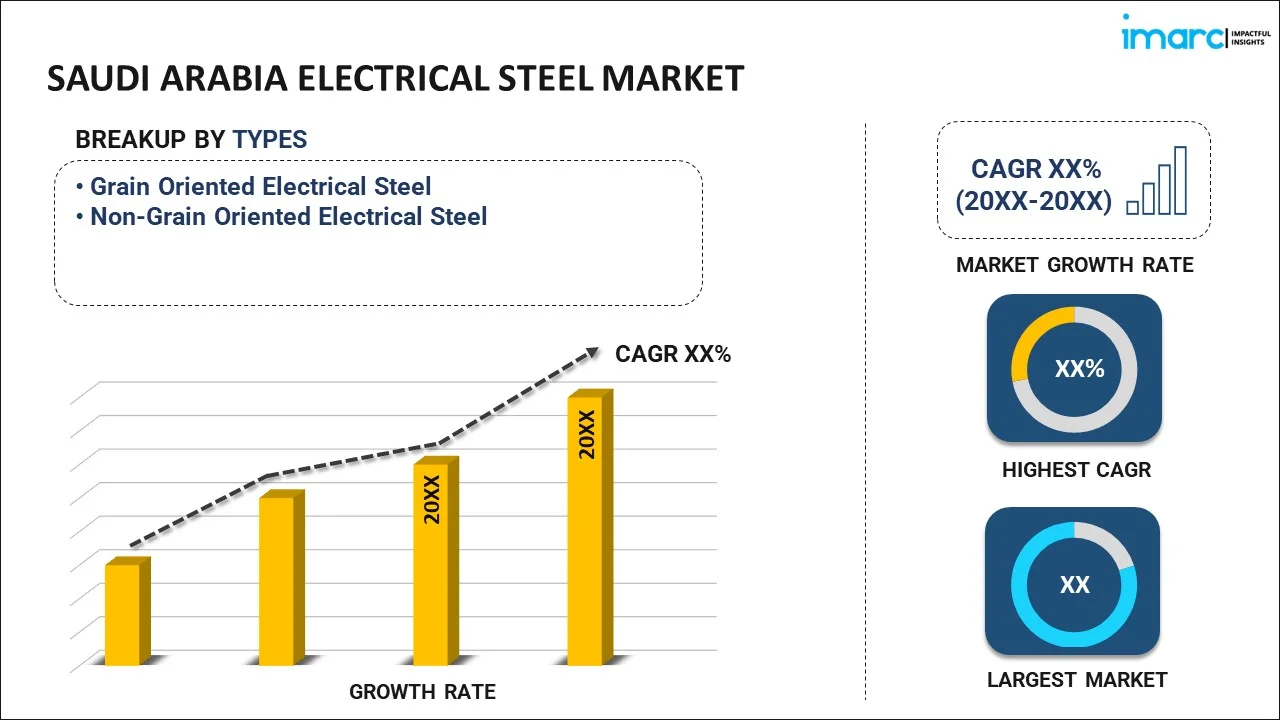
To get detailed segment analysis of this market Request Sample
- Grain Oriented Electrical Steel
- Non-Grain Oriented Electrical Steel
The report has provided a detailed breakup and analysis of the market based on the type. This includes grain oriented electrical steel and non-grain oriented electrical steel.
Application Insights:
- Transformers
- Motors
- Generators
- Others
A detailed breakup and analysis of the market based on the application have also been provided in the report. This includes transformers, motors, generators, and others.
End Use Industry Insights:
- Energy and Power
- Automobiles
- Household Appliances
- Building and Construction
- Others
The report has provided a detailed breakup and analysis of the market based on the end use industry. This includes energy and power, automobiles, household appliances, building and construction, and others.
Regional Insights:
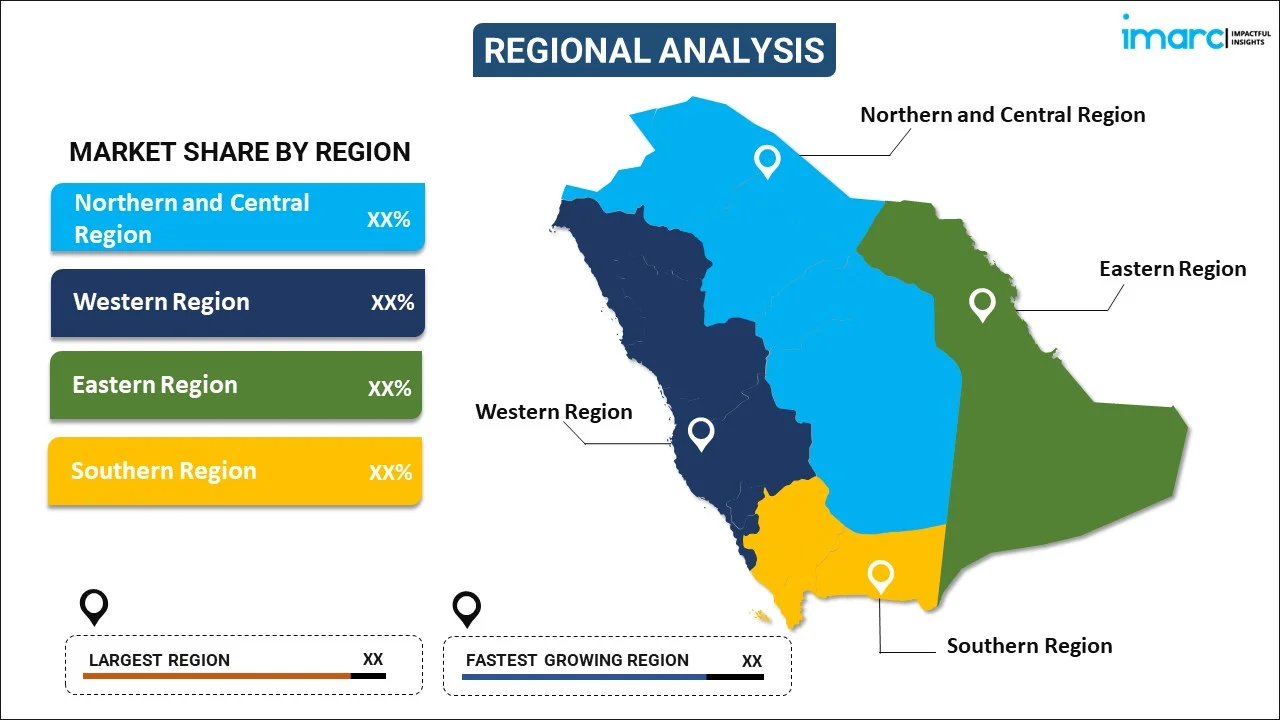
To get detailed regional analysis of this market Request Sample
- Northern and Central Region
- Western Region
- Eastern Region
- Southern Region
The report has also provided a comprehensive analysis of all the major regional markets, which include Northern and Central Region, Western Region, Eastern Region, and Southern Region.
Competitive Landscape:
The market research report has also provided a comprehensive analysis of the competitive landscape in the market. Competitive analysis such as market structure, key player positioning, top winning strategies, competitive dashboard, and company evaluation quadrant has been covered in the report. Also, detailed profiles of all major companies have been provided.
Saudi Arabia Electrical Steel Market Report Coverage:
| Report Features | Details |
|---|---|
| Base Year of the Analysis | 2025 |
| Historical Period | 2020-2025 |
| Forecast Period | 2026-2034 |
| Units | Million USD |
| Scope of the Report | Exploration of Historical and Forecast Trends, Industry Catalysts and Challenges, Segment-Wise Historical and Predictive Market Assessment:
|
| Types Covered | Grain Oriented Electrical Steel, Non-Grain Oriented Electrical Steel |
| Applications Covered | Transformers, Motors, Generators, Others |
| End Use Industries Covered | Energy and Power, Automobiles, Household Appliances, Building and Construction, Others |
| Regions Covered | Northern and Central Region, Western Region, Eastern Region, Southern Region |
| Customization Scope | 10% Free Customization |
| Post-Sale Analyst Support | 10-12 Weeks |
| Delivery Format | PDF and Excel through Email (We can also provide the editable version of the report in PPT/Word format on special request) |
Key Questions Answered in This Report:
- How has the Saudi Arabia electrical steel market performed so far and how will it perform in the coming years?
- What has been the impact of COVID-19 on the Saudi Arabia electrical steel market?
- What is the breakup of the Saudi Arabia electrical steel market on the basis of type?
- What is the breakup of the Saudi Arabia electrical steel market on the basis of application?
- What is the breakup of the Saudi Arabia electrical steel market on the basis of end use industry?
- What are the various stages in the value chain of the Saudi Arabia electrical steel market?
- What are the key driving factors and challenges in the Saudi Arabia electrical steel?
- What is the structure of the Saudi Arabia electrical steel market and who are the key players?
- What is the degree of competition in the Saudi Arabia electrical steel market?
Key Benefits for Stakeholders:
- IMARC’s industry report offers a comprehensive quantitative analysis of various market segments, historical and current market trends, market forecasts, and dynamics of the Saudi Arabia electrical steel market from 2020-2034.
- The research report provides the latest information on the market drivers, challenges, and opportunities in the Saudi Arabia electrical steel market.
- Porter's five forces analysis assist stakeholders in assessing the impact of new entrants, competitive rivalry, supplier power, buyer power, and the threat of substitution. It helps stakeholders to analyze the level of competition within the Saudi Arabia electrical steel industry and its attractiveness.
- Competitive landscape allows stakeholders to understand their competitive environment and provides an insight into the current positions of key players in the market.
Need more help?
- Speak to our experienced analysts for insights on the current market scenarios.
- Include additional segments and countries to customize the report as per your requirement.
- Gain an unparalleled competitive advantage in your domain by understanding how to utilize the report and positively impacting your operations and revenue.
- For further assistance, please connect with our analysts.
 Request Customization
 Speak to an Analyst
 Request Brochure
 Inquire Before Buying
Benefits of Customization
- Personalize this research
- Triangulate with your data
- Get data as per your format and definition
- Gain a deeper dive into a specific application, geography, customer, or competitor
- Any level of personalization
Get in Touch With Us
UNITED STATES
Phone: +1-201-971-6302
INDIA
Phone: +91-120-433-0800
UNITED KINGDOM
Phone: +44-753-714-6104
Email: [email protected]
Client Testimonials




.webp)




.webp)













Related Reports

Choose your plan
*Please note that the prices mentioned below are starting prices for each bundle type. Kindly contact our team for further details.*
Single User License
- 1 User License, Access on 2 Devices
- PDF Report + Excel Dataset (Password Protected)
- Lifetime Access
- No Printing Rights
- 10% Free Report Customization
- 10–12 Weeks of Analyst Support
Five User License
- Access for 5 Users, 2 Devices per User
- PDF Report + Excel Dataset (Password Protected)
- Lifetime Access
- Dedicated Account Manager
- 12–14 Weeks of Analyst Support
- No Printing Rights
- 15% Free Report Customization
- 25% Discount on Your Next Purchase
Corporate User License
- Unlimited User Access (Within Your Organization)
- PDF Report + Excel Dataset
- Lifetime Access
- Dedicated Account Manager
- 14–20 Weeks of Analyst Support
- No Printing Rights
- 20% Free Report Customization
- 30% Discount on Your Next Purchase
Essential Insights
What's included:
3 reports
- Lifetime Access
- PDF Reports
- Excel Datasets
- 2 Weeks of Free Analyst Support
- 2 User Licenses
- Access on 2 Devices
- Printing Rights
- Complimentary PowerPoint (PPT) Version
- Complimentary License Upgrade
Professional Access
What's included:
5 reports
- Lifetime Access
- PDF Reports
- Excel Datasets
- 8 Weeks of Free Analyst Support
- 2 User Licenses
- Access on 2 Devices
- Printing Rights
- Complimentary PowerPoint (PPT) Version
- Complimentary License Upgrade
Business Advantage
What's included:
8 reports
- Lifetime Access
- PDF Reports
- Excel Datasets
- 14 Weeks of Free Analyst Support
- 2 User Licenses
- Access on 2 Devices
- Printing Rights
- Complimentary PowerPoint (PPT) Version
- Complimentary License Upgrade
Enterprise Intelligence
What's included:
10 reports
- Lifetime Access
- PDF Reports
- Excel Datasets
- 20 Weeks of Free Analyst Support
- 2 User Licenses
- Access on 2 Devices
- Printing Rights
- Complimentary PowerPoint (PPT) Version
- Complimentary License Upgrade