
Saudi Arabia Fast Food and Quick Service Restaurant Market Size, Share, Trends and Forecast by Business Model, Cuisine, Product Type, Service Type, and Region, 2026-2034
Saudi Arabia Fast Food and Quick Service Restaurant Market Size, Share, Trends & Forecast (2026-2034)
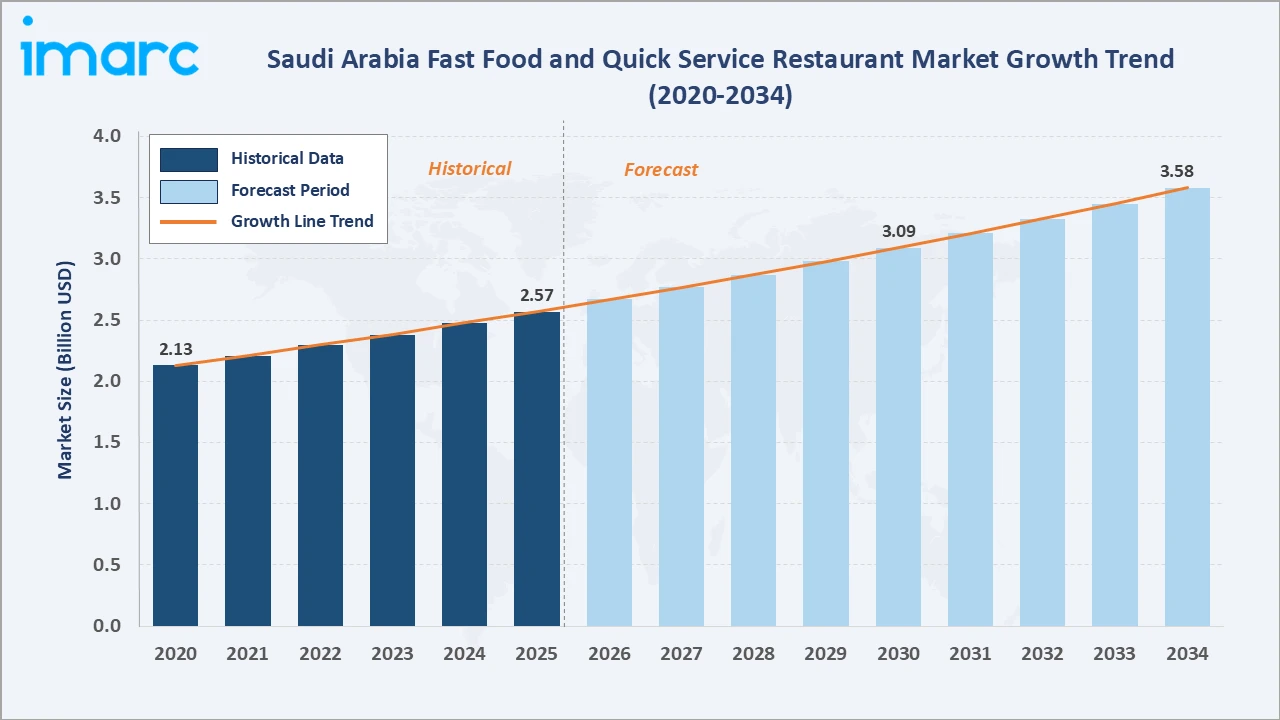
The Saudi Arabia fast food and quick service restaurant market grew from USD 2.57 Billion in 2025 to USD 2.66 Billion in 2026 and is projected to reach USD 3.58 Billion by 2034, growing at a CAGR of 3.76% during 2026-2034. The market is driven by rapid urbanization, rising disposable incomes, and a young, convenience-oriented consumer base.
Saudi Arabia recorded more than 30 million inbound and domestic tourist trips in 2024, materially expanding out-of-home food spending. This growth in travel and leisure activity is driving demand for standardized, affordable, and fast dining formats across urban and tourism corridors.
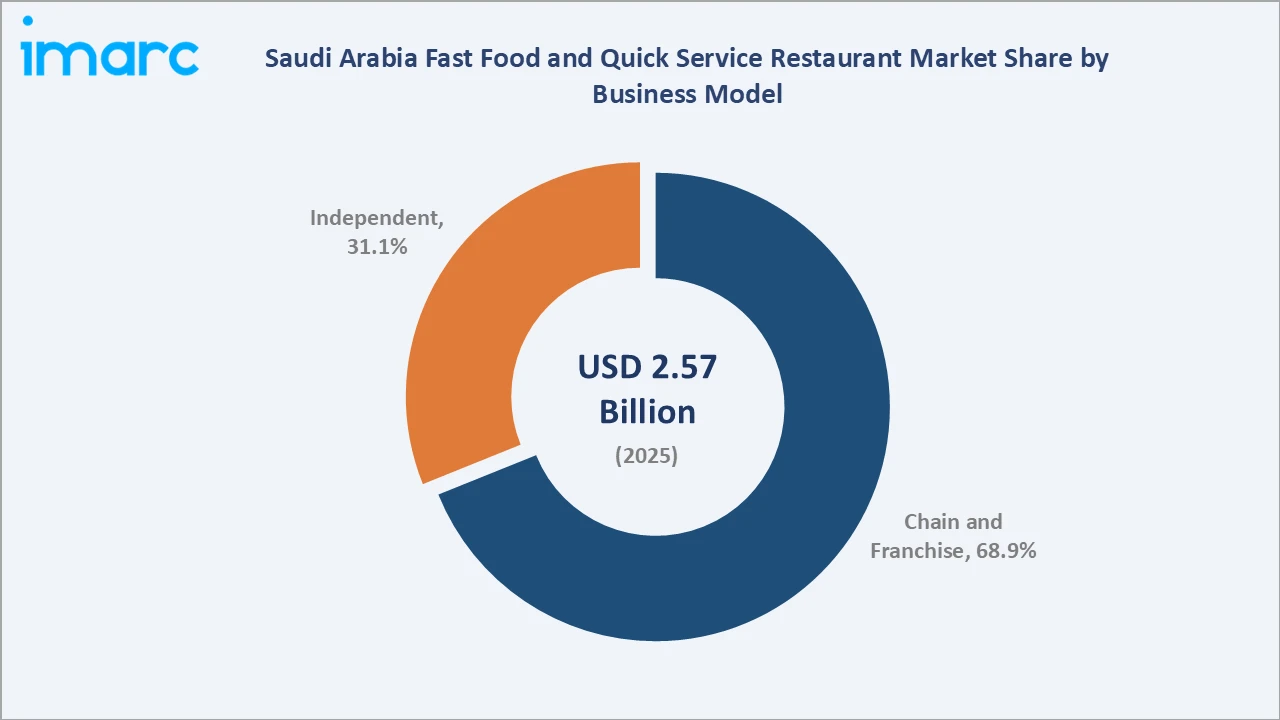
Chain and franchise outlets dominate at 68.9%. Offline service leads service type at 71.8%. The Northern and Central Region commands 40.3% of the national market share.
Market Snapshot
|
Metric |
Value |
|
Base Year Market Size (2025) |
USD 2.57 Billion |
| Market Size (2026) | USD 2.66 Billion |
|
Forecast Market Size (2034) |
USD 3.58 Billion |
|
CAGR (2026-2034) |
3.76% |
|
Base Year |
2025 |
|
Historical Period |
2020-2025 |
|
Forecast Period |
2026-2034 |
|
Dominant Business Model |
Chain and Franchise (68.9%, 2025) |
|
Dominant Service Type |
Offline Service (71.8%, 2025) |
|
Leading Region |
Northern and Central Region (40.3%, 2025) |
The market expanded from USD 2.13 Billion in 2020 to USD 2.57 Billion in 2025 and an estimated USD 2.66 Billion in 2026, anchored at USD 3.09 Billion in 2030, and forecast to reach USD 3.58 Billion by 2034. COVID-19 suppressed dine-in traffic in 2020 while accelerating a permanent shift toward delivery and drive-thru formats.
To get more information on this market, Request Sample
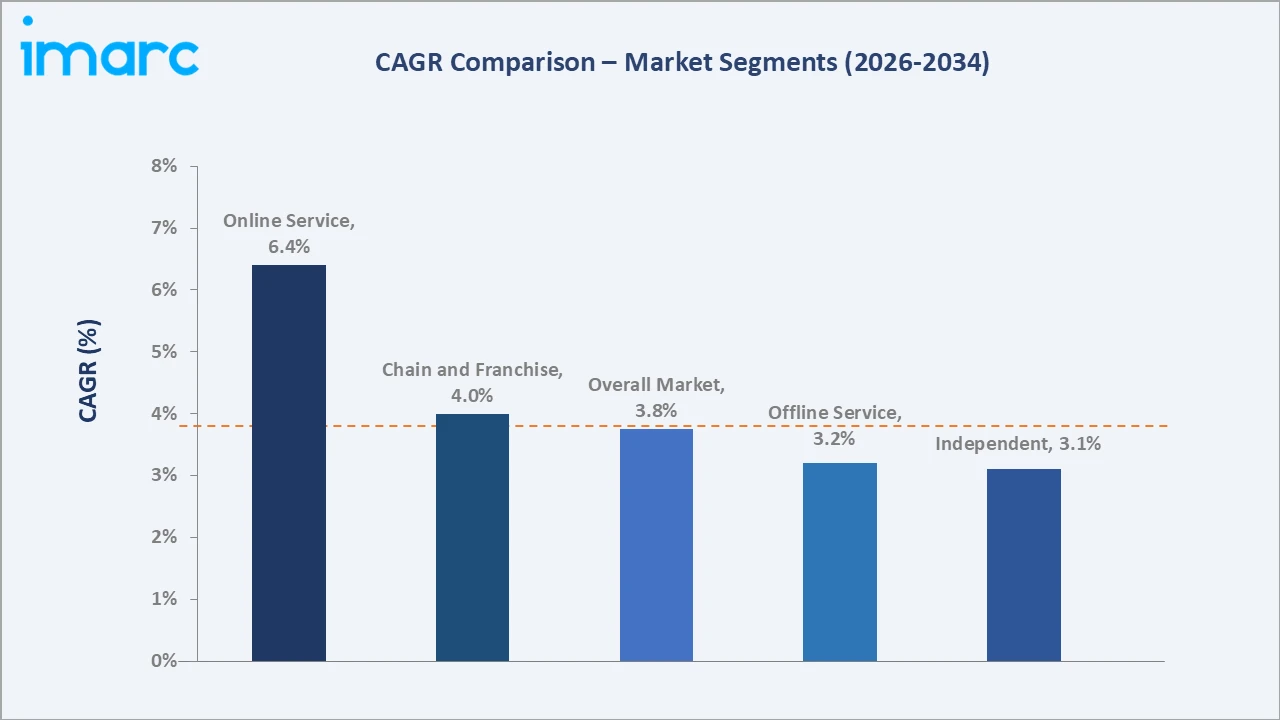
Online service grows fastest at approximately 6.4% CAGR as aggregator penetration deepens across secondary cities. Chain and franchise outlets grow at approximately 4.05% CAGR through master franchise expansion and standardized multi-site operating economics.
Executive Summary
The Saudi Arabia fast food and quick service restaurant market, which increased from USD 2.57 Billion in 2025 to an estimated USD 2.66 Billion in 2026, representing one of the most competitive consumer-facing food service arenas in the Gulf region. It spans branded international chains, regional master franchisees, homegrown Saudi brands, and independent operators across dine-in, drive-thru, takeaway, and delivery.
Chain and franchise outlets at 68.9% dominate through brand equity and supply chain scale. Offline service at 71.8% leads on the strength of drive-thru culture, mall food courts, and family dine-in occasions. The Northern and Central Region, at 40.3%, leads through Riyadh’s population concentration and rapid commercial development.
Key Market Insights
|
Insight |
Data |
|
Dominant Business Model |
Chain and Franchise - 68.9% share (2025) |
|
Dominant Service Type |
Offline Service - 71.8% market share (2025) |
|
Leading Region |
Northern and Central Region - 40.3% market share |
|
Market Opportunity |
Cloud kitchen expansion; drive-thru densification; Saudi homegrown brand franchising; giga-project and tourism corridor outlets; healthier menu formats; AI-enabled ordering and loyalty |
Key Analytical Observations Supporting the Above Data:
- Chain and Franchise at 68.9%: Chain and franchise operators dominate due to strong brand recognition, standardized menus, and centralized procurement that lowers unit costs. These operators benefit from faster site rollout, consistent service quality, and greater access to financing and prime retail locations.
- Offline Service at 71.8%: Offline service dominates because dine-in, drive-thru, and takeaway remain the default consumption occasions across the Kingdom. Family gatherings, mall footfall, and an entrenched drive-thru culture sustain high in-person volumes despite rapid delivery growth.
- Northern and Central Region at 40.3%: The Northern and Central Region leads on the back of Riyadh’s dense population, high per-capita income, and concentration of corporate offices and retail developments. Sustained infrastructure and entertainment investment further reinforces its leading position.
Saudi Arabia Fast Food and Quick Service Restaurant Market Overview
The Saudi Arabia fast food and quick service restaurant market encompasses the operation of limited-service outlets offering standardized menus with rapid preparation and counter, drive-thru, or digital ordering. The market covers branded chains, franchised outlets, independent quick service restaurants, and the delivery infrastructure supporting them.
Macroeconomic factors include a young population, rising female workforce participation, urban migration, and expanding tourism under Vision 2030. In addition, growing smartphone penetration, aggregator coverage, and entertainment sector liberalization are accelerating out-of-home food consumption across the Kingdom.
Market Dynamics
To evaluate market opportunities, Request Sample
Market Drivers
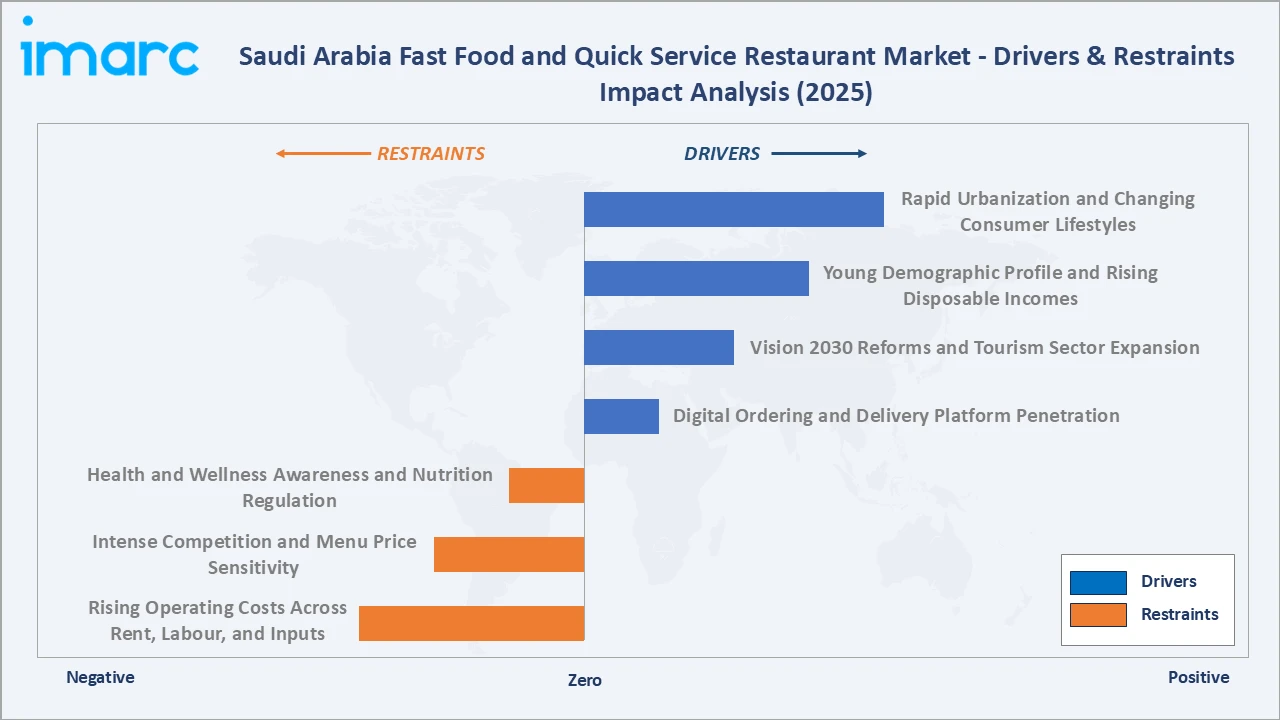
- Rapid Urbanization and Changing Consumer Lifestyles: Urban migration and faster-paced routines are reducing time available for home cooking. Dual-income households and longer commutes increase reliance on quick, affordable meals. Limited-service formats meet this demand through speed, predictable pricing, and wide availability.
- Young Demographic Profile and Rising Disposable Incomes: A large youth cohort with growing purchasing power favours affordable, branded, and socially visible dining. Higher household incomes allow more frequent out-of-home spending. Promotional pricing, combo offers, and social media marketing convert this demographic into a high-frequency customer base.
- Vision 2030 Reforms and Tourism Sector Expansion: Economic diversification programmes are expanding tourism, entertainment, and hospitality infrastructure. New destinations, events, and leisure venues increase footfall in commercial districts and travel corridors. Supportive franchising regulation and foreign investment rules are also encouraging international brands to accelerate outlet rollout.
- Digital Ordering and Delivery Platform Penetration: High smartphone penetration and mature aggregator networks are extending the addressable catchment of each outlet. Mobile applications, loyalty programmes, and integrated payment systems shorten transaction times and lift order frequency. Data from digital channels also enables sharper menu engineering and targeted promotional spend.
Market Restraints
- Rising Operating Costs Across Rent, Labour, and Inputs: Prime retail rents, localization-linked wage obligations, and volatile food input prices are compressing outlet economics. Energy and logistics costs add further pressure. Operators with limited scale struggle to absorb these increases without raising menu prices or reducing service coverage.
- Intense Competition and Menu Price Sensitivity: A crowded field of international, regional, and independent operators limits pricing power. Frequent discounting and aggregator commission structures erode contribution margins. Customer switching costs are minimal, so sustained differentiation requires continuous marketing and product investment.
- Health and Wellness Awareness and Nutrition Regulation: Growing consumer focus on nutrition and stricter calorie labelling and ingredient disclosure requirements are reshaping menu design. Reformulation, portion adjustment, and compliance reporting increase operating complexity. Some traditional high-calorie categories face slower growth as preferences shift.
Market Opportunities
- Cloud Kitchen and Delivery-Optimized Formats: Delivery-only kitchens reduce capital intensity and shorten time to market. They allow operators to test new brands and cuisines in dense residential catchments without prime retail rent. Shared infrastructure also improves asset utilization across multiple virtual brands.
- Homegrown Brand Franchising and Regional Expansion: Local brands with strong consumer affinity are attractive franchising propositions across secondary cities and neighbouring markets. Structured franchise systems provide capital-light growth while preserving brand control. Rising investor appetite for food service assets supports this expansion pathway.
Market Challenges
- Workforce Localization and Talent Retention: Meeting localization quotas while maintaining service standards requires sustained recruitment and training investment. High attrition in front-of-house roles raises hiring costs and disrupts service consistency. Operators must balance compliance obligations against unit-level productivity targets.
- Supply Chain Reliability and Cold Chain Dependence: Consistent menu execution depends on reliable sourcing of poultry, beef, bakery, and dairy inputs, much of which is imported. Cold chain interruptions, port delays, and currency movements affect availability and cost. Maintaining buffer inventory raises working capital requirements.
Emerging Market Trends
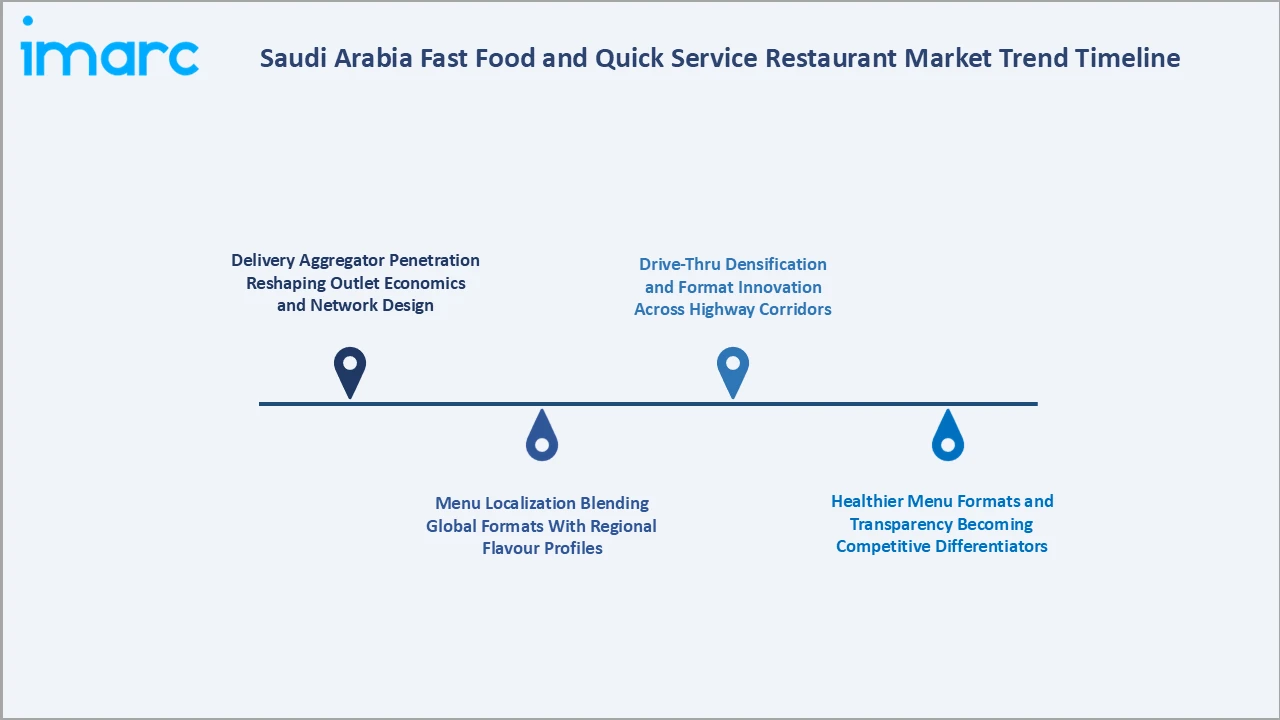
1. Delivery Aggregator Penetration Reshaping Outlet Economics and Network Design
Aggregator platforms have shifted a growing share of orders off-premise, allowing operators to serve wider catchments from smaller kitchens. Menu design, packaging, and staffing are being re-engineered around travel time. Commission structures compress margins, prompting investment in direct ordering applications and first-party loyalty programmes.
2. Menu Localization Blending Global Formats With Regional Flavour Profiles
International chains are adapting core menus with regional spice profiles, rice-based platters, and locally familiar sides to broaden appeal. Limited-time offers tied to national occasions and Ramadan drive traffic peaks. Localization also strengthens competitive defence against homegrown brands that already command strong cultural affinity.
3. Drive-Thru Densification and Format Innovation Across Highway Corridors
Drive-thru remains a defining Saudi consumption behaviour, and operators are adding dual-lane configurations, dedicated pickup bays, and digital menu boards to raise throughput. New sites cluster along arterial roads and intercity routes. These formats deliver higher average transaction volumes with lower seating-related overheads.
4. Healthier Menu Formats and Transparency Becoming Competitive Differentiators
Grilled options, reduced-sodium recipes, and clearer nutritional disclosure are moving from niche to mainstream. Younger consumers increasingly evaluate brands on ingredient quality and sourcing. Operators investing early in balanced menu architecture are strengthening long-term relevance without abandoning core indulgence categories.
Industry Value Chain Analysis
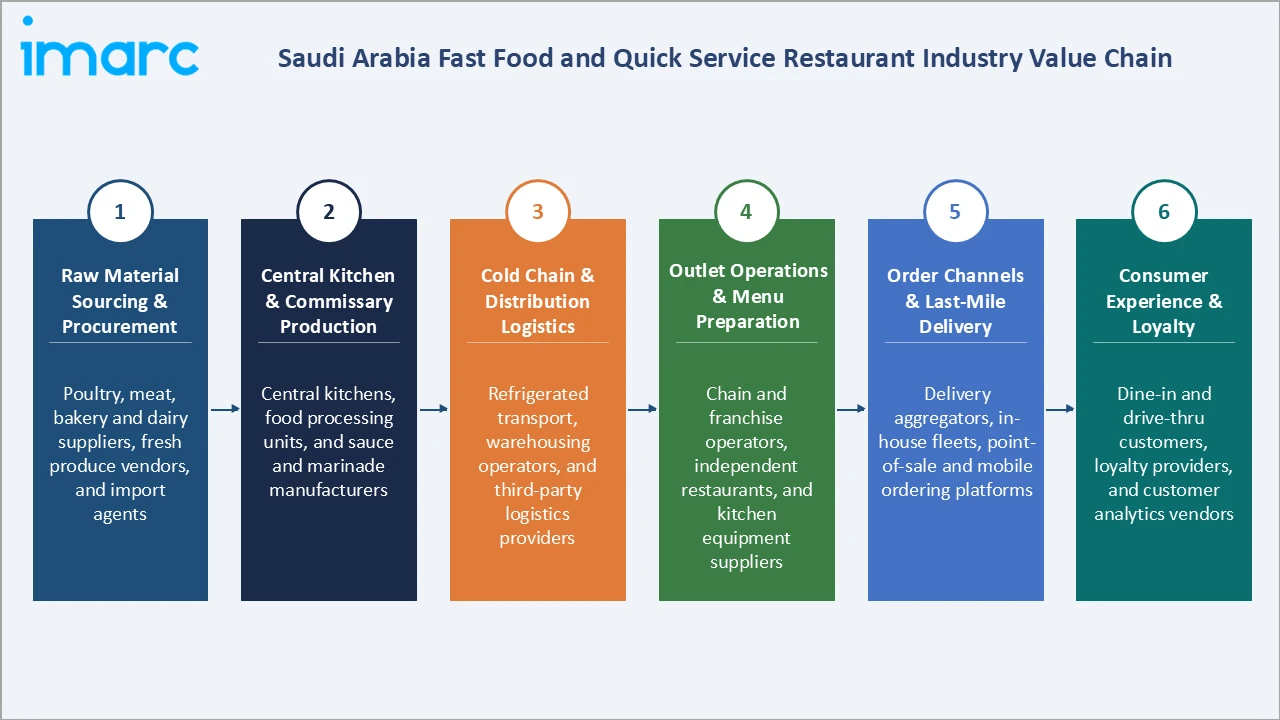
The value chain integrates raw material sourcing and procurement, central kitchen and commissary production, cold chain and distribution logistics, outlet operations and menu preparation, order channels and last-mile delivery, and consumer experience and loyalty management.
|
Stage |
Key Participants |
|
Raw Material Sourcing & Procurement |
Poultry and meat suppliers, bakery and dairy producers, fresh produce vendors, import and trading agents |
|
Central Kitchen & Commissary Production |
Central kitchen operators, food processing units, sauce and marinade manufacturers, quality assurance teams |
|
Cold Chain & Distribution Logistics |
Refrigerated transport providers, warehousing operators, third-party logistics companies, inventory management platforms |
|
Outlet Operations & Menu Preparation |
Chain and franchise operators, independent restaurants, kitchen equipment suppliers, training and operations consultants |
|
Order Channels & Last-Mile Delivery |
Delivery aggregators, in-house delivery fleets, point-of-sale and mobile ordering platforms, payment gateways |
|
Consumer Experience & Loyalty |
Dine-in and drive-thru customers, loyalty programme providers, marketing agencies, customer analytics vendors |
Outlet operations and menu preparation is the most operationally intensive and commercially differentiated stage of the chain. The cold chain and distribution layer determines menu consistency across geographically dispersed outlets. Order channel management increasingly governs customer acquisition cost and repeat purchase economics.
Technology Landscape in the Fast Food and Quick Service Restaurant Industry
Digital Ordering and Point-of-Sale Integration
Integrated point-of-sale and mobile ordering systems synchronize kitchen queues, inventory, and payments in real time. Self-service kiosks reduce counter congestion and raise average order value through guided upselling. Unified data across channels supports accurate demand forecasting and sharper labour scheduling at outlet level.
Kitchen Automation and Production Efficiency Systems
Automated fryers, conveyor ovens, and kitchen display systems standardize cook times and reduce variability across outlets. Production monitoring tools track ticket times and waste, enabling targeted interventions. These systems help operators sustain service speed as delivery volumes and menu complexity increase.
Customer Analytics and Loyalty Personalization
Loyalty platforms and customer data engines segment audiences by frequency, basket composition, and channel preference. Targeted offers improve redemption rates while limiting blanket discounting. Predictive models also guide new site selection and menu rationalization decisions across the outlet network.
Market Segmentation Analysis
The report covers the following segments:
|
Segment Category |
Leading Segment |
Market Share |
Year |
|
Business Model |
Chain and Franchise |
68.9% |
2025 |
|
Cuisine |
🔒 |
🔒 |
2025 |
|
Product Type |
🔒 |
🔒 |
2025 |
|
Service Type |
Offline Service |
71.8% |
2025 |
|
Region |
Northern and Central Region |
40.3% |
2025 |

By Business Model
Chain and franchise leads at 68.9% (2025). The segment covers international master franchise networks, regional multi-brand operators, and homegrown Saudi chains operating standardized outlets with centralized procurement, shared marketing, and common operating procedures.
To access detailed market analysis, Request Sample
Independent operators at 31.1% remain concentrated in neighbourhood catchments and regional cuisine formats. The segment grows at approximately 3.1% CAGR as delivery aggregators lower the visibility barrier for single outlets, partially offsetting scale disadvantages against branded chains.
By Service Type
Offline service leads at 71.8% (2025). The segment spans dine-in seating, drive-thru lanes, counter takeaway, and food court operations. Its growth of approximately 3.2% CAGR reflects continued outlet expansion alongside gradual channel migration toward digital ordering.
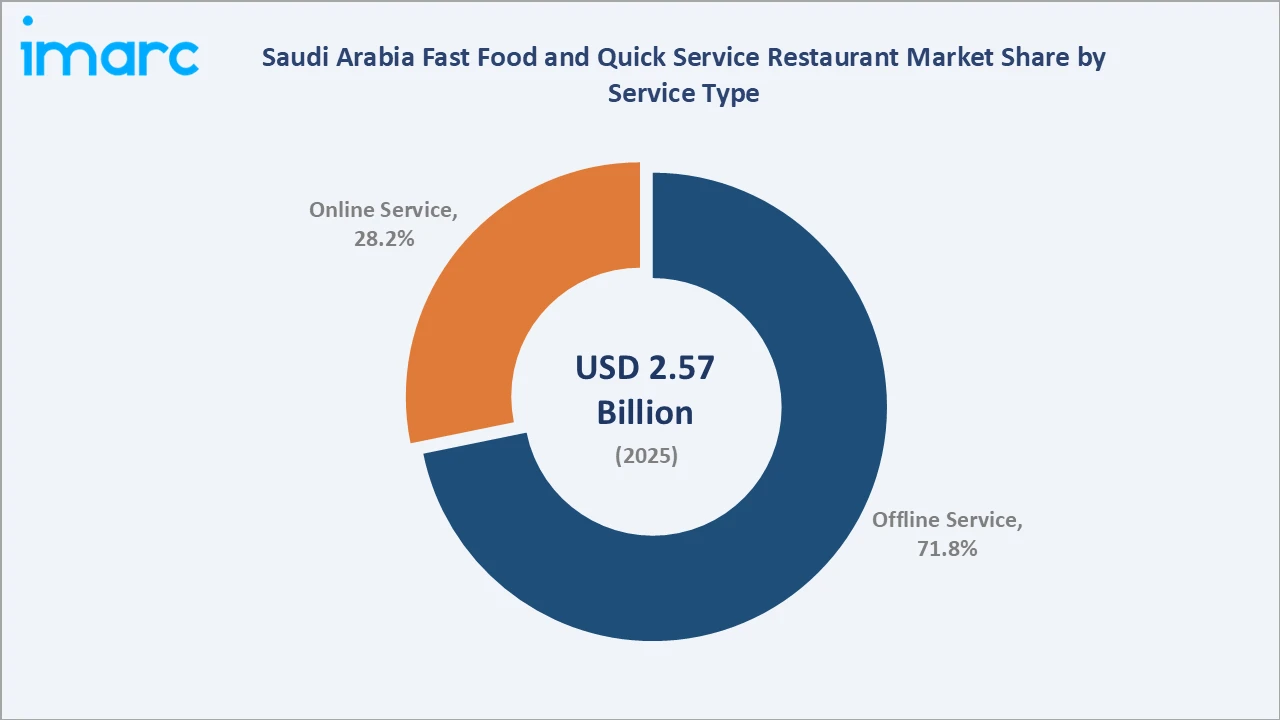
Online service at 28.2% grows fastest at approximately 6.4% CAGR through aggregator coverage expansion into secondary cities and rising direct application ordering. The segment covers marketplace platforms, brand-owned applications, and web-based ordering with delivery or scheduled pickup.
Regional Market Insights
|
Region |
Share (2025) |
Key Fast Food and Quick Service Restaurant Market Drivers & Characteristics |
|
Northern and Central Region |
40.3% |
Driven by Riyadh’s population density, high disposable incomes, corporate concentration, and rapid retail and entertainment development. |
|
Western Region |
29.1% |
Supported by Jeddah’s commercial base, religious tourism inflows to Makkah and Madinah, and sustained hospitality sector expansion. |
|
Eastern Region |
18.6% |
Driven by the industrial and energy employment base, high expatriate presence, and strong drive-thru and mall-based dining culture. |
|
Southern Region |
12.0% |
Supported by growing domestic tourism, improving road infrastructure, and gradual expansion of branded outlet networks into secondary cities. |
The Northern and Central Region’s 40.3% leadership is anchored by Riyadh, which combines the largest urban population with the highest concentration of commercial and entertainment developments. The Western Region’s 29.1% reflects Jeddah’s consumer market alongside year-round pilgrimage-driven footfall.
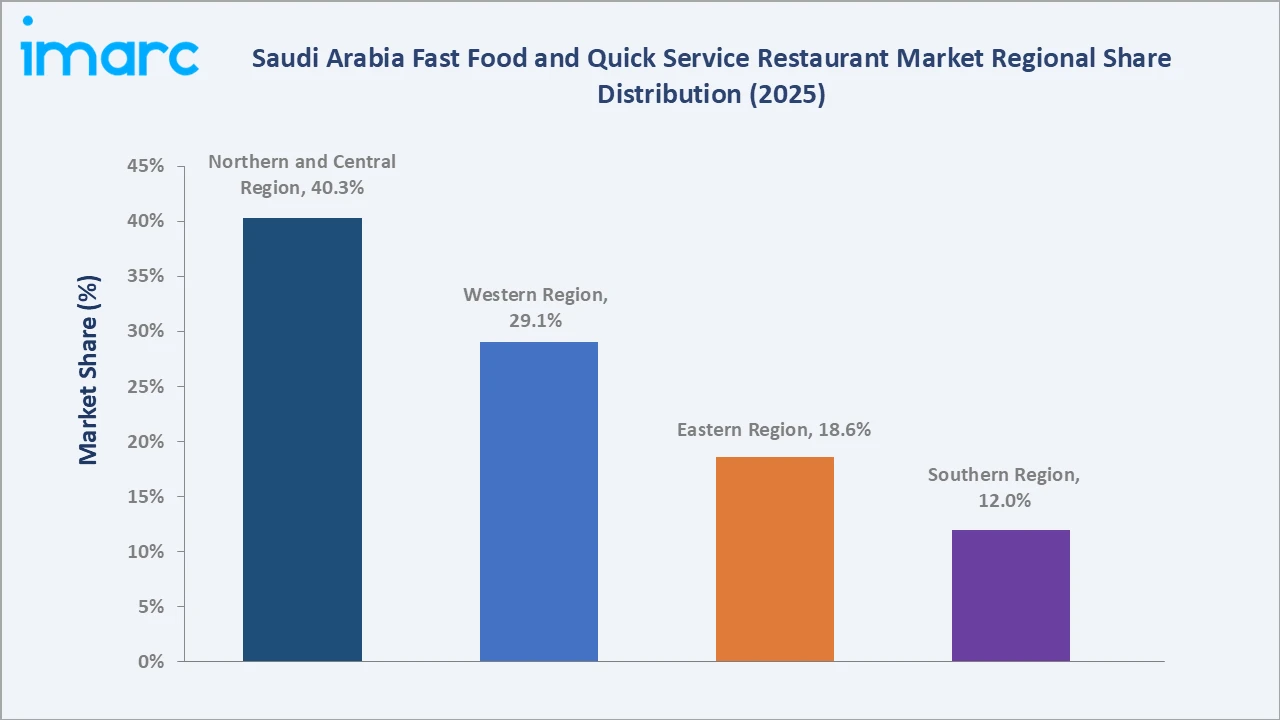
The Eastern Region’s 18.6% is underpinned by Dammam, Khobar, and Dhahran, where industrial employment supports consistent weekday demand. The Southern Region, at 12.0%, is the smallest but among the faster growing areas by outlet count as branded networks extend coverage.
Competitive Landscape
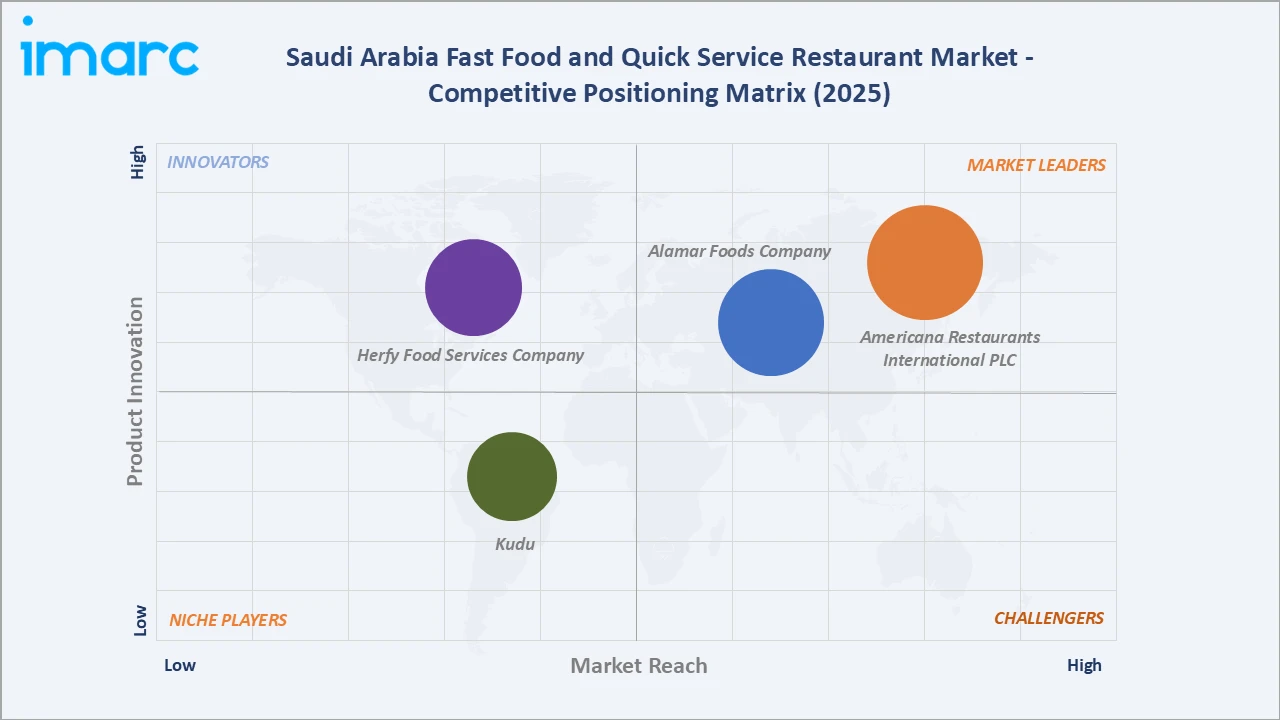
The competitive landscape spans distinct tiers: international brand owners, regional master franchise operators, homegrown Saudi chains, and independent quick service restaurants competing on price, location density, and menu familiarity.
|
Company Name |
Key Brands |
Market Position |
Core Strength |
|
Americana Restaurants International PLC |
KFC, Hardee’s, Pizza Hut, Krispy Kreme |
Market Leader |
Operates the Kingdom’s largest multi-brand franchise portfolio, with deep site coverage, integrated supply chain, and long-standing master franchise relationships across leading global brands. |
|
Alamar Foods Company |
Domino’s Pizza, Dunkin’ |
Market Leader |
Combines strong delivery execution with disciplined multi-brand franchise operations, supported by regional commissary infrastructure and mature digital ordering capability. |
|
Herfy Food Services Company |
Herfy Restaurants, Herfy Bakery |
Established Player |
Homegrown vertically integrated operator with in-house meat and bakery production, offering cost control and strong price positioning across value segments. |
|
Kudu |
Kudu |
Established Player |
Long-established Saudi brand with high cultural familiarity, dense coverage in central regions, and menu formats tailored to local taste preferences. |
Master franchise concentration creates a structure where a small number of multi-brand operators control a disproportionate share of outlets, sustaining bargaining power with suppliers and landlords. Consolidation is increasing as operators pursue portfolio scale to absorb rising fixed costs.
Key Company Profiles
Americana Restaurants International PLC
Americana Restaurants International PLC is a leading operator and franchisee of quick service and casual dining brands across the Middle East and North Africa, with a substantial outlet footprint in Saudi Arabia. The company operates a multi-brand portfolio supported by integrated food processing and distribution capability.
- Key Brands: KFC, Hardee’s, Pizza Hut, Krispy Kreme, TGI Fridays.
- Recent Developments: In July 2026, the company completed the acquisition of Arabic QSR brand Malak Al Tawouk in Saudi Arabia. Saudi revenue reached USD 336 Million in H1 2026, up 7% year-on-year across 761 restaurants, with 120-130 net new openings guided group-wide for 2026.
- Strategic Focus: Focuses on multi-brand portfolio scale, supply chain integration, and digital channel expansion.
Alamar Foods Company
Alamar Foods Company is a Saudi-headquartered quick service restaurant operator holding master franchise rights for international brands across the Middle East, North Africa, and Pakistan. The company is recognized for its delivery-led operating model and centralized commissary network.
- Key Brands: Domino’s Pizza, Dunkin’.
- Recent Developments: In August 2025, the company signed a binding offer to acquire 29 Domino’s branches in Makkah and Taif for SAR 40 Million, converting sub-franchised stores to direct operation. The transaction consolidates its Saudi network to around 325 outlets, reinforcing its position as the Kingdom’s largest pizza operator.
- Strategic Focus: Centered on delivery excellence, digital customer engagement, and disciplined franchise network growth.
Herfy Food Services Company
Herfy Food Services Company is a Saudi listed food service operator running one of the largest homegrown quick service restaurant chains in the Kingdom, supported by in-house meat processing and bakery operations that underpin its cost and quality position.
- Key Brands: Herfy Restaurants, Herfy Bakery.
- Strategic Focus: Focuses on vertical integration, value pricing, and expansion of complementary bakery and retail food channels.
Market Concentration Analysis
The market is moderately concentrated at the chain tier and highly fragmented among independents. A small group of master franchise operators controls a substantial share of branded outlets, while thousands of single-site restaurants compete locally.
Concentration is gradually increasing as larger operators acquire regional networks and rising cost pressures accelerate exits among sub-scale independent operators.
Investment & Growth Opportunities
Highest Growth Segments
Online service (approximately 6.4% CAGR), cloud kitchen networks (approximately 12-15% CAGR), drive-thru format expansion (approximately 5% CAGR), homegrown brand franchising (approximately 8% CAGR), and healthier menu formats (approximately 10% CAGR from a small base) represent the highest-growth investment vectors through 2034.
Emerging Investment Opportunities
Tourism corridor and giga-project outlet development represents the largest near-term opportunity. Operators securing early site rights in emerging destination developments and transport hubs are positioned for above-market revenue growth as visitor volumes scale through the forecast period.
Investment Themes
- Cloud kitchen platform investment capturing delivery demand with reduced capital intensity: Delivery-only kitchen networks allow multiple virtual brands to share infrastructure in dense residential catchments. Investors backing operators that build scalable kitchen platforms and brand incubation capability by 2026-2027 are positioned to capture the structural shift toward off-premise consumption.
- First-party digital ordering and loyalty ecosystems reducing aggregator dependence: Direct ordering channels materially improve contribution margin relative to marketplace transactions. Investment in application development, customer data infrastructure, and loyalty design creates durable competitive advantage and recurring high-frequency demand.
Future Market Outlook (2026-2034)
The Saudi Arabia fast food and quick service restaurant market is projected to grow from USD 2.57 Billion in 2025 to USD 2.66 Billion in 2026, reaching USD 3.58 Billion by 2034, registering a CAGR of 3.76% over the forecast period.
The anchor value of USD 3.09 Billion in 2030 represents an industry moving from outlet-count-led expansion toward channel mix optimization, where digital ordering, delivery economics, and format productivity determine operator returns more than raw footprint growth.
Three structural forces define growth through 2034. Demographics remain supportive, with a large youth cohort sustaining high consumption frequency. Tourism and entertainment expansion creates new high-footfall catchments. Digital channel maturation shifts advantage toward operators with superior data and logistics capability.
Research Methodology
Primary Research
Primary research comprised structured interviews with 45+ industry stakeholders (2025) including franchise operations directors; supply chain managers; delivery platform executives; independent restaurant owners; and regional food service market specialists.
Secondary Research
Secondary research encompassed national statistical publications; food service industry data; tourism and hospitality statistics; company annual reports and disclosures; franchise registry information; and delivery platform market data. Over 55 secondary sources reviewed.
Forecasting Models
Market revenue forecasts developed using a segment bottom-up model: (i) outlet count and format mix; (ii) average transaction value; (iii) transaction frequency by channel.
Saudi Arabia Fast Food and Quick Service Restaurant Market Report Coverage:
| Report Features | Details |
|---|---|
| Base Year of the Analysis | 2025 |
| Historical Period | 2020-2025 |
| Forecast Period | 2026-2034 |
| Units | Billion USD |
| Scope of the Report | Exploration of Historical Trends and Market Outlook, Industry Catalysts and Challenges, Segment-Wise Historical and Future Market Assessment:
|
| Business Models Covered | Independent, Chain and Franchise |
| Cuisines Covered | American, Chinese, Italian, Mexican, Japanese, Turkish and Lebanese, Others |
| Product Types Covered | Burgers and Sandwiches, Pizzas and Pastas, Drinks and Desserts, Chicken and Seafood, Others |
| Service Types Covered | Online Service, Offline Service |
| Regions Covered | Northern and Central Region, Western Region, Eastern Region, Southern Region |
| Companies Covered | Americana Restaurants International PLC, Alamar Foods Company, Herfy Food Services Company and Kudu, etc. |
| Customization Scope | 10% Free Customization |
| Post-Sale Analyst Support | 10-12 Weeks |
| Delivery Format | PDF and Excel through Email (We can also provide the editable version of the report in PPT/Word format on special request) |
Key Benefits for Stakeholders:
- IMARC’s industry report offers a comprehensive quantitative analysis of various market segments, historical and current market trends, market forecasts, and dynamics of the Saudi Arabia fast food and quick service restaurant market from 2020-2034.
- The research report provides the latest information on the market drivers, challenges, and opportunities in the Saudi Arabia fast food and quick service restaurant market.
- Porter's five forces analysis assist stakeholders in assessing the impact of new entrants, competitive rivalry, supplier power, buyer power, and the threat of substitution. It helps stakeholders to analyze the level of competition within the Saudi Arabia fast food and quick service restaurant industry and its attractiveness.
- Competitive landscape allows stakeholders to understand their competitive environment and provides an insight into the current positions of key players in the market.
Frequently Asked Questions About the Saudi Arabia Fast Food and Quick Service Restaurant Market Report
The Saudi Arabia fast food and quick service restaurant market size is estimated at USD 2.66 Billion in 2026. The market is driven by rapid urbanization, rising disposable incomes, and a large young population seeking convenient dining. Expanding delivery platform coverage, tourism growth, and continued outlet network development are further supporting market growth.
The market grows at 3.76% CAGR during 2026-2034, reaching USD 3.58 Billion by 2034. Online service grows fastest at approximately 6.4% CAGR through deepening aggregator penetration and rising direct application ordering across metropolitan and secondary city markets.
Chain and franchise leads at 68.9% through brand recognition, standardized operations, centralized procurement economics, and superior access to prime retail sites and financing relative to independent operators.
Offline service leads at 71.8% through entrenched drive-thru culture, mall food court traffic, and family dine-in occasions that continue to account for the majority of consumption events.
The Northern and Central Region leads at 40.3% through Riyadh’s population density, income levels, and concentration of commercial and entertainment developments.
Leading companies include Americana Restaurants International PLC, Alamar Foods Company, Herfy Food Services Company and Kudu, among others.
The market is projected to reach approximately USD 3.09 Billion by 2030, with delivery channels holding a materially larger share of transactions, cloud kitchen networks operating at commercial scale, drive-thru densification advancing along arterial corridors, and tourism corridor outlets contributing a growing share of incremental revenue.
A cloud kitchen is a delivery-only production facility operating one or more virtual brands without dine-in seating. The commercial case combines lower rent and fit-out costs with higher asset utilization, enabling operators to test concepts rapidly and serve dense residential catchments at materially reduced capital intensity.
Need more help?
- Speak to our experienced analysts for insights on the current market scenarios.
- Include additional segments and countries to customize the report as per your requirement.
- Gain an unparalleled competitive advantage in your domain by understanding how to utilize the report and positively impacting your operations and revenue.
- For further assistance, please connect with our analysts.
 Request Customization
 Speak to an Analyst
 Request Brochure
 Inquire Before Buying
Benefits of Customization
- Personalize this research
- Triangulate with your data
- Get data as per your format and definition
- Gain a deeper dive into a specific application, geography, customer, or competitor
- Any level of personalization
Get in Touch With Us
UNITED STATES
Phone: +1-201-971-6302
INDIA
Phone: +91-120-433-0800
UNITED KINGDOM
Phone: +44-753-714-6104
Email: [email protected]
Client Testimonials




.webp)




.webp)













Related Reports

Choose your plan
*Please note that the prices mentioned below are starting prices for each bundle type. Kindly contact our team for further details.*
Single User License
- 1 User License, Access on 2 Devices
- PDF Report + Excel Dataset (Password Protected)
- Lifetime Access
- No Printing Rights
- 10% Free Report Customization
- 10–12 Weeks of Analyst Support
Five User License
- Access for 5 Users, 2 Devices per User
- PDF Report + Excel Dataset (Password Protected)
- Lifetime Access
- Dedicated Account Manager
- 12–14 Weeks of Analyst Support
- No Printing Rights
- 15% Free Report Customization
- 25% Discount on Your Next Purchase
Corporate User License
- Unlimited User Access (Within Your Organization)
- PDF Report + Excel Dataset
- Lifetime Access
- Dedicated Account Manager
- 14–20 Weeks of Analyst Support
- No Printing Rights
- 20% Free Report Customization
- 30% Discount on Your Next Purchase
Essential Insights
What's included:
3 reports
- Lifetime Access
- PDF Reports
- Excel Datasets
- 2 Weeks of Free Analyst Support
- 2 User Licenses
- Access on 2 Devices
- Printing Rights
- Complimentary PowerPoint (PPT) Version
- Complimentary License Upgrade
Professional Access
What's included:
5 reports
- Lifetime Access
- PDF Reports
- Excel Datasets
- 8 Weeks of Free Analyst Support
- 2 User Licenses
- Access on 2 Devices
- Printing Rights
- Complimentary PowerPoint (PPT) Version
- Complimentary License Upgrade
Business Advantage
What's included:
8 reports
- Lifetime Access
- PDF Reports
- Excel Datasets
- 14 Weeks of Free Analyst Support
- 2 User Licenses
- Access on 2 Devices
- Printing Rights
- Complimentary PowerPoint (PPT) Version
- Complimentary License Upgrade
Enterprise Intelligence
What's included:
10 reports
- Lifetime Access
- PDF Reports
- Excel Datasets
- 20 Weeks of Free Analyst Support
- 2 User Licenses
- Access on 2 Devices
- Printing Rights
- Complimentary PowerPoint (PPT) Version
- Complimentary License Upgrade