
Saudi Arabia Fraud Detection and Prevention Market Size, Share, Trends and Forecast by Component, Application, Organization Size, Vertical, and Region, 2026-2034
Saudi Arabia Fraud Detection and Prevention Market Size, Share, Trends & Forecast (2026-2034)
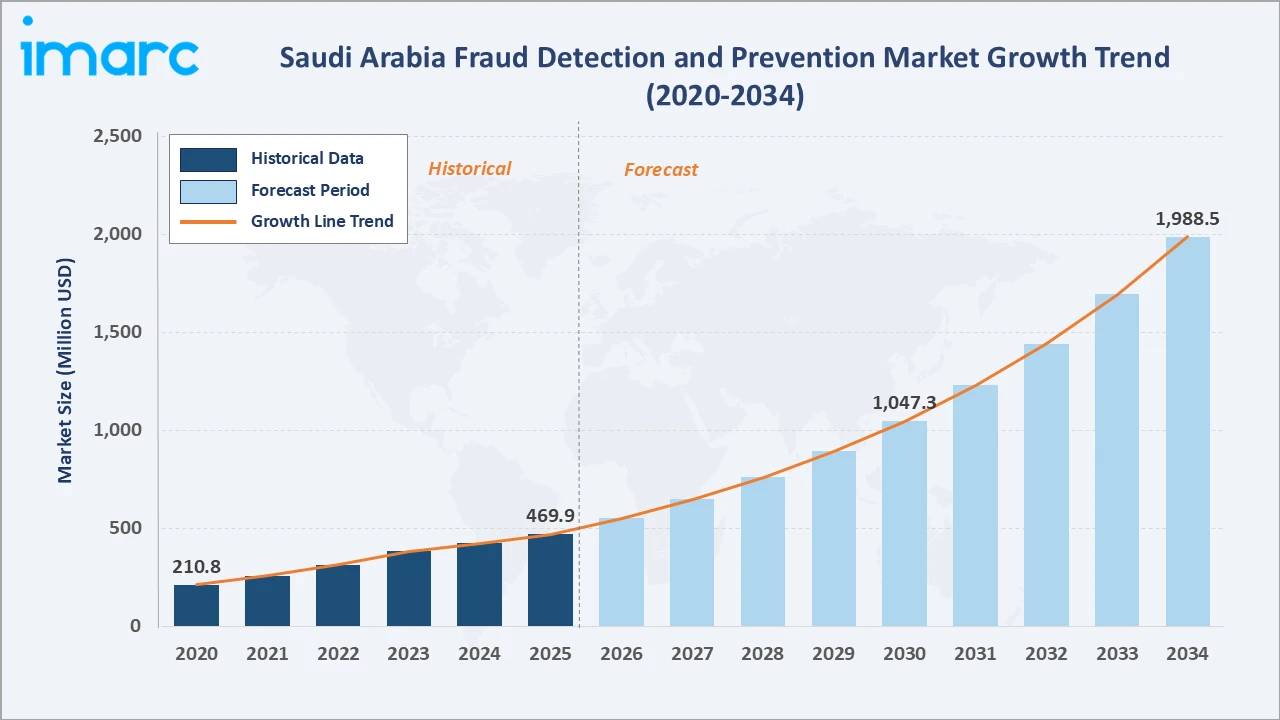
The Saudi Arabia fraud detection and prevention market reached USD 469.9 Million in 2025 and is projected to reach USD 1,988.5 Million by 2034, growing at a CAGR of 17.39% during 2026-2034. Rising digital payments, e-commerce expansion, and stringent SAMA cybersecurity mandates are driving robust demand for advanced fraud analytics.
Solution accounts for 68.4% of the market share in 2025, reflecting strong enterprise reliance on AI-driven detection platforms. Payment Fraud leads applications at 37.8%, while the Northern and Central Region commands 42.6% share, anchored by Riyadh's concentrated banking and fintech infrastructure.
Market Snapshot
|
Metric |
Value |
|
Market Size (2025) |
USD 469.9 Million |
|
Forecast Market Size (2034) |
USD 1,988.5 Million |
|
CAGR (2026-2034) |
17.39% |
|
Base Year |
2025 |
|
Historical Period |
2020-2025 |
|
Forecast Period |
2026-2034 |
|
Dominant Component |
Solution (68.4%, 2025) |
|
Dominant Application |
Payment Fraud (37.8%, 2025) |
|
Leading Region |
Northern and Central Region (42.6%, 2025) |
The market expanded from an estimated USD 210.8 Million in 2020 to USD 469.9 Million in 2025, more than doubling in five years. It is anchored at approximately USD 1,047.3 Million by 2030 and forecast to reach USD 1,988.5 Million by 2034, driven by accelerating digital transaction volumes and continuous regulatory modernization.
To get more information on this market, Request Sample
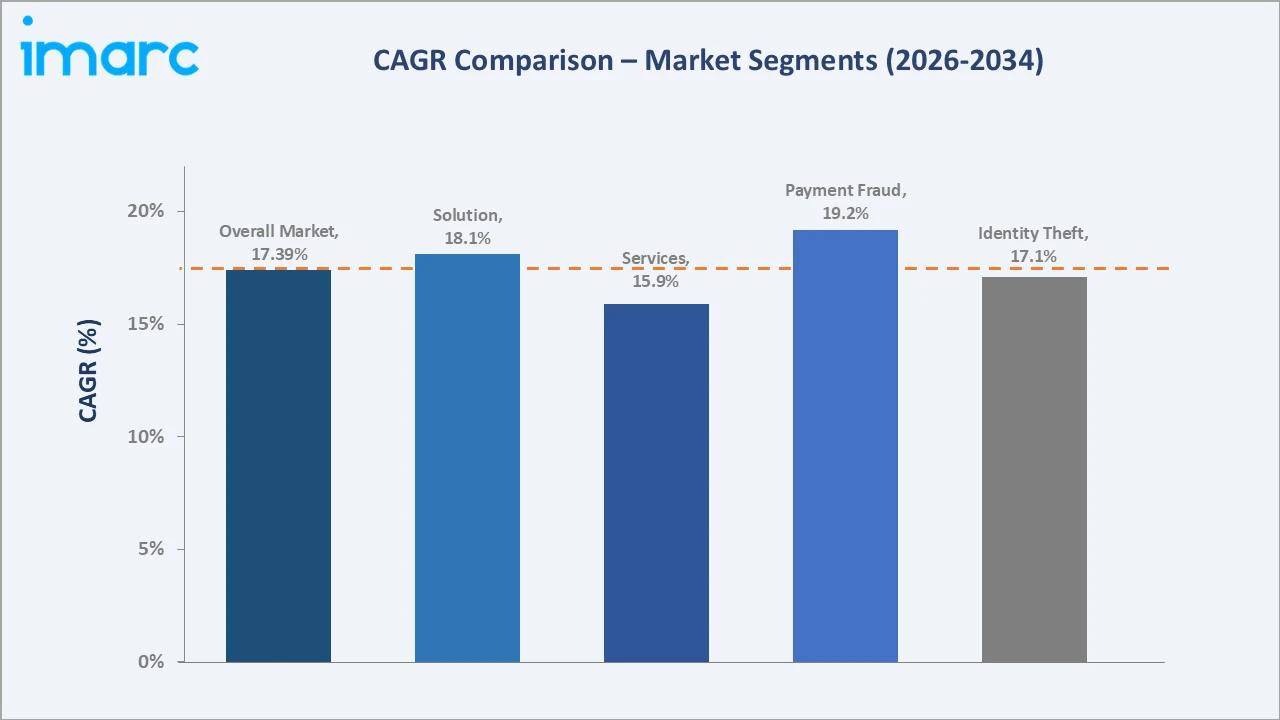
Solution-based platforms are estimated to grow at approximately 18.1% CAGR as banks and fintechs deepen investment in real-time AI transaction-monitoring engines. Payment Fraud detection grows fastest among applications at nearly 19.2% CAGR, reflecting surging card-not-present and instant-payment fraud volumes across Mada and SARIE rails.
Executive Summary
The Saudi Arabia fraud detection and prevention market reached USD 469.9 Million in 2025, propelled by the Kingdom's rapid digital-banking transformation under Vision 2030. Fraud detection systems are now central to safeguarding e-commerce, mobile banking, and government digital-payment channels against increasingly sophisticated cyber-enabled financial crime and organized fraud rings.
Solution at 68.4% dominates through widespread adoption of AI and machine-learning transaction-monitoring software by SAMA-regulated banks. Payment Fraud at 37.8% leads applications, while the Northern and Central Region at 42.6% leads regionally through Riyadh's concentration of banking headquarters, fintech licensees, and payment infrastructure operators.
Key Market Insights
|
Insight |
Data |
|
Dominant Component |
Solution - 68.4% share (2025) |
|
Dominant Application |
Payment Fraud - 37.8% share (2025) |
|
Leading Region |
Northern and Central Region - 42.6% share (2025) |
|
Market Opportunity |
Agentic AI orchestration; behavioral biometrics; SAFIU-integrated case management; graph-based network detection; open-banking fraud analytics |
Key Analytical Observations Supporting The Above Data:
- Solution at 68.4%: The solution segment dominates as banks and fintechs prioritize integrated platforms combining real-time scoring, case management, and AML screening, supported by SAMA's Counter Fraud Requirements and same-day SAR filing mandates that push institutions toward comprehensive detection suites.
- Payment Fraud at 37.8%: Payment fraud detection leads applications due to the Kingdom's rapid shift toward Mada, STC Pay, and instant SARIE transfers, which expand the digital attack surface and compel real-time authorisation-stage screening across every transaction channel.
- Northern and Central Region at 42.6%: This region dominates as Riyadh hosts the majority of bank headquarters, SAMA-regulated fintechs, and payment-network operators, concentrating fraud-technology procurement and reinforcing demand through government digital-transformation initiatives.
Saudi Arabia Fraud Detection and Prevention Market Overview
The market covers software and services deployed to identify, block, and investigate unauthorized transactions, identity theft, money laundering, and other financial crimes. It spans banks, fintechs, insurers, telecom operators, and government entities safeguarding digital transactions across the Kingdom's expanding e-commerce and mobile-banking ecosystem.
The ecosystem integrates core-banking and payment-gateway providers, cybersecurity vendors, AML software specialists, systems integrators, identity-data providers, and regulators including SAMA and SAFIU. Macro factors include Vision 2030's digital-economy targets, expanding smartphone penetration, and rising sophistication of social-engineering and mule-account fraud schemes.
Rising smartphone penetration, expanding national broadband coverage, and growing merchant acceptance of digital wallets are widening the addressable transaction base requiring fraud screening. This broadening digital footprint is reinforcing the strategic importance of scalable, cloud-native fraud-detection infrastructure across the Kingdom's financial ecosystem.
Market Dynamics
To evaluate market opportunities, Request Sample
Market Drivers
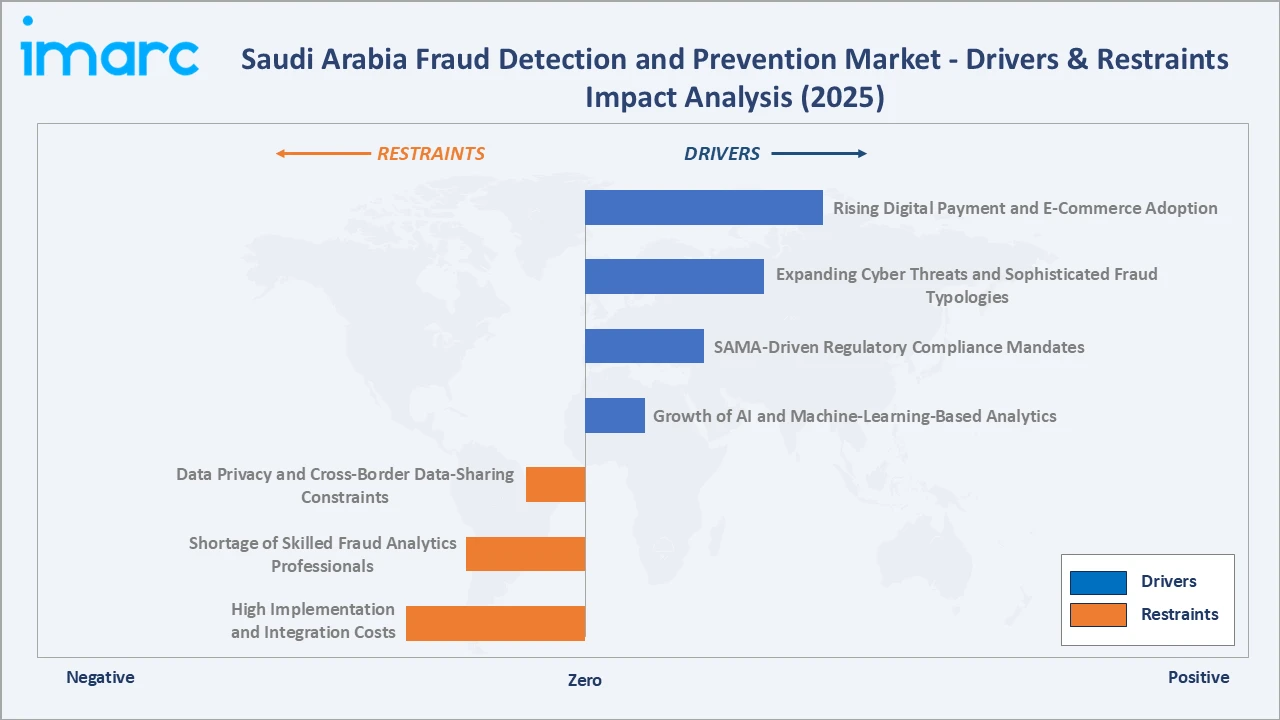
- Rising Digital Payment and E-Commerce Adoption: Saudi Arabia's expanding digital-payment ecosystem, including Mada, STC Pay, and SARIE instant transfers, is generating vast transaction volumes requiring real-time fraud screening, directly driving demand for advanced detection platforms across banks, fintechs, and e-commerce merchants nationwide.
- Expanding Cyber Threats and Sophisticated Fraud Typologies: Increasingly hybrid fraud schemes combining social engineering, impersonation, and mule-account laundering are compelling financial institutions to deploy AI-driven behavioral analytics and network-based detection tools capable of identifying multi-stage, cross-channel fraudulent activity in real time.
- SAMA-Driven Regulatory Compliance Mandates: The Saudi Central Bank's Counter Fraud Requirements, same-day suspicious-activity-report filing rules, and SAFIU-Connect integration obligations are compelling banks and fintechs to modernize legacy systems, directly accelerating procurement of compliant, real-time fraud-detection and AML-monitoring solutions.
- Growth of AI and Machine-Learning-Based Analytics: Advances in machine-learning models are improving detection accuracy while reducing false-positive alert volumes, enabling compliance teams to focus on genuinely suspicious cases and accelerating enterprise-wide adoption of AI-powered fraud-management platforms across the Kingdom's financial sector.
Market Restraints
- High Implementation and Integration Costs: Deploying advanced fraud-detection platforms requires significant upfront investment in software licensing, data infrastructure, and integration with legacy core-banking systems, which can limit adoption among smaller banks, regional fintechs, and mid-sized enterprises with constrained technology budgets.
- Shortage of Skilled Fraud Analytics Professionals: The Kingdom faces a limited pool of data scientists and fraud-investigation specialists capable of configuring, tuning, and managing AI-driven detection models, constraining institutions' ability to fully operationalize advanced analytics platforms and extract maximum value from investments.
- Data Privacy and Cross-Border Data-Sharing Constraints: Stringent data-localization and PDPL privacy requirements can restrict cross-border data pooling needed for network-based fraud detection, limiting the effectiveness of consortium-style intelligence sharing among banks, payment networks, and international fraud-technology vendors.
Market Opportunities
- Agentic AI Fraud Orchestration: Emerging agentic AI systems capable of autonomously triaging alerts, correlating cross-channel signals, and recommending investigative actions offer significant opportunity for vendors to reduce compliance-team workload while improving detection consistency across Saudi banking institutions.
- Behavioral Biometrics and Device Intelligence: Growing adoption of behavioral-biometric authentication and device-fingerprinting technology creates opportunity for vendors to strengthen account-takeover prevention, particularly as mobile-banking penetration and digital-onboarding volumes continue to expand across the Kingdom.
Market Challenges
- Evolving Mule-Account and Social-Engineering Networks: Increasingly organized mule-account networks and scam-driven social-engineering schemes are outpacing traditional rules-based detection, requiring continuous model retraining and cross-institutional intelligence sharing to keep pace with rapidly evolving fraud typologies.
- Balancing Fraud Prevention with Customer Experience: Financial institutions must balance increasingly strict fraud controls against maintaining seamless digital-banking experiences, as excessive friction or false-positive declines can erode customer satisfaction and drive adoption of less secure alternative channels.
Emerging Market Trends
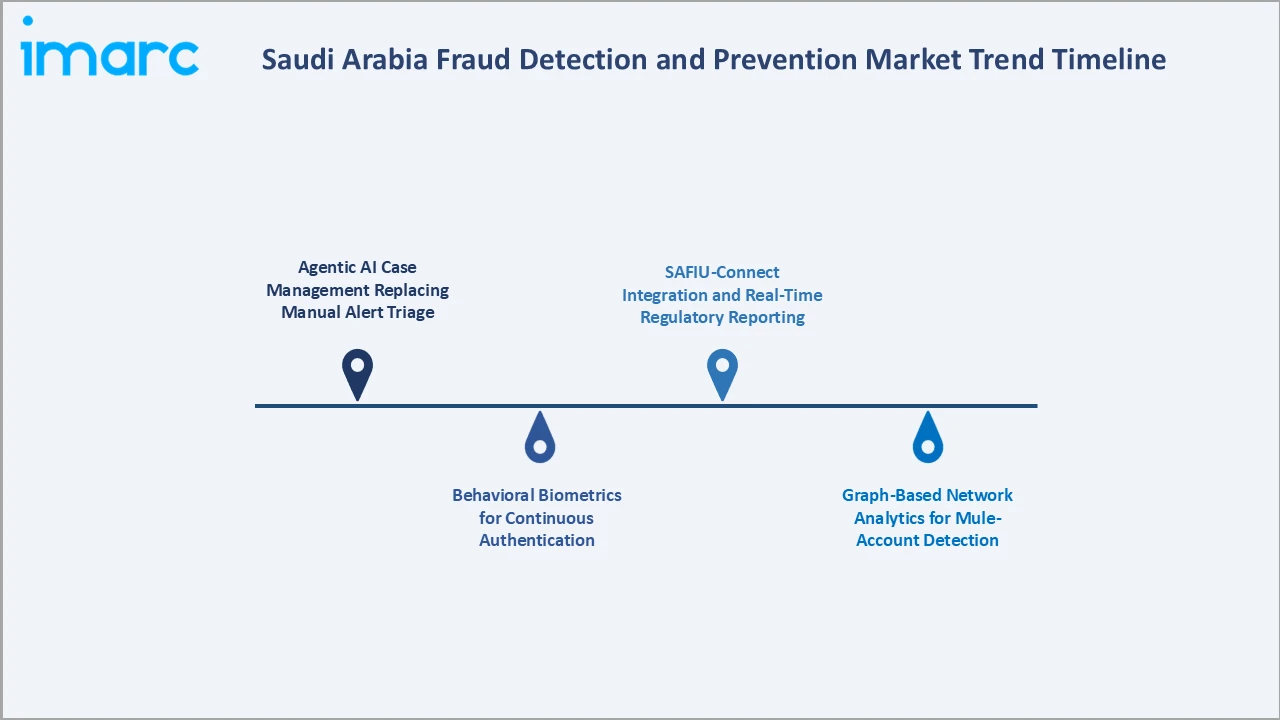
1. Agentic AI Case Management Replacing Manual Alert Triage
Agentic AI systems capable of autonomously investigating alerts, correlating customer behavior, and recommending case dispositions are gaining traction among Saudi banks. This trend is reducing investigation timelines while allowing compliance teams to focus on high-complexity, high-value fraud cases.
2. Behavioral Biometrics for Continuous Authentication
Banks are increasingly deploying behavioral-biometric technology that continuously authenticates users through typing patterns, touchscreen gestures, and device-handling behavior. This passive authentication layer is strengthening account-takeover prevention without adding friction to the customer digital-banking experience.
3. Graph-Based Network Analytics for Mule-Account Detection
Graph-based analytics that map relationships between accounts, devices, and transactions are becoming essential for identifying organized mule-account networks. Saudi banks are adopting these tools to uncover coordinated fraud rings that traditional rules-based systems typically fail to detect.
4. SAFIU-Connect Integration and Real-Time Regulatory Reporting
Growing integration between bank fraud-detection systems and SAFIU-Connect is enabling near-real-time suspicious-activity reporting. This trend is streamlining regulatory compliance workflows while improving national-level visibility into emerging fraud typologies across the Saudi financial system.
Industry Value Chain Analysis
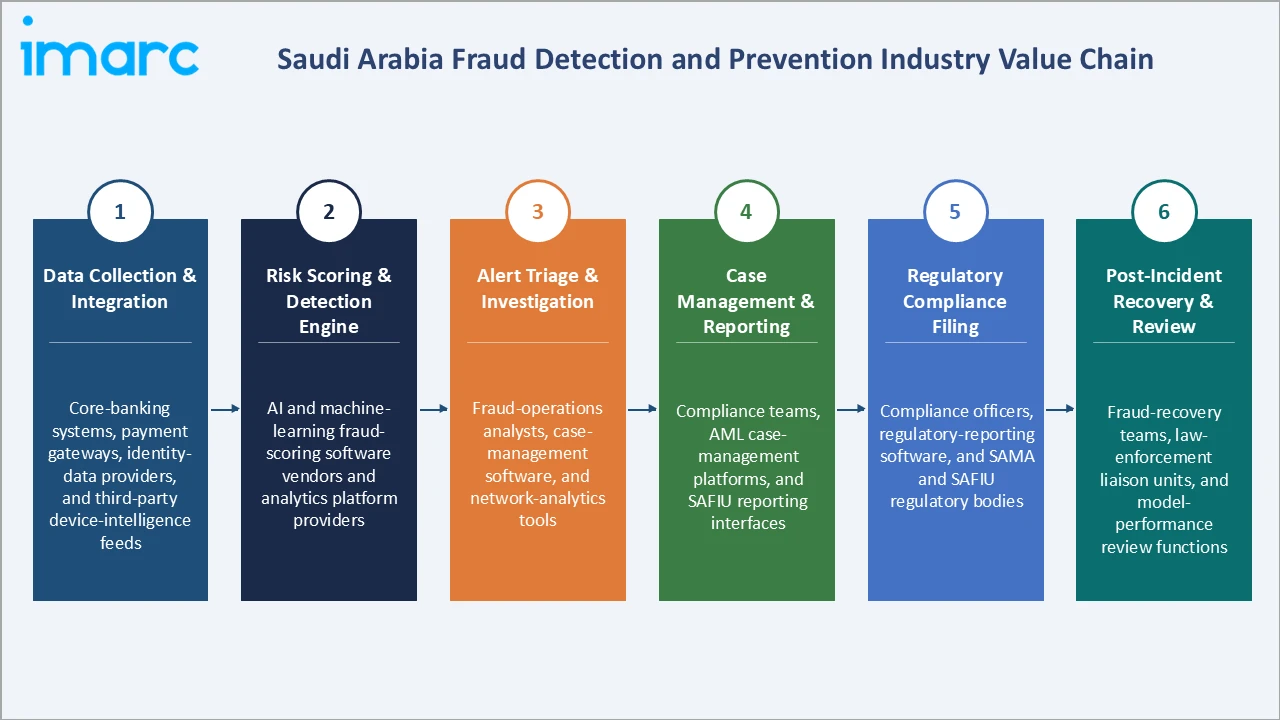
The fraud detection and prevention value chain integrates data collection and identity verification, risk-scoring and detection-engine processing, alert triage and investigation, case management and regulatory reporting, and post-incident recovery. Each stage progressively reduces false positives while improving detection accuracy and investigator efficiency.
|
Stage |
Key Participants |
|
Data Collection & Integration |
Core-banking systems, payment gateways, identity-data providers, and third-party device-intelligence feeds |
|
Risk Scoring & Detection Engine |
AI and machine-learning fraud-scoring software vendors and analytics platform providers |
|
Alert Triage & Investigation |
Fraud-operations analysts, case-management software, and network-analytics tools |
|
Case Management & Reporting |
Compliance teams, AML case-management platforms, and SAFIU reporting interfaces |
|
Regulatory Compliance Filing |
Compliance officers, regulatory-reporting software, and SAMA and SAFIU regulatory bodies |
|
Post-Incident Recovery & Review |
Fraud-recovery teams, law-enforcement liaison units, and model-performance review functions |
The risk-scoring and detection-engine stage is the value chain's most technologically dynamic segment, as vendors race to integrate agentic AI and graph-based analytics. The regulatory-compliance-filing stage remains the most tightly governed, given SAMA's stringent same-day reporting obligations.
Vertical consolidation between detection-engine vendors and case-management platform providers is increasingly common, as institutions seek unified, single-vendor solutions that reduce integration overhead and provide end-to-end visibility from initial alert generation through final regulatory disposition.
Technology Landscape in the Fraud Detection and Prevention Industry
AI and Machine-Learning Transaction Monitoring
AI and machine-learning transaction-monitoring platforms analyze behavioral patterns, transaction velocity, and contextual signals to score risk in real time. These systems continuously retrain on new fraud patterns, improving detection accuracy while reducing false-positive alert volumes for compliance teams.
Behavioral Biometrics and Device Intelligence
Behavioral-biometric technology authenticates users through typing rhythm, touchscreen pressure, and device-handling patterns, operating passively alongside traditional login credentials. This technology is increasingly embedded within mobile-banking applications to strengthen account-takeover prevention without adding customer friction.
Graph-Based Network Analytics
Graph-based analytics map relationships between accounts, devices, IP addresses, and beneficiaries to uncover coordinated fraud rings and mule-account networks. This technology is particularly effective against organized, multi-account laundering schemes that evade traditional rules-based detection systems.
Real-Time Payment Screening Infrastructure
Real-time payment-screening infrastructure evaluates transactions within milliseconds at the authorisation stage across Mada, SARIE, and instant-transfer rails. This infrastructure is becoming foundational as Saudi Arabia's payment ecosystem shifts decisively toward instant, irrevocable transaction settlement.
Market Segmentation Analysis
The report covers the following segments:
|
Segment Category |
Leading Segment |
Market Share |
Year |
|
Component |
Solution |
68.4% |
2025 |
|
Application |
Payment Fraud |
37.8% |
2025 |
|
Organization Size |
🔒 |
🔒 |
2025 |
|
Vertical |
🔒 |
🔒 |
2025 |
|
Region |
Northern and Central Region |
42.6% |
2025 |

By Component
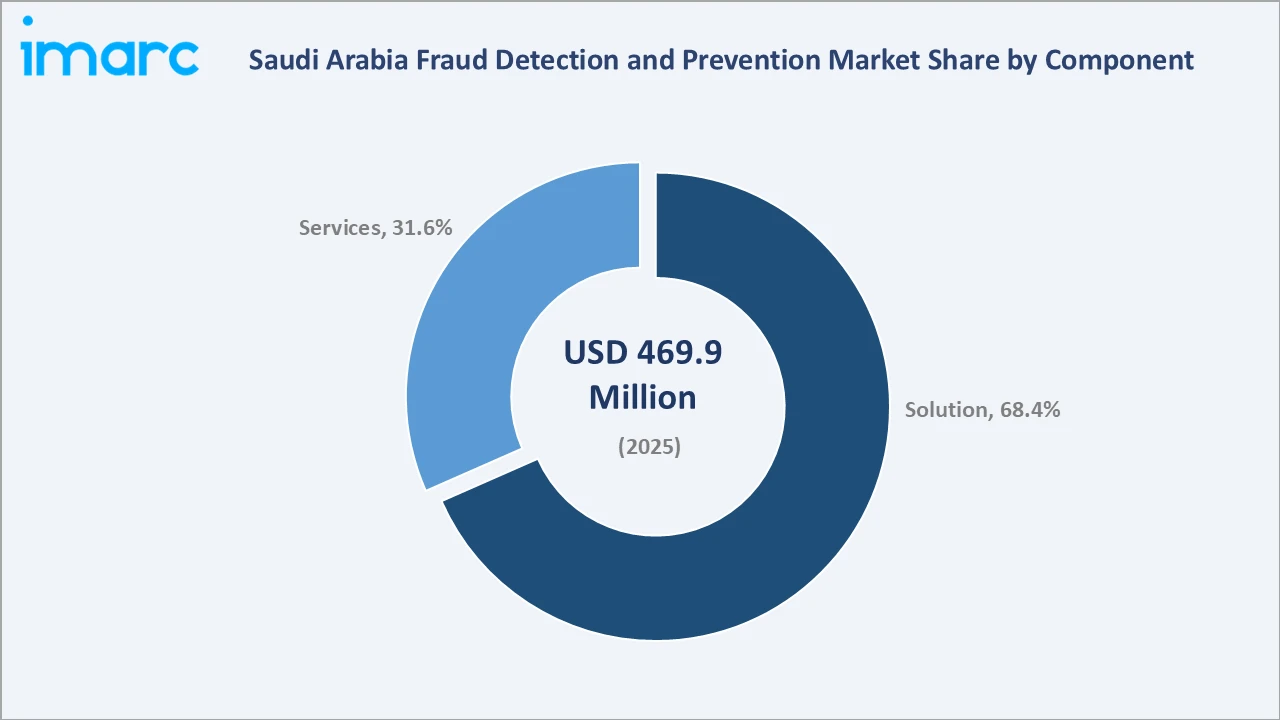
The Solution segment leads at 68.4% in 2025, encompassing AI-based transaction-monitoring, case-management, and AML-screening software increasingly embedded across SAMA-regulated banks' digital channels. Services, at 31.6%, include consulting, system integration, and managed-detection support as institutions scale real-time deployments.
To access detailed market analysis, Request Sample
By Application
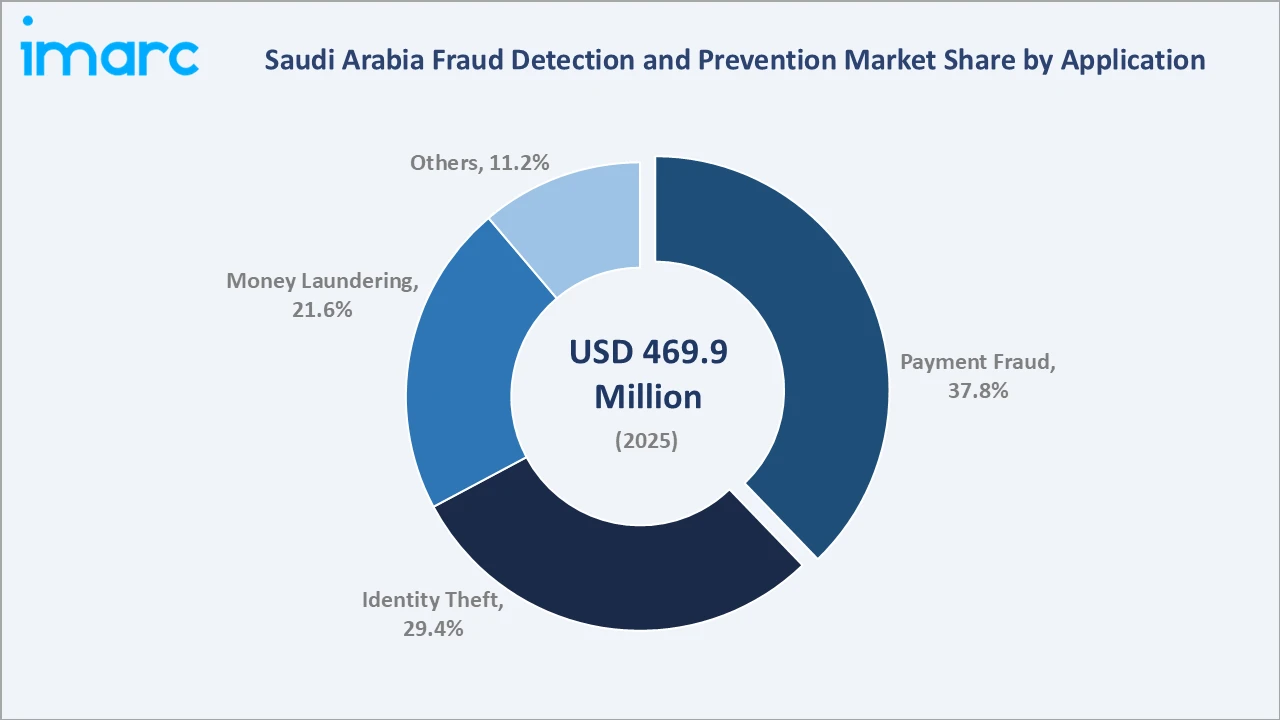
Payment Fraud leads applications at 37.8% in 2025, driven by surging card-not-present and instant-payment fraud across Mada and SARIE rails. Identity Theft follows at 29.4%, reflecting rising account-takeover and synthetic-identity attempts, while Money Laundering at 21.6% and Others at 11.2% complete the application landscape.
Regional Market Insights
|
Region |
Share (2025) |
Key Market Drivers & Characteristics |
|
Northern and Central Region |
42.6% |
Driven by its concentration of bank headquarters, fintech licensees, and government digital-transformation initiatives |
|
Eastern Region |
24.8% |
Driven by strong industrial and energy-sector banking activity and expanding regional payment infrastructure |
|
Western Region |
21.3% |
Driven by high e-commerce and tourism-linked transaction volumes across major commercial and pilgrimage centers |
|
Southern Region |
11.3% |
Emerging with growing digital-banking penetration and national financial-inclusion initiatives |
The Northern and Central Region, at 42.6%, leads through Riyadh's concentration of bank headquarters, SAMA oversight, and fintech licensees. The Eastern Region, at 24.8%, reflects industrial-sector banking demand and payment-infrastructure investment.
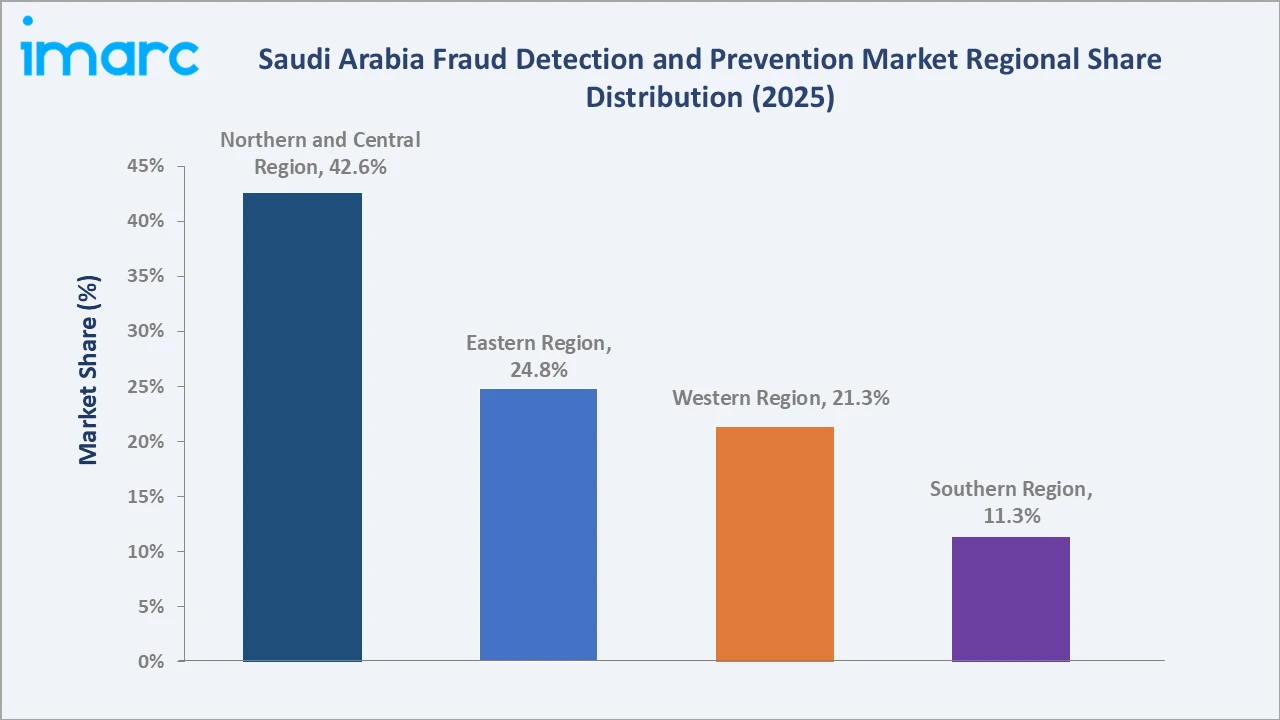
The Western Region, at 21.3%, benefits from Jeddah and Makkah's high e-commerce and tourism-linked payment volumes. The Southern Region, at 11.3%, represents an early-stage but growing market supported by national financial-inclusion and Vision 2030 outreach programs.
Competitive Landscape
The competitive landscape is moderately fragmented, comprising global enterprise-analytics leaders, specialized financial-crime software providers, and regional RegTech firms competing on SAMA-compliance depth, Arabic-language capability, and real-time detection accuracy across the Kingdom's banking and fintech sectors.
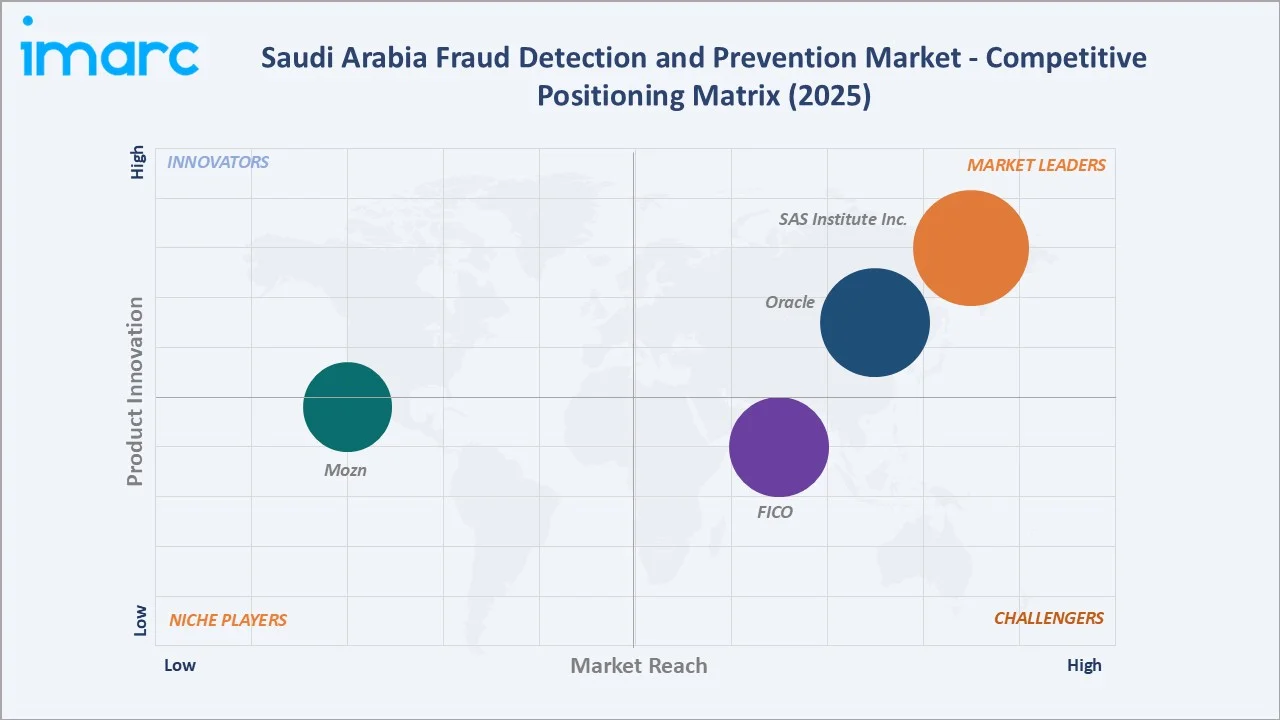
|
Company Name |
Key Products |
Market Position |
Core Strength |
|
SAS Institute Inc. |
SAS fraud and financial crime compliance solutions |
Market Leader |
AI-powered fraud-management and network-analytics platforms deployed across leading Saudi banks |
|
Oracle |
Fraud prevention and anti–money laundering |
Market Leader |
AI, machine-learning, and graph-based AML and fraud-compliance solutions for financial institutions |
|
FICO |
FICO Falcon Fraud Manager |
Strong Challenger |
Real-time payment-fraud scoring and case-management software widely used by card issuers |
|
Mozn |
FOCAL AML and Fraud Prevention Platform |
Emerging Regional Player |
Arabic-native AI fraud-detection and AML-compliance software tailored to Gulf regulatory requirements |
Key players include SAS Institute Inc., Oracle, FICO, Mozn, and others.
Key Company Profiles
SAS Institute Inc.
SAS Institute Inc. is a US-based analytics software company headquartered in Cary, North Carolina, with a strong presence in the Saudi fraud-detection market through its real-time fraud-management and network-analytics platforms deployed at leading Saudi banks and regional financial institutions.
- Key Products: SAS Fraud Management, SAS Viya Visual Investigator.
- Strategic Focus: Expanding AI-driven fraud-management and network-analytics capabilities across SAMA-regulated banks pursuing real-time transaction screening and mule-account detection.
Oracle
Oracle is a global enterprise-software company headquartered in Austin, Texas, with a strong presence in the Saudi market through its Financial Services Crime and Compliance Management suite serving banks, insurers, and regulated financial institutions across the Kingdom.
- Key Products: Oracle Financial Services Crime and Compliance Management, Investigation Hub Cloud Service.
- Strategic Focus: Expanding AI, machine-learning, and graph-analytics-driven AML and fraud-compliance offerings for Saudi banks navigating evolving SAMA regulatory requirements.
Market Concentration Analysis
The market is moderately concentrated, with the top four key players collectively accounting for a substantial share of enterprise-grade deployments across SAMA-regulated banks. Regional specialists and emerging RegTech entrants are gradually increasing competitive intensity as SAMA compliance requirements broaden, and localization demands grow.
Market concentration is expected to moderate over the forecast period as Arabic-native RegTech vendors such as Mozn gain quality certification for mainstream banking deployments, while global Tier-1 vendors deepen local partnerships to defend market share against increasingly capable regional competitors.
Investment & Growth Opportunities
Highest Growth Segments
Solution-based platforms (~18.1% CAGR), Payment Fraud detection (~19.2% CAGR), Identity Theft prevention (~17.1% CAGR), and agentic AI case-management tools represent the highest-growth investment vectors through 2034, reflecting sustained digital-payment expansion and tightening SAMA regulatory requirements.
Emerging Investment Opportunities
Behavioral-biometric authentication and graph-based network-analytics platforms represent the market's highest-value emerging opportunities, as banks increasingly prioritize passive, low-friction fraud prevention alongside deeper mule-account and organized-fraud-ring detection capabilities across digital-banking channels.
Investment Themes
- Arabic-Native RegTech Localization: Vendors investing in Arabic-language natural-language processing, local sanctions-list integration, and SAFIU-Connect compatibility can capture growing demand from SAMA-regulated institutions seeking deeply localized, compliance-ready fraud-detection platforms.
- Agentic AI Investigation Tooling: Investment in agentic AI capable of autonomously triaging alerts and drafting investigation narratives offers a structural cost advantage for vendors, as Saudi banks seek to scale fraud operations without proportionally expanding compliance headcount.
- Cross-Institutional Fraud Intelligence Sharing: Investment in privacy-preserving, consortium-style fraud-intelligence-sharing infrastructure enables banks and payment networks to jointly detect coordinated fraud rings, creating a defensible data-network advantage for early-moving vendors and financial-institution consortia.
Future Market Outlook (2026-2034)
The market is projected to grow from USD 469.9 Million in 2025 to USD 1,988.5 Million by 2034, at a 17.39% CAGR. Agentic AI orchestration, behavioral biometrics, and SAFIU-integrated case management are expected to define the market's next phase of technological evolution across Saudi financial institutions.
Continued Vision 2030 digital-transformation initiatives, expanding instant-payment infrastructure, and tightening SAMA counter-fraud requirements will sustain demand growth, while regional RegTech vendors deepen Arabic-language and localization capabilities to compete alongside established global fraud-analytics providers.
By 2034, the market is expected to feature largely autonomous fraud-orchestration platforms capable of end-to-end detection, investigation, and regulatory reporting, substantially reducing manual compliance workload while further strengthening the resilience of Saudi Arabia's digital financial ecosystem.
Research Methodology
Primary Research
Primary research comprised structured interviews with SAMA-regulated bank compliance officers, fraud-operations leads, fintech risk executives, and cybersecurity specialists across Saudi Arabia's banking, payments, and RegTech ecosystem.
Secondary Research
Secondary research encompassed company disclosures, SAMA rulebook publications, SAFIU guidance, industry association data, and financial-crime-technology vendor case studies covering the Kingdom's fraud-detection and prevention landscape.
Forecasting Models
Market forecasts were developed using a bottom-up model incorporating digital-transaction-volume growth, regulatory-compliance investment trends, component and application adoption rates, and regional banking-infrastructure expansion across Saudi Arabia.
All estimates were cross-validated against publicly disclosed vendor case studies, SAMA regulatory publications, and industry-association data to ensure consistency between historical figures, base-year estimates, and forecast projections throughout the 2020-2034 study period.
Saudi Arabia Fraud Detection and Prevention Market Report Coverage:
| Report Features | Details |
|---|---|
| Base Year of the Analysis | 2025 |
| Historical Period | 2020-2025 |
| Forecast Period | 2026-2034 |
| Units | Million USD |
| Scope of the Report | Exploration of Historical and Forecast Trends, Industry Catalysts and Challenges, Segment-Wise Historical and Predictive Market Assessment:
|
| Components Covered | Solution, Services |
| Applications Covered | Identity Theft, Money Laundering, Payment Fraud, Others |
| Organization Sizes Covered | Small and Medium-sized Enterprises, Large Enterprises |
| Verticals Covered | BFSI, Government and Defense, Healthcare, IT and Telecom, Manufacturing, Retail and E-Commerce, Others |
| Regions Covered | Northern and Central Region, Western Region, Eastern Region, Southern Region |
| Companies Covered | SAS Institute Inc., Oracle, FICO, Mozn, etc. |
| Customization Scope | 10% Free Customization |
| Post-Sale Analyst Support | 10-12 Weeks |
| Delivery Format | PDF and Excel through Email (We can also provide the editable version of the report in PPT/Word format on special request) |
Key Benefits for Stakeholders:
- IMARC’s industry report offers a comprehensive quantitative analysis of various market segments, historical and current market trends, market forecasts, and dynamics of the Saudi Arabia fraud detection and prevention market from 2020-2034.
- The research report provides the latest information on the market drivers, challenges, and opportunities in the Saudi Arabia fraud detection and prevention market.
- Porter's five forces analysis assist stakeholders in assessing the impact of new entrants, competitive rivalry, supplier power, buyer power, and the threat of substitution. It helps stakeholders to analyze the level of competition within the Saudi Arabia fraud detection and prevention industry and its attractiveness.
- Competitive landscape allows stakeholders to understand their competitive environment and provides an insight into the current positions of key players in the market.
Frequently Asked Questions About the Saudi Arabia Fraud Detection and Prevention Market Report
The market reached USD 469.9 Million in 2025, driven by Solution's 68.4% share, Payment Fraud's 37.8% application lead, and the Northern and Central Region's 42.6% regional share, reflecting rapid digital-banking expansion under Vision 2030.
The market is projected to grow at a 17.39% CAGR during 2026-2034, reaching USD 1,988.5 Million by 2034, driven by expanding digital payments, rising cyber-enabled fraud, and tightening regulatory compliance requirements across Saudi banks.
Solution leads at 68.4% in 2025, reflecting widespread adoption of AI-based transaction-monitoring, case-management, and AML-screening software among SAMA-regulated banks and fintechs seeking comprehensive, integrated detection suites.
Payment Fraud leads at 37.8%, driven by rising card-not-present and instant-payment fraud across Mada, STC Pay, and SARIE payment rails, followed by Identity Theft, Money Laundering, and other application types.
The Northern and Central Region leads at 42.6%, supported by Riyadh's concentration of bank headquarters, fintech licensees, and payment-infrastructure operators, followed by the Eastern, Western, and Southern regions.
Leading companies include SAS Institute Inc., Oracle, FICO, Mozn, and others.
The market is projected to reach approximately USD 1,047.3 Million by 2030, with agentic AI case management and behavioral biometrics becoming standard features across leading fraud-detection platforms deployed by Saudi banks.
Priority opportunities include Arabic-native RegTech localization, agentic AI investigation tooling, graph-based network-analytics platforms for mule-account detection, and cross-institutional fraud-intelligence-sharing infrastructure.
Need more help?
- Speak to our experienced analysts for insights on the current market scenarios.
- Include additional segments and countries to customize the report as per your requirement.
- Gain an unparalleled competitive advantage in your domain by understanding how to utilize the report and positively impacting your operations and revenue.
- For further assistance, please connect with our analysts.
 Request Customization
 Speak to an Analyst
 Request Brochure
 Inquire Before Buying
Benefits of Customization
- Personalize this research
- Triangulate with your data
- Get data as per your format and definition
- Gain a deeper dive into a specific application, geography, customer, or competitor
- Any level of personalization
Get in Touch With Us
UNITED STATES
Phone: +1-201-971-6302
INDIA
Phone: +91-120-433-0800
UNITED KINGDOM
Phone: +44-753-714-6104
Email: [email protected]
Client Testimonials




.webp)




.webp)













Related Reports

Choose your plan
*Please note that the prices mentioned below are starting prices for each bundle type. Kindly contact our team for further details.*
Single User License
- 1 User License, Access on 2 Devices
- PDF Report + Excel Dataset (Password Protected)
- Lifetime Access
- No Printing Rights
- 10% Free Report Customization
- 10–12 Weeks of Analyst Support
Five User License
- Access for 5 Users, 2 Devices per User
- PDF Report + Excel Dataset (Password Protected)
- Lifetime Access
- Dedicated Account Manager
- 12–14 Weeks of Analyst Support
- No Printing Rights
- 15% Free Report Customization
- 25% Discount on Your Next Purchase
Corporate User License
- Unlimited User Access (Within Your Organization)
- PDF Report + Excel Dataset
- Lifetime Access
- Dedicated Account Manager
- 14–20 Weeks of Analyst Support
- No Printing Rights
- 20% Free Report Customization
- 30% Discount on Your Next Purchase
Essential Insights
What's included:
3 reports
- Lifetime Access
- PDF Reports
- Excel Datasets
- 2 Weeks of Free Analyst Support
- 2 User Licenses
- Access on 2 Devices
- Printing Rights
- Complimentary PowerPoint (PPT) Version
- Complimentary License Upgrade
Professional Access
What's included:
5 reports
- Lifetime Access
- PDF Reports
- Excel Datasets
- 8 Weeks of Free Analyst Support
- 2 User Licenses
- Access on 2 Devices
- Printing Rights
- Complimentary PowerPoint (PPT) Version
- Complimentary License Upgrade
Business Advantage
What's included:
8 reports
- Lifetime Access
- PDF Reports
- Excel Datasets
- 14 Weeks of Free Analyst Support
- 2 User Licenses
- Access on 2 Devices
- Printing Rights
- Complimentary PowerPoint (PPT) Version
- Complimentary License Upgrade
Enterprise Intelligence
What's included:
10 reports
- Lifetime Access
- PDF Reports
- Excel Datasets
- 20 Weeks of Free Analyst Support
- 2 User Licenses
- Access on 2 Devices
- Printing Rights
- Complimentary PowerPoint (PPT) Version
- Complimentary License Upgrade