
Saudi Arabia Interactive Kiosk Market Size, Share, Trends and Forecast by Component, Type, Mounting Type, Panel Size, Location, Industry Vertical, and Region, 2026-2034
Saudi Arabia Interactive Kiosk Market Size, Share, Trends & Forecast (2026-2034)
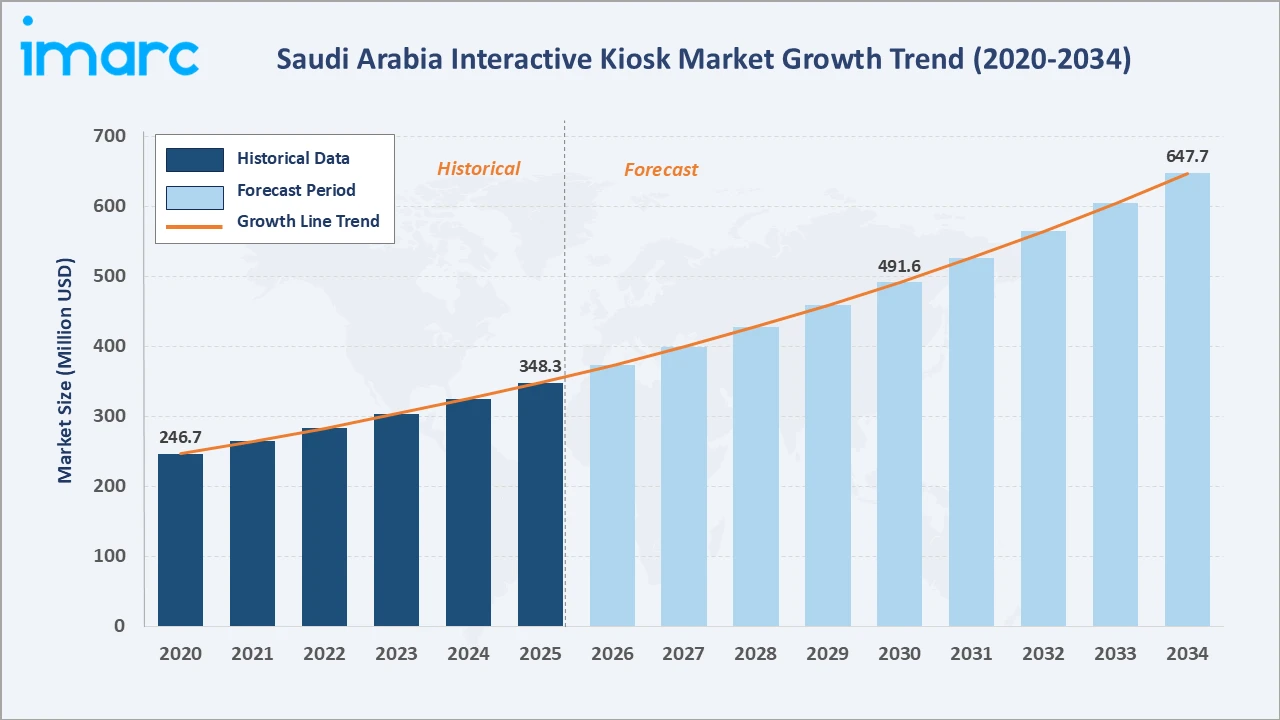
The Saudi Arabia interactive kiosk market reached USD 348.3 Million in 2025 and is projected to reach USD 647.7 Million by 2034, exhibiting a CAGR of 7.14% during 2026-2034. The accelerating digital transformation mandate embedded in Saudi Vision 2030 and the extraordinary expansion of hospitality and tourism infrastructure through giga-projects are the primary growth catalysts. Saudi Arabia's giga-projects represent approximately US$132.3 billion in planned investments. Beyond Riyadh and the Western corridor, projects across other regions include over 758,410 residential units, 1,810 hotel keys, and 195,625 square meters of retail space, reflecting the Kingdom's broad-based urban expansion. The rapid development of residential communities, retail destinations, hotels, and mixed-use urban projects is increasing demand for interactive kiosks across the Kingdom. Hardware leads the component at 48.6%, self-service kiosks lead the type at 50.8%, and the Northern and Central region accounts for the largest regional share at 41.8%.
Market Snapshot
|
Metric |
Value |
|
Market Size (2025) |
USD 348.3 Million |
|
Forecast Market Size (2034) |
USD 647.7 Million |
|
CAGR (2026-2034) |
7.14% |
|
Base Year |
2025 |
|
Historical Period |
2020-2025 |
|
Forecast Period |
2026-2034 |
|
Dominant Component |
Hardware – 48.6% (2025) |
|
Dominant Type |
Self-Service Kiosks – 50.8% (2025) |
|
Leading Region |
Northern and Central Region – 41.8% (2025) |
The Saudi Arabia interactive kiosk market grew from USD 246.7 Million in 2020 to USD 348.3 Million in 2025, driven by Vision 2030 e-government service digitization and the COVID-19 pandemic's acceleration of contactless self-service adoption across retail, healthcare, and government service contexts. The market is projected to reach USD 491.6 Million by 2030 and USD 647.7 Million by 2034.
To get more information on this market, Request Sample
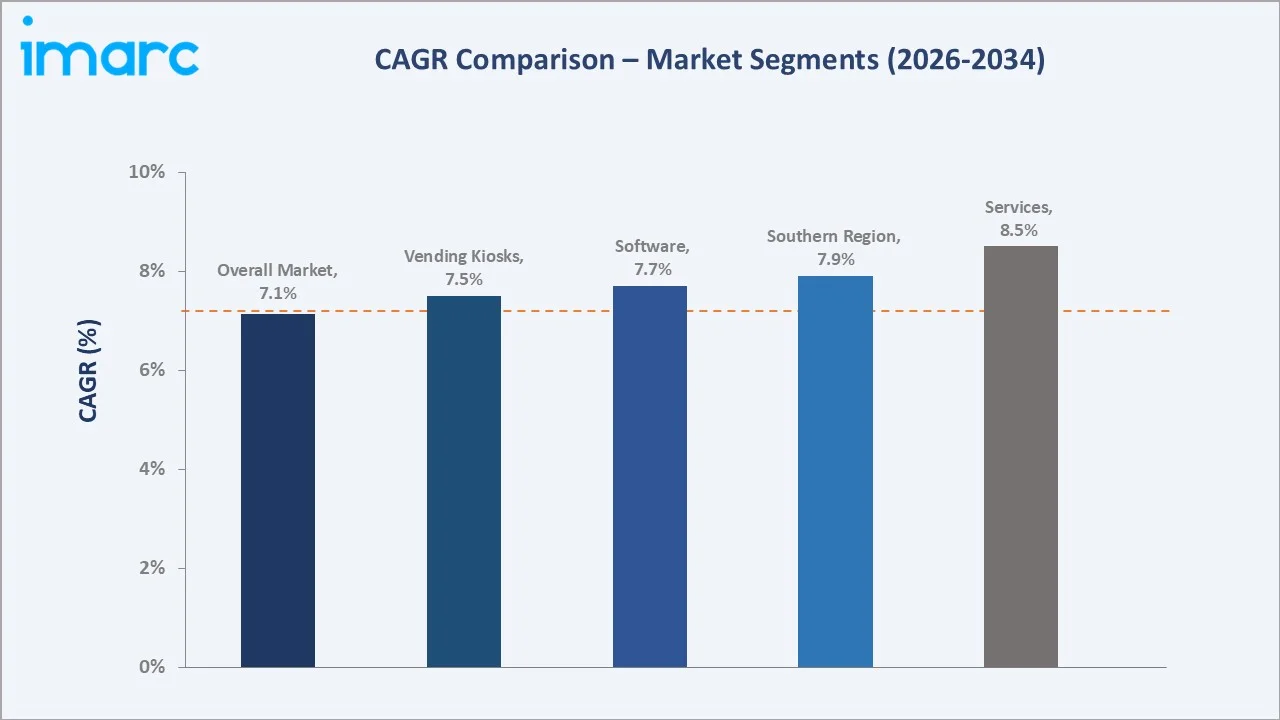
Services component grows at ~8.50% CAGR through expanding managed services, remote monitoring, predictive maintenance, and cloud-based kiosk software-as-a-service contracts as enterprises seek operational efficiency without internal kiosk IT teams. The Southern region grows at ~7.90% CAGR through NEOM's southern development and Asir tourism Vision 2030 programs. Software component grows at ~7.70% CAGR through AI, biometrics, and cloud-based kiosk software platform upgrades across the installed base. Vending kiosks grow at ~7.50% CAGR through smart vending deployment in NEOM, giga-project hospitality venues, and modern retail.
Executive Summary
The Saudi Arabia interactive kiosk market is one of the most strategically aligned technology sub-markets in the Kingdom's Vision 2030 digital transformation agenda, where the convergence of a young, technology-native population, government mandates for self-service e-government delivery, and the tourism mega-project pipeline collectively create a demand environment for interactive kiosks that is simultaneously government-mandated, commercially driven, and demographically supported. Interactive kiosks serve as the physical interface between Saudi citizens and digital services in a market where mobile-first deployment is prevalent but physical touchpoints remain essential for ID verification, cash handling, document dispensing, and accessibility compliance for senior citizens and people of determination requiring accessible service alternatives to digital-only channels.
Hardware leads at 48.6% (2025) through the dominance of kiosk enclosure, display, and peripheral procurement in the initial deployment cycle of Saudi Arabia's rapidly expanding kiosk installed base. Self-service kiosks lead type at 50.8% (2025) through the broadest application spectrum across the Saudi deployment landscape, encompassing government service kiosks, retail self-checkout, food ordering, and hospitality check-in. Northern and Central region leads at 41.8% (2025) through Riyadh's position as the Kingdom's administrative capital, highest population density, and largest concentration of Vision 2030 project headquarters generating kiosk procurement decisions.
Key Market Insights
|
Insight |
Data |
|
Dominant Component |
Hardware – 48.6% share (2025) |
|
Dominant Type |
Self-Service Kiosks – 50.8% share (2025) |
|
Leading Region |
Northern and Central Region – 41.8% share (2025) |
|
Market Opportunity |
NEOM and giga-project smart kiosk ecosystems; healthcare patient registration kiosks; retail self-checkout; Hajj and Umrah pilgrimage service kiosks; government biometric self-services |
Key Analytical Observations Supporting the Above Data:
- Hardware at 48.6% (2025): Hardware commands the largest component share through the capital-intensive nature of kiosk deployment in a market that is still in the high-growth phase of its installed base build-out, where each new deployment unit requires enclosure, display panel, payment hardware, biometric reader, receipt printer, camera, and connectivity module.
- Self-Service Kiosks at 50.8% (2025): Self-service kiosks represent the broadest kiosk type category in Saudi Arabia, encompassing government service kiosks, retail self-checkout, food ordering kiosks, healthcare patient registration and queue management kiosks, and entertainment and tourism kiosks.
- Northern and Central Region at 41.8% (2025): The Northern and Central region dominates due to extensive smart city projects, expanding government digital services, and high kiosk deployment across Riyadh’s retail, transportation, healthcare, hospitality, and commercial facilities.
Saudi Arabia Interactive Kiosk Market Overview
Interactive kiosks in Saudi Arabia are customer-facing, self-service computing terminals integrating touchscreen displays, payment peripherals, biometric sensors, printers, and connectivity hardware with purpose-built software applications that enable consumers, citizens, patients, and visitors to independently complete transactions, access information, conduct self-service registrations, and interact with digital services without requiring human service staff assistance. Macroeconomic factors include Saudi Arabia's strong government spending under Vision 2030, sustained non-oil economic diversification, and rising investments in smart infrastructure.
Market Dynamics
To evaluate market opportunities, Request Sample
Market Drivers
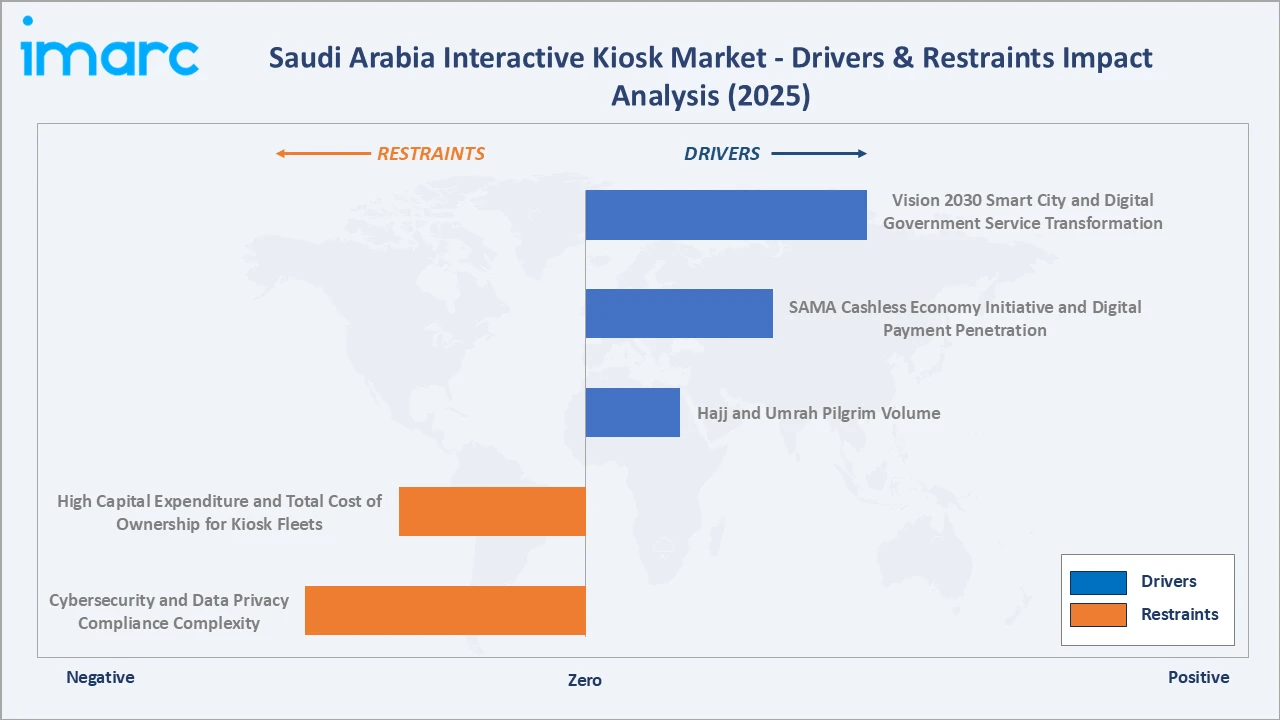
- Vision 2030 Smart City and Digital Government Service Transformation: Saudi Arabia's Vision 2030 national transformation program has explicitly mandated the digitization of government service delivery as a primary objective. The share of government services available through digital channels has increased from 44% to 91%. Meanwhile, citizen satisfaction with digital government services has risen from 52% to 86%, highlighting improved usability, accessibility, and convenience. Kiosks serve as the essential physical touchpoint for Saudi citizens who require in-person verification, document collection, or cash-based service access that purely digital channels cannot accommodate.
- SAMA Cashless Economy Initiative and Digital Payment Penetration: The Saudi Central Bank (SAMA) reported that electronic payments represented 85% of total retail payment transactions in 2025, compared with 79% in 2024. The increase was supported by continued expansion of the national payments infrastructure, with electronic transaction volumes rising to 14.6 billion from 12.6 billion a year earlier, which has been the primary driver of payment kiosk and bank kiosk demand across the Kingdom. This shift is increasing demand for payment-enabled interactive kiosks across retail, banking, transportation, healthcare, and government services.
- Hajj and Umrah Pilgrim Volume: Saudi Arabia hosts the largest annual human migration, creating one of the most complex visitor service logistics requirements where interactive kiosks provide scalable, multilingual service delivery capacity that human-staffed service counters cannot match economically at required throughput volumes. In 2025, Saudi Arabia welcomed more than 19.5 million international Hajj and Umrah visitors, comprising approximately 18.03 million Umrah performers and 1.5 million Hajj pilgrims. International Umrah participation increased by 114% compared with 2022, while satisfaction levels reached 91% among Hajj pilgrims and 94% among Umrah performers, surpassing Saudi Vision 2030 targets.
Market Restraints
- Cybersecurity and Data Privacy Compliance Complexity: Interactive kiosks collect and process sensitive payment, identity, and behavioral data, increasing exposure to cyberattacks and unauthorized access. Compliance with Saudi data protection, payment security, and sector-specific regulations raises implementation and maintenance costs. Businesses must invest in encryption, secure authentication, software updates, and continuous monitoring. These requirements can delay deployments, particularly among smaller organizations with limited technical and financial resources.
- High Capital Expenditure and Total Cost of Ownership for Kiosk Fleets: A comprehensive interactive kiosk unit for outdoor Saudi deployment has a high hardware procurement cost per unit before software, installation, and networking costs. Enterprise-scale kiosk deployments represent premium capital expenditure with additional annual managed service and maintenance contracts at 10-15% of hardware cost. The total cost of ownership analysis for Saudi kiosk operators creates procurement cycle delays and approval process complexity that moderates short-term demand acceleration even when the operational case for kiosk deployment is compelling.
Market Opportunities
- NEOM and Giga-Project Smart Kiosk Ecosystems: NEOM's THE LINE, 170 kilometers long, 200 meters wide, 500 meters high linear city targeting 9 million residents, has published smart city specifications requiring ubiquitous citizen service kiosks integrated with NEOM's unified digital platform providing identity services, payments, navigation, concierge, and emergency contact through AI-powered multimodal kiosk terminals that exceed any existing kiosk deployment in Saudi Arabia in technical sophistication. THE LINE's citizen kiosk specifications require Arabic NLP capability, facial recognition identity verification integrated with Saudi national ID, cashless payment, real-time Arabic-English bilingual interface, and 5G IoT connectivity, creating a showcase kiosk specification that will define the Saudi premium kiosk market segment through the forecast period.
- Healthcare Kiosk Expansion in Saudi MOH Hospitals: The Saudi Ministry of Health's digital transformation program is deploying patient registration, appointment check-in, and queue management kiosks across the government health facilities in the Kingdom. The Saudi Vision 2030 target to increase private healthcare participation in healthcare delivery, combined with the MOH's hospital transformation program creating new medical cities and primary health centers requiring modern patient service technology, represents a healthcare kiosk market opportunity.
Market Challenges
- Arabic Language and Bilingual UI Complexity: All Saudi government kiosk deployments mandate full Arabic language UI compliance including right-to-left text rendering, Arabic keyboard input, Arabic number formatting, and Hijri calendar support alongside English-language interface options. International kiosk software platforms built on English-language foundations require substantial localization investment that creates development cost and timeline challenges for international kiosk software vendors entering the Saudi market without established Arabic localization capability.
- Heat and Dust Resistance Engineering Requirements: Saudi Arabia's extreme climate requires kiosk hardware specifications significantly beyond standard international kiosk designs. IP65 minimum ingress protection rating, high-brightness displays operating at ambient temperatures above 60°C with active cooling, dust-proof keyboard and peripheral integration, and UV-resistant enclosure materials certified for continuous outdoor operation in Saudi climate conditions represent engineering requirements that increase per-unit hardware cost and limit the number of international kiosk manufacturers with Saudi climate-qualified products.
Emerging Market Trends
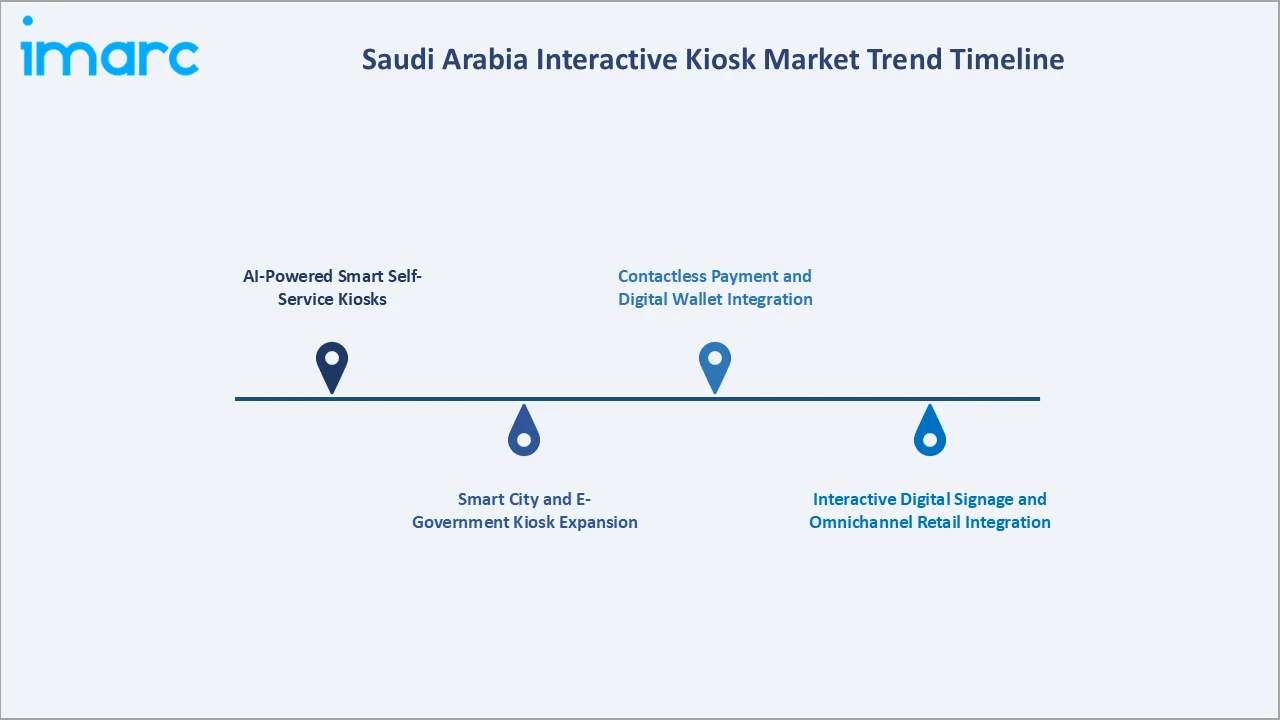
1. AI-Powered Smart Self-Service Kiosks
Artificial intelligence is being integrated into interactive kiosks to enable personalized recommendations, multilingual assistance, voice interaction, and predictive maintenance. AI-powered analytics also help businesses understand customer behavior and optimize service delivery. These capabilities are improving user experience while reducing operational costs across retail, banking, and healthcare sectors.
2. Contactless Payment and Digital Wallet Integration
Interactive kiosks are increasingly supporting NFC, QR code, and mobile wallet payments to align with Saudi Arabia's cashless economy initiatives. The Saudi Central Bank (SAMA) reported that electronic payments represented 85% of total retail payment transactions in 2025, compared with 79% in 2024. The increase was supported by continued expansion of the national payments infrastructure, with electronic transaction volumes rising to 14.6 billion from 12.6 billion a year earlier. This trend enhances transaction speed, convenience, and customer satisfaction while reducing dependence on cash handling.
3. Smart City and E-Government Kiosk Expansion
Saudi Vision 2030 is accelerating the deployment of interactive kiosks across smart cities, airports, public transportation, municipalities, and government service centers. These kiosks provide digital access to government services, visitor information, ticketing, and public utilities. In 2024, Saudi Arabia ranked sixth in the United Nations E-Government Development Index, advancing by 25 positions and recording one of the most significant improvements among the countries assessed. The trend supports greater digital accessibility and improved citizen engagement.
4. Interactive Digital Signage and Omnichannel Retail Integration
Retailers are combining interactive kiosks with digital signage, inventory management systems, loyalty programs, and e-commerce platforms to create seamless omnichannel shopping experiences. Customers can browse products, place online orders, redeem promotions, and access personalized offers, driving higher engagement and improving in-store sales efficiency.
Industry Value Chain Analysis
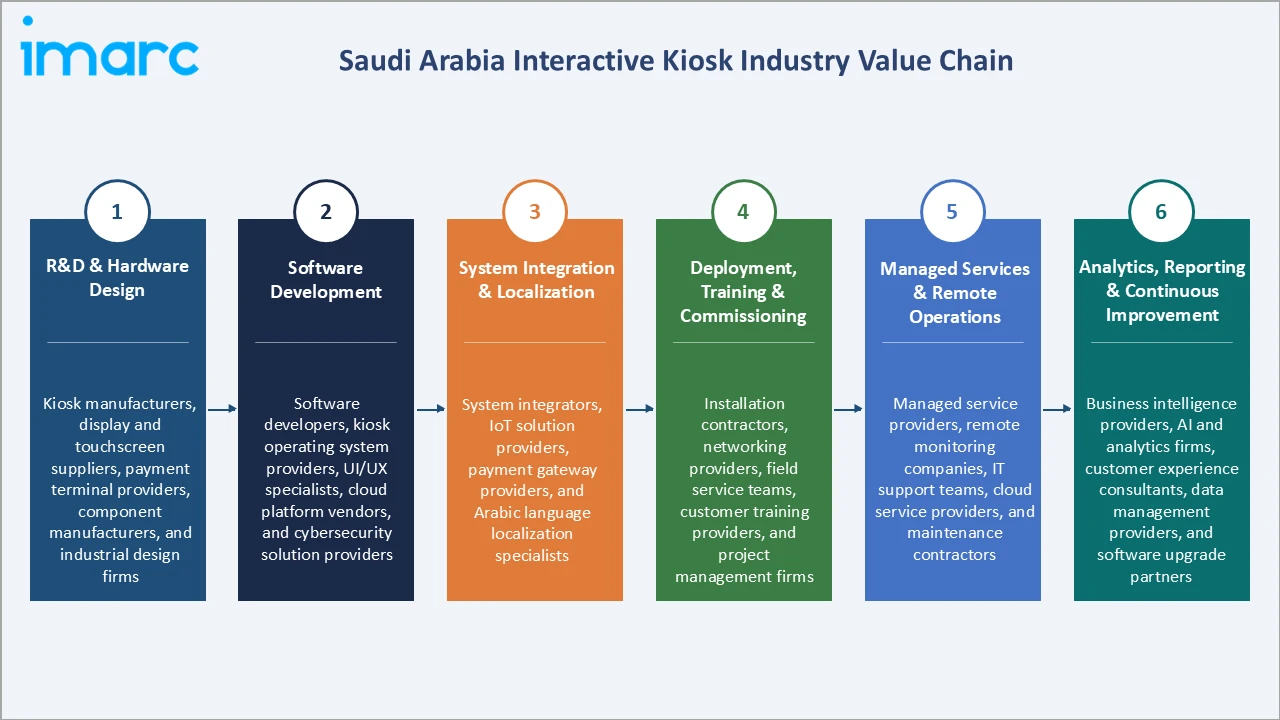
The Saudi Arabia interactive kiosk value chain integrates R&D & hardware design, software development, system integration & localization, deployment, training & commissioning, managed services & remote operations, and analytics, reporting & continuous improvement.
|
Stage |
Key Participants |
|
R&D & Hardware Design |
Kiosk manufacturers, display and touchscreen suppliers, payment terminal providers, component manufacturers, and industrial design firms. |
|
Software Development |
Software developers, kiosk operating system providers, UI/UX specialists, cloud platform vendors, and cybersecurity solution providers. |
|
System Integration & Localization |
System integrators, IoT solution providers, payment gateway providers, and Arabic language localization specialists. |
|
Deployment, Training & Commissioning |
Installation contractors, networking providers, field service teams, customer training providers, and project management firms. |
|
Managed Services & Remote Operations |
Managed service providers, remote monitoring companies, IT support teams, cloud service providers, and maintenance contractors. |
|
Analytics, Reporting & Continuous Improvement |
Business intelligence providers, AI and analytics firms, customer experience consultants, data management providers, and software upgrade partners. |
Software development is the most value-added stage in the interactive kiosk value chain, as it determines the kiosk's functionality, user experience, security, and integration capabilities. Advanced features such as AI-powered assistance, multilingual interfaces, cloud connectivity, payment processing, and analytics are enabled through software innovation. Continuous software updates and customization also help organizations improve operational efficiency and deliver differentiated customer experiences.
Technology Landscape in the Saudi Arabia Interactive Kiosk Industry
Biometric Authentication and National ID Integration
Saudi Arabia's advanced national digital identity infrastructure creates a uniquely enabling environment for biometric kiosk deployment where facial recognition, fingerprint, and iris scan authentication are legitimate and legally supported authentication mechanisms for government service kiosks. This contrasts with many international markets where biometric data collection in kiosks faces significant privacy regulation barriers.
Multilingual Touchscreen & Accessibility Technologies
Modern interactive kiosks feature high-resolution touch displays with multilingual interfaces, including Arabic and English, voice guidance, and accessibility features for users with disabilities. These technologies improve usability and support Saudi Arabia's diverse population and growing international visitor base.
Contactless Payment & NFC Technology
Interactive kiosks increasingly support NFC, QR code payments, digital wallets, and EMV-enabled card transactions. These technologies enable fast, secure, and cashless payments across retail, transportation, healthcare, and hospitality. The trend aligns with Saudi Arabia's growing digital payment ecosystem.
Market Segmentation Analysis
The report covers the following segments:
|
Segment Category |
Leading Segment |
Market Share |
Year |
|
Component |
Hardware |
48.6% |
2025 |
|
Type |
Self-Service Kiosks |
50.8% |
2025 |
|
Mounting Type |
🔒 |
🔒 |
2025 |
|
Panel Size |
🔒 |
🔒 |
2025 |
|
Location |
🔒 |
🔒 |
2025 |
|
Industry Vertical |
🔒 |
🔒 |
2025 |
|
Region |
Northern and Central Region |
41.8% |
2025 |

By Component
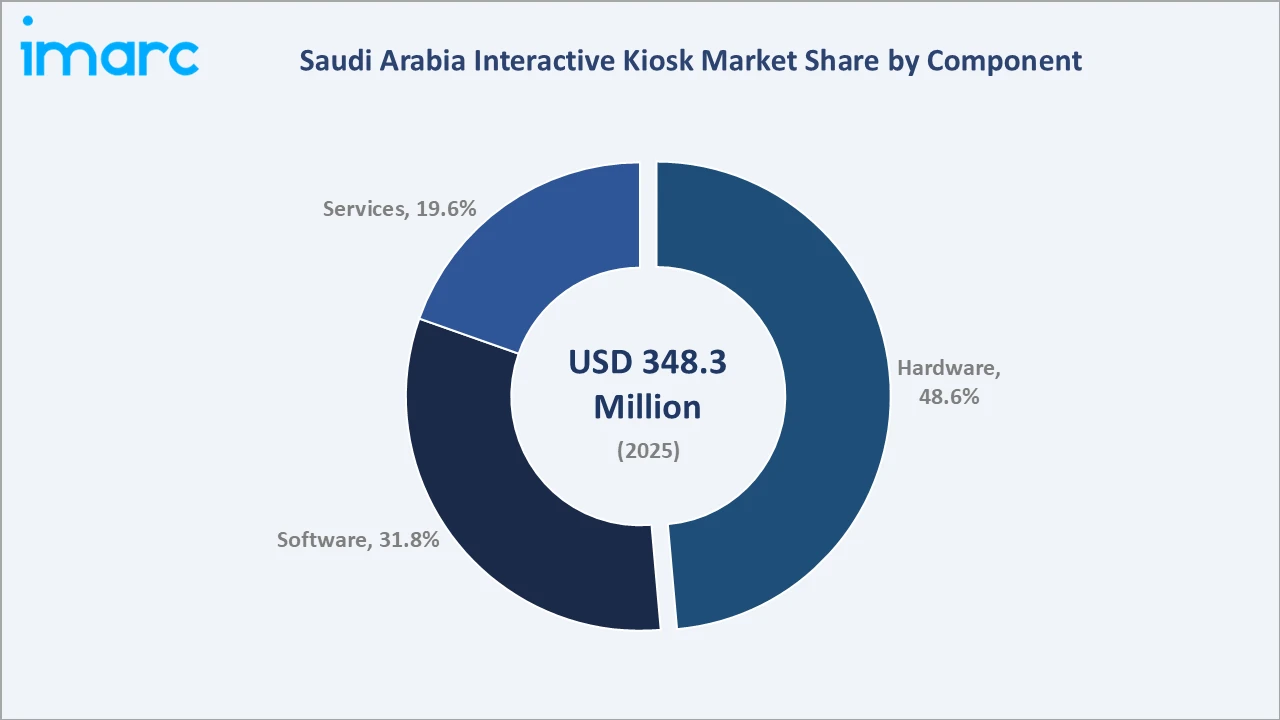
Hardware leads at 48.6% (2025) through kiosk enclosure, display, payment, biometric, and peripheral procurement costs in a market still building out its installed base. Software at 31.8%, growing at ~7.70% CAGR, through cloud SaaS management platforms, AI, and Arabic-language software upgrades.
To access detailed market analysis, Request Sample
Services at 19.6%, growing fastest at ~8.50% CAGR, through managed services, remote monitoring, maintenance contracts, and the emerging kiosk-as-a-service model across government and enterprise clients.
By Type
Self-service kiosks lead at 50.8% through the broadest application across government, retail, QSR, healthcare, and hospitality. Bank kiosks at 31.7% sustain share through SAMA compliance requirements and banking sector ATM fleet renewal.
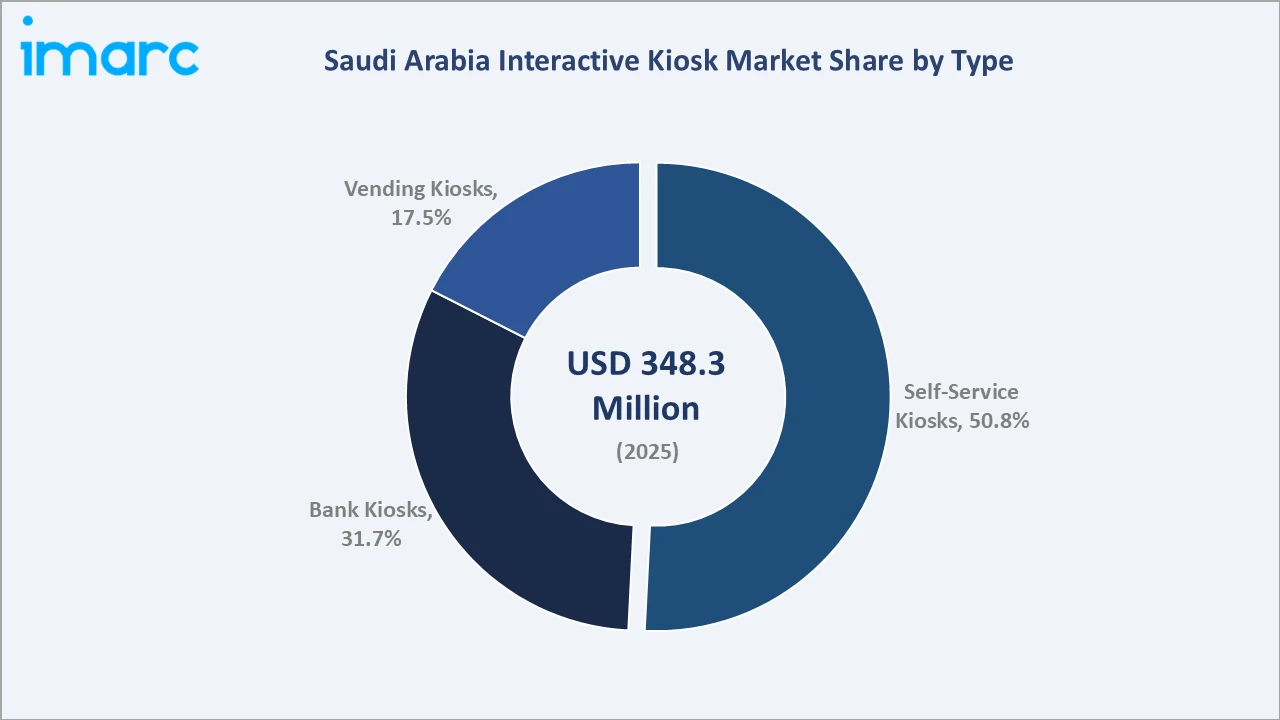
Vending kiosks at 17.5% are growing at ~7.50% CAGR through smart vending at giga-project venues, OTC pharmacy dispensing authorization, and Saudi Post parcel locker network expansion.
Regional Market Insights
|
Region |
Share (2025) |
Key Interactive Kiosk Market Drivers & Characteristics |
|
Northern & Central Region |
41.8% |
Dominates the market due to Riyadh's concentration of government offices, corporate headquarters, smart city projects, retail malls, airports, and healthcare facilities, driving high deployment of self-service kiosks. |
|
Western Region |
28.4% |
Strong demand is supported by religious tourism in Makkah and Madinah, expanding hospitality infrastructure, airports, and commercial developments requiring visitor information and self-service solutions. |
|
Eastern Region |
20.7% |
Growth is driven by industrial cities, oil and gas facilities, commercial centers, banking services, and increasing digital transformation initiatives across enterprises and public services. |
|
Southern Region |
9.1% |
The market is supported by gradual expansion of retail, healthcare, education, and government digital service infrastructure, with increasing adoption of kiosks in public facilities and commercial establishments. |
The Northern and Central region's 41.8% dominance reflects Riyadh’s concentration of government institutions, corporate offices, transportation facilities, shopping centers, and smart city projects. The Western Region holds 28.4%, driven by religious tourism, hospitality expansion, airports, and commercial development in Makkah, Madinah, and Jeddah.
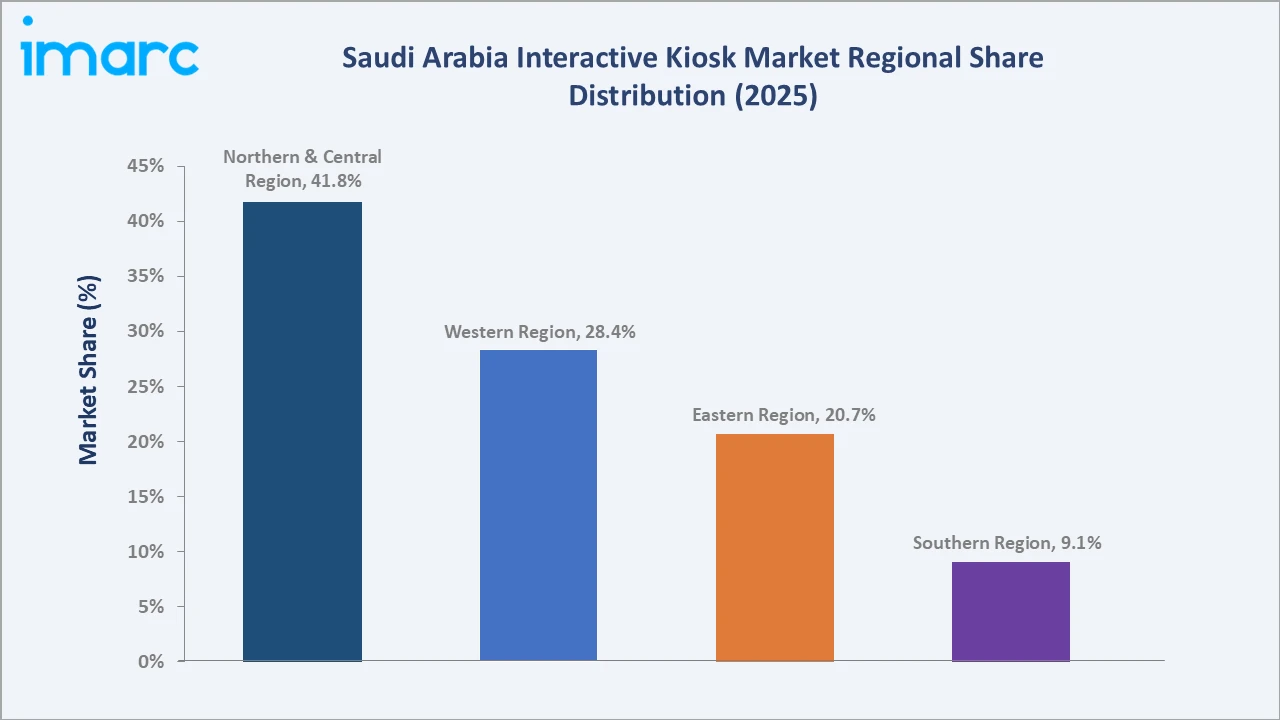
The Eastern region represents 20.7%, supported by industrial activity, financial services, enterprise digitization, and expanding urban infrastructure. The Southern region accounts for 9.1% and remains an emerging market with gradual adoption across government, healthcare, retail, and education facilities.
Competitive Landscape
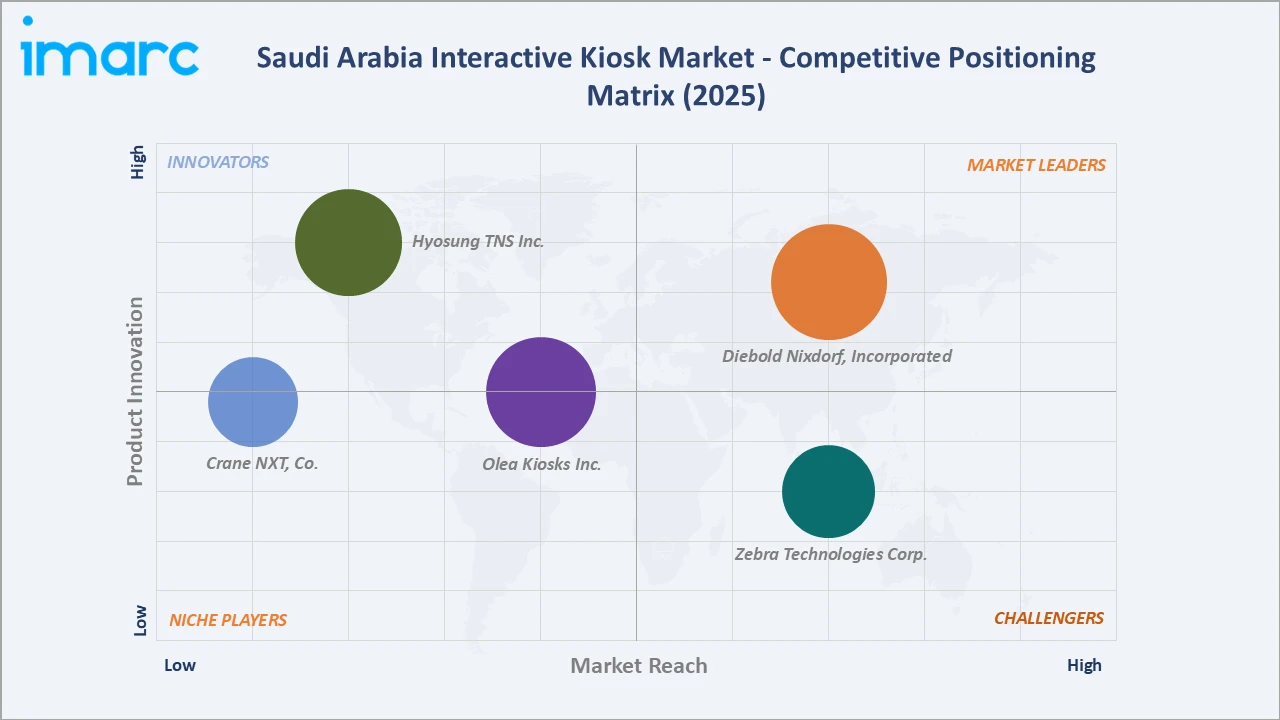
The Saudi Arabia interactive kiosk market is moderately fragmented, while a competitive landscape of specialist kiosk vendors, payment technology companies, and component specialists serves the self-service, retail, and vending kiosk segments through Saudi system integrator partnerships.
|
Company |
Key Products |
Market Position |
Core Strength |
|
Diebold Nixdorf, Incorporated |
DN Series EASY ONE, DN Series EASY eXpress, DN Series EASY MAX, DN Series EASY Cash Rack, DN Series EASY Pro |
Market Leader |
Diebold Nixdorf, Incorporated plays a crucial role in Saudi Arabia's interactive kiosk market by providing cutting-edge self-service hardware and software. |
|
Crane NXT, Co. |
Cora, COTI, ICON, CALI, Paypod Embedded, Paypod Compact |
Established Player |
Crane NXT, Co. operates in the Saudi Arabian interactive kiosk market through its division, Crane Payment Innovations (CPI). |
|
Hyosung TNS Inc. |
Series 5, Series 8, Series 9 ATMs, Series 4, X Series |
Innovator |
Hyosung TNS Inc. drives digital banking and self-service transformation in Saudi Arabia by providing smart, video-enabled ATMs and interactive kiosks. |
|
Zebra Technologies Corp. |
Zebra Kiosk System, CC6X Series, ZEC500 Series |
Challenger |
Zebra Technologies Corp. plays a critical role in Saudi Arabia's expanding self-service sector by providing enterprise-grade, Android-powered interactive kiosks. |
|
Olea Kiosks Inc. |
Austin Desktop, Austin Freestanding, Austin Healthcare, Austin Wall Mounted, Boulder, Detroit Drive-Thru, Irvine Desktop, Irvine Freestanding |
Established Player |
Olea Kiosks Inc. plays a specialized role as a designer and manufacturer of enterprise self-service infrastructure. Olea’s highly customizable hardware is a key foundational technology for interactive kiosks deployed across Saudi Arabia's rapidly growing smart city and digital transformation sectors. |
Competitive dynamics in the Saudi interactive kiosk market are increasingly shaped by the requirement for system integrator partnerships, where international kiosk vendors without established Saudi SI relationships face procurement barriers in government and large-enterprise segments that require local partner compliance.
Key Company Profiles
Diebold Nixdorf, Incorporated
Diebold Nixdorf, Incorporated is a provider of self-service solutions, interactive kiosks, automated teller machines (ATMs), point-of-sale (POS) systems, payment technologies, and retail software. The company serves financial institutions, retailers, government agencies, and transportation operators by delivering integrated hardware, software, cloud services, and managed solutions. Its interactive kiosk portfolio includes self-ordering, self-checkout, ticketing, payment, and information kiosks designed to improve customer engagement and operational efficiency. In Saudi Arabia, the company supports the market through advanced self-service technologies that align with the Kingdom's digital transformation, smart city initiatives, and growing adoption of cashless payment solutions across retail, banking, and public service sectors.
- Key Products: DN Series EASY ONE, DN Series EASY eXpress, DN Series EASY MAX, DN Series EASY Cash Rack, DN Series EASY Pro.
- Strategic Focus: Expanding intelligent self-service solutions that support Saudi Arabia's digital transformation and cashless economy initiatives. The company emphasizes AI-enabled kiosks, secure payment technologies, cloud-based remote management, and omnichannel software integration to improve customer experiences across banking, retail, transportation, and government sectors.
Crane NXT, Co.
Crane NXT, Co. is a technology company specializing in payment solutions, secure transaction technologies, vending systems, self-service hardware, and authentication products. Through its payment technologies business, the company provides payment terminals, cash handling systems, currency validation solutions, and integrated self-service platforms for retail, transportation, financial services, gaming, and unattended applications. In the Saudi Arabia interactive kiosk market, Crane NXT supports digital self-service deployments with secure payment acceptance, cash management, and transaction processing technologies.
- Key Products: Cora, COTI, ICON, CALI, Paypod Embedded, Paypod Compact.
- Strategic Focus: Strengthening secure self-service payment infrastructure by integrating advanced payment acceptance, cash handling, and authentication technologies into interactive kiosks. The company emphasizes contactless payments, cloud-enabled transaction management, and cybersecurity to support Saudi Arabia's expanding cashless economy.
Market Concentration Analysis
The Saudi Arabia interactive kiosk market is moderately fragmented, with a mix of global technology providers and regional system integrators competing across retail, banking, healthcare, transportation, hospitality, and government sectors. Leading international companies leverage advanced hardware, AI-enabled software, secure payment technologies, and cloud-based kiosk management platforms to strengthen their market position. Regional players compete through localized customization, integration services, and after-sales support tailored to Saudi regulatory and language requirements. Competition is increasingly driven by innovation, cybersecurity capabilities, omnichannel integration, and strategic partnerships supporting Vision 2030 digital transformation initiatives. As smart city projects and self-service adoption expand, new entrants and technology specialists are expected to intensify market competition.
Investment & Growth Opportunities
Highest Growth Segments
Services component (~8.50% CAGR), Southern region (~7.90% CAGR), software component (~7.70% CAGR), vending kiosks (~7.50% CAGR), and NEOM and giga-project smart kiosk ecosystems represent the Saudi Arabia interactive kiosk market's highest-growth investment vectors through 2034.
Investment Themes
- NEOM Smart Citizen Service Kiosk Ecosystem: Investment opportunities are emerging in AI-enabled interactive kiosks that provide government services, digital identity verification, payments, visitor information, and smart city wayfinding across NEOM. The project's digital-first infrastructure is expected to accelerate demand for connected cloud-managed self-service kiosks.
- Healthcare Kiosk Expansion Across MOH Hospital Network: Expanding self-service kiosks across the Ministry of Health (MOH) hospital network presents opportunities for patient registration, appointment scheduling, payment processing, queue management, and telehealth access. These investments support healthcare digitalization while improving operational efficiency and patient experience.
Future Market Outlook (2026-2034)
The Saudi Arabia interactive kiosk market is projected to grow from USD 348.3 Million in 2025 to USD 647.7 Million by 2034, delivering a 7.14% CAGR that positions it as one of the fastest-growing interactive kiosk markets in the Middle East and among the significant growth markets for self-service technology deployment. The anchor value of USD 491.6 Million in 2030 reflects the front-loaded nature of Saudi Vision 2030's infrastructure investment cycle, which encompasses the peak construction and deployment phase of most major giga-projects.
Three structural forces define this market's trajectory through 2034. First, Saudi Arabia's Vision 2030 digital government service transformation creates a government-funded, mandate-driven kiosk procurement pipeline that extends with high certainty through the forecast period. Second, Saudi Arabia's tourism and hospitality mega-project pipeline provides a capital-committed, sovereign-wealth-funded demand driver that is independent of economic cycle sensitivity. Third, SAMA's cashless economy program is extending from payment kiosks to a broader ecosystem of automated service delivery where kiosks serve as the universal citizen and consumer touchpoint for any service previously requiring human interaction.
Research Methodology
Primary Research
Primary research comprised in-depth interviews with Saudi banking IT directors, government digital transformation officials, kiosk vendor regional managers, Saudi system integrators, and SAMA payment technology compliance officers. Discussions validated market size estimates, component and type segment dynamics, regional demand patterns, competitive positioning, and Vision 2030 project kiosk procurement pipeline assessment.
Secondary Research
Secondary research encompassed digital transformation documentation, SAMA annual reports, NEOM smart city technology specifications, Vision 2030 Government Services Development Program progress reports, AI strategy documentation, company annual reports, and Saudi Central Bank ATM operational statistics.
Forecasting Models
Forecasting models were developed using historical Saudi Arabia interactive kiosk market data, Vision 2030 project kiosk deployment timeline and unit demand estimation, SAMA cashless economy impact on bank kiosk renewal cycle analysis, QSR sector self-order kiosk penetration rate modelling, healthcare kiosk MOH hospital program timeline, regional market growth differential analysis across four Saudi regions, competitive market share trajectory analysis, services-to-hardware revenue ratio evolution, and component cost deflation impact on hardware segment share. Both top-down and bottom-up approaches were validated through primary research.
Saudi Arabia Interactive Kiosk Market Report Coverage:
| Report Features | Details |
|---|---|
| Base Year of the Analysis | 2025 |
| Historical Period | 2020-2025 |
| Forecast Period | 2026-2034 |
| Units | Million USD |
| Scope of the Report | Exploration of Historical and Forecast Trends, Industry Catalysts and Challenges, Segment-Wise Historical and Predictive Market Assessment:
|
| Components Covered | Hardware, Software, Services |
| Types Covered | Bank Kiosks, Self-Service Kiosks, Vending Kiosks |
| Mounting Types Covered | Floor Standing, Wall Mount |
| Panel Sizes Covered | Below 17”, 17" - 32", Above 32” |
| Locations Covered | Indoor, Outdoor |
| Industry Verticals Covered | BFSI, Retail, Food and Beverage, Healthcare, Government, Travel and Tourism, Entertainment, Others |
| Regions Covered | Northern and Central Region, Western Region, Eastern Region, Southern Region |
| Companies Covered | Diebold Nixdorf, Incorporated, Crane NXT, Co., Hyosung TNS Inc., Zebra Technologies Corp., Olea Kiosks Inc., etc. |
| Customization Scope | 10% Free Customization |
| Post-Sale Analyst Support | 10-12 Weeks |
| Delivery Format | PDF and Excel through Email (We can also provide the editable version of the report in PPT/Word format on special request) |
Key Benefits for Stakeholders:
- IMARC’s industry report offers a comprehensive quantitative analysis of various market segments, historical and current market trends, market forecasts, and dynamics of the Saudi Arabia interactive kiosk market from 2020-2034.
- The research report provides the latest information on the market drivers, challenges, and opportunities in the Saudi Arabia interactive kiosk market.
- Porter's five forces analysis assist stakeholders in assessing the impact of new entrants, competitive rivalry, supplier power, buyer power, and the threat of substitution. It helps stakeholders to analyze the level of competition within the Saudi Arabia interactive kiosk industry and its attractiveness.
- Competitive landscape allows stakeholders to understand their competitive environment and provides an insight into the current positions of key players in the market.
Frequently Asked Questions About the Saudi Arabia Interactive Kiosk Market Report
The Saudi Arabia interactive kiosk market reached USD 348.3 Million in 2025, driven by Vision 2030 government digitization mandates deploying service kiosks, SAMA cashless economy achieving digital payment penetration driving bank kiosk renewal and expansion, and NEOM initial phase visitor experience kiosk pilot deployments.
The market grows at 7.14% CAGR, reaching USD 647.7 Million by 2034. Growth is supported by digital government services, cashless payments, smart city projects, and increasing self-service adoption across major industries.
Hardware leads at 48.6% (2025) through the capital-intensive kiosk enclosure, display, payment, biometric, and peripheral procurement cost in Saudi Arabia's rapidly expanding installed base.
Self-service kiosks lead at 50.8% (2025) through the broadest application across government service, QSR, retail, and hospitality encompassing the majority of Saudi Vision 2030 kiosk deployment verticals.
Northern and Central region leads at 41.8% through Riyadh's concentration of government ministry kiosk procurement authorities, NEOM headquarters administration, and Makkah-Madinah Hajj pilgrimage kiosk infrastructure serving Umrah pilgrims.
Leading companies include Diebold Nixdorf, Incorporated, Crane NXT, Co., Hyosung TNS Inc., Zebra Technologies Corp., and Olea Kiosks Inc., among others.
The market is projected to reach USD 491.6 Million by 2030, driven by NEOM Phase I citizen service kiosk deployment across THE LINE initial segment, Red Sea Project 10 resort properties opening with comprehensive hospitality kiosk infrastructure, Qiddiya entertainment complex opening phase kiosk visitor service deployment, Saudi MOH hospital kiosk program, SAMA cashless economy compliance, and Vision 2030 ministry service kiosk targets.
Top opportunities include NEOM smart citizen service kiosk ecosystem, MOH hospital patient registration kiosk program, managed kiosk services contracts, Saudi Arabia Arabic NLP kiosk software, outdoor smart vending kiosk for giga-project hospitality, and healthcare accessible kiosk for MOH inclusion mandate.
Need more help?
- Speak to our experienced analysts for insights on the current market scenarios.
- Include additional segments and countries to customize the report as per your requirement.
- Gain an unparalleled competitive advantage in your domain by understanding how to utilize the report and positively impacting your operations and revenue.
- For further assistance, please connect with our analysts.
 Request Customization
 Speak to an Analyst
 Request Brochure
 Inquire Before Buying
Benefits of Customization
- Personalize this research
- Triangulate with your data
- Get data as per your format and definition
- Gain a deeper dive into a specific application, geography, customer, or competitor
- Any level of personalization
Get in Touch With Us
UNITED STATES
Phone: +1-201-971-6302
INDIA
Phone: +91-120-433-0800
UNITED KINGDOM
Phone: +44-753-714-6104
Email: [email protected]
Client Testimonials




.webp)




.webp)













Related Reports

Choose your plan
*Please note that the prices mentioned below are starting prices for each bundle type. Kindly contact our team for further details.*
Single User License
- 1 User License, Access on 2 Devices
- PDF Report + Excel Dataset (Password Protected)
- Lifetime Access
- No Printing Rights
- 10% Free Report Customization
- 10–12 Weeks of Analyst Support
Five User License
- Access for 5 Users, 2 Devices per User
- PDF Report + Excel Dataset (Password Protected)
- Lifetime Access
- Dedicated Account Manager
- 12–14 Weeks of Analyst Support
- No Printing Rights
- 15% Free Report Customization
- 25% Discount on Your Next Purchase
Corporate User License
- Unlimited User Access (Within Your Organization)
- PDF Report + Excel Dataset
- Lifetime Access
- Dedicated Account Manager
- 14–20 Weeks of Analyst Support
- No Printing Rights
- 20% Free Report Customization
- 30% Discount on Your Next Purchase
Essential Insights
What's included:
3 reports
- Lifetime Access
- PDF Reports
- Excel Datasets
- 2 Weeks of Free Analyst Support
- 2 User Licenses
- Access on 2 Devices
- Printing Rights
- Complimentary PowerPoint (PPT) Version
- Complimentary License Upgrade
Professional Access
What's included:
5 reports
- Lifetime Access
- PDF Reports
- Excel Datasets
- 8 Weeks of Free Analyst Support
- 2 User Licenses
- Access on 2 Devices
- Printing Rights
- Complimentary PowerPoint (PPT) Version
- Complimentary License Upgrade
Business Advantage
What's included:
8 reports
- Lifetime Access
- PDF Reports
- Excel Datasets
- 14 Weeks of Free Analyst Support
- 2 User Licenses
- Access on 2 Devices
- Printing Rights
- Complimentary PowerPoint (PPT) Version
- Complimentary License Upgrade
Enterprise Intelligence
What's included:
10 reports
- Lifetime Access
- PDF Reports
- Excel Datasets
- 20 Weeks of Free Analyst Support
- 2 User Licenses
- Access on 2 Devices
- Printing Rights
- Complimentary PowerPoint (PPT) Version
- Complimentary License Upgrade