
Saudi Arabia Lubricants Market Size, Share, Trends and Forecast by Product Type, End User, and Region, 2026-2034
Saudi Arabia Lubricants Market Size, Share, Trends & Forecast (2026-2034)
The Saudi Arabia lubricants market grew from USD 1.35 Billion in 2025 to USD 1.39 Billion in 2026 and is projected to reach USD 1.72 Billion by 2034, growing at a CAGR of 2.69% during 2026-2034. The market is driven by rapid vehicle fleet expansion, Vision 2030 industrial activity, and oil & gas sector lubricant consumption. Engine Oils lead at 44.8%. Automotive dominates at 52.6%. Northern & Central Region commands 42.8% share.
Market Snapshot
|
Metric |
Value |
|
Base Year Market Size (2025) |
USD 1.35 Billion |
|
Market Size (2026) |
USD 1.39 Billion |
|
Forecast Market Size (2034) |
USD 1.72 Billion |
|
CAGR (2026-2034) |
2.69% |
|
Base Year |
2025 |
|
Historical Period |
2020-2025 |
|
Forecast Period |
2026-2034 |
|
Dominant Product Type |
Engine Oils (44.8%, 2025) |
|
Dominant End User |
Automotive (52.6%, 2025) |
|
Leading Region |
Northern & Central Region (42.8%, 2025) |
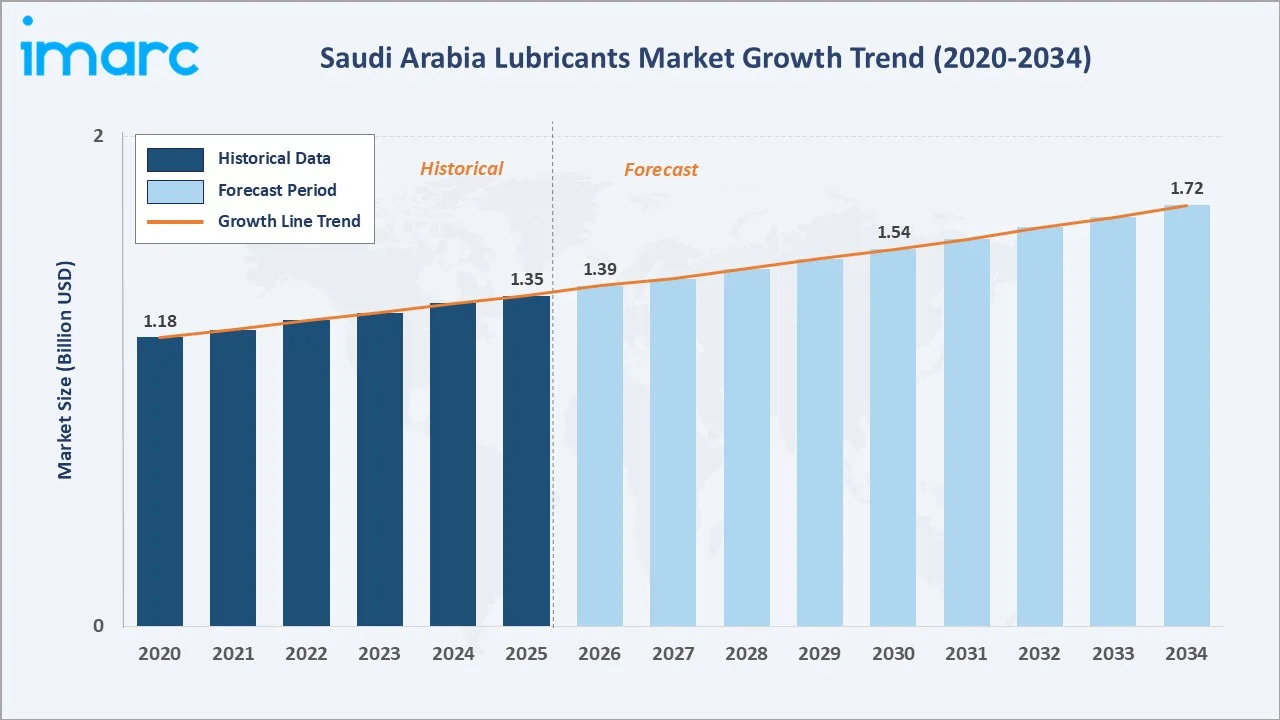
The Saudi Arabia lubricants market size increased from USD 1.18 Billion in 2020 to USD 1.35 Billion in 2025 and is estimated to reach USD 1.39 Billion in 2026. The market is further expected to grow to USD 1.54 Billion by 2030 and USD 1.72 Billion by 2034. Saudi Arabia's status as a major vehicle market, industrial hub, and oil & gas center creates structural multi-segment lubricant demand.
To get more information on this market, Request Sample
Engine Oils dominate at 44.8% through universal automotive and industrial application. Automotive end-users lead at 52.6% through Saudi Arabia's growing vehicle fleet exceeding 15.8 million registered vehicles. Vision 2030 infrastructure projects further sustain demand across hydraulic fluids, transmission oils, and metalworking fluids.
Executive Summary
The Saudi Arabia lubricants market expanded from USD 1.35 Billion in 2025 to an estimated USD 1.39 Billion in 2026, positioning it as a leading specialty chemicals market in the GCC. Growth is underpinned by fleet expansion, Vision 2030 industrial activity, and oil & gas sector consumption. The market is projected to reach USD 1.72 Billion by 2034. Engine Oils at 44.8% lead through automotive demand. Automotive at 52.6% reflects fleet scale. Northern & Central Region leads regionally at 42.8%.
Key Market Insights
|
Insight |
Data |
|
Dominant Product Type |
Engine Oils – 44.8% share (2025) |
|
Dominant End User |
Automotive – 52.6% market share (2025) |
|
Leading Region |
Northern & Central Region – 42.8% share (2025) |
|
Market Opportunity |
Vision 2030 industrial expansion; rising vehicle fleet; synthetic lubricant adoption; oil & gas sector growth |
Key Analytical Observations Supporting the Above Data:
- Engine Oils at 44.8%: Engine oils dominate through widespread automotive application across Saudi Arabia's large vehicle fleet, mandatory service interval compliance, and strong OEM-recommendation penetration through franchise dealerships and quick-lube chains across all four regions.
- Automotive at 52.6%: Automotive end-users lead through Saudi Arabia's vehicle fleet of over 15.8 million registered vehicles, growing at 6.9% annually. High vehicle density, hot climate conditions accelerating oil degradation, and limited EVs sustain structural engine oil replacement demand.
- Northern & Central Region at 42.8%: The region dominates through Riyadh's concentration of automotive service centers, industrial clusters, government fleet procurement, and ARAMCO's downstream lubricant distribution infrastructure.
Saudi Arabia Lubricants Market Overview
Saudi Arabia lubricants market is positioned at the intersection of the GCC's largest automotive market, a major global oil and gas producer, and an economy undergoing rapid industrial diversification under Vision 2030. These structural factors create persistent multi-segment lubricant demand.
The Saudi Arabia lubricants ecosystem integrates domestic refining-based base oil production via ARAMCO's Luberef subsidiary, licensed blending operations by global majors, national distribution networks, and quick-lube retail chains. Key macroeconomic drivers include Vision 2030 economic diversification, rising vehicle ownership, and sustained oil & gas sector capital investment.
Market Dynamics
To evaluate market opportunities, Request Sample
Market Drivers
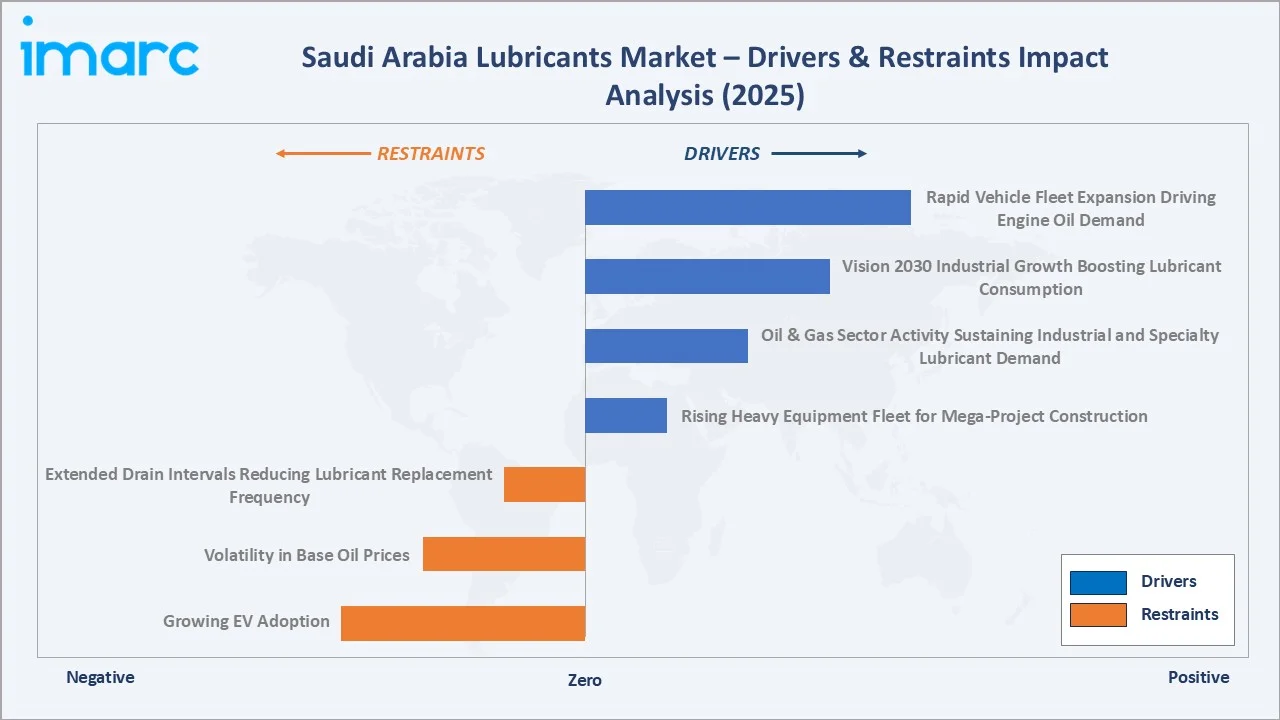
- Rapid Vehicle Fleet Expansion Driving Engine Oil Demand: Saudi Arabia's vehicle fleet exceeded 15.8 million registered vehicles at the end of 2024, growing 6.9% year-on-year, creating structural lubricant replacement demand. Hot climate conditions—summer temperatures exceeding 45°C—accelerate oil degradation, shortening service intervals. Government subsidy programs and rising female driving participation expand the active vehicle population. Quick-lube chains and franchise service centers enforce OEM-recommended service intervals, sustaining high lubricant replacement volumes across all urban centers.
- Vision 2030 Industrial Growth Boosting Lubricant Consumption: Vision 2030's industrial diversification agenda drives lubricant demand across construction equipment, manufacturing plants, and infrastructure projects. NEOM, Qiddiya, and Red Sea Project giga-projects require hydraulic fluids, gear oils, and greases for machinery under extreme conditions.
- Oil & Gas Sector Activity Sustaining Industrial and Specialty Lubricant Demand: Saudi Arabia's oil and gas production operations require specialized compressor oils, turbine lubricants, and hydraulic fluids for upstream, midstream, and downstream operations. ARAMCO's planned capacity expansion requires sustained lubrication of drilling equipment, pumps, compressors, and refineries. Petrochemical plants at Jubail and Yanbu consume metalworking fluids, hydraulic oils, and specialty lubricants. Offshore platform operations require high-performance marine lubricants resistant to saltwater contamination.
- Rising Heavy Equipment Fleet for Mega-Project Construction: Saudi Arabia's mega-project construction pipeline deploys heavy equipment at unprecedented scale—NEOM employed 140,000 workers with exponentially more machinery. Hydraulic excavators, crawler cranes, loaders, and road construction equipment require specialized fluids serviced at manufacturer-specified intervals. The Kingdom's extreme heat and sand conditions accelerate lubricant degradation, increasing per-unit consumption. Saudi Arabia's planned infrastructure investment of USD 150 billion annually through 2030 sustains multi-year heavy equipment lubricant demand.
Market Restraints
- Extended Drain Intervals Reducing Lubricant Replacement Frequency: Advanced synthetic and semi-synthetic lubricant formulations are progressively extending vehicle and equipment service intervals, reducing per-vehicle annual lubricant consumption. OEMs are approving 15,000-20,000 km drain intervals for modern engine oils versus 5,000-7,500 km historical standards. Industrial equipment manufacturers deploy condition monitoring systems extending lubricant life. These improvements structurally compress volume demand growth even as the vehicle and equipment base expands.
- Growing EV Adoption: Saudi Arabia's EV adoption is accelerating under Vision 2030 targets for 30% EV share of new vehicle sales by 2030, progressively reducing engine oil demand from the automotive segment. EVs eliminate engine oil requirements while generating new demand for EV-specific thermal management fluids at lower volumes. ARAMCO's evaluation of the Castrol acquisition signals strategic recognition of this long-term automotive lubricant challenge from vehicle electrification.
- Volatility in Base Oil Prices: Base oil prices—determined by crude oil feedstock costs and refinery runs—exhibit significant volatility that compresses lubricant manufacturer blending margins. Saudi SASO tightening conformity assessments and demanding Arabic safety data sheets increase compliance costs for both domestic blenders and international importers. Raw material cost inflation, combined with price-sensitive Saudi end-users, limits manufacturers' ability to pass input cost increases downstream.
Market Opportunities
- Synthetic and High-Performance Lubricant Premiumization: Rising consumer awareness and OEM mandates for synthetic lubricants create premium pricing opportunities. API SQ and ILSAC GF-7 compliant formulations—launched by TotalEnergies SE in May 2025—command above-average margins while extending service intervals. Saudi Arabia's Vision 2030 manufacturing push creates demand for specialized industrial synthetics with superior temperature resistance.
- EV Fluids and Next-Generation Lubricant Innovation: Growing EV adoption creates a new product category for thermal management fluids, e-motor lubricants, and transmission fluids optimized for electric drivetrains. Saudi Arabia's vision for 30% new EV sales by 2030 creates a structural market opportunity for lubricant manufacturers who innovate in EV-specific fluid technologies.
Market Challenges
- Intensifying Competition from Local and Value-Priced International Brands: The Saudi lubricants market faces intensifying competition between global premium brands, Saudi national champions (Petromin Corporation, Luberef), and value-priced imports from emerging markets. Price-sensitive commercial and industrial buyers evaluate total cost of ownership rather than brand premium, creating downward pricing pressure.
- Counterfeit and Substandard Product Penetration in Traditional Trade Channels: Counterfeit lubricants remain a persistent challenge in Saudi Arabia's traditional trade distribution channels, undermining premium brand economics and creating liability risks for distributors. SASO has implemented conformity assessment programs, but enforcement complexity across distributed retail channels limits effectiveness.
Emerging Market Trends
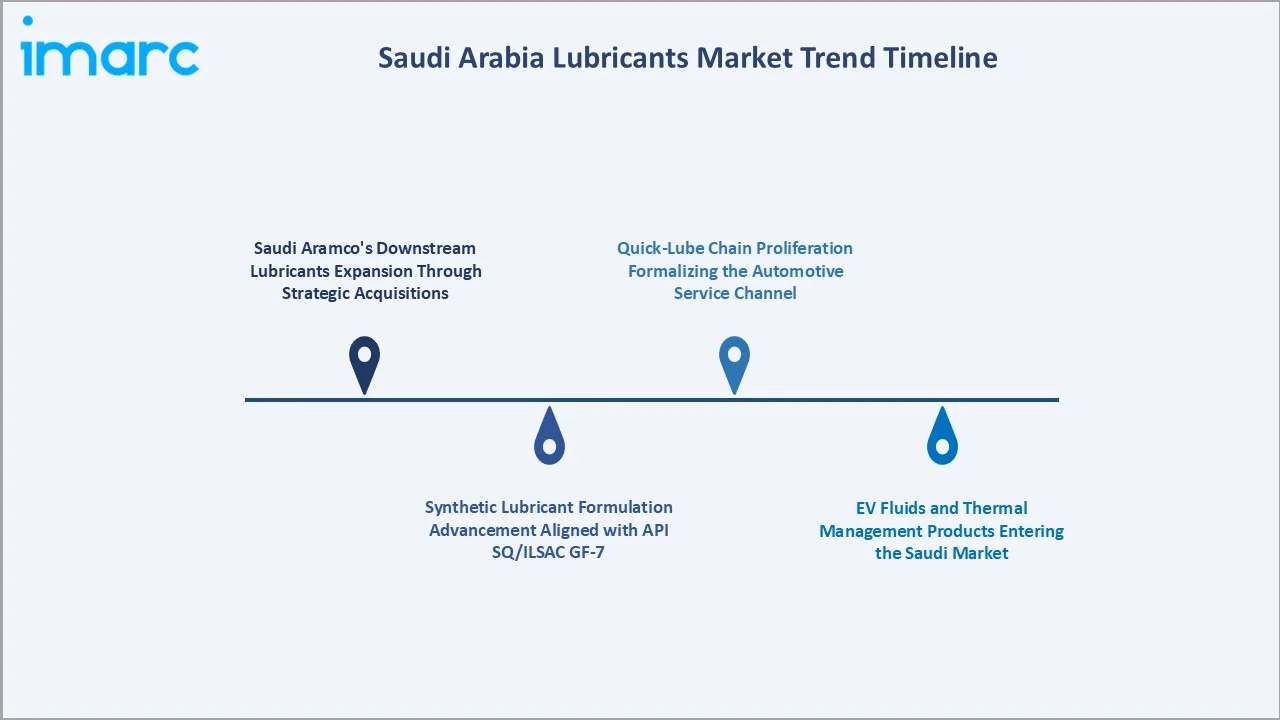
1. Saudi Aramco's Downstream Lubricants Expansion Through Strategic Acquisitions
Saudi Aramco completed its USD 2.65 billion acquisition of Valvoline's global products business in March 2023, adding a globally recognized consumer lubricant brand to its downstream portfolio. Aramco is further evaluating a USD 6-8 billion acquisition of the Castrol unit, creating an unparalleled integrated base oil-to-consumer lubricant platform.
2. Synthetic Lubricant Formulation Advancement Aligned with API SQ/ILSAC GF-7
TotalEnergies SE launched API SQ and ILSAC GF-7 compliant engine oils in August 2025, setting new performance benchmarks for fuel economy, wear protection, and emissions system compatibility. Global lubricant manufacturers are reformulating Saudi Arabia-targeted products to meet evolving OEM specifications from major franchise brands.
3. EV Fluids and Thermal Management Products Entering the Saudi Market
Saudi Arabia's 30% EV target for new vehicle sales by 2030 is accelerating lubricant manufacturer investment in EV-specific thermal management fluids and transmission lubricants optimized for e-axles. PETRONAS Lubricants International pioneered EV fluid innovation with its iona platform, establishing a template for the Saudi market.
4. Quick-Lube Chain Proliferation Formalizing the Automotive Service Channel
Petromin Corporation's nationwide quick-lube network, Mobil Service centers through APSCO, and franchise service chains are formalizing Saudi Arabia's fragmented automotive lubricant service market. These channels enforce OEM-recommended lubricant specifications, reducing counterfeit product risk.
Industry Value Chain Analysis
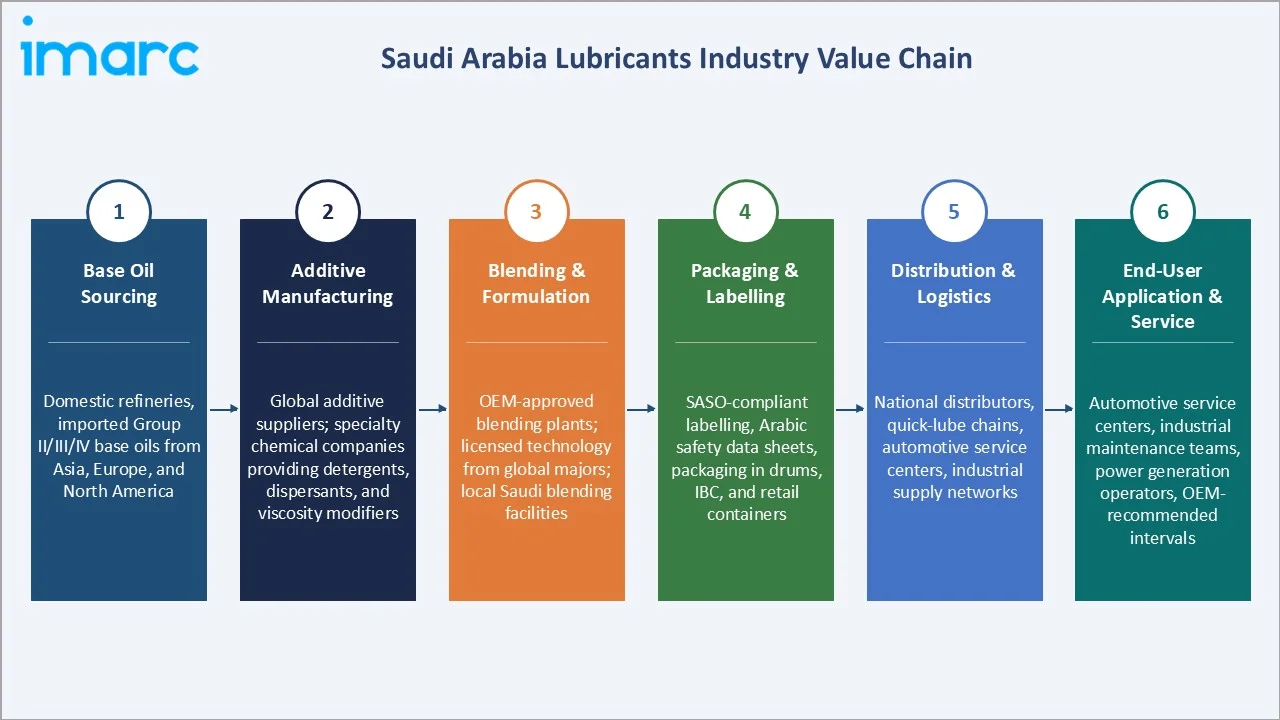
Saudi Arabia lubricants value chain integrates domestic base oil refining through ARAMCO's Luberef subsidiary, international additive supply chains, licensed blending operations by global majors, and comprehensive national distribution networks.
|
Stage |
Key Participants |
|
Base Oil Sourcing |
Domestic refineries, imported Group II/III/IV base oils from Asia, Europe, and North America |
|
Additive Manufacturing |
Global additive suppliers; specialty chemical companies providing detergents, dispersants, and viscosity modifiers |
|
Blending & Formulation |
OEM-approved blending plants; licensed technology from global majors; local Saudi blending facilities |
|
Packaging & Labelling |
SASO-compliant labelling, Arabic safety data sheets, packaging in drums, IBC, and retail containers |
|
Distribution & Logistics |
National distributors, quick-lube chains, automotive service centers, industrial supply networks |
|
End-User Application & Service |
Automotive service centers, industrial maintenance teams, power generation operators, OEM-recommended intervals |
The blending and formulation stage represents the highest-margin commercial opportunity. ARAMCO's Luberef subsidiary produces Group I and II base oils commanding feedstock cost advantages unavailable to international blenders. Quick-lube service channel expansion is extending lubricant manufacturer margin capture into the end-user application stage.
Technology Landscape in the Saudi Arabia Lubricants Industry
Synthetic Base Oil Technology and Group III/IV Formulations
Group III and Group IV synthetic base oils are increasingly displacing mineral base stocks in Saudi Arabia's premium engine oil segment. API SQ and ILSAC GF-7 compliant formulations require Group III or IV synthetic bases to meet fuel economy and low-temperature performance specifications.
Advanced Additive Chemistry for High-Temperature Performance
Saudi Arabia's extreme operating temperatures—surface temperatures exceeding 70°C in summer—require lubricant additive chemistry with superior oxidation inhibition, viscosity stability, and thermal resistance. A planned domestic additive manufacturing plant promises to reduce Saudi Arabia's dependency on imported additive packages.
EV Thermal Management and Immersion Cooling Fluids
Next-generation electric vehicle thermal management requires dielectric immersion cooling fluids, battery cooling liquids, and e-motor lubricants with fundamentally different performance requirements. PETRONAS Lubricants International's iona EV Fluids platform and TotalEnergies SE's EV fluid range represent leading commercial products entering Saudi Arabia's EV fluid market.
Market Segmentation Analysis
The report covers the following segments:
|
Segment Category |
Leading Segment |
Market Share |
Year |
|
Product Type |
Engine Oils |
44.8% |
2025 |
|
End User |
Automotive |
52.6% |
2025 |
|
Region |
Northern & Central Region |
42.8% |
2025 |

By Product Type
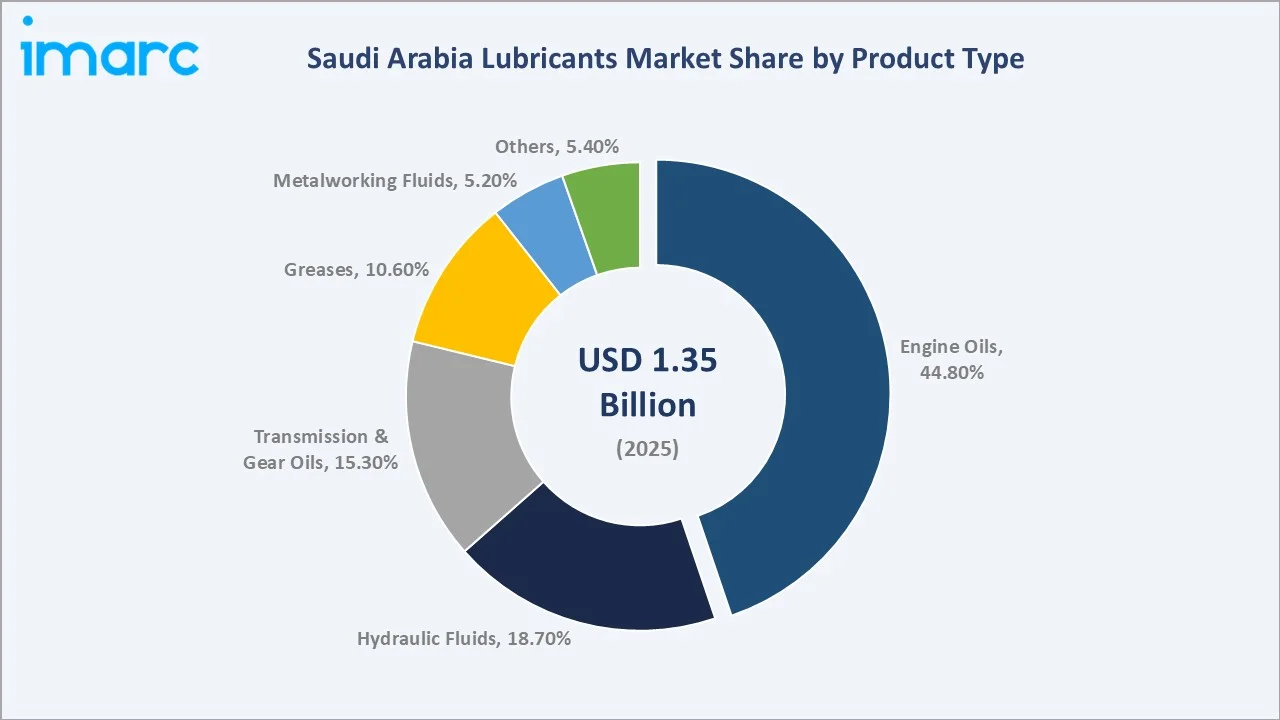
Engine Oils lead at 44.8% (2025). The engine oils segment dominates through universal application across Saudi Arabia's large automotive fleet and industrial engine applications. Engine oils' commercial dominance reflects the automotive sector's structural role as the primary lubricant demand engine, supported by OEM-recommended service intervals.
To access detailed market analysis, Request Sample
Hydraulic Fluids at 18.7% serve construction equipment and industrial systems. Transmission and Gear Oils at 15.3% cover automotive gearboxes and industrial drives. Greases at 10.6% serve heavy equipment. Metalworking Fluids at 5.2% serve manufacturing. Others at 5.4% include turbine oils and specialty fluids.
By End User
Automotive leads at 52.6% (2025). The automotive end-user segment captures the majority of Saudi Arabia's lubricant demand through passenger vehicles, commercial fleets, and two-wheelers. Saudi Arabia's vehicle fleet of over 15.8 million registered vehicles growing at 6.9% annually creates persistent structural engine oil demand.
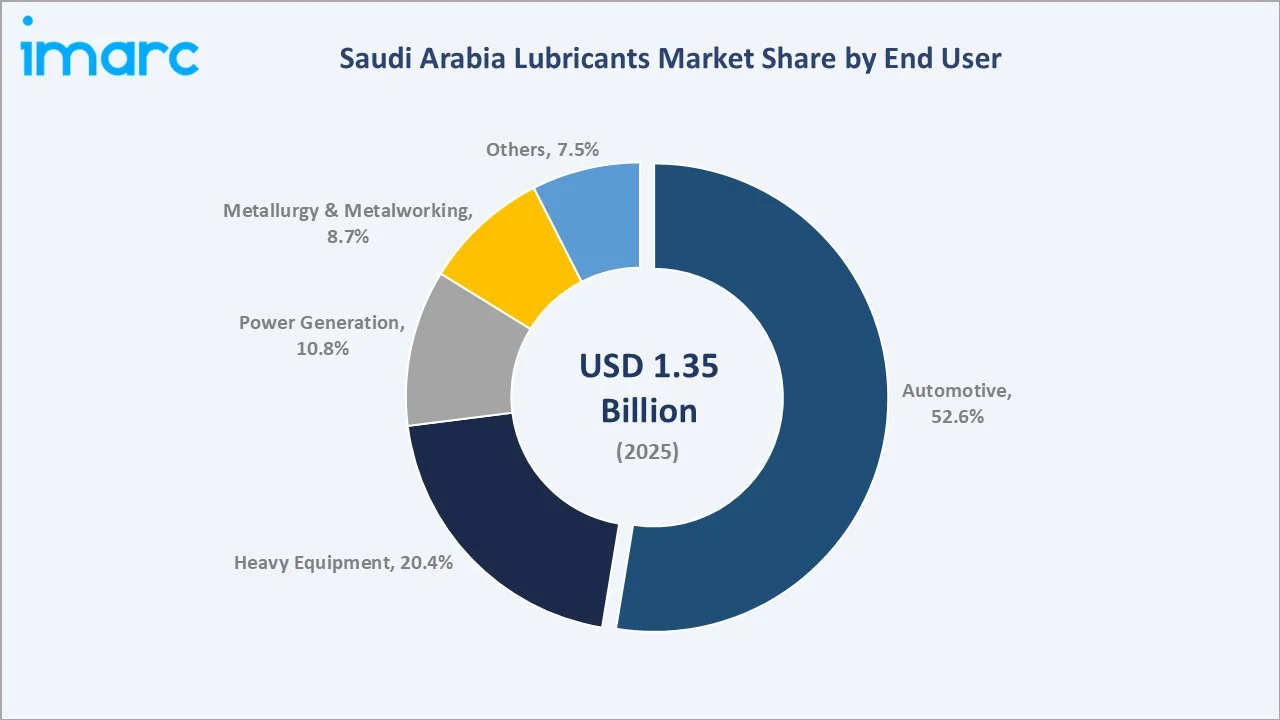
Heavy Equipment at 20.4% is growing rapidly through Vision 2030 construction activity. Power Generation at 10.8% reflects turbine and generator lubrication. Metallurgy and Metalworking at 8.7% serves Saudi Arabia's expanding manufacturing sector. Others at 7.5% include marine and agricultural applications.
Regional Market Insights
|
Region |
Share (2025) |
Key Saudi Arabia Lubricants Market Drivers & Characteristics |
|
Northern & Central Region |
42.8% |
Riyadh's large automotive fleet, industrial cluster demand, and government fleet procurement anchor the Kingdom's dominant regional lubricants market. |
|
Western Region |
27.9% |
Jeddah's port-led industrial activity, hospitality sector growth, and dense urban vehicle population drive sustained lubricant consumption. |
|
Eastern Region |
19.3% |
Oil and gas operations, petrochemical plants in Jubail, and heavy industry in Dammam generate consistent industrial lubricant demand. |
|
Southern Region |
10.0% |
Growing infrastructure activity, expanding vehicle fleet, and logistics corridor development support rising lubricant consumption. |
Northern & Central Region's 42.8% market leadership reflects Riyadh's dominant vehicle density, Aramco's lubricant distribution infrastructure, and industrial cluster demand. Western Region's 27.9% reflects Jeddah's port-based industrial activity, hospitality sector lubricant demand, and dense urban vehicle population.
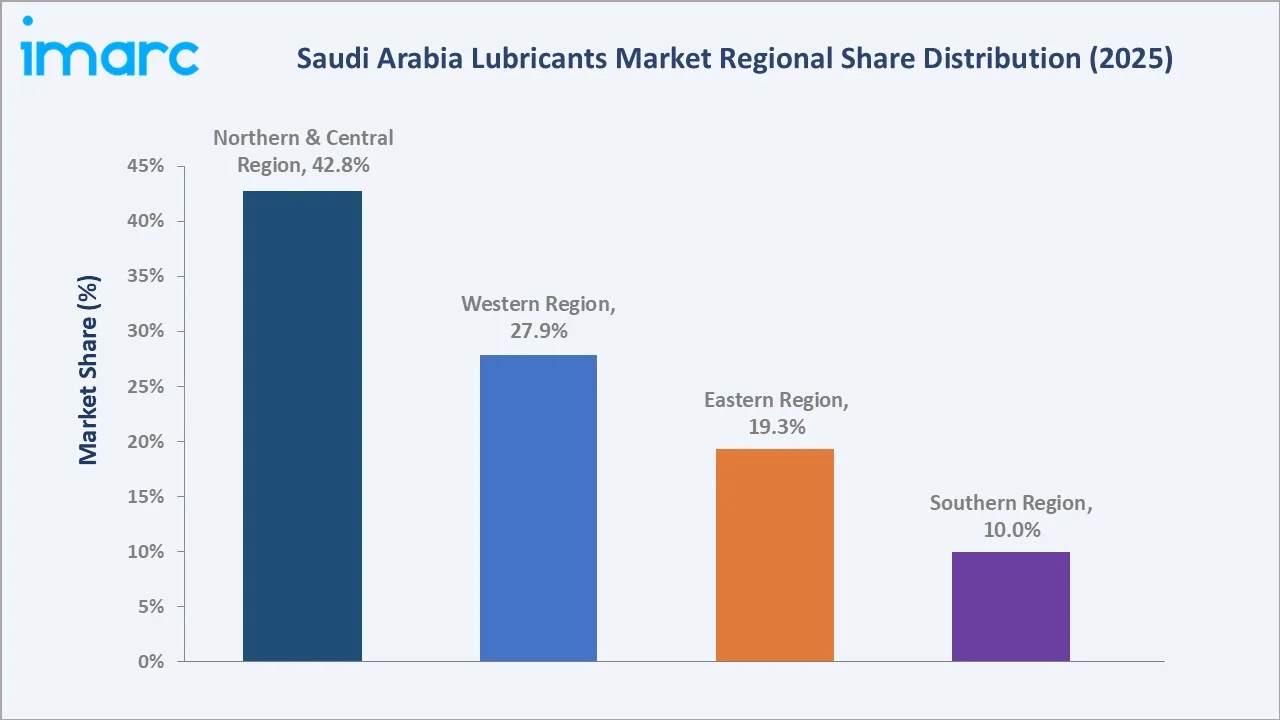
Eastern Region's 19.3% is sustained by oil and gas operations, petrochemical plant industrial lubricant demand, and Dammam's heavy industrial base. Southern Region's 10.0% represents the most nascent regional market, growing through rising vehicle registration, expanding logistics infrastructure, and border region construction activity.
Competitive Landscape
Saudi Arabia lubricants market competitive landscape is fairly consolidated, with the top five companies commanding an estimated 84% of market share by value.
|
Company |
Key Brands |
Market Position |
Core Strength |
|
Saudi Arabian Oil Co. |
Valvoline, Aramco Lubricants |
Market Leader |
Vertically integrated base oil and lubricant producer with captive feedstock advantage, Valvoline brand ownership, and dominant domestic market access. |
|
Exxon Mobil Corporation |
Mobil 1, Mobil Delvac, Mobilgrease |
Strong Challenger |
Global lubricant leader with superior synthetic technology, extensive OEM partnerships, and strong Saudi market presence through APSCO distribution. |
|
TotalEnergies |
Total Quartz, Total Rubia, Elfluor |
Strong Challenger |
Diversified energy major with premium lubricant range, API SQ/ILSAC GF-7 compliant formulations, and growing Saudi Arabia industrial and automotive presence. |
|
FUCHS |
FUCHS, Renolin, Pentosin |
Niche Player |
German specialty lubricant manufacturer with premium industrial formulations, Alhamrani-FUCHS Saudi joint venture, and technical specialty applications expertise. |
Key players include Saudi Arabian Oil Co., Exxon Mobil Corporation, TotalEnergies, FUCHS, and others.
Key Company Profiles
Saudi Arabian Oil Co.
Saudi Arabian Oil Co. (Saudi Aramco) is the world's largest oil producer and a vertically integrated lubricant participant through Luberef base oil production, the Valvoline brand, and downstream lubricant distribution operations across the Kingdom and internationally.
- Key Brands: Valvoline, Aramco Lubricants, among others.
- Strategic Focus: Establishing integrated market dominance through base oil production, premium brand ownership, and national distribution. Aramco aims to capture value across the entire lubricant value chain—from Group I/II base oil production at Luberef through to branded consumer lubricants sold through quick-lube and retail channels. The company aims to leverage the Valvoline acquisition's service center model to expand Saudi Arabia quick-lube penetration while building a globally competitive lubricant export business aligned with Vision 2030.
Exxon Mobil Corporation
Exxon Mobil Corporation is a global lubricant leader with a premium synthetic technology portfolio distributed in Saudi Arabia through Arabian Petroleum Supply Company (APSCO), serving automotive, commercial vehicle, and industrial lubricant segments.
- Key Brands: Mobil 1, Mobil Delvac, Mobil SHC, MobilGrease, among others.
- Strategic Focus: Advancing synthetic lubricant technology leadership and premium brand positioning across Saudi Arabia's growing high-end automotive segment. ExxonMobil's strategic focus centers on strengthening Mobil 1 brand equity through OEM co-branding with Toyota, Mercedes-Benz, and Porsche. The company aims to expand Mobil Delvac penetration in the Kingdom's commercial vehicle fleet through APSCO's fleet service programs.
Market Concentration Analysis
Saudi Arabia lubricants market is fairly consolidated, with the top five companies collectively commanding approximately 84% of total market value. This consolidation reflects strong OEM approval requirements, brand trust dynamics, and capital investment required for compliant blending and distribution infrastructure.
Investment & Growth Opportunities
Highest Growth Segments
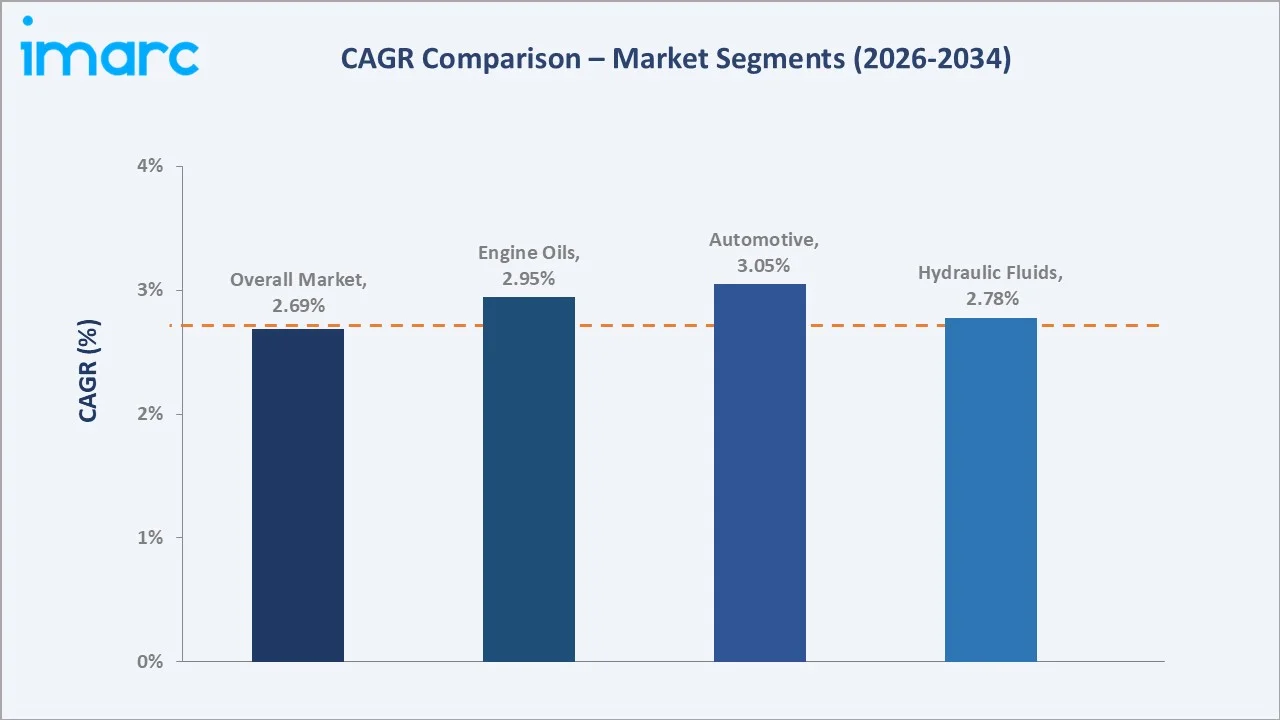
Synthetic engine oils (~3.5% CAGR through premium formulation migration), automotive end-user lubricants (~3.05% CAGR through fleet expansion), hydraulic fluids (~2.78% CAGR through construction activity), Northern & Central Region (~3.2% CAGR through Riyadh economic growth), and EV thermal management fluids (~above-market CAGR from low base) represent Saudi Arabia's highest-growth lubricant investment vectors through 2034.
Emerging Investment Opportunities
Saudi Arabia's planned domestic additive manufacturing facility, designed to reduce dependency on imported additive packages, represents a commercially significant investment opportunity. Investors in additive chemistry manufacturing can supply Saudi-based lubricant blenders with cost-competitive locally produced packages, reducing import costs and enabling more competitive mid-tier lubricant product development.
Investment Themes
- Premium synthetic lubricant distribution and quick-lube service channels: Investors in premium synthetic engine oil distribution and quick-lube service center development can capture above-average margins as Saudi consumers migrate from mineral to synthetic formulations through OEM mandate and environmental regulation.
- EV fluid technology development and distribution infrastructure: Saudi Arabia's 30% EV target creates a structural investment opportunity in EV-specific thermal management fluids, charging infrastructure lubricants, and specialized e-motor fluid distribution networks aligned with the Kingdom's EV adoption trajectory.
Future Market Outlook (2026-2034)
The Saudi Arabia lubricants market is projected to grow from USD 1.35 Billion in 2025 to USD 1.39 Billion in 2026, reaching USD 1.72 Billion by 2034, registering a CAGR of 2.69% during 2026-2034. The market's anchor value of USD 1.54 Billion in 2030 reflects Vision 2030 industrial activity, automotive fleet expansion, and petroleum sector lubrication maintenance.
Three structural forces define Saudi Arabia lubricants market growth through 2034: automotive fleet expansion driven by rising population and female driving participation creating persistent engine oil demand; Vision 2030's industrial diversification generating multi-segment industrial lubricant requirements; and Aramco's downstream acquisition strategy reshaping competitive dynamics toward greater vertical integration.
Research Methodology
Primary Research
Primary research comprised structured interviews with Saudi Arabia lubricants market stakeholders, including lubricant blenders, distributors, automotive service center managers, industrial procurement officers, and OEM regional representatives across all four Saudi regions.
Secondary Research
Secondary research encompassed Saudi SASO regulatory publications, Saudi Aramco annual reports, lubricant company investor presentations, SAGIA industrial reports, GCC automotive statistics, and trade press analysis. Over 50 secondary sources reviewed.
Forecasting Models
Market revenue forecasts developed using a demand-side consumption model: Saudi Arabia's vehicle fleet multiplied by per-vehicle annual lubricant consumption rates, aggregated with industrial lubricant consumption from equipment intensity ratios by sector. Vision 2030 industrial project pipeline used as primary industrial demand indicator.
Saudi Arabia Lubricants Market Report Coverage:
| Report Features | Details |
|---|---|
| Base Year of the Analysis | 2025 |
| Historical Period | 2020-2025 |
| Forecast Period | 2026-2034 |
| Units | Billion USD |
| Scope of the Report |
Exploration of Historical Trends and Market Outlook, Industry Catalysts and Challenges, Segment-Wise Historical and Future Market Assessment:
|
| Product Types Covered | Engine Oils, Greases, Hydraulic Fluids, Metalworking Fluids, Transmission and Gear Oils, Others |
| End Users Covered | Automotive, Heavy Equipment, Metallurgy and Metalworking, Power Generation, Others |
| Regions Covered | Northern and Central Region, Western Region, Eastern Region, Southern Region |
| Companies Covered | Saudi Arabian Oil Co., Exxon Mobil Corporation, TotalEnergies, FUCHS, etc. |
| Customization Scope | 10% Free Customization |
| Post-Sale Analyst Support | 10-12 Weeks |
| Delivery Format | PDF and Excel through Email (We can also provide the editable version of the report in PPT/Word format on special request) |
Key Benefits for Stakeholders:
- IMARC’s industry report offers a comprehensive quantitative analysis of various market segments, historical and current market trends, market forecasts, and dynamics of the Saudi Arabia lubricants market from 2020-2034.
- The research report provides the latest information on the market drivers, challenges, and opportunities in the Saudi Arabia lubricants market.
- Porter's five forces analysis assist stakeholders in assessing the impact of new entrants, competitive rivalry, supplier power, buyer power, and the threat of substitution. It helps stakeholders to analyze the level of competition within the Saudi Arabia lubricants industry and its attractiveness.
- Competitive landscape allows stakeholders to understand their competitive environment and provides an insight into the current positions of key players in the market.
Frequently Asked Questions About the Saudi Arabia Lubricants Market Report
Saudi Arabia lubricants market size is estimated at USD 1.39 Billion in 2026, driven by vehicle fleet expansion, Vision 2030 industrial activity, and oil & gas sector lubricant consumption across automotive, heavy equipment, and industrial applications.
Saudi Arabia lubricants market grows at 2.69% CAGR during 2026-2034, reaching USD 1.72 Billion by 2034. Growth is sustained by vehicle fleet expansion, Vision 2030 industrial diversification, heavy equipment lubricant demand, and synthetic formulation premiumization.
Engine Oils leads at 44.8% through universal automotive and industrial application, driven by Saudi Arabia's large vehicle fleet, OEM service interval compliance, and quick-lube channel enforcement of premium lubricant specifications.
Automotive leads at 52.6% through Saudi Arabia's vehicle fleet of over 15.8 million registered vehicles, high lubricant replacement frequency driven by hot climate conditions, and growing quick-lube service chain penetration enforcing OEM lubricant specifications.
Northern & Central Region leads at 42.8% through Riyadh's dominant vehicle density, Aramco's lubricant distribution infrastructure, industrial cluster demand, and government fleet procurement concentrated in the Kingdom's administrative capital.
Leading companies include Saudi Arabian Oil Co., Exxon Mobil Corporation, TotalEnergies, FUCHS, and others.
Saudi Arabia lubricants market is projected to reach approximately USD 1.54 Billion by 2030, sustained by Vision 2030 industrial activity, automotive fleet growth, petrochemical sector lubricant demand, and expanding quick-lube service channel penetration across all four Saudi regions.
Three priority investment opportunities: premium synthetic lubricant distribution and quick-lube service channel development; EV thermal management fluid development for Saudi Arabia's 30% EV target by 2030; and domestic additive manufacturing capacity investment to reduce import dependency and lower mid-tier lubricant formulation costs.
Need more help?
- Speak to our experienced analysts for insights on the current market scenarios.
- Include additional segments and countries to customize the report as per your requirement.
- Gain an unparalleled competitive advantage in your domain by understanding how to utilize the report and positively impacting your operations and revenue.
- For further assistance, please connect with our analysts.
 Request Customization
 Speak to an Analyst
 Request Brochure
 Inquire Before Buying
Benefits of Customization
- Personalize this research
- Triangulate with your data
- Get data as per your format and definition
- Gain a deeper dive into a specific application, geography, customer, or competitor
- Any level of personalization
Get in Touch With Us
UNITED STATES
Phone: +1-201-971-6302
INDIA
Phone: +91-120-433-0800
UNITED KINGDOM
Phone: +44-753-714-6104
Email: [email protected]
Client Testimonials




.webp)




.webp)













Related Reports

Choose your plan
*Please note that the prices mentioned below are starting prices for each bundle type. Kindly contact our team for further details.*
Single User License
- 1 User License, Access on 2 Devices
- PDF Report + Excel Dataset (Password Protected)
- Lifetime Access
- No Printing Rights
- 10% Free Report Customization
- 10–12 Weeks of Analyst Support
Five User License
- Access for 5 Users, 2 Devices per User
- PDF Report + Excel Dataset (Password Protected)
- Lifetime Access
- Dedicated Account Manager
- 12–14 Weeks of Analyst Support
- No Printing Rights
- 15% Free Report Customization
- 25% Discount on Your Next Purchase
Corporate User License
- Unlimited User Access (Within Your Organization)
- PDF Report + Excel Dataset
- Lifetime Access
- Dedicated Account Manager
- 14–20 Weeks of Analyst Support
- No Printing Rights
- 20% Free Report Customization
- 30% Discount on Your Next Purchase
Essential Insights
What's included:
3 reports
- Lifetime Access
- PDF Reports
- Excel Datasets
- 2 Weeks of Free Analyst Support
- 2 User Licenses
- Access on 2 Devices
- Printing Rights
- Complimentary PowerPoint (PPT) Version
- Complimentary License Upgrade
Professional Access
What's included:
5 reports
- Lifetime Access
- PDF Reports
- Excel Datasets
- 8 Weeks of Free Analyst Support
- 2 User Licenses
- Access on 2 Devices
- Printing Rights
- Complimentary PowerPoint (PPT) Version
- Complimentary License Upgrade
Business Advantage
What's included:
8 reports
- Lifetime Access
- PDF Reports
- Excel Datasets
- 14 Weeks of Free Analyst Support
- 2 User Licenses
- Access on 2 Devices
- Printing Rights
- Complimentary PowerPoint (PPT) Version
- Complimentary License Upgrade
Enterprise Intelligence
What's included:
10 reports
- Lifetime Access
- PDF Reports
- Excel Datasets
- 20 Weeks of Free Analyst Support
- 2 User Licenses
- Access on 2 Devices
- Printing Rights
- Complimentary PowerPoint (PPT) Version
- Complimentary License Upgrade