
Saudi Arabia Modular Construction Market Size, Share, Trends and Forecast by Type, Module Type, Material, End Use, and Region, 2026-2034
Saudi Arabia Modular Construction Market Size, Share, Trends & Forecast (2026-2034)
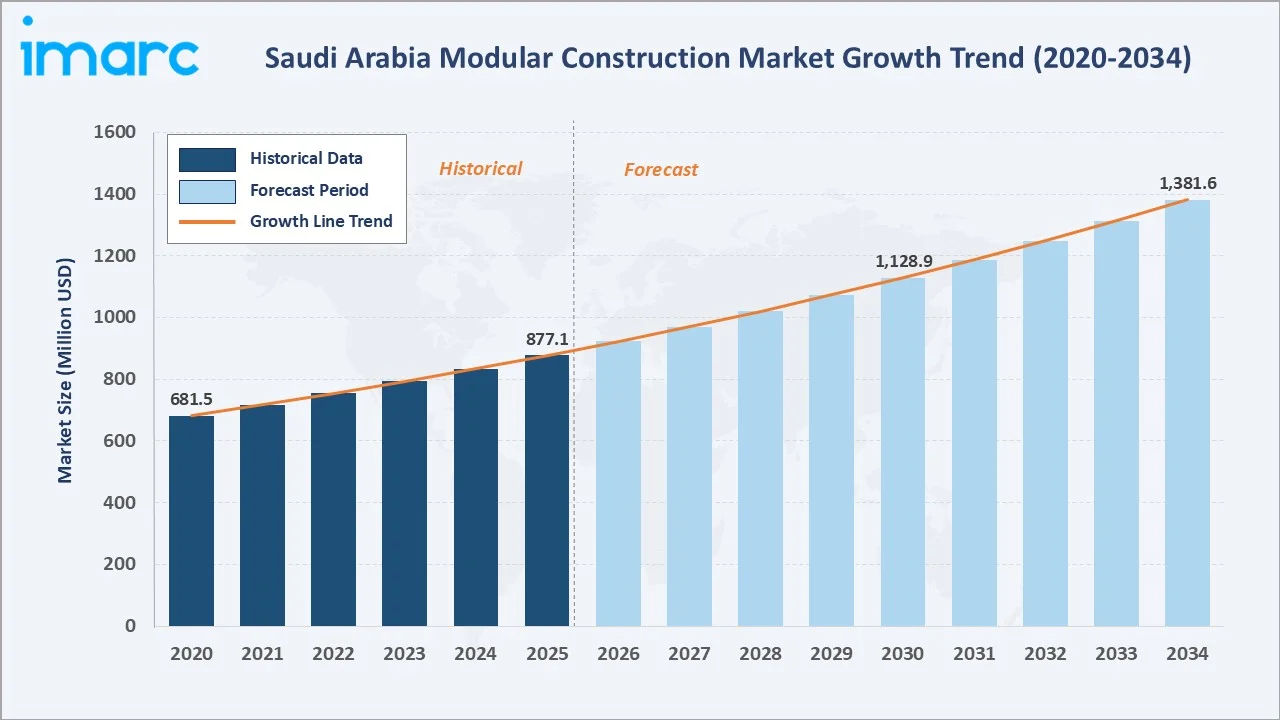
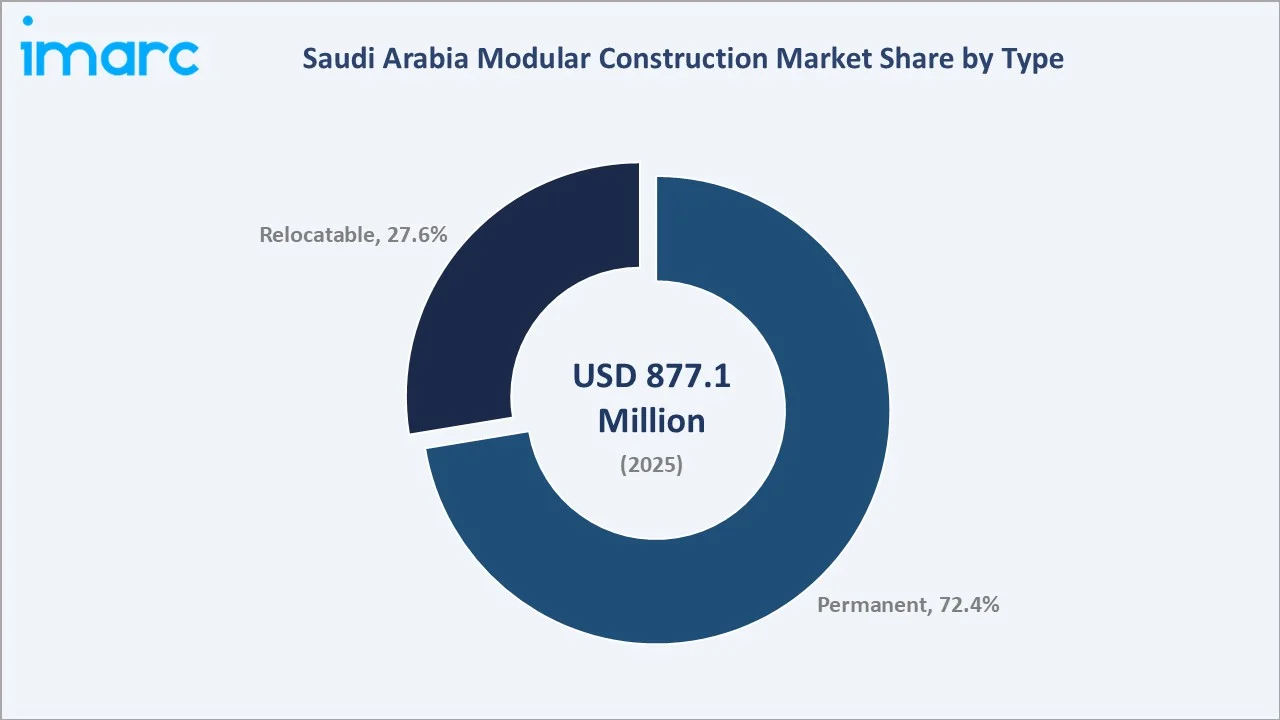
The Saudi Arabia modular construction market grew from USD 877.1 Million in 2025 to USD 922.5 Million in 2026 and is projected to reach USD 1,381.6 Million by 2034, growing at a CAGR of 5.18% during 2026-2034. The market is driven by the unprecedented scale of Vision 2030 giga-projects, the urgent workforce housing requirement, and the growing adoption of off-site fabrication methods that reduce construction timelines. Permanent type leads at 72.4%, four-sided modules dominate at 31.8% by module type, and the Northern and Central region commands the largest regional share at 45.3% in 2025.
Market Snapshot
|
Metric |
Value |
|
Base Year Market Size (2025) |
USD 877.1 Million |
|
Market Size (2026) |
USD 922.5 Million |
|
Forecast Market Size (2034) |
USD 1,381.6 Million |
|
CAGR (2026-2034) |
5.18% |
|
Base Year |
2025 |
|
Historical Period |
2020-2025 |
|
Forecast Period |
2026-2034 |
|
Dominant Type |
Permanent (72.4%, 2025) |
|
Dominant Module Type |
Four Sided (31.8%, 2025) |
|
Leading Region |
Northern and Central Region (45.3%, 2025) |
The Saudi Arabia modular construction market grew from USD 681.5 Million in 2020 to USD 877.1 Million in 2025, and further to USD 922.5 Million in 2026, reflecting accelerating adoption driven by Vision 2030 megaproject timelines, growing government support for industrialized construction, and the proven delivery of large-scale modular worker housing cities across NEOM, The Red Sea Global, and Qiddiya development zones. The market is projected to reach USD 1,128.9 Million by 2030 before reaching USD 1,381.6 Million by 2034.
To get more information on this market, Request Sample
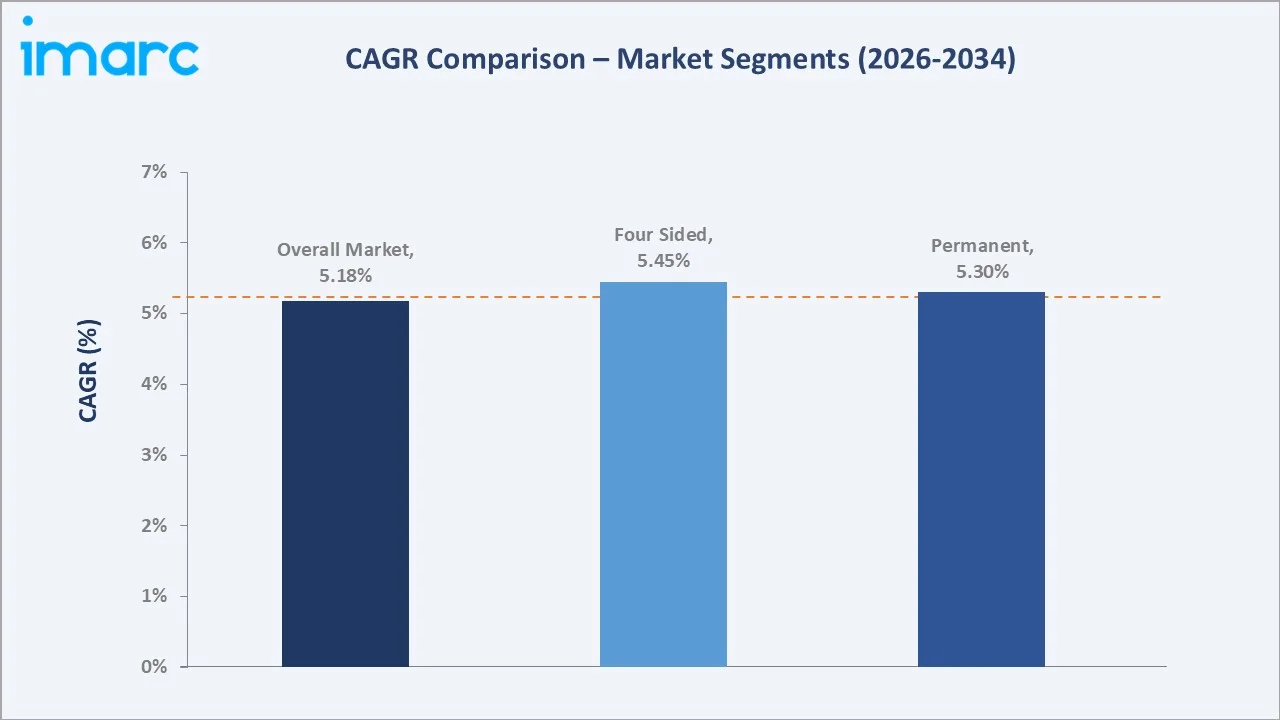
Permanent modular construction is growing at a 5.3% CAGR as Vision 2030 shifts from temporary workforce accommodation toward permanent residential communities, commercial structures, and hospitality assets that require the full structural integrity, aesthetic finish, and multi-decade durability of permanent modular buildings. Four-sided modules at 5.45% CAGR reflect their dominance as the primary volumetric module type for permanent residential and commercial modular buildings where complete enclosure provides maximum factory quality control before site assembly.
Executive Summary
The Saudi Arabia modular construction market is undergoing a structural acceleration driven by the coincidence of the most ambitious construction program in the kingdom's history under Vision 2030 and the proven ability of off-site modular fabrication to deliver workforce housing, permanent residential communities, hospitality assets, and complex building programs in compressed timescales that traditional construction methods cannot match.
Permanent type leads at 72.4%, reflecting the structured shift from relocatable workforce camps toward permanent modular residential villas, hospitality units, and commercial buildings that now constitute the majority of Saudi Arabia modular construction by value. Four-sided modules at 31.8% lead by module type, as the fully enclosed volumetric module provides the optimal form factor for permanent residential and accommodation applications. The Northern and Central region leads at 45.3%, driven by Riyadh concentration of Vision 2030 administrative capital, PIF residential projects, and the modular factory.
Key Market Insights
|
Insight |
Data |
|
Dominant Type |
Permanent - 72.4% share (2025) |
|
Dominant Module Type |
Four Sided - 31.8% share (2025) |
|
Leading Region |
Northern and Central Region - 45.3% (2025) |
|
Key Market Opportunity |
Large-scale affordable housing, Vision 2030 giga-projects, hospitality and tourism developments, workforce accommodation, healthcare and education facilities, infrastructure projects, localized modular manufacturing, BIM/digital construction, sustainable building solutions, and rapid-deployment temporary/relocatable structures. |
Key Analytical Observations Supporting the Above Data:
- Permanent at 72.4%: Permanent modular construction dominates because the Saudi Arabia modular market has matured beyond its initial workforce accommodation origins into a broader construction delivery method used for permanent residential communities, hospitality assets, and commercial facilities that require long-term structural durability.
- Four Sided Modules at 31.8%: Four-sided modules lead because fully enclosed volumetric modules provide maximum factory quality control by containing all four walls, floors, ceiling, windows, and fitted interior finishes within a single factory-assembled unit that arrives on site ready for connection, minimizing on-site weather exposure, quality risk, and assembly labor.
- Northern and Central Region at 45.3%: Riyadh concentration of PIF giga-project administrative functions, government ministry headquarters issuing construction programs, NEOM administrative offices, the modular factories, and the largest urban housing demand in the kingdom combine to make the Northern and Central region the primary modular construction demand and production center in Saudi Arabia.
Saudi Arabia Modular Construction Market Overview
The Saudi Arabia modular construction market encompasses all off-site manufactured building systems where structural building components, ranging from individual panels to complete volumetric room modules, are fabricated in controlled factory environments, then transported to sites for assembly into finished structures. Key construction methods include volumetric modular construction (complete three-dimensional module assembly including all finishes), panelized construction (flat wall, floor, and roof panels assembled on site), and hybrid approaches combining volumetric modules with a primary structural frame. Applications span permanent residential housing (individual villas and apartment complexes), hospitality and leisure facilities (hotel rooms and resort pods), workforce accommodation (construction camps and permanent worker cities), healthcare and education facilities, commercial and industrial buildings, and relocatable structures for temporary infrastructure.
Market Dynamics
To evaluate market opportunities, Request Sample
Market Drivers
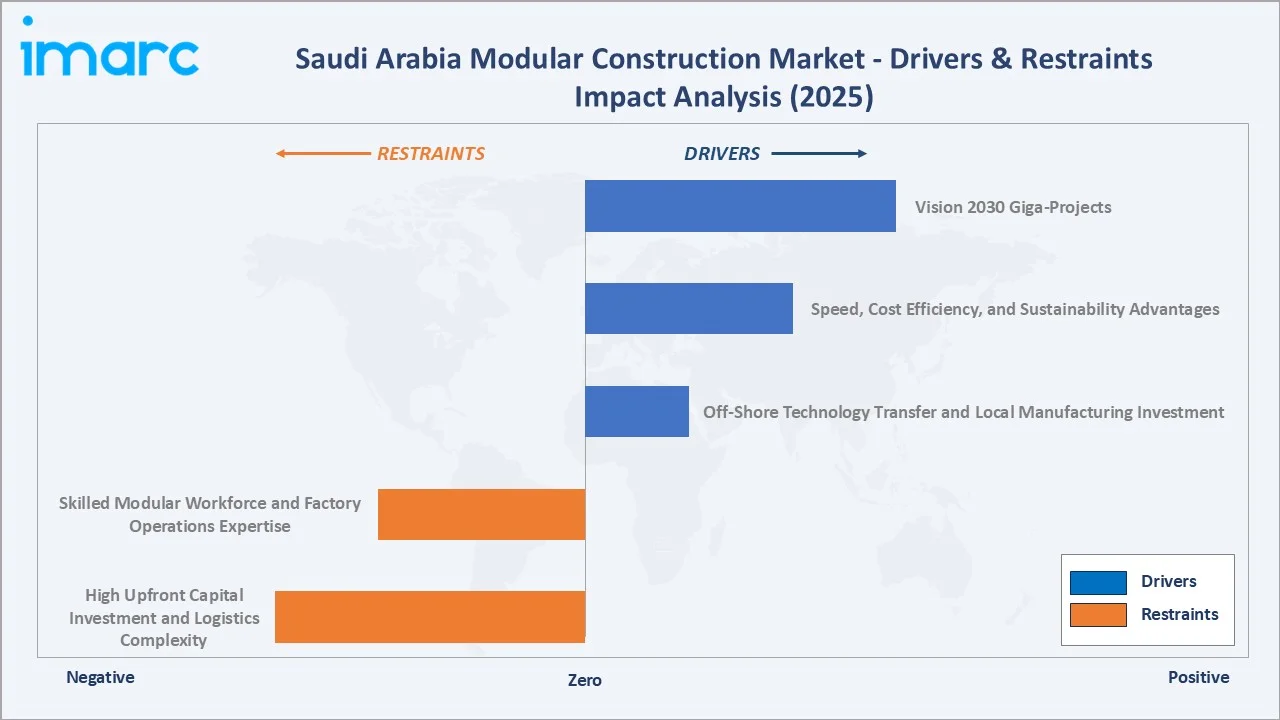
- Vision 2030 Giga-Projects: The four flagship Vision 2030 projects, NEOM, Red Sea Global, Qiddiya, and Diriyah Gate, are collectively projected to require a peak construction workforce, generating a housing requirement that is simply impossible to fulfill through traditional construction on the timescales that project delivery demands. This workforce accommodation requirement has become the defining demand driver for Saudi Arabia modular construction market, with Homagic securing a SAR 2.8 Billion contract from NEOM for Phase II delivery of 12,000 permanent worker accommodation units, directly illustrating the scale of modular construction demand from giga-project workforce housing alone.
- Speed, Cost Efficiency, and Sustainability Advantages: Modular construction reduces project timelines versus traditional construction, cuts on-site labor requirements, reduces construction waste, and enables factory quality control that is not achievable in open-air on-site construction. NEOM net-zero carbon construction requirements, Red Sea Global mandate for unprecedented prefabrication levels to achieve carbon-neutral operations, and durability requirements for worker accommodation are collectively formalizing modular construction as the mandatory delivery method for major Saudi projects where performance, sustainability, and timeline certainty are non-negotiable.
- Off-Shore Technology Transfer and Local Manufacturing Investment: The inauguration of CHEC's 200,000-square-meter modular factory in Riyadh in February 2025, incorporating advanced robotics and a fully digitalized design-to-production workflow, marks the transition from purely import-dependent modular supply toward Saudi Arabia becoming an actual manufacturing base for modular components.
Market Restraints
- Skilled Modular Workforce and Factory Operations Expertise: Establishing and operating advanced modular manufacturing facilities requires specialized skills in digital fabrication, robotics operation, BIM-to-factory production management, and precision assembly quality control that are not currently widely available in the Saudi Arabia construction workforce. The transition from site-based traditional construction to factory-based modular manufacturing requires a different technical skill set, and building the engineering and operator talent base to staff facilities like the CHEC Sedra factory takes years of training investment.
- High Upfront Capital Investment and Logistics Complexity: Establishing modular manufacturing facilities requires substantial upfront capital investment in land, factory fit-out, machinery, robotics, and production management systems before any modules are delivered. Module transport from factory to remote giga-project sites, including NEOM's northwestern coast, Red Sea coastal zones, and Diriyah Gate, introduces additional logistics costs and planning complexity from abnormal load transport route management.
Market Opportunities
- Permanent Residential Community Modular Applications: Beyond workforce housing, Saudi Arabia PIF-backed residential developers are progressively specifying modular construction for permanent family residential communities. This represents a market transition from temporary to permanent modular applications with significantly higher value per unit and longer product design life requirements that command premium pricing and create sustainable demand through the residential housing development cycle.
- Hospitality Pod and Resort Modular Construction: Red Sea Global Shebara Island installation of futuristic overwater pod-style villas demonstrates how precision-manufactured modular units can achieve design innovation in ecologically sensitive marine environments where traditional construction would cause unacceptable site disturbance. The Red Sea and Amaala projects collectively require thousands of premium hospitality units where modular precision, controlled quality, and minimal environmental footprint create a compelling specification for luxury resort modular construction.
Market Challenges
- Regulatory and Approval Complexity: Differences in building codes, permitting requirements, and approval procedures can complicate modular construction projects. Standardized modules may require additional certification to meet local construction and safety requirements. Lengthy approval processes can delay project schedules and increase development costs.
- Perception of Quality and Design Limitations: Some developers and customers may associate modular buildings with temporary or lower-quality structures. Concerns regarding durability, architectural flexibility, and customization can limit adoption. Greater industry awareness and successful large-scale projects are needed to strengthen market confidence.
Emerging Market Trends
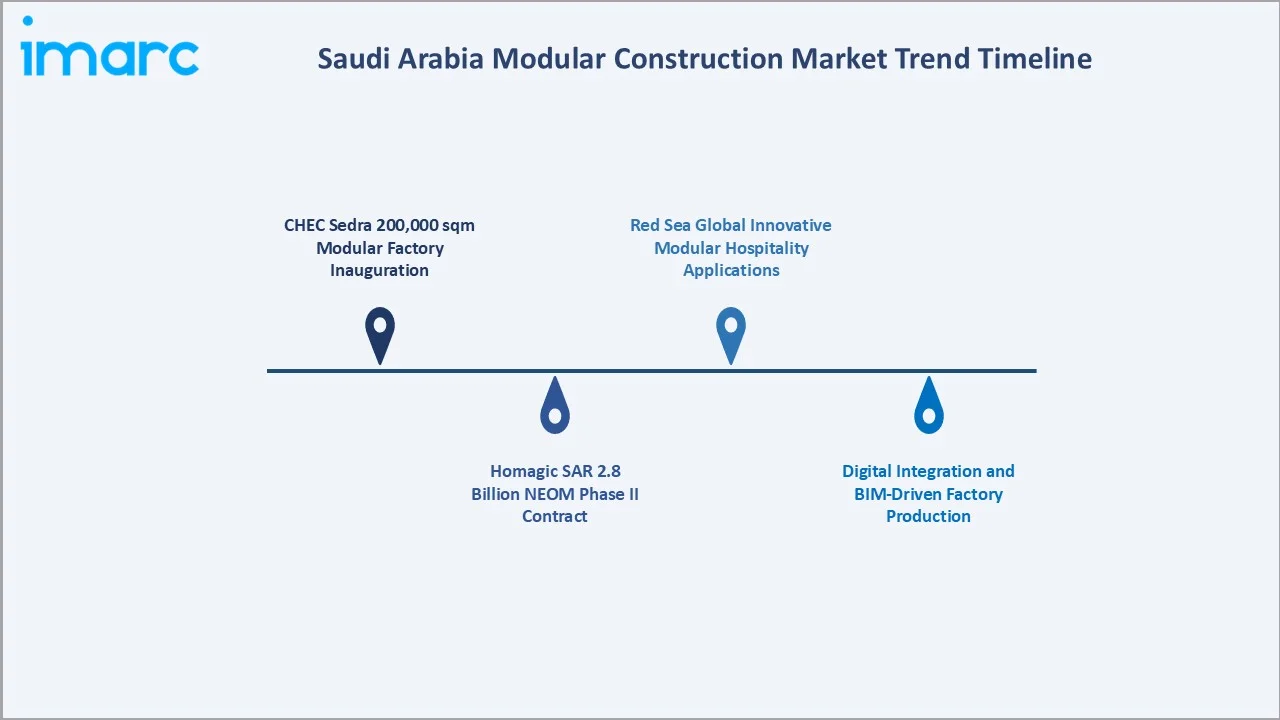
1. CHEC Sedra 200,000 sqm Modular Factory Inauguration
The February 2025 inauguration of China Harbour Engineering Company's modular building factory for the Sedra housing project in Riyadh represents the most significant single modular manufacturing investment event in Saudi Arabia construction history. Spanning 200,000 square meters and equipped with an independently developed production management system and advanced robotics enabling a fully digitalized workflow covering design, production, and storage, the facility supplies prefabricated components for Sedra fully modular villas while laying the industrial foundation for future prefabricated construction initiatives in Saudi Arabia.
2. Homagic SAR 2.8 Billion NEOM Phase II Contract
China Construction Integrated Building Company (CSCEC) Homagic brand secured a SAR 2.8 Billion (USD 746 Million) contract from NEOM to deliver 12,000 permanent worker accommodation units for the Phase II construction workforce housing program, the largest single Modular Integrated Construction contract ever signed in the Middle East. Homagic and the NEOM contract demonstrate the appetite for large-scale, high-value modular delivery contracts that Saudi Arabia giga-projects are generating.
3. Red Sea Global Innovative Modular Hospitality Applications
Red Sea Global Shebara Island overwater pod-style villa installation demonstrates how precision-manufactured modular units can achieve design innovation that is simultaneously more sustainable and more architecturally distinctive than traditional construction could achieve in ecologically sensitive marine environments. The Red Sea Project has set new benchmarks by mandating unprecedented levels of prefabrication to achieve carbon-neutral operations while maintaining aggressive construction schedules, using eco-friendly prefabricated units for iconic Saudi projects.
4. Digital Integration and BIM-Driven Factory Production
The integration of Building Information Modeling (BIM) with factory production management systems is enabling design-to-production workflows where digital building models are directly translated into factory cutting, forming, and assembly instructions without manual re-drawing. This digital continuity from architectural design through factory production through site assembly significantly reduces error, improves fit-up accuracy at site connection, and enables mass customization of module interior layouts while maintaining production efficiency. Leading firms are forging ecosystem partnerships from modular data center expansions to BIM-driven factory setups mirroring global trends in automation and digital integration.
Industry Value Chain Analysis
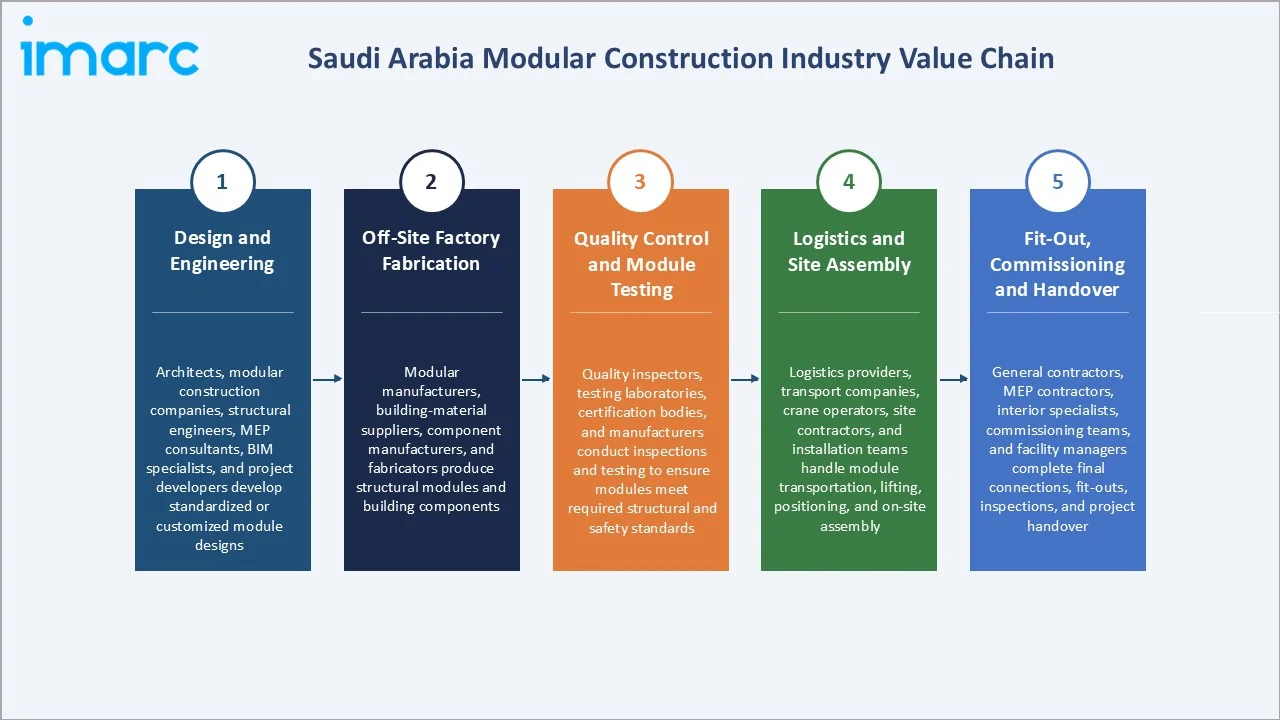
The Saudi Arabia modular construction value chain spans five integrated stages from design and engineering through fit-out and commissioning. The off-site factory fabrication stage captures the highest technical value addition in the chain, as factory-controlled manufacturing under quality management systems, incorporating precision robotics and digital production workflows, produces building modules that cannot be replicated in quality or efficiency through on-site construction methods regardless of skill level.
|
Stage |
Key Participants |
|
Design and Engineering |
Architects, modular construction companies, structural engineers, MEP consultants, BIM specialists, and project developers develop standardized or customized module designs. |
|
Off-Site Factory Fabrication |
Modular manufacturers, building-material suppliers, component manufacturers, and fabricators produce structural modules and building components. |
|
Quality Control and Module Testing |
Quality inspectors, testing laboratories, certification bodies, and manufacturers conduct inspections and testing to ensure modules meet required structural and safety standards. |
|
Logistics and Site Assembly |
Logistics providers, transport companies, crane operators, site contractors, and installation teams handle module transportation, lifting, positioning, and on-site assembly. |
|
Fit-Out, Commissioning and Handover |
General contractors, MEP contractors, interior specialists, commissioning teams, and facility managers complete final connections, fit-outs, inspections, and project handover. |
The off-site factory fabrication stage is the highest value-added stage in the modular construction value chain. Modular manufacturers operating certified production facilities with digitalized workflows achieve quality outcomes and production speed that cannot be replicated by traditional construction methods, commanding premium pricing for the quality, schedule certainty, and sustainability performance that industrial modular production provides.
Technology Landscape in the Saudi Arabia Modular Construction Industry
Robotic and Automated Factory Production
Advanced robotics integrated into modular factory production enable precision cutting, welding, panel assembly, and module finishing operations at production speeds and quality consistency levels that human-only factory production cannot maintain. Robotics are particularly valuable for repetitive operations across large production runs of standardized module configurations, enabling the scale economics that make factory-based modular production competitive against traditional on-site construction for large-volume residential and accommodation programs.
Building Information Modeling and Design for Manufacture and Assembly
BIM-integrated Design for Manufacture and Assembly (DfMA) methodology optimizes modular building designs for factory production efficiency and site assembly speed before any production begins, ensuring that connection details, service routing, and finish specifications are fully resolved in the digital model so that factory production proceeds without design queries and site assembly occurs without RFI delays. Saudi Arabia giga-projects, including NEOM and Red Sea Global, mandate advanced BIM Level 2 and progressively Level 3 compliance across all construction packages, creating a digital infrastructure requirement that directly supports the BIM-to-factory workflows that maximize modular construction efficiency.
Sustainable and Net-Zero Modular Construction Technology
NEOM net-zero construction requirements and Red Sea Global carbon-neutral operations mandate are driving investment in sustainable modular construction technologies, including solar-integrated roof panel modules, high-performance thermal insulation systems integrated in factory production, energy recovery ventilation systems pre-commissioned within modules, and material traceability systems that support whole-life carbon assessment. Factory production inherently reduces construction waste versus traditional construction, providing a structural sustainability advantage that aligns with both project environmental specifications and Saudi Arabia Green Initiative commitments.
Market Segmentation Analysis
The report covers the following segments:
|
Segment Category |
Leading Segment |
Market Share |
Year |
|
Type |
Permanent |
72.4% |
2025 |
|
Module Type |
Four Sided |
31.8% |
2025 |
|
Material |
🔒 |
🔒 |
2025 |
|
End Use |
🔒 |
🔒 |
2025 |
|
Region |
Northern and Central Region |
45.3% |
2025 |

By Type
Permanent leads at 72.4% in 2025, reflecting the structured maturation of the market from early-phase workforce camp installations toward permanent residential communities, hospitality resorts, and commercial facilities that constitute the majority of current Vision 2030 construction program value.
To access detailed market analysis, Request Sample
Relocatable at 27.6% serves the ongoing and growing temporary workforce accommodation requirement across Saudi Arabia active construction sites, oil and gas field operations, and temporary event infrastructure.
By Module Type
Four-sided lead at 31.8% in 2025, as the fully enclosed volumetric module provides the highest-quality factory build completeness for permanent residential, accommodation, and hospitality applications. The four-sided module arrives on site with all exterior walls, windows, doors, and internal finishes completed in the factory environment, requiring only structural connections and building services interface connections at site.
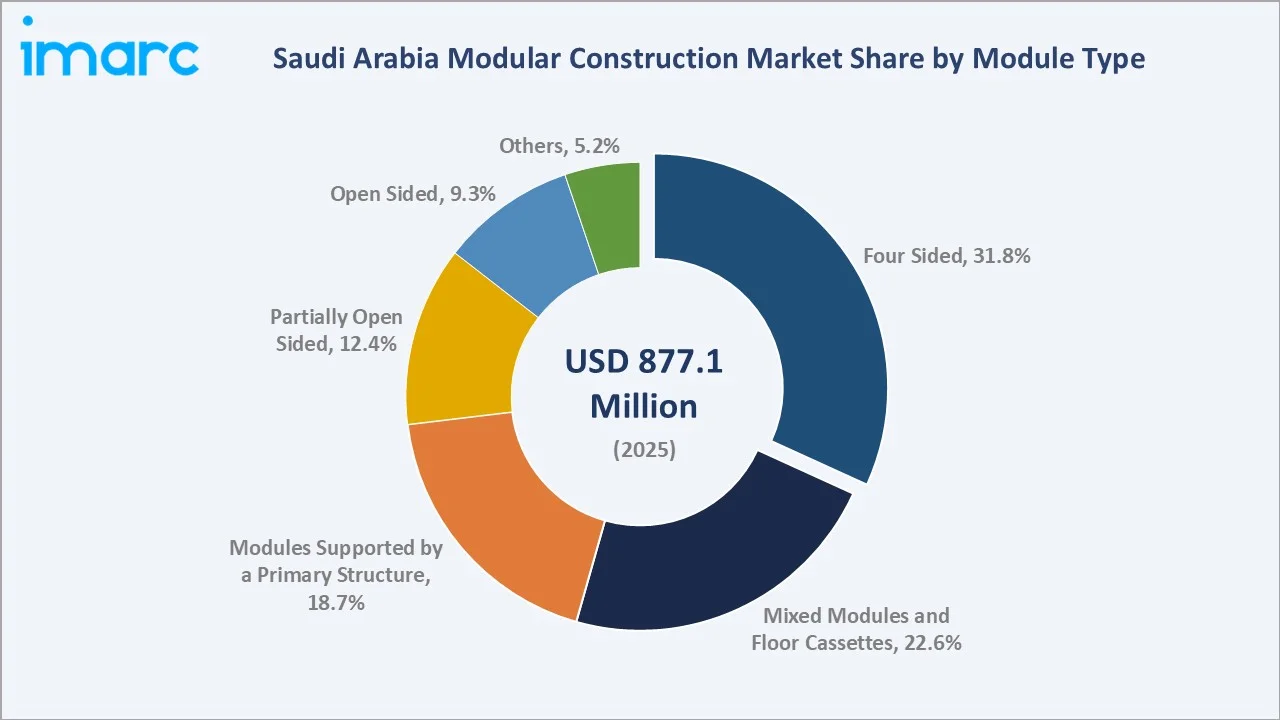
Mixed modules and floor cassettes at 22.6% enable hybrid construction approaches combining volumetric modules with a primary structural frame that is particularly suited to larger-footprint commercial and mixed-use buildings where complete volumetric modules are not architecturally efficient. Modules supported by a primary structure at 18.7% similarly serve complex multi-story applications. Partially open-sided at 12.4% and open-sided modules at 9.3% provide more cost-effective options for specific applications where partial factory enclosure is adequate and site-completion of open faces is practical, including covered walkways, carports, and industrial structures.
Regional Market Insights
|
Region |
Share (2025) |
Key Saudi Arabia Modular Construction Market Drivers & Characteristics |
|
Northern and Central Region |
45.3% |
The region leads the market due to the concentration of government infrastructure projects, residential developments, commercial buildings, and large-scale investments under Vision 2030, particularly around Riyadh and surrounding areas. |
|
Western Region |
26.4% |
Strong growth is supported by tourism, hospitality, mixed-use developments, and mega projects, creating demand for rapid and efficient modular construction solutions. |
|
Eastern Region |
18.2% |
Industrial expansion, energy-related developments, logistics facilities, and workforce accommodation projects drive the adoption of modular building systems in the region. |
|
Southern Region |
10.1% |
Infrastructure upgrades, public sector projects, and growing demand for cost-effective residential and commercial structures support market growth in the southern region. |
The Northern and Central region dominates the Saudi Arabia modular construction market, accounting for 45.3% of the market share in 2025, supported by major government, residential, and infrastructure developments. The Western region holds 26.4%, driven by tourism, hospitality, and large-scale development projects.
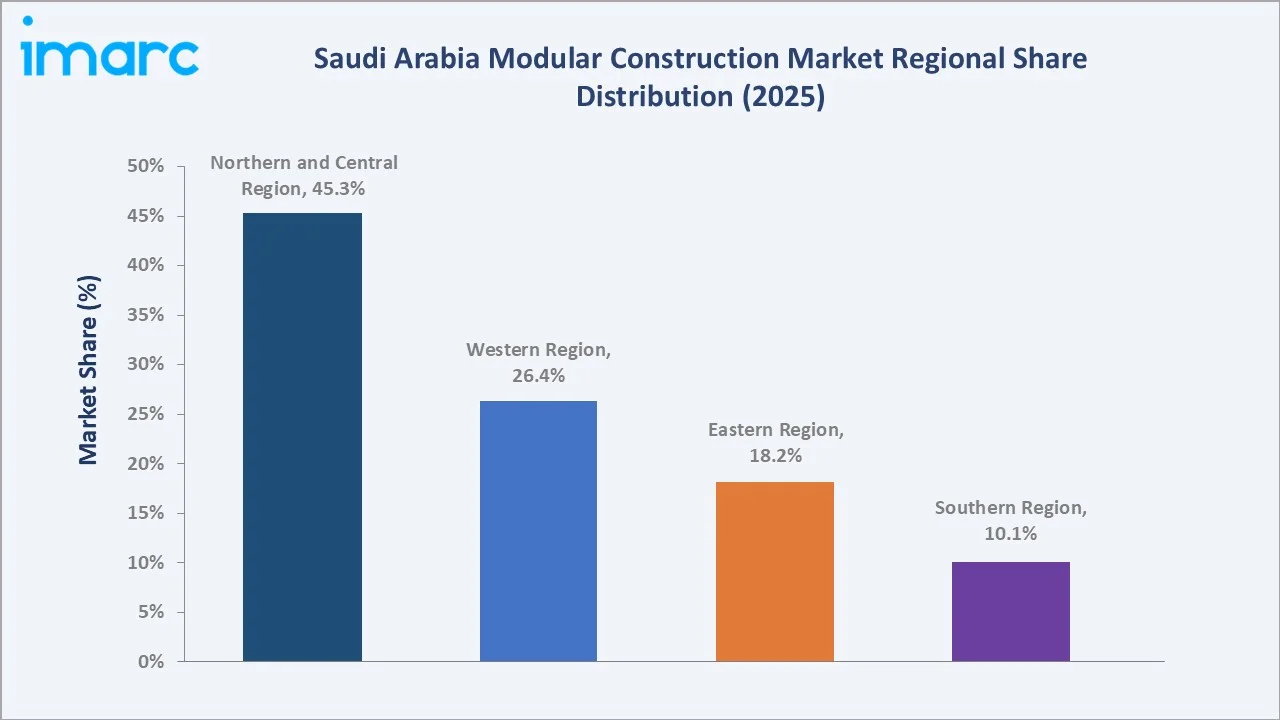
The Eastern region represents 18.2%, supported by industrial, energy, logistics, and workforce accommodation requirements. The Southern region accounts for the remaining 10.1%, with growth linked to infrastructure upgrades and residential construction.
Competitive Landscape
The Saudi Arabia modular construction market competitive landscape is evolving rapidly as the unprecedented scale of Vision 2030 giga-project demand is attracting major Chinese construction conglomerates to establish dedicated Saudi Arabia manufacturing infrastructure alongside established regional players.
| Company | Key Offerings | Market Position | Core Strength |
|---|---|---|---|
| China Harbour Engineering Company Limited | Sedra Project | Market Leader | China Harbour Engineering Company Limited (CHEC) plays a major role in Saudi Arabia's modular and precast construction sector, anchored by its involvement in the Sedra housing project in northern Riyadh. |
| China State Construction Group Co., Ltd. | Homagic 12,000 permanent worker accommodation units | Market Leader | China State Construction Group Co., Ltd., through its subsidiaries and regional operations like China State Construction Engineering Corporation Middle East (CSCEC ME) and affiliates, plays a growing, strategic role in modular construction across Saudi Arabia |
| Red Sea International | Red Sea Housing Services (RSHS) | Established Player | Red Sea International (RSI) is a leading public joint-stock company for modular construction across Saudi Arabia. |
| Zamil Group Holding Company | Pre Engineered Buildings | Established Player | Zamil Group Holding Company (operating through its Zamil Steel Holding Company Limited) plays a foundational role in Saudi Arabia's pre-engineered, modular, and structural steel construction. |
The competitive landscape is being reshaped by Chinese construction giants who have committed to Saudi Arabia modular manufacturing infrastructure at a scale that established regional players cannot immediately match, while Vision 2030 giga-project demand is simultaneously attracting global specialists and expanding the capability of existing regional players.
Key Company Profiles
China Harbour Engineering Company Limited
China Harbour Engineering Company Limited (CHEC) is an engineering and construction company offering services across infrastructure, building, and large-scale development projects. In Saudi Arabia, the company participates in major construction and infrastructure activities, supporting the Kingdom’s expanding development landscape. Its capabilities cover engineering, procurement, construction, project management, and related technical services. The company also supports prefabricated and modular construction solutions, aligning with the growing adoption of industrialized building methods in Saudi Arabia.
- Key Offerings: Sedra Project.
- Strategic Focus: Expanding its construction and engineering capabilities in Saudi Arabia while supporting large-scale infrastructure and building developments. The company emphasizes prefabrication, modular construction, efficient project execution, and integrated engineering solutions to address evolving construction requirements.
Red Sea International
Red Sea International is a Saudi-based company specializing in construction solutions for residential, commercial, industrial, and workforce accommodation projects. The company develops and supplies prefabricated and modular buildings for applications requiring efficient construction and rapid deployment. Its activities include design, manufacturing, installation, and related project services. The company serves various sectors and supports the adoption of industrialized construction solutions in Saudi Arabia.
- Key Offerings: Red Sea Housing Services (RSHS).
- Strategic Focus: Expanding its modular and prefabricated building solutions to serve residential, commercial, industrial, and workforce accommodation requirements. The company emphasizes integrated project delivery, manufacturing efficiency, and adaptable building solutions to support Saudi Arabia’s evolving construction landscape.
Market Concentration Analysis
The Saudi Arabia modular construction market has moderate concentration with a small number of large specialist players commanding the majority of high-value contract activity, alongside a fragmented ecosystem of smaller regional and international modular providers serving specific niche applications or geographic areas.
Market concentration is expected to evolve as CHEC and CSCEC Homagic leverage their established Saudi Arabia manufacturing and project delivery track records to compete for additional giga-project modular contracts, while established regional players maintain their positions through long-standing client relationships and proven delivery credentials. International specialists are competing for specific market segments where their technical differentiation or relationship networks provide competitive advantage.
Investment & Growth Opportunities
Highest Growth Segments
Permanent modular residential communities for Saudi Arabia national housing program represent the highest near-term volume growth opportunity. Permanent hospitality modular pods for Red Sea Global, Amaala, and Qiddiya projects represent the highest per-unit value opportunity, with premium design specifications commanding significant price premiums.
Investment Themes
- Saudi Arabia-Based Modular Manufacturing Infrastructure: Investment in domestic modular production facilities creates the industrial foundation for serving Vision 2030 residential and giga-project demand with domestic supply chain efficiency, Saudi content compliance, and reduced lead times versus international module sourcing.
- Digital DfMA Engineering Capability: Investment in BIM-to-factory digital engineering platforms that enable design-to-production workflows without manual data re-entry creates the efficiency and quality control infrastructure that distinguishes industrial-scale modular manufacturers from traditional prefab assemblers, commanding premium pricing and preferred supplier positioning on high-specification projects.
Future Market Outlook (2026-2034)
The Saudi Arabia modular construction market stood at USD 877.1 Million in 2025 and is projected to grow from USD 922.5 Million in 2026 to USD 1,381.6 Million by 2034, exhibiting a CAGR of 5.18% during the forecast period. The market is expected to reach an intermediate milestone of approximately USD 1,128.9 Million by 2030, as the CHEC Sedra factory scales residential villa production, Homagic delivers the 12,000-unit NEOM Phase II accommodation program, Vision 2030 construction programs, and permanent modular construction progressively extends from workforce accommodation and hospitality into mainstream residential, commercial, healthcare, and education building applications.
Three structural forces will define Saudi Arabia modular construction market through 2034. First, the unprecedented scale of Vision 2030 giga-project construction demand creates a structural workforce housing requirement that is physically impossible to fulfill through traditional on-site construction within giga-project timescales, making modular construction the mandated delivery method for worker accommodation across the entire Vision 2030 portfolio. Second, the establishment of industrial-scale modular manufacturing capacity within Saudi Arabia transforms the market from a primarily import-assembled modular industry into a domestic manufacturing ecosystem where factory economics, quality control, local content compliance, and supply chain proximity create sustainable commercial foundations for long-term market growth that extends beyond the initial Vision 2030 giga-project demand wave. Third, the technical innovation is progressively establishing modular construction as the technically superior building delivery method for a growing range of permanent applications, creating the design community and client awareness.
Research Methodology
Primary Research
Primary research comprised structured consultations with modular construction company executives in Saudi Arabia, Vision 2030 giga-project procurement and construction management personnel, PIF-linked developer representatives, DfMA engineering specialists, logistics and supply chain managers serving remote project sites, and industry association members representing the Saudi Arabia construction sector. These discussions validated market sizing, assessed the commercial impact of the CHEC Sedra factory and Homagic NEOM contract, identified permanent versus relocatable demand evolution, and provided competitive intelligence on procurement strategy across major project types.
Secondary Research
Secondary research drew on IMARC Group market data, Gulf Construction Online CHEC Sedra factory inauguration coverage (February 2025), Gulf Construction Online Homagic SAR 2.8 Billion NEOM Phase II contract reporting, Saudi Arabia modular and prefabricated building market analysis, and Middle East prefabricated construction market reports.
Forecasting Models
Market forecasts incorporated Vision 2030 giga-project pipeline construction phasing and associated workforce accommodation demand projections, PIF residential development program volume estimates, permanent modular residential market penetration rate modeling, hospitality modular demand projections from project timelines, CHEC Sedra factory production capacity scale-up trajectory, modular market penetration by building type across residential, commercial, healthcare, and education sectors, and macroeconomic indicators including Saudi Arabia non-oil GDP growth and construction sector investment trajectory through 2034.
Saudi Arabia Modular Construction Market Report Coverage:
| Report Features | Details |
|---|---|
| Base Year of the Analysis | 2025 |
| Historical Period | 2020-2025 |
| Forecast Period | 2026-2034 |
| Units | Million USD |
| Scope of the Report |
Exploration of Historical Trends and Market Outlook, Industry Catalysts and Challenges, Segment-Wise Historical and Future Market Assessment:
|
| Types Covered | Permanent, Relocatable |
| Module Types Covered | Four Sided, Open Sided, Partially Open Sided, Mixed Modules and Floor Cassettes, Modules Supported by a Primary Structure, Others |
| Materials Covered | Steel, Concrete, Wood, Plastic, Others |
| End Uses Covered | Residential, Commercial, Education, Retail, Hospitality, Healthcare, Others |
| Regions Covered | Northern and Central Region, Western Region, Eastern Region, Southern Region |
| Companies Covered | China Harbour Engineering Company Limited, China State Construction Group Co., Ltd., Red Sea International, Zamil Group Holding Company, etc. |
| Customization Scope | 10% Free Customization |
| Post-Sale Analyst Support | 10-12 Weeks |
| Delivery Format | PDF and Excel through Email (We can also provide the editable version of the report in PPT/Word format on special request) |
Key Benefits for Stakeholders:
- IMARC’s industry report offers a comprehensive quantitative analysis of various market segments, historical and current market trends, market forecasts, and dynamics of the Saudi Arabia modular construction market from 2020-2034.
- The research report provides the latest information on the market drivers, challenges, and opportunities in the Saudi Arabia modular construction market.
- Porter's five forces analysis assist stakeholders in assessing the impact of new entrants, competitive rivalry, supplier power, buyer power, and the threat of substitution. It helps stakeholders to analyze the level of competition within the Saudi Arabia modular construction industry and its attractiveness.
- Competitive landscape allows stakeholders to understand their competitive environment and provides an insight into the current positions of key players in the market.
Frequently Asked Questions About the Saudi Arabia Modular Construction Market Report
The Saudi Arabia modular construction market reached USD 922.5 Million in 2026, driven by Vision 2030 giga-project workforce housing demand, the February 2025 inauguration of CHEC 200,000 sqm modular factory for Sedra project, Homagic SAR 2.8 Billion NEOM Phase II contract, and permanent modular residential community development.
The market is projected to grow at a CAGR of 5.18% during 2026-2034, supported by Vision 2030 peak workforce requiring modular accommodation, CHEC Sedra factory scaling permanent residential modular output, Red Sea Global sustainability mandate driving premium modular adoption, and progressive expansion of modular methods into mainstream construction sectors.
The market is projected to reach approximately USD 1,128.9 Million by 2030, as Vision 2030 giga-projects reach peak construction intensity, Homagic completes NEOM Phase II 12,000-unit program, CHEC Sedra factory produces full residential community modular output for Sedra, and permanent modular construction extends into commercial, healthcare, and education applications.
Permanent leads with a 72.4% share in 2025, driven by the shift from temporary workforce camps toward permanent residential communities, permanent worker accommodation, and permanent hospitality assets for Red Sea Global and Amaala resort developments.
Four-sided lead with a 31.8% share in 2025, reflecting the dominance of fully enclosed volumetric modules for permanent residential and accommodation applications where factory-completed four-wall enclosure provides maximum build quality, minimum on-site weather exposure, and fastest site assembly.
The Northern and Central region leads with a 45.3% share in 2025, reflecting Riyadh as the administrative capital of Vision 2030 investment, the Sedra community, multiple PIF project headquarters, and the largest urban housing demand concentration generating sustained permanent modular residential demand.
Key players include China Harbour Engineering Company Limited, China State Construction Group Co., Ltd., Red Sea International, and Zamil Group Holding Company, among others.
The market is projected to reach USD 1,381.6 Million by 2034, driven by sustained permanent modular residential community development, completion of NEOM and Red Sea Global hospitality modular programs, expansion of modular methods into healthcare and education buildings, CHEC Sedra factory full production ramp, and growing adoption of sustainable net-zero modular construction technologies.
Need more help?
- Speak to our experienced analysts for insights on the current market scenarios.
- Include additional segments and countries to customize the report as per your requirement.
- Gain an unparalleled competitive advantage in your domain by understanding how to utilize the report and positively impacting your operations and revenue.
- For further assistance, please connect with our analysts.
 Request Customization
 Speak to an Analyst
 Request Brochure
 Inquire Before Buying
Benefits of Customization
- Personalize this research
- Triangulate with your data
- Get data as per your format and definition
- Gain a deeper dive into a specific application, geography, customer, or competitor
- Any level of personalization
Get in Touch With Us
UNITED STATES
Phone: +1-201-971-6302
INDIA
Phone: +91-120-433-0800
UNITED KINGDOM
Phone: +44-753-714-6104
Email: [email protected]
Client Testimonials

















Related Reports

Choose your plan
*Please note that the prices mentioned below are starting prices for each bundle type. Kindly contact our team for further details.*
Single User License
- 1 User License, Access on 2 Devices
- PDF Report + Excel Dataset (Password Protected)
- Lifetime Access
- No Printing Rights
- 10% Free Report Customization
- 10–12 Weeks of Analyst Support
Five User License
- Access for 5 Users, 2 Devices per User
- PDF Report + Excel Dataset (Password Protected)
- Lifetime Access
- Dedicated Account Manager
- 12–14 Weeks of Analyst Support
- No Printing Rights
- 15% Free Report Customization
- 25% Discount on Your Next Purchase
Corporate User License
- Unlimited User Access (Within Your Organization)
- PDF Report + Excel Dataset
- Lifetime Access
- Dedicated Account Manager
- 14–20 Weeks of Analyst Support
- No Printing Rights
- 20% Free Report Customization
- 30% Discount on Your Next Purchase
Essential Insights
What's included:
3 reports
- Lifetime Access
- PDF Reports
- Excel Datasets
- 2 Weeks of Free Analyst Support
- 2 User Licenses
- Access on 2 Devices
- Printing Rights
- Complimentary PowerPoint (PPT) Version
- Complimentary License Upgrade
Professional Access
What's included:
5 reports
- Lifetime Access
- PDF Reports
- Excel Datasets
- 8 Weeks of Free Analyst Support
- 2 User Licenses
- Access on 2 Devices
- Printing Rights
- Complimentary PowerPoint (PPT) Version
- Complimentary License Upgrade
Business Advantage
What's included:
8 reports
- Lifetime Access
- PDF Reports
- Excel Datasets
- 14 Weeks of Free Analyst Support
- 2 User Licenses
- Access on 2 Devices
- Printing Rights
- Complimentary PowerPoint (PPT) Version
- Complimentary License Upgrade
Enterprise Intelligence
What's included:
10 reports
- Lifetime Access
- PDF Reports
- Excel Datasets
- 20 Weeks of Free Analyst Support
- 2 User Licenses
- Access on 2 Devices
- Printing Rights
- Complimentary PowerPoint (PPT) Version
- Complimentary License Upgrade