
Saudi Arabia Network Automation Market Size, Share, Trends and Forecast by Component Deployment Mode, Organization Size, Network Type, End Use Industry, and Region, 2026-2034
Saudi Arabia Network Automation Market Size, Share, Trends & Forecast (2026-2034)
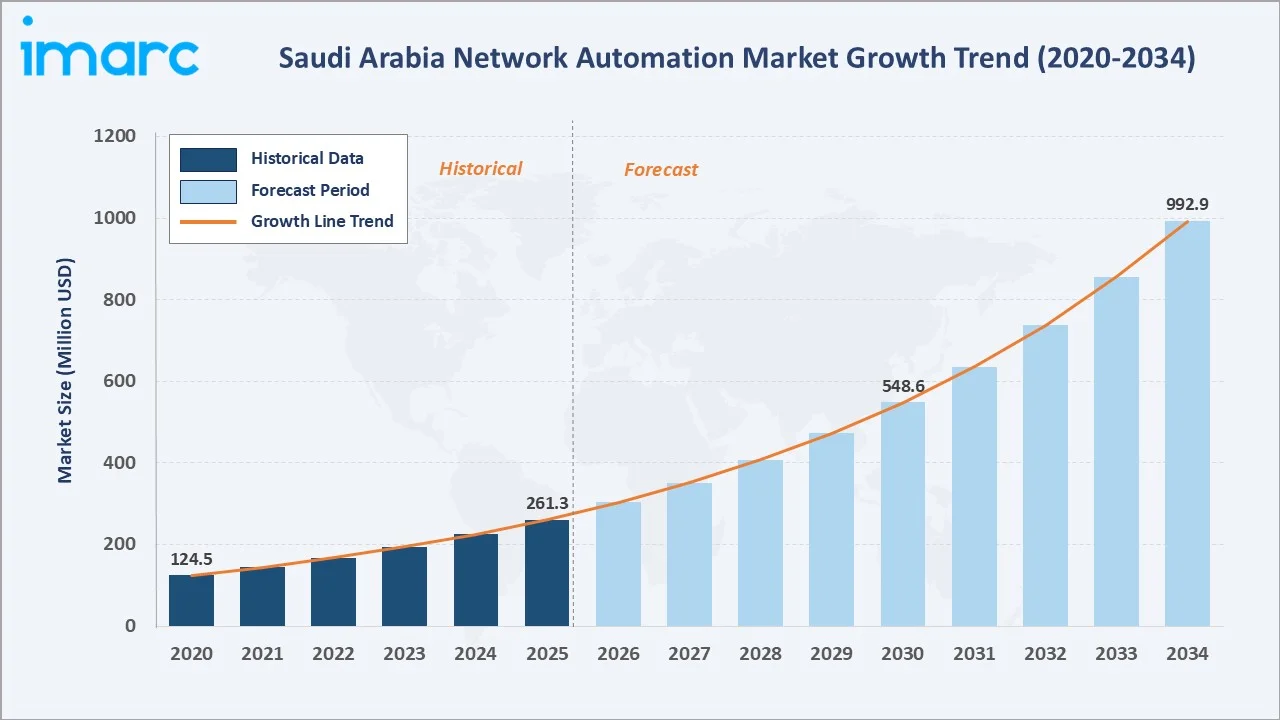
The Saudi Arabia network automation market size increased from USD 261.3 Million in 2025 to USD 303.1 Million in 2026 and is projected to reach USD 992.9 Million by 2034, exhibiting a CAGR of 15.99% during 2026-2034. The Kingdom's accelerating digital transformation agenda under Vision 2030, combined with rapid deployment of 5G infrastructure, is fundamentally reshaping how enterprises and service providers manage complex, high-throughput network environments.
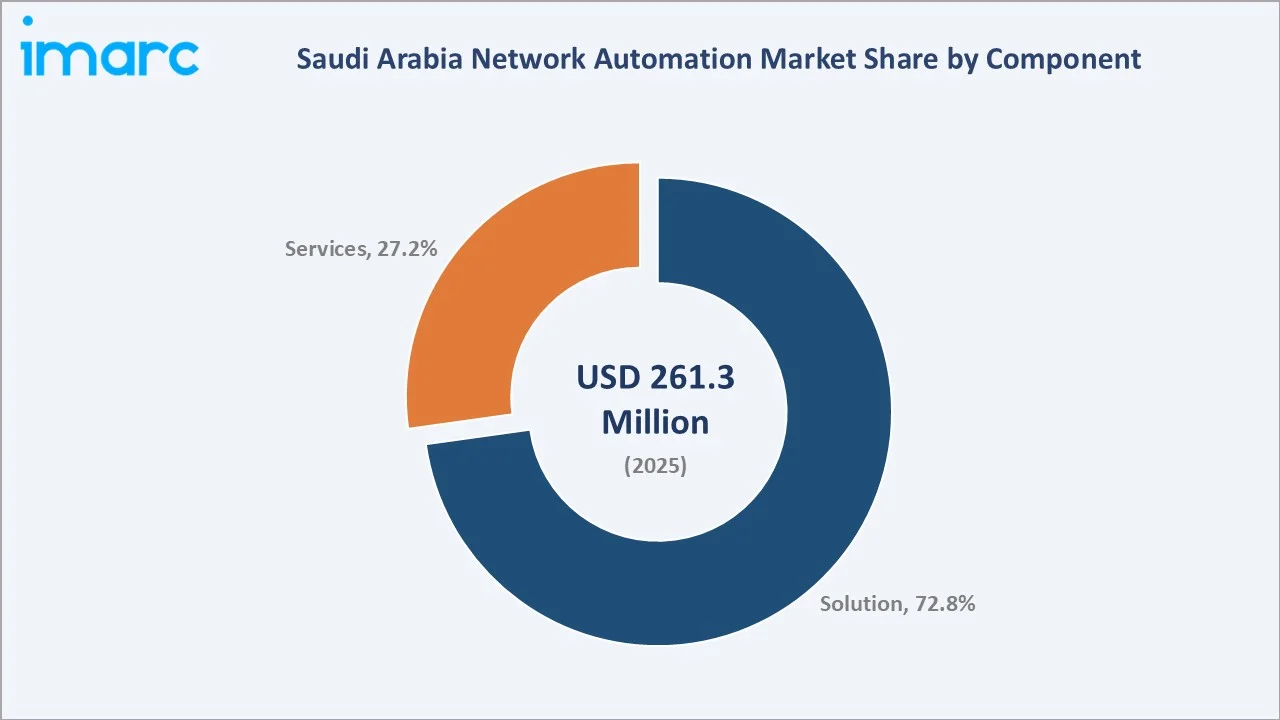
Solution leads the component segment at 72.8%, cloud-based dominates deployment mode at 65.4%, and Northern and Central Region commands 43.2% regional share.
Market Snapshot
|
Metric |
Value |
|
Base Year Market Size (2025) |
USD 261.3 Million |
| Market Size (2026) | USD 303.1 Million |
|
Forecast Market Size (2034) |
USD 992.9 Million |
|
CAGR (2026-2034) |
15.99% |
|
Base Year |
2025 |
|
Historical Period |
2020-2025 |
|
Forecast Period |
2026-2034 |
|
Largest Region |
Northern and Central Region (43.2%, 2025) |
|
Second Largest Region |
Western Region (24.9%, 2025) |
|
Leading Component |
Solution (72.8%, 2025) |
|
Leading Deployment Mode |
Cloud-based (65.4%, 2025) |
The Saudi Arabia network automation market expanded from USD 124.5 Million in 2020 to USD 261.3 Million in 2025 and an estimated USD 303.1 Million in 2026, anchored by widening adoption of software-defined networking (SDN) and rising enterprise demand for intelligent, policy-driven operations. Projected at USD 548.6 Million in 2030, the trajectory to USD 992.9 Million by 2034 reflects deepening cloud-native orchestration and AI-led network management adoption across the telecom, banking, and government sectors.
To get more information on this market, Request Sample
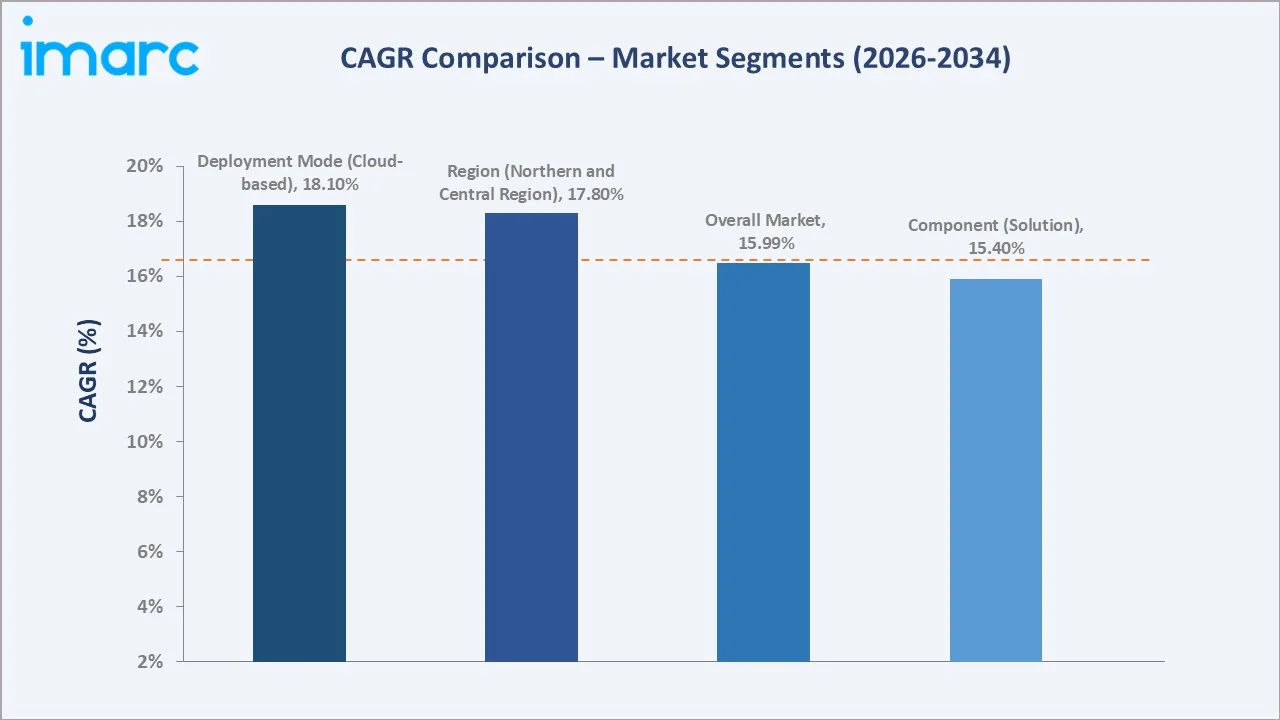
CAGR trajectories across component and deployment mode sub-segments, together with regional patterns, show Eastern Region and cloud-based expanding faster than the overall 15.99% market CAGR, driven by accelerating energy and industrial IoT digitization, growing enterprise cloud adoption, and expanding connectivity programs across underserved regions.
Executive Summary
The Saudi Arabia network automation market is on a sustained growth trajectory, rising from USD 124.5 Million in 2020 to an estimated USD 303.1 Million in 2026 and is projected to reach USD 992.9 Million by 2034. The industry has evolved from rule-based network scripting to AI-driven, intent-based orchestration that enables self-optimizing network operations across enterprise, government, and telecommunications environments.
Based on component, solution commands 72.8% of market share in 2025, supported by demand for AI-driven orchestration, SDN controllers, and intent-based networking (IBN) platforms. Cloud-based prevails over the deployment mode segment at 65.4%, reflecting enterprises' preference for scalable, subscription-driven network management infrastructure. Northern and Central Region holds 43.2% share, anchored by Riyadh's position as the Kingdom's primary technology and financial hub.
Key Market Insights
|
Insight |
Data |
|
Leading Component |
Solution - 72.8% share (2025) |
|
Second Largest Component |
Services - 27.2% share (2025) |
|
Leading Deployment Mode |
Cloud-based - 65.4% share (2025) |
|
Second Largest Deployment Mode |
On-premises - 34.6% share (2025) |
|
Leading Region |
Northern and Central Region - 43.2% share (2025) |
|
Second Largest Region |
Western Region - 24.9% share (2025) |
|
Top Companies |
Cisco Systems, Inc., Hewlett Packard Enterprise Company, Nokia Corporation, Huawei Technologies Co., Ltd., Telefonaktiebolaget LM Ericsson |
Key Analytical Observations Expanding On the Data Above:
- Solution dominance at 72.8% is propelled by enterprises deploying AI-based network orchestration, SDN controllers, and automation platforms to manage growing 5G and cloud workloads.
- Services at 27.2% are driven by demand for managed automation services, professional implementation support, and ongoing maintenance contracts from organizations with limited in-house networking expertise.
- Cloud-based leadership at 65.4% reflects preference for elastic, API-first infrastructure that simplifies multi-vendor integration and reduces capital expenditure across enterprise and government networks.
- On-premises at 34.6% is supported by organizations that prioritize greater control over network infrastructure, data security, and compliance requirements, particularly across government agencies and large enterprises managing sensitive workloads.
- Northern and Central Region at 43.2% is anchored by Riyadh's high concentration of technology vendors, government ministries, and large enterprise headquarters, creating strong local demand for network automation deployments.
Saudi Arabia Network Automation Market Overview
Network automation refers to the use of software-defined controls, AI algorithms, and policy-based orchestration to provision, configure, manage, and optimize network infrastructure without manual intervention. It encompasses SDN, NFV, IBN, and AI-driven operations (AIOps), enabling faster service delivery, improved uptime, and significant reductions in operational expenditure.
The Saudi ecosystem integrates global network equipment vendors, domestic telecommunications operators, cloud platform providers, system integrators, government regulatory bodies, and enterprise end-users. Collectively, they are building a digitally resilient national network infrastructure aligned with Vision 2030's smart city, industrial digitization, and e-government objectives.
Market Dynamics
To evaluate market opportunities, Request Sample
Market Drivers
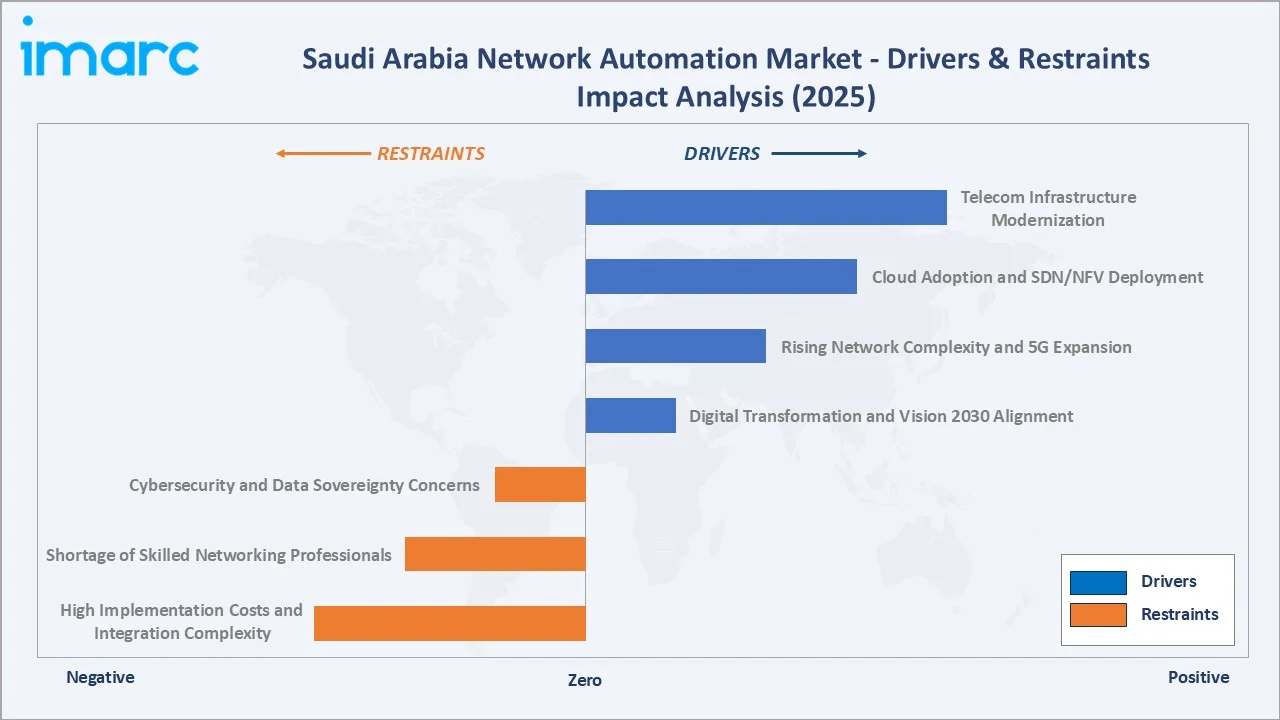
- Digital Transformation and Vision 2030 Alignment: Accelerating digital transformation across the government and private sectors is creating urgent demand for scalable, AI-driven network management solutions aligned with Vision 2030 technology mandates.
- Rising Network Complexity and 5G Expansion: The rapid rollout of 5G networks is generating unprecedented network complexity and traffic volumes that cannot be managed through traditional manual operations, accelerating automation adoption. As per IMARC Group, the Saudi Arabia 5G infrastructure market size reached USD 199.5 Million in 2025.
- Cloud Adoption and SDN/NFV Deployment: Widening adoption of cloud infrastructure across enterprise and government environments is increasing demand for cloud-native automation platforms that provide centralized visibility and control across hybrid and multi-cloud networks.
- Telecom Infrastructure Modernization: Saudi operators and enterprises are modernizing aging network infrastructure to support smart city, industrial IoT, and e-government initiatives, driving investment in automation platforms and professional services.
Market Restraints
- High Implementation Costs and Integration Complexity: Implementing enterprise-grade network automation requires significant upfront investment in software licenses, hardware upgrades, and system integration, which can delay procurement decisions particularly among mid-sized organizations.
- Shortage of Skilled Networking Professionals: A limited pool of professionals skilled in SDN programming, IBN, and AI-driven network operations constrains deployment pace and increases reliance on international expertise.
- Cybersecurity and Data Sovereignty Concerns: Concerns about data sovereignty and the security risks associated with centralized, software-controlled network architectures create hesitancy among regulated sectors including banking and defense.
Market Opportunities
- Mega Project Infrastructure Demand: Giga projects such as NEOM, The Line, and Red Sea Project require purpose-built, AI-orchestrated network infrastructure from the ground up, creating substantial opportunities for advanced automation solution providers.
- Edge Computing and Industrial IoT Expansion: Growing deployment of edge computing, industrial IoT, and smart facility networks across manufacturing and logistics sectors is driving demand for distributed, low-latency network automation at the edge.
Market Challenges
- Legacy Infrastructure Integration: Many enterprises rely on multi-vendor network environments that present interoperability obstacles when deploying unified automation platforms, requiring customized integration efforts.
- Regulatory Compliance Requirements: Managing regulatory compliance across data residency, network security, and operational standards adds complexity to automation deployments, particularly for cross-border and cloud-hosted solutions.
Emerging Market Trends
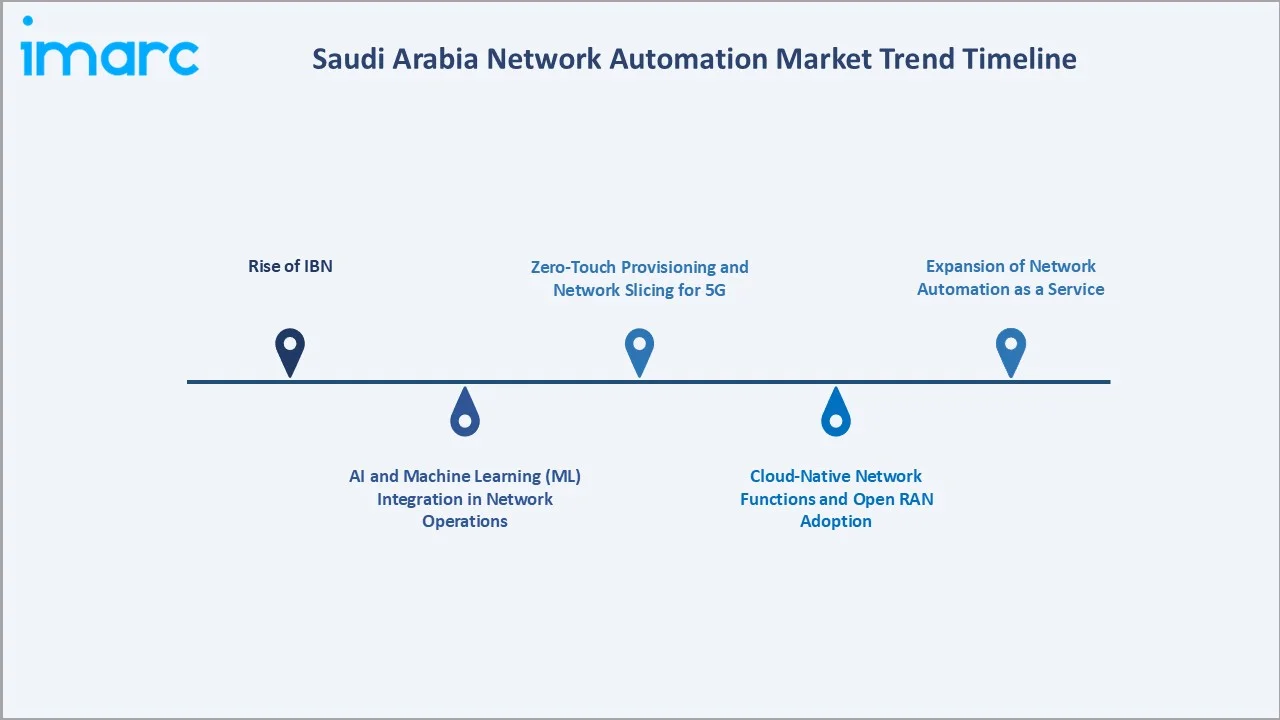
1. Rise of IBN
Network operators and enterprises are increasingly adopting IBN platforms that translate high-level business policies into automated network configurations. IBN enables networks to continuously verify alignment between operational intent and actual network behavior, significantly reducing configuration errors and policy drift.
2. AI and Machine Learning (ML) Integration in Network Operations
AI and ML capabilities are being embedded across network automation platforms to enable predictive anomaly detection, self-healing network functions, and intelligent traffic optimization. These capabilities reduce reliance on reactive network management and support proactive service assurance across complex multi-domain environments.
3. Cloud-Native Network Functions and Open RAN Adoption
Telecommunications operators are transitioning toward cloud-native network functions and Open RAN architectures to decouple hardware from software and accelerate the automation of radio access network operations.
4. Zero-Touch Provisioning and Network Slicing for 5G
Zero-touch provisioning frameworks and 5G network slicing capabilities are enabling operators to automate the rapid deployment of dedicated virtual network segments for industrial, government, and consumer use cases.
5. Expansion of Network Automation as a Service
Managed service providers and hyperscalers are introducing network automation as a service offerings that allow enterprises to consume automation capabilities on a subscription basis without building in-house orchestration infrastructure. This model is expanding automation access to mid-market and public sector organizations with constrained capital budgets.
Industry Value Chain Analysis
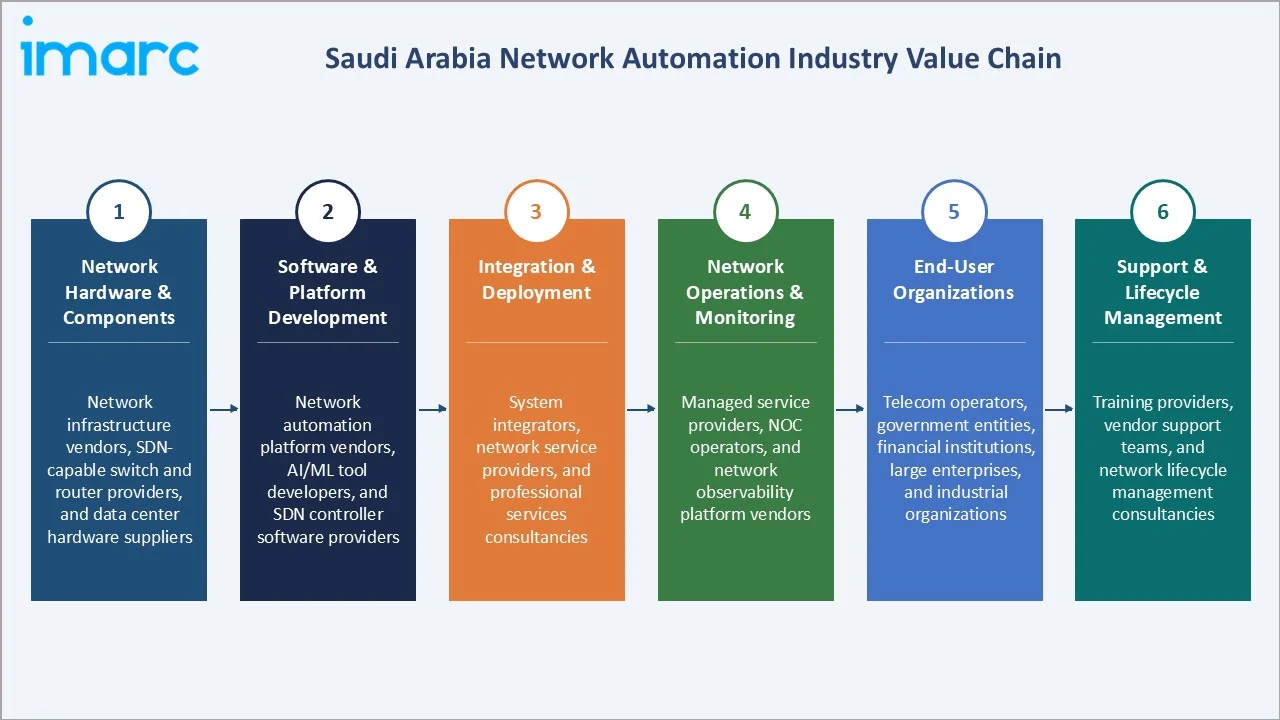
The Saudi Arabia network automation value chain spans six stages, from network hardware and software development through end-user engagement and lifecycle support. Solution development, integration, and network operations management capture the highest value-add, while support and lifecycle management capabilities increasingly determine sustainable competitive positioning.
|
Stage |
Key Players / Examples |
|
Network Hardware & Components |
Network infrastructure vendors, SDN-capable switch and router providers, and data center hardware suppliers |
|
Software & Platform Development |
Network automation platform vendors, AI/ML tool developers, and SDN controller software providers |
|
Integration & Deployment |
System integrators, network service providers, and professional services consultancies |
|
Network Operations & Monitoring |
Managed service providers, NOC operators, and network observability platform vendors |
|
End-User Organizations |
Telecom operators, government entities, financial institutions, large enterprises, and industrial organizations |
|
Support & Lifecycle Management |
Training providers, vendor support teams, and network lifecycle management consultancies |
Vertically integrated vendors offering end-to-end automation platforms from network hardware compatibility through AI-driven orchestration and managed services are positioned to capture greater value than point solution providers dependent on third-party integration partners.
Technology Landscape in the Saudi Arabia Network Automation Industry
SDN and Network Function Virtualization (NFV)
SDN and NFV architectures are foundational to network automation in Saudi Arabia, decoupling network control from physical hardware and enabling dynamic, software-driven network management. Telecom operators and large enterprises are deploying SDN controllers and virtual network functions to reduce infrastructure rigidity and accelerate service delivery.
AI and AIOps
AI-driven network operations platforms are being deployed to identify anomalies, predict failures, and automatically remediate network issues before they impact service availability. AIOps integration across network monitoring tools is shifting network management from reactive incident response to continuous, proactive optimization.
Cloud-Native Orchestration and API-Driven Automation
Cloud-native orchestration platforms and open API frameworks are enabling seamless integration between network automation tools and enterprise IT systems, improving operational efficiency and enabling policy-based control across hybrid and multi-cloud environments.
Zero-Touch Provisioning and Digital Twins
Zero-touch provisioning technologies are automating the onboarding and configuration of network devices across distributed enterprise and operator environments, reducing deployment timelines significantly. Digital twin technology is enabling operators to simulate network behavior and test automation policies in virtual environments before deploying changes to production networks.
Market Segmentation Analysis
The report covers the following segments:
|
Segment Category |
Leading Segment |
Market Share |
Year |
|
Component |
Solution |
72.8% |
2025 |
|
Deployment Mode |
Cloud-based |
65.4% |
2025 |
|
Organization Size |
🔒 |
🔒 |
2025 |
|
Network Type |
🔒 |
🔒 |
2025 |
|
End-Use Industry |
🔒 |
🔒 |
2025 |
|
Region |
Northern and Central Region |
43.2% |
2025 |

By Component
Solution commands a 72.8% majority share in 2025, driven by enterprise and operator demand for AI-based network orchestration platforms, SDN controllers, IBN software, and policy automation tools. The segment benefits from rapid product innovation, expanding platform capabilities, and growing integration with cloud-native and multi-vendor environments.
To access detailed market analysis, Request Sample
Services at 27.2% in 2025 encompass professional services, managed automation services, and training and support engagements. The segment is gaining relevance as organizations with limited in-house automation expertise seek external partners to design, deploy, and manage network automation implementations across complex multi-vendor environments.
By Deployment Mode
Cloud-based leads with 65.4% share in 2025, reflecting enterprise and telecom operators' preference for scalable, subscription-driven network automation infrastructure that supports rapid feature updates and reduces on-premises hardware investment.
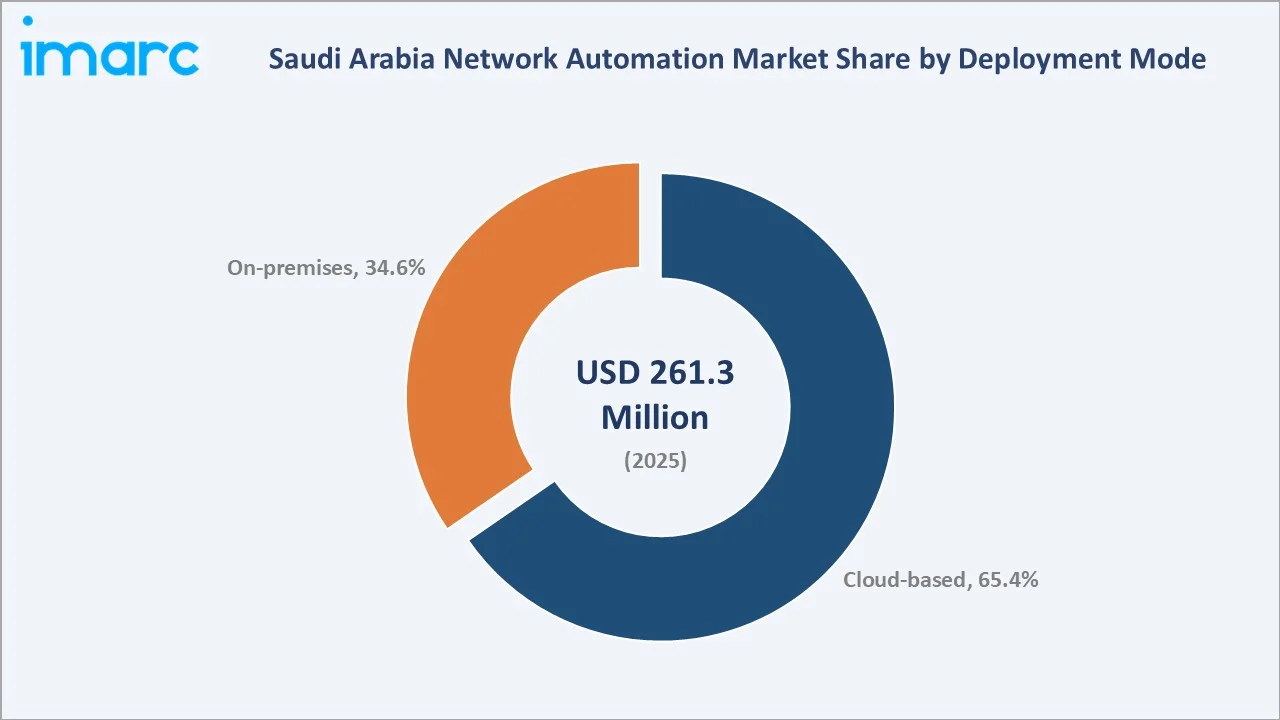
On-premises at 34.6% remains significant among banking, defense, and critical infrastructure organizations with stringent data localization requirements and legacy system compatibility constraints.
Regional Market Insights
|
Region |
Share (2025) |
Key Growth Drivers |
|
Northern and Central Region |
43.2% |
High concentration of government ministries, large enterprise headquarters, and technology vendors; strong ICT investment and Vision 2030 implementation activity |
|
Western Region |
24.9% |
Growing fintech and logistics sector demand, expanding smart port infrastructure, and increasing adoption by commercial enterprises |
|
Eastern Region |
20.8% |
Energy and petrochemical sector digitization, industrial IoT deployments, and critical infrastructure automation across energy sector entities |
|
Southern Region |
11.1% |
Emerging digital adoption, expanding connectivity programs, and growing government investment in regional infrastructure modernization |
Northern and Central Region at 43.2% in 2025 leads the regional landscape, anchored by Riyadh's position as Saudi Arabia's administrative and financial capital and a dense concentration of government entities, banking institutions, and technology vendors. Ongoing implementation of Vision 2030 mega-projects and e-government digitization initiatives continues to drive strong and sustained demand for advanced network automation solutions.
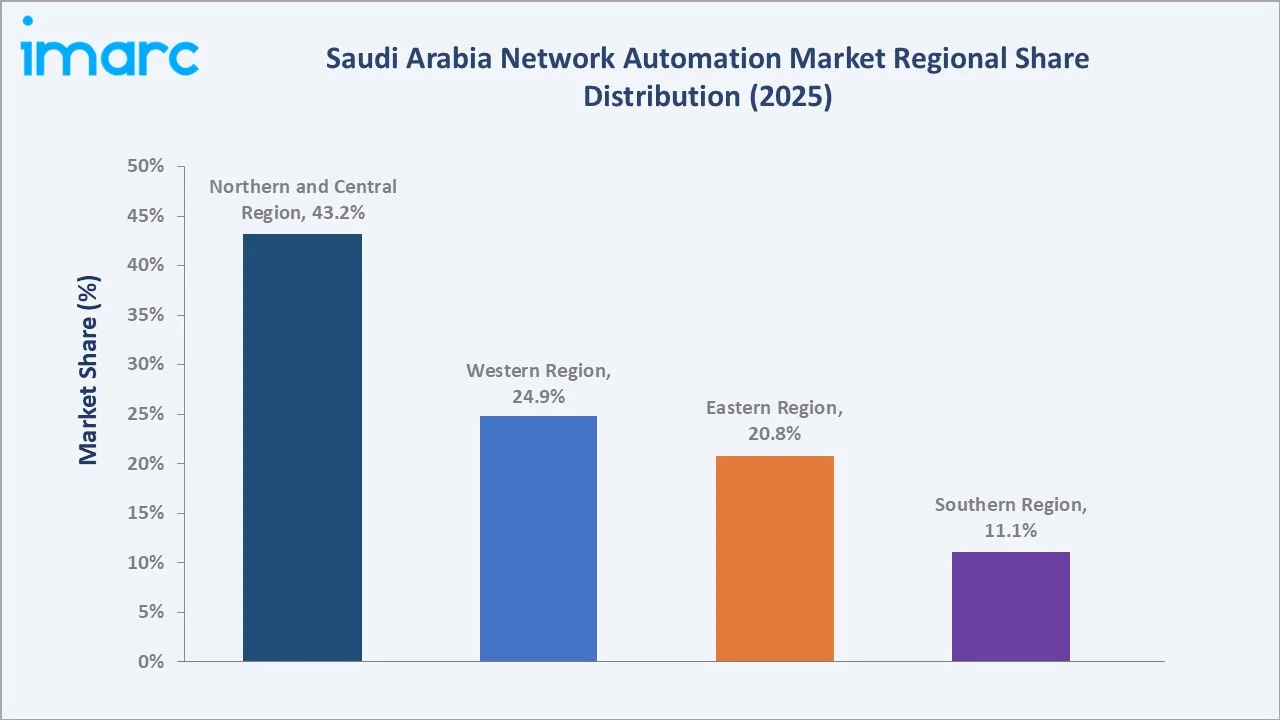
Southern Region, while currently the smallest contributor at 11.1%, is positioned for accelerating growth as government-led connectivity programs and infrastructure investment expand into underserved areas, supported by the development of NEOM and cross-border trade corridor infrastructure.
Competitive Landscape
The Saudi Arabia network automation market is moderately concentrated, with established global technology leaders and telecommunications equipment vendors dominating platform deployment while regional system integrators and specialized software providers compete on localized implementation and managed services capabilities. Portfolio depth, AI integration maturity, and regulatory compliance readiness form the key competitive differentiators.
|
Company Name |
Brand / Key Product |
Position |
Strategic Focus |
|
Cisco Systems, Inc. |
Cisco Catalyst Center |
Leader |
Expanding AI-driven network automation platform and cloud management capabilities across enterprise markets |
|
Hewlett Packard Enterprise Company |
Mist AI / Apstra Data Center Director |
Leader |
Advancing AI-native network operations and IBN adoption among enterprise and service provider clients |
|
Nokia Corporation |
Nokia Network Services Platform (NSP) |
Leader |
Growing cloud-native automation and SDN capabilities for telecommunications operators and enterprise customers |
|
Huawei Technologies Co., Ltd. |
iMaster NCE |
Challenger |
Scaling autonomous network and digital operations capabilities across enterprise and carrier segments |
|
Telefonaktiebolaget LM Ericsson |
Ericsson Intelligent Automation Platform (EIAP) |
Challenger |
Expanding AI-driven service orchestration and network automation solutions for mobile and fixed network operators |
Key players include Cisco Systems, Inc., Hewlett Packard Enterprise Company, Nokia Corporation, Huawei Technologies Co., Ltd., and Telefonaktiebolaget LM Ericsson, among others.
Key Company Profiles
Cisco Systems, Inc.
Cisco Systems, Inc. is a global technology leader headquartered in San Jose, California, offering a comprehensive portfolio of network automation, SDN, and AI-driven network management solutions deployed by enterprises and telecommunications operators worldwide.
- Product Portfolio: End-to-end network automation suite spanning intent-based networking, cloud-managed infrastructure, and AI-driven network operations for enterprise and service provider environments.
- Recent Developments: The company continues to invest in its network automation and cloud management platform, advancing capabilities to support enterprise customers in modernizing their network infrastructure and operational workflows.
- Strategic Focus: Strengthening its position as the leading provider of AI-powered network automation by deepening intent-based networking capabilities and broadening cloud management reach across enterprise and service provider markets worldwide.
Hewlett Packard Enterprise Company
Hewlett Packard Enterprise Company is a global technology leader headquartered in Texas, providing AI-native networking, cloud infrastructure, and intelligent network automation solutions to enterprises and service providers worldwide.
- Product Portfolio: AI-native networking portfolio covering campus, branch, data center, and WAN automation.
- Recent Developments: The company continues to advance its AI-native networking portfolio, integrating automation and observability capabilities across its enterprise networking products to support customers in building more intelligent and resilient network environments.
- Strategic Focus: Building a comprehensive AI-native networking portfolio by integrating Juniper capabilities into a unified cloud-driven platform that addresses campus, data center, and WAN automation needs for enterprise and service provider customers.
Nokia Corporation
Nokia Corporation is a global technology company headquartered in Espoo, Finland, delivering network automation, SDN, and cloud-native solutions to telecommunications operators and enterprise customers across multiple industries.
- Product Portfolio: Network automation platform covering service orchestration, network management, and cloud-native network functions for fixed, mobile, and enterprise network environments.
- Recent Developments: The company continues to invest in expanding its network automation and AI-driven platform capabilities, supporting telecommunications operators in accelerating their transition toward more intelligent and efficient network management.
- Strategic Focus: Delivering open, programmable network automation solutions that enable telecommunications operators and enterprise customers to simplify multi-vendor network management and accelerate their transition toward cloud-native, autonomous operations.
Market Concentration Analysis
The Saudi Arabia network automation market is moderately concentrated, with the top technology vendors accounting for a significant share of platform deployments across telecommunications, government, and large enterprise sectors, reflecting the scale and technical depth required to serve mission-critical network environments.
Barriers to entry include high research and development investment requirements, the necessity for proven interoperability across multi-vendor network environments, and the regulatory compliance expertise needed to serve government and financial sector clients in Saudi Arabia. These factors favor established global providers with deep engineering capabilities and existing local partnerships.
Consolidation is gradually increasing as larger technology vendors acquire specialized network automation and AIOps capabilities to broaden their platform portfolios. Strategic alliances between global vendors and regional system integrators are further shaping competitive positioning, with localized implementation partnerships becoming a key differentiator for market penetration in the Kingdom.
Investment & Growth Opportunities
Fastest-Growing Segments
Cloud-based is expanding fastest among deployment modes, driven by enterprise and operator preference for scalable, subscription-based network automation that reduces upfront capital commitment and supports rapid feature adoption. Services are also growing quickly as organizations with limited in-house automation expertise engage external providers for implementation, managed operations, and training support.
Emerging Markets
Eastern Region is the fastest-growing region, supported by large-scale digitization of energy and petrochemical operations, expanding industrial IoT networks, and critical infrastructure automation investment by major energy sector entities. Southern Region also represents significant untapped opportunity as government-led connectivity programs and NEOM-related infrastructure development accelerate digital adoption across underserved areas.
Venture & Investment Trends
Investment activity is concentrated in AI-driven network operations platforms, cloud-native orchestration solutions, and zero-touch provisioning capabilities aligned with 5G commercial expansion. Capital is also flowing into managed automation service models that reduce the skills and capital barriers to network automation adoption among mid-market enterprises and public sector organizations in Saudi Arabia.
Future Market Outlook (2026-2034)
The Saudi Arabia network automation market is projected to grow from USD 261.3 Million in 2025 to USD 303.1 Million in 2026, reaching USD 992.9 Million by 2034 at a CAGR of 15.99%, adding roughly USD 731.6 Million in incremental market value over the forecast period.
Four forces will shape the market through 2034: continued 5G network rollout creating demand for AI-driven, real-time network orchestration; accelerating cloud-native platform adoption across enterprise and government sectors; deepening integration of autonomous network operations and digital twin capabilities; and expanding network automation investment aligned with Vision 2030 smart city and industrial transformation programs.
By 2034, the Saudi Arabia network automation landscape is expected to be defined by intent-based, AI-orchestrated network environments with extensive zero-touch operations across telecommunications, financial services, government, and industrial sectors. Continued regulatory support for digital infrastructure and the progressive execution of mega-project technology programs will sustain strong momentum through the forecast period.
Research Methodology
Primary Research
Primary research included structured interviews with network automation platform vendors, telecommunications executives, enterprise IT decision-makers, system integrators, and regulatory specialists, validating market sizing, segment mix, and regional demand patterns across Saudi Arabia.
Secondary Research
Secondary sources included Saudi Vision 2030 program reports, vendor annual reports, investor presentations, and technology deployment announcements from leading organizations across the Kingdom.
Forecasting Models
Market forecasts used top-down and bottom-up models combining network infrastructure investment data, ICT sector growth rates, cloud adoption trends, and macroeconomic variables. Scenario analysis addressed 5G deployment pace, technology adoption timelines, and Vision 2030 program execution.
Saudi Arabia Network Automation Market Report Coverage:
| Report Features | Details |
|---|---|
| Base Year of the Analysis | 2025 |
| Historical Period | 2020-2025 |
| Forecast Period | 2026-2034 |
| Units | Million USD |
| Scope of the Report |
Exploration of Historical and Forecast Trends, Industry Catalysts and Challenges, Segment-Wise Historical and Predictive Market Assessment:
|
| Components Covered |
|
| Deployment Modes Covered | On-premises, Cloud-based |
| Organization Sizes Covered | Large Enterprises, Small and Medium-sized Enterprises |
| Network Types Covered | Physical, Virtual, Hybrid |
| End Use Industries Covered | IT and Telecom, Manufacturing, Energy and Utility, Banking and Financial Services, Education, Others |
| Regions Covered | Northern and Central Region, Western Region, Eastern Region, Southern Region |
| Companies Covered | Cisco Systems, Inc., Hewlett Packard Enterprise Company, Nokia Corporation, Huawei Technologies Co., Ltd., Telefonaktiebolaget LM Ericsson, etc. |
| Customization Scope | 10% Free Customization |
| Post-Sale Analyst Support | 10-12 Weeks |
| Delivery Format | PDF and Excel through Email (We can also provide the editable version of the report in PPT/Word format on special request) |
Key Benefits for Stakeholders:
- IMARC’s industry report offers a comprehensive quantitative analysis of various market segments, historical and current market trends, market forecasts, and dynamics of the Saudi Arabia network automation market from 2020-2034.
- The research report provides the latest information on the market drivers, challenges, and opportunities in the Saudi Arabia network automation market.
- Porter's five forces analysis assist stakeholders in assessing the impact of new entrants, competitive rivalry, supplier power, buyer power, and the threat of substitution. It helps stakeholders to analyze the level of competition within the Saudi Arabia network automation industry and its attractiveness.
- Competitive landscape allows stakeholders to understand their competitive environment and provides an insight into the current positions of key players in the market.
Frequently Asked Questions About the Saudi Arabia Network Automation Market Report
The Saudi Arabia network automation market size is estimated at USD 303.1 Million in 2026, driven by Vision 2030 digital transformation, 5G expansion, and rising enterprise demand for AI-driven network management.
The market is projected to grow at a CAGR of 15.99% from 2026-2034, reaching USD 992.9 Million, supported by accelerating cloud adoption and national ICT investment programs.
Solution leads the component segment at 72.8% in 2025, driven by demand for AI-based orchestration, SDN controllers, and IBN platforms across enterprise and operator deployments.
Cloud-based dominates at 65.4% in 2025, reflecting enterprise preference for scalable, subscription-driven network automation that reduces capital expenditure and supports rapid feature adoption.
Northern and Central Region commands 43.2% share in 2025, led by Riyadh's position as the Kingdom's administrative and technology hub with a dense concentration of government and enterprise network deployments.
Leading players include Cisco Systems, Inc., Hewlett Packard Enterprise Company, Nokia Corporation, Huawei Technologies Co., Ltd., and Telefonaktiebolaget LM Ericsson, among others.
Vision 2030 is driving significant ICT infrastructure investment, smart city development, and e-government digitization, creating sustained demand for network automation across government and enterprise sectors through 2034.
Key barriers include high implementation costs, shortage of skilled SDN and AIOps professionals, legacy infrastructure integration challenges, and regulatory compliance requirements for data localization and cybersecurity.
AI and ML are enabling predictive network operations, autonomous fault remediation, and intelligent traffic optimization, shifting network management from reactive maintenance toward continuous self-optimizing operations across enterprise and operator environments.
Need more help?
- Speak to our experienced analysts for insights on the current market scenarios.
- Include additional segments and countries to customize the report as per your requirement.
- Gain an unparalleled competitive advantage in your domain by understanding how to utilize the report and positively impacting your operations and revenue.
- For further assistance, please connect with our analysts.
 Request Customization
 Speak to an Analyst
 Request Brochure
 Inquire Before Buying
Benefits of Customization
- Personalize this research
- Triangulate with your data
- Get data as per your format and definition
- Gain a deeper dive into a specific application, geography, customer, or competitor
- Any level of personalization
Get in Touch With Us
UNITED STATES
Phone: +1-201-971-6302
INDIA
Phone: +91-120-433-0800
UNITED KINGDOM
Phone: +44-753-714-6104
Email: [email protected]
Client Testimonials




.webp)




.webp)













Related Reports

Choose your plan
*Please note that the prices mentioned below are starting prices for each bundle type. Kindly contact our team for further details.*
Single User License
- 1 User License, Access on 2 Devices
- PDF Report + Excel Dataset (Password Protected)
- Lifetime Access
- No Printing Rights
- 10% Free Report Customization
- 10–12 Weeks of Analyst Support
Five User License
- Access for 5 Users, 2 Devices per User
- PDF Report + Excel Dataset (Password Protected)
- Lifetime Access
- Dedicated Account Manager
- 12–14 Weeks of Analyst Support
- No Printing Rights
- 15% Free Report Customization
- 25% Discount on Your Next Purchase
Corporate User License
- Unlimited User Access (Within Your Organization)
- PDF Report + Excel Dataset
- Lifetime Access
- Dedicated Account Manager
- 14–20 Weeks of Analyst Support
- No Printing Rights
- 20% Free Report Customization
- 30% Discount on Your Next Purchase
Essential Insights
What's included:
3 reports
- Lifetime Access
- PDF Reports
- Excel Datasets
- 2 Weeks of Free Analyst Support
- 2 User Licenses
- Access on 2 Devices
- Printing Rights
- Complimentary PowerPoint (PPT) Version
- Complimentary License Upgrade
Professional Access
What's included:
5 reports
- Lifetime Access
- PDF Reports
- Excel Datasets
- 8 Weeks of Free Analyst Support
- 2 User Licenses
- Access on 2 Devices
- Printing Rights
- Complimentary PowerPoint (PPT) Version
- Complimentary License Upgrade
Business Advantage
What's included:
8 reports
- Lifetime Access
- PDF Reports
- Excel Datasets
- 14 Weeks of Free Analyst Support
- 2 User Licenses
- Access on 2 Devices
- Printing Rights
- Complimentary PowerPoint (PPT) Version
- Complimentary License Upgrade
Enterprise Intelligence
What's included:
10 reports
- Lifetime Access
- PDF Reports
- Excel Datasets
- 20 Weeks of Free Analyst Support
- 2 User Licenses
- Access on 2 Devices
- Printing Rights
- Complimentary PowerPoint (PPT) Version
- Complimentary License Upgrade