
Saudi Arabia Sodium Hypochlorite Market Size, Share, Trends and Forecast by Application, 2026-2034
Saudi Arabia Sodium Hypochlorite Market Size, Share, Trends & Forecast (2026-2034)
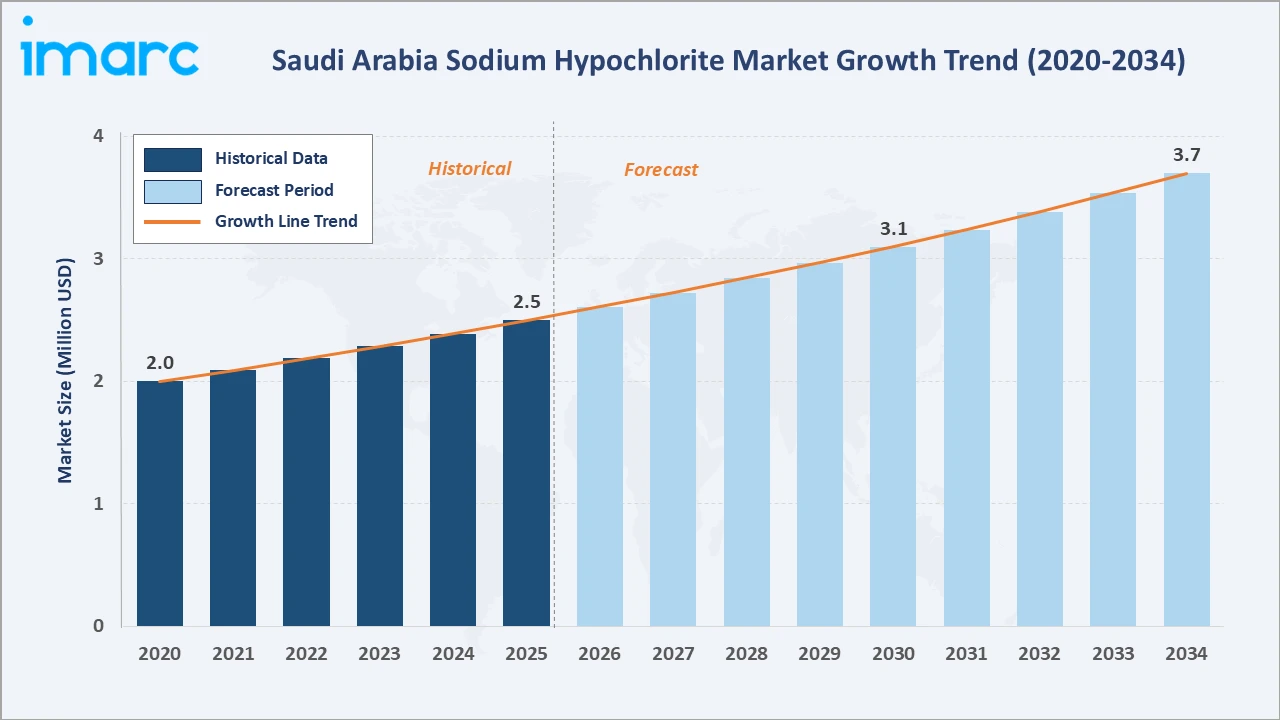
The Saudi Arabia sodium hypochlorite market size increased from USD 2.5 Million in 2025 to USD 2.6 Million in 2026 and is projected to reach USD 3.7 Million by 2034, growing at a CAGR of 4.14% during 2026-2034. Growth is driven by rising disinfection and hygiene demand, government water quality initiatives, and stringent wastewater treatment regulations. Disinfection and cleaning leads applications at 58.7% in 2025.
Market Snapshot
|
Metric |
Value |
|
Base Year Market Size (2025) |
USD 2.5 Million |
| Market Size (2026) | USD 2.6 Million |
|
Forecast Market Size (2034) |
USD 3.7 Million |
|
CAGR (2026-2034) |
4.14% |
|
Base Year |
2025 |
|
Historical Period |
2020-2025 |
|
Forecast Period |
2026-2034 |
|
Dominant Application |
Disinfection and Cleaning (58.7%, 2025) |
The market expanded from USD 2.0 Million in 2020 to USD 2.5 Million in 2025 and an estimated USD 2.6 Million in 2026, reaching USD 3.1 Million in 2030 and USD 3.7 Million by 2034, reflecting steady, consistent demand for cost-effective disinfection chemistry across the Kingdom.
To get more information on this market, Request Sample
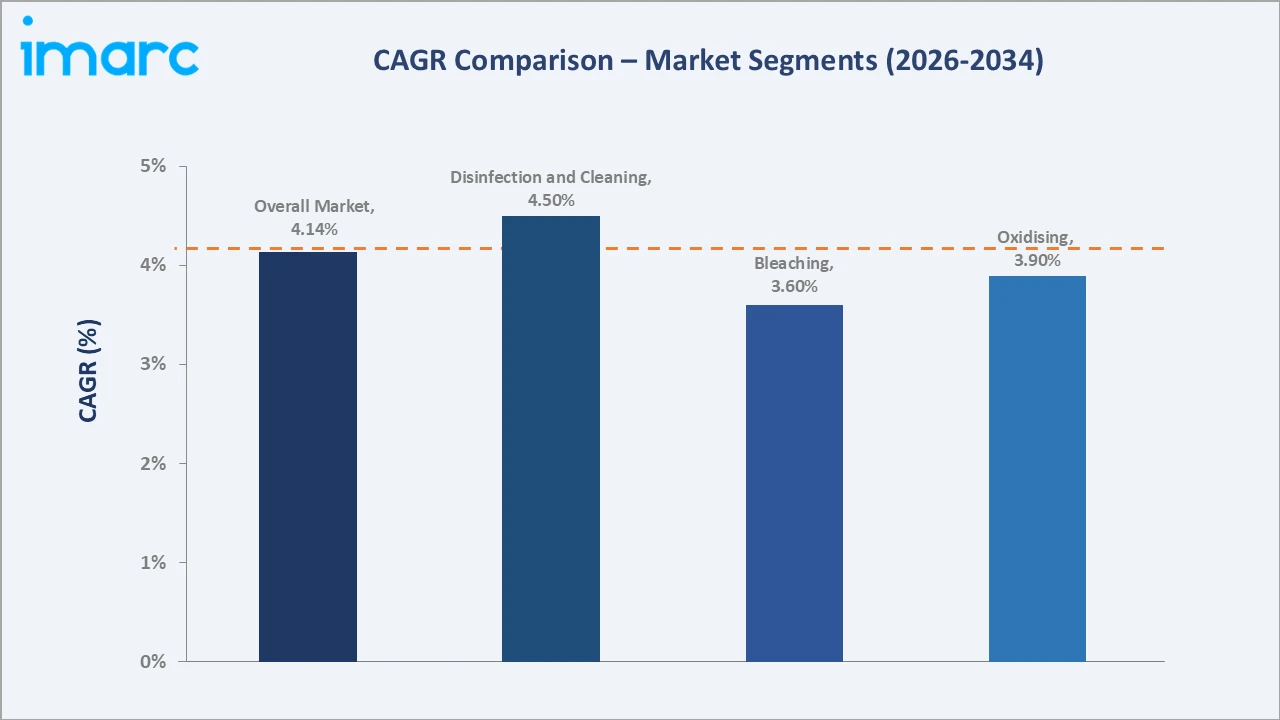
Disinfection and cleaning grows fastest at an estimated ~4.5% CAGR as institutional and municipal hygiene demand compounds, while the overall market advances at 4.14% CAGR, with bleaching, oxidising, and other applications growing at more moderate rates through 2034.
Executive Summary
The Saudi Arabia sodium hypochlorite market grew from USD 2.5 Million in 2025 to USD 2.6 Million in 2026, supported by the country's expanding water treatment, healthcare, and sanitation infrastructure. The market is projected to reach USD 3.7 Million by 2034.
Disinfection and cleaning dominates applications at 58.7%, driven by hygiene-focused institutional and municipal demand, followed by bleaching at 19.8%, supported by textile and household bleaching needs across the Kingdom.
Key Market Insights
|
Insight |
Data |
|
Dominant Application |
Disinfection and Cleaning - 58.7% share (2025) |
|
Second-Largest Application |
Bleaching - 19.8% share (2025) |
|
Market Opportunity |
Wastewater treatment chemicals; municipal water disinfection contracts; textile-grade bleach supply |
Key Analytical Observations Supporting The Above Data:
- Disinfection and Cleaning at 58.7%: This segment dominates due to escalating hygiene and sanitation requirements across households, hospitals, and municipal facilities, supported by heightened health awareness since the COVID-19 pandemic.
- Bleaching at 19.8%: Steady demand from the textile, laundry, and pulp-related cleaning applications supports this segment's continued relevance across commercial and industrial end uses.
Saudi Arabia Sodium Hypochlorite Market Overview
Sodium hypochlorite (NaClO) is a chlorine-based compound produced primarily through chlor-alkali electrolysis, widely used as a disinfectant, bleaching, and oxidising agent. Its broad-spectrum efficacy against bacteria, viruses, and fungi makes it a cost-effective sanitizer across sectors.
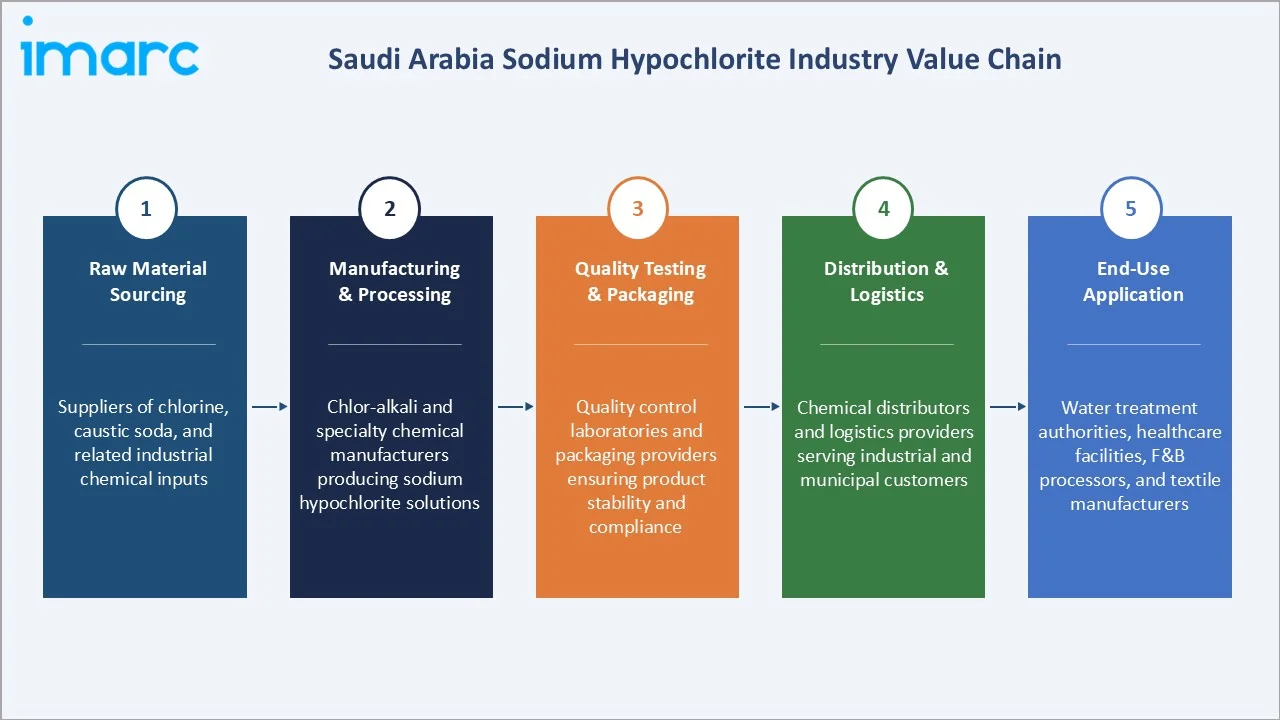
The Saudi ecosystem integrates chlor-alkali producers, sodium hypochlorite manufacturers, packaging and logistics providers, municipal water authorities, and industrial end users across water treatment, healthcare, F&B, and textile industries, supported by government sanitation initiatives.
Market Dynamics
To evaluate market opportunities, Request Sample
Market Drivers
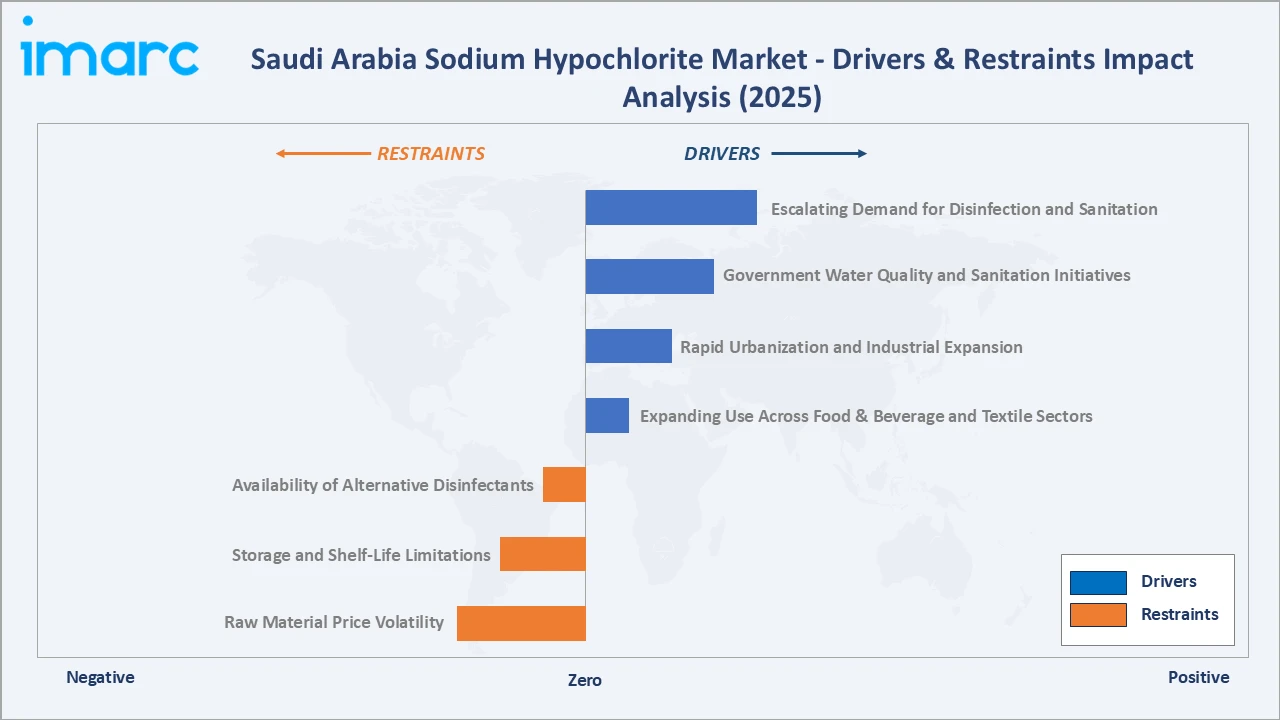
- Escalating Demand for Disinfection and Sanitation: Rising awareness of hygiene, particularly post-pandemic, is increasing adoption of sodium hypochlorite-based disinfectants across households, hospitals, and public facilities nationwide. Institutional buyers, including schools and healthcare providers, are formalizing routine disinfection protocols that rely on chlorine-based chemistries. This sustained behavioural shift is translating into recurring, non-discretionary procurement volumes rather than one-off pandemic-driven demand spikes.
- Government Water Quality and Sanitation Initiatives: Saudi government programmes to improve water quality and expand sanitation infrastructure, alongside stringent wastewater treatment regulations, are supporting steady product demand. National transformation initiatives tied to Vision 2030 continue to prioritize clean water access and public health standards. These programmes are channelling public investment into municipal treatment facilities, which in turn anchors long-term institutional demand for disinfection chemicals.
- Rapid Urbanization and Industrial Expansion: Growing population, urbanization, and industrialization are increasing infrastructure investment and demand for clean water and effective disinfection solutions across the Kingdom. Expanding residential and commercial construction is enlarging the base of facilities requiring routine water treatment and hygiene maintenance. Concurrently, industrial parks and manufacturing zones are adding process water treatment requirements that further broaden the addressable customer base.
- Expanding Use Across Food & Beverage and Textile Sectors: Rising product utilization in F&B sanitation and textile bleaching and disinfection applications is broadening the end-use base and supporting incremental demand. Food safety compliance standards are pushing processors toward validated chlorine-based sanitation protocols for equipment and surfaces. In parallel, textile finishing units are increasing bleach consumption as domestic textile and garment production capacity gradually expands.
Market Restraints
- Raw Material Price Volatility: Fluctuating prices and availability of chlorine and caustic soda, key inputs in sodium hypochlorite production, can affect manufacturing costs and pricing stability. Since these inputs are co-products of the broader chlor-alkali value chain, their pricing is sensitive to upstream energy costs and regional petrochemical cycles. This exposes manufacturers to margin compression during periods of feedstock cost inflation, particularly smaller producers with limited pricing power.
- Storage and Shelf-Life Limitations: Sodium hypochlorite degrades over time and requires controlled storage conditions, creating handling, transportation, and inventory management challenges for suppliers. Elevated ambient temperatures common across the Kingdom accelerate active chlorine decomposition, requiring climate-controlled storage and faster inventory turnover. These requirements add logistics and warehousing costs that smaller regional distributors may struggle to absorb.
- Availability of Alternative Disinfectants: Competing disinfection technologies, including UV treatment and alternative oxidising chemistries, may limit sodium hypochlorite's adoption in select high-value applications. Premium healthcare and food-processing facilities are increasingly evaluating these alternatives for their lower residual byproduct profiles. As adoption of such technologies matures, sodium hypochlorite suppliers may face gradual share erosion in these higher-margin end-use segments.
Market Opportunities
- Municipal Wastewater Treatment Expansion: Expanding municipal and industrial wastewater treatment capacity across Saudi Arabia creates sustained procurement opportunities for water disinfection chemicals. New treatment plant commissioning under national infrastructure programmes is expected to generate multi-year supply contracts. Suppliers that secure early positioning with municipal authorities stand to benefit from recurring, high-volume institutional demand.
- Sustainable and Eco-Friendly Formulations: Growing focus on sustainable product formulations and improved manufacturing techniques offers manufacturers avenues for differentiation and premium positioning. Investment in lower-emission production processes and reduced-byproduct formulations can help suppliers align with tightening environmental compliance expectations. This creates potential for premium pricing among customers prioritizing sustainability credentials in procurement decisions.
Market Challenges
- Product Substitution Risk: Increasing availability of alternative sanitation chemistries in premium healthcare and food-processing applications requires continuous cost and performance competitiveness. Suppliers must continuously invest in formulation quality and consistency to retain contracts in segments where switching costs for buyers are relatively low. Failure to keep pace with evolving customer performance expectations could accelerate share loss in these higher-value accounts.
- Price-Based Competition Among Domestic Suppliers: A moderately fragmented domestic supply base intensifies price competition, pressuring margins for smaller regional manufacturers. Limited product differentiation across commodity-grade sodium hypochlorite further concentrates competition on price rather than value-added service. This dynamic makes scale, distribution reach, and production cost efficiency key determinants of long-term competitiveness.
Emerging Market Trends
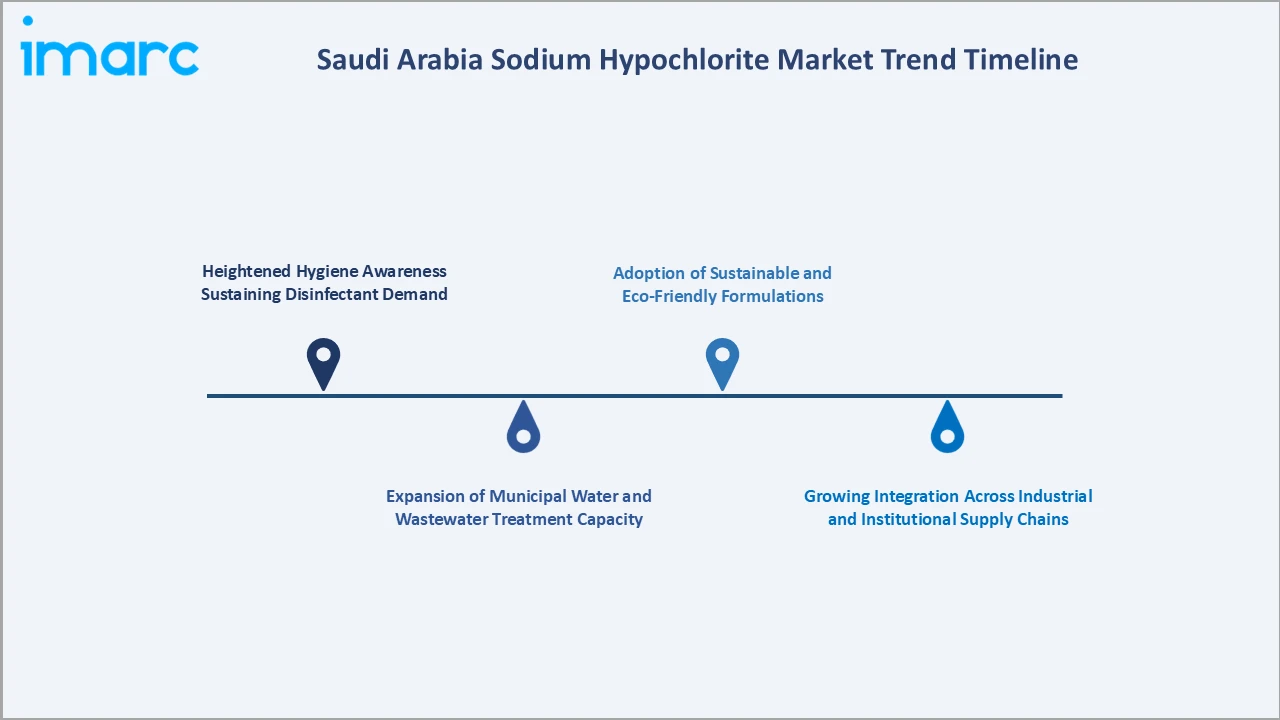
1. Heightened Hygiene Awareness Sustaining Disinfectant Demand
Post-pandemic hygiene consciousness continues to sustain elevated disinfectant demand across households, healthcare facilities, and public institutions, reinforcing baseline consumption of sodium hypochlorite-based products.
2. Expansion of Municipal Water and Wastewater Treatment Capacity
Ongoing investment in municipal water and wastewater treatment infrastructure is expanding institutional procurement of disinfection chemicals, supporting stable long-term demand growth.
3. Adoption of Sustainable and Eco-Friendly Formulations
Manufacturers are increasingly exploring sustainable production techniques and improved packaging to align with environmental and regulatory expectations, gradually shaping product development priorities.
4. Growing Integration Across Industrial and Institutional Supply Chains
Wider integration of sodium hypochlorite supply into industrial and institutional procurement chains, including F&B and textile processors, is broadening distribution reach and end-use diversification.
Industry Value Chain Analysis
The sodium hypochlorite value chain integrates raw material sourcing, chemical manufacturing, quality testing and packaging, distribution and logistics, and end-use application across industrial, municipal, and commercial sectors.
|
Stage |
Key Participants |
|
Raw Material Sourcing |
Suppliers of chlorine, caustic soda, and related industrial chemical inputs |
|
Manufacturing & Processing |
Chlor-alkali and specialty chemical manufacturers producing sodium hypochlorite solutions |
|
Quality Testing & Packaging |
Quality control laboratories and packaging providers ensuring product stability and compliance |
|
Distribution & Logistics |
Chemical distributors and logistics providers serving industrial and municipal customers |
|
End-Use Application |
Water treatment authorities, healthcare facilities, F&B processors, and textile manufacturers |
The manufacturing stage remains the value chain's most capital-intensive tier, while distribution and logistics play a critical role given the product's limited shelf life and handling requirements.
Technology Landscape in the Sodium Hypochlorite Industry
Membrane Cell Electrolysis Technology
Membrane cell electrolysis is the predominant production technology, offering improved energy efficiency and product purity compared to older diaphragm-based processes, supporting consistent sodium hypochlorite output quality.
On-Site Generation Systems
On-site sodium hypochlorite generation systems are gaining traction among large municipal and industrial users, reducing transportation and storage risks associated with bulk product handling.
Stabilized Formulation Technology
Advances in stabilized formulation technology are extending product shelf life and reducing degradation during storage and transport, improving supply chain reliability for distributors.
Market Segmentation Analysis
The report covers the following segments:
|
Segment Category |
Leading Segment |
Market Share |
Year |
|
Application |
Disinfection and Cleaning |
58.7% |
2025 |

By Application
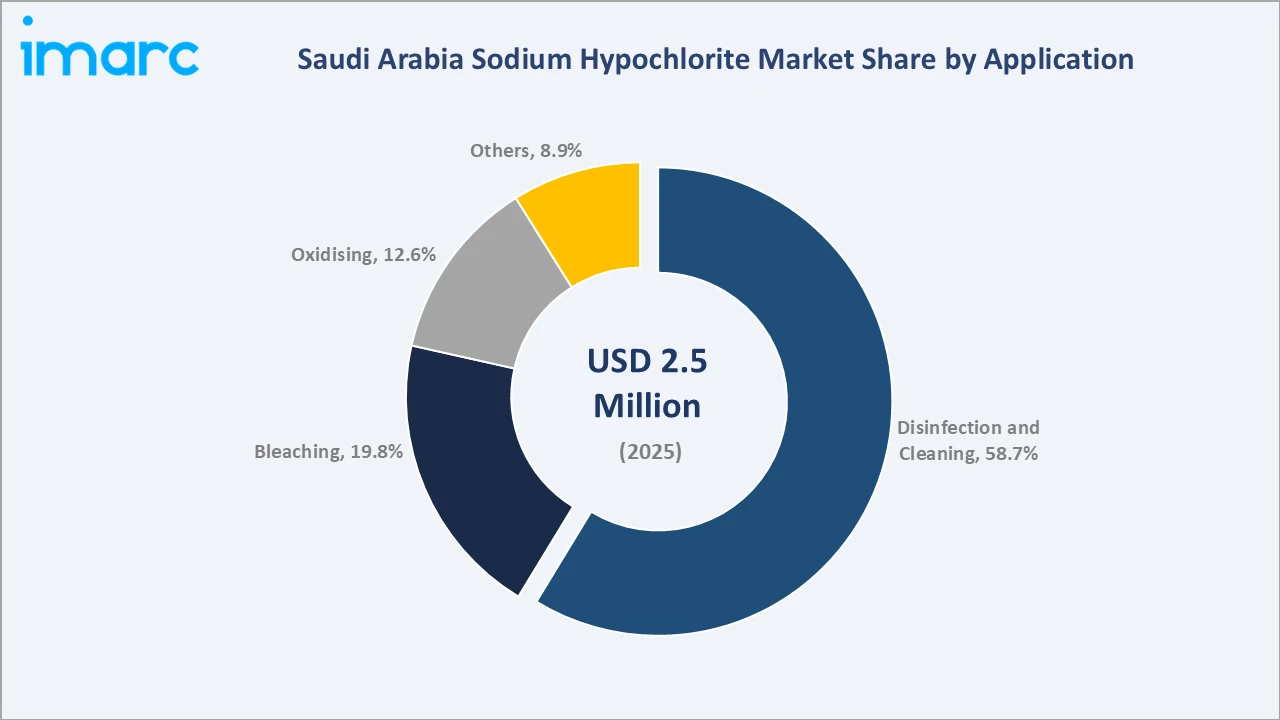
Disinfection and cleaning leads applications at 58.7% in 2025, driven by widespread institutional, municipal, and household hygiene demand across Saudi Arabia's expanding sanitation infrastructure.
To access detailed market analysis, Request Sample
Bleaching follows at 19.8%, supported by textile and laundry applications, while oxidising accounts for 12.6% across industrial process uses. Others, including wastewater treatment, represent 8.9% of the market.
Competitive Landscape
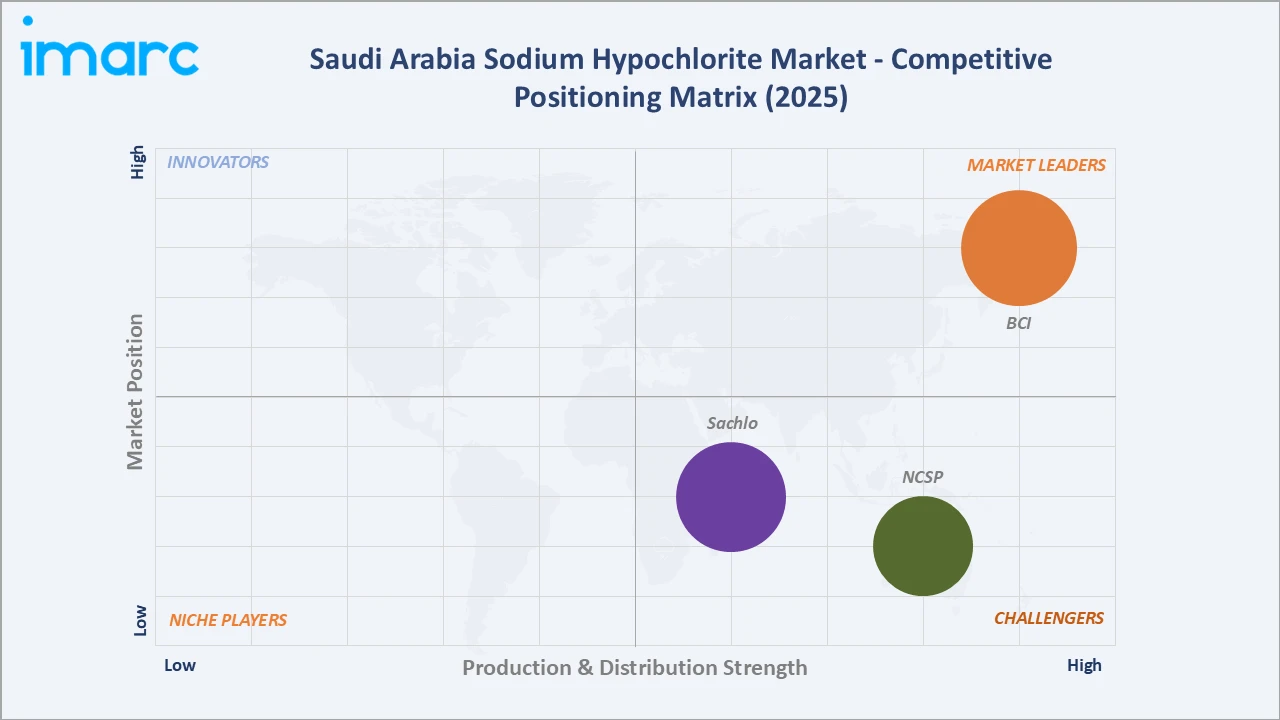
The Saudi Arabia sodium hypochlorite market is moderately fragmented, comprising domestic chlor-alkali producers and specialty chemical manufacturers competing on production scale, distribution reach, and regulatory compliance.
|
Company Name |
Key Products |
Market Position |
Core Strength |
|
BCI |
Sodium Hypochlorite Liquid |
Market Leader |
Established manufacturer supplying sodium hypochlorite and related chemicals across Saudi industrial sectors |
|
NCSP |
Sodium Hypochlorite 12%, Sodium Hypochlorite 14%, Sodium Hypochlorite 6% |
Strong Challenger |
Chemical manufacturer supporting industrial disinfection and processing chemical supply |
|
Sachlo |
Sodium Hypochlorite 12% |
Strong Challenger |
Dedicated sodium hypochlorite producer serving municipal and commercial disinfection markets |
Key players include BCI, NCSP, Sachlo, and others.
Key Company Profiles
BCI
BCI (Basic Chemical Industries Company) is a Saudi Arabia-based, Tadawul-listed chemical manufacturer with a strong presence in the sodium hypochlorite market through its long-standing chlor-alkali production operations.
- Key Products: Sodium Hypochlorite Liquid
- Strategic Focus: Expanding production capacity to serve growing water treatment and sanitation demand across the Kingdom. The company is also investing in quality assurance systems to meet evolving municipal and industrial procurement standards. Continued emphasis on reliable domestic supply positions the company to capture incremental demand from new water infrastructure projects
NCSP
NCSP (National Company for Sulphur Products) is a Saudi Arabia-based specialty chemicals manufacturer with sodium hypochlorite as one of its core production lines alongside sulphuric acid and sulphonated products.
- Key Products: Sodium Hypochlorite 12%, Sodium Hypochlorite 14%, Sodium Hypochlorite 6%.
- Strategic Focus: Supporting industrial and municipal disinfection demand through consistent production of multiple sodium hypochlorite concentrations. The company continues to leverage its dual-complex manufacturing base and distribution network to maintain supply reliability across the Kingdom's main provinces. It is also pursuing feasibility studies for expanded specialty chemical capacity to meet emerging customer requirements.
Market Concentration Analysis
The Saudi Arabia sodium hypochlorite market is moderately fragmented, with the top three key players collectively accounting for a meaningful share of domestic supply, alongside several regional chemical producers serving localized demand. Market concentration is expected to remain stable as domestic chlor-alkali integration continues to favour established producers.
Investment & Growth Opportunities
Highest Growth Segments
Municipal wastewater treatment procurement and industrial oxidising applications represent the highest-growth investment vectors, supported by continued government infrastructure and sanitation investment through 2034.
Emerging Investment Opportunities
Sustainable and stabilized formulation technologies represent an emerging investment opportunity, as manufacturers seek to extend product shelf life and align with evolving environmental expectations.
Investment Themes
- Municipal Water Infrastructure Partnerships: Long-term supply agreements with municipal water treatment authorities offer manufacturers stable, recurring revenue streams.
- Domestic Production Capacity Expansion: Investment in expanded chlor-alkali integrated production capacity supports cost competitiveness and supply reliability for domestic manufacturers.
Future Market Outlook (2026-2034)
The Saudi Arabia sodium hypochlorite market is projected to grow from USD 2.5 Million in 2025 to USD 2.6 Million in 2026, reaching USD 3.7 Million by 2034, delivering a 4.14% CAGR. Continued government investment in water infrastructure and sanitation will sustain steady demand through the forecast period.
Disinfection and cleaning will remain the leading application, while wastewater treatment and industrial oxidising uses offer incremental growth avenues as regulatory and infrastructure investment continues across the Kingdom.
Research Methodology
Primary Research
Primary research comprised structured interviews with industry stakeholders, including chemical manufacturers, distributors, and water treatment authority representatives across Saudi Arabia.
Secondary Research
Secondary research included company reports, government sanitation and water policy publications, industry association data, and trade statistics relevant to the Saudi chemicals sector.
Forecasting Models
Market revenue forecasts were developed using a bottom-up approach incorporating application-wise demand estimation, production capacity trends, and regulatory and infrastructure investment outlook.
Saudi Arabia Sodium Hypochlorite Market Report Coverage:
| Report Features | Details |
|---|---|
| Base Year of the Analysis | 2025 |
| Historical Period | 2020-2025 |
| Forecast Period | 2026-2034 |
| Units | Million USD |
| Scope of the Report |
Exploration of Historical Trends and Market Outlook, Industry Catalysts and Challenges, Segment-Wise Historical and Future Market Assessment:
|
| Applications Covered | Disinfection and Cleaning, Bleaching, Oxidising, Others |
| Companies Covered | BCI, NCSP, Sachlo, etc. |
| Customization Scope | 10% Free Customization |
| Post-Sale Analyst Support | 10-12 Weeks |
| Delivery Format | PDF and Excel through Email (We can also provide the editable version of the report in PPT/Word format on special request) |
Key Benefits for Stakeholders:
- IMARC’s report offers a comprehensive quantitative analysis of various market segments, historical and current market trends, market forecasts, and dynamics of the Saudi Arabia sodium hypochlorite market from 2020-2034.
- The research study provides the latest information on the market drivers, challenges, and opportunities in the Saudi Arabia sodium hypochlorite market.
- The study maps the leading, as well as the fastest-growing, regional markets.
- Porter's five forces analysis assist stakeholders in assessing the impact of new entrants, competitive rivalry, supplier power, buyer power, and the threat of substitution. It helps stakeholders to analyze the level of competition within the Saudi Arabia sodium hypochlorite industry and its attractiveness.
- Competitive landscape allows stakeholders to understand their competitive environment and provides an insight into the current positions of key players in the market.
Frequently Asked Questions About the Saudi Arabia Sodium Hypochlorite Market Report
The Saudi Arabia sodium hypochlorite market size is estimated at USD 2.6 Million in 2026, supported by rising disinfection and sanitation demand across households, healthcare facilities, and municipal water treatment operations. Disinfection and cleaning applications account for the largest share of this market size.
The market is projected to grow at a CAGR of 4.14% during 2026-2034, reaching USD 3.7 Million by 2034. This growth reflects sustained government investment in water infrastructure alongside expanding industrial and institutional disinfection demand.
Disinfection and cleaning leads at 58.7% share in 2025, followed by bleaching at 19.8%, driven by widespread institutional, municipal, and household hygiene demand. Oxidising and other applications, including wastewater treatment, together account for the remaining share of the market.
Key players include BCI, NCSP, Sachlo, and others.
Escalating disinfection demand, government water quality initiatives, urbanization, and expanding F&B and textile sector use are key growth drivers. Continued investment in municipal wastewater treatment infrastructure further supports steady demand growth through the forecast period.
The market is projected to reach approximately USD 3.7 Million by 2034, reflecting consistent growth from USD 2.5 Million in 2025.
Municipal water infrastructure partnerships, domestic production capacity expansion, and sustainable formulation technology represent priority investment opportunities. Suppliers securing long-term institutional supply agreements are best positioned to capture recurring, high-volume demand.
Need more help?
- Speak to our experienced analysts for insights on the current market scenarios.
- Include additional segments and countries to customize the report as per your requirement.
- Gain an unparalleled competitive advantage in your domain by understanding how to utilize the report and positively impacting your operations and revenue.
- For further assistance, please connect with our analysts.
 Request Customization
 Speak to an Analyst
 Request Brochure
 Inquire Before Buying
Benefits of Customization
- Personalize this research
- Triangulate with your data
- Get data as per your format and definition
- Gain a deeper dive into a specific application, geography, customer, or competitor
- Any level of personalization
Get in Touch With Us
UNITED STATES
Phone: +1-201-971-6302
INDIA
Phone: +91-120-433-0800
UNITED KINGDOM
Phone: +44-753-714-6104
Email: [email protected]
Client Testimonials




.webp)




.webp)













Related Reports

Choose your plan
*Please note that the prices mentioned below are starting prices for each bundle type. Kindly contact our team for further details.*
Single User License
- 1 User License, Access on 2 Devices
- PDF Report + Excel Dataset (Password Protected)
- Lifetime Access
- No Printing Rights
- 10% Free Report Customization
- 10–12 Weeks of Analyst Support
Five User License
- Access for 5 Users, 2 Devices per User
- PDF Report + Excel Dataset (Password Protected)
- Lifetime Access
- Dedicated Account Manager
- 12–14 Weeks of Analyst Support
- No Printing Rights
- 15% Free Report Customization
- 25% Discount on Your Next Purchase
Corporate User License
- Unlimited User Access (Within Your Organization)
- PDF Report + Excel Dataset
- Lifetime Access
- Dedicated Account Manager
- 14–20 Weeks of Analyst Support
- No Printing Rights
- 20% Free Report Customization
- 30% Discount on Your Next Purchase
Essential Insights
What's included:
3 reports
- Lifetime Access
- PDF Reports
- Excel Datasets
- 2 Weeks of Free Analyst Support
- 2 User Licenses
- Access on 2 Devices
- Printing Rights
- Complimentary PowerPoint (PPT) Version
- Complimentary License Upgrade
Professional Access
What's included:
5 reports
- Lifetime Access
- PDF Reports
- Excel Datasets
- 8 Weeks of Free Analyst Support
- 2 User Licenses
- Access on 2 Devices
- Printing Rights
- Complimentary PowerPoint (PPT) Version
- Complimentary License Upgrade
Business Advantage
What's included:
8 reports
- Lifetime Access
- PDF Reports
- Excel Datasets
- 14 Weeks of Free Analyst Support
- 2 User Licenses
- Access on 2 Devices
- Printing Rights
- Complimentary PowerPoint (PPT) Version
- Complimentary License Upgrade
Enterprise Intelligence
What's included:
10 reports
- Lifetime Access
- PDF Reports
- Excel Datasets
- 20 Weeks of Free Analyst Support
- 2 User Licenses
- Access on 2 Devices
- Printing Rights
- Complimentary PowerPoint (PPT) Version
- Complimentary License Upgrade