
South East Asia Cybersecurity Market Size, Share, Trends and Forecast by Component, Deployment Type, User Type, Industry Vertical, and Country, 2026-2034
South East Asia Cybersecurity Market Size, Share, Trends & Forecast (2026-2034)
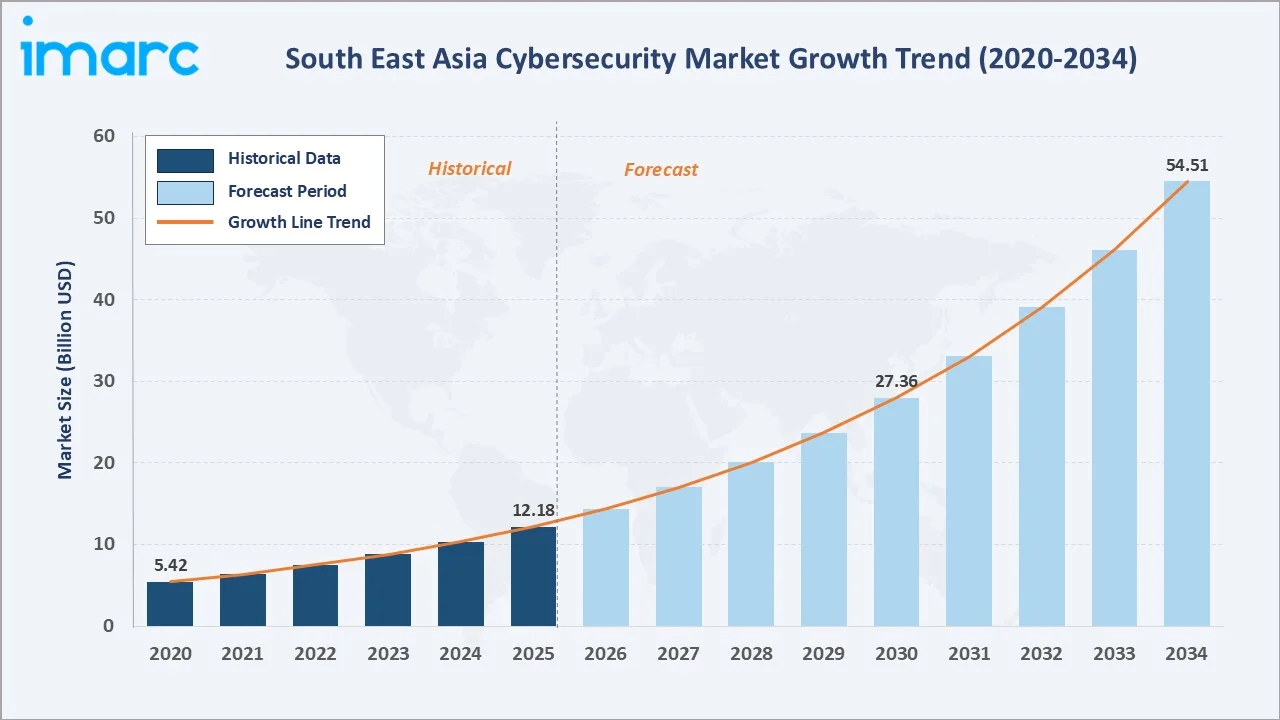
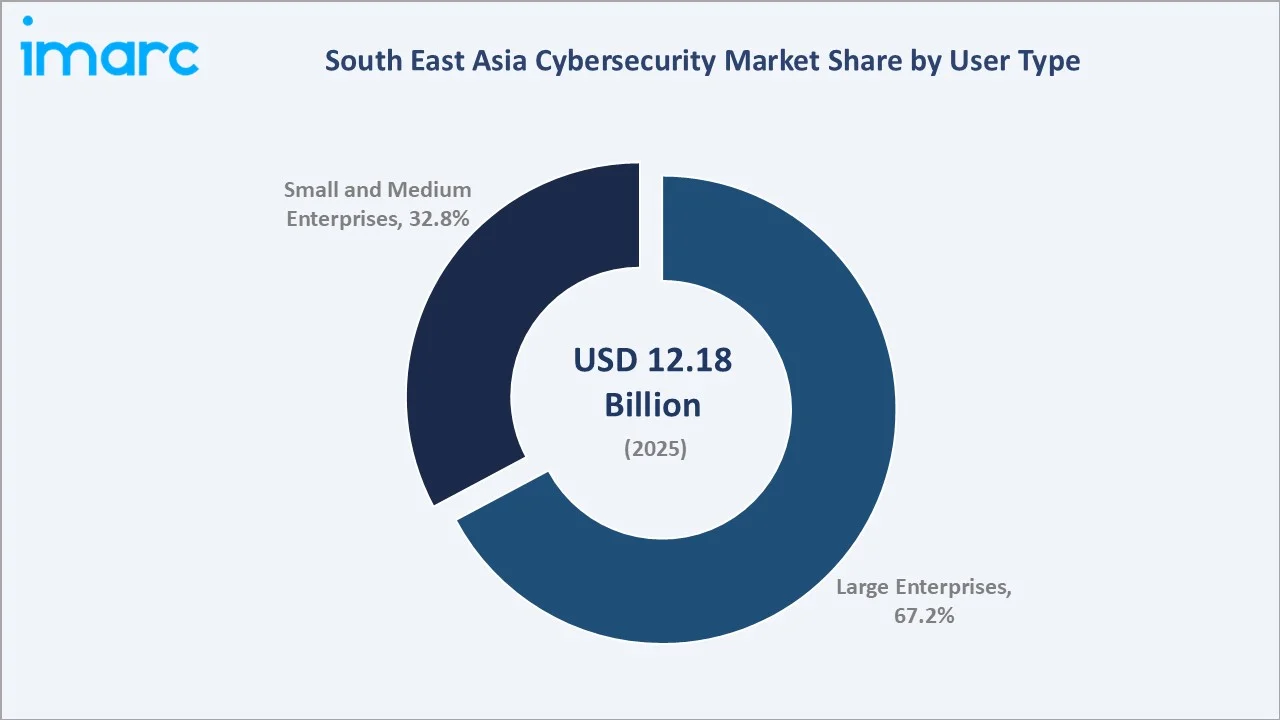
The South East Asia cybersecurity market reached USD 12.18 Billion in 2025 and is projected to reach USD 54.51 Billion by 2034, growing at a CAGR of 17.58% during 2026-2034. The market is driven by rising cyber threats, digitalization, cloud adoption, and stricter data protection regulations across the region. Large Enterprises from the user type segment dominate at 67.2%. Cloud-based deployment leads applications at 64.3%. Indonesia commands 24.8% of the country market share.
Market Snapshot
|
Metric |
Value |
|
Market Size (2025) |
USD 12.18 Billion |
|
Forecast Market Size (2034) |
USD 54.51 Billion |
|
CAGR (2026-2034) |
17.58% |
|
Base Year |
2025 |
|
Historical Period |
2020-2025 |
|
Forecast Period |
2026-2034 |
|
Dominant User Type |
Large Enterprises (67.2%, 2025) |
|
Dominant Deployment Type |
Cloud-based (64.3%, 2025) |
|
Leading Country |
Indonesia (24.8%, 2025) |
The market expanded from USD 5.42 Billion in 2020 to USD 12.18 Billion in 2025 - more than doubling in five years - anchored at USD 27.36 Billion in 2030 and forecast to reach USD 54.51 Billion by 2034. Rising ransomware, phishing, and data-breach incidents did not slow enterprise adoption; instead, they accelerated sustained investment in advanced detection, response, and recovery capabilities across the region.
To get more information on this market, Request Sample
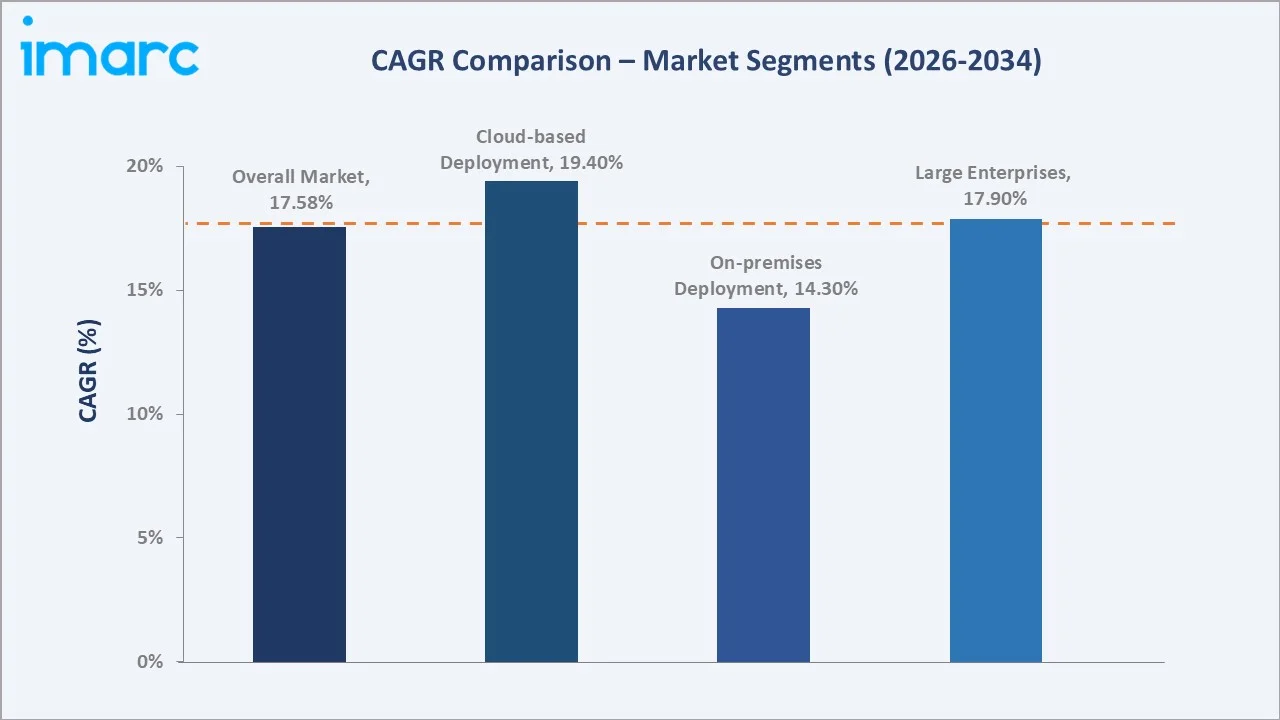
Cloud-based deployment grows fastest at ~19.4% CAGR as SaaS delivery and remote-first operations accelerate migration away from on-premises infrastructure, which grows at a comparatively modest ~14.3% CAGR. Large Enterprises grow at an estimated ~17.9% CAGR as regulated banking, telecom, and government entities expand security operations centres and identity governance programmes, while Small and Medium Enterprises grow at ~16.9% CAGR, gradually narrowing the gap as budget constraints ease.
Executive Summary
The South East Asia cybersecurity market reached USD 12.18 Billion in 2025, representing one of the region's highest-growth technology segments, driven by the fundamental digital transformation of enterprises, financial institutions, and government services. The market is projected to reach USD 54.51 Billion by 2034.
Large Enterprises at 67.2% dominate by maintaining dedicated security budgets and regulatory compliance mandates across banking, telecom, and government sectors. Cloud-based deployment at 64.3% leads through the region's accelerating shift toward SaaS-delivered, hybrid-ready security architectures. Indonesia at 24.8% leads globally through its large digital economy, expanding fintech ecosystem, and rising cyber-incident exposure across enterprises and government.
Key Market Insights
|
Insight |
Data |
|
Dominant User Type |
Large Enterprises - 67.2% market share (2025) |
|
Dominant Deployment Type |
Cloud-based - 64.3% market share (2025) |
|
Leading Country |
Indonesia - 24.8% market share (2025) |
|
Market Opportunity |
AI-driven threat detection; Zero Trust architecture; managed security services for SMEs; sovereign cloud security |
Key Analytical Observations Supporting the Above Data:
- Large Enterprises at 67.2%: Large enterprises maintain dedicated security budgets, in-house SOC capabilities, and compliance mandates across banking, telecom, and government sectors, cementing their share of regional cybersecurity spending. Its widespread adoption across regulated industries and multinational subsidiaries further strengthens segment demand.
- Cloud-based at 64.3%: Cloud-based deployment lowers upfront capital costs and enables faster rollout of managed detection and response, favouring SME and enterprise adoption alike across the region's fast-digitizing economies. Growing hybrid and remote work models continue to reinforce this shift toward cloud-delivered protection.
- Indonesia at 24.8%: Indonesia's large digital economy, expanding financial services sector, and rising ransomware incidents are driving sustained investment in cybersecurity solutions and services. Its rapidly growing e-commerce and mobile-banking user base further amplifies national cybersecurity spending.
South East Asia Cybersecurity Market Overview
The South East Asia cybersecurity market encompasses solutions and services that protect networks, systems, and data across enterprises, government agencies, and critical infrastructure operators across all major country markets, including Indonesia, Singapore, Thailand, Malaysia, Vietnam, and the Philippines.
The ecosystem integrates security solution vendors, managed security service providers, systems integrators and channel partners, telecom operators and cloud providers, regulatory bodies and national CERTs, and end users spanning enterprises and government. Macroeconomic factors include rapid digitalization, expanding e-commerce and fintech adoption, growing IoT connectivity, and tightening data-protection regulation across the region. Rising cross-border data flows and increasing reliance on third-party digital infrastructure are further reshaping how organizations across South East Asia evaluate and prioritize cybersecurity investment.
Market Dynamics
To evaluate market opportunities, Request Sample
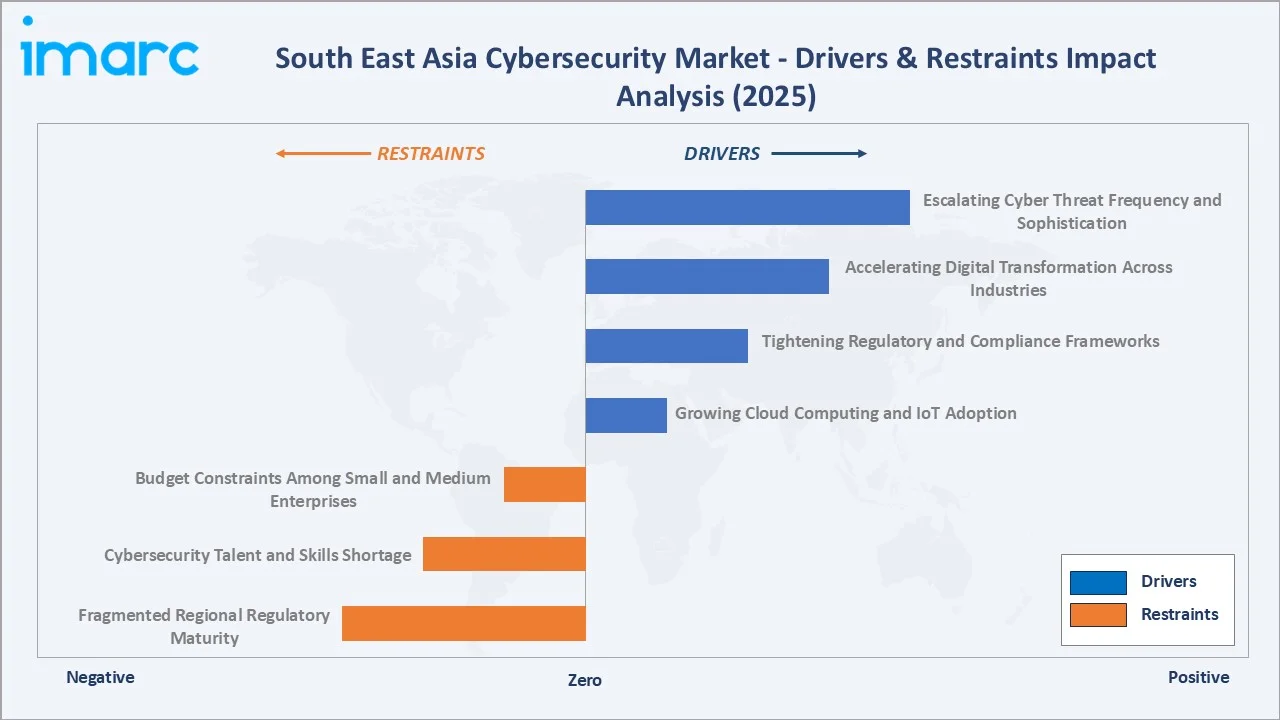
Market Drivers
- Escalating Cyber Threat Frequency and Sophistication: The rising frequency and sophistication of ransomware, phishing, and malware attacks is compelling enterprises and governments across South East Asia to prioritize advanced threat detection, response, and recovery capabilities. Attackers are increasingly leveraging automation and AI to scale campaigns, forcing organizations to adopt equally adaptive, intelligence-driven defense platforms. This sustained threat pressure is pushing security budgets higher across both large enterprises and mid-sized organizations throughout the region.
- Accelerating Digital Transformation Across Industries: Rapid digitization across banking, retail, and government services is expanding the digital attack surface, requiring comprehensive, layered cybersecurity strategies to protect interconnected systems and sensitive data. The proliferation of mobile banking, e-commerce platforms, and digital government services has multiplied the number of endpoints and data flows requiring continuous protection. Organizations undergoing digital transformation are increasingly embedding security controls at the design stage rather than retrofitting them after deployment.
- Tightening Regulatory and Compliance Frameworks: Stringent data-protection and cybersecurity regulations, including Singapore's amended Cybersecurity Act and evolving frameworks across Indonesia and Vietnam, are compelling organizations to invest in compliance-driven security infrastructure. National data-protection authorities are increasingly mandating breach disclosure timelines and minimum-security control standards for regulated sectors. Compliance-driven investment is extending beyond large enterprises as regulators broaden coverage to critical infrastructure and essential digital services.
- Growing Cloud Computing and IoT Adoption: Widening adoption of cloud computing and IoT devices across the region is amplifying the need for cybersecurity solutions capable of protecting distributed, interconnected environments and data flows. The rapid expansion of connected devices across manufacturing, logistics, and smart-city initiatives is creating new categories of endpoint risk that traditional perimeter defenses cannot address. Vendors are responding with cloud-native and IoT-specific security platforms tailored to the region's fast-growing connected-device ecosystem.
Market Restraints
- Budget Constraints Among Small and Medium Enterprises: Small and medium enterprises across South East Asia often face constrained security budgets, limiting adoption of advanced, subscription-based cybersecurity platforms and slowing overall market penetration. Many SMEs continue to rely on basic antivirus and firewall tools, leaving critical gaps in threat detection and incident response capability. Limited in-house IT expertise further compounds the challenge, as smaller organizations often lack dedicated staff to evaluate and manage security investments.
- Cybersecurity Talent and Skills Shortage: The region faces a persistent shortage of qualified cybersecurity professionals, constraining organizations' ability to deploy, manage, and optimize advanced security operations at scale. Universities and training institutes across South East Asia have struggled to keep pace with rapidly evolving skill requirements in cloud security and threat intelligence. This shortage is prompting greater reliance on managed security service providers and automated, AI-assisted security operations to bridge internal capability gaps.
- Fragmented Regional Regulatory Maturity: Fragmented regulatory maturity and inconsistent enforcement across ASEAN member states complicate cross-border compliance and slow harmonized adoption of regional cybersecurity standards. Multinational organizations operating across multiple South East Asian markets must navigate varying data-residency and breach-notification requirements, adding operational complexity. Ongoing ASEAN-level coordination efforts aim to narrow these gaps, though full regulatory harmonization is expected to take several years to materialize.
Market Opportunities
- AI-Driven Threat Detection and Response: AI and machine-learning-driven threat detection platforms enable predictive analytics and automated response, creating strong growth potential as organizations seek to outpace increasingly automated cyberattacks. Early adopters are reporting meaningfully reduced detection and response times, reinforcing enterprise appetite for further AI-driven security investment. Vendors are racing to embed generative AI copilots into security operations centres, creating a fast-expanding product category across the region.
- Managed Security Services for SMEs: Rising demand for outsourced, subscription-based managed security services offers a scalable entry point for SMEs seeking enterprise-grade protection without heavy upfront capital investment. Regional telecom operators and system integrators are expanding managed detection and response offerings tailored specifically to resource-constrained smaller organizations. This trend is expected to broaden the addressable market beyond large enterprises, unlocking a significant underserved SME customer base.
Market Challenges
- Sovereign Cloud and Data-Residency Requirements: Growing reliance on domestic cloud infrastructure to meet data-residency requirements requires vendors to localize infrastructure, adding cost and operational complexity across diverse ASEAN jurisdictions. Global vendors are increasingly required to establish in-country data centres and local partnerships to remain compliant with tightening sovereignty rules. This shift is reshaping vendor go-to-market strategies, favoring providers able to combine global technology with local infrastructure presence.
- AI-Enabled Threat Escalation: Attackers increasingly deploy AI-generated phishing and deepfake-based social engineering, requiring continuous investment in advanced, adaptive detection technologies to stay ahead of evolving threats. The rise of generative AI tools has lowered the technical barrier for launching convincing, large-scale social engineering campaigns across the region. Security teams are being forced to continuously retrain detection models to keep pace with rapidly evolving attacker techniques.
Emerging Market Trends
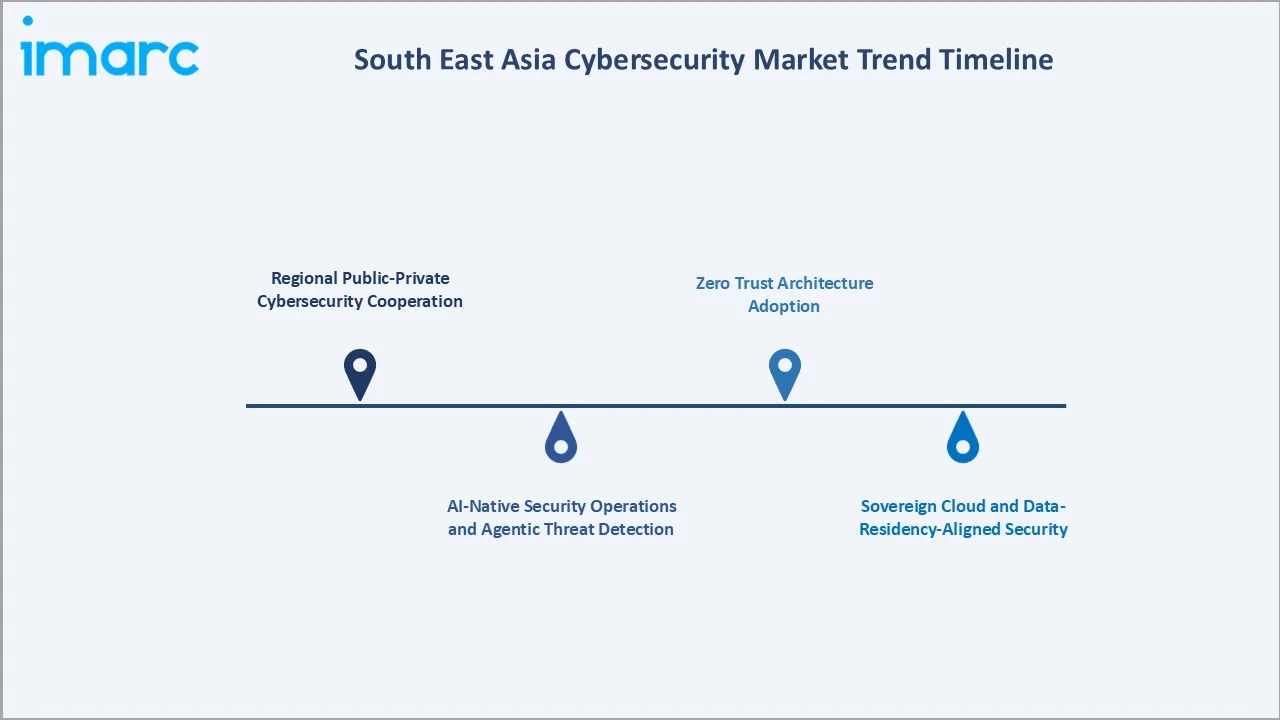
Several cybersecurity trends in ASEAN markets are reshaping how enterprises and governments across the region prioritize security investment, from AI-native security operations to sovereign cloud adoption, as outlined below.
1. AI-Native Security Operations and Agentic Threat Detection
Enterprises across the region are embedding AI-driven analytics into security operations centres to accelerate threat detection, automate incident response, and address the growing volume of AI-generated attacks, including scam and deepfake-based fraud. In 2025, Trend Micro deepened its collaboration with Google Cloud to advance AI-driven, sovereignty-aligned cybersecurity, extending capabilities such as its ScamCheck tool that uses generative AI models to verify suspicious images and messages. This shift toward agentic, autonomous security operations is expected to accelerate as organizations seek to counter increasingly automated adversaries.
2. Zero Trust Architecture Adoption
Organizations are shifting from perimeter-based defences toward Zero Trust frameworks that continuously verify identity and device posture, reducing the risk of credential-based intrusions, which account for a rising share of regional breaches. Identity-based attacks have emerged as a leading intrusion vector across South East Asia, prompting security teams to prioritize phishing-resistant multi-factor authentication and continuous access monitoring. As hybrid and remote work models persist, enterprises are increasingly treating identity as the primary security perimeter rather than the network edge.
3. Regional Public-Private Cybersecurity Cooperation
Initiatives such as the ASEAN Regional CERT and cross-border threat-intelligence sharing are strengthening coordinated incident response and encouraging harmonized cybersecurity standards across member states. The ASEAN Cybersecurity Cooperation Strategy continues to promote shared norms and public-private partnerships aimed at building a more resilient regional digital economy. Singapore's role as host of the ASEAN Regional CERT reinforces its position as the region's cybersecurity coordination hub, supporting faster cross-border response to large-scale incidents.
4. Sovereign Cloud and Data-Residency-Aligned Security
Rising data-residency requirements are driving demand for sovereign cloud security solutions that keep sensitive data within national borders while still delivering cloud-scale detection and response capabilities. Regulators across Indonesia, Vietnam, and Thailand are progressively tightening requirements for critical-sector data to remain within domestic infrastructure, prompting global vendors to expand local data-centre footprints. This trend is expected to reshape vendor competitiveness, favoring providers capable of combining global threat intelligence with compliant local infrastructure.
Industry Value Chain Analysis
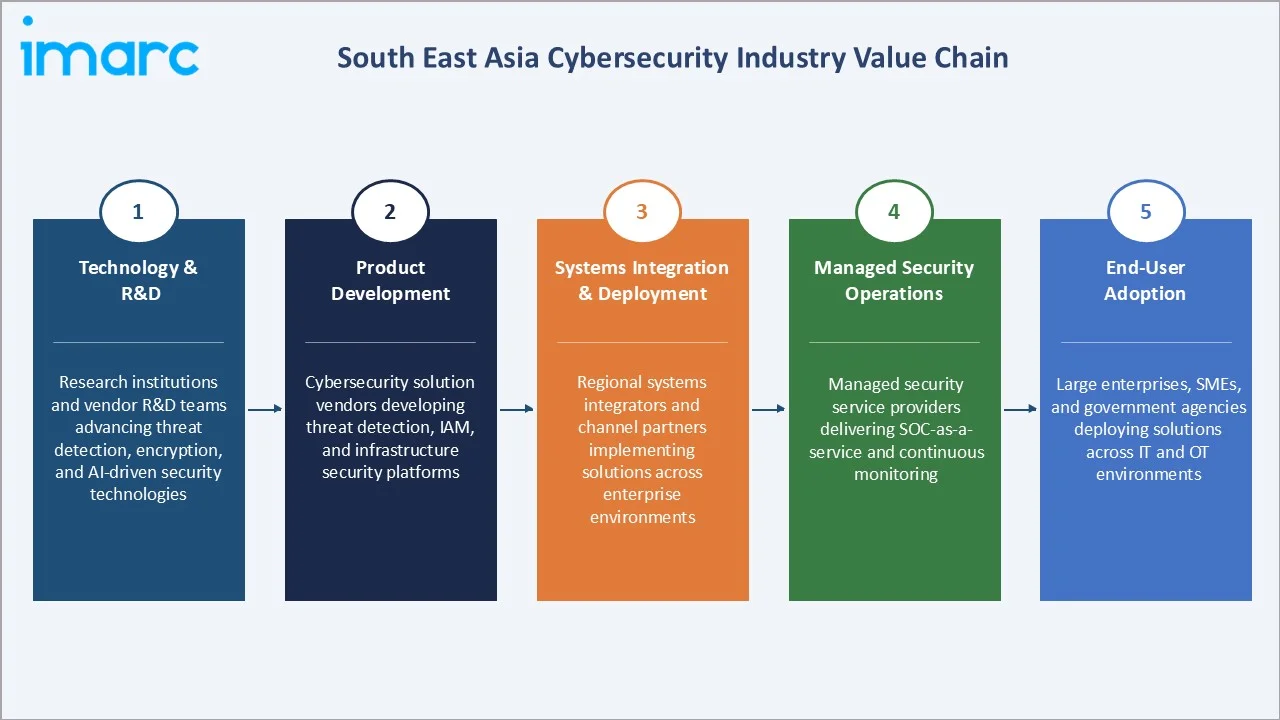
The cybersecurity value chain spans technology and R&D, product development, systems integration, managed operations, and end-user adoption, supporting enterprises, government agencies, and critical-infrastructure operators across South East Asia.
The value chain's commercial architecture continues to consolidate toward integrated, subscription-based platform delivery as the primary commercial format across the region.
|
Stage |
Key Participants |
|
Technology & R&D |
Research institutions and vendor R&D teams advancing threat detection, encryption, and AI-driven security technologies |
|
Product Development |
Cybersecurity solution vendors developing threat detection, IAM, and infrastructure security platforms |
|
Systems Integration & Deployment |
Regional systems integrators and channel partners implementing solutions across enterprise environments |
|
Managed Security Operations |
Managed security service providers delivering SOC-as-a-service and continuous monitoring |
|
End-User Adoption |
Large enterprises, SMEs, and government agencies deploying solutions across IT and OT environments |
Technology Landscape
AI and Machine Learning-Based Threat Detection
AI-driven platforms enable predictive threat modelling and automated response, improving detection accuracy and reducing dwell time for identity-based and ransomware attacks across enterprise environments. Adoption is accelerating as vendors embed generative AI copilots directly into security operations workflows. Enterprises increasingly view AI-native detection as a baseline requirement rather than a differentiating feature for next-generation security platforms.
Cloud-Native Security Platforms
Cloud-native platforms offer scalability, faster deployment, and lower upfront costs, supporting the region's accelerating shift toward SaaS-delivered and hybrid security architectures across large enterprises and SMEs alike. Integration with hyperscale cloud providers is further simplifying multi-cloud protection. Vendors continue to expand marketplace-based distribution to accelerate adoption among cloud-first organizations.
Zero Trust and Identity Security Technology
Zero Trust and identity-security technologies, including phishing-resistant multi-factor authentication and continuous access monitoring, are becoming foundational as identity-based intrusions rise across the region's enterprises and government agencies. Growing adoption of behavioral analytics is further strengthening organizations' ability to detect anomalous access patterns in real time.
Market Segmentation Analysis
The report covers the following segments:
|
Segment Category |
Leading Segment |
Market Share |
Year |
|
Component |
🔒 |
🔒 |
2025 |
|
Deployment Type |
Cloud-based |
64.3% |
2025 |
|
User Type |
Large Enterprises |
67.2% |
2025 |
|
Industry Vertical |
🔒 |
🔒 |
2025 |
|
Country |
Indonesia |
24.8% |
2025 |

By User Type
Large Enterprises lead at 67.2% in 2025, supported by dedicated security budgets, regulatory compliance mandates, and in-house security operations across banking, telecom, and government sectors.
To access detailed market analysis, Request Sample
Small and Medium Enterprises account for 32.8%, with adoption accelerating as cloud-based, subscription-priced solutions lower the barrier to enterprise-grade protection for resource-constrained organizations.
By Deployment Type
Cloud-based deployment leads at 64.3% in 2025, reflecting the region's rapid migration toward SaaS-delivered security platforms that reduce infrastructure overhead and support distributed workforces.
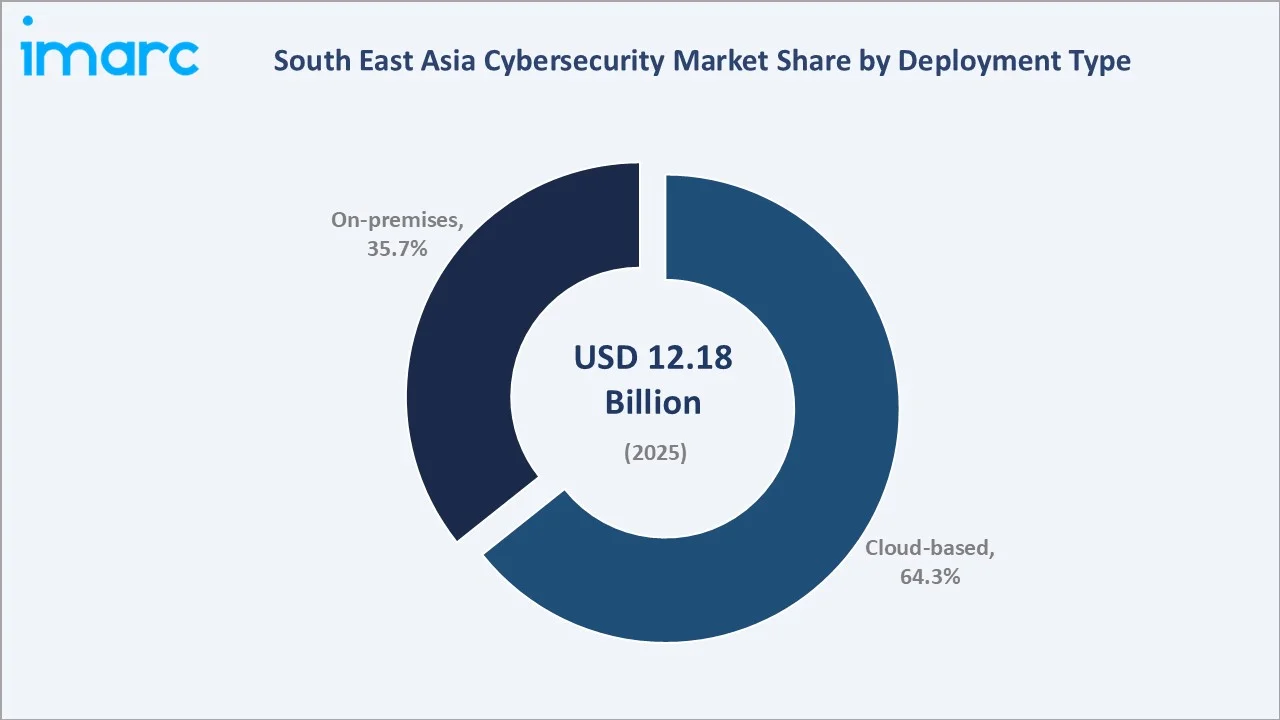
On-premises deployment retains 35.7% share, anchored by regulated banks, government agencies, and defence institutions that require air-gapped or data-resident environments for sensitive workloads.
Regional Market Insights
|
Country |
Share (2025) |
Key Market Drivers & Characteristics |
|
Indonesia |
24.8% |
Driven by its large digital economy, expanding fintech sector, and rising cyber-incident exposure across enterprises and government |
|
Singapore |
20.7% |
Supported by advanced regulatory frameworks and its role as the region's cybersecurity coordination hub |
|
Thailand |
16.8% |
Driven by strong vendor investment and expanding managed security services demand |
|
Malaysia |
13.9% |
Supported by growing digital banking, e-commerce expansion, and national cybersecurity initiatives |
|
Vietnam |
10.8% |
Driven by rapid digitalization and expanding telecom-sector security investment |
|
Philippines |
8.7% |
Reflects expanding BPO-sector security requirements and rising cloud-based protection adoption |
|
Others |
4.3% |
Early-stage but growing markets across the remaining South East Asian economies |
Indonesia, at 24.8%, leads through its large digital economy and expanding fintech ecosystem. Singapore, at 20.7%, benefits from its advanced regulatory environment and status as the region's cybersecurity coordination hub, hosting the ASEAN Regional CERT.
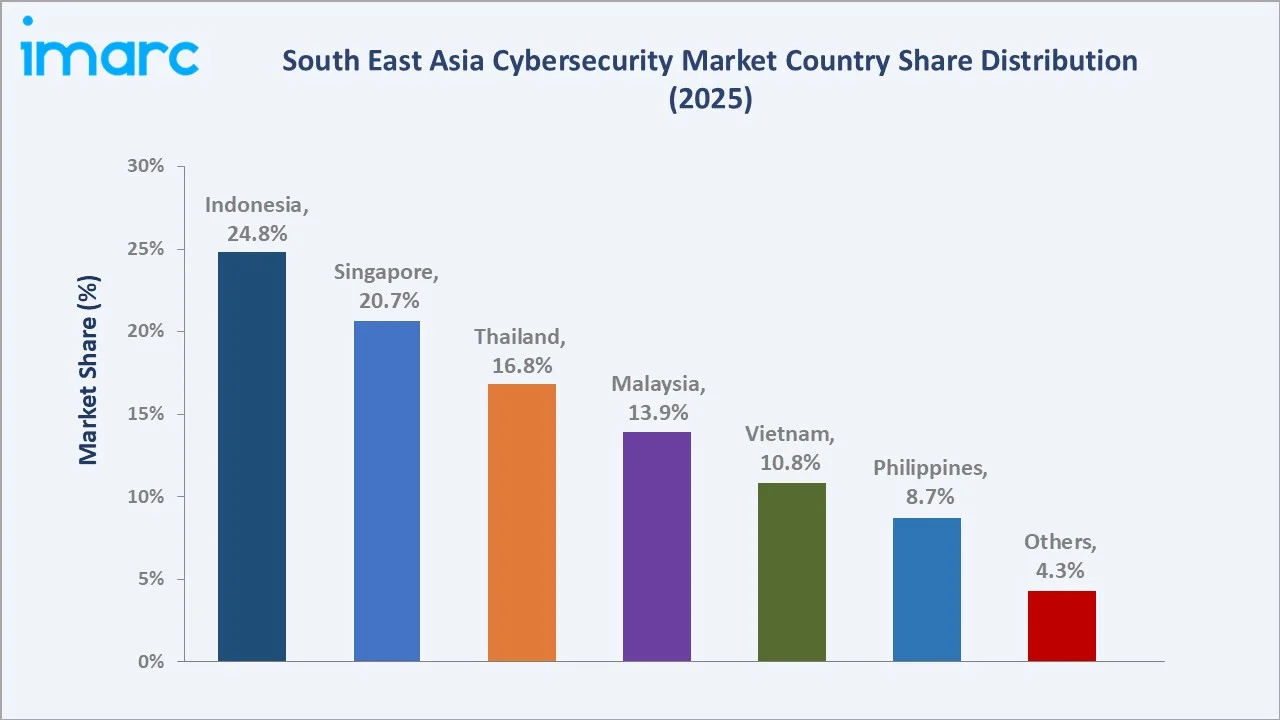
Thailand, at 16.8%, and Malaysia, at 13.9%, reflect strong vendor investment and government-led digital security initiatives. Vietnam, at 10.8%, and the Philippines, at 8.7%, represent fast-growing markets driven by telecom-sector and BPO-sector security spending.
Competitive Landscape
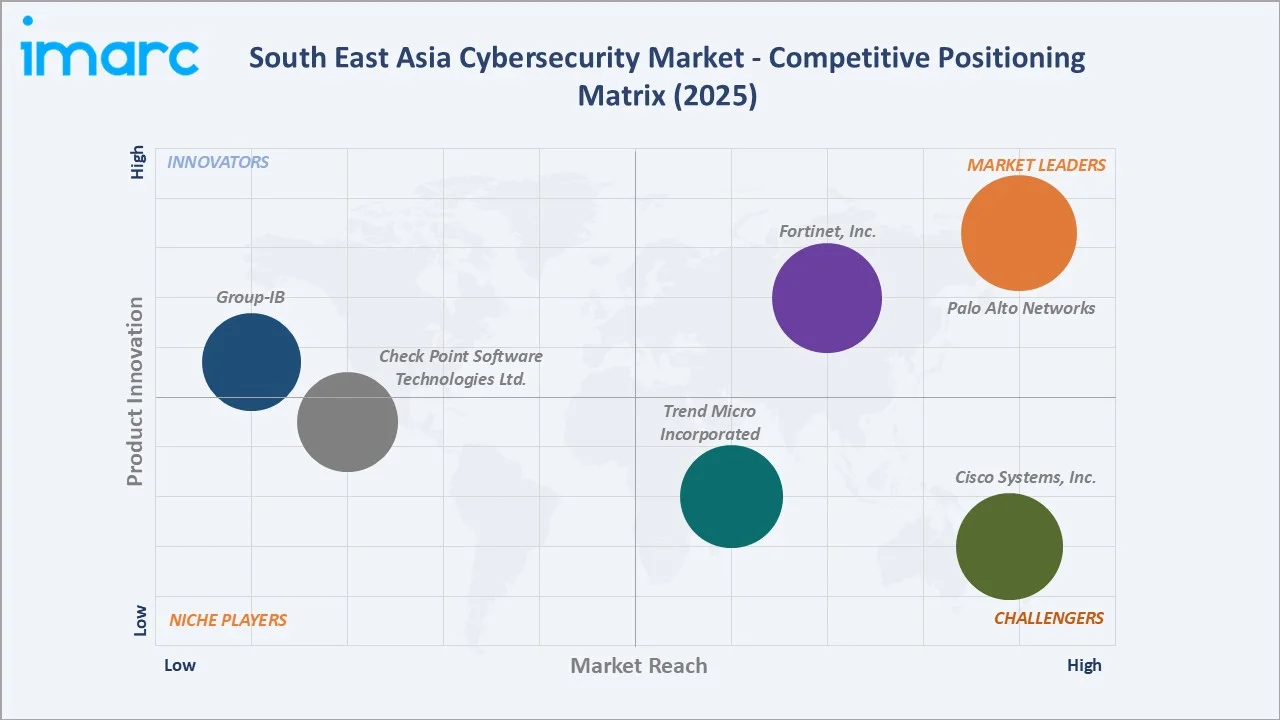
The South East Asia cybersecurity market competitive landscape is moderately fragmented, comprising global platform vendors, specialized security technology firms, and regional telecom-affiliated security providers competing across enterprise and government accounts. Several leading cybersecurity firms with government contracts in Asia, including regulated defence, public-sector, and critical-infrastructure engagements, are listed below.
|
Company Name |
Key Products |
Market Position |
Core Strength |
|
Palo Alto Networks |
Prisma Cloud, Cortex XDR, Prisma Access Browser, Advanced DNS Security, Prisma AIRS, Cortex Cloud, SaaS Security, VM-Series |
Market Leader |
Global cybersecurity leader offering an integrated network, cloud, and AI-driven security platform |
|
Fortinet, Inc. |
FortiGate NGFW, Fortinet Security Fabric, FortiAI-Protect, FortiAI-SecureAI, FortiGuard AI-Powered Security Services |
Market Leader |
High-performance, integrated network security with strong SEA channel presence |
|
Cisco Systems, Inc. |
Secure Firewall, Zero Trust Access, Cloud Security, Email Security, Endpoint Security, Network Security, Web Security, Security Platform, Security Suites |
Strong Challenger |
Broad enterprise networking base supporting integrated security deployments |
|
Trend Micro Incorporated |
Trend Vision One, Cloud App Security, Cyber Risk Exposure Management, Cloud Security, Endpoint Security, Network Security, Email and Collaboration Security, Identity Security |
Strong Challenger |
Deep regional footprint with AI-driven, cloud-native threat defence |
|
Check Point Software Technologies Ltd. |
Hybrid Mesh Network Security, Security Management, AI Security |
Established Player |
Unified threat-prevention architecture across network and cloud |
|
Group-IB |
Threat Intelligence, Attack Surface Management, Fraud Protection, Digital Risk Protection, Managed XDR, Business Email Protection, Cyber Fraud Intelligence Platform, Cloud Security Posture Management |
Established Player |
Singapore-based specialist in threat intelligence and fraud prevention |
Key players include Palo Alto Networks, Fortinet, Inc., Cisco Systems, Inc., Trend Micro Incorporated, Check Point Software Technologies Ltd., Group-IB, and others.
Key Company Profiles
Trend Micro Incorporated
Trend Micro Incorporated is a global cybersecurity leader with a deep footprint across South East Asia through its unified Trend Vision One platform and regional threat-intelligence operations.
- Key Products: Trend Vision One, Cloud App Security, Cyber Risk Exposure Management, Cloud Security, Endpoint Security, Network Security, Email and Collaboration Security, Identity Security
- Recent Developments: In August 2026, TrendAI, the enterprise AI security leader from Trend Micro Incorporated announced the go-live of a new local data center in Indonesia, hosting its unified AI-powered cybersecurity platform, TrendAI Vision One.
- Strategic Focus: Expanding AI-driven, cloud-native threat defence and deepening partner-ecosystem engagement across ASEAN markets. The company continues to strengthen its Singapore-based threat-intelligence operations to support faster regional incident response. Trend Micro is also expanding collaboration with hyperscale cloud providers to embed security deeper into customers' cloud transformation journeys.
Palo Alto Networks
Palo Alto Networks is a global cybersecurity platform provider offering integrated network, cloud, and AI-driven security solutions to enterprises and government agencies across South East Asia.
- Key Products: Prisma Cloud, Cortex XDR, Prisma Access Browser, Advanced DNS Security, Prisma AIRS, Cortex Cloud, SaaS Security, VM-Series
- Recent Developments: In March 2025, Palo Alto Networks announced new cloud infrastructure investment across Asia-Pacific and Japan, including Indonesia and Singapore, integrating its Prisma Access Browser to support local data-residency requirements.
- Strategic Focus: Expanding AI-native security offerings and regional cloud infrastructure to support sovereignty and compliance requirements. The company is scaling its Prisma platform across additional ASEAN markets to meet growing demand for integrated network and cloud security. Continued investment in local infrastructure reflects Palo Alto Networks' broader strategy of aligning global platform capabilities with regional data-residency expectations.
Market Concentration Analysis
The South East Asia cybersecurity market is moderately fragmented, with global platform vendors including the key players collectively accounting for a significant share of enterprise security spending, while regional and telecom-affiliated providers compete strongly in domestic and SME segments. Market concentration is expected to ease gradually as regional providers scale AI-driven offerings. Continued investment in local infrastructure and channel partnerships by global vendors is likely to intensify competition for regulated enterprise and government accounts over the forecast period.
Investment & Growth Opportunities
Highest Growth Segments
Cloud-based deployment (~19.4% CAGR), Large Enterprises (~17.9% CAGR), AI-driven threat detection, managed security services for SMEs, and Zero Trust architecture adoption represent the highest-growth investment vectors through 2034. Sovereign cloud security and regional threat-intelligence platforms are also emerging as attractive niches as compliance requirements continue to tighten across ASEAN markets.
Investment Themes
- AI-Native Security Platform Investment: AI-native security platforms present a structural investment opportunity as enterprises across the region prioritize automated detection and response to counter increasingly AI-enabled cyberattacks. Investors are increasingly favoring vendors that combine proprietary threat-intelligence data with scalable, subscription-based delivery models.
- Managed Security Services Expansion: Managed security services targeting SMEs offer a scalable growth avenue as cloud-based, subscription-priced offerings lower the barrier to enterprise-grade protection across the region's fast-digitizing economies. Regional telecom-affiliated providers are well positioned to capture this opportunity given their existing distribution reach into smaller organizations.
Future Market Outlook (2026-2034)
The South East Asia cybersecurity market is projected to grow from USD 12.18 Billion in 2025 to USD 54.51 Billion by 2034, delivering a 17.58% CAGR over the forecast period. The market's anchor value of USD 27.36 Billion in 2030 represents the industry's most transformative commercial inflection, as cloud-based deployment becomes the dominant delivery format, AI-driven threat detection achieves mainstream adoption, and regional regulatory harmonization continues to advance.
Three structural forces define market growth through 2034 with strong confidence. Rising digital adoption across banking, government, and telecom continues to widen the region's attack surface, sustaining long-term security spending. Tightening data-residency and compliance requirements are driving sovereign cloud security investment. Regional public-private cooperation, including the ASEAN Regional CERT, is expected to accelerate harmonized cybersecurity standards across member states.
Research Methodology
Primary Research
Primary research comprised structured interviews with industry stakeholders, including Chief Information Security Officers, security operations leads, and managed security service providers across South East Asia.
Secondary Research
Secondary research encompassed company reports, national CERT publications, ASEAN Cybersecurity Cooperation Strategy documentation, and regional regulatory filings.
Forecasting Models
Market revenue forecasts were developed using a bottom-up model incorporating enterprise IT security spending by user type and deployment type, adjusted for country-level digitalization and regulatory factors.
South East Asia Cybersecurity Market Report Coverage:
| Report Features | Details |
|---|---|
| Base Year of the Analysis | 2025 |
| Historical Period | 2020-2025 |
| Forecast Period | 2026-2034 |
| Units | Billion USD |
| Scope of the Report | Exploration of Historical and Forecast Trends, Industry Catalysts and Challenges, Segment-Wise Historical and Predictive Market Assessment:
|
| Components Covered |
|
| Deployment Types Covered | Cloud-based, On-premises |
| User Types Covered | Large Enterprises, Small and Medium Enterprises |
| Industry Verticals Covered | IT and Telecom, Retail, BFSI, Healthcare, Defense/Government, Manufacturing, Energy, Others |
| Countries Covered | Indonesia, Thailand, Singapore, Philippines, Vietnam, Malaysia, Others |
| Companies Covered | Palo Alto Networks, Fortinet, Inc., Cisco Systems, Inc., Trend Micro Incorporated, Check Point Software Technologies Ltd., Group-IB, etc. |
| Customization Scope | 10% Free Customization |
| Post-Sale Analyst Support | 10-12 Weeks |
| Delivery Format | PDF and Excel through Email (We can also provide the editable version of the report in PPT/Word format on special request) |
Key Benefits for Stakeholders:
- IMARC’s industry report offers a comprehensive quantitative analysis of various market segments, historical and current market trends, market forecasts, and dynamics of the South East Asia cybersecurity market from 2020-2034.
- The research report provides the latest information on the market drivers, challenges, and opportunities in the South East Asia cybersecurity market.
- Porter's five forces analysis assist stakeholders in assessing the impact of new entrants, competitive rivalry, supplier power, buyer power, and the threat of substitution. It helps stakeholders to analyze the level of competition within the South East Asia cybersecurity industry and its attractiveness.
- A competitive landscape allows stakeholders to understand their competitive environment and provides an insight into the current positions of key players in the market.
Frequently Asked Questions About the South East Asia Cybersecurity Market Report
The South East Asia cybersecurity market reached USD 12.18 Billion in 2025, driven by the Large Enterprises user-type segment dominant at 67.2%, Cloud-based deployment leading at 64.3%, and Indonesia commanding 24.8% of regional market share.
The South East Asia cybersecurity market grows at 17.58% CAGR during 2026-2034, reaching USD 54.51 Billion by 2034. This growth reflects rising cyber-threat exposure, accelerating digital transformation, and tightening regulatory frameworks across the region.
The Large Enterprises segment leads at 67.2%, capturing the mainstream regulated-sector cybersecurity spending category. This segment grows at ~17.9% CAGR through sustained compliance-driven investment.
Cloud-based deployment leads at 64.3% through the region's rapid shift toward SaaS-delivered security platforms. Cloud-based deployment grows fastest at ~19.4% CAGR through 2034.
Indonesia leads at 24.8% through its large digital economy and expanding fintech ecosystem, followed by Singapore at 20.7% and Thailand at 16.8%.
Leading companies include Palo Alto Networks, Fortinet, Inc., Cisco Systems, Inc., Trend Micro Incorporated, Check Point Software Technologies Ltd., Group-IB, and others.
The South East Asia cybersecurity market is projected to reach approximately USD 27.36 Billion by 2030, with AI-driven threat detection and Zero Trust adoption becoming mainstream specifications for enterprise security platforms.
Two priority investment opportunities: AI-native security platform investment for automated detection and response, and managed security service expansion targeting SMEs across the region.
Need more help?
- Speak to our experienced analysts for insights on the current market scenarios.
- Include additional segments and countries to customize the report as per your requirement.
- Gain an unparalleled competitive advantage in your domain by understanding how to utilize the report and positively impacting your operations and revenue.
- For further assistance, please connect with our analysts.
 Request Customization
 Speak to an Analyst
 Request Brochure
 Inquire Before Buying
Benefits of Customization
- Personalize this research
- Triangulate with your data
- Get data as per your format and definition
- Gain a deeper dive into a specific application, geography, customer, or competitor
- Any level of personalization
Get in Touch With Us
UNITED STATES
Phone: +1-201-971-6302
INDIA
Phone: +91-120-433-0800
UNITED KINGDOM
Phone: +44-753-714-6104
Email: [email protected]
Client Testimonials




.webp)




.webp)













Related Reports

Choose your plan
*Please note that the prices mentioned below are starting prices for each bundle type. Kindly contact our team for further details.*
Single User License
- 1 User License, Access on 2 Devices
- PDF Report + Excel Dataset (Password Protected)
- Lifetime Access
- No Printing Rights
- 10% Free Report Customization
- 10–12 Weeks of Analyst Support
Five User License
- Access for 5 Users, 2 Devices per User
- PDF Report + Excel Dataset (Password Protected)
- Lifetime Access
- Dedicated Account Manager
- 12–14 Weeks of Analyst Support
- No Printing Rights
- 15% Free Report Customization
- 25% Discount on Your Next Purchase
Corporate User License
- Unlimited User Access (Within Your Organization)
- PDF Report + Excel Dataset
- Lifetime Access
- Dedicated Account Manager
- 14–20 Weeks of Analyst Support
- No Printing Rights
- 20% Free Report Customization
- 30% Discount on Your Next Purchase
Essential Insights
What's included:
3 reports
- Lifetime Access
- PDF Reports
- Excel Datasets
- 2 Weeks of Free Analyst Support
- 2 User Licenses
- Access on 2 Devices
- Printing Rights
- Complimentary PowerPoint (PPT) Version
- Complimentary License Upgrade
Professional Access
What's included:
5 reports
- Lifetime Access
- PDF Reports
- Excel Datasets
- 8 Weeks of Free Analyst Support
- 2 User Licenses
- Access on 2 Devices
- Printing Rights
- Complimentary PowerPoint (PPT) Version
- Complimentary License Upgrade
Business Advantage
What's included:
8 reports
- Lifetime Access
- PDF Reports
- Excel Datasets
- 14 Weeks of Free Analyst Support
- 2 User Licenses
- Access on 2 Devices
- Printing Rights
- Complimentary PowerPoint (PPT) Version
- Complimentary License Upgrade
Enterprise Intelligence
What's included:
10 reports
- Lifetime Access
- PDF Reports
- Excel Datasets
- 20 Weeks of Free Analyst Support
- 2 User Licenses
- Access on 2 Devices
- Printing Rights
- Complimentary PowerPoint (PPT) Version
- Complimentary License Upgrade