
South Korea Healthcare Cold Chain Logistics Market Report by Product (Biopharmaceuticals, Vaccines, Clinical Trials), Segment (Transportation, Packaging, Instrumentation), and Region 2026-2034
Market Overview:
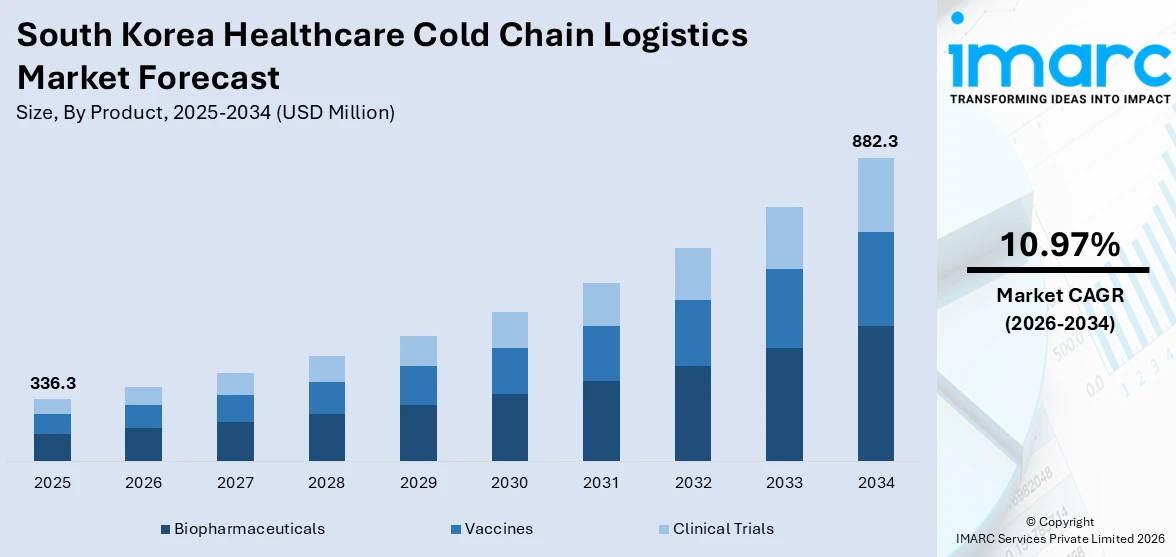
The South Korea healthcare cold chain logistics market size reached USD 336.3 Million in 2025. Looking forward, IMARC Group expects the market to reach USD 882.3 Million by 2034, exhibiting a growth rate (CAGR) of 10.97% during 2026-2034.
|
Report Attribute
|
Key Statistics
|
|---|---|
|
Base Year
|
2025 |
|
Forecast Years
|
2026-2034
|
|
Historical Years
|
2020-2025
|
| Market Size in 2025 | USD 336.3 Million |
| Market Forecast in 2034 | USD 882.3 Million |
| Market Growth Rate (2026-2034) | 10.97% |
Healthcare cold chain logistics help maintain the integrity of temperature-sensitive medical products like vaccines during transportation. They rely on a digital system for monitoring the cold chain and logistics at service delivery points and generating actionable data, which is provided to a designated person at each level of the cold chain. Nowadays, healthcare service providers require real-time monitoring and reporting for storing and transporting biological products. As a result, the demand for advanced healthcare cold chain logistics systems is rising in South Korea.
To get more information on this market Request Sample
South Korea Healthcare Cold Chain Logistics Market Trends:
The rising need for vaccines and biopharmaceuticals due to the increasing prevalence of infectious and chronic disorders represents one of the key factors catalyzing the demand for healthcare cold chain logistics in South Korea. Apart from this, the integration of augmented reality (AR), blockchain, and the internet of things (IoT) with cold chain monitoring systems to offer predictive alerts of warehouse management, transportation, and delivery is driving the market in the country. Furthermore, the escalating demand for transporting highly sophisticated clinical trial specimens and biologics is contributing to the market growth.
Key Market Segmentation:
IMARC Group provides an analysis of the key trends in each sub-segment of the South Korea healthcare cold chain logistics market report, along with forecasts at the country and regional levels from 2026-2034. Our report has categorized the market based on product and segment.
Breakup by Product:
- Biopharmaceuticals
- Vaccines
- Clinical Trials
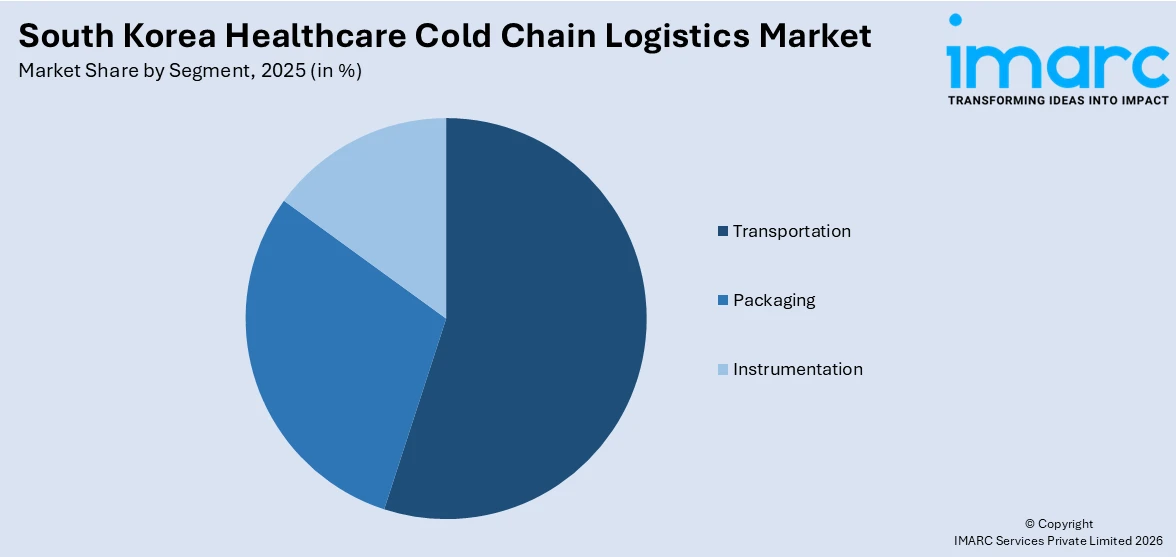
Breakup by Segment:
Access the comprehensive market breakdown Request Sample
- Transportation
- Packaging
- Instrumentation
Breakup by Region:
- East
- West
- Southwest
- Southeast
Competitive Landscape:
The competitive landscape of the industry has also been examined along with the profiles of the key players.
Report Coverage:
| Report Features | Details |
|---|---|
| Base Year of the Analysis | 2025 |
| Historical Period | 2020-2025 |
| Forecast Period | 2026-2034 |
| Units | Million USD |
| Segment Coverage | Product, Segment, Region |
| Region Covered | East, West, Southwest, Southeast |
| Customization Scope | 10% Free Customization |
| Post-Sale Analyst Support | 10-12 Weeks |
| Delivery Format | PDF and Excel through Email (We can also provide the editable version of the report in PPT/Word format on special request) |
Frequently Asked Questions About the South Korea Healthcare Cold Chain Logistics Market Report
We expect the South Korea healthcare cold chain logistics market to exhibit a CAGR of 10.97% during 2026-2034.
The rising demand for delivering clinical trial specimens and biologics is primarily driving the South Korea healthcare cold chain logistics market.
The sudden outbreak of the COVID-19 pandemic has led to the increasing utilization of healthcare cold chain logistics across the nation, to maintain the integrity of temperature-sensitive medical products, including vaccines, during their transportation.
Based on the product, the South Korea healthcare cold chain logistics has been divided into biopharmaceuticals, vaccines, and clinical trials. Among these, vaccines currently exhibit a clear dominance in the market.
Based on the segment, the South Korea healthcare cold chain logistics can be segmented into transportation, packaging, and instrumentation. Currently, transportation holds the majority of the total market share.
On a regional level, the market has been classified into East, West, Southwest, and Southeast.
Need more help?
- Speak to our experienced analysts for insights on the current market scenarios.
- Include additional segments and countries to customize the report as per your requirement.
- Gain an unparalleled competitive advantage in your domain by understanding how to utilize the report and positively impacting your operations and revenue.
- For further assistance, please connect with our analysts.
 Request Customization
 Speak to an Analyst
 Request Brochure
 Inquire Before Buying
Benefits of Customization
- Personalize this research
- Triangulate with your data
- Get data as per your format and definition
- Gain a deeper dive into a specific application, geography, customer, or competitor
- Any level of personalization
Get in Touch With Us
UNITED STATES
Phone: +1-201-971-6302
INDIA
Phone: +91-120-433-0800
UNITED KINGDOM
Phone: +44-753-714-6104
Email: [email protected]
Client Testimonials




.webp)




.webp)













Related Reports

Choose your plan
*Please note that the prices mentioned below are starting prices for each bundle type. Kindly contact our team for further details.*
Single User License
- 1 User License, Access on 2 Devices
- PDF Report + Excel Dataset (Password Protected)
- Lifetime Access
- No Printing Rights
- 10% Free Report Customization
- 10–12 Weeks of Analyst Support
Five User License
- Access for 5 Users, 2 Devices per User
- PDF Report + Excel Dataset (Password Protected)
- Lifetime Access
- Dedicated Account Manager
- 12–14 Weeks of Analyst Support
- No Printing Rights
- 15% Free Report Customization
- 25% Discount on Your Next Purchase
Corporate User License
- Unlimited User Access (Within Your Organization)
- PDF Report + Excel Dataset
- Lifetime Access
- Dedicated Account Manager
- 14–20 Weeks of Analyst Support
- No Printing Rights
- 20% Free Report Customization
- 30% Discount on Your Next Purchase
Essential Insights
What's included:
3 reports
- Lifetime Access
- PDF Reports
- Excel Datasets
- 2 Weeks of Free Analyst Support
- 2 User Licenses
- Access on 2 Devices
- Printing Rights
- Complimentary PowerPoint (PPT) Version
- Complimentary License Upgrade
Professional Access
What's included:
5 reports
- Lifetime Access
- PDF Reports
- Excel Datasets
- 8 Weeks of Free Analyst Support
- 2 User Licenses
- Access on 2 Devices
- Printing Rights
- Complimentary PowerPoint (PPT) Version
- Complimentary License Upgrade
Business Advantage
What's included:
8 reports
- Lifetime Access
- PDF Reports
- Excel Datasets
- 14 Weeks of Free Analyst Support
- 2 User Licenses
- Access on 2 Devices
- Printing Rights
- Complimentary PowerPoint (PPT) Version
- Complimentary License Upgrade
Enterprise Intelligence
What's included:
10 reports
- Lifetime Access
- PDF Reports
- Excel Datasets
- 20 Weeks of Free Analyst Support
- 2 User Licenses
- Access on 2 Devices
- Printing Rights
- Complimentary PowerPoint (PPT) Version
- Complimentary License Upgrade