
Squash Equipment Market Size, Share, Trends and Forecast by Product, Distribution Channel, and Region, 2026-2034
Squash Equipment Market Size, Share, Trends & Forecast (2026-2034)
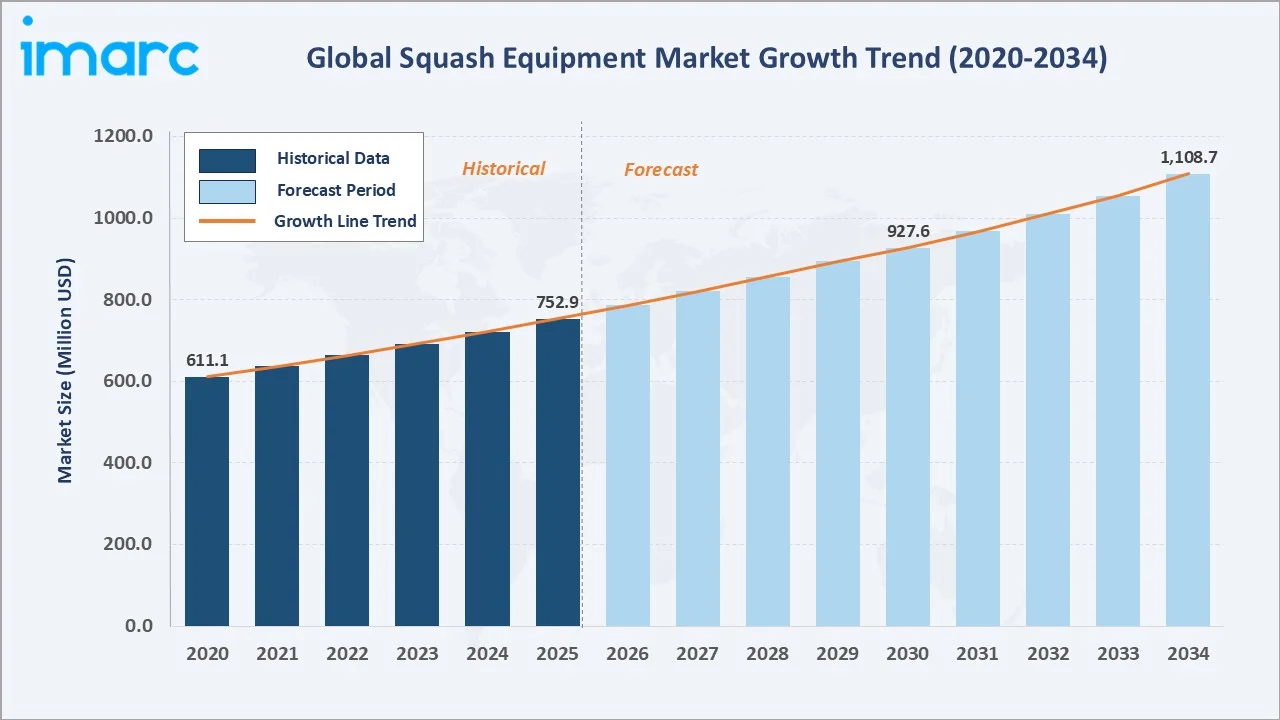
The global squash equipment market reached USD 752.9 Million in 2025 and is projected to reach USD 1,108.7 Million by 2034, growing at a CAGR of 4.26% during 2026-2034. Growth is driven by rising health consciousness, wider adoption of squash as a recreational sport, and expanding national and international leagues. Squash rackets dominate the product mix at 44.8% in 2025, while specialty and sports shops lead distribution at 49.6%. North America commands the largest regional share at 36.8%, supported by strong league participation and high consumer spending capacity.
Market Snapshot
|
Metric |
Value |
|
Market Size (2025) |
USD 752.9 Million |
|
Forecast Market Size (2034) |
USD 1,108.7 Million |
|
CAGR (2026-2034) |
4.26% |
|
Base Year |
2025 |
|
Historical Period |
2020-2025 |
|
Forecast Period |
2026-2034 |
|
Dominant Product |
Squash Rackets (44.8%, 2025) |
|
Leading Distribution Channel |
Specialty and Sports Shops (49.6%, 2025) |
|
Leading Region |
North America (36.8%, 2025) |
The global squash equipment market expanded from USD 611.1 Million in 2020 to USD 752.9 Million in 2025, anchored at USD 927.6 Million in 2030, and forecast to reach USD 1,108.7 Million by 2034. Post-pandemic recovery in organized sport, club membership growth, and rising disposable incomes sustained above-trend demand for squash rackets, balls, shoes, and accessories through 2022-2025.
To get more information on this market, Request Sample
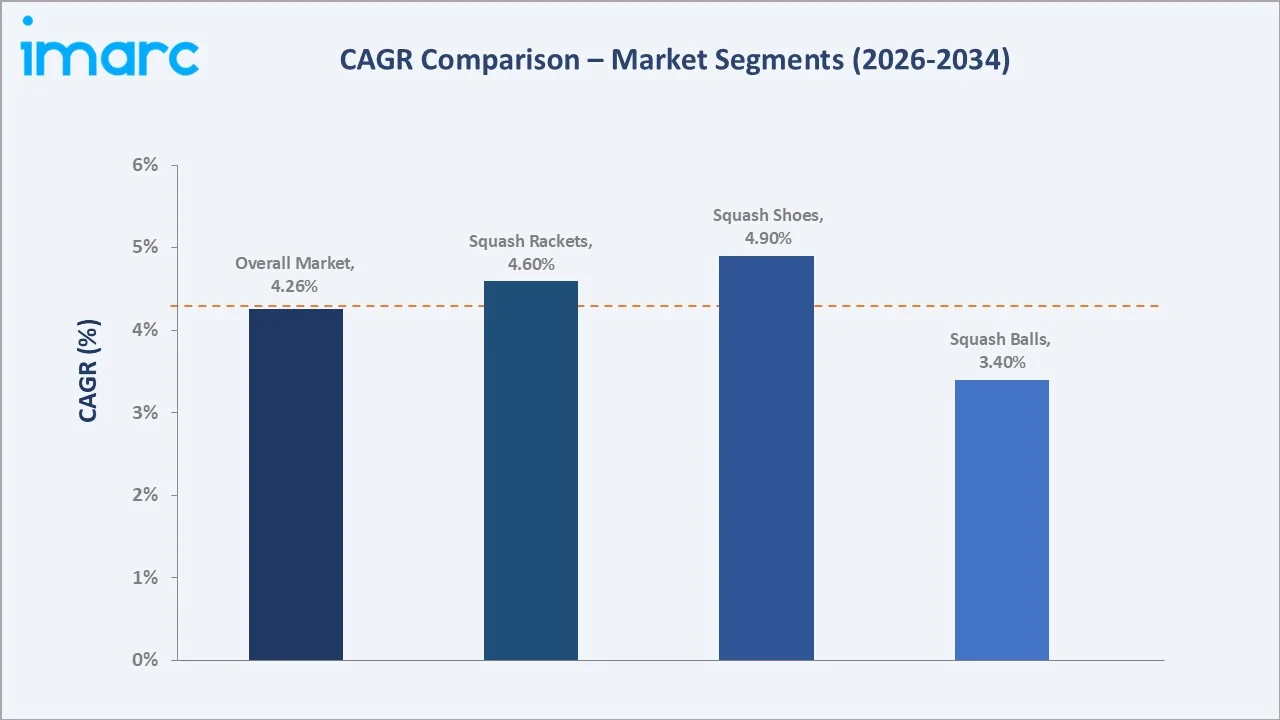
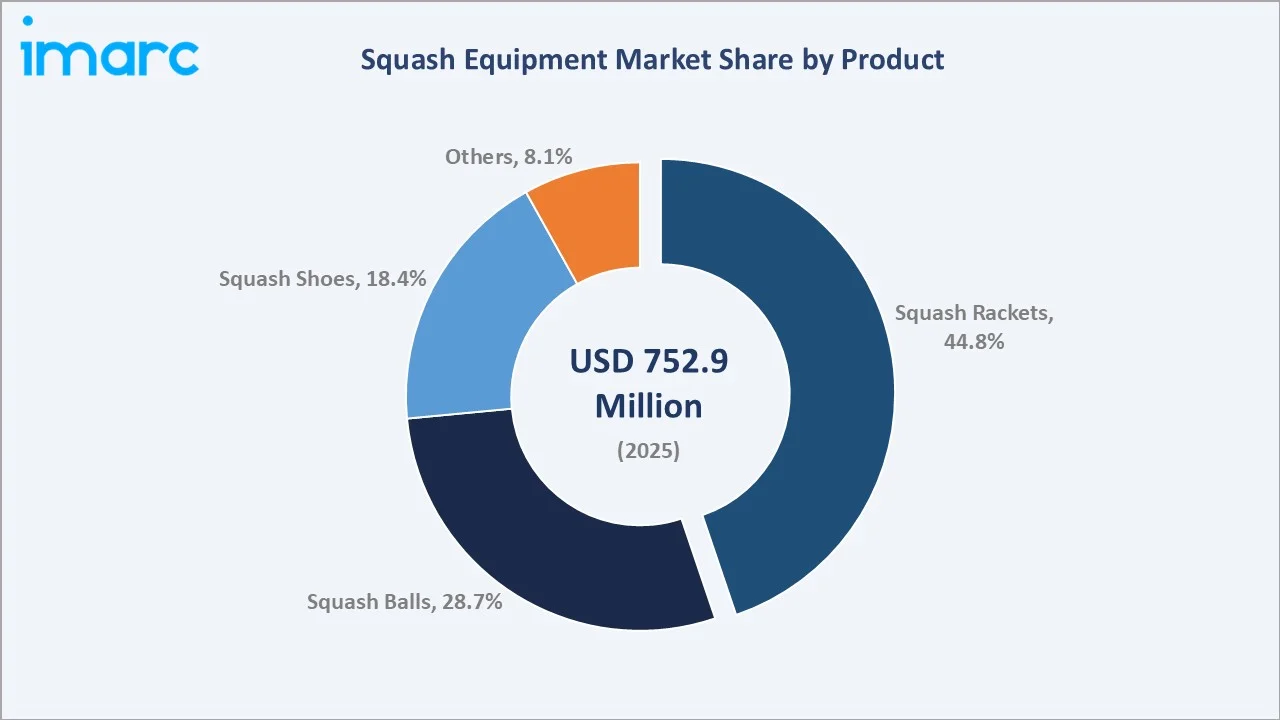
Squash shoes register the fastest product-level growth at an estimated 4.9% CAGR, reflecting rising demand for specialized court footwear that improves grip and reduces injury risk. Squash rackets grow at approximately 4.6% CAGR, supported by continuous frame material innovation and replacement demand among competitive players.
Executive Summary
The global squash equipment market reached USD 752.9 Million in 2025, reflecting the sport's steady expansion across recreational and competitive circuits worldwide. The market spans rackets, balls, footwear, apparel, and protective accessories manufactured for players of varying skill levels, from beginners at community clubs to professionals competing on the PSA World Tour.
Squash rackets lead the product mix at 44.8% share, driven by frequent replacement cycles and continuous demand for lighter, more durable frames. Specialty and sports shops remain the preferred distribution channel at 49.6%, reflecting buyers' preference for expert fitting advice and in-store racket testing before purchase. North America, at 36.8%, leads through high club membership density and strong collegiate and league participation.
Looking ahead, the market outlook remains positive as health-conscious consumers, expanding youth development programs, and eco-friendly material innovation continue to broaden the player base and replacement demand across all major regions through 2034.
Key Market Insights
|
Insight |
Data |
|
Dominant Product |
Squash Rackets - 44.8% share (2025) |
|
Leading Distribution Channel |
Specialty and Sports Shops - 49.6% share (2025) |
|
Leading Region |
North America - 36.8% market share (2025) |
|
Fastest Growing Product |
Squash Shoes - ~4.9% CAGR (2026-2034) |
|
Top Companies |
Head N.V., Sumitomo Rubber Industries (Dunlop Sports), Amer Sports, and MF Brands Group |
|
Market Opportunity |
Eco-friendly rackets; smart/connected sensors; e-commerce expansion; youth league sponsorship; emerging-market club development |
Key Analytical Observations Supporting The Above Data:
- Squash Rackets at 44.8%: The gutter-free single-piece composite construction and premium graphite blends preferred by competitive players drive frequent racket upgrades, reinforcing this segment's leading share.
- Squash Balls at 28.7%: Consumable equipment purchased repeatedly per season, balls sustain a resilient revenue base of 28.7%, supported by standardized tournament specifications set by the World Squash Federation.
- Specialty and Sports Shops at 49.6%: In-store fitting for racket grip size, weight balance, and string tension remains critical for performance equipment, sustaining specialty retail dominance despite e-commerce growth.
- Online Stores at 29.1%: Online stores are gaining share at 29.1% as digitally native brands and marketplace platforms expand access to squash gear in regions with limited specialty retail infrastructure.
- North America at 36.8%: Dense club networks, established scholastic and collegiate squash programs, and higher per-capita sporting goods spending underpin North America's 36.8% leadership position.
- Europe at 31.4%: Rising participation in England and France, combined with strong PSA World Tour viewership, supports Europe's 31.4% share and sustained equipment replacement demand.
Global Squash Equipment Market Overview
The global squash equipment market encompasses the design, manufacturing, and distribution of rackets, balls, footwear, apparel, and protective accessories used in singles and doubles squash. The ecosystem links raw material suppliers, frame and component manufacturers, brand licensing partners, and multi-channel retail networks that reach recreational and competitive players.
Macroeconomic factors including rising disposable incomes, urban club infrastructure growth, and youth sports development funding are accelerating equipment demand. Increasing health consciousness and expanding international league coverage further support wider adoption of squash as both a fitness and competitive activity.
Market Dynamics
To evaluate market opportunities, Request Sample
Market Drivers
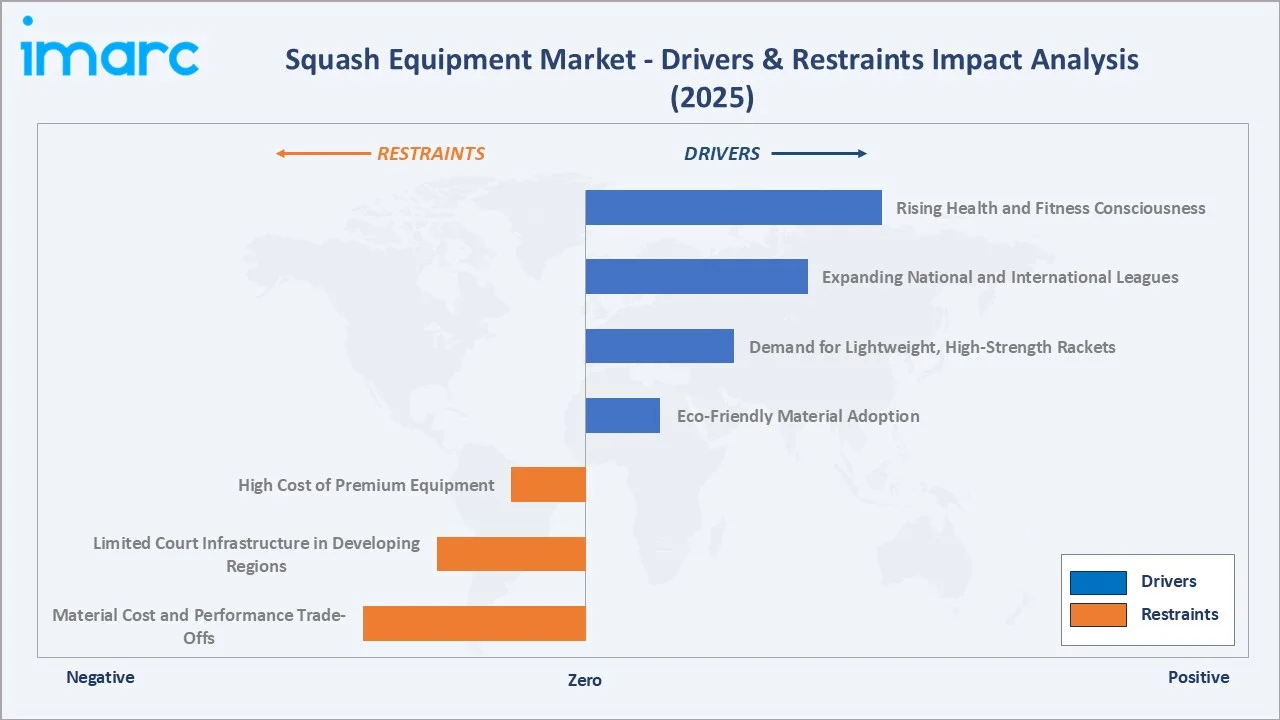
- Rising Health and Fitness Consciousness: Growing awareness of squash's cardiovascular and full-body fitness benefits is expanding the recreational player base, directly lifting demand for entry-level rackets, balls, and shoes across community and corporate fitness clubs worldwide.
- Expanding National and International Leagues: The introduction of new national and international leagues, along with growing PSA World Tour viewership, is increasing regular player participation rates and boosting replacement purchases of performance-grade equipment.
- Demand for Lightweight, High-Strength Rackets: Consumers increasingly seek rackets that balance power, control, and maneuverability, pushing manufacturers toward advanced graphite and composite frame technologies that command premium price points.
- Eco-Friendly Material Adoption: Manufacturers are replacing synthetic rubber and traditional leather with water-based adhesives, recycled plastics, and non-toxic thermoplastic elastomers, appealing to environmentally conscious buyers.
Market Restraints
- High Cost of Premium Equipment: Premium graphite rackets and specialized court footwear carry high price points, limiting adoption among price-sensitive recreational players in developing markets.
- Limited Court Infrastructure in Developing Regions: Squash court availability remains concentrated in mature markets, constraining new player acquisition and equipment sales growth in regions with limited sporting infrastructure.
Market Opportunities
- Sustainable Product Innovation: Growing demand for recyclable ball compounds and biodegradable racket grips presents an opportunity for manufacturers to differentiate through sustainability credentials.
- Smart and Connected Equipment: Integration of impact and swing-tracking sensors into rackets offers a premium upsell opportunity as players seek data-driven performance improvement tools.
Market Challenges
- Material Cost and Performance Trade-Offs: Balancing frame stiffness, weight, and durability while keeping production costs competitive remains a persistent engineering challenge for racket manufacturers.
- Counterfeit Product Circulation: Counterfeit rackets and balls sold through unauthorized online channels undermine brand equity and consumer trust in certain price-sensitive markets.
Emerging Market Trends
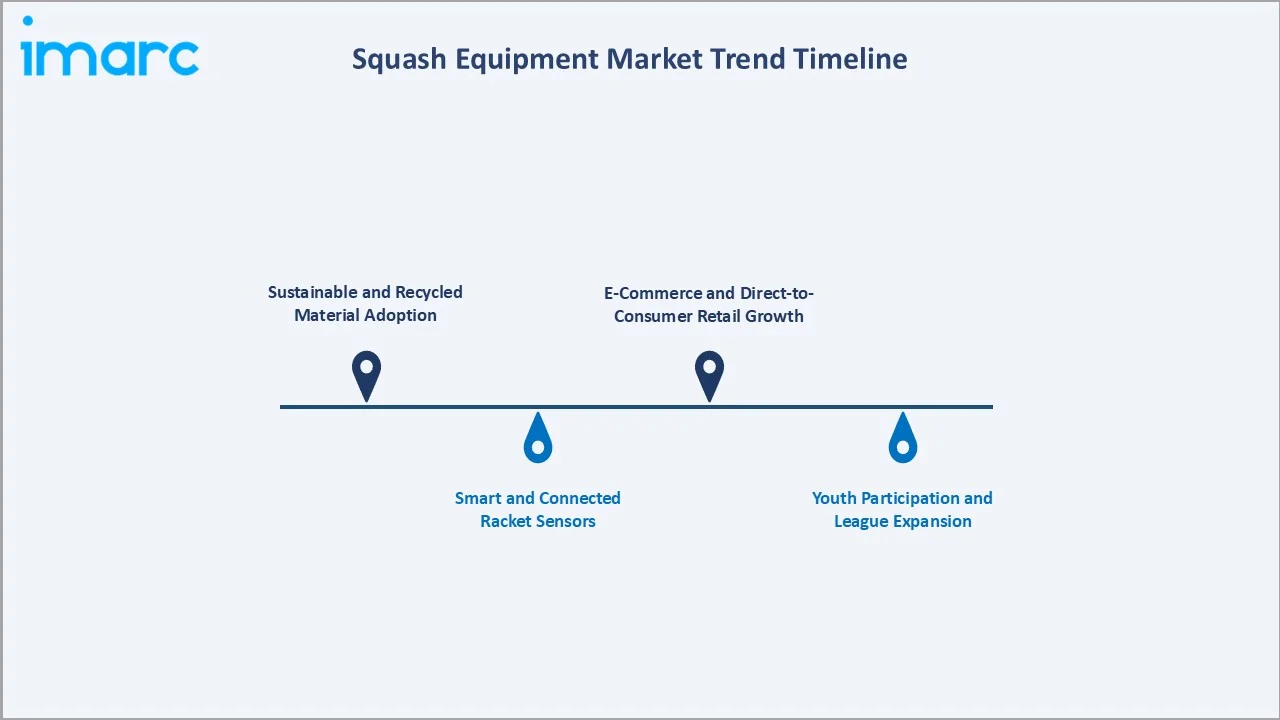
1. Sustainable and Recycled Material Adoption
Manufacturers are increasingly using recycled plastics and bio-based composites in racket frames and ball cores. This shift responds to growing consumer demand for environmentally responsible sporting goods without compromising performance.
2. Smart and Connected Racket Sensors
Embedded sensors that track swing speed, impact location, and shot power are entering the premium racket segment. These tools help competitive players analyze technique and are gradually filtering into club-level training programs.
3. E-Commerce and Direct-to-Consumer Retail Growth
Brands are expanding direct-to-consumer online stores alongside traditional specialty retail, using virtual fitting tools and video content to replicate the in-store advisory experience for racket selection.
4. Youth Participation and League Expansion
Federations and clubs are launching junior development programs and school partnerships to grow the player pipeline. This is expanding demand for entry-level and junior-sized equipment across new and existing markets.
Industry Value Chain Analysis
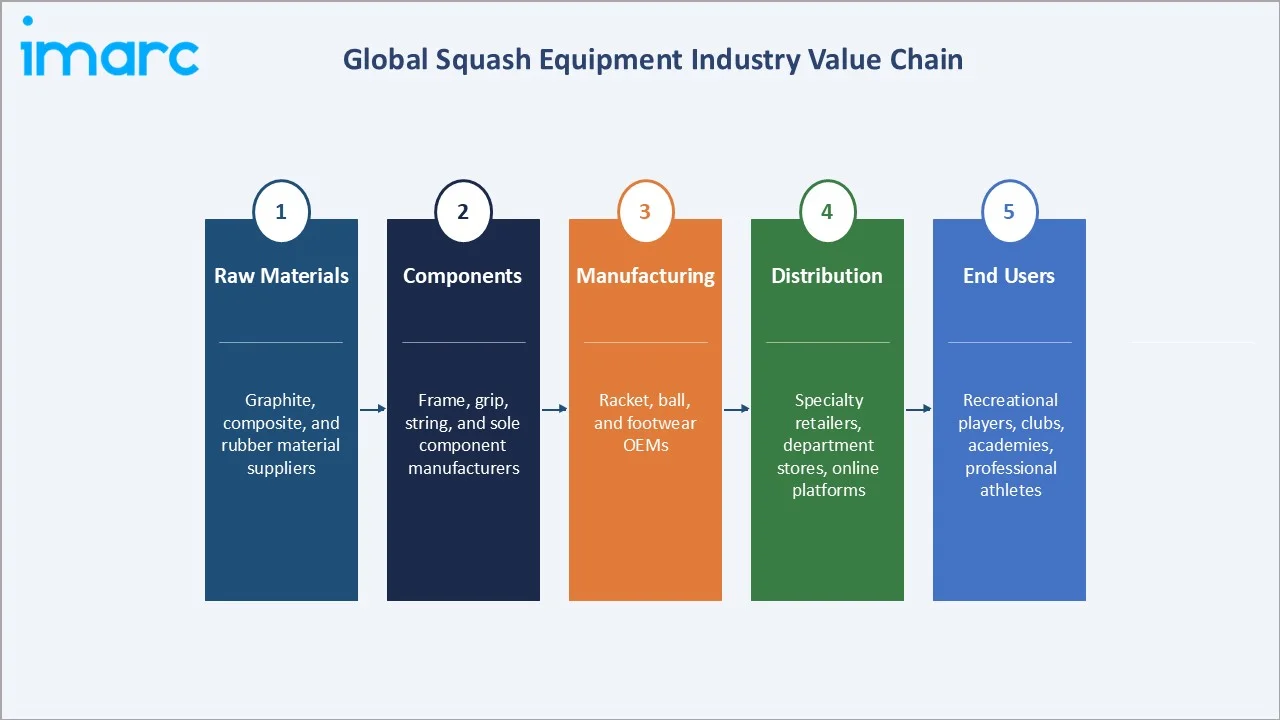
The squash equipment value chain integrates raw material sourcing, component and frame manufacturing, quality testing and assembly, multi-channel distribution, and end-use consumption by recreational and competitive players.
|
Stage |
Key Participants |
|
Raw Materials |
Graphite, composite, and rubber material suppliers |
|
Components |
Frame, grip, string, and sole component manufacturers |
|
Manufacturing |
Racket, ball, and footwear OEMs |
|
Distribution |
Specialty retailers, department stores, online platforms |
|
End Users |
Recreational players, clubs, academies, professional athletes |
Manufacturing and quality testing form the value chain's most technically demanding stage, where frame stiffness, weight balance, and durability are calibrated to competitive-play standards. Distribution partnerships with specialty retailers sustain the fitting-advisory experience that supports premium racket sales.
Technology Landscape in the Squash Equipment Industry
Advanced Frame Composite Technology
Graphite and carbon-composite frame technology enables lighter rackets with improved power transfer and control. Manufacturers continue refining resin layups to balance stiffness and shock absorption for competitive players.
Ball Compound Engineering
Rubber compound formulations determine bounce consistency across temperature ranges. Standardized dot-coding systems help players select balls matched to their skill level and court conditions.
Smart Connectivity
Sensor-embedded rackets and wearable trackers are enabling swing analytics, gradually extending from professional training environments into premium consumer products.
Footwear Cushioning and Grip Technology
Court-specific outsole compounds and multi-directional cushioning systems reduce injury risk during rapid lateral movement, a critical design focus for squash-specific footwear manufacturers.
Market Segmentation Analysis
The report covers the following segments:
|
Segment Category |
Leading Segment |
Market Share |
Year |
|
Product |
Squash Rackets |
44.8% |
2025 |
|
Distribution Channel |
Specialty and Sports Shops |
49.6% |
2025 |
|
Region |
North America |
36.8% |
2025 |

By Product
Squash rackets lead at 44.8% (2025), encompassing premium graphite composite frames used by competitive players and entry-level aluminum-hybrid models for recreational buyers.
To access detailed market analysis, Request Sample
Squash balls hold 28.7% share, sustained by standardized replacement cycles across club and tournament play. Squash shoes, at 18.4%, grow fastest at an estimated 4.9% CAGR as players prioritize specialized grip and injury-prevention footwear. Others, at 8.1%, cover apparel, eyewear, grips, and racket bags.
By Distribution Channel
Specialty and sports shops lead at 49.6% (2025), reflecting buyers' preference for expert fitting guidance when selecting performance rackets.
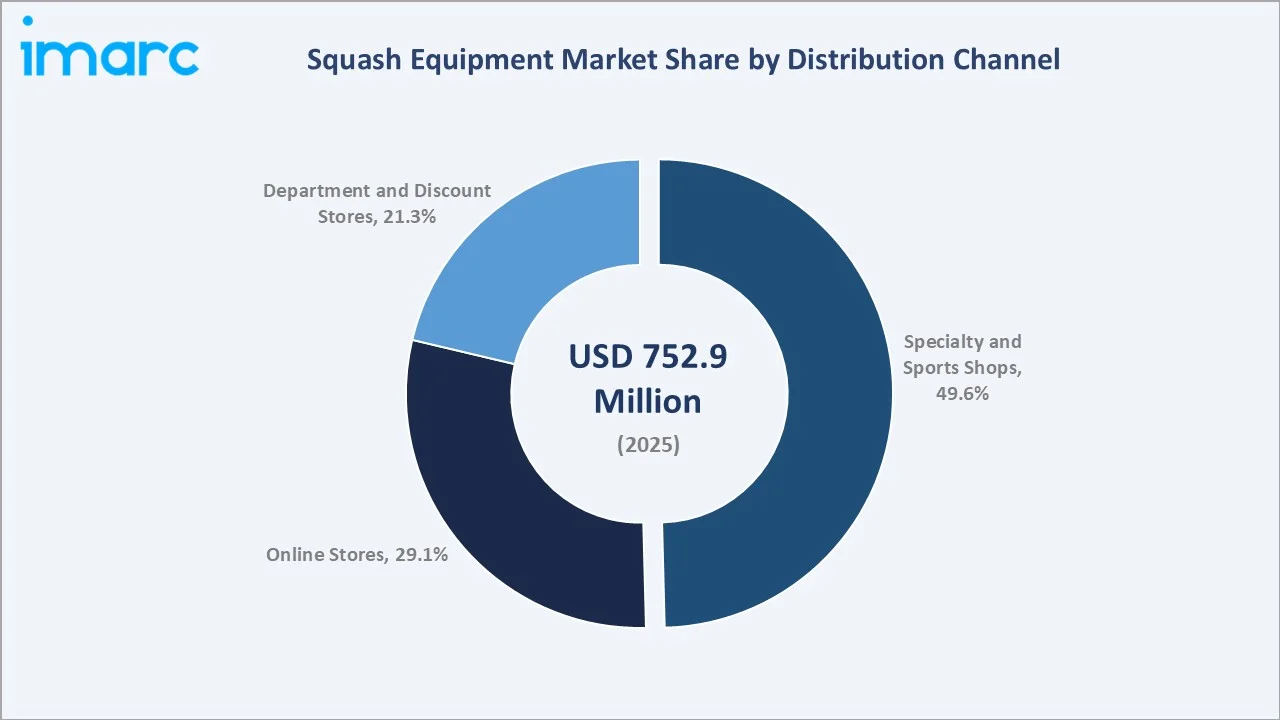
Online stores account for 29.1% and represent the fastest-growing channel as digitally native brands expand direct-to-consumer reach. Department and discount stores hold 21.3%, serving price-sensitive recreational buyers seeking entry-level equipment.
Regional Market Insights
|
Region |
Share (2025) |
Key Squash Equipment Market Drivers & Characteristics |
|
North America |
36.8% |
Driven by dense club networks, collegiate squash programs, and high per-capita sporting goods spending. |
|
Europe |
31.4% |
Supported by strong PSA World Tour viewership and established squash traditions in the UK and France. |
|
Asia-Pacific |
22.5% |
Driven by rising middle-class participation, new court construction, and government sports promotion in India and Malaysia. |
|
Latin America |
5.3% |
Supported by growing club membership and emerging national federation development programs. |
|
Middle East and Africa |
4.0% |
Anchored by Egypt's elite competitive squash tradition and expanding academy infrastructure. |
North America's 36.8% leadership is anchored by the United States' extensive club and collegiate squash network alongside Canada's growing junior participation programs. Europe's 31.4% reflects the region's deep competitive squash heritage across the UK and France diaspora communities.
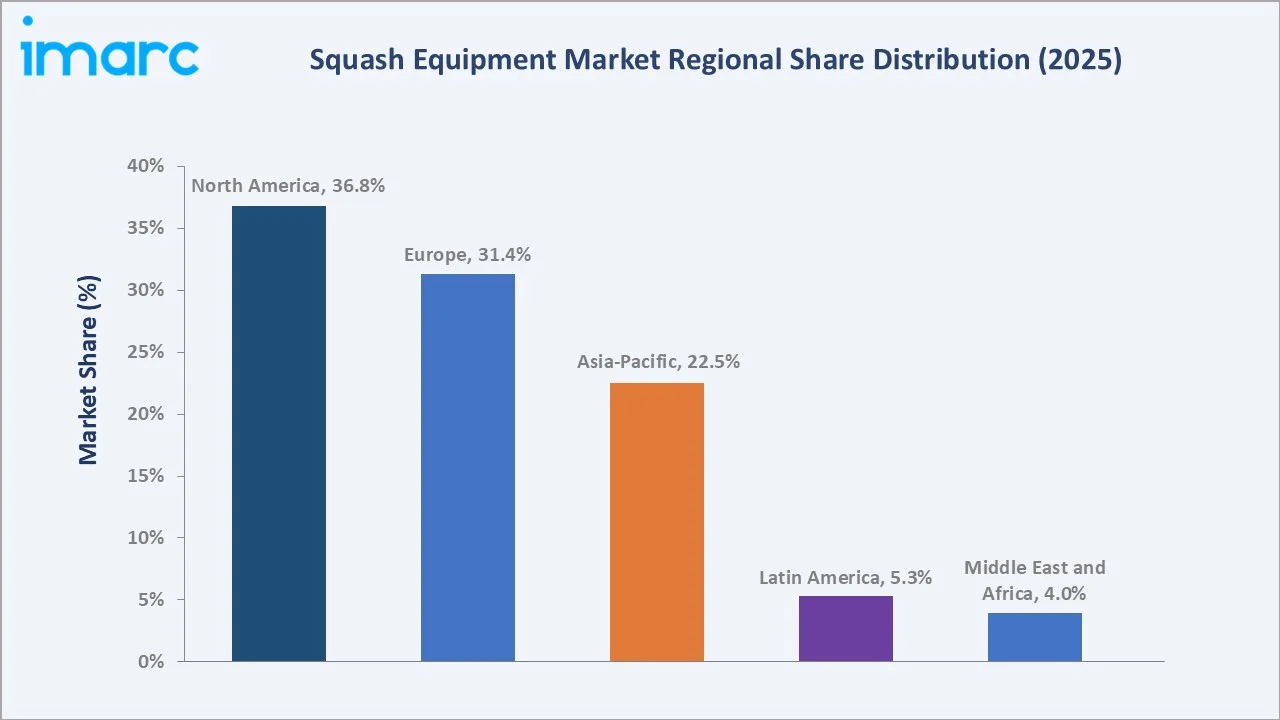
Asia-Pacific's 22.5% share reflects rising middle-class sports participation in India, China, and Malaysia. The Middle East and Africa, at 4.0%, benefits from Egypt's globally recognized elite player pipeline and academy investment.
Competitive Landscape
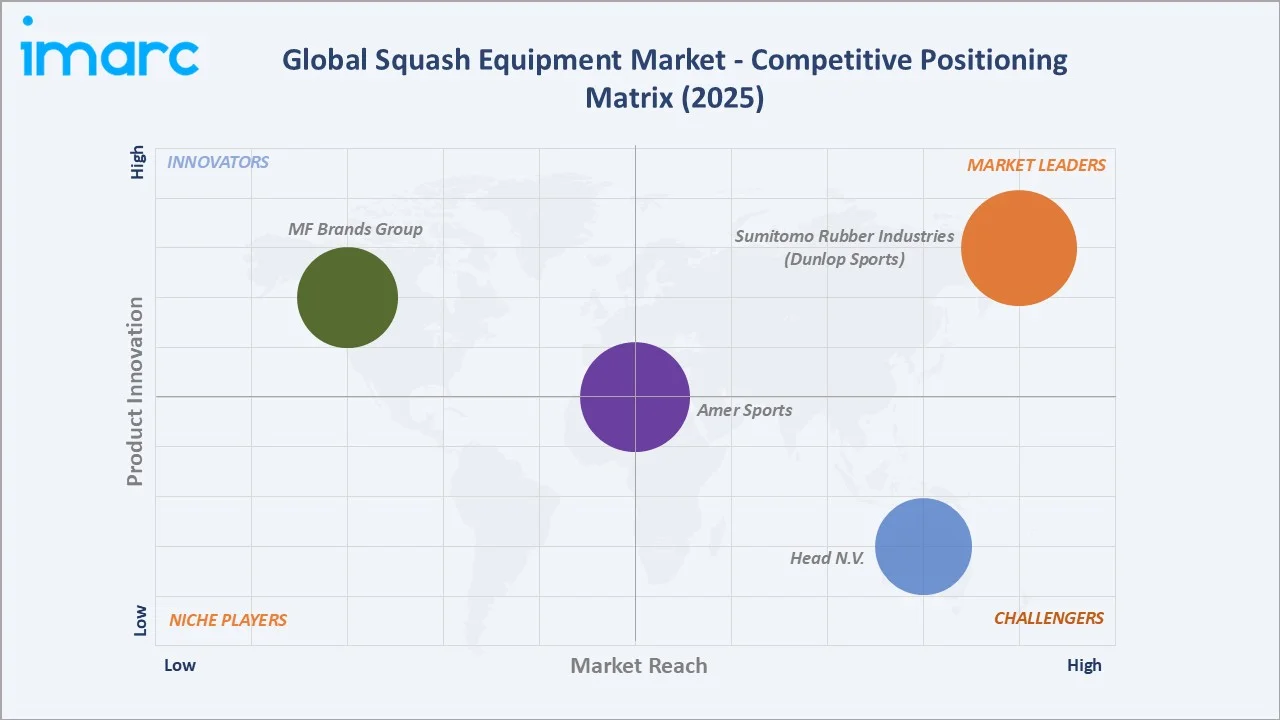
The global squash equipment market competitive landscape spans established racket sports brands, diversified sporting goods conglomerates, and specialized squash-focused manufacturers.
|
Company Name |
Key Products |
Market Position |
Core Strength |
|
Head N.V. |
Head Speed 120 Squash Racquet, HEAD Prime Double Dot Squash Ball, HEAD Pro Elite Squash Eyewear |
Strong Challenger |
HEAD plays a central role in squash through advanced graphite frame technology and professional player endorsements that reinforce performance credibility. |
|
Sumitomo Rubber Industries (Dunlop Sports) |
FX 128 Pro Racket, Pro Double Dot Ball, Vision Eyewear |
Market Leader |
Dunlop is the official ball and racket supplier of the PSA World Tour, giving it strong visibility among competitive and club-level players. |
|
Amer Sports |
Wilson Blade Team, Wilson Ultra Pro 300, Staff Squash Balls |
Established Player |
Operates via Wilson Sporting Good Company which leverages Amer Sports' global distribution network and cross-category racket sports expertise to serve recreational and club players. |
|
MF Brands Group |
Carboflex X-Top and Slash racket lines |
Innovator |
Owns Tecnifibre, pioneering X-Top bumperless frame technology, and polyurethane-impregnated string lines |
Brand endorsement of top-ranked PSA World Tour players sustains competitive differentiation among leading manufacturers. Consolidation reflects distributors' preference for suppliers offering full racket, ball, and footwear product lines.
Key Company Profiles
HEAD N.V.
HEAD N.V., via its wholly-owned subsidiary HEAD Sport GmbH, is a leading manufacturer of racket sports equipment, including squash, tennis, and badminton rackets. The company is headquartered in Kennelbach, Austria, and supplies performance equipment to elite and recreational players worldwide.
- Key Products: Head Speed 120 Squash Racquet, HEAD Prime Double Dot Squash Ball, HEAD Pro Elite Squash Eyewear, and others.
- Strategic Focus: Focused on lightweight graphite frame innovation, professional player endorsements, and expanding its squash product range alongside its established tennis and badminton lines.
Sumitomo Rubber Industries (Dunlop Sports)
Dunlop Sports, which is operated by Sumitomo Rubber Industries (SRI Sports), is a prominent sports equipment manufacturer with over a century of racket sports heritage. The company is the official ball and racket supplier of the PSA World Tour, giving it strong brand visibility among competitive squash players.
- Key Products: FX 128 Pro Racket, Pro Double Dot Ball, Vision Eyewear, and others.
- Strategic Focus: Centered on maintaining its PSA World Tour supplier relationship and expanding its junior and club-level racket range to broaden recreational adoption.
Amer Sports
Amer Sports, which is active in the squash equipment market via its subsidiary Wilson Sporting Goods Company, is a global sporting goods manufacturer with an established presence in racket sports equipment, including squash rackets, balls, and accessories.
- Key Products: Wilson Blade Team, Wilson Ultra Pro 300, Staff Squash Balls, and others.
- Strategic Focus: Centered on cross-category racket sports expertise and broadening distribution reach through Amer Sports' global retail network.
Market Concentration Analysis
The global squash equipment market is moderately fragmented, with established racket sports brands such as HEAD, Dunlop, and Wilson holding meaningful but non-dominant shares alongside specialized manufacturers including Tecnifibre, Karakal, and Harrow Sports. The top five players collectively account for an estimated 35-40% of global revenue, while regional and niche brands serve localized club and academy demand. Market concentration is gradually increasing as larger sporting goods conglomerates acquire specialized racket sports brands to broaden their category coverage.
Investment & Growth Opportunities
Highest Growth Segments
Squash shoes (~4.9% CAGR), online distribution (~29.1% share and rising), and squash rackets in Asia-Pacific (~5-6% regional CAGR) represent the highest-growth investment vectors through 2034, supported by expanding club infrastructure and digital retail adoption.
Emerging Investment Opportunities
Asia-Pacific's expanding middle class and new court construction represent the largest near-term opportunity for equipment manufacturers and distributors establishing early brand presence in India, China, and Malaysia.
Investment Themes
- Sustainable Material Investment: Recyclable rubber ball compounds and biodegradable grip materials position manufacturers to capture demand from environmentally conscious buyers while reducing long-term material costs.
- Smart Equipment Platform Development: Sensor-embedded rackets and companion training apps create a subscription-adjacent revenue opportunity beyond one-time equipment sales, particularly among competitive and academy players.
Future Market Outlook (2026-2034)
The global squash equipment market is projected to grow from USD 752.9 Million in 2025 to USD 1,108.7 Million by 2034, delivering a 4.26% CAGR over the forecast period. The market's anchor value of USD 927.6 Million in 2030 reflects steady, policy- and participation-driven expansion rather than cyclical volatility, as youth development programs and league growth continue to broaden the global player base.
Three structural forces define market growth through 2034. Rising global health consciousness sustains recreational participation regardless of broader economic conditions. Expanding national and international league coverage increases visibility and drives replacement purchases among competitive players. Sustainable material innovation is making premium equipment more accessible to environmentally conscious younger consumers, widening the addressable market over the coming decade.
Research Methodology
Primary Research
Primary research comprised structured interviews with squash equipment manufacturers, specialty retail buyers, distribution partners, and squash federation representatives across major regional markets.
Secondary Research
Secondary research encompassed sporting goods industry publications, company annual reports, federation participation statistics, and trade association data covering the historical and forecast period.
Forecasting Models
Market revenue forecasts were developed using a segment bottom-up model covering product type, distribution channel, and regional components, validated against top-down market sizing benchmarks.
Report Coverage:
| Report Features | Details |
|---|---|
| Base Year of the Analysis | 2025 |
| Historical Period | 2020-2025 |
| Forecast Period | 2026-2034 |
| Units | Million USD |
| Scope of the Report | Exploration of Historical Trends and Market Outlook, Industry Catalysts and Challenges, Segment-Wise Historical and Predictive Market Assessment:
|
| Products Covered | Squash Rackets, Squash Balls, Squash Shoes, Others |
| Distribution Channels Covered | Specialty and Sports Shops, Department and Discount Stores, Online Stores |
| Region Covered | Asia Pacific, Europe, North America, Latin America, Middle East and Africa |
| Countries Covered | United States, Canada, Germany, France, United Kingdom, Italy, Spain, Russia, China, Japan, India, South Korea, Australia, Indonesia, Brazil, Mexico |
| Companies Covered | Head N.V., Sumitomo Rubber Industries (Dunlop Sports), Amer Sports, MF Brands Group, etc. |
| Customization Scope | 10% Free Customization |
| Post-Sale Analyst Support | 10-12 Weeks |
| Delivery Format | PDF and Excel through Email (We can also provide the editable version of the report in PPT/Word format on special request) |
Key Benefits for Stakeholders:
- IMARC’s report offers a comprehensive quantitative analysis of various market segments, historical and current market trends, market forecasts, and dynamics of the squash equipment market from 2020-2034.
- The research study provides the latest information on the market drivers, challenges, and opportunities in the global squash equipment market.
- The study maps the leading as well as the fastest growing regional markets. It further enables stakeholders to identify the key country-level markets within each region.
- Porter's five forces analysis assist stakeholders in assessing the impact of new entrants, competitive rivalry, supplier power, buyer power, and the threat of substitution. It helps stakeholders to analyze the level of competition within the squash equipment industry and its attractiveness.
- The competitive landscape allows stakeholders to understand their competitive environment and provides an insight into the current positions of key players in the market.
Frequently Asked Questions About the Squash Equipment Market Report
The global squash equipment market reached USD 752.9 Million in 2025, driven by rising health consciousness, league expansion, and demand for high-performance rackets.
The market is projected to reach USD 1,108.7 Million by 2034, growing at a CAGR of 4.26% during 2026-2034.
The market is expected to grow at a CAGR of 4.26% during the 2026-2034 forecast period, supported by steady participation growth.
Squash rackets lead at 44.8% share in 2025, driven by frequent replacement cycles and continuous frame material innovation.
Specialty and sports shops lead at 49.6% share, reflecting buyer preference for expert fitting guidance on performance rackets.
North America leads at 36.8% share, supported by dense club networks and strong collegiate squash participation.
The market is projected to reach approximately USD 927.6 Million by 2030, continuing its steady historical growth trajectory.
Leading companies include Head N.V., Sumitomo Rubber Industries (Dunlop Sports), Amer Sports, and MF Brands Group, among others.
Growth is driven by rising health consciousness, expanding leagues, demand for lightweight rackets, and increasing use of eco-friendly materials.
The market was valued at USD 611.1 Million in 2020, growing steadily through the historical period to reach USD 752.9 Million by 2025.
Need more help?
- Speak to our experienced analysts for insights on the current market scenarios.
- Include additional segments and countries to customize the report as per your requirement.
- Gain an unparalleled competitive advantage in your domain by understanding how to utilize the report and positively impacting your operations and revenue.
- For further assistance, please connect with our analysts.
 Request Customization
 Speak to an Analyst
 Request Brochure
 Inquire Before Buying
Benefits of Customization
- Personalize this research
- Triangulate with your data
- Get data as per your format and definition
- Gain a deeper dive into a specific application, geography, customer, or competitor
- Any level of personalization
Get in Touch With Us
UNITED STATES
Phone: +1-201-971-6302
INDIA
Phone: +91-120-433-0800
UNITED KINGDOM
Phone: +44-753-714-6104
Email: [email protected]
Client Testimonials




.webp)




.webp)













Related Reports

Choose your plan
*Please note that the prices mentioned below are starting prices for each bundle type. Kindly contact our team for further details.*
Single User License
- 1 User License, Access on 2 Devices
- PDF Report + Excel Dataset (Password Protected)
- Lifetime Access
- No Printing Rights
- 10% Free Report Customization
- 10–12 Weeks of Analyst Support
Five User License
- Access for 5 Users, 2 Devices per User
- PDF Report + Excel Dataset (Password Protected)
- Lifetime Access
- Dedicated Account Manager
- 12–14 Weeks of Analyst Support
- No Printing Rights
- 15% Free Report Customization
- 25% Discount on Your Next Purchase
Corporate User License
- Unlimited User Access (Within Your Organization)
- PDF Report + Excel Dataset
- Lifetime Access
- Dedicated Account Manager
- 14–20 Weeks of Analyst Support
- No Printing Rights
- 20% Free Report Customization
- 30% Discount on Your Next Purchase
Essential Insights
What's included:
3 reports
- Lifetime Access
- PDF Reports
- Excel Datasets
- 2 Weeks of Free Analyst Support
- 2 User Licenses
- Access on 2 Devices
- Printing Rights
- Complimentary PowerPoint (PPT) Version
- Complimentary License Upgrade
Professional Access
What's included:
5 reports
- Lifetime Access
- PDF Reports
- Excel Datasets
- 8 Weeks of Free Analyst Support
- 2 User Licenses
- Access on 2 Devices
- Printing Rights
- Complimentary PowerPoint (PPT) Version
- Complimentary License Upgrade
Business Advantage
What's included:
8 reports
- Lifetime Access
- PDF Reports
- Excel Datasets
- 14 Weeks of Free Analyst Support
- 2 User Licenses
- Access on 2 Devices
- Printing Rights
- Complimentary PowerPoint (PPT) Version
- Complimentary License Upgrade
Enterprise Intelligence
What's included:
10 reports
- Lifetime Access
- PDF Reports
- Excel Datasets
- 20 Weeks of Free Analyst Support
- 2 User Licenses
- Access on 2 Devices
- Printing Rights
- Complimentary PowerPoint (PPT) Version
- Complimentary License Upgrade