
Synthetic Rope Market Size, Share, Trends and Forecast by Raw Material, Distribution Channel, End User, and Region, 2026-2034
Synthetic Rope Market Size, Share, Trends & Forecast (2026-2034)
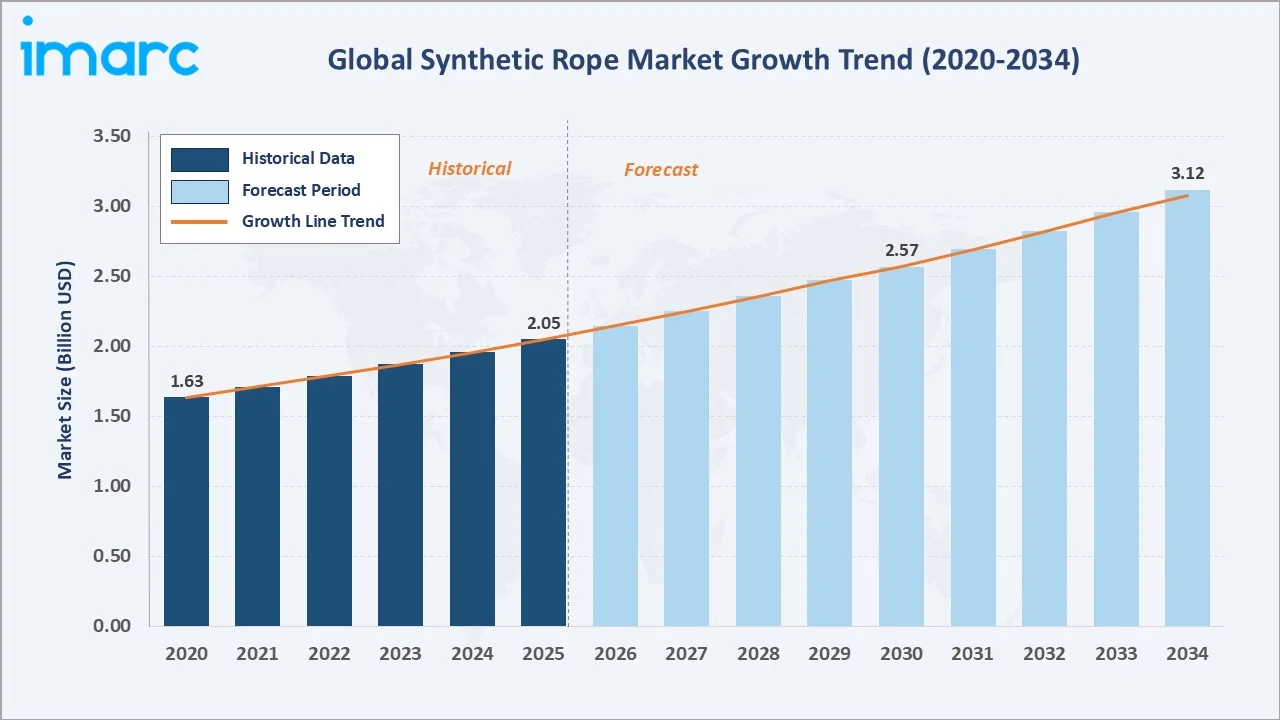
The global synthetic rope market reached USD 2.05 Billion in 2025 and is projected to reach USD 3.12 Billion by 2034, growing at a CAGR of 4.63% during 2026-2034. Expanding global offshore oil and gas operations, strong growth in marine shipping and fishing fleet activity, increasing adoption of high-performance synthetic alternatives to steel wire rope in lifting and mooring applications, and growing demand across construction and sports leisure sectors are the primary growth catalysts.
Market Snapshot
|
Metric |
Value |
|
Market Size (2025) |
USD 2.05 Billion |
|
Forecast Market Size (2034) |
USD 3.12 Billion |
|
CAGR (2026-2034) |
4.63% |
|
Base Year |
2025 |
|
Historical Period |
2020-2025 |
|
Forecast Period |
2026-2034 |
North America leads regionally with a 32.8% market share in 2025, driven by the United States' dominant offshore oil and gas sector and extensive marine and fishing fleet operations. Polypropylene is the leading raw material at 31.8%, while marine and fishing is the largest end user at 34.2%, reflecting the critical role of synthetic ropes in commercial fishing and port operations worldwide.
To get more information on this market, Request Sample
The global synthetic rope market is underpinned by three structural forces: the continued expansion of offshore energy infrastructure requiring high-performance mooring and lifting rope, the growth of global maritime trade driving demand for vessel mooring and handling ropes, and the ongoing weight-performance substitution of steel wire rope by high-modulus polyethylene (HMPE) and polyester ropes in demanding applications.
Executive Summary
The global synthetic rope market is experiencing steady growth, underpinned by the essential nature of rope and cordage products across marine, energy, construction, and leisure sectors worldwide. The market was valued at USD 2.05 Billion in 2025 and is forecast to reach USD 3.12 Billion by 2034 at a CAGR of 4.63%. This trajectory reflects both steady volume growth in traditional markets and increasing average selling price uplift from the substitution of commodity polypropylene ropes with higher-value specialty fiber products in demanding applications.
Polypropylene dominates raw materials at 31.8% in 2025, owing to its cost-effectiveness, buoyancy, and resistance to moisture, making it the preferred choice for general marine, fishing, and agricultural applications. Polyester at 25.4% is the leading fiber for high-load applications requiring dimensional stability and UV resistance, including offshore mooring lines and yacht racing rigging.
Marine and fishing leads end use at 34.2%, reflecting the fundamental dependency of global fishing fleets, port operations, and merchant shipping on synthetic rope for mooring, trawling, and deck handling. Oil and gas at 24.6% is driven by deepwater mooring system requirements where HMPE mooring lines replace steel wire at depths exceeding 1,000 metres.
Key Market Insights
|
Insight |
Data |
|
Largest Raw Material |
Polypropylene – 31.8% share (2025) |
|
Fastest Growing Raw Material |
Specialty Fibers – ~5.8% CAGR (2026-2034) |
|
Largest End User |
Marine and Fishing – 34.2% share (2025) |
|
Fastest Growing End User |
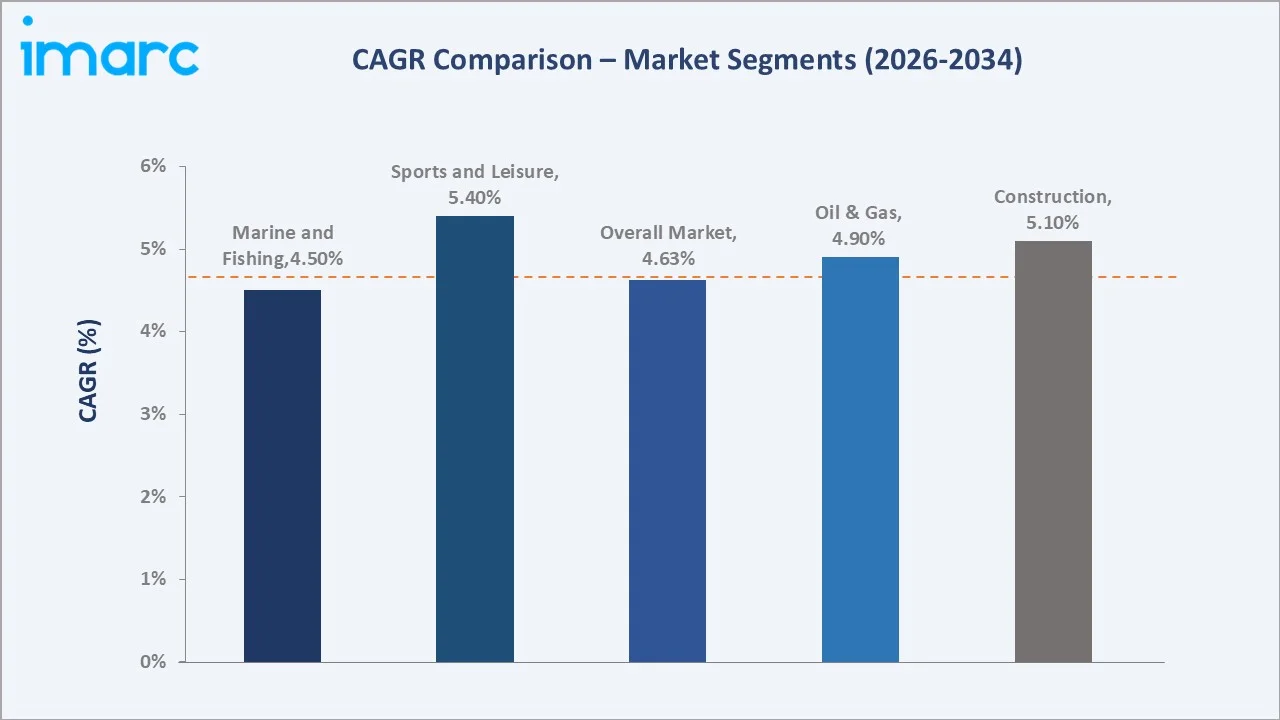
Sports and Leisure – ~5.4% CAGR (2026-2034) |
|
Leading Region |
North America – 32.8% share (2025) |
|
Top Companies |
Wind River Holdings, WireCo, Teufelberger, Bekaert |
Key Analytical Observations Supporting The Above Data:
- Polypropylene accounts for 31.8% of global synthetic rope raw material consumption in 2025. Its dominance reflects its optimal balance of cost, processing ease, buoyancy, and chemical resistance for the high-volume mass-market rope segments where premium fiber performance is not required and competitive price per kilogram is the primary procurement criterion.
- Marine and fishing commands 34.2% of global synthetic rope demand in 2025, reflecting the segment's breadth across commercial fishing fleets requiring gillnets, trawl warps, and mooring lines; port and terminal operations requiring vessel mooring and tug tow lines; and the global merchant shipping fleet's ongoing requirement for hawsers, mooring lines, and heaving lines at every port call worldwide.
- North America's 32.8% regional leadership (2025) is driven by the United States' combination of one of rices fluctuations the world's largest offshore oil and gas industry, one of the largest commercial fishing fleets, dominant marine recreational boating markets, and a large construction and lifting equipment sector.
- Specialty fibers at 9.5% market share represent the highest-value-per-kilogram and fastest-growing raw material segment, driven by HMPE adoption in offshore mooring, deep-sea anchor handling, racing sailboat standing rigging, and military and defense applications.
Synthetic Rope Market Overview
Synthetic ropes are load-bearing cordage products manufactured from man-made polymer fibers, encompassing a broad range of constructions designed to replace natural fiber and steel wire alternatives in applications requiring strength, flexibility, corrosion resistance, and reduced weight. The global market serves end users across marine and fishing, oil and gas, construction and lifting, sports and recreation, forestry, utilities, and military sectors.
The market is characterized by a distinct performance-price spectrum: commodity synthetic ropes manufactured from polypropylene and polyethylene serving high-volume, price-sensitive markets such as fishing and agricultural applications at USD 1–5 per kilogram; mid-performance ropes from polyester and nylon serving marine, construction, and leisure at USD 5–25 per kilogram; and high-performance ropes from HMPE, aramid, and LCP specialty fibers serving offshore energy, racing, and defense at USD 50–500 per kilogram.
Market Dynamics
To evaluate market opportunities, Request Sample
Market Drivers
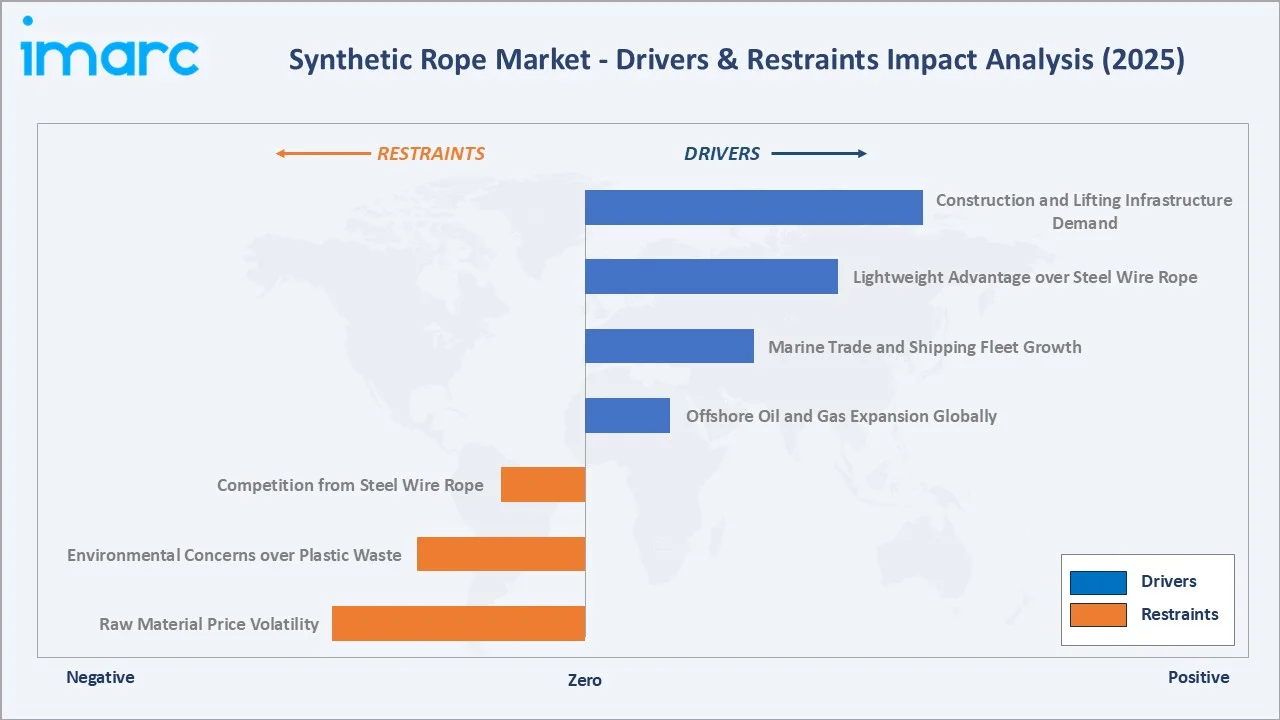
- Offshore Oil and Gas Expansion Globally: Global deepwater and ultra-deepwater oil and gas development requires extensive mooring systems for floating production, storage, and offloading (FPSO) vessels. Each FPSO mooring system requires 8–12 anchor lines of up to 3,000 metres in length, with HMPE and polyester fibre mooring lines increasingly replacing steel wire for their superior fatigue life and handling ease at depths exceeding 1,000 metres.
- Marine Trade and Shipping Fleet Growth: The global commercial shipping fleet comprises over 100,000 vessels requiring regular replacement of mooring hawsers, tow lines, and dock lines, typically replaced every 3–7 years depending on usage intensity. Port expansion programs across Asia, Middle East, and Africa are additionally commissioning new berth fender and mooring systems requiring heavy-duty synthetic mooring lines.
- Lightweight Advantage over Steel Wire Rope: In demanding offshore and lifting applications, synthetic ropes offer specific breaking strengths 5–10 times greater than steel on an equivalent weight basis. A 100 mm diameter HMPE rope weighs approximately 3.5 kg/m compared to 55 kg/m for equivalent-strength steel wire, enabling safer handling, reduced winch and spooling equipment loads, and simplified rope change operations at sea.
- Construction and Lifting Infrastructure Demand: Global infrastructure investment is driving steady growth in construction-sector rope demand. Offshore wind farm installation vessels require heavy-lift synthetic rope for monopile and turbine nacelle installation, with floating offshore wind platforms additionally requiring polyester or HMPE catenary mooring systems.
Market Restraints
- Raw Material Price Volatility: Polypropylene, polyethylene, and nylon are derived from crude oil and natural gas petrochemical feedstocks whose prices are subject to significant volatility. Polypropylene polymer price fluctuations directly impact manufacturing costs for commodity rope producers who face pricing pressure from distributor and fishing industry buyers with limited ability to pass through material cost increases.
- Environmental Concerns over Plastic Waste: Synthetic ropes made from non-biodegradable polymers contribute to marine plastic waste that is subject to increasing regulatory and consumer pressure. European Union regulations on fishing gear traceability and abandoned fishing gear recovery, and growing eco-label requirements from port authorities and marine environmental certification schemes, are creating compliance costs for commodity synthetic rope manufacturers.
- Competition from Steel Wire Rope: In many construction, mooring, and lifting applications, steel wire rope remains the incumbent solution with established supply chains, specification standards, and operator familiarity. Steel wire rope manufacturers have responded to HMPE competition by improving lubrication, plastic infill, and fatigue life of wire rope products, partially closing the operational life gap with synthetic alternatives in some applications.
Market Opportunities
- Floating Offshore Wind Mooring Systems: Floating offshore wind represents the highest-growth application for high-performance synthetic mooring ropes, with global floating wind capacity projected to reach 250 GW by 2050, each floating platform requiring 3–6 polyester or HMPE mooring lines of 500–2,000 metres. The global floating wind market is expected to require USD 2–4 Billion in synthetic mooring rope over the 2025–2035 period, creating a transformational new market segment for premium polyester and HMPE rope producers.
- Bio-Based and Sustainable Fiber Development: Consumer and regulatory pressure on plastic waste is driving R&D investment in bio-based polyester, bio-polyamide, and natural-synthetic composite fiber ropes that deliver synthetic rope performance with reduced end-of-life environmental impact. Specialty rope manufacturers are introducing certified recyclable and recycled-content rope products targeting sustainability-conscious marine and leisure customers.
Market Challenges
- Fragmented Distribution and Specification Standards: The synthetic rope market is served through a complex distribution chain encompassing marine chandleries, lifting equipment distributors, fishing gear suppliers, and industrial rope merchants, each with distinct customer relationships, specification knowledge, and pricing dynamics. Manufacturers face the challenge of maintaining specification compliance across multiple international standards while managing multi-tier distribution economics that compress margins for mid-market polyester and nylon rope products.
- Technical End-User Education: The performance advantages of high-modulus synthetic ropes require sustained investment in end-user technical education to overcome both familiarity bias toward steel wire rope and risk aversion among end users responsible for safety-critical load-bearing equipment. Certification, inspection, and retirement criteria for synthetic ropes differ fundamentally from steel wire, requiring operational training investment by end users that can slow technology adoption rates.
Emerging Market Trends
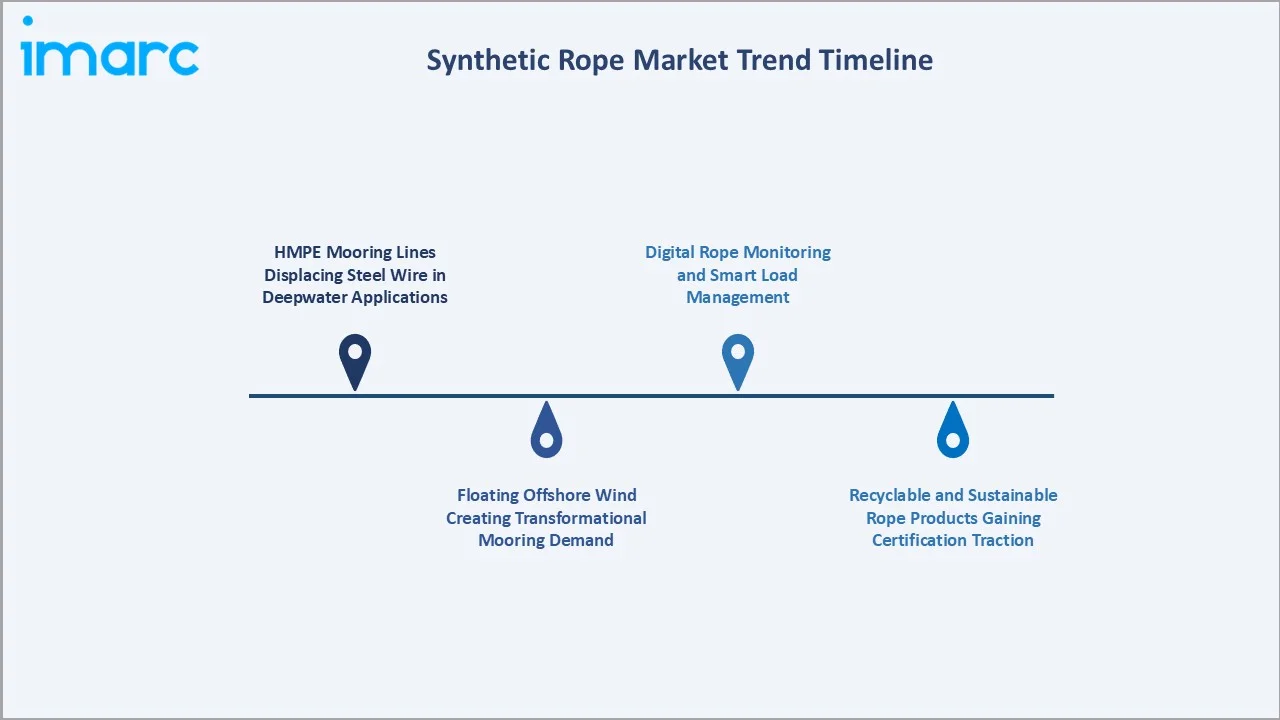
1. HMPE Mooring Lines Displacing Steel Wire in Deepwater Applications
High-modulus polyethylene (HMPE) ropes are progressively displacing steel wire rope in FPSO mooring, anchor-handling tug vessel (AHTV) work lines, and deep-sea lifting applications. Samson Rope Technologies' HMPE mooring lines are operational on multiple Gulf of Mexico FPSOs, delivering documented fatigue life improvements of 3–5x versus steel wire and reducing deck crew handling injuries from steel wire splinter hazards.
2. Floating Offshore Wind Creating Transformational Mooring Demand
The global floating offshore wind industry is creating a new, large-scale synthetic mooring rope application. Each floating wind turbine requires 3–6 mooring lines of 500–2,000 m in polyester or HMPE construction, with total synthetic rope requirements per floating wind farm of 100+ turbines reaching 500–1,500 tons of high-performance fiber rope. Bexco and Bridon-Bekaert have both secured supply contracts for floating wind mooring rope programs in European waters.
3. Recyclable and Sustainable Rope Products Gaining Certification Traction
Marine environmental certification requirements are creating demand pull for synthetic ropes with documented sustainability credentials. Teufelberger has introduced rope products incorporating recycled polyester fiber content, while Yale Cordage has developed bio-based core constructions that reduce fossil fuel content. The EU's proposed Extended Producer Responsibility regulations for fishing gear are expected to mandate recyclability certification for commercial fishing ropes sold in European markets, catalyzing industry-wide material transition.
4. Digital Rope Monitoring and Smart Load Management
Leading synthetic rope manufacturers are integrating sensor technology into high-performance rope constructions to enable real-time load monitoring, cumulative fatigue tracking, and end-of-life prediction. Yacht Club de Monaco installed Seares’ Seadamp hydraulic mooring technology to improve vessel stability, safety, and onboard comfort by reducing peak loads on mooring lines by up to 90%.
Industry Value Chain Analysis
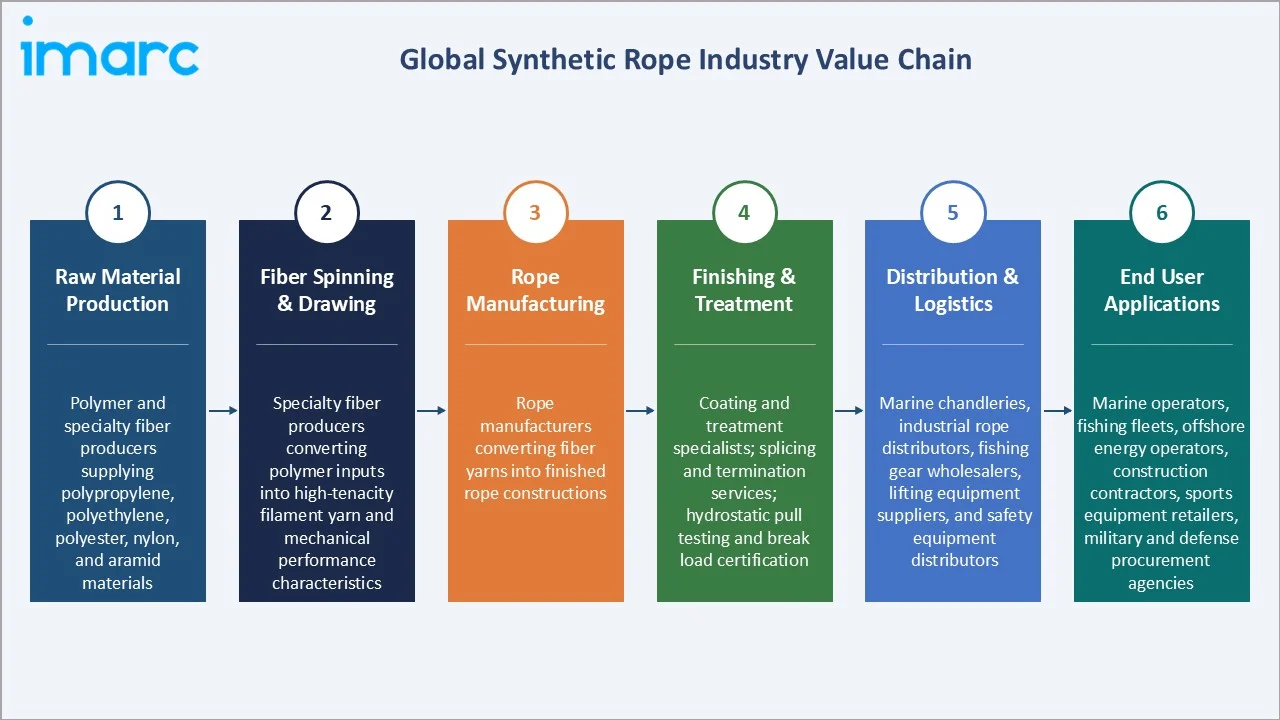
The synthetic rope value chain spans petrochemical and specialty fiber raw material production through end-user application, with each stage adding technical value and requiring specialist process capability and quality management.
|
Stage |
Key Players / Examples |
|
Raw Material Production |
Polymer and specialty fiber producers supplying polypropylene, polyethylene, polyester, nylon, and aramid materials |
|
Fiber Spinning & Drawing |
Specialty fiber producers converting polymer inputs into high-tenacity filament yarn and mechanical performance characteristics |
|
Rope Manufacturing |
Rope manufacturers converting fiber yarns into finished rope constructions |
|
Finishing & Treatment |
Coating and treatment specialists; splicing and termination services; hydrostatic pull testing and break load certification |
|
Distribution & Logistics |
Marine chandleries, industrial rope distributors, fishing gear wholesalers, lifting equipment suppliers, and safety equipment distributors |
|
End User Applications |
Marine operators, fishing fleets, offshore energy operators, construction contractors, sports equipment retailers, military and defense procurement agencies |
Technology Landscape in the Synthetic Rope Industry
High-Modulus Polyethylene (HMPE) Fiber Technology
HMPE fibers represent the performance frontier of synthetic rope materials. With specific tensile strength of 2.5 GPa and density below seawater, HMPE ropes float, achieve breaking loads equal to steel wire at one-seventh the weight, and exhibit excellent fatigue resistance in cyclic loading. dsm-firmenich's Dyneema SK75, SK78, and DM20 grades dominate the premium HMPE market, used in offshore mooring, load-handling, sport, and defense applications.
Polyester and Nylon High-Performance Constructions
High-tenacity polyester fiber ropes are the workhorses of deepwater mooring tethers for semi-submersibles and TLPs, where long-term creep resistance, low elastic elongation, and dimensional stability under sustained load are critical. Twelve-strand single-braid and parallel-strand polyester rope constructions are certified to DNV and ABS mooring standards for FPSO and floating wind applications.
Rope Construction Technologies: Braiding and Strand Architecture
Rope construction architecture profoundly influences mechanical performance: three-strand twisted and eight-strand plaited constructions offer simple field spliceability and cost-effective manufacture for commodity markets; twelve-strand single braid provides high strength efficiency and torque-free load response for marine and offshore applications; double braid offers abrasion resistance from the outer jacket combined with high-strength inner core for arborist, rescue, and industrial lifting applications.
Digital Manufacturing and Quality Assurance
Leading synthetic rope manufacturers are deploying digital manufacturing quality systems including automated online diameter and lay length monitoring during production, statistical process control for tensile property uniformity, and digital batch tracking linking each rope coil to its fiber lot, machine settings, and test certificate. RFID and barcode traceability systems enable field asset management that is increasingly required by offshore energy operators and lifting equipment regulations in Europe, North America, and Australia.
Market Segmentation Analysis
The report covers the following segments:
|
Segment Category |
Leading Segment |
Market Share |
Year |
|
Raw Material |
Polypropylene |
31.8% |
2025 |
|
End User |
Marine and Fishing |
34.2% |
2025 |
|
Distribution Channel |
Distributors |
🔒 |
2025 |
|
Region |
North America |
32.8% |
2025 |

By Raw Material
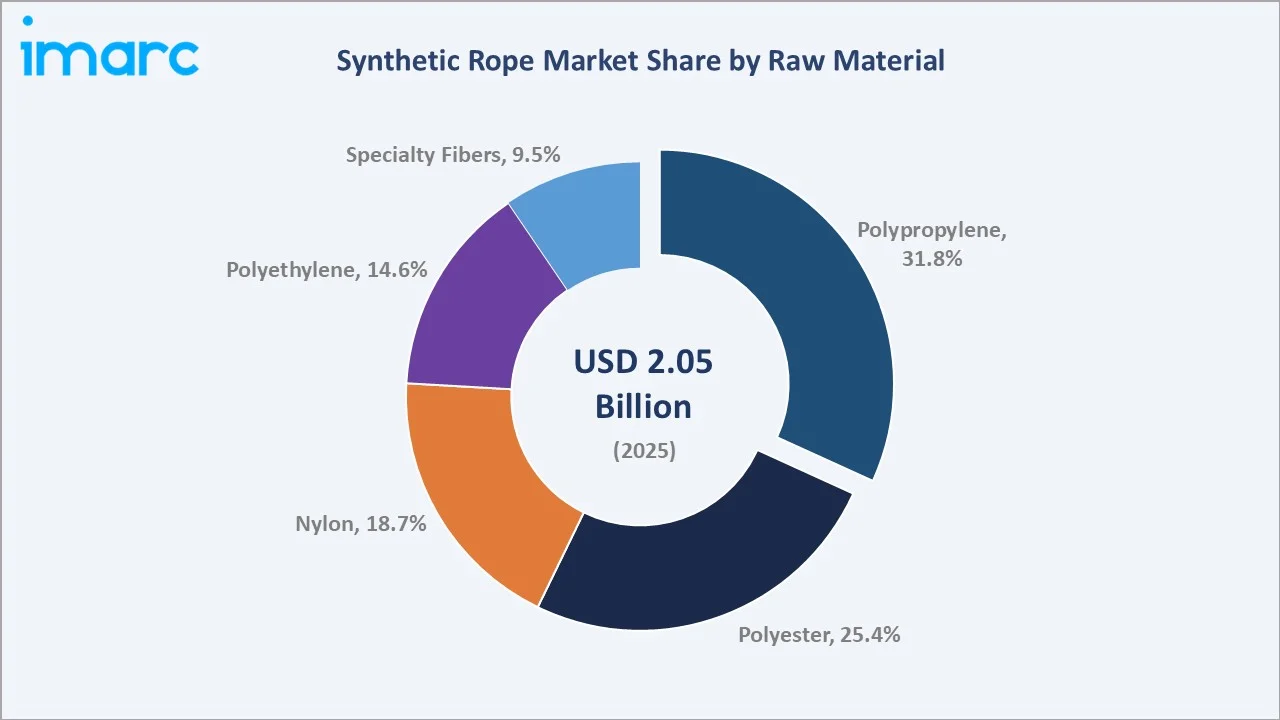
The raw material segment is led by polypropylene (31.8%), followed by polyester (25.4%), nylon (18.7%), polyethylene (14.6%), and specialty fibers (9.5%). Polypropylene's dominance reflects its cost competitiveness in high-volume commodity rope markets, while specialty fibers represent the fastest-growing and highest-value segment driven by HMPE adoption in offshore and high-performance applications.
To access detailed market analysis, Request Sample
Polyester serves the technically demanding marine mooring, yacht rigging, and industrial lifting segments where low elongation, UV resistance, and high tenacity are required at a more affordable price point than HMPE. Nylon remains essential for applications requiring elasticity and energy absorption.
By End User
The end user segment is led by marine and fishing (34.2%), followed by oil and gas (24.6%), construction (18.1%), sports and leisure (12.4%), and others (10.7%). Marine and fishing's dominance reflects the global commercial fishing fleet's consumption of large quantities of polyethylene and polypropylene net twine, trawl warp ropes, and mooring lines, combined with the merchant shipping fleet's requirement for synthetic mooring hawsers, tow lines, and heaving lines at every port call worldwide.
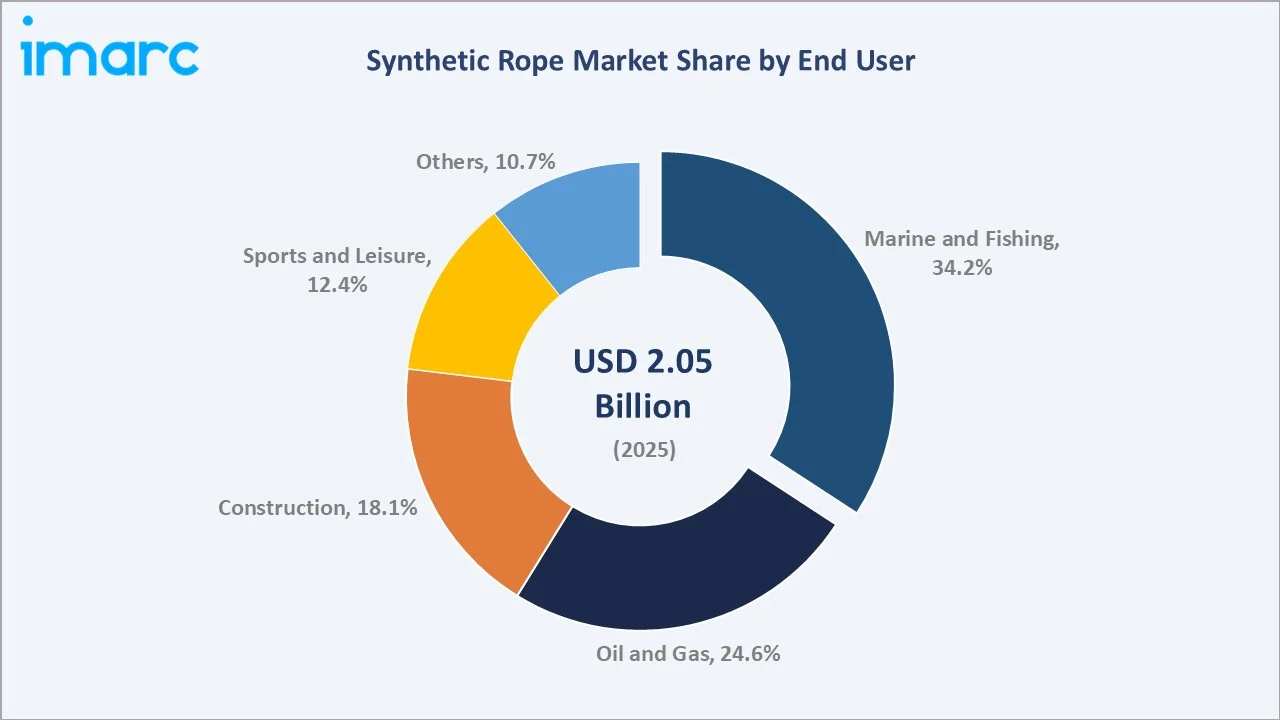
Oil and gas is the highest-value-per-ton end user, driven by HMPE and high-tenacity polyester requirements for offshore deepwater mooring, anchor-handling, and subsea installation operations. Construction encompasses lifting slings, safety lanyards, fall arrest systems, and scaffolding lashings across global building and infrastructure projects.
Regional Market Insights
North America leads global synthetic rope demand at 32.8% in 2025, anchored by the United States' dominant offshore oil and gas industry, large commercial fishing fleet, substantial marine recreation market, and significant construction and utilities sector rope consumption.
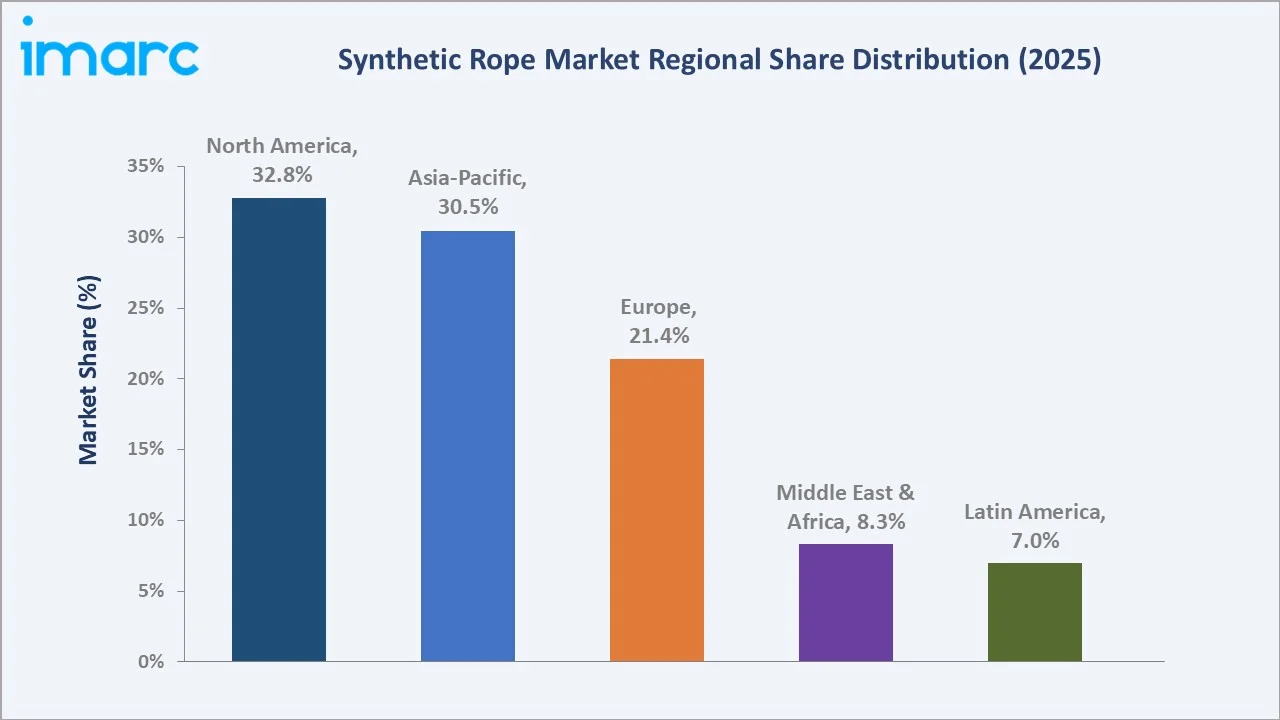
Asia-Pacific at 30.5% represents the world's largest fishing and aquaculture rope consumption market, while Europe at 21.4% maintains strong marine, offshore wind, and industrial lifting demand.
|
Region |
Share (2025) |
Key Growth Drivers |
|
North America |
32.8% |
Large marine recreation boating market; offshore wind development off US East and West Coasts; construction lifting and safety rope demand |
|
Asia-Pacific |
30.5% |
World's largest commercial fishing fleet; expanding offshore aquaculture requiring longline and mooring rope; growing offshore oil and gas in Southeast Asia |
|
Europe |
21.4% |
North Sea oil and gas mooring and offshore operations; leading floating offshore wind development market; strong marine and yacht racing culture |
|
Middle East & Africa |
8.3% |
Persian Gulf oil and gas offshore infrastructure expansion; growing port and logistics sector rope requirements; Red Sea shipping lane vessel supply |
|
Latin America |
7.0% |
Brazil pre-salt FPSO mooring system requirements; Chile and Peru large commercial fishing fleet; growing Caribbean marine tourism and recreational boating |
Competitive Landscape
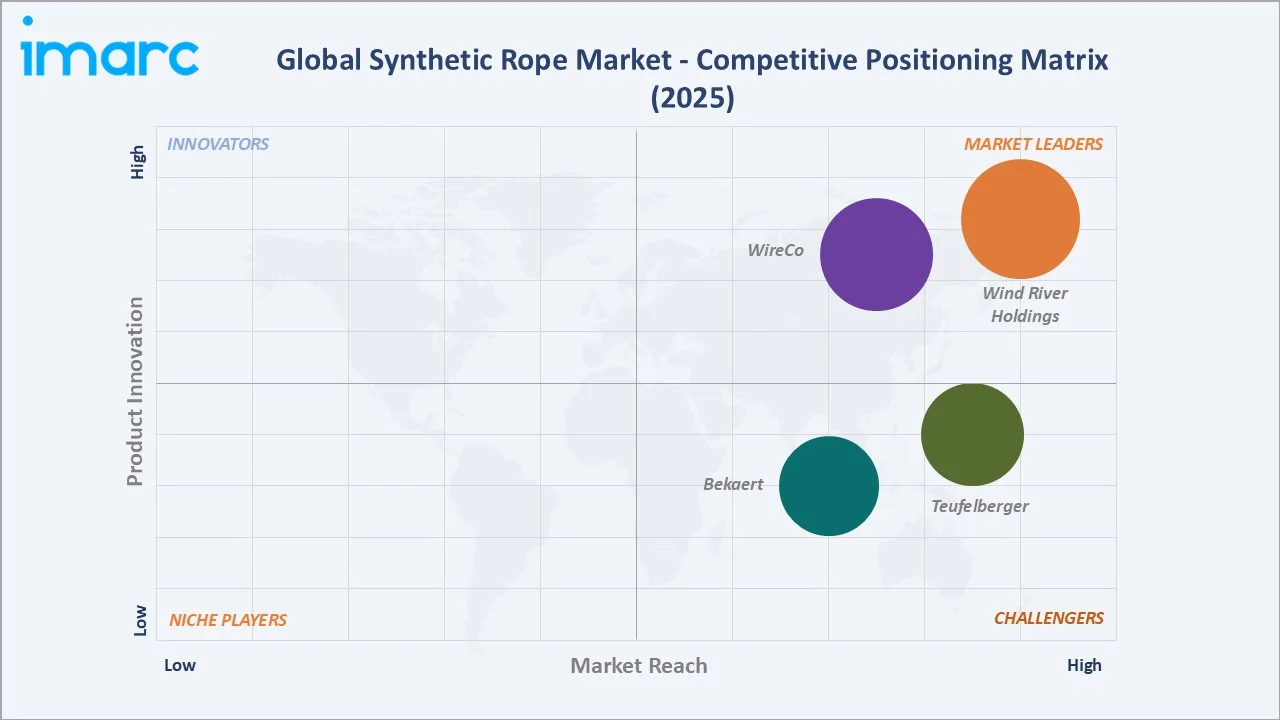
The global synthetic rope market exhibits fragmented competition in commodity segments and moderate concentration in premium specialty rope segments, where technical capability, proprietary fiber access, and quality certification credentials limit competitive field to 15–20 global-scale manufacturers.
|
Company Name |
Brands/Products |
Market Position |
Core Strength |
|
Wind River Holdings |
Velocity, Allegro, Amsteel, Arborfreak, Bail Out and Bail Out-Xl, Forte, among others |
Market Leader |
Leading US HMPE and high-performance synthetic rope; offshore mooring and AHV work line expertise; yacht and defense rope applications |
|
WireCo |
Casar, Oliveira, Union, Camesa, Lankhorst Ropes, Lankhorst EP, Euronete, Camesa Wire, WireCo Structures |
Market Leader |
Broad portfolio of wire rope and synthetic rope; global distribution network; offshore, lifting, and mining rope applications |
|
Teufelberger |
Wire Ropes, Fiber Ropes, Strapping Solutions, Fall Protection |
Strong Challenger |
Austrian precision rope manufacturer; arborist, climbing, and industrial lifting leadership; innovative constructions |
|
Bekaert |
Bexco |
Challenger |
Wire rope and synthetic rope hybrid portfolio; offshore and lifting applications; global manufacturing footprint |
Global specialty rope manufacturers compete through technical product differentiation, offshore industry certification, proprietary construction patents, and direct relationships with major oil and gas operators, shipping companies, and defense procurement agencies.
Key Company Profiles
Wind River Holdings
Wind River Holdings’ Samson Rope Technologies is one of the Americas' leading manufacturer of high-performance synthetic rope.
- Product Portfolio: HMPE mooring and work lines (AmSteel-Blue, Quantum-12); high-tenacity polyester anchor and mooring ropes (Trophy Braid, Tenex-TEC); nylon anchor warps and tow lines; double-braid rigging and deck lines; and certified lifting slings.
- Recent Developments: In July 2024, AMOS Group extended its distributorship agreement with Samson Rope Technologies for three years, reinforcing their collaboration in synthetic rope systems and services. The partnership aims to deliver safer, smarter, and more reliable lifting and mooring solutions, supported by AMOS Group’s manufacturing, testing, engineering, and technical-service capabilities.
- Strategic Focus: Floating offshore wind mooring rope market penetration; HMPE performance fiber rope expansion in deepwater applications; digital rope monitoring integration for condition-based retirement systems; North America and EMEA market expansion for premium offshore products.
WireCo
WireCo is one of the world's largest manufacturers of wire rope and synthetic rope, serving lifting, mining, offshore, and marine markets globally through a portfolio of multiple brands.
- Product Portfolio: Casar, Oliveira, Union, Camesa, Lankhorst Ropes, Lankhorst EP, Euronete, Camesa Wire, and WireCo Structures.
- Recent Developments: In April 2025, WireCo introduced CASAR LAZERLIFT, a rotation-resistant hoist rope designed for large telescopic, crawler, and high-capacity tower cranes, offering improved spooling and minimum breaking force. Engineered for extreme radial stress, the rope provides longer service life, greater lifting reliability, and reduced maintenance and downtime in heavy-duty crane operations.
- Strategic Focus: Synthetic rope portfolio expansion to complement wire rope leadership; offshore deepwater mooring and riser tensioning ropes; multi-material customer solutions spanning wire and synthetic; emerging markets expansion in Middle East, Africa, and Latin America.
Market Concentration Analysis
The global synthetic rope market exhibits a highly bifurcated concentration structure: the commodity polypropylene and polyethylene rope segment is intensely fragmented, with hundreds of manufacturers across Asia (China, India, South Korea) and Eastern Europe competing primarily on price for fishing, agricultural, and general-use markets.
Market consolidation in the premium segment is occurring through two mechanisms: fiber IP holders leveraging their material position to capture downstream rope value through licensing and branded fiber programs; and established rope manufacturers investing in proprietary fiber processing and rope construction technology to differentiate from commodity competition.
Investment & Growth Opportunities
Fastest Growing Segments
Specialty fiber HMPE ropes for floating offshore wind mooring (~8%+ CAGR), sustainable and recyclable synthetic rope products for regulated fishing markets (~6.5% CAGR), high-performance polyester mooring systems for deepwater FPSOs (~5.5% CAGR), and sports and adventure recreation rope (~5.4% CAGR) represent the highest-growth investment vectors through 2034.
Emerging Market Expansion
Southeast Asia's expanding offshore oil and gas sector represents a growing synthetic rope market where local and regional distribution infrastructure is underdeveloped relative to demand growth. West Africa's offshore oil and gas operations, anchored by Nigeria, Angola, Senegal, and Namibia discoveries, are driving growing demand for FPSO mooring rope that is currently supplied from North America and Europe but presents opportunities for regional distribution investment.
Venture and Institutional Investment Trends
- Floating offshore wind project developers are establishing long-term supply agreements with rope manufacturers for project-specific polyester and HMPE mooring line programs, providing manufacturers with multi-year revenue visibility that justifies production capacity investment.
- Bio-based and sustainable fiber technology investment is attracting sustainability-focused venture capital and corporate R&D spending from fiber producers (DSM, Toray) and rope manufacturers seeking to establish first-mover positions in the regulatory-driven transition to traceable and recyclable marine rope products ahead of EU fishing gear regulations.
- Digital rope asset management platforms are attracting technology investment from offshore operators seeking to optimize rope lifecycle economics in deepwater mooring applications where rope change operations cost USD 5–15 Million per vessel.
Future Market Outlook (2026-2034)
The global synthetic rope market is positioned for steady, sustained growth through 2034. From a base of USD 2.05 Billion in 2025, the market is projected to reach USD 3.12 Billion by 2034 at a CAGR of 4.63%, representing total incremental value creation of USD 1.07 Billion. This growth is underpinned by marine trade volume growth, offshore energy expansion, floating wind mooring demand, and progressive substitution of steel wire rope in high-performance applications.
The technology composition of the market will shift toward higher-value materials over the forecast period. Specialty fibers' share is projected to grow from 9.5% in 2025 to approximately 13–15% by 2034 as HMPE adoption in floating offshore wind, deepwater mooring, and defense expands. Polypropylene's share is expected to decline modestly from 31.8% as commodity rope markets in developed regions mature and up-trading toward polyester and specialty fiber products progresses.
Research Methodology
Primary Research
Primary research comprised structured interviews with over 75 industry participants in 2024–2025, including synthetic rope manufacturers, fiber raw material suppliers, marine and offshore procurement managers, fishing fleet operators, construction equipment rental companies, and retail sporting goods buyers across North America, Europe, Asia-Pacific, and Middle East and Africa.
Secondary Research
Secondary research encompassed rope industry association publications (EUROCORD, Cordage Institute), international standard bodies (ISO, EN, DNV, ABS) for rope specifications and testing requirements, offshore oil and gas operator annual procurement disclosures, global fishing fleet statistics (FAO), marine industry trade publications (Marine Log, Offshore Engineer), and specialty fiber producer technical and commercial documentation including Honeywell Spectra application guides.
Forecasting Models
Market size estimations were derived using top-down and bottom-up forecasting, incorporating global fishing fleet growth rates, offshore energy capital expenditure projections, marine trade volume forecasts (UNCTAD), construction sector investment by region, and specialty fiber adoption curve modelling for offshore and floating wind applications. A base-case CAGR of 4.63% reflects consensus estimates validated against manufacturer revenue growth disclosures, distribution channel demand surveys, and raw material consumption trends from 2020 to 2025.
Report Coverage:
| Report Features | Details |
|---|---|
| Base Year of the Analysis | 2025 |
| Historical Period | 2020-2025 |
| Forecast Period | 2026-2034 |
| Units | Billion USD |
| Scope of the Report | Exploration of Historical Trends and Market Outlook, Industry Catalysts and Challenges, Segment-Wise Historical and Future Market Assessment:
|
| Raw Materials Covered | Polypropylene, Polyester, Nylon, Polyethylene, Specialty Fibers |
| Distribution Channels Covered | Direct Sales, Distributors |
| End Users Covered | Marine and Fishing, Oil and Gas, Sports and Leisure, Construction, Others |
| Region Covered | Asia Pacific, Europe, North America, Latin America, Middle East and Africa |
| Countries Covered | United States, Canada, Germany, France, United Kingdom, Italy, Spain, Russia, China, Japan, India, South Korea, Australia, Indonesia, Brazil, Mexico |
| Companies Covered | Wind River Holdings, WireCo, Teufelberger, Bekaert, etc. |
| Customization Scope | 10% Free Customization |
| Post-Sale Analyst Support | 10-12 Weeks |
| Delivery Format | PDF and Excel through Email (We can also provide the editable version of the report in PPT/Word format on special request) |
Frequently Asked Questions About the Synthetic Rope Market Report
The global synthetic rope market reached USD 2.05 Billion in 2025 and is projected to reach USD 3.12 Billion by 2034.
The market is expected to grow at a CAGR of 4.63% during 2026-2034, driven by offshore oil and gas mooring demand, marine trade growth, floating offshore wind mooring system requirements, and the progressive substitution of steel wire rope by HMPE and high-tenacity polyester in demanding applications.
North America leads with a 32.8% market share in 2025, driven by the US Gulf of Mexico deepwater offshore industry, large commercial fishing fleets in Alaska and the Pacific Northwest, the world's largest marine recreational boating market, and significant construction and lifting rope consumption.
Polypropylene dominates with a 31.8% share in 2025, owing to its cost competitiveness, buoyancy in water, and chemical resistance that make it the preferred choice for high-volume commercial fishing, general marine, and agricultural rope applications.
Marine and fishing holds the largest end user share at 34.2%, driven by global commercial fishing fleet requirements for trawl warp, net, and mooring rope, combined with merchant shipping vessel mooring hawser and deck line requirements at port calls worldwide.
Key players include Wind River Holdings, WireCo, Teufelberger, and Bekaert.
Key drivers include offshore oil and gas deepwater expansion requiring HMPE and polyester mooring systems, global marine trade growth driving vessel mooring rope demand, and weight-performance advantages of HMPE over steel wire rope accelerating substitution in critical applications.
Key challenges include petrochemical raw material price volatility impacting polypropylene and nylon rope manufacturing margins, environmental regulation and plastic waste concerns creating compliance costs, and the technical education investment required to drive HMPE adoption in safety-critical applications.
Need more help?
- Speak to our experienced analysts for insights on the current market scenarios.
- Include additional segments and countries to customize the report as per your requirement.
- Gain an unparalleled competitive advantage in your domain by understanding how to utilize the report and positively impacting your operations and revenue.
- For further assistance, please connect with our analysts.
 Request Customization
 Speak to an Analyst
 Request Brochure
 Inquire Before Buying
Benefits of Customization
- Personalize this research
- Triangulate with your data
- Get data as per your format and definition
- Gain a deeper dive into a specific application, geography, customer, or competitor
- Any level of personalization
Get in Touch With Us
UNITED STATES
Phone: +1-201-971-6302
INDIA
Phone: +91-120-433-0800
UNITED KINGDOM
Phone: +44-753-714-6104
Email: [email protected]
Client Testimonials




.webp)




.webp)













Related Reports

Choose your plan
*Please note that the prices mentioned below are starting prices for each bundle type. Kindly contact our team for further details.*
Single User License
- 1 User License, Access on 2 Devices
- PDF Report + Excel Dataset (Password Protected)
- Lifetime Access
- No Printing Rights
- 10% Free Report Customization
- 10–12 Weeks of Analyst Support
Five User License
- Access for 5 Users, 2 Devices per User
- PDF Report + Excel Dataset (Password Protected)
- Lifetime Access
- Dedicated Account Manager
- 12–14 Weeks of Analyst Support
- No Printing Rights
- 15% Free Report Customization
- 25% Discount on Your Next Purchase
Corporate User License
- Unlimited User Access (Within Your Organization)
- PDF Report + Excel Dataset
- Lifetime Access
- Dedicated Account Manager
- 14–20 Weeks of Analyst Support
- No Printing Rights
- 20% Free Report Customization
- 30% Discount on Your Next Purchase
Essential Insights
What's included:
3 reports
- Lifetime Access
- PDF Reports
- Excel Datasets
- 2 Weeks of Free Analyst Support
- 2 User Licenses
- Access on 2 Devices
- Printing Rights
- Complimentary PowerPoint (PPT) Version
- Complimentary License Upgrade
Professional Access
What's included:
5 reports
- Lifetime Access
- PDF Reports
- Excel Datasets
- 8 Weeks of Free Analyst Support
- 2 User Licenses
- Access on 2 Devices
- Printing Rights
- Complimentary PowerPoint (PPT) Version
- Complimentary License Upgrade
Business Advantage
What's included:
8 reports
- Lifetime Access
- PDF Reports
- Excel Datasets
- 14 Weeks of Free Analyst Support
- 2 User Licenses
- Access on 2 Devices
- Printing Rights
- Complimentary PowerPoint (PPT) Version
- Complimentary License Upgrade
Enterprise Intelligence
What's included:
10 reports
- Lifetime Access
- PDF Reports
- Excel Datasets
- 20 Weeks of Free Analyst Support
- 2 User Licenses
- Access on 2 Devices
- Printing Rights
- Complimentary PowerPoint (PPT) Version
- Complimentary License Upgrade