
United States Surgical Navigation Systems Market Size, Share, Trends and Forecast by Technology, Application, End User, and Region, 2026-2034
United States Surgical Navigation Systems Market Size, Share, Trends & Forecast (2026-2034)
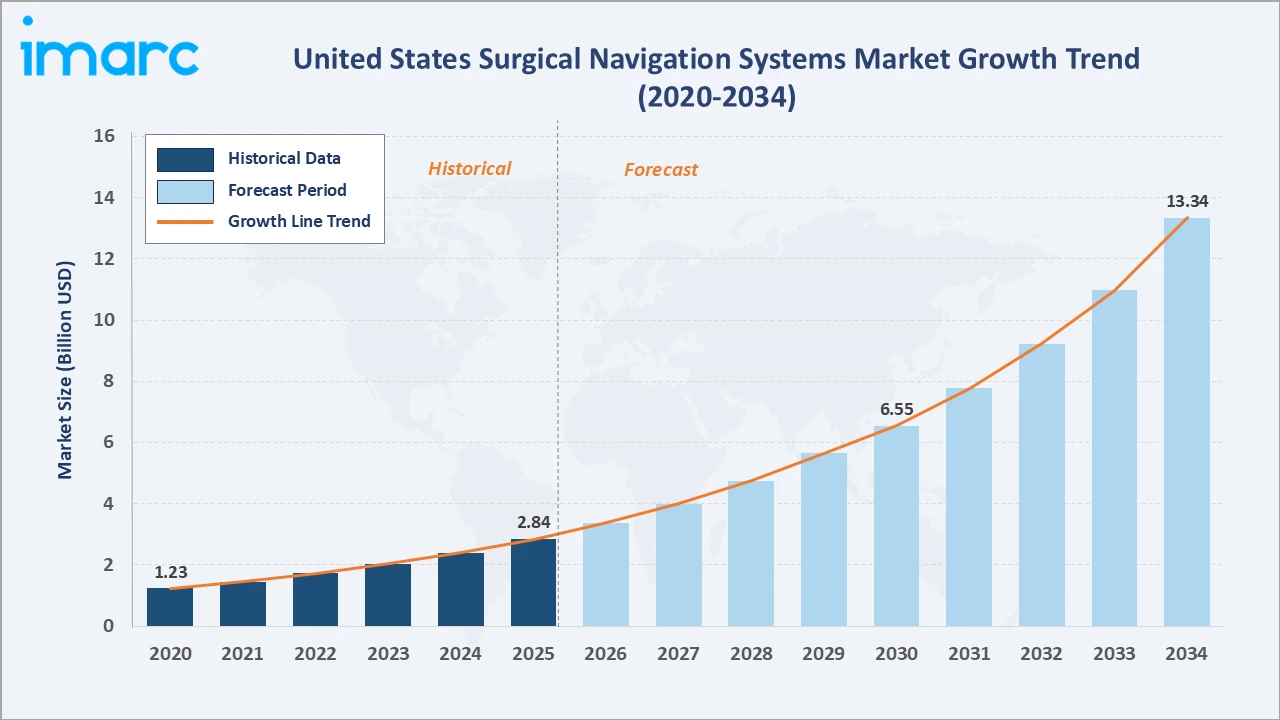
The United States surgical navigation systems market reached USD 2.84 Billion in 2025 and is projected to reach USD 13.34 Billion by 2034, growing at a CAGR of 18.19% during 2026-2034. Escalating demand for minimally invasive surgical procedures, the rapidly aging US population driving orthopedic and neurosurgical procedure volumes, deep integration of AI and robotic-assisted surgery with navigation platforms, and favorable Medicare and Medicaid reimbursement frameworks for image-guided surgical procedures are the primary growth catalysts.
Market Snapshot
|
Metric |
Value |
|
Market Size (2025) |
USD 2.84 Billion |
|
Forecast Market Size (2034) |
USD 13.34 Billion |
|
CAGR (2026-2034) |
18.19% |
|
Base Year |
2025 |
|
Historical Period |
2020-2025 |
|
Forecast Period |
2026-2034 |
The Northeast leads regionally with a 31.6% market share in 2025, anchored by the region's concentration of academic medical centers, Level I trauma hospitals, and high-volume arthroplasty and neurosurgery programs at institutions such as Hospital for Special Surgery (HSS), Penn Medicine, and Boston Children's Hospital,
To get more information on this market, Request Sample
The United States surgical navigation systems market is underpinned by three structural forces: an aging population of 61.2 million Americans over 65 years generating escalating orthopedic, spine, and cranial surgical volume that directly drives navigation system utilization; the integration of AI and machine learning algorithms into navigation platforms improving real-time accuracy and surgical decision support beyond what earlier-generation systems could deliver; and the progressive expansion of robotic-assisted surgery that bundles navigation as an inseparable component of the robotic surgery value proposition.
Executive Summary
The United States surgical navigation systems market is experiencing one of the highest growth rates among medical device categories, driven by converging demographic, technological, and policy forces. The market was valued at USD 2.84 Billion in 2025 and is forecast to reach USD 13.34 Billion by 2034 at a CAGR of 18.19%.
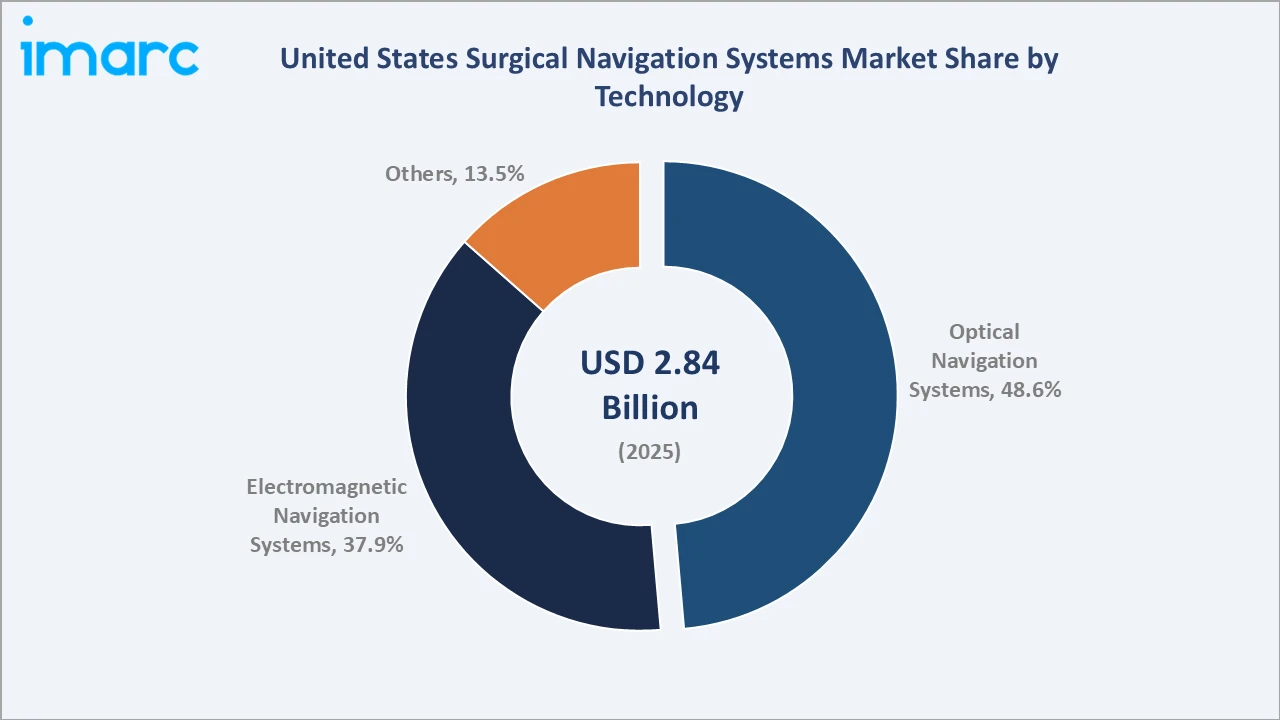
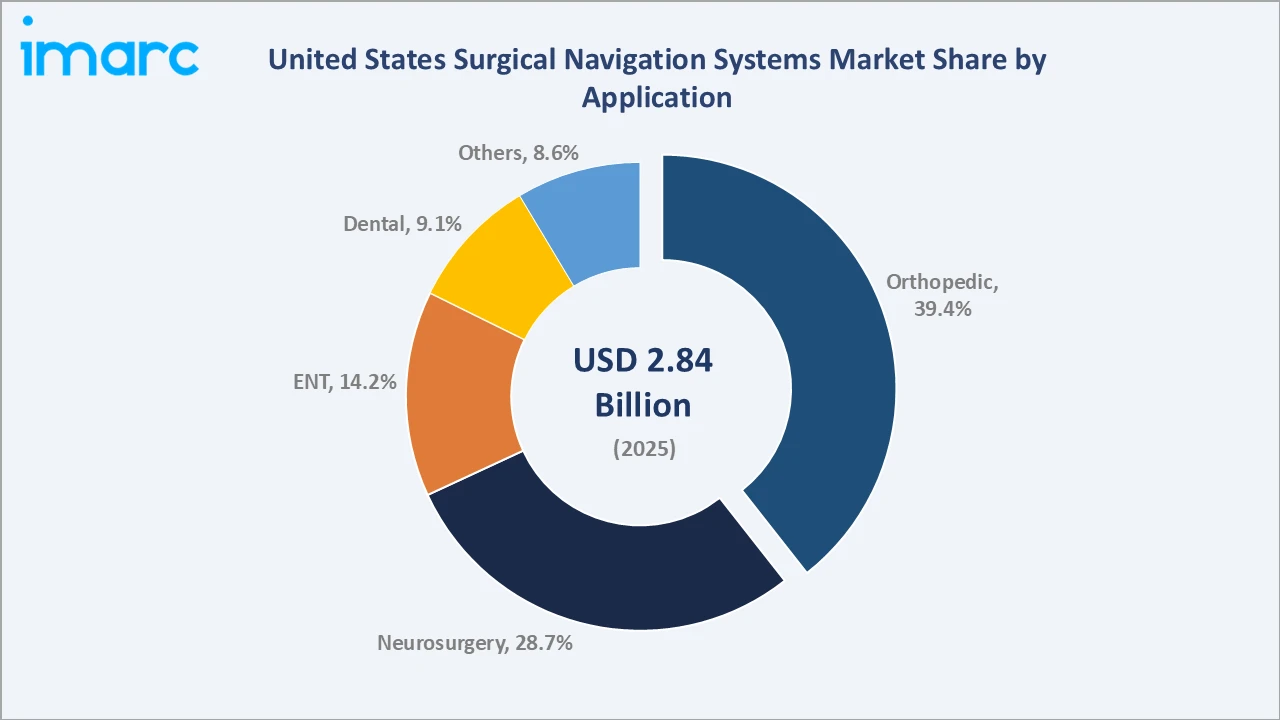
Optical navigation systems lead the technology segment at 48.6% in 2025, leveraging infrared-based tracking systems with sub-millimeter accuracy that are well established across orthopedic and spine surgical applications. Orthopedic applications lead at 39.4%, driven by total joint arthroplasty, unicompartmental knee replacement, and robotic-arm-assisted procedures that have achieved mainstream adoption at high-volume US joint replacement programs.
Neurosurgery at 28.7% serves brain tumor resection, deep brain stimulation (DBS) lead placement, cranial base surgery, and complex spine instrumentation. ENT at 14.2% covers functional endoscopic sinus surgery (FESS), skull base surgery, and cochlear implant placement, where navigation reduces complication rates in anatomically complex procedures.
Key Market Insights
|
Insight |
Data |
|
Largest Technology |
Optical Navigation Systems – 48.6% share (2025) |
|
Fastest Growing Technology |
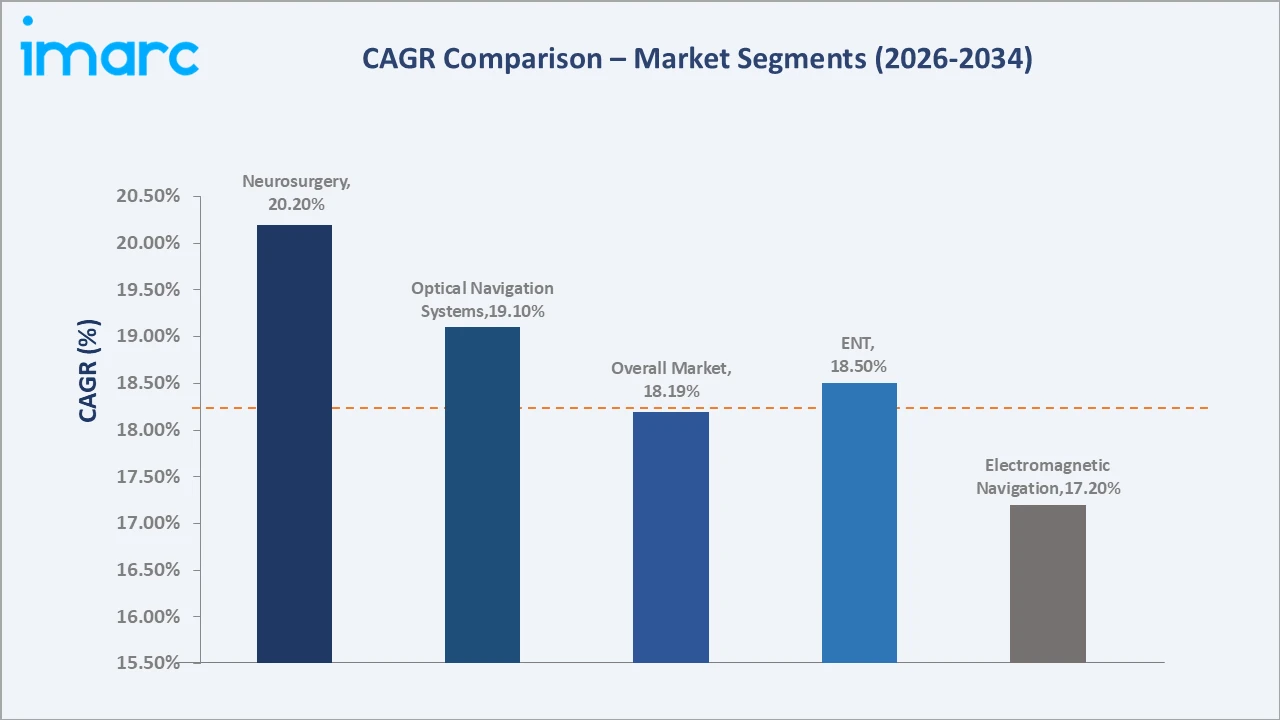
Optical Navigation Systems – ~19.1% CAGR (2026-2034) |
|
Largest Application |
Orthopedic – 39.4% share (2025) |
|
Fastest Growing Application |
Neurosurgery – ~20.2% CAGR (2026-2034) |
|
Leading Region |
Northeast – 31.6% share (2025) |
|
Top Companies |
Medtronic, Stryker Corporation, Zimmer Biomet Holdings, Inc., Brainlab SE, Johnson & Johnson |
Key Analytical Observations Supporting The Above Data:
- Optical navigation systems account for 48.6% in 2025, reflecting the technology's established accuracy, reliability, and integration with robotic surgery platforms across high-volume orthopedic and spine programs.
- Orthopedic's 39.4% application dominance (2025) reflects the US's annual volume of approximately 1 million knee and hip replacement surgeries, and a rapidly growing unicompartmental knee replacement segment where navigation and robotic assistance have transitioned from a technology differentiator to a near-standard of care expectation at leading US academic medical centers and high-volume community hospitals.
- The Northeast's 31.6% regional leadership (2025) reflects the concentration of major academic medical centers that serve as navigation technology adoption leaders, combined with the highest US regional density of fellowship-trained orthopaedic arthroplasty and neurosurgery specialists who generate above-average complex navigation-indicated case volumes.
- The 18.19% overall CAGR reflects the convergence of two adoption acceleration mechanisms unique to the current cycle: the transition of navigation from standalone systems to fully integrated robotic surgery platforms; and value-based care incentive programs that reward surgical accuracy metrics where navigation demonstrably improves performance.
United States Surgical Navigation Systems Market Overview
Surgical navigation systems are computer-assisted spatial tracking platforms that provide surgeons with real-time, three-dimensional guidance by registering patient anatomy to the surgical field, enabling precise instrument and implant positioning with accuracy beyond the limits of manual technique. The United States is the world's largest surgical navigation systems market, accounting for approximately 40-42% of global market value, underpinned by the country's healthcare infrastructure density, high surgical procedure volumes, and favorable reimbursement environment.
The market spans three primary technology categories: optical infrared tracking, electromagnetic tracking, and hybrid/software-defined platforms, serving orthopedic, neurosurgical, ENT, dental, and emerging applications including cardiac, oncology, and robotic laparoscopic surgery. The integration of navigation with robotic surgery platforms is fundamentally reshaping the competitive landscape by embedding navigation as an integral part of broader surgical platform architectures.
Market Dynamics
To evaluate market opportunities, Request Sample
Market Drivers
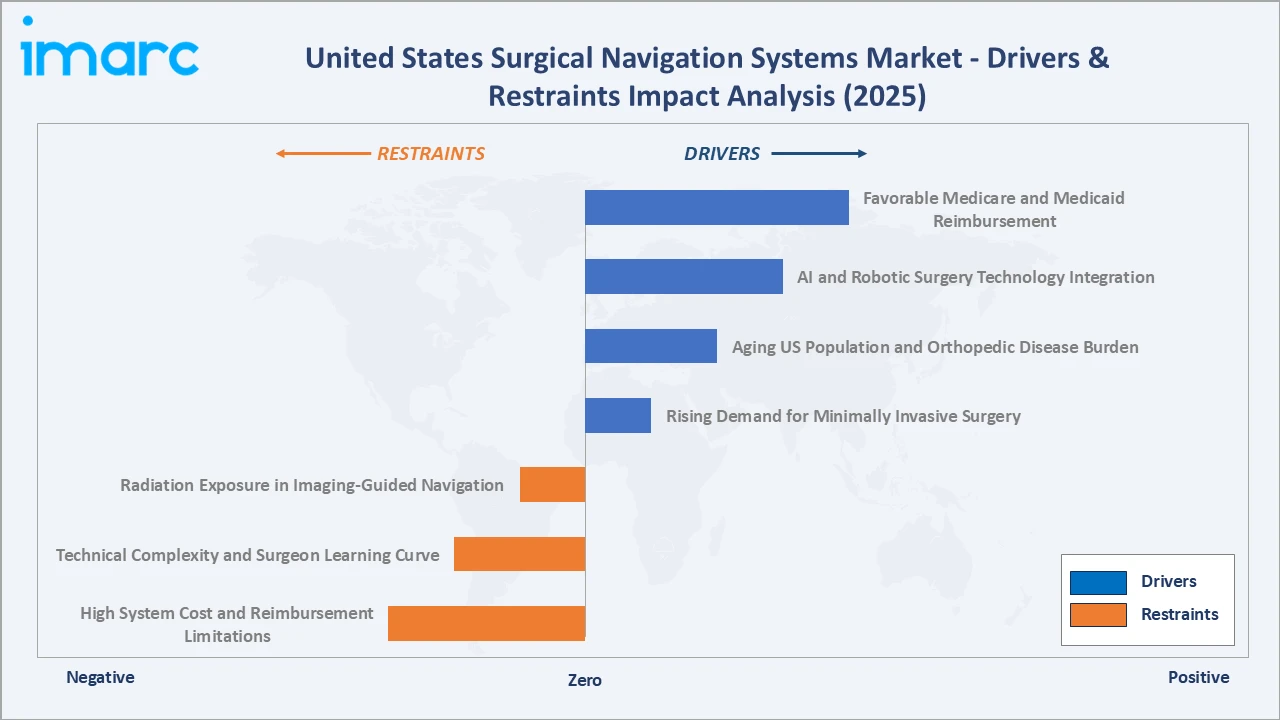
- Rising Demand for Minimally Invasive Surgery: United States minimally invasive surgery market size reached USD 26.6 Billion in 2025 and is expected to reach USD 37.3 Billion by 2034, exhibiting a growth rate (CAGR) of 3.69% during 2026-2034. Navigation systems enable MIS approaches for procedures previously requiring open surgery by providing real-time spatial guidance through limited access portals.
- Aging US Population and Orthopedic Disease Burden: The United States faces the world's most acute developed-economy orthopedic procedure demand growth, with the population aged 65+ projected to reach 82 million by 2050 and the volume of revision total hip arthroplasties forecast to reach 572,000 procedures by 2030.
- AI and Robotic Surgery Technology Integration: The integration of AI-powered bone morphology analysis, computer vision-based implant sizing, and machine learning outcome prediction into navigation platforms is fundamentally increasing the clinical value proposition of navigation beyond mere spatial tracking.
- Favorable Medicare and Medicaid Reimbursement: CMS maintains dedicated Current Procedural Terminology (CPT) reimbursement codes for computer-assisted navigation in orthopaedic and spine surgery, providing financial incentive for hospital systems to invest in navigation infrastructure. The average Medicare reimbursement increment for navigation-guided versus non-navigated total knee arthroplasty generates positive ROI for hospitals with navigation system utilization above 80–90 cases per year.
Market Restraints
- High System Cost and Reimbursement Limitations: Entry-level surgical navigation systems command USD 150,000–500,000 per unit, with integrated robotic navigation platforms requiring USD 1.0–1.5 Million per installation plus annual service contracts of USD 100,000–200,000.
- Technical Complexity and Surgeon Learning Curve: Navigation system adoption requires structured surgical workflow modification, intraoperative registration time of 15–25 minutes per case, and a learning curve of 25–40 cases for surgeons to achieve efficiency parity with non-navigated technique.
- Radiation Exposure in Imaging-Guided Navigation: US ALARA radiation protection standards and growing surgeon awareness of occupational radiation exposure, particularly for orthopaedic surgeons performing fluoroscopy-intensive spine navigation, create demand for radiation-free navigation alternatives that is driving EM and computer vision navigation development but currently limits imaging-based navigation expansion in some institution types.
Market Opportunities
- Augmented Reality Navigation Systems: Augmented reality (AR) surgical navigation represents the next-generation navigation paradigm that is entering early US clinical deployment. In 2019, Medivis received U.S. FDA 510(k) clearance for its SurgicalAR augmented reality platform, enabling clinical use and commercialization in operating rooms across the United States.
- Outpatient and Ambulatory Surgical Center Expansion: The shift of joint replacement and spine surgery from inpatient hospitals to ambulatory surgical centers (ASCs) creates new navigation system installation demand. ASC-optimized, space-efficient navigation systems designed for the multi-specialty ASC environment represent a hardware design and market entry opportunity that established OEMs and startups are actively pursuing, with compact navigation systems priced at USD 80,000–150,000 specifically targeting ASC budget parameters.
Market Challenges
- Operating Room Time Efficiency and Setup Complexity: Navigation system setup adds 15–25 minutes to operating room time per case, a high cost in US hospital settings where OR time is valued at USD 60–100 per minute. Hospital administrators applying strict OR efficiency metrics may limit navigation adoption to high-volume, high-margin procedure lines.
- Integration Complexity Across Imaging and EHR Systems: Navigation systems require integration with hospital PACS (Picture Archiving and Communication System) for preoperative imaging download, operating room management systems for scheduling coordination, and increasingly with electronic health record (EHR) systems for post-operative outcome documentation. The heterogeneous US hospital IT landscape creates ongoing interoperability investment requirements that add cost and complexity to navigation platform implementations.
Emerging Market Trends
.webp)
1. AI-Integrated Navigation Achieving Autonomous Bone Registration
Machine learning-based automatic bone registration is one of the most transformative technology developments in the US navigation market. A new study developed a compact, radiation-free bone-registration technique using structured-light 3D surface scanning for computer- and robotic-assisted orthopedic surgery. Testing on 24 femur models achieved 0.44 ± 0.22 mm accuracy, outperforming reported paired-point and intraoperative CT-based registration methods.
2. Robotic Navigation Integration Creating Bundled Platform Economics
The integration of navigation as an inseparable feature of robotic surgery platforms has fundamentally changed navigation's purchasing economics in US hospitals. Rather than navigation systems purchased on clinical evidence alone, hospital CFOs are now evaluating navigation as a component of multi-year robotic surgery platform contracts that include per-procedure implant commitments, volume-based hardware discounts, and bundled service agreements.
3. Intraoperative Imaging Navigation Combining CT and Navigation in Single Workflow
The combination of intraoperative CT imaging with navigation registration in a single workflow is gaining US adoption in complex spine deformity, revision arthroplasty, and skull base surgery where preoperative imaging-to-intraoperative anatomy mismatch would otherwise compromise navigation accuracy. The O-arm’s ability to acquire intraoperative CT during spine pedicle screw placement and confirm accurate navigation before wound closure has driven a 40%+ reduction in revision rates for complex spine cases at major US academic centers.
4. ENT Navigation Expanding to Office-Based Procedures
ENT navigation is expanding beyond the operating room into office-based and clinic-based procedures, driven by FDA clearance of compact, single-use navigation systems designed for clinic environments. Fiagon's miniaturized EM navigation for office-based sinus procedures is expanding the ENT navigation addressable market beyond hospital-based FESS.
Industry Value Chain Analysis
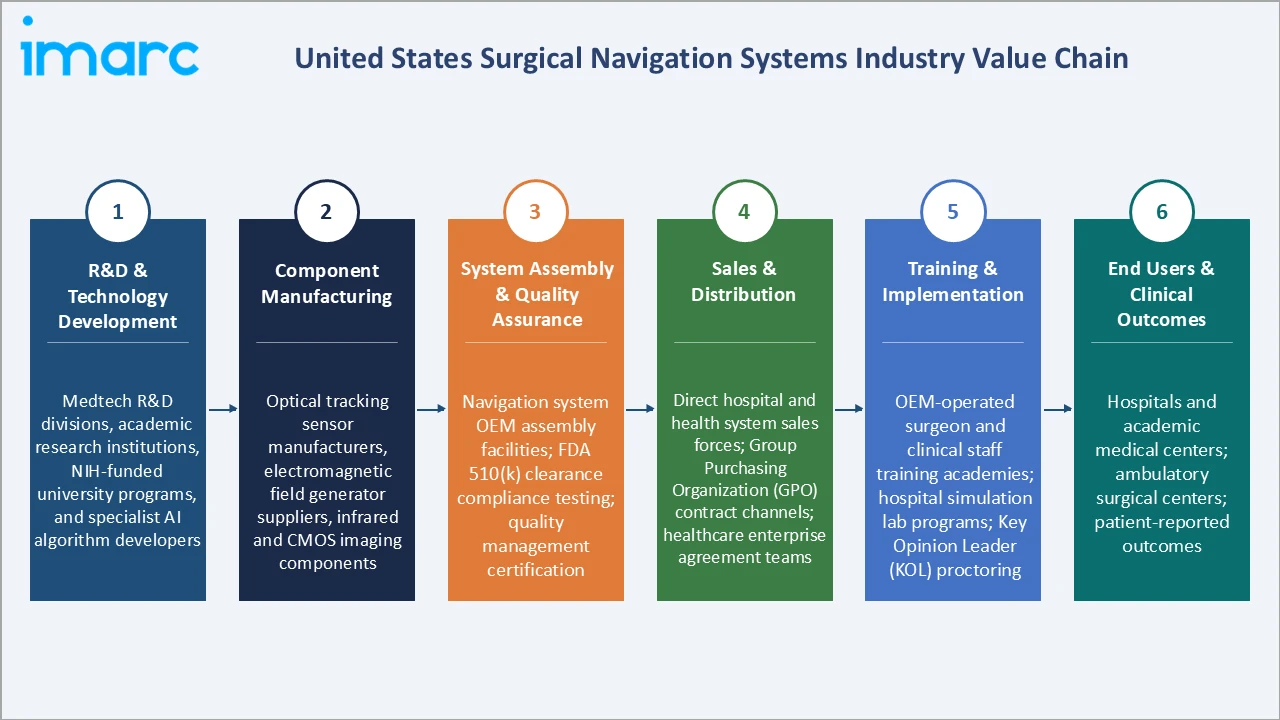
The US surgical navigation systems value chain spans fundamental technology R&D through patient-level surgical outcomes, with the FDA regulatory pathway serving as the primary quality and safety gate between development and commercial deployment.
|
Stage |
Key Players / Examples |
|
R&D & Technology Development |
Medtech R&D divisions, academic research institutions, NIH-funded university programs, and specialist AI algorithm developers |
|
Component Manufacturing |
Optical tracking sensor manufacturers, electromagnetic field generator suppliers, infrared and CMOS imaging components |
|
System Assembly & Quality Assurance |
Navigation system OEM assembly facilities; FDA 510(k) clearance compliance testing; quality management certification |
|
Sales & Distribution |
Direct hospital and health system sales forces; Group Purchasing Organization (GPO) contract channels; healthcare enterprise agreement teams |
|
Training & Implementation |
OEM-operated surgeon and clinical staff training academies; hospital simulation lab programs; Key Opinion Leader (KOL) proctoring |
|
End Users & Clinical Outcomes |
Hospitals and academic medical centers; ambulatory surgical centers; patient-reported outcomes |
Technology Landscape in the United States Surgical Navigation Systems Industry
Optical Infrared Navigation Technology
Optical navigation systems represent the dominant US navigation technology, with sub-millimeter tracking accuracy of 0.3–0.8 mm RMS that meets the accuracy threshold for total joint arthroplasty component positioning and spine pedicle screw placement. Northern Digital Inc. (NDI) produces the optical tracking cameras used by most navigation OEMs as a technology component, making NDI tracking technology a de facto standard optical tracking infrastructure across the US navigation market.
Electromagnetic Navigation Technology
Electromagnetic navigation systems generate a low-intensity magnetic field within which miniaturized EM sensor coils embedded in surgical instruments provide 6-degrees-of-freedom position and orientation data without requiring line-of-sight optical access. EM navigation is clinically essential for ENT procedures, bronchoscopic navigation, and minimally invasive spine procedures where optical tracker attachment to vertebral anatomy is impractical.
AI and Machine Learning in Navigation Platforms
Artificial intelligence is transforming navigation from a passive tracking tool to an active clinical decision support system across the US market. Key AI applications include: automated bone segmentation and registration from intraoperative imaging; AI-powered implant sizing and positioning recommendations; real-time kinematic simulation of implant positioning impact on joint mechanics; and machine learning-based complication prediction scoring integrated into navigation software workflow.
Market Segmentation Analysis
The report covers the following segments:
|
Segment Category |
Leading Segment |
Market Share |
Year |
|
Technology |
Optical Navigation Systems |
48.6% |
2025 |
|
Application |
Orthopedic |
39.4% |
2025 |
|
End User |
🔒 |
🔒 |
2025 |
|
Region |
Northeast |
31.6% |
2025 |

By Technology
The technology segment is analyzed across optical navigation systems (48.6%), electromagnetic navigation systems (37.9%), and others (13.5%). Optical navigation systems lead, reflecting their established accuracy across the dominant orthopedic and spine application segments, while electromagnetic navigation serves the expanding ENT, bronchoscopy, and minimally invasive procedures where optical tracking limitations create clinical demand.
To access detailed market analysis, Request Sample
Electromagnetic navigation systems serve a distinct and growing clinical need: more than 500,000 tonsillectomy operations conducted annually in children younger than 15 years, the expanding bronchoscopic lung biopsy and nodule navigation market, and minimally invasive spine and pain management procedures.
By Application
The application segment is led by orthopedic (39.4%), neurosurgery (28.7%), ENT (14.2%), dental (9.1%), and others (8.6%). Orthopedic's application share reflects the scale of US annual joint replacement volume: 1 million knee and hip replacement surgeries, 100,000+ shoulder arthroplasties, and growing unicompartmental knee replacement volumes collectively representing the world's highest per-capita joint replacement rate.
Neurosurgery serves brain tumor resection, deep brain stimulation lead placement for Parkinson's disease and essential tremor, and complex cervical and lumbar spine deformity correction, three procedure categories where navigation has achieved near-universal adoption at US academic neurosurgery programs.
Regional Market Insights
The Northeast's 31.6% US market leadership in 2025 reflects the region's unique concentration of academic medical centers, world-class neurosurgery and orthopaedic surgery programs, and the highest US regional density of fellowship-trained surgical specialists.
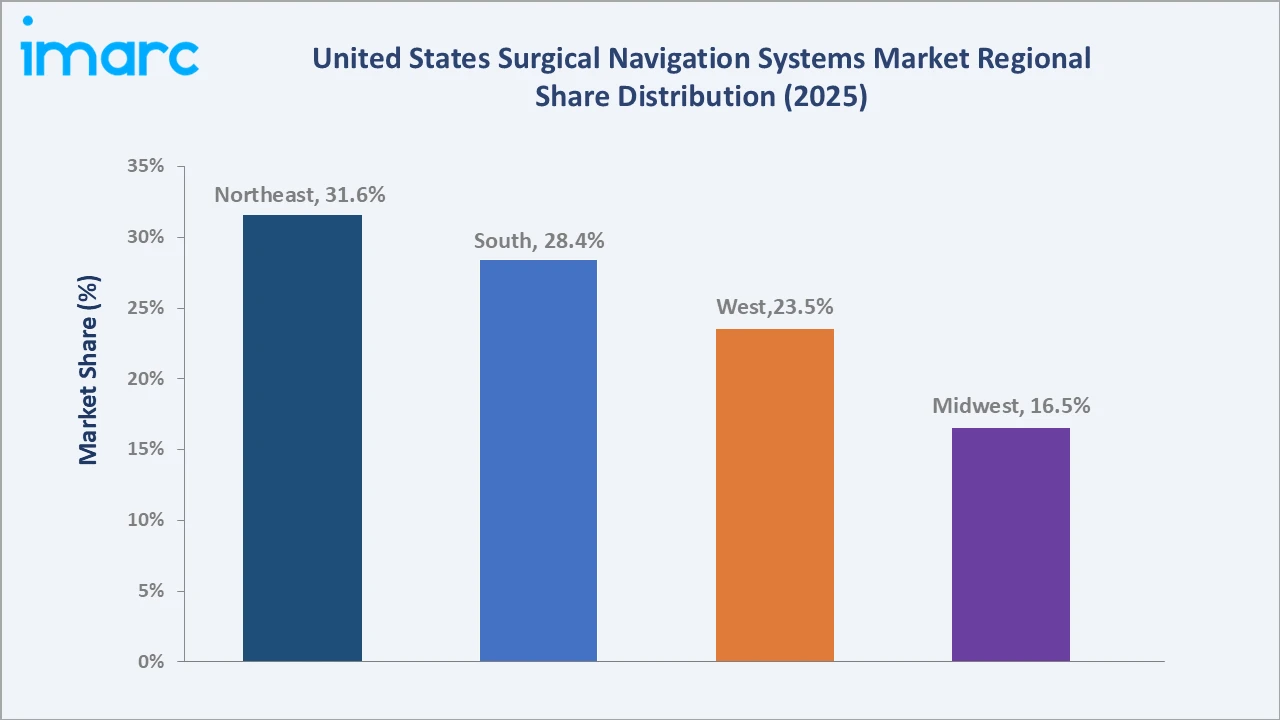
The South at 28.4% represents the market's largest population base and fastest-growing surgical volume region, while the West at 23.5% is anchored by California's large healthcare system and the Pacific Northwest's advanced technology adoption culture.
|
Region |
Share (2025) |
Key Growth Drivers |
|
Northeast |
31.6% |
Academic concentration of academic medical centers and specialty surgical programs; leading navigation technology adoption; strong NIH research funding and fellowship-trained specialist density |
|
South |
28.4% |
Largest US regional population base with fastest-growing surgical procedure volumes; expanding academic medical center infrastructure; high musculoskeletal disease burden driven by ageing demographics |
|
West |
23.5% |
Large integrated health system navigation standardization programs; technology-forward surgical culture; growing shift of arthroplasty to ambulatory surgical centers |
|
Midwest |
16.5% |
Presence of major reference adoption sites (academic medical centers); large community hospital surgical volume base representing significant incremental adoption potential |
Competitive Landscape
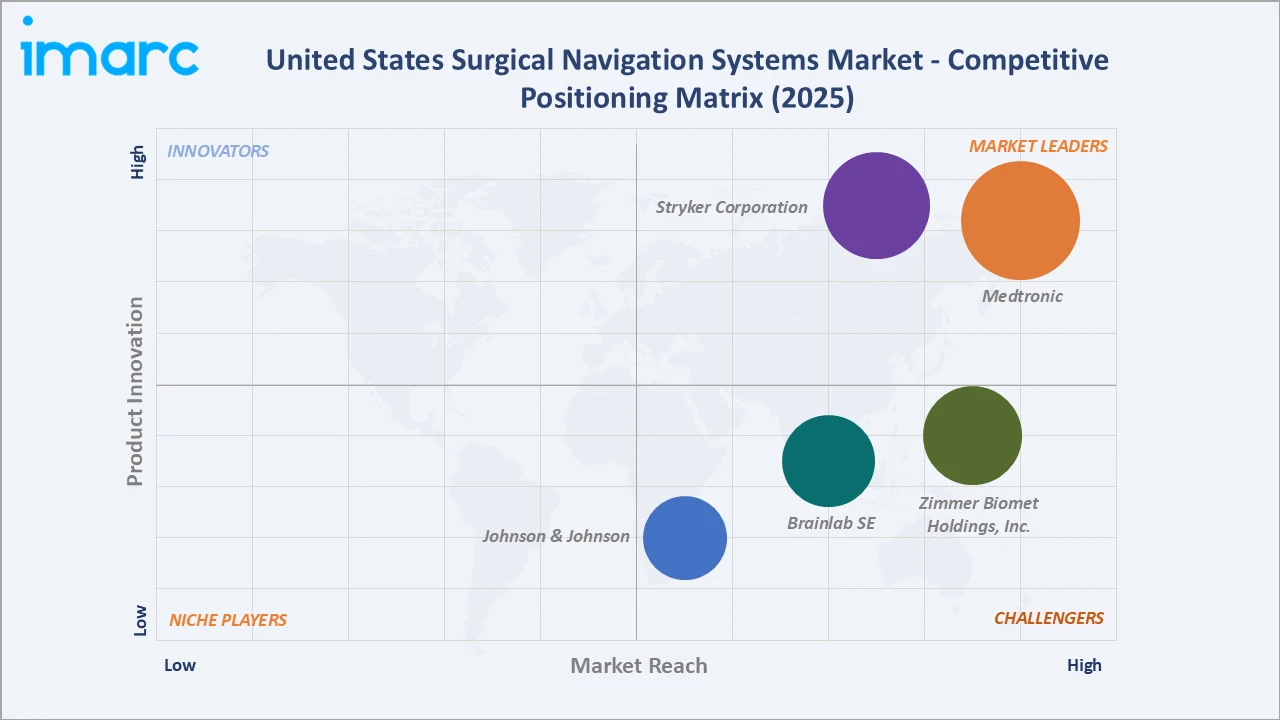
The US surgical navigation systems market is highly concentrated, with key players collectively holding approximately 60–65% of total US market revenue.
|
Company Name |
Brand/Product |
Market Position |
Core Strength |
|
Medtronic |
Mazor Robotic Guidance System, Stealth Autoguide Robotic Guidance System, StealthStation FlexENT Navigation System, StealthStation ENT Navigation System, StealthStation S8 Navigation Platform, among others |
Market Leader |
StealthStation platform; Mazor X Stealth Edition robotic spine navigation; broadest US navigation indication coverage |
|
Stryker Corporation |
Cranial Guidance Software, Q Guidance System, Stryker ENT Navigation System, Ortho Guidance Express Knee Software, Ortho Guidance Precision Knee Software, Ortho Guidance Versatile Hip Software, Ortho Q Guidance System, Mako Robotic-Arm Assisted Surgery platform, among others |
Market Leader |
Mako robotic navigation; optical tracking accuracy; TKA, THA, UKA, shoulder applications; full arthroplasty robotic navigation suite |
|
Zimmer Biomet Holdings, Inc. |
ROSA Robotic Surgery Platform (Knee, Hip, Spine) |
Strong Challenger |
ROSA robotic navigation platform; total knee, hip, spine applications; AI-powered bone model generation; global implant portfolio integration |
|
Brainlab SE |
Curve Navigation Platform, Buzz Digital O.R., Loop-X Mobile Imaging Robot, Kick Navigation System |
Strong Challenger |
Curve navigation platform (cranial, spine, ENT); AI automated bone registration; strong academic medical center presence |
|
Johnson & Johnson |
VELYS Robotic-Assisted Solution |
Challenger |
DePuy Velys knee robotic navigation system; FDA clearance for TKA navigation; expanding application coverage |
The market's concentration is reinforced by the bundling of navigation with robotic surgery platforms, creating switching costs that extend well beyond navigation hardware to surgeon training investment, implant vendor relationships, and service contract commitments.
Key Company Profiles
Medtronic
Medtronic is one of the US surgical navigation market leaders through its StealthStation platform combined with the O-arm intraoperative CT system and the Mazor X Stealth Edition robotic spine navigation platform.
- Product Portfolio: Mazor Robotic Guidance System, Stealth Autoguide Robotic Guidance System, StealthStation FlexENT Navigation System, StealthStation ENT Navigation System, and StealthStation S8 Navigation Platform, among others.
- Recent Developments: In February 2026, Medtronic received U.S. FDA clearance for the Stealth AXiS surgical system, the first integrated platform combining planning, navigation, and robotics for spine surgery. The system features real-time segmental tracking to visualize anatomical movement and patient alignment, helping streamline workflows and support more precise, personalized procedures.
- Strategic Focus: AI integration across the StealthStation platform for automated surgical planning; robotic spine navigation market leadership through Mazor X Stealth commercial expansion; cardiac navigation development for structural heart intervention guidance.
Brainlab SE
Brainlab SE is one of the leading independent surgical navigation software and hardware companies in the US market with the Curve and Kick navigation platforms across cranial neurosurgery, spine, and ENT applications.
- Product Portfolio: Curve Navigation Platform, Buzz Digital O.R., Loop-X Mobile Imaging Robot, and Kick Navigation System.
- Recent Developments: In September 2025, Brainlab received U.S. FDA 510(k) clearance and launched its Spine Mixed Reality Navigation system in the United States. The platform integrates optical navigation with mixed-reality visualization, displaying real-time entry and target points in the surgeon’s field of view to support precise pedicle-screw placement.
- Strategic Focus: AI-automated registration commercial launch targeting academic medical center adoption; paediatric neurosurgery navigation expansion; ENT navigation market share growth.
Market Concentration Analysis
The US surgical navigation systems market exhibits high concentration at the tier-1 system platform level, with key players commanding approximately 60–65% of total market revenue. Concentration is reinforced by robotic surgery platform bundling, where navigation hardware, software, implants, service contracts, and surgeon training are sold as integrated commercial packages, creating switching costs that effectively lock hospital systems into single-vendor navigation ecosystems for 7–10 year hardware lifecycles.
The market's next competitive evolution is being driven by software differentiation: as hardware optical and EM tracking accuracy converges toward clinical equivalence across vendors, AI navigation software is becoming the primary competitive differentiator. This software-centric competition is attracting medtech software specialists and technology company entrants that are challenging hardware-centric OEM competitive advantages.
Investment & Growth Opportunities
Fastest Growing Segments
Neurosurgery navigation (~20.2% CAGR driven by AI cranial and DBS expansion), AR and next-generation navigation platforms (~25%+ CAGR in premium segment), ASC-optimized navigation systems (~22% CAGR as joint replacement shifts outpatient), and AI navigation software subscriptions (~28%+ CAGR as SaaS navigation revenue models emerge) represent the highest-growth investment vectors through 2034.
Emerging Market Expansion
The transition of total joint arthroplasty and cervical spine surgery to ambulatory surgical centers represents the US navigation market's most significant geographic expansion opportunity. CMS 2021 and 2024 coverage expansion for THA and TKA in ASCs has created 2,500+ US ASCs potentially eligible for joint replacement that collectively lack navigation infrastructure. ASC-optimized navigation systems priced at USD 80,000–150,000 specifically target this market.
Venture and Institutional Investment Trends
- Surgical navigation AI companies are attracting the highest per-round medtech venture capital valuations and multiple stealth-mode surgical AI startups raising Series A and B rounds at USD 15–50 Million valuations, reflecting investor confidence in AI navigation's ability to command software subscription revenue on top of existing hardware economics.
- NIH and BARDA funding for navigation-guided surgical interventions, including NIH R01 grants for AR navigation in paediatric neurosurgery and BARDA funding for navigation-guided battlefield trauma surgery, is providing non-dilutive capital for foundational technology development that seeds the commercial navigation market's next generation of clinical applications.
Future Market Outlook (2026-2034)
The United States surgical navigation systems market is positioned for exceptional growth through 2034. From a base of USD 2.84 Billion in 2025, the market is projected to reach USD 13.34 Billion by 2034 at a CAGR of 18.19%, representing total incremental value creation of USD 10.50 Billion.
This trajectory is underpinned by the US ageing population driving surgical volume growth, AI navigation software transforming the economics and clinical value of navigation systems, and the progressive shift of arthroplasty procedures to ASCs expanding the navigation installation base beyond academic and large community hospitals.
By 2034, AI-powered navigation will have fundamentally restructured the US market. Automated registration, eliminating the primary workflow barrier to navigation adoption, will increase US orthopaedic navigation penetration from 45% (2025) to an estimated 75–80% of total joint arthroplasty procedures.
Research Methodology
Primary Research
Primary research comprised structured interviews with over 75 industry participants in 2024–2025, including orthopaedic surgeons, neurosurgeons, ENT specialists, hospital OR directors, health system CFOs, navigation system product managers, and medical device venture capital investors across the Northeast, South, West, and Midwest US regions.
Secondary Research
Secondary research encompassed the FDA 510(k) clearance database for surgical navigation devices, CMS procedure volume statistics by CPT code for navigation-indicated procedures, American Academy of Orthopaedic Surgeons (AAOS) technology adoption survey data, American Association of Neurological Surgeons (AANS) navigation utilization statistics, hospital navigation system installation data from hospital purchasing database providers, and financial disclosures.
Forecasting Models
Market size estimations were derived using top-down and bottom-up forecasting, incorporating CMS procedure volume growth projections by navigation-indicated CPT code, navigation adoption rate trajectory models by hospital type and geography, average system selling price evolution models accounting for competitive pricing pressure and technology upgrade cycles, and software revenue model projections for AI navigation subscription components.
United States Surgical Navigation Systems Market Report Coverage:
| Report Features | Details |
|---|---|
| Base Year of the Analysis | 2025 |
| Historical Period | 2020-2025 |
| Forecast Period | 2026-2034 |
| Units | Billion USD |
| Scope of the Report | Exploration of Historical Trends and Market Outlook, Industry Catalysts and Challenges, Segment-Wise Historical and Future Market Assessment:
|
| Technologies Covered | Electromagnetic Navigation Systems, Optical Navigation Systems, Others |
| Applications Covered | Neurosurgery, Orthopedic, ENT, Dental, Others |
| End Users Covered | Hospitals, Ambulatory Surgical Centers |
| Regions Covered | Northeast, Midwest, South, West |
| Companies Covered | Medtronic, Stryker Corporation, Zimmer Biomet Holdings Inc., Brainlab SE, Johnson & Johnson, etc. |
| Customization Scope | 10% Free Customization |
| Post-Sale Analyst Support | 10-12 Weeks |
| Delivery Format | PDF and Excel through Email (We can also provide the editable version of the report in PPT/Word format on special request) |
Key Benefits for Stakeholders:
- IMARC’s industry report offers a comprehensive quantitative analysis of various market segments, historical and current market trends, market forecasts, and dynamics of the United States surgical navigation systems market from 2020-2034.
- The research report provides the latest information on the market drivers, challenges, and opportunities in the United States surgical navigation systems market.
- Porter's five forces analysis assist stakeholders in assessing the impact of new entrants, competitive rivalry, supplier power, buyer power, and the threat of substitution. It helps stakeholders to analyze the level of competition within the United States surgical navigation systems industry and its attractiveness.
- Competitive landscape allows stakeholders to understand their competitive environment and provides an insight into the current positions of key players in the market.
Frequently Asked Questions About the United States Surgical Navigation Systems Market Report
The United States surgical navigation systems market reached USD 2.84 Billion in 2025 and is projected to reach USD 13.34 Billion by 2034.
The market is expected to grow at a CAGR of 18.19% during 2026-2034, driven by escalating MIS procedure demand, AI navigation software adoption, robotic surgery platform integration, and the shift of arthroplasty to ASCs, expanding the navigation installation base.
The Northeast leads with a 31.6% market share in 2025, anchored by the concentration of major academic medical centers that serve as navigation technology adoption reference sites, combined with the highest US regional density of fellowship-trained arthroplasty and neurosurgery specialists.
Optical navigation systems dominate with a 48.6% share in 2025, reflecting their established accuracy of 0.3–0.8 mm across orthopedic and spine navigation combined with the dominant US deployment of Stryker Mako and Zimmer Biomet ROSA robotic platforms.
Orthopedic holds the largest application share at 39.4%, reflecting the US's growing joint arthroplasty volume annually, combined with the growing adoption of navigation for US arthroplasty procedures.
Some of the key players include Medtronic, Stryker Corporation, Zimmer Biomet Holdings, Inc., Brainlab SE, and Johnson & Johnson.
Key drivers include rising demand for minimally invasive surgery, the aging US population driving orthopedic and neurosurgical procedure volumes, and the expansion of joint replacement surgery to ASCs creating new navigation installation demand.
Key challenges include the high capital cost of integrated robotic navigation systems, technical complexity and surgeon learning curves limiting adoption among community arthroplasty surgeons, and IT integration complexity across heterogeneous US hospital EHR and PACS systems.
Need more help?
- Speak to our experienced analysts for insights on the current market scenarios.
- Include additional segments and countries to customize the report as per your requirement.
- Gain an unparalleled competitive advantage in your domain by understanding how to utilize the report and positively impacting your operations and revenue.
- For further assistance, please connect with our analysts.
 Request Customization
 Speak to an Analyst
 Request Brochure
 Inquire Before Buying
Benefits of Customization
- Personalize this research
- Triangulate with your data
- Get data as per your format and definition
- Gain a deeper dive into a specific application, geography, customer, or competitor
- Any level of personalization
Get in Touch With Us
UNITED STATES
Phone: +1-201-971-6302
INDIA
Phone: +91-120-433-0800
UNITED KINGDOM
Phone: +44-753-714-6104
Email: [email protected]
Client Testimonials




.webp)




.webp)













Related Reports

Choose your plan
*Please note that the prices mentioned below are starting prices for each bundle type. Kindly contact our team for further details.*
Single User License
- 1 User License, Access on 2 Devices
- PDF Report + Excel Dataset (Password Protected)
- Lifetime Access
- No Printing Rights
- 10% Free Report Customization
- 10–12 Weeks of Analyst Support
Five User License
- Access for 5 Users, 2 Devices per User
- PDF Report + Excel Dataset (Password Protected)
- Lifetime Access
- Dedicated Account Manager
- 12–14 Weeks of Analyst Support
- No Printing Rights
- 15% Free Report Customization
- 25% Discount on Your Next Purchase
Corporate User License
- Unlimited User Access (Within Your Organization)
- PDF Report + Excel Dataset
- Lifetime Access
- Dedicated Account Manager
- 14–20 Weeks of Analyst Support
- No Printing Rights
- 20% Free Report Customization
- 30% Discount on Your Next Purchase
Essential Insights
What's included:
3 reports
- Lifetime Access
- PDF Reports
- Excel Datasets
- 2 Weeks of Free Analyst Support
- 2 User Licenses
- Access on 2 Devices
- Printing Rights
- Complimentary PowerPoint (PPT) Version
- Complimentary License Upgrade
Professional Access
What's included:
5 reports
- Lifetime Access
- PDF Reports
- Excel Datasets
- 8 Weeks of Free Analyst Support
- 2 User Licenses
- Access on 2 Devices
- Printing Rights
- Complimentary PowerPoint (PPT) Version
- Complimentary License Upgrade
Business Advantage
What's included:
8 reports
- Lifetime Access
- PDF Reports
- Excel Datasets
- 14 Weeks of Free Analyst Support
- 2 User Licenses
- Access on 2 Devices
- Printing Rights
- Complimentary PowerPoint (PPT) Version
- Complimentary License Upgrade
Enterprise Intelligence
What's included:
10 reports
- Lifetime Access
- PDF Reports
- Excel Datasets
- 20 Weeks of Free Analyst Support
- 2 User Licenses
- Access on 2 Devices
- Printing Rights
- Complimentary PowerPoint (PPT) Version
- Complimentary License Upgrade