
Vietnam Screen and Script Writing Software Market Size, Share, Trends and Forecast by Platform Type, Deployment Mode, End User, and Region, 2026-2034
Vietnam Screen and Script Writing Software Market Summary:
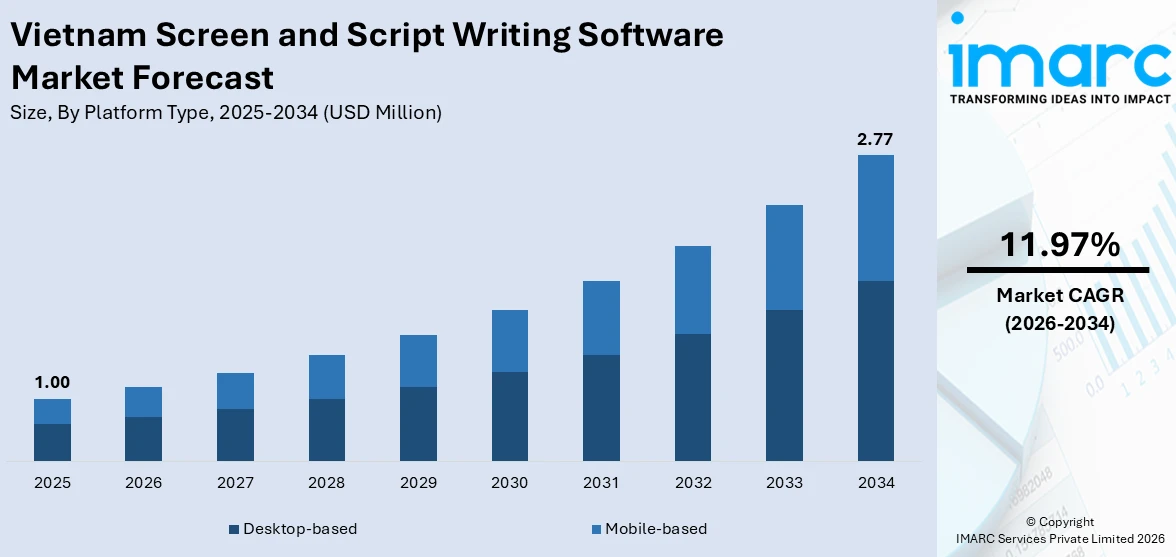
The Vietnam screen and script writing software market size was valued at USD 1.00 Million in 2025 and is projected to reach USD 2.77 Million by 2034, growing at a compound annual growth rate of 11.97% from 2026-2034.
The Vietnam screen and script writing software market is gaining strong momentum as the country’s entertainment and digital content creation industries undergo rapid expansion. Rising demand for locally produced films, television series, and streaming content is driving the need for professional scriptwriting and production management tools. Increasing digital transformation across media organizations, growing adoption of cloud-based collaborative platforms, and the integration of artificial intelligence capabilities into creative workflows are reshaping content creation practices. Government-led cultural industry initiatives and a thriving independent filmmaking community are further accelerating adoption, positioning Vietnam as a dynamic growth frontier for screen and script writing software solutions across the Asia-Pacific region.
Key Takeaways and Insights:
- By Platform Type: Desktop-based dominates the market with a share of 62% in 2025, owing to its robust processing capabilities, comprehensive offline functionality, and advanced toolsets for script formatting, scene organization, and character tracking that meet the demands of professional screenwriters and production studios.
- By Deployment Mode: Cloud-based leads the market with a share of 68% in 2025. This dominance is driven by growing demand for real-time collaboration features, seamless cross-device accessibility, and automatic cloud synchronization that enable writing teams to co-create scripts efficiently regardless of geographic location.
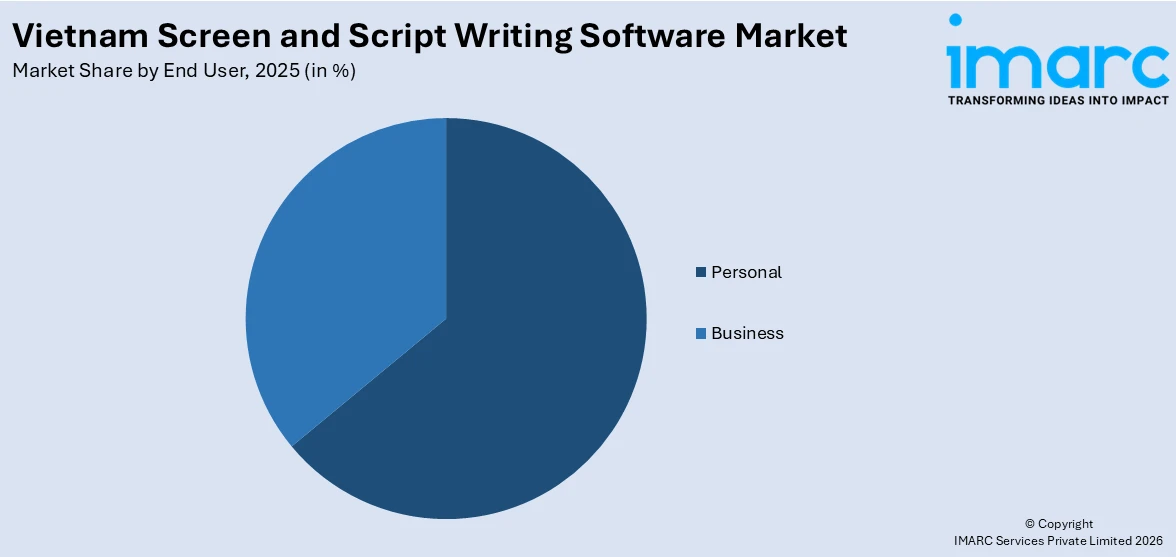
- By End User: Personal represents the largest segment with a market share of 64% in 2025, reflecting the expanding community of independent screenwriters, aspiring filmmakers, and freelance content creators who increasingly rely on accessible digital writing tools for creative projects.
- By Region: Southern Vietnam exhibits a clear dominance in the market with 49% share in 2025, driven by the concentration of major film production companies, media organizations, and creative enterprises in Ho Chi Minh City.
- Key Players: Key players drive the Vietnam screen and script writing software market by expanding product portfolios, enhancing AI-powered writing assistance and collaboration features, and strengthening digital distribution. Their investments in cloud infrastructure, localization, and partnerships with production studios boost adoption and ensure consistent product availability across diverse user segments.
To get more information on this market Request Sample
The Vietnam screen and script writing software market is advancing as filmmakers, content creators, and media enterprises embrace professional digital writing tools to meet surging demand for high-quality original content. A major driver shaping this progress is the country’s rapidly growing entertainment industry, which is generating unprecedented opportunities for scriptwriting software adoption. The proliferation of over-the-top streaming platforms, increasing investment in original Vietnamese content, and the emergence of a vibrant independent filmmaking community are creating sustained demand for sophisticated writing and pre-production tools. Cloud-based solutions with real-time collaboration capabilities are particularly gaining traction among distributed writing teams. Integration of artificial intelligence features, including automated formatting, script analysis, and visual storyboarding, is further enhancing productivity and creative output. Government support for cultural industries and digital content creation initiatives are contributing to a more favorable environment for screen and script writing software adoption across the Vietnam screen and script writing software market share.
Vietnam Screen and Script Writing Software Market Trends:
Integration of Artificial Intelligence in Scriptwriting Workflows
The integration of artificial intelligence into screen and script writing software is transforming creative workflows across Vietnam's entertainment industry. AI-powered features including automated script formatting, dialogue analysis, character development tracking, and visual storyboarding are enabling writers to enhance productivity and narrative quality. Leading software providers are increasingly embedding generative AI capabilities that allow screenwriters to visualize scenes, generate style-consistent imagery, and produce preliminary video content directly from their scripts. These advancements are encouraging broader adoption of modern writing tools among both professional and aspiring filmmakers in Vietnam, reshaping the creative landscape.
Rising Adoption of Cloud-Based Collaborative Platforms
Cloud-based screen and script writing solutions are rapidly gaining popularity in Vietnam as writing teams increasingly require seamless real-time collaboration and cross-device accessibility. The shift toward remote and hybrid content production models is driving demand for platforms that support simultaneous editing, integrated communication, and automatic version management, contributing to Vietnam screen and script writing software market growth. According to the official report by government, Vietnam’s digital economy reached approximately USD 45 Billion by 2025, reflecting the broader digital transformation that underpins growing adoption of cloud-native creative tools across the country’s media and entertainment ecosystem.
Expansion of Domestic Content Production and Streaming Ecosystem
Vietnam’s entertainment landscape is experiencing a significant surge in domestic content production, fueled by the growth of local over-the-top streaming platforms and increasing audience preference for culturally resonant narratives. This expansion is generating heightened demand for professional scriptwriting tools that streamline the content creation pipeline from initial concept to production-ready scripts. As per the industry reports, Vietnamese domestic films accounted for approximately 62% of the national box office market share in 2025, nearly doubling from 42% in 2024, underscoring the rapid growth of local content creation that directly supports demand for advanced writing software.
Market Outlook 2026-2034:
The market for screen and script writing software in Vietnam is expected to grow steadily due to the nation's thriving entertainment sector, the speed at which digital transformation is occurring, and the growing government commitment to the growth of the cultural sector. There will likely be a persistent need for professional scriptwriting tools due to the growth of the independent filmmaking community, the development of domestic film production, and more investment in streaming content. As writing teams prioritize real-time collaboration and productivity-enhancing features, cloud-based deployment models with integrated artificial intelligence capabilities are expected to gain market share. The market generated a revenue of USD 1.00 Million in 2025 and is projected to reach a revenue of USD 2.77 Million by 2034, growing at a compound annual growth rate of 11.97% from 2026-2034.
Vietnam Screen and Script Writing Software Market Report Segmentation:
|
Segment Category |
Leading Segment |
Market Share |
|
Platform Type |
Desktop-based |
62% |
|
Deployment Mode |
Cloud-based |
68% |
|
End User |
Personal |
64% |
|
Region |
Southern Vietnam |
49% |
Platform Type Insights:
- Desktop-based
- Mobile-based
Desktop-based dominates with a market share of 62% of the total Vietnam screen and script writing software market in 2025.
Desktop-based screen and script writing software remains the preferred choice among professional screenwriters and production studios in Vietnam, owing to its powerful processing capabilities, extensive offline functionality, and comprehensive toolsets for complex scriptwriting projects. These platforms offer advanced features including scene organization, character tracking, production scheduling, and integrated storyboarding that are essential for feature-length film and television productions. Continuous enhancements in workspace customization, outlining tools, and character development capabilities further solidify desktop platforms as the industry standard for professional screenwriting across Vietnam's growing entertainment sector.
The continued preference for desktop-based solutions in Vietnam reflects the requirements of established production houses and experienced writers who prioritize processing power and feature depth over mobility. Desktop platforms support offline workflows critical for writers in areas with inconsistent internet connectivity and provide the large-screen workspace necessary for managing multi-scene scripts. Vietnam's growing film production output, characterized by a rising number of domestic releases and expanding box office performance, continues to drive demand for the robust capabilities that desktop-based screenwriting software provides to professional content creators across the country.
Deployment Mode Insights:
- On-premises
- Cloud-based
Cloud-based leads with a share of 68% of the total Vietnam screen and script writing software market in 2025.
Cloud-based deployment has emerged as the dominant model in Vietnam’s screen and script writing software market, driven by the growing need for real-time collaborative capabilities and flexible cross-device access. The shift toward distributed content production workflows, accelerated by the post-pandemic digital transformation of media organizations, has positioned cloud platforms as essential tools for modern writing teams. Cloud-based solutions enable seamless synchronization across multiple devices, automatic version control, and integrated communication features. Vietnam had nearly 73,788 active digital technology enterprises by the end of 2024, reflecting the broader cloud adoption trend that supports the deployment of cloud-native creative software solutions across the country’s media industry.
The accessibility and cost-effectiveness of cloud-based screenwriting platforms are particularly appealing to Vietnam’s expanding community of independent filmmakers and aspiring content creators who require professional-grade tools without significant upfront investment. Subscription-based pricing models offered by cloud providers lower barriers to entry and ensure continuous access to the latest features and updates. The integration of AI-powered capabilities within cloud platforms, including automated formatting, collaborative note-taking, and script analysis, is further enhancing their value proposition.
End User Insights:
Access the comprehensive market breakdown Request Sample
- Personal
- Business
Personal represents the largest segment with a 64% share of the total Vietnam screen and script writing software market in 2025.
Personal end users represent the largest segment of Vietnam’s screen and script writing software market, reflecting the country’s expanding community of independent screenwriters, freelance content creators, film students, and aspiring filmmakers. The democratization of content creation tools through affordable subscription plans and free-tier offerings has significantly broadened access to professional-grade scriptwriting software. Vietnam’s young, digitally connected population provides a substantial base of potential personal users who are increasingly engaging with creative digital tools for storytelling across film, television, and digital media formats.
The growth of personal end-user adoption is further supported by the expansion of film education programs and digital content creation communities across Vietnam. Leading universities have launched specialized film and media production programs to meet rising demand for trained creative professionals, equipping aspiring screenwriters with industry-relevant skills. The Vietnam Digital Content Creation Awards, established to recognize outstanding digital content, have garnered strong participation from creators across diverse fields, demonstrating the vibrant and growing community of individual content creators who rely on accessible screenwriting tools to develop and refine their creative projects for both domestic and international audiences.
Regional Insights:
- Northern Vietnam
- Central Vietnam
- Southern Vietnam
Southern Vietnam exhibits a clear dominance with a 49% share of the total Vietnam screen and script writing software market in 2025.
Southern Vietnam currently holds the top spot in the market due to the concentration of significant film production firms, media outlets, post-production facilities, and creative businesses in Ho Chi Minh City and the surrounding metropolitan area. With most of the nation's movie theater chains, private production companies, and digital content studios located there, the city acts as the main center for Vietnam's entertainment sector. Because of the region's established infrastructure for producing and distributing information, authors and production teams continue to need professional screenwriting tools.
Numerous film festivals, educational institutions, and creative incubators that promote industry collaboration and talent development contribute to the region's thriving creative environment. Ho Chi Minh City is becoming more and more popular as a destination for filming, which increases its allure for partnerships in the creation of both domestic and foreign content. The continued use of cutting-edge screen and screenplay writing software solutions throughout Southern Vietnam is further supported by the convergence of established production infrastructure, talented creative people, and growing digital media businesses.
Market Dynamics:
Growth Drivers:
Why is the Vietnam Screen and Script Writing Software Market Growing?
Rapid Expansion of Domestic Film and Content Production
Vietnam’s entertainment industry is experiencing unprecedented growth, generating robust demand for professional screen and script writing software solutions. The domestic film sector has witnessed a remarkable surge in production volume and revenue, driven by increasing audience preference for culturally resonant narratives and the growing capabilities of local filmmakers. This expansion encompasses feature films, television series, web dramas, and digital short-form content, all of which require sophisticated scriptwriting and pre-production management tools. As per the industry reports, the total revenue of Vietnamese films in the domestic market reached approximately VND 3,650 Billion in 2025, nearly doubling from 2024, with the historical war film “Red Rain” alone contributing VND 714 Billion, the highest revenue ever achieved by a Vietnamese feature film. This dramatic growth in content production is directly driving increased adoption of specialized writing software that streamlines the scriptwriting process, facilitates collaboration among production teams, and ensures industry-standard formatting for professional film and television productions.
Accelerating Digital Transformation Across Media Organizations
Vietnam's broader digital transformation is creating a fertile environment for the adoption of advanced screen and script writing software across media organizations of all sizes. The country's rapid digitalization, supported by strong government policy frameworks and expanding digital infrastructure, is encouraging media companies to modernize their content creation workflows with cloud-based collaborative tools, AI-powered features, and integrated production management platforms. The Government of Vietnam's National Digital Transformation Program has set ambitious targets for the ICT sector, prioritizing increased digital connectivity, expanded broadband access, and accelerated technology adoption across industries. This digital momentum is directly supporting the transition from traditional scriptwriting methods to modern software-based workflows. Media organizations are increasingly investing in technology solutions that enable remote collaboration, version control, and seamless integration with broader production pipelines, driving sustained demand for digital screenwriting tools.
Government Support for Cultural Industry Development
Vietnam's government has identified cinema as a strategic cultural industry and is implementing comprehensive policies to support its growth, creating a favorable regulatory environment that stimulates demand for professional content creation tools. The cultural industry development strategy positions cinema among the leading sectors targeted for investment, innovation, and international integration, encouraging both domestic and foreign participation in Vietnam's growing entertainment ecosystem. The government's long-term vision for developing cultural industries through 2030 identifies cinema as one of the key priority industries, with dedicated programs aimed at strengthening production capabilities and expanding the creative economy across major urban centers. These policy initiatives, combined with tax incentives, creative development funds, and international cooperation frameworks, are building institutional support for the entertainment industry that extends to the adoption of professional software tools essential for modern content production.
Market Restraints:
What Challenges the Vietnam Screen and Script Writing Software Market is Facing?
High Cost of Professional Software Licenses
The premium pricing of leading professional screenwriting software solutions presents a significant barrier to adoption in Vietnam, particularly among independent writers, film students, and small production companies. Industry-standard tools often carry substantial one-time purchase costs or recurring subscription fees that can be prohibitively expensive for price-sensitive users in an emerging market. While free-tier options exist, they typically offer limited functionality, restricting access to advanced features essential for professional-grade content production and discouraging broader market penetration.
Limited Specialized Training and Workforce Readiness
Despite growing interest in filmmaking and content creation, Vietnam faces a shortage of skilled professionals trained in the use of modern screenwriting software tools. Insufficient formal training institutions, limited specialized curricula addressing digital pre-production workflows, and a gap between academic preparation and industry requirements hinder the effective adoption of advanced screen and script writing solutions. The lack of localized tutorials, Vietnamese-language interfaces, and region-specific support further compounds this challenge, slowing the transition from conventional writing methods to digital platforms.
Resistance to Transitioning from Traditional Methods
A segment of Vietnam’s established filmmaking community continues to rely on traditional pen-and-paper or basic word processing methods for scriptwriting, creating resistance to adopting specialized digital platforms. This reluctance is driven by comfort with familiar workflows, perceived complexity of modern software interfaces, and skepticism about the value added by feature-rich writing tools. Overcoming this inertia requires sustained industry education, demonstration of tangible productivity gains, and culturally sensitive onboarding approaches that address the specific needs of Vietnam’s creative professionals.
Competitive Landscape:
The market for screen and script writing software in Vietnam is becoming more competitive as new regional platforms and foreign software suppliers increase their footprints. Businesses are concentrating on establishing mobile-friendly platforms, boosting AI-powered writing aid, and enhancing real-time collaboration tools. Investments in cloud infrastructure, localization for support of the Vietnamese language, and integration with larger production management ecosystems are other factors driving competition. Innovation is being promoted and product uptake is being accelerated through strategic alliances with movie studios, academic institutions, and content platforms. As suppliers fight for customers in Vietnam's expanding independent creative and professional production sector, subscription-based pricing structures and freemium services are escalating competition.
Vietnam Screen and Script Writing Software Market Report Coverage:
|
Report Features |
Details |
|
Base Year of the Analysis |
2025 |
|
Historical Period |
2020-2025 |
|
Forecast Period |
2026-2034 |
|
Units |
Million USD |
|
Scope of the Report |
Exploration of Historical Trends and Market Outlook, Industry Catalysts and Challenges, Segment-Wise Historical and Future Market Assessment:
|
|
Platform Types Covered |
Desktop-based, Mobile-based |
|
Deployment Modes Covered |
On-premises, Cloud-based |
|
End Users Covered |
Personal, Business |
|
Regions Covered |
Northern Vietnam, Central Vietnam, Southern Vietnam |
|
Customization Scope |
10% Free Customization |
|
Post-Sale Analyst Support |
10-12 Weeks |
|
Delivery Format |
PDF and Excel through Email (We can also provide the editable version of the report in PPT/Word format on special request) |
Frequently Asked Questions About the Vietnam Screen and Script Writing Software Market Report
The Vietnam screen and script writing software market size was valued at USD 1.00 Million in 2025.
The Vietnam screen and script writing software market is expected to grow at a compound annual growth rate of 11.97% from 2026-2034 to reach USD 2.77 Million by 2034.
Desktop-based dominated the market with a share of 62%, owing to its robust processing capabilities, comprehensive offline functionality, and advanced professional toolsets for script formatting, scene organization, and character tracking favored by production studios.
Key factors driving the Vietnam screen and script writing software market include rapid expansion of domestic film production, accelerating digital transformation across media organizations, growing cloud-based collaborative platform adoption, AI integration in creative workflows, and government support for cultural industry development.
Major challenges include high cost of professional software licenses, limited specialized training infrastructure, resistance to transitioning from traditional writing methods, insufficient Vietnamese-language localization, and workforce readiness gaps in digital pre-production skills.
Need more help?
- Speak to our experienced analysts for insights on the current market scenarios.
- Include additional segments and countries to customize the report as per your requirement.
- Gain an unparalleled competitive advantage in your domain by understanding how to utilize the report and positively impacting your operations and revenue.
- For further assistance, please connect with our analysts.
 Request Customization
 Speak to an Analyst
 Request Brochure
 Inquire Before Buying
Benefits of Customization
- Personalize this research
- Triangulate with your data
- Get data as per your format and definition
- Gain a deeper dive into a specific application, geography, customer, or competitor
- Any level of personalization
Get in Touch With Us
UNITED STATES
Phone: +1-201-971-6302
INDIA
Phone: +91-120-433-0800
UNITED KINGDOM
Phone: +44-753-714-6104
Email: [email protected]
Client Testimonials




.webp)




.webp)













Related Reports

Choose your plan
*Please note that the prices mentioned below are starting prices for each bundle type. Kindly contact our team for further details.*
Single User License
- 1 User License, Access on 2 Devices
- PDF Report + Excel Dataset (Password Protected)
- Lifetime Access
- No Printing Rights
- 10% Free Report Customization
- 10–12 Weeks of Analyst Support
Five User License
- Access for 5 Users, 2 Devices per User
- PDF Report + Excel Dataset (Password Protected)
- Lifetime Access
- Dedicated Account Manager
- 12–14 Weeks of Analyst Support
- No Printing Rights
- 15% Free Report Customization
- 25% Discount on Your Next Purchase
Corporate User License
- Unlimited User Access (Within Your Organization)
- PDF Report + Excel Dataset
- Lifetime Access
- Dedicated Account Manager
- 14–20 Weeks of Analyst Support
- No Printing Rights
- 20% Free Report Customization
- 30% Discount on Your Next Purchase
Essential Insights
What's included:
3 reports
- Lifetime Access
- PDF Reports
- Excel Datasets
- 2 Weeks of Free Analyst Support
- 2 User Licenses
- Access on 2 Devices
- Printing Rights
- Complimentary PowerPoint (PPT) Version
- Complimentary License Upgrade
Professional Access
What's included:
5 reports
- Lifetime Access
- PDF Reports
- Excel Datasets
- 8 Weeks of Free Analyst Support
- 2 User Licenses
- Access on 2 Devices
- Printing Rights
- Complimentary PowerPoint (PPT) Version
- Complimentary License Upgrade
Business Advantage
What's included:
8 reports
- Lifetime Access
- PDF Reports
- Excel Datasets
- 14 Weeks of Free Analyst Support
- 2 User Licenses
- Access on 2 Devices
- Printing Rights
- Complimentary PowerPoint (PPT) Version
- Complimentary License Upgrade
Enterprise Intelligence
What's included:
10 reports
- Lifetime Access
- PDF Reports
- Excel Datasets
- 20 Weeks of Free Analyst Support
- 2 User Licenses
- Access on 2 Devices
- Printing Rights
- Complimentary PowerPoint (PPT) Version
- Complimentary License Upgrade