
Australia and New Zealand Cross Laminated Timber (CLT) Market Size, Share, Trends and Forecast by Application, 2026-2034
Australia and New Zealand Cross Laminated Timber (CLT) Market Size, Share, Trends & Forecast (2026-2034)
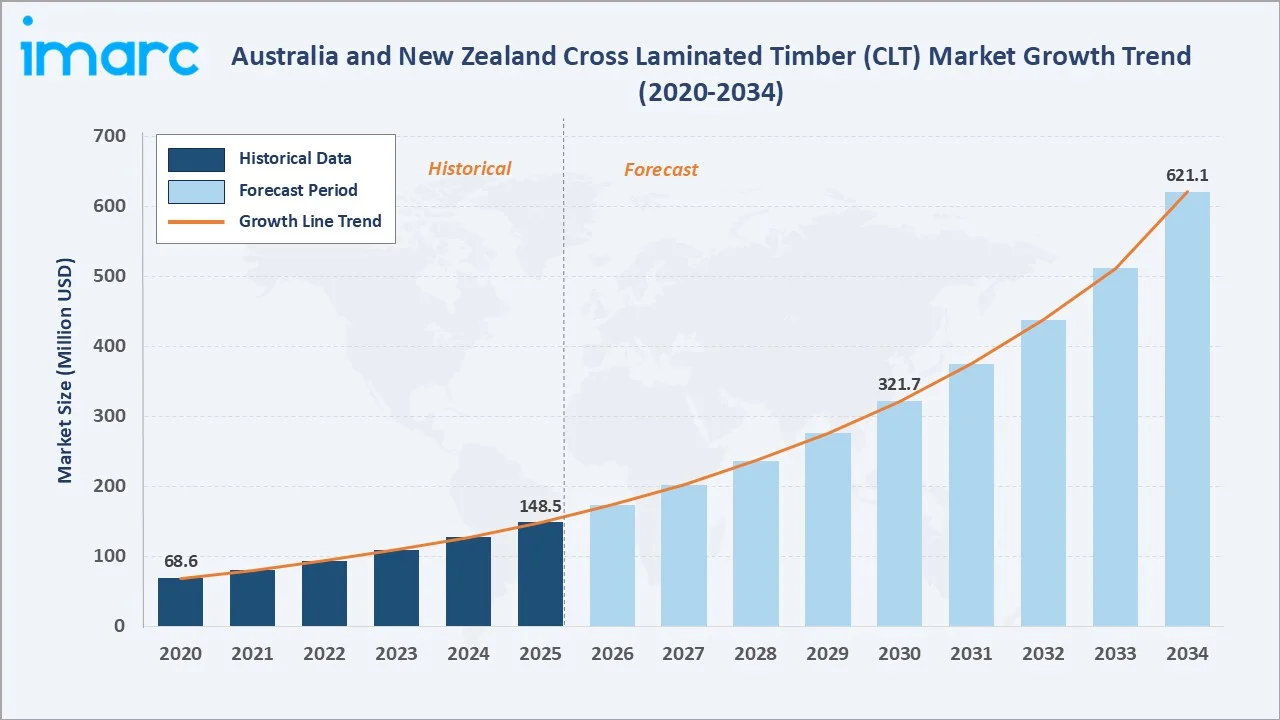
The Australia and New Zealand cross-laminated timber (CLT) market reached USD 148.5 Million in 2025 and is projected to reach USD 621.1 Million by 2034, growing at a CAGR of 16.72% during 2026-2034. Rising sustainability mandates, net-zero construction targets, and mass timber high-rise regulatory approvals are driving adoption. Australia's non-residential segment leads at 48.6%; New Zealand's residential segment leads at 57.8%.
Market Snapshot
|
Metric |
Value |
|
Market Size (2025) |
USD 148.5 Million |
|
Forecast Market Size (2034) |
USD 621.1 Million |
|
CAGR (2026-2034) |
16.72% |
|
Base Year |
2025 |
|
Historical Period |
2020-2025 |
|
Forecast Period |
2026-2034 |
|
Leading Application (Australia) |
Non-Residential Units (48.6%, 2025) |
|
Leading Application (New Zealand) |
Residential (57.8%, 2025) |
The market expanded from USD 68.6 Million in 2020 to USD 148.5 Million in 2025, anchored at approximately USD 321.7 Million in 2030 and forecast to reach USD 621.1 Million by 2034. Government decarbonisation targets, growing mass timber project pipelines, and NCC code updates drove consistent high-growth market expansion.
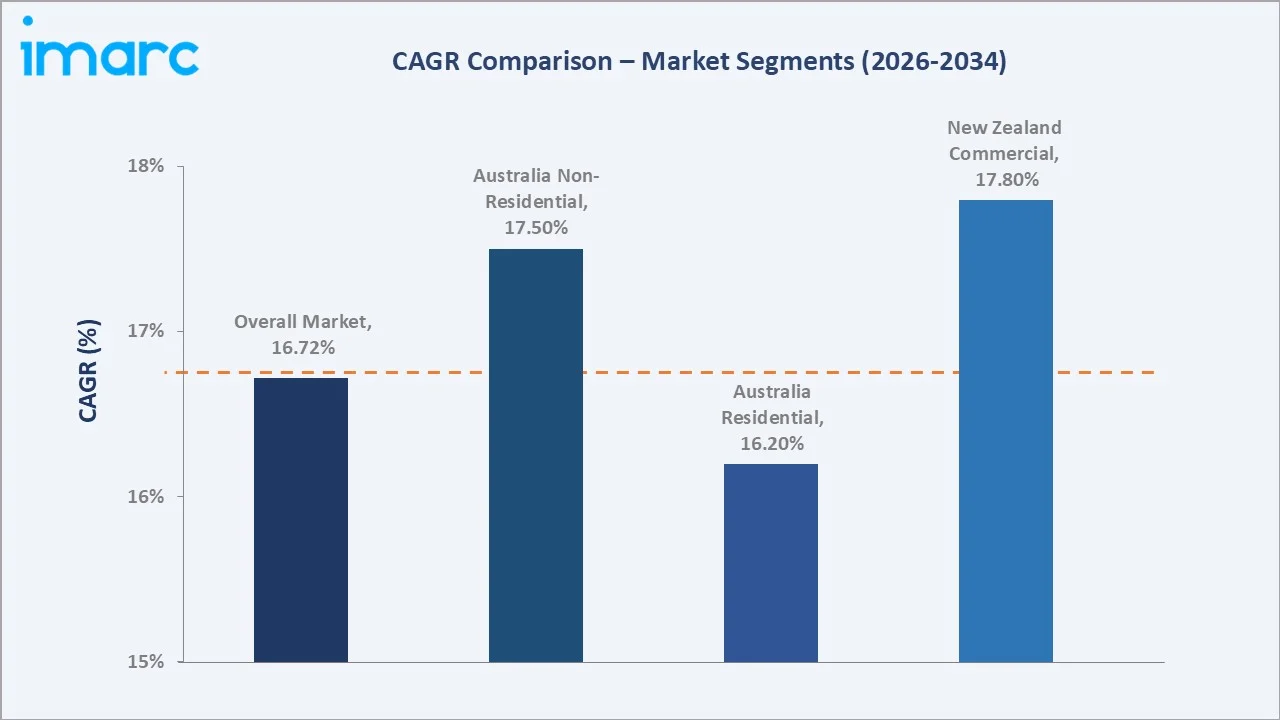
Non-residential CLT applications grow fastest at ~17.5% CAGR in Australia, driven by education, healthcare, and commercial office projects mandating low-carbon construction materials through government procurement frameworks and corporate sustainability commitments that specify mass timber over conventional steel and concrete.
To get more information on this market, Request Sample
New Zealand's commercial segment grows at ~17.8% CAGR, reflecting growing adoption of CLT in retail, hospitality, and mixed-use developments as architects and developers prioritise biophilic design and sustainable building credentials that CLT uniquely delivers at commercial scale.
Executive Summary
The Australia and New Zealand CLT market reached USD 148.5 Million in 2025, positioning the region as the Asia-Pacific's most advanced mass timber market driven by progressive building code reforms, ambitious net-zero construction targets, and a growing pipeline of landmark mass timber projects. The market is projected to reach USD 621.1 Million by 2034.
Australia's non-residential units segment at 48.6% leads through government-mandated sustainable procurement in public buildings. New Zealand's residential segment at 57.8% dominates through progressive NCC equivalents supporting multi-storey timber construction and developer preference for CLT's structural and aesthetic advantages over conventional materials.
Key Market Insights
|
Insight |
Data |
|
Leading Application (Australia) |
Non-Residential Units – 48.6% share (2025) |
|
Leading Application (New Zealand) |
Residential – 57.8% share (2025) |
|
Market Opportunity |
Mass timber high-rise approvals, net-zero construction mandates, domestic manufacturing expansion |
Key Analytical Observations Supporting the Above Data:
- Non-Residential Units at 48.6% (Australia): Government and institutional procurement policies mandating lower embodied carbon in new public buildings are the primary structural driver for CLT adoption in Australia's non-residential segment, generating large-volume, high-specification project opportunities.
- Residential at 57.8% (New Zealand): New Zealand's progressive building codes, higher consumer awareness of sustainable building materials, and the compact urban housing density of Auckland and Wellington create structural conditions for rapid CLT adoption in mid-rise residential construction above conventional timber or concrete alternatives.
- Commercial at 42.2% (New Zealand): New Zealand's commercial CLT segment is expanding rapidly through hospitality, mixed-use, and retail developments where biophilic design principles and sustainability credentials create strong commercial value for CLT over conventional construction materials at comparable cost structures.
Australia and New Zealand CLT Market Overview
The Australia and New Zealand CLT market encompasses the production, import, distribution, design, and application of cross-laminated timber structural panels across residential, commercial, and institutional building construction segments throughout both countries.
The ecosystem integrates international CLT manufacturers (predominantly European), the sole domestic producer XLam Australia, licensed importers, structural engineering firms, and specialist mass timber contractors. Key macroeconomic drivers include net-zero construction mandates, carbon-neutral building certification growth, mass timber high-rise regulatory approvals, and expanding consumer and corporate preference for sustainable built environments.
Market Dynamics
To evaluate market opportunities, Request Sample
Market Drivers
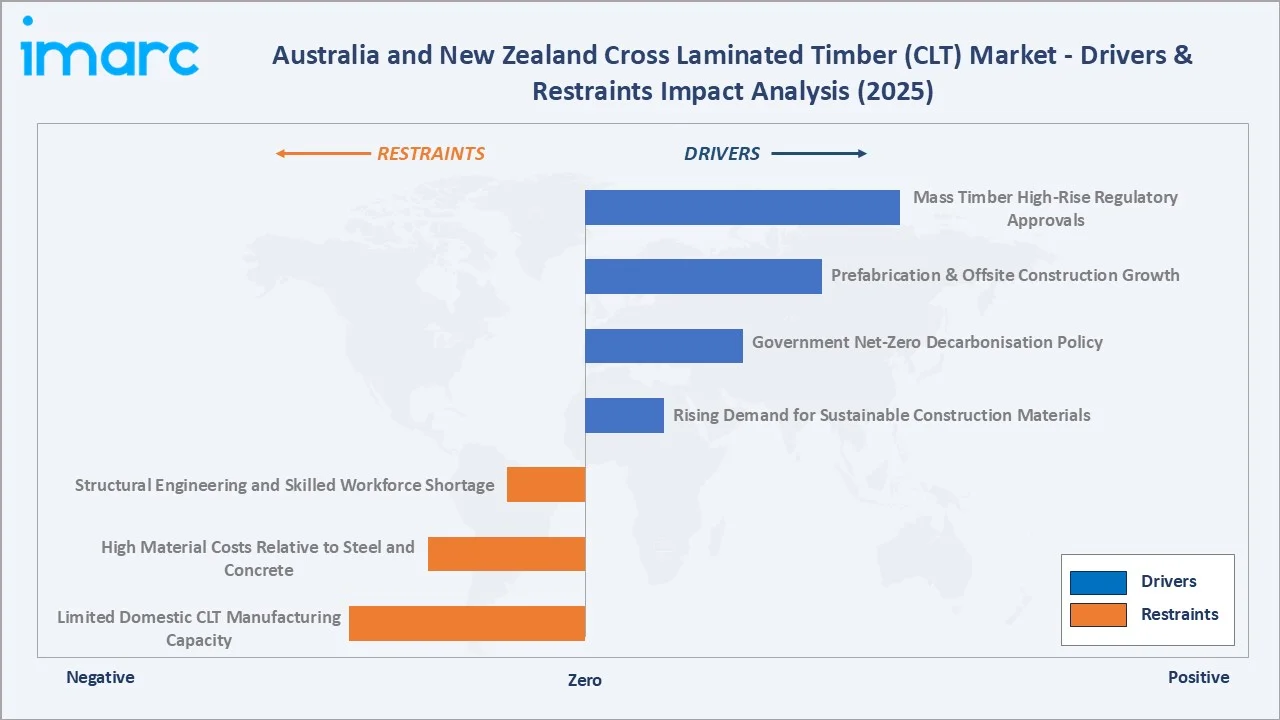
- Rising Demand for Sustainable Construction Materials: Government net-zero targets, Green Star building certification requirements, and corporate sustainability commitments across Australia and New Zealand are structurally accelerating CLT adoption as the only scalable structural material that achieves net carbon sequestration in the built environment. Each tonne of CLT deployed substitutes approximately 1.7 tonnes of CO₂ emissions compared to structural steel, making it the preferred material for achieving embodied carbon reduction targets in new construction..
- Government Net-Zero and Decarbonisation Policy: Australian and New Zealand government mandates for low-embodied-carbon public buildings, carbon-neutral procurement frmeworks, and incentives for sustainable construction materials create a structural policy-led demand pool for CLT in public sector projects. The Australian Government's Net Zero Economy Authority and New Zealand's Climate Commission have both identified mass timber construction as a priority pathway for reducing construction sector emissions.
- Prefabrication and Offsite Construction Growth: CLT's suitability for precision prefabrication and rapid on-site assembly is driving adoption across both commercial and residential sectors experiencing acute skilled labour shortages. Prefabricated CLT panels arrive on site precision-cut and ready for crane installation, reducing on-site labour requirements and construction programme risk. The growing pressure on Australian and New Zealand construction timelines from housing shortage urgency is making CLT's speed advantage a critical commercial differentiator over conventional construction methods.
- Mass Timber High-Rise Regulatory Approvals: Progressive updates to the National Construction Code (NCC) in Australia and equivalent frameworks in New Zealand are systematically removing regulatory barriers to mass timber buildings above traditional height limits. The NCC 2022 changes extended mass timber building height provisions, and ongoing regulatory evolution continues to unlock CLT for taller building typologies. Each regulatory expansion creates new addressable market segments for CLT that were previously unavailable, compounding the structural market growth rate and creating pipeline demand for multiple forecast years simultaneously.
Market Restraints
- Limited Domestic CLT Manufacturing Capacity: Australia and New Zealand remain overwhelmingly dependent on European CLT imports, primarily from Austria and Finland. This import dependency creates long lead times (typically 8–20 weeks), elevated logistics costs, and supply chain vulnerability to global shipping disruptions that increase project cost risk and constrain CLT's competitiveness in time-sensitive construction programmes. Scaling domestic production requires substantial capital investment in sawmill-to-panel manufacturing infrastructure that has not yet attracted sufficient institutional investment at the scale needed to materially reduce import dependency.
- High Material Costs Relative to Steel and Concrete: CLT panels command a significant price premium over structural steel and concrete on a per-square-metre floor area basis, limiting adoption in cost-sensitive residential and commercial development projects where developer margins are under pressure. While CLT's whole-life cost advantages can offset the material premium in many applications, initial cost comparisons without lifecycle analysis frequently favour conventional materials. Price sensitivity is particularly acute in affordable housing, light commercial, and secondary regional markets where project economics constrain premium material specification.
- Structural Engineering and Skilled Workforce Shortage: The limited number of structural engineers with mass timber design expertise and construction contractors with CLT installation experience creates a significant capacity constraint that restricts the rate at which the CLT project pipeline can be delivered. Training and upskilling the engineering and construction workforce requires sustained industry investment over multiple years. This expertise gap is particularly pronounced outside major metropolitan centres, limiting CLT adoption in regional construction markets despite strong sustainability drivers.
Market Opportunities
- Domestic CLT Manufacturing Investment: Establishing additional CLT manufacturing capacity within Australia would dramatically reduce import dependency, lower landed costs, and shorten lead times, unlocking market segments currently excluded by supply chain risk. Australia's abundant plantation softwood resource base provides the raw material foundation for economically viable domestic CLT production at scale.
- Mass Timber Educational and Healthcare Infrastructure: Government capital expenditure programmes for new schools, universities, and hospital buildings represent a large and growing addressable market where sustainability mandates, biophilic design requirements, and carbon reporting obligations structurally favour CLT specification. These projects carry long planning horizons that accommodate CLT's longer supply chain lead times and provide high-value, repeatable project pipelines for CLT suppliers.
Market Challenges
- Fire Performance Perception and Insurance Barriers: Despite CLT's demonstrated fire performance, persistent misconceptions among insurance underwriters and facility managers about timber's fire risk compared to non-combustible steel and concrete create insurance cost premiums and approval delays that increase project transaction costs. Overcoming these perception barriers requires coordinated industry education investment across the insurance, engineering, and building management sectors.
- Supply Chain Lead Time Management: The 8–20-week lead times for European CLT imports require project teams to commit to CLT specification significantly earlier in the design process than conventional materials, constraining adoption in projects with compressed design-to-construction programmes or those requiring design flexibility in later stages. This structural constraint is particularly challenging for speculative development projects where final design decisions are often deferred until late in the planning process.
Emerging Market Trends
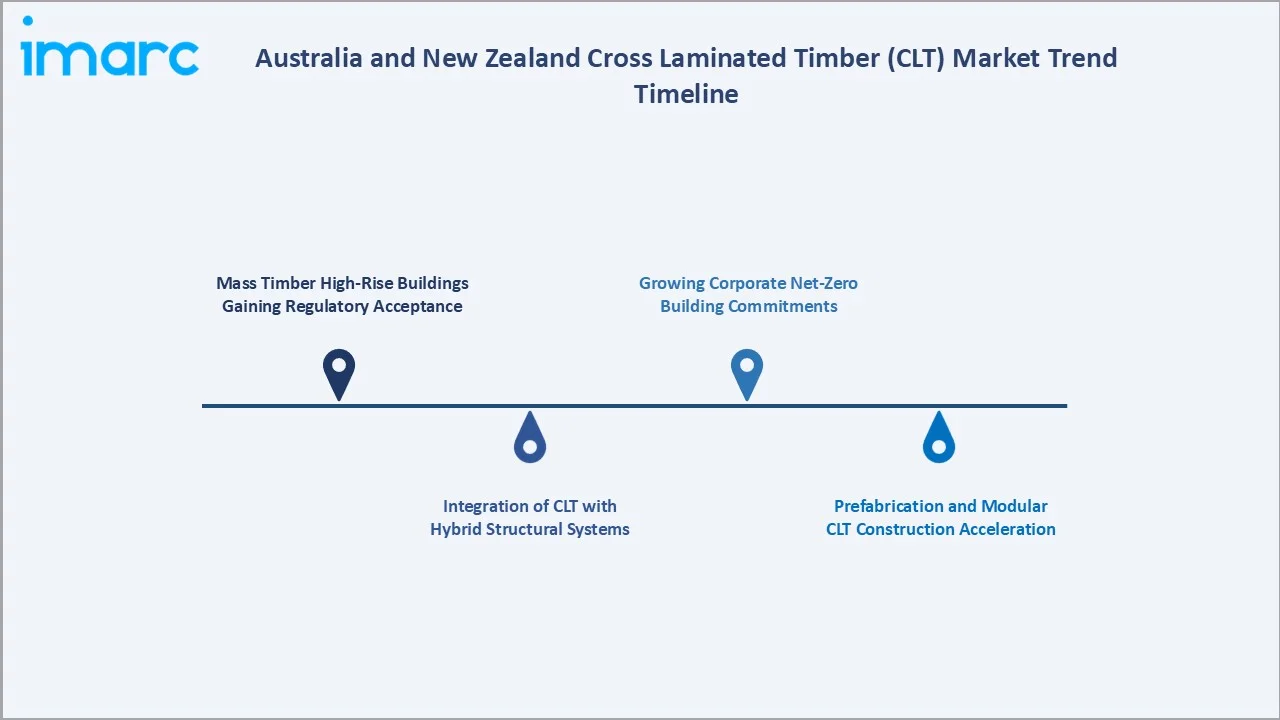
1. Mass Timber High-Rise Buildings Gaining Regulatory Acceptance
Progressive NCC updates in Australia and building code reforms in New Zealand are systematically expanding the permitted height and scale of mass timber construction. Buildings such as 25 King Street Brisbane and Forte Melbourne have demonstrated CLT's viability in mid-rise construction, building the regulatory and engineering evidence base for taller future approvals.
2. Integration of CLT with Hybrid Structural Systems
The combination of CLT panels with steel, glulam, and concrete in hybrid structural systems is emerging as the dominant design approach for larger commercial and residential projects, enabling architects and engineers to optimise material performance and cost while achieving the aesthetic and sustainability benefits of exposed CLT in inhabited spaces.
3. Prefabrication and Modular CLT Construction Acceleration
Advanced prefabrication of CLT structural frames, including pre-installed services, insulation, and cladding, is emerging as a transformative productivity technology reducing on-site construction programmes by 30–50%. Several Australian contractors have established dedicated CLT prefabrication workflows that are now competitive on total project delivery time with conventional construction.
4. Growing Corporate Net-Zero Building Commitments
Major ASX-listed corporations and institutional property investors are committing to net-zero carbon buildings as a strategic ESG priority, with CLT specified as the structural material of choice in new headquarters, campuses, and mixed-use developments. These corporate mandates create a growing private sector demand stream that complements government-led institutional procurement of CLT structures.
Industry Value Chain Analysis
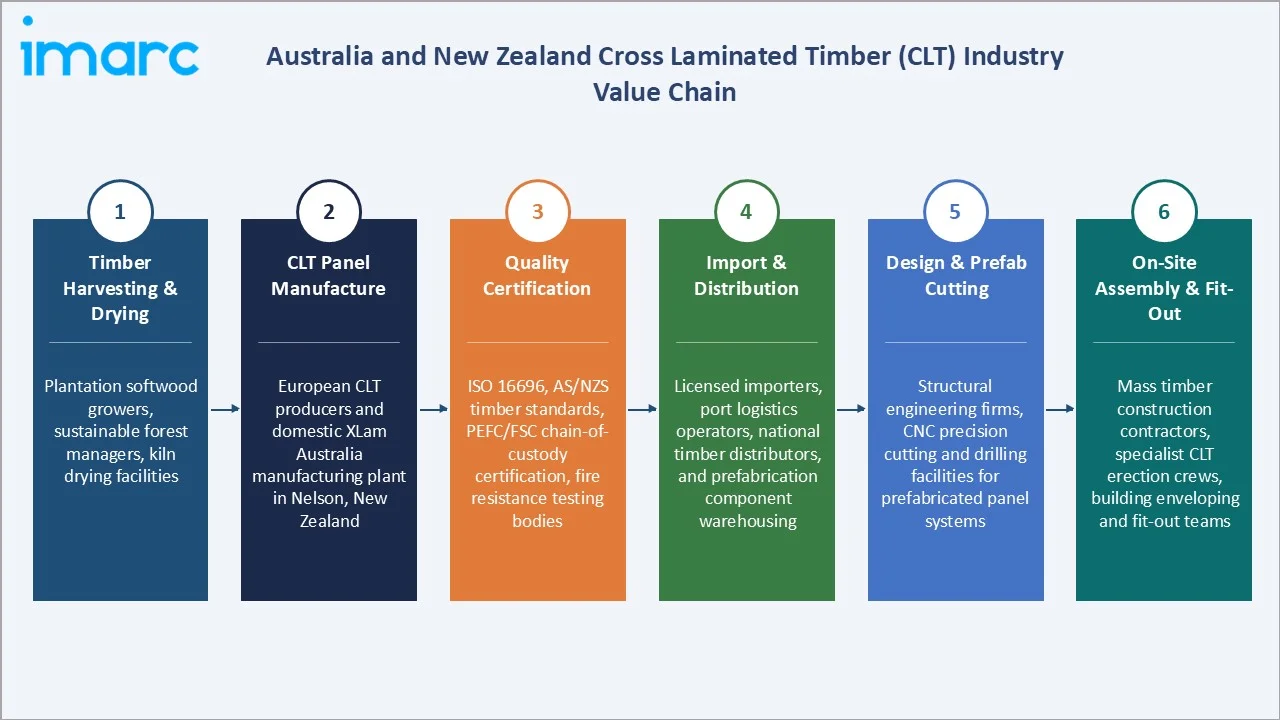
The Australia and New Zealand CLT value chain spans plantation timber harvesting in Austria, Finland, and domestic New Zealand forests, through precision CLT manufacturing in European and domestic facilities, quality certification, international shipping and in-country distribution, design and prefabrication, and on-site structural assembly.
|
Stage |
Key Participants |
|
Timber Harvesting & Drying |
Plantation softwood growers, sustainable forest managers, kiln drying facilities |
|
CLT Panel Manufacture |
European CLT producers and domestic XLam Australia manufacturing plant in Nelson, New Zealand |
|
Quality Certification |
ISO 16696, AS/NZS timber standards, PEFC/FSC chain-of-custody certification, fire resistance testing bodies |
|
Import & Distribution |
Licensed importers, port logistics operators, national timber distributors, and prefabrication component warehousing |
|
Design & Prefab Cutting |
Structural engineering firms, CNC precision cutting and drilling facilities for prefabricated panel systems |
|
On-Site Assembly & Fit-Out |
Mass timber construction contractors, specialist CLT erection crews, building enveloping and fit-out teams |
The manufacture and import stage carries the highest commercial risk given Australia's near-total European import dependency. The design and prefab stage are experiencing the fastest transformation as specialist CLT contractors build proprietary workflows that create durable competitive advantages in project delivery speed and precision.
Technology Landscape in the Australia and New Zealand CLT Industry
Standard CLT Panel Technology
Conventional CLT panels — 3, 5, 7, or 9 alternating layers of kiln-dried structural timber — represent the dominant product category. Leading manufacturers supply standard panel grades meeting AS/NZS structural requirements, with Australian projects typically specifying C24 or higher strength classes.
Acoustic and Fire-Treated CLT Systems
Specialised CLT panel systems incorporating acoustic interlayers, fire-retardant treatment, and surface finishes for direct use as exposed architectural ceilings and walls are a growing product category commanding premium pricing. These systems eliminate the need for suspended ceilings and separate acoustic treatment, reducing project cost and embodied carbon.
Digital Fabrication and BIM-Integrated CLT
CNC precision fabrication — with millimetre-accurate panel cutting, drilling, and routing driven directly from BIM models — is the standard production technology for Australian CLT projects. This digital fabrication capability enables rapid, error-free on-site assembly that delivers CLT's construction speed advantage and supports the prefabrication trend.
Market Segmentation Analysis
The report covers the following segments:
|
Segment Category |
Leading Segment |
Market Share |
Year |
|
Australia CLT Market – By Application |
Non-Residential Units |
48.6% |
2025 |
|
New Zealand CLT Market – By Application |
Residential |
57.8% |
2025 |

Australia CLT Market – By Application
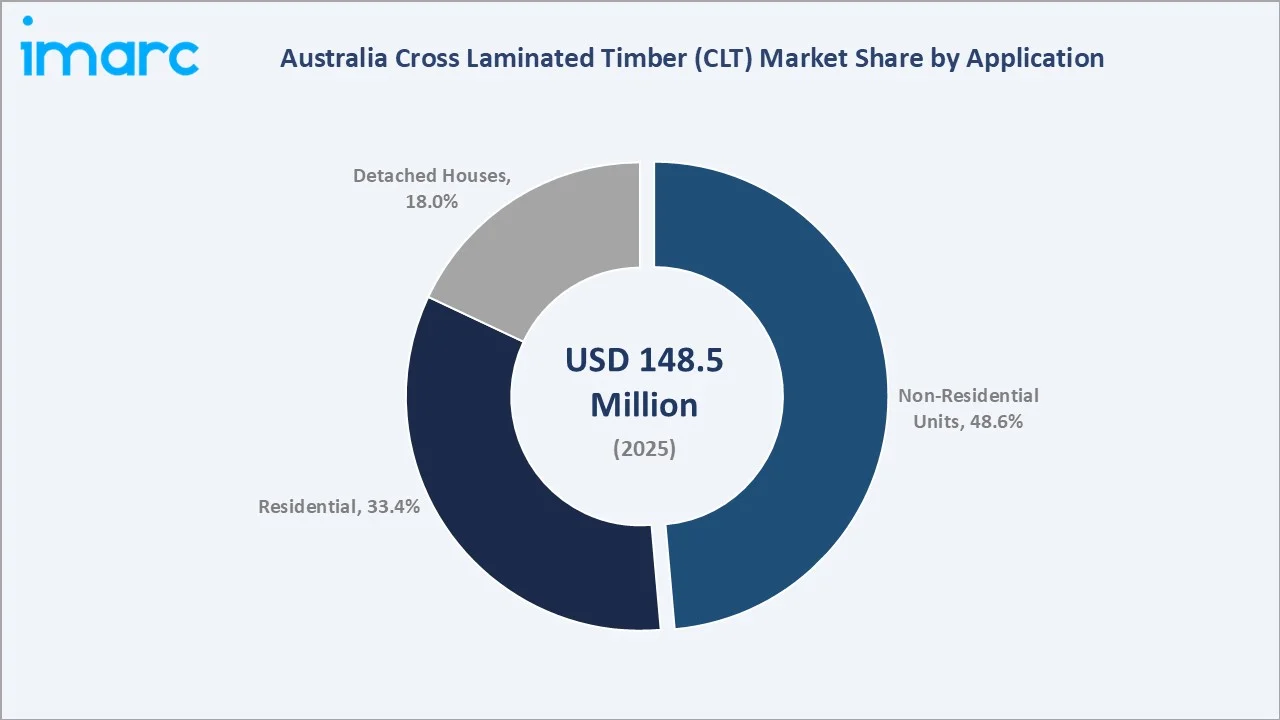
Non-Residential Units lead at 48.6% through government procurement mandates for sustainable public buildings, institutional education and healthcare facility construction, and corporate office development where low-carbon credentials are increasingly specified as procurement requirements.
To access detailed market analysis, Request Sample
Residential applications at 33.4% capture mid-rise apartment and mixed-use construction where CLT's speed and aesthetic advantages justify the material premium over concrete. Detached houses at 18.0% represent an emerging adoption segment driven by premium custom home builders and sustainability-motivated homeowners seeking carbon-sequestering structural materials.
New Zealand CLT Market – By Application
Residential applications lead at 57.8% in New Zealand, reflecting progressive building codes supporting multi-storey timber construction, urban housing density requirements in Auckland and Wellington, and strong consumer-led demand for natural building materials in premium residential developments.
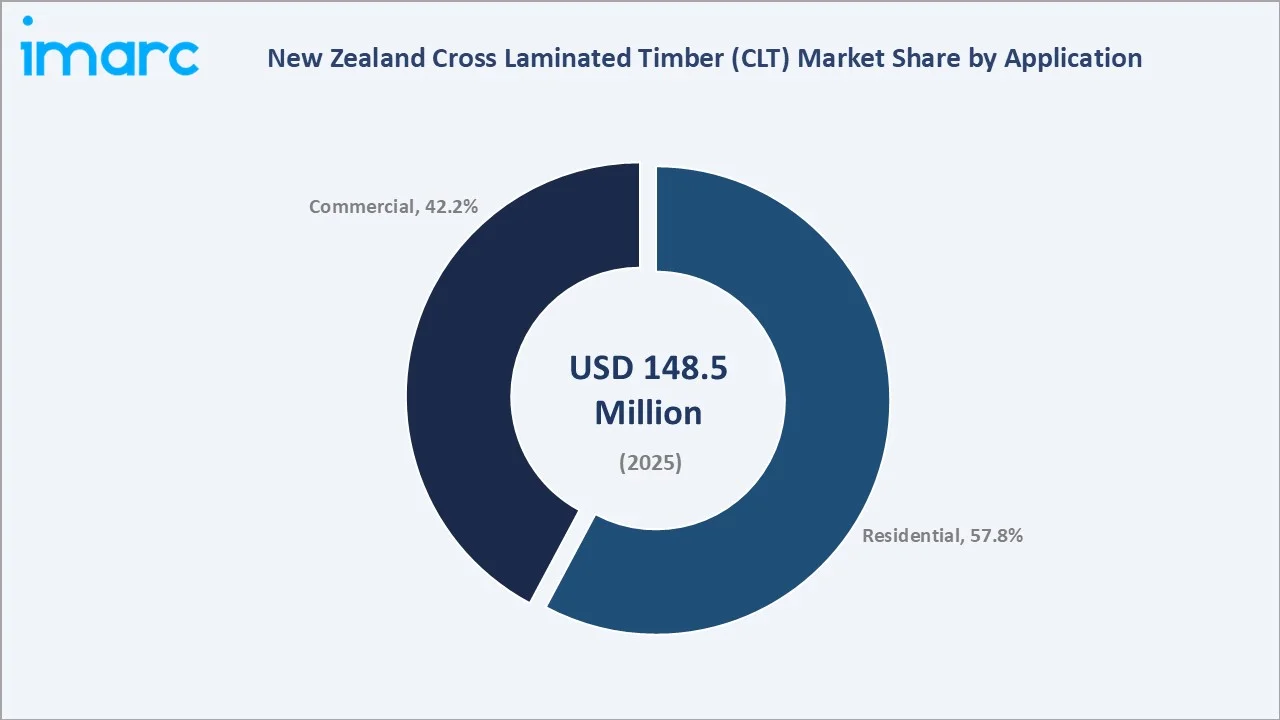
Commercial applications at 42.2% in New Zealand are growing at the fastest rate among all segments, driven by biophilic design adoption in retail, hospitality, and mixed-use developments and by corporate sustainability commitments that specify mass timber in new commercial construction as a differentiating ESG asset.
Competitive Landscape
The Australia and New Zealand CLT competitive landscape is dominated by European manufacturers, particularly Austrian and Finnish producers, supplying the market through import partnerships and licensed distributor networks.
|
Company Name |
Key Products |
Market Position |
Core Strength |
|
Stora Enso |
CLT-Type C, CLT-Type L, Sylva CTL Stairs |
Market Leader |
Global mass timber innovation leader with the largest CLT production capacity and landmark project delivery across Australia |
|
Binderholz Oberrot |
CLT BBS |
Strong Challenger |
Austrian mass timber specialist with high-volume CLT production and growing presence in Australian commercial and residential projects |
|
HASSLACHER Holding GmbH |
Hasslacher cross-laminated timber |
Niche Player |
Austrian producer supplying engineered timber to Australian construction, including involvement in landmark Sydney mass timber projects |
|
Mayr-Melnhof Holz Holding AG |
MM crosslam |
Niche Player |
Austrian timber group with established CLT production and growing export capability targeting high-growth Asia-Pacific markets |
Key players include Stora Enso, Binderholz Oberrot, HASSLACHER Holding GmbH, Mayr-Melnhof Holz Holding AG, and others.
Key Company Profiles
Stora Enso
Stora Enso is a Finland-headquartered global renewable materials company and the world's largest CLT producer, with manufacturing operations across Austria and Finland supplying Australia and New Zealand through distribution partnerships and direct project supply arrangements.
- Key Products: CLT-Type C, CLT-Type L, Sylva CTL Stairs
- Strategic Focus: Consolidating global CLT market leadership through continuous production capacity investment, digital fabrication technology advancement, and deepening technical partnership with leading Australian mass timber design and construction firms. Stora Enso targets landmark project supply to build specification momentum and brand recognition that drives repeat adoption across the Australian project pipeline.
Binderholz Oberrot
Binderholz Oberrot is the CLT and engineered timber company manufacturing Binderholz CLT BBS panels and supplying Australian construction projects through direct export and a dedicated technical support team.
- Key Products: CLT BBS panels
- Strategic Focus: Binderholz targets the non-residential and mid-rise residential segments where high-volume, high-specification CLT supply capability, combined with factory-level structural pre-design services, creates a decisive advantage over smaller-volume European competitors.
Market Concentration Analysis
The Australia and New Zealand CLT market is moderately concentrated, with the key players collectively accounting for an estimated 45–55% of combined market revenue. European manufacturers collectively account for a further 30–35%, with the balance distributed among smaller European and emerging domestic suppliers.
Market concentration is expected to decrease over the forecast period as additional domestic manufacturing investments materialise, and new European producers establish Australian import partnerships, increasing competitive intensity and creating pricing pressure that benefits construction cost competitiveness.
Investment & Growth Opportunities
Highest Growth Segments
New Zealand commercial CLT (~17.8% CAGR), Australia non-residential units (~17.5% CAGR), Australia residential apartments (~16.2% CAGR), and domestic CLT manufacturing represent the highest-growth investment vectors through 2034.
Emerging Investment Opportunities
Domestic CLT manufacturing investment in Australia, particularly in Victoria and Queensland where plantation softwood resources and construction market scale create viable business cases, represents the single largest structural investment opportunity, with potential to transform the market's competitive dynamics and total addressable cost structure over the forecast period.
Investment Themes
- Domestic CLT manufacturing plant investment leveraging Australia's plantation softwood resource base, government low-carbon manufacturing incentives, and the large addressable market that would be unlocked by domestically produced CLT at cost-competitive pricing relative to European imports.
- Mass timber construction contractor capability development through investment in CLT design expertise, BIM-integrated fabrication systems, and prefabrication workflows that capture the growing pipeline of government and corporate CLT-specified construction projects across Australia and New Zealand.
Future Market Outlook (2026-2034)
The Australia and New Zealand CLT market is projected to grow from USD 148.5 Million in 2025 to USD 621.1 Million by 2034, delivering a 16.72% CAGR one of the fastest-growing construction material segments in the Asia-Pacific region. Government net-zero mandates, mass timber regulatory expansions, and domestic manufacturing investment will be the primary growth catalysts.
Three structural forces define market growth through 2034. Progressive NCC and building code updates will continue to unlock new mass timber building typologies and height thresholds, expanding the addressable market. Corporate and government net-zero commitments will sustain premium specification demand for CLT independent of cost parity with conventional materials. Domestic manufacturing investment will progressively reduce import dependency, lower the cost structure, and extend CLT's competitive reach into previously excluded market segments.
Research Methodology
Primary Research
Primary research comprised structured interviews with 35+ industry stakeholders (2025), including CLT manufacturers, structural engineers specialising in mass timber design, construction contractors with CLT project experience, and government sustainability procurement officers across Australia and New Zealand.
Secondary Research
Secondary research encompassed company annual reports and project case studies, National Construction Code publications, New Zealand Building Code documentation, Green Building Council of Australia research, Climate Active programme data, and over 45 secondary sources systematically reviewed and cross-referenced.
Forecasting Models
Market revenue forecasts developed using a construction activity-based bottom-up model: (i) total building construction output by segment and country; (ii) CLT penetration rate assumptions by building type; (iii) average CLT content per building project; (iv) CLT price per cubic metre including logistics; (v) regulatory uplift adjustments for code-driven market expansion events.
Australia and New Zealand Cross Laminated Timber (CLT) Market Report Scope:
| Report Features | Details |
|---|---|
| Base Year of the Analysis | 2025 |
| Historical Period | 2020-2025 |
| Forecast Period | 2026-2034 |
| Units | Million USD, Cubic Metre |
| Scope of the Report |
Exploration of Historical Trends and Market Outlook, Industry Catalysts and Challenges, Segment-Wise Historical and Future Market Assessment: Australia Cross Laminated Timber Industry:
New Zealand Cross Laminated Timber Industry:
|
| Applications Covered |
|
| Companies Covered | Stora Enso, Binderholz Oberrot, HASSLACHER Holding GmbH, Mayr-Melnhof Holz Holding AG, etc. |
| Customization Scope | 10% Free Customization |
| Post-Sale Analyst Support | 10-12 Weeks |
| Delivery Format | PDF and Excel through Email (We can also provide the editable version of the report in PPT/Word format on special request) |
Key Benefits for Stakeholders:
- IMARC’s report offers a comprehensive quantitative analysis of various market segments, historical and current market trends, market forecasts, and dynamics of the Australia and New Zealand cross laminated timber (CLT) market from 2020-2034.
- The research study provides the latest information on the market drivers, challenges, and opportunities in the Australia and New Zealand cross laminated timber (CLT) market.
- Porter's Five Forces analysis assists stakeholders in assessing the impact of new entrants, competitive rivalry, supplier power, buyer power, and the threat of substitution. It helps stakeholders to analyze the level of competition within the Australia and New Zealand cross laminated timber (CLT) industry and its attractiveness.
- Competitive landscape allows stakeholders to understand their competitive environment and provides an insight into the current positions of key players in the market.
Frequently Asked Questions About the Australia and New Zealand CLT Market Report
The Australia and New Zealand CLT market reached USD 148.5 Million in 2025, driven by Australia's non-residential units segment leading at 48.6% and New Zealand's residential segment leading at 57.8%, supported by government sustainability mandates, mass timber regulatory approvals, and growing project developer confidence in CLT structural systems.
The market grows at a CAGR of 16.72% during 2026-2034, reaching USD 621.1 Million by 2034. This high-growth trajectory reflects progressive mass timber regulatory approvals, government net-zero construction mandates, growing domestic CLT manufacturing capacity, and compounding project developer CLT adoption across both Australia and New Zealand.
Non-Residential Units lead in Australia at 48.6% in 2025, driven by government and institutional procurement mandates for sustainable public buildings, education and healthcare facility construction programmes, and corporate office developments specifying CLT as a low-carbon structural alternative to conventional steel and concrete.
Residential applications lead in New Zealand at 57.8% in 2025, driven by progressive building codes supporting multi-storey timber construction, urban housing density requirements in major New Zealand cities, and strong consumer-led demand for natural sustainable building materials in premium residential development projects.
Key companies include Stora Enso, Binderholz Oberrot, HASSLACHER Holding GmbH, Mayr-Melnhof Holz Holding AG, and others.
The Australia and New Zealand CLT market is projected to reach approximately USD 321.7 Million by 2030, with non-residential and residential construction driving the majority of volume growth, domestic manufacturing capacity expanding to supplement European imports, and mass timber mid-rise becoming a mainstream construction methodology in major Australian and New Zealand cities.
Three priority investment opportunities: domestic CLT manufacturing plant development leveraging Australia's plantation softwood resource base; mass timber construction contractor capability building in CLT design, BIM fabrication, and prefabrication; and project development targeting government-specified low-carbon public buildings where net-zero mandates create structural CLT specification demand independent of conventional material cost comparisons.
Need more help?
- Speak to our experienced analysts for insights on the current market scenarios.
- Include additional segments and countries to customize the report as per your requirement.
- Gain an unparalleled competitive advantage in your domain by understanding how to utilize the report and positively impacting your operations and revenue.
- For further assistance, please connect with our analysts.
 Request Customization
 Speak to an Analyst
 Request Brochure
 Inquire Before Buying
Benefits of Customization
- Personalize this research
- Triangulate with your data
- Get data as per your format and definition
- Gain a deeper dive into a specific application, geography, customer, or competitor
- Any level of personalization
Get in Touch With Us
UNITED STATES
Phone: +1-201-971-6302
INDIA
Phone: +91-120-433-0800
UNITED KINGDOM
Phone: +44-753-714-6104
Email: [email protected]
Client Testimonials




.webp)




.webp)













Related Reports

Choose your plan
*Please note that the prices mentioned below are starting prices for each bundle type. Kindly contact our team for further details.*
Single User License
- 1 User License, Access on 2 Devices
- PDF Report + Excel Dataset (Password Protected)
- Lifetime Access
- No Printing Rights
- 10% Free Report Customization
- 10–12 Weeks of Analyst Support
Five User License
- Access for 5 Users, 2 Devices per User
- PDF Report + Excel Dataset (Password Protected)
- Lifetime Access
- Dedicated Account Manager
- 12–14 Weeks of Analyst Support
- No Printing Rights
- 15% Free Report Customization
- 25% Discount on Your Next Purchase
Corporate User License
- Unlimited User Access (Within Your Organization)
- PDF Report + Excel Dataset
- Lifetime Access
- Dedicated Account Manager
- 14–20 Weeks of Analyst Support
- No Printing Rights
- 20% Free Report Customization
- 30% Discount on Your Next Purchase
Essential Insights
What's included:
3 reports
- Lifetime Access
- PDF Reports
- Excel Datasets
- 2 Weeks of Free Analyst Support
- 2 User Licenses
- Access on 2 Devices
- Printing Rights
- Complimentary PowerPoint (PPT) Version
- Complimentary License Upgrade
Professional Access
What's included:
5 reports
- Lifetime Access
- PDF Reports
- Excel Datasets
- 8 Weeks of Free Analyst Support
- 2 User Licenses
- Access on 2 Devices
- Printing Rights
- Complimentary PowerPoint (PPT) Version
- Complimentary License Upgrade
Business Advantage
What's included:
8 reports
- Lifetime Access
- PDF Reports
- Excel Datasets
- 14 Weeks of Free Analyst Support
- 2 User Licenses
- Access on 2 Devices
- Printing Rights
- Complimentary PowerPoint (PPT) Version
- Complimentary License Upgrade
Enterprise Intelligence
What's included:
10 reports
- Lifetime Access
- PDF Reports
- Excel Datasets
- 20 Weeks of Free Analyst Support
- 2 User Licenses
- Access on 2 Devices
- Printing Rights
- Complimentary PowerPoint (PPT) Version
- Complimentary License Upgrade